Safe and Timely Dynamic Updates for Multi-threaded Programs
Iulian Neamtiu
University of California, Riverside Riverside, CA 92521, USA
Michael Hicks
University of Maryland College Park, MD 20742, USAAbstract
Many dynamic updating systems have been developed that enable a program to be patched while it runs, to fix bugs or add new features. This paper explores techniques for supporting dynamic updates to multi-threaded programs, focusing on the problem of applying an update in a timely fashion while still producing correct behavior. Past work has shown that this tension ofsafetyversustimeliness can be balanced for single-threaded programs. For multi-threaded programs, the task is more difficult because myriad thread inter-actions complicate understanding the possible program states to which a patch could be applied. Our approach allows the program-mer to specify a few program points (e.g., one per thread) at which a patch may be applied, which simplifies reasoning about safety. To improve timeliness, a combination of static analysis and run-time support automatically expands these few points to many more that produce behavior equivalent to the originals. Experiments with thirteen realistic updates to three multi-threaded servers show that we can safely perform a dynamic update within milliseconds when more straightforward alternatives would delay some updates indef-initely.
Categories and Subject Descriptors F.3.2 [Semantics of Pro-gramming Languages]: Program analysis; D.1.3 [Concurrent Pro-gramming]: Parallel programming; D.3.4 [Processors]: Compil-ers; C.4 [Performance of Systems]: Reliability, availability, and serviceability
General Terms Languages, Performance, Reliability
Keywords dynamic software updating, update safety, update timeliness, multi-threading
1.
Introduction
Continuous operation is a requirement of many of today’s computer systems. Nonetheless, such systems must be updated to fix bugs and add new features. To permit on-line updates, many researchers have proposed variations of an approach calleddynamic software updat-ing(DSU). In this approach, a running program is patched with new code and data on the fly, while it runs. DSU is appealing be-cause of its generality: in principle any program can be updated in a fine-grained way, without need for redundant hardware or special-purpose software architectures. Application state is naturally pre-served between updated versions, so that current processing is not
Permission to make digital or hard copies of all or part of this work for personal or classroom use is granted without fee provided that copies are not made or distributed for profit or commercial advantage and that copies bear this notice and the full citation on the first page. To copy otherwise, to republish, to post on servers or to redistribute to lists, requires prior specific permission and/or a fee.
PLDI’09, June 15–20, 2009, Dublin, Ireland.
Copyright c2009 ACM 978-1-60558-392-1/09/06. . . $5.00
compromised or interrupted. General-purpose DSU systems have been shown to successfully support long strings of updates derived from actual releases of server applications (Neamtiu et al. 2006; Chen et al. 2007) and operating systems (Baumann et al. 2007), while more specialized systems support smaller bug fixes or secu-rity patches (Makris and Ryu 2007; Altekar et al. 2005; Sidiroglou et al. 2007).
The primary challenge in building a DSU system is balancing flexibility and safety: the system should support as many kinds of dynamic changes as possible, and it must provide means to en-sure that an program update is well-timed, to avoid incorrect be-havior (Gupta et al. 1996). To see why timing is important, con-sider that many programs change functions’ type signatures as they evolve (Neamtiu et al. 2005, 2006). If a patch changes functionf’s type signature, applying the patch just before the program is about to callfwould result in a type error since the caller still presumes f’s old signature. To avoid such problems, some DSU systems im-pose some automatic timing restrictions. For example, a system may require that updated functions not be running when a patch is applied (Soules et al. 2003; Baumann et al. 2007; Altekar et al. 2005; Arnold and Kaashoek 2009). Since changing a function’s type signature necessitates changing its callers, we can be sure, us-ing this constraint, that no code will be runnus-ing that presumes the old signature. Despite the reliance of some systems on purely au-tomatic checks (Soules et al. 2003; Baumann et al. 2007; Altekar et al. 2005; Arnold and Kaashoek 2009), these are in general in-sufficient to ensure safety (Gupta et al. 1996), so manual assistance may be needed to further constrain legal update times (Hicks and Nettles 2005; Stoyle et al. 2007).
Here lies a tension: timing constraints are needed to ensure that an update will be applied safely, but if the constraints are too strict, they may prevent the update from taking place at all. For exam-ple, if a patch may only be applied when changed functions are not active, a change to a function running an infinite loop will be delayed indefinitely. For single-threaded programs, the safety/time-liness trade-off can be managed with some care, e.g., by extracting infinite loops into separate functions that occasionally become in-active (Neamtiu et al. 2006). However, many long-running systems that could benefit from DSU are multi-threaded, and for them the situation is far worse. As explained further in Section 2, myriad in-teractions among threads complicates reasoning about safety, and may render approaches to control timing ineffective. For example, while a single thread may be sure to eventually exit an extracted loop body, there is no guarantee that all threads will eventually exit it at once to allow it to be updated (Makris and Ryu 2007).
This paper explores new ideas for balancing the tension between safety and timeliness when dynamically updating multi-threaded programs. We start with the idea that the programmer will specify Σ, a handful of safeupdate points, perhaps one or two per thread, which are program locations at which an update may take place. In a multi-threaded setting, a dynamic patchπmay be applied when
all threads becomequiescent, meaning they have each reached an update point ` ∈ Σ and that all automatic timing restrictions, such as activeness, have been satisfied. By keeping|Σ|small, it is relatively straightforward for the programmer to reason thatπ will be applied correctly. We could implement this semantics by barrier-synchronizing all threads at update points`, but doing so could degrade performance (while threads block, or even deadlock) and fail to achieve quiescence quickly because fewer update points implies greater delays between the times they are reached.
Therefore, to improve timeliness while retaining the same level of safety, we propose two novel concepts, described in Section 3: induced update pointsandrelaxed synchronization. An induced up-date point for a given patch πis a program point`π 6∈ Σsuch
that applying πat`π is equivalent to having appliedπat some
`∈Σ. Thus, induced update points expand the points at which an update may take place without increasing the burden of reasoning about safety. However, expanding the number of possible update points reduces, but does not eliminate, the drawbacks of barrier synchronization. Therefore, we have also developed a technique we callrelaxed synchronizationthat eliminates the need for threads to block at update points. The basic insight is the following. Suppose that a consecutive range of program statementss1, ..., sn qualify
as induced update points forΣandπ. Instead of potentially syn-chronizing at eachsi, a threadt“checks in” when it reachess1 to indicate that, until told otherwise, its execution is safe with re-spect toπ. Threadtmay then immediately proceed with executing s2, ...sn, “checking out” after executingsnto indicate that
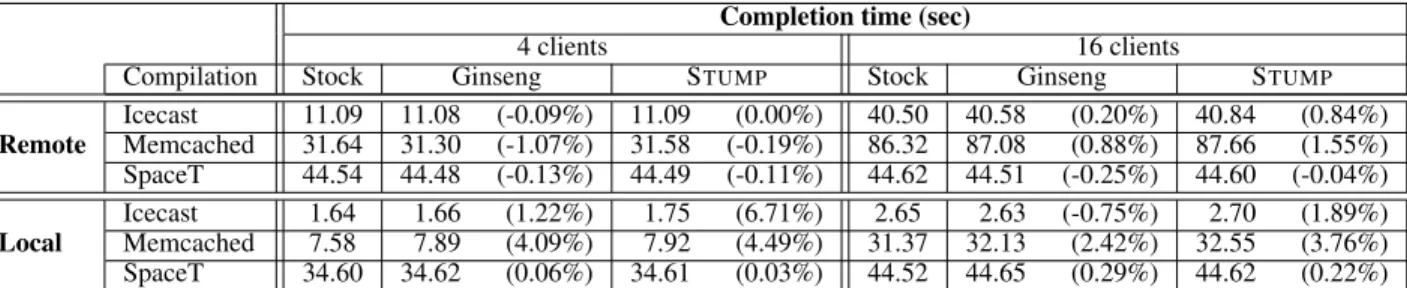
apply-ingπwould no longer be safe. Once all threads have checked in, πcan be applied safely. Check-in points often create more oppor-tunities for updating (whole blocks of code, rather than particular statements) and allow threads to continue to execute until quies-cence is reached, avoiding performance degradation and deadlock. We have implemented these techniques as an extension to Gin-seng, a freely available DSU framework for C programs (Sec-tion 4). We call our extended system STUMP(forSafe and Timely Updates to Multi-threaded Programs). We have used STUMP to dynamically update three open-source, multi-threaded server programs—the Icecast streaming server, the Memcached caching server, and the Space Tyrant game server—with updates that cor-respond to thirteen actual releases that span one year (Section 5). Experimental results in Section 6 show that induced update points and relaxed synchronization effectively balance safety and time-liness for these programs: with only a few update points (1 or 2 per thread) and a few other annotations, we could reach quiescence very quickly, typically in less than ten milliseconds. Without these mechanisms some patches failed to take effect at all, and others took hundreds of milliseconds or several seconds to apply. We also measured the impact of STUMP’s update support on application performance and found that the slowdown for application-specific benchmarks is modest, less than 7% for all applications.
In summary, the main contributions of this paper are as follows: •We introduce two techniques—induced update points and re-laxed synchronization—for balancing safety and timeliness when dymamically updating multi-threaded programs. •We implement these ideas in STUMP, a framework for
dynam-ically updating C programs, and find that STUMPis effective in practice: all updates we considered can be successfully ap-plied in short order, while overhead on application performance is small.
2.
Balancing safety and timeliness
Given rtime support for on-line program updates, we must un-derstand how to use this support safely, and yet in such a man-ner that an update can be applied in a timely fashion. This section
1 typedef struct event { int e id ; ... } evt ; 2 void process (evt∗ev) {
3 switch (ev→e id){caseX: m(ev); ... case Y: n(ev );... }; 4 log (ev→e id);
5 }
6 void clean (evt∗ev) { ... } 7 void handle thread () { 8 while (1) {
9 /∗ definite update point ∗/ 10 evt∗ ev = get event ();
11 /∗candidate induced update point ∗/ 12 process (ev );
13 clean (ev ); 14 } }
(a) Original version
1 typedef struct event {char∗name;int e id ; ... } evt ; 2 void process (evt∗ev) {
3 switch (ev→e id){caseX: m(ev); ... case Y: n(ev );... }; 4 /∗no log () call ∗/
5 }
6 void clean (evt∗ev) {/∗added:∗/log (ev→e id); ... } 7 /∗handle thread () as before ∗/
(b) Changes in new version
Figure 1. Example program and update
explains why balancing these tensions is difficult, particularly for multi-threaded programs.
2.1 Example
Figure 1(a) depicts a simple server in whichnthreads execute the handle thread function to process events extracted from a global queue (via the potentially blocking callget event, code not shown). Events are values of the type evt, which contains an e id field (among others not shown) for identifying the event’s type. The process function is called to actually handle each event, dispatch-ing to other functions based on the e idfield, and logging the re-sult when it completes (via thelogfunction). The cleanfunction performs further post-processing. (The comments inhandle thread will become clear later.)
Figure 1(b) shows a sample update to this program, which changes the definition of theevttype to add a new field and changes the implementations of the process and clean functions. Notice that thelogfunction has been moved from the end of theprocess function in the old version to the beginning of thecleanfunction in the new version.
Several existing DSU systems could support this update or one like it, including POLUS (Chen et al. 2007), Ginseng (Neamtiu et al. 2006), DLpop (Hicks and Nettles 2005), Jvolve (Subramanian et al. 2009), K42 (Baumann et al. 2007; K42), and UpStare (Makris and Bazzi 2009). While the mechanisms differ between systems, essentially the definitions in Figure 1(b) would be gathered into a dynamic patchalong with atype transformerfunction to convert values whose type definition has changed.1 In our example, the
dynamic patch would contain a type transformer forstruct event. This function might initialize the newnamefield to”none”while preserving the contents of the other (unchanged) fields.
2.2 Safe patch application
Given a dynamic patch, the next question is: when during the original program’s execution can it be applied safely? Most DSU
1A type transformer’s application could occur when the update is
ap-plied (Hicks and Nettles 2005; Subramanian et al. 2009) or as needed during execution (Neamtiu et al. 2006; Chen et al. 2007; Baumann et al. 2007).
systems apply a patch according to a combination of manually specified and automatically determined timing constraints.
A typical automatically determined constraint is that functions changed by a patch may not be running when the patch is ap-plied (Soules et al. 2003; Baumann et al. 2007; Altekar et al. 2005; Arnold and Kaashoek 2009; Subramanian et al. 2009). To see why such a constraint might be needed, suppose our update was to be applied just before the call tologin theprocessfunction on line 4 of the old program (when an active function is updated, the old version continues to run and the new version takes effect on the next call (Chen et al. 2007; Hicks and Nettles 2005; Neamtiu et al. 2006)). Therefore, in the oldprocess code there is a subtle prob-lem: this function has been compiled to assume thate idis the first field of evt, but now that evthas been updated, it is the second field. Therefore, this old code will mistakenly accesschar ∗name as if it were the int e id, a type error. The activeness constraint would prevent this problem, and indeed ensures type safety so long as the new program version, compiled from scratch, is itself type-correct (Walton 2001; Stoyle et al. 2007).
We may be tempted to believe that “activeness” checking is sufficient to ensure an update will be applied correctly, and indeed this presumption is made by some existing systems (Arnold and Kaashoek 2009; Baumann et al. 2007). Unfortunately, Gupta (Gupta et al. 1996) has shown that automatically determining a valid time at which to apply a dynamic patch is in general undecidable. In-deed, we can see why activeness is insufficient in our example. Suppose that the update were to take effect just after the call to process (ev)on line 12 ofhandle thread. If there is only a single thread runninghandle thread, then no changed code is active. The next call is to thenew cleanfunction, whose first action is to call log. But this is probably not what we wanted: just prior to the up-date, the oldprocessfunction would have calledlog(on line 4) for this same event; so this update timing has precipitated a redundant log entry.
Given that automatic timing constraints are insufficient, many DSU systems allow the programmer to assist in controlling up-date timing. There are two basic approaches: identify awhitelist of program locations, termedupdate points, that are valid for an update (Hicks and Nettles 2005; Neamtiu et al. 2006; Makris and Bazzi 2009); or specify ablacklistof functions that must be inactive prior to updating (Lee 1983; Gupta et al. 1996; Chen et al. 2007).
With such manual controls in hand, prior work has explored applying updates at “quiescent points” in a program’s execu-tion (Soules et al. 2003; Baumann et al. 2007; Neamtiu et al. 2006). For example, a quiescent point could be just prior to a complete it-eration of an event processing loop. Intuitively, writing correct state transformation code to take effect at quiescent points is relatively easy because the program is not in the middle of some high-level activity, and invariants concerning global data structures are clear. In our example, we could imagine requiring the update to take place at the start ofhandle thread’s loop on line 9, since this is when it is about to begin its basic high-level activities.
2.3 Timely patch application
Unfortunately, while timing restrictions are clearly necessary for ensuring safety, they can significantly delay when a patch is actu-ally applied. Indeed, the activeness restriction precludes patch ap-plication indefinitely if a changed function isalwaysactive, as is thehandle threadfunction in our example. We can solve this par-ticular problem by extracting the bodies of infinite loops into sep-arate functions which become inactive on each iteration (Neamtiu et al. 2006). With such support (or support for more fine-grained updates to active code (Makris and Bazzi 2009)), a single quies-cent point often suffices to assure timeliness for single-threaded programs, e.g., because events are processed relatively quickly.
Unfortunately, for multi-threaded programs, the task of choos-ing suitable update points is much more difficult because the state ofallthreads must be considered when choosing appropriate times. One approach would be to identify a small number of safe update points for each thread (e.g., just one or two) and apply an update only when all threads have reached safe update points. In our ex-ample, we would apply the update only whenallthreads running handle threadhave completed a loop iteration. This approach eases reasoning about patch correctness because only a few system states need to be considered. On the other hand, this approach could se-riously compromise timeliness, since it may be very difficult or unlikely for all threads to reach update points at once. We could improve the chances by expanding the number of update points per thread, but doing so complicates the programmer’s reasoning that a patch is correct, and may lead to problems such as those we have described. Overall, the number of system states that must be con-sidered will benmwheremis the number of threads, andnis the number of update points per thread.
Thus we must find some way to balance the need to easily reason about a patch’s correctness while not unduly delaying the time at which it can be applied.
3.
Safe and timely dynamic updates
This section describes how we can balance safety and timeliness when applying a dynamic patch. We use the following program-ming model. To update a programP, the programmer provides an update specificationU, which is a pair(π,Σ)whereπis a dynamic patch andΣis a set ofupdate points. The patchπis a map from variables to new or updated definitions (or the type transformer, for changed types). We writechanges(π)to denote the names of func-tions, variables and type definitions changed by the patch. Each update point inΣis simply a location (i.e., line number)`in the program. The intended semantics is thatπshould be applied when the program counter of each threadtinP has reached an update point`∈Σ, and any automatic safety checks (e.g., activeness) are satisfied. Our goal is to apply the patch as quickly as possible.
3.1 Simple approach: barrier synchronization
OnceUbecomes available, a simple approach to applying it safely is to treat each update point`∈Σas a barrier and block any thread that reaches it. Once all threads have synchronized, the patch is applied, and the threads are resumed.
While pleasingly simple, the barrier approach has two main drawbacks. First, there is the possibility of deadlock. For exam-ple, if threadtblocks at some point`while holding a lock, then any other thread attempting to acquire the lock will never make progress toward reaching some`∈ Σ. The second problem is re-lated: even if all threads eventually synchronize, application perfor-mance may suffer in the meantime. For example, suppose threadt1 is responsible for accepting new connections whilet2performs per-connection event processing. Ift1reaches point`fairly quickly, but t2takes much longer to reach point`0, say because it must complete a lengthy transaction first, then the entire system will be prevented from accepting new connections, and performance will suffer. In the limit, the barrier approach may needlessly block threads that are completely unaffected by the changes in a patchπ.
Our way forward is to observe that it does not matter if the update takes place when all threads areactually at points inΣ. Rather, we use induced update points (described in Section 3.2) and relaxed synchronization (Section 3.3) to apply the patchπif the effect of the update will besemantically equivalentto having applied the patch when the PC of each thread is at one of the update points`∈ Σ. This expands the number of program points that permit a patch to take effect, improving timeliness, without increasing the reasoning burden on the programmer.
Lines Trace 1 Trace 2 Trace 3
9 (def-upd) X ×
10 g {1} g {1,2} g {1}
11 updateg updatep,c updateg,p
12 p {1,2} p {2} p {2} 3 e, m {1,2} e, m {1,2} e, m {1,2} 4 l, e {1,2} 13 c {1,2} c {2} c {1,2} 6 l, e {1,2} 9 (def-upd) X ×
(a) Roll-forward (b) Rollback (c) Disallowed
Figure 2. Examples of legal and illegal induced updates.
3.2 Induced update points
Given a specificationU = (π,Σ), aninduced update pointis a program point`0 such that ifπis applied when a thread reaches `0, the program will behave as if the patch had been applied at some update point`∈ Σ. Given a set ofcandidate update points ξ, our task is to determine, via static analysis, which of those ` ∈ ξ that meet this criterion. In our Ginseng implementation (Section 4), we require programmers to specifyξ, but here we make no assumptions about howξis generated.
3.2.1 Version-consistent traces
The key concept we will use is the notion of aversion-consistent ex-ecution trace. This idea is illustrated in Figure 2. Each of the right three columns represents an execution trace of the handle thread function from Figure 1(a), starting at line 9 and iterating once around the loop. Each element of the trace consists of an identi-fier followed by a set of versions. Identiidenti-fiers can be functions (indi-cating the function was called), global variables (indi(indi-cating a read or write), and type names (indicating a variable with that type was read or written). We abbreviate the longer identifiers used in Fig-ure 1(a) with just their first letter in the trace, e.g.,gstands for a call toget event, andestands for a read/write from anevtvalue. Theversion setindicates the version of an identifier at the point where that identifier is used. Accesses to variables changed byπ will always have a version set containing a single element,{1} be-fore the patch is applied, and{2}afterward. When a variable is notchanged by the patch its definition is the same in both program versions. Hence its version set is{1,2}.
A trace also containsupdate events“updatechanges(π)” to in-dicate patchπhas been dynamically applied. All the specifications (π,Σ)we consider haveΣ = {9}; that is, the patchπmay only appear to take effect at line 9. We refer to this as thedefiniteupdate point, since it defines what the programmer believes will result in correct behavior (line 9 is annotated in the first column for refer-ence). If givenξ={11}, then we must determine whether apply-ingπat line 11 would have the same effect as updating at line 9.
Figure 2(a) considers the case whenchanges(π) ={g}; that is, it contains a changed version of functionget event. In this case, 11 is indeed an induced update point: the execution of the program is equivalent to having performed the update at line 9, at the end of the trace marked with aX. To see why, consider the version set of each function that was called. In the trace in Figure 2(a), we can see that all version sets include version 1, the old version, and thus the program will behave just as if we “rolled forward” the program to line 14 before performing the update.
Figure 2(b) considerschanges(π) ={p, c}. In this case, 11 is still an induced update point, but now the effect of the program is
equivalent to having performed the update at line 9 at the start of the trace. This is because all accesses can be attributed to version 2, the new version, just as they would be if we had rolled back the program to perform the update at line 9.
Figure 2(c) considerschanges(π) ={g, p}. In this case there is no program version that all accesses share, so 11 is not valid.
3.2.2 Version consistency via static analysis
To predict whether a patchπapplied at some`∈ ξwill induce a version-consistent trace, we can statically analyze the program to approximate all relevant behavior that could occur in an execution including`. In particular, we wish to find a static approximation of the execution behavior from any preceding definite update point to`, which we shall call theprior effectα`, and an approximation
of the execution from`to the first occurrence of a definite update point, which we call thefuture effectω`(Neamtiu et al. 2008). For
determining version consistency, we are interested in those events we considered in our traces above: calls to functions, reads/writes from/to global variables, and accesses to values of named type. We are not interested in the number or order of these events, but only in the names of the functions, variables, or types involved. Thus a prior/future effect at`can be characterized as the set of all definition names involved in events that could occur before/after`. For ` = 11 in our example program we have α` = {g}
andω` = {p, e, m, n, l, c}. The reason for the former is easy to
see: before reaching line 11 on an execution starting from line 9, the only interesting event is the call toget event. For the latter, we can see that before again reaching line 9, the program will execute process and clean, and these functions may themselves access values ofevttype and call functions log,m, orn. On the other handgis not included becauseget event will not be called before line 9 is reached. We will discuss how these effects are computed in the next subsection.
We can determine whether applying a patchπat some`∈ ξ will result in a version-consistent trace using contextual effects. For each`, we compute its prior and future effectsα` and ω`,
respectively. Ifchanges(π)∩ω`=∅we know that all definitions
possibly accessed after`up to the next definite update point can be attributed to the old version since they are unaffected byπ. Thus `can be considered a roll-forward induced update point. This condition holds forchanges(π) = {g} in our example, as shown in Figure 2(a). On the other hand, if changes(π) ∩ α` =∅, then the patchπhas not modified any variables possibly
accessed since the last definite update point. In this case, these accesses can also be attributed to the new version, and thus`can be considered a rollback induced update point. This condition holds forchanges(π) ={p, c}in our example, as shown in Figure 2(b). Neither condition holds for changes(π) = {g, p}, so for this particular patch`is not valid, as shown in Figure 2(c).
3.2.3 Contextual effects
Now we explain how to compute prior and future effects for the purpose of determining induced update points. Our approach is to use a generalization ofeffect inference(Talpin and Jouvelot 1992) calledcontextual effect inference(Neamtiu et al. 2008).
In a traditional effect system, theeffectεof some program ex-pressionecharacterizes an aspect ofe’s non-functional behavior, for example the names of lockseallocates (Pratikakis et al. 2006), or the abstract names of memory locationsedereferences (Talpin and Jouvelot 1992). For enforcing version consistency our notion of effect is as we just described: a set containing the names of func-tions that are called, global variables that are read or written (and likewise, static names for dereferenced pointers, acquired from a points-to analysis), and types whose instances—whether local or global—are read or written.
The contextual effectΦof an expressioneconsists of a triple [α;ε;ω], whereεis the normal effect ofe;αis theprior effect, which characterizes the computation since the last definite update point up to (but not including)e; andωis thefuture effect, which characterizes the computation followinge, up until the next definite update point. We compute contextual effects using a constraint-based analysis that we express as a series of inference rules. In our prior paper (Neamtiu et al. 2008), we proved that, for single-threaded programs, valid induced update points produce version-consistent executions when prior and future effects are computed with our contextual effects analysis. This basic proof is extended to multi-threaded programs in the first author’s dissertation (Neamtiu 2008). We give a flavor of the analysis here, and refer the interested reader to our prior work for details (Neamtiu et al. 2008).
Suppose we have two statements in sequences1;s2which have contextual effects Φ1 and Φ2, respectively. Then the contextual effect Φ of the two statements in sequence is according to the judgmentΦ1BΦ2 ,→ Φdefined as follows:
XFlow-Ctxt
Φ1= [α1;ε1; (ε2∪ω2)] Φ2= [(ε1∪α1);ε2;ω2] Φ = [α1; (ε1∪ε2);ω2]
Φ1BΦ2 ,→ Φ
There are three key elements of this rule. First, ifε1is the normal effect ofs1, then becauses1 precedess2,ε1must be included in the prior effect ofΦ2. Conversely, ifε2is the normal effect ofs2, then becauses2followss1,ε2must be included in the future effect ofΦ1. Finally, the contextual effect of the sequences1;s2has the prior effect ofΦ1, the future effect ofΦ2, and its normal effect is the union of the normal effects of the two statements.
The Xflow-Ctxt rule is essentially constraining the form of prior and future effects according to the normal effects of each statement. Thus we can use standard techniques to generate per-statement effectsεand generate additional constraints for the prior and future effectsαandω(Neamtiu et al. 2008).
The effectsαandωare also constrained by the placement of definite update points. In the general case, there could be many definite update points reachable from a given statements. Like-wise, several definite update points could reachs, and these could be in the same function assor in its function’s callers or callees. While implementing contextual effects for this general case is pos-sible, doing so is unnecessarily complicated and computationally expensive. Therefore, we employ a simpler model, described next. As an alternative toΣ, a set of definite update points, we define ˆ
Σto be a set ofpairsof definite update points. When computing the prior effectαat`, instead of finding all possible update points inΣthat could reach`, we only consider a single point`1 such that(`1, `2)∈Σˆand(`1, `2)defines a lexical scope that encloses `. By “enclose,” we mean that`could literally occur in between `1and`2in the program text, or it could be in a function called, directly or transitively, by a statement between `1 and `2. The future effectω of`is analogously computed with respect to`2. Since pairs(`1, `2) define a lexical scope, we call them update scopes.To be sound, there can be at most one update scope that encloses a given`, meaning that update scopes may neither nest nor overlap. Moreover, only candidate update points`∈ξenclosed within scopes(`1, `2) ∈Σˆare permitted. With these restrictions, we compute contextual effects for the whole program as follows:
•For each block of statements`1:s1;...;`2:s2where(`1, `2)∈ ˆ
Σwe compute the contextual effects of each statement in that scope, constraining the prior effectα1ofs1and the future effect ωn of sn to be the empty set, thus delimiting the extent of
prior and future effects computed within the scope. We will also compute the contextual effects of functions called bys1...sn.
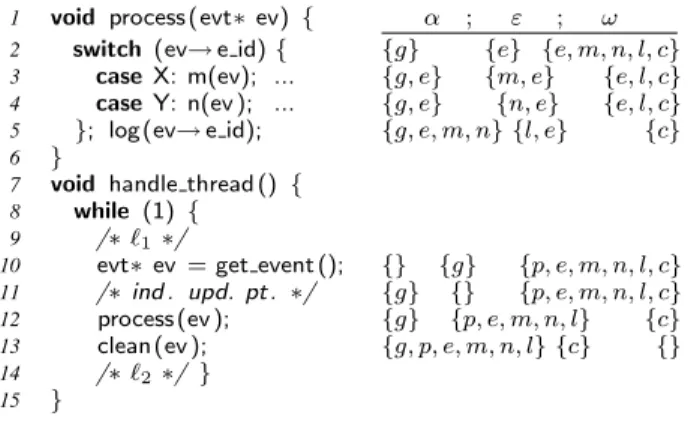
1 void process (evt∗ ev){ α ; ε ; ω 2 switch (ev→e id){ {g} {e} {e, m, n, l, c} 3 caseX: m(ev); ... {g, e} {m, e} {e, l, c} 4 caseY: n(ev ); ... {g, e} {n, e} {e, l, c} 5 }; log (ev→e id); {g, e, m, n} {l, e} {c}
6 }
7 void handle thread () { 8 while (1) {
9 /∗`1∗/
10 evt∗ev = get event (); {} {g} {p, e, m, n, l, c} 11 /∗ind . upd. pt . ∗/ {g} {} {p, e, m, n, l, c} 12 process (ev ); {g} {p, e, m, n, l} {c} 13 clean (ev ); {g, p, e, m, n, l} {c} {} 14 /∗`2∗/ }
15 }
Figure 3. Contextual effects for example in Fig. 1(a).
• We cannot allow induced update points in functions, such as those in libraries, that could be called from both within and out-side an update scope. Therefore we add the additional constraint that the prior and future effects of each thread function (i.e., mainor functions passed topthread create) include the set of all possible events, written>. Thus any candidate update point in a function called from outside an update scope will have prior and future effect>, effectively precluding an induced update point. On the other hand, functions called only from within update scopes will not be so restricted, since the effects of scopes are computed independently of the functions they reside in. Note there is no problem with a function called from within multiple (non-nested) update scopes—the prior and future effects in this function will naturally approximate the limits imposed by all enclosing scopes.
• Finally, we rule out nested update scopes during inference by not bounding the prior and future effects of update scopes with the empty set, as stated above, but rather with a marker set{K}. Then we check that the statements immediately outside each update scope do not haveKin their prior or future effects. Figure 3 shows the contextual effects computed forprocessand handle threadfrom our example program (Figure 1(a)), modified to use an update scope(`1, `2)shown in comments. This scope is essentially the same as the single definite update point we used be-fore, and the prior and future effects of the candidate update point at line 11 are as indicated in the previous subsection. There are a few other things to notice. First, notice that line 12’s normal ef-fect includes the call toprocessand the effect of executing its body. Second, notice that the prior and future effects withinprocess prop-erly include the events that take place in its caller,handle thread. Finally, notice the handling of theswitchstatement inprocess: the prior/future effects of the code in each of the cases assumes that the other branches are not executed (e.g.,nis not in the prior/fu-ture effect at line 3, andmis not in the prior/future effect at line 4), but the prior/future effect of the code that precedes or follows the
switchas a whole conservatively presumes that all branches were executed (and hence bothmandnare mentioned in the effects).
3.3 Relaxed synchronization
While induced update points increase a thread’s opportunities for applying a dynamic update, they still force the thread to block, and thus do not eliminate the potential for degraded performance and deadlock. Therefore we have developed a second technique we callrelaxed synchronizationthat avoids the need to block at update points while still greatly improving the chances that an update will be applied quickly.
We now present the idea behind relaxed synchronization. Sup-pose we have a sequence of statementss1...snat locations`1...`n,
respectively, that execute within some update scope. Further sup-pose each of the`i in`1...`nis a valid induced update point for
patchπ, which implies thatπcould be safely applied while a thread is executing any ofs1...sn. As an optimization, then, there is no
need to block when a thread first reaches`1. Instead, the thread can “check in” with the run-time system to indicate it has reached a point at which it is safe to applyπ. Then it may continue its ex-ecution. When the thread reaches`nit must inform the run-time
system it is no longer safe to perform the update; thus it “checks out,” and again resumes execution. When all threads have checked in, the update may commence. If the update is still taking place when a thread reaches a check-out point, it simply waits for the update to complete.
We can implement this idea as follows. For each`∈ξenclosed in some update scope(`1, `2) ∈ Σ, we will determine whetherˆ ` is a legal check-in point (otherwise, it is a check-out point). LetL denote the set of all`0 ∈ ξ reachable from an execution starting at`. Let LS denote the set of locations `i of all statementssi
that, starting from `, could be executed prior to reaching some `0 ∈ L∪ {`2}. Then`is a valid check-in point if all`i ∈ LS
are valid induced update points. Otherwise,`must be considered a check-out point.
In the prior subsection we argued that it would be difficult to compute contextual effects if we had to determine all definite update points that could be reached after executing a given definite update point. Similarly, it would be difficult to determine the sets LandLS, above. We simplify the problem in the same way: rather
than specify individual candidate update points`∈ξ, we specify candidate updatescopes(`(, `)) ∈ ξˆ, with the interpretation that `(is a potential check-in point, and`)is a check-out point. Since the two form a lexical scope, the statements s1;...;sn between
them are readily apparent. Moreover, to check that each of these statements is a valid induced update point, ifεis the normal effect of the blocks1;...;sn(which we already compute as a matter of
course), then it suffices to compute S
1≤i≤nαi ≡ α1 ∪ε and S
1≤i≤nωi≡ωn∪ε≡ω1. We call the former thecheck-in prior
effectof`(and the latter thecheck-in future effectof`(. For each (`(, `)) pair for which our validity check using prior and future check-in effects is satisfied, at run-time the thread will check in when reaching`( and check out at`). Those pairs for which this check is not satisfied will have no run-time effect.
Returning to our example (Figure 3), consider (11,14) as a candidate scope. The normal effectεof the statementsprocess (ev ); clean (ev)in this scope is{p, e, m, n, l, c}. Thus the prior check-in effect is{g} ∪ {p, e, m, n, l, c}= {g, p, e, m, n, l, c}and the future check-in effect is{} ∪ {p, e, m, n, l, c}={p, e, m, n, l, c}. So 11 would be a valid check-in point forπwherechanges(π) = {g}since this does not conflict with the future check-in effect, but would not be considered valid for πwherechanges(π) = {p} sincepappears in both the prior and future check-in effects. Note the clear tradeoff here. The larger the check-in scope, the larger the check-in effects and the less likely a check-in point will be valid. On the other hand, the smaller the check-in scope, the less likely that all threads will be simultaneously executing in valid scopes when an update is available. As we show with our experimental results in Section 6, we find a few well-chosen check-ins and relaxed synchronization to be largely beneficial.
A more complicated variation of relaxed synchronization is proved sound in the first author’s dissertation (Neamtiu 2008); we believe it would be straightforward to extend the argument there to the present system.
4.
Implementation
We have implemented induced update points and relaxed synchro-nization as extensions to Ginseng v1.2.2,2 a DSU compiler for
single-threaded C programs (Neamtiu et al. 2006). We call our extended version STUMP(forSafe and Timely Updates to Multi-threaded Programs). We believe our techniques could be imple-mented for other DSU systems as well.
4.1 Background: DSU in Ginseng
In Ginseng, a dynamic patchπconsists of definitions—functions, types, or global variables—that have been added or changed since the last (deployed) program version. The dynamic patch is com-piled into a shared object file and then loaded into the specially compiled running program to take effect. In an updatable program, all direct function calls are compiled to be indirected through tion pointers, and after the patch is loaded, the targets of the func-tion pointers are redirected to the newly loaded versions.
To support changes to type definitions, Ginseng compiles all accesses to typed values to be throughconcretization functions. For example, ifphas type struct T∗, then Ginseng will compile the source-program expressionp→xto be con struct T (p)→x instead. This function will examine the contents of its argument to see whether it has been updated to the new version of type
struct T, and if so, it executes a user-defined type transformer function to bring it up to date. Ginseng uses a simple compilation strategy to make this check, and the transformation, possible: all values of a named type that are updatable are given an extra version field and padded to permit future growth.
The programmer may also define astate transformerfunction ST. FunctionST()is called at the time the update is applied and contains code needed to set up the state of the new program, e.g., to initialize the contents of newly created global variables, or to make system calls that normally occur in the new version ofmainwhen the program is started from scratch.
Controlling update timing. To specify the time at which a dy-namic patch is applied, Ginseng requires the programmer to insert explicit calls to the functionDSU updateat those program points at which a dynamic patchπmay take effect. Thus, these calls in-dicate definite update pointsΣ, though Ginseng in effect forces the programmer to defineΣat deployment time, before the next patch toPis known. We further discuss this requirement in Section 4.3.
When the program callsDSU updateand a patch is available, some safety checks are performed before the patch is applied. Prior to deployment, a static updatability analysis(Stoyle et al. 2007) of the program determines, for eachDSU updatecall, a set ∆of variables and type names that may not be changed by a futureπif applied at that point, to ensure type-safety. Then the DSU updatecall is compiled to pass a representation of∆to the run-time system, which will enforce∆∩changes(π) =∅before applying the update.3 This check essentially takes the place of the “activeness check” described in Section 2.2, but admits some updates to active code.
Code extraction. Ginseng’s compilation strategy ensures that an updated function will be used the next time it is called. This cre-ates a problem for functions that run indefinitely, as described in Section 2.3. To cope with this, Ginseng provides acode extraction mechanism that excises a programmer-indicated code block into its own function. The boundaries of extracted functions in the old version effectively designate points at which an update could take placewithin a function, and the boundaries of the same extracted
2Available athttp://www.cs.umd.edu/projects/PL/dsu/. 3The implementation usesset ids as arguments, rather than sets, to keep
functions indicate the corresponding code to execute (i.e., to where to map the PC) in the new version.
4.2 STUMPextensions
We made several extensions to Ginseng to support induced update points and relaxed synchronization, and also extended parts of its run-time system and compiler to ensure thread-safety. As with defi-nite update points in Ginseng, update scopes (Σ) and candidate up-ˆ date points/scopes (ξ/ξˆ) are specified when a program is deployed, before a particular patchπis known.
Definite update points and update scopes. To designate the se-quences1;...;snas an update scope(`1, `n) ∈ Σ, the program-ˆ
mer explicitly labels the sequence asUPDATE SCOPE:{s1;...;sn}.
Thus, update scopes are specified at deployment time, rather than patch time, replacing analogous calls toDSU updatein standard Ginseng. The compiler uses such scopes when computing contex-tual effects, and then inserts calls toDSU updateat the beginning and end of the scope. As usual, these calls are passed the set∆ generated by the standard updatability analysis.
Induced update points and barrier synchronization. The pro-grammer specifies candidate induced update points ξ by includ-ing explicit calls to functionDSU induced updatein the deployed program. A contextual effects analysis infersαandω, and the up-datability analysis infers∆, for these program points; the compiler modifies the calls to pass a representation of these sets. Once a dy-namic patchπis available and threadicallsDSU induced update the run-time system will check whether (changes(π) ∩αi =
∅ ∨changes(π)∩ωi=∅)∧(changes(π)∩∆i=∅). (We discuss
changesbelow.) If this check succeeds, the current update point is compatible with the update and the thread is blocked. Calls to DSU updatewill block so long aschanges(π)∩∆i=∅. Once all
threads have blocked, the update may proceed.
We definechanges(π) = changes(π)∪writes(ST), where writes(ST)is the set of locations (determined by points-to analy-sis) that could be read or written by executing state transformerST. This effect must be included in the safety check to ensure version consistency. For example, if not accounted for, the code prior to an induced update point could read global variableg, functionST could write to it, and then subsequently executed code in the update scope could readgagain, thus seeing the new value, violating ver-sion consistency. A similar problem could occur with the execution ofSTif code in the update scope prior to and followingST’s exe-cution could write to a variable read byST, unmasking the illusion thatSTis only executed at the start or end of an update scope.
While we properly account for such changes to the heap, we do not account for interactions with the environment outside the process. For example, ifSTwrites to the file system and code in an update scope could read from the same file location before and after an induced update point, then an update at that point could violate version consistency. While we could imagine tracking I/O effects to avoid this situation, in practice we have never needed to write a state transformer that changes the external environment in a manner visible to existing code.
Check-ins and relaxed synchronization. When using relaxed synchronization, we designate check-in scopes(`(, `)) by label-ing a code block as CHECKIN:{s1;...;sn}. The compiler inserts
a call to the functionDSU checkin at the beginning of a check-in block, and the computed check-check-in effect representations (and a similarly adjusted-for-checkin∆set) are passed as arguments. In particular, if the normal effect of s1;...;sn is ε, and
con-textual/updatability effects for s1 and sn are (α1, ω1,∆1) and (αn, ωn,∆n), respectively, the call inserted by the compiler will
beDSU checkin(α1∪ε, ωn∪ε,∆1).
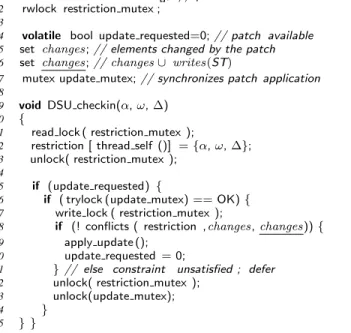
1 thread restr restriction []; // per−thread check−ins 2 rwlock restriction mutex ;
3
4 volatile bool update requested=0;// patch available 5 set changes;// elements changed by the patch 6 set changes;//changes∪ writes(ST)
7 mutex update mutex;// synchronizes patch application 8
9 void DSU checkin(α,ω,∆) 10 {
11 read lock ( restriction mutex );
12 restriction [ thread self ()] ={α,ω,∆}; 13 unlock( restriction mutex );
14
15 if (update requested) {
16 if ( trylock (update mutex) == OK){ 17 write lock ( restriction mutex );
18 if (! conflicts ( restriction ,changes,changes)){ 19 apply update ();
20 update requested = 0;
21 } // else constraint unsatisfied ; defer 22 unlock( restriction mutex );
23 unlock(update mutex);
24 }
25 } }
Figure 4. Check-in based relaxed synchronization protocol.
Generally speaking we should insert a call to check out at the end of a check-in scope, but we avoid doing this in our experiments by making check-in blocks back-to-back and non-nested, so that the code range covered by one is immediately followed by another. Otherwise we would need a stack of triples per thread, where the topmost element represents the thread’s current restriction, a check-in pushes the given triple on the stack, and a check-out pops it off; the stack is initialized to(>,>,>). With relaxed synchronization, insertedDSU updatecalls no longer have run-time effect—rather than modify them to include check-in effects we simply ignore them and in practice place aCHECKINannotation on the first block within the update scope.
The pseudocode for DSU checkinis shown in Figure 4. The restriction array (line 1) is indexed by a (normalized) thread identifier, and contains the arguments passed to the most recent DSU checkincall, i.e., a triple of set IDs for the prior and future check-in effectsαandω, and the capability∆. When no update is in progress, threads may change restriction in parallel because restriction mutex is acquired in reader mode. This is safe because each thread will only write to its own portion of the array.
When a patchπbecomes available, the flag update requested is set to 1, and the setschanges(π) andchanges(π)are popu-lated. The next thread that checks in and acquires theupdate mutex will attempt to apply the update (lines 15–16). This updating thread will then acquire the restriction mutex in writer mode (line 17), and thus other threads will block at their next check-in pocheck-ints (lcheck-ine 11). Next, the updatcheck-ing thread checks whether the update contents conflict with the current per-thread restrictions; the call to conflicts checks that for each thread i, (changes(π)∩ αi = ∅ ∨ changes(π) ∩ωi = ∅) ∧(changes(π)∩ ∆i =
∅), where restriction [ i ] = {αi, ωi,∆i}. If this check
suc-ceeds, apply update proceeds with the update, redirecting func-tion pointers, installing type transformers, and calling ST, as described above. Either way, the updating thread releases the restriction mutex to unblock any checked-in threads, and releases theupdate mutexto enable future updates (or retries).
Supporting concurrency. Ginseng’s type wrapping changes the representation of updatable named types, so we must be careful not to introduce races. Sinceconfunctions can potentially call the type transformer to update a value to the current version, a race-free read–read access can become a racing write–write access. To avoid this problem, we changedconfunctions to use per-type locks to en-sure atomic type transformation, and used double-checked locking to speed up the version check. However, introducing locks creates the potential for deadlock; e.g., a type transformer could call a func-tion that tries to acquire an applicafunc-tion lock while another thread holding that lock invokes the same type transformer. The problem can be avoided by writing type transformers that never call func-tions (including other type transformers) that could acquire locks; adhering to this restriction was easy for all our test applications.
4.3 Discussion
Ginseng requires the programmer to choose update pointsΣat de-ployment time, and STUMPlikewise requires a deployment-time choice of update scopesΣˆand check-in scopesξˆ.4In our experi-ence, the choice ofΣ(for single-threaded applications (Neamtiu et al. 2006)) orΣˆ (for multi-threaded applications) is relatively clear and applies for all versions. As such, the deployment-time re-striction imposes no practical limitation. On the other hand, delay-ing the choice ofξˆuntil the patchπis known could reduce update-related delays. In particular, we could maximize the extent and number of check-in scopes inξˆby computing contextual effects for every statement in the program, and designating update scopes for each sequence of statements that are safe with respect toπ. The problem is that an update-time choice ofξˆis difficult to imple-ment efficiently. Compiling the program to insert check-in/check-out stubs, where some subset of them is enabled when the patch is known, would add significant bloat. Shepherding each thread’s execution, e.g., usingptrace, also seems fairly heavyweight.
On the other hand, deploying with just definite update scopes and a few check-in blocks opens the possibility of deploying more check-ins later, if needed. The programmer could compute the max-imal setξˆof check-in scopes relative to the given patch, adjust the original program source to use this set, and then update the de-ployed program with the new check-ins. Since the only difference in the two programs is the presence of check-ins, which have no impact on the normal semantics of the program, we could apply this patch piecemeal (e.g., one function at a time) to reduce possi-ble conflicts. Once the check-in patch is deployed, the actual patch πcan be applied with maximum effectiveness. A similar trick can be played to accommodate further code extractions, if necessary.
5.
Experience
We used STUMPto dynamically update three open-source multi-threaded programs: the Icecast streaming media server, Mem-cached, a high-performance, distributed-memory object caching system, and the Space Tyrant multi-player gaming server. We chose these programs because they are long-running, maintain soft state that could be usefully preserved across patches, employ a variety of multi-threaded programming patterns, and spawn a non-trivial number of threads. In the remainder of this section, we briefly present each program and its threading model, then we describe the evolution of these programs during the period we considered, and finally discuss changes we made to prepare the programs for compilation with STUMP.
4We do not specifically consider induced update pointsξin this discussion;
they are analogous to check-in scopes.
5.1 Application overview
Icecast is a streaming media server—a popular solution for build-ing Internet radio stations. Updatbuild-ing Icecast on the fly would en-able media content providers to keep their streams live 24/7, yet be protected with the latest security fixes, or supporting the newest features. Icecast employs an event-based server model with a fixed number of threads, each performing separate duties: accepting a connection, handling incoming connections, reading from a media source, keeping statistics, etc.
Memcached is a high-performance, distributed-memory object caching system used on high-traffic sites such as YouTube, Face-book, and Wikipedia to store and deliver pre-rendered Web content, avoiding slow per-client database accesses and on-demand render-ing. Updating Memcached on the fly would help maintain high web server throughput; taking Memcached down to install the next version would discard the in-memory cache and cause degraded operation while the restarted program’s cache refills. Memcached uses a homogeneous threading model, where all application threads (a user-configurable number) perform the same fixed task. Space Tyrant is a multi-threaded gaming server. It uses a mixed threading model: three fixed threads (for managing the game state, accepting new connections and performing backups) and two threads for each client, one dealing with user input, one deal-ing with output from the server to the client. On-the-fly updates to Space Tyrant would enable continuous game server operation, without having to disconnect clients for each update.
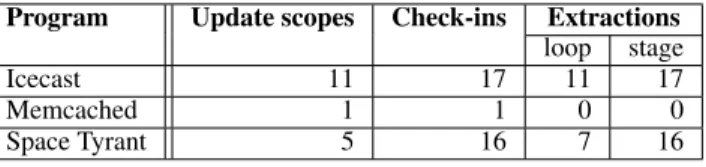
Evolution history. Table 1 summarizes the release information and shows some of the ways the programs changed over time. The first two groups of columns describe the first and last release we considered for each program. The last three groups of columns contain the cumulative number of changes that occurred to the software over that span. “Type changes” refers tostructs,unions andtypedefs. We can see that programs have changed significantly during the period we considered. For example, Icecast added nearly 4,000 lines of code; there were 25 changes to types, 10 changes to function prototypes, and 292 changes to function bodies.
5.2 Source code changes
When building updatable applications with STUMP, the program-mer may need to intervene at two phases: when preparing the source code for compilation with STUMP, and when creating dy-namic patches. We present details on the strategy we followed, and programmer effort (annotations or lines of code) for each of these phases, in turn, for our three test programs.
Stage extraction. As mentioned in Section 4.1, Ginseng supports code extraction as a solution for updating long-running code. In single-threaded Ginseng programs, long-running loop bodies are often extracted into separate functions where aDSU updatecall is placed just after the extracted call. This approach ensures the next loop iteration will be to the new version, and reduces the∆ re-strictions (types that are not allowed to change) at the update point, since the extracted function is inactive there. However, just extract-ing the loop body turns out to be insufficient in some cases for our multi-threaded programs, because many threads may be running the same loop, and blocking synchronization may prevent them from all exiting the loop at once. For example, producer/consumer-style threads may result in one thread blocked in the first part of a loop while the second thread does work in the second part (Makris and Ryu 2007). To address this problem, we must further extract logical “stages” of some loops into separate functions that can be updated separately.
Program Updates First release Last release Function Type Global var.
Ver. Date Size Ver. Date Size changes changes changes
(LOC) (LOC) Proto Body Init Type
Icecast 4 2.2.0 12/2004 25,349 2.3.1 11/2005 29,079 10 292 25 0 1
Memcached 3 1.2.2 05/2007 5,743 1.2.5 03/2008 6,345 14 118 6 1 5
Space Tyrant 6 0.307 10/2006 18,738 0.351 10/2007 20,223 0 107 11 2 3
Table 1. Application update information (all versions).
Program Update scopes Check-ins Extractions
loop stage
Icecast 11 17 11 17
Memcached 1 1 0 0
Space Tyrant 5 16 7 16
Table 2. Source code annotations.
Multi-threading annotations. Table 2 presents the number of an-notations we added to our test programs to prepare them for compi-lation with STUMP. Identifying long-running loops, update scopes, and stages was relatively straightforward, as we explain below. The second column shows the number of update scopes. The multi-threaded servers we have considered perform a few high-level op-erations whose boundaries suggest natural definite update points. Examples of such operations are processing one event, accepting and dispatching a client connection, etc. We enclosed each thread loop body for Icecast and Space Tyrant into an update scope. In the case of Memcached, the update scope delimits the processing of one event. The third column shows the number of blocks marked as check-ins; we placed check-in annotations around stages. To use the same source code for both barrier and relaxed approaches, we directed STUMP to compile the beginning of check-in blocks to DSU induced updatefor the barrier approach, and toDSU checkin for the relaxed approach (see Section 4.2).
The last two columns show the number of times we used loop or stage extraction. Identifying long-running loops was easy, as each long-running thread essentially executes a loop. We identified 11 loops in Icecast and 7 in Space Tyrant; these numbers are higher than the number of update scopes because some loops are nested. Loop extraction was not necessary for Memcached because looping occurs in an separate event-handling library. Finally, the last column shows the number of stages designated for extraction. These often coincide with the check-in blocks, but for Memcached no stage extraction was necessary.
Other changes to source code. In addition to designating update scopes, check-ins and stages, we had to make several small changes to application source code to cope with Ginseng’s conservative safety analysis (Neamtiu et al. 2006). These changes amounted to 42 lines for Icecast, 23 lines for Memcached and 19 for Space Tyrant (details can be found in our technical report (Neamtiu and Hicks 2009)).
Adjusting auto-generated patches. Ginseng automatically gen-erates candidate type transformer functions for type definitions that have changed. We inspected (and completed, where necessary) the generated type transformers, and wrote state transformers when needed; across all patches, we had to write 80 lines of code for Icecast, 12 for Memcached and 81 lines for Space Tyrant.
6.
Experiments
We performed two sets of experiments. First, we measured how quickly an update can take effect in STUMPas compared to various alternatives (Section 6.1). Second, we measured the overhead that
STUMP’s update support imposes on application performance com-pared to stock versions of the programs, and the original Ginseng without our added support (Section 6.2).
We conducted our experiments using a client-server setup, where the updatable applications ran on a quad-core Xeon 2.66GHz server with 4GB of RAM running Red Hat Enterprise Linux AS release 4, kernel version 2.6.9. The clients ran on a two-way SMP Xeon 2.8GHz machine with 3.6GB of RAM running Red Hat En-terprise Linux WS release 3, kernel version 2.4.21. The client and server systems were connected by a 100Mbps network. All C code (generated by STUMPor otherwise), was compiled withgcc3.4.6 at optimization level-O2.
6.1 Update timeliness
To measure the effectiveness of induced update points and relaxed synchronization in STUMP, we measure update timeliness, for all 13 patches that we developed, using gradual refinements (called update protocols) to our approach for reaching safe update points. We start with a straightforward extension to Ginseng, and show that this performs poorly in practice. We then add induced update points, and find that they improve update timeliness, though some-times we fail to reach safe update points. Finally, we add relaxed synchronization and show that it is very effective at reaching safe update points, fast. We first describe the experimental setup, then proceed to describing the protocols and the results.
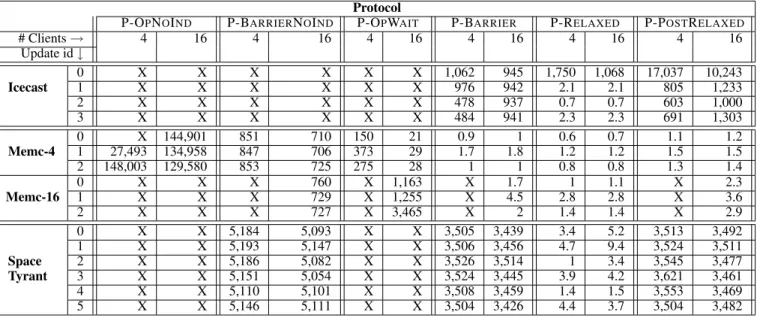
We ran experiments for each update and measured the time it took the system from the moment the update was signaled to the moment it could safely be applied; results (in milliseconds) are pre-sented for each protocol in Table 3. The first column shows the pro-gram, while the second column shows the update sequence number.
5
The subsequent columns show the results for each protocol. For each protocol, we tested two configurations, 4 and 16 con-current clients. The number of server-side threads varied, depend-ing on the application and number of clients. Icecast has a fixed number of threads; in our configuration this number was 6 in Ice-cast 2.2.0, and 7 in later versions. Memcached has a thread pool with a configurable number of handler threads, independent of the number of clients. We present results for two configurations, one with four server threads (Memc-4), and one with 16 server threads (Memc-16). Space Tyrant uses two threads per connected client, plus three fixed threads that perform housekeeping, so the number of Space Tyrant server-side threads were 11 (8 client handlers + 3 fixed) for the 4-client configuration and 35 (32 client handlers + 3 fixed) for the 16-client configuration.
We are interested in measuring update timeliness while the server is under load (since thread activity is likely to obstruct up-dates from taking effect), and most importantly whether an update may take place at all. The methodology for each program was to start the server, connect 4 (or 16) clients that are constantly asking
5For Icecast, we considered versions 2.2.0, 2.3.0rc1, 2.3.0rc2, 2.3.0.rc3,
and 2.3.1; hence entry 0 corresponds to the update 2.2.0→2.3.0rc1. For Memcached, we considered versions 1.2.2, 1.2.3, 1.2.4, and 1.2.5. For Space Tyrant, we considered versions 0.307, 0.316, 0.319, 0.331, 0.335, 0.347, and 0.351.
Protocol
P-OPNOIND P-BARRIERNOIND P-OPWAIT P-BARRIER P-RELAXED P-POSTRELAXED
# Clients→ 4 16 4 16 4 16 4 16 4 16 4 16 Update id↓ 0 X X X X X X 1,062 945 1,750 1,068 17,037 10,243 Icecast 1 X X X X X X 976 942 2.1 2.1 805 1,233 2 X X X X X X 478 937 0.7 0.7 603 1,000 3 X X X X X X 484 941 2.3 2.3 691 1,303 0 X 144,901 851 710 150 21 0.9 1 0.6 0.7 1.1 1.2 Memc-4 1 27,493 134,958 847 706 373 29 1.7 1.8 1.2 1.2 1.5 1.5 2 148,003 129,580 853 725 275 28 1 1 0.8 0.8 1.3 1.4 0 X X X 760 X 1,163 X 1.7 1 1.1 X 2.3 Memc-16 1 X X X 729 X 1,255 X 4.5 2.8 2.8 X 3.6 2 X X X 727 X 3,465 X 2 1.4 1.4 X 2.9 0 X X 5,184 5,093 X X 3,505 3,439 3.4 5.2 3,513 3,492 1 X X 5,193 5,147 X X 3,506 3,456 4.7 9.4 3,524 3,511 Space 2 X X 5,186 5,082 X X 3,526 3,514 1 3.4 3,545 3,477 Tyrant 3 X X 5,151 5,054 X X 3,524 3,445 3.9 4.2 3,621 3,461 4 X X 5,110 5,101 X X 3,508 3,459 1.4 1.5 3,553 3,469 5 X X 5,146 5,111 X X 3,504 3,426 4.4 3.7 3,504 3,482
Table 3. Time to reach a safe update point using various update protocols (in milliseconds).
for data, and send an update request while the server is perform-ing work. We then measured the time from the moment an update was requested to the moment it could be safely applied, or timed out after 15 minutes. We performed each experiment 11 times; we report the median time to reach a safe update point for terminating runs. An Xentry means that for that specific configuration, none of the 11 runs could reach such a point within 15 minutes. We also measured update loading times, i.e., time to load a dynamic patch after reaching a safe point. Loading times are proportional to patch size, and in all cases were less than 3 ms; we omit details due to space constraints. We now present our protocols and findings.
P-OPNOINDmodels a straightforward extension to Ginseng, and does not use induced update points (DSU induced updatecalls are treated as no-ops) or relaxed synchronization. It na¨ıvely tries to coax all threads to quiesce by yielding (via sched yield) when a definite update point is reached. If the last thread discovers that all threads are at definite update points, and that all these points are compatible with the update, the update is applied. The results are in columns 3 and 4 of Table 3. We can see that this protocol fails to reach a safe update point for almost all scenarios, and when it does, it can take several minutes to apply an update.
P-BARRIERNOINDattempts to improve P-OPNOIND. When a thread reaches a definite update point, and the effects at that point do not conflict with the update, it blocks. When the last thread discovers that all threads are blocked, the update is applied. We can see that this strategy (columns 5 and 6) is more successful than P-OPNOIND, but we still cannot reach a safe update point for the Icecast updates and some Memcached updates. We discuss the reasons below.
P-OPWAIT follows the optimistic approach of P-OPNOIND, but calls sched yield at induced update points as well. We can see (columns 7 and 8) that the extra points help—P-OPWAITreaches safe update points more quickly than P-OPNOIND, and in more cases. Likewise, P-BARRIERis the same as P-BARRIERNOINDbut synchronizes at induced update points, and again (columns 9 and 10) the result is improved performance in both update successes and update times.
P-RELAXED employs STUMP’s support for check-ins and relaxed synchronization. As shown in columns 11 and 12, P-RELAXED is the only protocol able to reach a safe point for all
updates, and it does so quickly, sometimes orders of magnitude faster than the other protocols. The only update for which P-RELAXEDis not the fastest is #0 for Icecast (shown in the first row). P-RELAXEDtakes 1.75 seconds with 4 clients and 1.06 seconds with 16 clients to reach a safe update point, compared to 1.06 and 0.94 seconds, respectively, for P-BARRIER. The added slowdown is due to the more conservative safety check for P-RELAXED. As explained in Section 4.2, in the relaxed approach, a check-in scope s1;...;snwith normal effectεcallsDSU checkin(α1∪ε, ω1,∆1) (recallω1 =ωn∪ε). This effectively prevents anything inεfrom
being updated whiles1;...;sn is being executed. By contrast, a
DSU induced updatecall just prior tos1would pass inα1, ω1,∆1, reducing the chance of a conflict with the prior effect. The Icecast update #0 contains a particularly large number of changes, and the safety check fails for many check-in scopes where it succeeds for induced update points at the same positions.
On the other hand, the barrier-based protocols P-BARRIERand P-BARRIERNOINDmust wait for all threads to reach an (induced or definite) update point before applying the update, which results in some updates failing to take place. For P-RELAXED, the update is applied as soon as it becomes available if allowed by the current restriction. In all the failing cases for Icecast and Memcached one or more threads are suspended due to a blocking call (on I/O or a condition variable) before reaching an update point, and will not proceed before new clients connect. For example, in the Memc-16 scenario, we have 16 server threads, and activity from only 4 clients prevents each of the 16 threads from being scheduled within the 15 minute time-out window.
While the barrier protocols could reach safe points eventually under different workloads (e.g., without a fixed set of clients), a more robust solution might be to treat blocking calls as a kind of induced update point, wrapping them with code to registerα, ω,∆ with the run-time system just prior to the actual call, and adding code to synchronize the thread upon returning from the call if an update has since become available. An update may be applied once currently active threads reach safe points as long as regis-tered threads are safe. While this solution should work for these programs, we feel barrier synchronization is still generally undesir-able for two reasons: (1) the server’s performance will be degraded because the existing client threads will block at update points and