2212-8271 © 2016 The Authors. Published by Elsevier B.V. This is an open access article under the CC BY-NC-ND license (http://creativecommons.org/licenses/by-nc-nd/4.0/).
Peer-review under responsibility of the scientific committee of the 8th Product-Service Systems across Life Cycle doi: 10.1016/j.procir.2016.03.239
Procedia CIRP 47 ( 2016 ) 48 – 53
ScienceDirect
Product-Service Systems across Life Cycle
Modelling influence and reach in sentiment analysis
Rui
Neves-Silva
a,b, Marta Gamito
a, Paulo Pina
a,*, Ana Rita Campos
aaInstitute for the Development of New Technologies, UNINOVA, Campus da FCT, 2829-516 Caparica, Portugal bFCT-UNL, FCT Campus, 2829-516 Caparica. Portugal
* Corresponding author. Tel.: +351-212-947-832; fax: +351-212-957-786. E-mail address: [email protected]
Abstract
Sentiment analysis emerged as an important research topic for its potential in tapping into the large amount of opinions that became a central piece of social networks, providing companies who have any kind of public feedback with new insights on their products and services. Research in this field focuses mainly on the semantic aspects of sentiment recognition and, in more recent years, on the impact of influence in propagation of opinions. Here we present a model that aggregates both these aspects and focuses on providing a framework for calculating global sentiments. The model is based on current literature and provides information regarding not only polarity of opinions, but also on other aspects that affect their diffusion and prevalence, such as influence, reach, ambiguity and relevance. The global sentiment is the result of a weighted evaluation of these aspects and is used both for estimating current sentiment towards an object and for predicting future trends in sentiment.
© 2016 The Authors. Published by Elsevier B.V.
Peer-review under responsibility of the scientific committee of the 8th Product-Service Systems across Life Cycle. Keywords: sentiment analysis; opinion mining; global sentiment
1.Introduction
Sentiment analysis (or opinion mining) deals with the computational treatment of opinion, sentiment, and subjectivity in text [1]. "Sentiment Analysis is a task of detecting, extracting and classifying opinions, sentiments and attitudes concerning different topics, as expressed in textual input" [2]. The fundamental principle of sentiment analysis is classifying the polarity of the text under analysis as positive, negative or neutral, i.e. distributing the collected information among these three categories.
Although there are authors that argue that opinion mining and sentiment analysis have different objectives [3] we will follow the most frequent definition [1], [4] and treat them as equivalent approaches for the same end, i.e. the identification of the attitude of a person (spoken or written) regarding a particular issue. More precisely, sentiment analysis and opinion mining refer to the overall polarity of a document.
Sentiment analysis emerged as an important research topic for its potential for tapping into the large amount of opinions that became a central piece of social networks, providing
companies who have any kind of public feedback with new insights on their products and services, i.e., by conjugating sentiment analysis with social networking analysis.
Social networking analysis is the study of social relationships in terms of network theory, consisting of nodes, representing individual actors within the network, and ties or edges, representing relationships between the individuals (friendship, kinship, organizations, etc.). These networks are often depicted in a social network diagram, where nodes are show as points and ties as lines.
The rise of the circular economy and the need to decouple revenues from consumption of resources, as well as an increasing awareness of the impact of efficiency not only on the costs of production but also on the environment, provided the scaffolding for building product-service systems (products with a servitising layer that allow extensible functionalities). These systems enable longer operation spans by extending and adapting their functions throughout the life-cycle.
But one challenge of such a layout is that it can only work if producing and maintain companies have insights into the needs and wishes of users. In this context, sentiment analysis gains
© 2016 The Authors. Published by Elsevier B.V This is an open access article under the CC BY-NC-ND license (http://creativecommons.org/licenses/by-nc-nd/4.0/).
additional importance as the vehicle of communication between users and companies.
This paper presents the results of the research performed in the scope of project DIVERSITY [5]. Among other things, we studied the potential impact of feedback from users, provided in social networks, in the design or re-design of product service systems.
To this end we studied the contents posted by social networks’ users (sentiment analysis) and how these users interact within these networks (social networking analysis) - what they share and how they share it - and not so much how the connections between users are established.
1.1 Sentiment analysis
An important issue in sentiment analysis is to detect what influences a person regarding a specific product, when that person searches for information about it on social networks.
Sentiment analysis can be performed at three different levels: (i) document level, (ii) sentence level and (iii) feature (or aspect) level [6]. At document level, the goal is to find the overall opinion of the whole document. Hence, it can be seen as a task that classifies each document into positive or negative groups. At sentence level, the goal is to find the sentiment orientation of each sentence. A common approach is to first identify the subjective sentences and then determine the sentiment of each of them. At aspect level, the features of the object that the user has commented on are first identified and then the targeted sentiment is ascertained [7].
When characterizing sentiments we must make a clear distinction between different terms that may appear, on a first analysis, similar and are many times used interchangeably.
In the course of our research we defined them as follows:
x A post is a content published by a user on a social network, providing a sentiment on a specific subject. It can be accompanied by comments that reinforce or contradict the original sentiment.
x A sentiment is a thought or idea based on a feeling about a subject.
x An opinion is the global intrinsic sentiment of a posted content. It encapsulates the targeted sentiments (sentence- or aspect-level) of the post itself and of related comments.
x Global sentiment emerges from the opinions during a given timeframe. It indicates a polarity towards a target. A number of tasks must be performed in order to analyze sentiments. Not all of them are mandatory nor are they some kind of step-by-step process. Instead, one of these tasks can be performed singly or in conjunction with the others. The main objective is to determine how the process is conducted. The basic tasks involved in sentiment analysis include:
x Detect the authorship of the expressed sentiment/opinion
x identify the object towards which the sentiment/opinion is expressed
x Classify the polarity of the sentiment/opinion (positive, negative, neutral)
x Aggregate the different sentiments about a specific target in one single opinion
x Detect spam in the available opinions
After this point, we can proceed to analyse the reach and influence of a sentiment.
2.Reach and influence in social sentiment analysis
With the rise in social networks and e-commerce, user-generated opinions and reviews about products grew rapidly. Such product reviews can not only help potential consumers to make decisions in buying products, but also provide valuable feedback for the companies producing those goods [8]. Companies have much to earn with this feedback because they can know why consumers like or dislike the product. A person who has little or no knowledge about a product or who doesn´t have access to objective information about it, is more likely to follow others' advice or example [9]. One of the best and easiest options to obtain information about a product is to get into virtual communities and read reviews by other users. Inside these communities there are always opinion leaders. They can be defined as "those influential, respected, WOM-spreading (word-of-mouth) individuals, whose perceived expertise could be considered especially credible, that others turn to for advice or information, thus exercising personal influence over a number of people" [9]. The characteristics of an opinion leader are the following:
x they are seen as having knowledge about a certain product or service;
x they post relevant contributions and are highly active members in the community; and
x they are commonly known as trendsetters regarding specific products or services.
Opinion leaders know how to be convincing because normally they are experts in some products. When a new product comes out on the market, the opinion leader is among the first to try it and learn the product characteristics, in order to give his opinion on that product. Opinion leaders often dictate the popularity of a product, since they have a strong influence on the communities. If their opinion is positive, it causes confidence in the product and influences people into buying it; if their opinion is negative, it will negatively influence the opinion of others regarding the product [10].
Generally, people access virtual communities in order to obtain information about a particular topic or product. An additional objective is the desire to interact socially with other community members. In these cases, social interaction is very strong. Helping others and responding to requests for
information or help provides status and is therefore a social investment that takes time, empathy and effort [9].
Lack of trust is what makes online interaction more difficult. Opinion leaders have an important role in overcoming this, because of their status in the community. Marketing uses the relationship between opinion leaders and followers on social networks to spread the word on their products. The electronic word-of-mouth (eWOM) is a more effective way of marketing than the traditional marketing, because of its potential reach, the rapid diffusion through the network, the fact that it builds more trust and creates price premiums on the products, minimizes risk, decreases search time, reduces purchase regret, enables the discovery of new products, and increases social status, among others [11], [12]. The extent and pace of the diffusion depends on the reach by both primary and secondary eWOM [13].
3.Obtaining the collective opinion from a group
The final activity in sentiment analysis, in the scope of our research, is to aggregate sentiments and opinions. The objective is twofold: summarization of sentiments in one single opinion (the expressed opinion from a post and its accompanying comments) and the aggregation of opinions from different authors and sources during a time interval, to provide a global sentiment towards the target.
Summarization attempts to generate a concise and understandable synthesis of a large number of opinions. It is considered the ultimate task regarding sentiment analysis due to the large amount of opinions over the web (in blogs, Facebook and Twitter, news portals, e-commerce sites, etc.).
Related work in this area can be very broadly classified into those that require a set of aspects - aspect-based summarization - and those that do not rely on the presence of aspects - non-aspect-based summarization [14].
Aspect-based summarization divides input texts into
aspects, which are also called features or subtopics, and generates summaries of each aspect. For example, for the summary of a smartphone, there can be aspects such as ‘battery life’, ‘design’, ‘price’, etc. By dividing the input texts into smaller units, aspect-based summarization can show more details in a structured way. Aspect division can be even more useful when overall opinions are different from sentiments of each aspect because aspect-based summary can present sentiment distribution of each aspect separately.
For presenting the summary several techniques may be applied, specifically [14]:
x Statistical summary: uses the results of aspect identification and sentiment classification, i.e. a list of aspects and the related sentiments. It presents the number of positive and negative sentiment for each aspect along with all sentences, with corresponding opinion;
x Text selection: provides the actual text necessary to understand the specifics of the aspect and uses short excerpts of text as summary;
x Aggregated ratings: combines statistical summary and text selection, based on the identified aspects and on the average of the sentiment results. Aspect ratings are shown along with representative phrases;
x Summary with a timeline: helps to understand the trend of opinions about a target over time, and provides inputs for further analysis (e.g. understand what changes people’s opinions by correlating variations with events that happened at that moment of time).
Non-aspect-based summarization: Includes all other kinds
of opinion summarization methods, which do not divide the input texts into sub topics. The non-aspect-based summaries either assume that the text has been pre-segmented by aspects or simply produce a generalized summary without consideration of aspects.
They can be categorised as follows [14]:
x Basic sentiment summarization: uses the sentiment detection results. The number of positive and negative opinions are counted (independently from any aspect) and a simple statistical opinion summary is generated.
x Text summarization
- Opinion integration: typically used when sentiments from different types of sources are addressed (e.g. from experts and ordinary authors);
- Contrastive sentiment summarization: given positive and negative sentences as inputs, generates contrastive paired sentences to help clarify sentences with mixed orientation; - Abstractive text summarization: is a less common
strategy, yet it is considered to be suited for capturing the major sentiments in a text; - Multi-lingual sentiment summarization: relies on
EuroWordNet [15] and tries to introduce sentiment summarization into translation.
x Visualization: uses different ways of displaying the results of summarization, in order to provide a more intuitive presentation and increase readability;
x Entity-based summary: shows the entities in the text (‘who’ says ‘what’to ‘whom’) and their relationships with sentiment polarity annotations.
Aggregation and contradiction analysis is a field with many open problems. However, the body of work on this subject is still lacking, even in recent years [16].
Global sentiment can be a very valuable indicator for companies. It was shown that it is possible to correlate the rate of mentions about a product and its sales [17]. Moreover, it provides additional value to user-level sentiment analysis,
since it can change the overall sentiment of a group of users [18], [19].
It can also be a tool to improve the accuracy of sentiment analysis of individual sentiment. A microblog is likely to be positive if it contains many words with positive sentiment and connects to other microblogs with positive sentiment [20]; a word is likely to be positive if it associates with many microblogs with positive sentiment and correlates to other words with positive sentiment. This also applies for negative and neutral polarities. The underlying motives for this propagation mechanism are related to the social processes of selection and influence. Selection indicates that people are more prone to be connected to other people with similar sentiments and opinions, while influence states that people become more similar to their friends over time [19].
The balance between strength and intensity of the global sentiment is also a relevant variable for estimating global sentiment. A subjective evaluation of global sentiment has difficulty in differentiating between strength and intensity, therefore distorting the real polarity of the global sentiment [21]. Another challenge for analysing global sentiment is related to the variance of polarity in a given sample. Opinion leaders have different positive-negative ratios in their audiences, i.e. followers who are positively or negatively influenced by their posts [22].
Stability is also an important indicator of global sentiment, as it demonstrates the interest of users in a given subject. Abrupt changes to stability can also be used to identify relevant events that affect the subject [22].
3.1.Predicting sentiment
The main objectives of predicting sentiment are: to predict the change of sentiment on a given topic over time and to identify key features that contribute to the change of sentiment.
The process of prediction depends on history window size (length of history data used for the prediction), prediction bandwidth (length of time into the future considered by the prediction) and response time (the time between an event or action and its effect on social networks) [18].
Research in this area is growing. Some models reached an accuracy of 85% in predicting variations to global sentiment [18]. Prediction of sentiment is a valuable tool for companies. Global sentiment in social networks can itself be used to predict changes in the real world. Online content can be used to predict sales peaks [17]; It can be correlated to predict box-office revenues of Hollywood movies [23].
4.Results
4.1.A model for defining social sentiment
Previous activities of literature review in the scope of the DIVERSITY project indicated a lack of models or ontologies focused on the issues of feedback provision by end-users regarding product-service systems and impacting on future design processes.
As a result of our research, we defined a model that enables the accurate definition of sentiments expressed by users from
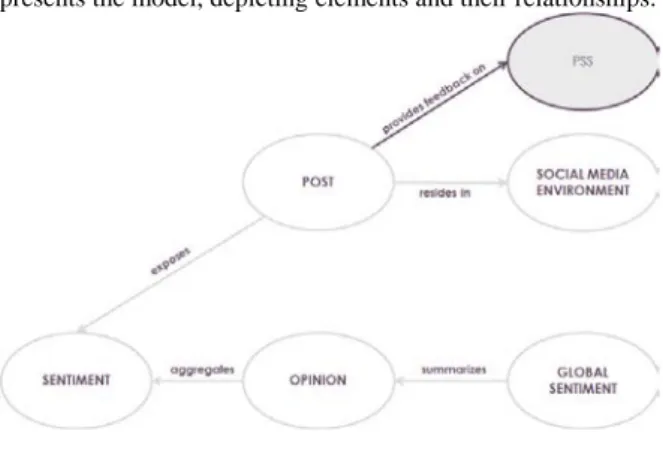
social networks towards product-service systems (PSS). Fig. 1 presents the model, depicting elements and their relationships.
Fig. 1: Model for social sentiment
A post is a content published by a user on a social network, providing an opinion on a specific subject. A post comes with comments, approvals (or likes), metadata identifying author, location and other parameters and tags, for classification purposes. Posts reside in Social Media Environments (e.g. Facebook, LinkedIn, Twitter) and – in this context –provide feedback on a given PSS.
A sentiment is a thought or idea, based on a feeling about a subject. It is composed of a target, a polarity, ambiguity (how clear the polarity is) and emotions. Sentiments are exposed by posts i.e. posts project the sentiments of the author regarding a given subject.
An opinion is the global intrinsic sentiment of a posted content. It encapsulates (or aggregates) the targeted sentiments (sentence- or aspect-level) of the post itself and of related comments. The properties of an opinion inherit those of the sentiment and also include reach (weighting the number of views/likes/comments), relevance and influence (representing the capacity the author has to influence others regarding the target).
Global sentiment emerges from the opinions during a given timeframe. It indicates a weighted polarity towards a target and includes values for strength (number of opinions during the sampled timeframe), intensity (number of posts per user regarding the target), reach (representing the number of unique authors and respective followers or commenters), stability (increase or decrease of strength during the timeframe) and conflict (variance in the polarity of opinions). Therefore, global sentiment summarises a set of opinions.
The importance of each opinion for calculating the global sentiment comes from the weighting of the different parameters. Fig. 2 illustrates the normalized weighting space for a generic opinion.
Fig. 2: Weighting opinions 4.2.Assessment of accuracy
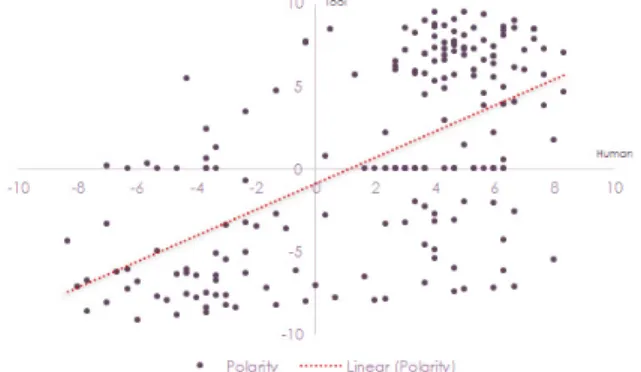
The model presented in the previous section is the basis for the calculation of the opinions and global sentiments regarding PSS. There are commercial tools in the market providing good results on the polarity of a sentiment [24]. We tested the accuracy of a prominent tool in practice, compared with human evaluation. Most sentiment analysis tools have an accuracy around 70% [24], [25] compared to human judgement. A preliminary analysis of this tool by the authors, with a dataset of 200 sentences against classification by human counterparts, provided accuracy results of 80%, with 19% of classifications with a deviation over 30%. Error! Reference source not found. depicts the correlation between average human and automatic classification.
Fig. 3: Correlation between human and automatic classifications 5.Conclusions
This paper presents the results of the research on sentiment analysis together with social networking analysis for provision of feedback about products and services. Starting from the pre-existing work on social networking analysis, we established a model for hierarchizing the elements in sentiment analysis and representing interconnections between users in social networks and their impact on the global sentiment. We also established an ontology for sentiment analysis.
Review of existing literature indicated the inexistence of research focused on sentiment analysis regarding product-service systems design. A model for sentiment analysis, integrated with a more comprehensive product-service system ontology (developed in the DIVERSITY project and outside the scope of this paper) was developed, aiming to address this gap. This model followed current literature on the subject of sentiment analysis.
Regarding the accuracy of the assessment of polarity by sentiment analysis tools, these have greater difficulties dealing with ambiguity, context, sarcasm and language variation (colloquialisms, slang). In order to cope with these issues and increase the accuracy of the results, a mechanism for human actors to override automated sentiment analysis should be provided.
Additionally, the use of a domain-specific ontology, mapping and weighting of aspects in the ontology and
contextual information also proved to be an improvement on accuracy [26].
In the scope of project DIVERSITY [5], this work will be the foundation for a sentiment extraction and prediction tool for identifying and predicting opinions towards existing and planned product-service systems. We will perform further research to optimize the results of polarity, by including a domain-specific ontology for better sentiment contextualization. For prediction purposes, we will build on existing work [22], [18] to improve the accuracy of global sentiments calculation.
This paper presented the main results of the research developed in the DIVERSITY project, addressing the gaps in current literature on sentiment analysis for product-service systems. This resulted in a model for sentiment taking into account reach and influence for evaluating opinions and global sentiment. Furthermore, existing shortcomings in sentiment analysis tools were evaluated and the critical points for future developments in this area were identified.
Acknowledgements
This work has been partially supported by the H2020 EC funded project DIVERSITY - Cloud Manufacturing and Social Software-based Context Sensitive Product-Service Engineering Environment for Globally Distributed Enterprise (G.A. No: 636692).
6.References
[1] B. Pang and L. Lee, "Opinion Mining and Sentiment Analysis," Foundations and Trends in Information Retrieval, Volume 2 Issue 1-2, pp. Pages 1-135, 2008. [2] A. Montoyo, P. Martínez - Barco and A. Balahur,
"Subjectivity and Sentiment Analysis: An overview of the current state of the area and envisaged
developments," Journal Decision Support Systems, vol. 53, pp. 675-679, 2012.
[3] D. Osimo and F. Mureddu, "Research Challenge on Opinion Mining and Sentiment Analysis," W3C, 2012. [4] R. Varghese and J. M, "A Survey on sentiment analysis
and opinion mining," International Journal of Research in Engineering and Technology, vol. 2, no. 11, pp. 312-317, 11 2013.
[5] DIVERSITY, "DIVERSITY project," 2015. [Online]. Available: https://www.diversity-project.eu/. [6] B. Liu, Sentiment analysis and opinion mining, vol. 5,
Morgan & Claypool Publishers, 2012, pp. 1-167. [7] M. Farhadloo and E. Rolland, "Multi-Class Sentiment
Analysis with Clustering and Score Representation," in
13th International Conference on Data Mining Workshops, 2013.
[8] M. Wang and H. Shi, "Research on Sentiment Analysis Technology and Polarity Computation of Sentiment Words," Progress in Informatics and Computing, vol. 1, pp. 331-334, 2010.
[9] G. Leal, L. Hor-Meyll and I. Pessoa, "Influence of virtual communities in Purchasing decisions: the participants' perspective," in Journal of Business Research, Vols. 67
(5),, pp. 882-890, 2014.
[10] P. Van Eck, W. Jager and P. Leeflang, "Opinion Leaders' Role in Innovation Diffusion: A Simulation Study,"
Journal of Product Innovation Management, vol. 28, pp. 187-204, 2011.
[11] B. Li, A. Chong and E. Ch’ng, "What Triggers Sharing in Viral Marketing? The Role of Emotion and Social Feature," in Pacific Asia Conference on Information Systems (PACIS) Proceedings, Singapore, 2015. [12] C. Yoo , Y. J. Kim and G. L. Sanders , "The impact of
interactivity of electronic word of mouth systems and E-Quality on decision support in the context of the e-marketplace," Information & Management 52, pp. 496-505, 2015.
[13] J. Hornik, R. S. Satchi, L. Cesareo and A. Pastore, "Information dissemination via electronic word-of-mouth: Good news travels fast, bad news travels faster!,"
Computers in Human Behavior, Volume 45, pp. 273-280, April 2015.
[14] H. Kim, K. Ganesan, P. Sondhi and C. Zhai,
"Comprehensive Review of Opinion Summarization," University of Illinois at Urbana-Champaign, Champaign, 2011.
[15] P. Vossen, "EuroWordNet: a multilingual database for information retrieval," in DELOS workshop on Cross-language Information Retrieval, Zurich, 1997. [16] W. Medhat , A. Hassan and H. Korashy, "Sentiment
analysis algorithms and applications: A survey," Ain Shams Engineering Journal, 2014.
[17] D. Gruhl, R. Guha, R. Kumar and J. Novak, "The predictive power of online chatter," in KDD '05 Proceedings of the eleventh ACM SIGKDD international conference on Knowledge discovery in data mining , Chicago, 2005.
[18] L. T. Nguyen, P. Wu, W. Chan, W. Peng and Y. Zhang, "Predicting collective sentiment dynamics from time-series social media," in WISDOM '12 Proceedings of the First International Workshop on Issues of Sentiment Discovery and Opinion Mining, Beijing, 2012. [19] X. Hu, L. Tang, J. Tang and H. Liu, "Exploiting social
relations for sentiment analysis in microblogging," in
WSDM '13 Proceedings of the sixth ACM international conference on Web search and data mining , Rome, 2013.
[20] J. Tang, C. Nobata, A. Dong, Y. Chang and H. Liu, "Propagation-based Sentiment Analysis for
Microblogging Data," in Proceedings of the 2015 SIAM International Conference on Data Mining, 2015. [21] K. Weaver, S. M. Garcia, N. Schwarz and D. T. Miller,
"Inferring the Popularity of an Opinion From Its Familiarity: A Repetitive Voice Can Sound Like a Chorus," Journal of Personality and Social Psychology, Vol. 92, No. 5, p. 821–833, 2007.
[22] Y. Bae and H. Lee, "Sentiment Analysis of Twitter Audiences: Measuring the Positive or Negative Influence of Popular Twitterers," OURNAL OF THE AMERICAN SOCIETY FOR INFORMATION SCIENCE AND TECHNOLOGY, 63(12), p. 2521–2535, 2012.
[23] S. Asur and B. A. Huberman, "Predicting the future with social media," in Proceedings of the 2010
IEEE/WIC/ACM International Conference on Web Intelligence and Intelligent Agent Technology – Volume 01, Washington D. C., 2010.
[24] J. Burn-Murdoch, "Social media analytics: are we nearly there yet?," 10 06 2013. [Online]. Available:
www.theguardian.com/news/datablog/2013/jun/10/social-media-analytics-sentiment-analysis.
[25] B. Donkor, "On Social Sentiment and Sentiment Analysis," 16 12 2013. [Online]. Available: http://brnrd.me/social-sentiment-sentiment-analysis/. [26] B. Agarwal, N. Mittal, P. Bansal and S. Garg, "Sentiment
Analysis Using Common-Sense and Context Information," Computational Intelligence and Neuroscience, 2015.
[27] T. W. Valente and P. Pumpuang, "Identifying Opinion Leaders to Promote Behaviour Change," Health Education & Behaviour, vol. 34, no. 6, pp. 881-896, 2007.