Knowledge from Source Code
Vom Fachbereich Informatik der Technischen Universit¨at Darmstadt genehmigte
Dissertation
zur Erlangung des akademischen Grades eines
Doktor-Ingenieurs (Dr.-Ing.)
vorgelegt von
Ervina C¸ ergani, M.Sc.
geboren in Tirana (Albania).
Referent: Prof. Dr.-Ing. Mira Mezini
Korreferent: Prof. Dr. Christoph Bockisch
Datum der Einreichung: 3. Juni 2019
Datum der m¨undlichen Pr¨ufung: 12. Juli 2019
Erscheinungsjahr 2019
Darmst¨adter Dissertationen
C¸ ergani, Ervina : Machine Learning as a Mean to Uncover Latent Knowledge from Source Code
Darmstadt, Technische Universit¨at Darmstadt
Jahr der Ver¨offentlichung der Dissertation auf TUprints: 2020
URN: urn:nbn:de:tuda-tuprints-116586
URL: https://tuprints.ulb.tu-darmstadt.de/id/eprint/11658
Tag der m¨undlichen Pr¨ufung: 12.07.2019
Ver¨offentlicht unter CC BY-SA 4.0 International
I tend to always question even minor things in life and try to find the answers from simple facts. Maybe this is why I became interested into data analysis. The idea of finding new facts and giving value to simple data really fascinates me. I happily accepted the offer to join the Software Technology Group at TU Darmstadt as a PhD student, which allowed me to expand my knowledge into the software engineering domain and provided me with another kind of data worth exploring. What followed were years of continuous learning, hard work, and many many ups and downs. However, these last years have been a journey that I have not undertaken alone. In the following, I would like to express my deep gratitude to all the people that accompanied me in this journey.
First of all, I want to say a big thank you to my supervisor Prof. Dr.-Ing. Mira Mezini for offering me the opportunity to do my PhD thesis at her group and under her supervision. Thank you for your support during my years of PhD and your research guidance over this path. Thank you for your constructive feedback and for making this thesis possible, even though the path has not always been straight.
Other people that helped me for designing the research path and that I am very thankful for are Dr.-Ing. Sebastian Proksch with whom I collaborated very closely
during the first year of my PhD, and Prof. Dr. Sarah Nadi who joined ourrecommenders
subgroup as a postdoc. We shared many ups and downs during this time. I am deeply grateful for your advices and your reliability, even after you had long left to pursue your academic career at the University of Zurich and University of Alberta respectively. Many thanks go also to Prof. Dr. Ulf Brefeld and Dr.-Ing. Sven Amann. Our meetings provided me with ideas, confidence, and insights to tackle obstacles on the path to a successful project, as well as this thesis. Thank you all for your patient and your continues feedback and advices. Your guidance strongly influenced the way I think and work. Furthermore, many thanks go also to Dr. rer. nat. Edlira Kuci for our many long friendly conversations in the office and walkings in the park. Thanks for motivating me every time when I felt the finish line of the PhD seemed too far.
Many special thanks goes for Gudrun Harris, for your understanding and making my PhD life easier through the infinite journey of paper works. Thank you for being always there for me, and solving the funding matter with the best means possible. Thank you for encouraging me in the hardest time and helping me to see the light at the end of the tunnel with your positive attitude. You were always available for a good chat and with your humor ensured that I stay focused on my path.
I would like to thank all my other colleagues from the Software Technology Group that I had the pleasure to get to know during my PhD journey: Prof. Dr. Guido Salvaneschi, Dr. Andi Bejleri, Dr.-Ing. Ben Hermann, Dr. Ingo Maier, Dr. Johannes Lerch, Dr.-Ing.
ert, Daniel Sokolowski, David Richter, Dominik Helm, Felix Weirich, Florian K¨ubler, Jurgen van Ham, Leonid Glanz, Manuel Weiel, Matthias Eichholz, Michael Reif, Mirko
K¨ohler, Nafise Eskandani Masoule, Pascal Weisenburger, Patrick M¨uller, Ragnar Mogk,
and Sven Keidel. Thank you for all the diversity you brought over the years.
Finally and most importantly, I want to thank my family and my friends. First of all, I thank my parents for their unconditional love and trust since the first day I was born, and for supporting me throughout school and university despite of the difficulties life brought in our path. Thanks to you I learned that the impossible becomes possible, if we really want something and work hard for achieving it. I’m grateful that you endured it to build the foundation of my education and that you kept supporting me until I managed to stand on my own feet. A special thank you goes to my dearest grandparents, who with care and love taught me as a child how important education is in someone’s life, and how to put priorities in life. Unfortunately, you were not still physically around to celebrate my graduation with me, but you certainly were in my heart. You have shown me how important it is to care for each other as a family and I will always strive to be the good hearted, honest, and generous person that you taught me to be. Many special thanks go of course to my only and best sister. Whenever I need a hand or an honest second opinion for a decision, I know that you will always be there for me. I like that we do not always agree on everything, because in this way we perfectly complement each other, and I’m very grateful for having you in my life. Thank you to all my family for your unconditional love and support in every step I took. Thank you for being my strength in the most difficult moments. Thank you for believing in me, for being patient with me and for always being there for me despite of the geographical distance. Last but not least, I would like to thank all my friends I got to know before and during the PhD journey. I am deeply grateful to have known every single one of you, for excepting me for who I am and for having shared so much with me. I know that they say good friendships are the ones that last longer, and most of you have perfectly reflected it over the years we have shared.
Becoming increasingly complex, software development relies heavily on the reuse of exist-ing libraries. Such libraries expose their functionality through Application Programmexist-ing Interfaces (APIs) for developers to interact with, as effective means for code reuse. How-ever, developers using an API must be aware of how to efficiently and correctly use it in their development tasks in order to deliver simple, clear, comprehensive and correct software. To assist developers work with APIs more efficiently, a family of developer-assistance tools known as Recommender Systems for Software Engineering (RSSEs) have shown to be useful in increasing programmers’ productivity. Applications of RSSEs are based on learning API usage patterns by analyzing source code. In reaction to this, many approaches have been proposed for learning API usage patterns from code repositories. However, a major challenge in these approaches is the discovery of latent knowledge in source code. Current approaches heavily rely on program analyses that predefine the learning process, and then use different algorithms to aggregate the detailed information extracted from source code.
On this thesis, we aim to redirect the focus on using advanced machine learning tools to uncover latent knowledge in source code. Machine learning algorithms are known to use general input formats, are fully automated and work well across different domains. Therefore, to investigate the advantages of machine learning approaches and their
po-tential in software engineering, we consider two different dimensions. First, we use the
same program analyses as used by a state of the art method call recommender [123], and investigate if replacing the existing learning approach (canopy clustering) with a more powerful machine learning algorithm (Boolean Matrix Factorization - BMF), discovers additional knowledge that was not possible with the previous approach. We find that BMF is indeed able to automatically discover the number of clusters to represent the object usage space, and identifies corner cases (noise) in the data, while reducing model
size and improving inference speed without compromising prediction quality. Second,
we use an event stream mining algorithm that can automatically learn different code representations (pattern types), without complex domain knowledge needed to encode a-priori. We evaluate the quality of the learned patterns on the application context of misuse detection, and compare its performance with five state of the art misuse detec-tors. Our evaluation results show that the patterns learned perform better in terms of precision by ranking true positives higher in the top findings, and in terms of recall by being able to detect more misuses in the source code.
Our results show practical evidence of the positive impact that machine learning tools can bring to the field of software engineering, in terms of automatically discover latent knowledge in source code, and their comparability (or even better) performance with respect to state of the art approaches.
Die Softwareentwicklung wird immer komplexer und h¨angt stark von der Wiederver-wendung vorhandener Softwarebibliotheken ab. Solche Bibliotheken stellen ihre
Funk-tionalit¨at ¨uber APIs (Application Programming Interfaces) zur Verf¨ugung, mit denen
Entwickler interagieren k¨onnen, um Code effektiv wiederzuverwenden. Entwickler, die
eine API verwenden, m¨ussen jedoch wissen, wie sie diese effizient und korrekt in ihren
Entwicklungsaufgaben verwenden k¨onnen, um einfache, klare, umfassende und korrekte
Software bereitzustellen. Um Entwicklern die effizientere Arbeit mit APIs zu erleichtern,
hat sich eine Reihe von Tools zur Entwicklerunterst¨utzung, die als Recommender Systems
for Software Engineering (RSSEs) bekannt sind, als n¨utzlich erwiesen, um die
Produk-tivit¨at von Programmierern zu steigern. Anwendungen von RSSEs basieren auf dem
Erlernen von API-Nutzungsmustern durch Analyse des Quellcode. Als Reaktion darauf
wurden viele Ans¨atze vorgeschlagen, um API-Verwendungsmuster aus Code Repositorys
zu lernen. Eine große Herausforderung bei diesen Ans¨atzen ist jedoch die Entdeckung
latenten Wissens im Quellcode. Gegenw¨artige Ans¨atze st¨utzen sich stark auf
Programm-analysen, die den Lernprozess vordefinieren und dann verschiedene Algorithmen verwen-den, um die aus dem Quellcode extrahierten detaillierten Informationen zu aggregieren. In dieser Arbeit wollen wir den Fokus auf die Verwendung fortschrittlicher maschineller Lernwerkzeuge lenken, um latentes Wissen im Quellcode aufzudecken. Es ist bekannt,
dass Algorithmen f¨ur maschinelles Lernen allgemeine Eingabeformate verwenden,
vollst¨andig automatisiert sind und in verschiedenen Bereichen gut funktionieren. Um die
Vorteile von Ans¨atzen des maschinellen Lernens und ihre Potenziale in der
Softwareen-twicklung zu untersuchen, betrachten wir daher zwei verschiedene Dimensionen. Zuerst
verwenden wir dieselben Programmanalysen wie ein letzte Stand der Technik Meth-odenaufrufempfehlung [123] und untersuchen, ob der vorhandene Lernansatz (Canopy
Clustering) durch einen leistungsf¨ahigeren Algorithmus f¨ur maschinelles Lernen (Boolean
Matrix Factorization - BMF) ersetzt wird, entdeckt zus¨atzliches Wissen, das mit dem
vorherigen Ansatz nicht m¨oglich war. Wir stellen fest, dass BMF tats¨achlich in der Lage
ist, die Anzahl der Cluster zur Darstellung des data Objekten automatisch zu ermitteln
und Eckf¨alle (Rauschen) in den Daten zu identifizieren, w¨ahrend die Modellgr¨oße
re-duziert und die Inferenzgeschwindigkeit verbessert wird, ohne die Vorhersagequalit¨at zu
beeintr¨achtigen. Zweitens verwenden wir einen Event-Stream-Mining-Algorithmus, der
automatisch verschiedene Codedarstellungen (Mustertypen) lernen kann, ohne dass
kom-plexe Dom¨anenkenntnisse f¨ur die a-priori-Codierung erforderlich sind. Wir bewerten die
Qualit¨at der erlernten Muster im Anwendungskontext der Missbrauchserkennung und
vergleichen ihre Leistung mit f¨unf letzte Stand der Technik Missbrauchsdetektoren.
Un-sere Bewertungsergebnisse zeigen, dass die erlernten Muster in Bezug auf die Pr¨azision
wer-Unsere Ergebnisse zeigen praktische Beweise f¨ur die positiven Auswirkungen, die Tools
f¨ur maschinelles Lernen auf das Gebiet der Softwareentwicklung haben k¨onnen, indem sie
automatisch latentes Wissen im Quellcode entdecken und deren Vergleichbarkeit (oder
Preface 3 1 Introduction 13 1.1 Problem Statement . . . 15 1.1.1 Program Analyses . . . 15 1.1.2 Learning approaches . . . 16 1.1.3 Thesis Focus . . . 17
1.2 Contributions of this Thesis . . . 19
1.3 Publications . . . 21
1.4 Structure of this Thesis . . . 21
2 Background and State of the Art Survey 23 2.1 Terminology . . . 24
2.2 Sources of API Usages . . . 24
2.2.1 Source Code Repository . . . 25
2.2.2 API Documentation . . . 26
2.2.3 Interaction Data . . . 26
2.2.4 Online sites . . . 27
2.3 Code Elements in API Usage Patterns . . . 28
2.3.1 Object Types . . . 28
2.3.2 Method Calls . . . 28
2.3.3 Exception Handling . . . 29
2.3.4 Parameters . . . 30
2.3.5 Iteration . . . 30
2.4 Survey on API Usage Pattern Learning Approaches . . . 30
2.4.1 Methodology . . . 32
2.4.2 Closely Related Learning Approaches . . . 33
2.4.3 Other Learning Approaches . . . 45
2.4.4 Discussion . . . 47
3 Matrix Factorization to Improve Scalability in API Method Call Analytics 53 3.1 Background & Motivation . . . 54
3.1.1 PBN Pipeline . . . 55
3.1.2 Problem Statement . . . 58
3.1.3 Intuition Behind Using BMF . . . 60
3.2 Integrating BMF into PBN . . . 61
3.2.2 Using BMF to Generate Patterns . . . 63 3.2.3 Calculating PBN . . . 64 3.3 Evaluations . . . 65 3.3.1 Data . . . 65 3.3.2 Recommender Evaluation . . . 65 3.3.3 Evaluation Results . . . 66 3.4 Threats to Validity . . . 68 3.4.1 Internal Validity . . . 68 3.4.2 External Validity . . . 69 3.5 Related Work . . . 69 3.5.1 Matrix Factorization . . . 69
3.5.2 Potential Applications in Code Recommenders . . . 70
3.5.3 Potential Applications in Pattern Mining . . . 70
3.5.4 Scalability in Code Recommenders . . . 70
3.6 Discussion . . . 70
4 Investigating Order Information in API Usage Patterns 73 4.1 Related Work . . . 75
4.1.1 API Usage Representations . . . 75
4.1.2 Empirical Studies of API Usages . . . 77
4.2 Conceptual Differences between Pattern Types . . . 77
4.3 Episode Mining for API Patterns . . . 80
4.3.1 Episode Mining Algorithm . . . 80
4.3.2 Mining API Usage Patterns . . . 81
4.4 Evaluation Setup . . . 82
4.4.1 Dataset . . . 83
4.4.2 Threshold Analyses . . . 83
4.4.3 Metrics for Pattern Comparison . . . 85
4.4.4 Limitations . . . 86
4.5 Pattern Types Benchmark (PTBench) . . . 86
4.5.1 Data Representation . . . 86
4.5.2 Benchmark Automation . . . 87
4.5.3 Reproducibility and Traceability . . . 87
4.6 Evaluation Results . . . 87 4.6.1 Pattern Statistics . . . 87 4.6.2 Expressiveness . . . 88 4.6.3 Consistency . . . 90 4.6.4 Generalizability . . . 91 4.7 Implications . . . 92 4.8 Threats to Validity . . . 94 4.8.1 Internal Validity . . . 94 4.8.2 External Validity . . . 94 4.9 Discussion . . . 95
5 On the Impact of Order Information in API Method Call Misuses 97
5.1 Background and Motivation . . . 99
5.2 A New Detector . . . 100
5.2.1 Pattern Mining . . . 100
5.2.2 Detecting and Ranking API Misuses . . . 100
5.3 Evaluation Setup . . . 102 5.3.1 Dataset . . . 102 5.3.2 Threshold Analyses . . . 102 5.3.3 Experimental Setup . . . 103 5.4 Evaluation Results . . . 104 5.4.1 Precision . . . 105 5.4.2 Recall . . . 105 5.4.3 Discussion . . . 106
5.5 Extension and Further Use . . . 107
5.5.1 Dataset Extensions . . . 107
5.5.2 New Metrics for Pattern Comperison . . . 107
5.5.3 Comparison of Pattern Types based on Applications . . . 107
5.6 Threats to Validity . . . 108
5.7 Related Work . . . 108
6 Conclusion and Outlook 111 6.1 Summary of Results . . . 112
6.2 Future Work . . . 114
6.3 Closing Discussion . . . 117
Contributed Implementations and Data 119
Over the last few decades, software has become an essential part of our everyday life: mobiles, TVs, computers, everything runs on software. Despite the continuous advance in state of the art, software development remains a challenging and knowledge-intensive activity, because software systems become increasingly complex. At the same time, de-velopers are continuously introduced to new technologies, components and ideas. In order to keep up with the market speed and the need for introducing new software, the software development process is mainly based on reusing existing software compo-nents [18, 141, 142], referred to as software libraries. Rather than implementing new systems from scratch, developers look for, and try to integrate into their projects, li-braries that provide functionalities of interest. Such lili-braries expose their functionality through Application Programming Interfaces (APIs) for developers to interact with, as effective means for code reuse. However, developers using an API must be aware of how to efficiently and correctly use it in their development tasks in order to deliver simple, clear, comprehensive and correct software.
A proactive approach to assist developers work with APIs more efficiently are a family of developer-assistance tools, referred to as Recommender Systems for Software Engi-neering (RSSEs) [131, 133]. The key idea behind RSSEs is to automatically obtain information items estimated to be valuable for a software engineering task in a given context and to provide them to developers, often directly in their Integrated Development Environments (IDEs). RSSE tools have shown to be useful in assisting developers during their development time as means to increase programmers’ productivity [131, 133].
Applications of RSSEs include: code completion [21, 123, 103], code search [178], and bug or anomaly detection [158, 110, 91, 157]. Code completion can be divided into single completion at a time (method completion, parameter completion etc.), and code snippets
completion. Single completionis heavily used by developers to decide which code element
to use next given the current context. While traditional code completion systems only exploit the type system and propose an alphabetically sorted list of all possible code elements in focus, intelligent code completion systems propose relevant code elements by comparing the editor content to code patterns extracted by analyzing large repositories.
Code snippet completion on the other hand, assist developers by recommending complete code snippets containing multiple code elements, while also comparing the editor content
with the learned code patterns. Code search engines search through different available
sources, such as Google Code1 and Stack Overflow2, to provide developers within the
IDE code examples that illustrate the use of code elements of interest. Misuse detectors
analyze the code editor written by the developer and if a violation is identified with
1
https://code.google.com
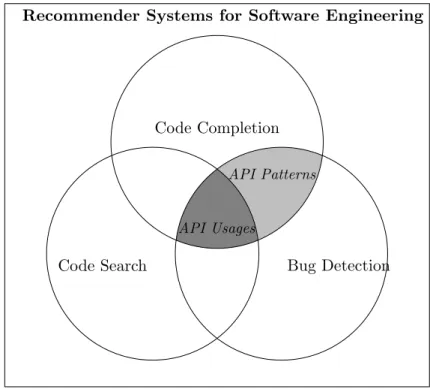
Code Completion
Code Search Bug Detection
Recommender Systems for Software Engineering
API Patterns
API Usages
Figure 1.1: RSSE applications based on API usages
respect to API specifications or some mined patterns, the code is marked as a potential anomaly.
All the above mentioned RSSE tools, are based on API usages to provide recommen-dations to developers within their IDE environment. The only difference is that while code search tools propose to developers API usage examples as extracted from available sources, code completion and anomaly detection tools first analyze the extracted API usages in order to learn API patterns before outputting their final recommendations to developers (Figure 1.1).
A source code snippet that combines one or more API elements in order to accomplish
some task, is referred to as anAPI usage. AnAPI pattern encodes a set of API elements
that are frequently used together (similar API usages), optionally complemented by constraints like the order in which those API elements must be called.
At the same time, the number of open-source projects committed in public
version-control systems (VCS), such asGitHub3andBitBucket4, has tremendously increased
over last decades, making source code data easily accessible. Given the above facts, learning API patterns is a topic of much interest. In reaction to this, researchers have proposed many approaches to learn API usage patterns from code repositories [132].
The focus of this thesis are API usage pattern learning approaches based on source code for the application domain of code recommenders in software engineering, as shown
3
https://github.com
in Figure 1.1, within the context of code completion and misuse detection.
1.1 Problem Statement
As illustrated in Figure 1.1, API usages are the core information in many RSSE tools. They define the source code representation that serves as input information to different API pattern learning approaches within the application context of code completion and misuse detection. However, a major challenge in these approaches is the discovery of latent knowledge in source code. Current approaches heavily rely on specialized hand-crafted domain knowledge to define the source code representation, which in most of the cases also predefines the learning process. Moreover, the learning process is based on algorithms that mainly aggregate the detailed information extracted from source code,
instead of uncovering new knowledge automatically. In such approaches,domain
knowl-edge represent program analyses performed by the researchers on code repositories, such
as domain knowledge feature extraction [123], or the encoding of data and control-flow dependencies into the source code representation [13].
In this thesis, we discuss the limitations of such approaches and investigate the poten-tial of advanced machine learning algorithms to automatically uncover latent knowledge from code representations that encode less semantic knowledge. Our main focus are code completion and misuse detection tools based on source code that use
simultane-ously program analyses andlearning algorithms to generate their recommendations.
1.1.1 Program Analyses
Many program analysis efforts are invested in order to turn raw code into a sufficiently
in-terpreted format that can be further processed. For example, the source code has to be parsed, commits have to be aggregated, and software has to be abstracted into depen-dency graphs. In the following, we present some of the main program analyses used to convert source code into interpretable formats and discuss their respective limitations:
Program slicing is a type of analysis intended to identify the parts of a program that may affect, or be affected by, the values computed at some point of interest [151]. Although static slicing and its variants are conceptually appealing techniques, they suffer
from practical limitations.First, computing slices can be expensive [162], and pragmatic
considerations may require lower-precision data-flow analyses [152]. Second, because a
statement is often transitively dependent on many other statements, slices are often very large [162].
Static analysis examine source code statically, as it is written in the code editor
before the program is run. Due to the complexity of code, static analysis can
pro-duce infeasible call sequences. For example by extracting call sequences from both if
and else-clauses [134, 143].
Dynamic analysis collect information as the program executes. Therefore, they heavily depend on the availability and quality of test cases for an executable system. As such, they cannot be applied to incomplete code or to code that cannot be executed [39, 166].
Despite of their limitations, program analyses have many advantages and might reveal information that is not clearly expressed in source code. However, such analyses also comes with some costs when used exclusively to uncover latent knowledge directly from source code:
• A human expert is required for designing such analyses. These analyses are
usu-ally developed iteratively: as the results of some analyses being examined, other analyses need to be introduced to either broaden or limit the results that are al-ready identified. Such iterative analyses are developed through manual inspection or empirical analysis, introducing a human burden [133].
• Generalizing to other programing languages is much more difficult, as the analyses
need to be implemented differently for every language [150].
• In some cases, the designed analyses can only be used for one specialized task.
For example, given a known bug, a human expert is expected to develop program analysis to find occurrences of similar bugs elsewhere in the project, or other
projects (i.e. FindBugs [53]).
1.1.2 Learning approaches
Over the years, a variety of approaches have been used by researchers to learn API patterns from source code. In the following, we give a brief overview of these approaches.
Collaborative filtering operates on uncompressed versions of unit data. Such ex-amples include nearest neighbors [21]. The fundamental idea is to recommend to users code elements that have been used by similar users in similar contexts.
Content-based filtering calculates a set of elements that are most similar to other elements already seen in the source code. These approaches compare the content of already used elements (i.e. method calls), with new elements that can potentially be
recommended. Concrete applications include clustering which groups similar elements
together, and statistical-based methods that calculate a probability distribution of
ele-ments based on other eleele-ments already seen in the source code [123].
Data mining finds and summarizes patterns in some structure, and those patterns represent how, in the past, users have explored that structure. Concrete algorithms
includesubgraph mining [13] which uses graph representations,subsequence mining [178]
using a strict order representation, frequent item-set mining finds sets of elements that
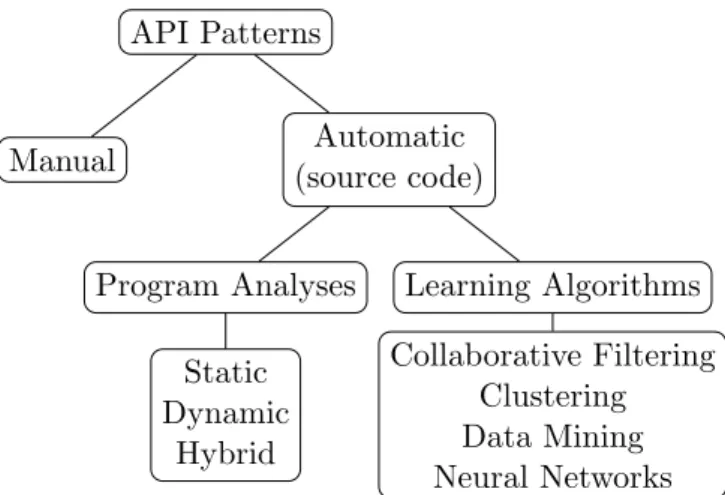
are frequently called together [66], andFinite State Automata (FSA, [121]) calculates a
transition function between different states of a program.
The above mentioned approaches are mainly used in the literature to aggregate the detailed information collected by program analyses, instead of automatically discovering latent knowledge from source code. Instances of such program analyses information include the set of features extracted from source code [21, 123], or a predefined code structure which encodes data and control-flow dependencies [13].
At the same time, general purpose machine learning algorithms use simple input for-mats that are natural, general, fully-automatic, and work well across different tasks and
programming languages. We see the following advantages by using advanced machine learning approaches:
• The human expert burden is significantly reduced, since machine learning offers
general purpose algorithms not bounded within a specific domain context.
• Generalizing to other programming languages might be as simple as replacing the
parser for the new language and using the same traversal algorithm.
• The focus is mainly in automatically discovering latent knowledge not obvious in
source code, instead of aggregating the detailed information extracted through program analysis [123, 13].
Learning from large available datasets using advanced machine learning approaches has transformed a number of areas such as natural language processing [60], computer vision [135], and recommendation systems [61]. Prominent examples include, but are not
limited to automatic machine translation systems, such as Google Translate5 that learns
from existing documents to translate sentences from one natural language to another. Accurate face detection services is another example of successful learning from a large dataset of images. Given the overwhelming success of machine learning in a variety of application domains, we want to bring the same benefits to software engineering. For this purpose, in this thesis, we adapt existing machine learning approaches to the application domain of RSSE, and empirically evaluate how they compare to existing approaches.
1.1.3 Thesis Focus
Figure 1.2 illustrates the general pipeline of code recommendation and misuse detection
approaches from the literature. In the first step, some program analyses (slicing, static,
dynamic) are applied on the source code to transform it into some representation (a set of features, data and control-flow). As described in Section 1.1.1, usually this repre-sentation includes some domain specific information extracted from source code which
require a domain expert knowledge. In thesecond step, learning algorithms are applied
on the code representation, which as described in Section 1.1.2, usually aggregate the
detailed information extracted in the previous step in some patterns representation.
Fi-nally, the learned patterns are inputted to the recommender engine to generate relevant recommendations to the developer, or for detecting violations in source code.
The focus of this thesis lies on the second step of the pipeline in Figure 1.2, where we aim to shift from approaches that simply aggregate the inputted (known) information extracted through domain specific program analyses, into more sophisticated approaches that are able to automatically discover latent (unknown) knowledge from source code. The research question that we address therefore is:
m1() - 90% m2() - 56% m3() - 27% ... Method proposals Analyze Code 1 0 0 ... 0 1 1 ... 0 0 0 ... ... ... ... ... Data representation Calculate BN Cluster OUs (1 ? 1 ? ? …) Query Calculate proposals Code snippets class C implements J { @Override void n(T ou3) { ou3.m2(); ou3.m3(); } } class A implements I { @Override void m(T ou1) { ou1.m1(); ou1.m2(); } } class B implements J { @Override void m(T ou2) { ou2.m1(); ou2.m2(); ou2.m4(); } } class D implements K { @Override
void o(T ou4) { ou4.m4; } }
Fig. 2. Code snippet examples from code repositories
TABLE I. OBJECTUSAGES REPRESENTED IN THE FEATURE SPACE
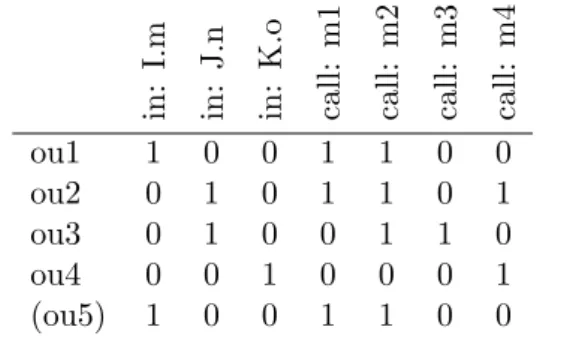
in: I.m in: J.n in: K.o call: m1 call: m2 call: m3 call: m4 ou1 1 0 0 1 1 0 0 ou2 0 1 0 1 1 0 1 ou3 0 1 0 0 1 1 0 ou4 0 0 1 0 0 0 1 (ou5) 1 0 0 1 1 0 0 A. Data representation
The input data for PBN is generated by statically analyzing code repositories for example usages of object types that belong to frameworks or libraries. Examples that are found are represented as anobject usage. Anobject usageis an abstract representation of a single instance of a specific API type and contains differentfeaturesthat describe it. Apart from the invoked method calls, additional features are extracted that describe the surrounding code in which the instance was used. This includes the enclosing class and method context, the definition site of an object usage, and all parameter call sites.
In Figure 2, we show five code snippets that we will use as a running example throughout the paper. For all examples, we are collecting information for the object typeT. The first object usageou1has a method contextI.m1and two receiver
call sitesm1andm2. Thus,ou1can be described by these three features. Similar information can be gathered for the other snippets.
All code snippets are transformed into the processable format shown in Table I in two steps. First, all features are aggregated and stored in a feature set. This set spans the available feature space of all possible feature combinations. In our example, these are the vertical labels in the table. Second, each object usage is transformed into a binary vector in the feature space (as defined by the feature set). The dimension of each feature contained in the object usage is set to1, all others are set to0. Each row in the table represents a single object usage from the examples.
Using the first declaration as the context is a generalization that might result in duplication. For example, object usage ou5(not shown in Figure 2) might be observed in a different implementation ofI, sayA2. If the same combination of methods are invoked, it is considered as the same object usage asou1, because it is represented with the same binary vector. Proksch et al. [6] do not merge such object usages, but keep them as separate rows in the table. In Section??, we discuss how we merge such object usages.
1The method context always points to the type in the hierarchy in which the method signature was defined first. Therefore, it isI.mand notA.m.
P1 P2 0.6 0.2 P3 0.2 Patterns 0 P2 P1 true 1 0 1 false0 1 P3 Call: m1 0 P2 P1 true 1 1 false ... P3 Call: m2 0 P2 P1 true 0 1 false ... P3 Call: m3 1 P2 P1 true0.330 false ... P3 Call: m4 K.o 0 0 1 0 P2 P1 I.m0.670 1 J.n 0.33 0 P3 Context
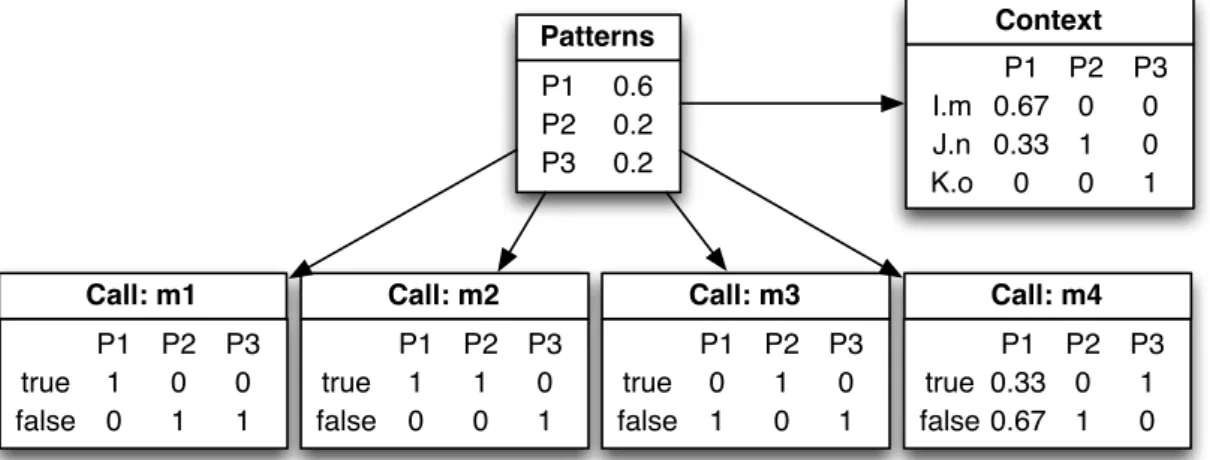
Fig. 3. PBN inference engine as a result of canopy clustering of the object usages in Figure 2 and represented by the matrix in Table I
Note that similar to Proksch et al. [6], we consider all feature kinds (method calls,method context,class context, definition site,receiver call site, andparameter call site) in our work. However, all examples in this paper are reduced to method calls and method context to make them more comprehensible.
B. Clustering the input data
The matrix generated in the previous step is passed to the clustering component in the PBN pipeline in order to find similar vectors that can be grouped into patterns (see Figure 1). A pattern has a defined probability and also contains a probability between0and1for every feature in the feature space. For example, consider that the object usagesou1,ou2, andou5end up in the same cluster since they are similar. The resulting patternp1has the probability0.6because it contains
3out of a total of5object usages. The probability of each feature in the pattern is determined by the fraction of object usages that possess this feature, e.g.2
3of the object usages in
this cluster were observed in contextI.m. The complete vector that describes the probabilities of all dimensions in the feature space of patternp1is(0.67,0.33,0,1,1,0,0.33).
The clustering component is exchangeable and represents the extension point that is addressed in this work. The original PBN publication used a variant of canopy clustering that followed a simple algorithm:
1) Randomly select an object usage.
2) Calculate the distance to all remaining object usages. 3) Select all object usages closer than a specified threshold. 4) Merge these into a centroid that represents the cluster. 5) Remove all selected object usages.
6) Repeat steps 1-5 until no object usages are left. While merging all object usages in step 4, all binary information is converted to probabilities like those shown above. The authors applied smoothing to omit extreme values
class C implements J { @Override void n(T ou3) { ou3.m2(); ou3.m3(); } } class A implements I { @Override void m(T ou1) { ou1.m1(); ou1.m2(); } } class B implements J { @Override void m(T ou2) { ou2.m1(); ou2.m2(); ou2.m4(); } } class D implements K { @Override
void o(T ou4) { ou4.m4; } }
Fig. 2. Code snippet examples from code repositories
TABLE I. OBJECTUSAGES REPRESENTED IN THE FEATURE SPACE
in: I.m in: J.n in: K.o call: m1 call: m2 call: m3 call: m4 ou1 1 0 0 1 1 0 0 ou2 0 1 0 1 1 0 1 ou3 0 1 0 0 1 1 0 ou4 0 0 1 0 0 0 1 (ou5) 1 0 0 1 1 0 0 A. Data representation
The input data for PBN is generated by statically analyzing code repositories for example usages of object types that belong to frameworks or libraries. Examples that are found are represented as anobject usage. Anobject usageis an abstract representation of a single instance of a specific API type and contains differentfeaturesthat describe it. Apart from the invoked method calls, additional features are extracted that describe the surrounding code in which the instance was used. This includes the enclosing class and method context, the definition site of an object usage, and all parameter call sites.
In Figure 2, we show five code snippets that we will use as a running example throughout the paper. For all examples, we are collecting information for the object typeT. The first object usageou1has a method contextI.m1and two receiver
call sitesm1andm2. Thus,ou1can be described by these three features. Similar information can be gathered for the other snippets.
All code snippets are transformed into the processable format shown in Table I in two steps. First, all features are aggregated and stored in a feature set. This set spans the available feature space of all possible feature combinations. In our example, these are the vertical labels in the table. Second, each object usage is transformed into a binary vector in the feature space (as defined by the feature set). The dimension of each feature contained in the object usage is set to1, all others are set to0. Each row in the table represents a single object usage from the examples.
Using the first declaration as the context is a generalization that might result in duplication. For example, object usage ou5(not shown in Figure 2) might be observed in a different implementation ofI, sayA2. If the same combination of methods are invoked, it is considered as the same object usage asou1, because it is represented with the same binary vector. Proksch et al. [6] do not merge such object usages, but keep them as separate rows in the table. In Section??, we discuss how we merge such object usages.
1The method context always points to the type in the hierarchy in which the method signature was defined first. Therefore, it isI.mand notA.m.
P1 P2 0.6 0.2 P3 0.2 Patterns 0 P2 P1 true 1 0 1 false0 1 P3 Call: m1 0 P2 P1 true 1 1 false ... P3 Call: m2 0 P2 P1 true 0 1 false ... P3 Call: m3 1 P2 P1 true0.330 false ... P3 Call: m4 K.o 0 0 1 0 P2 P1 I.m0.670 1 J.n 0.33 0 P3 Context
Fig. 3. PBN inference engine as a result of canopy clustering of the object usages in Figure 2 and represented by the matrix in Table I
Note that similar to Proksch et al. [6], we consider all feature kinds (method calls,method context,class context, definition site,receiver call site, andparameter call site) in our work. However, all examples in this paper are reduced to method calls and method context to make them more comprehensible.
B. Clustering the input data
The matrix generated in the previous step is passed to the clustering component in the PBN pipeline in order to find similar vectors that can be grouped into patterns (see Figure 1). A pattern has a defined probability and also contains a probability between0and1for every feature in the feature space. For example, consider that the object usagesou1,ou2, andou5end up in the same cluster since they are similar. The resulting patternp1has the probability0.6because it contains
3out of a total of5object usages. The probability of each feature in the pattern is determined by the fraction of object usages that possess this feature, e.g.2
3of the object usages in
this cluster were observed in contextI.m. The complete vector that describes the probabilities of all dimensions in the feature space of patternp1is(0.67,0.33,0,1,1,0,0.33).
The clustering component is exchangeable and represents the extension point that is addressed in this work. The original PBN publication used a variant of canopy clustering that followed a simple algorithm:
1) Randomly select an object usage.
2) Calculate the distance to all remaining object usages. 3) Select all object usages closer than a specified threshold. 4) Merge these into a centroid that represents the cluster. 5) Remove all selected object usages.
6) Repeat steps 1-5 until no object usages are left. While merging all object usages in step 4, all binary information is converted to probabilities like those shown above. The authors applied smoothing to omit extreme values
class C implements J { @Override void n(T ou3) { ou3.m2(); ou3.m3(); } } class A implements I { @Override void m(T ou1) { ou1.m1(); ou1.m2(); } } class B implements J { @Override void m(T ou2) { ou2.m1(); ou2.m2(); ou2.m4(); } } class D implements K { @Override
void o(T ou4) { ou4.m4; } }
Fig. 2. Code snippet examples from code repositories
TABLE I. OBJECTUSAGES REPRESENTED IN THE FEATURE SPACE
in: I.m in: J.n in: K.o call: m1 call: m2 call: m3 call: m4 ou1 1 0 0 1 1 0 0 ou2 0 1 0 1 1 0 1 ou3 0 1 0 0 1 1 0 ou4 0 0 1 0 0 0 1 (ou5) 1 0 0 1 1 0 0 A. Data representation
The input data for PBN is generated by statically analyzing code repositories for example usages of object types that belong to frameworks or libraries. Examples that are found are represented as anobject usage. Anobject usageis an abstract representation of a single instance of a specific API type and contains differentfeaturesthat describe it. Apart from the invoked method calls, additional features are extracted that describe the surrounding code in which the instance was used. This includes the enclosing class and method context, the definition site of an object usage, and all parameter call sites.
In Figure 2, we show five code snippets that we will use as a running example throughout the paper. For all examples, we are collecting information for the object typeT. The first object usageou1has a method contextI.m1and two receiver
call sitesm1andm2. Thus,ou1can be described by these three features. Similar information can be gathered for the other snippets.
All code snippets are transformed into the processable format shown in Table I in two steps. First, all features are aggregated and stored in a feature set. This set spans the available feature space of all possible feature combinations. In our example, these are the vertical labels in the table. Second, each object usage is transformed into a binary vector in the feature space (as defined by the feature set). The dimension of each feature contained in the object usage is set to1, all others are set to0. Each row in the table represents a single object usage from the examples.
Using the first declaration as the context is a generalization that might result in duplication. For example, object usage ou5(not shown in Figure 2) might be observed in a different implementation ofI, sayA2. If the same combination of methods are invoked, it is considered as the same object usage asou1, because it is represented with the same binary vector. Proksch et al. [6] do not merge such object usages, but keep them as separate rows in the table. In Section??, we discuss how we merge such object usages.
1The method context always points to the type in the hierarchy in which the method signature was defined first. Therefore, it isI.mand notA.m.
P1 P2 0.6 0.2 P3 0.2 Patterns 0 P2 P1 true 1 0 1 false0 1 P3 Call: m1 0 P2 P1 true 1 1 false ... P3 Call: m2 0 P2 P1 true 0 1 false ... P3 Call: m3 1 P2 P1 true0.330 false ... P3 Call: m4 K.o 0 0 1 0 P2 P1 I.m0.670 1 J.n 0.33 0 P3 Context
Fig. 3. PBN inference engine as a result of canopy clustering of the object usages in Figure 2 and represented by the matrix in Table I
Note that similar to Proksch et al. [6], we consider all feature kinds (method calls,method context,class context, definition site,receiver call site, andparameter call site) in our work. However, all examples in this paper are reduced to method calls and method context to make them more comprehensible.
B. Clustering the input data
The matrix generated in the previous step is passed to the clustering component in the PBN pipeline in order to find similar vectors that can be grouped into patterns (see Figure 1). A pattern has a defined probability and also contains a probability between0and1for every feature in the feature space. For example, consider that the object usagesou1,ou2, andou5end up in the same cluster since they are similar. The resulting patternp1has the probability0.6because it contains
3out of a total of5object usages. The probability of each feature in the pattern is determined by the fraction of object usages that possess this feature, e.g.2
3of the object usages in
this cluster were observed in contextI.m. The complete vector that describes the probabilities of all dimensions in the feature space of patternp1is(0.67,0.33,0,1,1,0,0.33).
The clustering component is exchangeable and represents the extension point that is addressed in this work. The original PBN publication used a variant of canopy clustering that followed a simple algorithm:
1) Randomly select an object usage.
2) Calculate the distance to all remaining object usages. 3) Select all object usages closer than a specified threshold. 4) Merge these into a centroid that represents the cluster. 5) Remove all selected object usages.
6) Repeat steps 1-5 until no object usages are left. While merging all object usages in step 4, all binary information is converted to probabilities like those shown above. The authors applied smoothing to omit extreme values
Patterns ou1 ou2 ou3 … ou5 P1 P2 PBN inference engine
PBN Pipeline Inferring Method Proposals
3 1 2 4 1 Program Analyses Source Code 1 0 0 1 1 0 0 0 1 0 1 1 0 1 0 1 0 0 1 1 0 0 0 1 0 0 0 1 1 0 0 1 1 0 0 Code representation 2 Aggregation … b a c Patterns 3 Recommendations
RSSE
Figure 1.2: General pipeline of RSSE tools from the literature.
Can RSSE tools profit from machine learning in order to reduce the effort of human-involved program analyses by automatically uncover latent knowledge from the available source code datasets, and still be able to achieve similar or better results compared to the state of the art approaches?
Addressing this question is challenging, because as opposed to other kinds of data, source code represent complex structure and semantics that should be captured dur-ing the learndur-ing process. Existdur-ing naive approaches based on traditional information retrieval methods treat code as natural language text [51]. These approaches however ignore important semantic information of source code and are too imprecise, leading to limited practical applicability.
Therefore, in this thesis we investigate the advantages of machine learning in two dimensions:
First, based on the same program analyses as defined in a state of the art approach (PBN [123]), we investigate if by using a more sophisticated machine learning algorithm we are able to find additional latent knowledge that was not possible to uncover before, and if this knowledge contributes in improving the performance on the current system.
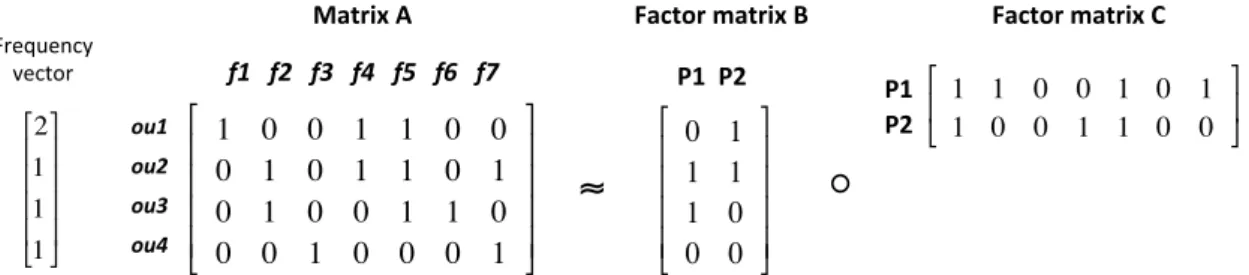
For this purpose, we use aBoolean Matrix Factorization (BMF) approach. We show that
BMF overcomes many of the drawbacks that come with simple clustering approaches, such as automatically discovering the number of clusters to represent the object usage space from source code, and identify corner cases (noise) in the data. To evaluate BMF performance, we use the PBN recommender, which is designed as an extensible inference engine for method completion. We replace the originally used canopy clustering with BMF, and compare the performance of both approaches in terms of model size, prediction quality and inference speed.
Second, we use an event stream mining algorithm (episode-mining) that automati-cally learns different code representations (sequences, sets and partial-orders), with no complex domain knowledge needed to encode a-priori. Designing a code representation that enables effective learning is a critical task that is often done manually for each programming language. The main idea behind episode mining is to represent source code as a stream of events by traversing its abstract syntax tree (AST). This allows a learning model to leverage the structured nature of code, while still considering AST semantics. We use episode mining to learn different API usage pattern types from source code, perform an empirical study to compare the different pattern types based on three pre-defined metrics (Section 4.4.3), build an API misuse detector based on the learned
patterns, and analyze how it compares to state of the art misuse detectors in terms of precision and recall.
1.2 Contributions of this Thesis
This work contributes to the area of code recommenders. Our systematic survey of existing API usage pattern mining literature provides an overview on the state of the art in the field. We adapt the Boolean Matrix Factorization (BMF) approach in the application domain of code completion to automatically learn the number of clusters needed to represent an object usage space and identify noise in the data. Our empirical evaluations show that BMF can successfully identify noisy data, which result in reduced model size of the learned patterns and improved inference speed compared to a state of the art recommender (PBN [123]). Furthermore, we introduce a new benchmark (PtBench) which adapts an existing episode mining approach [1] to automatically
identify different representations (sequential, partial, and no-order patterns) from source code, perform a qualitative and quantitative empirical comparison between the different representations, and evaluate the mined patterns on the application domain of misuse detection. Our empirical evaluations show that partial-order patterns are a good trade-off for representing source code in the wild. Furthermore, in the application context of misuse detection we get comparable results to state of the art approaches [13, 91, 158,
110, 157], heavily based on program analysis. We makePtBench6 publicly available to
other researchers for exploring additional properties of API patterns, and for building-up other applications based on API usage patterns.
The State-of-the-Art in API-Usage Pattern Mining Approaches Our first
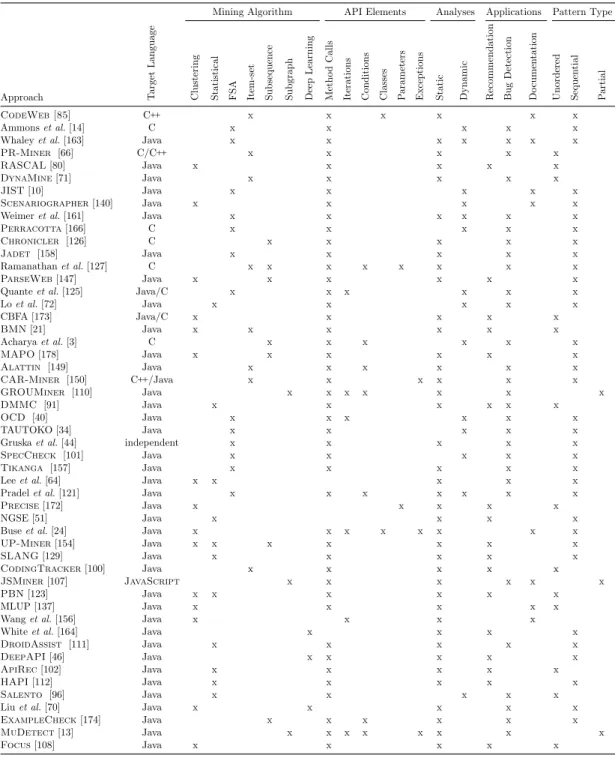
contribu-tion is a systematic literature review of existing work in API-usage pattern mining. In order to push for more advanced machine learning approaches in API-usage pattern learning, first we need to understand how existing approaches are built, and what their current capabilities and limitations are. First, we introduce the large variety of re-sources from where researchers extract different kind of code snippets. Then, we present an overview of the different code elements analyzed in the pattern learning approaches from the literature. At the end, we present existing approaches used to learn API pat-terns within the application domain of code completion and misuse detection. We find that most of the approaches are based on static and dynamic analysis, and aggregation algorithms to learn patterns from source code.
Scalability in API Method Call Analytics In our second contribution, we apply BMF
approach within the context of intelligent method call completion. Our evaluation re-sults reveal that BMF is an effective approach in reducing the model size of an existing intelligent code completion engine based on canopy clustering, by automatically detect-ing noise in source code. We extend the BMF approach with a heuristic to further improve pattern detection within the application domain of method call completion. We
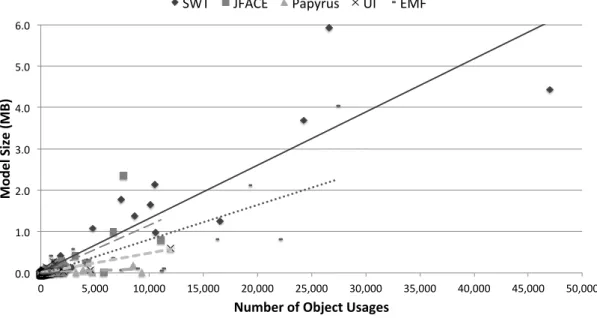
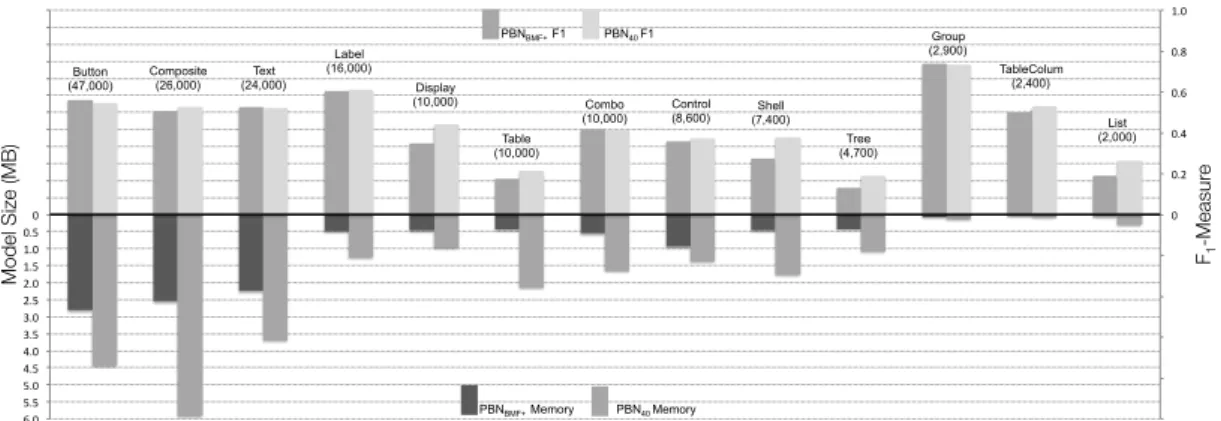
perform a systematic empirical evaluation on the effect of BMF on the performance of an intelligent method call completion engine based on three metrics: model size, infer-ence speed and prediction quality. The evaluations show that BMF reduces model size up to 80% and increases inference speed up to 78%, while not compromising prediction quality. This improvement is due to the ability of the BMF approach to automatically identify noise in the data, and remove that noise from the learned patterns.
A Systematic Comparison of API-Usage Pattern Types In our third contribution,
we provide a public benchmark (PtBench) that enables the comparison of different
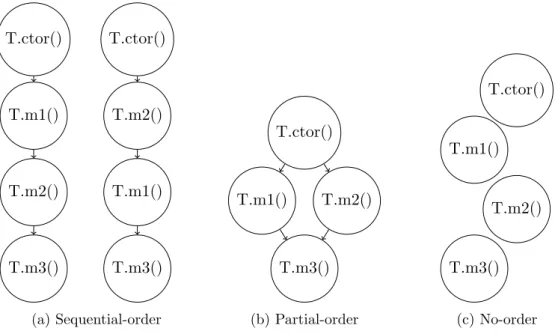
pattern types. So far, we lack systematic studies of the tradeoffs between the different types of patterns in representing source code in practice. Such a comparison with re-gards to some predefined metrics is indeed challenging, because each approach in the literature uses a different learning technique with configurations specific to its data, a different representation for API usages and patterns, and might even be specifically tight to a particular programing language or input form. For this purpose, we first adapt an existing episode mining algorithm [1] that automatically identifies different code repre-sentations (pattern types) by simply transforming source code into a stream of events. Then, we define three metrics on which we base on the comparison of the identified pat-tern types: expressiveness, consistency and generalizability. At the end, we perform an empirical study that compares the pattern types based on the defined metrics. Some of
our main findings are:(1)the three pattern types don’t differ in terms of pattern size and
number of API types involved;(2)partial-order mining finds additional patterns missed
by sequence mining, which are used across repositories;(3) sequential and partial-order
mining encode important order information for representing correct co-occurrences of code elements in real code. Our findings help in building better applications based on API usages. Furthermore, our benchmark is publicly available to other researchers to evaluate additional metrics on the different pattern types.
The Impact of Order Information in API Method Call Misuse Detection In our
fourth contribution, we presentEmDetect, a new API-misuse detector as an extension
of PtBench. We build EmDetect based on the identified patterns by the episode
mining algorithm, and evaluate the quality of the learned patterns in the application domain of misuse detection. Our results show that sequential-order patterns perform better in terms of precision by ranking true positives higher in the top findings, while partial-order patterns perform better in terms of recall by being able to find more misuses
in the source code. In general,EmDetectshows comparable results compared to other
state of the art approaches [13, 91, 158, 110, 157], in terms of both precision and recall.
Our benchmark (PtBench) provides support for two programming languages: C# and
1.3 Publications
Most of the content presented in this thesis have previously been published to software engineering conferences or workshops. This section gives an overview over these publi-cations and the respective parts of this thesis. Parts of the thesis may contain verbatim content of the publications.
Addressing Scalability in API Method Call Analytics [29]. The SWAN’16 paper
presents the BMF approach as a mean to reduce the memory cost of an existing intelligent method completion engine (PBN [123]) with no loss in prediction quality (Chapter 3). BMF is evaluated using Eclipse SWT framework (including 44 API types and 190,000 object usages in total), and has shown to improve the inference speed by up to 78% and reduce the model size by up to 80%, without significant changes to the prediction quality, as presented in Section 3.3.3.
Investigating Order Information in API-Usage Patterns: A Benchmark and
Em-pirical Study [30]. The ICSOFT’18 paper presents an empirical investigation of the
trade-offs between three pattern types identified from the literature with respect to real code (Chapter 4). Our approach consists of three steps (Section 4.3.2): the transforma-tion of source code into an event stream, the adaptatransforma-tion of an existing general-purpose episode mining algorithm to the special context of pattern mining for software engineer-ing, and filtering the resulting patterns. We define three metrics on which we base the comparison between the identified pattern types: expressiveness, consistency and gener-alizability (Section 4.4.3). In Section 4.7, we present a set of Implications that we derive from the evaluation results presented in Section 4.6.
EmDetect: On the Impact of Order Information in API Usage Patterns [27]. The
paper presents a new API-misuse detector (EmDetect), used as a baseline to
empiri-cally evaluate and compare the effect of order information in API patterns, within the application context of misuse detection (Chapter 5). For the sake of completeness, the
paper also compares the performance of EmDetect with other state of the art misuse
detectors ([13, 91, 158, 110, 157]), in terms of precision and recall (Section 5.4).
1.4 Structure of this Thesis
This thesis is organized as follows. In Chapter 2, we present our survey on existing API usage pattern mining approaches from the literature. Section 2.1 introduces the main terminology used throughout this thesis. Section 2.2 presents the variety of resources from where researchers extract examples of code snippets. In Section 2.3, we present an overview of the different code elements analyzed in the pattern learning approaches from the literature. In order to push for more advanced machine learning approaches in API-usage pattern learning, first we need to understand how existing approaches are built, and what their current capabilities and limitations are. For this, we present in Section 2.4
a systematic literature survey to identify existing work on API-usage pattern learning, and assess and compare the methodologies of respective approaches.
In Chapter 3, we adapt the BMF approach within the application context of recom-mender systems, to tackle scalability in terms of model size in an existing intelligent code completion engine. Section 3.1 presents the background on how PBN [123] pipeline works, and the motivation behind using BMF. PBN is an extensible pipeline for intel-ligent method call completion, which we use to compare the previous approach based on canopy clustering with the newly proposed BMF approach. Section 3.2 describes the integration of BMF into the existing PBN pipeline. Section 3.3, first presents the metrics on which we base on the evaluations of the new recommender, and then describes our empirical evaluation results in comparing BMF with canopy clustering. Threats to va-lidity is discussed in Section 3.4, related work presented in Section 3.5, and we conclude this part with a discussion in Section 3.6.
In Chapter 4, we introduce PtBench, our benchmark for learning and comparing
different pattern types: sequential, partial and no-order patterns. First, we present re-lated work in mining different pattern types, and empirical studies performed on API usages (Section 4.1). We then discuss how we adapt a general purpose episode min-ing algorithm to the special context of minmin-ing API usage patterns (Section 4.3), then we define the evaluation setup (Section 4.4) for the empirical comparison we perform
in Section 4.6. Through automating most of the evaluation process withPtBench, we
enable reproducible and comparable results (Section 4.5). To conclude, we derive a set of implications from our empirical comparison that are useful to other researchers working with API usages (Section 4.7). Section 4.8 treats threats to validity, and we conclude this part with a discussion in Section 4.9.
In Chapter 5, we presentEmDetect, our new API-misuse detector, used as a baseline
to compare the different pattern types within the application context of misuse
detec-tion. In Section 5.1, we explain our motivation for buildingEmDetect. In Section 5.2,
we present our detector’s violation-detection algorithm and its ranking strategy.
Sub-sequently, we describe the evaluation setup we use to assessEmDetect’s performance
(Section 5.3), evaluate the detector in terms of precision and recall, and compare it to other detectors from the literature (Section 5.4). Section 5.5 demonstrates the potential
for future use of PtBench, where we explain how the benchmark can be further
ex-tended with new datasets, new metric definitions, and new applications. To conclude,
we discuss the threats to validity of PtBench(Section 5.6), and present an overview of
related work (Section 5.7).
In Chapter 6, we conclude this thesis (Section 6.1) and present an outlook to future work (Section 6.2).
An API pattern encodes a set of code elements that are frequently used together, op-tionally complemented by constraints like the order in which these code elements must
be called. An example of an usage constraint is having to callhasNext() before calling
next()on an Iterator.
Although using an API can be as simple as calling a function, in practice it is often much more difficult since often interface structures must be accessed by combining
in-terface elements into usage patterns [132]. Murphy et. al [97] noted that developers
often have difficulties in using unfamiliar APIs during their development tasks. For this reason, developers often search for code examples of API usages to help them com-plete their tasks. Ideally, development environments should assist developers during their development tasks. Existing development assistance tools have been approached in various ways, e.g., through actively notifying developers about relevant API usage constraints [36], or by recommending correct usages [52, 21, 123].
To make these tools more efficient, and practically usable in developers’ everyday tasks, they need to be scalable and provide correct and meaningful, syntactic and se-mantic code examples within a given context. On the same time, while developing such tools, researchers should also consider that source code itself represent complex struc-ture and semantics, which is not directly visible. For these reasons, the literastruc-ture offers a large variety of approaches for learning API patterns [132]. However, current tools heavily rely on domain knowledge to extract detailed information from source code, and on using learning algorithms that simply aggregate the detailed information extracted. Even though domain knowledge has many advantages in learning correct patterns, it in-troduces a huge human burden. In this thesis, we advocate on using advanced machine learning approaches that are able to automatically discover new knowledge from source code, instead of simple aggregation approaches that rely on detailed and specialized domain knowledge encoded a-priori, which also tend to predefine the learning process.
In order to push for more advanced machine learning approaches in API pattern learning, first we need to understand how existing approaches are built, and what their current capabilities and limitations are. This would allow researchers to improve cur-rent applications based on API usages, by enhancing the strengths and overcoming the weaknesses of current approaches.
To address these needs, in this part of the thesis, we present a conceptual analysis of the state of the art in API pattern learning approaches. In Section 2.1, we present our main definitions used throughout this thesis. Then in Section 2.2, we introduce the variety of resources from where researchers extract examples of API usages, like API documentation, source code, user’s interaction data, and online sites. We find that most of the approaches use published source code as their main data source.
In Section 2.3, we present an overview of the different code elements that are considered in different pattern learning approaches. We find that all approaches consider method calls, and in most of the approaches they are considered exclusively. Often, in the literature, method calls are defined as the main block of communication with the APIs, therefore they are attributed as more important by the researchers.
In Section 2.4, we present the results of a systematic literature review to identify existing API pattern learning approaches within the application domain of code comple-tion and misuse deteccomple-tion. We find that existing approaches are mainly based on static and dynamic analyses, and aggregation algorithms to learn patterns from source code. We qualitatively compare the descriptions of 32 existing approaches, and identify their conceptual capabilities and shortcomings.
The terminology and the approaches presented in this part are helpful to understand the contributions of this thesis. The conceptual analysis of the state of the art in API-pattern learning approaches motivate our work presented in the following parts of the thesis.
2.1 Terminology
Application Programming Interfaces (APIs) provide abstraction mechanism that enable complex functionality to be used by client programs. However, such abstractions do not come for free, because understanding how to use an API in practice can still be difficult. Therefore, researchers have developed different approaches for learning API patterns to
provide to developers during their development time. An API pattern encodes a set
of basic code elements that are frequently used together, optionally complemented by
constraints like the order in which they must be called. We call such constraints API
usage constraints, and they are specific for a given API. For example, callinghasNext()
before calling next() on an Iterator, in order to avoid a NoSuchElementException
at runtime. Approaches that automatically identify patterns from a given codebase
are referred to as API-pattern learning approaches. Such approaches use as input an
abstract representation of source code responsible to accomplish some task, referred to
as anusage. A given usage that uses one or more API code elements is known as anAPI
usage. AnAPI usage patternis an API usage that contains all of the code elements from
a given pattern, satisfying the respectiveusage constraints enforced by the pattern.
2.2 Sources of API Usages
The quality of the input data is one of the main factors for building successful tools [5]. Therefore, deciding on the sources from where to get this data is one of the most im-portant decisions while building RSSE tools. The decision should consider the main purpose of the tool to be build, and what kind of support it is designed to offer.
API-pattern learning approaches extract API usages from a large variety of sources, such as source code repositories, API documentations, user’s interaction data, and online
sites. For every such data source, we present some of the main platforms that make them accessible for researchers, and explain the corresponding usage scenarios.
2.2.1 Source Code Repository
Source code is publicly available in many repositories of open-source projects. After decades of development, software repositories accumulate many source files that illus-trate API usages. In recent years, it has been a hot research topic to mine specifications from such source files, where a mined specification defines the legal sequences or the
in-variants (e.g., preconditions) for calling APIs. Asource-code repository is a web hosting
facility where a large amount of source code for software is kept, either publicly or pri-vately. They are often used by open-source software projects and other multi-developer projects to handle various versions. Some of the main services hosting source code
of open-source projects include: Assembla1 hosting more than 100K client projects.
BitBuckethosting 900K teams and 5M developers on its platform. GitHubin June
2018 reports hosting over 57M repositories (including 28M public repositories) and 28M
users, making it the largest host of source code in the world. LaunchPad2 in June 2018
hosted more than 40K projects. SourceForge3 in March 2014 claimed to host more
than 430K projects and had more than 3.7M registered users.
Despite of the many other alternatives of available sources of API usages, source code seems to be the most commonly used one for research on APIs. It represents the most up-to-date artifact and therefore the most reliable data source. Source code provides a rich and structured source of information upon which researchers can rely on for training their models, and provide useful recommendations to software developers. Fur-thermore, since programming lies at the heart of software development, it is no surprise that recommendation systems based on source code analysis draw such an impact. Rec-ommendation systems that rely on source code repositories as their input data, provide support for tasks such as how to use a given API [22], provide hints on things missing from the code [97], suggest how to reuse [80], [169] or correct an existing code.
Even though there are many RSSE tools that rely on source code as their main
input data source, they analyze code mainly based on static and dynamic analyses.
MAPO [178] statically analyze source files to extract API usages. Due to the
com-plexity of code, static approaches can produce infeasible call sequences, for example by
extracting call sequences from bothif andelse-clauses. However, it is easier for static
analysis to extract all the API usages from a piece of source code compared to other
types of analyses. Nguyenet al.[112] statically analyzebyte-code to extract API usages.
It is simpler to analyze byte-code than source code, but analyzing byte code has its unique challenges. For example, Meng and Miller [82] complain that byte code can have non-code bytes, missing symbols, and overlapping instructions, which complicate the
analysis. Ammons et al. [14] execute source code with various input values to analyze
execution traces. Although the API usages extracted from execution traces are
accu-1www.assembla.com
2
https://launchpad.net
rate, it can lose some other API usages occurring in source code, due to the difficulty to prepare sufficient test cases. Furthermore, scaling dynamic analyses techniques has proven difficult in industrial programs, because they require perfect traces, and do not work well in situations where only imperfect traces are available.
Each of the above mentioned types of code analyses come with their own advantages and disadvantages, depending on the main purpose of the respective tools using them. In the next chapters of this thesis, we use static analyses, since we are interested in extracting static API usages as they are written in the IDE editor.
2.2.2 API Documentation
Traditional API documentation provide the most direct and intuitive reference in learn-ing how to use APIs correctly. Documentation complements the API by providlearn-ing information not obvious from the API syntax. However, with the fast evolution of soft-ware, many of such documentation get fast outdated and are not considered a trustful resource anymore. Due to the limitation of development time and schedule, many of the newly implemented API specifications are missing from proper documentation. More-over, software developers would rather write code than documentation. For instance,
Saiedet al. [139] carried out an observational study on API usage constraints and their
documentations. The results show that three out of four constraint types, from 79% to
88% usage constraints are not documented. On the other hand, Zhouet al. [182] found
that more than half (51.2%) of all specifications mined in theJava Class Library are
incorrectly documented.
However, API documentation are still considered an important source of information,
especially for newly created and unpopular APIs. Thummalapenta et al. [148] found
that even popular libraries have unpopular API classes. Their results do not indicate that unpopular APIs are useless, since with the evolution of software, unpopular APIs can become popular. For example, the latest API library can implement many new
APIs. Furthermore, Zonget al. [176] found that most of APIs do not have much client
code, so we have to learn their usages from other data sources. Newly released APIs, typically cannot be found in client code, but later they can become popular. If many APIs are unpopular or do not have sufficient client code, researchers usually consider other sources such as their respective documentations (i.e., Doc2Spec [180]).
Furthermore, in the recent years many approaches have been developed that facilitate the maintenance of API documentation, by automatically generating and maintaining them (e.g., [146], [93], [25]). These approaches are useful in keeping API documentation up-to-date, and therefore making them a good reference in learning APIs.
2.2.3 Interaction Data
Interaction data is considered the new source of information in software engineering. It refers to the data that captures and describes the interactions (i.e., edits) of developers with artifacts (i.e., source code entities) using tools (i.e., IDE). These actions are usually performed within a context, for example a specific task. Interaction data is used to