Coding, Multicast, and Cooperation for
Cache-Enabled Heterogeneous Small Cell Networks
Jialing Liao, Student Member, IEEE, Kai-Kit Wong, Fellow, IEEE, Yangyang Zhang,
Zhongbin Zheng, and Kun Yang, Senior Member, IEEE
Abstract— Caching at the wireless edge is a promising
approach to dealing with massive content delivery in heteroge-neous wireless networks, which have high demands on backhaul. In this paper, a typical cache-enabled small cell network under heterogeneous file and network settings is considered using max-imum distance separable (MDS) codes for content restructuring. Unlike those in the literature considering online settings with the assumption of perfect user request information, we estimate the joint user requests using the file popularity information and aim to minimize the long-term average backhaul load for fetching content from external storage subject to the overall cache capacity constraint by optimizing the content placement in all the cells jointly. Both multicast-aware caching and cooperative caching schemes with optimal content placement are proposed. In order to combine the advantages of multicast content delivery and cooperative content sharing, a compound caching technique, which is referred to as multicast-aware cooperative caching, is then developed. For this technique, a greedy approach and a multicast-aware in-cluster cooperative approach are proposed for the small-scale networks and large-scale networks, respectively. Mathematical analysis and simulation results are presented to illustrate the advantages of MDS codes, multicast, and coopera-tion in terms of reducing the backhaul requirements for cache-enabled small cell networks.
Index Terms— Caching, cooperation, heterogeneous networks.
I. INTRODUCTION
T
HE concept of caching has recently been introduced to the physical layer for wireless content delivery net-works (CDNs) to reduce peak-time traffic, latency as well as Manuscript received January 4, 2017; revised May 15, 2017 and July 13, 2017; accepted July 15, 2017. Date of publication August 4, 2017; date of current version October 9, 2017. This work was supported in part by EPSRC under Grant EP/K015893/1, in part by the Natural Science Foundation of China under Grant 61620106011, in part by the Shenzhen Key Laboratory of Artificial Microstructure Design under Grant CXB201109210099A, and in part by Shenzhen Science and Technology Plan under Grant JSGG20150917174852555. The associate editor coordinating the review of this paper and approving it for publication was J. Zhang. (Corresponding author: Jialing Liao.)J. Liao and K.-K. Wong are with the Department of Electronic and Electrical Engineering, University College London, London WC1E 7JE, U.K. (e-mail: [email protected]; [email protected]).
Y. Zhang is with the State Key Laboratory of Meta-RF Electromag-netic Modulation Technology, Kuang-Chi Institute of Advanced Technology, Shenzhen 518057, China (e-mail: [email protected]).
Z. Zheng is with the East China Institute of Telecommunications, China Academy of Information and Communications Technology, Shanghai 200001, China (e-mail: [email protected]).
K. Yang is with the School of Computer Science and Electronic Engineering, University of Essex, Colchester CO4 3SQ, U.K., and also with the School of Communication Engineering, University of Electronic Science and Technol-ogy of China, Chengdu 610051, China (e-mail: [email protected]).
Color versions of one or more of the figures in this paper are available online at http://ieeexplore.ieee.org.
Digital Object Identifier 10.1109/TWC.2017.2731967
the requirement for expensive high capacity backhaul links [1]. The main idea of caching is to pre-fetch popular content at the network edge, either at the base stations (BSs) or/and user terminals (UTs) to bring the content much closer to the users. For cache enabled networks, one needs to address, e.g., where to cache, how to cache, the corresponding transmission policy, and so on.
Regarding the first question, caching can take place at the BSs or UTs. By caching at the BSs, we can reduce the traffic in backhaul and improve the energy and spectral efficiencies, while caching at the UTs adds cooperation gain and improves network scalability, facilitating device-to-device (D2D) links. Also, cache content placement addresses what to cache. As far as content updating is concerned, caching schemes can be divided into adaptive caching and proactive caching. Adap-tive caching, a.k.a. pull-based caching, works in a reacAdap-tive manner by storing content in the caches on demand. In this scheme, caching decision is performed only after users have made their requests so that online algorithms, such as the least frequently used (LFU) and least recently used (LRU), can be used. As a result, the cached content in each cell is updated every time a new round of requests are made by the users. By contrast, proactive caching is a push-based approach which proactively estimates user demand patterns and per-forms content placement before the users make requests. Some popular schemes include common uniform placement, popu-larity based placement, probabilistic placement [2], partition-based placement [3] and other offline schemes. When caching contents, we can either store the entire files or fragments of the files based on file splitting to ensure diversity of the cached contents in the case that the cache capacity is relatively limited compared to the average file size. For this reason, network codes, such as maximum distance separable (MDS) codes have been utilized to construct file pieces. In optimizing content placement, the objective is usually on one of the followings: the hit ratio [2], latency [4], backhaul load [5], service cost, and so on.
Recently, considerable research has been done on physical layer caching. An information-theoretic study was first given in [5] for a homogeneous system with a single content server and several users served with a shared link. Subsequently in, e.g., [6]–[13], more complex network topologies with hetero-geneous network settings have been studied for, respectively, nonuniform file popularity, file sizes and cache sizes, random requests, secure delivery, interference channel, D2D networks, and recently fog random access networks (F-RANs).
Another hot topic for cache-enabled networks is the beam-forming design. In [14], instantaneous beambeam-forming and BS activation for the cloud RAN (C-RAN) were addressed, while [15] considered the joint design of data assignment and beamforming for a cooperative multicell network both assuming a given cache content placement in a short-term time scale. In [16], beamforming and cache content placement were jointly optimized utilizing a mixed time-scale stochastic optimization scheme. In addition, performance analysis of cache-enabled wireless networks has also been extensively conducted in the literature, e.g., [17]–[20]. To summarize, those results largely analyzed cache-enabled small-cell net-works using stochastic geometry to model the stochastic prop-erties of channel fading and interference. However, the results either ignored the spatial diversity of the cached content and disabled the coordination and cooperation aspect among different cells [17], [18] or even ignored the file popularity information altogether [19], [20].
Apart from the above, emerging topics in physical layer caching also include hierarchical caching [21], mobility-aware caching [22], multicast-aware caching, cooperative caching, and caching architecture design in fog-RAN.
In this paper, our aim is to reduce the backhaul requirements by considering multicast-aware content delivery and cooper-ative caching as well as the service cost using MDS codes. In the following, we discuss the related work, emphasizing their many differences compared to our work.
A. Related Work
Of relevance to our work are [23]–[34] where they focused on the optimization of content placement for cache-enabled small-cell networks. Firstly, [23] studied the optimal caching and user association strategy for a small cell network with a macro cell and multiple cache-enabled small-cell BSs (SBSs) which was similar to ours. However, multicast transmis-sion and collaboration at the BSs were not considered with also the limits of storing entire files and homogenous file popularity.
By using file partitioning and network coding, storing sub-files in the caches instead of storing entire sub-files has been well recognized as an effective way to improve content diversity. The optimal uncoded and coded data allocation strategies with the minimum expected costs were studied in [24], where only one single file was considered ignoring the diversity of the required file library in practice. In [25], both the analysis and optimization were extended to the multiple files scenario with two partition-based caching designs studied for a large scale successive interference cancellation (SIC)-enabled wireless network. In [26], MDS coded caching was considered with homogeneous network settings, i.e., same file sizes, cache sizes and file popularity for all the cells, which gave rise to identical content placement in all cells. Any cache miss was dealt with by separate costly unicast transmissions via the backhaul.
In addition to the studies on caching strategies using mul-tiple unicast transmissions to serve the requests mentioned above, multicasting transmission at BSs to serve the requests for the same file simultaneously has been explored to support massive content delivery over wireless networks. In [27], joint
throughput-optimal caching and scheduling algorithms were developed to maximize the service rates with both elastic and inelastic requests. For inelastic services, optimal mutlicasting scheduling was discussed while unicast communication was assumed for elastic requests. In another work [28], the authors studied uncoded multicast-aware caching in delay tolerant networks, with the assumption that consecutive requests for the same file within a multicast period can be served by a single multicast transmission. Although heterogeneous settings were assumed, no extra challenges were brought in this case since the discrete optimization problem was solved in a rather heuristic and exhaustive manner with all the possible joint user request profiles fully listed and calculated which limits its usage in large scale networks and coded caching scenar-ios. In our previous work [29], although coded multicast-aware caching was proposed, the research was limited to the partly heterogeneous settings of distinct cache and file sizes but homogeneous file popularity and numbers of users in all the cells. Beisdes caching design, [30], [31] offer performance analysis towards caching and multicasting for single-tier and multi-tier heterogenous networks (HetNets), respectively. Although they provide some content diversity, the assumptions made in [30] and [31] greatly limit the full usage of this diversity. For instance, the file library for the BSs in the same tier to cache from is actually the same while those for BSs in different tiers are mutually exclusive. The identical caching in the macro-tier, the random caching design with the same probability distribution in the pico-tier as well as the uncoded caching limitation of storing entire files altogether lead to this issue. Another main difference is that they focused more on multicast transmission between caches and users while we also exploit the multicast opportunities for delivering the uncached content.
While the works mentioned above are offline schemes with limited cache sizes, an online cooperative caching scheme with infinite cache capacity was presented in [32]. In this case, the energy consumption for content updating in the caches was considered which can be ignored in offline schemes in a long-term time scale. Due to the fact that the previous content placement and the current user demands were given and the caching policies for different files were mutually independent, the formulated problem was actually linear and therefore could be easily solved. Subsequently in [33], the study was extended to the joint design of caching, routing and interference man-agement with perfect user request information.
Finally in [34], an in-network cooperative caching scheme was proposed assuming that the cooperative SBSs were con-nected to the same service gateway to share cached content. It was assumed that the costs for fetching content from any of the cooperative SBSs were identical and so did the costs for fetching content from the content provider to the SBSs. In that effort, a cooperative caching utility maximization problem was decomposed into a number of sub-problems in different network domains and addressed by a decentralized heuristic scheme with the strong assumption of knowing the actual file demands of each user. Furthermore, the scheme is suboptimal, and the heterogeneity of the locations of the SBSs and file popularity in different cells were not well addressed.
B. Contributions
Considering the heterogeneity of cache-enabled small-cell networks, such as distinct file popularity, file sizes, cache sizes, coverages and locations of different SBSs, not only requires redesign of content placement but also cache size allocation amongst the SBSs, as mentioned in [35] and [36]. In this setup, cache size allocation and content placement in different cells will generally not be the same. Considering also the fact that file sizes may be large compared to the limited cache size in practice, files are usually split into fragments. Nevertheless, note that all of the above-mentioned works considered whole file caching except [26], [29], [33]. When the fragments are randomly selected and stored in the caches without coding, both the number of fragments in each cell and which fragments that are stored (i.e., the degree of content duplication amongst the cells), determine the backhaul load. As a result, it would be very difficult for the macro base station (MBS) to deliver the uncached content via a shared link to all the cells and unicast content delivery is therefore commonly used between the MBS and SBSs at the expense of high backhaul cost [23]–[27], [32]–[34]. On the other hand, cache content overlap among different cells would restrain cooperative caching from being effective.
In this paper, our aim is to unleash the potential of multicast-aware caching and cooperative caching by taking advantages of the inherent independence amongst the MDS coded packets for minimizing the average bakchaul rate. In summary, this paper has made the following major contributions:
• We develop offline caching schemes optimizing the long-term average performance of the cache-enabled network by estimating all possible joint user requests in differ-ent cells simultaneously without the knowledge of the actual user requests assumed in [32]–[34]. Furthermore, unlike [28], we classify the large number of possible user request profiles into several types according to their values of the associated backhual load and there-fore reduce the computational complexity in terms of user request uncertainty in the analysis of multicast-aware caching. Moreover, a multicast-multicast-aware in-cluster cooperative approach is proposed suitable for large-scale networks.
• Unlike the homogenous settings considered in [26], [29], and [34], the heterogeneity of the parameters that affects the design of cache management and cooperative policy is all considered with the coordination among different SBSs and files. Also, cache size allocation is optimized subject to an overall cache capacity budget rather than uniform or an arbitrarily given heterogeneous allocation in literature.
• Furthermore, we derive the performance gains of storing coded packets over uncoded fragments in the caches and quantify the advantages of multicast-aware and coopera-tive caching over common caching schemes via mathe-matical analysis or/and simulation results. Benefited from the independence of the MDS coded packets, we combine the merits of multicast-aware caching and cooperative caching to greatly reduce the backhaul load.
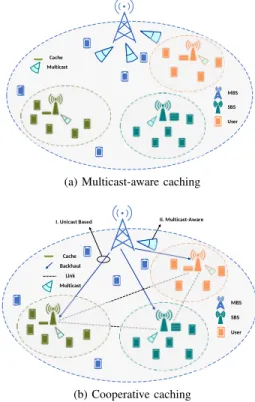
Fig. 1. Cache-enabled heterogeneous small-cell networks.
II. OURMODEL
A. Network Model
A small cell network is considered which comprises a single MBS, and K non-overlapping small cells each con-sisting of a single SBS and Ik users, for the kth cell. Let
K {1, . . . ,K} denote the set of SBSs which operate
in disjoint subchannels with the MBS in order to remove the impact of interference. Besides, any interference among neighboring SBSs is assumed eliminated by techniques such as enhanced inter-cell interference coordination (eICIC) or/and orthogonal multiple access [37], [38]. We assume that the MBS has access to all files in the set F {f1, f2, . . . , fN} with respective file sizes s[s1,s2, . . . ,sN] while the SBSs have limited cache capacities that are subject to a network-wide total cache capacity budget M. We let Mk denote the cache capacity for SBS k, with Mk ≤ Nj=1sj. SBSs can push the cached packets to the users when requested while the uncached parts have to be delivered to the SBSs via backhaul from the MBS (or cooperative SBSs in the case of cooperative caching). Note that the users located outside of any small cells can only be served by the MBS and hence are ignored when considering the backhaul requirements.
1) Multicast-Aware Caching: If this approach is used,
SBSs will fetch the uncached content from the MBS via backhaul using multicast, see Fig. 1a. Based on the file pop-ularity information, we obtain the optimal content placement to minimize the average backhaul load for all possible user request profiles with the overall cache capacity budget.
2) Cooperative Caching: As shown in Fig. 1b, neighboring
SBSs can be connected to each other via high-capacity links to share their cached content in different cells collaboratively.
In this scheme, the uncached content can be fetched from not only the MBS via backhaul but also the cooperative SBSs via the fronthaul links. Considering the different costs for fetching content from the MBS and the neighboring SBSs, we adopt the concept of user attrition (UA) cost introduced in [32] to evaluate the performance of the cooperative caching scheme.1 Cache content placement and the policy for SBS cooperation are to be jointly optimized to minimize the UA cost. Unless stated otherwise, this scheme uses unicast for content delivery.
3) Multicast-Aware Cooperative Caching: In this approach,
multicast-based content delivery and content sharing amongst neighboring SBSs are combined with the aid of MDS codes. In contrast to conventional cooperative caching, multicasting is applied by the MBS to deliver content to the SBSs requesting the same file simultaneously, see Case II of Fig. 1b.
B. MDS Coding
MDS codes are employed to construct pieces of a file that can be put back together to recover the file. They are particu-larly suitable for our settings of multicast-aware caching and cooperative caching in which the cached content in different cells needs to be coordinated. Compared to the case of storing uncoded fragments, MDS codes bring a unique benefit that the coded packets are all independent from each other so that a certain number of randomly drawn packets will be sufficient to recover the file. This allows us to use only the number of packets stored in each cell, instead of the details of the packets, to derive the backhaul load, simplifying the analysis.
We parametrize MDS codes by(lj,nj)such that file j is cut into nj fragments and then coded into lj independent packets by MDS. Any nj packets can rebuild the entire file.
Considering that the kth SBS caches mk,j coded packets of file j , we let mj [m1,j,m2,j, . . . ,mK,j] be the content placement vector for file j . For multicast-aware caching, to ensure that the uncached packets delivered from the MBS are totally different from the ones cached in local servers, file j should be coded into at least
lj = K k=1 mk,j unique packets cached in SBSs
+ nj− min
k∈{1,...,K}mk,j
unique packets delivered via backhual
packets.
For unicast and multicast-aware cooperative caching scenarios, the total number of packets has to be at least
lj = K k=1 mk,j unique packets cached in SBSs
+ nj − min k∈{1,...,K} K t=1 xkt,j
unique packets delivered via backhual
,
where xkt,j denotes the number of packets delivered from SBS t to SBS k to serve the requests for file j so that there is no content overlap in both content sharing process amongst the cooperative SBSs and content delivery phase at the MBS. 1UA cost is the overall cost for fetching content from an external storage.
C. File Popularity Profile
Note that users in different cells may have different prefer-ences towards the files. The most popular file in one cell may receive least attentions from another cell. It is thus better to consider local file popularity in each cell rather than the global popularity in the entire network which is often the case in the literature. Without loss of generality, here we assume that the file popularity in each cell obeys Zipf’s distribution but with unique skewness parameter and popularity rank. According to the Zipf’s law, the frequency for file j to be requested by each user in cell k can then be written as [39]
pk,j = 1/λγkk,j N i=1(1/iγk) , ∀k,j, (1)
whereγkis the skewness in cell k reflecting the concentration of the popularity distribution andλk,j denotes the rank of the popularity of file j in cell k. For instance, λk,j = 1 means file j is the most popular file in cell k. Hence, the probability of file j not being requested by the users in cell k is
αk,j =(1−pk,j)Ik, ∀k,j. (2)
Thus, the probability for file j being requested by at least one of the users in cell k will be 1−αk,j.
III. MULTICAST-AWARECACHING
The aim is to minimize the average backhaul load for all possible user request profiles, meaning that content placement should be done to satisfy different requests for all the cells simultaneously with a single multicast transmission instead of multiple unicast transmissions to each SBS separately.
A. Problem Formulation
Different from the literature where the knowledge of the actual requests from the cells was usually assumed, we analyze all possible request profiles and their probabilities using the learned file popularity. Here, the joint user request profile in all the cells is focused rather than the user request profiles in individual cells. We let j denote the collection of all the possible user request profiles and πj ∈ j denote a particular user request profile for file j in all cells. Given any user request profile πj, Kπj is used to denote the set of the cells where file j is required by the served users. In case that file j is requested in all the cells except cell K , we have πj = [1,1, . . . ,1,0]1×K where 1 means that file j is requested by users in the considered cell while 0 states that none of the users in the cell requests the file. Therefore, it follows thatKπj = {1,2, . . . ,K−1}for the mentionedπj. The joint user request profile for all the files simultaneously can be written as {π1, . . . ,πN}. For each file j , if there are t (≤ K) cells where the served users request file j , the corresponding file request profileπj and the cell setKπj may haveKtpossible combinations. In this way, we evaluate that the total number of differentπj andKπj will be as high as 2K.
The average backhaul load is defined as the average volume of the file packets requiring to be fetched from the MBS via
backhaul with a single multicast transmission in terms of all possible user request profiles. Our objective is to minimize the average backhaul load subject to the overall cache capacity constraint. Mathematically, that is,
min {mk,j} {π1,...,πN} N j=1 1− min k∈Kπj mk,j nj sjPr({π1, . . . ,πN}) (3a) s.t. K k=1 N j=1 mk,j nj sj ≤ M, (3b) 0≤mk,j ≤nj, ∀k,j, (3c)
where Pr({π1, . . . ,πN}) denotes the joint probability that a certain user request profile for all the files, i.e.,{π1, . . . ,πN} appears. Since there are multiple cells, users and also requested files, the required analysis and calculation of the joint prob-abilities would be rather complex. To this end, the following lemma is used to simplify the objective function in (3a).
Lemma 1: Based on the fact that the backhaul load for
a particular file j only relies on πj regardless of {πi}i=j, the average backhaul rate in (3a) can be rewritten as
RmulticastMDS = N j=1 πj∈j 1− min k∈Kπj mk,j nj sjPr(πj). (4)
where Pr(πj)is the probability thatπj appears.
Proof: See [29, Appendix A].
The following lemma exploits the relationships among the elements in mj to express RmulticastMDS in closed form. Let rk,j be the rank of the value of mk,j among those of all the elements in mj. For instance, rk,j =1 means mk,j is the smallest in mj while rk,j =K states that mk,j is the largest.
Lemma 2: The backhaul load in (3a) can be rewritten as RmulticastMDS = N j=1 K k=1 1−mk,j nj sj (1−αk,j) t∈Tk,j αt,j, (5)
in whichTk,j denotes the collection of cells storing no more packets of file j than cell k, i.e.,Tk,j = {t|rt,j <rk,j}.
Proof: See Appendix A. B. Comparison
As a comparison, in the typical unicast case, the backhaul rate for storing uncoded fragments directly or the MDS coded packets would have been given by
Runicast = N j=1 K k=1 1−mk,j nj sj(1−αk,j). (6)
It can be observed in (5) and (6) that additional multipliers 0 < t∈T
k,j αt,j ≤ 1,∀k,∀j appear after using multicast
transmission at the MBS in the content delivery phase, and hence bring a global gain, i.e., RMDSmulticast<Runicast[5]. On the other hand, it is worth pointing out that storing MDS coded packets has advantages over uncoded segments in the case of multicast-aware caching for minimizing the average backhaul rate. We assume that cell k stores mk,j different fragments
randomly drawn from the nj fragments equiprobably, and all fragments except the ones stored in all the cells requesting the particular file have to be sent from the MBS. Therefore,
Runcodedmulticast= N j=1 πj∈j 1−ρπj sjPr(πj), (7)
where ρπj denotes the probability of a certain fragment of file j being stored in all the cells requesting the file given by
ρπj = k∈Kπj nj−1 mk,j−1 nj mk,j = k∈Kπj mk,j nj . (8) Since mk,j
nj ≤ 1,∀k, it holds true that ρπj ≤ mink∈Kπj
mk,j nj . Thus, we derive that RmulticastMDS ≤ RmulticastUncoded. A rigorous proof has been provided in our previous work [39].
C. Optimization
Defining qk,j mk,j
nj and using (5), (3) can be recast into
min {qk,j} N j=1 K k=1 1−qk,j sj (1−αk,j) t∈Tk,j αt,j (9a) s.t. K k=1 N j=1 qk,jsj ≤ M, (9b) 0≤qk,j ≤1, ∀k,j. (9c)
Unfortunately, before {qk,j} are obtained, it is impossible to know the ranks {rk,j}, or Tk,j. To tackle this, we sort the elements of qj,∀j in an ascending order and define the sorted variables as gj [g
1,j, . . . ,gK,j],∀j . To illus-trate the relationships between qj and gj, a new matrix
Y[ytk,j]K×N×K with ytk,j ∈ {0,1}is defined such that
qk,j =
K t=1
gt,jytk,j. (10)
If qk,j is the tth lowest in qj, i.e., rk,j =t, we let ytk,j =1 and ytk,j =0,∀t =t. Note that the ranks are assumed to be
unique integers even if there are several elements of qj equal to each other. The characteristics of {ytk,j} are concluded in the following constraints (11e)–(11g). Now, (9) becomes
min {gt,j},{ytk,j} N j=1 K t=1 1−gt,j sjϕt,j (11a) s.t. K k=1 N j=1 K t=1 gt,jytk,jsj ≤ M, (11b) gt,j ≤gt+1,j, ∀t <K, and∀j, (11c) 0≤gt,j ≤1, ∀t,j, (11d) K t=1 ytk,j =1, ∀k,j, (11e) K k=1 ytk,j =1, ∀t,j, (11f) ytk,j ∈ {0,1}, ∀t,j,k, (11g)
where ϕt,j is the probability that 100gt,j% of file j requires delivery from the MBS via backhaul. Define a new group of variables {σt} satisfying qσt,j =gt,j as the indices mapping
gt,j to qσt,j. For instance,σt =1 states that q1,j ranks the tth in qj, i.e., q1
,j =gt,j. And we can then obtain the expression ofϕt,j given by ϕt,j =(1−ασt,j)
t−1
ν=1ασν,j based on (9a) and the definition of gj. Utilizing (10), it holds true that
ytσt,j =1. Hence,ϕt,j can be further rewritten as
ϕt,j = K k=1 1−αk,j ytk,j t−1 ν=1 K k=1 (αk,jyν,kj) , ∀t >1 (12) withϕ1,j = K k=1 1−αk,j y1k,j.
Due to the coupling among the variables in the constraints as well as the objective function, (11) is a mixed integer nonlinear program (MINLP) and is difficult to deal with. The expression of ϕt,j also makes it too complex to be linearized. As such, reformulation is done here to simplify the constraints.
Lemma 3: Based on the characteristics of{ytk,j}, the overall
cache capacity constraint in (11b) can be re-expressed as K
t=1 N
j=1gt,jsj ≤M. Hence, (11) can be rewritten as
min {gk,j},{ytk,j} N j=1 K t=1 1−gt,j sjϕt,j (13a) s.t. K t=1 N j=1 gt,jsj ≤ M, (13b) (11c)–(11g), (13c)
with the optimal allocated cache sizes given by
Mk = N j=1 K t=1 gt,jytk,jsj, ∀k. (14)
Proof: According to (10), it can be easily proved that (14)
holds. Then utilizing the constraint (11f), we obtain K k=1 Mk = K k=1 N j=1 K t=1 gt,jytk,jsj, = N j=1 K t=1 gt,j K k=1 ytk,j sj = N j=1 K t=1 gt,jsj. (15)
Hence, we get (13b), which completes the proof.
After utilizing Lemma 3, {gt,j} and Y are now decoupled in the constraints of (13). To proceed, we firstly fix{gt,j}and optimize Y. The problem of interest is given by
P({gt,j}): min {ytk,j} N j=1 K t=1 1−gt,j sjϕt,j (16a) s.t. (11e)–(11g), (16b) with {gt,j} satisfying (11c)–(11d) and (13b). Obviously, {ykt,j} are independent with each other in different files in problem (16). As a result, we can separate the problem into a
number of sub-problems with regard to different file j , e.g.,
Pj({gt,j}): min {yk t,j} K t=1 1−gt,j ϕt,j (17a) s.t. K t=1 ytk,j =1, ∀k, (17b) K k=1 ytk,j =1, ∀t, (17c) ytk,j ∈ {0,1}, ∀t,k. (17d) The coupling and complexity of ϕt,j makes it intractable to find the optimal{ytk,j}even when {gt,j} are given. To tackle this problem, we analyze the impact of{ytk,j}on the objective function based on the characteristics of{gt,j}and{ytk,j}, and infer the relations among {ytk,j} and the probabilities {αj}. For illustrative purposes, we let αj [α1,j, α2,j, . . . , αK,j], rearrange the elements inαj in a descending order and define the new vector asβj [β1,j, β2,j, . . . , βK,j]. Let{θk}reflect the one-to-one correspondence between the elements of βj and αj satisfying βk,j = αθk,j,∀k. Meanwhile,αj, βj, and {θk}are all known. The result is given in the following lemma.
Lemma 4: The optimal probability ϕt∗,j would be ϕt∗,j =
1−βt,j tν−=11βν,j. Accordingly, the optimal {ytk,j} to problem (17) are given by
ytk,j =
1, if k=θt,
0, otherwise. (18)
Proof: See Appendix B.
Since Lemma 4 holds true for all the files, (13) becomes min {gt,j} N j=1 K t=1 1−gt,j sj 1−βt,j t−1 ν=1 βν,j (19a) s.t. (13b)–(13c), (19b)
which is convex and hence can be easily solved by well known solvers, e.g., CVX [40]. Then substituting (18) into (14), the optimal cache capacities in each cell can be rewritten as
Mk =
N
j=1
gt,jsj|θ(t)=k, ∀k, (20)
with the optimal content placement given by
qk,j =gt,j|θ(t)=k, ∀k,j. (21)
In the proposed multicast-aware caching scheme, we clas-sify the large number of possible user request profiles into sev-eral types according to the values of the associated backhual load. By doing so, we reduce the computational complexity in terms of user request uncertainty massively fromO(NK)to
O(K N)to obtain the optimal solution. IV. COOPERATIVECACHING
In this section, we consider that the SBSs can fetch content from the neighboring SBSs via some high capacity links and study the optimal cooperative caching policy among the SBSs.
Note that the independence amongst the MDS coded packets cached in all the cells almost surely guarantees that the shared contents are always non-overlapping.
A. Problem Formulation
Cooperative caching consists of three phases: (i) the content placement phase,
(ii) the content sharing phase among the SBSs, and (iii) the content delivery phase from the MBS via backhaul. Note that in the content delivery phase, we assume that unicast is used by the MBS to sent uncached content to the SBSs.
Since backhual load is unable to provide sufficient insight about the impact of cooperative content sharing on reducing the backhual requirements, here we utilize user attrition (UA) cost, i.e., the overall cost for fetching content from an external storage, to evaluate the performance of the cooperative caching schemes. To further eliminate the redundancy, we assume that the SBSs can selectively deliver part of the packets from their own caches to the requested SBS rather than the whole of the cached packets. The amounts of shared content among the cooperative SBSs are defined as X = {xkt,j}K×N×K where
xkt,j denotes the number of packets delivered from SBS t to SBS k for file j . Thus, we let fkt be the associated unit cost when SBS k fetches unit data (e.g., per MB) from SBS t and
fkM be the cost for delivering unit data to SBS k from MBS. The UA costs are modeled as the products of the data loads of the BSs and the associated unit costs [32]. Furthermore, it is assumed that the unit costs are proportional to the square of the minimum distances between the associated BSs with the unit cost coefficients defined as f0 and f0M, respectively, according to [24], [28], and [32]. Note that {fkt}must satisfy the triangle inequality, i.e., fkt ≤ flt + fkl, and the cost for fetching content from local storage can be ignored, i.e.,
fkk =0,∀k. Moreover, the UA costs for fetching content from
the MBS via backhaul are usually higher than those caused by the cooperation between the SBSs due to proximity.
Instead of focusing on the backhaul load, our objective here is to minimize the average UA cost, i.e., the cost of fetching content from external storage, subject to a given overall cache capacity constraint by optimizing the cache content placement and cooperation policy jointly. In this case, the expected UA cost defined as CcoopMDS can be written as
CMDScoop = N j=1 K k=1 1−min 1, K t=1 xtk,j nj fkM + K t=1 xkt,j nj fkt sj(1−αk,j). (22)
Hence, the problem of interest is given by min {mk,j},{xkt,j} CcoopMDS (23a) s.t. K k=1 N j=1 mk,j nj sj ≤ M, (23b) 0≤mk,j ≤nj, ∀k,j, (23c) 0≤xkt,j ≤mt,j, ∀k,j,t, (23d)
where the cache size allocation problem is merged into the optimization of the content placement as mentioned in
Lemma 3. Apparently, xkk,j =mk,j,∀k,j holds true in (23).
B. Comparison
The significance of adopting MDS codes is to avoid content overlap among the fragments stored in different caches, hence reducing the average UA cost. Suppose that SBS k stores mk,j different fragments randomly drawn among the nj fragments and xtk,j of the mk,j fragments are randomly selected to be sent to SBS t. It is difficult to ensure that the fragments from the neighboring cells are always mutually exclusive. Thus, both the number of fragments stored in local cache and sent to other cells and which fragments being cached and shared contribute in deciding the backhaul rate and the average UA cost.
Lemma 5: Given any cooperative caching policy satisfying
constraints (23b)–(23d), the UA cost in the coded scenario is always lower than the associated cost in the uncoded scenario defined as Ccoopuncoded, i.e., CcoopMDS≤Ccoopuncoded.
Proof: See Appendix C.
C. Optimization
We can tackle (23) by proving that the optimal cooper-ative caching policy always satisfies tK=1x
t k,j
nj ≤ 1,∀k,j . Letting ({ ˜xkt,j},{ ˜mk,j}) be the optimal solution to (23) with at least a group of (k∗,j∗) satisfying tK=1x˜
t k∗,j∗
nj > 1, we can always find some ({xtk,j},{ ˜mk,j}) with xkt,j =
˜
xtk,j,∀ (k,j,t)= (k∗,j∗,t)andKt=1
˜
xtk∗,j∗
nj =1 which sat-isfy all the constraints in (23) while demanding the same cost from backhaul but a lower cost from content sharing among the cooperative SBSs. Consequently, the average UA cost is given by CcoopMDS= N j=1 K k=1 1− K t=1 ztk,j fkM+ K t=1 zkt,j fkt ×sj(1−αk,j), (24) where we let qk,j = mk,j nj and z t k,j = xkt,j nj . Problem (23) can then be rewritten as min {qk,j},{ztk,j} (24) (25a) s.t. K k=1 N j=1 qk,jsj ≤ M, (25b) 0≤qk,j ≤1, ∀k,j, (25c) K t=1 ztk,j ≤1, ∀k,j, (25d) 0≤ztk,j ≤qt,j, ∀k,j,t, (25e) which is linear and can easily be solved using, e.g., CVX.
For comparison, the average UA cost in the unicast based non-cooperative caching scenario is given by
Cnoncoopunicast = N j=1 K k=1 1−qk,j fkMsj(1−αk,j). (26) As fkt ≤ fkM and zkk,j =qk,j,∀k,t,j , we have CcoopMDS ≤ N j=1 K k=1 ⎛ ⎝1− K t=1 zkt,j+ t=k zkt,j ⎞ ⎠ × fkMsj(1−αk,j)≤Cnoncoopunicast . (27)
V. MULTICAST-AWARECOOPERATIVECACHING In this section, a compound caching policy named multicast-aware cooperative caching is proposed to take the advan-tages of both multicasting at the MBS and collaboration among the SBSs. Global optimal caching scheme is proposed for small scale networks followed by the multicast-aware in-cluster cooperative caching scheme developed particularly for the large scale networks.
A. Small Scale Networks
Lemma 6: In case of multicast-aware cooperative caching,
the UA cost can be written as
CmultMDS,coop = N j=1 ⎡ ⎣ πj∈j 1− min k∈Kπj K t=1 ztk,j max k∈Kπj f M k ×Pr(πj)+ K k=1 K t=1 ztk,jfkt(1−αk,j) sj. (28)
Proof: See Appendix D.
The average UA cost minimization problem is min
{qk,j},{ztk,j}
CmultMDS,coop s.t.(25b)–(25e). (29) We recognize that similar content in different cells is preferred for multicast-aware caching while for cooperative caching the cached content in different cells should be mutually exclusive. The use of MDS codes strikes a balance in the combination. It is worth pointing out that multicast-aware cooperative caching brings additional multicast gain in most cases in terms of minimizing the long term average UA cost considering the large numbers of BSs, files, and user request profiles while unicast content delivery might only be preferred in rare extreme cases, e.g., when only a few cells with steeply graded unit costs require the same file. To eliminate the impact of these special cases, a new group of binary variable can be introduced to identify which content delivery strategy is preferred for each user request profile in the case of small scale networks.
Lemma 7: Given any mutlicast-aware cooperative caching
policy({qk,j},{ztk,j})satisfying the constraints in (29), the UA cost in the coded scenario is always much lower than that in the uncoded case, i.e., CmultMDS,coop≤Cuncodedmult,coop.
Proof: See Appendix E.
To solve (29), we resort to a greedy algorithm by listing all possible user request profiles for each file. Furthermore, a number of new variables and constraints need to be added to linearize the function min(·). That is, for any user request profile πj, we introduce a new variable ξπj subject to the constraints, i.e., (0≤ξπj ≤ K t=1ztk,j,∀k∈Kπj), to replace mink∈Kπ j K
t=1ztk,j in (28). Since (29) can be linearized, general solvers can be employed to solve it for small-scale networks. However, in practical scenarios with dozens of BSs and thousands of files, the greedy approach is not viable.
B. Large Scale Networks
In order to reduce the complexity in large scale networks, we propose a multicast-aware in-cluster cooperative caching scheme by decomposing a macro cell into a series of annular regions {Cu,∀u ∈ [1,U]} with their radii between Ru ±
Ru (Ru Ru). In each annulus, the neighboring SBSs form a number of disjoint clusters defined as{S1u,S2u, . . . ,SuL
u} where Lu is the number of clusters in the uth annulus. Let |Slu| denote the number of SBSs in cluster Slu. It is assumed that the SBSs in the same cluster Slu can share content over high capacity links with a cost flu = f0d
u l where
dlu is the average of the squares of the distances among the cooperative SBSs. The cost for retrieving content from the MBS is fuM = f0M Ru2 where Ru is the radius for the uth annulus. The UA cost in clusterSlu is given by
Clu = N j=1 ⎡ ⎢ ⎣ πu l,j∈lu,j ⎛ ⎝1− min k∈Kπu l,j t∈Su l ztk,j ⎞ ⎠ fuMPr(πul,j) + k∈Slu t∈Slu\k ztk,jflu(1−αk,j) ⎤ ⎦sj. (30) Therefore, this scheme solves
min {qk,j},{ztk,j} u l Clu (31a) s.t. t∈Slu zkt,j ≤1, ∀k∈Slu,∀j, ∀l, ∀u, (31b) 0≤ztk,j ≤qt,j, ∀t,k∈Slu, ∀j, ∀l, ∀u, (31c) 0≤qk,j ≤1, ∀k∈Slu, ∀j, ∀l, ∀u, (31d) u l j k∈Slu qk,jsj ≤M. (31e)
For the sake of mathematical tractability, we decompose the problem into a number of sub-problems each minimizing the UA cost for a cluster. In this case, we let qk,j =qlu,j,∀k ∈
Su
l,∀j,l,u and the sub-problem for clusterSlu is given by
P({qlu,j}): min {zkt,j} Clu (32a) s.t. t∈Sul ztk,j ≤1, ∀k∈Slu, ∀j, (32b) 0≤ztk,j ≤qlu,j, ∀t,k∈Slu, ∀j. (32c) Because the cost for fetching content from local cache can be ignored, it holds true that zkk,j =qlu,j,∀k∈Slu. For any given
cache composition satisfying the constraints (31b)–(31e), we find it important to understand the volume of content that is needed to be fetched from the MBS via backhaul. Let Dlu= N
j=1
k∈Sluqlu,jsj (1 − αk,j). Given cache composition,
Dluis always constant and hence can be ignored. The objective function can then be further reformulated into
Clu =Clu+Dlu= N j=1 ⎡ ⎢ ⎣ πu l,j∈ul,j ⎛ ⎝1− min k∈Kπu l,j λk,j ⎞ ⎠ ×fuMPr(πul,j)+ k∈Slu λk,jflu(1−αk,j) ⎤ ⎦sj. (33) where λk,j = t∈Su l z t
k,j denotes the percentage of file j accessible to SBS k within the cluster and is subject to
0≤ λk,j ≤1, ∀k∈Slu, ∀j, (34)
qlu,j ≤ λk,j ≤ |Slu|qlu,j, ∀t,k∈Slu, ∀j. (35)
Note that with the assumption of homogeneous content place-ment in the SBSs in the same cluster, this gives the overall percentage of a certain file j SBS k gets access to, i.e., λk,j. In the following, we focus on obtaining the optimal values of {λk,j}. Similar to the multicast-aware caching scenario, the objective function can be rewritten as
Clu= N j=1 k∈Su l ⎡ ⎣1−λk,j fuM (1−αk,j) t∈Tk,j αt,j +λk,j flu (1−αk,j) ⎤ ⎦sj, (36) where Tk,j is the set of cells satisfying Tk,j = {t|rt,j <
rk,j} as in Lemma 5. In this case, we manage to obtain the actual relation amongst λk,j,∀k ∈ Slu in the following lemma.
Lemma 8: Given any homogeneous cache decomposition
in cluster Slu, it holds true that the optimal percentages for file j accessible to the SBSs within the cluster either at local cache or from the cooperative SBSs are always the same regardless of the distinct probabilities for file j being requested by users in different cells, i.e., λk,j = λt,j,∀k,
t ∈Slu.
Proof: See Appendix F.
According to Lemma 8, we let λk,j =λul,j,∀k ∈ Slu. The associated UA cost in (30) can be rewritten as
Clu = j 1−λul,j fuMωlu,jsj+ j=1 k∈Su l λk,j −qlu,j ×flu(1−αk,j)sj, (37) where ωul,j is the probability for file j being requested by any of the users served by the SBSs in the cluster Slu given by ωu l,j =1− k∈Slu αk,j, ∀j,l,u. (38)
Therefore, (31) can then be recast into min {qlu,j},{λul,j} u l Clu (39a) s.t.0≤λlu,j ≤1, ∀j, ∀l, ∀u, (39b) qlu,j ≤λul,j ≤ |Slu|qlu,j, ∀j, ∀l, ∀u. (39c) 0≤qlu,j ≤1, ∀j, ∀l, ∀u, (39d) u l j qlu,jsj ≤ M. (39e)
The problem is now linear with smaller sets of variables and constraints and can be solved by well-known solvers.
VI. SIMULATIONRESULTS
Here, we evaluate the performances of the proposed coded caching schemes in terms of the average backhaul load as well as the UA cost via computer simulations. A typical small cell network with K = 10 cells and N = 100 files is considered for the evaluation of multicast-aware caching scheme and the overall cooperative caching schemes while a large scale network with K =28,N =1000 is considered for in-cluster cooperative caching schemes. The MBS is located at the center of the macro cell with radius R=400km while the SBSs are randomly deployed uniformly within the cell without coverage overlapping. To show clearly the capabilities for the SBSs to accommodate the files, the overall cache capacity budget is presented as the average cache size for each SBS scaled by the overall file size given by ρ = M/K/jsj. Unless otherwise specified, we set ρ = 0.25 for multicast-aware caching and in-cluster caching schemes whileρ=0.05 is assumed for overall cooperative caching schemes to ensure the participation of backhual in content delivery. The file sizes are randomly chosen uniformly within[0,500]MB. The skewness parameters{γk}are selected randomly within[0,2] while the popularity ranks of the files in each cell are generated randomly. Also, the number of users in each cell is set to be ranged within [0,10], respectively. For cooperative caching, the neighboring SBSs are linked when the distances between them are less than a given threshold. Here, we consider that two SBSs can share content in their caches when the cost for retrieving content from the other SBS is lower than that of fetching content from the MBS. The unit cost coefficients for the two routes for fetching content from external storage are set as f0M =2 and f0=1.
Below describes all the considered schemes.
• Unicast-Based Caching (Non-Cooperative Caching):
This is the unicast-based non-cooperative caching scheme with optimal cache management in [26].
• Multicast-Aware Caching (Uniform): This scheme
per-forms multicast-aware caching with uniform cache size allocation and content placement.
• Multicast-Aware Caching (Popularity): This is same as
above except with popularity based content placement.
• Multicast-Aware Caching: This refers to our proposed
multicast-aware caching scheme with optimal cache con-tent placement.
• Multicast-Aware Caching (Low Bound): This refers to
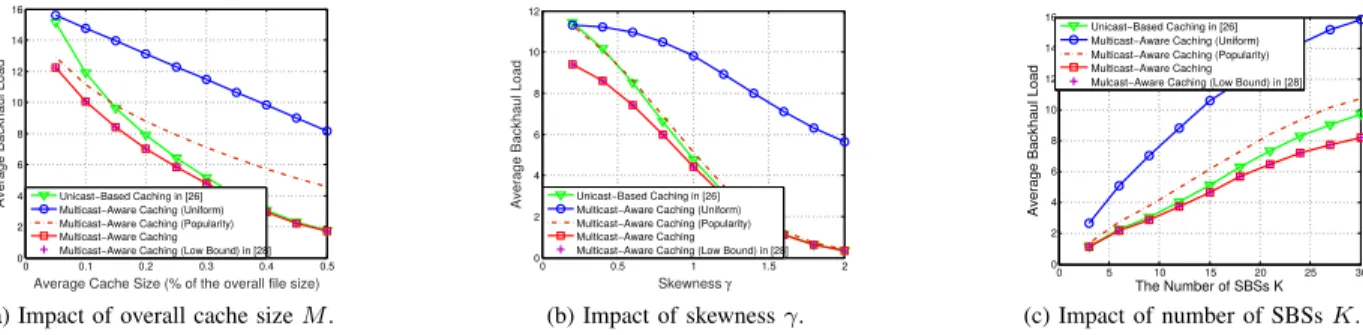
Fig. 2. The average backhaul rate of the proposed multicast-aware caching scheme versus the unicast based caching scheme and the multicast-aware caching schemes.
placement of the linear relaxed multicast aware uncoded caching problem in [28]. Notice that this is practically impossible and only serves as a lower bound.
• Cooperative Caching: This corresponds to our proposed
unicast-based cooperative caching scheme with optimal cache management and cooperation policy.
• Multicast-Aware Cooperative Caching (Uniform):
This is the multicast-aware cooperative caching scheme that uses uniform cache size allocation and content placement.
• Multicast-Aware Cooperative Caching (Popular-ity): Same as above except with popularity content
placement.
• Multicast-Aware Cooperative Caching: This refers
to our proposed multicast-aware cooperative caching with optimal cache management and cooperation policy.
• In-Cluster Cooperative Caching: This scheme is similar
to cooperative caching except that cooperation is enabled among the SBSs in the same clusters.
• Multicast-Aware In-Cluster Cooperative Caching:
This scheme is similar to multicast-aware cooperative caching except that multicasting and cooperation are enabled among the SBSs in the same clusters.
1) Multicast-Aware Caching: Results in Fig. 2 are provided
for the proposed multicast-aware caching scheme, with differ-ent contdiffer-ent placemdiffer-ents, and compared with the uniform based caching scheme. Moreover, the impacts of different parameters and file profile are investigated. As can be seen in Fig. 2a, the increase of overall cache size budget leads to a decrease in backhaul rates in all the cases. Also, the proposed multicast-aware caching scheme with optimal content placement, which reaches the low bound of the multicast aware uncoded caching scheme in [28] using linear relaxation and optimal cache management at much lower commuting complexity, shows apparent advantages over the unicast based scheme as expected while the multicast-aware caching schemes with uniform and popularity based content placement show worse performances due to the naive cache management, confirming the signifi-cance of multicast transmission in content delivery as well as the centralized cache management in heterogeneous small cell networks. Similar results can be observed in Fig. 2b against the skewness parameter of the Zipf’s distribution, withγ =γk,∀k and distinct popularity ranks for the files in different cells. The impact of the number of BSs on the backhaul rate is
shown in Fig. 2c where the gain improves in denser networks. Again, the multicast-aware scheme outperforms other caching schemes.
2) Cooperative Caching (Unicast and Multicast): Results
in Fig. 3 compare the performance of the proposed cooperative caching schemes with that of the non-cooperative scheme in terms of the average UA cost. As can be observed, the pro-posed multicast-aware cooperative caching scheme shows the best performances followed by the unicast based cooperative caching scheme while the non-cooperative caching scheme yields the worst performance in all the cases. In addition, the multicast-aware cooperative caching schemes using com-mon content placement demand higher UA costs compared with the proposed optimal multicast-aware caching scheme as expected. As we see in Fig. 3a, the UA costs decrease with the overall cache size in all cases. Apparently, the utility of cooperation in caching and multicast-aware caching reduce the average UA cost in the network dramatically. For compari-son, we also present the results of multicast-aware in-cluster cooperative caching scheme with the maximum cluster size, i.e., the maximum number of SBSs in the clusters defined asη, equal to 2 and 3, respectively. Though the in-cluster caching scheme causes certain performance loss compared with the overall cooperative caching schemes, it largely reduces the computational complexity which makes it suitable for large-scale networks where overall cooperative caching schemes are unviable. Moreover, we can see in the figure that the performance gap can be narrowed by increasing the maximum cluster sizeη. Fig. 3b presents the cache size allocation among the SBSs using different caching schemes when ρ = 0.05. Results show that the optimal cache sizes for different cells are always heterogeneous as opposed to the assumption of uniform cache size allocation in many caching networks. Similar conclusions on the impacts of the skewness and the number of users to the non-cooperative case mentioned above can be drawn from Figs. 3c and 3d. Next, Figs. 3e and 3f investigate the impacts of the number of files and the cost coefficient f0M. As we can see in Fig. 3e, the UA cost reduction of the proposed multicast-aware cooperative caching scheme decreases with the number of files whenρ=0.05 and
sj =250MB,∀j to unicast based cooperative scheme. Finally, the impact of the ratio between the unit cost coefficients is studied in Fig. 3f where f0 = 1 but f0M varies. Apparently, the UA cost of the non-cooperative caching scheme is propor-tional to f0M while the cooperative schemes have much better
Fig. 3. The average UA cost of the proposed cooperative caching schemes versus the non-cooperative scheme.
Fig. 4. The average UA cost of the proposed multicast-aware in-cluster cooperative caching scheme versus in-cluster cooperative caching scheme and non-cooperative caching scheme.
tolerance towards the increase of f0M for fetching content via backhaul.
3) Multicast-Aware and in-Cluster Cooperative Caching:
Now, a large-scale small cell network with K =28 cells and
N = 1000 files is considered where the greedy algorithm for multicast-aware cooperative caching scenario is no longer efficient due to high computational complexity and hence in-cluster cooperative caching schemes are considered. Here we assume typical grid deployment of the SBSs as depicted in Fig. 4a. The MBS is located at the center of the macro cell with radius R = 400km and the distance between any two of the neighboring SBSs is fixed at d = R/3.
The SBSs are divided into 4 annuli based on the distances and then the neighboring SBSs in each annulus are allocated into a number of disjoint clusters where the SBSs in the same color form a cluster. Unless stated otherwise, same parameters as before are used.
Results for the multicast-aware in-cluster caching scheme are provided in Fig. 4. We see that the multicast-aware in-cluster cooperative caching scheme achieves the best UA cost performance followed by the in-cluster cooperative caching scheme while the non-cooperative caching scheme gives the highest UA cost. Compared with that in small scale networks, the UA cost reduction becomes more obvious. The reason may
be that the network topologies are different and denser which gives rise to larger number of clusters and the average cluster size than those in the previous scenarios.
VII. CONCLUSIONS
In this paper, we considered the design of content caching and sharing for cache-enabled heterogeneous small cell works using MDS codes under heterogeneous file and net-work settings. We first presented two coded caching schemes, dubbed as the multicast-aware caching and the cooperative caching schemes, for minimizing the long-term average back-haul load or the UA cost subject to the overall cache capacity constraint. In both cases, we have obtained the optimal content placement by reformulating the original problems into convex ones. A compound caching scheme, referred to as multicast-aware cooperative caching, was then proposed exploiting the independence of MDS coded packets to further reduce the backhaul requirements. In this case, a greedy algorithm can be used for small scale networks while for large scale networks a multicast-aware in-cluster cooperative caching algorithm was developed. The advantages of storing coded packets over the uncoded fragments in all the scenarios as well as the benefits of utilizing multicast-aware caching and/or cooperative caching over common caching schemes have been analyzed.
APPENDIXA
Firstly, we divide the possible user request profiles for each file, e.g.,πj into K+1 types defined as{π0j,π1j,π2j, . . . ,πKj} according to the different values of the associated back-haul load (in percentage) for file j , i.e., {0,1 − m1,j
nj ,1− m2,j
nj , . . . ,1 − mK,j
nj }, respectively. Note that π 0
j states that file j is not requested by users in any of the cells, and hence backhaul is no longer needed in this case. If cell k stores the least number of packets of file j among all the cells requesting file j , i.e., mint∈Kπ
j mt,j
nj = mk,j
nj , then the associated user request profile πkj will imply that file j is requested by cell k and that there will not be any cell t satisfying
rt,j <rk,j. Considering the definition ofTk,j, we obtain that
Pr(πkj) = (1−αk,j)
t∈Tk,jαt,j. Summing up all types of user request profiles {πkj} for all files, the average backhaul rate can be written as (5) which ends the proof of the lemma.
APPENDIXB
Here pairwise comparison is used to tackle the problem caused by the uncertain relation of {αϑν,j}. Firstly, we utilize a simple example to help better clarify this lemma.
Example 1: Let K = 3. Then it follows that αj =
[α1,j, α2,j, α3,j]. Now, assume that for any given j , the only three nonzero elements of{ykt,j}are given by yθ1
1,j =1,yθ 2 2,j = 1,yθ3 3,j = 1. Then we let ϕt,j = 1−αθt,j tν−=11(αθν,j),∀t using (12). As such, the objective function can be rewritten as
RmulticastMDS = 1−g1,j 1−αθ1,j +1−g2,j 1−αθ2,j ×αθ1,j+ 1−g3,j 1−αθ3,j αθ1,jαθ2,j. (40)
Now we prove that the optimal{ykt,j}must ensure thatαθ1,j ≥ αθ2,j ≥ αθ3,j by contradiction. Assume αθ2,j < αθ3,j and
calculate RMDSmulticast using (40). Then we exchange the values ofαθ2,j andαθ3,j and recalculate the objective function. The
difference between the former and the later objective function can be given by RMDS multicast= g3,j−g2,j αθ1,j αθ3,j−αθ2,j . (41)
Considering g2,j ≤ g3,j and αθ2,j < αθ3,j, we prove that
RMDS
multicast≥0. That is to say, for any αθ2,j < αθ3,j, we can
always obtain a smaller or at least equal objective function by exchangingαθ2,j andαθ3,j. Hence,αθ2,j ≥αθ3,j is essential to
minimize the backhaul load. In the same way, we can prove that αθ1,j ≥ αθ2,j. Consequently, αθ1,j ≥ αθ2,j ≥ αθ3,j is
proved. The same conclusion can easily be extended to the K cell scenario which indicates that αθ1,j ≥ αθ2,j ≥ · · ·αθK,j.
The rigorous mathematical proof is presented below.
We letφνj,∀ν=2,3, . . . ,K be the summation of the items
in RmulticastMDS that involvesαϑν−1,j andαϑν,j, given by
φj ν = ν k=ν−1 1−gk,j (1−αϑk,j) k−1 t=1 αϑt,jsj. (42)
Since αϑt,j,t = 1,2, . . . , ν −2 are interchangeable in φνj, the relation among them will not affect the value of φνj as well as the relation betweenαϑν−1,j andαϑν,j. Consequently, we consider the derivatives of αϑν−1,j and αϑν,j in φνj as follows ∂φj ν ∂αϑν−1,j =gν−1,j−1+ 1−gν,j (1−αϑν,j) ν−2 t=1 αϑt,jsj, (43) ∂φj ν ∂αϑν,j = − 1−gν,j ν−1 t=1 αϑt,jsj. (44) Letνj = ∂α∂φνj ϑν ,j − ∂φj ν
∂αϑν−1,j, and we obtain that
j ν = N j=1 1−gν,j αϑν,j−αϑν−1,j ν−2 t=1 αϑt,jsj +(gν,j−gν−1,j) ν−2 t=1 αϑt,jsj. (45)
Because νj = 0 indicates that αϑν−1,j and αϑν,j are inter-changeable, here we focus on the case when νj = 0. If νj > 0, it follows that the derivative of αϑν,j in φνj is higher than that of αϑν−1,j, which is to say, the weight
for αϑν,j in terms of the weighted summationφνj is higher. Hence, we should letαϑν,j ≤αϑν−1,j in order to minimize the
objective function RMDSmulticast. On the contrary, ifνj <0, then it holds true that αϑν,j ≥ αϑν−1,j. Consequently, assuming
that νj < 0, we obtain αϑν,j ≥ αϑν−1,j and hence the
right side of (45) is always non-negative since gν,j ≤ 1 and
gν−1,j ≤ gν,j, which conflicts with the assumption. Hence, it holds true thatνj ≥0 and αϑν,j ≤αϑν−1,j and the lemma
is then proved.
Based on the definition of βj and the conclusion drawn above, we derive that βj = [αθ1,j, αθ2,j, . . . , αθK,j]. As a