Pr
e
-pr
oce
ss
in
g
fea
tur
e
se
le
cti
o
n
“T
w
o
st
ag
e
app
roac
h
”
No
p
re
-p
roce
ss
in
g
“One
st
ag
e
ap
p
ro
ach
”
Al l D at a Sds sS _ac nt >1 lo gP > 5 lo gP = <5 Sds sS _ac nt >1Oral ab
sorp
tion
Q
SAR Mod
el
s
V
s.
ACS Paragon Plus Environment
Pre-processing feature selection for improved C&RT models for oral absorption
1
Danielle Newbya, Alex. A. Freitasb, Taravat Ghafouriana,c*
2
aMedway School of Pharmacy, Universities of Kent and Greenwich, Chatham, Kent, ME4 3
4TB, UK 4
bSchool of Computing, University of Kent, Canterbury, Kent, CT2 7NF, UK 5
c Drug Applied Research Centre and Faculty of Pharmacy, Tabriz University of Medical
6
Sciences, Tabriz, Iran 7
* Corresponding Author, Email: [email protected]; Tel +44(0)1634 202952; Fax 8 +44 (0)1634 883927 9 10 11 12 13 14 15 16 17 18 19 20 21 22 23 24 25 2 3 4 5 6 7 8 9 10 11 12 13 14 15 16 17 18 19 20 21 22 23 24 25 26 27 28 29 30 31 32 33 34 35 36 37 38 39 40 41 42 43 44 45 46 47 48 49 50 51 52 53 54 55 56 57 58
Abstract
26
There are currently thousands of molecular descriptors that can be calculated to represent a 27
chemical compound. Utilising all molecular descriptors in Quantitative Structure-Activity 28
Relationships (QSAR) modelling can result in overfitting, decreased interpretability and thus 29
reduced model performance. Feature selection methods can overcome some of these 30
problems by drastically reducing the number of molecular descriptors and selecting the 31
molecular descriptors relevant to the property being predicted. In particular, decision trees 32
such as C&RT, although they have an embedded feature selection algorithm, can be 33
inadequate since further down the tree there are fewer compounds available for descriptor 34
selection and therefore descriptors may be selected which are not optimal. In this work we 35
compare two broad approaches for feature selection: (1) a “two-stage” feature selection 36
procedure, where a pre-processing feature selection method selects a subset of descriptors, 37
and then classification and regression trees (C&RT) selects descriptors from this subset to 38
build a decision tree; (2) a “one-stage” approach where C&RT is used as the only feature 39
selection technique. These methods were applied in order to improve prediction accuracy of 40
QSAR models for oral absorption. Additionally, this work utilises misclassification costs in 41
model building to overcome the problem of the biased oral absorption datasets with more 42
highly-absorbed than poorly-absorbed compounds. In most cases the two stage feature 43
selection with pre-processing approach had higher model accuracy compared with the one 44
stage approach. Using the top 20 molecular descriptors from random forest predictor 45
importance method gave the most accurate C&RT classification model. The molecular 46
descriptors selected by the five filter feature selection methods have been compared in 47
relation to oral absorption. In conclusion, the use of filter pre-processing feature selection 48
methods and misclassification costs produce models with better interpretability and 49
predictability for the prediction of oral absorption. 50
Keywords:
51
Oral absorption, intestinal absorption, in silico, classification, feature selection, QSAR 52 53 2 3 4 5 6 7 8 9 10 11 12 13 14 15 16 17 18 19 20 21 22 23 24 25 26 27 28 29 30 31 32 33 34 35 36 37 38 39 40 41 42 43 44 45 46 47 48 49 50 51 52 53 54 55 56 57 58
1. Introduction
54
The cost of bringing a drug to the market keeps on increasing 1, 2. The expense is likely to rise
55
further with higher costs of everything from consumables to clinical studies and also tighter 56
regulations governing acceptance of oral drugs on the market 3. Although there has been a
57
successful effort to reduce compound attrition rates by incorporating pharmacokinetic (PK) 58
assays in a high throughput manner earlier in drug discovery, compounds are now failing for 59
other reasons as well as poor PK such as efficacy and toxicity 4. There is specific interest in
60
predicting the intestinal absorption of new chemical entities (NCEs) as the oral route is the 61
dominant route of drug delivery due to ease of administration and patient acceptance 5, 6. In
62
silico modelling of intestinal absorption using QSAR (Quantitative Structure-Activity 63
Relationships) can be used as a cost effective strategy to remove unsuitable compounds based 64
on physicochemical properties and chemical structure alone. Moreover, in silico modelling
65
can be used in tandem with high throughput assays in drug discovery and act as a guide to 66
select appropriate assays that will help understand the mechanistic absorption properties of 67
compounds 7.
68
QSAR involves the mathematical relationships between a molecular structure and biological 69
activity. However this relationship cannot be determined directly, therefore molecular 70
descriptors that describe the chemical structure are calculated to derive relationships between 71
the molecular descriptors and activity. Molecular descriptors are numerical representations of 72
the chemical structure. Molecular descriptors can be classed as 0, 1, 2, 3 and 4D groups 8.
73
Simple 0D descriptors are counts of atom and bonds in structure such as molecular weight 74
and number of hydrogen atoms in a molecule. Molecular descriptors that count structural 75
fragments, atomic properties or fingerprints are classed as 1D. Examples of 1D are number of 76
hydrogen bond donors or acceptors. Topological descriptors based on the 2D structure of the 77
molecule are predicted using graph theory, vectors and indices, and examples include the 78
kappa shape, chi connectivity indices 9 and topological polar surface area 10. More
79
complicated molecular descriptors such as 3D and 4D require the 3D coordinates of the 80
structure. 3D descriptors are geometric descriptors and there are two types based on the 81
internal or external orientation properties of the molecule. Good examples of 3D descriptors 82
are energies relating to the orbitals of the atoms in the compound such as the lowest
83
unoccupied molecular orbital (LUMO) and the highest occupied molecular orbital (HOMO) 84
energies. These molecular descriptors are derived from quantum chemistry theories and relate 85 2 3 4 5 6 7 8 9 10 11 12 13 14 15 16 17 18 19 20 21 22 23 24 25 26 27 28 29 30 31 32 33 34 35 36 37 38 39 40 41 42 43 44 45 46 47 48 49 50 51 52 53 54 55 56 57 58
to the reactivity of the compound. Finally 4D descriptors are based on the 3D structure but 86
take into account the different flexibilities of the structure 8.
87
In order to produce a model that is robust and high in predictive power, a wide choice of
88
molecular descriptors is very important. Identifying the relevant descriptors correlating with 89
intestinal absorption can be carried out using statistical feature selection methods although, 90
additionally, educated assumptions can be made about physiological and physicochemical 91
factors that influence the process of oral absorption to choose the useful descriptors 11.
92
Feature selection is used frequently in QSAR and data mining to selectively minimise the 93
number of independent variables (molecular descriptors) used to accurately describe the 94
dependent variable – i.e., absorption 12. Feature selection is important for numerous reasons.
95
Firstly, fewer molecular descriptors increase interpretability and understanding of resulting 96
models 13, 14. Secondly feature selection can provide improved model performance for the
97
prediction of new compounds 15, 16. Finally, it can reduce the risk of overfitting from noisy
98
redundant molecular descriptors 17.
99
Feature selection can be split into two broad categories: data pre-processing or embedded 100
methods. Data pre-processing feature selection involves reduction of the number of molecular 101
descriptors before model building, unlike embedded methods that incorporate the feature 102
selection into the training and building of the model 17, 18. Data pre-processing techniques can
103
be further split into filter and wrapper techniques. Filter techniques usually involve 104
calculating a relative score of the molecular descriptors and ranking them in order of best 105
score, and the descriptors that are at the top of the list are then used as input for classification. 106
Examples of these are chi square and information gain. Wrapper techniques consider a 107
number of subsets of molecular descriptors, evaluate each of these based on the predictive 108
performance of a classification model built from that descriptor subset and eventually select 109
the descriptor subset with the best predictive performance 19. In comparison of filter and
110
wrapper methods, there are advantages and disadvantages. The choice of method depends on 111
many things such as interpretability, predictability and computational cost. 112
Filter methods offer a fast and simple way to select important descriptors. In addition, 113
because they are independent of the classification algorithm, the score for each descriptor 114
only needs to be calculated once, and the selected descriptors can be used as input for a 115
variety of classification algorithms. A disadvantage of univariate filter methods is they fail to 116
account for interactions between independent variables as most measure the correlation 117 2 3 4 5 6 7 8 9 10 11 12 13 14 15 16 17 18 19 20 21 22 23 24 25 26 27 28 29 30 31 32 33 34 35 36 37 38 39 40 41 42 43 44 45 46 47 48 49 50 51 52 53 54 55 56 57 58
between the dependent variable and each independent variable separately. This can be 118
overcome by multivariate methods which take into account independent variable interactions. 119
Wrapper techniques on the other hand are usually more computationally expensive, but 120
unlike many univariate filter techniques, they take into account independent variable 121
interactions 17, 18. In addition, hybrid filter and wrapper methods have also been developed as
122
successful feature selection techniques 20
123
Most oral absorption models in the literature have utilised feature selection methods either in 124
pre-processing or in model development. There are many types of research in the literature 125
that focus on different issues of oral absorption modelling; e.g. those that focus on obtaining 126
a high predictive model with the feature selection not as the primary focus, but just as a part 127
of the modelling process 21; and those that compare different feature selection techniques and
128
compare the molecular descriptors chosen by the different techniques 11, 20. However, an
129
underlying problem of oral absorption models in the literature is that they were developed 130
using current oral absorption datasets in the literature which are highly biased towards the 131
prediction of highly-absorbed compounds 21-24. This is due to availability of more data on
132
marketed drugs which are mostly highly-absorbed in contrast with data on compound and 133
drug candidates that never made into the market and failed during drug discovery. The 134
models in this case may predict high absorption rate for poorly-absorbed compounds, i.e. 135
false positives. This is not an ideal scenario as in drug discovery more compounds are now 136
poorly-absorbed due to higher lipophilicity and poor aqueous solubility of current drug
137
candidates 25, 26.
138
Two methods have been studied previously to overcome the problem of biased oral datasets 139
that show the effect of data distribution in the training sets for regression and classification. 140
Firstly under-sampling the majority class, highly-absorbed compounds, to create a balanced 141
training set with the same number of poorly and highly-absorbed compounds 27. The second
142
technique utilises the whole biased dataset but applies misclassification costs to reduce false 143
positives 28. The use of higher misclassification costs for model development should improve
144
the predictive power of the model built with the molecular descriptor subsets chosen by 145
appropriate feature selection methods. 146
This work investigates five pre-processing filter feature selection techniques for selecting 147
subsets of molecular descriptors. The comparison of these different feature selection 148
techniques is anticipated to give an idea of the relative abilities of the different techniques 149 2 3 4 5 6 7 8 9 10 11 12 13 14 15 16 17 18 19 20 21 22 23 24 25 26 27 28 29 30 31 32 33 34 35 36 37 38 39 40 41 42 43 44 45 46 47 48 49 50 51 52 53 54 55 56 57 58
based on their prediction ability on the validation set. Furthermore, we compare two broad 150
approaches for feature selection: (1) a “two-stage” feature selection procedure, where in the 151
first stage a pre-processing feature selection method selects a subset of descriptors, and in the 152
second stage classification and regression trees (C&RT), which is itself an embedded feature 153
selection method, selects a subset of the descriptors selected by the filter technique to build a 154
decision tree; (2) a “one-stage” approach where C&RT is used as the only feature selection 155
technique, without using data pre-processing feature selection methods. A comparison 156
between these two approaches could indicate the usefulness of pre-processing feature 157
selection for C&RT analysis. Additionally, this work utilises misclassification costs in model 158
building to overcome the problem of biased datasets. This work offers an investigation of 159
feature selection techniques which reduces the number of molecular descriptors, increasing 160
interpretability of resulting models and combined with this the use of misclassification costs 161
in model development to increase model predictability when analyzing a biased dataset. 162
Therefore this work offers a novel combination of pre-processing feature selection combined 163
with misclassification costs to develop models for biased oral absorption datasets. 164
2. Methods and Materials
165
2.1 Dataset and Misclassification Costs
166
The published dataset of Hou et al21 containing %HIA (Percent Human Intestinal Absorption)
167
data for 645 drugs and drug-like compounds was utilised for development and optimisation 168
of models. An additional set of data was collated from literature to serve as the external 169
validation set. The %HIA values and references for the external validation set can be found in 170
the Supporting Information. 171
All the compounds in Hou et al’s data set were sorted by ascending %HIA values and then by 172
logP values. The %HIA ascending values were put into groups of six then 5/6th of these 173
compounds were placed randomly in the training set and the remaining into the parameter 174
optimisation set (internal test set). The training set was used to train the model in C&RT; the 175
parameter optimisation set was used to obtain the best parameters for the models. In addition, 176
the external validation set was used to show the predictive ability of the models created with 177
an unseen validation set. All compound sets had similar data distributions of highly and 178
poorly-absorbed compounds to create a fairer more controlled validation of the models. The 179 2 3 4 5 6 7 8 9 10 11 12 13 14 15 16 17 18 19 20 21 22 23 24 25 26 27 28 29 30 31 32 33 34 35 36 37 38 39 40 41 42 43 44 45 46 47 48 49 50 51 52 53 54 55 56 57 58
exact number of compounds in the training, parameter optimisation and validation set are 180
shown in Table 1.
181
Table 1. Numbers of Compounds for training, parameter optimisation and validation sets 182
Data Set Number of
compounds (N)
Training set 534
Parameter optimisation set 107
Validation set 48
183
As stated previously the data set is highly skewed with many more highly-absorbed than 184
poorly-absorbed compounds. Therefore any model generated using this biased dataset will be 185
better at predicting highly-absorbed than poorly-absorbed compounds and there will be more 186
misclassified poorly-absorbed compounds (false positives). To overcome this problem 187
applying a higher misclassification cost to the poorly-absorbed misclassification (false 188
positive) will reduce the number of false positives and increase overall prediction accuracy. 189
In a previous investigation it was shown that applying misclassification costs to the 190
prediction of poorly-absorbed compounds improved the predictive power especially for 191
poorly-absorbed compounds by overcoming the distribution bias of the dataset 28. In this
192
work, in order to assign an objective number for the overall misclassification cost, we have 193
used the class distribution of the highly and poorly-absorbed compounds. Therefore we have 194
used a misclassification factor of four to one, for low and high classes, respectively. 195
2.2 Molecular descriptors
196
A variety of different software packages were used to compute molecular descriptors; they 197
include TSAR 3D v3.3 (Accelrys Inc.), MDL QSAR (Accelrys Inc.), MOE (Chemical 198
Computing Group Inc.) v2010.10 and Advanced Chemistry Development ACD Labs/ LogD 199
Suit v12. A total of 204 descriptors were initially used in this study before applying feature 200
selection methods. 201
2.3 Classification and Regression Trees (C&RT)
202
Classification of the compounds using C&RT analysis was carried out using STATISTICA 203
v11 (StatSoft Ltd). Compounds were placed into categorical classes of ‘high’ or ‘low’ 204
according to the observed %HIA value in the dataset. The threshold for the classes was 50%; 205
therefore any compounds with %HIA ≥ 50% was assigned to the ‘High’ class and any 206
compound with a %HIA less than 50% was assigned to the ‘Low’ class. 207 2 3 4 5 6 7 8 9 10 11 12 13 14 15 16 17 18 19 20 21 22 23 24 25 26 27 28 29 30 31 32 33 34 35 36 37 38 39 40 41 42 43 44 45 46 47 48 49 50 51 52 53 54 55 56 57 58
C&RT analysis is a statistical technique that uses decision trees to solve regression and 208
classification problems 29. For this work, the dependent variable (HIA Class) was categorical
209
and classification trees were produced which classed compounds either ‘high’ or ‘low’ 210
absorption. For this work the stopping factors were minimum number of compounds for 211
splitting at 30 based on preliminary experiments. This enables pruning of the tree and 212
prevents over-fitting of the decision tree 29, 30.
213
For this work, HIA Class was set as the dependent categorical variable and either all 203 214
molecular descriptors or a subset of these selected by various feature selection methods were 215
selected as continuous independent variables. The analyses also included one categorical 216
independent variable, N+ group, the indicator variable for presence or absence of quaternary 217
ammonium. If there were any trees with only one compound in the terminal nodes, manual 218
pruning was carried out to prevent this final split so that no terminal nodes contained only 219
one compound. All other settings used were default setting defined by the software. 220
It must be noted that C&RT performs embedded feature selection; therefore in this work we 221
are also investigating the use of feature selection methods in a pre-processing phase, before 222
inputting the descriptor subset into C&RT. By carrying out data pre-processing feature 223
selection the methods can avoid C&RT’s drawback of ‘data fragmentation’. In other words, 224
as the decision tree is built and compounds split into smaller nodes there are fewer 225
compounds to split; therefore, the selection of descriptors in that local node becomes less 226
statistically reliable. Figure 1 shows the work flow of this investigation and how the
pre-227
processing feature selection selects molecular descriptors as input for C&RT analysis 228
compared to the embedded C&RT approach. 229 230 2 3 4 5 6 7 8 9 10 11 12 13 14 15 16 17 18 19 20 21 22 23 24 25 26 27 28 29 30 31 32 33 34 35 36 37 38 39 40 41 42 43 44 45 46 47 48 49 50 51 52 53 54 55 56 57 58
Figure 1: Workflow for molecular descriptor generation for pre-processing feature
231
selection and embedded C&RT analysis
232
2.4 Missing values
233
Missing values for molecular descriptors can be a problem when building QSAR models. 234
Depending on the software, procedures used to overcome the problems of missing values will 235
vary 20, 31. For example, with general C&RT analysis in STATISTICA any compounds with
236
missing values for certain molecular descriptors will be removed at the tree root. This means 237
that there are fewer compounds used to build the C&RT models and the possibility of 238
reducing the chemical coverage of the resulting QSAR model. In comparison, interactive 239
trees will remove chemical compounds from the decision tree on a case by case basis, so only 240
when that particular molecular descriptor is picked in the C&RT analysis will the chemical 241
compounds be removed. Missing molecular descriptors values for compounds can identify 242
patterns relating to certain functional groups or structural features that give rise to the missing 243
values. In this work it was noted that compounds that contained a permanent quaternary 244
ammonium ion had more missing descriptor values than other compounds in the dataset. 245
Therefore, an indicator variable that described the permanent positive nitrogen (YES/NO) 246
was calculated. Molecular descriptors that are difficult to compute and result in missing 247
values may not be suitable to be used in resulting models as the molecular descriptors may 248
not be able to be calculated for new compounds, leading to poor performance of the model
249
for classification of these compounds. Therefore, we removed all molecular descriptors that 250
had 10 or more missing values based on preliminary work, and therefore had a final number 251
of 204 descriptors available for feature selection techniques. 252
2.5 Feature Selection
253
We used feature selection methods in pre-processing step to reduce the number of molecular 254
descriptors to a smaller subset that accurately describes the dependent variable, in this case 255
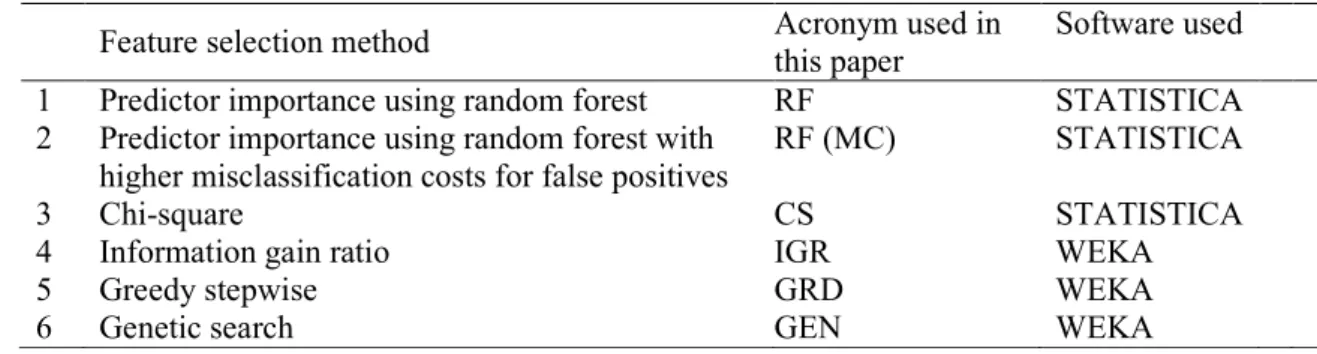
HIA Class. The software used for feature selection was STATISTICA v11 and WEKA v 3.6 256
32. The feature selection techniques to select molecular descriptors for the classification
257
models of oral absorption are shown in Table 2. The descriptors selected by the feature
258
selection techniques in Table 2 were used as input by C&RT which then performed further
259
(embedded) feature selection (Figure 1).
260 261 262 2 3 4 5 6 7 8 9 10 11 12 13 14 15 16 17 18 19 20 21 22 23 24 25 26 27 28 29 30 31 32 33 34 35 36 37 38 39 40 41 42 43 44 45 46 47 48 49 50 51 52 53 54 55 56 57 58
Table 2. Pre –processing feature selection methods utilised in this work 263
Feature selection method Acronym used in
this paper
Software used
1 Predictor importance using random forest RF STATISTICA
2 Predictor importance using random forest with
higher misclassification costs for false positives
RF (MC) STATISTICA
3 Chi-square CS STATISTICA
4 Information gain ratio IGR WEKA
5 Greedy stepwise GRD WEKA
6 Genetic search GEN WEKA
264
It is also important to define which parts of dataset were used for the different feature 265
selection techniques. The training set is used by all methods; however, for the filter methods 266
CS, IGR, GRD and GEN the parameter optimisation set was combined with the training set 267
to carry out feature selection using these techniques. For random forest and C&RT 268
(embedded feature selection) the training set was used to train the model and separately the 269
parameter optimisation set was used to obtain optimal parameters for the method (Figure 2).
270
271
Figure 2. Compound sets were used for pre-processing and embedded feature selection.
272
In this work for methods RF, CS, IGR the top 20 molecular descriptors were selected based 273
on the highest values of the descriptor scoring function. Other numbers of selected molecular 274
descriptors were tried; however, based on the C&RT analysis results on the parameter 275
optimisation set, the top 20 descriptors gave the highest classification accuracy and was 276 selected. 277 2 3 4 5 6 7 8 9 10 11 12 13 14 15 16 17 18 19 20 21 22 23 24 25 26 27 28 29 30 31 32 33 34 35 36 37 38 39 40 41 42 43 44 45 46 47 48 49 50 51 52 53 54 55 56 57 58
2.5.1 Predictor importance ranking using Random forest (RF) 278
Random forest generates a set of decision trees based on random subsets of compounds and 279
descriptors in the training set. The ensemble of decision trees vote based on the individual 280
tree results and then the majority vote for a particular compound determines the classification 281
of that compound 33, 34.
282
This method was carried out for the training set and the parameters of the analysis were 283
optimised using the parameter optimisation set. The top 20 descriptors based on a ranking 284
function called predictor importance in STATISTICA were obtained from the selected model. 285
In STATISTICA software, for every molecular descriptor, the drop in each node impurity 286
(delta) is summed for all nodes in the trees and expressed relative to the largest sum – i.e. the 287
most significant descriptor. The delta is calculated for every descriptor (even if not used in 288
the node for the splitting of the tree) and summed for every node and tree produced in the 289
forest. The larger the delta the more significant the molecular descriptor is. The final summed 290
delta value for every descriptor is normalized against the most important molecular descriptor 291
and therefore expressed relative to the molecular descriptors with the largest delta. This 292
means that important molecular descriptors that may not have been picked to be in the trees 293
may still appear in the final predictor importance table. 294
Optimization of the random forest method was carried out based on the plot of 295
misclassification error on the parameter optimisation set vs. the number of trees. The 296
misclassification rate is the number of misclassified compounds divided by the total number 297
of compounds. The lower the misclassification rate for the parameter optimisation set, the 298
better the model. Based on the misclassification rate, the optimum number of trees was 299
selected and used to repeat the analysis again with the new optimized value. The maximum 300
number of levels for each tree was set to three. The software default value of eight was used 301
for the number of molecular descriptors used in each tree. For random forest there was an 302
option to apply misclassification costs, therefore two sets of molecular descriptors were 303
selected using this technique: a descriptor set selected using equal misclassification costs 304
(RF) and a descriptor set selected using a misclassification cost ratio of 4:1 for false 305
positives: false negatives (RF (MC)). 306
2.5.2 Chi Square (CS) 307
In STATISTICA the CS function can be calculated and molecular descriptors ranked 308
accordingly. CS is a statistical measure of the association (or dependence) between two 309 2 3 4 5 6 7 8 9 10 11 12 13 14 15 16 17 18 19 20 21 22 23 24 25 26 27 28 29 30 31 32 33 34 35 36 37 38 39 40 41 42 43 44 45 46 47 48 49 50 51 52 53 54 55 56 57 58
categorical variables 35. The greater the CS value, the more statistically significant the 310
molecular descriptor is in relation to the %HIA class, therefore allowing the most statistically 311
important molecular descriptors to be ranked. The main drawback of using CS as well as 312
many other filter techniques is that it is a univariate feature selection method; therefore it 313
does not take into account interactions between the molecular descriptors. This could be a 314
potential issue in relation to intestinal absorption, where there are many interlinking factors 315
influencing absorption with many molecular descriptors describing them 6, 36. CS is an
316
association measure for categorical descriptors, therefore there may be problems when 317
continuous variables are used that contain a large spread of numerical values, since the 318
conversion of numerical variables into categorical ones (required for the use of the chi square 319
measure) may lose relevant information. The software default number of bins (ten) was used 320
for chi square discretizing of the molecular descriptors. 321
2.5.3 Information gain ratio (IGR) 322
Information gain ratio is a normalised function of the information gain feature selection 323
method developed by Quinlan37 as part of the ID3 (Iterative Dichotomiser) decision tree
324
algorithm. This feature selection method is used to split the decision tree into nodes and 325
identify molecular descriptors that are the best for the individual splits 37. Information gain
326
works to minimise the information needed to classify compounds into resulting nodes. It is 327
the difference between the original information (before the data is spilt) and the new 328
information produced after using the molecular descriptor to split the training set data. This 329
difference is the gain of information achieved by using a specific molecular descriptor, 330
therefore the molecular descriptor with the highest gain is the one used for the split 14.
331
Information gain ratio was first described by Quinlan38 in the context of the C4.5 algorithm,
332
which superseded ID3. Information gain ratio overcomes the bias towards selecting those 333
molecular descriptors with many numerical values by normalising the information gain. The 334
higher the ratio value the better the molecular descriptor for the split. This feature selection 335
technique was carried out using WEKA 3.6. 336
2.5.4 Greedy Stepwise (GRD) 337
The previous feature selection methods are based on ranking the molecular descriptors based 338
on a certain criteria and do not take into account the interactions between the molecular 339
descriptors. Therefore two additional feature selection methods were used that utilise a search 340
method which takes molecular descriptor interaction into account as well as the correlation 341
with HIA class. These methods seek to maximise the correlation between HIA and the 342 2 3 4 5 6 7 8 9 10 11 12 13 14 15 16 17 18 19 20 21 22 23 24 25 26 27 28 29 30 31 32 33 34 35 36 37 38 39 40 41 42 43 44 45 46 47 48 49 50 51 52 53 54 55 56 57 58
molecular descriptors being tested, and minimise correlations between the molecular 343
descriptors. 344
The first of these methods is greedy stepwise, which is a forward stepwise feature selection 345
method 39. This is a local search method that firstly considers all the molecular descriptors
346
and picks the best one – i.e., the one that correlates with HIA class. It then starts again with 347
all the remaining molecular descriptors, and picks the best molecular descriptor that pairs 348
with the previously selected molecular descriptor in relation to HIA class. The iterations carry 349
on until a local maximum is reached. Due to the nature of this technique only a local search 350
can be carried out based on the molecular descriptor(s) selected in all the previous iterations, 351
therefore the potential for a global search of all the different possible subsets is limited, and 352
promising regions of molecular descriptor space can be missed 15. To guide the greedy search
353
in the feature selection process, in the WEKA software an evaluator is used. The evaluator 354
function used was correlation-based feature selection subset evaluator (CfssubsetEval). This 355
evaluator not only aims to maximise the correlation between the best molecular descriptors 356
and HIA class, but also to minimise the correlation or redundancy between the descriptors for 357
the search subsets generated. 358
2.5.5 Genetic Search (GEN) 359
GEN is a filter (rather than wrapper) version of the genetic algorithm 40. Genetic algorithm
360
(GA) was first created by Holland41, although the concept of genetic algorithm was being
361
researched before this. Now termed generally as an evolutionary algorithm, GA mimics the 362
process of natural evolution. An initial population is created containing random candidate 363
solutions. In the context of this work, a candidate solution is a molecular descriptor subset. 364
Each candidate solution is evaluated in terms of its fitness (quality), and candidate solutions 365
are then selected to be reproduced and to undergo modifications with a probability 366
proportional to their fitness values. The process of selecting “parent” candidate solutions 367
based on fitness and producing “offspring” solutions that are based on the parents is 368
iteratively performed for a number of iterations, so that the population of candidate solutions 369
gradually evolves towards better and better candidate solutions. 41. In this work we have
370
utilised the genetic search feature selection method using WEKA software 42. This method
371
carries out a global search in the ‘molecular descriptor space’ to find the best subset of 372
molecular descriptors relating to HIA class, guided by a subset evaluator that generates a 373
numerical value of ‘fitness’ (quality) of any given feature subset. Like with the greedy search 374
technique, the evaluation function used for the genetic search method was ‘CfssubsetEval’. 375 2 3 4 5 6 7 8 9 10 11 12 13 14 15 16 17 18 19 20 21 22 23 24 25 26 27 28 29 30 31 32 33 34 35 36 37 38 39 40 41 42 43 44 45 46 47 48 49 50 51 52 53 54 55 56 57 58
2.6 Statistical significance of the models
376
Specificity (SP), sensitivity (SE), cost normalized misclassification index (CNMI), and SP × 377
SE were used to show the predictive performance of classification models. Specificity is the 378
fraction of poorly-absorbed compounds correctly classified by the model and is inversely 379
proportional to the number of false positives (poorly-absorbed compounds wrongly classified 380
as highly-absorbed compounds). Specificity is defined as SP = TN/(TN + FP), where TN is 381
the number of true negatives (absorbed compounds correctly classified as poorly-382
absorbed) and FP is the number of false positives. Sensitivity is the ratio of highly-absorbed 383
compounds correctly classified by the model, and is inversely proportional to the number of 384
false negatives. Sensitivity is defined as SE = TP/(TP + FN), where TP is the number of true 385
positives (highly-absorbed compounds correctly classified as highly-absorbed) and FN is the 386
number of false negatives (highly-absorbed compounds wrongly classified as poorly-387
absorbed compounds). The overall predictive performance of a model was measured by 388
multiplying the specificity and sensitivity (SP x SE). This is an effective measure of a 389
model’s predictive performance as it takes into account the effect of unbalanced class 390
distribution. In contrast, the overall accuracy measure, usually defined by the ratio of the 391
number of correct predictions made by the model over the total number of (correct or wrong) 392
predictions, does not take into account the effect of unbalanced class distributions or 393
misclassification costs. To take into account misclassification costs in the models, the cost 394
normalised misclassification index (CNMI) was calculated. CNMI can be calculated by 395 Equation 1 below. 396 397 Eq. 1 398
CostFP and CostFN are the misclassification costs assigned for false positives and false 399
negatives and Neg and Pos define the total number of negative and positive observations, 400
respectively. The CNMI value will be between zero and one, zero showing no 401
misclassification errors and as the number increases towards one the number of 402
misclassifications increases. For a more detailed explanation of Equation 1, see reference 28
403
3. Results
404
A full list of molecular descriptors selected by each of the feature selection methods can be 405
found in the supporting information (Supporting information). For GRD and GEN, as these
406 2 3 4 5 6 7 8 9 10 11 12 13 14 15 16 17 18 19 20 21 22 23 24 25 26 27 28 29 30 31 32 33 34 35 36 37 38 39 40 41 42 43 44 45 46 47 48 49 50 51 52 53 54 55 56 57 58
are not ranking feature selection methods the number of descriptors picked by the method 407
will depend on the technique. GRD selected a total of 21 descriptors and GEN selected 64. 408
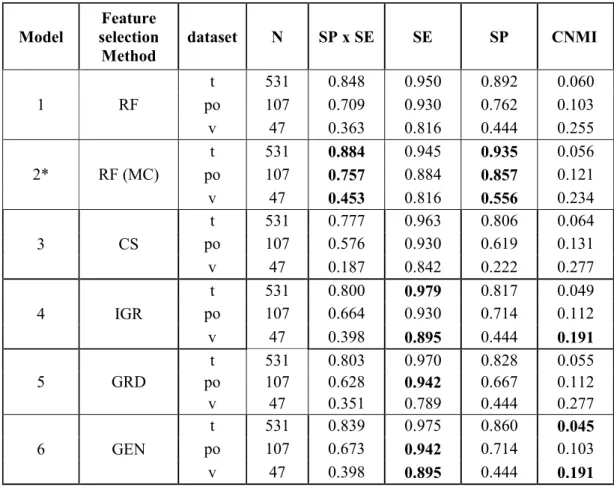
Tables 3 and 4 show the predictive performance measures from the classification trees using 409
different sets of molecular descriptors from feature selection methods. In Table 3 equal
410
misclassification costs have been applied to false positive and false negatives for C&RT 411
analysis, while in Table 4 the ratio of misclassification costs is 4:1 for false positives: false
412
negatives. In Table 3 and 4 the best models are those that have the highest SE, SP and SP x
413
SE measures and the lowest CNMI. These have been highlighted in bold for the training (t),
414
parameter optimisation (po) and validation (v) sets. For the random forest feature selection 415
method there was an option to apply misclassification costs. Therefore the descriptor sets 416
selected by RF with equal (models 1 and 8) and higher misclassification costs applied to false 417
positives (models 2 and 9) were used and also compared. All the C&RT decision trees from 418
Tables 3 and 4 can be found in the Supporting Information. 419
Table 3. The results of C&RT classification analysis using different feature selection
420
methods with equal misclassification costs applied to the C&RT algorithm
421
Model
Feature selection
Method dataset N SP x SE SE SP CNMI
1 RF t 531 0.848 0.950 0.892 0.060 po 107 0.709 0.930 0.762 0.103 v 47 0.363 0.816 0.444 0.255 2* RF (MC) t 531 0.884 0.945 0.935 0.056 po 107 0.757 0.884 0.857 0.121 v 47 0.453 0.816 0.556 0.234 3 CS t 531 0.777 0.963 0.806 0.064 po 107 0.576 0.930 0.619 0.131 v 47 0.187 0.842 0.222 0.277 4 IGR t 531 0.800 0.979 0.817 0.049 po 107 0.664 0.930 0.714 0.112 v 47 0.398 0.895 0.444 0.191 5 GRD t 531 0.803 0.970 0.828 0.055 po 107 0.628 0.942 0.667 0.112 v 47 0.351 0.789 0.444 0.277 6 GEN t 531 0.839 0.975 0.860 0.045 po 107 0.673 0.942 0.714 0.103 v 47 0.398 0.895 0.444 0.191 2 3 4 5 6 7 8 9 10 11 12 13 14 15 16 17 18 19 20 21 22 23 24 25 26 27 28 29 30 31 32 33 34 35 36 37 38 39 40 41 42 43 44 45 46 47 48 49 50 51 52 53 54 55 56 57 58
7 C&RT
t 531 0.784 0.959 0.817 0.066
po 105 0.694 0.942 0.737 0.095
v 47 0.281 0.842 0.333 0.255
SE= Sensitivity, SP = Specificity; SP × SE = accuracy; CNMI = Cost normalised misclassification index, * misclassification
422
costs applied to feature selection method
423
Comparing models built with equal misclassification costs (Table 3); the best overall model
424
to choose would be model 2. This model has the highest SP x SE, plus the highest specificity 425
values for the training, parameter optimisation and validation sets. However, this model does 426
not achieve the highest sensitivity values, with SE = 0.945, 0.884 and 0.816 for the training, 427
parameter optimisation and validation set respectively. All other models have better SE than 428
model 2 for the three data subsets; apart from model 1, which has the same SE for the 429
validation set, and model 5 (GRD), with a lower SE of 0.789. If the aim of the model was to 430
achieve the best sensitivity then model 6, using genetic search feature selection, would be the 431
best model to use as it achieved the best sensitivity for the parameter optimisation and the 432
highest SE for the training set amongst the three selected models above, along with the lowest 433
CNMI for the training set. Model 2 was able to classify correctly all the permanent 434
ammonium-containing compounds used in the training and parameter optimisation set, and 435
this reflected in the correct prediction of a permanent ammonium containing compounds in 436
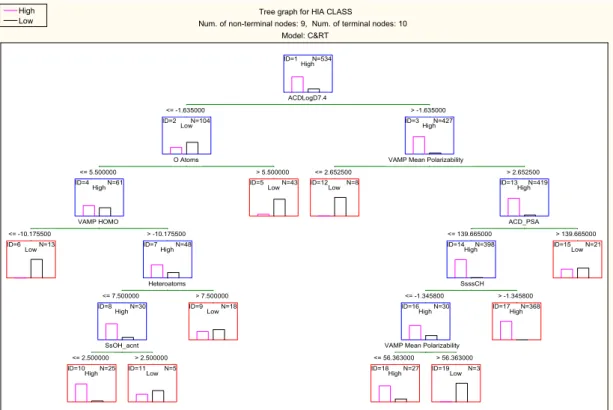
the validation set. The classification tree using the molecular descriptors from this model is 437 shown in Figure 3. 438 2 3 4 5 6 7 8 9 10 11 12 13 14 15 16 17 18 19 20 21 22 23 24 25 26 27 28 29 30 31 32 33 34 35 36 37 38 39 40 41 42 43 44 45 46 47 48 49 50 51 52 53 54 55 56 57 58
439
Figure 3. Tree graph for C&RT analysis using random forest predictor importance as feature 440
selection method with equal misclassification costs applied to pre-processing C&RT (Model 441
2 in Table 3) 442
Table 4. The results of C&RT classification analysis using different feature selection
443
methods with higher misclassification costs applied to false positives to the C&RT
444
algorithm (misclassification cost ratio of FP: FN = 4:1)
445 Model Feature selection Method dataset N SP x SE SE SP CNMI 8 RF t 531 0.887 0.927 0.957 0.026 po 107 0.725 0.895 0.810 0.068 v 47 0.675 0.868 0.778 0.081 9* RF (MC) t 531 0.879 0.909 0.968 0.028 po 107 0.738 0.860 0.857 0.066 v 47 0.635 0.816 0.778 0.093 10 CS t 531 0.838 0.906 0.925 0.037 po 107 0.687 0.849 0.810 0.079 v 47 0.544 0.816 0.667 0.118 11 IGR t 531 0.853 0.934 0.914 0.033 po 107 0.673 0.884 0.762 0.082
Tree graph for HIA CLASS
Num. of non-terminal nodes: 9, Num. of terminal nodes: 10 Model: C&RT ID=1 N=534 High ID=2 N=104 Low ID=4 N=61 High ID=7 N=48 High ID=8 N=30 High ID=3 N=427 High ID=13 N=419 High ID=14 N=398 High ID=16 N=30 High ID=6 N=13 Low ID=10 N=25
High ID=11Low N=5
ID=9 N=18 Low
ID=5 N=43
Low ID=12Low N=8
ID=18 N=27
High ID=19Low N=3
ID=17 N=368 High ID=15 N=21 Low ACDLogD7.4 <= -1.635000 > -1.635000 O Atoms <= 5.500000 > 5.500000 VAMP HOMO <= -10.175500 > -10.175500 Heteroatoms <= 7.500000 > 7.500000 SsOH_acnt <= 2.500000 > 2.500000
VAMP Mean Polarizability
<= 2.652500 > 2.652500
ACD_PSA
<= 139.665000 > 139.665000
SsssCH <= -1.345800 > -1.345800
VAMP Mean Polarizability <= 56.363000 > 56.363000 High Low 2 3 4 5 6 7 8 9 10 11 12 13 14 15 16 17 18 19 20 21 22 23 24 25 26 27 28 29 30 31 32 33 34 35 36 37 38 39 40 41 42 43 44 45 46 47 48 49 50 51 52 53 54 55 56 57 58
v 47 0.544 0.816 0.667 0.118 12 GRD t 528 0.892 0.943 0.946 0.025 po 106 0.654 0.872 0.750 0.085 v 47 0.725 0.816 0.889 0.068 13 GEN t 531 0.885 0.895 0.989 0.027 po 107 0.640 0.895 0.714 0.090 v 47 0.614 0.789 0.778 0.099 14 C&RT t 531 0.911 0.932 0.978 0.020 po 107 0.726 0.907 0.800 0.066 v 47 0.544 0.816 0.667 0.118
FP = False positive; FN = False negative; SE= Sensitivity, SP = Specificity; SP × SE = accuracy; CNMI = Cost normalised
446
misclassification index, * misclassification costs applied to feature selection method
447
For Table 4, based on the SP x SE for the external validation set the best model is model 12 448
with a SP x SE value of 0.725 but this model also had one of the lowest SP x SE for the po 449
set (0.654) which has a higher number of chemicals compared to the external validation set. 450
In comparison, models 8 and 9 achieved higher SP x SE of 0.725 and 0.738 respectively, 451
where the po set was not used for molecular descriptor selection and hence it was also an 452
external set. From models 8 and 9, model 9 had a similar balance of high estimation of SP 453
and SE compared to model 8 which was slightly worse at predicting poorly-absorbed 454
compounds for the po set. What was interesting to note about model 9 was the feature 455
selection method using predictor importance from random forest, which allowed 456
misclassification costs to be applied at the feature selection level. Then the resulting C&RT 457
model (with misclassification costs) achieved high prediction accuracy for the unseen 458
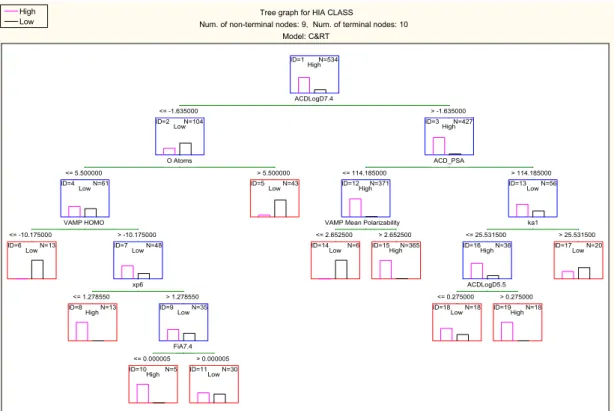
validation set as well as training and parameter optimisation sets. The C&RT tree for model 9 459 is shown in Figure 4. 460 2 3 4 5 6 7 8 9 10 11 12 13 14 15 16 17 18 19 20 21 22 23 24 25 26 27 28 29 30 31 32 33 34 35 36 37 38 39 40 41 42 43 44 45 46 47 48 49 50 51 52 53 54 55 56 57 58
461
Figure 4. Tree graph for C&RT analysis using random forest predictor importance as feature 462
selection method with higher misclassification costs applied to reduce false positives (model 463
9 in Table 4) 464
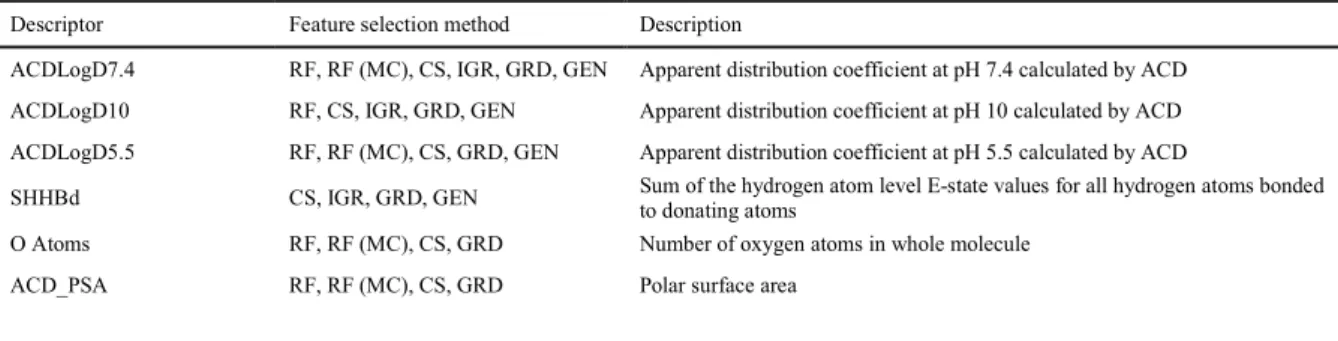
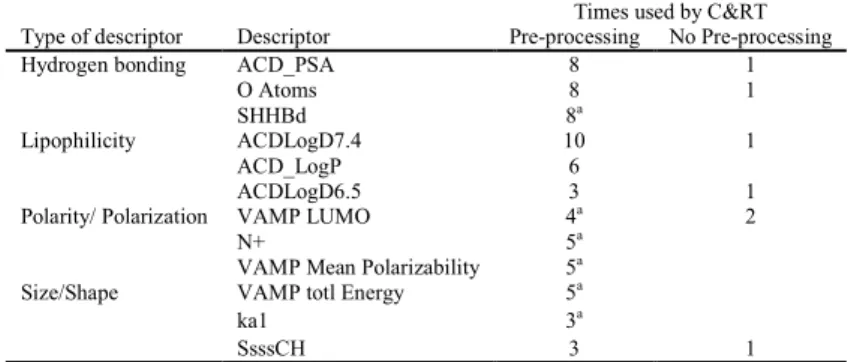
3.1 Interpretation of the selected models (models 2 and 9)
465
Both models 2 and 9 have been developed using the 20 most significant molecular descriptors 466
selected by random forest analysis. Although the top 20 molecular descriptors were given as 467
input to the C&RT analysis, not all of the molecular descriptors were used to build the 468
decision trees. The first split variable in both models is ACDLogD7.4, the logarithm of the 469
apparent distribution coefficient between octanol and water, and a measure of hydrophobicity 470
at pH 7.4. This molecular descriptor along with logP is used in numerous publications for 471
oral absorption modelling, and has been found to have a positive effect for transcellular 472
absorption 43, 44. For compounds to be split into the high absorption class, LogD7.4 has to be
473
greater than -1.63 according to both models. For compounds with low logD7.4 (≤-1.63), if 474
they contain more than five oxygen atoms they are classed as poorly-absorbed in this terminal 475
node according to both models. This molecular descriptor is linked to the number of 476
hydrogen bond acceptors, highlighted in Lipinski’s rule of five 45; which states that a
477
molecule will be highly likely to be poorly-absorbed if two or more of the following rules are 478
Tree graph for HIA CLASS
Num. of non-terminal nodes: 9, Num. of terminal nodes: 10 Model: C&RT ID=1 N=534 High ID=2 N=104 Low ID=4 N=61 Low ID=7 N=48 Low ID=9 N=35 Low ID=3 N=427 High ID=12 N=371
High ID=13LowN=56
ID=16 N=36 High ID=6 N=13 Low ID=8 N=13 High ID=10 N=5
High ID=11LowN=30
ID=5 N=43 Low
ID=14 N=6
Low ID=15HighN=365
ID=18 N=18
Low ID=19HighN=18
ID=17 N=20 Low ACDLogD7.4 <= -1.635000 > -1.635000 O Atoms <= 5.500000 > 5.500000 VAMP HOMO <= -10.175000 > -10.175000 xp6 <= 1.278550 > 1.278550 FiA7.4 <= 0.000005 > 0.000005 ACD_PSA <= 114.185000 > 114.185000
VAMP Mean Polarizability <= 2.652500 > 2.652500 ka1 <= 25.531500 > 25.531500 ACDLogD5.5 <= 0.275000 > 0.275000 High Low 2 3 4 5 6 7 8 9 10 11 12 13 14 15 16 17 18 19 20 21 22 23 24 25 26 27 28 29 30 31 32 33 34 35 36 37 38 39 40 41 42 43 44 45 46 47 48 49 50 51 52 53 54 55 56 57 58
broken: if molecular weight >500 Da, sum of OH and NH hydrogen bond donors >5, 479
calculated logP (C LogP) >5 and sum of N and O atoms as hydrogen bond acceptors >10. 480
Examples of poorly-absorbed compounds classed in this node are ceftriaxone and raffinose. 481
In both models, the next important descriptor selected for the partitioning of compounds with 482
low logD7.4 and less than six oxygen atoms is VAMP HOMO. This molecular descriptor is 483
the energy of the highest occupied molecular orbital calculated by AM1 semi-empirical 484
method using the VAMP programme in TSAR 3D software. The higher the value (>-10.18 in 485
the split in the trees) indicates higher absorption classification. Compounds with low HOMO 486
values are in the low absorption terminal nodes; and correlates with previous research 28. The
487
majority of compounds with low HOMO energy (<-10.18) according to this split contain a 488
permanent quaternary ion such as pralidoxime and bethanechol, which are small polar 489
molecules mainly related to the neurotransmitter acetylcholine, or compounds such as 490
fosmidomycin and fosfomycin, which contain phosphorus atoms. Compounds with a higher 491
HOMO energy are further split with different molecular descriptors in the two trees. 492
In Figure 3 compounds with more than seven heteroatoms are classed as poorly-absorbed. 493
This corresponds to Lipinski’s rule of five, more precisely the number of hydrogen bond 494
acceptors rule. In this node the majority of compounds are antibiotics such as meropenem and 495
imipenem, which are both poorly-absorbed. There are also some misclassified antibiotics 496
such as penicillin V and amoxicillin, which are highly-absorbed. However, both these 497
compounds have been found to be substrates for the oligopeptide transporter, PEPT1 498
(SLC15A1), influx transporter in the small intestine 46. The remaining 30 compounds are
499
classed as highly-absorbed if they contain less than three OH groups (SsOH_Acnt). 500
In Figure 4 however, compounds with low xp6 values are classed as highly-absorbed. The 501
descriptor xp6 is the sixth order single path molecular connectivity index 9, which may be
502
regarded as a size descriptor with some shape/connectivity elements. Examples of 503
compounds in this node are of a small, polar often peptide like nature with no permanent 504
charge and mainly natural or semi-synthetic compounds such as phenylalanine and captopril 505
which may have the possibility to be absorbed using oligopeptide transporters (Figure 4,
506
Node ID=8). The remaining 35 compounds are classed as poorly-absorbed if they have 507
acidic groups with ionization fraction > 0.000005. 508
Highly-absorbed compounds with logD value greater than -1.63 are split differently in 509
Figures 3 and 4. Despite this, the best molecular descriptors for splitting of these 427 510 2 3 4 5 6 7 8 9 10 11 12 13 14 15 16 17 18 19 20 21 22 23 24 25 26 27 28 29 30 31 32 33 34 35 36 37 38 39 40 41 42 43 44 45 46 47 48 49 50 51 52 53 54 55 56 57 58
compounds in both trees are the same, namely polarizability (VAMP mean polarizability) and 511
polar surface area (ACD_PSA). In both trees, compounds with polarizability values ≤ 2.65 512
are poorly-absorbed. This molecular descriptor indicates the distortion of a compound’s 513
electron cloud by an external electric field 47. Examples of compounds with ≤2.65
514
polarizability values (Node ID = 12 in Figure 3 and 14 in Figure 4) are bephenium and
515
vecuronium, both with low polarizability due to the permanent quaternary ion present in the 516
molecules. Polar surface area (PSA) is a common molecular descriptor used in oral 517
absorption models 20, 28. PSA is the area of the Van der Waals surface that arises from oxygen
518
and nitrogen atoms or hydrogen atoms bound to these atoms. In both trees compounds with 519
high PSA are poorly-absorbed. In Figure 3 a compound is poorly-absorbed if the PSA is
520
greater than 139.67Å, which matches the literature threshold value where it was cited that a 521
molecule will be poorly-absorbed (<10% FA) if the PSA is ≥140Å 43, 48. In Figure 4, a
522
threshold value of 114.19 Da has been used but these high PSA compounds have been 523
partitioned further and those with smaller molecular size as indicated by ka1, and higher 524
logD5.5 values than 0.275 are classed as highly-absorbed. An interesting feature can be 525
observed in Figure 3, where for the compounds with PSA values ≤139.67 and low index for
526
>CH- groups (SsssCH ≤ -1.35), if polarizability is too high (VAMP mean polarizability 527
>56.363) then oral absorption will be poor. Examples of these drugs are two pro-drug ACE 528
inhibitors moexipril diacid and fosinopril plus the cardiac glycoside cymarin. 529
3.2 Chemical space and repeating misclassifications in models
530
There were a few compounds that were continually misclassified by most models. Within the 531
validation set the compounds misclassified by all models was lovastatin, while frovatriptan 532
was misclassified by the majority of models. These compounds are poorly-absorbed, but the 533
models misclassified them as highly-absorbed. Lovastatin is a naturally occurring product 534
used to reduce cholesterol; this compound has poor solubility issues in aqueous medium 49,
535
plus it has been identified as heavily undergoing gut metabolism both of which could account 536
for the misclassification 50. In addition, this compound has been identified as a potential
537
substrate and inhibitor of the efflux transporter P-gp 51. Frovatriptan, according to the Varma
538
et al (2010), has a fraction escaping gut metabolism of 69% meaning potentially, 30% could 539
be metabolised by the gut, specifically UDP-glucuronosyltransferases (UGT’s) in the gut due
540
to their substrate specificity of the indole group present in frovatriptan and the similarity of 541
this compound to serotonin, a UGT substrate. However there is no direct evidence of this in 542
the literature however this could explain the misclassification by our models 52, 53.
543 2 3 4 5 6 7 8 9 10 11 12 13 14 15 16 17 18 19 20 21 22 23 24 25 26 27 28 29 30 31 32 33 34 35 36 37 38 39 40 41 42 43 44 45 46 47 48 49 50 51 52 53 54 55 56 57 58
4. Discussion
544
Thousands of molecular descriptors can be calculated to represent molecular features or 545
properties of the compounds. The use of feature selection to reduce the number of molecular 546
descriptors is a common practice in QSAR as a part of pre-processing or embedded methods. 547
Feature selection increases interpretability by reducing the number of molecular descriptors, 548
it reduces overfitting associated with noisy or redundant descriptors and often improves 549
predictability of resulting classification models. 550
In this paper we used various filter feature selection methods for data pre-processing, to pick 551
significant descriptors related to intestinal absorption. These descriptor sets were used as 552
input for C&RT analysis, which has an embedded feature selection method, to classify 553
compounds into high or low absorption in a biased dataset. The application of higher 554
misclassification costs for false positives to the C&RT analysis was also investigated to 555
overcome the problem of biased datasets (which contain many more highly-absorbed 556
compounds than poorly-absorbed compounds) and to see if models with greater prediction 557
accuracy could be achieved. 558
The feature selection methods used in this work were predictor importance using random 559
forest (RF), chi square (CS), information gain ratio (IGR), greedy search (GRD) and genetic 560
search (GEN). The feature selection methods were compared based on the predicted ability of 561
the C&RT algorithm. There were certain expectations of the feature selection methods based 562
on how they work and their advantages and disadvantages. To begin, it was expected that the 563
combination of a pre-processing feature selection method and C&RT, which has an 564
embedded feature selection, to have higher prediction accuracy when compared to using 565
C&RT with no pre-processing feature selection method. This was on the basis that when 566
C&RT splits compounds, further down the tree there are fewer compounds in the deeper 567
nodes, therefore less statistical support for an effective selection of the best descriptor 568
especially when there are a larger number of molecular descriptors to choose from. Therefore 569
as a result the C&RT algorithm could pick descriptors that may be less relevant to molecular 570
descriptors higher up in the tree. However, C&RT is a successful technique in its own right 571
with an embedded feature selection function which is used in model development for the 572
prediction of oral absorption 28, 54. The benefits of using C&RT are that it can cope with noisy
573
data (to some extent) of moderately sized biased datasets 11 and produces models (decision
574 2 3 4 5 6 7 8 9 10 11 12 13 14 15 16 17 18 19 20 21 22 23 24 25 26 27 28 29 30 31 32 33 34 35 36 37 38 39 40 41 42 43 44 45 46 47 48 49 50 51 52 53 54 55 56 57 58
trees) that in principle can be easily interpreted. In addition it is less time consuming than 575
pre-processing the molecular descriptors first. 576
The expectations of the feature selection methods themselves can be considered and 577
compared to the obtained results in this work. The benefits of simple univariate filter 578
techniques such as CS and IGR are that they are simple and fast to compute; however they 579
fail to take into account molecular descriptor interactions 18, 55. This is in contrast to GRD and
580
GEN, which take molecular descriptor interactions into account but are more computationally 581
expensive. In a comparison of GRD and GEN, due to the way these feature selection methods 582
work, GEN should achieve higher accuracy, as it performs a global search in the molecular 583
descriptor space, whilst GRD performs a local search in the molecular descriptor space. 584
Using the predictor importance in the random forest method is computationally expensive; 585
however, there is the added advantage that misclassification costs can be applied using the 586
software as well as being applied for the C&RT analysis. Finally, based on previous research, 587
the application of higher misclassification costs to false positives will produce models with 588
increased overall accuracy and reduced false positive misclassifications, therefore 589
overcoming the problem of biased datasets compared with equal misclassification costs. 590
Overall, one of the best feature selection methods according to the models produced in this 591
work was predictor importance using random forest. This was expected for this method, as it 592
was possible to apply higher misclassification costs to the feature selection technique itself as 593
well as applied to the C&RT analysis. Even when misclassification costs were not applied to 594
predictor importance, the produced models still had higher overall accuracies over most 595
models. This is down to the ensemble nature of this method, which is known to perform 596
better than single tree analysis 56. In comparison with C&RT where no pre-processing feature
597
selection was utilised, the predictor importance feature selection method had higher overall 598
accuracy for the validation set in all cases. The high classification accuracy on the training set 599
but low prediction accuracy on the validation set could indicate overfitting of the models 600
produced by C&RT. Models produced by other pre-processing feature selection techniques 601
were better compared with models produced by C&RT with no pre-processing feature 602
selection on the validation set, except for the models produced by CS feature selection. In the 603
majority of the cases, using C&RT alone gave better prediction accuracy for the parameter 604
optimisation set compared with IGR, GRD and GEN; however these latter methods had better 605
overall prediction accuracy for the validation set. This shows that C&RT without pre-606
processing can cope with redundant and meaningless molecular descriptors, however is prone 607 2 3 4 5 6 7 8 9 10 11 12 13 14 15 16 17 18 19 20 21 22 23 24 25 26 27 28 29 30 31 32 33 34 35 36 37 38 39 40 41 42 43 44 45 46 47 48 49 50 51 52 53 54 55 56 57 58
to overfitting (even with pruning of the trees) and can lack predictive accuracy for the 608
prediction of the validation set. 609
Comparing the expectations set out initially, it was found that comparing univariate methods 610
such as CS and IGR with those that take into account molecular descriptor interactions (GEN 611
and GRD) there is no clear pattern in the difference between their results. However, overall, 612
when equal misclassification costs were applied to the C&RT analysis, GEN as expected had 613
better or comparable predictor performance than CS and IGR. On the other hand, GRD had 614
comparable performance with CS and weaker compared with IGR. When misclassification 615
costs were applied to C&RT, GEN and GRD models were better than CS and IGR for the 616
training and validation set, again it is difficult to state which method is better overall. This 617
effect is also seen in the next example when comparing GEN and GRD feature selection 618
methods based on the predictive accuracy of the C&RT analysis. GEN performs better than 619
GRD when equal misclassification costs were used; this matches the predictions previously 620
made. This is in some agreement with work using numerical regression analysis 57. However
621
upon applying higher misclassification costs the molecular descriptors pre-processed by the 622
GRD model outperformed the GEN model. This could be due to the correlation-based feature 623
selection subset evaluator used by the GEN method not being suitable for use with C&RT 624
and misclassification costs, and potentially highlight overfitting by the GEN based model. 625
The effect of applying higher misclassification costs to either false positives or false 626
negatives has been investigated in previous research 28. In this work the application of higher
627
misclassification costs to false positives resulted in better overall accuracy and specificity as 628
expected in the majority of cases. 629
In this work we have shown that for most models using pre-processing feature selection does 630
appear to improve classification accuracy compared to the control (C&RT using all molecular 631
descriptors) based on prediction accuracy. This agrees with work carried out by Xue and co-632
workers16 who considered three different datasets including prediction of oral absorption.
633
They used recursive feature elimination for feature selection and SVM to classify 634
compounds. They compared the results with and without the feature selection method and 635
found that for oral absorption improved accuracy was obtained when the feature selection 636
method was used. For one of the datasets, feature selection gave comparable predictive 637
ability, which with a smaller descriptor subset will increase the interpretability of resulting 638
models 16. However, a study by Suenderhauf11 carried out regression and classification for
639
oral absorption using a variety of techniques including C&RT, Support Vector Machine 640 2 3 4 5 6 7 8 9 10 11 12 13 14 15 16 17 18 19 20 21 22 23 24 25 26 27 28 29 30 31 32 33 34 35 36 37 38 39 40 41 42 43 44 45 46 47 48 49 50 51 52 53 54 55 56 57 58