Southall, Laura (2014) Using realistic evaluation to
evaluate ‘Forest School’ with young people aged 14-16
with special educational needs. DAppEdPsy thesis,
University of Nottingham.
Access from the University of Nottingham repository:
http://eprints.nottingham.ac.uk/27690/1/LS%20DAEP%20Ethesis.pdf Copyright and reuse:
The Nottingham ePrints service makes this work by researchers of the University of Nottingham available open access under the following conditions.
· Copyright and all moral rights to the version of the paper presented here belong to the individual author(s) and/or other copyright owners.
· To the extent reasonable and practicable the material made available in Nottingham ePrints has been checked for eligibility before being made available.
· Copies of full items can be used for personal research or study, educational, or not-for-profit purposes without prior permission or charge provided that the authors, title and full bibliographic details are credited, a hyperlink and/or URL is given for the original metadata page and the content is not changed in any way.
· Quotations or similar reproductions must be sufficiently acknowledged.
Please see our full end user licence at:
http://eprints.nottingham.ac.uk/end_user_agreement.pdf A note on versions:
The version presented here may differ from the published version or from the version of record. If you wish to cite this item you are advised to consult the publisher’s version. Please see the repository url above for details on accessing the published version and note that access may require a subscription.
School of Psychology
Using Realistic Evaluation to evaluate ‘Forest School’ with
Young People aged 14-16 with Special Educational Needs.
by
Laura Southall BSc PGCE MA
Thesis submitted to the University of Nottingham for the degree of
Doctor of Applied Educational Psychology
Abstract
This study aims to evaluate a Scandinavian approach to outdoor learning, which is used in the UK. The approach, known as ‘Forest School’ involves children and young people spending regular time in natural woodland working on practical projects. Forest School promotes a child-led ethos, so children are encouraged to choose their own activities (Forest School Association, 2013).
A Realist Synthesis (Pawson, 2006) was undertaken to develop an understanding of how Forest School works, according to existing research. Features of the context, change mechanisms and outcomes were abstracted to form a set of hypotheses. In line with a Realistic Evaluation (Pawson and Tilley, 1997), these hypotheses were tested through a case study of Forest School involving 14-16 year old pupils with special educational needs (SEN). Drawing on interview, observation, questionnaire and documentary evidence, the initial programme specification was refined through thematic analysis (Braun and Clarke, 2006) to create programme specification 2. Participants checked this in a Realist Interview (Pawson and Tilley, 1997) and a final programme specification was produced.
The final programme specification presents findings through context + mechanism = outcome configurations. The study extends existing research by finding that Forest School can support confidence, social skills, language and communication, motivation and concentration, physical skills, knowledge and understanding of the world and emotional well-being and behaviour in young people aged 14-16 with SEN. The study further indicates that Forest School works differently for different pupils, depending on their individual characteristics. Strategies for best practice were illuminated which may be useful to other Forest School practitioners, such as a high level of adult practical skills. The evaluation has implications for professionals working with young people as it highlights how Forest School can promote positive outcomes for some young people aged 14-16 with SEN.
Acknowledgements
I would like to thank the staff from Oak School* and Crow’s Wood* who
enabled this evaluation to go ahead. Particular thanks go to Ade, Richard, Jo and Rose for the time they gave to this project.
Thank you to the parents and pupils who took part in this study.
Many thanks to my colleagues in the Educational Psychology Service for allowing me to follow my interests.
Thank you to Dr Nick Durbin at the University of Nottingham for all of his support throughout my professional training.
To my comrades, ‘Team TEP’.
A final thank you to my family and friends for keeping me going, especially Wendy, Mike, Don, Lucy and Joe.
Table of Contents
Chapter 1
1. Introduction
1.1Researcher Identity and Background to the Study 1.2Rationale and Aims of this Evaluation
1.3 Overview of the Thesis
Page 10 10 12 12 Chapter 2
2. Forest School: A Realist Synthesis
2.1Introduction
2.2Structure of the Realist Synthesis Literature Review 2.3A Realist Synthesis of Forest School Research
2.3.1 Search Strategy 2.3.2 Method of Review
2.4Child-led versus Adult-directed Learning in the UK 2.5Children’s Experiences of Outdoor Learning in Education 2.6Theory and Research Underpinning Outdoor Learning 2.7Outdoor Learning in Scandinavia
2.8Definition and History of Forest School in the UK 2.9The Forest School Realist Synthesis
2.10 Research and Evaluations of UK Forest School with Early Years Children
2.11 Research and Evaluations of UK Forest School with Primary Age Children
2.12 Research and Evaluations of UK Forest School with pupils with Special Educational Needs (SEN)
2.13 Forest School Research Targeting Forest School Practitioners
2.14 Discussion and Critical Reflections on the Research 2.15 Findings of the Realist Synthesis
2.16 Context of this Study
2.17 Study Aims and Research Questions
14 14 14 14 16 17 18 20 21 24 25 27 27 29 37 42 46 47 48 49
Chapter 3
3. Methodology
3.1Introduction
3.2Evaluations and Research 3.3Epistemology
3.4Scientific Realism
3.5Generative Causation and Realistic Evaluation (RE)
3.6Context, Mechanisms and Outcomes (CMOs) in a Realistic Evaluation
3.7Designing a Realistic Evaluation 3.8Case Study Design
3.9Procedure
3.9.1 Identifying a School and Liaison with Stakeholders 3.9.2 Participants and Research Context
3.9.3 Data Gathering Tools 3.9.3.1 Observations
3.9.3.2 Documentary Analysis 3.9.3.3 Questionnaires
3.9.3.4 Interviews
3.9.3.4.1 Telephone Interviews with Parents 3.9.3.4.2 Interviews with Young People 3.9.3.4.3 Interviews with Forest School staff 3.9.3.5 Realist Interview (RI)
3.10 Ethical Considerations 3.10.1 Consent
3.10.2 Confidentiality 3.10.3 Feedback 3.11 Data Analysis
3.12 Examples of the Data Analysis Procedure 3.12.1 Interview Extract 3.12.2 Questionnaire Extract 3.12.3 Observation Extract 3.12.4 Documentation Extract 50 50 50 51 53 55 56 58 60 61 62 63 64 66 68 68 69 70 70 71 72 74 74 75 75 76 78 78 79 79 80
3.13 Validity and Reliability
3.14 Reflections on the Method and Limitations to the Design
81 82 Chapter 4
4. Results
4.1Introduction
4.2Describing the Themes Identified
4.3Final Programme Specification CMO Configurations 4.3.1 Confidence
4.3.2 Social Skills
4.3.3 Language and Communication 4.3.4 Motivation and Concentration 4.3.5 Physical Skills
4.3.6 Knowledge, Understanding of the World and Independence
4.3.7 New Perspectives in Adult/Child Relationships 4.3.8 Ripple Effects
4.3.9 Emotional Well-being and Behaviour 4.3.10 Enabling Aspects
4.3.11 Hindering Aspects
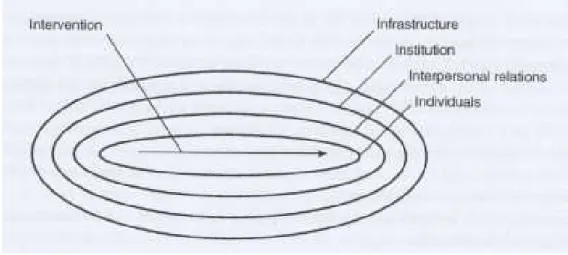
4.3.12 Areas for Further Development 4.4 Summary 84 84 85 87 88 90 92 93 95 96 99 101 102 104 106 108 109 Chapter 5 5. Discussion 5.1Introduction 5.2Contextual Factors 5.2.1 Individual capacities 5.2.2 Interpersonal relationships 5.2.3 Institutional settings 5.2.4 Wider infrastructure 5.3Mechanisms 5.4Outcomes 5.5Summary
5.6Limitations to the Realistic Evaluation
110 110 110 110 112 113 114 114 116 118 119
5.6.1 Case Study Design 5.6.2 Data Collection Tools
5.6.2.1 Observations
5.6.2.2 Documentary Evidence 5.6.2.3 Questionnaires
5.6.2.4 Interviews 5.6.3 Data Analysis
5.7The Challenge of Real World Research 5.8Implications of the Evaluation
5.8.1 Implications of the Evaluation for Educational Psychologists (EPs)
5.9Disseminating Findings and Further Research 5.10 Summary 121 122 122 123 123 124 125 126 126 128 128 129 Chapter 6 6. Conclusion 6.1Introduction
6.2Summary of Main Findings
6.3Personal Reflections on the Research Journey
131 131 131 132 7. References 134 8. Appendices
8.1Sources and Summaries of Papers from the Realist Synthesis 8.2Realist Synthesis CMOCs (Prog Spec 1)
8.3Ethics Committee Approval
8.4Information Sheets and Consent Forms 8.5Treatment Validity Checklist
8.6Purpose of Piloting Semi-Structured Interviews
8.7Semi-Structured Interview Transcripts - Forest School Staff 8.8Extracts of Observation Notes
8.9Extract of Documentary Evidence
8.10 Notes from Parent Telephone Interviews 8.11 Semi-Structured Interview Transcripts – Pupils 8.12 Teacher and Forest School Staff Questionnaires 8.13 Thematic Map 149 152 162 163 168 176 177 205 212 219 221 226 231
8.14 Inter-rater Development of Codes to Themes
8.15 Case Study and Realist Synthesis CMOCs (Prog Spec 2) 8.16 Realist Interview Plan
8.17 Notes from the Realist Interview
8.18 Establishing Rankings during the Realist Interview 8.19 Final CMOCs (Prog Spec 3)
232 233 247 250 253 256 List of Tables Table Page
2.1Context-Mechanism Outcome Illustration 2.2Gough (2007) Weight of Evidence Framework 2.3Extract from the Initial Programme Specification
3.1 The Realistic Evaluation Process (from Timmins and Miller, 2007)
3.2 Pupil Participant Characteristics
3.3 Data gathering Tools used in this Study 3.4 Timeline of Case Study Research Activity
3.5 Phases of Thematic Analysis (Braun and Clarke, 2006) 3.6 Interview Extract
3.7 Questionnaire Extract 3.8 Observation Extract 3.9 Document Extract
3.10 Threats to Internal Validity (Robson, 2011) 4.1 Data Coding System
4.2 An example of a CMOC to explain the Data Sources 4.3 Summary of Themes identified by the Study 4.4 Colour Coded-key to present Rankings
15 17 48 59 63 65 66 77 78 79 80 80 82 84 85 86 87
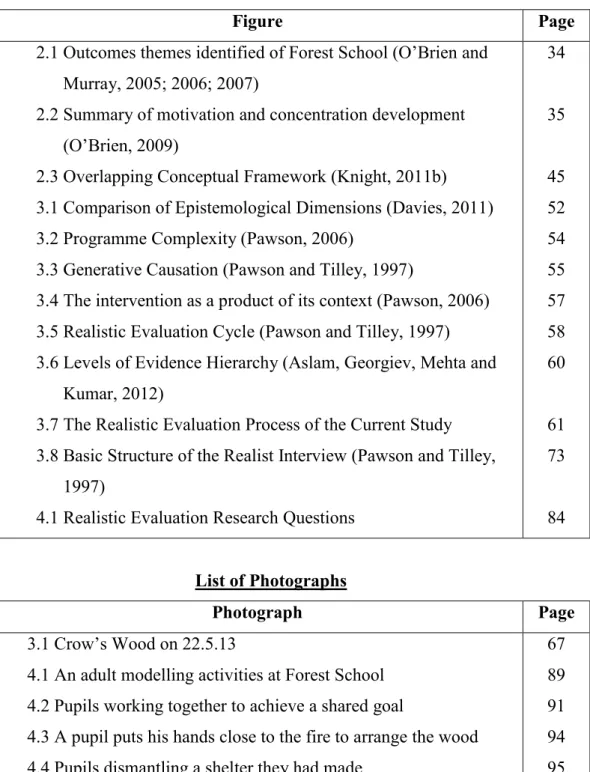
List of Figures
Figure Page
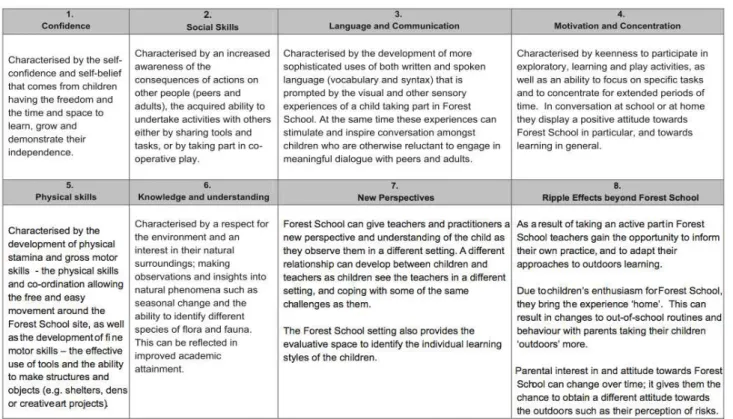
2.1Outcomes themes identified of Forest School (O’Brien and Murray, 2005; 2006; 2007)
2.2Summary of motivation and concentration development
(O’Brien, 2009)
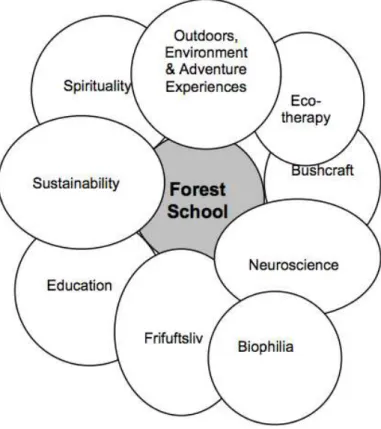
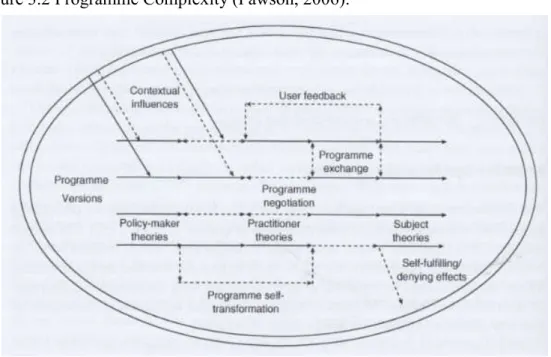
2.3Overlapping Conceptual Framework (Knight, 2011b) 3.1Comparison of Epistemological Dimensions (Davies, 2011) 3.2Programme Complexity (Pawson, 2006)
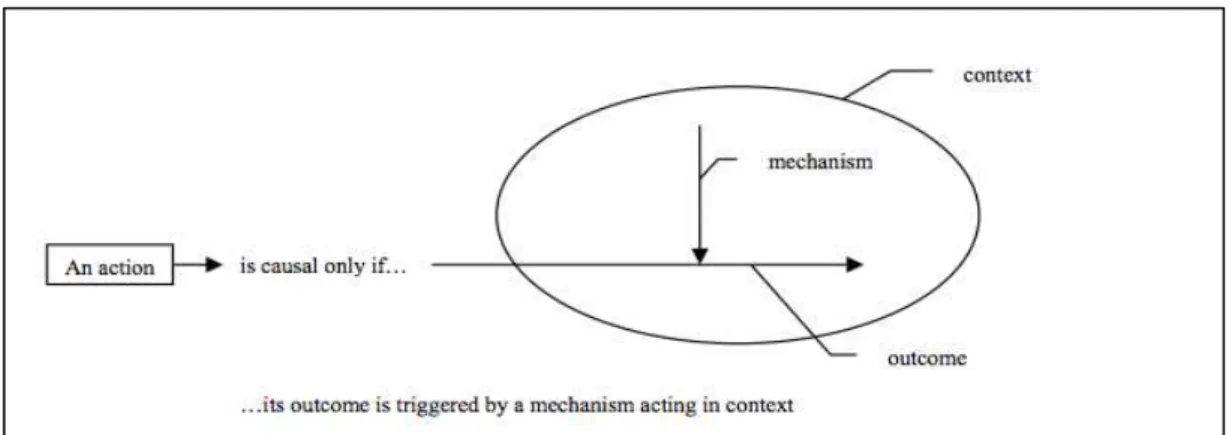
3.3Generative Causation (Pawson and Tilley, 1997)
3.4The intervention as a product of its context (Pawson, 2006) 3.5Realistic Evaluation Cycle (Pawson and Tilley, 1997) 3.6Levels of Evidence Hierarchy (Aslam, Georgiev, Mehta and
Kumar, 2012)
3.7The Realistic Evaluation Process of the Current Study 3.8Basic Structure of the Realist Interview (Pawson and Tilley,
1997)
4.1 Realistic Evaluation Research Questions
34 35 45 52 54 55 57 58 60 61 73 84 List of Photographs Photograph Page 3.1Crow’s Wood on 22.5.13
4.1An adult modelling activities at Forest School 4.2Pupils working together to achieve a shared goal
4.3A pupil puts his hands close to the fire to arrange the wood 4.4Pupils dismantling a shelter they had made
4.5A wooden pig made by Pupil 4 and two others 4.6Wooden chairs made by the pupils
4.7A Forest School leader and pupil working together 4.8A pupil whittling to make fire sticks
4.9Jewellery made at Forest School
8.1 Sorting codes to themes for mutual exclusivity
67 89 91 94 95 97 98 100 103 105 232
Glossary
CMOC – Context + Mechanism = Outcome Configuration DAEP – Doctorate of Applied Educational Psychology
DfE - Department for Education
DfEE - Department for Education and Employment DfES - Department for Education and Skills
EBP – Evidence-based practice EP – Educational Psychologist
EPS – Educational Psychology Service FS - Forest School
FSA - Forest School Association FSL - Forest School Leader KS1 – Key Stage 1
KS2 – Key Stage 2 KS3 – Key Stage 3 KS4 – Key Stage 4 LA – Local Authority
NOCN - National Open College Network
OECD - Organisation for Economic Co-operation and Development OFSTED - Office for Standards in Education
PEP – Principal Educational Psychologist RE - Realistic Evaluation
RI – Realist Interview RS - Realist Synthesis
SEN - Special Educational Needs SEP – Senior Educational Psychologist SLT - Senior Leadership Team
TA – Teaching Assistant
TEP – Trainee Educational Psychologist UK – United Kingdom
Chapter 1. Introduction
This thesis presents research undertaken during the second and third year of a Doctorate of Applied Educational Psychology (DAEP) at the University of Nottingham, while working in a West Midlands Local Authority (LA) as a Trainee Educational Psychologist (TEP). The crux of the current study is to evaluate a Scandinavian approach to outdoor learning, known in the United Kingdom (UK) as
‘Forest School’.
A scientific realist perspective is taken and Realist Synthesis (Pawson, 2006) is used as a method of reviewing the extant relevant literature to extract the existing understanding of how Forest School may work. The available literature is based predominantly on research with pre-school and primary age pupils, so a Realistic Evaluation (Pawson and Tilley, 1997) investigates the extent to which these findings apply to a small group of 14-16 year old pupils who attend a special school within a West Midlands LA.
1.1 Researcher Identity & Background to the Study
On reflection, an interest in the potential of outdoor experiences to impact upon child development stemmed from a variety of personal and professional experiences. Childhood memories of playing happily alongside peers in natural environments may have played a role in triggering this professional interest, particularly as awareness
grew of the potential threats to children’s experiences of outdoor play, such as the use
of computer games, loss of green spaces and parental restrictions due to safety concerns (Edgington, 2002; Louv, 2005; Gill, 2011).
An interest in working with children who have special educational needs (SEN) also developed, particularly how creative and flexible adaptations to the environment and/or curriculum may support engagement and inclusion (Lloyd, 2007). Experience of working as a teaching assistant (TA) in a special school meant I supported a range of alternative curriculum programmes for pupils aged 7-16 with emotional and learning needs. These programmes often utilised outdoor environments which seemed to facilitate positive relationship building between staff and pupils, something I hypothesised to be important when working to engage vulnerable pupils.
Later, as a mainstream Key Stage 1 (KS1) teacher, I was offered the opportunity to
train as a ‘Forest School Leader’ (FSL). This training enabled me to deliver weekly Forest School for pupils aged 5-11, which continued for three years. Pupils and staff generally enjoyed attending Forest School and there were opportunities for curriculum
links and to notice pupils’ strengths, which may not have been so apparent in an environment placing greater value on academic achievement. However, this understanding did not develop beyond anecdotal experiences and ceased after enrolling on the DAEP.
As part of my current role as a TEP I provide psychological services to ten schools including primary schools, a secondary academy and a secondary special school. The
secondary special school (referred to as ‘Oak School’ to protect participant anonymity)
invests in alternative curriculums to provide bespoke educational packages for its pupils. One of the alternative curriculums on offer is Forest School, which has been
provided for the past five academic years for some of Oak School’s Year 10 and 11
pupils. Due to prior experience of Forest School with mainstream primary pupils, I was instantly intrigued to learn more about the pupils who go to Forest School, their experience of the programme and whether or not it improves pupil outcomes. I was also particularly interested in the potential of Forest School to promote inclusion and maximise engagement and learning for young people with SEN, which is a priority for work as a TEP.
Aside from personal interests and values as a TEP, I was eager to contribute to the knowledge base of the Educational Psychology Service (EPS) who currently supervise my training. Forest School occurs across this LA in a myriad of ways, i.e. either on or off school grounds, with leaders who may or may not be school teachers and with heterogeneous groups of children. A research proposal was presented to the Principal Educational Psychologist (PEP) and a panel of Senior Educational Psychologists (SEPs) who agreed the proposal whilst highlighting key areas for further consideration, such as the use of photographs to illustrate contextual features of the programme (where pupil and parent informed consent is gained). Interestingly, the PEP and SEPs all knew of several schools in the LA using Forest School, and felt that evaluation was required due to a limited evidence base, despite a high investment in the programme. Developing evidence-based practice (EBP) is a key function of a
scientist-practitioner such as an Educational Psychologist (EP) (Hoyos, 2012), therefore undertaking an evaluative study of Forest School was thought likely to
support the development of the researcher’s skills as an EP, as well as contributing to
the LA and Forest School evidence base.
1.2 Rationale and Aims of this Evaluation
The role of an EP often involves supporting children indirectly through the adults working with them (Conoley and Conoley, 1990). This has unavoidably influenced this evaluation, which subsequently aims to gain information about how a Forest School programme works, so that practitioners can make use of this information. Research which focuses solely on the outcomes of Forest School for a small group of participants will not be generalisable or particularly useful to other settings because of failing to gain detail about how the programme may have caused any outcomes. Therefore, an approach able to capture this information was sought.
As a researcher I consider that there is value in understanding causality through a rigorous methodology whilst simultaneously considering and accounting for the impact of contextual factors which are embedded within real world contexts (Robson, 2011), and which will inevitably be encountered in an applied psychology career. Therefore, an epistemology of scientific realism (Pawson and Tilley, 1997) appears the best fit to my own values as a researcher and applied psychologist. Using a Realistic Evaluation framework (Pawson and Tilley, 1997) within this epistemology to support the understanding of “what works for whom in which circumstances” (Pawson and Tilley, 1997, p.86) will therefore meet the aims of this evaluation.
1.3 Overview of the Thesis
Chapter 2 gives a brief historical account of the education system in the UK including
how and, to some extent, possible reasons why outdoor education and specifically
‘Forest School’ has become embedded in some parts of this system. A comprehensive
and critical account of the existing available research and theory underpinning Forest School in the UK is presented and factors in this literature relating to the context, mechanisms and outcomes are extracted to form an initial programme specification (Pawson, 2006).
Chapter 3 describes and justifies the epistemology and methodology used in this study before Chapter 4 presents the findings and gives key data extracts which illustrate how evidence has been used to refine the initial programme specification developed in the Realist Synthesis. Chapter 5 provides a discussion of the findings, methodological limitations, areas for further research and implications of the findings for professionals working with children and young people. Finally, Chapter 6 offers concluding reflections on the research journey.
Chapter 2. Forest School: A Realist Synthesis
2.1 Introduction
Through working as a Trainee Educational Psychologist (TEP) in a West Midlands
Local Authority (LA) I have provided psychological services to ‘Oak School’ (name
changed to protect participant anonymity). Oak School is a special school which provides alternative provisions for young people who have Special Educational Needs (SEN). One alternative curriculum on offer for Key Stage 4 (KS4) pupils at Oak School is a form of outdoor education promoting a child-led approach, known in the UK as
‘Forest School’ (Forest School Association (FSA), 2013). This study aims to evaluate
the Forest School programme commissioned by Oak School, starting with a review of the literature and existing Forest School evidence base.
2.2 Structure of the Realist Synthesis Literature Review
The literature review is structured in two key parts. Firstly, a brief historical and theoretical account of child vs. adult-directed education in the UK is offered and it is suggested that outdoor environments can facilitate experiential learning. Outdoor education is briefly explored, including theoretical underpinnings and what is learned from research into outdoor learning with children in the UK. A Scandinavian approach of regular child-led outdoor learning is discussed, leading into the Realist Synthesis. The second part of the literature review defines the Danish programme of child-led
outdoor learning, known in the UK as ‘Forest School’, and sets it apart from other forms
of outdoor education. Research into the impact of Forest School on children and young people in a variety of UK contexts is presented, summarised and critiqued and then
information from this research is drawn out to form a ‘programme specification’, a
process unique to Realist Synthesis (RS). RS is an increasing popular alternative to a systematic literature review (Rycroft-Malone, McCormack, Hutchinson, Decorby, Bucknall, Kent, Schultz, Snelgrove-Clarke, Stetler, Titler, Wallin and Wilson, 2012) and the application of RS to the Forest School research is described and justified below.
2.3 A Realist Synthesis (RS) of Forest School Research
The extant research into Forest School was sourced by searching databases for papers containing relevant terms (outlined in search strategy below). As would occur in a typical literature review, relevant papers are described and critiqued to give a current
account of the impact of Forest School on child development. However, within a RS, theories are also generated from the existing literature by deconstructing current research findings to develop a detailed understanding of the programme by considering:
What is it about the programme which might produce change?
Which individuals, subgroups and locations might benefit most readily from the programme?
Which social and cultural resources are necessary to sustain the changes?
(Pawson and Tilley, 1997, p. 85)
Therefore, information within the existing Forest School research will be extracted to
develop a ‘programme specification’, which provides a set of hypotheses which begins
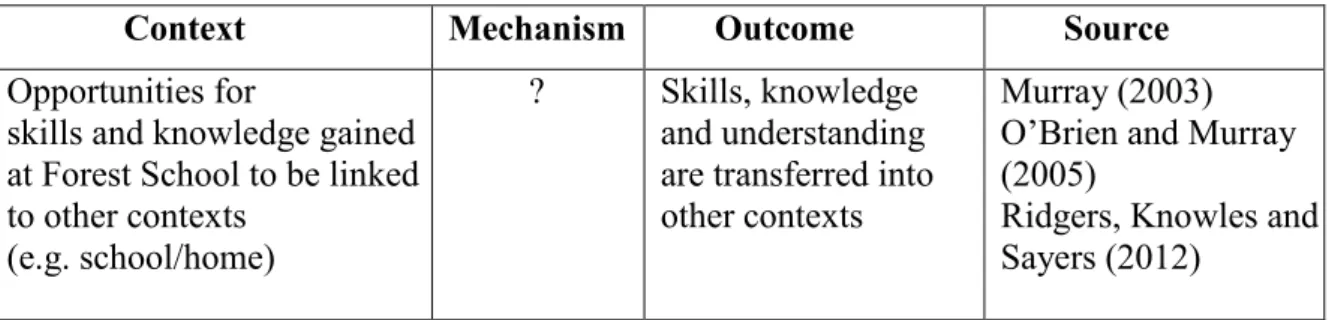
to address the points above and attempts to explain in detail how Forest School works (Pawson, 2006). A programme specification presents the outcomes of a programme alongside how features of the programme context set up mechanisms of change (Pawson and Tilley, 1997). Table 2.1 presents how contextual features set up conditions for mechanisms to produce an outcome, using igniting gunpowder as an example.
Table 2.1 Illustration of a Context + Mechanism = Outcome Configuration (C+M=O) (adapted from Pawson and Tilley, 1997)
Context + Mechanism = Outcome
Gunpowder is dry, compacted and sufficient in amount. Oxygen is present. Heat is applied.
Chemical reaction occurs Explosion
Pawson and Tilley (1997) propose that the formula (C+M=O) can provide a framework for evaluating social programmes, which attempt to understand the multitude of aspects influencing how a programme works. Rather than only focusing on the outcomes of social programmes, RS is also concerned with establishing “why a program works, for
whom and in what circumstances” (Pawson and Tilley, 1997, p. xvi). However, existing research, which has approached Forest School with a different theoretical framework, will vary in the amount of information it presents relating to contexts, mechanisms and outcomes:
“some studies will be relatively revealing about underlying mechanisms, some will concentrate on outcomes, others may describe context in depth. The review is concerned with juxtaposing the evidence as, for instance, when one study provides the process data to make sense of the outcome pattern noted in another”
(Pawson, 2006, p. 74) Therefore, the programme specification developed from reviewing the existing Forest School literature will reflect elements of the context, mechanisms and outcomes, drawn from a variety of sources. RS is an alternative to a traditional systematic review, but comparable in terms of robustness (Pawson, 2006) and a bedfellow to the method of
evaluation used in this study, ‘Realistic Evaluation’ (RE) (Pawson and Tilley, 1997).
The RS will provide information to inform the RE research questions, by highlighting gaps in existing research, for example in terms of the methodologies or participant groups used. A more detailed description and justification of the epistemology and methodology chosen for this research is provided in chapter 3.
2.3.1 Search Strategy
The following databases were searched to offer a comprehensive account of the research into Forest School:
The terms used as keywords in this search were:
“Forest School” “Forest Education” “Woodland School” “Woodland Education” “Danish School”
Details of the relevant Forest School research papers found (n=20), including a brief summary are presented in appendix 8.1. The Danish terms used in the literature review
search strategy (‘Skovbornehave’ and ‘Udeskole’) unfortunately revealed studies which
Medline PsychInfo Science Direct Web of Science Embase Google Scholar Google “Danish Education” “Outdoor Education” “Outdoor Learning”
“Skovbornehave” (Danish Forest Kindergartens)
were only published in Scandinavian languages and inaccessible for accurate review (e.g. Bentsen, Mygind and Barfoed Randrup, 2008; Droscher-Nielson, 2006).
2.3.2 Method of Review
All accessible and relevant Forest School literature will be used to shape the initial program specification as part of the RS (Pawson, Greenhalgh, Harvey and Walshe, 2004), but evidence which is deemed more methodologically sound will be drawn more heavily upon. Therefore, it is important that all research studies are examined critically
and Gough’s (2007) Weight of Evidence (WoE) framework provides a helpful tool for
supporting the process of “appraising the contribution that each one makes to the
developing synthesis” (Pawson, 2006, p. 87). Gough (2007) suggests there are three review criteria (A,B,C) which lead to an overall assessment (D) of the quality and
appropriateness of a research paper. Table 2.2 outlines Gough’s (2007) framework,
which supports the review process.
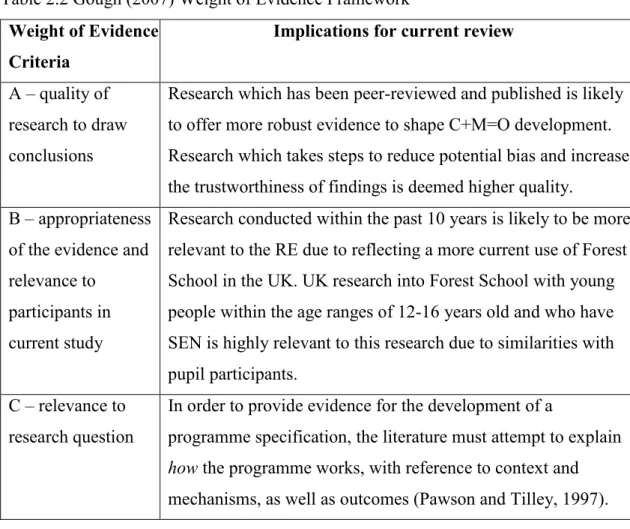
Table 2.2 Gough (2007) Weight of Evidence Framework
Weight of Evidence Criteria
Implications for current review
A – quality of research to draw conclusions
Research which has been peer-reviewed and published is likely to offer more robust evidence to shape C+M=O development. Research which takes steps to reduce potential bias and increase the trustworthiness of findings is deemed higher quality.
B – appropriateness of the evidence and relevance to participants in current study
Research conducted within the past 10 years is likely to be more relevant to the RE due to reflecting a more current use of Forest School in the UK. UK research into Forest School with young people within the age ranges of 12-16 years old and who have SEN is highly relevant to this research due to similarities with pupil participants.
C – relevance to research question
In order to provide evidence for the development of a
programme specification, the literature must attempt to explain
how the programme works, with reference to context and mechanisms, as well as outcomes (Pawson and Tilley, 1997).
Gough’s (2007) WoE framework (Table 2.2) was used to support the RS through
drawing more heavily upon high quality research which is relevant to the case study participant group. However, as Forest School is not well represented in published literature (Swarbrick, Eastwood and Tutton, 2004), information from less rigorous studies was also included in order to provide sufficient information to develop an initial programme theory. Despite this potential threat to validity, the RE methodology (Pawson and Tilley, 1997) encourages testing and refining of theories as an iterative process. Therefore, if the programme specification from the RS draws upon findings of poor quality research which prove unsupported by the data collected in the RE, then these initial C+M=O configurations can be discarded as part of the refinement process, and will not pose a further threat to validity (Pawson and Tilley, 1997).
This section has intended to provide essential information explaining how the existing Forest School research has been reviewed in this RS. The following section now returns to the starting point of the literature review, which aims to present a brief historical discussion of child-led vs. adult led education, with a focus on child-led outdoor learning. Forest School will then be introduced as a form of child-led outdoor learning and research focusing on the impact of Forest School in the UK will be presented and used to develop an initial programme specification (Pawson, 2006).
2.4 Child-led versus Adult-directed Learning in the UK
Since the UK government passed the Education Act (1870) making education of children aged 5-13 compulsory, there has been debate about the best way to educate children and young people (Gillard, 2011). This debate revolves primarily around what should be learnt and the extent to which education should be delivered within a teacher centered or learner-centered paradigm (McManus, 2001). Early compulsory UK
education typically concentrated on the ‘three Rs’: reading, writing and arithmetic
(Gillard, 2009). In contrast, the Hadow Reports (Hadow, 1926; 1931) recommended that teachers provide experience and activity within education, and these recommendations were written into legislation within the Education Act (1944). However, this legislation also introduced competitive testing for places in Secondary Grammar schools via the administration of the 11+examination (Tomlinson, 2005), and therefore teachers continued to focus on adult-directed teaching of core subjects to support success in the exam (Galton, Simon and Croll, 1980).
The 1960s saw a period of more child-led education, supported by the Plowden Report (Central Advisory Council for Education (CACE), 1967), which had similarities to the Hadow Reports (Hadow, 1926; 1931). This experiential approach is thought to facilitate learning because knowledge develops from abstract to concrete concepts, due to the continual testing of knowledge through experiences (Kolb, 1984). Lewin (1943) proposed that behaviour is a function of a person in their environment and feedback is gained through experience, which enables individuals to evaluate the consequences of their actions. Dewey (1897) posited that experiential learning supports maturation due to its ability to transform impulses into considered actions and Piaget (1976) also acknowledged that a child is active in its environment (Piaget, 1976).
Despite the support from aforementioned psychologists and educationalists, the experiential approach of the 1960s was short-lived, possibly due to the lack of
practitioner understanding of ‘high quality’ child-led education (Cree and McCree, 2012). By the late 1960s the UK government proposed that a higher standard of education required more formal teaching methods, and this became embedded in legislation in the 1980s (Education Act, 1986, no.2). Classroom-based and adult directed education prevailed, particularly when the Education Reform Act (1988) set out the first centrally controlled UK curriculum. A revision of the National Curriculum (Department for Education and Employment (DfEE), 1999) meant some of the content was reduced but the curriculum remained prescriptive and allowed UK teachers little freedom (DfEE, 1999). This was in contrast to other countries, such as Denmark and Finland, which have better educational outcomes than the UK (Office for Standards in Education (OFSTED), 2003).
In the current UK education system the benefits of experiential learning are recognised for children under 5 (DfE, 2012). However, when children in the UK become statutory school age teaching becomes more formal and adult-directed, possibly due to the pressures on teachers for academic results (Shields, 2010). This occurs despite recent primary curriculum reviews (The Cambridge Primary Review, 2011; Rose, 2009) advocating the use of experiential learning for children throughout their primary years.
The current government’s new National Curriculum (DfE, 2013) for school-aged children, due to be implemented from September 2014, has been developed by drawing on education systems in performing countries (DfE, 2011). One of these named top-performing countries is Finland (DfE, 2011), where the curriculum includes regular experiential learning opportunities (OFSTED, 2003). Although this level of experiential learning is not an explicit requirement of the new UK curriculum (DfE, 2013), it
proposes that, “There is time and space in the school day and in each week, term and
year to range beyond the national curriculum specifications” (DfE, 2013, 3.2). This suggests that UK teachers should have time to deliver activities outside the statutory curriculum and could therefore include experiential activities within the timetable.
In summary, formal classroom-based and adult-led education has historically been presented as the answer to comparatively low UK educational standards, but has not provided the desired results (Gillard, 2009). Therefore, it is argued that some experiential learning should be considered for statutory-age children in the UK within the new curriculum (DfE, 2013). The following section explores the use of outdoor environments to facilitate this experiential approach, as part of a “balanced curriculum
diet” (Gill, 2011, p.20) for children in the UK.
2.5 Children’s Experiences of Outdoor Learning in Education
The potential of outdoor environments to facilitate learning is not a new concept,
illustrated for example in Rousseau’s (1762) early writings about effective education. Outdoor environments have been central to the learning environments in early Kindergartens (Froebel, 1912), nurseries (McMillian, 1919; Montessori, 1967) and Steiner schools (Steiner, 1947). Despite the efforts of these early educationalists, many present-day writers have expressed concern about children’s lack of opportunity for play in the outdoors (Rickinson, Dillon, Teamey, Morris, Choi, Sanders and Benefield, 2004; Louv, 2005; Waters and Begley, 2007), and the poor practice or missed opportunities when outdoor activities are on offer (Bilton, 2010; Maynard and Waters, 2007).
The decline in frequency of children’s outdoor play is likely to be due to a variety of
social changes (Gill, 2011) such as the popularity of computer games (Public Health England (PHE), 2013) and parental concerns about abduction, which are often fuelled
by the media (Edgington, 2002). Concern about the lack of opportunities for children to engage in experiential learning may have led to support for this within the previous
Government’s ‘Learning Outside the Classroom Manifesto’ (LOtCM) (Department for Education and Skills (DfES), 2006). Although the LOtCM was not a statutory document, its publication by the government at the time suggested some commitment to more learning outside the classroom (DfES, 2006), which was also encouraged by OFSTED (2008).
The LOtCM defines ‘outdoor learning’ as “the use of places other than the classroom for teaching and learning” (DfES, 2006, p.1). This definition does not therefore propose
that ‘outdoor learning’ has to be actually outside. This lack of clarity may mean that
outdoor learning is construed differently by different professionals, ranging from teachers implementing lessons away from the usual classroom, to outdoor adventure
activities such as ‘Go Ape’ (Go Ape, 2014). Both of these examples are likely to
provide at least some experiential learning, but the frequency of lessons outside depends on the particular teacher and outdoor adventure programmes tend to be one-off or short term (Knight, 2009; Donnelly, 2013). The lack of clarity in the LOtCM (DfES, 2006)
when defining ‘outdoor learning’ and the fact that it does not feature explicitly in the
new curriculum (DfE, 2013) suggests that outdoor learning is not currently well defined, despite governmental claims of drawing on educational systems in top performing countries which use a regular experiential outdoor approach (DfE, 2011; OFSTED, 2003; Bentsen et al, 2009).
2.6 Theory and Research Underpinning Outdoor Learning
The thinking of the aforementioned educationalists (Rousseau, 1762; Froebel, 1912;
Steiner, 1947) supports the ‘Biophilia hypothesis’ (Kellert and Wilson, 1993), which
suggests that people have an innate affinity to be part of the natural world, and that destruction of the environment and other factors which reduce the relationship between humans and nature may have detrimental consequences for quality of life (Kellert and Wilson, 1993). Public Health England (PHE, 2013) found a significant negative association between time spent accessing computer games and wellbeing, suggesting that more time spent on activities away from technology is beneficial. This may be particularly pertinent in a time when there are concerns about the mental health of
children and young people, as research suggested that 10% of 5-15 year olds in the UK
have a ‘mental disorder’ (Meltzer, Gatwood, Goodman and Ford, 2000).
The reported positive effect of being in environments away from technology may be explained to some extent by ‘Attention Restorative Theory’ (Kaplan, 1995), which suggests that urban environments can cause attention to fatigue, but this can be restored when attention is not effortful. Non-effortful attention occurs when individuals are intrinsically fascinated and opportunities for this are particularly suited to a natural environment (Herzog, Black, Fountaine and Knotts, 1997). Restorative effects are
defined as ‘tending to restore strength or health’ (Oxford English Dictionary, 2013) and
exposure to a natural environment can provide greater restorative effects than exposure to urban environments or relaxation techniques (Hartig, Mang and Evans, 1991). Faber Taylor and Kuo (2009) also found that young people with Attention Deficit Hyperactivity Disorder (ADHD) showed significantly enhanced levels of concentration after exposure to nature in comparison to other environments, further supporting the use of natural environments to restore attention.
Natural environments may have cognitive as well as restorative benefits, as Gardner’s (1999) theory of multiple intelligence includes naturalistic intelligence and suggests that children need opportunities to learn about the outdoors and can succeed in this aspect of learning, even if they are less able in other areas of intelligence. Outdoor learning provides opportunities for children to socialise with peers and adults (Rickinson et al, 2004) which, according to Vygotsky (1978), is key to cognitive development, “every function in the child’s cultural development appears twice: first, on the social level, and later, on the individual level” (Vygotsky, 1978, p. 58).
Vygotsky’s (1978) theory of social learning suggests that a child learns within their
zone of proximal development (ZPD) and that more knowledgeable others mediate this learning through offering support when required. This suggests that learning is supported by social interaction, which occurs frequently during free play (Moyles, 2010) and which can be facilitated by a natural outdoor environment (O’Brien and Murray, 2005). Therefore, children are likely to benefit from access to natural environments in groups to support their emotional (Kaplan, 1995), social (Moyles,
2010) and cognitive development (Gardner, 1999; Vygotsky, 1978) and also to fulfill their innate need for a relationship with the outdoors (Kellert and Wilson, 1993).
In a review of 150 studies examining fieldwork visits, outdoor adventure and outdoor school or community projects, Rickinson et al (2004) found that outdoor education promotes increased knowledge and skills, social development, enhanced confidence, improved health and physical development and a positive change in attitude. The National Wildlife Federation (2010) also found that outdoor learning supported positive
behaviour and young people’s motivation to learn. This supports Reed (2005) who found that outdoor activities improved pupil’s behaviour and helped to reduce rates of
pupil exclusions from school, which has increased in the UK (Gordon, 2001). However, it must be acknowledged that this research (Rickinson et al, 2004; The National Wildlife Federation, 2010) received funding from organisations with potentially vested interest in publishing positive findings, so these conclusions should be treated cautiously.
As aforementioned, ‘outdoor learning’ appears to represent a variety of activities from
lessons in a different location from the classroom to outdoor adventure (e.g. Go Ape, 2014). Clearly, not all outdoor learning opportunities use natural environments or promote child-led learning, and according to Bilton (2010) these may not therefore be
considered ‘high quality’ outdoor experiences (Bilton, 2010). Bilton (2010) and Cree
(2009) describe high quality outdoor learning as involving children and staff talking as equals with the child only seeking adult help when required to meet their purposes. However, these views appear to be based on opinion and anecdotal evidence rather than research. Although practitioner views could be considered high value due to their position to know the children involved and note changes, anecdotal case studies are considered less reliable than research which takes steps to reduce threats to validity (Aslam, Georgiev, Mehta and Kumar, 2012).
The following section turns the focus to Scandinavia, where the quality of life and educational outcomes are better than the UK (OFSTED, 2003; Organisation for Economic Co-operation and Development (OECD), 2013) and where regular, child-led outdoor education is embedded within the curriculum for young people, often throughout their educational career.
2.7 Outdoor Learning in Scandinavia
In Scandinavia there is a cultural commitment for children to experience regular (often daily) child-led opportunities to learn in the outdoors, throughout their time in education (OFSTED, 2003; Williams-Siegfredsen, 2012; Bentsen, Mygind and Randrup, 2009; Bentsen et al, 2010). Many young children in Denmark experience regular use of the outdoors in all weathers when they attend ‘Skovbornehave’ (Forest Kindergarten) (Williams-Siegfredsen, 2012). There has also been a push for Danish young people aged 7-16 to experience a day a week or fortnight on curriculum-related tasks in natural environments (Bentsen et al, 2009). In Denmark, this experience is known as
‘Udeskole’ (Outdoor Education). A national survey of (n=2,082) Danish schools found that 28% practice ‘Udeskole’ with a further 15% planning to introduce a compulsory
weekly outdoor experience within the next three years (Bentsen et al, 2009). In a review
of the Scandinavian literature on ‘Udeskole’ published in English, Bentsen et al (2010)
cites findings which include increased physical activity, more explorative language and increased positive social interactions. However, the studies are only briefly summarised and rely heavily on case study reports.
In Denmark there is a social pedagogy or ‘way of life’ know as ‘friluftsliv’, translating to ‘fresh air life’ (Williams-Siegfredsen, 2012). The effects of ‘friluftsliv’ may be reflected in an overall review of population well-being as, according to the OECD (2013) Denmark is 7thon the ‘Better Life Index’, for education, ahead of the UK (15th). The following seven pedagogical principles of educational practice in Denmark are supported by the use of outdoor environments (Williams-Siegfredsen, 2012).
1. A holistic approach to children’s learning and development 2. Each child is unique and competent
3. Children are active and interactive learners 4. Children need real-life, first-hand experiences 5. Children thrive in child-centered environments
6. Children need time to experiment and develop independent thinking 7. Learning comes from social interactions
These seven principles reflect the ideology of influential thinkers such as Rousseau (1762), Vygotsky (1978) and Froebel (1912) and mirrors some of the messages within the LOtCM (DfES, 2006), with the emphasis on real-life experiences. In order to learn more from Danish practice, a group of staff from Bridgewater College, Somerset,
visited a Danish ‘Skovbornehave’ in 1995 and subsequently the idea of regular sessions
in a woodland for young children was introduced to the UK (Bridgewater College,
2013; O’Brien and Murray, 2006). The term ‘Forest School’ is used henceforth to
describe this approach (Williams – Siegfredsen, 2012; FSA, 2013).
2.8 Definition and History of Forest School in the UK
Since the Bridgewater College visit to a Danish ‘Skovbornehave’ (Bridgewater College, 2013) there has been growing interest in Forest School in the UK (O’Brien and Murray,
2007) potentially linked to the increasing concern over limitations in children’s outdoor
play (Louv, 2005; Maynard, 2007a). Forest School sites are developing across the UK (Gill, 2011); in 2006 it was reported that there were approximately 140 Forest Schools
in the UK (O’Brien and Murray, 2006) and since then many more Forest School
Leaders (FSLs) have been trained (Ritchie, 2010). Early years and primary aged children in the UK most commonly access Forest School (Knight, 2011a), however some secondary and special provisions are beginning to use the approach with their young people (Knight, 2011a; Archimedes Training, 2011a; 2011b).
Forest School is a unique method of outdoor education where children or young people spend regular time in a woodland area on self-initiated activities (FSA, 2013).
According to Cree (2009) Forest School is “fundamentally different in its pedagogy”
(p.23) to other forms of outdoor learning because adults stand back and act as a
‘facilitator’, not as a ‘teacher’. This may be challenging for adults used to teaching to
particular objectives (Maynard, 2007a) and Cree (2009, p.23) acknowledges that it takes “great courage” to step back and facilitate. Forest School is defined as:
“an inspirational process that offers children, young people and adults regular
opportunities to achieve, and develop confidence and self-esteem through hands-on learning experiences in a woodland environment.”
In order to access these ‘hands-on learning experiences’ such as shelter building, fire lighting or the use of sharp tools, pupils must have engaged with some skill-based teaching. However, once shown these key skills children decide how they choose to spend their time at Forest School, as the practitioners involved recognise the benefits of play (Moyles, 2010). Indeed, there are links between the Forest School ethos and principles of play therapy, as both suggest that children need independence and self-direction to be themselves which is facilitated by a therapeutic relationship with a FSL (Axline, 1947) and having responsibility for their own development (Landreth, 2002).
There is a specific set of criteria which need to be met before outdoor learning can be considered a Forest School (FS), outlined as follows by the FSA (2013):
•FS is a long-term process of regular sessions, rather than a one-off or infrequent visits; the cycle of planning, observation, adaptation and review links each session.
•FS takes place in a woodland or natural environment to support the development of a relationship between the learner and the natural world.
•FS uses a range of learner-centered processes to create a community for being, development and learning.
•FS aims to promote the holistic development of all those involved, fostering resilient, confident, independent and creative learners.
•FS offers learners the opportunity to take supported risks appropriate to the environment and to themselves.
•FS is run by qualified Forest School practitioners, who continuously maintain and develop their professional practice. (FSA, 2013)
The FSA was formed in 2012 as a national governing body for Forest School and is a source of information for training, resources, news and information. Knight (2011b) - who is part of this governing body - states that:
“Forest School is on the cusp of becoming a respected and established intervention in
schools for all ages of children and young people, as well as moving out into the
community as a way of working with vulnerable groups”. (Knight, 2011b, p. 590)
Knight’s (2011b) view suggests that more research and development is needed to take
the Forest School movement away from the ‘cusp’ and into the realm of established and respected practice, if indeed that is where it belongs. In order to develop an evidence
base for Forest School and, in particular, outcomes for children and exactly how they are supported by Forest School, robust research activity is required. The following section aims to present the existing Forest School research and illuminate any gaps in the existing evidence base, which might be filled by the current study.
2.9 The Forest School Realist Synthesis (RS)
The previous section has aimed to present an account of the development of outdoor learning opportunities for children in the UK and some of the theory and research which may underpin this. The following account aims to focus on reviewing the research with has specifically addressed Forest School, as defined by the FSA (2013) criteria.
Gough’s (2007) framework was applied to each study to establish how evidence would
be used to develop the initial programme specification (appendix 8.2).
With the aim of developing some order to the RS, the available literature will be presented in approximate ascending order of target participant age. This is also likely to reflect the research chronology, as Forest School in the UK was first used with early
years pupils, to reflect its use in Danish ‘Skovbornehave’ (Knight, 2011b; Williams -Siegfredsen, 2012).
2.10 Research and Evaluations of UK Forest School with Early Years Children
Massey (2004) conducted a participatory case study to evaluate the Forest School experience for 8 children aged 3-4 years old attending an independent nursery. This small scale study observed the children at Forest School over one academic year and gained information through structured observations with video recording, interviewing children, staff, Forest School leaders and parents and pre-post programme questionnaires to parents. Massey (2004) highlighted key themes from the data to illustrate the perceived changes in the children’s levels of skill and development.
Findings suggest that children appeared to develop positive relationships with peers and adults, were observed working more as a group and considering the needs of others. Forest School provided opportunities for children to develop social interaction skills, such as asking others for help when moving heavy objects (Massey, 2004). Massey
(2004) noted that, over time, children’s questions became more specific, altering from statements (“look at this”) to questions (“is that like a badger?” – referring to a fox
being nocturnal). The Forest School environment seemed to provide a real context for language use and vocabulary development and children appeared to develop confidence in self-initiation and choosing. The balance of adult support and self-initiated activities led children to consider risk taking and a safe risk-taking environment was created
because supportive adults didn’t interfere too early, but made risks apparent to the
children and provided small and achievable tasks (Massey, 2004).
Massey (2004) further indicated that children demonstrated perseverance for a sustained amount of time on projects they were motivated to complete and adults at Forest School were able to assess the children’s skills and understanding in a different way. Massey (2004) also highlights some of the contextual features of Forest School, including a child-led approach, which is useful for the programme specification development. However, no detailed summary was offered about how skills in risk taking, language and social development could be transferred to other contexts, such as the nursery classroom. These findings (Massey, 2004) should be treated very cautiously as any
improvements in children’s skills could be due to maturation, and this small-scale study was not published or peer-reviewed.
Waters and Begley (2007) investigated the effects of Forest School on pre-school age children, through a case study considering the risk-taking behaviours of two children (both 4 years 4 months old) at Forest School, in comparison to the nursery playground. Waters and Begley (2007) gathered data through narrative observations of the two children in both contexts (Forest School and the nursery playground). The researchers spoke their observations into Dictaphones before transcribing the recordings and using thematic analysis to develop codes and themes (Braun and Clarke, 2006). The children and their classmates attended Forest School for half a day each fortnight and were observed over a 4-month period. The two participants were selected by their teacher, based on pre-existing risk-taking characteristics. Participant A was male and was considered to take risks in his play which often concerned adults due to the danger created to himself and others. Participant B, in contrast, was female and noted to rarely, if ever, take risks in her environment, preferring to focus her attention on keeping to rules and avoiding reprimand.
The results of the study suggested that more appropriate risk taking occurred at Forest School for both children (Waters and Begley, 2007). Child A received fewer reprimands at Forest School in comparison to the playground, whereas Child B took more risks at Forest School in comparison to other environments, and her excitement about the Forest School experience was also noted. It was observed that the rules of the school playground altered slightly according to which adult was supervising, which may have led to confusion for the children (Waters and Begley, 2007). However, at Forest School the adults were consistent so the rules were constant, which meant that children were more likely to understand the rules and less likely to be reprimanded (Waters and Begley, 2007). The study attempted to avoid bias by drawing on inter-rater reliability for the identification of data themes and this attempt to enhance validity is valued in
terms of Gough’s (2007) framework. However, the sample was extremely small and
selection may have caused bias due to the requirement for pre-existing characteristics.
2.11 Research and Evaluations of UK Forest School with Primary Age Children
Davis and Waite (2005) reported the findings of research undertaken by seven undergraduate students who had acted as participant-researchers during the delivery and evaluation of Forest School in three different settings in Devon, with children from Reception and Year 1. A range of methods were used (observations, questionnaires and interviews) and the studies focused on identifying any changes to children’s social skills, play, language and cognitive development. Programmes lasted 6 weeks, with the children either attending a morning or afternoon session once per week. The research provides rich information in the form of quotes and observational data, which was triangulated by gathering the views of parents (n=15), children (n=60), teachers and FSLs (numbers not specified).
Positive developments were noted in each area of functioning explored and suggestions made for future development, including drawing more upon the Forest School environment for delivering the curriculum. Despite the potential need for more opportunities to link activities on offer at Forest School to the national curriculum (DfEE, 1999), William-Siegfredsen (2012) suggests that this can occur naturally, for example children observe seasonal changes to the site and are intrigued by the evidence of the presence of animals (Williams-Siegfredsen, 2012).
In addition, Davis and Waite (2005) cannot guarantee the quality of data collection due
to reliance on other people’s work in seven separate studies. However, by examining evidence gathered by the undergraduates, they became aware that “each programme varies according to the child attending, the leaders and supporting staff, the site used and the weather experienced,” (Davis and Waite, 2005, p. 2). This suggests that multiple elements can impact upon Forest School programme development and success, offering further C+M=O data that could contribute to the initial programme specification for the present study.
A study by Lovell (2009a, 2009b) investigated the frequency of physical activity at Forest School with a single group of 26 children aged 9-11 in a Scottish primary school. The research aimed to find out whether Forest School significantly increased children’s frequency of physical activity, given that low levels of physical activity can be linked to health problems (Currie et al, 2008). Using a two-phase mixed methodology design Lovell (2009a; 2009b) initially measured children’s physical activity at Forest School in comparison to a normal school day using an accelerometer and then by interviewing the child participants in pairs to understand more about their experiences and perceptions of physical activity during and away from Forest School. Lovell (2009a; 2009b) found that children were significantly (p<0.001) more active at Forest School in comparison to normal school days, even when children had physical education (P.E). At Forest School their activity was more continuous, rather than in short bursts.
Significant differences between boys and girls were found on school days but a gender effect was not found on Forest School days, suggesting that the Forest School activities on offer appeal equally to both sexes (Lovell, 2009a; 2009b). The results of the semi-structured interviews suggested that children particularly enjoyed active games and the opportunity to be outside and get dirty. This qualitative information appears to support
the ‘Biophilia hypothesis’ (Kellert and Wilson, 1993) as the children reported enjoying being outside. The findings may also support the notion that the opportunity to be active for a longer period of time (a day rather than a single lesson) is a key element of Forest School, particularly considering the effect physical activity may have on improving a
Lovell’s (2009a; 2009b) research investigated an important feature of what Forest
School can offer, and used technology to gain accurate measurements, although the accelerometers sometimes failed. Lovell (2009a) provides a succinct report published by the Forestry Commission, a group potentially with a vested interest and more likely to promote positive findings. Lovell (2009b) is an unpublished Doctoral thesis and is one of few studies into Forest School which has quantitative data, albeit on a single aspect of the Forest School experience. The study is helpful for programme specification development due to attempts to use control to enhance validity (Gough, 2007) but is limited by a small sample size and has difficulties generalising results because participants were from a single school.
Vandewalle (2010) describes how Forest School was used in a single school in Hertfordshire (UK) where all children from nursery to Year 6 access the programme. The author is a teacher in the school and a trained Forest School Leader. Parents of children attending Forest School were asked to complete questionnaires and their children were interviewed. The findings indicate that parents noticed their children were enthusiastic about Forest School and talked about their experiences, whilst the children also reported several specific activities they enjoyed, including den making. Vandewalle (2010) reports how the National Curriculum (DfEE, 1999) is easily drawn into the Forest School programme, but does not elaborate on the extent to which children are directed to curriculum-related activities in this programme, which may be concerning as the criteria for a Forest School is that activities are child-led (FSA, 2013; Knight, 2009). This short report does not make this important feature of Forest School clear, and other key information such as sample size, method of analysis and limitations are also not included. Due to these restrictions, the findings of Vandewalle (2010) will be used sparingly and cautiously in the initial programme specification (Gough, 2007).
More recently, Ridgers, Knowles and Sayers (2012) adopted a case study approach to focus on the natural play of 17 children aged 6-7 years in a Forest School site of a UK primary school. Children were asked about their experiences of play through child focus groups (2-3 children in each group) before and after the children attended a Forest School programme. The results reported that, prior to Forest School, the children generally considered natural play to occur indoors and to involve freedom and choice to play what they wanted to. Post-programme data suggested that children had become
more aware of the range of opportunities for play in natural environments. At both data collection points, children demonstrated awareness of barriers to natural play, which were mainly around parental fear for their safety, such as dangerous roads, fears of abduction and injury. The weather was cited less frequently as a barrier to play post Forest School, in comparison to baseline (Ridgers, Knowles and Sayers, 2012).
Ridgers, Knowles and Sayers (2012) conclude that natural environments, such as those used during Forest School, provide diverse and challenging play that “tests children’s
competencies, enables them to manage their own perceptions of risk, and helps their creativity, observation and motor skills” (Ridgers, Knowles and Sayers, 2012, p. 60). The authors claim that the children gave evidence to suggest that they now seek to access the natural world for play. This research provides helpful outcome data for programme specification development and the authors took steps to enhance the validity of their data by using inter-rater reliability checks. However, opportunities to enhance the research by triangulating information from other sources such as parents and teachers were missed.
Murray (2003) reported the outcomes of a participatory evaluation project with Forest School leaders from Wales, which aimed to build a picture of how Forest School works. The participants met as a focus group to develop hypotheses about the outcomes of Forest School, and then tested these hypotheses in their settings. The practitioners collected case study data from children attending two primary schools (participant numbers not given) and to support transition of 34 Year 6 students from other schools. The case study data was used to test out the initial hypotheses developed in the focus group. Findings suggest that there are six key outcomes of Forest School, as follows:
1. Forest School increases children’s self-esteem and self-confidence.
2. Forest School improves an individual’s ability to work co-operatively and increases their awareness of others.
3. Forest School counters a lack of motivation and negative attitude towards learning. 4. Forest School encourages ownership and pride in the local environment.
5. Forest School encourages an improved understanding of the outdoors.
6. Forest School increases the skills and knowledge of the individuals who take part. (Murray, 2003, p. 13)
Murray (2003) also posited that ten success factors were necessary for Forest School to meet the aforementioned outcomes:
1. Trained and experienced Forest School Leaders recognised and accredited by the schools who are confident to deliver sessions.
2. Encouraging adults to attend each session to ensure a low child to adult ratio 3. The same Forest School Leaders for each group or cohort throughout a series
of sessions
4. Close contact and good communication between the school staff and the Forest School Leaders.
5. A prepared and established site where all the sessions are delivered 6. Good access to the Forest School
7. Link activities to the school curriculum 8. Familiar routines and structures to sessions
9. Enjoyment by the teachers and Forest School Leaders 10.Parent and carer involvement in Forest School activities
(Murray, 2003, p. 23)
This bottom-up approach resulted in the production of a self-appraisal form which practitioners could use to evaluate their practice. However, some of the participants may have had a vested interest in promoting the success of Forest School due to their employment as FSLs and therefore the results may have been positively biased. Murray
(2003) constitutes ‘Phase 1’ of a study which was developed further and reported in ‘Phase 2’ by O’Brien and Murray (2005; 2006; 2007), discussed below.
O’Brien and Murray (2005; 2006; 2007) describe how the initial data gathered from FSLs in phase 1 (Murray, 2003) was tested to see whether the same findings applied
elsewhere. O’Brien and Murray (2005; 2006; 2007) conducted case studies with 24
children aged 3-9 across seven schools in Oxfordshire, Shropshire and Worcestershire to understand whether the six outcomes of Forest School from phase 1 (Murray, 2003) were present in these other settings. The research was conducted over 8 months using an action research framework (Reason and Bradbury, 2011) and appreciative inquiry (Cooperrider, Whitney and Stavros, 2003).