Mobility and Popularity-Aware Coded Small-Cell Caching
Emre Ozfatura and Deniz Gündüz
Abstract—In heterogeneous cellular networks with caching capability, due to mobility of users and storage constraints of small-cell base stations (SBSs), users may not be able to download all of their requested content from the SBSs within the delay deadline of the content. In that case, the users are directed to the macro-cell base station (MBS) in order to satisfy the service quality requirement. Coded caching is exploited here to minimize the amount of data downloaded from the MBS taking into account the mobility of the users as well as the popularity of the contents. An optimal distributed caching policy is presented when the delay deadline is below a certain threshold, and a distributed greedy caching policy is proposed when the delay deadline is relaxed.
Index Terms—Heterogeneous cellular network, content caching, user mobility.
I. INTRODUCTION
C
ACHING popular video contents at the network edge, closer to the end users, is a promising method to cope with increasing video traffic. In heterogeneous cellular net-works, popular video files are stored at SBS caches to reduce latency as well as backhaul traffic [1]–[3]. The goal in these works is to maximize the hit rate, or equivalently, to minimize the amount of data downloaded from MBSs under given SBS cache capacity constraints. A common assumption is that a user stays connected to the same set of SBSs during the whole duration of video download. However, in ultra dense networks, where there is a large number of operating SBSs with limited coverage areas, it is indispensable to take user mobility into consideration to meet the prescribed quality of service (QoS) requirements [4].Our aim in this paper is to provide a caching policy, which, for given video popularity profile and user mobility patterns, minimizes the average amount of data downloaded from the MBS. We adopt the delayed offloading scheme in heterogeneous networks; that is, each video content request has a deadline, and if the mobile user cannot download all the fragments of the content from the SBSs it has connected to by the deadline, the remainder of the request is satisfied by the MBS [5]. We consider maximum distance separable (MDS) coding for storing the video contents in the SBS caches. To the best of our knowledge, [6] is the only work that considers mobility-aware caching with delayed offloading. The goal in [6] is to minimize the probability of a request being served by the MBS. In this work, as in [7], we assume that the MBS serves the remaining fragments as MDS coded packets at a higher cost. Hence, unlike [6], our goal is to minimize the Emre Ozfatura and Deniz Gündüz are with the Information Processing and Communications Lab, Department of Electrical and Electronic Engineering, Imperial College London, London SW7 2AZ, UK.
This work was supported by EC H2020-MSCA-ITN-2015 project SCAV-ENGE under grant number 675891, and by the European Research Council project BEACON under grant number 677854.
amount of data downloaded from the MBS. We show that, if the request deadline is below a certain threshold there is an optimal distributed solution. If the request deadline does not meet this condition, we introduce a sub-optimal greedy caching policy.
II. SYSTEMMODEL ANDPROBLEMFORMULATION Consider a heterogeneous network that consists of one MBS and N SBSs, SBS1, . . . ,SBSN, with disjoint coverage areas.
A mobile user (MU) is served by only one SBS at any particular time. We consider a video libraryV={v1, . . . ,vK}
consisting of K distinct video files, each of length B bits, indexed according to their popularity profile, i.e., filevk is the kth most popular file with request probability pk. Further, we
assume that video files are encoded by rateless MDS coding [3], so that a video file can be retrieved when B parity bits are collected in any order, from any SBSs.
We consider equal-length time slots, whose duration cor-responds to the minimum time that a MU remains in the coverage area of a SBS. Therefore, although a MU cannot connect to more than one SBS during one time slot, it may stay connected to the same SBS over several consecutive time slots. We assume thatSBSn is capable of transmittingRn bits
within a time slot to a MU within its coverage area, and it has a storage capacity ofCn bits. Due to the QoS requirement, a
video file must be downloaded withinT time slots once it is requested. Thus, if a MU is not able to collect B bits from SBSs inT slots, the remaining bits are provided by the MBS at a higher cost.
We define the mobility path of a user as the sequence of small-cells visited overT time slots after requesting a video file. For instance, forT =5,SBS1,SBS2,SBS2,SBS3,SBS4 is
a possible mobility path. We remark that the MU may remain connected to the same SBS more than one time slot, and can connect to at mostT different SBSs. Hence, there is a finite number of distinct mobility paths, denoted by M. We denote themth mobility path byIm, and its realization probability by qm. Realization probabilities can be obtained from empirical
observations, or via modeling mobility paths as random walks on a Markov chain.
Our aim is to minimize the expected amount of data downloaded from the MBS for given SBS storage capaci-ties C , {Cn}nN=1, data transmission rates R , {Rn}nN=1,
video popularity profiles P , {pk}Kk=1, and mobility paths
with realization probabilities IT , {(Im,qm)}Mm=1. Let XT =
xn,k
N,K
n=k=1denote the caching policy overT time slots, where
xn,k indicates the number of parity bits for file vk stored in
SBSn. A caching policy isfeasibleifÍKk=1xn,k ≤Cn,∀n. The
average amount of data downloaded from the MBS is denoted by dav(XT,IT), or simply by dav.
the MBS for video vk following mobility path Im. For given C,R,P,IT, and caching policyXT, we have
dk,m=max ( B− N Õ n=1 minxn,k,RnSm,n ! ,0 ) , (1) where Sm,n denotes the total number of time slots the MU
connected to SBSn in mobility path Im. Then, taking the
average over all mobility paths and video files, dav can be
written in terms of dk,m as dav =ÍMm=1ÍKk=1qmpkdk,m. Our
goal is to find the optimal feasible caching policy XT? that minimizes dav, formulated as follows:
P1: min XT dav subject to: K Õ k=1 xn,k ≤Cn, ∀n. (2) xn,k ≥0, ∀n,k. (3)
In order to avoid themaxoperator in Eqn. (1), problemP1is reformulated as follows. We treat dk,m as decision variables,
and add the following constraint:
dk,m ≥max ( B− N Õ n=1 minxn,k,RnSm,n ! ,0 ) . (4) We note that, for a given feasible caching policy the objective function is monotonically increasing withdk,m; hence, for the
optimal solution, constraint (4) must be satisfied with equality. The equivalent optimization problem is obtained as follows.
P2: min XT,DT dav subject to: K Õ k=1 xn,k ≤Cn, ∀n, (5) N Õ n=1 min xn,k,RnSm,n +dk,m≥B, ∀k,m, (6) dk,m≥0, ∀k,m, (7) whereDT ,dk,m K,M
k=m=1. Notice that constraints (6) and (7)
together imply constraint (4). Recall that a MU cannot connect to more than T different SBSs. Hence, for each (k,m) pair, constraint (6) can be replaced by at most2T linear constraints. To clarify, letT =4andN=6, and consider the mobility path
Im = {SBS1,SBS1,SBS2,SBS2}. For this specific mobility
path and file vk, (6) can be written as
minx1,k,2R1 +min
x2,k,2R2 +dk,m≥B. (8)
Equivalently, (8) can be replaced by the following set of linear constraints:
x1,k+x2,k+dk,m≥B, (9) x1,k+2R2+dk,m≥B, (10)
2R1+x2,k+dk,m≥B, (11)
2R1+2R2+dk,m≥B. (12)
Consequently, the initial optimization problemP1can be cast into a linear optimization problem. However, the number of constraints are exponential in time constraint T. In the next subsection we show that, under a certain assumption onT,P1 can be solved in a distributed manner.
III. DISTRIBUTEDSOLUTION
In this section, we consider the case T ≤ Tmin , Rm a xB ,
where Rmax is the maximum data rate across all the cells,
i.e., Rmax , max{R1, . . . ,RN}. This special case is also
in-strumental in highlighting the distinction between our problem formulation and that of [6], whose goal is to minimize the probability of downloading any data from the MBS. We note that, with the formulation of [6], when T <Tmin all caching
policies are equivalent since it is not possible to collectBbits inTslots. While [6] ignores the mobility paths whenT <Tmin,
each caching policy will induce a different dav. Hence, an
optimal caching policy XT in [6] may lead to a suboptimal dav. Instead, we present the optimal caching algorithm that
minimizes dav when T ≤ Tmin. We also propose a greedy
caching policy, forT >Tmin. A. Optimal Distributed Solution
WhenT ≤Tmin, (1) simplifies to dk,m=B− N Õ n=1 min xn,k,RnSm,n . (13)
Then, our objective dav can be rewritten as: dav =B− M Õ m=1 K Õ k=1 N Õ n=1 qmpkmin xn,k,RnSm,n | {z } ,d˜a v . (14)
Note that minimizing dav is equivalent to maximizing d˜av,
which denotes the average amount of data downloaded from the SBSs. We change the order of the summations in (14):
˜ dav = N Õ n=1 K Õ k=1 pk M Õ m=1 qmmin xn,k,RnSm,n | {z } ,d˜a v,n , (15)
we observe that the optimal caching policy can be obtained via maximizingd˜av,n, defined above, for eachSBSnseparately.
LetXnTdenote the caching policy forSBSn. ForSBSn, we have
the following optimization problem: P3: max Xn T ˜ dav,n subject to: K Õ k=1 xn,k ≤Cn. (16) xn,k ≥0, ∀k. (17)
If we group the mobility paths according to the time spent in cellSBSn,d˜av,n can be written as
˜ dav,n= K Õ k=1 T Õ t=1 Õ m:Sm,n=t pkqmminxn,k,t Rn | {z } ,d˜k a v,n . (18)
The termminxn,k,t Rn can be expanded as follows:
min xn,k,t Rn = t−1 Õ i=0 max min xn,k−iRn,Rn ,0 , (19)
Algorithm 1: Algorithm for optimal distributed caching (γ-based policy) Input : R,C,{γn}N n=1 Output: XγT 1 forn=1,. . . ,N do 2 xn,k ←0,k ∈ {1, . . . ,K}; 3 whileCn >0do 4 γn ´ k,´t←maxγ n; 5 x n,k´← xn,k´+min(Cn,Rn); 6 γn←γn\ n γn ´ k,´t o ; 7 Cn←Cn−Rn; 8 end 9 end
and d˜avk ,n can be rewritten as: ˜ dkav,n= T Õ t=1 Õ m:Sm,n≥t pkqmmax minxn,k − (t−1)Rn,Rn ,0 . (20) Equivalently, ˜ davk ,n= T Õ t=1 γn k,tmax minxn,k− (t−1)Rn,Rn ,0 , (21) whereγn
k,t ,pkP(Sm,n ≥t). We observe that for eachk,d˜avk ,n
is a monotonically increasing piecewise linear function ofxn,k,
and its slope is γkn,t for xn,k ∈ ((t−1)Rn,t Rn). Consequently,
the objective function in P3 is the sum of N monotonically increasing piecewise linear functions, and sum of its variables are bounded by constraint (16). Accordingly, it is maximized by maximizing the variable that corresponds to the linear function with the maximum slope. We propose Algorithm 1 to maximize the objective function that follows a straightforward procedure using γkn,t values for each SBSn. The algorithm
starts with increasing the variable xn,k that corresponds to the
maximum slope, until the slope ofd˜avk ,nchanges, then it again searches for the maximum slope, and repeats this process until the sum of the variables satisfies (16) with equality. From a computational point of view, proposed algorithm sorts the elements of set Γn , nγn
k,t:k=1, . . . ,K;t=1, . . . ,T o
for each n∈N. Since |Γn|=KT, the complexity of Algorithm 1 is O(N KTlog(KT)). The optimality of the algorithm follows from the fact thatγkn,t ≤γkn,t−1for any(k,t)pair, which implies thatd˜k
av,nis a concave function for eachk. The caching policy
constructed according to Algorithm 1 is called the γ-based policy, and denoted byXγT. We note that whenT ≤Tmin,XγT
is the optimal policy, i.e.,XγT =X?T.
B. Distributed Greedy Cache Allocation Scheme
WhenT >Tmin it is not possible to predict the performance
of XγT, or ensure that dav(XγT,IT) ≤ dav(XγTmi n,ITmi n). We note that XγTmi n is the γ-based caching policy explained above for Tmin. However, we know that for any T > Tmin, dav(XγTmi n,IT) ≤ dav(XγTmi n,ITmi n). Hence, our aim is to provide a greedy distributed caching policyXgT that performs
Algorithm 2: Greedy algorithm for storage reallocation Input : C,R,IT,P,X?Tmi n Output: XTg 1 forn=1,. . . ,N do 2 ∆+ k,∆ − k ←NULL :k∈ {1, . . . ,K},V r ed← {}; 3 V+← {},V−← {}; 4 xmax=maxxn,1, . . . ,xn,K ; 5 while xmax >0do 6 k´=maxk:xn,k ≥xmax ; 7 if k´ <V− then 8 V−←V−∪k´ , calculate∆− k ; 9 end 10 if k´+1<V+ then 11 V+←V+∪´ k+1 , calculate ∆+ k; 12 end 13 xmax←xmax−Rn; 14 end
15 ∆+max←max∆+,∆−max ←max∆−;
16 if∆+max >|∆−max|then
17 k´←maxk∆+ k,k`←maxk∆ − k; 18 ∆+` k,∆ + ´ k ←NULL; 19 xn,k´←xn,k´+Rn,xn,k` ←xn,k`−Rn; 20 Go back to line 3 21 end 22 end better than XγT mi n, i.e., dav(X g T,IT) ≤ dav(X γ Tmi n,IT). Our proposed method to construct XTg consists of two steps. In the first step, we obtain the optimal caching policyX?T
mi n by executing Algorithm 1. In the second step, we follow a greedy method for cache reallocation for each cell separately, which is performed by Algorithm 2. Assume that we are reallocating the cache for SBSn, Algorithm 2 first identifies candidate
video files for cache capacity increment and reduction. In this identification process, the main criteria is the popularity of the video files, e.g., if there are several video files that have been allocated the same cache capacity, then the most popular file among those is a candidate for cache capacity increment, whereas the least popular one is a candidate for cache capacity reduction. Accordingly, letV+ andV− denote the sets of indices of the video files that are candidates for cache capacity increment and reduction, respectively. After identification of a candidate filevk, we calculate∆−k ifk ∈V−,
or ∆+
k if k ∈ V+, whose initial values are is NULL. ∆+k
and∆−
k denote the amount of change in dav when the cache
capacity of video file vk is increased by Rn, or decreased
by Rn 1, respectively. In the last step, algorithm compares
the values of ∆+max , maxk∆+k and ∆−max , maxk∆−k. The
condition∆+max >|∆−max|implies that dav can be reduced via
storage capacity reallocation. Then, the algorithm performs the following task, storage capacity of video file vk, where
∆+
k =∆+max, is increased by Rn, and the storage capacity of
1Storage reallocation can be done with smaller sizes to improve the
performance of the policy with a cost of complexity; however, due to limited space, we do not study this tradeoff in this letter.
10 15 20 25 30 35 40 45 50
Cache size(% of file library), C
0 0.1 0.2 0.3 0.4 0.5 0.6 0.7
Average data served by MBS, d
av N most popular XTγ
XTminγ
XTg
(a)T=5andTmin=2.
2 2.5 3 3.5 4 4.5 5 5.5 6
Delay deadline (slots), T
0.2 0.25 0.3 0.35 0.4 0.45
Average data served by MBS, d
av N most popular XTγ X Tmin γ XTg
(b)C=300(files) andTmin=2.
0.15 0.2 0.25 0.3 0.35 0.4 0.45 0.5
Data transmission rate (file per slot), R
0.1 0.15 0.2 0.25 0.3 0.35 0.4 0.45 0.5 0.55
Average data served by MBS, d
av N most popular XTγ XTminγ XTg (c)C=300(files) andT =5.
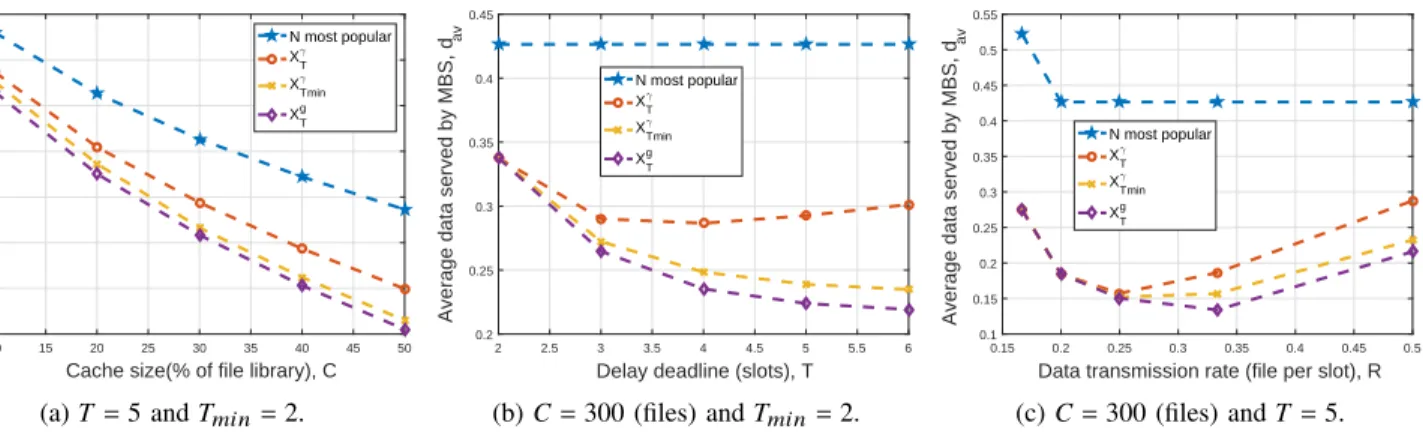
Fig. 1: The average amount of data served by the MBS (normalized by the file size) for different values of: (a) normalized cache size C, (b) delay deadlineT, and (c) data transmission rate R=1/Tmin.
video filevk where∆−k =∆−max is decreased by Rn.
IV. NUMERICALRESULTS
For numerical simulations we consider K = 1000 files in the library, and assume that their popularities follow a Zipf distribution with parameter0.56[8]. There are 16 SBSs located in a 2D square grid. We fix the transmission rate of each SBS to R, according to parameterTmin, i.e.,R=1/Tmin
file per slot. We consider the following Markov mobility model: a MU connected to SBSn remains connected to the
same SBS with probability fn, or connects to one of the
neighboring SBSs with equal probability. In the experiment, we consider f4 = f13 = 0.4, f7 = f9 = 0.5, and for the
all other SBSs fn = 0.3. As a performance benchmark, we
also consider theN most popular policy, which simply caches the most popular N files at each SBS. We remark that, when
T >Tmin the value ofT has no impact on the performance of
the Nmost popular policy since it caches the files as a whole. On the other hand, whenT ≤Tmin, the value ofdav decreases
linearly with increasingT.
In the first experiment, we setTmin=2,T =5and consider
the normalized SBS cache sizes (as portion of the entire file library) 10%,20%,30%,40%,50%. The greedy algorithm XTg provides up to 40% further reduction in the amount of data downloaded from the MBS compared to γ-based policy XγT as depicted in Fig. 1(a). We also observe that the gap between the performances ofXγT andXTg widens with increasing cache sizes. Finally, note that the N most popular policy performs quite poorly in general as it ignores the mobility patterns.
In the second experiment, we set C =300,Tmin =2, and
the delay deadline T takes values from 2 to 6 time slots. Performance of the caching policies for different T values are plotted in Fig. 1(b). The key observation from the figure is that, although the average portion of the video file downloaded from the MBS monotonically decreases with increasing T under policy XgT and XγTmi n, this is not the always the case for XγT. Note that XγT mainly depends on the sojourn statistics,
P(Sm,n ≥ t), over all possible paths, and when T > Tmin
those statistics might be misleading because in certain paths the MU might collect all the parity bits before connecting to SBSn. In that case, storage capacity of the popular files might
be increased due to sojourn statistics even though it is not required.
In the third experiment we set T = 5, C = 300, and the transmission rate takes values 1/2,1/3,1/4,1/5,1/6 file per slot, which correspond toTmin values of 2,3,4,5,6 slots
respectively. Although it is expected that the MBS usage decreases with the increasing transmission rate, Fig 1(c) illus-trates that after a certain point the amount of data downloaded from the MBS increases with the transmission rate under all policies. This is because, Tmin decreases when the rate
increases and the difference betweenTmin andT widens, as a
result of which the performance becomes worse.
V. CONCLUSIONS
In this letter, we studied mobility and popularity aware content caching for a heterogeneous network with MDS-coded caching at the SBSs. Assuming a maximum download time requirement T, for each request, we first defined the threshold Tmin on T, below which some bits of the request
must be downloaded from the MBS. Then, we obtained the optimal distributed caching policy when T ≤ Tmin, called
the γ-based policy, which minimizes the amount of data that need to be downloaded from the MBS. Then, we utilized the parameter Tmin and the γ-based policy for T =Tmin to
obtain a greedy caching policy forT > Tmin. Consequently,
we showed how to design a coded caching policy according toTmin and performed various simulations to demonstrate that
the utilization ofTmin improves the performance significantly.
REFERENCES
[1] W. Jiang, G. Feng, and S. Qin, “Optimal cooperative content caching and
delivery policy for heterogeneous cellular networks,”IEEE Trans. Mobile
Comput., vol. 16, May 2017.
[2] K. Poularakis, G. Iosifidis, and L. Tassiulas, “Approximation algorithms
for mobile data caching in small cell networks,”IEEE Trans. Commun.,
vol. 62, Oct. 2014.
[3] K. Shanmugam, N. Golrezaei, A. G. Dimakis, A. F. Molisch, and G. Caire, “Femtocaching: Wireless content delivery through distributed
caching helpers,”IEEE Trans. Inf. Theory, vol. 59, Dec. 2013.
[4] R. Wang, X. Peng, J. Zhang, and K. B. Letaief, “Mobility-aware caching
for content-centric wireless networks: Modeling and methodology,”IEEE
[5] K. Lee, J. Lee, Y. Yi, I. Rhee, and S. Chong, “Mobile data offloading:
How much can WiFi deliver?”IEEE/ACM Trans. Netw., vol. 21, Apr.
2013.
[6] K. Poularakis and L. Tassiulas, “Code, cache and deliver on the move: A
novel caching paradigm in hyper-dense small-cell networks,”IEEE Trans.
Mobile Comput., vol. 16, no. 3, Mar. 2017.
[7] J. Liao, K. K. Wong, M. R. A. Khandaker, and Z. Zheng, “Optimizing
cache placement for heterogeneous small cell networks,”IEEE Commun.
Lett., vol. 21, Jan. 2017.
[8] M. Zink, K. Suh, Y. Gu, and J. Kurose, “Characteristics of YouTube network traffic at a campus network - measurements, models, and