Journal of Modern Applied Statistical
Methods
Volume 8 | Issue 1
Article 18
5-1-2009
Improved Confidence Intervals for the Difference
between Two Proportions
James F. Reed III
Christiana Care Hospital System, Newark, Delaware, [email protected]
Follow this and additional works at:
http://digitalcommons.wayne.edu/jmasm
Part of the
Applied Statistics Commons
,
Social and Behavioral Sciences Commons
, and the
Statistical Theory Commons
This Regular Article is brought to you for free and open access by the Open Access Journals at DigitalCommons@WayneState. It has been accepted for inclusion in Journal of Modern Applied Statistical Methods by an authorized administrator of DigitalCommons@WayneState.
Recommended Citation
Reed, James F. III (2009) "Improved Confidence Intervals for the Difference between Two Proportions,"Journal of Modern Applied Statistical Methods: Vol. 8: Iss. 1, Article 18.
208
Improved Confidence Intervals for the Difference between Two Proportions
James F. Reed III
Christiana Care Hospital System, Newark, Delaware
Wald-z asymptotic methods, with and without a continuity correction, have less than nominal coverage probability characteristics but continue to be used. Newcombe's hybrid method and the Agresti-Caffo methods have coverage probabilities that are near nominal for either equal or unequal samples. Newcombe's hybrid and Agresti-Caffo methods demonstrate superior coverage properties.
Key words:Wald-z asymptotic, Newcombe's hybrid, Agresti-Caffo.
Introduction
In reporting the results of medical studies the problem of comparing two binomial success probabilities p1 and p2, p1 > 0 and p2 > 0 is often
encountered. Implicit in this comparison are the independent observations X1 ~ B (n1, p1) and X2
~ B (n2, p2). The most common comparison is
the hypothesis Ho: p1 = p2 versus Ha: p1 ≠ p2.
Accompanying the hypothesis test is the construction of a confidence interval for the difference between p1 and p2. Nearly all
introductory statistics textbooks include a method for computing this confidence interval and issue a warning - usually in a footnote - when not to use the common method: this commonly described method is the Wald-z method. Occasionally, a continuity corrected version is given (Wald-c).
The problems associated with the confidence interval for the difference between two independent proportions are similar to the confidence interval of a single proportion. Despite these properties, the Wald-z and Wald-c methods continue to dominate. We review the coverage probability functions of the Wald methods and a set of alternative methods for computing a confidence interval for the difference between two independent proportions.
James F. Reed III, PhD, is a Senior Biostatistician. Email him at: [email protected].
Methodology
The Wald-z and Wald-c confidence interval lower upper bounds for the difference between two independent proportions are defined as (See Appendix A for a typical data structure):
Wald-z: LB = (p1 − p2) − zα/2√ (ac/m3 + bd/n3) UB = (p1 − p2) + zα/2√ (ac/m3 + bd/n3) Wald-c: LB=(p1−p2)−[zα/2√{ac/m3+bd/n3}+(1/m+1/n)/2] UB=(p1−p2)+[zα/2√{ac/m3+bd/n3}+(1/m+1/n)/2]
The primary criteria for evaluating a confidence interval method is the coverage probability function. This coverage probability for the difference between two independent proportions, C(π1,π2|n1,n2,α), is found by fixing
n1, n2, π1, and π2, then computing the confidence
interval for each xi = 0, …, ni for i= 1, 2. The
coverage probability is then defined by: C(π1,π2|n1,n2,α) =
ΣPr(X1 = x1|n1,π1)Pr(X2 = x2|n2,π2)
δ(π1,π2|x1,x2,n1,n2,α).
If (π1-π2)∈[LB(x1,x2,n1,n2,α), UB(x1,x2,n1,n2,α)],
δ(π1,π2|x1,x2,n1,n2,α) = 1, and 0 otherwise.
Figure 1 shows the 95% confidence interval coverage probability function for the Wald-z and Wald-c methods as a function of π1,
π1 ∈ [0,1] for n1 = n2 = 20 and p2 = 0.3. The
REED
209
is due to the discontinuities for values of p1
corresponding to any lower or upper limits in the set of confidence intervals. Like its one sample cousin, the Wald-z coverage probability curve is subnominal and less than 0.95 overall. The Wald-c coverage probability always exceeds 0.95 overall with interval widths larger than Wald-z.
Figure 2 shows the 95% confidence interval coverage probability function for the Wald-z and Wald-c methods as a function of π1,
π1∈ [0,1] for n1 = 20, n2 = 10 and p2 = 0.3. The
Wald-z coverage probability curve is subnominal for differences in proportions near 0 and 1 and less than 0.95 overall.
Beal evaluated several asymptotic methods for computing a confidence interval between the differences of two independent proportions. All involved identifying the interval within which (θ - θ')2≤ z2 V(ψ, θ'), where θ'= p
1
− p2, and V(ψ, θ')=u{4ψ(1 −ψ)θ = π1(1 −π1)/m
+ π2(1 − π2)/n (Beal, 1987). Beal examined two
methods, labeled the Haldane (H) and Jeffreys-Perks (JP) methods. The JP method provides non-degenerative confidence intervals for all values of p1 and p2 unlike Wald-z or Wald-c. H
and JP generally performed better than the Wald-z and Wald-c and of the two, JP was preferred (Beal, 1987; Radhakrishna, et. al., 1992).
Figure 1: Coverage probabilities for nominal 95% Wald-z and Wald-c as a function of p1
when p2=0.3 with n1=n2=20 0.000 0.250 0.500 0.750 1.000 P 0.800 0.850 0.900 0.950 1.000 W Z Wald-z 0.000 0.250 0.500 0.750 1.000 P 0.800 0.850 0.900 0.950 1.000 W C Wald-c
210
The Haldane and Jeffreys-Perks lower and upper limits are defined by:
H LB=θ* − w, and UB=θ* + w, where θ*=(θ'+z2v(1−2ψ'))/(1+z2u), w=[z/(1+z2u)]√[u{4ψ'(1−ψ')−θ'2}+2v(1−2ψ')θ'+ 4z2u2(1−ψ')ψ'+z2v2(1−2ψ')2] ψ'=(a/m+b/n)/2, u=(1/m+1/n)/4, and v=(1/m−1/n)/4. JP LB=θ* − w, and UB=θ* + w, where ψ' from the Haldane method is:
ψ'=[(a+0.5)/(m+1)+(b+0.5)/(n+1)]/2. Newcombe (1998) compared eleven methods for estimating the difference between independent proportion. Similar to the single proportion, the virtues of Wald-z and Wald-c Figure 2: Coverage probabilities for nominal 95% Wald-z and Wald-c as a function
of p1 when p2=0.3 with n1=20, n2=10 0.000 0.250 0.500 0.750 1.000 P 0.800 0.850 0.900 0.950 1.000 W Z Wald-z 0.000 0.250 0.500 0.750 1.000 P 0.800 0.850 0.900 0.950 1.000 W C Wald-c
REED
211
methods are in their simplicity, but overshoot and inappropriate intervals are still common. The Haldane and Jeffreys-Perks methods attempt to overcome the overshoot and inappropriate intervals while maintaining closed-form tractability. Newcombe concluded that both H and JP were improvements over the Wald-z and Wald-c methods, but both were still inadequate. Newcombe recommended a hybrid method based on Wilson's score method for a single proportion without continuity correction (NS). The LB and UB for the NS method are: NS LB=(p1−p2)−δ, where δ=√{(a/m−l1)2+(u2−b/n)2} =zα/2√{l1(1−l1)/m+u2(1−u2)/n}. UB = (p1 − p2) +ε, where ε=√{(u1−a/m)2+(b/n−l2)2} =zα/2√{u1(1−u1)/m+l2(1−l2)/n},
and l1, l2, u1, u2 are the lower and upper bounds
for the two proportions p1 and p2 using Wilson's
score method.
Agresti & Coull's (1998) adjustment to the Wald method for a single proportion adds t/2 successes and t/2 failures. Agresti & Caffo (2000) later suggested that by adding two successes and two failures (total) to the two-sample method would improve the simple Wald
References
Agresti, A., & Coull, B.A. (1998). Approximate is better than 'exact' for interval estimation of binomial proportions. The
American Statistician,52, 119-126.
Agresti, A., & Caffo, B. (2000). Simple and effective confidence intervals for proportions and differences of proportions result from adding two successes and two failures. The
American Statistician, 54, 280-288.
Beal, S. L. (1987). Asymptotic confidence intervals for the difference between two binomial parameters for use with small samples. Biometrics,43, 941-950.
method. This is an adjustment that adds a pseudo observation of each type to each sample. For instance, for sample i, pi = (ri+1)/(ni+2).
Results
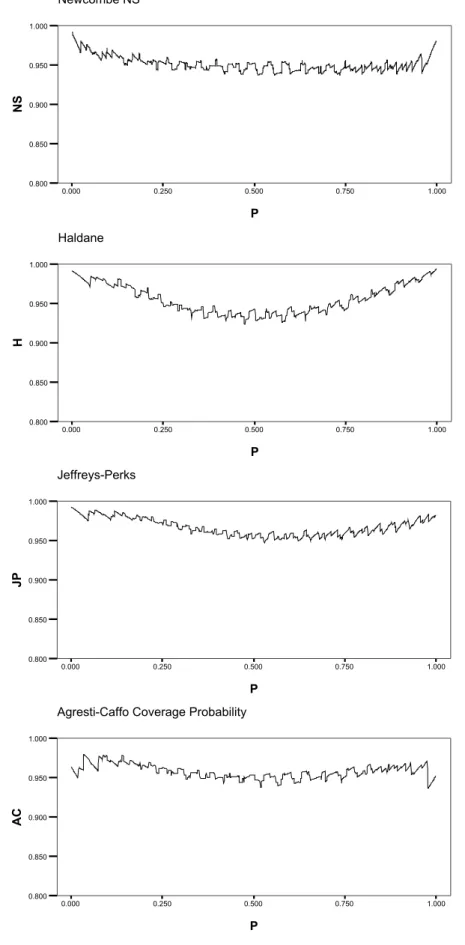
Figure 3 shows the 95% confidence interval coverage probability function for the Newcombe NS, Haldane, Jeffreys-Perks, and Agresti-Caffo methods as a function of π1, π1 ∈ [0,1] for n1 =
n2 = 20 and p2 = 0.3. The NS and Agresti-Caffo
methods demonstrate coverage probabilities that are near nominal over π1∈ [0, 1].
Figure 4 shows the 95% confidence interval coverage probability function for the Newcombe NS, Haldane, Jeffreys-Perks, and Agresti-Caffo methods as a function of π1, π1∈
[0,1] for n1 = 20, n2 = 10 and p2 = 0.3. In the
unequal sample size situation, Newcombe NS and Agresti-Caffo coverage probability functions are near nominal over π1∈ [0, 1].
Conclusion
In the case of differences between two independent proportions the Wald-z confidence interval behaves poorly with coverage probabilities below nominal values. Considering the coverage probability criterion, two alternative methods demonstrate superior coverage properties and both are easily programmable. Based on these results, the recommendation is to use either the NS or the Agresti-Caffo methods.
Newcombe, R. G. (1998). Interval estimation for the difference between independent proportions: comparison of eleven methods. Stat Med, 17, 873-890.
Radhakrishna, S., Murthy, B. N., Nair, N. G. K., Jayabal, P., & Jayasri, R. (1991). Confidence intervals in medical research. Indian
212
Jeffreys-Perks, and Agresti-Caffo as a function of p1 when p2=0.3 with n1=n2=20
0.000 0.250 0.500 0.750 1.000 P 0.800 0.850 0.900 0.950 1.000 N S Newcombe NS 0.000 0.250 0.500 0.750 1.000 P 0.800 0.850 0.900 0.950 1.000 H Haldane 0.000 0.250 0.500 0.750 1.000 P 0.800 0.850 0.900 0.950 1.000 JP Jeffreys-Perks 0.000 0.250 0.500 0.750 1.000 P 0.800 0.850 0.900 0.950 1.000 A C
REED
213
Figure 4: Coverage probabilities for nominal 95% Newcombe NS, Haldane, Jeffreys-Perks, and Agresti-Caffo as a function of p1 when p2=0.3 with n1=20, n2=10
0.000 0.250 0.500 0.750 1.000 P 0.800 0.850 0.900 0.950 1.000 N S Newcombe NS 0.000 0.250 0.500 0.750 1.000 P 0.800 0.850 0.900 0.950 1.000 H Haldane 0.000 0.250 0.500 0.750 1.000 P 0.800 0.850 0.900 0.950 1.000 JP Jeffreys-Perks 0.000 0.250 0.500 0.750 1.000 P 0.800 0.850 0.900 0.950 1.000 A C
214
Appendix A: Methods for calculation of confidence intervals for the difference between independent proportions
Sample 1 Sample 2 + a b p1 = a/m − c d p2 = b/n Total m m θ = π1−π2 θ' = p1− p2 Method Formula Wald-z LB=(p1 − p2) − zα/2√ (ac/m3 + bd/n3) UB=(p1 − p2) + zα/2√ (ac/m3 + bd/n3) Wald-c LB=(p1 − p2) − [zα/2√{ac/m3 + bd/n3} + (1/m + 1/n)/2] UB=(p1 − p2) + [zα/2√{ac/m3 + bd/n3} + (1/m + 1/n)/2] Haldane-H LB=θ*−w
UB=θ*+w, where θ*=(θ'+z2v(1-2ψ'))/1+z2u),
w=[z/(1+z2u)]√[u{4ψ'(1-ψ')-θ'2}+2v(1-2ψ')θ'+4z2u2(1-ψ')ψ'+z2v2(1-2ψ')2]
ψ'=(a/m+b/n)/2, u=(1/m+1/n)/4, and v=(1/m − 1/n)/4
Jeffreys-Perks-JP
LB=θ*−w
UB=θ*+w, where ψ' (from Haldane method) is:
ψ'=[(a+0.5)/(m+1)+(b+0.5)/(n+1)]/2
Newcombe-NS
LB=(p1-p2) −δ, where δ=√{(a/m−l1)2+(u2−b/n)2}=zα/2√{l1(1−l1)/m+u2(1−u2)/n}
UB=(p1-p2) + ε, where ε=√{(u1−a/m)2+(b/n−l2)2}=zα/2√{u1(1−u1)/m+l2(1−l2)/n}
l1, l2, u1, u2 are the LB and UB for p1 and p2 using Wilson's score method
Agresti & Caffo
LB = (p1-p2) − zα/2√ (ac/m3 + bd/n3)
![Figure 2 shows the 95% confidence interval coverage probability function for the Wald-z and Wald-c methods as a function of π 1 , π 1 ∈ [0,1] for n 1 = 20, n 2 = 10 and p 2 = 0.3](https://thumb-us.123doks.com/thumbv2/123dok_us/9736410.2855242/3.918.189.744.177.730/figure-confidence-interval-coverage-probability-function-methods-function.webp)