DRO
Deakin Research Online,
Deakin University’s Research Repository Deakin University CRICOS Provider Code: 00113B
Using Twitter to access the human right of communication for people who
use Augmentative and Alternative Communication (AAC)
Citation:
Hemsley, Bronwyn, Palmer, Stuart, Dann, Stephen and Balandin, Susan 2018, Using Twitter
to access the human right of communication for people who use Augmentative and
Alternative Communication (AAC)
, International journal of speech-language pathology
, vol.
20, no. 1, pp. 50-58.
DOI: https://doi.org/10.1080/17549507.2017.1413137
© 2018, The Authors
Reproduced by Deakin University under the terms of the Creative Commons Attribution
Non-Commercial No-Derivatives Licence
Downloaded from DRO:
Using Twitter to access the human right of communication for people
who use Augmentative and Alternative Communication (AAC)
BRONWYN HEMSLEY
1, STUART PALMER
2, STEPHEN DANN
3& SUSAN BALANDIN
41Graduate School of Health, UTS, Sydney, Australia,2Faculty of Science, Engineering and Built Environment,
Deakin University, Melbourne, Australia,3ANU College of Business & Economics, Australian National University, Canberra, Australia, and4School of Health and Social Development, Deakin University, Melbourne, Australia
Abstract
Purpose: Articles 19, 26 and 27 of the Universal Declaration of Human Rights and Articles 4, 9 and 21 of the Convention on the Rights of Persons with Disabilities promote the human rights of communication, education, use of technology and access to information. Social media is an important form of online communication, and Twitter increases users’ visibility, influence and reach online. The aim of this sociotechnical research was to determine the impact of teaching three people who use Augmentative and Alternative Communication (AAC) to use Twitter.
Method: Three participants were trained in ways of using Twitter strategically. Data collected from participants’ Twitter profiles were examined to determine the impact of training on Twitter follower count, frequency of tweeting, tweet content and the development of social networks. Data were also examined using (1) KH Coder software analysis and visualisation of co-occurring networks in the text data, based on word frequencies; and (2) Gephi software analysis to show the Twitter network for each participant.
Result: Two participants showed an improvement in Twitter skills and strategies.
Conclusions: Twitter can be used to improve social connectedness of people who use AAC, and should not be overlooked in relation to communication rights.
Keywords: Article 19;Universal Declaration of Human Rights; United Nations; AAC; complex communication needs; social media;Twitter
Introduction
Twitter is a popular microblogging social media platform used by 3 million Australians (Social Media News, 2017), representing 0.9% of 319 million monthly active Twitter users worldwide (Statista, 2017). Twitter enables users to communicate with the public in short messages of 140 characters in length. Messages require few keystrokes, and spel-ling errors and common abbreviations are tolerated, thus Twitter is ideal for people who use Augmentative and Alternative Communication (AAC) (Hemsley, Palmer, & Balandin, 2014). Twitter use increases visibility, influence and reach online (Boyd, 2014). People with communication disability associated with motor neurone disease (Hemsley & Palmer, 2016) or traumatic brain injury (Brunner, Hemsley, Palmer, Dann, & Togher, 2015) and their support associations have used Twitter strategically for awareness raising campaigning (e.g. #ALSIceBucketChallenge, #BrainInjuryAwareness
Month). However, despite the apparent benefits of Twitter, currently people who use AAC have relatively small Twitter networks (Hemsley, Dann, Palmer, Allan, & Balandin, 2015).
Twitter use enables both individuals and groups to access their right to ‘‘freedom of opinion and expression’’ (United Nations, 1948, Article 19) in their online and real-world communities, as evi-denced in the outcomes of Twitter campaigns for positive political and social change, including dis-ability advocacy (Trevisan, 2017). According to the Universal Declaration of Human Rights (United Nations, 1948, Article 27) ‘‘everyone has the right freely to participate in the cultural life of the community, to enjoy the arts and to share in scientific advancement and its benefits’’. In addition, everyone has a right to education (United Nations, 1948, Article 26). Accordingly, educating people who use AAC on using Twitter could facilitate their right to freedom of expression, and their
Correspondence: Bronwyn Hemsley, Head of Speech Pathology, Graduate School of Health, UTS, 67 Thomas Street Broadway, Ultimo, NSW, 2007, Australia. Email: [email protected] Twitter: @BronwynHemsley
ISSN 1754-9507 print/ISSN 1754-9515 onlineß2018 The Author(s). Published by Informa UK Limited, trading as Taylor & Francis Group
This is an Open Access article distributed under the terms of the Creative Commons Attribution-NonCommercial-NoDerivatives License (http:// creativecommons.org/licenses/by-nc-nd/4.0/), which permits non-commercial re-use, distribution, and reproduction in any medium, provided the original work is properly cited, and is not altered, transformed, or built upon in any way.
communication rights enshrined in the Convention on the Rights of Persons with Disabilities (United Nations, 2006). Articles 2, 4, 9 and 21 of the Convention on the Rights of Persons with Disabilities focus on communication and communi-cation technology and emphasise that people with disability not only have the right to use a range of communication modes but also to learn and use new technology that will increase their participation and access to information at an affordable cost.
Already, Twitter is part of a wider use of social media for political and collective action, providing marginalised groups with a ‘‘voice’’ in wider society (Hemsley et al., 2014; Trevisan, 2017). Recently, Hemsley, Balandin, Palmer, and Dann (2017) reviewed the literature on social media and AAC, noting that the majority of research to date focuses on Facebook and its use by children and young people, and/or people’s views and experiences of social media. They called for sociotechnical research (see Avgerou, Ciborra, & Land, 2004; Hemsley et al., 2014) into publicly available social media data produced by people who use AAC to: (1) under-stand about how people using AAC used social media platforms, and (2) identify increased oppor-tunities for improved participation and inclusion online. Despite the potential of Twitter for the communication and technology rights of people using AAC, little is known about the impact on people who use AAC of learning to use Twitter to increase their social networks, or to enter public discourse on topics of their own choosing. Therefore, the aims of this sociotechnical research (Avgerou et al., 2004) were to determine the impact of teaching people who use AAC to use Twitter, on follower count, frequency of tweeting, tweet content and the development of social networks in Twitter.
Method
The study was approved by the University of Newcastle Human Ethics Committee [H-2014-0027].
Participants
Participants were recruited through social media and organisations providing services to people with disability. In total, six adults with no cognitive impairment consented to take part in the training study; and their order of training was randomised across six consecutive months from September 2015. After randomisation and study commence-ment, but before their training commenced, three participants declined to complete the training, owing to competing study demands or personal health problems. Therefore, this study included three adults (@User1, @User2 and @User3) aged between 35 and 50 years with little or no functional speech, who used AAC systems, computers and the
Internet. All had previously used Twitter and wanted to increase their strategic use of Twitter. To protect their identity, the gender of the participants is not reported, details about their AAC device are with-held and the plural pronoun is used to refer to the individual.
Use of the internet and goals for Twitter training
Prior to developing the training, the three partici-pants were interviewed about their use of the Internet and their goals for participating in the training. A semi-structured survey (available from the authors) was used and analysed descriptively to determine the patterns of use in terms of frequency and purpose on each type of social media platform (e.g. Facebook, Instagram, Twitter) and any adverse events they had experienced in using social media. Prior to their Twitter training, participants were also asked about their knowledge and use of Twitter and their goals for using Twitter strategically.
All participants were adults who used AAC, had access to a computer and used the Internet for over two years, and currently used the Internet daily. The pre-training interview revealed participants’ use of multiple social media platforms. Twitter was used for reading and occasionally writing tweets (@User2 and @User3), and @User1 only read tweets throughout the baseline period. @User1 used Facebook and YouTube regularly, and Twitter infrequently or rarely, and their goal was to use Twitter for both writing and reading tweets to find information on topics of interest. @User2 used Facebook regularly, and used Twitter primarily for reading. Their goal was to improve writing of tweets, and using Twitter for: professional purposes, getting quick answers to questions, finding information on a particular topic, connecting socially with friends, participating in conversation, growing a community audience/network (e.g. raise profile with likeminded people), self-promotion or promotion of any aspect interest, and lobbying for causes/advocacy. @User3 used Facebook and Instagram regularly, and wanted to use Twitter to: contribute to political discourse in public activism online, connect multiple social media platforms with a larger audience, and follow the news or current.
Six months after the training, a follow-up conver-sational-style interview was conducted with two of the participants (@User2 and @User3), and @User1 did not respond to the invitation to participate in the interview after taking part in the training. During their 30 min face-to-face interviews, the participants were shown graphic visualisations of their own Twitter data networks and asked to reflect upon their Twitter experiences since the training. The first author verified her interpretations of their experi-ences for reporting purposes. Results of the follow-up Using Twitter to access communication rights 51
interview were analysed descriptively and individually.
Training
We developed training materials on the basis of (1) each participant’s stated Twitter learning goals; (2) publicly available How to Use Twitter resource material, presented on the Twitter website in 2015; (3) literature on the structural layers of Twitter (Bruns & Moe, 2014), including (a) that adding a hashtag sends the tweet to the macro larger com-munity of Twitter, (b) that not including a hashtag and not starting with @User sends the tweet the meso layer – limited to all followers so audience relies on follower numbers, and (c) that starting a tweet with an @User sends the tweet to the micro layer, with a very small audience; and (4) a content classification of tweets (Dann, 2015) demonstrating how to compose tweets strategically, including for: (a) conversational tweets (mentioning another user, for conversation), (b) news (for announcements and journalism), (c) pass-along tweets (for sharing links to other Internet content), (d) social presence tweets (for connecting personally with a Twitter audience) and (e) status broadcast tweets, reflecting Twitter’s use as a soapbox where users communicate their thoughts, feelings, experiences, and ‘‘diary of a daily life’’. An online training mode was selected to enable participation from any location in Australia, and consisted of a PowerPoint slideshow saved as a PDF and emailed to participants one week prior to training. This could be printed or saved to a local device and accessed at any time offline prior to and after the training. Additionally, training included an individual 2 h tutorial on the strategic use of Twitter, delivered via Skype.
The training was piloted with two adult col-leagues of the first author who wanted to increase their use of Twitter for a range of purposes similar to the participants’ stated goals (e.g. obtaining infor-mation, participating in discussion online, promot-ing their own work). The pilot study was conducted to check the (1) duration of the training, (2) level of information being suitable for people who wanted to learn to tweet more confidently and strategically and (3) clarity of the training. On the basis of the pilot, minor changes were made to the order of slides, and to clarifying technical details on the strategic use of the structural layers of Twitter (i.e. the difference between micro, meso and macro layers) for sending tweets to engage with different audiences. During the interactive tutorial, the first author explained each slide and used the ‘‘share screen’’ feature of Skype to demonstrate features of tweets and Twitter settings on the Twitter website. Participants also had the opportunity to do the activities outlined in the tutorial and were encouraged to continue doing these after the tutorial. The intervention started in September 2015, three months after baseline data
collection for each of the participants, and follow-up data was collected for six months.
Twitter data collection
Participants’ social media data produced in Twitter was collected continuously on a weekly basis, amas-sing all tweets sent any day from the start of baseline to six months after the training (i.e. 9 months of Twitter data). Using a protocol outlined in Hemsley et al. (2014), multiple hand content coding and computa-tional analytic methods were used to determine: (1) the quantitative effect of the training on the partici-pants’ Twitter skills, including frequency of tweets, retweets and mentions in Twitter; (2) the strength of the networks developed for communication in Twitter, in terms of their size and density; and (3) the content of tweet expressions either authored or retweeted by or mentioning the participants.
The Twitter application programming interface (API) allows publically available Twitter data to be retrieved on the basis of searches (e.g. @user name, one word, date); and the web browser add-on NCapture (QSR International, 2017) allows the results of a Twitter search to be recorded in a machine-readable data format. Over the relevant periods of interest, for both pre- and post-training data for @User1, @User2 and @User3, the Twitter API was used to extract data about: (1) follow count (number of people following the user and number of people being followed by the user); (2) tweets and retweets sent from their account; and (3) mentions of their account. The NVivo program (QSR International, 2016) was used to convert the captured Twitter data into Microsoft Excel (Microsoft, 2013) spreadsheets for further processing and analysis.
Twitter data network visualisations
In Twitter, an individual tweet can represent the connection between the sender and receiver. A single tweet that mentions another @User is considered as ‘‘directed’’ towards that user; if a single tweets does not not mention any other account, it may be considered ‘‘undirected’’. In this study, undirected tweets were considered as being sent to a common notional ‘‘user’’ node labelled as ‘‘undirected’’, to permit a complete network to be formed from the available Twitter data. The spreadsheet Twitter data of @User1, @User2 and @User3 were imported into the Gephi program (The Gephi Consortium, 2012) for network visualisation. In the Twitter network diagrams presented in this study, edges are presented as curved lines, the direction of tweets is clockwise around the edge, and the width of an edge is proportional to the total number of tweets recorded between the two nodes in that direction. The Yifan Hu layout algorithm (Hu, 2005) was used for the Twitter network visualisations with the data of @User2 and @User3 for the three separate time periods of interest: (1) three months pre-training;
(2) three months post-training; and (3) three-six months post-training.
Twitter network density
Network density has been positively associated with the diversity of a social network (Morrison, 2002); as network density increases, the diversity and range of a person’s social network decreases (Campbell, Marsden, & Hurlbert, 1986). Network density (D) is a measure of how interconnected a network isD¼1 when all nodes are connected to all other nodes, and D¼0 when no nodes are connected to any other nodes. For a directed network (as used here) withn nodes andeedges, the density (D) is given by:
D¼ e
nðn1Þ ð1Þ
For all @Users, basic network statistics were compiled for the three separate time periods of interest: (1) three months pre-training; (2) three months training; and (3) three-six months post-training. The weekly total Twitter activity (i.e. tweets and retweets from, and mentions of) was computed and plotted on a timeline, highlighting the three separate time periods of interest. The individual participant Twitter activity timelines were combined onto a common timeline, with a vertical line added to indicate the time of training for each participant; and network density was calculated for @User2 and @User3.
Content of tweets: Visualisations using KH coder
The tweet text from the spreadsheet Twitter data was exported in plain text format, converted to all lower case, and used as input to the KH Coder program (Higuchi, 2014) to analyse and visualise the text content as co-occurrence network (CON) and multi-dimensional scaling (MDS) plots. Frequently co-occurring terms in the visualisation are connected by lines/edges, the relative frequency of terms is indi-cated by the relative size of their node, and the relative frequency of co-occurrence of terms is indicated by the relative thickness of the edge connecting their nodes. Words/terms clustered close together in the resultant MDS visualisation are found more fre-quently close together in the source text, and may reveal key themes in the tweet data. For @User2 and @User3, CON and MDS plots were generated for the three separate time periods of interest: (1) three months pre-training; (2) three months post-training; and (3) three-six months post-training.
Results
Single case multiple baseline frequency of tweets, retweets, and mentions in the data
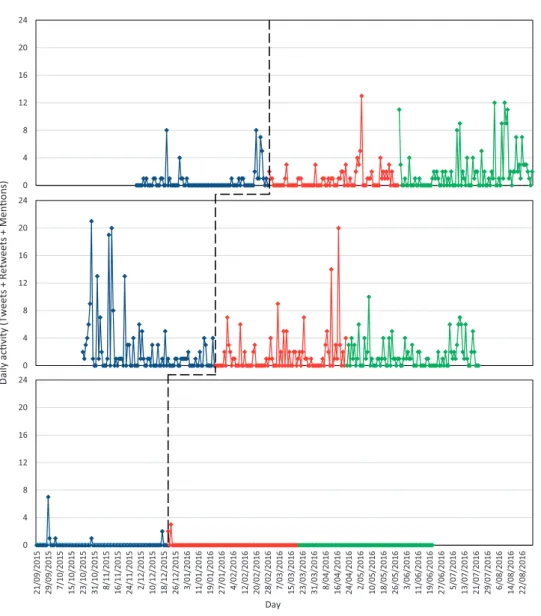
The raw network data, including tweets, retweets and mentions for all participants is presented in Table I and in a concurrent graph in Figure 1.
Prior to the training, all data for @User1 reflected @User1 being mentioned in tweets sent by others, with only one original tweet from @User1. @User1’s follow count did not change although @User1 demonstrated skill immediately in writing direct conversational tweets (i.e. starting with an @User) mentioning six other Twitter handles and being mentioned by one other user. However, following this initial burst of Twitter activity @User1 did not change from the baseline pattern of non-use of Twitter as an expressive mode of communication after the training. Both @User2 and @User3 increased in terms of follower counts, and network nodes and edges following the training. Only @User3’s graph (Figure 1) reflects a notable increase in frequency of tweeting, retweeting and being mentioned.
Network and content analysis of the twitter data
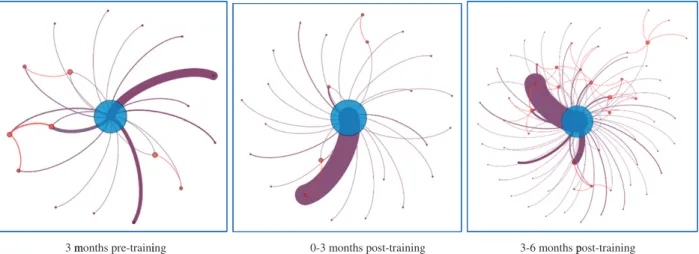
As @User1 only interacted with six other @Users following training, computational analysis (i.e. using Gephi and KH Coder methods) was not needed. The Gephi networks reflected growth in the size and complexity of networks developed by @User2 and @User3 over time. An example of the computational analysis of Twitter networks using Gephi is pre-sented for @User3 in Figure 2.
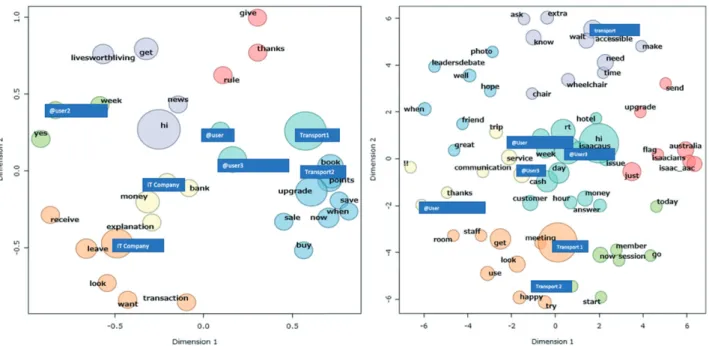
The words captured in KH Coder graphics in Figures 3 and 4 give some insights as to the broad range of topics of conversation or expression in Twitter and substantiate participants’ views and experiences of using Twitter. An example of the content of tweets as analysed and visualised in KH Coder software is presented in the three months pre-training and three-six months post-pre-training, with a CON network presented in Figure 3 for @User2 and an MDS visualisation presented in Figure 4 for @User3. Potentially identifying words (names or brands) are removed by masking the labels.
Post-training interviews: @User2 and @User3 views on their use of Twitter
@User2 Developing mastery in Twitter
Six months after the training, @User2 considered that their Twitter network was ‘‘growing in the direction I want – being about disability issues – last week I felt valued when disability organisations liked or retweeted me’’. This reflected @User2’s view that Twitter was a good way to vent opinions as a person with disability, precisely ‘‘because it goes to an audience’’. Indeed, @User2 acknowledged that feelings of irritation or anger definitely provided an impetus to tweet, and started the interview with: ‘‘I just have to tweet I am so angry’’ about the way someone had spoken about disability. As such, Twitter was an important mode of self-expression that provided the opportunity to express personal Using Twitter to access communication rights 53
views, and engage with organisations who were also aiming to influence disability issues ‘‘and promote AAC.’’ Twitter acts validated the value of being networked with both familiar and unfamiliar people in Twitter: ‘‘last week a friend of mine tweeted something about my work, and another person who I do not know liked it’’. @User2 attended to their Twitter audience feedback which affirmed their Twitter activity. Indeed, the Twitter data reflected that 41 of @User2’s tweets had been retweeted, ‘‘yesterday I tweeted about students not knowing much about people with disability and it’s been retweeted about five times’’. @User2 appreciated the
fact that through retweets, these messages made it out to new audiences. @User2 used Twitter the most at events, ‘‘as it’s a community.’’ Indeed, it was at an event that @User2 moved from primarily using micro layer conversational tweets (i.e. @User replies directed at one @User) or meso layer tweets to followers, to using macro layer tweets (i.e. tweets including a hashtag). For @User2, the shared experience of a real-life audience at an event could be augmented by commentary on Twitter that only followers who were also present would fully under-stand. Such tweets were not intended for @User2’s broader Twitter audience.
0 4 8 12 16 20 24 0 4 8 12 16 20 24 0 4 8 12 16 20 24 21/ 09/ 2015 29/ 09/ 2015 7/ 10/2015 15/ 10/ 2015 23/ 10/ 2015 31/ 10/ 2015 8/ 11/2015 16/ 11/ 2015 24/ 11/ 2015 2/ 12/2015 10/ 12/ 2015 18/ 12/ 2015 26/ 12/ 2015 3/ 01/2016 11/ 01/ 2016 19/ 01/ 2016 27/ 01/ 2016 4/ 02/2016 12/ 02/ 2016 20/ 02/ 2016 28/ 02/ 2016 7/ 03/2016 15/ 03/ 2016 23/ 03/ 2016 31/ 03/ 2016 8/ 04/2016 16/ 04/ 2016 24/ 04/ 2016 2/ 05/2016 10/ 05/ 2016 18/ 05/ 2016 26/ 05/ 2016 3/ 06/2016 11/ 06/ 2016 19/ 06/ 2016 27/ 06/ 2016 5/ 07/2016 13/ 07/ 2016 21/ 07/ 2016 29/ 07/ 2016 6/ 08/2016 14/ 08/ 2016 22/ 08/ 2016 Day Da ily ac vi ty (T wee ts + Re twee ts + Me n on s)
Figure 1. Twitter data for @User1 (bottom), @User2 (middle) and @User3 (top). Table I. Features of the Twitter data for @User 1, @User 2 and @User 3.
Feature @User1 3 mos pre @User1 0–3 mos post @User1
3–6 mos post Feature
@User2 3 mos pre
@User2 0–3 mos post
@User2
3–6 mos post Feature
@User3 3 mos pre @User3 0–3 mos post @User3 4–6 mos post
Tweets 1 5 0 Tweets 111 76 78 Tweets 45 73 142
Retweets 0 0 0 Retweets 15 11 18 Retweets 0 0 8
Mentions 11 0 0 Mentions 70 50 38 Mentions 7 4 25
Total 12 5 0 Total 196 137 134 Total 52 77 175
Nodes 12 6 0 Nodes 63 66 80 Nodes 18 25 63
Edges 22 5 0 Edges 135 138 156 Edges 24 28 97
@User2, who did not state a goal of using Twitter politically beyond work or disability matters, also admitted to developing a Twitter network strategically to indirectly influence information content in Twitter, saying: ‘‘if I find something political I want to get out I send it (by email) to (my friend) knowing that she will tweet it’’. Thus, the Twitter Direct Message feature enabled some covert redirection of information that @User2 was not comfortable to tweet. @User2 was also cautious about tweeting and not being cyber bullied so ‘‘learning to block’’ was useful. @User2 also reported that it was useful to learn how to insert links into tweets, and tweet pictures from the mobile phone camera, and was doing this more frequently. Although taught how to insert links to external websites into tweets, @User2 preferred ‘‘to tweet for myself ’’, in a process of reflection and commentary rather than only passing on information for followers. Nonetheless, Figure 4 shows that @User2’s post-training data reflected the insertion of links into ‘‘news’’ type tweets
tagged with a conference hashtag, perhaps motivated by the currency of information presented at such events (see https elements in CON plot post-training). @User2 hoped to use Twitter more, as it ‘‘saves more time than Facebook’’, but was aiming to limit time on social media as ‘‘I do not need to know rubbish’’ and was choosey in ‘‘lurking’’ behaviour saying ‘‘I don’t read everything’’. In the follow-up interview, @User2 verified the researcher’s interpret-ation that @User2’s tweets reflected an ability to use the publicity of Twitter but keep the intimacy of communicating with people who had shared know-ledge at events, which was also reflected in the substantial use of conversational replies in Twitter. Limiting tweets to ‘‘cryptic’’ messages when angry enabled @User2 to keep a professional reputation intact –not criticising, and affording some protection from ‘‘trolls’’ who ‘‘might just want to get into an argument’’. @User2 described this as being ‘‘master-ful’’ in composing tweets, modifying Twitter style to Figure 3. CON Plot @User2 – full 3 months pre-training (left) and CON Plot @User2 at 3–6 months post (right).
3 mmonths pre-trainiing 0-3 months post-training 3-6 months ppost-training
Figure 2. @User3 Gephi visualisation 3 months pre-training, 0–3 months post-training and 3–6 months post-training. Using Twitter to access communication rights 55
particular contexts, saying ‘‘I am black and white when needed’’.
@User3 ‘‘Facebook is family, and Twitter is professional’’
@User3 reported being pleased that their Twitter follower numbers had gone up appreciably and with having a larger network of influential tweeters interacting with tweets (e.g. retweets from public figures and people @User3 respected). Prior to the training, @User3 had found it increasingly difficult to find spare minutes to use social media, but since the training had been tweeting more frequently, and logging in more regularly, at least once a week, to check notifications and reply to people. @User3 said that on some days there were up to 20 notifications (i.e. of likes, retweets, or mentions), ‘‘because I’ve been using a hashtag to gripe about transport, and a lot of other people are having that problem too’’. In terms of developing a professional profile, @User3 was reportedly ‘‘building networks locally and nationally’’, in conjunction with using Instagram and Facebook. Indeed, @User3 signifi-cantly increased both the level of Twitter activity (tweets/retweets/mentions) and the richness or sophistication of the Twitter network (nodes/ edges/density). Since the training, @User3 had been using Twitter primarily for ‘‘sharing ideas and getting feedback mostly, I attended a (work-related) workshop and through that I developed local networks on Twitter’’. @User3 had also actively tried growing a network in Twitter by putting their Twitter handle on a business card, and felt more confident with inviting people to follow the handle. @User3 considered that training had helped them to build confidence and be more productive in keeping it up as in ‘‘feeding’’ the tweet stream, ‘‘being in there’’ yielded responses
from the general public. @User3’s reading of tweets had also improved: ‘‘I also know now how to follow a feed, like if I see a response I know how to read the full chat as such’’. @User2 reported finding the ads and promoted tweets a little annoying, and had at times attracted mild criticism from ‘‘trolls’’, but could counter or ignore much of this and block or report a reason for not liking those tweets. @User3 also reflected on balancing the demands and uses of multiple social media platforms: ‘‘I went off it for a bit, I just needed a break from the whole social media world . . . Facebook is family, and Twitter is professional. That’s how it fits in my brain’’. @User3’s advice to other AAC users on Twitter reflected persistence and equity: ‘‘I think every social media platform you should at least try, and stick with it for a while. I always say it (Twitter) levels the playing field’’.
Discussion
In this study, people who use AAC and wanted to learn to use Twitter approached the learning oppor-tunity with a range of communicative goals for participation online. Their goals demonstrate that they perceived Twitter as an avenue for achieving the rights articulated in Article 19 of the Universal Declaration of Human Rights (United Nations, 1948) and in the Convention on the Rights of Persons with Disabilities (United Nations, 2006), such as being used for accessing information (Article 9), or providing a platform for free expression (Article 21). Furthermore, Article 4 states that technologies should be affordable. Twitter is a free platform available for any any adult able to access the Internet and use the platform for a range of purposes including participating in communities and groups, albeit on-line. Education is clearly defined in Figure 4. MDS visualisation @User3–3 months up to training (left) and 3–6 mos post-training (right).
Article 24. Facilitating adults to learn to use social media and participate is important, particularly as many currently popular platforms were not available when the adults who may now want to use them were at school.
According to the quality standards of single case multiple baseline design studies (Krtochwill et al., 2010) the study met the methodological criteria of including at least three cases, at least three data points in each phase of the study, and randomisation in the order of participants. In order to account for an expected variation in use of Twitter across participants, all had at least three months baseline data collected. Furthermore, the data were analysed using objective methods in computational coding using Gephi and KH Coder. However, the study did not meet the criteria of at least three cases showing an effect in terms of percentage of non-overlapping data (determined visually) in terms of pre- and post-training frequency of either tweeting, retweeting or being mentioned in Twitter. Therefore, it is not possible to conclude that a 2-h online training based on information drawn from the Twitter platform How to Use Twitter, including specific information on the way tweets are seen by different audiences in Twitter, and customised to user goals, is effective in increasing Twitter activity for people who use AAC. Each of the @Users responded differently to the training. @User1’s follow count did not change throughout the three months of baseline data or up to six months following training. Both @User2’s and @User3’s follow count increased from flat baseline numbers rising at three and six months following the training. @User1’s main priority in the training was to use Twitter for writing tweets, and this goal was not realised. In terms of frequency of tweeting, retweeting or being mentioned, @User1’s Twitter activity rose briefly after training, but rapidly returned to baseline levels, and it is not known whether Twitter was a useful source for accessing information. @User1 might not have tweeted or retweeted suffi-ciently to build up their follow count or develop a useful network of information sources in Twitter, which might yield information that could not be found more easily on an already familiar social media platform used, namely Facebook.
The results for @User2 are mixed, with an initial and overall drop in Twitter data in terms of frequency of tweets, retweets and mentions, com-pared to the full three-months of pre-training data, and increased when compared only to the two-month period prior to the training. @User2’s pattern of tweeting in this study could reflect cyclical variation in tweeting. There was an overall ‘‘dampening’’ in frequency of Twitter data, with more activity during events when sharing the real-life experience with other tweeters in the audience. Overall, even in the context of dampened frequency of tweeting, @User2 increased the size of their Twitter network, sharpened or honed their ‘‘voice’’
on Twitter, and displayed increased finesse and confidence in applying Twitter functions to self-expression in tweets and retweets.
In both @User2 and @User3, the number of nodes and the number of edges increased post-training. So, irrespective of the number of tweets, both @user2’s and @user3’s networks included more communication partners (@users) and more directed communication paths post-training. Additionally, the network density decreasedfor both @User2 and @User3 post-training. A high social network density is generally taken to be an indicator of a homogeneous network where participants know each other. A lower social network density is generally taken as an indicator of network diversity and increased ‘‘reach’’. So, on these metrics, both @User2 and @User3 participants increased the size and sophistication of their Twitter networks post-training, as reflected in their Gephi visualisations. Thus, their Twitter data supports experiences of improved social connectedness in reflecting reduced density with greater reach, and larger networks. That @User2 did this without substantially increasing the number of tweets sent compared to baseline suggests a degree of sophistication in Twitter use developing as a result of the training followed by sustained use. Limitations of the study include (1) @User1 took part in the training but not the follow-up interview for insights into their use of Twitter for finding information or the rapid return to baseline low levels of using Twitter, (2) we did not capture any data relating to any changes made to the participants’ Twitter profiles over time (e.g. updates to biograph-ical statements, pictures) which could also have impacted on Twitter interactions, and (3) we did not examine ‘‘likes’’ or ‘‘media’’ data on the participants’ profiles over time. Future research could investigate these aspects, and also the impact of other strategies for increasing tweeting frequency (e.g. by partici-pants tweeting in a hashtag chat, which involves several tweets and replies, inserting links and using hashtags frequently), particularly in the first month following the initial training in order to support persistence in ‘‘sticking with it’’ while skills are being established. In this study, the researchers deliber-ately avoided public interactions with participants (e.g. in the form of liking, retweeting or responding to participants). With the option of ‘‘liking’’ Tweets, Twitter might also be a useful way for trainers to affirm trainees as they put their developing Twitter skills into practice. The prominence of event tweets in both @User2 and @User3’s data suggests that timing Twitter training to immediately precede conferences might also facilitate a burst of tweeting more frequently, if including additional material about ‘‘live tweeting’’ is included, and might also enable @Users to build up the size and reduce the density of their Twitter networks.
The mixed results of this study suggest that (1) targeted Twitter training might be useful for people Using Twitter to access communication rights 57
with communication disability who already use Twitter and want to enhance their strategic use of its functions to build safe and enjoyable networks with more people online; and (2) social media platforms, such as Twitter may be powerful in supporting adults with disability access their rights according to the Universal Declaration of Human Rights (United Nations, 1948) and the Convention on the Rights of Persons with Disabilities (United Nations, 2006). @User2’s goal of increasing others’ awareness of disability issues online supports the notion that Twitter might benefit both people who use AAC being included in disseminating and generating information about disability; and benefit society through ‘‘greater awareness of disability, improved attitudes, and increased knowledge about disability and its impacts on people with disability and the wider community’’ (Hemsley et al., 2014). @User3’s use of Twitter to advance their profes-sional networks and business opportunities, and to engage with commercial entities in Twitter for access to their consumer rights.
Acknowledgements
The authors acknowledge the assistance of Wendy Goonan (research associate) who assisted in coding of the data. The authors would like to thank and acknowl-edge the University of Newcastle, NSW Australia who administered the funding for this research, which was funded by the Australian Research Council through a Discovery Early Career Research Award to the first author.
Declaration of interest
The authors declare no potential or actual conflict of interest.
Funding
This research was funded by the Australian Research Council through a Discovery Early Career Research Award to the first author.
ORCID
Bronwyn Hemsley http://orcid.org/0000-0002-6255-3140
References
Avgerou, C., Ciborra, C., & Land, F. (2004).The social study of information and communications technology: Innovation, actors
and context. Oxford, UK: Oxford University Press.
Boyd, d. (2014).It’s complicated: The social lives of networked teens. Yale, NH: Yale University Press.
Brunner, M., Hemsley, B., Palmer, S., Dann, S., & Togher, L. (2015). Review of the literature on the use of social media by people with traumatic brain injury (TBI). Disability and
Rehabilitation, 37, 1511–1521. doi:10.3109/09638288.2015.
1045992
Bruns, A., & Moe, H. (2014). Structural layers of communication in Twitter. In K. Weller, A. Bruns, M.M. Burgess & C.
Puschmann (Eds.),Twitter and society(pp. 15–28). New York, NY: Peter Lang.
Campbell, K.E., Marsden, P.V., & Hurlbert, J.S. (1986). Social resources and socioeconomic status. Social Networks, 8, 97–117. doi: 10.1016/S0378-8733(86)80017–X10.1016/ S0378-8733(86)80017-X
Dann, S. (2015). Benchmarking microblog performance: Twitter content classification framework. In J.N. Burkhalter & N.T. Woods (Eds.), Maximizing commerce and marketing strategies
through micro-blogging(pp. 313–332). Hershey, PA: IGI Global.
Hemsley, B., Balandin, S., Palmer, S., & Dann, S. (2017). A call for innovative social media research in the field of augmenta-tive and alternative communication. Augmentative and
Alternative Communication, 33, 14–22. doi:10.1080/
07434618.2016.1273386
Hemsley, B., Dann, S., Palmer, S., Allan, M., & Balandin, S. (2015). ‘‘We definitely need an audience’’: Experiences of Twitter, Twitter networks and tweet content in adults with severe communication disabilities who use augmentative and alternative communication (AAC).Disability and Rehabilitation,
37, 1531–1542. doi:10.3109/09638288.2015.1045990 Hemsley, B., & Palmer, S. (2016). Two studies on Twitter
networks and tweet content in relation to amyotrophic lateral sclerosis (ALS): Conversation, information, and ‘diary of a daily life’:Vol. 227. 24th Australian National Health Informatics
Conference, HIC 2016 (pp. 41–47). Amsterdam, The
Netherlands: IOS Press.
Hemsley, B., Palmer, S., & Balandin, S. (2014). Tweet reach: A research protocol for using Twitter to increase information exchange in people with communication disabilities.
Developmental Neurorehabilitation, 17, 84–89. doi:10.3109/
17518423.2013.861529
Higuchi, K. (2014). KH Coder (Version 2.beta.32). Koichi Higuchi. Kyoto, Japan. Retrieved from http://khc.sourcefor-ge.net/en/
Hu, Y. (2005). Efficient, high-quality force-directed graph drawing.Mathematica Journal,10, 37–71. doi:10.1007/978-1-4614-3223-4_12
Krtochwill, T.R., Hitchcock, J., Horner, R.H., Levin, J.R., Odom, S.L., Rindskopf, D.M., & Shadish, W.R. (2010).Single-case
designs technical documentation. Retrieved from ies.ed.gov/ncee/
wwc/pdf/wwc_scd.pdf
Microsoft. (2013).Excel (Version 15.0.4911.1000). Redmond, WA: Microsoft. Retrieved from https://products.office.com/en-au/excel Morrison, E.W. (2002). Newcomers’ relationships: The role of social network ties during socialization. Academy of
Management Journal,45, 1149–1160. doi:10.2307/3069430
QSR International. (2016). NVivo (Version 11.2.1.616). Doncaster, Australia: QSR International. Retrieved from http://www.qsrinternational.com/nvivo-product
QSR International. (2017). NCapture (Version 1.0.203.0). Doncaster, Australia: QSR International. Retrieved from http://www.qsrinternational.com/nvivo-support/faqs/what-is-ncapture
Social Media News. (2017).Social media statistics Australia – June 2017. Retrieved from https://www.socialmedianews.com.au/ social-media-statistics-australia-june-2017/
Statista. (2017).Global social networks ranked by number of users. Retrieved from https://www.statista.com/statistics/272014/ global-social-networks-ranked-by-number-of-users/
The Gephi Consortium. (2012). Gephi (Version 0.8.1). Paris, France: The Gephi Consortium. Retrieved from https:// gephi.org/
Trevisan, F. (2017). Disability rights advocacy online: Voice,
empowerment and global connectivity. New York, NY: Routledge.
United Nations. (1948). Universal declaration of human rights. Retrieved from http://www.un.org/en/universal-declaration-human-rights/
United Nations. (2006).Convention on the rights of persons with
disabilities. Retrieved from https://www.un.org/development/
desa/disabilities/convention-on-the-rights-of-persons-with-disabilities.html