Absorptive Capacity for Firms Development: Impending Factors
for Small and Medium Sized Construction Firms
Ade Abdulquadri Bilau1, Musibau Akintunde Ajagbe2*, Ahmadu Shehu Bustani3 Tolani Abdulrahman Sani4
1. Department of Building, Federal University of Technology, Minna, Nigeria.
2. Center for Entrepreneurship Studies, Department of Business Management, Covenant University, Ota, Nigeria.
3. Spinal Engineering Services limited, Suite A305 Abuja Investment Neighborhood Centre, Abuja, Nigeria.
4. Department of Building, Waziri Umaru Federal Polytechnic, Birnin Kebbi, Nigeria. Abstract
The concept of Absorptive Capacity (AC) emanated from the presumptions of macroeconomists, who described it as the capability of an economy to adapt and absorb external knowledge. The concept was engrossed into firms through the capacity to identify the value of new, external information, assimilate it, and apply it to business perspectives. However, this study sought to explore on issues concerning AC on development of Small and Medium Sized Construction Firms (SMCFs) in Nigeria. Through qualitative interviews and quantitative survey protocols of 100 respondents, relevant responses were obtained from participants in the construction industry and research institutions. The questionnaire used was designed to obtain responses using closed ended questions for easy analysis through the Likert Scale and ranking system. The data obtained were subjected to a computer based Statistical Package for Social Scientist (SPSS) Version 17. Other open-ended responses and interviews were thematically analyzed to determine the distribution of responses to the variables under investigation. The study finds that SMCFs in Nigeria have a mean awareness index of 4.38 out of a scale of 5.0. This finding indicates that construction firms in Nigeria are highly aware of the prospects of the implementation of AC concept for the development of SMCFs. In addition to this, the study also has identified the factors affecting the implementation of AC concept in Nigeria.
Keywords: Absorptive capacity, Small and medium sized firms, Service Organizations; Construction firms, Knowledge management, Nigeria.
1. Introduction
Adler (1965) pointed out that the concept of Absorptive Capacity (AC) originated from the macroeconomics theory which refers it to the ability of an economy to utilize and absorb external information and resources. This macroeconomic concept was adapted to organizations by Cohen & Levinthal (1990) when they described Absorptive Capacity as the ability of an organization to recognize the value of new, external information, assimilate it, and apply it to commercial ends. They authors argued that the AC is largely a function of the organization's level of prior related knowledge and posit that it is critical to the organization's innovative capabilities. The definition of Absorptive Capacity by Cohen & Levinthal (1990) was expanded by Zahra & George (2002) when they defined the concept as a set of organizational routines and processes by which organizations acquire, assimilate, transform, and exploit knowledge to produce a dynamic organizational capability (Wong & Aspinwall 2004; Wu & Guo 2008; Abdullah et al., 2011). Absorptive Capacity pertains to knowledge creation and utilization that enhances an organization's ability to gain and sustain a competitive advantage. Othman (2009) opine that this concept has since been put to use by other industries including manufacturing, information technology, pharmaceutical industries (Ismail et al. 2012; Ajagbe & Ismail 2014) to mention a few. While Sharmistha (2001) mentioned that AC focus on the fact that knowledge outside the boundaries of the firm is not absorbed freely and effortlessly, even though it is in the public domain, rather, effort, expertise, and purposeful action on the part of firm’s researchers are needed to identify, assimilate, and exploit potentially valuable external knowledge (Cohen & Levinthal 1990; Abdullah et al., 2012; Bilau, 2011).
In order to explore the role of firm’s strategies in provision of benefits of AC, firms must focus on the exploitation of research results as generated by in-house researchers, university scientists, and large firm’s inventions. Newly generated knowledge by university scientists forms an important research input to firm’s innovative output. Current authors have described industries reliance on scientific research as the bedrock to the development of new products and processes (Grey, 2006; Ofori, 2009; Lim, 2006; Ajagbe et al., 2012; Ismail et
output. Cohen & Levinthal (1990) described the two faces of Research and Development (R&D) with reference to the dual benefits gained by an organizations research. They mentioned that the knowledge gained is useful for innovation as an internal R&D which brings about new innovations, improvement, and thus development on the firm’s internal expertise. In addition, the scientific expertise developed resulting from the processes of R&D allow the firm’s researchers to identify potentially new external knowledge. They authors concluded that the can also acquire and incorporate it into the firm’s research and thereby exploit the external knowledge for the benefit of the firm.
Kanter (1985) put forward that organizational variables such as structure, culture and communication also influence Absorptive Capacity. Cohen & Levinthal (1990) found that the aforementioned variables are interconnected and as a result influence one other. Organizational culture has an important influence on an organization's innovativeness as a result it is of specific importance whether tradition or continuous change is a value in the organization (Kanter, 1985; Thwala et al., 2012; Long et al., 2012a; Long et al., 2012b). Earlier researchers opined that people try to adjust to a certain culture and if changes are desired, the individuals will be much more motivated to search information about possible changes and improvements. Kotter (1996) highlighted that strong cultures tend to hinder the process of change and foster inbreeding. Oden (1997) posit that cultures of this nature are not favorable to organizational innovation, especially if the ideas for innovation come from outside the organization. Since organizational culture also influences the employees’ perception of the external environment (Oden, 1997; Long et al., 2012a; Long et al., 2012b), as a result, employees become reluctant to assimilate and use external information because they cannot recognize their value, though they might be aware of them. Therefore, these kinds of cultures leave little room for the absorption of the external sources of knowledge, especially if they contradict the existing beliefs (Van Den Bosch et al., 1999; Ofori, 2009; Bilau, 2011). This study which is aimed at exploring issues on Absorptive Capacity (AC) of Small and Medium Sized Construction Firms (SMCFs) in Nigeria shall be arranged in the following manner. The dual objectives of the research are presented in the next section, followed by the methodology adopted for this study. After which the detailed information about the respondent’s profile is presented and followed by the analysis and discussions of the responses from the participants. At the final section of this study are the conclusions and suggestions for policy directions.
Research Aim and Objectives
This research is aimed at finding out the factors influencing development of Small and Medium sized Construction Firms in Nigeria using Absorptive Capacity. The objectives of this study are:
1. To identify the level of awareness of AC by SMCFs in Nigeria;
2. To identify the factors affecting the effective implementation of AC by the firms. Research Methodology
The survey protocols adopted for this study is the survey technique where a random survey of SMCFs and research institutes were carried out and questionnaires administered to professionals and researchers on AC of firms. The sample population targeted professionals (100 respondents) who are managers of SMCFs in the construction industry i.e. Architect, Builders, Engineers and Quantity Surveyors based on categorization for registration with the Federal Government of Nigeria (FGN) and National Small and Medium Enterprises of Nigeria (NASME). In addition to this are the researches or institutions of higher learning and other construction related research institutions in and around Lagos and Abuja, Nigeria. The fundamental data used for the study were collected via structured questionnaire, the Likert Scale and ranking with an online interview via online social media to validate responses from the returned questionnaires. The questions were framed in such a way as to obtain responses through closed ended questions for easy analysis and also the use of open ended questions in order to obtain relevant information required for this study.
Apart from the collection of primary data, secondary data were collected from Journals of high impact, government publications and other reliable materials from the internet to gain the required information regarding AC and SMCFs. The data obtained were subjected to a computer based Statistical Package for Social Scientist (SPSS) Version 17, other open-ended responses and the interview transcript was thematically analyzed to determine the distribution of the responses of the variables under investigation. The SPSS used simplified calculation of average mean index and easy to generate charts and graphs. The average index was calculated based on equation as suggested by Al- Hammad & Assaf (1996).
Average Index =
Where, ai = constant expressing the weight given to i Xi = sum of frequency
McCaffer (1997) adopted the rating scales in previous studies using questionnaires as such in this study. Table 1 indicates the Long Caption Rating as previously utilized in Majid & McCaffer (1997) study.
Table 1: Long Caption Rating
Rating Scale Classification
Very low Awareness 1.00 < Average Index score< 1.5 Low Awareness 1.50 < Average Index score < 2.50 Medium or moderately Aware 2.50< Average Index score < 3.50 High or very effectively Aware 3.50 < Average Index score< 4.50 Very high or extremely Aware 4.50<Average Index score < 5.00
Details from Respondents’ Demographic Profile
This study reviewed responses from both strategic and operational managers of building and construction related SMCFs and researchers involved in construction related researches. Majority of the respondent’s academic qualifications is Bachelor’s Degree with about 5 year’s industry experience. From the results obtained through data analysis of the section of background information and demographic data of respondents. The results of the analysis done, showed that a majority of respondents are from building construction firms with 48.6% response rating, followed by 25% from civil engineering firms, 15.3% from construction affiliated research institutions and the least percentage of 11.1 from property development organizations. This demographic distribution further showed that most of the responses were collected from medium sized firms with a percentage of 56.9 while the remaining 43.1% came from small sized firms involved in building construction, civil engineering and property development.
In Figure 1a it was further asserted by the results of the analysis made that 38.9% of respondents are builders, 23.6% are civil engineers, 15.3% are architects, and 12.5% are researchers from research institutions and the least respondents with percentage of 9.7 are quantity surveyors. The implications of these results as obtained, is that responses were sort from a broad base of professionals involved in AC of firms as obtained in Nigeria’s construction industry. In addition, Figure 1b indicated that the respondents chosen for this study possess a broad range of relevant industry experience that qualified them as appropriate for the study. However, the result showed that 43.1% of respondents as shown in Figure 1b have years of experience ranging from 5 to 9years, 20.8% of them having between 10 to 15years of professional experience, 13.9% with 15 or more years of experience and 22.2% having experience ranging between 0 to 4 years.
Figure 1(a) and (b): Profession and Respondents Years of Experience
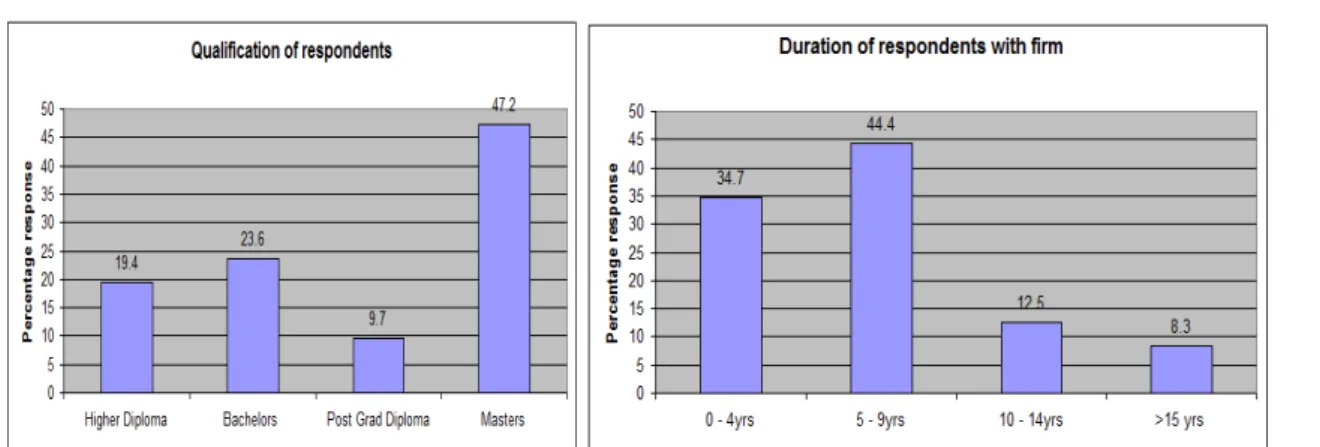
As regards the qualifications of the interviewed respondents, Figure 2a below shows 47.2% respondents have acquired Master’s degree, 9.7% Post graduate diploma, 23.6% having Bachelor’s degree and the least which is 19.4%- have acquired a higher National Diploma certificate. Whereas Figure 2b revealed that 44.4% of respondents have spent between 5-9 years with the firm, 12.5% have spent between 10 -15years, 8.3% have spent at least 15years and a percentage of 34.7 have at most spent 4years with their respective firms.
Figure 2(a) and (b): Respondents Qualification and Duration with firm Analysis and Discussions
Recent Dynamisms in Construction Contracts and the Effects of Construction Firms Development on Nations Economic Development
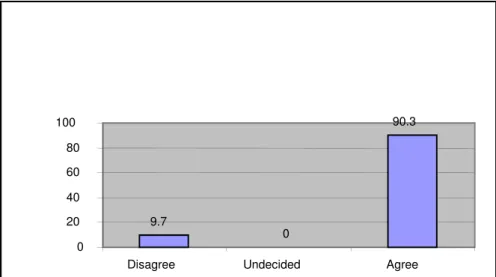
The result from this study reported that a cumulative percentage of 77.8% of respondents agreed that construction contracts in Nigeria is moving from the traditional design – bid and build to performance and innovative based contract as compared to the 6.9% of respondents who disagreed. On the effect of firms development on nations economic development, cumulative of 90.3% of respondents agreed that the development of construction firms greatly affected the nation’s economic development. The result confirms Rodney (2010) assertion on construction contracts changing from the normal design- bid and build approach to performance and innovative based approach. This is geared towards meeting the needs and high expectations of clients, spontaneous changes in technology, globalization among other factors. Hence, this finding is important for the SMCFs in Nigeria to continue to positively contribute to construction industry which further contribute to national development. Figure 4 shows the degree of agreement with construction contract shift among SMCFs in Nigeria.
Figure 3: Construction Contract Shift
Application of Innovative Techniques to meet Client Need and Improvement on Information and Knowledge Base through Capacity Development
The result of the study shows that all respondents (100%) as shown in Figure 4 strongly agreed that there are needs for SMCFs to apply innovative approaches and techniques to their process and product development in order to meet clients’ needs. This shows that SMCFs in Nigeria are aware of the need to improve on their products and services delivery through application of innovations to their processes and products.
6.9 15.3 77.8 0 10 20 30 40 50 60 70 80 90
Figure 4: Meeting Clients Need through Application of Innovative Techniques Firms Knowledge and Information Base Improvement
Based on responses received and analyzed as evident in Figure 5, about 90.3% of respondents cumulatively agreed that for SMCFs to innovate on their process and product development. They also need to ensure continuous improvement on the firm’s information and knowledge base to be able to attain innovativeness for competitive advantages. However, 7.0% of respondents disagreed on this assertion while 2.8% of respondent were undecided.
Figure 5: SMCFs ability to improve on their Information and Knowledge Base through Capacity Development
Enhancing Firm's Innovative Capacity by Employing Qualified Personnel
As shown in Figure 6, all respondents (100%) agreed that for SMCFs to enhance their innovative capacities and capabilities through Absorptive Capacity. Small and Medium Sized Construction Firms in Nigeria must employ qualified personnel in terms of qualification and experience in construction domain who will serve as the firms existing knowledge base. This finding is consistent with that of Zahra & George (2002) who asserted on the importance of firms existing knowledge base for easy identification, acquisition, integration and transformation of the newly acquired knowledge to the firms competitive advantages.
Degree of respondents agreement on application of Innovative techniques to
meeting clients needs
0 20 40 60 80 100
Disagree Undecided Agree
P e rc e n ta g e r e s p o n s e 9.7 0 90.3 0 20 40 60 80 100
Figure 6: SMCFs ability to enhance their innovative capacity by employing qualified personnel Learning from Projects Handled
This study reported in Figure 7 that 83.3% among 100 respondents shows that new knowledge can be acquired also by learning from previous projects handled. In addition, other experiences which will aid SMCFs in improving, expanding and utilization of the firm’s competences and innovative ability could bring about transformation of work processes and products and as a result increase the productivity of the firm. This particular finding is in line with Cohel & Levinthal (1990) who found that learning from experiences is a way of absorbing capacities.
Figure 7: SMCFS learning from previous projects and experiences
0 0 100 0 20 40 60 80 100 120
Disagree Undecided Agree
7 9.7 83.3 0 20 40 60 80 100
Figure 8: SMCFS investing in R&D for innovativeness Investing in Research and Development
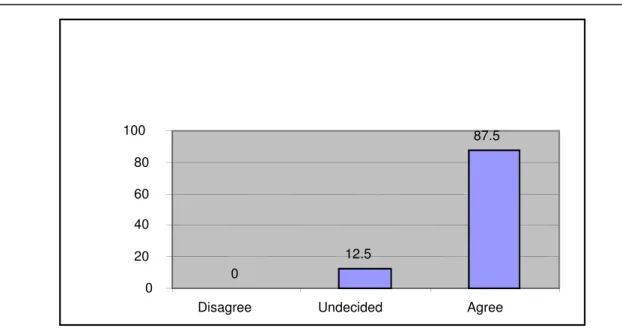
This research finds that considering SMCFs in Nigeria investing in research and development, about 87.5 % of respondents as shown in Figure 8 agreed that there exist needs that SMCFs invest in R&D. This investment will help to equip the firm in seeking and acquiring potentially new and valuable information and/or knowledge that when integrated into the firm would enhance the firm’s performance in process and product development. This could also lead to helping the firm sustain competitive edge over others in the industry. While about 12.5% of the participants were undecided on the issue of establishing an Internal R&D unit in SMCFs in Nigeria in order to perform some amount of research internally. This will help as suggested earlier by Cohen & Levinthal (1990) that a better equipped organisation could help to absorb external R&D output.
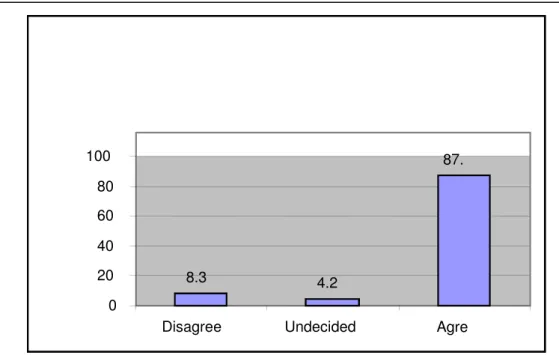
Employment of Highly Educated Personnel & Encouragement to Continuous Professional Development According to the result of survey made, 80.5% of respondents agreed that it is important that small and medium sized construction firms employ highly educated personnel, on this same question, 19.4% were undecided while 11.1% disagreed. On the encouragement for further training, 8.3% disagreed and 87.5% agreed that SMCFs personnel should be encouraged to further training. This results as acquired from the survey and shown in Figure 9 below acknowledge education and training as an approach to acquiring and improving on firm’s individual and organizational knowledge base. This knowledge is needed to achieve a set of system that is innovative in its process and product development. The results acknowledge Nika & Igor (2009) proposition that for firms to effectively absorb capacity, it is pertinent on them to engage the services of highly educated personnel and also invest continuously on professional development through training of its personnel to the benefit of the firms
0 12.5 87.5 0 20 40 60 80 100
Figure 9: SMCFs Personnel Encouragement to further Training or Continuous Professional Development Employees Training and Development should be more focused on Organizational Needs & Funding of Research for Potentially New and Valuable Information
Going by the result as obtained in the survey as shown in Figure 10 below, 79.2% of respondents agreed that training and development of firm’s employees should be more focused on organizational needs. This will help the firm to successfully be able to absorb capacity that will be of benefit to the firm’s specific needs. While a total of 20.8% of respondents were undecided when asked this question.
Figure 10: SMCFS Focusing its Employees Training and Organizational Needs Development of Closer Ties and Relationship with Larger Firms
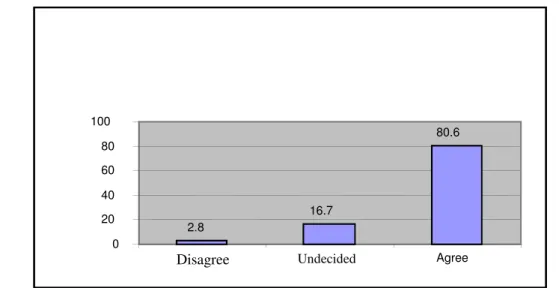
On the building of close relationships with large companies, 80% of respondents agreed that another manner by which SMCFs could improve its potential effect of acquiring potential information and tacit knowledge is through the development of closer ties with larger construction firms that are doing well. This confirms existing literature which states that a firm that develops closer relationship with one of the main actors will do better in comparism with those that do not (Vinding, 2006). Although 16.7% of respondents were undecided while 2.8% disagreed to this. Figure 11 shows the development of closer ties with larger firms.
8.3 4.2 87. 0 20 40 60 80 100
Disagree Undecided Agre
0
20.8
79.2
0
10
20
30
40
50
60
70
80
90
Figure 11: Development of Closer Ties and Relationship with Larger Firms Cooperation with Research Institutions to Gain Potential New Knowledge
As regards cooperation with research institutions to gain potential new knowledge, 97.3% agreed that SMCFs stand to acquire more valuable potentially new knowledge is cooperating and collaboration with research and institutions of higher learning. This is in view of the fact that collaboration with research institutions breed scientific research outputs as a result, higher Absorptive Capacity within a short time. Absorptive Capacity of firms according to Fabrozio (2006) and Lim (2006) is mainly a function of connection between firms and research and institutions of higher learning. Contrary to majority opinion, about 2.7% of respondents were undecided on this question as shown in Figure 12 below.
Figure 12: Gaining Potentially New Knowledge through Cooperation with Research Institutes Awareness Index of Small and Medium Sized Construction Firms in Nigeria
Figure 13 below shows the list of the contents of Absorptive Capacity awareness and the mean index for each of the elements as obtained from the survey made on Small and Medium Sized Construction Firms in Nigeria. The figure shows that SMCFs awareness on enhancing the firm’s innovative capacity through the employment of qualified professionals scored the highest mean index of 4.61. This is followed by awareness on outing in place
2.8 16.7 80.6 0 20 40 60 80 100
Disagree Undecided Agree
0 2.7 97.3 0 20 40 60 80 100 120
4.51each. The seventh awareness index of SMCFs on investing in R&D indicated a mean index of 4.49. Ranked 8th in ACAP awareness mean index is motivation of personnel of SMCFs towards seeking information and knowledge that could yield the firms innovativeness, with 4.46 mean indexes. This is followed by an index of 4.42 for the encouragement of SMCFs personnel for further training or continuous professional development. The tenth as shown in the Figure is awareness on learning from previous projects handled and experiences with awareness index of 4.31. The 11th index as ranked is imbibing innovative organizational attitudes and culture with an awareness index of 4.29. Followed by awareness index of construction contract shift from design-bid and build to performance and innovative based contract with awareness index of 4.18. Also followed by is focusing training and development of SMCFs personnel on organizational needs with awareness index of 4.17. The 14th ranked awareness index is SMCFs awareness on development of closer ties and relationship with larger firms and the last ranked index being SMCFS establishment of internal R&D unit.
Absorptive Capacity Mean Awareness Index of SMCFs in Nigeria =
=
.
= 4.38
Figure 13: Absorptive Capacity Awareness Index for SMCFs in Nigeria
Factors affecting the Implementation of Absorptive Capacity Concept by Small and Medium Sized Construction Firms in Nigeria
ACAP Awareness Index for SMCFs in Nigeria
4.18 4.51 4.54 4.61 4.31 4.49 4.06 4.42 4.17 4.53 4.12 4.51 4.56 4.29 4.46 3.6 3.8 4 4.2 4.4 4.6 4.8 1
M otivation to seeking information and knowledge for innovation
Imbibing innovative organizational attitudes and culture
Effective organisational structure for effective acquisition and dissemination of knowledge
Coop eration with research institutions
Development of closer ties and relationship with larger firms
Funding of Research for potentially new and valuable information/knowledge Focusing on training and develop ment organizational needs
Encouragement to further training or continuous p rofessional develop ment Establishment of Internal R&D Committee /Unit
Firms' Investing in R&D
Learning from projects handled /experiences
Enhancing firm's innovative capacity by employ ing qualified personnel Information and knowledge base Improvement
App lication of Innovative techniques to work p rocess for outp ut development Contract Shift From Design-Bid and Build to Performance & Innovative ap proach
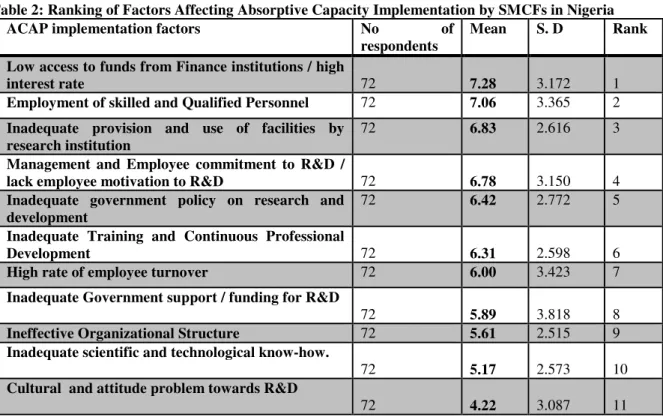
A total of eleven (11) factors were identified from reviewed literature and confirmed through this study to be among the main factors affecting the implementation of AC concept in SMCFs in Nigeria. In order to validate the factors, a survey protocol was conducted through tape recorded interviews on the factors in Nigerian context. In the interviews, respondents affirmed that all the eleven factors as obtained in the literature are essential to the development of SMCFs through the adoption of AC in Nigeria. These factors were listed in the questionnaire survey and respondents were asked to rank them in order of importance, with the factor seen as most important ranked 1st and the one seen as least important ranked 11th.
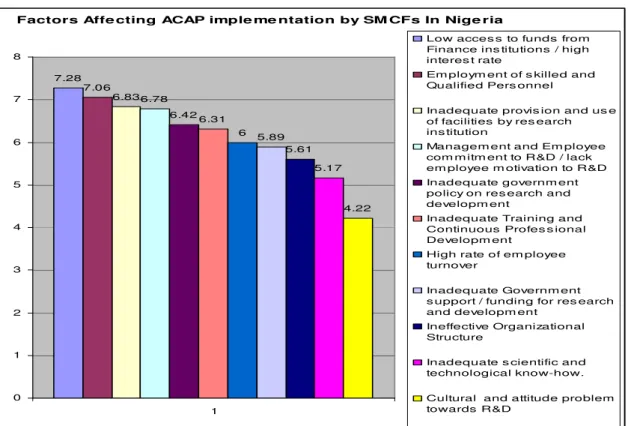
Based on the analysis made on responses received, low access to funds from finance institutions/high interest rate was ranked 1st with a mean of 7.28, this is followed by employment of skilled and qualified personnel coming 2nd with a mean of 7.06. The 3rd factor as ranked by respondents is inadequate provision and use of facilities by research institutions with mean score of 6.83, the 4th is low management and employee commitment and motivation towards R&D with a mean score of 6.78. The 5th ranked factor is inadequate government policy on R&D with a mean score of 4.42, followed by inadequate provision of training and continuous professional development for employees with a mean score of 6.31. The 7th ranked factor is high rate of employee turn-over in SMCFs with a mean score of 6.0. This is followed by inadequate government support and funding of R&D with a mean score of 5.59. As presented in Table 2, ineffective organizational structure was ranked 9th with mean index 5.61 while inadequate scientific and technological know-how of SMCFs personnel came 10th on the ranking made. Ranked least on the table as factor affecting the implementation of AC concept by SMCFs is cultural and attitude problem of personnel of small firms to R&D. Factors affecting the implementation of AC concept by SMCFs in Nigeria are indicated on Table 2 and in Figure 14.
Table 2: Ranking of Factors Affecting Absorptive Capacity Implementation by SMCFs in Nigeria
ACAP implementation factors No of
respondents
Mean S. D Rank
Low access to funds from Finance institutions / high
interest rate 72 7.28 3.172 1
Employment of skilled and Qualified Personnel 72 7.06 3.365 2 Inadequate provision and use of facilities by
research institution
72 6.83 2.616 3
Management and Employee commitment to R&D /
lack employee motivation to R&D 72 6.78 3.150 4
Inadequate government policy on research and development
72 6.42 2.772 5
Inadequate Training and Continuous Professional
Development 72 6.31 2.598 6
High rate of employee turnover 72 6.00 3.423 7
Inadequate Government support / funding for R&D
72 5.89 3.818 8
Ineffective Organizational Structure 72 5.61 2.515 9
Inadequate scientific and technological know-how.
72 5.17 2.573 10
Cultural and attitude problem towards R&D
Figure 14: Factors affecting ACAP Implementation in Nigeria ranked in Descending Order Conclusions, Limitations and Suggestions
This study has been able to provide a summary and conclusion of this research and also provides appropriate suggestions for future development of the study. The study was conducted with the aim to answer two broad based research objectives as enumerated in the introduction and methodology part of this article. The first objective is to study the level of awareness of the AC concept by SMCFs in Nigeria, while the second objective is to identify the factors affecting the implementation of AC concept by SMCFs in Nigeria. In order to achieve these objectives, intensive literature review was conducted which firstly identified the level of awareness of SMCFs in Nigeria, by identifying the AC measurement indices for SMCFs. From this study, it was found that SMCFs in Nigeria have a mean awareness index of 4.38 out of a scale of 5.0. Comparing this with the Long Caption Rating Scale used (see Table 1 above), it means that SMCFs in Nigeria have a “High or Very Effective Awareness Index” of the prospects of the implementation of AC concept for the development of SMCFs. Subsequently the study was also able to identify the factors affecting the implementation of AC concept by SMCFs in Nigeria. From the study, eleven (11) factors affecting the implementation of AC concept by SMCFs were identified and ranked in descending order. These factors include:
i. Low access to funds from Finance institutions / high interest rate ii. Employment of skilled and Qualified Personnel
iii. Inadequate provision and use of facilities by research institution
iv. Management and Employee commitment to R&D / lack of employee motivation to R&D v. Inadequate government policy on R&D
vi. Inadequate Training and Continuous Professional Development vii. High rate of employee turnover
viii. Inadequate Government support / funding for research and development ix. Ineffective Organizational Structure
x. Inadequate scientific and technological know-how xi. Cultural Barrier/attitude problem towards R&D
However, in the ranking made, low access to funds from finance institutions and high interest rates were ranked as most important factor and cultural barrier and or attitude problem towards R&D were ranked as least important. Although this has been able to achieve the outlined objectives, but, it recorded a limitation on its findings as the study was only able to interview two interviewee regarding the validation of factors affecting the implementation of AC concept by SMCFs in Nigeria as obtained in literature out of the proposed 10 interviewees.
However, in order for SMCFs in Nigeria to leave up to expectations, the following suggestions should Factors Affe cting ACAP imple me ntation by SM CFs In Nige ria
7.28 7.06 6.836.78 6.42 6.31 6 5.89 5.61 5.17 4.22 0 1 2 3 4 5 6 7 8 1
Low acces s to funds from Finance ins titutions / high interes t rate
Em ploym ent of s killed and Qualified Pers onnel
Inadequate provis ion and us e of facilities by res earch ins titution
Managem ent and Em ployee com m itm ent to R&D / lack em ployee m otivation to R&D Inadequate governm ent policy on res earch and developm ent
Inadequate Training and Continuous Profes s ional Developm ent
High rate of em ployee turnover
Inadequate Governm ent s upport / funding for res earch and developm ent
Ineffective Organizational Structure
Inadequate s cientific and technological know-how. Cultural and attitude problem towards R&D
be considered:
• There should be easy access to funds from finance institution at Low interest rate so they could invest into research and development.
• SMCFs must employ adequately skilled and Qualified Personnel to bring about and run efficiently firm’s internal R&D.
• The Nigerian government should make adequate provision of facilities for R&D for research institutes and the facilities must be effectively put to use by research institution(s).
• Management and Employee should be highly commitment to the firm’s R&D and employees should be appropriately motivated to be involved in R&D
• Government should enact policies that would enhance firms involvement and benefiting from research and development
• SMCFs should involve their personnel in training and Continuous Professional Development tailored towards the achievement of the firm’s innovativeness.
• Caution should be taken on the High rate of employee turnover to retain personnel tacit knowledge.
• Government should adequately support and create funding for researches and development.
• SMCFs should put in place effective Organizational Structure that enhance R&D
• Researchers of institutions and firms personnel involved in R&D should be exposed to scientific and technological know-how that can enhance research process and output.
• SMCFs must do away with all forms of Cultural Barriers that could retard their commitment to R&D. Openness and knowledge sharing should be encouraged among firm’s personnel.
Acknowledgements
The researchers wish to thank the Federal University of Technology Minna, Nigeria and the Covenant University Ota, Nigeria for making available some of the facilities that enhanced the compilation of this research.
*Corresponding Author: Dr. Musibau Akintunde Ajagbe is from the Center for Entrepreneurship Development Studies (CEDS), Covenant University, Canaan Land, Ota, Nigeria.
References
Adler, J. H. (1965), Absorptive Capacity: The Concept and Its Determinants. Brooking Institution, Washington. Abdullah, A., Bilau, A. A., Enegbuma., W. I., Ajagbe, A. M., Ali, K. N. & Bustani, S. A. (2012), Small and
Medium Sized Construction Firms Job Satisfaction and Evaluation in Nigeria. International Journal of Social Science and Humanity, 2 (1), 35-40.
Abdullah, A., Bilau, A. A., Enegbuma. W.I., Ajagbe, A. M. & Ali, K. N. (2011), Evaluation of Job Satisfaction and Performance of Employees in Small and Medium Sized Construction Firms in Nigeria. Proceedings of the 2nd International Conference on Construction and Project Management,
Singapore, 15, 225-229.
Al-Hammad, A. & Assaf, S. (1996), Assessment of Work Performance of Maintenance Contractors in Saudi Arabia. Journal of Management in Engineering, 12 (2), 44-49.
Ajagbe, A. M., Ismail, K., Aslan, A. S. & Choi, S. L. (2012), Investment in Technology Based Small and Medium Sized Firms in Malaysia: Roles for Commercial Banks. International Journal of Research in Management and Technology, 2 (2), 147-153.
Ajagbe, A. M. & Ismail, K. (2014), Factors Influencing Venture Capital Assessment of High Growth Companies in Malaysia. International Journal of Entrepreneurship and Small Business, 21 (4), 457-494.
Bilau, A. A. (2011), The Development of Small and Medium Sized Construction Firms in Nigeria Using Absorptive Capacity. Being a MSc. Thesis Submitted to the Graduate School of Faculty of Civil Engineering, Universiti Teknologi Malaysia.
Cohen, W. M. & Levinthal, D. A. (1990), Absorptive Capacity: a new Perspective on Learning and Innovation, Administrative Science Quarterly, 35, 128–152.
Fabrizio, K. (2006), Absorptive Capacity and Innovation: Evidence from Pharmaceutical and Biotechnology Firms [Working paper].
Grey, C. (2006), Absorptive Capacity, Knowledge Management and Innovation in Entrepreneurial Small Firms.
International Journal of Entrepreneurial Behaviour and Research, 12 (6), 345-360.
Semiconductor Chips [Working paper].
Long, C. S., Perumal, P. & Ajagbe, A. M. (2012a), The Impact of Human Resource Management Practices on Employees’ Turnover Intention: A Conceptual Model. Interdisciplinary Journal of Contemporary Research in Business, 4 (2), 629-641.
Long, C. S., Ajagbe, A. M., Khalil M. N. & Suleiman, S. E. (2012b), The Approaches to Increase Employees’ Loyalty: A Review on Employees’ Turnover Models. Australian Journal of Basic and Applied Sciences, 6 (10), 282-291.
Mohhamed, Z. A. & McCaffer, R. (1997), Assessment of Work Performance of Maintenance Contractors in Saudi Arabia. Journal of Management in Engineering, 13 (5), 91-97.
Narin, F., Hamilton, K. S. & Olivestro, D. (1997), The Increasing Linkage between U.S. Technology and Public Science. Research Policy, 26, 317–330.
Nika, M. & Igor, P. (2009), Absorptive Capacity, its Determinants, and Influence on Innovation Output: Cross-cultural Validation of the Structural Model. Technovation, 29, 859-872.
Ofori, G. (2009), Small and Medium Sized Construction Enterprise Development. Construction for Development (ISIZA). 1st Quarter.
Oden, H. W. (1997), Managing Corporate Culture, Innovation, and Intrapreneurship, Quorum Books, Westport.
Othman, S. N. (2009), Firms Absorptive Capacity and Product Development Design among Automotive Components Manufacturers in Malaysia.
Rodney, M., Kristel, M., Nora, M. & John, D. (2010), The Development of Absorptive Capacity-Based Innovation in a construction SME. Entrepreneurship and Innovation, 11 (3), 231-244.
Shamistha, B. (2001), Product Innovation and Competitive Advantage in an Area of Industrial Decline: the Niagara Region of Canada. Technovation, 21, 45-54.
Thwala, D. W., Ajagbe, A. M., Enegbuma, W. I., Bilau, A. A. & Long, S. C. (2012), Sudanese Small and Medium Sized Construction Firms: An Empirical Survey of Job Turnover. Journal of Basic, Applied Scientific Research, 2 (8), 7414-7420.
Van Den Bosch, F. A. J., Volberda, H. W., & De Boer, M. (1999), Co-evolution of Firm Absorptive Capacity and Knowledge Environment: Organizational Forms and Combinative Capabilities, Organization Science, 10, 551–568.
Vinding, A. L. (2006), Absorptive capacity and innovative performance: a human capital approach, Economics of Innovation and New Technology, 15, 507–517.
Wong, K. Y & Aspinwall, E. (2004), Characterizing Knowledge Management in Small Business Environment.
Journal of Knowledge Management, 8 (3), 44-55.
Wu, J. & Guo, J. (2008), Specialization of Small to Medium-Sized Construction Enterprises. School of Economics and Management, Beijing Jiaotong University, P. R. China.
Zahra, S. A. & George, G. (2002), Absorptive Capacity: a Review, Reconceptualization, and Extension, Academy of Management Review, 27, 185–203.
A. A. Bilau obtained his Bachelor’s degree in Building from Ahmadu Bello University, Zaria, Nigeria and Master’s degree in Construction Management from Universiti Teknologi Malaysia. He is a Member of the Nigerian Institute of Building and Chattered Institute of Building, U.K. He is currently pursuing his doctoral degree on Disaster Management.
Dr M. A. Ajagbe was born in 18th October, 1972 in Ibadan, Nigeria. He obtained his first degree in Business Administration & Management (Business Finance) in 1997, second degree in Business Administration (Marketing Management) in 2007 from Ambrose Ali University, Ekpoma, Nigeria and third degree in Management (Technology Entrepreneurship) in 2014 from Universiti Teknologi Malaysia. This author became an Associate Member of the Nigeria Institute of Management (Chartered), Associate Member of the National Institute of Marketing of Nigeria, and currently a Fellow with the Chartered Institute of Entrepreneurship and Corporate Governance in 2014.