APPENDIX - XI X-RAY DIFFRACTION RADIATION SAFETY INFORMATION
The following information should be read by all users of x-ray diffraction units. The form at the end of this section should be signed by each user and responsible Principal Investigator, and forwarded to Radiation Safety.
I. Hazards of Operating Machine Sources of X-Rays
The radiation from x-ray machines can be very dangerous, and such danger should not be minimized. On the other hand, there is no reason to be afraid to operate these machines after receiving proper training and instructions. The operator of an analytical x-ray machine should never become complacent or overconfident about the potential danger from an x-ray beam.
Numerous safety devices may be provided, but the user should not depend too heavily on these safety devices lest he become overconfident. If a safety device should fail unnoticed, serious injury may result. Adequate safeguards must be provided, but these can never replace constant vigilance and alertness to possible danger. Proper training in the operation of these machines should teach the nature of the hazards so that the user can be properly alert and vigilant.
The wavelengths of the x-rays used most commonly in x-ray diffraction and fluorescent x-ray spectroscopy fall in the range from approximately 0.5 to 10A. These are so-called "soft" x-rays which are readily absorbed in matter. A thickness of only a few mm or less of Al, Fe, or Pb is required to reduce the intensity of the transmitted beam to 1/10 that of the initial intensity even for x-rays with a wavelength of 0.5A. The 1.54A wavelength corresponds to CuKa radiation, and 1.93A is the wavelength of FeKa radiation. These are commonly used sources in x-ray diffraction work.
It is apparent that only relatively thin layers of shielding are required to protect against this radiation, but it is this same property that makes these x-rays very dangerous. They are highly absorbed in soft tissue, and severe burns can result from exposure of the hands, arms, skin or eyes to the direct or diffracted beams. The maximum permissible dose of radiation for various parts of the body are shown in Table I. For comparison, x-ray intensities that may be obtained with high-power tubes and strongly diffracting crystals are also shown in Table I. It is apparent that a dose of 100 to 500 times the permissible yearly dose may be obtained from a 1-second exposure to the most intense direct beam. Even a strong diffracted beam can deliver the maximum permissible yearly dose to the eye in less than 10 minutes.
o o
o
II. Biological Effects of Intense X-Ray Beams
It is possible to provide a general classification of the kind of changes that ionization radiation can produce in skin. It is useful to categorize these effects into three areas. 1. Reversible changes.
2. Conditional reversible changes. 3. Irreversible changes
A. Reversible Changes
The most common and earliest reversible change is the production of reddening of the skin or erythema. If the dose and energy is low enough that most of the radiation is absorbed in the superficial layers of the skin, reddening occurs, then disappears apparently with no future effects.
Another reversible change is the loss of hair or epilation. It is possible to give a dose of radiation that will stop cell division in the epithelial cells so that hair ceases to grow temporarily and falls out. With a low dosage, the hair will begin to grow after a period of time, with no apparent permanent ill effects.
A third system that shows reversible effects are the sebaceous glands (oil-producing glands in the skin) which are temporarily affected to produce less sebum (oil secretion of these glands in the skin).
B. Conditional Reversible Changes
Pigmentation of the skin is not a totally reversible change. If a large area of skin is irradiated, erythema and pigmentation will occur with the pigmentation eventually fading. It has been shown that the resulting skin is not normal and has some "memory of the injury." Future doses of the same area do not produce the same skin response.
C. Irreversible Changes
If enough radiation of the proper energy is absorbed in the skin this will result in permanent destruction of either hair or sweat glands, or whole skin, with a resulting scar. The irreversible changes are categorized in the heading of:
1. Radiation Dermatitis
2. Chronic radiation dermatitis 3. Radiation cancer
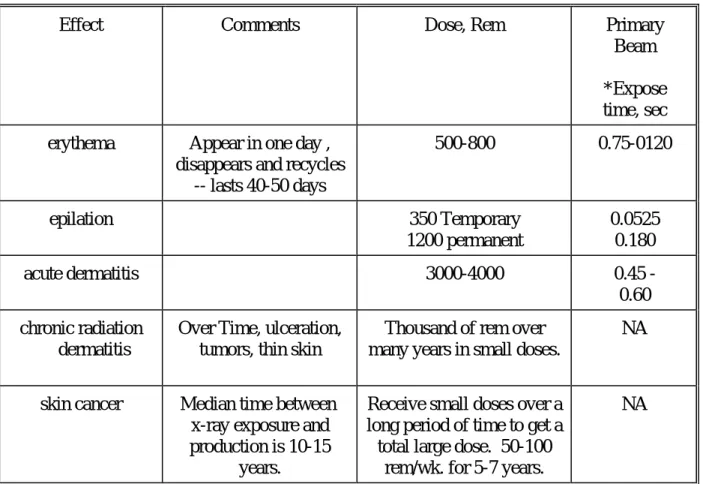
A summary of the various effects to be expected after given acute dose to low energy x-rays and the time of exposure to receive the dose in the beam are given in Table II on page 84.
Sources of Exposure
1. The primary beam.
2. Leakage of primary beam through cracks in shielding.
3. Penetration of primary beam through shutters, cameras, beam stops, etc. 4. Secondary emission (fluorescence) from a sample or shielding material. 5. Diffracted rays from crystal.
6. Radiation generated by rectifiers in the high voltage power supply.
TABLE 1
NRC OCCUPATIONAL EXPOSURE LIMITS*
YEARLY LIMIT (mrem)
WHOLE BODY 5000
SKIN OF THE WHOLE BODY 50000
EXTREMITY 50000
LENS OF EYE 15000
MINORS (PERSONS UNDER THE AGE OF 18) 500
FETAL EXPOSURE 500/Nine months
*Note: State of Connecticut exposure limits vary slightly. For more information contact Radiation Safety.
TYPICAL X-RAY BEAM INTENSITIES
Primary Beam: 400,000 Rem/min., 2.4 x 10⁷ Rem/hr Diffracted Beam: 80 Rem/hr.
It should be noted that in x-ray diffraction both the primary beam and the diffracted beam are small and well collimated, which increases the possibility of receiving severe burns on very localized areas of the fingers, hands, eyes, or arms if inadvertently exposed. Leakage of the primary beam or scattered radiation through cracks or small openings in the shielding likewise may give rise to small but intense beams which may escape detection in general area radiation surveys unless the survey is carried out carefully. The penetration of the primary beam through shutters on commercial equipment may result if the shutter becomes defective or does not close properly. Improperly designed shielding can itself be a hazard if it excited to fluorescence and the radiation is allowed to scatter into the room. The rectifiers in the high-voltage power supply constitute a frequently unsuspected source of hazardous radiation. When they become gassy they function like x-ray tubes, and due to the high voltages that may be impressed across them, they can emit penetrating radiation. It is essential that adequate shielding be provided around the rectifier tubes to prevent this radiation from escaping into the room.
TABLE II
Effect Comments Dose, Rem Primary
Beam *Expose time, sec erythema Appear in one day ,
disappears and recycles -- lasts 40-50 days 500-800 0.75-0120 epilation 350 Temporary 1200 permanent 0.0525 0.180 acute dermatitis 3000-4000 0.45 -0.60 chronic radiation dermatitis
Over Time, ulceration, tumors, thin skin
Thousand of rem over many years in small doses.
NA
skin cancer Median time between x-ray exposure and production is 10-15
years.
Receive small doses over a long period of time to get a total large dose. 50-100
rem/wk. for 5-7 years.
NA
* assuming an in-beam dose rate of 400,000 rem/min.
IT SHOULD BE POINTED OUT THAT A ONE (1) SECOND EXPOSURE OF AN EXTREMITY IN THE PRIMARY X-RAY BEAM COULD RESULT IN A DOSE OF OVER 6,000 REM!
III.Precautionary Measures
General precautionary measures to be taken to protect against accidental exposure to x-radiation are:
1. Effective shielding
2. Check tubes or shield tubes in high voltage rectifier 3. Interlock switches and warning lights
4. Radiation monitoring, film badges 5. Physical exam of any suspected injury
6. Radiation surveys by the Radiation Safety Section and operator.
To be effective, the shielding must prevent any stray radiation from escaping into areas where it can be intercepted by personnel in the room. Care should be taken to avoid cracks or small openings which may go unnoticed.
Tube status indicators should be provided both at the on-off switch and near the tube head so that the operator will be reminded whenever the x-ray beam is on. In addition, a light or other signal should be provided to indicate when the shutter is open, and this should be augmented by interlock switches and lights or manual control devices that will prevent access to the beam area when the shutter is open. It is advisable to conduct a regular maintenance program scheduled and checked by the Principal Investigator in order to insure that these safety devices are always in proper working order.
Radiation monitoring is of two types. On the one hand, the intent is to determine how much radiation a person may have received in a given period of time. For this purpose a film badge is worn, but this usually indicates only the general level of radiation in the room, or the level of whole-body radiation. Radiation surveys around the tube head and associated equipment should be conducted by the operator and radiation safety personnel to check the adequacy of the shielding. This should be done periodically with a detector which is sensitive to the x-ray wavelengths being used or generated. A survey should also be conducted whenever the geometrical arrangement or design of the equipment is changed in order to accommodate new experiments or procedures. Records should be kept of the survey results.
Beam detection with fluorescent screens should be done with the screen placed on a long device to insure that no exposure to the primary beam is possible. For experiments taking long periods of time, the operator should leave the area, securing it for unauthorized access.
IV. Accidents
If you feel you may have been exposed to the primary beam, or if you feel conditions on your unit have changed significantly, you should call Radiation Safety at 785-3550. If you cannot reach anyone in Radiation Safety, call Campus Police at 111 or 432-4400 (accidents and emergencies only). Campus Police will then contact the appropriate Radiation Safety personnel.
- - -
Detach, sign and mail to: Radiation Safety
135 College Street
New Haven, CT 06510
I have read the contents of this x-ray diffraction radiation safety guide and have been instructed as to the proper operation procedures in using the unit(s) located in:
User Signature:
SIGNATURE and TYPED NAME
Trainer:
SIGNATURE and TYPED NAME
Responsible Principal
Investigator Signature:
SIGNATURE AND TYPED NAME
V. X-ray Diffraction Unit Safety Guidelines
AUTHORIZED PERSONNEL ONLY - You must have department approval and proper equipment orientation training prior to using x-ray equipment. A Radiation Safety information handout is available as a resource. See the equipment supervisor or call the Radiation Section at 785-3550.
• To insure your safety, do not attempt any unauthorized repair of x-ray unit. • Do not allow hands, fingers or other body parts to enter the x-ray beam.
• Be sure the beam is off and shutter is closed prior to sample changing or other activity. Check all warning lights prior to placing hands near the beam line. Use a GM radiation survey instrument to confirm “beam off” conditions.
• Use the shielding and interlocks provided. Do not bypass interlocks.
X-ray units need routine shutter maintenance to prevent shutter failure and resulting safety hazard. See equipment supervisor.
Should any safety related interlock or device fail, the unit should be taken out of service until such time as effective repairs have been made. Failure of beam shutter(s) must be reported to the Radiation Safety Section. A heath physicist may physically inspect the unit prior to use, after such repairs have been made. If you are having problems with the equipment, ask for assistance. In case of emergency or accident notify your supervisor and Radiation Safety immediately at 785-3555. Prevent further use of the unit until a safety evaluation is done.