Fakult¨at f¨ur Physik der Technischen Universit¨at M¨unchen Lehrstuhl E15, Univ.-Prof. Dr. F. von Feilitzsch
Institut f¨ur Astro-Teilchen-Physik
Development of a Liquid Scintillator
and of Data Analysis Methods for BOREXINO
Marianne G¨oger-Neff
Vollst¨andiger Abdruck der von der Fakult¨at f¨ur Physik der Technischen Universit¨at M¨unchen zur Erlangung des akademischen Grades eines
Doktors der Naturwissenschaften genehmigten Dissertation.
Vorsitzender : Univ.-Prof. Dr. M. Lindner Pr¨ufer der Dissertation : 1. Univ.-Prof. Dr. F. von Feilitzsch
2. Apl. Prof. Dr. V. Sch¨onfelder 3. Univ.-Prof. Dr. H.-J. K¨orner
(schriftliche Beurteilung)
Die Dissertation wurde am 20. August 2001 bei der Technischen Universit¨at M¨unchen eingereicht und durch die Fakult¨at f¨ur Physik am 23. Oktober 2001 angenommen.
Abstract
The solar neutrino problem has been one of the most intriguing questions in astrophysics and particle physics over the last 30 years. The first motivation for a solar neutrino experiment was the possibility to use the neutrinos “to see into the interior of a star and thus verify directly the hypothesis of nuclear energy generation in stars” [Bah64]. The evidence for solar neutrinos in the first detector, the Homestake experiment, showed that the sun indeed produces a large fraction of its energy by nuclear fusion reactions. However, the first generation of solar neu-trino experiments (Homestake, Kamiokande, GALLEX, SAGE) all measured a substantially lower neutrino flux than predicted by the standard solar model. Even more puzzling, the sup-pression factors in the four detectors are different and not explainable by modifications of the theoretical solar models, like nuclear reaction rates or the equation of state. The standard solar model, on the other hand, has been confirmed by helioseismological measurements. Thus, the success of the neutrino experiments in confirming stellar evolution theory by the detection of neutrinos became a challenge for physicists to explain the discrepancy between the measured and predicted neutrino flux.
The only convincing solution to the solar neutrino problem is flavour transitions between the different lepton families (e;;), which can occur only if the neutrinos have a non-zero rest mass, and the eigenstates of the weak interaction are not equal to the mass eigenstates. This would imply that the standard model of electroweak interactions has to be modified as, in this theory, the neutrinos are assumed to be massless a priori. The first evidence for neutrino oscillations (
$
), and thus for physics beyond the standard model, was announced in 1998 by the Super-Kamiokande experiment measuring atmospheric neutrinos [Fuk98]. The main focus of the second generation solar neutrino experiments (Super-Kamiokande, GNO, SNO, BOREXINO) is now to confirm the evidence for neutrino oscillations and to pinpoint the mass and mixing parameters down to one of the currently allowed oscillation scenarios. BOREXINO can play an important role in increasing our understanding of the so-lar neutrino problem because of its ability to measure the low energy soso-lar 7
Be neutrinos in real-time at a high rate. The measurement of the total flux and the time variability of the 7
Be signal will allow one to distinguish between all of the currently allowed oscillation scenarios. The direct detection of the 7
Be neutrinos is therefore considered as the missing clue for the solution of the solar neutrino problem.
The work described in this thesis was performed in the context of the BOREXINOexperiment. The main emphasis was on the development of new methods for the position reconstruction of scintillation events and for particle identification, which are important for an effective back-ground reduction, and on the characterization of a new scintillator mixture based on phenyl-o-xyxlylethane (PXE) that, due to its optical properties and its radiopurity, could be employed in BOREXINO as well as in other large-volume, low-background scintillation detectors.
The first chapter contains a short overview of the theory of solar neutrinos, their production inside the sun and their detection with present and future experiments. The implications of the discrepancy between the predicted and the measured count rates that all experiments to date have seen is discussed, followed by a presentation of the different possible solutions to the solar neutrino problem. The most likely solution, neutrino oscillations, will be discussed in detail.
The second chapter introduces the physics goals of the BOREXINO experiment. The design of the detector and its ancillary systems are described. The different types of background are discussed and the importance of their effective suppression is underlined. In chapter 3 the design and results from the first data taking period of the Counting Test Facility (CTF) are presented, and the main design improvements of the upgraded CTF2 are shortly discussed. In chapter 4 a newly developed reconstruction method for scintillation events for both BORE-XINOand the CTF is presented. This method is based on a comparison of each real event with simulated events from known positions, and includes a model that describes the generation and propagation of the scintillation photons in the detector. Promising results are obtained with Monte Carlo simulations and confirmed by the analysis of real data from the CTF. Chapter 5 discusses the scintillation processes which allow particle identification, and the application of neural networks to this problem. Results obtained with Monte Carlo simulations and CTF data show the capabilities of this method.
Chapter 6 is devoted to the development of an alternative liquid scintillator for the BORE-XINO experiment, namely PXE. This scintillator offers the advantage of a higher density (and therefore higher target mass) compared to the solution chosen for BOREXINO(pseudocumene based scintillator). The results of several tests and measurements in laboratory and in the CTF are presented. The optical properties (light yield, fluorescence time, absorption and reemis-sion), which are essential for position reconstruction and =-discrimination, are comparable to those of pseudocumene. The radiopurity level obtained with a newly adopted purification method using a silica gel column was for238
U and232
Th below the sensitivity limit of the neu-tron activation analysis. Due to background problems, however, it was not possible to confirm these results by the measurements in the CTF.
The last chapter describes the calibration measurements in the CTF2 that I performed. With these measurements the position- and energy-dependent detector response could be tested. The spatial and energy resolution were determined as a function of position and energy, and systematic effects due to the position reconstruction could be excluded.
¨
Ubersicht
Das solare Neutrinoproblem ist seit mehr als 30 Jahren eine der faszinierendsten Fragen der Astro- und der Elementarteilchenphysik. Die erste Motivation f¨ur ein solares Neutrino-Experiment war die M¨oglichkeit, Neutrinos dazu zu benutzen, um “in das Innere eines Sterns zu schauen und auf diesem Weg die Hypothese der Energieerzeugung durch Kernfusion in Sternen zu verifizieren” [Bah64]. Der Nachweis solarer Neutrinos mit dem ersten Detektor, dem Homestake-Experiment, zeigte, dass die Sonne tats¨achlich einen großen Teil ihrer En-ergie aus Fusionsreaktionen gewinnt. Allerdings ergaben die Messungen der Experimente der ersten Generation (Homestake, Kamiokande, GALLEX, SAGE) einen deutlich gerin-geren Neutrinofluss als vom Standardsonnenmodell vorhergesagt wurde. Noch verbl¨uffender ist die Tatsache, dass die Unterdr¨uckungsfaktoren f¨ur die verschiedenen Experimente unter-schiedlich sind und nicht durch ¨Anderungen der theoretischen Sonnenmodelle, z. B. der Fu-sionswirkungsquerschnitte oder der Zustandsgleichung, erkl¨art werden k¨onnen, zumal ander-erseits das Standardsonnenmodell in den letzten Jahren durch helioseismologische Messun-gen hervorraMessun-gend best¨atigt wurde. Auf diese Weise wurde aus dem erfolgreichen Nachweis solarer Neutrinos, um die Theorie der Sternentwicklung zu best¨atigen, eine Herausforderung f¨ur die Physiker, die Diskrepanz zwischen vorhergesagten und gemessenen Neutrinofl¨ussen zu erkl¨aren.
Die einzige ¨uberzeugende L¨osung des solaren Neutrinoproblems stellen ¨Uberg¨ange zwischen Neutrinos der verschiedenen Leptonfamilien dar (e;;), die allerdings nur dann auftreten k¨onnen, wenn die Neutrinos eine von Null verschiedene Ruhemasse besitzen und die Eigen-zust¨ande der schwachen Wechselwirkung nicht identisch mit den MasseeigenEigen-zust¨anden sind. Dies w¨urde bedeuten, dass das Standardmodell der elektroschwachen Wechselwirkung mod-ifiziert werden muss, da in diesem Modell die Neutrinos a priori als masselos angenommen werden. Eine erste Evidenz f¨ur Neutrinooszillationen (
$
), und damit Physik jenseits des Standardmodells, ist 1998 von dem Super-Kamiokande-Experiment bei atmosph¨arischen Neutrinos beobachtet worden [Fuk98].
Das Ziel der zweiten Generation solarer Neutrinoexperimente (Super-Kamiokande, GNO, SNO, BOREXINO) ist es, diese Evidenz f¨ur Neutrinooszillationen zu best¨atigen und die Massen- und Mischungsparameter auf eine der derzeit erlaubten Kombinationen einzugren-zen. BOREXINO kann dabei eine wichtige Rolle spielen, da es in der Lage sein wird, die niederenergetischen7
Be Neutrinos in Echtzeit und mit hoher Statistik nachzuweisen. Die Mes-sung des gesamten7
Be Neutrinoflusses und seiner Zeitabh¨angigkeit wird eine Unterscheidung zwischen allen derzeit erlaubten Oszillationsl¨osungen erlauben. Der direkte Nachweis der7
Be Neutrinos wird daher als der fehlende Schl¨ussel zur L¨osung des solaren Neutrinoproblems angesehen.
Die vorliegende Arbeit wurde im Rahmen des BOREXINO-Experiments durchgef¨uhrt. Der Schwerpunkt lag dabei in der Entwickung neuer Methoden f¨ur die Ortsrekonstruktion von Szintillationsereignissen und f¨ur die Teilchenidentifikation, die f¨ur eine wirkungsvolle Un-tergrundsunterdr¨uckung von Bedeutung sind, sowie in der Charakterisierung eines neuen Fl¨ussigszintillators, PXE, der aufgrund seiner optischen Eigenschaften und seiner Reinheit
an Radionukliden in BOREXINO sowie in anderen großvolumigen untergrundarmen Szintilla-tionsdetektoren eingesetzt werden k¨onnte.
Kapitel 1 enth¨alt einen kurzen ¨Uberblick ¨uber die Theorie der solaren Neutrinos, ihre Erzeu-gung im Inneren der Sonne und ihren Nachweis mit bestehenden und zuk¨unftigen Experi-menten. Die Folgerungen, die sich aus der Diskrepanz zwischen vorhergesagten und gemesse-nen Ereignisraten ergeben, werden diskutiert und verschiedene L¨osungsm¨oglichkeiten vorgestellt. Neutrinooszillationen als die wahrscheinlicheste L¨osung werden im Detail behan-delt.
Im zweiten Kapitel wird die physikalische Zielsetzung des BOREXINO-Experiments vorgestellt und das Nachweisprinzip sowie der Aufbau des Detektors beschrieben. Die ver-schiedenen Klassen von Untergrundereignissen werden diskutiert und M¨oglichkeiten zu ihrer effektiven Unterdr¨uckung aufgezeigt. Im dritten Kapitel werden der Aufbau und Resultate der ersten Messperiode des Prototypdetektors CTF vorgestellt, und die wichtigsten ¨Anderungen der verbesserten Version CTF2 beschrieben.
In Kapitel 4 wird eine v¨ollig neu entwickelte Methode zur Ortsrekonstruktion von Szintilla-tionsereignissen in BOREXINOund der CTF beschrieben. Diese Methode basiert auf dem Ver-gleich von gemessenen Ereignissen mit simulierten Ereignissen, die an bekannten Positionen stattfanden. Als wichtiger Bestandteil wurde ein Modell entwickelt, das die Erzeugung und Ausbreitung des Szintillationslichts im Detektor beschreibt. Mit Monte-Carlo-Simulationen wurden mit dieser neuen Methode vielversprechende Ergebnisse erzielt, die bei der Analyse von in der CTF gemessenen Daten best¨atigt werden konnten.
Kapitel 5 erl¨autert im Detail die Prozesse bei der Entstehung des Szintillationslichts, die f¨ur die Teilchenidentifikation ausgen¨utzt werden k¨onnen, sowie die Anwendung k¨unstlicher neu-ronaler Netze auf dieses Problem. Ergebnisse, die mit Monte-Carlo-Simulationen sowie CTF-Daten erzielt wurden, zeigen das Potential dieser Methode.
Kapitel 6 ist der Entwicklung eines neuen Fl¨ussigszintillators f¨ur BOREXINO, PXE, gewid-met. Dieser Szintillator h¨atte gegen¨uber dem f¨ur BOREXINO gew¨ahlten PC den Vorteil einer h¨oheren Dichte (und daher gr¨oßeren Nachweiseffizienz). Die Ergebnisse verschiedener Mes-sungen, die im Labor oder in der CTF durchgef¨uhrt wurden, werden vorgestellt. Die optischen Eigenschaften von PXE (Lichtausbeute, Fluoreszenz-Zeit, Absorption und Reemission), die f¨ur die Ortrekonstruktion und = Diskrimination von Bedeutung sind, sind mit jenen von PC vergleichbar. F¨ur die Reinigung des Szintillators wurde eine neue Methode getestet, die S¨aulenreinigung mit Silicagel. Die damit erzielten Reinheitsgrade lagen f¨ur 238
U und 232 Th unter der Nachweisgrenze der in Garching entwickelten Neutronenaktivierungsanalyse. Auf-grund von UnterAuf-grundproblemen bestand allerdings keine M¨oglichkeit, diese Ergebnisse in den CTF-Messungen zu best¨atigen.
Das letzte Kapitel besch¨aftigt sich mit den Eichmessungen, die ich in der CTF2 durchgef¨uhrt habe. Mit diesen Messungen wurde die Orts- und Energieabh¨angigkeit des Detektors getestet. Die Energie- und Ortsaufl¨osung des Rekonstruktionsprogramms konnten in Abh¨angigkeit von Ort und Energie bestimmt und somit systematische Effekte der Ortsrekonstruktion aus-geschlossen werden.
Contents
1 Solar Neutrinos 1
1.1 The Standard Solar Model . . . 1
1.2 Detection of Solar Neutrinos . . . 4
1.2.1 Detection Techniques . . . 4
1.2.2 Results from Solar Neutrino Experiments . . . 5
1.2.3 Future Experiments . . . 8
1.3 The Solar Neutrino Puzzle . . . 9
1.3.1 Implications from the Experimental Results . . . 9
1.3.2 Astrophysical Solutions . . . 10
1.3.3 Nuclear Physics Solutions . . . 11
1.3.4 Neutrino Oscillations . . . 11
2 The Borexino Experiment 17 2.1 Physics Goals . . . 17
2.2 The Detection Principle . . . 22
2.3 Detector Design . . . 24
2.3.1 The Main Detector . . . 24
2.3.2 Ancillary Systems . . . 26
2.4 Background . . . 30
2.4.1 Internal Background . . . 30
2.4.2 External Background . . . 32
3 The Counting Test Facility (CTF) of Borexino 36
3.1 Motivation . . . 36
3.2 Detector Design . . . 37
3.3 Results from the CTF1 . . . 39
3.4 The upgraded Counting Test Facility: CTF2 . . . 41
3.4.1 Motivation . . . 41
3.4.2 Design Improvements . . . 41
4 Position Reconstruction of Scintillation Events 46 4.1 Basic Idea . . . 46
4.2 The Tracking of the Scintillation Photons . . . 47
4.3 The Reconstruction Program . . . 54
4.4 Results Obtained with Simulated Data . . . 58
5 Particle Identification with a Neural Network 61 5.1 Pulse Shape Discrimination in Liquid Scintillator . . . 61
5.1.1 The Scintillation Process . . . 61
5.1.2 Response to Different Radiations . . . 62
5.1.3 Pulse-Shape-Discrimination . . . 64
5.1.4 The Flash-ADC . . . 64
5.2 Artificial Neural Networks . . . 66
5.3 Results . . . 68
5.3.1 Simulated Data . . . 68
5.3.2 Data from CTF2 . . . 72
6 Test of a PXE based scintillator for Borexino 76 6.1 Motivation for an alternative scintillator . . . 76
6.2 Laboratory Measurements with PXE . . . 77
6.2.1 Basic properties of PXE . . . 77
6.2.2 Optical Properties . . . 79
Contents
6.3 The PXE Tests in the CTF . . . 82
6.3.1 The liquid handling system Module-0 and the column plant . . . 82
6.3.2 PXE Test in the CTF1 1996 - 1997 . . . 84
6.3.3 The PXE Test in the CTF2 2000 . . . 85
6.3.4 Results concerning the Radiopurity . . . 87
6.3.5 Optical Properties . . . 93
7 The Source Runs in CTF2 97 7.1 Motivation . . . 97
7.2 Production of the Sources . . . 97
7.3 The Source Runs . . . 100
7.4 Analysis of the Source Runs . . . 104
7.4.1 Event Selection . . . 104
7.4.2 Reconstructed Source Positions . . . 106
7.4.3 Energy Dependence of the Spatial Resolution . . . 108
7.4.4 Energy Resolution . . . 109
7.4.5 Homogeneity of the Detector Response . . . 110
7.4.6 Time Response . . . 111
Summary and Outlook 113
Bibliography 116
1 Solar Neutrinos
Neutrinos are produced in the solar core when hydrogen is fused to form helium. As neutrinos are subject only to the weak interaction, they leave the solar core virtually unhindered, distinct from photons or any other radiation. They travel through about 700 000 km of solar matter and1:510
8
km of interplanetary space in less than 10 minutes before they reach the earth, whereas photons need about10
5
years just to reach the solar surface. Therefore the neutrinos, if detected, give information about the present state of the solar interior, while the electro-magnetic radiation we receive comes only from the most superficial layers of the sun. By comparing the measured neutrino fluxes and spectra with theoretical predictions, the Standard Solar Model and, more generally, the theory of stellar structure and evolution can be tested. From the particle physics point of view, the sun is a very intense low-energy electron neutrino source at a very large distance. It therefore provides important opportunities to investigate non-standard neutrino properties, such as non-zero rest mass, mixing between different flavours or a non-zero magnetic moment, on a level that is not accessible with ‘man-made’ neutrino sources (e.g. reactors, accelerators). In order to test neutrino properties by the detection of solar neutrinos, the neutrino fluxes and spectra generated by the source must be precisely known.
1.1
The Standard Solar Model
The sun is a main-sequence star at a stage of stable hydrogen burning. The Standard Solar Model (SSM, e.g. [Bah89, Bah01a]) gives a quantitative description of the sun. It is based on a set of plausible assumptions taking into account results of solar observations and laboratory measurements:
(1) Solar energy generation is due to thermonuclear fusion of hydrogen to helium 4p + 2e !
4
He + 2 e
+ 26:73MeV [Bet39]:
On average, the electron neutrinos carry away 2 - 3 % of the energy (about 0.6 MeV). The detailed chain of fusion reactions is called pp-cycle and is shown in fig. 1.1. The CNO-cycle, which uses 12
C and 14
N as catalysts for the fusion reaction, becomes dominant only in stars with higher core temperatures and plays only a minor role in the sun (about 1.5 % of the energy production).
Figure 1.1: The pp-cycle is the dominant energy generation mechanism in the sun. It is
subdi-vided into four chains: pp-I 85 %, pp-II 14 %, pp-III 0.016 %, pp-IV10 8
. The reactions, in which neutrinos are emitted, are framed.
(2) The sun is in hydrostatic and thermal equilibrium. This means that the hydrostatic pres-sure resulting from thermonuclear fusion counterbalances the gravity, and that the energy pro-duced by nuclear reactions balances the total energy loss, which is the sum of the radiative energy flux (luminosity) and the energy carried away by neutrinos.
(3) Energy transport from the solar center, where nuclear fusion takes place (r < 0:2R ), outwards to the surface occurs, apart from neutrinos, primarily by electromagnetic radiation and, forr >0:7R
, additionally by convection.
(4) Initially, the chemical composition of the sun was homogeneous. The local abundances of individual isotopes in the solar interior have slowly changed with time due to nuclear fusion, while in the surface layers the initial elemental abundances are preserved.
The boundary conditions for the model are the sun’s known characteristics: the solar radius, mass, surface temperature, luminosity and age. Other measured input data are nuclear reaction cross sections, radiative opacities and isotopic abundances.
The system of differential equations for the solar structure and evolution is solved numerically. It yields, among other things, predictions for the solar core temperature T
c, the temperature and density profile inside the sun, and the rates at which the various nuclear fusion reactions contribute to the4
He generation, hence the solar neutrino spectrum and flux. The solar neutrino spectrum according to the SSM [Bah98] is shown in fig. 1.2 and the expected neutrino fluxes on earth for the individual neutrino branches are listed in table 1.1.
1.1 The Standard Solar Model
Figure 1.2: The solar neutrino spectrum predicted by the Standard Solar Model [Bah98]. Solid
lines correspond to neutrinos from the pp-cycle, dotted lines to the CNO-cycle which plays only a minor role in the sun. Fluxes are given in units ofMeV
1 cm
2 s
1
for continuous spectra and
cm 2
s 1
for lines at a distance of 1 Astronomical Unit.
neutrino neutrino flux average energy maximum energy
branch (cm 2 s 1 ) <E >(MeV) (MeV) pp (5:950:06)10 10 0.2668 0.423 7 Be (4:770:48)10 9 0.863 (0.386) 0.863 (0.386) 8 B (5:05 +1:01 0:81 )10 6 6:7350:036 15 pep (1:400:02)10 8 1:445 1:445 hep 9:310 3 9:628 18:778 13 N (5:48 +1:15 0:93 )10 8 0.7063 1:19820:0003 15 O (4:80 +1:20 0:91 )10 8 0:9964 1:73170:0005 17 F (5:631:41)10 6 0:9977 1:73640:0003
Table 1.1: Energies and fluxes of the individual solar neutrino branches according to the SSM
1.2
Detection of Solar Neutrinos
1.2.1
Detection Techniques
Neutrinos, as neutral and leptonic particles, are subject only to the weak interaction. This in-teraction may be mediated by either the charged W
- or the neutral Z0
-bosons, referred to as charged current (CC) or neutral current (NC) interaction. Experimentally, solar neutrino detec-tion is difficult due to the very low reacdetec-tion cross secdetec-tions for neutrino interacdetec-tion with matter. Large target size, high detector sensitivity and effective background suppression are therefore characteristic features for solar neutrino experiments. The detectors are located deep under-ground to shield them from cosmic rays, and made from high radiopurity materials to mini-mize the internal background. Two major types of solar neutrino detectors are distinguished: radiochemical detectors (based on inverse beta-decay) and real-time experiments (Cerenkov or scintillation detectors).
Radiochemical Detectors
Radiochemical detectors use inverse beta decay to detect electron neutrinos via e + A Z X ! e + A Z+1 Y;
where the nuclei X and Y have equal atomic number A, but different electric charge. The threshold energy for the neutrinos is defined by the Q-value of the reaction (Q = m
Y + m
e m
X). The detection of other neutrino flavours than
e is not possible for solar neutrinos (E
;max
15MeV), as the masses of the corresponding charged leptons,m
= 106:95MeV andm
= 1777MeV, exceed E
;maxby far. The product nucleus Y decays back to X with a short half life. The nuclei produced by neutrino interaction are extracted from the target after a sufficiently long exposure time (until equilibrium between production and decay is reached), and their back decay is measured. Radiochemical detectors integrate over all neutrino branches (with energies above the threshold), making the interpretation of their results more difficult.
Real-time Experiments
In contrast to the radiochemical detectors, real-time detectors yield the event time and en-ergy. One reaction, that has been successfully applied to solar neutrino detection, is neutrino-electron scattering. This process is possible for neutrinos of all flavours
x
+e !
x
+e (x=e;;):
The scattered electron can be detected in a Cerenkov detector or a scintillation detector. The scattering of
e is possible due to both CC and NC, whereas
; scatter only via NC. The corresponding Feynman-diagrams are shown in fig. 1.3. Hence, if the flavour of solar neutrinos is converted from
e to
or
when arriving at earth, the count rate in such an experiment would be reduced significantly, but still be measurable. Neutrino-electron scattering is possible for neutrinos of all energies; the energy threshold of the individual experiments is set mainly due to background considerations.
1.2 Detection of Solar Neutrinos
Figure 1.3: Feynman diagrams of neutrino electron scattering. Electron neutrinos scatter due to
CC- and NC-interaction, the other flavours only due to NC-interaction.
1.2.2
Results from Solar Neutrino Experiments
The Homestake Chlorine Experiment
The Chlorine Experiment of R. Davis and collaborators started in 1968 [Dav68]. It is located in the Homestake mine in South Dakota (USA) at a depth of 4100 meters water equivalent (mwe). For the detection of the solar neutrinos the reaction
37 Cl + e ! 37 Ar + e
with a threshold of 814 keV is used. The detector is therefore sensitive to electron neutrinos from all major neutrino branches except the pp neutrinos, mainly the 7
Be and8
B neutrinos. The target consists of 615 tons of perchloroethylene (C
2 Cl
4). The 37
Ar atoms produced by solar neutrinos decay back to37
Cl with a half life of 35 days. They are extracted every 60 - 70 days from the target, and their decay is measured in miniaturized proportional counters. The measured rate, averaged over 25 years of data taking (1970 - 1995)
R exp
=(2:56 0:16(stat:) 0:16(sys: ))SNU
1
[Dav98]; is roughly one third of the predicted rate
R SSM =(7:6 +1:3 1:1 )SNU[Bah01a]:
Kamiokande and Super-Kamiokande
The Kamiokande detector was originally built to look for proton decay (Kamioka n ¯ucleon d
¯ecay e¯xperiment). It is located in the Kamioka mine (Japan) in a depth of 2700 mwe. It is a large water Cerenkov detector, and therefore able to measure neutrinos of all flavours via neutrino scattering on electrons
x
+ e !
x
+ e (x=e;;): 11 Solar Neutrino Unit = 1 neutrino interaction per 1036
With this detection technique it is possible to measure the time of the event and the energy and direction of the recoil electron. Kamiokande began observing solar neutrinos in 1986 (almost two decades after the Chlorine experiment) with 680 tons of water, 1000 PMTs and a detection threshold of 7.5 MeV (limited due to background from natural radioactivity). The upgraded version, Super-Kamiokande, started data taking in 1996. With 50 000 tons of water (22 500 tons fiducial volume) and 12 000 PMTs, and thanks to the higher purity components and better shielding, Super-Kamiokande is able to measure down to a threshold of 5.5 MeV. The measured rate after 1117 days is
R exp =(2:40 0:03(stat:) +0:08 0:07 (sys:))10 6 cm 2 s 1 [Suz01]: The comparison with the theoretical prediction [Bah98] leads to a ratio of
R exp =R SSM =0:465 0:005(stat:) +0:015 0:013 (sys: ):
The shape of the measured 8
B neutrino spectrum is consistent with no distortion. As a real-time detector, Super-Kamiokande is able to measure the day flux and night flux separately. The ratio obtained is
N D (N+D)=2 =0:034 0:022(stat:) +0:013 0:012 (sys:):
The Gallium Experiments: GALLEX, GNO and SAGE
To observe the low energy pp neutrinos, which have a maximum energy of 422 keV, V. Kuzmin proposed in 1966 [Kuz66] a radiochemical experiment based on the inverse beta decay
71 Ga + e ! 71 Ge + e
with a threshold of 233 keV. There are two experiments using this reaction: GALLEX (re-named GNO in 1998) in the INFN Gran Sasso underground laboratory (Italy) at a depth of 3600 mwe, and SAGE in the INR Baksan valley neutrino laboratory in the Caucasus moun-tains (Russia) at a depth of 4700 mwe. The target consists of 30 tons gallium in an aqueous gallium chloride solution for GNO, and of 60 tons of metallic gallium for SAGE. The germa-nium nuclides produced by solar neutrinos are extracted from the target every 4 - 5 weeks, and their back decay (t
1=2
= 11:4d) is measured in low background proportional counters. The prediction for the gallium experiments is
R SSM =(129 +8 9 )SNU[Bah98]: GALLEX measured after 7 years a signal of
R exp
=(77:5 6:2(stat:) +4:3
4:7
(sys: ))SNU[Ham99]; the successor GNO measured after 2 years
R exp =(65:8 +10:2 9:6 (stat:) +3:4 3:6
1.2 Detection of Solar Neutrinos
SAGE obtains a similar result R exp =(75:4 +7:0 6:8 (stat: ) +3:5 3:0
(sys: ))SNU [Gav01]:
Both experiments tested the overall detector response with intense man-made 51
Cr neutrino sources, and observed a good agreement between the measured and predicted71
Ge production rates.
The Sudbury Neutrino Observatory (SNO)
The SNO experiment is located in the Creighton mine near Sudbury (Canada) at a depth of 5000 mwe. The detector consists of 1000 tons of heavy water (D2O) contained in an acrylic sphere, viewed by 9500 photomultipliers, and shielded by a 3 m layer of light water (H2O). The main feature of SNO is its ability to discriminate between charged current and neutral current reactions [McD01].
The neutrino detection reactions are: x + e ! x + e elastic scattering e + 2 H ! p + p + e CC, threshold 1.44 MeV x + 2 H ! p + n + x NC, threshold 2.2 MeV .
The electrons are detected via the Cerenkov effect, with an electron energy threshold of about 6 MeV. The neutrons are thermalized and eventually captured by deuterium, followed by the emission of 6.25 MeV gammas. For the second phase of the experiment the SNO collaboration has added recently NaCl to the heavy water in order to enhance the neutron detection by neutron capture on Cl, followed by an 8.6 MeV gamma ray cascade.
SNO started data taking in May 1999. On the 18th of June 2001 the SNO collaboration re-leased their first results on the measurement of the CC interaction of the8
B neutrinos [Ahm01]. The measured eflux is CC ( e )=1:750:07(stat.) +0:12 0:11 (sys.)0:05(theor.)10 6 cm 2 s 1 :
The flux inferred from the electron scattering (ES), assuming no flavour transformation, is ES ( x )=2:390:34(stat.) +0:16 0:14 (sys.)10 6 cm 2 s 1 :
Comparison of the two rates yields a 1.6 difference. Comparing the CC rate of SNO with the ES rate measured by Super-Kamiokande yields a 3.3difference, providing evidence that there is a non-electron flavour active neutrino component in the solar neutrino flux. The cross section of
; for electron scattering is about a factor of 6 lower than for
e. The total flux of 8
B neutrinos can therefore be determined to (8 B )=5:440:9910 6 cm 2 s 1 ;
which is in agreement with the prediction of the SSM(5:05 +1:01 0:81 )10 6 cm 2 s 1 [Bah01a].
1.2.3
Future Experiments
Borexino and KamLAND
BOREXINOand KamLAND [Bra00, Pie01] both aim to detect solar7
Be neutrinos by neutrino-electron scattering using liquid scintillation spectroscopy. The physics goals and the design of BOREXINOwill be described in more detail in chap. 2. The design of KamLAND is very simi-lar to that of BOREXINO, but with three times simi-larger scintillator mass (1000 t). The KamLAND detector is currently under construction in the old Kamioka site (Japan); data taking will start in 2001. The first stage of KamLAND is primarily devoted to detecting reactor antineutrino oscillations. At a later time, low-energy solar neutrino detection is also envisioned, but this will require an additional improvement of radiopurity beyond the present design specifications.
LENS
The LENS project (l
¯ow e¯nergy n¯eutrino s¯pectrometer) aims for real-time spectroscopy of solar electron neutrinos in the sub-MeV energy range [Rag97, Cri00]. It will use scintillator loaded with176
Yb,160
Gd or115
In for the detection of the inverse beta decay 176 Yb+ e ! e + 176 Lu ? (E >245keV) 160 Gd+ e ! e + 160 Tb ? (E >301keV) 115 In+ e ! e + 115 Sn ? (E >118keV)
Characteristic electron-gamma coincidence signatures due to isomeric states occupied in the daughter nuclei (with lifetimes of 100ns) could help to achieve the required background reduction at very low energies. Combining the measured CC-rate of 7
Be neutrinos in LENS with the rate measured in BOREXINO(CC + NC) could give an unambiguous proof of neutrino oscillations.
1.3 The Solar Neutrino Puzzle
1.3
The Solar Neutrino Puzzle
1.3.1
Implications from the Experimental Results
The major results from the experiments described in the last section are graphically shown in fig. 1.4 and compared to the expected values based on the SSM according to [Bah01a]. As can be seen from this figure, the measured solar neutrino fluxes are, in all instances, sub-stantially lower than the predictions of the SSM. This discrepancy constitutes the “first solar neutrino problem”.
Translating the 8
B neutrino rate measured by Super-Kamiokande (about 50 %) into an ex-pectation value for the Chlorine experiment, the result is(30:5)SNU. Compared with the measured signal of (2:56 0:22)SNU there is almost no space left for the
7
Be neutrinos, which theoretically should contribute to about 15 % of the Chlorine signal. This problem is known as the “second solar neutrino problem”, or the problem of the missing7
Be neutrinos. A “third solar neutrino problem” emerges from the gallium detector results: the measured rate is just sufficient to account for the pp neutrinos whose flux is determined by the luminosity of the sun. Again, there is almost no room for7
Be neutrinos.
Figure 1.4: The expected total rates of the solar neutrino experiments according to the SSM
1.3.2
Astrophysical Solutions
After the results of the Homestake experiment, the solar neutrino deficit was assumed to be mainly a8
B deficit. As the8
B flux has a very strong temperature dependence, all that is needed to reduce the8
B neutrino flux is a reduction of the central temperature. However, it turns out that this cannot be achieved in the frame of the SSM without severely affecting other outputs of the model. As a consequence, many nonstandard solar models have been proposed to explain the solar neutrino problem (see fig. 1.5). Most nonstandard models are especially tailored to reduce the8
B neutrino flux by various mechanisms which lower the central temperature (e.g. turbulent diffusion, axion emission). As the temperature dependence of the three main neutrino branches is [Bah96] pp /T 1:1 ; 7 Be /T 10 ; 8 B /T 24 ; a reduced central temperature of the sun would affect the 8
B neutrinos more than the 7 Be neutrinos, and thus cannot explain the stronger suppression of the7
Be neutrino flux.
Within recent years, accurate measurements of solar seismic modes have allowed to inde-pendently infer the sound speedc
s
(r)and thereby the solar density profile, inwards to about 0:05R
. Confronting the results from helioseismology with the solar model predictions shows an intriguing agreement, better than 1 % fractional dicrepancy [Bah01a]. This result supports the standard solar model as a reliable description of the sun and strongly disfavours most nonstandard solar models.
Figure 1.5: Combined fit of the results of the solar neutrino experiments (Chlorine, GALLEX,
SAGE, Kamiokande) for the7
Be and8
B neutrino flux. Also shown are the predictions of various standard and nonstandard solar models. From [Hat97].
1.3 The Solar Neutrino Puzzle
1.3.3
Nuclear Physics Solutions
Another solution scenario focuses on the nuclear physics side, the determination of the cross-sections for the individual fusion reactions of the pp-chain. These cross cross-sections are accessible in laboratory experiments only at higher energies and are extrapolated down to the low ener-gies relevant for the solar interior (few keV). By a variation of some of the reaction rates the individual neutrino branches can be suppressed differently, which seems to provide a possibil-ity to resolve the discrepancy between the measured and predicted neutrino fluxes. To reduce the 8
B neutrino flux down to the measured value, an enhancement ofS
33 (e.g. due to a low energy resonance) or a reduction ofS
34 would be needed, and to suppress the 7
Be neutrino flux more than the8
B neutrinos, an enhancement of theS
17 would be needed. However, in a model-independent analysis of the results of the solar neutrino experiments it can be shown that tremendous changes in these reaction rates would be needed, which exceed the uncertain-ties of the measured cross sections by more than 10 [Sch99a]. The measurement of theS
33 down to 20 keV, which is the center of the solar Gamow peak for this reaction, didn’t show any evidence for a significant enhancement [Bon99]. Recent measurements of the S17indicate an even lower value than the one used in older SSM calculations [Ade98].
1.3.4
Neutrino Oscillations
An alternative and more likely path towards the solution of the Solar Neutrino Puzzle explores new neutrino physics, outside the boundaries of the Standard Model of electroweak interac-tion. If neutrinos have nonstandard properties, such as mass, magnetic moment and a non zero flavour mixing angle, they can take part in different physical processes that lower their rate of detection. I will discuss here only the phenomena of neutrino oscillations in vacuum and matter. A more detailed description of these phenomena can be found in [Bil99].
Neutrino Oscillations in Vacuum
The idea that neutrinos can oscillate between leptonic flavours was first suggested by Bruno Pontecorvo [Pon58a, Pon58b, Pon68]. This is a non standard phenomenon that takes place only if at least one of the neutrino states has non zero mass and if the lepton family number is not conserved.
The neutrino flavour eigenstates (
=e;;) can be expressed as a linear combination of the mass eigenstates
i (
i=1;3), which describe the free particle propagation in vacuum j i= X i U i j i i; with U y U =1:
The mixing matrixU is an analogy to the Cabbibo-Kobayashi-Maskawa matrix in the quark sector. In the case of mixing leptonic flavours, this matrix is non-diagonal.
If at the initial timet=0the state of neutrino isj
i, then the neutrino state at the timetis j(t)i= X i U i e iE i t j i i:
Using the unitarity of the mixing matrix this can be written as j(t)i= X i; U i U ? i e iE i t j i:
The transition amplitudeA( ! ;t)is A( ! ;t)=h j(t)i= X i U i U ? i e iE i t ;
and the transition probability P( ! ;t)=jA( ! ;t)j 2 = X i U i U ? i e iE i t 2 :
For the case of relativistic neutrinos (p i
m
i) we can use the approximation E i = q p 2 +m 2 i 'p+ m 2 i 2p 'E+ m 2 i 2E and write the transition probability as
P( ! ;t)= Æ + 3 X i=2 U i U ? i exp ( i m 2 i1 L 2E ) 1 2 :
It is clear that flavour transitions can occur only if neutrino mixing exists (U 6= I), and if at least onem
2 ij
6=0.
Oscillations in the Two-Neutrino Case
In the simplest case of mixing only between two neutrino flavours the mixing matrix can be written as
U =
cos sin
sin cos !
and the transition probability is given by P( ! ;t)= 1 2 sin 2 2 1 cos2 L L osc whereL
oscis the oscillation length L osc =4 E m 2 '2:47 E 1MeV 1eV 2 m 2 m :
Therefore the transition probability is a periodic function ofL=E. This phenomenon is called neutrino oscillations. The oscillations can be observed if the oscillation length is not much larger than the distance source - detector
LL
osc :
1.3 The Solar Neutrino Puzzle
Neutrino Source L=E(m/MeV) m 2 (eV2 ) Reactor 1 -10 2 10 3 -10 1 Accelerator 10 2 - 10 10 2 -10 Atmosphere 10 2 -10 4 10 5 -10 3 Sun 10 10 -10 11 10 12 -10 11 Supernova 10 19 -10 20 10 20 -10 21
Table 1.2: Sensitivity level of different types of neutrino oscillation experiments depending on
the neutrino energy and the distance source - detector [Bah89].
This inequality allows to estimate the sensitivity to the parameter m 2
of different types of neutrino experiments (assuming large mixing angles). These estimates are presented in table 1.2.
Neutrino Oscillations in Matter (MSW-Effect)
Neutrino oscillations in matter were first investigated by Wolfenstein [Wol78]. Mikheyev and Smirnov found a resonance effect in matter that strongly enhances the oscillation probability [Mik85] for electron neutrinos when traveling through a region with variable electron density. During the propagation of the neutrinos through the sun they coherently scatter forward on the particles of the solar plasma. Unlike - and -neutrinos, which only interact via NC-reactions, electron-neutrinos can in addition couple via W
-bosons to the electrons. Therefore, the scattering cross section of
e is enhanced compared to the one of the other two neutrino flavours. The difference in the forward scattering amplitudes for electron and muon neutrinos is f ee (0) f ;e (0) = G F p p 2 ; where G
F denotes the Fermi constant and
p the momentum of the neutrino. The forward scattering amplitude is related to the refractive index via the optical theorem,
n 1= 2N e p 2 f (0); whereN
eis the particle density of electrons. Thus, the refractive index is different for ethan for ; n e n ; = 2N e p 2 f e e (0) f ; e (0) = p 2G F N e p : The oscillation length for electron neutrinos in matter then becomes
L mat = 2 p 2G F N e = 1:6 e 10 7 m where
eis the electron number density in units of Avogadro’s number. The oscillation length in matter is independent from the neutrino energy. It is 200km in the sun’s core and
10 4
km in the earth. The mixing angle in matter
mat is related to the one in vacuum by the relation sin 2 2 mat = sin 2 2 (cos2 L osc =L mat ) 2 +sin 2 2 :
This expression has a resonance for L
osc L
mat
=cos2:
Thus, for regions with
c = cos2m 2 2 p 2G F E there is local maximal mixing
sin 2 2 mat =1 ) mat =45 Æ
even though the vacuum mixing angle can be very small. As from the solar core to the surface, the density of the matter decreases from150 g/cm
3
in the core to zero at the surface, this condition can be fulfilled for all electron neutrinos produced in the solar core with energies above a given threshold:
E >E c = m 2 cos2 2 p 2G F N e The neutrinos with energiesE > E
care generated in the solar core ( >
c) as electron neu-trinos, which in the high density region are mainly constituted by the heavier mass eigenstate. Under adiabatic conditions no transitions between the heavy and the light eigenstate occur, so that the neutrino leaves the sun as a neutrino of a different flavour. In the non-adiabatic case, the conversion is only partial. The phenomenon of neutrino oscillations in matter can also take place inside the earth: electron neutrinos that have been converted into other flavours inside the sun, can regenerate while crossing the earth, leading to a day/night asymmetry in the detected neutrino rate.
1.3 The Solar Neutrino Puzzle
Neutrino-Oscillation Solutions to the Solar Neutrino Problem
A global analysis of the Homestake, SAGE, GALLEX+GNO and Super-Kamiokande results leaves only a few allowed regions in the m
2
tan 2
plane. These are shown in fig. 1.6 [Bah01b]. The choice of the variabletan
2
rather thansin 2
(2)allows to include also mixing angles larger than=4(the so-called dark side). The no-oscillation hypothesis is excluded at 99.7 % C.L. (3).
The latest results from Super-Kamiokande [Fuk01] and SNO [Ahm01] disfavour the possi-bility of oscillations to sterile neutrinos and prefer the solutions with large mixing angles (sin
2
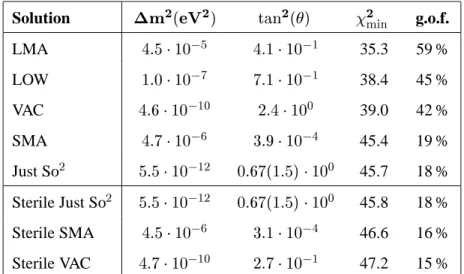
(2) 1), e.g. [Fog01, Bah01b]. The best fit values for the global analysis including the SNO results are listed in table 1.3 and shown in fig. 1.7 [Bah01b]. The CC measurement by SNO has not changed qualitatively the globally allowed solution space for solar neutrinos, though it has provided convincing evidence for neutrino oscillations into active neutrinos. I will show in the next chapter, that the BOREXINO experiment has the potential to distinguish between the currently allowed oscillation scenarios.
Figure 1.6: Global analysis of the Homestake, SAGE, GALLEX/GNO and Super-Kamiokande
results, taking into account the total rates, and the8
B energy spectrum measured by Super-Kamiokande separately during the day and during the night as well as the theoretical neutrino fluxes according to BP00. The MSW solutions are known as ”small mixing angle”, ”large mix-ing angle” and ”low” solution, respectively. The contours correspond to 90 %, 95 %, 99 % and 99.73 % C.L. relative to each of the best-fit solutions (marked with black circles). Taken from [Bah01b].
Solution m 2 (eV 2 ) tan 2 () 2 min g.o.f. LMA 4:510 5 4:110 1 35.3 59 % LOW 1:010 7 7:110 1 38.4 45 % VAC 4:610 10 2:410 0 39.0 42 % SMA 4:710 6 3:910 4 45.4 19 % Just So2 5:510 12 0:67(1:5)10 0 45.7 18 % Sterile Just So2 5:510 12 0:67(1:5)10 0 45.8 18 % Sterile SMA 4:510 6 3:110 4 46.6 16 % Sterile VAC 4:710 10 2:710 1 47.2 15 %
Table 1.3: Best-fit global oscillation parameters and goodness-of-fit (calculated from
2 min
=d.o.f.) with all available solar neutrino data, including the SNO CC measurement, using
the BP00 theoretical neutrino fluxes. From [Bah01b].
Figure 1.7: Global oscillation solutions including all available solar neutrino data. Taken from
2 The Borexino Experiment
2.1
Physics Goals
The goal of BOREXINO is to measure for the first time, in real-time, the monoenergetic flux of the7
Be-neutrinos from the sun (E
=862keV). BOREXINOwill detect neutrinos by elastic scattering on electrons. This process can occur via charged- or neutral-current interactions (exchange of a W
- or Z0
-boson respectively), and is therefore sensitive to neutrinos of all flavours. Even in the case of complete conversion of the electron neutrinos to neutrinos of other flavours the count rate will still be measurable, though significantly reduced. The expected count rate in BOREXINO is about 50 d 1
according to the SSM, and about 12 d 1
in the case of complete conversion to other active neutrino flavours. Only conversion into sterile neutrinos could lead to an even lower count rate. Fig. 2.1 shows the expected count rates in BOREXINO for the most interesting oscillation scenarios.
Figure 2.1: The expected signal rate in BOREXINO (99 % C.L.) for the different oscillation scenarios. The values are given relative to the SSM [Bah98].
The relatively high statistics of the 7
Be-neutrino signal allows the observation of time de-pendent effects, such as seasonal or diurnal variations. Distinguishing between the different possible solutions to the solar neutrino problem should be possible by using both the rate and the time dependence of the signal (see fig. 2.3):
- In the case of the SMA solution the 7
Be neutrinos are fully converted to other active neutrino flavours during passage through the sun. The 7
Be signal in BOREXINO in this case would be due solely to neutral current scattering and the rate would be reduced to about 24 % of the SSM signal.
- In the LMA solution the 7
Be neutrinos are not fully converted and the rate would be reduced to about 60 % of the SSM rate. For BOREXINO the only measurable difference between the SMA and LMA solutions is the total count rate.
LMA LOW SMA R/RSSM tan 2ω δ m (eV ) 22
yearly-averaged total rates (N+D) normalized to the SSM unoscillated values Borexino total rates compared with the SMA, LMA and LOW solutions
QUASI VACUUM
Borexino N-D asymmetry compared with the
SMA, LMA and LOW solutions
SMA LOW LMA tan 2ω δ m (eV ) 22
yearly-averaged nighttime and daytime rates
(normalized to the SSM unoscillated values)
100×(N-D)/(N+D)
QUASI VACUUM
Figure 2.2: Expected count rates in BOREXINO for the different MSW scenarios. The choice of the variable tan
2
! (! =
12) rather than the usual sin
2
(2!) allows an expanded view of
the large mixing region. BOREXINO has the potential to discriminate between SMA, LMA and LOW solution using both information about total rates and the day-night-asymmetry.
2.1 Physics Goals
- For theLOWsolution there is also an incomplete conversion of
ein the sun, but there is a resonant regeneration of
einside the earth which would lead to a significantly higher count rate during the night hours than during the day, the so-called “day-night effect”. This effect is maximal in the energy region below 1 MeV(see fig. 2.3). BOREXINO, which is the only real-time experiment measuring neutrinos at these low energies, would see a day-night difference of 10 - 20 %.
- The eccentricity of the earth’s orbit causes an annual variation of the solar neutrino flux, with a difference of7 % between perihelion and aphelion. Form
2 '510 10 eV 2 the
vacuum oscillationlength for 7
Be neutrinos is about 3 % of the sun-earth distance. This would lead to significant seasonal variations of the counting rate (see fig. 2.4), as the oscillation probability changes with the distance from the sun.
- In the case of oscillations into sterile neutrinos, the conversion of the electron neutrinos is almost complete. As the sterile neutrinos don’t interact in any way in the detector, the measured count rate in BOREXINOwould range from 0 to 25 % of the SSM flux.
Figure 2.3: Energy dependent survival probabilities of electron neutrinos for the different MSW
scenarios. The time averaged probability is shown in addition to the separate probabilities for day and night hours. Only for the LOW solution there is a significant day-night effect for the7
Be neutrinos.
Figure 2.4: Test of vacuum oscillations with BOREXINO. The annual variation of the signal rate is shown for the case of no oscillations (variation due to the eccentricity of the earth’s orbit) and for three different values of the parametersm
2 ; sin
2
2. Taken from [Hag00a].
Physics Beyond Solar Neutrinos
In addition to the main goal of BOREXINO, i.e. to measure solar neutrinos, there are also some further purposes of the detector:
- BOREXINOis an excellent detector of electron antineutrinos via the inverse decay of the proton. This is due to the delayed coincidence between the initial positron signal and the delayed 2.2 MeV neutron-proton capture gamma ray, following an interaction.
e +p!e + +n n+p!d+2:2MeV
The threshold antineutrino energy is 1.8 MeV and the lifetime of the neutron in the scin-tillator is about 250s. This may be useful for setting limits on the flux of antineutrinos from the sun, and for detecting antineutrinos from other sources (see below).
- The BOREXINO detector is sensitive to neutrino bursts from type II supernovae in our galaxy. For a supernova at the center of our galaxy (10 kpc), over 100 neutrinos will
2.1 Physics Goals
be detected in 300 tons of scintillator [Ali99]. This will be mainly due to CC scatter-ing of electron antineutrinos on protons p(
e ;e
+
)n(threshold 1.8 MeV), with an addi-tional contribution from NC scattering of neutrinos on carbon 12
C( x ; x ) 12 C ? (thresh-old 15.1 MeV). The potential of the BOREXINO detector for Supernova neutrino detec-tion is discussed in more detail in [Cad00].
- The uranium and thorium content in the earth’s crust can be determined by measuring the antineutrinos from their decay chains via inverse beta decayp(
e ;e
+
)n(threshold 1.8 MeV). This will give important geophysical information on the heat generation in-side the earth [Rag98]. The estimated geophysical antineutrino event rate in BOREXINO is 10 events per year.
- Nuclear power reactors are strong sources of electron antineutrinos. By measuring the rate of antineutrinos from the nuclear power plants in Europe it is possible to perform a long-baseline neutrino oscillation search to probe the LMA solution of the MSW effect [Sch99b]. The nuclear reactors which dominate the flux are at a distance of800km to Gran Sasso, as Italy itself has no nuclear power reactors. Since the distances to the reac-tors are known, and the fuel composition and operating cycle of the reacreac-tors can also be known very well, the antineutrino event rates and the positron spectrum in BOREXINO can be calculated with an uncertainty less than 3 %. The expected reactor antineutrino event rate in 300 tons of scintillator is 30 events per year. For the LMA solution the neutrino flux would be suppressed by 50% . The expected background due to accidental coincidences is less than 1 event per year.
- The magnetic moment of the electron neutrino can be determined by using a strong artificial neutrino source, e.g.51
Cr or90
Sr, that allows one to measure the shape of the neutrino energy spectrum [Ian98, Ian99a, Ian99b]. The source will be placed in a tunnel directly below the BOREXINO tank.
- It is also possible to load the scintillator with a double beta unstable isotope, e.g. 136 Xe, and search for neutrinoless double beta decay [Cac00, Bel01], which is allowed only if the neutrino is a massive Majorana particle. A different approach uses scintillating crystals doped with the double beta instable isotope, namely 116
CdWO4, which would be placed inside the scintillator. In this case, the liquid scintillator would serve only as a veto detector [Bel00]. The limit onT
1=2 (02)reachable with 65 kg of 116 CdWO4 crys-tals in the CTF is10 26 a, corresponding tom 0:06eV. With 1000 kg 116 CdWO4 in BOREXINO a limit form
2.2
The Detection Principle
The neutrino detection in BOREXINO is based on neutrino-electron scattering using the well-known technique of liquid scintillation spectroscopy. The Feynman diagram of the process of neutrino-electron scattering was shown in fig. 1.3. Solar neutrinos scattering off the electrons in the scintillator will result in a recoil electron which can be detected via scintillation light. The cross section for this pure leptonic reaction can be calculated using the standard theory of electroweak interactions [t’H71]: d dT = e g 2 L g 2 R 1 T E 2 g L g R T E 2 ;
where:T = kinetic energy of the scattered electron E
= energy of the incoming neutrino e= 2G 2 F m 2 e =h 4 = 88:08310 46 cm2 g R= sin 2 W = 0:23150:0004 g L= (sin 2 W 1=2), + for e, – for ;. For a neutrino with a given energyE
the maximum kinetic energy of the electron is T max = 2E 2 m e c 2 +2E :
A monoenergetic neutrino source produces an electron recoil spectrum with a sharp edge and thus a good signature. For the7
Be-neutrinos at 862 keV this edge lies at 665 keV (see fig. 2.5). Even though the recoil spectrum goes from zero to the edge, in practice the optimum 7
Be- signal window in BOREXINO is from 250 - 800 keV. The lower threshold has to be set due to
Figure 2.5: The cross section for e scattering for monoenergetic neutrinos with E
= 862keV.
2.2 The Detection Principle
intrinsic background present in the organic scintillator (mainly14
C), the upper limit is chosen to accommodate the finite energy resolution of the detector (about 7 % at 665 keV).
BOREXINOis sensitive to all neutrino flavours, as e
; and
can interact via neutral current interactions while only
e can additionally interact via charged current interactions. The ratio of the cross-sections for
eand
; is about 5:1 in the 7
Be-signal window. In principle, the shape of the recoil spectrum is slightly different for
eand
;, but the difference is probably too small to be distinguishable in practice.
As the scintillation light is emitted isotropically, the directional information of the scattered neutrino is lost and no directional cuts on the neutrino source can be applied. Since the ex-perimental signature is simply a few hundred keV energy deposition in the scintillator, the requirements on the radiopurity of the detector components, especially the scintillator, are very high. The different sources of background and their suppression will be discussed in detail in section 2.4.
Solar neutrinos from other branches of the pp-cycle also contribute to the count rate in the7 Be neutrino window (250 - 800 keV). These are summarized in table 2.1. With a threshold energy of 250 keV for the recoil electron, the lowest energy for neutrinos that can be be detected is 410 keV.
neutrino branch SSM LMA SMA LOW
pp 1.3 1.0 0.6 0.6 7 Be 45.7 26.0 9.7 25.1 pep 2.0 1.0 0.4 1.0 13 N 4.2 2.3 0.9 2.3 15 O 5.5 2.8 1.1 2.8 17 F 0.07 0.03 0.01 0.03 8 B 0.01 0.04 0.05 0.05 Sum 58.78 33.17 12.76 31.78
Table 2.1: Expected signal rates (counts per day in 100 tons of scintillator in the energy range
from 250 - 800 keV) in BOREXINOfrom neutrinos of the individual branches for different oscil-lation scenarios.
2.3
Detector Design
2.3.1
The Main Detector
The BOREXINO detector is being constructed in hall C of the Gran Sasso underground labo-ratory (LNGS) in Italy. The labolabo-ratory is shielded by an overburden of 3600 mwe which leads to a suppression of the cosmic muon flux by a factor of10
6 , down to a value of1:1m 2 h 1 . The detector is designed in such a way as to reduce the external gamma ray background in the central fiducial volume to a level well below the expected solar neutrino signal. A detailed description of the BOREXINO detector can be found in [Ali01]. A sketch of the detector is shown in fig. 2.6.
The active part of the detector is an unsegmented volume of 300 tons of liquid scintillator, contained in a thin (0.1 mm) spherical nylon vessel of diameter 8.5 m (Inner Vessel). The scintillator consists of the solvent pseudocumene (PC, 1,2,4 trimethylbenzene) with 1.5 g/l PPO (3,5 diphenyloxazole) added as fluor.
The scintillation light is observed by 2200 8” diameter photomultiplier tubes (PMTs) mounted on the inside surface of a stainless steel sphere with a diameter of 13.7 m. 1800 PMTs are equipped with light concentrators for an efficient collection of the scintillation light from the Inner Vessel. Signals from the 400 remaining PMTs without concentrators will be used for distinguishing muon tracks producing Cerenkov light in the buffer region from events inside the scintillator. The three dimensional arrangement of the photomultipliers allows the position of the neutrino interactions within the detector volume to be reconstructed using the timing information of the triggered PMTs. Thus, a fiducial volume of 100 tons of scintillator (radius 3 m) can be defined by software cuts to reduce the external background.
The volume between the Inner Vessel and the stainless steel sphere is filled with 1000 m3 of a buffer liquid which serves as shielding against radioactive background from the outer detector parts. This buffer liquid has to fulfill several requirements: it should be optically transparent to the fluorescence emission of PPO (i.e. it should not absorb the scintillation light from the active scintillator volume), and it should not emit fluorescence light itself, as this would lead to very high counting rates mainly due to the background from the PMTs. Ideally, the refractive index of the buffer should match that of the scintillator. The density of the buffer liquid should be very close to the density of the scintillator to minimize the buoyancy-induced stress on the thin nylon vessel (thickness only 0.1 mm). The buffer liquid was chosen to be pseudocumene with the addition of 5 g/l DMP (dimethylphthalate) as a quencher to suppress the fluorescence in the buffer PC by a factor of 20 [Che99]. A second nylon barrier with a diameter of 10.5 m should prevent the222
Rn atoms emanating from the steel, PMTs and concentrators from getting close to the active scintillator volume.
The external steel tank with a height of 17 m and 18 m diameter filled with deionized water provides a final shield against gamma rays and neutrons from the surrounding rocks. The thickness of the water buffer is 2 m, except at the bottom where it is only 1 m. Steel plates under the floor of the tank provide the equivalent of 1 m of water shielding. 200 phototubes
2.3 Detector Design
mounted on the outer surface of the stainless steel sphere facing outwards detect the Cerenkov light produced by muons intersecting the water buffer. The collection of the Cerenkov light is enhanced by reflecting sheets of Tyvek film that cover all surfaces of the external tank and the sphere. The design of the muon veto system is described in [Obe98].
2.3.2
Ancillary Systems
Scintillator Purification and Fluid Handling System
The system to store, handle and purify the 300 tons of PC scintillator and 1000 tons of PC buffer consists of a storage area for the scintillator and the concentrated fluor and quencher solutions, several purification systems, and detector filling systems for BOREXINO and the Counting Test Facility (CTF) (see fig. 2.7).
The purification system is composed of five separate units to apply different purification methods to the scintillator: sub-micron filtration to remove dust particles, water extraction to remove ionizable elements like metals, vacuum distillation to remove low volatility con-taminants like dust particles and degraded solvent molecules, nitrogen stripping to remove gaseous impurities (222
Rn,85
Kr) and water dissolved in the scintillator, and solid column pu-rification to remove polar impurities. The method of column pupu-rification will be described in more detail in chapter 6. A complete description of the purification system can be found in [Ben98, Sch99c].
The purification plants are designed to carry out the purification prior to and during the filling operations. Continuous on-line purification of the scintillator as a whole is provided, if neces-sary, though the hope is that this procedure will not be required in BOREXINO. The PC used for the scintillator will be delivered well in advance of the filling operation. It will be tested in
BOREXINO
CTF
BB: big building with electronic equipment, clean rooms etc. CR: clean room of the CTF
S: storage vessel area for the liquid scintillator H: tunnel walls of the hall C
W: movable crane
LHS
LHS: liquid handling system
2.3 Detector Design
the CTF for radioactive impurities and for optical properties and then stored in three 120 m3 stainless steel storage vessels until filling of the BOREXINO detector. The raw material for the PC may come from different petroleum sources, which can cause variability in the 14
C level. The CTF will be used to test the14
C level to assure that the scintillator is appropriate for BO-REXINO. The fluor PPO will be purified off-line as concentrated solution in pseudocumene. The existing CTF purification plant will be modified to process the fluor solution, by a com-bination of water extraction and distillation. The concentrated fluor solution will be stored in two 4 m3
vessels until it is added to the solvent during the filling operation to a concentration of 1.5 g/l. The PC used for shielding will be delivered and purified on-line for direct filling of the buffer. The DMP is added on-line to a concentration of 5 g/l .
Water Purification System
Water is a major shielding component for both BOREXINO and the CTF, attenuating the gamma ray flux from the rock surrounding hall C. The design purity goal is about 10
13 g =g
238
Uin the CTF and about10 11
g =g 238
Uin BOREXINO (where additional shield-ing is provided by the PC buffer). The water purification system consists of a purification system for raw water from the rock, and a recirculation loop to maintain the purity of the wa-ter. The water is processed by reverse osmosis, a continuous deionization unit, ultra filtration, an ion exchanger and a final nitrogen stripping to remove222
Rn. For details see [Bal96].
Nitrogen System
Nitrogen gas is used in BOREXINO as a purge gas to remove gaseous contaminations (222 Rn, 85
Kr) from the scintillator and buffer fluids as well as a buffer gas against recontamination with atmospheric air. Two qualities of gaseous nitrogen with the following Rn-purity are provided by the nitrogen plant: regular nitrogen (RN2, 1 mBq/m
3
) and high purity nitrogen (HPN2, 10Bq=m
3
). The primary source of the nitrogen will be liquid nitrogen commercially deliv-ered to the LNGS and stored in three 6 m3
tanks. The regular nitrogen is produced by direct evaporation of the liquid. The high purity nitrogen is obtained from two high purity charcoal traps operated at 196
Æ
Cin line with the liquid flow from the storage tanks to a special evapo-rator and heater. The high purity line is fabricated of electropolished stainless steel to maintain the Rn-purity level. For a detailed description of the system see [Rau99, Heu00].
Electronics and Data Acquisition
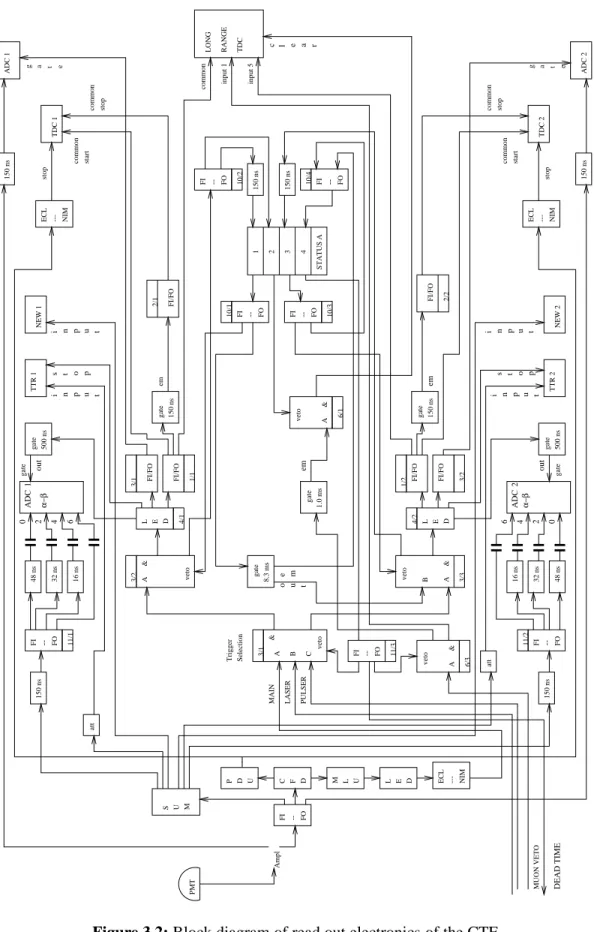
In order to get the information on time, position and energy of an event, the time and pulse height information of each PMT are needed. The basic block diagram of the electronics is shown in fig. 2.8. The PMTs will work mainly in the single photoelectron mode (events in the neutrino window have pulse heights between 50 and 300 photoelectrons), but can also give very large signals due to cosmic rays. The PMT signals arrive at the Front End Board,
which performs the high voltage decoupling, low frequency noise filtering, fast amplification and integration of the total charge for each channel. The resistive sum of each 24 channels is sent to the flash ADC which records the total charge and the pulse shape of these sum signals. The flash ADC will provide an energy measurement in the range from 1 to 8 MeV (detection of8
B neutrinos, Supernova neutrinos . . . ), where the single PMT chain signals will already be saturated. The fast and the integrated PMT signal are sent from the front end board to a digital readout board. The fast PMT signal is used to fire the discriminator and to give the time information. The integrated PMT signal gives the energy information. It goes into a dual sampling 8 bit ADC which samples the signal just before its rising edge and 80 ns later using the discriminator output signal. The difference between the two measurements is then proportional to the charge collected by the PMT. The data is written into a local FIFO buffer where it is stored temporarily while the system is waiting for a possible trigger. The BOREXINO trigger algorithm is to count the PMTs fired in a 50 ns time window and start the data acquisition if this number is greater than a given threshold. The data acquisition will read data in a time range from 1s before the trigger to 4 - 5s after the trigger, so that also short delayed coincidences will be registered. A detailed description of the data acquisition system can be found in [Gat99, Gat01].
2.3 Detector Design
Calibration and Monitoring
The calibration program for BOREXINO covers the energy and time response of the detector using built-in systems, active tags of trace impurities in the scintillator, and the insertion of localized radioactive sources [Man00]:
- The pulse timing and gain of each phototube is calibrated by a laser system. Photons from a laser are carried by thin optical fibers connected to each light concentrator, with a light yield corresponding to single photoelectron signals.
- 14
C present in the scintillator can be used to monitor the stability of the energy response of the detector in the low energy range. Also the 2.2 MeV ray emitted after neutron capture on a proton can be used for an energy calibration. Neutrons are created in the scintillator by cosmic ray muons at a rate of about 0.3 per day and ton (experimentally determined in the CTF), and are captured by protons in the scintillator after a lifetime of250s.
- Optical sources will be used to monitor the scintillator and buffer transparency. Laser light with several different wavelengths will be carried into different regions of the de-tector by optical fibers.
- As the energy response of the detector will be position dependent, a calibration with a point-like source at several known positions in the detector is needed. The plan is to insert a small encapsulated source that can be moved to known positions inside the scintillator.
- An unambiguous, straightforward test of the overall detector response will be provided by a calibration with a 51
Cr source with an activity in the MegaCurie range. It emits neutrinos of 740 keV energy, which is close to the 7
Be neutrino energy. The source would be placed in an existing tunnel under the detector.
![Table 1.1: Energies and fluxes of the individual solar neutrino branches according to the SSM [Bah01a].](https://thumb-us.123doks.com/thumbv2/123dok_us/9949539.2889414/13.918.164.740.99.954/table-energies-fluxes-individual-solar-neutrino-branches-according.webp)
![Figure 1.4: The expected total rates of the solar neutrino experiments according to the SSM [Bah01a] compared with the measured values.](https://thumb-us.123doks.com/thumbv2/123dok_us/9949539.2889414/19.918.197.728.181.982/figure-expected-neutrino-experiments-according-compared-measured-values.webp)

![Table 1.2: Sensitivity level of different types of neutrino oscillation experiments depending on the neutrino energy and the distance source - detector [Bah89].](https://thumb-us.123doks.com/thumbv2/123dok_us/9949539.2889414/23.918.151.751.68.1064/sensitivity-different-neutrino-oscillation-experiments-depending-neutrino-distance.webp)