Chapter 4
TWO-LEVEL GRAMMARS
W
e used attributes in Chapter 3 to augment a context-free grammar in order to verify context sensitivity. This chapter will focus on two-level grammars, another formal technique that starts with a text-free grammar, augmenting it with a higher-level grammar to test con-text-sensitive properties.A BNF grammar involves a finite number of terminal symbols and produc-tion rules. We think of BNF as a “one-level grammar”. The new approach of introducing “rules about rules” is called a “two-level grammar”. Although we still have a finite number of terminal symbols, adding a second level to the grammar can be used to generate an infinite number of production rules. Consequently, a two-level grammar is inherently more powerful than a BNF grammar. Two-level grammars are sometimes called W-grammars, named after Aad van Wijngaarden, the researcher who developed this approach. The programming language Algol68 was defined using a two-level grammar to specify its complete syntax, including context-sensitive conditions.
This chapter begins with a brief introduction to two-level grammars; then in section 4.2, we develop a context-sensitive grammar for Wren. Two-level gram-mars can also be extended into the realm of operational semantics by building a programming language interpreter into the grammar, but this extension is beyond the scope of this text. Interested readers can consult the references described in the further reading section of this chapter. We end the chapter by showing how small two-level grammars can be implemented in Prolog. We also discuss the relationship of two-level grammars and logic programming.
4.1 CONCEPTS AND EXAMPLES
We begin by looking at the part of a two-level grammar that is equivalent to BNF. Protonotions correspond to nonterminals and terminals in a BNF gram-mar. We use a sequence of lowercase, boldface characters to represent protonotions. Terminals are distinguished by the final word symbol. Spaces can occur anywhere in a protonotion and do not change its meaning. Ex-amples of protonotions are
program is equivalent to the nonterminal <program>.
The correspondence between the protonotions ending in symbol and the actual terminal symbols is presented in a representation table.
A grammar rule for defining protonotions is called a hyper -rule. The follow-ing conventions are used in hyper-rules:
• A colon separates the left- and right-hand side of a rule. • A comma indicates the juxtaposition of protonotions.
• A semicolon indicates alternatives on the right-hand side of a rule. • A period terminates a hyper-rule.
For example, the following hyper-rule corresponds to the productions for <element> in Wren.
element : numeral; variable;
left par en symbol, integer expr , right par en symbol; negation symbol, element.
A complete (context-free) grammar for Wren using two-level grammar nota-tion is shown in Figure 4.1, with the corresponding representanota-tion table given in Figure 4.2.
Next we look at the terms and notation associated with the “second level” of two-level grammars. A metanotion can stand for any number of protonotions. Metanotions are written in boldface, uppercase letters with no embedded spaces. The allowed protonotions are specified in the form of metarules, which use the following notational conventions:
program : pr ogram symbol, identifier , is symbol, block.
block : declaration seq, begin symbol, command seq, end symbol. declaration seq : empty;
declaration, declaration seq. empty : .
declaration : var symbol, variable list, colon symbol,
type, semicolon symbol. type : integer symbol;
boolean symbol. variable list : variable;
variable, comma symbol, variable list. command seq : command;
command, semicolon symbol, command seq.
107 4.1 CONCEPTS AND EXAMPLES
command : variable, assign symbol, expr ession; read symbol, variable;
write symbol, integer expr; skip symbol;
while symbol, boolean expr , do symbol,
command seq, end while symbol; if symbol, boolean expr , then symbol,
command seq, end if symbol; if symbol, boolean expr , then symbol, command seq,
else symbol, command seq, end if symbol. expression : integer expr;
boolean expr . integer expr : term;
integer expr , weak op, ter m. ter m : element;
term, str ong op, element. element : numeral;
variable;
left par en symbol, integer expr , right par en symbol; negation symbol, element.
boolean expr : boolean ter m;
boolean expr , or symbol, boolean ter m. boolean ter m : boolean element;
boolean ter m, and symbol, boolean element. boolean element : true symbol;
false symbol; variable; comparison;
left par en symbol, Boolean expr , right par en symbol; not symbol, left par en symbol,
boolean expr , right par en symbol. comparison : integer expr , relation, integer expr .
variable : identifier .
Figure 4.1: Grammar for Wren Using Two-level Notation (Part 2)
• A double colon (::) separates the left- and right-hand sides of a metarule. • A space indicates the juxtaposition of items.
• A semicolon indicates alternatives on the right-hand side of a metarule. • A period terminates a metarule.
relation : less or equal symbol; less symbol;
equal symbol; greater symbol;
greater or equal symbol; not equal symbol. weak op : plus symbol;
minus symbol. strong op : multiply symbol;
divide symbol. identifier : letter;
letter, identifier; letter, digit.
letter : a symbol; b symbol; c symbol; d symbol; e symbol; f symbol; g symbol; h symbol; i symbol; j symbol; k symbol; l symbol; m symbol; n symbol; o symbol; p symbol; q symbol; r symbol; s symbol; t symbol; u symbol; v symbol; w symbol; x symbol; y symbol; z symbol.
numeral : digit;
digit, numeral.
digit : zero symbol; one symbol; two symbol; three symbol; four symbol; five symbol; six symbol; seven symbol; eight symbol; nine symbol.
Figure 4.1: Grammar for Wren Using Two-level Notation (Part 3)
The following metarule specifies that the metanotion ALPHA stands for 26 alternative protonotions.
ALPHA :: a; b; c; d; e; f; g; h; i; j; k; l; m;
n; o; p; q; r; s; t; u; v; w; x; y; z.
A metarule can also contain metanotions on the right-hand side.
NOTION :: ALPHA; NOTION ALPHA.
In this case a NOTION is any sequence of bold, lowercase letters—in other words, a protonotion. Metanotions can also appear anywhere in a hyper-rule. For example, the following hyper-rule for Wren
109
program symbol program colon symbol :
is symbol is semicolon symbol ;
begin symbol begin comma symbol ,
end symbol end assign symbol :=
var symbol var plus symbol +
integer symbol integer minus symbol
-boolean symbol boolean multiply symbol *
skip symbol skip divide symbol /
read symbol read negation symbol
-write symbol write left par en symbol (
while symbol while right par en symbol )
do symbol do less or equal symbol <=
end while symbol end while less symbol <
if symbol if equal symbol =
then symbol then greater symbol >
else symbol else greater or equal symbol >=
end if symbol end if not equal symbol <>
or symbol or a symbol a
and symbol and : : :
not symbol not z symbol z
true symbol true zero symbol 0
false symbol false : : :
nine symbol 9
Figure 4.2: Representation Table for Wren
letter : a symbol; b symbol; c symbol; d symbol; e symbol; f symbol; g symbol; h symbol; i symbol; j symbol; k symbol; l symbol; m symbol; n symbol; o symbol; p symbol; q symbol; r symbol; s symbol; t symbol; u symbol; v symbol; w symbol;
x symbol; y symbol; z symbol.
can now be written simply as
letter: ALPHA symbol.
By introducing a metanotion, we have one hyper-rule that stands for 26 possible rules: letter : a symbol. , letter : b symbol. , and so on.
Traditionally, two-level grammars are printed in boldface. The basic terms introduced so far can be summarized as follows:
• A protonotion is a sequence of lowercase, boldface characters that define a nonterminal; however, if the nonterminal is followed by the protonotion
symbol, then protonotion corresponds to a terminal in the target language as given in a representation table.
• A metanotion is a sequence of uppercase characters, used to represent any number of protonotions.
• A hyper -rule is a production rule that define a protonotion or a class of protonotions; it may contain protonotions and metanotions on the left-and right-hleft-and sides, left-and substitutions of protonotions for metanotions must be consistent.
• A metarule is a production rule that defines the single metanotion on its left-hand side using protonotions or metanotions on its right-hand side. As indicated at the start of this chapter, it is possible to generate an infinite number of production rules. Suppose that we want to specify a nonempty list structure as a sequence of one or more items separated by commas. Wren uses a list structure to define lists of variables:
variable list : variable; variable, comma symbol, variable list.
We can generalize this list concept by introducing the metanotion NOTION to provide a template for list construction:
NOTION list : NOTION; NOTION, comma symbol, NOTION list.
If NOTION has the value variable, this hyper-rule specifies our metarule from Wren. If NOTION takes other values, say integer or character, then we are specifying a list of integers or a list of characters. We do require consis-tent substitution of protonotions for a metanotion within a hyper-rule, thus guaranteeing that our list contains elements of the same type. It will not be possible to produce a hyper-rule such as
integer list : character; integer , comma symbol, variable list. (illegal!) Since NOTION can match any protonotion (without embedded spaces), we have given a single hyper-rule that can match an infinite number of produc-tions specifying nonempty lists containing items of the same kind.
We now introduce some notational conveniences. The metanotion EMPTY
can stand for the empty protonotion:
EMPTY :: .
Suppose that we want to use a tally notation to define the concept of number. For example, the tally iiiiiiii represents the number 8. We can specify a tally by the metarule
111
We cannot represent the number zero by using TALLY, so we use the EMPTY
protonotion
TALLETY :: EMPTY ; TALLY.
A conventional notation in two-level grammars is to have the suffix -ETY
allow the EMPTY protonotion as one of the alternatives.
A second notational convenience allows us to relax (at least notationally) the consistent substitution principle. Consider the nonempty list example again. Initially assume lists can contain integers or characters, but not both.
LISTITEM list :
LISTITEM; LISTITEM, comma symbol, LISTITEM list. LISTITEM :: integer; character .
Now suppose we want to mix integers and characters in a single list. A pos-sible specification is
mixed list : LISTITEM; LISTITEM1, comma symbol, mixed list. LISTITEM1 :: LISTITEM.
The hyper-rule mixed list has four different possibilities: 1. mixed list : integer; integer , comma symbol, mixed list.
2. mixed list : integer; character , comma symbol, mixed list.
3. mixed list : character; character , comma symbol, mixed list.
4. mixed list : character; integer , comma symbol, mixed list.
We adopt the convention that a metanotion ending in a digit stands for the same set of protonotions as the metanotion without the digit, so we do not have to specify metarules such as LISTITEM1 :: LISTITEM. given above. (It should be noted that LISTITEM1 was not strictly required to produce the mixed list since LISTITEM and LISTITEM1 appear only once in different alternatives; however, the intent of this example should be clear.)
Fortran String Literals
In older versions of Fortran having no character data type, character string literals were expressed in the following format:
<string literal> ::= <numeral> H <string>
where the <numeral> is a base-ten integer (≥ 1), H is a keyword (named after Herman Hollerith), and <string> is a sequence of characters. The (context-sensitive) syntax of this string literal will be correct if the numeric value of the base-ten numeral matches the length of the string. A two-level grammar is developed for a Fortran string literal. The initial version assumes that the
numeral is a single digit from 1 to 9. The hyper-rules for the digit symbols are as follows:
i digit : digit one symbol. ii digit : digit two symbol. iii digit : digit thr ee symbol. iiii digit : digit four symbol. iiiii digit : digit five symbol. iiiiii digit : digit six symbol. iiiiiii digit : digit seven symbol. iiiiiiii digit : digit eight symbol. iiiiiiiii digit : digit nine symbol.
The string literal is a sequence of lowercase letters, which we call LETTERSEQ, as specified by the following metarules:
APLHA :: a; b; c; d; e; f; g; h; i; j; k; l; m;
n; o; p; q; r; s; t; u; v; w; x; y; z. LETTER :: letter ALPHA.
LETTERSEQ :: LETTER; LETTERSEQ LETTER.
The string literal, called hollerith, is specified by the following hyper-rule. Notice that the consistent substitution for TALLY, defined previously, pro-vides the desired context sensitivity.
hollerith : T ALLY digit, hollerith symbol, T ALLY LETTERSEQ.
Finally, we need to show how a TALLY LETTERSEQ decomposes. The basic idea is that every time we remove an i from TALLY we also remove a LETTER
from LETTERSEQ. We must eventually reach a single i followed by a single
LETTER. The following two hyper-rules express these ideas.
TALLY i LETTER LETTERSEQ : i LETTER, T ALLY LETTERSEQ. i LETTER : LETTER symbol.
The representation table for this two-level grammar involves symbols for low-ercase letters, digits, and the separator H.
Representation Table
letter a symbol a digit one symbol 1
: : : : : : : :
letter z symbol z digit nine symbol 9
113
Derivation Trees
Since two-level grammars are simply a variant of BNF, they support the idea of a derivation tree to exhibit the structure of a string of symbols.
Definition: A derivation tr ee of a string in a two-level grammar displays a derivation of a sentence in the grammar. The nodes in the tree are labeled with protonotions, and the protonotions for all leaf nodes end with symbol, indicating terminal symbols. Traversing the leaf nodes from left to right (a preorder traversal) and replacing the protonotion symbols with the corre-sponding tokens in the Representation Table produces the string being parsed.
Empty leaves just disappear. ❚
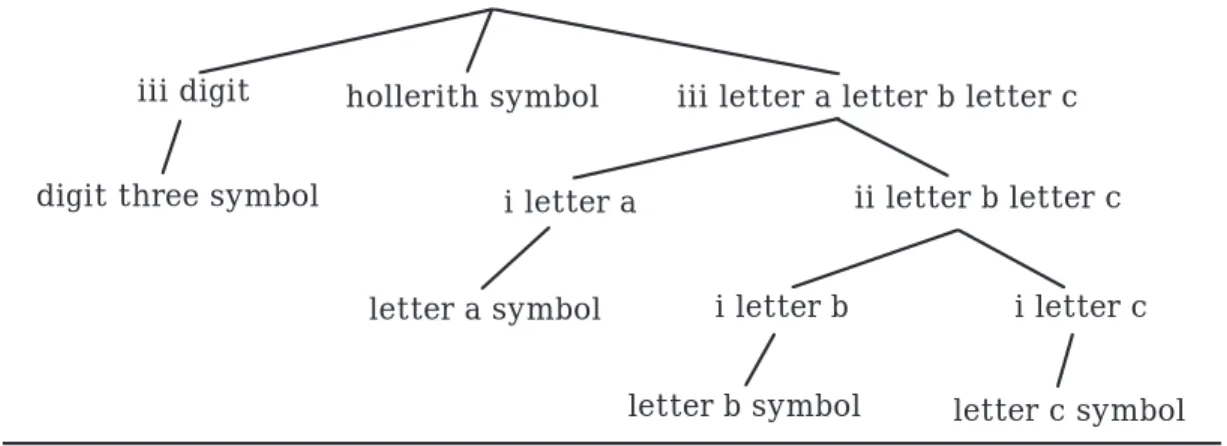
The derivation tree for “3Habc” is shown in Figure 4.3.
hollerith
iii digit hollerith symbol iii letter a letter b letter c
digit three symbol i letter a ii letter b letter c
i letter b i letter c letter a symbol
letter c symbol letter b symbol
Figure 4.3: Derivation Tree for “3Habc”
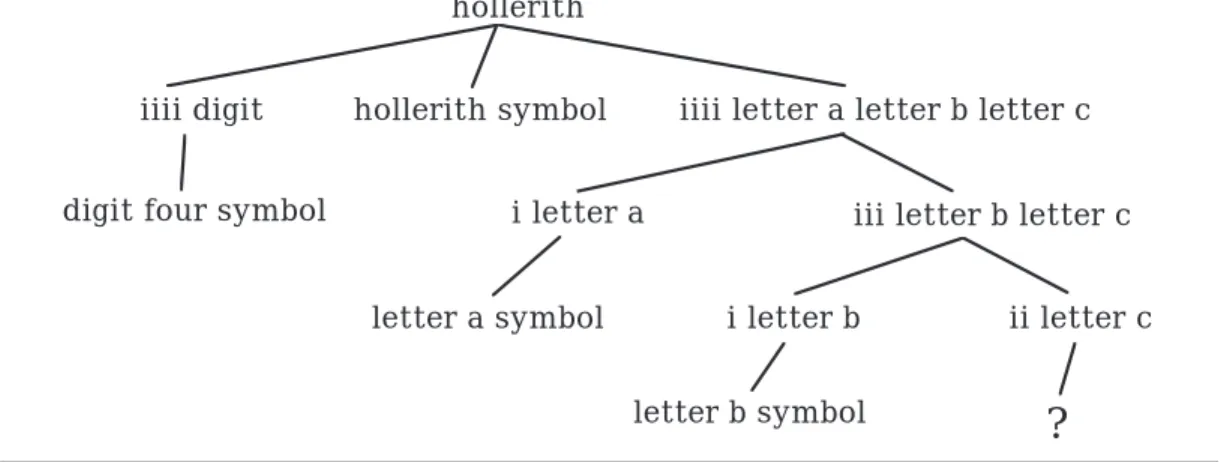
When a string does not obey the context-sensitive conditions, no derivation is possible. Figure 4.4 shows an attempt to draw a derivation tree for “4Habc”, but, as indicated, it is not possible to complete the tree.
If an arbitrary numeral is allowed to the left of the hollerith symbol in the previous example, a mechanism is needed to transform the base-ten nu-meral into a tally representation. For example, if the leaves of the subtree for a numeral are digit two symbol followed by digit thr ee symbol, the TALLY
will be iiiiiiiiiiiiiiiiiiiiiii , a sequence of 23 i’s. We need to allow for a zero digit at any position, other than the leading digit, and for the corresponding empty tally.
EMPTY digit : digit zer o symbol. TALLETY :: T ALLY; EMPTY .
ii letter c hollerith
iiii digit hollerith symbol iiii letter a letter b letter c
digit four symbol i letter a iii letter b letter c
i letter b letter a symbol
?
letter b symbolFigure 4.4: Attempted Derivation Tree for “4Habc”
We develop a hyper-rule for TALLY constant that captures the semantics of base-ten numerals. For a multiple digit numeral d1d2 ... dn-1dn, we know that
value(d1d2 ... dn-1dn) is 10 • value(d1d2…dn-1) + value(dn).
In a tally numeration system, multiplying by 10 is accomplished by concat-enating ten copies of the tally together. So we rewrite our equation as
tally(d1d2 ... dn-1dn) is ten copies of tally(d1d2…dn-1)
followed by one copy of tally(dn).
A wher e clause gives us a mechanism for expressing this equality, as evi-denced by the following hyper-rule that includes both the base case and the general case:
TALLETY constant : TALLETY digit;
TALLETY2 constant, T ALLETY3 digit, wher e TALLETY is TALLETY2 T ALLETY2 T ALLETY2 T ALLETY2 T ALLETY2 TALLETY2 T ALLETY2 T ALLETY2 T ALLETY2 T ALLETY2 TALLETY3.
where TALLETY is T ALLETY : EMPTY .
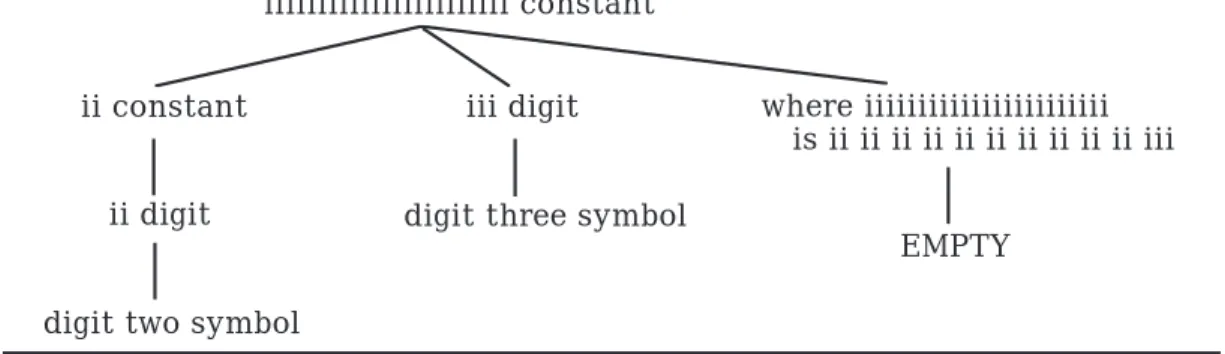
The wher e clause is similar to condition checking in attribute grammars. If the condition holds, the EMPTY protonotion is the leaf on the tree; other-wise, the parse fails. This wher e clause is best illustrated by drawing the complete derivation tree, as shown for the numeral 23 in Figure 4.5. Notice that we rely on the fact that spaces in a protonotion do not change the protonotion.
115
iiiiiiiiiiiiiiiiiiiiiii constant
ii constant
ii digit
digit two symbol
iii digit
digit three symbol
where iiiiiiiiiiiiiiiiiiiiiii is ii ii ii ii ii ii ii ii ii ii iii
EMPTY
Figure 4.5: Derivation Tree for the Numeral 23
Exercises
1. Suppose that we have a programming language that allows mixed types for the arithmetic operations. Setting aside issues of precedence for the moment, we can describe expressions by the following two-level grammar:
EXPR TYPE :: integer expr ession;
real expr ession; complex expr ession. OPERATION :: addition; subtraction; multiplication; division. expression : EXPR TYPE, OPERA TION, EXPR TYPE.
How many different hyper-rules are possible for expression? 2. Suppose we have the following productions:
TYPE :: integer; r eal; complex; character; string.
assignment : TYPE1 name, assign symbol, TYPE2 expr ession, where TYPE1 is assignment compatible with TYPE2.
Write the hyper-rules for this wher e condition assuming success if the types are the same, an integer expression can be assigned to a real or complex variable, a real expression can be assigned to a complex vari-able, and a character can be assigned to a string variable.
3. Develop a two-level grammar that parses only strings of the form anbncn. Use the consistent substitution of a metanotion into a hyper-rule to guarantee that the values of n are the same. Test the grammar by draw-ing the derivation tree for “aaabbbccc”. Also show why there is no valid derivation tree for “aabbbcc”.
4. Some implementations of Pascal limit the size of identifiers to eight or fewer characters. The following hyper-rule expresses this constraint:
identifier : letter , upto iiiiiii alphanum.
Develop a general hyper-rule to express the meaning of
upto T ALLY NOTION
Draw the derivation tree for the identifier “count”.
4.2 A TWO-LEVEL GRAMMAR FOR WREN
The two-level grammar that we construct for Wren performs all necessary context checking. The primary focus is on ensuring that identifiers are not multiply declared, that variables used in the program have been declared, and that their usage is consistent with their types (see Figure 1.11). All dec-laration information is present in a metanotion called DECLSEQ, which is associated with the context-sensitive portions of commands. We use the fol-lowing Wren program for illustration as we develop the two-level grammar:
program p is var x, y : integer; var a : boolean; begin read x; read y; a := x < y;
if athen write x else write y end if end
The program is syntactically correct if we can build a complete derivation tree for it. Recall that a tree is complete if every leaf is a terminal symbol or empty and that a preorder traversal of the leaf nodes matches the target program once the symbols have been replaced with the corresponding to-kens from the representation table. We introduce metarules and hyper-rules on an “as needed” basis while discussing the sample program. The complete two-level grammar, with all rules identified by number, will appear later in this chapter in Figures 4.12 and 4.13. The representation table for Wren has already been presented in Figure 4.2.
We first introduce the metanotions that serve as some of the basic building blocks in Wren.
(m1) ALPHA :: a; b; c; d; e; f; g; h; i; j; k; l; m;
n; o; p; q; r; s; t; u; v; w; x; y; z.
(m2) NUM :: zer o; one; two; thr ee; four; five; six; seven; eight; nine.
(m3) ALPHANUM :: ALPHA; NUM.
(m4) LETTER :: letter ALPHA.
117
(m6) LETTERDIGIT :: LETTER; DIGIT .
A NAME starts with a letter followed by any sequence of letters or digits. One possible NAME is
letter r digit two letter d digit two
A NUMERAL is a sequence of digits.
(m7) NAME :: LETTER; NAME LETTERDIGIT .
(m8) NUMERAL :: DIGIT ; NUMERAL DIGIT .
Declarations
A declaration associates a name with a type. Suppose that a Wren program contains the following declarations:
var sum1 : integer;
var done : boolean;
These declarations will be represented in our two-level grammar derivation tree as
letter s letter u letter m digit 1 type integer letter d letter o letter n letter e type boolean
The following metanotions define a declaration and a declaration sequence. Since a valid Wren program may have no declarations—for example, it may be a program that writes only constant values—we need to allow for an empty declaration sequence.
(m9) DECL :: NAME type TYPE.
(m10)TYPE :: integer; boolean; pr ogram.
(m11)DECLSEQ :: DECL; DECLSEQ DECL.
(m12)DECLSEQETY :: DECLSEQ; EMPTY .
(m13)EMPTY :: .
These metanotions are sufficient to begin construction of the declaration information for a Wren program. The most difficult aspect of gathering to-gether the declaration information is the use of variable lists, such as
var w, x, y, z :integer;
which should produce the following DECLSEQ:
letter w type integer letter x type integer letter y type integer letter z type integer
The difficulty is that integer appears only once as a terminal symbol and has to be “shared” with all the variables in the list. The following program frag-ments should produce this same DECLSEQ, despite the different syntactic form: var w :integer; var x :integer; var y :integer; var z :integer; and var w, x :integer; var y, z :integer;
A DECLSEQ permits three alternatives: (1) a sequence followed by a single declaration, (2) a single declaration, or (3) an empty declaration.
(h3) DECLSEQ DECL declaration seq :
DECLSEQ declaration seq, DECL declaration.
(h4) DECLSEQ declaration seq : DECLSEQ declaration.
(h5) EMPTY declaration seq : EMPTY .
It should be noted that these three hyper-rules can be expressed as two rules (h4 is redundant), but we retain the three alternatives for the sake of clarity. If all variables are declared in a separate declaration, we will require a single hyper-rule for a declaration:
(h6) NAME type TYPE declaration : var symbol, NAME symbol, colon symbol, TYPE symbol, semicolon symbol.
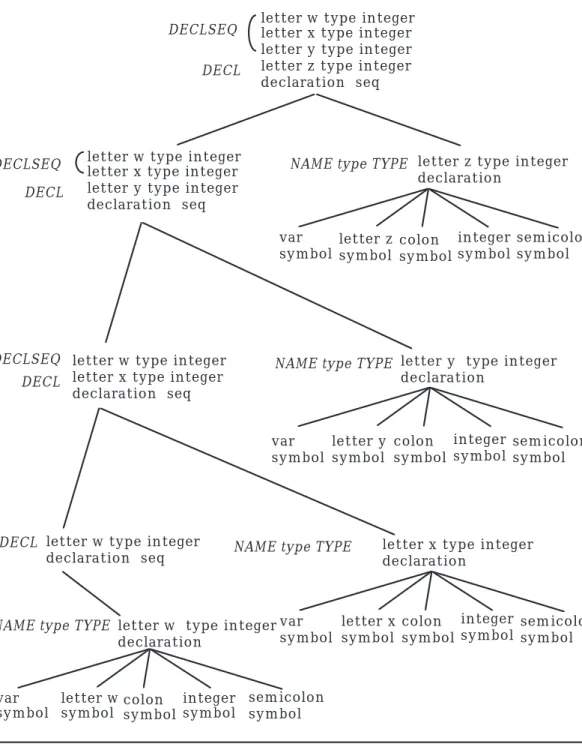
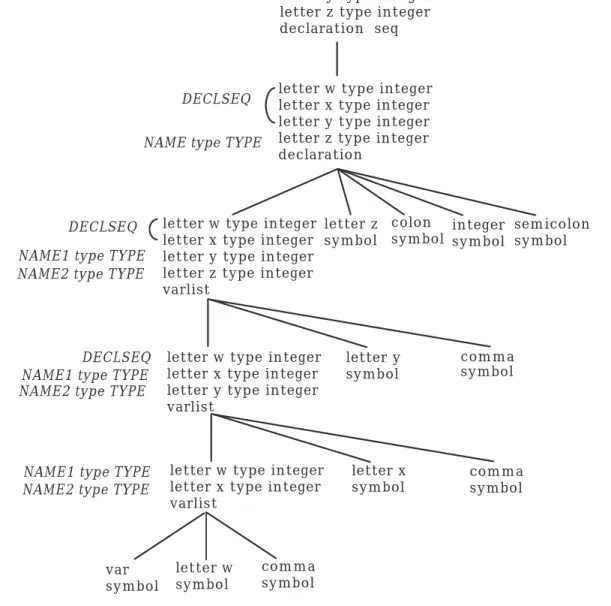
Figure 4.6 shows how h6, in combination with h3 and h4, can parse the definition of w, x, y, and z in separate declarations. For pedagogical empha-sis, the corresponding metanotions are shown in italics to the left of the nodes in the tree, but these metanotions are not part of the tree itself. Ob-serve that the specification of NAME symbol restricts identifier names to single characters. Since this makes the derivation tree more manageable with regard to depth, the example programs use only single letter identifiers. An exercise at the end of this section asks what modifications are needed in the grammar to allow for multiple character identifiers.
The same declaration sequence should be produced by the single declaration:
var w, x, y, z :integer;
This is accomplished by adding three hyper-rules:
1. The first variable in the list, which must be preceded by var symbol and followed by comma symbol.
119
letter w type integer letter x type integer letter y type integer letter z type integer declaration seq
DECLSEQ
DECL
letter z type integer declaration
NAME type TYPE
letter z symbol var
symbol
letter y type integer declaration
NAME type TYPE
letter y symbol var
symbol
letter x type integer declaration
NAME type TYPE
letter x symbol colon symbol integer symbol semicolon symbol var symbol letter w type integer
declaration
NAME type TYPE
letter w symbol colon symbol integer symbol semicolon symbol var symbol
letter w type integer letter x type integer letter y type integer declaration seq
DECL DECLSEQ
DECLSEQ letter w type integer letter x type integer declaration seq
DECL
letter w type integer declaration seq DECL colon symbol integer symbol semicolon symbol colon symbol integer symbol sem icolon sym bol
Figure 4.6: Parsing Individual Declarations
2. The last variable in the list, which must be followed by colon symbol , the type, and semicolon symbol
3. “In between” variables, each of which is followed by comma symbol 4.2 A TWO-LEVEL GRAMMAR FOR WREN
The general strategy is to have the type information passed from right to left. Here are the three hyper-rules that are used in conjunction with h4 to build the declaration information.
(h7) DECLSEQ NAME type TYPE declaration : DECLSEQ NAME type TYPE var list,
NAME symbol, colon symbol, TYPE symbol, semicolon symbol.
(h8) DECLSEQ NAME1 type TYPE NAME2 type TYPE var list : DECLSEQ NAME1 type TYPE var list,
NAME1 symbol, comma symbol.
(h9) NAME1 type TYPE NAME2 type TYPE var list : var symbol, NAME1 symbol, comma symbol.
Figure 4.7 shows the derivation tree for the declaration of the variables w, x, y, and z in a single declaration statement.
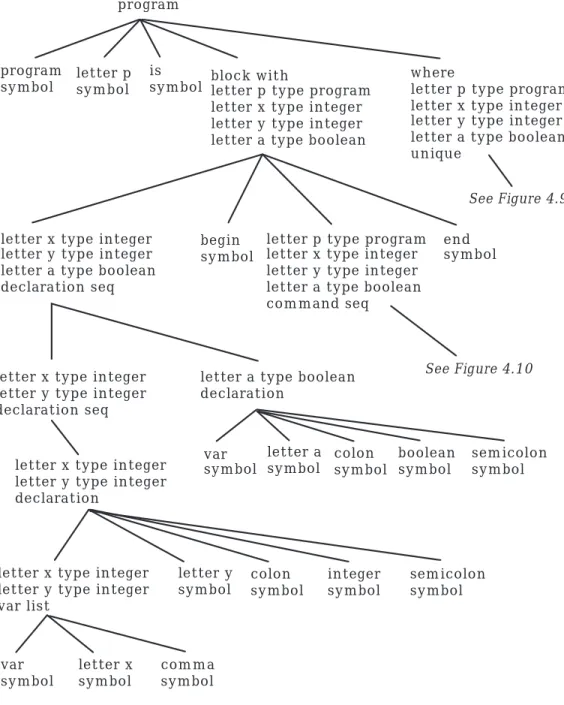
We now return to our sample program. To develop the derivation tree from the program node, we need these hyper-rules for program and block. (h1) program : program symbol, NAME symbol, is symbol,
block with NAME type pr ogram DECLSEQETY , where NAME type pr ogram DECLSEQETY unique.
(h2) block with NAME type pr ogram DECLSEQETY : DECLSEQETY declaration seq, begin symbol,
NAME type pr ogram DECLSEQETY command seq, end symbol.
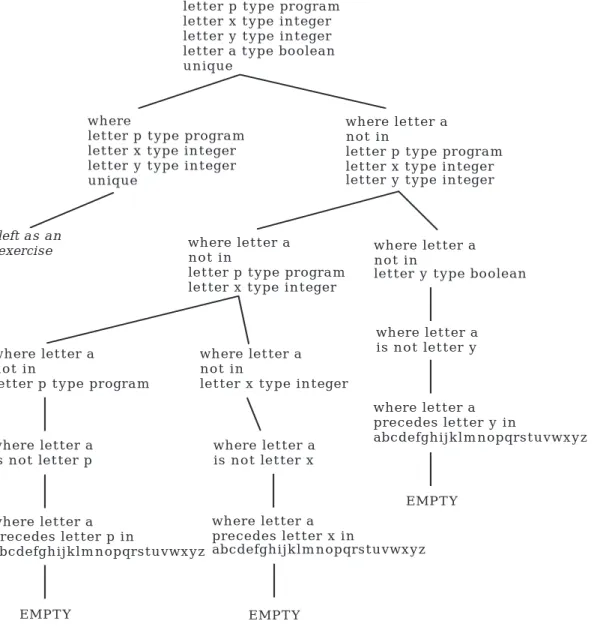
Notice that the program identifier name is added to the declaration sequence with type program. This information is passed to the command sequence and is also checked for multiple declarations of the same identifier by a where rule. A top-level derivation tree for the example program is shown in Figure 4.8. The wher e rule checks for the uniqueness of declarations. All leaf nodes for the wher e clauses will be EMPTY if the identifiers are unique. Since our hyper-rules for variable lists have produced separate declaration informa-tion for each identifier, this checking is relatively straightforward, albeit lengthy. The easiest case is a single declaration, which is obviously unique. (h22) where DECL unique : EMPTY .
In the case of multiple declarations, we separate the last declaration in the list, and we use the following rule to ensure that the name is not contained in any declarations to the left
121 letter w symbol comma symbol letter y symbol comma symbol letter z symbol colon symbol integer symbol sem icolon sym bol letter w type integer
letter x type integer letter y type integer letter z type integer declaration
DECLSEQ
NAME type TYPE
var symbol
letter w type integer letter x type integer letter y type integer letter z type integer declaration seq
DECLSEQ NAME1 type TYPE NAME2 type TYPE
letter w type integer letter x type integer letter y type integer letter z type integer varlist
letter w type integer letter x type integer letter y type integer varlist
DECLSEQ NAME1 type TYPE NAME2 type TYPE
letter w type integer letter x type integer varlist
letter x symbol
comma symbol
NAME1 type TYPE NAME2 type TYPE
Figure 4.7: Parsing the Declaration: var w, x, y, z : integer;
(h23) where DECLSEQ NAME type TYPE unique : where DECLSEQ unique,
where NAME not in DECLSEQ.
program program symbol is symbol letter p symbol block with
letter p type program letter x type integer letter y type integer letter a type boolean
where
letter p type program letter x type integer letter y type integer letter a type boolean unique
letter x type integer letter y type integer letter a type boolean declaration seq
letter p type program letter x type integer letter y type integer letter a type boolean command seq begin symbol end symbol See Figure 4.9
letter x type integer letter y type integer declaration seq
letter a type boolean declaration var symbol letter a symbol colon symbol boolean symbol semicolon symbol letter x symbol comma symbol var symbol letter y symbol colon symbol integer symbol semicolon symbol letter x type integer
letter y type integer declaration
letter x type integer letter y type integer var list
See Figure 4.10
Figure 4.8: Top-Level Derivation Tree of Sample Program
To ensure that a name is not contained in a declaration sequence, we check one declaration at a time from right to left.
(h24) where NAME not in DECLSEQ DECL : where NAME not in DECLSEQ, where NAME not in DECL.
123
The type information in a declaration sequence is not needed to check for name uniqueness, so the hyper-rule simply checks that two names are not the same.
(h25) where NAME1 not in NAME2 type TYPE : where NAME1 is not NAME2.
Names are separated into a sequence of characters, which is possibly empty, followed by a final character. We need to use the metanotions for NOTION
and NOTETY introduced in section 4.1. (m14)NOTION :: ALPHA; NOTION ALPHA.
(m15)NOTETY :: NOTION; EMPTY .
The identifiers contain either alphabetic characters or digit characters. If characters are of different kind, they are not equal. If characters are of the same kind but they are not the same, then one character appears before the other character in the appropriate character set. This test is applied to all characters in the sequence until a mismatch is found.
(h26) where NOTETY1 NOTION1 ALPHANUM1 is not NOTETY2 NOTION2 ALPHANUM2 : where NOTETY1 is not NOTETY2;
where NOTION1 dif ferent kind NOTION2; where ALPHANUM1 pr ecedes ALPHANUM2
in abcdefghijklmnopqrstuvwxyz; where ALPHANUM2 pr ecedes ALPHANUM1
in abcdefghijklmnopqrstuvwxyz; where ALPHANUM1 pr ecedes ALPHANUM2
in zer o one two thr ee four five six seven eight nine; where ALPHANUM2 pr ecedes ALPHANUM1
in zer o one two thr ee four five six seven eight nine.
A letter is always different than a digit.
(h27) where letter dif ferent kind digit : EMPTY .
(h28) where digit dif ferent kind letter : EMPTY .
Finally, two hyper-rules check whether a character or a digit precedes an-other.
(h29) where ALPHA1 pr ecedes ALPHA2
in NOTETY1 ALPHA1 NOTETY2 ALPHA2 NOTETY3 : EMPTY .
(h30) where NUM1 pr ecedes NUM2
in NOTETY1 NUM1 NOTETY2 NUM2 NOTETY3 : EMPTY .
Figure 4.9 shows the use of these wher e rules to check the uniqueness of the identifiers in our sample program.
where
letter p type program letter x type integer letter y type integer letter a type boolean unique
where
letter p type program letter x type integer letter y type integer unique
where letter a not in
letter p type program letter x type integer letter y type integer
where letter a not in
letter p type program letter x type integer
where letter a not in
letter y type boolean
where letter a is not letter y where letter a precedes letter y in abcdefghijklm nopqrstuvwxyz EM PTY where letter a not in
letter p type program
where letter a not in
letter x type integer
where letter a is not letter p where letter a precedes letter p in abcdefghijklm nopqrstuvwxyz EM PTY where letter a is not letter x where letter a precedes letter x in abcdefghijklm nopqrstuvwxyz EM PTY left as an exercise
Figure 4.9: Checking Uniqueness of Declared Identifiers
Commands and Expressions
We complete the development of our two-level grammar for Wren by examin-ing how declaration information is used to check for the proper use of vari-ables that appear in commands. To reduce the number of hyper-rules, we introduce metanotions for the arithmetic operators and comparison opera-tors.
125
(m16)WEAKOP :: plus symbol; minus symbol.
(m17)STRONGOP :: multiply symbol; divide symbol.
(m18)RELATION ::
less or equal symbol; less symbol; not equal symbol; greater symbol; gr eater or equal symbol; equal symbol.
Declaration information is passed to each individual command. Note that an empty declaration sequence need not be allowed since every program must be named, even if no variables are declared.
(h10) DECLSEQ command seq : DECLSEQ command;
DECLSEQ command, semicolon symbol,
DECLSEQ command seq.
Commands use the declaration information in different ways: • The skip command uses no declaration information.
• The write, while, and if commands pass the declaration information to their constituent parts.
• The read command uses the declaration information to check that the associated variable is of type integer.
Here is the hyper-rule that separates these cases: (h11) DECLSEQ command :
TYPE NAME in DECLSEQ, assign symbol, TYPE expr ession in DECLSEQ; skip symbol;
read symbol, integer NAME in DECLSEQ;
write symbol, integer expr ession in DECLSEQ;
while symbol, boolean expr ession in DECLSEQ, do symbol, DECLSEQ command seq, end while symbol; if symbol, boolean expr ession in DECLSEQ, then symbol,
DECLSEQ command seq, end if symbol; if symbol, boolean expr ession in DECLSEQ, then symbol,
DECLSEQ command seq, else symbol, DECLSEQ command seq, end if symbol.
The read command illustrates hyper-rules of the form TYPE NAME in DECLSEQ that perform two important functions: They produce the appro-priate NAME symbol and they check that the NAME appears in the DECLSEQ
with the appropriate TYPE.
(h19) TYPE NAME in DECLSEQ :
NAME symbol, wher e NAME type TYPE found in DECLSEQ.
The DECLSEQ is checked one declaration at a time from left to right. The
EMPTY notion is produced if the appropriate declaration is found; other-wise, the parse fails.
(h20) wher e NAME type TYPE found in
NAME type TYPE DECLSEQETY : EMPTY .
(h21) wher e NAME1 type TYPE1 found in NAME2 type TYPE2 DECLSEQETY : wher e NAME1 type TYPE1
found in DECLSEQETY .
The remainder of the two-level grammar, dealing with expressions and com-parisons, is straightforward. The portion of the grammar dealing with Bool-ean expressions has been left as an exercise.
(h12) integer expr ession in DECLSEQ : term in DECLSEQ;
integer expr ession in DECLSEQ, WEAKOP , ter m in DECLSEQ.
(h13) ter m in DECLSEQ : element in DECLSEQ;
ter m in DECLSEQ, STRONGOP , element in DECLSEQ.
(h14) element in DECLSEQ : NUMERAL symbol;
integer NAME in DECLSEQ;
left par en symbol, integer expr ession in DECLSEQ,
right par en symbol; negation symbol, element in DECLSEQ.
(h15) boolean expr ession in DECLSEQ : left as an exercise.
(h16) boolean ter m in DECLSEQ : left as an exercise.
(h17) boolean element in DECLSEQ : left as an exercise.
(h18) comparison in DECLSEQ :
integer expr ession in DECLSEQ, RELA TION,
integer expr ession in DECLSEQ.
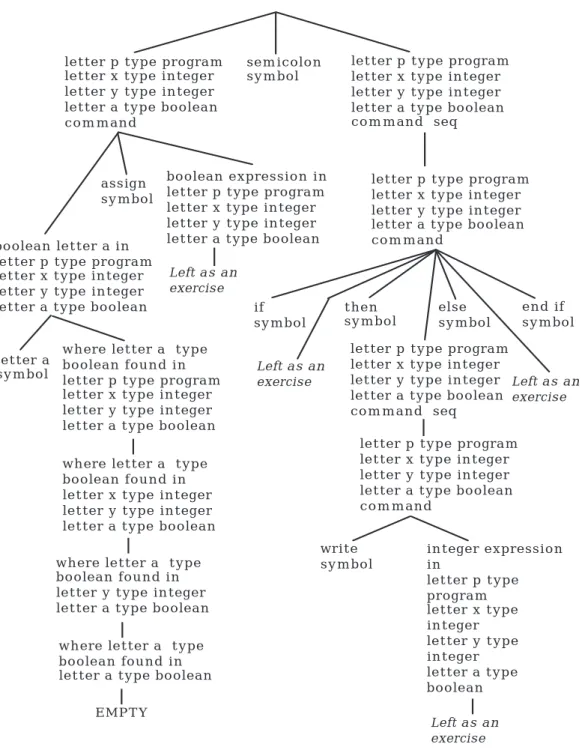
Figures 4.10 and 4.11 illustrate a partial derivation tree for the command sequence in the sample program. The unfinished branches in the tree are left as exercises.
127
letter p type program letter x type integer letter y type integer letter a type boolean command seq
letter p type program letter x type integer letter y type integer letter a type boolean command
letter p type program letter x type integer letter y type integer letter a type boolean command seq semicolon
symbol
letter p type program letter x type integer letter y type integer letter a type boolean command
letter p type program letter x type integer letter y type integer letter a type boolean command seq semicolon symbol read symbol Left as an exercise integer letter x in letter p type program letter x type integer letter y type integer letter a type boolean
letter x symbol
where letter x type integer found in letter p type program letter x type integer letter y type integer letter a type boolean
where letter x type integer found in letter x type integer letter y type integer letter a type boolean
EMPTY
See
Figure 4.11
Figure 4.10: Partial Derivation Tree for a Command Sequence
integer expression in letter p type program letter x type integer letter y type integer letter a type boolean sem icolon sym bol boolean expression in letter p type program letter x type integer letter y type integer letter a type boolean letter p type program
letter x type integer letter y type integer letter a type boolean com m and
boolean letter a in letter p type program letter x type integer letter y type integer letter a type boolean
letter a sym bol
where letter a type boolean found in letter p type program letter x type integer letter y type integer letter a type boolean
where letter a type boolean found in letter x type integer letter y type integer letter a type boolean
EMPTY assign sym bol
where letter a type boolean found in letter y type integer letter a type boolean
where letter a type boolean found in letter a type boolean
letter p type program letter x type integer letter y type integer letter a type boolean com m and seq
letter p type program letter x type integer letter y type integer letter a type boolean com m and
write sym bol
letter p type program letter x type integer letter y type integer letter a type boolean com m and seq
letter p type program letter x type integer letter y type integer letter a type boolean com m and Left as an exercise then sym bol if sym bol else sym bol end if sym bol Left as an exercise Left as an exercise Left as an exercise
129
(m1) ALPHA :: a; b; c; d; e; f; g; h; i; j; k; l; m;
n; o; p; q; r; s; t; u; v; w; x; y; z. (m2) NUM :: zer o; one; two; thr ee; four; five; six; seven; eight; nine. (m3) ALPHANUM :: ALPHA; NUM.
(m4) LETTER :: letter ALPHA. (m5) DIGIT :: digit NUM.
(m6) LETTERDIGIT :: LETTER; DIGIT .
(m7) NAME :: LETTER; NAME LETTERDIGIT . (m8) NUMERAL :: DIGIT ; NUMERAL DIGIT . (m9) DECL :: NAME type TYPE.
(m10) TYPE :: integer; boolean; pr ogram. (m11) DECLSEQ :: DECL; DECLSEQ DECL. (m12) DECLSEQETY :: DECLSEQ; EMPTY . (m13) EMPTY :: .
(m14) NOTION :: ALPHA; NOTION ALPHA. (m15) NOTETY :: NOTION; EMPTY .
(m16) WEAKOP :: plus symbol; minus symbol. (m17) STRONGOP :: multiply symbol; divide symbol.
(m18) RELATION :: less or equal symbol; less symbol; not equal symbol; greater symbol; gr eater or equal symbol; equal symbol.
Figure 4.12: Metarules for Wren
(h1) program : program symbol, NAME symbol, is symbol, block with NAME type pr ogram DECLSEQETY , where NAME type pr ogram DECLSEQETY unique. (h2) block with NAME type pr ogram DECLSEQETY :
DECLSEQETY declaration seq, begin symbol,
NAME type pr ogram DECLSEQETY command seq, end symbol. (h3) DECLSEQ DECL declaration seq :
DECLSEQ declaration seq, DECL declaration. (h4) DECLSEQ declaration seq :
DECLSEQ declaration.
(h5) EMPTY declaration seq : EMPTY .
Figure 4.13: Hyper-rules for Wren (Part 1)
(h6) NAME type TYPE declaration : var symbol, NAME symbol, colon symbol, TYPE symbol, semicolon symbol. (h7) DECLSEQ NAME type TYPE declaration :
DECLSEQ NAME type TYPE var list,
NAME symbol, colon symbol, TYPE symbol, semicolon symbol. (h8) DECLSEQ NAME1 type TYPE NAME2 type TYPE var list :
DECLSEQ NAME1 type TYPE var list, NAME1 symbol, comma symbol. (h9) NAME1 type TYPE NAME2 type TYPE var list :
var symbol, NAME1 symbol, comma symbol. (h10) DECLSEQ command seq :
DECLSEQ command;
DECLSEQ command, semicolon symbol, DECLSEQ command seq.
(h11) DECLSEQ command :
TYPE NAME in DECLSEQ, assign symbol, TYPE expr ession in DECLSEQ; skip symbol;
read symbol, integer NAME in DECLSEQ; write symbol, integer expr ession in DECLSEQ;
while symbol, boolean expr ession in DECLSEQ, do symbol, DECLSEQ command seq, end while symbol; if symbol, boolean expr ession in DECLSEQ, then symbol,
DECLSEQ command seq, end if symbol; if symbol, boolean expr ession in DECLSEQ, then symbol,
DECLSEQ command seq, else symbol, DECLSEQ command seq, end if symbol. (h12) integer expr ession in DECLSEQ :
term in DECLSEQ;
integer expr ession in DECLSEQ, WEAKOP , ter m in DECLSEQ. (h13) term in DECLSEQ :
element in DECLSEQ;
term in DECLSEQ, STRONGOP , element in DECLSEQ. (h14) element in DECLSEQ :
NUMERAL symbol;
integer NAME in DECLSEQ;
left par en symbol, integer expr ession in DECLSEQ, right par en symbol;
negation symbol, element in DECLSEQ. (h15) boolean expr ession in DECLSEQ : left as exercise
(h16) boolean ter m in DECLSEQ : left as exercise Figure 4.13: Hyper-rules for Wren (Part 2)
131
(h17) boolean element in DECLSEQ : left as exercise
(h18) comparison in DECLSEQ :
integer expr ession in DECLSEQ, RELA TION, integer expr ession in DECLSEQ.
(h19) TYPE NAME in DECLSEQ :
NAME symbol, wher e NAME type TYPE found in DECLSEQ (h20) wher e NAME type TYPE found in NAME type TYPE DECLSEQETY :
EMPTY.
(h21) wher e NAME1 type TYPE1 found in NAME2 type TYPE2 DECLSEQETY : wher e NAME1 type TYPE1 found in
DECLSEQETY . (h22) wher e DECL unique : EMPTY .
(h23) where DECLSEQ NAME type TYPE unique : where DECLSEQ unique,
wher e NAME not in DECLSEQ. (h24) wher e NAME not in DECLSEQ DECL :
wher e NAME not in DECLSEQ, wher e NAME not in DECL. (h25) wher e NAME1 not in NAME2 type TYPE :
where NAME1 is not NAME2.
(h26) where NOTETY1 NOTION1 ALPHANUM1 is not NOTETY2 NOTION2 ALPHANUM2 : where NOTETY1 is not NOTETY2;
wher e NOTION1 dif ferent kind NOTION2; where ALPHANUM1 pr ecedes ALPHANUM2
in abcdefghijklmnopqrstuvwxyz; where ALPHANUM2 pr ecedes ALPHANUM1
in abcdefghijklmnopqrstuvwxyz; where ALPHANUM1 pr ecedes ALPHANUM2
in zer o one two thr ee four five six seven eight nine; where ALPHANUM2 pr ecedes ALPHANUM1
in zer o one two thr ee four five six seven eight nine. (h27) wher e letter dif ferent kind digit : EMPTY .
(h28) wher e digit dif ferent kind letter : EMPTY . (h29) where ALPHA1 pr ecedes ALPHA2
in NOTETY1 ALPHA1 NOTETY2 ALPHA2 NOTETY3 : EMPTY . (h30) where NUM1 pr ecedes NUM2
in NOTETY1 NUM1 NOTETY2 NUM2 NOTETY3 : EMPTY .
Figure 4.13: Hyper-rules for Wren (Part 3)
Exercises
1. Show the derivation tree for the following declaration sequence:
var w, x :integer; var y, z :integer;
2. Complete the remaining branches in Figure 4.9. 3. Complete the following hyper-rules:
(h15) boolean expr ession in DECLSEQ :
(h16) boolean ter m in DECLSEQ :
(h17) boolean element in DECLSEQ :
4. Complete the remaining branches in Figures 4.10 and 4.11. 5. Draw the complete derivation tree for the following program:
program p is
var n, f : integer; begin
read n; f := 1;
while n > 0 do f := f * n; n := n – 1 end while; write f
end
6. Suppose the declaration in exercise 5 is changed to
var n : integer; var f : boolean;
Show all locations in the command sequence where the parse fails, as-suming the declaration sequence letter n type integer letter f type boolean.
7. Show all changes necessary to metarules and hyper-rules to allow for multiple character identifiers. Some rules already allow for multiple char-acters whereas others, such as those with NAME symbol , will have to be modified. Additional rules may be needed.
4.3 TWO-LEVEL GRAMMARS AND PROLOG
The consistent substitution of protonotions for a metanotion within a hyper-rule may seem similar to the binding of identifiers in a Prolog clause. In fact, a close relationship exists between two-level grammars and logic proming. Rather than present a complete implementation of the two-level
gram-133
mar for Wren in this section, we present a brief example of implementing a two-level grammar in Prolog and then discuss some of the relationships be-tween two-level grammars and logic programming.
Implementing Two-Level Grammars in Prolog
We implement the Hollerith string literal grammar from Section 4.1 to give the flavor a two-level grammar in Prolog. The top-level predicate, named
hollerith, is called with three arguments:
hollerith(<list of digit symbols>, hollerith, <list of lowercase letters>).
The program should print either “valid Hollerith string” or “invalid Hollerith string”, as appropriate for the data. We assume the list of digits and list of letters are syntactically correct. A sample session appears below.
| ?- hollerith([digitSixSymbol], hollerith, [a,b,c,d,e,f]). valid Hollerith string
yes
| ?- hollerith([digitSixSymbol], hollerith, [a,b,c,d,e]). invalid Hollerith string
yes
| ?- hollerith([digitTwoSymbol,digitFiveSymbol], hollerith, [a,b,c,d,e,f,g,h,i,j,k,l,m,n,o,p,q,r,s,t,u,v,w,x,y]). valid Hollerith string
yes
| ?- hollerith([digitTwoSymbol,digitFiveSymbol], hollerith, [a,b,c,d,e,f,g,h,i,j,k,l,m,n,o,p,q,r,s,t,u,v,w,x,y,z]). invalid Hollerith string
yes
This interface is not very elegant, but it will serve adequately to illustrate the intended performance. An exercise suggests techniques for improving the interface. Observe that we have allowed for numerals of any size, so a wher e
clause must be used in the grammar. The two-level grammar for Hollerith string literals is summarized in Figure 4.14.
hollerith : T ALLY digit, hollerith symbol, T ALLY LETTERSEQ. TALLY i LETTER LETTERSEQ : i LETTER, T ALLY LETTERSEQ. i LETTER: LETTER symbol.
i digit : digit one symbol. ii digit : digit two symbol. iii digit : digit thr ee symbol. iiii digit : digit four symbol. iiiii digit : digit five symbol. iiiiii digit : digit six symbol. iiiiiii digit : digit seven symbol. iiiiiiii digit : digit eight symbol. iiiiiiiii digit : digit nine symbol. TALLETY constant :
TALLETY digit;
TALLETY2 constant, T ALLETY3 digit, wher e TALLETY is TALLETY2 T ALLETY2 T ALLETY2 T ALLETY2 T ALLETY2 TALLETY2 T ALLETY2 T ALLETY2 T ALLETY2 T ALLETY2 TALLETY3.
where TALLETY is T ALLETY : EMPTY . EMPTY digit : digit zer o symbol. TALLETY :: T ALLY; EMPTY .
APLHA :: a; b; c; d; e; f; g; h; i; j; k; l; m; n; o; p; q; r; s; t; u; v; w; x; y; z. LETTER :: letter ALPHA.
LETTERSEQ :: LETTER; LETTERSEQ LETTER.
Figure 4.14: Two-level Grammar for Hollerith String Literals
The clauses for single digits are simple.
digit([digitZeroSymbol], [ ]). digit([digitOneSymbol], [i]). digit([digitTwoSymbol], [i,i]). digit([digitThreeSymbol], [i,i,i]). digit([digitFourSymbol], [i,i,i,i]). digit([digitFiveSymbol], [i,i,i,i,i]). digit([digitSixSymbol], [i,i,i,i,i,i]). digit([digitSevenSymbol], [i,i,i,i,i,i,i]). digit([digitEightSymbol], [i,i,i,i,i,i,i,i]). digit([digitNineSymbol], [i,i,i,i,i,i,i,i,i]).
135
A constant is a single digit or a sequence of digits. We use the technique of concatenating ten copies of the tally for the leading digits to the tally for the units digit to produce a final tally. Supporting clauses are used to split the digits into the leading digits and units digit, to concatenate the ten copies of the leading digit’s tally to the units digit’s tally, and to perform the concat-enation itself.
constant(DIGIT, TALLETY) :- digit(TALLETY, DIGIT). constant(DIGITS, TALLETY)
:-splitDigits(DIGITS, LeadingDIGITS, UnitDIGIT), constant(LeadingDIGITS, TALLETY2),
digit(UnitDIGIT, TALLETY3),
concatTenPlusDigit(TALLETY2, TALLETY3, TALLETY). splitDigits([D], [ ], [D]).
splitDigits([Head|Tail],[Head|Result],Unit) :- splitDigits(Tail, Result, Unit). concatTenPlusDigit(TALLETY2, TALLETY3, TALLETY)
:-concat(TALLETY2, TALLETY2, TwoTimes), concat(TwoTimes, TwoTimes, FourTimes), concat(FourTimes, FourTimes, EightTimes), concat(EightTimes, TwoTimes, TenTimes), concat(TenTimes, TALLETY3, TALLETY). concat([ ],L,L).
concat([Head|Tail],L,[Head|Result]) :- concat(Tail,L,Result).
The tally is generated from the number part, and it is used to check the length of the letter sequence. Each time a tally symbol is removed, a letter is removed. One base case is a single tally and a single letter, resulting in a valid hollerith string. If either the tally or the letter sequence becomes empty, the other base cases, the hollerith string is invalid. Each letter is checked to ensure that it is a lowercase character.
hollerith(Number,hollerith,Letters) :- constant(Number, TALLETY), letterSeq(TALLETY, Letters). letterSeq([i],[Letter]) :- alpha(Letter),
write(‘valid Hollerith string’), nl. letterSeq([i|TALLETY],[Letter|Letters]) :- alpha(Letter),
letterSeq(TALLETY, Letters). letterSeq([ ],Letters) :- write(‘invalid Hollerith string’), nl.
letterSeq(Number,[ ]) :- write(‘invalid Hollerith string’), nl.
alpha(a). alpha(b). alpha(c). alpha(d). alpha(e). alpha(f). alpha(g). alpha(h). alpha(i). alpha(j). alpha(k). alpha(l). alpha(m). alpha(n). alpha(o). alpha(p). alpha(q). alpha(r). alpha(s). alpha(t). alpha(u). alpha(v). alpha(w). alpha(x). alpha(y). alpha(z).
Two-level Grammars and Logic Programming
Hyper-rules in level grammars are similar to clauses in Prolog. In two-level grammars we have consistent substitution of the same value for a par-ticular metanotion in a rule. In Prolog we have the consistent binding of the same value to a particular variable in a clause. Some of the syntax and pat-tern matching in two-level grammars are also similar to Prolog. Several re-searchers have investigated the relationships between two-level grammars (also known as W-grammars) and logic programming. We briefly summarize one of those approaches, originally presented by S. J. Turner in a paper entitled “W-Grammars for Logic Programming” [Turner84].
A programming language seldom completely represents a programming para-digm. For example, Common Lisp is not a purely functional language, and Prolog is not a purely logical language. Turner believes that two-level gram-mars as an implementation mechanism for logic programming have many advantages over Prolog, the most popular logic programming language. He implements a logic programming system based on a two-level (or W-) gram-mar in a system called WLOG. He claims this system overcomes some of the disadvantages of Prolog (see [Turner84], page 352).
• Understanding Prolog requires a detailed understanding of the backtrack-ing mechanism built into the implementation of Prolog.
• The meaning of a Prolog program is highly dependent on the order of the clauses in the database, making the formal analysis of the semantics of Prolog very difficult.
• Many built-in predicates in Prolog have side effects that make parallel implementations difficult.
• Minor programming errors, such as misspelling, are difficult to find since the entire program fails with no indication of where the error occurred. Consider the following example taken from Turner’s paper:
MAN :: geor ge; john; paul. WOMAN :: jane; mary; sue.
137
PERSON :: MAN; WOMAN.
THING :: flowers; food; football; food; wine.
LEGAL :: PERSON likes THING; PERSON likes PERSON.
A fact is usually stated as a hyper-rule with an empty right side, such as:
mary likes football : . john likes wine : . paul likes mary : . jane likes sue : . paul likes food : . geor ge likes football : .
We can make a query, such as finding out what paul likes: paul likes THING?
which succeeds with THING matching mary and food. We can have com-pound queries, such as:
PERSON1 likes PERSON, PERSON likes THING?
which succeeds with paul likes mary and mary likes football. Hyper-rules with right-hand sides are used to express rules of logic. Consider the logical rule: Two people who like the same object like each other, which is expressed as:
PERSON1 likes PERSON2 : PERSON1 likes OBJECT , PERSON2 likes OBJECT .
From the database given above, we can conclude that mary likes john. Turner’s paper gives a formal definition of WLOG and discusses an imple-mentation based on non-deterministic finite automata. This impleimple-mentation uses a breadth-first search, which means that the order of the database is not critical and that certain types of parallelism can be realized. The system also handles not in a more understandable manner than Prolog. With the database given above, if we pose the query
paul likes WOMAN?
then only mary is found in the database. In WLOG, if we make the query not [paul likes WOMAN]?
then the values of sue and jane satisfy the query. This should be compared with Prolog where this query fails. In WLOG, not[not[X]]? is satisfied by the same values as X?, but this is not true in Prolog, which is based on negation as failure. This completes our brief look at the relationship between two-level grammars and pure logic programming.
Exercises
1. Build a “front end” for the Hollerith string checker to prompt the user for string input and then print the appropriate evaluation message. Use the built-in Prolog clause name for converting a string to a sequence of ascii codes.
2. Implement a two-level grammar that parses strings of the form anbncn. The program should either print that the string obeys the grammar or that it does not. Assume that the strings are syntactically correct, in the sense that they are a sequence of a’s followed by a sequence of b’s, followed by a sequence of c’s.
3. Implement a two-level grammar to recognize valid Pascal identifiers as-suming that an identifier starts with a letter followed by a sequence of alphanumeric characters and that the length of the identifier is eight or fewer characters (see exercise 4 in section 4.1).
4.4 FURTHER READING
Two-level grammars are also called W-grammars after their developer, Aad van Wijngaarden, who described them in an early paper [vanW ijngaarden66]. The formal definition of Algol68 using two-level grammars appears in [van Wijngaarden76]. [Kupka80] has applied two-level grammars to model infor-mation processing.
Several references include two-level grammars as part of an overview of for-mal techniques. Most notable are [Pagan81], [Marcotty76], and [Cleaveland77]. Pagan develops an interpreter for a language with parameterized procedures using a two-level grammar.
Some of the theoretical issues relating to two-level grammars are discussed in [Deussen75] and [Slintzoff67]. The relationship between two-level gram-mars and programming language design is explored in [van Wijngaarden82], [Maluszynski84], and [Turner84].
The most active group of researchers in the United States working on two-level grammars is at the University of Alabama, Birmingham. Barrett Bryant and Balanjaninath Edupuganty are coauthors of several papers dealing with applications of two-level grammars to a wide variety of problem domains [Bryant86a], [Bryant86b], [Bryant88], [Edupuganty85], [Edupuganty88], [Edupuganty89], and [Sundararaghavan87].