TOWARDS AUTO-SCALING IN THE
CLOUD: ONLINE RESOURCE
ALLOCATION TECHNIQUES
Lenar Yazdanov
Born on: 25th February 1986 in Brezhnev, USSR
DISSERTATION
to achieve the academic degree
DOCTOR OF PHILOSOPHY (PH.D.)
First referee
Prof. Christof Fetzer, Ph.D.
Technische Universit ¨at Dresden, GermanySecond referee
Prof. R ¨
udiger Kapitza, Ph.D.
Technische Universit ¨at Braunschweig, Germany
Submitted on: 30th September 2015 Defended on: 26th September 2016
resources to allocate. Many applications running in the cloud face workload changes that af-fect their resource demand. The first thought is to plan capacity either for the average load or for the peak load. In the first case there is less cost incurred, but performance will be af-fected if the peak load occurs. The second case leads to money wastage, since resources will remain underutilized most of the time. Therefore there is a need for a more sophisticated re-source provisioning techniques that can automatically scale the application rere-sources according to workload demand and performance constrains.
Large cloud providers such as Amazon, Microsoft, RightScale provide auto-scaling services. However, without the proper configuration and testing such services can do more harm than good. In this work I investigate application specific online resource allocation techniques that allow to dynamically adapt to incoming workload, minimize the cost of virtual resources and meet user-specified performance objectives.
ACKNOWLEDGEMENTS
First, I would like to thank Prof. Christof Fetzer for giving me opportunity to join Systems En-gineering group. I have learned a lot from him. He always motivated me and provided many ideas. I also want to thank Prof. R ¨udiger Kapitza for serving as the thesis external reviewer. He gave me some valuable hints when I start writing the thesis.
I would like to thank the people with whom I discussed my papers and who have commented on early versions of the papers: Diogo Behrens, Stefan Weigert, Andre Martin, Do Le Quoc.
My many thanks to Martin Nowack who helped me to setup experimental environment in the beginning and Stephan Creutz who introduced me to the wonderful world of Linux.
I also want to thank my colleges Robert Krahn and Thomas Knauth for reviewing on early drafts of the thesis and correcting my English mistakes.
My especial thanks go to my wife Dinara who supported me during my PhD. Without her I would not have time and strength to write the thesis. And of course, I want to thank my parents who were helping me and my family over the last five years.
Abstract 3 Introduction 9 1.1 Motivation. . . 11 1.2 Thesis outline . . . 11 Background 15 2.1 Introduction . . . 17 2.2 Scaling types . . . 18 2.2.1 Horizontal scaling. . . 20 2.2.2 Vertical scaling . . . 21 2.3 Workloads . . . 23 2.4 Cloud trends . . . 25 2.5 Summary . . . 27 Auto-scaling system 29 3.1 Introduction . . . 31 3.2 Auto-scaling process . . . 31 3.3 System identification . . . 32 3.4 Auto-scaling techniques . . . 33
3.4.1 Threshold based scaling . . . 34
3.4.2 Reinforcement learning . . . 36
3.4.3 Control theory . . . 38
3.4.4 Queuing theory. . . 41
3.4.5 Time series . . . 43
3.5 Summary . . . 44
Vertical scaling for prioritized VMs provisioning 47 4.1 Introduction . . . 49 4.2 Design rationale . . . 50 4.3 Controller architecture . . . 52 4.4 Evaluation . . . 53 4.4.1 Single VM scaling . . . 54 4.4.2 Prioritized VMs scaling . . . 56 4.5 Discussion . . . 57 4.6 Related work . . . 58 4.7 Conclusion . . . 59
Autonomic Virtual Machine Scaling 61 5.1 Introduction . . . 63
5.2 Motivation. . . 63
5.3 Parallel learning with assumption . . . 65
5.4 VScaler design . . . 66
5.5 Evaluation . . . 69
5.5.1 Convergence speedup . . . 69
5.5.2 Real world scenario . . . 70
5.6 Related work . . . 72
5.7 Conclusion . . . 73
Autonomic Multi-tier application Scaling 75 6.1 Introduction . . . 77
6.3 System identification . . . 79
6.3.1 CPU usage and performance . . . 79
6.3.2 Memory usage and performance . . . 80
6.3.3 Cluster wide correlation . . . 81
6.4 Controller architecture . . . 82
6.4.1 Overview . . . 82
6.4.2 MDP design solutions . . . 83
6.4.3 Initializing Q-learning . . . 84
6.4.4 Model learning and exploitation . . . 84
6.5 Evaluation . . . 85
6.6 Related work . . . 87
6.7 Conclusion . . . 89
I/O aware elastic MapReduce cluster scaling 91 7.1 Introduction . . . 93
7.2 Motivation. . . 94
7.3 Background . . . 96
7.3.1 MapReduce slowstart parameter . . . 96
7.3.2 Anatomy of MapReduce job. . . 97
7.3.3 Anatomy of Linux network stack . . . 98
7.4 Approach . . . 99
7.5 System architecture . . . 101
7.5.1 Overview . . . 101
7.5.2 Job profile collection . . . 101
7.5.3 Job resource allocation . . . 102
7.6 Evaluation . . . 102
7.6.1 Bandwidth cap estimation . . . 104
7.6.2 Runtime cluster resizing . . . 104
7.7 Related work . . . 106
7.8 Conclusion . . . 107
Conclusion 109 8.1 Vertical scaling for prioritized VMs provisioning . . . 111
8.1.1 Future work . . . 112
8.2 Reinforcement learning based techniques . . . 112
8.2.1 Autonomic Virtual Machine Scaling . . . 112
8.2.2 Autonomic Multi-tier application Scaling . . . 112
8.2.3 Future work . . . 113
8.3 Elastic mapreduce cluster scaling . . . 113
8.3.1 Future work . . . 113
Bibliography 115 Lists of Figures, Tables and Algorithms 131 List of Figures . . . 133
1.1 MOTIVATION
Cloud computing lowered the barrier of entry to an infinite amount of computing resources. Therefore, nowadays any person in the world can rent computing resources to run an applica-tion. Usually the resources are delivered in the form of virtual machines (VMs). In comparison to traditional provisioning techniques that require upfront servers’ deployment, cloud users can acquire and release resources on-demand. However, it is not easy to answer the question aboutwhento allocate andhow many resources to allocate.
To identify the right amount of resources to lease the user needs to consider a number of factors: such as application elasticity, workload dynamics, user-defined performance objectives and conversion of the performance objective to resource allocation. For a non-expert cloud user that has limited knowledge about the application and its resource demand pattern, it is hard to make an optimal scaling decision.
Cloud market offers a variety of resource allocation schemes. The user can choose a VM from the set of predefined templates or specify a VM he needs. Later on, during runtime it is pos-sible to change the application resource capacity by modifying the number of VMs dedicated to the application (horizontal scaling) or adapt individual VM resources (vertical scaling). The number of possible resource allocation strategies becomes too large to be managed by a hu-man. Therefore there is a need for automating the process of resource allocation. Auto-scaling services offered by cloud providers simplify the process of acquiring and releasing resources, but leave a burden of scaling policy design to the user.
The focus of this thesis is techniques and approaches for online scaling policy discov-ery. To design optimal scaling policy the user has to address a number of challenges. These challenges motivate our research. In this work we present resource allocation controllers that perform horizontal and vertical resource scaling. There are two objectives that we target. First, the amount of assigned resources should be enough to meet the application performance ob-jectives. Second, the cost of running the application should be minimal.
1.2 THESIS OUTLINE
This thesis divided in to 8 chapters including introduction. The following paragraphs give a short overview of each chapter.
Chapter 2gives an overview of resource scaling types, applications and trends in cloud mar-ket. Over the last decade cloud became a popular computing platform. In contrast to traditional provisioning approaches it offers flexibility in terms amount computational resources that user can acquire and the resources rental time. Users can modify the capacity of the application dur-ing runtime either by scaldur-ing it horizontally or vertically. The choice of the method depends on the application type, expected resource demand and utilization of the application. It is common today that datacenters host mix of applications. In general there are two types of applications. The first type consists of latency-sensitive interactive applications. To the second type belong resource intensive batch applications. Each application type requires an individual provisioning strategy. Cloud market is not static, it constantly evolves. Economic interests of cloud users force the providers to shift towards VM customization model and shorter billing cycles. In con-trast to fixed size VM allocation model, the observed trends in the market require techniques for dynamic fine-granular resource allocation.
Chapter 3presents the process of auto-scaling system design and gives an overview of tech-niques for automating resource allocation. The process of auto-scaling consists of four phases: monitoring, analysis, planning and execution. Analysis and planning constitute the core of the system. The analysis phase determines the current state of the application or predicts future needs. Once the state is known (or predicted) the auto-scaler plans how to perform resource allocation. The scaling decisions are made by exploiting the application performance model.
The model describes relationships between a set of parameters such as the application perfor-mance, incoming workload, assigned amount of virtual resources and service level objectives. The model can be defined offline by an expert user over the set of system identification exper-iments. Alternatively a hybrid and an online model discovery approaches can be used. The last two offer flexibility in terms of the scaling policy adaptation. There is a number of techniques that are used to describe the model. Generally, they are classified in five groups: threshold based, reinforcement learning, queuing theory, time series analysis and control theory. In Chap-ter 3we present each technique, discuss its advantages and disadvantages, and review related work.
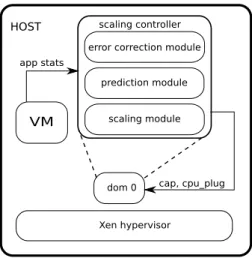
Chapter 4describes an approach for collocation of VMs that support vertical scaling. Many interactive applications have varying resource demand. Running these applications in a fixed size VM leads to resource wastage. In contrast to fixed size VM model, VM reconfiguration allows to follow resource demand curve of interactive applications. However, VM collocation is a challenging task for cloud providers that want to support vertical scaling. It is hard to give performance guarantees for the applications running in collocation with a VM that can be dy-namically reconfigured. One would need to maintain a certain resource headroom. However, it will lead to low utilization of provider’s infrastructure. To solve the problem we propose to col-locate interactive and batch applications. Batch applications tolerant to performance slowdown and can make progress even under resource pressure. In Chapter 4 we design time-series based auto-scaling controller that follows the interactive application resource demand and as-signs remaining resources to the batch application. From one side the controller delivers a high performance to the interactive application, from another side it allows the batch application to harvest the residual resources and improve the provider’s infrastructure utilization.
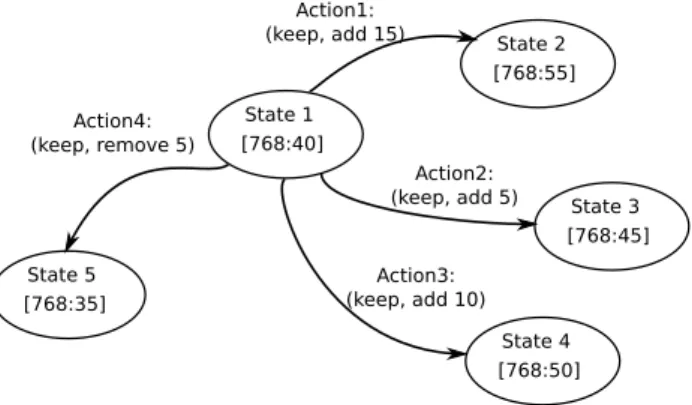
In Chapter 5 we design autonomic resource scaling controller. The controller exploits re-inforcement learning approach. Rere-inforcement learning is a knowledge-free approach for the application performance model identification. It allows to adapt scaling decisions with respect to changing resource demand. Cloud user does not need to define particular model for the application. However, the drawback of RL approaches is a significant learning time. Therefore, auto-scaling systems that use RL have bad performance in early steps. Chapter 5 describes a technique that allows significantly improve the learning time. Typically, the reinforcement learning agent after each action updates only one state-action transition. We observe that in resource allocation problem the agent can learn more from one taken action. Our results show that the controller quickly converges to the optimal resource allocation policy and keeps the application performance within user-specified performance objective.
Chapter 6presents an extension of approach described in previous chapter. One of the chal-lenges of RL based approaches is dealing with state-action space complexity. The space size is determined by the number of parameters that describe resource capacity of the application VM. For multi-tier application we need to include into the state-space model parameters that define each tier capacity, which increase the space size. Large state-space RL model is hard to apply in practice. To address the issue we analyze the impact of individual VM resources on the application performance. The results of the analysis show that memory can be excluded from the application performance control knobs. It allows us to create separate RL models for RAM and CPU. By splitting models we significantly reduce the state-pace complexity.
InChapter 7 we investigate a batch application cluster sizing problem. MapReduce paradigm isde-factostandard for large data analytics, which has an open-source implementation called Hadoop. It offers a simple programming model for parallel computation with fault tolerance guarantees. Some of big public cloud providers adopted it and deliver Hadoop based cloud ser-vices for large data processing. To enable elasticity of MapReduce applications cloud providers split Hadoop cluster into data and compute parts. It allows easily shrink and expand the com-pute part of the cluster. However, to perform cost-efficient resource allocation the user needs manually determine optimal cluster size by running MapReduce job with different cluster sizes.
Chapter 7 presents a technique that finds an optimal cluster size during runtime from the first wave tasks of the job.
InChapter 8 we summarize the content presented in previous chapters and provide our per-spective view on future research directions.
2.1 INTRODUCTION
The number of virtualized datacenters and cloud hosting services is growing. Virtualization rapidly became popular, because it provides resource isolation, system manageability and re-duced operational cost through resource consolidation. Some of data centers operate as a pub-lic cloud services, others are managed as a private enterprise clouds. Cloud computing offers so called ’pay-as-you-go’ model. Cloud users can acquire and release resources on-demand. According the model, users pay for resources they use. Cloud market can be described as a stack consisting of three layers. Users and providers can interact on any of these layers.
Cloud infrastructure level, known as Infrastructure-as-a-Service (IaaS)defines models for monitoring, access and management of datacenter resources such as processing power, stor-age and networking services. IaaS eliminates the need to buy real hardware, users lease resources from a cloud provider. Examples of IaaS are Amazon EC2 [10], Google Cloud En-gine [58], Microsoft Azure [101].
Platform-as-a-Service(PaaS) delivers environments and tools for management of cloud in-frastructure. Users can build and deploy their applications, so they don’t need to consider low level complexities such as configuring and setup of VMs. The examples of PaaS are Amazon Elastic Beanstalk, Google App Engine [57], Microsoft Azure Services [101].
Software-as-a-Service(SaaS) uses web to deliver application to the end user. SaaS moves the task of managing and deploying applications to the third party service. Among the examples of SaaS are Google Apps and storage solutions such as Dropbox.
In this thesis we mostly interested in IaaS level, where the process of virtual resources as-signment takes a place. We consider a case, where cloud user wants to deploy an application. There is a need to answer the following questions. How manyresources to allocate? When
the user needs to trigger scaling? What performance levels can be achieved with allocated amount of resources? Canthe user minimize the cost of running an application in the cloud?
Traditionally applications were provisioned statically. A company bought servers and ran an application on the private infrastructure. The resources available for the application did not change for a long time, until the increased workload reached the limit of the servers’ capacity. As soon as it is happened, the company bought additional servers. Next time, when the limit was reached again, the cluster of servers was extended again. So it was a repetitive process. Cloud computing brought a new philosophy of resource provisioning-elasticity. In the nutshell the term elasticity means that users are able to stretch and contract resources dynamically based on resource demand from the applications they are running. Cloud providers charge users based on the amount of resources they use or reserve. But there is no guarantee with respect to the application performance that can be achieved with the assigned amount of resources.
It is common today that datacenters host a mix of interactive user-oriented and resource in-tensive batch applications [41,143,124,119]. Interactive applications are latency sensitive and should not run under resource pressure. In contrast, batch applications are throughput-oriented and can tolerate resource pressure during runtime. Many applications running in the cloud en-vironment have varying workload. Some variations are easy to predict. For example, promotion campaigns or load during working hours. But there are cases, where it is difficult to make an accurate prediction, such as unplanned load spikes caused by slash-dotting effects. Moreover, the application performance depends on the amount of allocated resources. For example, if we run an application on the server with 2 CPUs, then in ideal case we may expect that our appli-cation will be two times faster, rather than when it runs on a single CPU server. In other words there is a mapping between the resources assigned to the application and its performance. To achieve the desired performance the user has to change resource assignment every time when the workload changes. To perform accurate resource allocation it is required to take a number of steps: predict incoming workload, learn impact of workload on the application resource de-mand and find relationship between application resource assignment and its performance. This
Figure 1:Structure of scaling rule
is a challenging task, especially for the average user, who lacks expertise knowledge about the application.
To simplify resource scaling process cloud providers offer auto-scaling services. The services provide high level resource management interface, while users are responsible to define scaling policy. The policy is described in form of scaling rules. An example of the scaling rule structure presented on figure 1. A rule consists of action, threshold, metric and time delays, which determine when to trigger resource scaling process and how many resources to allocate. The user has to find right metric to track and the threshold value that triggers scaling action. In addition, the rule requires defining the amount of resources to allocate. One or two VMs? Which one is better? The auto-scaling service hides low level complexities from the user such as defining the host to run a VM, IP assignment process and etc. But leaves the user with a set of parameters to determine. It is hard to find a threshold value to achieve desired objective (e.g. minimize cost, maximize performance) without deep understanding of resource scaling process. Therefore there is a need to develop an auto-scaling system that is able to predict workload and perform scaling decisions to maintain desired performance with minimal amount of resources assigned to the application.
Below we outline the list of objectives that the auto-scaling system should fulfill:
• Performance. Cloud user expects certain quality of service delivery from a cloud provider hosting the application. To apply the requirements two parts (user and provider) sign con-tract called Service level agreement (SLA). SLA contains service level objectives (SLO). SLO describes performance that should be delivered by the cloud provider. For example, the application response time should not cross 1 second upper bound or a job should be finished within 10 minutes after the submission.
• Cost. Cloud providers charge users for the time the assigned resource is being used. Therefore to reduce the cost user either needs to minimize the resource usage time or maximize utilization of assigned resources. Otherwise, the user will overpay for underuti-lized resources.
• Utilization. The revenue of a cloud provider depends on the number of customers using the cloud infrastructure. Expanding datacenter is a costly process. Therefore in order to accept more users on a fixed size datacenter the cloud provider should focus on improving utilization of the datacenter computing resources. According to Delimitrou and Kozyrakis [41] modern dataceters utilization levels are around 10−20%. It means that there is a substantial room for the utilization improvement.
In the following sections we cover different aspects of resource scaling in the cloud. The background chapter is divided in to three parts. The first part presents resource scaling types. In the second part we overview cloud applications with respect to resource elasticity. The third part is dedicated to observation of cloud trends with respect to resource allocation. Finally, we summarize the topics discussed in the chapter.
2.2 SCALING TYPES
As it was mentioned above the key property of cloud computing is elasticity - ability to allocate and release resources on demand. The resource allocation in the cloud can be performed in
Figure 2:Summary of the Available Mechanisms for Holistic Application Scalability by Vaquero, Rodero-Merino, and Buyya [138]
different directions and on layers of the cloud stack. Figure2gives an overview of mechanisms available for scaling application in the cloud environment. The scaling actions can be triggered either on IaaS or PaaS levels. IaaS layer gives control over the cloud infrastructure in the form of virtual resources, while PaaS scales the application instances.
PaaS level hides management and scaling complexities from the user. The user does not need to install and configure a full stack of software. PaaS also simplifies the application scaling process. For example, database instances can be replicated to handle more queries. There is no need to worry about correct IP-addresses assignment or proper load-balancing. The new database instance will be added automatically to the database cluster. However, the process of replica management provides weak consistency [138]. Usually updates are not immediately done. There is an assumption that they will be ’eventually’ done in the future. It poses some limitation of how transactions can be treated by developers.
Cloud is a multi-tenant environment, where applications from different users run together. Therefore there is a threat that users may interfere with each other on security or resource levels. To enable isolation some cloud providers such as OpenShift host application instances in the form of containers. The task of the containers is to provide necessary isolation. User applications are isolated with help of SELinux, CGroups, Linux quota and Linux namespaces. Number and size of containers can be easily scaled. However, the user is responsible to define the rules for scaling. The scaling rules are similar to the one presented in figure1. Hence, the user faces the same challenges. PaaS level simplifies the process of the application develop-ment and resource scaling. But one major disadvantage of PaaS is lock-in problem. Users are locked to a certain platform and it is hard to move to another cloud provider. IaaS level gives flexibility in terms of changing cloud provider.
On the infrastructure level the resource management process is done via virtual machine. VM is a primary allocation unit in IaaS. The resource scaling can be implemented in two directions:
horizontally (scaling out/in) or vertically (scaling up/down). The first approach allows to add a new VM with an application server replica inside to distribute load among all running application servers. In contrast, vertical scaling allows resizing the application VM on-the-fly. For example, we can add more virtual CPUs (VCPU) to speed up our application. However, not every OS supports vertical scaling. Moreover, it is challenging task to collocate VMs that support vertical scaling. These are the reasons why only a few cloud provides support vertical scaling. But vertical scaling has a number of advantages over horizontal scaling that will be discussed further.
2.2.1 HORIZONTAL SCALING
Many applications on the cloud run in a distributed fashion. Therefore for these applications it is common when one of server instances joins or leaves the application cluster. For example, we can add more servers to the front-end tier of a web application, so it can serve more client requests. We can keep adding servers if the number of clients continues to increase. In ideal case we are not limited on horizontal scaling. Horizontal scaling allows expanding an application cluster even beyond single cloud provider [27]. Later when the load decreases, we can remove some servers if the remaining ones can provide acceptable performance.
From the first look horizontal scaling is simple. However, there is a number of issues to address. First of all we need a load-balancer that redirects client requests to the front-end servers. From resource provisioning perspective we have an overhead of allocating capacity to the load-balancer. Moreover, we need to run it continuously nevertheless the load is high or low.
Second, we need to perform IP-address management to inform the load balancer about a new application instance. Some of cloud providers such as Amazon offer higher customization level [26] that eliminates the problem. The load balancer is part of cloud provider’s service and automatically routes traffic to a new VM instance. But it is not for free. The user pays for the time the load balancer runs and amount of data passing through it.
Third, horizontal scaling provides coarse-grained resource allocation. Most of cloud providers sell their resources in the form of ’T-shirt’ sized VMs [55], such assmall,mediumandlarge. For example, Amazon EC2smallVM has 1 GB of RAM and 1 CPU, whilethe mediumone has 4 GB and 2 CPU. Assume that our application requires only 2 GB and 1 CPU. Hence, we cannot run it onthe small instance. We need to add 1 GB of RAM. Therefore we startthe mediumone. In this case the application will not utilize 2 remaining GB of RAM and 1 CPU. But the user will pay for all resources assigned to the VM. It is not what the user needs [4]. Users want to pay only for what they actually use.
Forth, adding a new VM is not an instant process. It has some overhead. Multiple authors [47,
8] evaluated horizontal scaling overhead. They found that it takes up to 1 minute to get a VM up and running. Is the value big or small? For the application that has to respond to real client the value is unacceptable. Probably a few people would like to sit in front of the screen and wait for 1 minute until the application they are working on, will respond to their request. It means that we have to take into account the resourceacquisition time. The time it takes to start a new VM and get it ready to serve clients request. Largeacquisitiontime requires triggering scaling process before we reach resource limit of running servers. Probably in example presented in
1we cannot use CPU utilization threshold value equal to 100%. It should be lower. Alterna-tively, there are approaches that reduce horizontal scaling overhead with the help of VM cloning techniques [90,23,107] or VM live migration [31,75,146,147]. VM cloning allows to start a copy of the running VM on another host. In case of live migration a VM is moved to the less overloaded host with the minimal service interruption. However, VM cloning and live migration techniques have an overhead in terms of CPU and network I/O that can affect performance of other VMs.
Some applications do not scale horizontally, because it causes a significant overhead. Rela-tional databases do not support horizontal scaling out-of-the-box. To enable horizontal scaling one would need to partition the database by creating shards. It is a tremendous work to change data scheme of existing database of a company. NoSQL databases natively scale horizontally. But the scaling requires data transfer. For example, before adding a new instance of NoSQL database into production we need to run data re-balancing. The time is takes depends on the size of the data. The need to transfer data puts a limit on applicability of horizontal scaling for database applications. Alternatively, we can apply vertical scaling.
Cloud environment is a multi-tenant environment, where many users share virtual resources. Modern hyper-visors focus on providing guaranteed amount of CPU and RAM for VMs.
How-ever, they do not offer similar guarantees to the disk and network layer. As a result, it creates holes for possible resource stealing attacks [139] due to the lack of isolation for disk and network I/O. For many applications running in a distributed fashion the network plays substantial role in the application performance. Often it becomes a bottleneck. There is a number of attempts to deal with network saturation problems [5] and providing fair network share between user applications [87]. Baldine et al. [18] proposed the idea of Naas (Network as-a-Service) to offer capacity guarantees on the network layer. The approach can be implemented via distributed rate limiting [115], flow control [127] or network slicing techniques [102]. In NaaS the network bandwidth can be dynamically allocated based on the application demand. It is assumed that the users will pay for the actual bandwidth consumption. So far none of the well-known public providers offers performance guarantees for I/O level, either disk or network.
2.2.2 VERTICAL SCALING
Virtualization technology provides an alternative for horizontal scaling. Instead of adding more VMs, we can expand the size of a VM. Modern hyper-visors support memory, CPU and network scaling. We mainly focus on memory and CPU, because cloud providers do not offer dynamic network allocation. Further we describe the technologies used for memory and CPU scaling.
Memory scaling is performed with the help of memory ballooning [145]. The technique is used by hyper-visor to reclaim memory from a guest VM and share it with other VMs running on the same host. For example, a VM may allocate 4GB of RAM and use only half of it. In this case hyper-visor, can provision other VMs with the remaining 2 GB of RAM. The ballooning runs as follows. A balloon module is loaded into guest OS as a kernel service. To reclaim memory from the VM the hyper-visor instructs the module to ’inflate’ by allocating physical pages within the VM. In the same way the balloon ’deflates’ to de-allocate previously reclaimed pages. When the balloon ’inflates’ it raises memory pressure in the guest OS. As a result it triggers memory management algorithms of the guest OS to free up memory. If the VM is low on memory, then some pages may be paged out to the virtual disk. Otherwise, if the guest OS has enough memory it will return free pages.
A VM CPU capacity can be changed in two different ways: by plugging virtual CPU (VCPU) and limiting physical CPU cycles available to the VM. CPU plugging is a technique that allows adding or removing virtual CPU to/from a VM during runtime. Historically CPU hot-plug fea-ture was used to isolate failing CPUs and later on a number of other use cases appeared [54]. Such as clearing work from CPU, improving energy efficiency and resizing guest OS running in virtual environments. Unfortunately, not every OS supports the technique. Linux supports CPU-hotplug starting from version 2.6.5. If CPU-hotplug is supported, then it takes about 150 ms to bring CPU offline and 220 ms to bring it online [110]. It is two orders of magnitude less than adding a new VM in public cloud. If CPU-hotplug is not supported, then one can use a hyper-visor’s virtual CPU limit capabilities.
CPU limit does not require the change of the kernel. It can be applied to any OS. Xen [19] and other hyper-visors offer CPU scaling feature. To describe how the CPU scaling works we use Xen credit scheduler as an example, since Xen is one of widely applied hyper-visors [29]. Each VM VCPU is given a credit, which represents share of physical CPU. The scheduler monitors CPU usage every 10 ms and removes the credits from currently running VCPU. It switches to another VCPU if the current one has no credits left. The credits are given to a VCPU every 30 ms. Hence, if CPU intensive VM runs out of its credits, then it has to wait for 30 ms. The scheduler supports work-conserving(wc) and non-work-conserving (nwc) modes. Inwc mode Xen assigns a weight to each VM. For example, in case of resource contention a VM with weight of 512 will get twice as much CPU as a VM with the weight of 256. However, if one of the VMs is blocked, then the second one can utilize entire CPU. Inwc mode idle CPU cycles distributed among running VMs. Innwc mode each VMs gets cap value. Ifcap is zero, then
VM does not receive any extra CPU cycles. Cap value above zero expresses amount of CPU VM gets innwc mode. Public cloud provides such as Amazon usecapvalue to fix the power of VM VCPU [11]. For example, if a host processor runs at 2GHz and a VMcap value is 50% then the speed of VCPU is 1GHz. nwc mode reduces CPU sharing efficiency, but improves isolation. CPU limit as well as CPU plugging has sub-second range allocation overhead [126]. Existing auto-scaling systems use either CPU plugging or CPU capping techniques to change VM computational capacity.
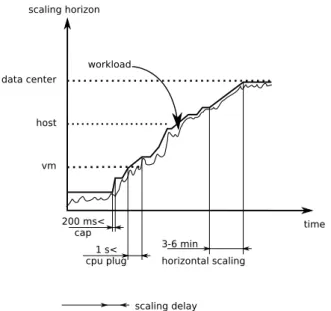
In comparison to horizontal scaling, vertical scaling allows to assign virtual resources in a fine-granular manner. For example, we can choose between adding 512MB RAM or 1 GB. Fig-ure3 shows an example how vertical scaling helps to deal with increasing workload. In [39] authors comparedElasticVMandStaticVMthat run Apache web server.ElasticVMwas allowed get 30% more CPU power thanStaticVM. Authors used step function to increase traffic rate to the VM. Up to 730 seconds both VMs provide same performance for increasing workload. However, after 730 secondsStaticVMreaches its resource limit, whileElasticVMcontinues to expand. On the right hand side graph we see that fully utilizedStaticVMdramatically increases response time, whileElasticVMkeeps response time below SLO bound (20ms). The presented example shows that vertical scaling sustains application performance when the load increases. As it was mentioned above the overhead of horizontal scaling is about 1 minute. Vertical scaling can provide necessary time buffer to freshly started VM. In our example we could start hori-zontal scaling at 730 seconds and continue to scale vertically. For the timeElasticVMreaches it resource limit on the host the new VM on another host will be ready to serve incoming re-quests. Combining horizontal and vertical scaling allows scaling beyond capacity of the host with minimum negative impact on the application performance.
However, vertical scaling is not always possible or it creates challenges when applied in cloud environment. Many applications are not designed with resource elasticity in mind. For exam-ple, some applications have static resource limits parameters. Especially it is true for memory. Java applications have the heap size parameter that limits memory available to JVM. Hence, extending memory capacity of a VM will not affect the Java application running inside the VM. We need to update the heap size limit too. Moreover, scaling down below the heap size may lead to out-of-memory events (OOMs) [143]. Therefore the application should be aware of a resource elasticity. It raises challenge on developing the applications that adapt for expanding and contraction of virtual resources. In [68] authors manually instructed Apache web server to flush used RAM to scale memory down. Salomie et al. [122] addressed the problem of dy-namic memory allocation for the application with statically configured memory. They extended ballooning to a database engine and java runtime, so that memory can be efficiently distributed between virtualized instances. [94] adapted java process heap size based on the execution of previous tasks of MapReduce job. Another challenge is the complexity of scheduling VMs with vertical scaling capabilities. The size of the VM can change at any time, so it becomes difficult to collocate it with other VMs. However, there are approaches [153] that address collocation of VMs with vertical elasticity. In chapter 4 we present an approach to collocate VMs with vertical scaling capabilities.
To summarize, the resource scaling on IaaS level can be performed horizontally or verti-cally. Horizontal scaling uses a VM as resource allocation unit and allows boundlessly scale the application out. However, it comes with substantial overhead for client interactive applica-tions. Hence, the scaling process should be started long enough before the incoming workload reaches the capacity limit of the VM. Some application types such as databases do not support scaling out or they require significant time and network I/O to add new instance (we need to transfer data to the replica). Vertical scaling has lower management complexity. There is no need to assign IP-address or requests redirection. Vertical scaling allows fine-granular tuning of individual VM resources, so the application can be provisioned with only resource it needs. But the scaling horizon is limited by capacity of the host. The process of scaling up/down has an
Figure 3:StaticVM vs ElasticVM: Throughput and response time comparison reported by Dawoud, Takouna, and Meinel [39]
overhead in sub-second ranges, which makes it attractive to deal with sudden workload spikes. However, to take full advantage of vertical scaling and achieve the best application performance the internal parameters of the application should be adapted. The parameters adaptation is out of the scope this work.
2.3 WORKLOADS
A wide range of applications runs on cloud infrastructure. Web applications, batch applications, video streaming services are the examples of common cloud workloads. Each application has its own performance constraints and preferable scaling horizon. Some applications are critical to resource shortage, because it greatly degrades their performance. Others can tolerate the shortage and make a progress even under high resource pressure. Moreover, not every ap-plication can be easily scaled vertically and horizontally. Awareness of the apap-plication type, its performance requirements and resource scaling limits allows the auto-scaling system to make better scaling decisions. Therefore in this section we present classification of applications in the cloud.
There are number of works [41,143,124,119] that analyzed modern datacenters workloads. The datacenters workloads fall into one of the two classes: interactive and batch applications. The first class of the applications often called as latency-sensitive [143] or user-facing interac-tive applications [41]. Interactive applications usually serve real clients overhttpprotocol. The examples are online shops, Google services such Gmail, Google Docs or web search engines. Since interactive applications communicate with real users, it is important to provide human acceptable performance. Usually response time for these applications should be in sub-second range. Violating the requirement can lead to high revenue loss. Amazon reports that every 100 ms of latency can affect the sales by 1%. Another observation from Google [100] states that increase of page load time from 400 milliseconds to 900 milliseconds results in 25% drop of the traffic. It means that clients get disappointed and go to another web site.
Interactive applications run indefinitely. The workload of the application has different pat-terns: daily, weekly, seasonal, bursty. The first three patterns can be easily predicted with high accuracy. We know that clients are more active during daylight time. So it is expected that the application has to serve more requests when people at work, rather than at night, when most of the people sleep. There is also longer period pattern such as difference between working week and weekends. Some e-commerce applications are affected by higher load during special seasons. For example, people tend to buy more during Christmas time. All of these patterns are easy to predict, so one can plan resource provisioning in advance. However, bursty load pre-diction is a challenging task. It characterized by high fluctuation and short duration. The reasons for such load could be different. For example, the release of a new product may attract more
than the expected number of internet users. Or if the news published on a highly popular web-site refer to some less popular one. Then a high fraction of the clients get redirected from the first website and overload the second website. Such situation is called ”slashdotting” effect. To deal with bursty load one could always keep some headroom of resources. However, it is obviously leads to resource wastage, since load spikes are rare. As an alternative one could use reactive scaling. There is no need to allocate resources upfront. But it requires low overhead resource allocation mechanism, to minimize impact on the application performance. Vertical scaling is the best candidate for reactive provisioning. It has a sub-second resource allocation overhead.
Most of interactive web applications have tiered architecture: front-end tier (web server), application tier (business logic) and back-end tier (database). The incoming requests go from tier to tier and come back to the clients with results. Each tier of the application can be scaled separately. But it does not mean that one tier can be scaled in isolation of other tiers. Scaling mechanism should be aware of cluster wide correlation and possible shift of bottlenecks. Clus-ter wide correlation happens when one of the tiers has certain resource shortage that affects resource usage of another tier. For example, CPU saturation of database tier raises memory utilization of the front-end tier. It happens because the database cannot serve fast enough in-coming requests. Hence, it cannot accept connections from the web server. As a result the web server has to enqueue incoming client requests. The bigger queue needs more memory. Horizontal scaling is one of commonly used resource allocation mechanisms for interactive ap-plications. However, horizontal scaling of back-end tier is challenging. The back-end tier is a state-full tier. We cannot just start one additional instance. We need to transfer the data from a running instance to the replica. Moreover, it is desirable to shrink resources when the load decreased. Shutting down one of database instances requires special treatment, otherwise the data will be lost. For this reasons most of existing auto-scaling systems [63,82] leave it over-provisioned and don’t scale it. One can argue that there are number of distributed key-value stores which can be easily scaled out and scaled in. Unfortunately, most of e-commerce systems use traditional relation databases, which don’t scale horizontally. To enable horizontal scaling one would need to build sharding logic into relational database, which introduces com-plexity and limits ability to use the relational features of the database. A good alternative is vertical scaling. It eliminates the need for data replication. We can easily grow and contract a VM running database instance.
Batch applications consist of resource intensive jobs, which can start and stop at any point of time. These applications usually perform data-analytics tasks to solve scientific problems, crawl internet and create different types of reports. Large body of data analytic platforms use MapReduce computational model [40]. Hadoop is one of popular implementations of MapRe-duce paradigm. A number of companies use it in a production [16]. SLO objectives of these types of applications are described in the form of job execution deadline. Batch job consists of a number of tasks that can run simultaneously. Therefore resource allocation process of batch applications is performed in the form of task scheduling. The scheduler decides how many tasks to launch in parallel to meet the deadline. It means that the scheduler performs horizontal scaling. The task usually runs in a container, which limits resources such CPU and RAM available to the task. Batch applications also support vertical scaling. To improve task runtime Li et al. [94] adapted the container size based on previous tasks execution. Batch jobs are tolerant to performance slowdown and could run under high resource pressure. Hence, in contrast to interactive applications batch applications do not require immediate reaction to re-source under-provisioning. Moreover, in case of rere-source shortage on the host one could apply admission control via task termination and relaunch the terminated task later [30,32]. These jobs are designed with fault tolerance in mind and termination of one the tasks does not kill the application.
resources: memory, I/O, CPU. Therefore, a lot of research has been done to deal with various resource bottlenecks. Over the past decade disk locality was the main focus in resource usage optimization [156,14] for batch applications. The motivation for disk locality is based on two facts [13]. First, disk bandwidth exceeds network performance. Second, disk I/O has substan-tial contribution to overall task execution time. Nowadays the focus shifts from disk locality to network. It was observed that network reads performance is comparable to the disk reads [72]. Batch jobs can create a huge traffic across the cloud. It can affect performance of other applica-tions sharing cloud infrastructure with them. Hence, the auto-scaling system should consider, not only resources resided on a host, but also pressure on the networking infrastructure [6,
128,36].
One of the main goals of cloud provider is minimize energy costs related with cloud infras-tructure. For cloud provider it is difficult to expand infrastructure, because power source with desired capacity may not be available nearby. Hence, cloud provider needs to push datacenter to higher utilization levels. Current state of utilization levels far away from ideal. It is about 10−20% for the industry [41, 143]. One of the reasons is that datacenter owners sacrifice utilization for latency sensitive applications. These applications run on dedicated servers in isolation from batch applications. In isolation latency sensitive applications achieve high perfor-mance even during peak demands and sudden load spikes. The modern trend is to collocate both application types and raise utilization of the datacenter [32, 143, 41]. The desired per-formance of latency intensive application is achieved with help of prioritization [41, 143] and vertical scaling [153].
To summarize, cloud runs a wide range of workloads. Cloud applications can be classified in two groups: batch and interactive applications. The first group contains resource intensive jobs that partitioned into tasks. The jobs can tolerate significant wait time. The scaling of the applications implemented in the form of scheduling, where the scheduler based on available cluster capacity decides how many tasks of each job to run. In contrast, the second group consists of applications that are highly sensitive to performance slowdown, because they serve real clients. Even a short delay can cause high revenue loss. Interactive applications consist of tiers. Hence, the auto-scaling system should orchestrate resource scaling across all tiers to avoid shift of resource bottlenecks.
2.4 CLOUD TRENDS
Most of IaaS cloud providers sell virtual resources in the form of fixed bundles such as VMs. The bundles have predefined amount of CPU power, memory and storage size. Providers charge users for the time the resource bundle being used. The users usually charged for VM usage in a hour granularity. Agmon Ben-Yehuda et al. [4] analyzed development of the cloud market and observe number of trends that drive cloud market toward fine-granular resource allocation, seconds range billing cycles, proper resource pricing and service level differentiation.
Billing periods Years before cloud computing has emerged, the time for which physical server was used counted in years. The appearance of web hosting changed the situation. Clients were able to rent servers on a monthly basis. In 2006 Amazon introduced elastic com-pute cloud (EC2), which dropped rental granularity from months to hours. So the cloud users were allowed to rent servers for hours and shutdown unused ones. Hence, the users paid only for resources being utilized.
The renting of VMs for shorter periods is driven by economic incentives, which push users to perform optimizations in order to reduce resource wastage. For example, if an instance runs for half an hour, then user has to pay for full hour. It means that the user overpays for half an hour. However, if half second runtime of a VM was billed as full second, then the user overpays only half a second. Smaller billing cycles reduce user’s overpay costs.
The trend of shrinking billing cycles is already in the cloud market. In 2009 Amazon announced
spot-instances, which price changes every 5 minutes [2]. Later on in 2010 a new cloud provider CloudSigma [33] announced 5 minute billing cycles. Then in 2012 GridSpot [59] and Profit-Bricks [113] appeared in the market and offered 3 and 1 minute billing cycles, respectively. In 2013 Google Cloud Engine started to charge by 1 minute. The trend of shrinking resource billing cycles runs parallel to telephony billing cycles. In the past telephony billing cycles shrank to seconds. Therefore, there is an expectation that cloud providers continue to move towards second billing cycles.
Resource granularitySelling fixed bundles is common for the most of IaaS providers. Cloud providers have different names for the bundles. For example, Google Compute cloud calls them ’machines type’, Amazon and RackSpace call ’instance type’, GoGrid calls ’server sizes’. Cloud providers use fixed bundles to keep a connection between virtual resources and real hardware. So the user can find virtual machine that is equal to a server running in private infras-tructure. From 2012 the model of fixed bundles begins to change. In 2012 Amazon announced Elastic Block Storage service that allows users to modify I/O resources for already running instances. Freshly started cloud providers such as CloudSigma(2010), ProfitBricks(2012) and GridSpot(2012) announced flexible bundles model. Users can specify the amount of resources they need. It is similar to buying server in computer shop, where the customer decides how much RAM, CPU and hard disks put into a server.
Users are not motivated to buy fixed size VMs. The workload of many applications is not constant. It changes over the time. Hence, the VMs are not fully utilized every moment of the time. Moreover, the workload may change from CPU intensive to memory intensive, which would require changing type of the VM. Hence, the model of flexible bundles enables follow-ing the workload dynamics and optimizfollow-ing resource usage. The dynamic fine-granular resource allocation from one side leaves space for optimization; from another side it increases the com-plexity of resource management. The user would need automating tools that are able to allo-cate resources according to the price of the resources, the application workload and the user’s objectives in terms of cost and performance goals.
Resource pricing Multiple VMs running on the same host with a help of virtulization tech-nique can successfully share CPU and memory resources. However, the sharing of network and disk I/O is more challenging. It was observed [17,139] that performance of VMs can greatly vary due to interference and bottlenecks created by collocated VMs. It means that there is a difference between what user rents and what cloud provider delivers. To solve the issue re-searchers proposed to sell the performance instead of resources [109,136,106]. The approach is easy to implement on the levels such SaaS and PaaS, where application performance can be well defined and cloud provider has full visibility of the user’s application. However, on IaaS level cloud provider and the user are separated entities. The provider does not know what kind of application the user runs and what performance levels are desired. Moreover, the user could lie to the provider about the application performance to get more resources [3]. In order to as-sure the application performance cloud provider could offer resources in the form of guaranteed time of resources. For example, in 2014 Amazon launched burstable T2 instances and general purpose SSD (GP2). Each VM has certain guaranteed CPU minutes per hour. It means that VM gets guaranteed baseline CPU speed for these minutes. Moreover, according to the model the user can earn credits when a VM is idling (1 credit - 1 guaranteed CPU time). Later when the load burst occurs the VM gets guaranteed CPU cycles. Such model allows users to get VMs for lower price and make sure, that it will provide the best performance during high load spikes.
Service levels Instant resource demand from the users can exceed cloud provider’s data-center capacity. However, the users have different performance objectives. Some users have strict performance requirements, others are more flexible. Therefore, to be able to accept re-source requests from all users cloud provider later during runtme can preempt or slowdown applications of flexible users for the sake of strict ones. In 2009 Amazon introducedReserved
instancesand Spot instances. Reserved instancesare high priority level VMs. Spot instances
are low-priority level VMs that usually have significantly lower price in comparison toreserved instances. By prioritizing VM instances a provider can offer elasticity and availability to high pri-ority users for the cost of degrading low pripri-ority users. However, cloud provider can also offer spare resources to low-priority users if high-priority users don’t utilize acquired capacity. Both sides of the cloud market can benefit from the service differentiation. Cloud providers have opportunity to better utilize the infrastructure by offering residual resources in the form of low-priority VMs. Cloud users can choose low-priority level that reflects their budget and the application performance constrains. For example, users with smaller budget can enter cloud by using low priority VM.
We gave an overview of trends in the cloud market. There is evidence that cloud providers’ re-source rental model moves from coarse-grained toward fine-granular rere-source allocation. More-over, cloud providers billing periods in the near future are going drop to the seconds range. Till now the shift from hours to minutes was already observed. Smaller billing periods together with fine-granular resource allocation increase the complexity of resource allocation in comparison to fixed size VM assignment. The new model would require development of auto-scaling systems that are able to find optimal decision with respect to workload dynamics and flexible resource bundles model offered by the cloud environment. The users of the cloud are diverse in terms of budget and the application performance constrains. Therefore cloud providers would benefit if they offer resources under different service levels. Such approach opens access to the cloud for the users with smaller budget and offer guaranteed performance for high priority users. In this circumstances the role of vertical scaling increases. Instead of migrating VM during peak load, it allows with low overhead upscale one user VM by taking resources from neighboring VM of another user.
2.5 SUMMARY
We started with an overview of cloud market and presented the problem of dynamic resource allocation. Then we looked into resource scaling types: described horizontal and vertical scaling. We discussed overheads and applicability of each of the types. We also pointed out that to achieve the best performance out of allocated amount of resources one needs to adapt the application parameters too.
Later we analyzed applications running in the cloud environment. Cloud applications can be classified in two types: interactive and batch applications. Interactive applications are latency sensitive and require either some resource over-provisioning or low overhead reactive scaling to keep the latency low. Batch applications usually run resource intensive workloads and can tolerate performance slowdown. Resource allocation for batch applications is usually defined as a scheduling. The goal of the scheduling is to meet certain job execution deadline. The workload of the both application types can change during runtime. It can vary during day, week, etc. Some of the workload patterns are hard to predict, such as load spikes caused by ’slashdotting’ effects. In this case we can apply vertical scaling that has low resource allocation overhead. Moreover, the workloads can change from being CPU-intensive to memory-intensive.
Finally we provide survey of cloud market trends. The major outcome is that resource rental model moves from fixed bundles to flexible bundles, where cloud user can dynamically change individual resource assignment. However, fine granular resource allocation increases the com-plexity of capacity management process. Hence, there is a need for auto-scaling systems that can provide optimal scaling decision from the large number of possible allocation schemes. Another trend is service differentiation. By offering different service levels cloud providers can better utilize own infrastructure and lower barrier of entry for small companies.
3.1 INTRODUCTION
The goal of auto-scaling system is allocate resources to effectively handle dynamic workload changes, while providing guaranteed application performance with respect to SLO. Resource auto-scaling is a complex process that requires taking a set of steps. First, one needs to monitor workload, application status and resource usage. Second, to make a decision about resource provisioning it is necessary to analyze monitored data. Third, as soon as decision about re-source allocation has been made, we need to plan how many rere-sources to allocate. To perform optimal resource scaling decisions the accurate model of relationships between the application performance, input workload and the amount of allocated resources should be identified. The questions arewhen and how to identify the relationships. The final step of auto-scaling pro-cess is allocating the estimated amount of resources. In section3.2we describe auto-scaling process phases in details. Then in section 3.3we present system identification approaches and discuss pros and cons of each the approaches. The relationships can be described us-ing a wide range of techniques. Among the literature we review the techniques applied in auto-scaling systems fall into following categories: threshold based techniques, reinforcement learning, techniques that use control and queuing theories, and techniques that based on time series analysis. We present an overview of these techniques and related work in section3.4.
3.2 AUTO-SCALING PROCESS
The process of auto-scaling has a set of phases and can be described as MAPE loop [49,77], where M stands for monitoring, A - analyzing, P - planning and E - execution. The collecting of information about resource utilization, input workload and the application status is a part of monitoring phase. Analyzing phase uses monitoring data to determine current state of the appli-cation and estimate the need to perform scaling action. In planning phase auto-scaling system decides what action to take. The system needs to find tradeoff between cost of resources and satisfying user-defined SLO. Finally, in the execution phase via API call of underlying platform the actual resource allocation action is performed. The auto-scaling system has four compo-nents (monitor, analyzer, planner, executor) that involved in each of the phases.
Themonitoringis essential part of auto-scaling system. It provides measurements about re-source consumption, the application health status and its performance with regard to objectives defined in SLA. The list of monitored metrics consists of CPU, memory, network, disk utiliza-tion, response time, throughput,request rate job progress and etc. Some works [126,108] use CPU as the application performance indicator. However, better performance control is achieved if direct metrics such as response time included into monitored metrics set [85]. The quality of scaling decision also depends on the delivery of up-to-date monitoring data. To monitor ap-plications researchers apply sampling intervals from seconds to minutes. Emeakaroha et al. [49] evaluated the impact of monitoring interval size on the web application SLA violation rate. They use 0.15$ as a measurement cost and 0.30$ as a cost of missing violation. 5 seconds measurement interval was set as baseline that detects all SLA violations. Figure1 presents results of the evaluation. The graph shows that the cost of missing SLA violation significantly increases if the monitored data updates delayed. Hence, monitoring component should be in sync with the application it monitors. Most of cloud providers offer monitoring services on IaaS level [26,1]. However, provider services are not always exposing all necessary information. It is common that the user needs implement own monitoring agents to collect the application specific data.
The analyzerprocesses monitoring data to analyze application status and resources utiliza-tion. It triggers planning phase if the SLA violations or significant changes in workload charac-teristics are detected or predicted. Auto-scaling system is considered isreactiveif it responds only on the current state of the application. It means that the planner will scale assigned
re-Figure 1:Impact of monitoring interval
sources when SLA violation is already happened. Resource allocation is not an instant process. It has some overhead [52]. For example, adding one VM requires up to 1 minute [47]. Hence, it is important to trigger the planner with some anticipation. The system that anticipates future resource demand is calledpredictive. Predictive scaling provisions the application in advance to deal with fluctuating workloads. Most of works presented in3.4use time series technique to analyze the monitoring data.
Theexecutorperforms actual resource allocation: add/remove VMs, resize capacity of run-ning VM or even migrate VMs. The allocation actions performed over API offered by cloud provider. If the application deployment runs on private cloud, then API of cloud management framework is used. For example, CloudSigma provider offers REST interface to dynamically resize VM. As we stated earlier in section 2.2 actual resource allocation process has some overhead. Therefore scaling overhead should be part of the planner’s resource assignment algorithm to prevent the application performance degradation during resource assignment.
Theplannercomponent is a core of auto-scaling system. It contains a system model which describes relationship between the application performance and its resource demand. The model can be fixed during design time or the planner can adapt it during runtime. As soon as the information about current or predicted state of the system is known, the planner has to make a decision about resource assignment. For example, VM can be removed from application cluster if the observed application utilization is low. However, the assigned capacity should guarantee desired application performance. As we stated earlier in section 2.3 the workload of many applications constantly changes. Therefore the planner should also include input workload into the system model. In section3.4 we will cover auto-scaling techniques and algorithms that compose the core of the planner.
3.3 SYSTEM IDENTIFICATION
The resource scaling policy is applicable only if the model of controlled application is well inves-tigated. Therefore to develop resource scaling system, first we have to understand the quan-titative relationships between the application performance and its resource usage. To build a model (or identify system) we need a profiling environment. The environment can be fully isolated from the application running in production mode(offline modeling), build on top of pro-duction environment (sand-boxing) or the application running in propro-duction mode can be profiled during runtime (online modeling). Each of the approaches has strong and weak sides. One can choose the approach based on optimization goals.
Many auto-scaling systems [43,108,67] use fixed models that obtainedofflineand do not change during runtime. To discover the model authors of the systems take empirical approach
and run set of tests against the application that will be later put into production. The goal of the tests is find and tune essential application and scaling policy parameters. The approach provides high accuracy, since it easy to repeat the experiments, compare results with previous runs and tune the model parameters. However, any changes of the application such as updates or unseen workloads would require going offline again and running tuning experiments again. Moreover, in some cases it is difficult replay real workload. There is a need for approach that builds the system model during runtime.
Sand-boxing [159, 140, 41,143] eliminates the problem of offline system modeling. The idea is to build a small clone of the application production environment and redirect live workload to the sand-box. The overhead of profiling the application and adapting scaling policy can be greatly improved. Delimitrou and Kozyrakis [41] claim that it requires about 5 minutes to obtain a new profile. Experiments with the sand-box do not affect performance of the application in production mode, since the ’sand-box’ isolated from the application running in production mode. However, the approach has some overhead in terms of infrastructure for the ’sand-box’ and its management. First, the complexity of building sand-boxing environment is high. One has to provide application specific implementation to redirect live workload data. Second, it requires dedicated hardware for testing scaling policy. Applications hosted on the cloud can be very different by nature. Hence, it is hard to build generic ’sand-box’ for all applications. It can be only application specific, which also stated by authors in [41] .
In theonlinesystem identification approach the application runs on the cloud without main-tenance delays and the scaling policy immediately adapts to the application resource demand. Machine learning techniques [118] and statistical analysis [22] among the tools applied in for the approach. The strong side of the approach is that it does not require upfront knowledge about the system model. The resource scaling policy is obtained by observing the reactions of the application on resource assignment actions. However, it requires careful change of resource entitlements, because the actions applied to the life system. The time to obtain initial policy can be significant, because one needs to collect enough observations to train the model. But there are approaches that address the issue [154,20].
To summarize, we can use different system identification approaches. Testing allocation pol-icy offline gives the freedom of experiments. However, we cannot catch all real world com-plexities. Sand-boxing brings the testing environment closer to the real cloud environment. So we can evaluate scaling policy on a live workload data. But the approach has overhead of build-ing the sand-box. Moreover, we would need to adapt the sand-box for every application we want to dynamically provision. Evaluating scaling policy of the application running in production mode eliminates the drawbacks of two previous approaches. However, it adds the challenges to the system identification process. Because adapting scaling policy online could impact per-formance of the application. The process of system identification should be less visible to the application client. Otherwise, bad experience with application would motivate clients to move to other services [100].
3.4 AUTO-SCALING TECHNIQUES
The goal of auto-scaling technique is determine the relationships between application perfor-mance and assigned capacity. The techniques that used to model the relationship can be di-vided into five categories: threshold based, reinforcement learning, control theory, queuing theory and time series. Threshold based, control theory and queuing theory are offline system identification approaches. The model is obtained analytically or empirically over a set of offline experiments. And the model does not change lifetime of the application. Some control theoret-ical approaches can perform online system adaptation. But, the initial model is obtained offline. Auto-scaling systems that exploit reinforcement learning and time series can be used for online system identification. However, both techniques require significant time to obtain initial policy.
1: ifx>thUpthen
2: add y
3: wait for inUp min.
4: end if
5: ifx<thDownthen
6: remove y
7: wait for inDown min.
8: end if
Algorithm 1:Scaling up/out and scaling down/in rules
But there are works [56, 126, 116, 154, 20, 152] that address the issue. In this chapter we describe each technique and present related works.
3.4.1 THRESHOLD BASED SCALING
Many cloud providers offer auto-scaling services that exploit threshold based scaling. The pop-ularity of the technique is explained by its simplicity. It is easy to understand for average cloud user. However, to design a good scaling policy the user is required to have deep understanding of the application, its workloads and experience with provider’s infrastructure.
Threshold based techniques use rules to describe scaling policy. The rules define amount resources to allocate/de-allocate such as number of VMs, CPU or RAM. The rules can be di-vided in two sets: scaling up/out or scaling down/in. Algorithm1shows examples of the rules presented in two columns. The left side column describes allocation (scale up/out) rule and the right side column shows de-allocation (scale down/in) rule.
The rules consist of two parts: condition and action. The lines1and 5 are conditions of the rule. Usually the condition contains the metricx and its thresholdthUp. The condition can be also complex and contain more metricsx1, x2, .., xnand thresholds thUp1, thUp2, .., thUpn. It
is common to use CPU utilization [26, 85, 63, 64] and response time [85, 74] in conditions. The second part is action. In our example actions presented in lines 2 and 6. For horizontal scaling the action is defined as a number of VMs to add or remove. In case of vertical scaling individual resources such as CPU, RAM is described in the action. After the action is triggered the controlled application requires some time to reach steady state, therefore the rules have ’grace’ period between scaling actions: inUpandinDown. This is the time, when no action is executed even if the conditions are met.
Usually threshold based rules contain only two rules per metric: one for extension and one for compaction. Hasan et al. [64] extended the rules. In addition to the upper and lower thresholds they added intermediate upperThrbU and the lower ThroLthresholds. The former is slightly below the upper threshold and the latter slightly above the lower threshold. The authors also added two duration parameters. The main goal of extending the rule is to catch the trend of measured metric. However, the question about how to determine ’good’ threshold values remains open.
The quality of resource scaling algorithm greatly depends on the metric used to trigger scaling action. In [26,85] authors compared utilization-based and latency-based rules. For utilization based rules they applied CPU utilization, while for the second approach average response time was used to trigger scaling actions. The results from both rules show that applying direct application performance metrics such response time allows to save resources in comparison to utilization based rules. The application running under resource pressure still can achieve desired performance goal.
Most of threshold based auto-scaling systems operate in a reactive way by executing scaling action after the threshold is met. Casalicchio and Silvestri [26] added one step ahead arrival rate prediction mechanism to the threshold based scaling. The evaluation results show that the
![Figure 2: Summary of the Available Mechanisms for Holistic Application Scalability by Vaquero, Rodero-Merino, and Buyya [138]](https://thumb-us.123doks.com/thumbv2/123dok_us/9311756.2809820/21.892.98.730.98.362/figure-summary-available-mechanisms-holistic-application-scalability-vaquero.webp)
![Figure 3: StaticVM vs ElasticVM: Throughput and response time comparison reported by Dawoud, Takouna, and Meinel [39]](https://thumb-us.123doks.com/thumbv2/123dok_us/9311756.2809820/25.892.89.766.87.304/figure-staticvm-elasticvm-throughput-response-comparison-reported-takouna.webp)

![Figure 3: Queuing model from [93] Figure 4: Queuing network from [53]](https://thumb-us.123doks.com/thumbv2/123dok_us/9311756.2809820/43.892.133.719.91.251/figure-queuing-model-from-figure-queuing-network-from.webp)