Multilingual Distributed Word
Representation Using Deeplearning
A thesis submitted to the
Graduate School of Natural and Applied Sciences
by
Gihad Sohsah
in partial fulllment for the degree of Master of Science
in
He who does not know how to look back at where he came from will never get to his destination.
Multilingual Distributed Word Representation Using Deeplearning
Gihad Sohsah
Abstract
In this work, the problem of extracting meaningful multilingual word embeddings is studied with special focus on morphologically-rich languages. In order to achieve mul-tilingualism, a data-driven method that makes use of a sentence-aligned parallel corpus is used. This method is expanded hierarchically to take account for the words parts, tokens or morphemes, rather than just considering the raw words as the basic language units. Also various architectures and aggregation functions for constructing word and sentences embeddings given their parts are studied and compared. The aggregation func-tion for a specic funcfunc-tion is chosen according to the nature of the particular language. To evaluate the dierent methods, one sanity check test is used and two more tests are used to evaluate the quality of the resulting representations. The sanity check which is mainly used to make sure that the models are learning anything from the corpus and is also used for the parameter tuning, is the paraphrase test. The second test, t-SNE, is a visual test that just gives insights about the model's ability to bring semantically equiv-alent words and sentences close to each other in the space. The third test, that gives the most meaningful measure, is the cross-lingual document classication task. The (CLDC) task is concerned with training a supervised classier using documents from one language, the rich-resources language, and testing it using another language, the low-resources one, while maintaining a satisfying performance. The performances of the models are described in terms of the F1-score. As the experiments have shown, a multi-lingual framework for extracting word-embeddings jointly for both English and Turkish that uses additive functions at both sentences and words level results the best result in terms of the F1-score achieved in the (CLDC) task. Various data preprocessing methods are also studied, the words can be either extracted by simply dividing the sentences using the space as a delimiter, using a tokenizer, or using a morphological analyzer in the case of the morphologically-rich languages. The experiments showed that using the raw data format for English and the morphemes as the basic language unit for Turkish yields the best results.
Keywords: Natural Language Processing, Deeplearning, Neural Networks, Morphologically-rich languages, Turkish NLP Natural Language Processing, Lan-guage Model, Deeplearning, Neural Networks, Multilingual, Word Embeddings
Derin ö§renme ile çok dilli, da§tlm³ kelime temsilleri
Gihad Sohsah
Öz
Bu çal³mada manal çok dilli temsillerin çkarlmas problemi morfolojik olarak zen-gin dillere odakla incelenmi³tir. Çok dillili§i sa§lamak için cümle olarak e³le³tirilmi³ metinleri kullanan veri tabanl bir metot kullanlm³tr. Bu metot sadece yaln kelimeleri de§il, hiyerar³ik olarak kelime parçalar, ekleri ve di§er morphemeleri dikkate alacak ³ekilde hiyerar³ik olarak geli³tirilmi³tir. Ayrca, parçalarndan kelime ve cümle temsilleri olu³turmak için farkl mimari ve birle³tirme fonksiyonlar incelenmi³ ve kar³la³trlm³tr. Bir dilin birle³tirme fonksiyonu o dilin özelliklerine göre seçilmi³tir. Farkl metotlar kar³la³trmak ve temsillerin amaca uygunlu§unu belirlemek için, biri hzl kontrol amaçl olmak üzere üç test kullanlm³tr. Hzl kontrol için olu³turulan paraphrase testi hem metinlerden ö§renme olup olmad§n kontrol etmek, hem de parametreleri belirlemek için kullanlm³tr. kinci test, t-SNE, modelin birbirine e³it kelime ve cümleleri bir araya getirmesinin görsel bir testdir. En anlaml sonucu veren üçüncü test bir diller aras dökü-man snandrma (CLDC) testidir. Bu test çok kaynak bulunan bir dilde e§itilen göze-timli ö§renme snandrcnn az kaynak bulunan bir dilde performans kayb olmadan test edilmesiyle ilgilidir. Modellerin performans recall ve precision' göz önünde bulunduran bir ölçü olan F1-skoru ile açklanmaktadr. Bu çal³mada kelime temsilleri kullanlarak ngilizce gibi çok kaynakl bir dilden, Türkçe gibi az kaynakl bir dile bilgi aktarlmas ve ngilizce üzerinde e§itilen modellerin Türkçe dökümanlarn snandrlmasnda yeterli performans sa§lamasna odaklanlm³tr. Bu test de, averaged-perceptron snandrcs TED-Corpus kullanlarak e§itilmektedir. Bu snandrc e§itildikten sonra bir dökü-man tesmiline göre 14 snftan birine atamaldr. Bu döküdökü-man temsili bütün kelimelerin temsillerini ekleyerek olu³turulmaktadr. Averaged perceptron iki sn bir snandrc oldu§undan one-vs-all tekni§i kullanlarak bu snandrc 14 sn bir snandrcya dönü³türülmü³tür. Deneylere göre, kelime temsillerini Türkçe ve ngilizce için ortak çkaran ve toplama kompozisyon fonksiyonlarn kullanan çok dilli yöntem, hem kelime hem cümle seviyesinde CLDC F1 skoru olarak en iyi sonuçlar vermi³tir. Farkl veri i³leme yöntemleri incelenmi³tir. Cümleler bir tokenizer kullanarak bo³luklar ile kelimelere yada zengin morfolojisi olan diller için bir morfolojik inceleyici kullanlarak morphemelerine ayrlabilir. Deney sonuçlarna göre ngilizce'de kelimeleri, Türkçe'de morphemeleri kul-lanmak en iyi sonuçlar vermi³tir.
Anahtar Sözcükler: Do§al dil ³leme, derin ö§renme, sinir a§lar, Zengin mor-folojisi olan diller, Türkçe do§al dil i³leme Mühendislik, Deneysel Psikoloji
To my father, Nageeb Sohsah, who would have been proud . . .
Acknowledgments
Firstly, I would like to express my sincere gratitude to my advisor Prof. Onur Güzey for the continuous support during my journey as a student at ehir University. All thanks are due to him . . . for his patience, motivation, and knowledge. Without his guidance I would not have made it to this point. He has been a great mentor as the great mentor should be!
I would also like to thank the rest of my thesis committee: not only for their insightful comments and encouragement, but also for the hard questions which incented me to widen my research from various perspectives.
I thank my fellow labmates in for the stimulating discussions, for being a great company during the sleepless nights in the lab. Also I thank my friends for being there whenever I needed support. Last but certainly not least, I would like to thank my family: my parents, my brother and little sister for supporting me spiritually throughout my entire life.
Contents
Abstract iv
Öz v
Acknowledgments vii
List of Figures x
List of Tables xii
1 Background 1
1.1 Introduction . . . 1
1.2 Dimensionality Reduction Methods . . . 1
1.2.1 Word co-occurrence matrix . . . 1
1.2.1.1 Principal Component Analysis . . . 2
1.2.1.2 Pointwise Mutual Information Matrix . . . 3
1.2.1.3 Skip-Gram with Negative Sampling . . . 3
1.3 Neural Networks Methods . . . 4
1.3.1 SENNA embeddings . . . 4 1.3.2 Turian embeddings . . . 5 1.3.3 HLBL embeddings . . . 6 1.3.4 Huang's embeddings . . . 6 1.3.5 Word2vec . . . 7 1.3.6 Polyglot . . . 7
1.4 Cross Lingual Models . . . 8
1.4.1 Klementiev et al. embeddings . . . 8
1.4.1.1 Multitask Learning . . . 9
1.4.1.2 The Neural Network Model . . . 9
1.4.2 Karl Moritz Hermann and Phil Blunsom embeddings . . . 10
1.5 Problem Denition . . . 12
1.5.1 Available methods for tackling the proposed issues . . . 12
1.5.1.1 Using Simple Additive Function . . . 13
1.5.1.2 Using Recurrent Neural Network . . . 13
2 Proposed Method 15 2.1 Introduction . . . 15
2.2 Proposed Framework . . . 15
Contents ix
3 Experiments and Results 19
3.1 Introduction . . . 19
3.1.1 Experimental Setting . . . 19
3.1.1.1 Choosing the composition function . . . 19
3.1.1.2 Data preprocessing . . . 20
3.1.1.3 Training and Parameter Tuning . . . 21
3.1.1.4 The Paraphrase Test . . . 22
3.1.1.5 The CLDC Test . . . 22
3.1.1.6 Hardware and Software . . . 23
3.1.2 Experimental Results . . . 23
3.1.2.1 Extracting the Embeddings . . . 24
3.1.2.2 Evaluating the quality of the embeddings . . . 24
4 Conclusion 37 4.1 Introduction . . . 37
4.2 Conclusion . . . 37
List of Figures
1.1 The neural network architecture proposed by Collobert and Weston [8] for extracting word embeddings using a xed-sized window. The same architecture was also exploited by Turian et al. [23] with few dierences in the experimental settings. . . 5 1.2 The architecture proposed by Huang et al. [12] for extracting word
em-beddings using both local and global contexts to capture the multiple meanings of the same word by learning from the global context i.e. doc-ument words. The model uses the same archiecture proposed by Turian et al. [23]. . . 7 1.3 The architecture proposed by Bengio et al. [3] for extracting word
embed-dings using n−gram sequences. A similar architecture is used by Kle-mentiev et al. [13] to train multiple models for multiple languages jointly using MTL descriped in section . . . 10 1.4 The bilingual architecture proposed by Hermann and Blunsom [11] for
extracting word embeddings leveraging parallel corpora. . . 11 1.5 The layered architecture proposed by Smith and Eisner [22] that utilizes
RNN to build word embeddings from morphemes embeddings. . . 14 2.1 English-Turkish framework for extracting word embeddings . . . 17 3.1 t-SNE visualization of animals names in Turkish and English using word
embeddings extracted by the 6-gram tanh model using tokenization as a preprocessing method . . . 25 3.2 t-SNE visualization of numbers in Turkish and English using word
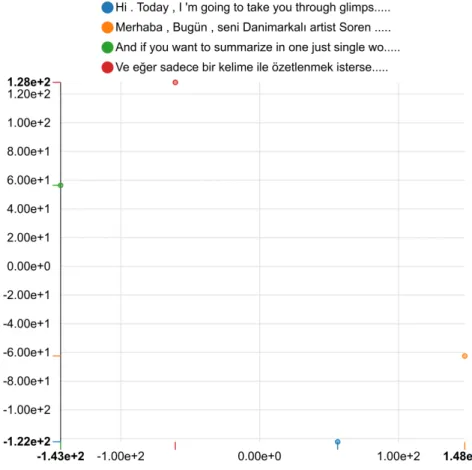
em-beddings extracted by the 6-gram tanh model using tokenization as a preprocessing method . . . 26 3.3 t-SNE visualization of sentences in Turkish and English using word
em-beddings extracted by the 6-gram tanh model using tokenization as a preprocessing method . . . 27 3.4 t-SNE visualization of animals names in Turkish and English using word
embeddings extracted by the 6-gram tanh model using raw words . . . 28 3.5 t-SNE visualization of numbers in Turkish and English using word
em-beddings extracted by the 6-gram tanh model using raw words . . . 29 3.6 t-SNE visualization of sentences in Turkish and English using word
em-beddings extracted by the 6-gram tanh model using raw words . . . 30 3.7 t-SNE visualization of animals names in Turkish and English using word
embeddings extracted by the additive model using raw words . . . 31 3.8 t-SNE visualization of numbers in Turkish and English using word
em-beddings extracted by the additive model using raw words . . . 32
List of Figures xi 3.9 t-SNE visualization of sentences in Turkish and English using word
em-beddings extracted by additive model using raw words . . . 33 3.10 t-SNE visualization of animals names in Turkish and English using word
embeddings extracted by the additive model using tokenization as a pre-processing method . . . 34 3.11 t-SNE visualization of numbers in Turkish and English using word
em-beddings extracted by the additive model using tokenization as a prepro-cessing method . . . 35 3.12 t-SNE visualization of sentences in Turkish and English using word
em-beddings extracted by the additive model using tokenization as a prepro-cessing method . . . 36
List of Tables
3.1 The paraphrase test results for each type of models studied in this work according to the data preprocessing scheme using add function as a com-position function. . . 24 3.2 The paraphrase test results for each type of models studied in this work
according to the data preprocessing scheme using n-gram tanh function as a composition function. . . 24 3.3 F1-scores obtained by training four models using four types of embeddings.
The language of the training set is English while the language for the test set is Turkish. . . 25
Chapter 1
Background
1.1 Introduction
Distributed word representation, also known as word embedding, is a set language mod-elling and feature representation techniques for various natural language processing tasks. They also can be dened as a set of low-dimensional vector space where each vector rep-resents a word and the dimensions are the potential features to describe the semantic and syntactic properties of the word. It is a low-dimensional space compared to the number of the words in the vocabulary. Each word is described in the space as a contentious real-valued vector such that with similar semantics, syntactic properties, or share the same context in the corpus should be in proximity to each other in the space. Word-embedding can be extracted from huge corpora using various methods, including neural networks, dimensionality reduction methods, and even probabilistic methods. In the following subsections we overview the various methods for extracting word embedding.
1.2 Dimensionality Reduction Methods
In this set of methods, word embeddings are extracted by running dimensionality reduc-tion algorithms on the word-context or words co-occurrence matrix of the corpus. These methods are easier and less time-consuming than the neural methods which need long time and tons of data for training.
1.2.1 Word co-occurrence matrix
The word-context matrix, or word co-occurrence matrix, is formed by counting the oc-currences of the words in the contexts. For example, for the corpus C we have two
Chapter 1. Background 2 main sets, 1)Vw which represents the words vocabulary. 2)Vc which represents the
con-texts vocabulary. Each c belongs to Vc is an L-sized window, and the context of any
word is all the surrounding words. The co-occurrence matrix is formed by computing all probabilitiesP(w|c). P(w|c) = P(w, c) P(c) = n(w, c) P wn(w, c) (1.1)
The co-occurrence matrix size is dependent on the number of words in the vocabulary, so using the discrete distribution directly as word embeddings is not practical for large vocabulary. That is why after forming the word co-occurrence matrix, a dimensionality reduction algorithm, such as Principal Component Analysis, can be used to extract the word embeddings.
A method that exploits Hellinger PCA as a technique for extracting word embeddings from words co-occurrence matrix is described in Lebret and Collobert [14]. In their work, they use Hellinger distance to compute word discrete distributions. Afterwards they use PCA to reduce the dimensions in order to get the nal word embeddings. They show that a simple spectral method as PCA can generate word embeddings that are at least as good as the ones extracted using deep-learning architectures.
1.2.1.1 Principal Component Analysis
Principal Component Analysis, PCA, was rst formulated in statistics by Pearson [21] , who formulated the analysis as nding "lines and planes of closest t to systems of points in space". As illustrated by Wold et al. [24] , PCA provides a way of reducing a multivariate data matrix X as the product of two small matrices T and P0. These
matrices, T and P0are believed to capture the essential data represented by the matrix
X. By plotting the columns ofT, we can get a picture of the dominant "object patterns" and by plotting the rows ofP0we can get a picture of the dominant "variable patterns".
PCA can be used for various tasks, including: 1) simplication, 2) data reduction and compression, 3) modelling, and 4) feature-selection for machine learning problems. In this context, PCA is used to reduce the data and detect the correlating dimensions given the word-context or the words co-occurrence matrix and then map the data into a space of a set of linearly uncorrelated dimensions called principal components.
Another work by Levy and Goldberg [15] tackles the problem as an implicit matrix fac-torization problem. They consider the words co-occurrence matrix and try to broaden
Chapter 1. Background 3 the understanding of the problem. They argue that the training objective of the neural-network language modelling is to maximize the dot-product between the vectors of word-context pairs that frequently co-occur. On the other hand, it is desirable to minimize the dot-product for random word-context pairs. In their work, they try to model Skip-Gram with Negative Sampling known as, SGNS, training method as weighted matrix factor-ization problem. They show that the objective of the training is implicitly factorizing a shifted Pointwise Mutual Information matrix. In the following subsections we give further details about PMI matrix, and how to model the objective of SGNS.
1.2.1.2 Pointwise Mutual Information Matrix
From information theory, pairwise mutual information is an association measure between two discrete outcomes p and q, it can be dened as:
P M I(x, y) = log P(x, y)
P(x).P(y) (1.2)
In the NLP context, P M I(w, c) is an association measure between a word w and a
context c. the use of PMI as an association measure was rstly introduced by Church and Hanks [7]. The PMI for word-context can be estimated using the counts of occurences as follows:
P M I(w, c) = logcount(w, c).|C|
n(w).n(c) (1.3)
An extension to this denition to make it more t for NLP problems is the positive PMI metric. Where all negative entries in the matrix are replaced by zero. Or more formally, for each(w, c) pair we do the following:
P P M I(w, c) = max(P M I(w, c),0) (1.4)
1.2.1.3 Skip-Gram with Negative Sampling
In Skip-Gram with negative sampling SGNS introduced in Mikolov et al. [17] the objec-tive can be dened as follows:
Consider a word context pair(w, c)and a corpus C. letP(C = 1|w, c) be the
Chapter 1. Background 4 the corpusC that contains the wordw. And let be the probability that it is not a valid pair in the corpus.
The negative sampling objective tries to maximize P(C = 1 | w, c) for all (w, c) pairs
in the corpus while also maximizing P(C = 0 | w, c) for randomly samples negative
pairs. This assmes that a randomly selected context for a given word is likely to result a non-existing pair(w, c)in the corpusC. Using this understanding as a departure point, the problem can be modeled implicitly as a matrix factorization problem for the PPMI matrix. Therefore, a spectral dimensionality reduction algorithm can be casted.
1.3 Neural Networks Methods
In this set of methods, neural networks, with various architectures, are exploited to learn the words vector representations namely, word embeddings, from large training corpora. There have been many eorts that showed success in using neural networks as a mean for extracting word embeddings. Here we discuss some of the most popular methods and review their results.
1.3.1 SENNA embeddings
In their work, Collobert and Weston [8] propose a neural-networks-based method for cap-turing the word embeddings using an architecture that learns to distinguish between an n-gram sequence from the training corpus and a corrupted version of it. The corrupted sequence is generated by replacing a word in the middle with an arbitrary word from the vocabulary. The replaced word is the word of interest. The training objective is to learn to associate a higher score with the original sequence than the score associated with the corrupted one. The loss is calculated using a hinge function and then backprobagated through the model to change the word embeddings of the word of interest that has been replaced in the corrupted sequence. In their benchmarking results, they showed that the extracted embeddings, when used as feature vectors in the absence of any other fea-tures, are fairly well performing in various NLP tasks. They performed their tests using tasks including 1) chuncking, 2) part-of-speech-tagging, and 3) named-entity recognition. Figure 1.1 illustrates the basic model they propose for learning the embeddings.
Chapter 1. Background 5
Figure 1.1: The neural network architecture proposed by Collobert and Weston [8] for extracting word embeddings using a xed-sized window. The same architecture was also exploited by Turian et al. [23] with few dierences in the experimental settings.
1.3.2 Turian embeddings
In Turian et al. [23], they propose a semi-supervised model for NLP tasks. They imple-mented the same model described by Collobert and Weston [8] but with the following dierences:
• they corrupted the last word in the n-gram sequence instead of the middle. • they choose dierent learning rates for the embeddings, i.e. lookup table
Chapter 1. Background 6 In their tests, they not only use the word embeddings, but they also combine them with typical NLP features to improve their results. And for this reason, it is a semi-supervised method, because not all features are learned in an unsupervised manner.
1.3.3 HLBL embeddings
Mnih and Hinton in their work Mnih and Hinton [18] use a variation of Restricted Boltzmann Machines, RBM, called Factored Restricted Boltzmann Machine, FRBM, to obtain the language model. In the model training, they train their model to predict the nthword in ann−gramsequence given all then−1words. They proposed a log-bilinear
loss function to calculate the loss at each iteration. Later, in Mnih and Hinton [19], they introduced a hierarchical log-bilinear model, HLBL, to overcome the drawback of the slow training and testing. This model was primarily inspired by the hierarchical method proposed in Morin and Bengio [20] that prunes the search space for the next word without the need to compute all the probabilities for all the words in the vocabulary.
Before the training of the model, a binary tree for words is constructed. This tree can be constructed using expert data, data-driven methods, or a hybrid method that utilizes the two. Then a hierarchical clustering is performed on this tree based on words usage. The training of the HLBL model is done using the trees resulting from the clustering, and as shown in their results that helped leveraging the performance. However, they use perplexity as a performance measure which is arguably an inadequate metric for evaluating the quality of the information captured by the word embeddings Chen et al. [6].
1.3.4 Huang's embeddings
In their work, Huang et al. [12] try to tackle the challenge of synonymy, i.e. words with multiple meanings. They do this by incorporating the local n−gram contexts with the document global context to disambiguate the multiple meanings of the words. They exploit the same architecture proposed by Turian et al. [23], meaning that, the model is trained to assign a higher score to an n−gram sequence than the score assigned to a corrupted version of it as proposed by Collobert and Weston [8]. However, the corrupted version is the same as the original one after replacing the nth word with an arbitrary word from the vocabulary. This is done on both local and global contexts as shown in Figure 1.2 and scores are combined using a summation function.
Chapter 1. Background 7
Figure 1.2: The architecture proposed by Huang et al. [12] for extracting word em-beddings using both local and global contexts to capture the multiple meanings of the same word by learning from the global context i.e. document words. The model uses
the same archiecture proposed by Turian et al. [23].
1.3.5 Word2vec
One of the most publicly famous available word embeddings are the ones known as, word2vec. The model has been initially proposed by Mikolov et al. [17] and used Skip-gram and Skip-Skip-gram with Negative Sampling, SGNS, explained in Section 1.2.1.3 for models training. In their work, they show that the subsampling of the frequent words leads to faster training and better representations of less frequent words. They also propose an approach for learning phrases representations by simply representing each phrase as a single token in the vocabulary. They made the code for training the word and phrase vectors available as an open-source project 1.
1.3.6 Polyglot
Since most of the methods available focus primarily on English and rich-resources lan-guages, Al-Rfou et al. [1] tried to generate word embeddings for multilingual NLP. In their work, they use a similar architecture that is used in Collobert and Weston [8] to generate SENNA embeddings descriped in section 1.3.1. However their method diers from the one used to generate SENNA in the following ways:
• they do not limit their models to English, they also train embeddings for a hundred
and seventeen other languages.
• they do not do excessive normalization in the preprocessing step to preserve
lin-guistic features that might get lost by doing so. For example, their English model represents the word "Apple" by a vector closer in the representation space to IT
Chapter 1. Background 8 companies vector representations and the word "apple" by a vector closer to fruits vector representations.
They released the embeddings and the code for obtaining them as an open-source project for the community to utilize2.
1.4 Cross Lingual Models
The methods described so far focus on extracting word embeddings one language at a time. Meaning that, the models are trained to induce the distributed representations for just one language and to get the representations for a dierent language a new model need to be trained. This also means that each language will be represented in a space that is separate from all the other languages. And there is no guarantee that words with the same or similar meanings from dierent languages will have vectors that are close to each other if we assumed that they are in the same space. However, there is a relatively new research trend that spots the light on how to train the models jointly for two or more dierent languages. Such that semantically similar words are adjacent to each other in the space irrespective of the language. In the following subsections we review two of the methods that can be utilized to generate jointly trained multilingual word embeddings. One of them Hermann and Blunsom [11] use a data-driven method by utilizing parallel corpora to jointly train the models. While the other Klementiev et al. [13] can be described as an algorithm-driven since it uses the multitasking learning method proposed by Cavallanti et al. [5] to extend the logistic regression algorithm to make it capable of optimizing more than one model jointly.
1.4.1 Klementiev et al. embeddings
In their work, Klementiev et al. [13] aim to extract word embeddings that capture the syntactic and semantic features of the words such that words with similar meanings are brought closer in the space regardless the language. They use a variation of the neural network model described by Bengio et al. [3] and do the joint training using the multitask learning (MTL) setting proposed by Cavallanti et al. [5]. In the following subsections we give more details about the (MLT) and the neural network model they use.
Chapter 1. Background 9 1.4.1.1 Multitask Learning
In the multi task set-up, a multitask learner at time t receives a training example for one of the K training tasks. Along with each xt, yt pair, a task index it is associated.
A multitask version of the perceptron algorithm, they propose keeping a weight vector for each task. When a mistakes is made at time t, not only the weights for the task it
is updated but also for all the remaining K−1 tasks. The update rate for each task is
dened by a K×K matrix called the interaction matrix A. The update at each time stept and taskit can be written as:
vj,s←vj,s−1+ytAj,i−1txt,∀j∈[1, K] (1.5)
1.4.1.2 The Neural Network Model
A neuraln−gramlanguage model architecture is used for generating word embeddings for each language. This architecture is similar to the one described by Bengio et al. [3] and illustrated in gure . The model is given as an input a sequence of wordswt−n+1:t−1
and tries to estimate the probability of the output wordwt∈V whereV is the set of all
words in the vocabulary. The architecture is used and trained as follows:
• The representations of the input words are obtained and concatenated, preserving
the order, to form the input vectorc= (ct−n+1, ct−n, . . . , ct−1).
• The hidden layer is a simple linear transformation followed by a logistic function
to implement the logistic regression algorithm.
• Finally, the output layer is a softmax layer to compute the probabilities of each
word in the vocabularyV to be the output word wt.
• The model is trained using backpropagation using a large corpus.
• The set of free trainable parameters consists of both W, which are the weights of the model layers, and c which are all the representations for all the words in the vocabulary.
• The Learning objective is to maximize the log likelihood expressed as follows:
L(θ) =
T
X
t=1
logPθ(wt|wt−n+1:t−1) (1.6)
Chapter 1. Background 10
Figure 1.3: The architecture proposed by Bengio et al. [3] for extracting word embed-dings usingn−gramsequences. A similar architecture is used by Klementiev et al. [13]
to train multiple models for multiple languages jointly using MTL descriped in section .
1.4.2 Karl Moritz Hermann and Phil Blunsom embeddings
The second cross lingual approach we consider here is proposed by Hermann and Blunsom [11]. They leverage parallel corpora and learn to align the embeddings of semantically equivalent sentences. They also extend their approach to learn representations at the document level as well. Their bilingual model archeticture is illustrated in gure and trained as follows:
• For each sentence pair in the parallel corpus, the sentence vector representation of
each sentence is composed using a compositional vector model (CVM).
• During the training, the CVM learns how to construct the semantic representation
of larger syntactic units given the semantic representations of its parts.
• Assume having two composition functionsf andg which map sentences from lan-guages x and y onto distributed representation space. They dene the energy of the model given two sentences (a, b) ∈ C where C is the parallel corpus used for the training and(a, b) are two parallel sentences as follows:
Chapter 1. Background 11
• They then try to minimizeEbi for all equivalent sentences in the corpus.
• To prevent the model from degenerating, they sample a number of noise sentences
n for each pair of parallel sentences (a, b) where n are not equivalent toa with a high probability. Then they dene a hinge-loss energy function as follows:
Ehl(a, b, n) = [m+Ebi(a, b)−Ebi(a, n)]+ (1.8)
• In their work, they propose two compositional models, the rst model is theADD model which simply construct the sentences embeddings by simply summing all the embeddings of the consisting words. This simply can be considered a distributed bag-of-words approach. The second model, is the BI model, which captures the bi-gram information using a non-linear tanh function over bi-gram pairs in each sentence: f(x) = n X i=1 tanh(xi−1+xi) (1.9)
• Models are trained using backpropagation.
Figure 1.4: The bilingual architecture proposed by Hermann and Blunsom [11] for extracting word embeddings leveraging parallel corpora.
Chapter 1. Background 12
1.5 Problem Denition
In the previous sections, we shed a light on distributed word representations, their origin and denition, their usage and methods for extraction, we also reviewed a large portion of what is done so far. However, on one hand, most of the work described in the previous literature focus on high-resources languages as language modelling requires huge corpora. On the other hand, most of the work available consider the word as the basic unit of language, the fact that hinders the performance of most of the methods when dealing with morphologically-rich languages, such as Turkish. Looking closely at the Turkish lan-guage, considering the TED Talks English-Turkish parallel corpus3, the corpus contains
around 136700 sentences that split into 246629 words. This is an enormous number com-pared with the number of the English words in the same 136700 corresponding sentences which is 103928. This, in most of the cases, makes the size of the corpus inadequate to embed sucient syntactic and semantic information in the word representations. The reason why the number of Turkish words in relatively large is simply that the words can take various forms according to the suxes entailed to it. And most of the grammar and semantics are represented as suxes. So in this case, it is a better choice to consider the morphemes as the basic language unit instead of the word. To summarize, in the problem of word embeddings extraction from language corpora, two main issues arise. Firstly, the problem of data scarcity in some languages and secondly the fact that not all languages are the same when it comes to the grammar and semantics. This makes the practice of treating all languages the same way quite inadequate. To provide a solu-tion for these problems in order to produce high-quality word embeddings, the available methods for dealing with these pitfalls are explored.
1.5.1 Available methods for tackling the proposed issues
For dealing with low-resources languages, a method that represents multiple language in a joint space can be utilized. In the previous discussion we introduced two methods for representing two or more languages in the same joint space. The rst is discussed in section 1.4.1 and can be described as an algorithm-based method since it utilizes an algorithm called multitask learning to simultaneously optimize two models. The second method that can be described as a data-driven method achieves the multilingualism by utilizing sentence-aligned parallel corpora as described in section 1.4.2. One of these methods can be utilized to potentially leverage the quality of the low-resources language word embeddings, by allowing information transfer from high-resources languages to low-resources ones. For example, can consider English and Turkish, using the same setting
Chapter 1. Background 13 explained in section 1.4.2, we can start the training with pre-trained embeddings for English and allow the parameters for only Turkish word embeddings to change.
To tackle the issues arise with the morphologically-rich languages, we review some of the techniques from the available literature for integrating compositional morphological rep-resentations into language models. In the following subsections, we discuss two of these techniques one simply aggregates the word parts to produce the vector representation for each word. The second method utilizes a recurrent neural network architecture to form the word embeddings.
1.5.1.1 Using Simple Additive Function
One of the methods found interesting, is described in Botha and Blunsom [4] and uses an additive function to aggregate the word embedding vector given the vectors for its consisting morphemes. In their setting, the word embeddings are constructed as follows: This method can also deal with out-of-vocabulary words by constructing them from their building components. For example, if the wordinconvenientwas not encountered during the word embeddings extraction phase, we can still build its vector given the vectors for the morpheme in and the word convenient. In their setting, the word embeddings are constructed as follows:
−−−−−−−−−→
imperf ection=−im→+−−−−−→perf ect+−→ion (1.10) They, in order to avoid the order invariance, add the word itself as a component. Meaning that, the embedding for the wordgreenhouse is aggregated as follows:
−−−−−−−−→
greenhouse=−−−−−−−−→greenhouse+−−−→green+−−−→house (1.11) This overcomes the order-invariance of the additive function that would makehandover=
overhand.
1.5.1.2 Using Recurrent Neural Network
The second method we discuss here is introduced by Luong et al. [16] and instead of simple additive function it utilizes a simple recurrent neural network architecture to build the word out of its consisting morphemes. Their model as shown in gure 1.5 consists of two layers:
• The morphological RNN layer which generates the word vector by recursively
Chapter 1. Background 14
• The word-based neural language model which optimizes scores for relevant n-grams
using a similar method as the one described in Smith and Eisner [22].
This method, unlike the previously discussed one, takes the order into account which makes it a better choice for the morphologically-rich languages that has prexes and postxes as essential components of its syntactic and grammatical rules. However, in the languages which the grammatical and semantic information is mainly represented by only postxes or prexes, the additive function is preferred due to the long training time of the RNN and its data-greedy nature.
Figure 1.5: The layered architecture proposed by Smith and Eisner [22] that utilizes RNN to build word embeddings from morphemes embeddings.
Chapter 2
Proposed Method
2.1 Introduction
In our work, we try to extract multilingual distributed word representations that project all words from dierent languages in the same vector space while focusing on morpho-logically rich languages such as Turkish. In our previous discussion, we discussed two methods for extracting multilingual word embeddings. These two models are briefed in section , the rst of them can be referred to as an algorithm-based method since it uti-lizes an algorithm called multitask learning to jointly train two models as described by the original paper Klementiev et al. [13] . The second method that can be described as a data-driven method since it achieves the multilingualism by utilizing sentence-aligned parallel corpora as detailed in Hermann and Blunsom [11]. For overcoming the chal-lenging nature of the morphologically-rich languages, we have previously discussed two methods, one uses a simple additive function to build up the word embedding by adding the vectors for its consisting morphemes as described by Botha and Blunsom [4]. The other method uses a recursive neural network architecture that recursively takes the morphemes consisting a word as an input sequence and outputs the word embedding as described by Luong et al. [16].
2.2 Proposed Framework
In our work, due to it is eectiveness and simplicity, we follow the method described in Hermann and Blunsom [11] to extract the word embeddings. Parallel corpora are utilized in order to extract multilingual word embeddings. We used the same model architecture illustrated in gure. In their settings, sentence embeddings are constructed using either
Chapter 2. Proposed Method 16 an ADDfunction or BI given by the following equation:
f(x) =
n
X
i=1
tanh(xi−1+xi) (2.1)
However, in this work, a variation of the equation is used. Insteard of considering only bigrams, we consider 6-grams and we apply the tanh function over the vector summation. The equation becomes as follows:
f(x) = k X i=1 tanh( i+6 X j=i xj) (2.2)
TheADD function is used without any modications.
For Turkish, as a morphologically rich language, a more sophisticated composition func-tion is used. So instead of simply aggregating the sentence embedding given the words, the words need rstly to be constructed using their consisting morphemes. This is done to avoid the pitfalls discussed in the privious chapter represented in the fact that the number of words in the vocabulary would blow up undesirably since the method would consider the word kedi which means cat, the word kediler which means cats, and the word kedilerim which means my cats as three distinct words. This makes the size of the corpus indequate to embed all the semantic and syntactic information in the words vectors. That is why, the morpheme should be considered as the basic unit instead of the word. To build up the word vector using the morphemes vectors, one of the methods discussed in section can be used. The method introduced by Botha and Blunsom [4] is chosen in favor of the one introduced by Luong et al. [16]. This is due to the insucient data to train a recurrent neural network architecture. It is also argued that a recur-rent architecture would be of a little use in the case of the Turkish language since the semantic, syntactic, and grammatical information are mainly represented in the form of suxes. Also, the ordering of the postxes is mainly xed, for example, the plural sux comes before the possessive sux. For this reason, the order of the morphemes is of little importance in the case of Turkish language since it does not change, hence, it does not include any semantic information. That is why, the simple additive method described in Botha and Blunsom [4] is used. However, there is a subtle dierence in the way the word vectors are formed here and the way they form them. In their work, they try to avoid the problem of order-invariance of the additive function that would make handover=overhand by considering the word itself as a component as in the following example:
−−−−−−−−→
Chapter 2. Proposed Method 17 In the case of the Turkish language, and as discussed previously, the order of the mor-phemes is of little meaning, we do not include the word itself in the equation. This is also useful in avoiding unnecessarily increasing the number of items in the vocabulary. So for the word arkadaslarim, we have only three components instead of four. The word is devided into arkadas, lar, and im. In this case the word vector is constructed as follows:
−−−−−−−−−−→
arkadaslarim=−−−−−→arkadas+−→lar+−im→ (2.4)
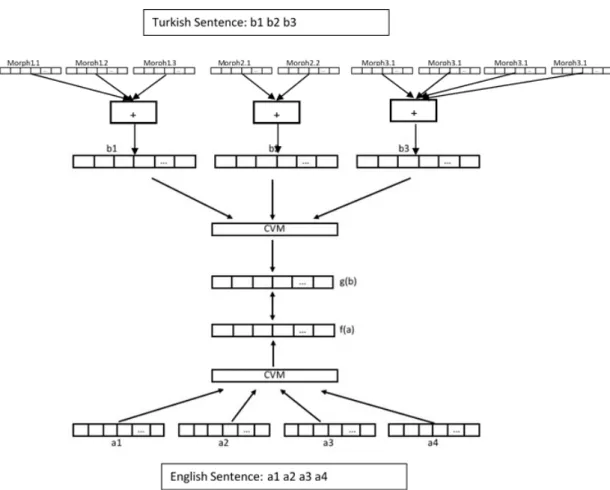
The framework we use in this work for English-Turkish language pair for example can be illustrated as in gure 2.1.
Figure 2.1: English-Turkish framework for extracting word embeddings
We use various frameworks for various languages as required by the specic language. The intiuition behind our method is that: for each language, we use a composition function to construct the word from its parts, if the language was relatively morphologically rich, and another composition function for constructing the sentences out of their consisting words. For each parallel sentences pair in the corpus, we form the sentence vector for each using the suitable composition functions for forming the words vectors and sentence vectors according to the nature of the language. The composition functions can be anything, as discussed in the previous sections. We vary them choosing between a
Chapter 2. Proposed Method 18 simple additive function, n-gram tanh function, or we can even use a recurrent neural network architecture. In the following chapter we conduct various experiments using the illustrated framework and review the results.
Chapter 3
Experiments and Results
3.1 Introduction
In this chapter, we discuss in details how the experiments are performed and how the qualities of the extracted word embeddings using dierent composition functions are evaluated. We also give details about the datasets and the tools used for the data preprocessing.
3.1.1 Experimental Setting
3.1.1.1 Choosing the composition function
As discussed previously, we can choose the composition functions for composing the words given the words parts and sentences given their consisting words using dierent schemes. These schemes include, simple additive function, the n-gram tanh function given by the equation 3.1 below, or we can also use a recurrent neural network architecture.
f(x) = k X i=1 tanh( i+n X j=i xj) (3.1)
By varying the composition functions various frameworks per language pairs can be achieved. For example, for each language we can achieve 23 = 8 methods to achieve
sentence embeddings by varying the word composition function and the sentence compo-sition function. And for each language pair we can achieve82= 64dierent frameworks.
Chapter 3. Experiments and Results 20 3.1.1.2 Data preprocessing
For multilingualism, the method described by this work as a data-driven method dis-cussed by [11] is followed. In their work they propose an architecture for extracting the word embeddings utilizing the TED Talks sentence-aligned corpus. This corpus consists of thousands for parallel sentences per language pair. The proposed method aims at minimizing the distance between the vectors that represent the same sentence in the corpus. In the original work, no data preprocessing is done, meaning that, the words are extracted by simply splitting the sentences using the space as a delimiter. In this work, we follow the same architecture but we introduce the idea for not considering the words as the simplest language unit. Instead, we choose between dierent options, either to consider the words as the basic language block, the tokens, or the morphemes. In the following we dene the word, the token, and the morpheme:
• The word: words are obtained by simply splitting the sentences using the space
as a delimiter. For example, the sentence "I don't know!" would be split to three words: I, don0t, and know!. This method ignores the fact that don0t consists of two wordsdo and notand the word know!is the wordknow and the exclamation mark. To split data into words no special tools are needed, we simply use the string processing libraries included in most of the high-level programming languages.
• The token: tokens are obtained by using a tokenizer tool. The one used here is the
nltk1 available for python2. When a sentence like "I don't know!" is passed to the
tokenizer, the tokenizer returns: I, do, n0t, know, and !. This output is language
independent, meaning that, if a Turkish sentence was passed, the output would not dier to adapt the language grammar. For example, the sentence "bilmiyorum!" which is the Turkish equivalent to "I don't know!" will be split into: bilmiyorum, and the exclamation mark ignoring the fact that the tokenbilmiyorum itself con-sists of dierent parts correspond toI,do,n0t, andknowin its English equivalent.
• The morpheme: it can be dened as a meaningful morphological unit of a
lan-guage that cannot be further divided. For example, the word incoming can be divided into in, come, and ing. The morphemes can be obtained using a special tool called morphessor or morphologicalanalyzer. This tool is usually language specic, meaning that, the morphological analyzer for one language cannot be used for another. In the case of our example, the output of a Turkish morphessor for the sentence "bilmiyorum!" which is the Turkish equivalent to "I don't know!" would be: bil,mithe negation morpheme, yorthe present continues morpheme, andum
1http://www.nltk.org/ 2http://www.python.org/
Chapter 3. Experiments and Results 21 the singular rst person subject pronoun. The morphological analyzer used for Turkish is the one available as a part of ITU-NLP pipeline 3 that is described by
Eryigit [9] and Eryi§it et al. [10].
Dierent methods for data preprocessing can be combined with various frameworks ob-tained by varying the composition functions. However, the number of possibilities will blow up and it will be unpractical to try them all. That is why only the methods found intuitive are tried knowing the nature of languages and their grammar structures.
3.1.1.3 Training and Parameter Tuning
After designing the architecture for the embeddings extraction, we need to set the training parameters to achieve the best possible quality embeddings. The training objective is to minimize the loss function over the training corpus. The loss function used in this work is the absolute function, meaning that, the model is trained to minimize the absolute distance given by the equation 3.2 between each a,b pair of parallel sentences.
Ebi=||f(a)−f(b)|| (3.2)
The models are then trained using backpropagation (backpropagation through time in the case of recurrent architectures) utilizing the output gradients calculated from the loss function in the equation 3.2. For the training we need to tune some parameters we list them below:
• The learning rate.
• The learning rate decay factor, by which the learning rate is divided after a
specic threshold in order to avoid oscillations during the training.
• The threshold, the number of epochs after which the learning rate should decay. • The maximum number of epochs, which represents the number of times we
should repeat the training using the dataset.
• The batch size, the number of sentences per batch.
• And in the case of the n-gram tanh composition function, the window-size n is also considered as a design parameter.
Chapter 3. Experiments and Results 22 Due to the long training time of the model at each parameter setting (typically two days) and the large number of possible model architectures, the tuning was done in a trial-and-error manner rather than brute-force search. For parameter tuning, we use a check for sanity called the paraphrase test which we talk about in details in the following subsection.
3.1.1.4 The Paraphrase Test
The paraphrase test is done by simply going through randomly selected 1000 pairs of sentences of the training corpus and forming their embeddings. Then the distances between each two vectors each from one language are computed. For each sentence, if the closest sentence, in terms of embedding, is the one that corresponds to this particular sentence in the parallel corpus, the score increases by 1. Then the total score is reported as a percentages of the correct mapping.
3.1.1.5 The CLDC Test
The cross-lingual document classication or (CLDC) is a problem that was rst described by Bel et al. [2] and then was introduced by Klementiev et al. [13] as a method for evalu-ating the quality of multilingual word embeddings. The (CLDC) task is concerned with training a supervised classier using documents from one language, the rich-resources language, and testing it using another language, the low-resources one, while maintain-ing a satisfymaintain-ing performance. The performances of the models are described in terms of the F1-score which is a combined metric that considers both recall and precision of the trained model. In our work, we study how multilingual word embeddings can be used to transfer information from a high-resources language, English, to a low-resources language, Turkish, to successfully train models using English documents and use the same models to classify Turkish documents and still achieving satisfying results. In this test, we train an averaged-perceptron classier, as suggested by Hermann and Blunsom [11], using the TED-Corpus. This classier, after trained, should assign one of 14 classes to a document given its embedding. The document embedding is calculated by adding the embeddings of all the consisting words. Since the averaged perceptron is originally a binary classier, we use one-vs-all to extend it to a multi-class classier by training 14 binary classiers each of which is trained to distinguish one class.
Chapter 3. Experiments and Results 23 3.1.1.6 Hardware and Software
For this work, a TitanX GPU is mainly used due to the high performance that can be achieved by using a GPU for training deep neural networks. Torch7 4, a scientic
computing framework with a wide support for machine learning and neural networks algorithms is used. It is easy to use and computationally ecient since it is built on top of Lua, an easy fast scripting programming language whose compiler is implemented using ANSI-C. Torch7 has support for CUDA which makes it a good choice for implementing and running neural networks on GPU. The code for obtaining the results of this work is open-sourced and made available for the community.
3.1.2 Experimental Results
In our experiments we try dierent models by variating the data preprocessing method and the composition function. As discussed earlier the number of dierent combinations is too large to try all the dierent possibilities. That is why the composition functions and the data preprocessing methods are chosen according to the nature of the language at hand. We rstly try additive functions for all composition functions at both languages using all preprocessing methods discussed in section 3.1.1.2. The second setting tried during the experimentations is achieved by using raw words without any preprocessing at the English side and morphemes at the Turkish side. As discussed earlier, the order of arranging the morphemes in Turkish is xed (the suxes are appended to the end in the same order according to their semantic function) which makes the idea of utilizing the simple additive function as a composition function to aggregate the words vectors from their consisting morphemes straightforward. The addition function is preferred over the RNN method due to its simplicity and eectiveness. Also, as mentioned in the previous chapter, the additive method described by Botha and Blunsom [4] is changed subtly for the Turkish language. Instead of adding the word itself as in the following example:
−−−−−−−−→
greenhouse=−−−−−−−−→greenhouse+−−−→green+−−−→house (3.3) The word itself is not included since the order of the morphemes in Turkish does not change, to give an example for this, the word arkadaslarim can be constructed as follows:
−−−−−−−−−−→
arkadaslarim=−−−−−→arkadas+−→lar+−im→ (3.4)
Chapter 3. Experiments and Results 24
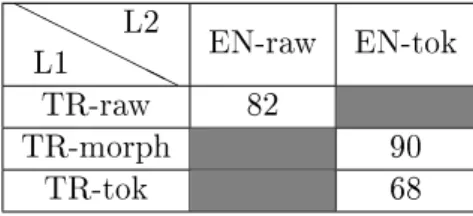
Table 3.1: The paraphrase test results for each type of models studied in this work according to the data preprocessing scheme using add function as a composition
func-tion. H H H H HH L1 L2 EN-raw EN-tok TR-raw 82 TR-morph 90 TR-tok 68
Table 3.2: The paraphrase test results for each type of models studied in this work according to the data preprocessing scheme using n-gram tanh function as a composition
function. H H H H HH L1 L2 EN-raw EN-tok TR-raw 80 TR-morph TR-tok 50
This helps overcoming the issues that would arise due to including both the words and the morhemes in the vocabulary causing the size of the dictionary to blow up. This would make the size of the training data insucient for learning meaningful word embeddings.
3.1.2.1 Extracting the Embeddings
The word embeddings for English and Turkish are extracted using one of the models following the proposed framework. Table 3.1 demonstrates the paraphrase test results for each type of models studied in this work according to the data preprocessing scheme. The composition function used at both words and sentences level is a simple additive function. On the other hand, the paraphrase test results illustrated in table 3.2 use the 6-gram tanh function given by the equation 3.1.
3.1.2.2 Evaluating the quality of the embeddings
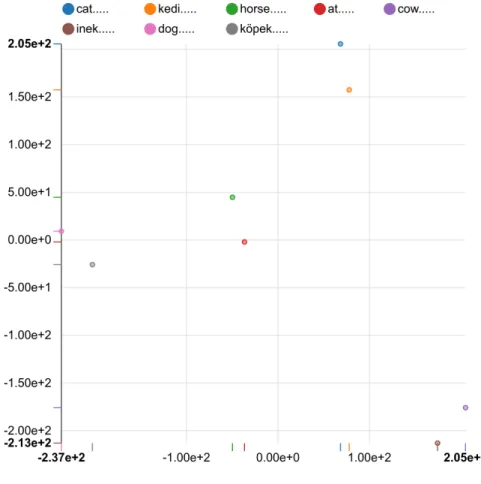
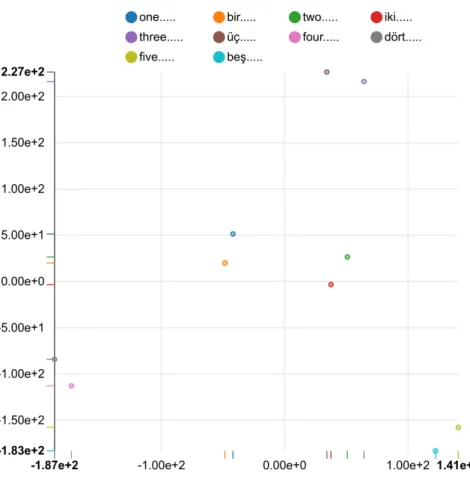
To evaluate the embeddings quality t-SNE and CLDC tests discussed earlier are used. The t-SNE test results can be illustrated as gures that show the fact that equivalent words project onto the 2D space close to each other. Figures 3.1, 3.2, and 3.3 show the results for t-SNE test for the 6-gram tanh model trained using tokenized data. Figures
Chapter 3. Experiments and Results 25 3.4, 3.5, and 3.6 show the results for t-SNE test for the 6-gram tanh model trained using raw data. Figures 3.10, 3.11, and 3.12 show the results for t-SNE test for the simple additive model trained using tokenized data. Figures 3.7, 3.8, and 3.9 show the results for t-SNE test for the simple additive model trained using raw data.
Figure 3.1: t-SNE visualization of animals names in Turkish and English using word embeddings extracted by the 6-gram tanh model using tokenization as a preprocessing
method
The CLDC results are reported in table 3.3. As we discussed previously, the performance metric used here is the F1-score which is a combined score that takes into account both precision and recall. both tanh-tok and add-tok consider tokenization preprocessing scheme for both languages.
Table 3.3: F1-scores obtained by training four models using four types of embeddings. The language of the training set is English while the language for the test set is Turkish.
Embed. set add-raw add-tok tanh-raw tanh-tok 0.74 0.73 0.73 0.64
Chapter 3. Experiments and Results 26
Figure 3.2: t-SNE visualization of numbers in Turkish and English using word em-beddings extracted by the 6-gram tanh model using tokenization as a preprocessing
Chapter 3. Experiments and Results 27
Figure 3.3: t-SNE visualization of sentences in Turkish and English using word em-beddings extracted by the 6-gram tanh model using tokenization as a preprocessing
Chapter 3. Experiments and Results 28
Figure 3.4: t-SNE visualization of animals names in Turkish and English using word embeddings extracted by the 6-gram tanh model using raw words
Chapter 3. Experiments and Results 29
Figure 3.5: t-SNE visualization of numbers in Turkish and English using word em-beddings extracted by the 6-gram tanh model using raw words
Chapter 3. Experiments and Results 30
Figure 3.6: t-SNE visualization of sentences in Turkish and English using word em-beddings extracted by the 6-gram tanh model using raw words
Chapter 3. Experiments and Results 31
Figure 3.7: t-SNE visualization of animals names in Turkish and English using word embeddings extracted by the additive model using raw words
Chapter 3. Experiments and Results 32
Figure 3.8: t-SNE visualization of numbers in Turkish and English using word em-beddings extracted by the additive model using raw words
Chapter 3. Experiments and Results 33
Figure 3.9: t-SNE visualization of sentences in Turkish and English using word em-beddings extracted by additive model using raw words
Chapter 3. Experiments and Results 34
Figure 3.10: t-SNE visualization of animals names in Turkish and English using word embeddings extracted by the additive model using tokenization as a preprocessing
Chapter 3. Experiments and Results 35
Figure 3.11: t-SNE visualization of numbers in Turkish and English using word em-beddings extracted by the additive model using tokenization as a preprocessing method
Chapter 3. Experiments and Results 36
Figure 3.12: t-SNE visualization of sentences in Turkish and English using word em-beddings extracted by the additive model using tokenization as a preprocessing method
Chapter 4
Conclusion
4.1 Introduction
In this chapter, we overview the methods used for this word, the problem denition, and the main ndings.
4.2 Conclusion
In this work, the problem of extracting multilingual distributed word representations is studied. The various method proposed by the literature are also overviewed. As detailed in the background chapter, there are various methods for extracting distributed word representations, also known as, word embeddings by utilizing huge corpora that contain hundreds of thousands of sentences and various language modelling techniques. These word embeddings are numerical vectors that capture the semantic and syntactic information of the words such that similar words should be represented in a proximity in the space. Some of the techniques used for this problem are simply probabilistic methods combined with dimensionality reduction algorithms. Some other techniques are based on training deep neural networks to learn those representations from the available linguistics resources. Most of the work in this eld is focusing on learning the word representations for one language at a time. Therefore, the word representations for dierent languages can be represented as vectors in mutually exclusive spaces. Since the representations would be more meaningful if they enable multilingualism allowing their utilization in a wider spectrum of natural language processing tasks, this word is focused on extracting multilingual word embeddings. For this purpose we use a data-driven method that utilizes neural networks to extract word embeddings for two or more languages from sentence-aligned parallel corpora. This method tries to minimize the distance between
Chapter 4. Conclusion 38 the embeddings for each two parallel sentences. The sentences embeddings are formed by aggregating the embeddings for their consisting words. All embeddings for all words in the vocabulary of a language are stored as weights in the neural model. These words are extracted from the training corpus by splitting all the sentences in the corpus using the space as a delimiter. This method for extracting the words causes many issues to arise with morphologically-rich languages. Considering Turkish as an example for morphologically rich languages, the number of the non-identical words in a corpus will be huge if the same word and its dierent forms were considered as dierent words. In this case, more data would be required to learn the representations for such a huge number of words. Since Turkish is a relatively low-resources languages, this would cause the representative power of the model to degrade. To solve this issue, the embeddings for the words are constructed from theirmorphemes before they are aggregated into sentences embeddings. In this work, a hierarchical method that starts at the level of the morphemes embeddings up to the level of sentences embeddings through the word embeddings is proposed. At the transition between each two levels a suitable composition function should be used. In this word, the use of dierent composition functions that range from simple additive functions to sophisticated recurrent neural networks architectures are discussed. However, for the case study we consider here that includes Turkish and English, the additive function is used at all levels due to its simplicity and eectiveness. The eect of varying the methods for data preprocessing is also studied and compared. Three ways for data preprocessing are considered. The rst uses the raw words obtained by splitting the corpus using the space as a delimiter as the basic language unit. The second divides the corpus into a set of tokens. The third method uses a morphological analyizer to generate the morphemes for each word in the corpus and considers the morpheme as the most basic language unit. To evaluate the performance of the model at each settings, three tests were used. The rst of them is the paraphrase test, which was used as a primary sanity check to make sure that the model is actually learning something. The paraphrase test was also used to tune the training parameters. The second test, is performed to visualize the embeddings from dierent languages to show their expressive power. The visualizing method used here is t-SNE, a method that is used to reduce the dimensions of the embeddings for the purpose of visualizing them. The third, and most meaningful, test uses the cross-lingual document classication task (CLDC) to evaluate how well the models embed the multilingual information into the word vectors. In this test, classiers are trained to assign topic classes to documents. The classiers are trained using documents from one language and tested using documents from another. For test, F1-score is used as a performance evaluation metric meaning that the model is considered more representative if the F1-score value gets higher. In the experimentations of this work, the model that uses additive functions at all levels for both English and Turkish and uses raw words as the basic language unit for English
Chapter 4. Conclusion 39 and the morphemes as the basic language unit for Turkish scored higher F1-score value than all of the other explored methods.
Bibliography
[1] R. Al-Rfou, B. Perozzi, and S. Skiena. Polyglot: Distributed word representations for multilingual nlp. arXiv preprint arXiv:1307.1662, 2013.
[2] N. Bel, C. H. Koster, and M. Villegas. Cross-lingual text categorization. In In-ternational Conference on Theory and Practice of Digital Libraries, pages 126139. Springer, 2003.
[3] Y. Bengio, R. Ducharme, P. Vincent, and C. Jauvin. A neural probabilistic language model. Journal of Machine Learning Research, 3(Feb):11371155, 2003.
[4] J. A. Botha and P. Blunsom. Compositional morphology for word representations and language modelling. In ICML, pages 18991907, 2014.
[5] G. Cavallanti, N. Cesa-Bianchi, and C. Gentile. Linear algorithms for online mul-titask classication. Journal of Machine Learning Research, 11(Oct):29012934, 2010.
[6] Y. Chen, B. Perozzi, R. Al-Rfou, and S. Skiena. The expressive power of word embeddings. arXiv preprint arXiv:1301.3226, 2013.
[7] K. W. Church and P. Hanks. Word association norms, mutual information, and lexicography. Computational Linguistics, 16(1):2229, 1990.
[8] R. Collobert and J. Weston. A unied architecture for natural language processing: Deep neural networks with multitask learning. In Proceedings of the 25th Interna-tional Conference on Machine Learning, pages 160167. ACM, 2008.
[9] G. Eryigit. The impact of automatic morphological analysis & disambiguation on dependency parsing of turkish. In LREC, pages 19601965, 2012.
[10] G. Eryi§it, J. Nivre, and K. Oazer. Dependency parsing of turkish. Computational Linguistics, 34(3):357389, 2008.
[11] K. M. Hermann and P. Blunsom. Multilingual models for compositional distributed semantics. arXiv preprint arXiv:1404.4641, 2014.
Chapter 4. Conclusion 41 [12] E. H. Huang, R. Socher, C. D. Manning, and A. Y. Ng. Improving word rep-resentations via global context and multiple word prototypes. In Proceedings of the 50th Annual Meeting of the Association for Computational Linguistics: Long Papers-Volume 1, pages 873882. Association for Computational Linguistics, 2012. [13] A. Klementiev, I. Titov, and B. Bhattarai. Inducing crosslingual distributed
repre-sentations of words. 2012.
[14] R. Lebret and R. Collobert. Word emdeddings through hellinger pca. arXiv preprint arXiv:1312.5542, 2013.
[15] O. Levy and Y. Goldberg. Neural word embedding as implicit matrix factorization. In Advances in Neural Information Processing Systems, pages 21772185, 2014. [16] T. Luong, R. Socher, and C. D. Manning. Better word representations with recursive
neural networks for morphology. In CoNLL, pages 104113, 2013.
[17] T. Mikolov, K. Chen, G. Corrado, and J. Dean. Ecient estimation of word repre-sentations in vector space. arXiv preprint arXiv:1301.3781, 2013.
[18] A. Mnih and G. Hinton. Three new graphical models for statistical language mod-elling. In Proceedings of the 25th International Conference on Machine Learning, pages 641648. ACM, 2007.
[19] A. Mnih and G. E. Hinton. A scalable hierarchical distributed language model. In Advances in Neural Information Processing Systems, pages 10811088, 2009. [20] F. Morin and Y. Bengio. Hierarchical probabilistic neural network language model.
In Aistats, volume 5, pages 246252. Citeseer, 2005.
[21] K. Pearson. Liii. on lines and planes of closest t to systems of points in space. The London, Edinburgh, and Dublin Philosophical Magazine and Journal of Science, 2 (11):559572, 1901.
[22] N. A. Smith and J. Eisner. Contrastive estimation: Training log-linear models on unlabeled data. In Proceedings of the 43rd Annual Meeting on Association for Com-putational Linguistics, pages 354362. Association for ComCom-putational Linguistics, 2005.
[23] J. Turian, L. Ratinov, and Y. Bengio. Word representations: a simple and general method for semi-supervised learning. In Proceedings of the 48th Annual Meeting of The Association for Computational Linguistics, pages 384394. Association for Computational Linguistics, 2010.
[24] S. Wold, K. Esbensen, and P. Geladi. Principal component analysis. Chemometrics and Intelligent Laboratory Systems, 2(1-3):3752, 1987.
![Figure 1.1: The neural network architecture proposed by Collobert and Weston [8]](https://thumb-us.123doks.com/thumbv2/123dok_us/9216882.2805819/18.893.226.721.121.729/figure-neural-network-architecture-proposed-collobert-weston.webp)
![Figure 1.2: The architecture proposed by Huang et al. [12] for extracting word em- em-beddings using both local and global contexts to capture the multiple meanings of the same word by learning from the global context i.e](https://thumb-us.123doks.com/thumbv2/123dok_us/9216882.2805819/20.893.170.784.119.327/architecture-proposed-extracting-beddings-contexts-multiple-meanings-learning.webp)
![Figure 1.3: The architecture proposed by Bengio et al. [3] for extracting word embed- embed-dings using n−gram sequences](https://thumb-us.123doks.com/thumbv2/123dok_us/9216882.2805819/23.893.179.783.126.510/figure-architecture-proposed-bengio-extracting-embed-embed-sequences.webp)
![Figure 1.4: The bilingual architecture proposed by Hermann and Blunsom [11] for extracting word embeddings leveraging parallel corpora.](https://thumb-us.123doks.com/thumbv2/123dok_us/9216882.2805819/24.893.187.759.622.1069/bilingual-architecture-proposed-hermann-blunsom-extracting-embeddings-leveraging.webp)
![Figure 1.5: The layered architecture proposed by Smith and Eisner [22] that utilizes RNN to build word embeddings from morphemes embeddings.](https://thumb-us.123doks.com/thumbv2/123dok_us/9216882.2805819/27.893.158.778.369.618/figure-layered-architecture-proposed-utilizes-embeddings-morphemes-embeddings.webp)