Contents lists available atSciVerse ScienceDirect
Journal of Computer and System Sciences
www.elsevier.com/locate/jcssTwo-server password-only authenticated key exchange
Jonathan Katz
a,∗
,1
, Philip MacKenzie
b, Gelareh Taban
a, Virgil Gligor
c,2aDept. of Computer Science, University of Maryland, College Park, MD 20742, USA bGoogle, Inc., Mountain View, CA 94043, USA
cDept. of Electrical and Computer Engineering, Carnegie Mellon University, Pittsburgh, PA 15213, USA
a r t i c l e
i n f o
a b s t r a c t
Article history: Received 1 July 2008
Received in revised form 22 February 2011 Accepted 20 September 2011
Available online 22 September 2011 Keywords:
Passwords
Key-exchange protocols
Typical protocols for password-based authentication assume a single server that stores all the information (e.g., the password) necessary to authenticate a user. An inherent limitation of this approach, assuming low-entropy passwords are used, is that the user’s password is exposed if this server is ever compromised. To address this issue, it has been suggested to share a user’s password information among multiple servers, and to have these servers cooperate (possibly in a threshold manner) when the user wants to authenticate. We show here a two-server version of the password-only key-exchange protocol of Katz, Ostrovsky, and Yung (theKOY protocol). Our work gives the first secure two-server protocol for the password-onlysetting (in which the user need remember only a password, and not the servers’ public keys), and is the first two-server protocol (in any setting) with a proof of security in the standard model. Our work thus fills a gap left by the work of MacKenzie et al. (2006) [31] and Di Raimondo and Gennaro (2006) [16]. As an additional benefit of our work, we show modifications that improve the efficiency of the original KOY protocol.
©2011 Elsevier Inc. All rights reserved.
1. Introduction
Humans typically choose “weak”, low-entropy passwords, while standard authentication protocols assume the use of cryptographic(i.e., high-entropy) secrets. Unfortunately, protocols designed and proven secure in the latter setting are gen-erally insecure in the former context because these protocols are not resistant to off-line dictionary attacks in which an eavesdropping adversary derives information about the password from observed transcripts of login sessions. In recent years, much attention has focused on designing password-based authenticated key-exchange protocols resistant to such at-tacks. (We remark thaton-line dictionary attacks– in which an adversary simply attempts to login repeatedly, trying each possible password – cannot be prevented by cryptographic means but can be dealt with using other methods outside the scope of this work.)
Means of protecting against off-line dictionary attacks in a single-server setting were first suggested [27,21] in a “hybrid”, PKI-based model where users are required to store the server’s public key in addition to a password. Bellovin and Merritt [5] were the first to suggest protocols forpassword-only authenticated key exchange(PAKE), where users are required to storeonly a short password. These initial works (and others [6,23,28,33]) were relatively informal and did not provide definitions or proofs of security. Subsequently, formal definitions and provably secure protocols for the “hybrid” model were given [22,7],
*
Corresponding author.E-mail address:[email protected](J. Katz).
1 Work supported by NSF grants #0447075 and #0310751. 2 Work done while at the University of Maryland.
0022-0000/$ – see front matter ©2011 Elsevier Inc. All rights reserved. doi:10.1016/j.jcss.2011.09.005
followed by models for the password-only setting [1,8,20] and associated protocols with proofs of security in the random oracle/ideal cipher models3[1,8,30] or in the standard model [26,20,19,25]. (The protocols of [26,19,25] assume some public information which is available to all parties. Since this information can be hard-coded into implementations of the protocol, clients do not need to memorize or store any high-entropy, cryptographic information as they are required to do in the PKI-based setting.)
Although the above protocols protect against off-line dictionary attacks, they do nothing to mitigate the concern that an adversary might obtain users’ passwords via server compromise. Such attacks represent a serious threat since they are potentially cost-effective (in that an adversary might be able to obtain thousands of users’ passwords by corrupting a single, poorly-protected server), and because users frequently utilize the same password at multiple sites. It is easy to show that it isimpossibleto protect against server compromise when a single server holds the information needed to authenticate a user (assuming the only secret information held by the user is a low-entropy password). To protect against server compromise, Ford and Kaliski [18] thus proposed using athresholdprotocol in which the authentication functionality is distributed across nservers who cooperate to authenticate a user, and who obtain independent session keys (shared with the user) following a successful authentication. Their protocol, which is designed in the PKI-based model, remains secure (and, in particular, an adversary learns nothing about users’ passwords other than what it learns from its on-line password guesses) as long as n
−
1 or fewer servers are compromised. Jablon [24] gave a protocol with similar functionality in the password-only setting. Neither of these works, however, include rigorous definitions or proofs of security.Subsequent to the work of Ford–Kaliski and Jablon, a number of provably secure protocols for threshold password-based authentication have been given. We summarize what is known:
•
MacKenzie et al. [31] showed a protocol in the “hybrid”, PKI-based setting which requires onlyt out ofn servers to cooperate in order to authenticate a user, for any values oft,n(of course, security is only obtained as long ast−
1 or fewer servers are compromised). They prove security for their protocol in the random oracle model.•
Di Raimondo and Gennaro [16] proposed a protocol in the password-only setting with a proof of security in the standard model. (A second protocol given in their paper, which we will not discuss further, achieves the weaker functionality in which the user shares the same session key with all the servers.) Their protocol requires fewer than 1/
3 of the servers to be compromised (i.e., they requiret<
n/
3) and thus does not give a solution for the two-server case.4 (In general,threshold cryptosystems for the two-party case do not follow immediately from threshold solutions that require honest majority.)
•
Brainard et al. [9] developed a two-server protocol, a variant of which has been proven secure in the random oracle model [32]. These protocols assume the PKI-based setting since they require a “secure channel” between the client and the server(s) which must presumably be implemented using public-key techniques.1.1. Our contributions
We show here a two-server protocol for password-only authenticated key exchange, with a proof of security in the standard model. Ours is the first provably secure server protocol in the password-only setting, and is the first two-server protocol (in any setting) with a proof of security in the standard model. Our protocol extends and builds upon the (single-server) password-based key-exchange protocol of Katz, Ostrovsky, and Yung [26] (theKOY protocol). As an additional benefit of our work, we show two modifications which improve the efficiency of the original KOY protocol even in the single-server case. (One of these modifications was also used in [11].)
In Section 4 we describe a “basic” two-server protocol which is secure against a passive (i.e., “honest-but-curious”) adversary who has access to the entire state of one of the servers throughout its execution of the protocol, but cannot cause this server to deviate from its prescribed behavior. (Even in the this case, however, the adversary is assumed to control all communication between the client and the servers.) This protocol is interesting in its own right (when the assumption on adversarial behavior is warranted), and serves as a useful prelude to our second result. In Section 5 we show how to modify the basic protocol so as to achieve security against anactiveadversary who may cause a corrupted server to deviate arbitrarily from the protocol.
The protocols we construct are relatively efficient. Each party in the basic two-server protocol performs (roughly) twice the amount of work as in the original KOY protocol. For the protocol secure against active adversaries, the work of the client stays the same but the work of the servers increases by a factor of approximately 6. (More explicit calculations of the computational cost are given in the appropriate sections.) This does not take into account potential efficiency improvements such as off-line computation or pre-processing.
3 In the random oracle model [2], parties are assumed to have “black-box” access to a random function; the ideal cipher model assumes that parties have
“black-box” access to a random keyed permutation. In practice, a random oracle is instantiated by a cryptographic hash function. It is known [10], however, that protocols secure in the random oracle model may be insecure foranychoice of hash function.
4 The approach in their paper does not extend to the casetn/3. The authors mention (without details) that “[i]t is possible to improve the
2. Definitions and preliminaries
We assume the reader is familiar with the model of Bellare et al. [1] (building on [3,4]) for password-based key exchange in the single-server case. Here, we generalize their model and present formal definitions for two-server protocols. While the model presented here is largely equivalent to the model proposed by MacKenzie et al. [31] (with the main difference being that we do not assume a PKI), we can simplify matters a bit since we focus on the two-server setting exclusively. For convenience we first describe the model for the case of a “passive” adversary corrupting one of the servers, and then discuss briefly the modifications needed to handle an “active” adversary. (As discussed below, in both the “passive” and “active” cases the adversary is free to interfere with all communication between the client and the servers. These cases only differ in the power of the adversary to control the actions of the corrupted servers: specifically, a “passive” adversary is unable to control the actions of corrupted servers, whereas an “active” adversary can.)
We first present a general overview of the system. For simplicity, we assume that every clientC in the system shares its passwordpw with exactly two servers A and B. In this case we say that servers A and B areassociated with C. (A single server may be associated with multiple clients.) In addition to holding password shares, these servers may also be pro-visioned with arbitrary other information (that need not be stored by C). Any such information is provisioned by some incorruptible, central mechanism (a system administrator, say) at the outset of the protocol. This doesnotrepresent a re-striction in practice, since the servers must be provisioned with correct password shares anyway, and so any additional information can be provided to the servers at that time. Furthermore, the servers have no restriction – as the client does – on the amount of information they can store. An (honest) execution of a protocol between client C and associated servers A andB should result in the client holding two (independent) session keysskC,A,skC,B, and servers AandB holdingskA,C andskB,C, respectively, withskC,A
=
skA,C andskC,B=
skB,C.2.1. Passive adversaries
We assume an adversary who corrupts some servers at the outset of the protocol, such that for any clientCat most one of the servers associated withCis corrupted. (Our definition does not require the adversary to corrupt one server associated with each client; thus, our definition implies security when neither server associated with some client is corrupted.) In the case of a passive adversary, a corrupted server continues to operate according to the protocol but the adversary may monitor the corrupted server’s internal state.
There are two types of communication: between clients and servers, and between servers. We give the adversary full control over the client-server communication; thus, the adversary can eavesdrop on this communication, send messages of its choice to servers or clients, or tamper with, delay, refuse to deliver, etc. any messages sent between servers and clients. Server–server communication is assumed to be done over a secure channel (this can be realized via standard use of private-key cryptography, since the servers can store long-term, shared private-keys); thus, the adversary is unable to eavesdrop on the communication between two uncorrupted servers, and communication between anytwo servers is not under adversarial control.5
With the above in mind, we proceed to the formal definitions.
Participants, passwords, and initialization. There is a fixed set of protocol participants (also called principals), each of which is either a clientC
∈
Clientor a server S∈
Server, whereClientandServerare disjoint. Each C∈
Clientis assumed to have a passwordpwC chosen uniformly and independently from the “dictionary”{
1, . . . ,
N}
.6 As noted earlier, we make the simplifying assumption that each client shares its password with exactly two servers. If clientC shares its password with the distinct servers A,
B, then A(resp., B) holds apassword share pwC,A (resp.,pwC,B); the mechanism for generating these shares depends on the protocol itself. We also allow each server to hold information in addition to these password shares. The initialization phase during which this information is provisioned is assumed to be carried out by some trusted authority, but any information stored by a corrupted server is available to the adversary.In general, additional information can be generated during the initialization phase. For example, in the “hybrid” pass-word/PKI model [22,7] public/secret key pairs are generated for each server and the secret key is given as input to the appropriate server, while the public key is provided to the appropriate client(s). For the protocol presented here, we require only the weaker requirement of a single set of public parameters that is provided to all parties.
Execution of the protocol.In the real world, a protocol determines how principals behave in response to messages from the network. In the formal model, these messages are provided by the adversary. Each principal is assumed to be able to execute the protocol multiple times (possibly concurrently) with different partners; this is modeled by allowing each principal to have an unlimited number of instances [4,1] with which to execute the protocol. We denote instance i of principal U
5 For two uncorrupted servers, this follows by our assumption of a secure channel between them. A corrupted server in the passive setting communicates
as specified by the protocol, and so we do not allow the adversary to control this communication. A corrupted server in the active setting may send whatever it likes and so it is unnecessary to allow the adversary to interfere with the communication channel in this case.
6 As in other work, our protocol and proof of security may be adapted easily to handle arbitrary dictionaries and/or non-uniform (but efficiently
as
Π
Ui. A given instance may be used only once. The adversary is given oracle access to these different instances, and each instanceΠ
Ui maintains (local) state, updated during the course of the experiment, which includes the following:•
sidiU, pidiU, and skiU are thesession id,partner id, and session key(s) for an instance, respectively. The session id keeps track of the different executions of a particular userU; we specify below how this is determined. The partner id denotes the identity of the principal with whomΠ
Ui believes it is interacting. A client’s partner id will be a set of two servers; a server’s partner id will be a single client (viewed as a set for notational convenience). For C a client, skiC consists of a pairskiC,A,skiC,B, where these are the keys shared with servers A and B, respectively. A server instanceΠ
Si with partnerC has only a single session keyskiS,C.•
termiU and acciU are boolean variables indicating whether a given instance has terminated or accepted, respectively. Termination means that a given instance is done sending and receiving messages; acceptance indicates successful ter-mination.As highlighted earlier, the adversary is assumed to have complete control over all communication between the servers and clients. This is modeled via access tooracleswhich are essentially as in [1] and are described now:
•
Send(C,
i,
S,
msg), whereC∈
ClientandS is a server associated withC. This sends messagemsgto client instanceΠ
Ci, supposedly from S. This client instance runs according to the protocol specification and the message it outputs, if any, is given to the adversary. Ifmsgis empty then this query represents a “prompt” forCto initiate the protocol.•
Send(S,
i,
C,
msg), where S∈
Server is associated with clientC. This sends message msgto server instanceΠ
Si, sup-posedly from C. This instance runs according to the protocol specification, and the message it outputs is given to the adversary. If S is corrupted, the adversary also receives the entire internal state of S; if the other serverS associated withC is corrupted, then the adversary is given the entire internal state ofS.•
Execute(C,
i,
A,
B,
j)
, whereC∈
Clientand A, B are servers associated withC. This executes the full protocol between instancesΠ
Ci andΠ
Aj,Π
Bj, and outputs the entire transcript of the client-server communication in this execution. In addition, if S∈ {
A,
B}
is corrupted the adversary is given the entire internal state ofS.•
Reveal(U,
U,
i)
, whereU∈
pidiU. This outputsskiU,U, a session key held by instanceΠ
Ui. This oracle call models usage of the session key by some higher-level application, or possible leakage of a session key due to, e.g., compromise of a host computer.•
Test(U,
U,
i)
. This does not model any real capability of the adversary, but is needed to define security. As in the case of aRevealquery, we assumeU∈
pidiU. IfskiU,U=
null, then this oracle outputs⊥
. Otherwise, a random bitbis generated; if b
=
1 the adversary is given skiU,U, and if b=
0 the adversary is given a random session key. Theadversary is allowed only a singleTestquery, at any time during its execution.
As usual, Sendoracle calls are intended to model active attacks on the protocol (i.e., “on-line attacks”), whereas Execute
calls are intended to model passive eavesdropping (i.e., “off-line attacks”).
Session ids and partnering.We define a natural notion of partnering based on matching transcripts. For a client instance
Π
Ciassociated with servers A andB, letsidiC,A (resp.,sidiC,B) denote the ordered sequence of messages sent to/from the client and server A (resp., server B). For a server instance
Π
Bj, let sidBj be the ordered sequence of messages sent to/from this instance and the client; note that server–server communication is not included. ThenΠ
Ci andΠ
Bj are partnered if: (1)sidiC,B=
sidBj=
null; and (2) B∈
pidiC andC∈
pidBj.Correctness.We require a key-exchange protocol to satisfy the following: if a client instance
Π
Ci and server instancesΠ
Ajand
Π
Bj run an honest execution of the protocol with no interference from the adversary, thenacciC=
accAj=
accBj=
true,andskiC,A
=
skjA,C, andskiC,B=
skBj,C.In the case of an active adversary who has corrupted server A, we impose no correctness requirements. However, our protocol in Section 5 achieves the following: with all but negligible probability, for every pair of partnered instances
Π
Ciand
Π
Bj withacciC=
accBj=
true, it holds thatskiC,B=
skBj,C=
null.Freshness. To formally define the adversary’s success we must first define a notion offreshness for a session key, where freshness of a key is meant to indicate that the adversary does not trivially know the value of the key. We say a session keyskiU,U isfreshif: (1) neitherU norUis a corrupted server, (2) the adversary never queriedReveal(U
,
U,
i)
; and (3) theadversary never queriedReveal(U
,
U,
j)
, whereΠ
Uj andΠ
Ui are partnered.Advantage of the adversary.Informally, the adversary succeeds if it can distinguish a fresh session key from random. (Re-stricting to a fresh session key is necessary for a meaningful definition of security.) Formally, we say an adversary
A
succeedsif it makes a single query Test(U
,
U,
i)
regarding a fresh keyskiU,U, and outputs a bitb withb=
b (recall thatb is thebit chosen by theTestoracle). We denote this event bySucc. The advantage of adversary
A
in attacking protocol P is then given byAdvA,P
(
k)
def=
2·
Pr[
Succ] −
1,
where the probability is taken over the random coins used by the adversary as well as the random coins used during the course of the experiment.
An adversary can always succeed by trying all passwords one-by-one in an on-line impersonation attack; a protocol is secure if this is the best an adversary can do. In our model, on-line attacks correspond to Sendqueries. Formally, every instance for which the adversary has made aSendquery counts as one on-line attack. We stress that instances with which the adversary interacts via Executequeries are not counted as on-line attacks. The number of on-line attacks represents a bound on the number of passwords the adversary could have tested in an on-line fashion.
Definition 1.Protocol P is asecure two-server protocol for password-only authenticated key-exchangeif, for all dictionary sizesN and for allpptadversaries
A
making at most Q(
k)
on-line attacks and corrupting at most one server associated with eachclient, there exists a negligible function
ε
(
·
)
such thatAdvA,P(
k)
Q(
k)/
N+
ε
(
k)
.Explicit mutual authentication. The above definition captures the requirement of implicit authentication only (and the protocol we present here achieves only implicit authentication). Using standard techniques, however, it is easy to add explicit authentication to any protocol achieving implicit authentication.
2.2. Active adversaries
The only difference in the active case is that the adversary may now cause any corrupted servers to deviate in an arbitrary way from the actions prescribed by the protocol. Thus, if a server is corrupted the adversary controls all messages sent from this server to any other servers. (The adversary can also control messages sent from this server to any clients; note, however, that even a passive adversary has this ability since it controls the communication channel between servers and clients.) Because of this change, we no longer use a Send oracle to model sending messages to a corrupted server, but we formally introduce a newSendoracle to model communication from a corrupted server to a non-corrupted server. (We also charge the adversary with an additional on-line attack for using the latter.) As in the passive case, however, we continue to assume that the adversary cannot eavesdrop on or control communication between two non-corrupted servers.
3. A review of the KOY protocol
Here, we provide a brief review of the KOY protocol [26] which will be useful toward understanding our two-server protocol in the following section. We also discuss the modifications we introduce to the KOY protocol which have the effect of both simplifying our eventual two-server protocol as well as improving the efficiency of the KOY protocol even in the single-server setting.
The KOY protocol operates in three rounds. At a high level, in round 1 the client generates a Cramer–Shoup encryp-tion [14] of its password (using a “public key” contained in the public parameters) and sends the resulting ciphertext to the server; the server acts symmetrically in round 2. We observe that the following modifications may be made without affecting security of the protocol:
•
The server may use El Gamal encryption[17]in round2 rather than Cramer–Shoup encryption (this was first observed, in a different context, in [11]). This is somewhat surprising, as the proof of security in [26] explicitly relies on the chosen-ciphertext security of Cramer–Shoup encryption, while El Gamal encryption is only semantically secure.•
There is no need for the server to compute a fresh encryption of the password(in round2)in each execution of the protocol; instead,the server can store an encryption of the password (along with the randomness used to generate this encryption) as part of its long-term state, and use the same ciphertext every time it executes the protocol.
We refer to the KOY protocol with the above modifications as theKOY* protocol. (We do not formally prove security of the KOY* protocol in the single-server case; however, such a proof may be derived from the proofs of the two-server protocols that we give in this paper.)
In brief (we provide more detail when we discuss the two-server version of this protocol in the following section), then, the KOY* protocol assumes public parameters containing a description of a group
G
with specified prime order q. Additionally, the parameters include random generatorsg1,
g2,
g3,
h,
c,
d∈
G
×(whereG
×def
=
G
\{
1}
) and a hash function H. Components g1,
g2,
h,
c,
d,
Hwill be used for Cramer–Shoup encryption by the client in round 1 (as in the original KOYA password pwC
∈
Z
q is chosen for each client C and shared with the appropriate server S. In addition, S is pre-provisioned with bothrand a ciphertextComS,Cdef
=
(
gr 1,
gr 3g pwC1
)
, wherer∈
Z
qis chosen at random; note that ComS,C is simply a (random) El Gamal encryption of gpwC1 .
Execution of the protocol proceeds as follows. When a client Client with passwordpwC wants to initiate an execution of the protocol, it runs a key-generation algorithm for a one-time signature scheme, yielding VK andSK. It then chooses a random r
∈
Z
q and computes A=
gr1, B=
gr2, and C=
hr·
gpwC
1 . It then computes
α
=
H(
Client|
VK|
A|
B|
C)
and sets D=
(
cdα)
r. Note that(
A,
B,
C,
D)
is a (labeled) Cramer–Shoup encryption of gpwC1 . The client sends msg1def
=
Client,
VK,
A,
B,
C,
Dto the server.
The server re-computes
α
=
H(
Client|
VK|
A|
B|
C)
, then chooses randomx,
y,
z,
w∈
Z
q, and computes E=
gx1g2yhzcdαw.
It sends the message
msg2def
=
E,
F,
Gto the client, where
(
F,
G)
=
ComS,C. We stress that the same values F,Gare used by this server every time. Upon receiving msg2, the client chooses random x,
y∈
Z
q and computes K=
gx1gy
3. It also computes a signature
σ
on(msg
1,
msg2,
K)
usingSK, and sendsmsg3def
=
K,
σ
to the server. The client concludes by computing its session key as skC
=
ErFx(
G/
gpw1 C)
y.The server, upon receivingmsg3, verifies the signature and aborts if it is incorrect. Otherwise, is computes the session key skS
=
Ax
By
(
C/
gpwC1
)
zDwKr. It may be easily verified that in a correct execution the client and server compute identical session keys.
4. A protocol secure against passive adversaries 4.1. Description of the protocol
We assume the reader is familiar with the decisional Diffie–Hellman (DDH) assumption [15], strong7one-time signature
schemes, and the Cramer–Shoup encryption scheme [14] with labels. A high-level depiction of the protocol is given in Figs. 1–3, and a more detailed description, as well as some informal discussion about the protocol, follows.
Initialization. During the initialization phase, public parameters (i.e., a common reference string) are generated and made available to all parties. For security parameter k, the public parameters for our protocol contain a group
G
(written multi-plicatively) having specified prime order q with|
q| =
k; we assume the hardness of the DDH problem inG
. Additionally, the parameters include random generators g1,
g2,
g3,
h,
c,
d∈
G
\ {
1}
and a hash function H:{
0,
1}
∗→
Z
qchosen at random from a collision-resistant hash family.As part of the initialization, each server S is provisioned with an El Gamal public-/secret-key pair
(
pkS,
skS)
, where pkS=
gskS1 . If A andB are associated with the same client C, then A (resp.,B) is givenpkB (resp.,pkA). We stress that, in contrast to the PKI-based model, the client is not assumed or required to know the public keys of any of the servers.
Given a message m
∈
G
and a public key (i.e., group element) pk, we let M←
ElGpk(
m)
denote the act of choosing a random r∈
Z
q and setting M=
(
gr1,
pkr
m
)
. We let M[
1]
refer to the first component of this ciphertext, and letM[
2]
refer to the second. Note that ifskis the corresponding secret key (i.e.,pk=
gsk1), then we havem=
M[2]M[1]sk.
Passwords and password shares are provisioned in the following way: a password pwC is chosen randomly for each client C and we assume that this password can be mapped in a one-to-one fashion to
Z
q. If A and B are the servers associated with a client C, then password shares pwA,C,
pwB,C∈
Z
q are chosen uniformly at random subject to pwA,C+
pwB,C=
pwC modq, with pwA,C given to server A and pwB,C given to server B. In addition, both A and B are given ComA,C,ComA,C,ComB,C, andComB,C, whereComA,C def
=
ElGg3 gpwA,C 1=
gra 1,
g ra 3g pwA,C 1,
ComA,Cdef
=
ElGpkAgpwA,C
1
,
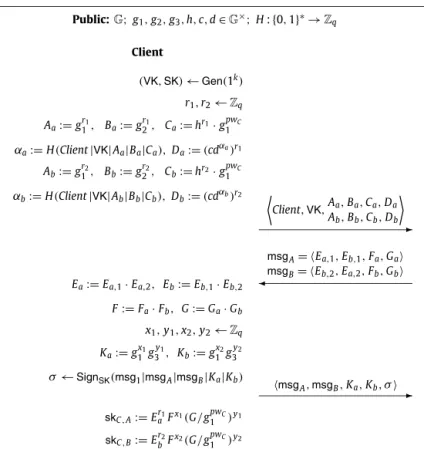
Public:G;g1,g2,g3,h,c,d∈G×;H:{0,1}∗→Zq Client (VK,SK)←Gen(1k) r1,r2←Zq Aa:=gr11, Ba:=g2r1, Ca:=hr1·gpw1 C
αa
:=H(Client|VK|Aa|Ba|Ca),Da:=(cdαa)r1 Ab:=gr12, Bb:=g2r2, Cb:=hr2·gpw1 Cαb
:=H(Client|VK|Ab|Bb|Cb), Db:=(cdαb)r2 Client,VK,Aa,Ba,Ca,Da Ab,Bb,Cb,Db msgA= Ea,1,Eb,1,Fa,Ga msgB= Eb,2,Ea,2,Fb,Gb Ea:=Ea,1·Ea,2, Eb:=Eb,1·Eb,2 F:=Fa·Fb, G:=Ga·Gb x1,y1,x2,y2←Zq Ka:=gx11g3y1, Kb:=gx12g y2 3σ
←SignSK(msg1|msgA|msgB|Ka|Kb) msgA,msgB,Ka,Kb,σ
skC,A:=Era1Fx1(G/g pwC 1 )y1 skC,B:=Erb2Fx2(G/g1pwC)y2Fig. 1.An execution of the protocol from the client’s point of view.
ComB,Cdef
=
ElGg3 gpwB,C 1=
grb 1,
g rb 3g pwB,C 1,
ComB,Cdef
=
ElGpkBgpwB,C
1
.
(Note that the keys for these El Gamal encryptions differ.) ServerA (resp., serverB) is additionally given the randomnessra (resp.,rb) used to constructComA,C (resp.,ComB,C).
Protocol execution. At a high level one can view our protocol as two executions of the KOY* protocol, one between the client and server A (using server B to assist with the authentication), and one between the client and server B (using server Ato assist with the authentication).
When a client with password pwC wants to initiate an execution of the protocol, this client computes Cramer–Shoup “encryptions” ofpwC for each of the two servers. In more detail (cf. Fig. 1), the client begins by running a key-generation algorithm for a one-time signature scheme, yielding verification keyVKand signing keySK. The client next chooses random r1
∈
Z
q and computesAa=
gr11,Ba=
gr21, andCa=
hr1·
gpwC
1 . The client then computes
α
a=
H(
Client|
VK|
Aa|
Ba|
Ca)
and sets D=
(
cdαa)
r1. This exact procedure is carried out a second time using an independent random valuer2∈
Z
q. The client sendsmsg1def
=
Client,
VK,
Aa,
Ba,
Ca,
Da,
Ab,
Bb,
Cb,
Dbto each server as the first message of the protocol. Note that this corresponds to two independent “encryptions” of pwC using the labelClient
|
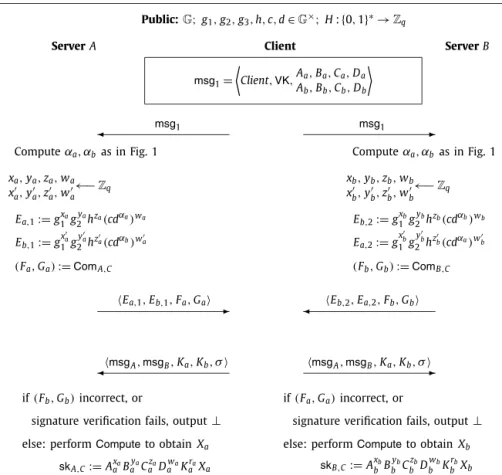
VK.The servers act symmetrically, so for simplicity we describe the actions of server A (cf. Fig. 2). Upon receiving msg1, server A sends “shares” of (1) two values of the form g1xg2yhz
(
cdα)
w (forα
∈ {
α
a,
α
b}
), one for server A and one for serverB, and (2) an El Gamal encryption ofpwC. In more detail, serverAchooses randomxa,
ya,
za,
wa∈
Z
q and computes Ea,1=
g1xagya
2 hza
(
cdαa)
wa. It also chooses random xa,
ya,
za,
wa∈
Z
q and computes Eb,1=
g xa 1 g ya 2 hz a(
cdαb)
wa. Finally, it sets(
Fa,
Ga)
equal to ComA,C (which, recall, is an El Gamal encryption ofgpwA,C
1 using “public key”g3 and randomnessra). It
sends the messagemsgA def
=
Ea,1,
Eb,1,
Fa,
Gato the client.After receiving a second-round message from each server, the client combines the values thus received by multi-plying them component-wise to obtain
Ea,
Eb,
F,
G (cf. Fig. 1). Note that (1) neither server knows the representation of Ea (resp., Eb) with respect to the basis g1,
g2,
h, (
cdαa)
(resp., g1,
g2,
h, (
cdαb)
), and (2) the values(
F,
G)
form anval-Public:G;g1,g2,g3,h,c,d∈G×;H:{0,1}∗→Zq Client msg1= Client,VK,Aa,Ba,Ca,Da Ab,Bb,Cb,Db
msg1 msg1 ServerA ServerBCompute
αa
,αb
as in Fig. 1 xa,ya,za,wa xa,ya,za,wa←−Zq Ea,1:=gx1ag2yahza(cdαa)wa Eb,1:=g xa 1g ya 2hz a(cdαb)wa (Fa,Ga):=ComA,C Ea,1,Eb,1,Fa,GaCompute
αa
,αb
as in Fig. 1 xb,yb,zb,wb xb,yb,zb,wb←−Zq Eb,2:=g xb 1g yb 2h zb(cdαb)wb Ea,2:=g xb 1 g yb 2 h zb(cdαa)wb (Fb,Gb):=ComB,C Eb,2,Ea,2,Fb,Gb msgA,msgB,Ka,Kb,σ
msgA,msgB,Ka,Kb,σ
if(Fb,Gb)incorrect, or
signature verification fails, output⊥ else: performComputeto obtainXa
skA,C:=AxaaBayaCazaDawaKaraXa
if(Fa,Ga)incorrect, or
signature verification fails, output⊥ else: performComputeto obtainXb
skB,C:=AbxbBbybCbzbDwbbKrbbXb
Fig. 2.Execution of the protocol from the servers’ points of view; see text for details. TheComputeprotocol is given in Fig. 3.
ues x1
,
y1,
x2,
y2∈
Z
q, computes Ka=
g1x1g3y1 and Kb=
g1x2g3y2, and computes a signatureσ
on msg1|
msgA|
msgB|
Ka|
Kb using the secret key SKthat it had previously generated. It sends msg3def
=
msgA,
msgB,
Ka,
Kb,
σ
to each server as the final message of the protocol. (Of course,msgAneed not be sent to Aand similarly formsgB. Furthermore, it would suffice for the client to sign and send hashes of these messages.) Finally, the client computes session keysskC,A
:=
Era1Fx1 G/
gpwC 1 y1,
skC,B:=
Erb2Fx2 G/
gpwC 1 y2.
Upon receiving
msgA,
msgB,
Ka,
Kb,
σ
from the client, server A verifies that the(
Fb,
Gb)
component ofmsgB is equal to ComB,C (recall that A storesComB,C), and thatσ
is a valid signature on msg1|
msgA|
msgB|
Ka|
Kb with respect to VK. If verification fails, the server terminates the execution. Otherwise, servers A and B jointly execute theCompute protocol (cf. Fig. 3 and described next) in order to compute their session keys.Before describing the Compute protocol, we introduce notation for manipulation of El Gamal ciphertexts. If M, M are two El Gamal ciphertexts (encrypted with respect to the same public key pk), then we let M
×
M denote(
M[
1] ·
M[
1]
,
M[
2] ·
M[
2]
)
. Note that ifMis an encryption ofmandM is an encryption ofm, then M×
Mis an encryption ofm·
m. Forx∈
Z
q, we let Mx denote the ciphertext(
M[
1]
x,
M[
2]
x)
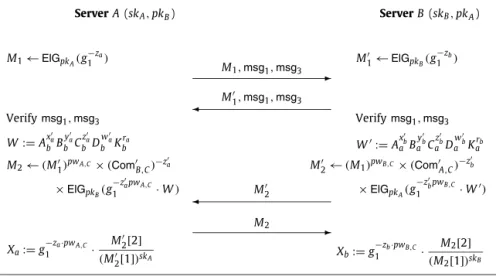
. Here, the resulting ciphertext is an encryption ofmx.With this in mind, we now describe theCompute protocol. Since the protocol is symmetric, we simply describe it from the point of view of server A. This server sets M1 to be an El Gamal encryption (with respect to pkA) of g−1za. It then
sends M1 to serverB, who computes M2
←
MpwB,C 1×
ComA,C−zb×
ElG pkA g−zbpwB,C 1 A xb a B yb a C zb a D wb a Kraband sends this value back to server A (recall that rb is the randomness used to construct ComB,C). Finally, server A de-crypts M2 and multiplies the result byg−za·pwA,C
1 to obtain Xa. Note that Xa
=
g−( za+zb)·pwC 1·
Axb a B yb a C zb a D wb a Karb,
(1)ServerA(skA,pkB) ServerB(skB,pkA) M1←ElGpkA(g1−za) M1, M1 ←ElGpkB(g−1zb) msg1,msg3
M1,msg1,msg3 Verifymsg1,msg3 W:=Axa b B ya b C za b D wa b K ra b M2←(M1)pwA,C×(ComB,C)−za ×ElGpkB(g− zapwA,C 1 ·W) Verifymsg1,msg3 W:=Axb a B yb a C zb a D wb a Karb M2←(M1)pwB,C×(ComA,C)−zb ×ElGpkA(g− zbpwB,C 1 ·W) M2 M2 Xa:=g− za·pwA,C 1 · M2[2] (M2[1])skA Xb:=g −zb·pwB,C 1 · M2[2] (M2[1])skBFig. 3.TheComputeprotocol. See text for a description of the notation used.
using the fact that pwC
=
pwA,C+
pwB,Cmodq. In addition to the above, in the first step of the protocol the servers exchange the messages received from the client thus far; each server then verifies that these messages match their own view (and terminates if not).Although omitted in the above description, we assume that the client and servers always verify that incoming messages are well formed, and in particular that all appropriate components of the various messages indeed lie in
G
(we assume that membership inG
can be efficiently verified).Correctness.Since the protocol is symmetric, we focus on the session key shared between the client and server A. The client computes skC,A
=
Era1Fx1 G/
gpwC 1 y1=
gxa+xb 1 g ya+yb 2 h za+zbcdαawa+wbr1g(ra+rb)·x1 1 g (ra+rb)·y1 3.
Meanwhile, server Acomputes
skA,C
=
AaxaBayaCazaDawaKaraXa=
Axa+x b a B ya+yb a C za+zb a D wa+wb a Kara+rb·
g −(za+zb)·pwC 1=
Axa+xb a B ya+yb a Ca·
g−1pwC za+zb Dwa+wb a Kara+rb,
using Eq. (1) to substitute for the value of Xa. Continuing, we haveskA,C
=
gxa+xb 1 g ya+yb 2 hza+z bcdαawa+w br1gx1 1 g y1 3 ra+rb,
which is equal toskC,A.Efficiency.We count exponentiations only, and assume a multi-exponentiation with up to 5 bases can be computed at the cost of at most 1.5 exponentiations. The client performs the equivalent of 15 full exponentiations (note thatpwC is small, so does not count as a full exponentiation), while each server performs 13 exponentiations (computation ofM2,M2can be
done by expressing each of them as the product of two multi-exponentiations). Thus, our protocol increases each party’s computation relative to the original KOY protocol by about a factor of 2. Performance could be further improved using pre-computation.
4.2. Proof of security for passive adversaries
Theorem 1.Assuming(1)the DDH problem is hard for
G
; (2)(Gen,
Sign,Vrfy)is a strong one-time signature scheme;and(3)H is collision-resistant, the protocol of Figs.1–3is a secure two-server protocol for password-only authenticated key exchange in the pres-ence of a passive adversary.Before proving this theorem, we introduce some notation. We view the adversary’s queries to itsSendoracles as queries to four different oraclesSend0,Send1,Send2,Send3 corresponding, respectively, to the request for a client to initiate the
protocol as well as the three rounds of the protocol. E.g., query Send0
(
C,
i,
S,
ε
)
represents a request for instanceΠ
Ci of client C to initiate the protocol; the output of this query is an initial message Client,
VK,Aa, . . . ,
Da,
Ab, . . . ,
Db. Simi-larly, a query Send3(
A,
i,
C,
msgA,
msgB,
Ka,
Kb,
σ
)
represents sending messagemsgA,
msgB,
Ka,
Kb,
σ
to instanceΠ
Ai of server A. In the proof, we always let msg1 denote the initial message sent by the client to both servers; let msgA (resp.,msgB) denote the second-round message sent from server A(resp., server B) to the client; and letmsg3 denote the final message sent by the client.We do not explicitly use collision-resistance ofHin the proof that follows, but that assumption is needed for security of the Cramer–Shoup encryption scheme (which is used in the proof).
Proof of Theorem 1. Given a passive adversary
A
attacking the protocol, we imagine a simulator that runs the protocol forA
. More precisely, after the adversary chooses which servers to corrupt, the simulator initializes the system (including selecting the public parameters, choosing passwords for all clients, and computing password shares – as well as any other necessary information – for all servers), givesA
the information held by all corrupted servers, and then responds to the oracle calls made byA
. After computing the appropriate answer to the oracle query, the simulator provides the adversary with the internal state of any corrupted servers involved in the query.When the adversary queries the Testoracle, the simulator chooses a random bitb. When the adversary completes its execution and outputs a bit b, the simulator can tell whether the adversary succeeds by checking whether (1) a single
Test query was made regarding some fresh session key skiU,U, and (2) b
=
b. Success of the adversary is denoted byeventSucc, and for any experiment P we defineAdvA,P
(
k)
def=
2·
PrA,P[
Succ] −
1, where PrA,P[·]
denotes the probability of an event when the simulator interacts with the adversary in accordance with experiment P. We refer to the original execution of the experiment (i.e., exactly according to the specification of the protocol) as P0. We will introduce a sequenceof transformations to the original experiment and bound the effect of each transformation on the adversary’s advantage. We then bound the adversary’s advantage in the final experiment; this yields a bound on the adversary’s advantage in the original experiment.
It is useful to keep two observations in mind while reading the proof. First, the initial message of theComputeprotocol (and the fact that we are in the passive setting) ensures that servers A and B abort without outputting a session key unless they have consistent views on the messages sent between the client and the servers. Second, when the two servers associated with some client are both uncorrupted the messages exchanged by the servers during theComputeprotocol are irrelevant since the adversary cannot eavesdrop on their communication.
ExperimentP0.In experiment P0, the simulator interacts with the adversary as before except that the adversary doesnot succeed, and the experiment is aborted, if any of the following occur:
1. At any point, a msg1 generated by the simulator (whether in response to an Execute query or a Send0 query) is
repeated.
2. At any point, amsgA ormsgB generated by the simulator (whether in response to anExecutequery or aSend1 query)
is repeated.
3. At any point, the adversary forges a new, valid message/signature pair for any verification key used in a simulator-generatedmsg1 (whethermsg1 was generated in response to anExecutequery or aSend0 query).
In addition, the simulator changes how it computes the session key for any non-corrupted serverBso that it no longer uses the long-term El Gamal secret keyskB. Recall that this secret key is used only to compute Xbwithin theComputeprotocol. Instead of computing Xbthis way, the simulator simply computesXb directly via
Xb
:=
g−(zb+z a)·pwC 1·
Axa b B ya b C za b D wa b K ra b.
We stress that the simulator can do this because we are dealing with a passive adversary (and so the simulator knows the internal state of all servers, even corrupted ones).
These changes have only a negligible effect on the adversary’s advantage. Events 1 and 2, above, clearly occur with only negligible probability. Event 3 occurs with negligible probability assuming the security of
(Gen,
Sign,Vrfy)as a strong one-time signature scheme. Finally, the change in computing Xb is merely a conceptual one since we assume a passive adversary (and so the value of Xb is identical in games P0 and P0; cf. Eq. (1)). Putting everything together, we have that|
AdvA,P0(
k)
−
AdvA,P0(
k)
|
is negligible.ExperimentP0.In this experiment, for any non-corrupted server B the pre-provisioned valueComB,C (for any clientC) is set to be an El Gamal encryption of a random value (with respect to the public keypkB). Similarly, when any non-corrupted server B runs the Compute protocol with a corrupted server, M1 is set to be an El Gamal encryption of a random value (with respect to the public key pkB). Since, in experiment P0, the simulator does not use the secret keyskB of any
non-corrupted server B (recall that computation of Xb no longer usesskB), it follows from the semantic security of El Gamal encryption with respect to the public keys of all non-corrupted servers (as well as a straightforward hybrid argument) that
|
AdvA,P0(
k)
−
AdvA,P0(
k)
|
is negligible.In the experiments that follow, we distinguish between the following possibilities for amsg1received by a non-corrupted
server: We say msg1 is oracle generated if it was output by the simulator in response to an oracle query (i.e., either an
Executequery or aSend0 query); we say msg1 isadversary generatedotherwise. We also make the convention throughout
the rest of the proof that anySend3queries made by the adversary contain a valid signature on the appropriate message as
required by the protocol (since otherwise the server will simply reject the message and terminate the appropriate instance, and the adversary can determine by itself whether the signature is valid or not). Also, we assume that any components of adversary-generated messages that are supposed to lie in
G
actually do (as a server will again reject if this is not the case).ExperimentP1. In experiment P1, the simulator changes the way it responds to a msg3 sent to an uncorrupted server,
whenmsg1 for the corresponding server instance is oracle generated. (By definition, this is automatically the case for any
Executequery being answered by the simulator.) Let A andB be the servers associated with some clientC, and sayB is uncorrupted. Say amsg3 as described above is sent to instance
Π
j
B, either as a result of anExecute(C
,
i,
A,
B,
j)
query or a Send3(
B,
j,
C, )
query, and that the corresponding instance of serverA has also been sentmsg3. (If no instance of server Ahas yet received the final messagemsg3, then
Π
jB will not execute beyond the first message of theComputeprotocol.) The simulator searches for the uniqueisuch thatsidiC,B
=
sidBj (we comment below on the existence of such ani). The simulator then setsskBj,C:=
skiC,B. Furthermore, if Ais corrupted then M2 (in theComputeprotocol) is computed asM2
←
ElGpkA skiC,A·
A−xa a B−ayaCa−zaD−awaKa−rag za·pwA,C 1.
Anias desired must exist, since otherwise the adversary has succeeded in forging a signature with respect to a verification key generated by the simulator and the simulator would then have aborted (cf. experiment P0). Furthermore, thisi must be unique or else an oracle-generatedmsg1 has repeated and the simulator would have aborted.
The changes just described do not have any effect on the view of the adversary. This is clear for the case ofskBj,C, since inP0 it is always the case thatskBj,C
=
skCi,BwhenΠ
BjandΠ
Ci are partnered and Bdoes not terminate the protocol. (Recall we assume a passive adversary.) Furthermore, in both experiments P1 andP0, the value M2 is a random encryption of theunique valuev such that
skjA,Cdef
=
v·
g−za·pwA,C 1 A xa a BayaCazaDawaKraa=
skiC,A.
Thus,AdvA,P1(
k)
=
AdvA,P0(
k)
.We next introduce another conceptual change in the experiment by having the simulator choose public parametersh, c,din such a way that it knows their representations with respect tog1,g2. That is, when generating the public parameters
the simulator now choosesg1
,
g2←
G
\ {
1}
(as before) and then choosesκ
←
Z
∗qand(
χ
1,
χ
2), (ξ
1, ξ
2)
← {
(
x,
y)
∈
Z
q×
Z
q|
g1xg2y=
1}
. It then sets h=
gκ1,
c=
gχ1 1 g χ2 2,
d=
g ξ1 1 g ξ2 2.
It is clear that the resulting distribution on the public parameters is unchanged from the previous experiment, and so this has no effect on the adversary’s view.
Say
(
Client,
VK,A,
B,
C,
D)
is acorrect encryptionif Aχ1+αξ1Bχ2+αξ2=
D andC/
Aκ=
gpwClient1 , where
α
def=
H(
Client|
VK|
A|
B|
C)
;
otherwise, it is anincorrect encryption. We now distinguish three types of adversary-generated
msg1
=
Client,
VK,
AAa,
Ba,
Ca,
Da b,
Bb,
Cb,
Db:
•
msg1re-uses an oracle-generated verification keyifVKis identical to a verification key used in an oracle-generatedmsg1.•
msg1 isvalid if it does not re-use an oracle-generated verification key, and(
Client,
VK,Aa,
Ba,
Ca,
Da)
or(
Client,
VK, Ab,
Bb,
Cb,
Db)
is a correct encryption.•
msg1 is invalid if it does not re-use an oracle-generated verification key, and neither(
Client,
VK,Aa,
Ba,
Ca,
Da)
nor(
Client,
VK,Ab,
Bb,
Cb,
Db)
is a correct encryption.The simulator can always tell whether a givenmsg1 re-uses an oracle-generated verification key, and (due to the way the
public parameters are now generated) can also efficiently determine whether a givenmsg1 is valid or invalid.
ExperimentP2.In this experiment, the simulator changes the way it responds to amsg3sent to an uncorrupted server when
themsg1 for the corresponding server instance is adversary-generated and invalid. Let A and B be the servers associated
with some clientC, and say B is uncorrupted. When amsg3 as described above is sent to an instance
Π
jB of server B, and Bdoes not terminate the protocol, then the session keyskBj,C is chosen uniformly at random from