Master Thesis
Submitted for the degree of
Master of Science in International Economic Consulting
Immigrants as Economic
Integrators
-
Evidence from Denmark.
Authors
Samuel Michael Olsen and Simon Weinberger
Academic supervisor
Philipp J. H. Schröder
Aarhus University
Abstract
This thesis examines the influence of immigration on Danish import, export and FDI inflow between 1995 and 2008. In the period undertaken the share of the Danish population constituted of residents with a foreign background grew from 5,3% to 9,1%. The increased ethnic diversity makes it a very applicable and highly relevant case to analyze.
The empirical analysis is founded in the potential reduction of trade barriers and the facilitation that immigrants can exhibit via their proficiencies and knowledge pertaining to their origin country. The model applied to investigate this is grounded in the augmented Gravity equation.
The findings provide significant robust evidence and establish a causal relationship through a strong positive link between immigration and increased import, export and FDI inflow to Denmark. Furthermore, it is found that the linkage is stronger for import than export, varies in strength across product differentiation and origin country characteristics - institutional quality, economic development, continent and geographical distance. Moreover, the outcomes confirm that the knowledge possessed by immigrants actually encompasses to their descendants. Descendants are estimated to have a significant and positive influence on the level of Danish bilateral trade. The immigration policy reform conducted in 2001 was found not to have a significant and diminishing influence on the nexus between immigration and trade in the period after its commencement.
The estimated effects from immigration are found to be autonomous due to the total lack of strategic actions and initiatives that seek to boost and enhance the effect from immigrants residing in Denmark. The study concludes that an immigrant network formation in Denmark is an applicable initiative to utilize the resources and knowledge possessed by immigrants.
Contents
Abstract ... 1
1. Introduction ... 1
1.1 Purpose and delimitations ... 3
1.2 Structure and outline ... 5
2. Theoretical background ... 6
2.1 Trade models and international capital movements... 6
2.2 Immigrants and trade ... 7
2.2.1 Immigration and foreign direct investments ... 9
2.2.2 The role of individual characteristics ... 10
3. Literature review... 11
3.1 Previous research on immigration and its potential effect on trade ... 11
3.2 Previous literature of immigration and its effect on FDI inflow ... 14
4. Clarification of the immigration cost paradox ... 16
4.1 Labour mobility ... 17
4.2 The cost paradox of immigration ... 18
5. Immigration policy ... 20
5.1 Immigration policy ... 20
5.1.1 Historical Danish immigration policy ... 21
5.2 Immigrants in Denmark ... 23
5.2.1 Immigration ... 24
5.2.2 Population heterogeneity ... 25
6. Methodology and estimation strategy... 27
6.1 Scientific approach ... 27 6.2 Gravity model ... 28 6.2.1 Multilateral resistance ... 29 6.3 Empirical specifications ... 29 6.3.1 Regression specifications ... 30 6.3.2 Interaction terms ... 32 6.3.3 Rauch classification... 33
6.3.4 Reverse causality issues ... 34
6.4 Econometric estimation methods ... 34
6.6 Sample Selection ... 37
6.7 Analysis delimitation... 37
7. Dataset and model specification ... 39
7.1 Time period and dependent variables ... 39
7.1.1 Product classification by level of differentiation ... 40
7.2 Independent variables ... 41
7.2.1 Variable description ... 41
7.2.2 Dummy variables ... 46
7.3 Sensitivity analysis ... 48
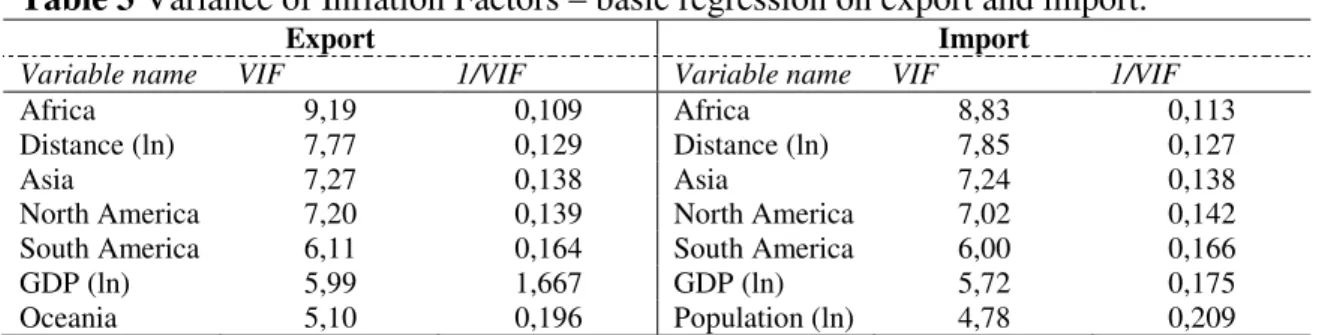
7.3.1 Variance Inflation Factor ... 48
7.3.2 Heteroscedasticity ... 49
8. Results ... 49
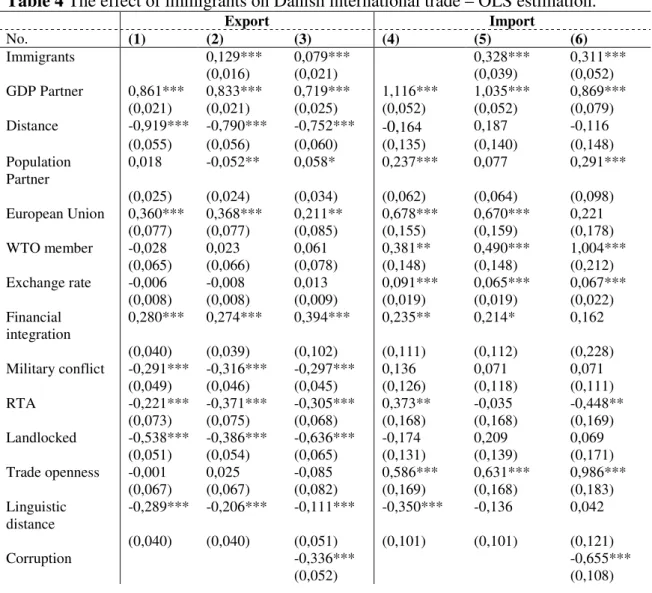
8.1 Does immigration increase Danish international trade? ... 50
8.1.1 Magnitude and importance of immigrants ... 53
8.2 Immigration as an indirect trade instrument ... 54
8.2.1 Institutional quality ... 55
8.2.2 Economic gap ... 57
8.2.3 Continents... 58
8.3 Immigrants as an information channel – goods classification ... 59
8.4 The role of descendants ... 61
8.5 Immigration as a FDI inflow projector ... 63
8.6 Immigration policy and time dimension ... 64
8.7 Interpretation of the results – practical aspects ... 66
8.8 Robustness test ... 67
8.8.1 Immigration-trade link check ... 67
8.9 Partial conclusion ... 69
8.10 Further research ... 70
9. Trade barriers, Project Kosmopolit and utilization ... 70
9.1 Exploitation and level of utilization in Denmark ... 71
9.2 Project Kosmopolit – a Swedish application and organization ... 72
9.3 Danish trade obstacles ... 73
10. Results, implications and recommendations ... 75
10.2 Bridging the gap - a strategic initiation ... 77
10.2.1 An immigrant business network in Denmark ... 79
10.3 Immigration policy ... 80
10.4 Critics of the DREAM model ... 81
10.5 Welfare implications ... 82
10.5.1 The welfare state paradox ... 83
10.6 The authors remarks ... 84
11. Conclusion ... 85
12 References ... 88
13 Appendices ... 102
List of tables
Table 1 (Litterature review) ... 14Table 2 (Immigrants in Denmark) ... 24
Table 3 (Variance of Inflation Factors) ... 48
Table 4 (The effect of Immigrant on Danish Trade) ... 50
Table 5 (The Effect of origin characteristics) ... 54
Table 6 (The Effect of immigrants by level of product differentiation) ... 60
Table 7 (The Effect of descendants on trade) ... 61
Table 8 (The Effect of immigrants on FDI) ... 63
Table 9 (Impact from the immigration policy reform in 2001) ... 65
Table 10 (Robustness check) ... 68
List of figures
Figure 1 (Population heterogeneity in Denmark) ... 261. Introduction
At the moment five ministries, Ministry of Finance, Economic and Business Affairs, Interior and Health, Refugee, Immigration and Integration Affairs and Ministry of Employment, are finalizing their analysis of the economic consequences from immigration to Denmark. In April 2011 interim results were published. The subject of this thesis has its background and motivation in those presented results and can be viewed as contributions and comments upon the calculations to some of the related economic questions that it raises.
The estimated annual costs in year 2010 from immigration, that is both immigrants and their descendants, from less developed nations was presented to be approximately 16 billion kroner per year1 (Regeringens arbejdsgruppe, 2011), but this estimation has been widely criticized by specialists and experts due to a number of reasons pertaining to the foundation of the calculations. Among the weaknesses and shortcomings that have been pointed out are the omission of critical variables and a possible misspecification of the applied model. The absence of factors such as level of education and age may result in possible bias of the results. Due to the outlook of the population, 2 3⁄ of the descendants are between 0-15 years old and thereby do not generate any direct revenue through taxes, the report is likely to give an inaccurate outcome. Additionally the model employed is static and therefore only gives a snapshot of the public financial costs such as present revenue and costs. Other critics conclude that the calculations just confirm what is already considered a known issue; immigrants have a lower participation rate than ethnic Danes (MM, 2011).
Immigration policy has previously been a highly sensitive and contentious political and social issue in the western world but during the last decade the rhetoric in the public regarding immigrants and immigration policy has intensified. The costs that immigrants are calculated to impose on the host countries has been a common focus in political debates. Concerns about increased labour movements and its influence on the social services, welfare systems, labour market and cultural institutions have fostered the
1
This number composes of a net cost from immigrants and descendants of 4,0 billion DKK and 11,7 billion DKK, respectively. The numbers regarding developed countries is a surplus of 4,7 billion DKK and 2,5 billion DKK for immigrants and descendants, respectively. The numbers are based upon the newest calculations which are performed by the Danish Rationale Economic Agent model (DREAM). The computation was ordered by Center for Political Studies (CEPOS) (Regeringens arbejdsgruppe, 2011).
European governments to increase the restrictiveness of its immigration policy (White, 2007b) and (Hiller, 2011). Furthermore, international political and civil unrest and persistent economic disparity between developed and developing countries causes continued increase in future immigration pressure.
Past tightened immigration policies indicate that immigration politically is not viewed as a potential part of the solution to the problems that Denmark faces in the coming years. This can prompt some adverse and detrimental effects on the outlook of the labour market. As is the case for many European countries in the forthcoming years Denmark is expected to have a considerable decrease in the labour supply due to a declining and ageing population (Coppel et al., 2001). The present situation with strong focus on the negative effects and costs imposed by immigrants has entailed limited attention to the contribution of possible benefits from immigration e.g. larger variety of products, lower wages in the service sector, increased trade integration etc. Previous studies and research have shown that immigrants bring some superior knowledge about culture, business policies, contacts, linguistic and about the regulatory environment of their country of origin. This expertise and unique know-how about their origin country can help lower trade costs between country of birth and country of residence by providing an information channel that reduces trade barriers and frictions, which can facilitate trade and investment relations (Hatzigeorgiou, 2010a).
The dynamic effects and influence from immigrants described above and the deflected revenue have not been included in the calculations of the costs from immigration. These so-called indirect economic effects have previously been investigated and detected in a number of countries including Denmark. Calculating and quantifying the costs and benefits of a specific economic phenomenon is always a potential object for discussion due to the very nature of such an analysis - even if calculated accurately (White, 2009). Some factors are very difficult to monetize and the question about at what detail level the analysis should be based upon are both issues, which make findings across studies hard to compare directly. Nevertheless, regardless of this discussion the findings in this paper will contribute with some additive aspects of the phenomenon, which has been absent in earlier calculations and from the public and political debates in general.
The outlined problem with the lack of awareness and attention towards the appointed benefits from immigration in Denmark is the starting point for this thesis. This research
will provide a better understanding of the competences that immigrants possess by quantitatively investigating the effect of immigration on the Danish international trade and FDI inflow and sketch a strategic initiative for a more optimal utilization. Organizing this knowledge in a more comprehensive way can support and remedy some of the problems that Denmark is to be confronted with in the near future. Applying the results can foster increased foreign trade and investments, create more jobs, induce higher growth and facilitate internationalization. This study and concretization of these additional effects should contribute to a broader and more complete perspective of the immigration picture in Denmark and accounting the net influence of immigrants. In the setting of policy formulations the understanding of such complex links is very important because increased immigration policy restrictiveness may discourage trade and foreign direct investments flows across borders.
It should be stressed that this thesis is not political motivated. It is primarily founded in the situation outlined above, which reveals an interesting paradox. Immigration is calculated to be a financial burden to the Danish economy in 2010, despite the fact that immigration and free mobility of labour across borders are thought to be beneficial, theoretically.
1.1 Purpose and delimitations
The specific purpose of the thesis is to investigate the theoretical links between immigration and import, export, and FDI inflow from the origin-countries in the case of Denmark. The study is founded in the augmented gravity equation where data on bilateral trade flows, export and import, and FDI inflow is applied from the period 1995-2008.
The thesis examines two main hypotheses, which both are formulated upon the relating theory. The first hypothesis pertains to the immigration-trade link and is listed below.
H1: There is a positive relationship between the number of immigrants from a
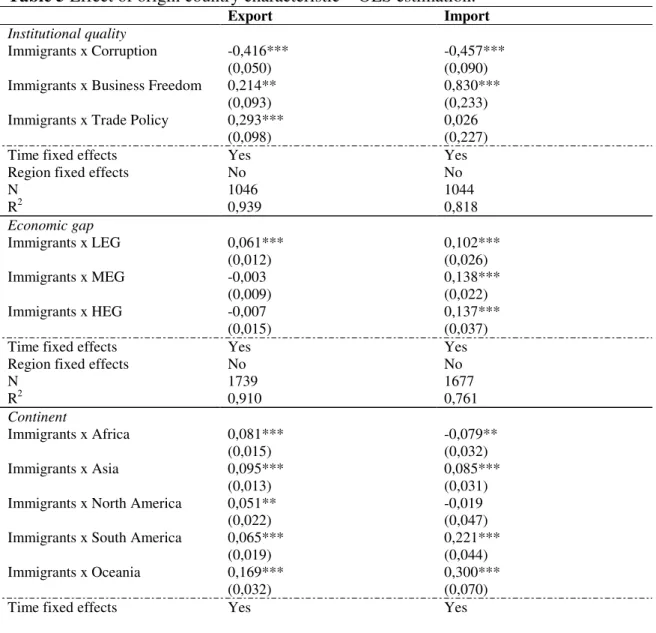
The literature, which will be presented in detail in section 2.2, describes a large variety of theoretic channels through which immigrants influence the relationship between two countries and enhance their bilateral trade. The two most common channels are the transplanted bias effect and the network effect. The case of Denmark is further supported by (White, 2007b), who found a significant and positive immigration-trade link for Denmark investigating data from the period 1980-2000. In order to establish a solid basis to infer that immigrants generate and strengthen Danish trade the following sub-hypotheses will be tested. These are founded in previous literature and theory and the overall aim is to investigate the possible heterogeneity in the immigration-trade link.
• Coefficients on immigrant stock variables are of greater magnitude if import is employed as the measure of trade as compared to when export is employed. • The more institutional dissimilar Denmark is to its trade partners the stronger
the immigration-trade link.
• The more economically dissimilar Denmark is to its trade partners the stronger the immigration-trade link.
• The immigration-trade link differs depending on regional location.
• The link between immigration and trade varies based on product type with the strength of the link increasing with the degree of product differentiation.
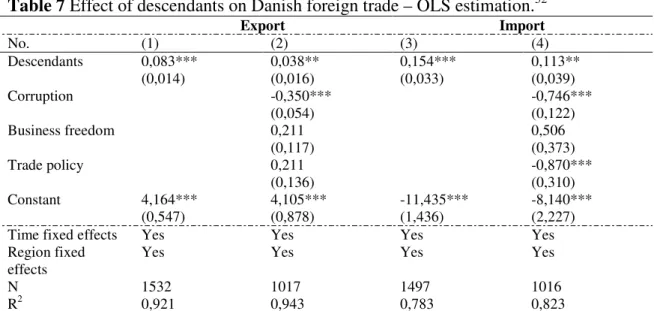
• There is a positive relationship between the number of descendants from a given country and Danish bilateral trade flows with that country.
Analyzed in a standard trade-theoretical framework capital and labour should be substitutes, but as will be argued there is well founded background to state that the two factors flow in the same direction and a complementary relationship persists (Navaretti et al., 2007). The second main hypothesis builds on this.
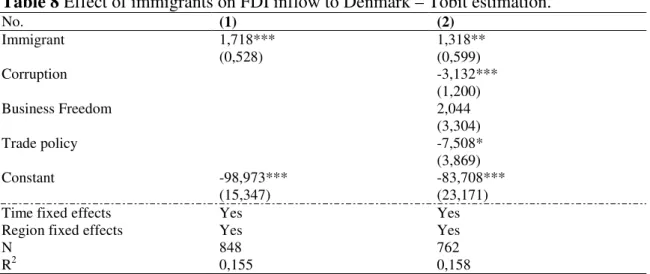
H2: There is a positive relationship between the number of immigrants from a
given country and FDI inflow to Denmark from that country.
When comparing the need for information in relation to FDI activities to international trade a much more detailed level of knowledge is required (Tong, 2005). FDI generally requires long-term focus and involvement of an extensive and diverse group of agents
(Javorcik et al., 2011). Derived from this immigrants are thought to have a stronger effect pertaining to FDI inflow than on trade. The following sub-hypothesis is based on this.
• The link between immigration and FDI inflow is stronger than the observed immigration-trade linkage.
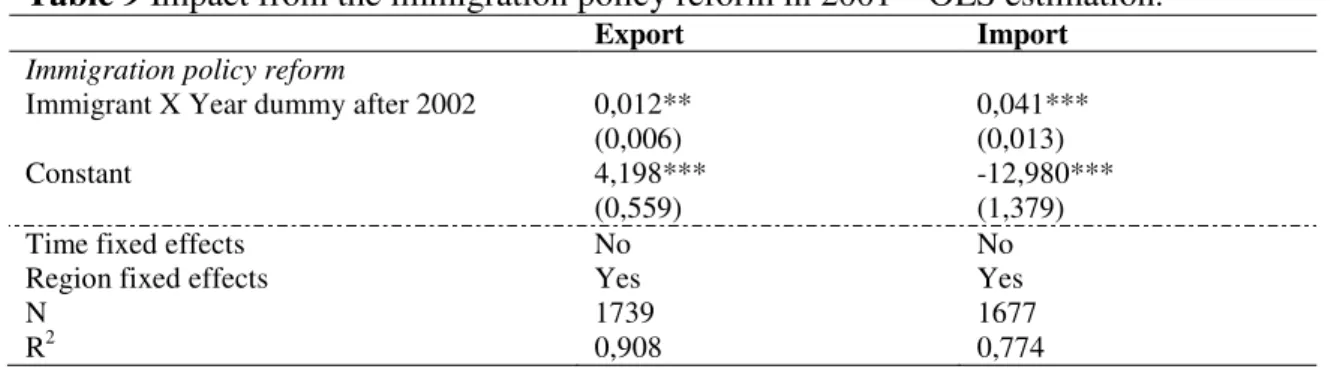
During the period investigated an immigration policy reform was conducted in 2001. Thus, this reform might change the annual immigrant inflow pattern to Denmark and thereby a possible alteration of the immigrant stock composition. This entails the possibility of shifts in the outlined nexus between the immigration and trade. This generates the following hypothesis.
• The immigration policy reform in 2001 has had a diminishing effect on the Danish immigration-trade link.
The hypotheses will serve as the foundation for an examination of practical aspects that possibly have influenced the outcomes of the quantitative analysis. In the literature the effect from immigration is described as an autonomous effect and hence present without any concrete facilitation. To secure that the estimated elasticities exclusively represents an autonomous effect an investigation of the existing awareness of the subject is conducted. That is, whether immigrants strategically have been applied in the purpose of promoting and strengthening bilateral trade and FDI inflow to Denmark or not. Upon the examinations applicable recommendations are derived on how the outcomes can be integrated into practice.
1.2 Structure and outline
The structure of the thesis is divided into four main parts. The first part serves as a theoretical foundation consisting of a presentation of relevant theory regarding immigration, bilateral trade flows and FDI inflow. Subsequent follows a review of previous research investigating the effect from immigration on trade and FDI inflow. Next follows a clarification of the calculated cost from immigration in Denmark, a description of Danish immigration policy in a historical perspective, and a descriptive
overview of immigrants in Denmark. The second part contains the choice of the econometric models applied and a description of the data the empirical analysis will be based on. This serves as the basis for third part, which is a presentation of the results from the different regressions and tests of the stated hypotheses. Along with the presentation of the results a description of how the results should be understood and the possible implications will be provided. The fourth and final part investigates practical aspects of the results and set the outcomes in to context and perspective on how the results can be applied in Denmark.
2. Theoretical background
This section describes the theories that the empirical work is to be founded in. The first part describes the movements of trade, capital and labour flows in a theoretical context. The second part concerns the theory regarding immigration-trade link and the link between immigration and FDI. The primary focus is on the channels and mechanisms through which immigrants can influence bilateral trade relations and FDI inflows.
2.1 Trade models and international capital movements
When analyzing the mobility of production factors – capital and labour - The Heckscher Ohlin and The Ricardian Model are the typical models applied and have shown to be very applicable (Van Marrewijk, 2007). The relationship between capital and labour is traditionally examined by focusing on whether these are complementary or substitutes. Substitution can be defined as if the factors, capital and migration, seen from the perspective of a given location, move in opposite direction or as complements when they move in the same direction (Navaretti et al., 2007). The assumption behind the Heckscher Ohlin theorem is that production factors are immobile across trading partners. Analyzed in this perspective the exchange of goods is a way to get access of the scarcer production factor, which is incorporated in the imported goods (Malchow-Møller et al., 2009). Without the assumption of immobile production factors there would be no obvious economic reason for trade and factors would simply flow to where it is relative scarce and best remunerated. E.g. capital would flow to the labour abundant country and labour would flow to the capital abundant country. Consequently, price differentials would be reduced and the economic incentive for trade would consequently
diminish. As depicted, then in the Heckscher Ohlin theorem, trade works as a substitute for immobile production factors. In this outlined standard trade framework the relationship between migration and trade and migration and FDI is substitutional. Labour and capital are substitute ways to match workers and employers located in different countries (Navaretti et al., 2007).
Analyzed in the settings of the Ricardian model the relationship is characterized as the exact opposite (Feenstra and Taylor, 2008). In this framework where the main reason for trade is explained by differences in technologies and productivity across countries a complementary relationship can be observed between capital and labour flows if factor movements are allowed. Due to these differences an economic incentive has been set up for capital and labour to flow where it can be employed most efficiently. Depending on which setting and model applied in the analysis dictate how trade and investments should move theoretically.2
2.2 Immigrants and trade
The theory presented above represents the traditional approaches when analyzing trade patterns and factor mobility. Empirical literature however has found a complementary relationship between capital and labour flows and that immigration can influence the directions and magnitude of this mechanism. Therefore, the description below can be viewed as extensions and contributions to the grounded trade models.
At an aggregated level international labour mobility changes the labour supply in the host and origin country and thereby also the production of and the demand for goods in the two nations. As a consequence trade is increased, but substantial fixed costs are faced before initiating trade. Previous studies have noted that immigrants can influence and enhance trade. One of the pioneers to investigate and describe the theoretical channels through, which immigrants can influence the bilateral trade relationship between two countries was (Gould, 1994). The argument was that the level of trade is influenced by immigrants through two channels; the transplanted bias effect and the
2 These derivations are dependent on the type of FDI; horizontal or vertical. Theory predicts a substitutional link between horizontal FDI and trade - instead of exporting, the goods are produced locally. In the case of vertical FDI and trade a complementary relationship predicted. Vertical FDI can generate international trade flows due to export back to the FDI source country (Kim 2006).
network effect. When immigrants enter the host country they often tend to have a preference for familiar or home-country products. Moreover, foreign products often tend to differ in both quality and tastes compared to goods available in the host country. The unavailability of these differentiated products or satisfactory substitutes can potentially increase the import from the origin country, which is called the transplanted bias effect. Further, even though immigrants over time assimilate and adapt to the environment of the host country they often still maintain consumption of familiar products related to the culture and heritage. This can be seen as “holding on” to traditional values preserving their “native heritage” (Epstein and Gang, 2006). Additionally, the magnitude of this effect is dependent the size of the different immigrant stocks (Hatzigeorgiou, 2010a). The transplanted bias effect only relates to the increased flow of goods from the source country to the host country, which makes it solely having an impact on import to the country of residence.
The network effect is sometimes described as twofold and works through the information or network mechanism. As oppose to the transplanted bias effect this can potentially both affect import and export. First, immigrants often have some unique knowledge about the markets and business contacts in their origin country. E.g. the network mechanism can induce greater trust when dealing with contacts in the country of origin due to a greater understanding of norms, procedures and business practices. This can establish a trust relationship between the residence country and the country of origin and thereby reduce communication and negotiation costs (Hatzigeorgiou, 2010a). Second, culture, colonial and historical ties, common language and knowledge of political and social institutions can reduce trading transaction costs. This can be reflected in knowledge in relation to products and characteristics in both host and origin country. In this way new trade opportunities can be revealed (Wagner et al., 2002). This is often referred to as, the information channel. Immigrants who are bilingual and share common language with residents in both host country and country of origin can facilitate the relation between the two countries by reducing information and communication barriers and frictions thereby reducing trading transaction cost (Gould, 1994).
As described immigrants can reduce trading costs and these can be affected from different directions. The extra costs that arise compared to domestic trade are due to information asymmetries across borders. Difficulties of gathering reliable information
drive up the associated costs of import and export (Hatzigeorgiou, 2010b). National borders define political and legal environments, this constrain contract enforcement due to national sovereignty jurisdictions across borders (Rodrik, 2000). Limited contract enforcement and lack of information about how foreign markets function will in the same manner as transportation costs or tariffs induce trading transaction cost. Immigrants networks that possess superior knowledge about home country markets and business contacts can lower these costs. Furthermore, networks can possibly enforce cross-border contracts that alternatively would have been difficult to enforce or non-existent, this mechanism is especially important in regions where the legal environment may be weak (Gould, 1994). It can be argued that strong ethnic networks allow for international trade despite a large moral hazard problem (Greif, 1993).
The network effect and thereby the reduction in trading costs depends on the initial level of information available about the immigrants country of origin. Immigrants and their ability to influence and spread the knowledge is determined by different aspects such as integration into host country communities, duration of stay, level of education and the size of their community (Concalves and Africano, 2009).
All together the two described channels can reduce trading transaction costs, which can foster trade relations between the host country and the immigrant’s country of origin. Whereas the network effect affects both import and export the transplanted bias effect only influences import.
2.2.1 Immigration and foreign direct investments
The effect and role of immigrants on FDI activities is to a great extend similar to the network effect outlined above where the formation of business links can stimulate and facilitate FDI flows to a particular location. When an investor is involved in an international transaction some informal and formal barriers have to be coped with. These barriers often concern difficulties related to the information regarding investment opportunities and the legal and regulatory environment across national borders. The difficulties associated with collecting the necessary information makes it costly, which might increase with greater distance and national borders. In sum, cross-country business and formal networks help overcome barriers and consequently stimulate mutually beneficial international transactions (Javorcik et al., 2011). Investing abroad often tend to include a wide range of people involved. That is suppliers, workers and
government officials, who require detailed level of knowledge about local markets. In total this will augment the complexity of the decisions and transactions compared to international trade (Dolman, 2007). FDI activities generally have the need of a long-term focus and collaboration with a diverse group of people. Immigration networks can establish the required links to achieve efficient distribution, procurement, transportation and satisfactory regulation (Kugler and Rapoport, 2006). Because long-term investments are thought to benefit relatively more from the lowered risk and costs due to immigration networks it can be argued that immigrants affect FDI flows to a greater degree than it is the case for international trade (Foad, 2011).
2.2.2 The role of individual characteristics
The role of immigrants and their ability to facilitate trade and influence trading transaction costs might depend on several different characteristics both individual, non-individual and the type of product traded. Regarding the transplanted bias effect the intuition is that when products are homogenous there is little reason to prefer product from a specific country and the effect is expected to be stronger in the case of final or differentiated products. In the end, the preference approach can act as a stimulus to intra-industry trade (Concalves and Africano, 2009). The magnitude of the effect is larger the more dissimilar host- and source country are, fewer reasonable substitutes are available (White, 2007a).
In addition to the network effect other aspects might influence the magnitude of the effect from immigration. Gould (1994) argued that the effect from immigration on trade could not be characterized by a constant elasticity relationship. Moreover, the effect from immigration is likely to be dependent on how much information about a certain economy that already exists in the host country. The more information about a nation or a market that the host country possesses the less value will an additional immigrant potentially add. This implies that the marginal effect from immigration on trade decreases with the size of the immigrant stock. The non-constant elasticity is further described by Head and Ries (1998), which measured the immigration-trade link based on the purpose of stay of the immigrant; family, refugee and independent. Herein is implicit assumed that the effect vary in magnitude with the group, independent expected to have the largest effect. This is based on the fact that these immigrants tend to be more skilled or educated than other groups of immigrants. The probability that a more skilled
immigrant possesses some superior knowledge and contacts relating to their country of origin seems more likely compared with the other groups e.g. refugee. Finally, the level of additional information that immigration contributes also depends on the characteristics of the country of origin. If the immigrant comes from a country with similar social and political institutions compared to the host country the amount of new information added might be limited. This is often the case for countries that share colonial or cultural ties, e.g. countries in the European Union (Blanes-Cristóbal, 2008). This underlines the role and importance of immigrants pertaining to knowledge about social and political institutions from dissimilar countries. In this setting an immigrant with a set of completely different characteristics can possess valuable information and therefore can reduce transaction costs more than an immigrant from a source country with similar institutional outlook.
3. Literature review
This section seeks to give an overview of previous studies of the effects from immigration on trade and FDI inflow. The literature investigating the links have generally found that these effects are positive but that the estimates and size of these effects vary widely according to the period investigated, countries in focus, data applied and estimation method. The number of studies has grown over the past years and provided evidence for the existence of a significant positive immigration-trade link but the nexus between immigration and FDI inflow is still a relatively unexplored area. Different approaches have been pursued to empirically investigate these relationships but the majority of the work has been grounded in the augmented Gravity model. In general the variations in the results underline that these results are not transferable across time periods and countries. Additionally, the differences in the estimates can be explained due the lack of a specific grounded econometric approach; estimation methods simply differ across studies.
3.1 Previous research on immigration and its potential effect on trade
Gould (1994) was one of the first to investigate the impact from immigration on US import and export in the period 1970-1986. The results demonstrated that immigration had a positive influence on US trade and that the effect was stronger for export than
import. An additional conclusion derived was that the magnitude of the effect on immigration varied according to type of good traded with a stronger effect on consumer products than producer products. Head and Ries (1998) studied Canadian trade with partner countries and confirmed the positive influence from immigration on trade but in this analysis the effect on import was greater than on export. Subsequent, even though much of the empirical work is carried out with US in focus, similar studies have found a positive association between immigration and trade for other periods and countries that is (Girma and Yu, 2002) in United Kingdom, (Wagner et al., 2002) in Canada, (Blanes-Cristobal, 2003) in Spain, (Bryant et al., 2004) in New Zealand, (White, 2007b) in Denmark, (White and Tadesse, 2007) in Australia and (Hatzigeorgiou, 2010b) in Sweden.
A study, particular relevant in the context of this thesis, is White (2007b) who tested the Danish immigrant-trade link in the period 1980-2000 with 170 countries employed. Besides investigating the association between immigration and trade countries included in the analysis were classified according to their income and trade was divided by product differentiation. Differentiated products are characterized by potentially incomplete information this implication entails that an immigrant possess asymmetric information in relation to contacts and network connections, which is thought to diminish for homogenous products compared to differentiated products. The findings were a positive immigration-trade nexus and that the magnitude of the link varied across income classification and product differentiation. The greatest magnitude was found when considering countries classified as high income and weakest magnitude but still positive when examine low income countries. This aspect was further explored by Hatzigeorgiou (2010b), who examined the role of economic development since information failures are more common in poor countries. The findings showed that the level of economic development influenced the effect from immigration on Swedish export but not import. The results strengthened the hypothesis that the immigration-trade link is stronger for immigrants originating from less developed countries than developed countries. The literature has further explored whether the effect from immigration varies according to several other origin country characteristics. The rationale is that social and institutional dissimilarity between the host and the origin country increases the strength of the immigrant-trade linkage. In this setting with large information asymmetry an immigrant from an institutionally and socially dissimilar
country is thought to be able to add more new information, which may boost trade to a larger degree than an immigrant from a similar country. A related subject here is corruption. Dunlevy (2006) suggested that the immigrant effect was greater on US trade when the political system of the origin country is more corrupt.
In much of the previous empirical work it is assumed that the estimated influence of immigration is the same across all ethnicities but removing this restriction reveals that this might not be the case. Bandyopadhyay et al. (2008) investigated US export from 51 states to 29 countries and allowed for a country-specific effect with the result that the estimated effect only was significant for five countries, further that the effect was much larger than not restricted to be homogenous across countries.
Person-specific characteristics and the role of education have also been tested. Blanes-Cristobal (2008) found supportive evidence that before immigrants were able to fully exploit contacts, network and the knowledge of their country of origin, the immigrants were required to have a certain level of education. This heterogeneity of skills was much in line with the results from Head and Ries (1998) in which the immigrant group “independent”, who was characterized by being relative more skilled than the other groups, had the most pronounced effect on trade. White and Tadesse (2007) analyzed the role of immigration policy on trade in relation to Australia. The examination was based on data from 101 Australian trading partners in the period 1989-2000 investigating the influence of immigrants from nations afforded preference under the White Australia policy and nations not afforded; non-White Australia policy. Collectively, it was concluded that the abandonment of the White Australian policy had led to increased cultural diversity and thereby influenced the Australian trade patterns. It was argued that due to the effect from immigration on trade flows this is needed to be considered when formulating immigration policies. This is supported by several studies among them White (2009).
Generally, the work done so far has found a significant and positive relationship between immigration and trade but also that the magnitude varied whether import or export was analyzed. The theory and literature were further explored and extended by including aspects pertaining to the role of individual and non-individual characteristics, product specifications and origin-country characteristics. Selected empirical papers are arranged in the table below.
Table 1 Literature of immigration stock elasticity on trade.
Study Data Export
elasticity
Import elasticity
(Gould 1994) US, 47 trading partner countries, 1970-1986.
0,02a 0,01a
(Head and Ries 1998) Canada, 136 trading partner countries, 1980-1992.
0,1 0,31
(Girma and Yu 2002)b UK, 48 trading partner countries, 1981-1993.
0,50c 0,19c
(Wagner, Head and Ries 2002)
Canada, 160 trading partner countries and between five Canadian regions, 1992-1995.
0,08 0,25
(Blanes-Cristobal 2003) Spain, 40 trading partner countries, 1991-1998.
0,23 0,03
(Bardhan and Guhathakurta 2004)
US export from East and West Coast and 51 trading partner countries, 1994-1996.
0,239d 0,059d,e
Na (Bryant, Genç, and Law
2004)
New Zealand, more than 170 trading partner countries, 1981-2001.
0,09 0,15
(White 2007a) US, 73 trading partner countries, 1980-2001.
0,113f 0,13f
(White 2007b) Denmark, 170 trading partner countries, 1980-2000.
0,572g 0,328g
(White and Tadesse 2007)
Australia, 101 trading partner countries, 1989-2000.
0,46 0,18
(Bandyopadhyay, Coughlin and Wall 2008)
US, 29 trading partner countries, 1988-1992 and 1998-2002.
0,142 Na
(Blanes-Cristobal 2008) Spain, 83 trading partner countries, 1995-2003.
0,28 0,18
(White 2009) US, 70 trading partner countries, 1980-1997.
0,204g, h 0,05e, g, h Notes: a The elasticities are calculated by (Wagner et al. 2002) b Elasticities are from the regression specification including a lagged dependent variable c Non-commonwealth countries d East and West Coast e Insignificant at 10% f Only immigrants from low income countries significantly influence trade g The effects are based on high income countries h Differentiated goods.
3.2 Previous literature of immigration and its effect on FDI inflow
As pointed out in the theory part the literature exploring FDI inflow and immigration is relatively new, which is reflected in the scarcity and limited number of studies investigating the possible linkage. The prior work has primarily focused on the nexus between emigration and FDI outflows. Theoretically, channels through which immigrants can have an impact of FDI flows are double-sided and pertain to both inflow and outflow.
The research solely focusing on immigration and FDI inflow is limited to a small number of sectorial case studies investigating the mechanisms through which
immigrants and FDI seem to complement each other e.g. in the software industry.3 In this context immigrants are thought to evoke their influence via business networks and by integrating into business communities. This facilitation is not only restricted to skilled immigrants but also concern unskilled immigrants, who can convey information, which can contribute to relax information constraints on FDI e.g. about workers characteristics (Kugler and Rapoport, 2007). Tong (2005) studied ethnic Chinese networks in facilitating and promoting cross-border investments between countries. Developed Chinese migrant networks can serve as a center of information exchange between coethnic business people both on local, national and international level and the migrant networks can therefore be considered as a set of inter-connected networks at different levels. The analysis included 70 countries in the period around 1990. It was found that Chinese networks significantly increased FDI inflow and that the effect was larger in developed countries. The paper concluded that even though the results were based on Chinese networks it did not imply that the effectiveness only was valid and limited to this ethnic group. The effect of networking activities in promoting and facilitating investments between countries could play a significant role for other ethnic groups as well. Buch et al. (2003) estimated the link between stocks of inward and outward migration and FDI in the case of 16 German states. They found supportive evidence for a strong positive link between German emigrants and stocks of FDI abroad and a positive but weaker evidence for immigration of foreigners and inward FDI. The study found that cultural linkages in international economic relations were an important additional aspect to the traditional factors affecting international factors movements. An alternative approach to investigate the complementary relationship is in the perspective of emigration and FDI outflow. Findings from Kugler and Rapoport (2007), who studied US FDI outflows in 1990 and 2000, suggested that migration and FDI were contemporaneous substitutes and dynamic complementary. The impact varied according to school attainment with a more prone effect from migrants with the highest attainment. The exact same results were supported by Javorcik et al. (2006). As the above literature indicates immigration is not unilateral in its influence, but both FDI inflow and outflow can be influenced, simultaneously. Flisi and Murat (2009) analyzed this for five different countries with time spans going from 1990 to 2006 and found that immigration had a positive and robust effect on bilateral FDI for three countries – both
inward and outward. This was further supported by Gheasi et al. (2011), who tested the robustness of the relationship between migration and FDI based on a meta-analysis. The results confirmed that immigration had a positive impact on FDI on both inward and outward and that these impacts were higher when migrants were highly‐educated and skilled.
Going through the literature the question of reverse causality arises - that is whether immigration influence FDI inflow or vice versa. Groznik (2003) examined net FDI flow into 21 developed, 14 emerging and 13 transition countries in the period 1950-1997 with the rest of the world as source countries and found that immigration had a positive influence on FDI inflow. Based on FDI and migration flows between Canada and USA during the period 1967-1995 the study concluded that not only did migration flows precede and help explain FDI flows by moving in the same direction but also that labour led capital. Similar results were found by Kim (2006), who investigated immigration, FDI inflow and import in the United States using data from 1969-2000. The study found significant evidence that immigration both led and caused import and FDI inflows. The two studies collated indicate that international labour movements are a forecast of future FDI flows.4 Lucas (1990) presented three explanations for the complementary relationship that were productivity- and human capital differences and labour market imperfections. Political instability, opaque regulations and the risk of appropriation all raise the cost of making long-term investments in foreign country. E.g. this might be the explanation why less capital flows are seen to developing countries.
4. Clarification of the immigration cost paradox
This section pursues to clarify the paradox presented in the introduction. Immigration is calculated to be a financial burden to the Danish economy in 2010, even though in a theoretical context immigration and the free mobility of labour across borders are viewed to be beneficial. Furthermore, Danish immigration policy in a historical perspective will be presented. Prior and the presented calculations of the costs from
4
The results from the two studies and that immigration flows are a leading indicator of FDI flows are based on Granger causality tests. This test does not necessarily leads to the conclusion that movement of labour “causes” movements of FDI but only that immigration flows lead FDI flows.
immigration might be a part of the explanation for the development and transformation that the Danish immigration policy has undergone.
4.1 Labour mobility
Effects from international migration flows are often seen as an integrated part of international trade theory. In a standard trade theory, like the presented Heckscher-Ohlin Theorem, labour is immobile across countries and trade works as substitute for migration flows (Moses and Letnes, 2004). Alternatively, in the case of free mobility the incentive and the economic reasoning is that factors will flow where it is the most productive. Labour will benefit thus obtaining a higher income and the host country benefit in that the more productive employment of the labour implies cheaper goods and services. The economic consequence from mobility of labour across countries is the same as for free trade between countries; production factors will locate where they are most productive (Poot and Strutt, 2010). Other beneficial effects also prevail to both the sending and receiving countries. While immigrants benefit from higher incomes due to a more optimal allocation the sending countries benefit through the increasing marginal product of labour and therefore higher wages of those left behind. Additionally, receiving countries benefit through the so-called immigration surplus that accrues to the owners of capital with complementing from of immigrants (Borjas, 1999b).
Analyzing labour movements between countries in the Specific-Factors model it is assumed that only labour is a mobile factor in the short run whereas the factors, capital and land, are fixed.5 The model predicts that immigration will lower wages in the country in which the workers arrive. As the wages fall due to immigration owners of the specific factors – either capital or land – will benefit through a rise in the marginal product of the specific factor. The assumption that capital and land are fixed is reasonable in the short run, but in the long run factors can flow between industries, which will change the effect of immigration on wages and rentals. When solely analyzing two of the three factors the long run model is similar to the Heckscher-Ohlin model. In the long run immigration can affect the output of a country by restructuring the country’s industries; increasing the output of the labour-intensive industry and decrease the output of the capital-intensive industry. One of the implications in the short run is that native labour in the host country face competition from immigrants and
receives lower wages while owners of capital and land benefit from immigration (Feenstra and Taylor, 2008). This result is complemented by the simple framework stated by (Borjas, 1995). In this setting the calculated gains and losses differ across different groups in the population. Whether the native labour gain or lose depends on their productive endowments; natives, who have productive endowments that complement those of immigrants, gain, while natives, who have productive endowments that compete with those of immigrants, lose. The effect is that the host country benefit as long as natives and immigrants differ in their productive endowments – bigger differences in endowments resulting in larger benefits. In conclusion this means that gains are not evenly distributed across population groups in a society due to the differences in endowments of the native labour. Summing up then there are overall gains to the host country. In total, the theories predict that labour moves to where it is the most productive and that there are gains to both the country of origin and the host country. Even though the economy as a whole gains from immigration then the unevenly distribution of the gains make some population groups very vulnerable.
4.2 The cost paradox of immigration
With the basis in the theory described above it seems singular that immigration at a macro perspective is calculated to be a financial burden to the Danish economy. A more closely look upon the model used to compute the results reveals possible explanations why immigrants and their descendants have an overall negative impact on the public finances and differ from the predictions upon the theories.6 The paradox arises due to the presence of existing welfare benefits and certain characteristics of immigrants. Investigating the characteristics of immigrants in Denmark elucidate why there is a financial burden in the setting of the DREAM model. The parameters in which immigrants distinguish compared to ethnic Danes with regard to economic conduct are primarily unemployment tendency, productivity when at work, and the extent to which they receive public transfers and enjoy individual public consumption (Schou, 2006).7 Explanations for these immigrant characteristics are diverse among them labour market imperfections and welfare generosity. Labour market imperfections might originate in the relative shortage of unskilled jobs in Denmark and high minimum wage. These
6
A presentation of the model applied in the computation of the results follows in appendix A. 7 Even though this part is based on a study from 2006 the characteristics are still present today.
imperfections imply that differences in educational and linguistic skills lead to employment differences rather than wage differences between groups (Pedersen and Smith, 2002). An important aspect that affects the level of labour market integration is the duration of the residence in Denmark. The speed of the assimilation process to the same economic conduct as ethnic Danes varies according to the personal characteristics of the immigrant e.g. language skills, schooling and educational level (Husted et al., 2001).8 An alternative explanation is that the high unemployment rate might be a reaction to the presence of a generous welfare system. For some immigrants during the period investigated there has been a large dis-incentive to work because of the weak or even negative financial incentive to work despite the relative high minimum wage in Denmark (Indvandring, integration og samfundsøkonomi, 2002).
From a life cycle perspective certain features entail that the net costs to the public sector are not as large as could be expected based on the calculations of the costs from one year. Two explanations given are the age distribution at the time immigrants enter Denmark and the organization of the Danish welfare society. The point of time at which immigrants enter is often during their working-age years - on average approximately in the mid-twenties (Stephensen and Pedersen, 2002). An integrated part of the Danish welfare system is a pay-as-you go pension system. The basic point of this is that people engaged in active employment through taxes pay to the young and elderly people. In this way the arrangement of the pension system means that each generation through tax payments pay for its parental generation (Pedersen, 2004). The fact that this generation of immigrants does not “carry” their parental generation with them means that if the immigrants through taxes are able to pay for the public expenses associated with themselves and their descendants their presence will not affect the public finances negatively while in active employment. This relation between generations in Denmark diminishes the requirements of payments that immigrants have to the public sector in order not to be a financial burden. The positive contribution of the first generation of immigrants when shifted forward in the future gives the Danish economy a one-time gain (Schou, 2006). The conclusion is that even though the net contributions from immigrants are negative in a given year then over a life cycle immigration can influence
8
Participation rates of those who have spent more than 10 years in Denmark are around double of those who have been in the country two years or less (Roseveare and Jorgensen, 2004).
the public finances positively due payments from the following generations (Pedersen, 2004).
5. Immigration policy
The following part is a description of the immigration policies conducted in Denmark. In the essence migration policy is an attempt to influence future immigration flows – the growth and the composition of the immigration stocks - and henceforth the public finances. This is described in a separate passage because tightened immigration policies influence immigration flows which consequently might affect the nexuses between immigration and capital- and trade flows. Furthermore, viewing Danish immigration policy in a historical perspective is an explanatory aspect of the immigration stock outlook today and thereby possibly also Danish trade and FDI inflow relations.
5.1 Immigration policy
When assessing whether the present immigration policy is optimal from a purely financial perspective and how it should be constructed in this setting a rule of thumb that has its background in Simon (1984) and Simon (1989) has been interpreted by DeVoretz (2004) is as follows:
“If the marginal immigrant makes a non-negative contribution to the treasury you continue to admit immigrants until the contribution goes to zero”
The rule simply states that as long as there is a positive effect to the public finances by an extra immigrant then the valid and current immigration policy should aim at increasing immigration. Obviously this rule is very simplified due to the presence of effects that do not affect the public finances but would be disregarded if the strictly following the rule. Nevertheless, the essence of the rule is whether the immigration under the present policies constitutes to a contribution or a financial burden to the country of residence. Additionally, it also explicitly addresses the immigration policy that should prevail considered from a strictly economic perspective.
Based on this it can be argued that the present and previous immigration policy has not been efficiently framed. In this context the calculated costs stress the need of
investigating the present immigration and social policies to avoid a future financial burden.
5.1.1 Historical Danish immigration policy
In a historical perspective the immigration policy in Denmark has undergone a radical transformation. In the period following the second world war Denmark had a very liberal immigration and social policy with relatively free immigration opportunities and a high requirement of being economic self-reliant. In this period immigrants in Denmark primarily came from other Scandinavian countries, Germany and United Kingdom. Up until the beginning of the 1970’s immigration into Denmark was economically motivated and labour that were able to provide for themselves had free entry. In these years Danish firms were permitted to hire and recruit workers with a foreign background due to the labour-market shortage with the main source countries being Turkey, Yugoslavia and Pakistan (Roseveare and Jorgensen, 2004). This liberal policy ended with the so-called guest worker stop in 1973 because of a rising unemployment. Many of the guest workers entering Denmark before the new regulations came into force did not emigrate back to their country of origin but resided in Denmark, permanently. Those immigrants residing permanently accelerated and acted as a catalyst to a new source of immigration due to the existing rules of the option regarding family reunion (Liebig, 2007). In the years after the immigration regulations were a mixture of national legislation and obligations in relation to the ratification of international refugee convention. In this period the group of de facto refugee and asylum seekers became very significant with Sri Lanka, Iran, Iraq and Lebanon being the primary origin countries and in the 1990’s Balkan, Afghanistan and Somalia. After 1983 the increased immigration gave rise to at the time present regulations and legislations towards an increased restrictiveness (Pedersen and Smith, 2002). The immigration policy revision in 1983 introduced legal claims on family unifications of children, spouses and parents plus the conception “de facto refugee” (Velfærdskommissionen, 2005a).9
9
The conception “de facto refugees” concern refugees that cannot directly be categorized as a refugee according to the UN convention but where there are similar basses where the persons concerned are not ought to emigrate their origin countries.
The immigration policy reform in 2001 was a culmination of a general tendency up during the 1990’s. The shift in entry policy was motivated by the increasing immigration pressure and the relatively weak labour market integration. The generosity of the public income and welfare system along with the easy entry had created a welfare magnet and improved economic and social integration of immigrants already staying in Denmark before adding more newcomers (Roseveare and Jorgensen, 2004). The ideas of the reform are highlighted in three main principles.10 First, immigrants from other Nordic source countries maintained free access to Denmark and without applying for residence permit. Second, immigrants from EU/EEA were allowed to come to Denmark for three months without residence permit or applying for a visa. Finally, other groups of immigrants could only get temporary or permanent residence if they had the status as a refugee, asylum seeker or family reunion. People of the last categorization were the group, which had attracted the most attention in the public debates. This was reflected in the tightening of immigration policy specifically towards this type of immigrations flows and immigrants from non-European countries. This selection process was likely to affect the characteristics of the immigrants e.g. in relation to educational skills and country of origin (Hiller, 2011). The impact of the reform was detected immediately; in 2002 there was a decrease in around 50% in applicants for asylum whereas it remained stable in the overall applicants in the European Union (Roseveare and Jorgensen, 2004). Immigration policy for an individual country is often dependent on international conventions and legislation e.g. for asylum seekers and refugees. Initiatives to regulate immigration regarding this type of flows are as a result very limited. A group that is not regulated by international legislation is family unification. This group constitutes the largest category of residence permits in Denmark. In order to employ this option severe requirements have to be satisfied by this group of immigrants. Consequently, this might be due to the lack of dependence and control regarding other type of immigrant inflow (Pedersen and Smith, 2002). The immigration policy transformation can be explained by the size of the immigration flows and the difficulties and challenges in relation to labour market integration and their usage of welfare and social benefits.
The development of strong immigration pressure from less economic developed countries can be explained in a theoretical framework (Borjas, 1999a). Denmark is
characterized by a high and progressive tax pressure, a compressed wage structure universal and generous welfare and social benefits. The result is that the composition regarding immigration flow might induce a selectivity problem for the Danish economy, meaning that less skilled immigrants are attracted due to the “magnetic” welfare effects whereas skilled immigrants chose and prefer a country with higher rewards (Pedersen and Smith, 2002).11 Over the years Denmark experienced a net emigration of high skilled labour, which can be viewed as the reversed case. The common tightening immigration policy presumably had caused fewer immigrants of all types among these also high educated immigrants. Thus this has strengthened the net emigration from Denmark (Økonomi- og Erhvervsministeriet 2003). The at the time government’s long term goal was to ensure that immigrants should come to Denmark for the right reasons e.g. special qualifications, financial and cultural attractive (Økonomi- og Erhvervsministeriet, 2004). The immigration policy changes had entailed increased rigidity, which is why further changes were made in order to create the flexibility in the immigration procedures for immigrants with specific qualifications.
Whether or not the presented rule of thumb on how an immigration policy should be formulated in an economic perspective has been applied as a guideline in the construction of Danish immigration policy in a historical perspective is difficult to answer definitively but it might have served as a benchmark.
5.2 Immigrants in Denmark
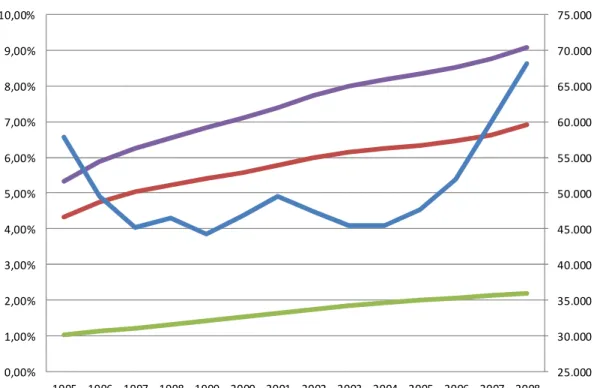
This part outlines the development of immigrant stocks in Denmark and emphasizes why Denmark is an interesting case in relation to the subject of the thesis. The Danish population has during the period in focus, 1995–2008, gone from being a relative homogenous population to the current state where immigrants and descendants constitute for a substantial share of the total population – going from 5,3% to 9,1% in the period investigated. The increased ethnic diversity of the Danish population makes it an applicable and highly relevant case to analyze. Moreover, this part connects immigration policy and historical events with the outlook of main immigrant stocks in Denmark.
5.2.1 Immigration
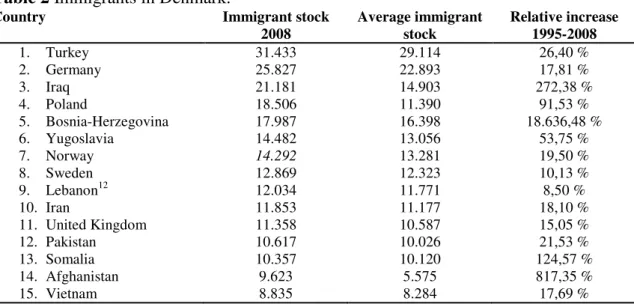
Generally, the origin countries vary in their size of resident stocks and approximately 50% of the source countries have only a stock of 200 immigrants or less. On average during the period considered the immigrant stock from a particular country range from 1.187 to 2.005 numbers of immigrants in 1995 and 2008, respectively. The total average for the period is estimated to 1.634 residents. Table 2 below shows the top 15 origin countries ranked by their immigrant stock in 2008. The following two columns are the computed average of the immigrant stock over the time span for that particular nation and the relative increase in the immigration stock over the 14 years.
Table 2 Immigrants in Denmark.
Country Immigrant stock
2008 Average immigrant stock Relative increase 1995-2008 1. Turkey 31.433 29.114 26,40 % 2. Germany 25.827 22.893 17,81 % 3. Iraq 21.181 14.903 272,38 % 4. Poland 18.506 11.390 91,53 % 5. Bosnia-Herzegovina 17.987 16.398 18.636,48 % 6. Yugoslavia 14.482 13.056 53,75 % 7. Norway 14.292 13.281 19,50 % 8. Sweden 12.869 12.323 10,13 % 9. Lebanon12 12.034 11.771 8,50 % 10. Iran 11.853 11.177 18,10 % 11. United Kingdom 11.358 10.587 15,05 % 12. Pakistan 13. Somalia 14. Afghanistan 15. Vietnam 10.617 10.357 9.623 8.835 10.026 10.120 5.575 8.284 21,53 % 124,57 % 817,35 % 17,69 %
Source: Danish Statistics and authors own compilation
The countries in the table account for approximately 62% of the total immigrant stock on 377.000 in 2008. In 2008 the two main origin countries were Turkey and Germany. The fact that eight of the top 15 countries mentioned above are European countries highlights the existence of different motives for residing in Denmark, ranging from refugee and asylum seeker to work related immigration. Nevertheless, some of the largest stocks – Norway, Sweden and United Kingdom – are neighboring countries.13 Focusing on the relative increase in the stocks over the time span unveil heterogeneity in the growth rates of the different origin countries. The countries with the largest increase are Bosnia-Herzegovina, Somalia, Iraq, Poland and Afghanistan. This composition of countries again reflects the distinct motives and incentives for
12
The majority of this group consists of stateless Palestinian that immigrated to Denmark in the period 1985-1992 (Danmarks Statistik, 2010).
13
In general the duration of the residence for many of the immigrants from those countries is very short (Danmarks Statistik, 2011).
immigrating to Denmark. Whereas the development in the stocks of the origin nations Bosnia-Herzegovina, Somalia, Iraq and Afghanistan can be explain by their involvement in wars during the period this is not the case for Poland.14 The expansion of the Polish resident stock in Denmark is registered in a very short period; from 2005 to 2008 with an absolute increase of more than 7.000 people. This evolvement is primarily explained by the lack of Danish labour supply and the large inflow during those years is therefore presumed to be work related migration.15
The presented table shows the size and development in the immigration top 15 immigration stocks over the period but whether it is the same people with a foreign background that are included in the stocks is hard establish. An indication of this is that during the period 2001-2008 it was found that 25-34% of immigrants that came to Denmark in a given year were emigrated a year later. Additional, those who emigrated differed highly across origin-countries, with immigrants from western origin nation being more prone to emigrate (Danmarks Statistik, 2010).16
5.2.2 Population heterogeneity
To give an indication of the heterogeneity of the Danish population in the period the following figure shows the development in annual immigration inflow and the growth in the immigrant and descendant stocks as a share of the total Danish population.17
14
Bosnia-Herzegovina was in a military conflict from 1992-1995, civil war in Somalia, for Iraq the Gulf war in 1990 plus the regime and the invasion in 2003 and the intervention of Afghanistan in 2001. At these specific years or the following year a steep increase in the immigrant stocks were registered. Almost all immigrants from Iraq, Bosnia-Herzegovina, and Somalia are refugees. Of all immigrants in Denmark about 25% are categorized as refugees (Danmarks Statistik, 2010).
15 Moreover, this is influenced by the fact that Poland became a member of EU in year 2004 (Danmarks Statistik, 2010).
16
For immigrants from USA that came to Denmark during 2001 72 % of them had left again 2009. This number is 11 % and 4 % for the origin nations Iraq and Afghanistan, respectively (Danmarks Statistik, 2010).