Annual Report
2005~2006
Federal Magistrates Court of Australia – Annual Report 2005-2006 ISSN 1444-6707 (print version)
ISSN 1447-5065 (online version) © Federal Magistrates Court 2006
A copy of this annual report is located on the Court’s website at www.fmc.gov.au
This work is copyright. Apart from use permitted under the Copyright Act 1969, no part can be reproduced by any process without prior written permission from the Chief Executive Officer of the Federal Magistrates Court, 97-99 Goulburn Street, Sydney, New South Wales 2000.
16 October 2006
The Honourable Philip Ruddock MP Attorney-General
Parliament House Canberra ACT 2600
Dear Attorney-General Annual Report
I have pleasure in submitting the Annual Report of the Federal Magistrates Court of Australia for the period 1 July 2005 to 30 June 2006 in accordance with section 117 of the Federal Magistrates Act 1999, which requires the Federal Magistrates Court to prepare and give you a report of the management of the administrative affairs of the Court during the financial year as soon as practicable after 30 June in each financial year.
Yours sincerely
John Pascoe AO Chief Federal Magistrate
FEDERAL MAGISTRATES COURT OF AUSTRALIA Chambers of the Chief Federal Magistrate
Telephone: (02 9230 8924 Fascimile: (02) 9230 8814
Law Courts Building Queens Square Sydney NSW 2000
National Administration Office
Owen Dixon Commonwealth Law Courts Building 305 William St
Melbourne Victoria 3000
National Enquiry Centre: 1300 352 000 Melbourne telephone number: (03) 8600 4450 Melbourne fax number: (03) 8600 4445 Websites www.fmc.gov.au
www.familylawcourts.gov.au Email [email protected]
Contact details
Chambers of the Chief Federal Magistrate
Chief Federal Magistrate John Pascoe AO Level 18, Law Courts Building
Queens Square, Sydney NSW 2000 Phone (02) 9230 8924
Office of the Chief Executive Officer
Mr John Mathieson Lionel Bowen Building
97-99 Goulburn St, Sydney NSW 2000 Phone (02) 9217 7243 Wollongong Sydney Newcastle Parramatta Canberra Alice Springs Perth Shepparton Morwell Coffs Harbour Lismore Hervey Bay Bundaberg Rockhampton Mackay Cairns Brisbane Townsville Darwin Principal locations Launceston Hobart Circuit locations Berri Whyalla Port Lincoln Devonport Adelaide Melbourne Bendigo Hamilton Warrnambool Geelong Dandenong Tamworth Armidale Orange Dubbo Wagga Wagga Bega Castlemaine Gippsland Ballarat
Registries for family law and child support issues
All telephone enquiries: 1300 352 000
All email enquiries: [email protected]
New South Wales
Sydney Lionel Bowen Building, 97-99 Goulburn St, Sydney NSW 2000
Parramatta Garfield Barwick Commonwealth Law Courts Building, 1-3 George St, Parramatta NSW 2150 Newcastle 61 Bolton St, Newcastle NSW 2300
Lismore Manchester Unity Building, 29-31 Molesworth Street, Lismore NSW 2480 Albury 463 Kiewa Street, Albury NSW 2640 (Divorce applications only)
Dubbo Cnr Macquarie and Wingewarra Sts, Dubbo NSW 2830 (Divorce applications only) Wollongong 43 Burelli Street, Wollongong NSW 2500 (Divorce applications only)
Queensland
Brisbane Harry Gibbs Commonwealth Law Courts Building , 119 North Quay, Brisbane Qld 4000 Townsville 143 Walker St, Townsville Qld 4810
Rockhampton Commonwealth Centre, Cnr East and Fitzroy Sts, Rockhampton Qld 4700 Cairns 104 Grafton St, Cairns Qld 4870
Victoria
Melbourne Owen Dixon Commonwealth Law Courts Building, 305 William St, Melbourne Vic 3000 Australian Capital Territory
Canberra Nigel Bowen Commonwealth Law Courts Building, Cnr University Ave and Childers St Canberra ACT 2600
South Australia
Adelaide Roma Mitchell Commonwealth Law Courts Building, 3 Angas St, Adelaide SA 5000 Northern Territory
Darwin TCG Building Commonwealth Law Courts, 80 Mitchell St, Darwin NT 0800 Alice Springs Centrepoint Building, Hartley St, Alice Springs NT 0870
Tasmania
Launceston ANZ Building, Cnr Brisbane and George Sts, Launceston Tas 7250
Registries for general federal law issues
New South Wales
Law Courts Building, Queens Square, Sydney NSW 2000 Phone (02) 9230 8567
Email [email protected] Australian Capital Territory
Nigel Bowen Commonwealth Law Courts Building, Cnr Childers St and University Ave, Canberra ACT 2600 Phone (02) 6267 0566
Email [email protected]
Northern Territory
Supreme Court Building, State Square, Darwin NT 0800 Phone (08) 8941 2333
Email [email protected]
Tasmania
Edward Braddon Commonwealth Law Courts Building, 39-41 Davey St, Hobart Tas 7000 Phone (03) 6232 1715
Email [email protected] Victoria
Owen Dixon Commonwealth Law Courts Building, 305 William St, Melbourne Vic 3000 Phone (03) 8600 3333
Email [email protected] Queensland
Harry Gibbs Commonwealth Law Courts Building, Level 6, 119 North Quay, Brisbane, QLD 4000 Phone (07) 3248 1100
Email [email protected] South Australia
Roma Mitchell Commonwealth Law Courts Building, 3 Angas St, Adelaide SA 5000 Phone (08) 8219 1000
Email [email protected]
Western Australia
Peter Durack Commonwealth Law Courts Building, 1 Victoria Ave, Perth WA 6000 Phone (08) 9268 7100
Contents
Contents vii
Introduction 1
PART ONE Year in review 3
Introduction 3
New appointments 3
Expanded jurisdiction 3
Increased depth and breadth in workload 3
Migration litigation 4
Combined registry in family law 4
Timely delivery of judgments 5
Governance 5
Other highlights 6
Challenges - now and for the future 7
PART TWO Overview 9
Role and functions of the Court 9
Objective of the Court 9
The administration of the Court 10
Judicial officers 10
Retirements 11
Jurisdiction of the Court 11
Federal Magistrates Court Rules 13
PART THREE Performance 15
The work of the Court by jurisdiction 15
General federal law 15
Family law and child support 27
Primary dispute resolution 33
Self-represented litigants 40
Information, knowledge and records management 41
Performance measures 43
Access and performance 44
Fees 45
Transfer of matters between courts 46
Complaints 46
Enquiry service 47
Judgments 47
PART FOUR Administration and governance 53
Governance 53
Strategic planning 55
Organisational plan 55
Arrangements with the Federal Court and the Family Court 56
Risk management, fraud control and internal audit 56
The APS code of conduct 56
Senior appointments 57
Remuneration 57
Financial performance 58
Management of human resources 59
PART FIVE External scrutiny and activities 63
Auditor-General audit report 63
Commonwealth Ombudsman 63
Privacy 63
Family Law Council 64
National Alternative Dispute Resolution Advisory Council 64
Statement under section 8 of the Freedom of Information Act 1982 64
PART SIX Purchasing and contracting 67
Performance against core purchasing policies 67
PART SEVEN Financial statements 69
PART EIGHT Appendix 103
A) Compliance with annual report guidelines 103
B) Summary resources 105
C) Conferences attended and presentations made by federal magistrates 106
D) Staffing levels 114
E) Organisational chart 116
F) Consultancies 117
G) Fraud Control Certification 118
Index 119
Part one of the Federal Magistrates Court of Australia 2005-06 annual report contains an annual review of the Federal Magistrates Court’s work, examining the major legal and administrative developments over the year.
Part two provides a brief introduction to and overview of the Federal Magistrates Court of Australia (‘Federal Magistrates Court’) – its establishment, objectives, organisational details and jurisdiction.
Part three contains information on the performance of the Federal Magistrates Court, the work of the Court, examples of cases and information on complaints, appeals, court circuits and primary dispute resolution.
Part four contains information on governance, corporate planning, performance reporting and review, remuneration of senior executives and an analysis of financial performance.
Information about external scrutiny and management of human resources is contained in part five. Part six contains information on purchasing, assets management, consultancies and competitive tendering and contracting.
Financial statements are contained in part seven. Appendixes in part eight provide details on staffing levels, report compliance, resources, presentations, consultancies and fraud control.
Contact officer
Requests for copies of this report should be directed to: Public Affairs Manager
Federal Magistrates Court of Australia
Owen Dixon Commonwealth Law Courts Building 305 William St, Melbourne VIC 3000
Phone (03) 8600 4451
Fax (03) 8600 8205
Email [email protected]
Information about the Court can also be found on the Court’s website at www.fmc.gov.au
Introduction
Introduction
The Federal Magistrates Court continued to grow and develop during 2005-06. This was reflected in the appointment of more federal magistrates, an expansion of jurisdiction, an increased workload and new governance structures.
New appointments
Five federal magistrates were appointed to the Court during the year, taking up positions in Newcastle, Brisbane, Parramatta, Sydney and Melbourne. One federal magistrate in Melbourne retired following her appointment as a judge of the Family Court of Australia (‘Family Court’). At the end of the year there were 35 federal magistrates, a 13 per cent increase over 2004-05 and over triple the number of federal magistrates on the Court’s first day of operation on 3 July 2000. Furthermore, during the year the Government announced funding for the appointment of 11 further federal magistrates. This will equate to another 31 percent increase in numbers of federal magistrates.
These appointments further increase the capacity of the Court to fulfil its objective to deal with less complex family and general federal law civil matters and, in turn, allow the superior federal courts to focus on the more complex cases and their appellate work.
Expanded jurisdiction
The Court received new and extended jurisdiction during the year with the commencement of the Workplace Relations Amendment (Work Choices) Act 2005, Anti-Terrorism Act (No. 2) 2005, Federal Magistrates Jurisdiction Amendment Act 2006 and, from 1 July 2006, Family Law Amendment (Shared Parental Responsibility) Act 2006.
This includes unlawful termination and other workplace relations matters, in personam admiralty matters, a broader range of trade practices matters (with power to award higher damages), being an issuing court for the control orders regime of the anti-terrorism legislation, removal of the monetary limitation of the court’s jurisdiction to hear family law property matters without consent, and jurisdiction in any matter transferred to the Court by the Federal Court of Australia (Federal Court) or Family Court.
Increased depth and breadth in workload
The Court’s workload in both family law and general federal law continued to increase during
Year in review
PART ONE
While overall new filings increased by a little less than one per cent compared with 2004-05, there was a decline of five per cent in the filing of new divorces. If divorce applications, which are largely handled by registrars, are excluded, new filings in the Court during the year increased overall by almost nine per cent compared with the previous year.
In family law, new filings decreased by one per cent from 2004-05. When divorce applications are excluded, filings increased overall by seven per cent. Of interest was the marked regional variation in the areas that recorded an increase in family law filings (see page 27).
In general federal law, new filings increased overall by 16 per cent from 2004-05. Again, a feature of the increases was the marked regional variations that occurred, and the type of matters filed (see page 16).
The broadening of the work of the Court, noted in the Court’s Annual Report 2004-05 (pages 5-6), continued through 2005-06. The Court devoted significant judicial resources to the hearing of general federal law matters throughout the year commensurate with the increased new filings in that area of work and towards the disposal of the backlog of migration matters which developed during 2002-03 and 2003-04.
Migration litigation
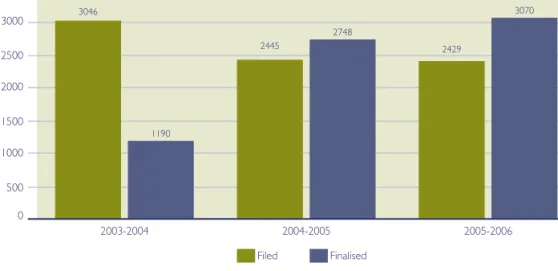
During the year the Court made inroads into the backlog of migration matters awaiting hearing, despite there being no reduction in the rate of new filings. While 2439 migration matters were pending at 30 June 2005 and 2429 new matters were filed in or transferred to the Court during 2005-06, 3070 matters were finalised. As a result, at 30 June 2006 there were 1806 migration matters pending, 633 less than at the beginning of the year.
The Court was able to increase incrementally the finalisation rates to be above the rate of new filings through more efficient listing of migration matters. In each of the last five months of the year, the number of migration matters finalised was more than those filed; the margin also increased month by month.
With additional general federal law appointments announced during the year, this reduction in the backlog of migration matters is expected to be further accelerated in 2006-07.
Combined Registry in family law
The Court continued to work with the Family Court towards completion of implementation of the Combined Registry Program. That program, which commenced in July 2004, aims to provide simplified access to the Family Law Courts. It is comprised of a number of major projects which have been completed or are nearing completion.
The Family Law Courts Board consists of the Chief Justice of the Family Court, the Chief Federal Magistrate and the Chief Executive Officers of each Court. The Board was established during
the previous year to oversee the coordination and management of the shared arrangements evolving through the Combined Registry initiative and other shared services arrangements, and continued to meet during 2005-06. The Board has functioned effectively in considering and working towards the resolution of cross-court issues.
Timely delivery of judgments
The majority of the Court’s judgments (67 per cent) continue to be delivered orally at the time of hearing or shortly afterwards, allowing the Court to deal with a high volume of matters expeditiously. The nature of many matters facilitates this; however, an increasing number of complex matters necessitate more detailed considerations and the preparation of reserved judgments, which are usually delivered at a later date and in writing.
In 2005-06, 96 per cent of judgements were delivered within six months of the hearing and 99.5 per cent within twelve months. Only three judgments (0.1 per cent) were delivered over eighteen months after the hearing.
It is an ongoing challenge for the Court to address the balance of increasing workload with finalising reserved judgments. More time has been allocated to judgment writing and better systems and procedures have been implemented to record and monitor progress of reserved judgments and to better identify complex cases that should be transferred to the superior courts. The success of these approaches was reflected in the halving of complaints to the Court; complaints in previous years have predominantly been about delayed delivery of judgments.
Governance
The governance structure of the Court was altered by amendments to the Federal Magistrates Act 1999 (‘the Act’), which commenced on 15 November 2005. The alteration aligns the arrangements for the management of the administrative affairs of the Court with those of the Federal Court and Family Court.
The Chief Federal Magistrate is now not only responsible for ensuring the orderly and expeditious discharge of the business of the Court, but also for managing the administrative affairs of the Court. However, in the latter, the Chief Federal Magistrate is assisted by the Chief Executive Officer. The Chief Executive Officer is, for the purposes of the Public Service Act 1999, the Head of the Statutory Agency constituted by the Chief Executive Officer and the Australian Public Service employees of the Court. The Chief Executive Officer is also the Chief Executive of the Federal Magistrates Court for the purposes of the Financial Management and Accountability Act 1997, which imposes obligations on him or her to manage the affairs of the Court in a way which promotes the efficient, effective and ethical use of Commonwealth resources. Therefore, the Chief Federal Magistrate and the Chief Executive Officer have different but complementary responsibilities for various aspects of the Court’s operations.
The Chief Federal Magistrate may delegate all or any of his or her administrative powers to one or more federal magistrates. The Chief Federal Magistrate has appointed four federal magistrates as Coordinating Federal Magistrates for regions across Australia. Each assists in the management of a range of administrative matters for the federal magistrates in his or her region and has been delegated certain powers for these purposes.
The Court has also appointed a number of advisory committees, each comprising federal magistrates and Court staff. They provide advice to the Court in relation to the powers of the Court under the Act and the making of the Rules of Court and they advise the Chief Federal Magistrate and the Chief Executive Officer in relation to their respective responsibilities. A review of the committee structure commenced during the year.
The positions of Coordinating Federal Magistrates and the membership of federal magistrates’ committees rotate every two years.
Other highlights
The Court has continued to consolidate its position as an effective federal court to deal with less complex family and general federal law matters. The Court’s success is illustrated in the following developments during the year.
Cases transferred from other courts, particularly the superior courts, have continued to increase; for example, the Family Court transferred twice as many cases in 2005-06 than 2004-05. The first workplace relations matters, following the extension of the Court’s jurisdiction into this area of work, were filed in April. Initially, the number of these matters filed has been low but is expected to increase. Six federal magistrates will be appointed in 2006-07 to cope with the expected workload.
The Court continued to hone it practices, procedures and systems to further improve its efficiency. In both family and general federal law, the numbers of cases that were finalised exceeded the number of applications made.
Because of the complexity of some types of general federal law matters, the court is progressively establishing specialist panels in each region. These panels will ensure that cases in these specialist areas will be handled by federal magistrates with appropriate expertise and with a commitment to allocating appropriate priority to the cases immediately they are assigned. The court believes this system will best enable it to target the required judicial resources in these specialist areas to achieve the timely and appropriate disposition of these cases.
The number of complaints and appeals reduced significantly. Complaints halved from 0.2 to 0.1 per cent of all cases, largely due to many fewer complaints about delayed judgments. Appeals in general federal law decreased by 17 per cent while appeals in family law remained steady.
The Court participated in a joint pilot project with the Family Court to improve mental health support for clients. Key elements included staff training in mental health issues surrounding separation and in dealing with clients who present with mental health or emotional wellbeing issues, and the development of a referral service where clients with mental health issues are linked directly to community-based professional counselling services. The Department of Health and Ageing sponsored the pilot and contributed $300,000. Conducted in the Adelaide and Darwin family law registries, the pilot concluded on 30 June 2006 and, following its success, is expected to be implemented nationally in 2006-07.
The Family Court and Federal Magistrates Court also ran a joint family violence screening and risk assessment pilot in the Brisbane Registry from late 2005 to March 2006. The pilot aimed to ensure that family violence issues were identified as early as possible in the court process. Where appropriate, safety plans were developed with parties to facilitate their safety at court events and maximise their capacity to participate in court proceedings. The pilot is being evaluated for possible national implementation.
Challenges – now and for the future
There has been rapid growth in the number of judicial officers, the range of jurisdiction and the volume of work. This has, and will, continue to present challenges for the Court to strengthen the skills and productivity of federal magistrates and staff to better enable them to cope. In recognising the importance of maintaining the optimal health, well-being and productivity of federal magistrates, the Court has implemented programs to encourage annual health checks and provide access to professional and confidential counselling. The Court continues to strive to improve its programs for induction and ongoing judicial education of federal magistrates and training and development of its staff.
The Court also continues to develop its practices, procedures and systems to achieve greater efficiency in the management of its workload.
In terms of the challenges faced by the Court when handling matters by self-represented litigants, the Court continues to develop support services and information for these litigants that will assist them use the Court effectively (see pages 40-41).
Role and functions of the Court
The Federal Magistrates Court is a federal court established under the Constitution by the Federal Magistrates Act 1999 (‘the Act’). It was established to handle less complex matters in the areas of family law and general federal law. The Court shares jurisdiction with the Family Court and the Federal Court.
The Act received royal assent on 23 December 1999. The first court sittings were on 3 July 2000 in Adelaide, Brisbane, Canberra, Melbourne, Newcastle, Parramatta and Townsville. Jurisdiction is conferred on the Court by laws of the Commonwealth other than the Act. The initial jurisdiction of the Court was conferred by the Federal Magistrates (Consequential Amendments) Act 1999. The jurisdiction of the Court is expanded by amendment of Commonwealth legislation to confer the new jurisdiction, most recently by the Workplace Relations Amendment (Work Choices) Act 2005, Anti-Terrorism Act (No. 2) 2005 and Federal Magistrates Jurisdiction Amendment Act 2006.
After six years, the Court has established itself as the basic trial court in significant areas of jurisdiction of the federal judicial system. Most first instance migration review matters are now filed with the Court. Nearly all bankruptcy work and a significant amount of children’s and property applications are now completed in the Court. The Court handles almost all divorce applications filed in all states and territories in Australia other than Western Australia.
The number of federal magistrates increased to 35 during the year. In December the government announced the appointment of six new federal magistrates to hear workplace relations matters and in May announced another five federal magistrates to deal with increased jurisdiction and workload.
Objective of the Court
The objective of the Court is to provide a simple and accessible alternative to litigation in the Federal Court and the Family Court where matters can be dealt with expeditiously. This allows the higher courts to focus on more complex cases and appellate work. It also translates into lower costs for litigants and the Government.
The Court encourages the use of various dispute resolution approaches to resolve matters without judicial decisions. This objective has been strengthened with the new family law legislation’s requirement for pre-court dispute resolution activity. Where practical, parties are encouraged to resolve their disputes through family dispute resolution and negotiation methods such as counselling, mediation and conciliation any time prior to or during the court process. This
Overview
PART TWO
The administration of the Court
The Chief Federal Magistrate of the Court is Mr John Pascoe AO. Mr John Mathieson is the Chief Executive Officer.
Section 89 of the Act now provides that the Chief Federal Magistrate is responsible for the administrative affairs of the Court. The Chief Federal Magistrate continues to be responsible for the day-to-day management of the business of the Court (Section 12).
The Chief Federal Magistrate is assisted by the Chief Executive Officer, who can exercise powers on the Chief Federal Magistrate’s behalf in relation to the Court’s administrative affairs (Section 96). The Chief Executive Officer has the responsibilities and powers of an agency head for the purposes of the Public Service Act 1999 and Financial Management and Accountability Act 1997.
A system of coordinating federal magistrates for each region was introduced in 2004-05 to assist in the management of administrative matters for federal magistrates located in each of those regions.
Judicial officers
The Court consists of the Chief Federal Magistrate and federal magistrates. The federal magistrates appointed to the Court as at 30 June 2006 were:
■ Chief Federal Magistrate John Pascoe — Sydney (appointed 14 July 2004) ■ Federal Magistrate Warren Donald — Newcastle (appointed 13 June 2000) ■ Federal Magistrate Christine Mead — Adelaide (appointed 13 June 2000) ■ Federal Magistrate Judy Ryan — Parramatta (appointed 13 June 2000) ■ Federal Magistrate Michael Baumann — Brisbane (appointed 19 June 2000) ■ Federal Magistrate James Brewster — Canberra (appointed 19 June 2000) ■ Federal Magistrate Norah Hartnett — Melbourne (appointed 19 June 2000) ■ Federal Magistrate Stephen Scarlett — Sydney (appointed 19 June 2000) ■ Federal Magistrate John Coker — Townsville (appointed 26 June 2000) ■ Federal Magistrate Murray McInnis — Melbourne (appointed 26 June 2000) ■ Federal Magistrate Rolf Driver — Sydney (appointed 31 July 2000)
■ Federal Magistrate Kenneth Raphael — Sydney (appointed 31 July 2000)
■ Federal Magistrate Stuart Roberts — Hobart and Launceston (appointed 4 December 2000)
■ Federal Magistrate Maurice Phipps — Melbourne (appointed 18 December 2000)
■ Federal Magistrate Jennifer Rimmer — Brisbane (appointed 5 February 2001) ■ Federal Magistrate Michael Connolly — Melbourne (appointed 4 June 2001) ■ Federal Magistrate John Walters — Melbourne (appointed 29 October 2001)
■ Federal Magistrate Stewart Brown — Darwin (appointed 5 November 2001)
■ Federal Magistrate Shenagh Barnes — Sydney (appointed 5 November 2001)
■ Federal Magistrate Stuart Lindsay — Adelaide (appointed 19 January 2004) ■ Federal Magistrate Michael Jarrett — Brisbane (appointed 2 February 2004) ■ Federal Magistrate Sylvia Emmett — Parramatta (appointed 5 July 2004) ■ Federal Magistrate Grant Riethmuller — Melbourne (appointed 19 July 2004) ■ Federal Magistrate Michael Lloyd-Jones — Sydney (appointed 26 July 2004)
■ Federal Magistrate Daniel O’Dwyer — Melbourne (appointed 2 August 2004)
■ Federal Magistrate Matthew Smith — Sydney (appointed 2 August 2004)
■ Federal Magistrate Graham Mowbray — Sydney (appointed 2 August 2004)
■ Federal Magistrate Nick Nicholls — Sydney (appointed 23 August 2004)
■ Federal Magistrate Robyn Sexton — Sydney (appointed 27 September 2004)
■ Federal Magistrate Kevin Lapthorn — Newcastle (appointed 29 August 2005) ■ Federal Magistrate Keith Slack — Brisbane (appointed 12 September 2005)
■ Federal Magistrate Louise Henderson — Parramatta (appointed 28 November 2005)
■ Federal Magistrate Judith Housego — Sydney (appointed 16 January 2006) ■ Federal Magistrate Kate Hughes — Melbourne (appointed 30 January 2006)
Retirements
Federal Magistrate Victoria Bennett resigned her appointment as a federal magistrate to take up appointment as a judge of the Family Court on 30 November 2005.
Jurisdiction of the Court
The Court shares concurrent jurisdiction with the Family Court (family law) and the Federal Court (general federal law) in almost all areas of law where it has jurisdiction.
Family law
The areas of family law in which the Court has jurisdiction are:
■ Applications for divorce
■ Applications concerning spousal maintenance
■ Property disputes where the parties are or were married
■ All parenting orders, whether the parents are married or unmarried
■ Enforcement of family law orders made by the Federal Magistrates Court, Family Court of
Australia or state courts
■ Location and recovery orders and warrants for the apprehension or detention of a child
or other person associated with the child
■ Determination of parentage and recovery of child bearing expenses.
General federal law
In general federal law, the Court has jurisdiction to hear matters relating to administrative law, admiralty, bankruptcy, copyright, discrimination, migration, privacy, trade practices and workplace relations.
The Court shares jurisdiction with the Federal Court in the following areas:
■ Applications made under the Administrative Decisions (Judicial Review) Act 1977. It can hear
appeals from the Administrative Appeals Tribunal transmitted by the Federal Court.
■ Matters arising under sections 9, 27 and 28 of the Admiralty Act 1988 (Cth) (‘Admiralty
Act’) relating to in personam claims. The Federal Court and state Supreme Courts may also remit any in rem matters to the Court.
■ Matters arising under the Bankruptcy Act 1966 (‘Bankruptcy Act’) apart from matters
requiring jury trials.
■ Civil copyright matters under the Copyright Act 1968, in particular, matters arising under
Parts V, VAA, IX and section 248J.
■ Unlawful discrimination matters under the Human Rights and Equal Opportunity Commission
Act 1986 relating to complaints under the Age Discrimination Act (2002), Disability Discrimination Act (1992), Racial Discrimination Act (1975) and Sex Discrimination Act (1984).
■ Industrial law, including matters under the Workplace Relations Act 1996 and Building and
Construction Industry Improvement Act 2005 relating to unlawful termination, breaches of the Australian Fair Pay and Conditions Standards, claims about business transmission rules, workplace agreements, right of entry, certain types of industrial action and unfair contracts for building services.
■ Enforcement of determinations of the Privacy Commissioner and private sector adjudicators
under the Privacy Act 1988.
■ Unfair trade practices matters arising under Parts IV and V of the Trade Practices Act 1974,
with power to award damages up to $750,000.
Additionally the Court has jurisdiction to hear any matter transferred to it by the Federal Court. The Court has the same jurisdiction in relation to applications for judicial review of visa-related decisions of the Migration Review Tribunal, Refugee Review Tribunal and the Administrative Appeals Tribunal under the Migration Act 1958, as possessed by the High Court of Australia (‘High Court’).
Federal Magistrates Court Rules 2001
The following amendments were made to the Federal Magistrates Court Rules 2001 during the year.
■ Federal Magistrates Court Amendment Rules 2005 (No 1)
As a consequence of the passage of the Migration Litigation Reform Act 2005 (‘the Act’), rule amendments were made which came into effect on the commencement of the Act on 1 December 2005. A new Part 44 was introduced for proceedings under the Migration Act; it gives the Court a wide discretion as to how to deal with migration matters, including providing for a show cause application to be dealt with at the first court date. Rule amendments were also made in relation to summary dismissal, consistent with amendments made by the Act, which introduced a new test for the dismissal of a case that has ‘no reasonable prospect of success’.
■ Federal Magistrates Court (Bankruptcy) Rules 2006
The Federal Magistrates Court (Bankruptcy) Rules 2006 replace Chapter 4 of the Federal Magistrates Court Rules 2001 (FMCR) and prescribe stand-alone bankruptcy rules which mirror the Federal Court (Bankruptcy) Rules 2005, with necessary modifications. These rules, which commenced on 6 February 2006, resulted from a joint project by the Federal Court and Federal Magistrates Court to develop harmonised rules in the bankruptcy jurisdiction as this was considered to be advantageous to all concerned. While the new harmonised Rules are based closely on the previous Chapter 4 FMCR and Order 77 Federal Court Rules, they introduce a new version of the prescribed form of creditor’s petition, which includes the affidavit verifying paragraphs 1, 2, and 3 of the petition.
■ Federal Magistrates Court Amendment Rules 2006 (No 1)
This rule amendment includes some of the following amendments: consequential amendments following prescription of separate bankruptcy rules; amendments to rules in relation to divorce proceedings consistent with amendments to the Family Law Act to replace the terms ‘dissolution of marriage’, ‘decree nisi’ and ‘decree absolute’ with ‘divorce’ and ‘divorce order’; and amendments consistent with amendments made to Order 81 by the Federal Court Amendment Rules 2004 (No 4) SR 281 of 2004, with the result that forms 167 and 168 of the Federal Court Rules are also prescribed for use in human rights proceedings in the Federal Magistrates Court.
Federal Magistrates Regulations 2000
The following miscellaneous amendments were made to the Regulations during the year.
■ Federal Magistrates Amendment Regulations 2006 (No 1)
As a consequence of the conferral of some Admiralty Act jurisdiction, there were amendments to the fee regulations to ensure the search and seizure of goods fee does not apply to proceedings in the Court under the Admiralty Act, mirroring the comparable item in the Federal Court fee regulations. The Regulations commenced on 4 May 2006, coinciding with the commencement of Admiralty Act jurisdiction.
■ Federal Magistrates Amendment Regulations 2006 (No 2)
The amendments reflect changes to terminology within the divorce and child-related provisions of the Family Law Act as amended by the Family Law Amendment Act 2005 and the Family Law Amendment (Shared Parental Responsibility) Act 2006. The Regulations commenced on 1 July 2006, coinciding with the commencement of Schedules 1 and 2 of the Shared Parental Responsibility Act.
■ Workplace Relations Amendment (Work Choices) (Consequential Amendments)
Regulations 2006 (No 1)
There were consequential amendments to the fee regulations to incorporate a new item 12 in Schedule 1 for filing an application for unlawful termination of employment; it mirrors the same item payable for filing such an application in the Federal Court. The amendment to the Regulation commenced on 27 March 2006, the same day as the commencement of the conferral of workplace relations jurisdiction on the Federal Magistrates Court pursuant to the Workplace Relations Amendment (Work Choices) Act 2005.
■ Federal Magistrates Regulations 2000 - biennial fee increase
A biennial fee increase pursuant to Regulations 14 and 15 commenced on 1 July 2006. In addition, the Government announced the appointment of five new federal magistrates in the 2006-07 Budget, the cost of whom was to be be offset by a 15 per cent increase in the Federal Magistrates Court general federal law and divorce fees and Federal Court fees.
The work of the Court by jurisdiction
The Federal Magistrates Court’s jurisdiction encompasses both general federal law and family law. While family law still accounts for ninety per cent of filings, general federal law applications are increasing as the Court gains the confidence of the legal profession and the public, and as new jurisdictions are added and new federal magistrates appointed.
PART THREE
Performance
Figure 1 National statistics for Federal Magistrates Court filings Total % of Total FAMILY LAW Final Orders 12,399 15.3% Interim Orders 11,578 14.3% Divorce 46,512 57.5% Other 2,798 3.4%
Total Family Law 73,287 90.6% FEDERAL LAW
Bankruptcy 4,900 6.1%
Migration 2,429 3.0%
Other 232 0.3%
Total Federal Law 7,561 9.4%
Grand Total 80,848 100% 3.0% Migration 6.1% Bankruptcy 15.3% Final Orders (Family) 0.3% Other (General Federal) 57.5% Divorce 3.4% Other (Family) 14.3% Interim Orders (Family)
General federal law
Jurisdiction in general federal law matters is conferred on the Court under subject-specific legislation and is concurrent with the jurisdiction of the Federal Court. The Court is increasingly becoming a court of general federal law jurisdiction, with jurisdiction continuing to expand in 2005-06 to include admiralty law and workplace relations and increased trade practices jurisdiction. As part of the anti-terrorism legislation, the Court is now an issuing court for the purpose of the control order regime. Amendments to the Migration Act 1958 by the Migration Litigation Reform Act 2005 (‘Migration Reform Act’) mean the Court now hears most first instance judicial reviews of migration matters.
This Act included the conferral of jurisdiction on the Court in relation to any matter transferred to it by the Federal Court or Family Court, as recommended by the 2003 Review of the Federal Magistrates Court. This review of the first two years of the Court’s operation found the Court to be successfully dealing with less complex family and general federal law disputes.
The Explanatory Statement accompanying the Jurisdiction Amendment Act stated: It was always the Government’s intention that the FMC would deal with a wide range of lower level work of the Family and Federal Court, and thus provide more time and resources in the superior courts to deal with more complex matters. The Bill also provides further opportunities for litigants to take advantage of the streamlined and accessible forum offered by the FMC.
The Court also has jurisdiction with respect to associated claims.
In 2005-06, 7561 general federal law applications were made to the court, representing a 16 per cent increase on 2004-05. The majority of applications were bankruptcy and migration filings (4900 and 2429 respectively), but increases in other areas are expected in 2006-07 given the Court’s new jurisdiction.
There were marked variations between 2004-05 and 2005-06 in terms of regional filings and the type of matters filed. Decreases in new filings occurred in Darwin (20 per cent) and Hobart (33 per cent) but increases, some significant, occurred in all other locations: Adelaide (40 per cent), Brisbane (13 per cent), Canberra (33 per cent), Melbourne (10 per cent), Perth (39 per cent) and Sydney (16 per cent). There was a slight decline in new filings of migration matters (1 per cent) and more significant decreases in new filings of trade practices (15 per cent) and unlawful discrimination (7 per cent) matters, but significant increases in new filings of bankruptcy (27 per cent) and copyright (14 per cent) matters.
The Court was able to deal with matters more efficiently and to finalise more outstanding matters, as shown by the increase in matters that were finalised (7831).
Figure 2 General federal law applications filed in the Federal Magistrates Court in 2005-06 FEDERAL LAW Total % of Total
Administrative Law 39 0.5% Bankruptcy 4,900 64.8% Consumer Protection 66 0.9% Copyright 32 0.4% Human Rights 85 1.1% Industrial 10 0.1% Migration 2,429 32.1% Sub Total 7,561 100% 0.9% Consumer Protection 1.1% Human Rights 0.5% Administrative Law 32.1% Migration 0.4% Copyright 64.8% Bankruptcy 0.1% Industrial
Figure 3 Total number of general federal law applications filed in the Magistrates Court in 2005-06 by location
Adelaide Brisbane Canberra
64 48 46 897 794 655 404 288 286 Melbourne 1784 1624 1696 Darwin 12 15 12 Hobart 58 87 62 Perth 332 239 188 Sydney 4010 3444 3735 0 500 1000 1500 2000 2500 3000 3500 4000 4500
2003–04 [total 6680] 2004–05 [total 6539] 2005–06 [total 7561]
Admiralty law
Admiralty law jurisdiction was conferred on the Court by the Jurisdiction Amendment Act and commenced on 4 May 2006. It is expected the Court will provide an alternative venue for the hearing of smaller cargo claims within the federal system. The admiralty and maritime work of the Court is limited to proceedings under ss.9, 27 and 28 of the Admiralty Act 1988 (Cth) and any matters referred by the Federal Court. It is expected parties will always seek an early resolution of matters and consider mediation for the resolution of claims in a speedy and inexpensive manner. It is envisaged that the admiralty work of the court, in conjunction with the more extensive Federal Court jurisdiction, will result in an integrated Federal Admiralty and Maritime Jurisdiction for matters of all types and sizes.
A notice has been issued setting out national arrangements whereby nominated federal magistrates are listed to undertake the conduct of admiralty matters. A copy of this notice is on the Court’s website.
Administrative law
The number of applications in the Court in administrative law is small.
In relation to appeals from decisions of the Administrative Appeals Tribunal, the Court has jurisdiction only upon remitter from the Federal Court. In addition, decisions by Presidential Members (including Deputy Presidents) cannot be transferred. The number of matters transferred is not large.
There is no similar restriction on the jurisdiction of the Court to hear applications under the Administrative Decisions (Judicial Review Act) 1977 and the Court has concurrent jurisdiction in
Figure 4 Number of bankruptcy applications filed by location 0 500 1000 1500 2000 2500
2003–04 [total 3386] 2004–05 [total 3863] 2005–06 [total 4900] Adelaide Brisbane Canberra
51 27 34 838 729 625 350 258 255 Melbourne 1359 1118 980 Darwin 10 11 8 Hobart 52 79 58 Perth 297 214 163 Sydney 1943 1427 1263
The Court continued to deal with most bankruptcy applications filed, with 94 per cent of applications in 2005-06 compared to 92 per cent in 2004-05. There were 4900 bankruptcy applications, accounting for 64.8 per cent of applications in general federal law matters and 6.1 per cent of all filings in the Court. This was a 27 per cent increase over the previous year. The Court acknowledges the significant role of the registrars in facilitating the work of the Court in its bankruptcy jurisdiction.
In 2001, the Federal Court and the Federal Magistrates Court initiated a joint project to develop harmonised rules for proceedings under the Bankruptcy Act. Following consultation, the new harmonised Bankruptcy Rules commenced on 6 February 2006 in the Federal Magistrates Court and the Federal Court, Federal Magistrates Court (Bankruptcy) Rules 2006 and Federal Court (Bankruptcy) Rules 2005, respectively.
The High Court decision in April 2006 of Adams v Lambert [2006] HCA 10 (Adams), was of some significance in overturning the ‘form over substance’ approach adopted by the majority in Australian Steel Company (Operations) Pty Ltd v Lewis [2000] 109 FCR 33 (Australian Steel) where the High Court agreed that Australian Steel should be overruled. Section 306 of the Bankruptcy Act provides that a bankruptcy notice is not invalidated by a formal defect or an irregularity, unless substantial injustice has been caused. An example of a decision made in the Court following the High Court decision in Adams is Crown Diagnostic v Sood (No 2) [2006] FMCA 265 (on appeal). In this case, the Court considered whether a proceeds of crime order, which prevented the debtor from disposing of her interest in property, invalidated the bankruptcy notice by staying proceedings. The Court held that the effect of the order was not to prevent payment of the judgment debt as the Proceeds of Crime Act 2002 has provision for a debtor to apply to release moneys for the payment of the debt.
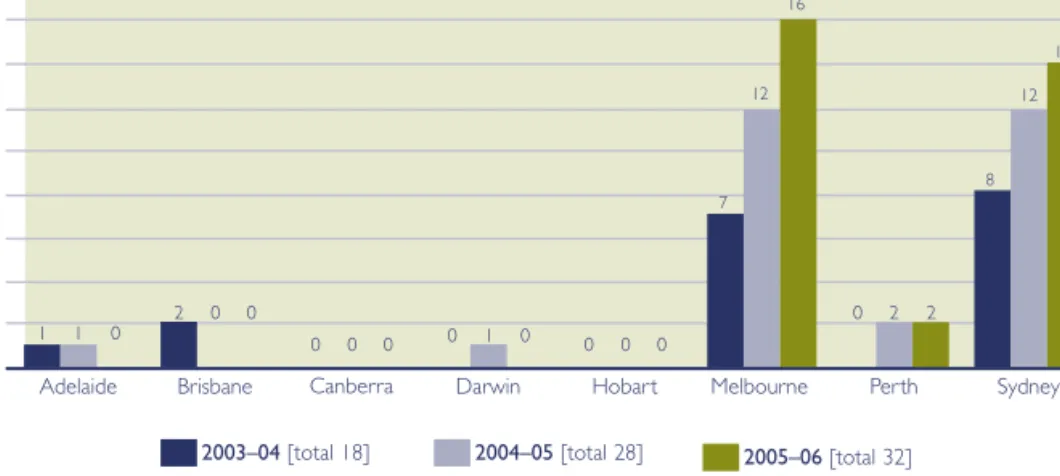
Figure 5 Number of copyright applications filed by location 0 2 4 6 8 10 12 14 16 18
2003–04 [total 18] 2004–05 [total 28] 2005–06 [total 32] Adelaide Brisbane Canberra
0 0 0 0 0 2 0 1 1 Melbourne 16 12 7 Darwin 0 1 0 Hobart 0 0 0 Perth 2 2 0 Sydney 14 12 8
The number of copyright applications filed in the Court is relatively small. Only 32 applications were made in 2005-06, 0.4 per cent of all general federal law applications, but a 14 per cent increase on the previous year. The jurisdiction is limited to civil claims and matters under Parts V, VAA, IX and section 248J of the Copyright Act 1968, such as claims for injunctions and damages for breach of copyright. The Court also has jurisdiction with respect to associated claims. As highlighted in some cases which have come before federal magistrates, the Court has the facility to grant urgent relief in the nature of Anton Pillar orders and Norwich Pharmacal relief. In MG Distribution Pty Ltd & Ors v Knah & Anor [2005] FMCA 500, such relief was considered appropriate, but in Australian New College v Li & Ors [2005] FMCA 984, the Court did not consider there to be sufficient special circumstances for the making of such an order. In Phonographic Performance & Ors v Adelaide City Entertainment [2005] FMCA 92, additional damages of $85,000 were awarded where there was found to be a flagrant breach of copyright. The federal magistrate noted:
To totally ignore a series of 30 letters over a period of three years, and to play recorded music, clearly the copyright of third parties, to large audiences in a popular nightclub is, to my mind, flagrant activity. It is activity designed to insult the copyright owners and to bring the existence of copyright protection into disrepute.
Subsection 115(4)(1a) was deliberately inserted into the Act because of pressure upon the parliament from copyright owners in this field, and in the field of motion pictures, who notoriously have been the victims of unlicensed activity. Any steps which the court can take to prevent the continuance of this type of activity should be taken [14-15].
The decisions of the Court continue to be of significance in this expanding area of federal jurisprudence. Although the number of applications filed in federal courts under this head of jurisdiction is not large, the Federal Magistrates Court hears 70 per cent.
A useful summary of the expanding jurisprudence is found in the May 2006 supplement to the Federal Discrimination Law by the Human Rights and Equal Opportunity Commission. This covers significant cases decided in the federal unlawful discrimination jurisdiction since the release of the publication in March 2005.
While the Court has jurisdiction to deal with applications under the four anti-discrimination Acts, there have not been any applications under the Age Discrimination Act 2004. The majority of applications relate to proceedings under the Sex Discrimination Act 1984. The scope of the Sex Discrimination Act and its application to acts done in the territories was clarified in the Full Court decision of South Pacific Resort Hotels Pty Ltd v Trainor [2005] FCAFC 130, which upheld the decision of the federal magistrate that the Sex Discrimination Act (1984) applies generally to acts done in territories such as Norfolk Island.
The Court has made a number of determinations as to whether there has been discrimination in the context of employees who return to part-time work following pregnancy and maternity leave. The extent to which employees with family responsibilities can seek protection under the discrimination laws is likely to be further tested in the courts following recent changes to the workplace relations laws.
Furthermore, allegations of sexual discrimination in the workplace may be of increasing significance. For example, in Phillis v Manic [2005] FMCA 330, the Court found in favour of the applicant for sexual harassment and awarded damages. The applicant had also sought an apology but this was not ordered as the federal magistrate considered:
Figure 6 Number of unlawful discrimination applications filed by location
0 10 20 30 40 50 60
2003–04 [total 102] 2004–05 [total 91] 2005–06 [total 85] Adelaide Brisbane Canberra
1 5 2 0 0 7 11 12 15 Melbourne 22 15 19 Darwin 2 2 1 Hobart Perth 6 3 Sydney 27 41 51 12 14 2 1 1 6
Discrimination
I have made it clear in previous decisions that I do not believe that there is any utility in forcing someone to apologise. An apology should come from the heart and not be required of someone by an order of the court.
While the number of applications under the Racial Discrimination Act is relatively small in comparison to the overall number of applications for discrimination, the decision of AB v New South Wales [2005] FMCA 1113 was of some significance. This case involved the refusal of a selective high school to admit a child on the basis the child was not an Australian citizen or permanent resident. The applicant alleged discrimination on the basis of his Romanian national origin (the argument was one of indirect discrimination). In dismissing the application, the federal magistrate had to consider the possible relevance of an Article of an international convention. He concluded that:
Nothing in this Convention may be interpreted as affecting in any way the legal provisions of the States’ Parties concerning nationality, citizenship or naturalisation, provided that such provisions do not discriminate against any particular nationality.
The High Court decision of Purvis v New South Wales (Department of Education and Training) [2003] 217 CLR 92 has been followed by the Court in a number of cases of alleged disability discrimination. In Tyler v Kesser Torah College [2006] FMCA 1 the Court relied upon Purvis and dismissed an application for disability discrimination where a student had been temporarily excluded from the respondent school. The federal magistrate found that the exclusion by the school was to ensure it complied with its duty of care and not because of the disability of the child.
The case of Wiggins v Department of Defence [2006] FMCA 800 attracted some publicity, being an application by a former officer of the Royal Australian Navy claiming unlawful discrimination pursuant to the Sex Discrimination Act 1984 (the SDA) and the Disability Discrimination Act 1992 (the DDA). While the Court was not satisfied on the appropriate standard of proof that the applicant had proved the claim of unlawful discrimination arising out of the SDA, it upheld her claim under the DDA in relation to the disability, namely depressive illness, and the different treatment, namely her sick leave led to adverse comments and removal from her post without consultation.
Migration law
Migration filings in the Federal Magistrates Court remained relatively stable, with 2429 applications comprising 32.1 per cent of federal law filings, a one per cent decrease on the previous year. However, the demographics of migration filings changed, with a twelve per cent decrease in the Melbourne registry and a three per cent increase in the Sydney registry. Filings in other registries increased from 2004-05 to 2005-06; for example, Adelaide increased from 16 to 38 and Perth from 7 to 17. It is significant to note there was also a 12 per cent increase in the number of migration matters finalised during the year (3070).
Figure 7 Number of migration applications filed and finalised Filed Finalised 0 500 1000 1500 2000 2500 3000 3500 2429 3070 3046 1190 2445 2748
Figure 8 Number of migration applications filed by location
0 500 1000 1500 2000 2500 3000
2003–04 [total 3046] 2004–05 [total 2445] 2005–06 [total 2429]
Adelaide Brisbane Canberra Darwin Hobart Melbourne Perth Sydney
38 16 14 6 32 30 4 12 6 2 1 0 2 4 1 331 427 615 17 7 8 2006 1946 2395
Figure 9 Number of migration applications finalised by location
0 500 1000 1500 2000 2500 3000 2003–04 [total 1190] 2004–05 [total 2748]
Adelaide Brisbane Canberra Darwin Hobart Melbourne Perth Sydney
33 13 11 0 31 25 0 4 17 1 2 0 2 2 2 522 605 344 17 9 20 2454 2082 812 2003-2004 2004-2005 2005-2006
The Migration Litigation Reform Act 2005 (‘the Migration Reform Act’), which commenced on 1 December 2005, made some significant amendments to the Migration Act 1958. One of the stated aims of the Migration Reform Act was to direct first instance migration review to the Federal Magistrates Court. The Court now has the same migration jurisdiction that the High Court has under section 75(v) of the Constitution.
There were consequential amendments made to the Federal Magistrates Court Rules 2001 with the addition of a new Part 44, which gives the Court wide discretion in dealing with migration matters, including proceeding by way of a show cause application. An example of the different approaches being adopted by the Court is illustrated in MZXFA v Minister for Immigration & Anor [2006] FMCA 245, where the Court relied on the summary dismissal power in preference to making an interlocutory order pursuant to the show cause procedure. In contrast, in SZHTI v Minister for Immigration & Anor [2006] FMCA 41, the federal magistrate relied on the show cause power to dismiss on the first court date and commented on the circumstances in which such an order may be appropriate. In SZHZI v Minister for Immigration & Anor [2006] FMCA 662, the federal magistrate made observations on the evidentiary impact of a show cause order:
[6] In my view, the consequence of making a show cause order pursuant to rule 44.12(1)(b) of this Court’s rules is to place upon the Minister a burden of active participation in the judicial review process from that point. I see no other consequence. A show cause order is made by the Court where an applicant is able to demonstrate an arguable case. That is a relatively low threshold test. It logically follows, in my view, that the burden of proof in order to obtain final relief must remain with an applicant. That said, the Minister would be at serious risk of final orders being made in favour of an applicant if the Minister did not comply with the show cause order. In practice, however, no additional burden is placed upon the Minister by a show cause order than that which would in the ordinary course be met by the Minister without such an order having been made, at a final hearing. A show cause order may be met by evidence or by submissions. In practice the Minister almost invariably does both. The effect of a show cause order made at the interlocutory stage is to indicate a preliminary view of the Court as to those issues which might support final relief. It is no more than that.
In Tran v Minister for Immigration [2006] FMCA 961, the federal magistrate highlighted that the role of the Court in judicial review of migration decisions is not a mere ‘rubber stamp’ process.
New Rule 44.15 and Schedule 1 of the Federal Magistrates Court Rules also introduced a specific scale of costs for migration matters and provision for automatic costs where proceedings are discontinued.
The Act also made consequential amendments to the Federal Magistrates Act 1999 by inserting a new section 17A which introduces a new test for the summary disposal of proceedings before the Court. This provision applies generally to all proceedings commenced on or after
identical provision was inserted in the Judiciary Act 1903 (s. 25A) and the Federal Court of Australia Act 1976 (s.31A). Consequential amendments were made to the Federal Magistrates Court Rules 2001 incorporating the new statutory test of no reasonable prospect of success. There has been limited judicial consideration of the federal test; however, in MZXES v Minister for Immigration [2006] FMCA 316, the Court stated when referring to new section 17A:
[11] That section does not effectively diminish the responsibility the Court undoubtedly has in considering summary dismissal, having regard to the well known authority of Dixon J, as he then was, in Dey v Victorian Railways Commissioner (1949) 78 CLR 91.
The consequential amendments made to the Migration Act 1958 have the stated aim of deterring unmeritorious claims in the courts. They include strict time limits, the requirement for lawyers to certify that the proceedings have a prospect of success and a requirement on the courts to impose personal costs orders where such consideration has not been given. In addition, applicants are now required to disclose previous applications for judicial review. The scope of these provisions awaits judicial clarification.
Trade practices
Trade practices matters represent a small proportion of the overall work of the Court. However, the impact of increased jurisdiction during the year may result in an increase in the number of such applications filed in the Court.
The Jurisdiction Amendment Act of 4 May 2006 also included amendments to the Trade Practices Act 1974. The Explanatory Statement accompanying the Amendment noted that:
The amendments expanding the FMC’s trade practices jurisdiction implement recommendations of the FMC Review and the Government’s response in June 2004 to the Senate Economics References Committee’s March 2004 report, The Effectiveness of the Trade Practices Act 1974 in Protecting Small Business. The new jurisdiction would replicate as closely as possible the jurisdiction of lower level State courts. It would enable the FMC to deal with claims under Parts IVA, IVB, V and VA of the TP Act and to award damages up to an amount of $750,000 rather than $200,000.
The Court now has a broad trade practices jurisdiction with respect to the following heads and associated common law and equitable claims, can provide injunctive relief under section 80 and award damages up to $750,000:
■ Part IV A - Unconscionable conduct ■ Part IVB - Breach of industry codes
■ Part V - Consumer protection, including Division 1 (unfair practices, including misleading
and deceptive conduct), Division 1AAA (pyramid selling schemes), Division 1A (product safety and product information), and Division 2A (actions against manufacturers and importers of goods), and
Figure 10 Number of trade practices applications filed by location 0 10 20 30 40 60 70
2003–04 [total 93] 2004–05 [total 78] 2005–06 [total 66]
Adelaide Brisbane Canberra Darwin Hobart Melbourne Perth Sydney 50 1 1 1 44 46 60 0 0 0 4 11 8 15 14 1 0 0 9 5 5 5 4 0 3
This trade practices jurisdiction is still not as extensive as that conferred on the Federal Court. However, there is now a general power conferred on the Federal Court to transfer matters within its jurisdiction which would otherwise not be within the jurisdiction of the Federal Magistrates Court. The explanatory statement to the Amending Act noted:
This amendment will give the FMC non-appellate jurisdiction in matters in which it would not otherwise have jurisdiction because the jurisdiction has not been conferred under another provision or there is a limit on the FMC’s jurisdiction, such as a limit on the amount of damages that can be awarded (eg section 86AA of the Trade Practices Act).
To complement its trade practice jurisdiction, the Court considers it would be desirable for conferral of jurisdiction in relation to financial services under the Australian Securities and Investments Commission Act 2001 and in relation to less complex corporate insolvency matters under the Corporations Act 2001.
Workplace relations
On commencement of the Workplace Relations Amendment (Work Choices) Act 2005, the Court was given similar jurisdiction to the Federal Court in relation to workplace relations matters except for matters under Schedule 1B (registration and accountability of organisations). The Court has jurisdiction in a number of matters under the Workplace Relations Act 1996 including:
■ unlawful termination
■ breaches of the Australian Fair Pay and Conditions Standard ■ business transmission rules
■ workplace agreements
As a result, the Court also has jurisdiction in matters arising under the Building and Construction Industry Improvement Act 2005 with respect to unfair contracts for services in the building industry.
Ten workplace relations applications were made to the Court in the four months of 2005-06 after the jurisdiction was given. However, it is expected that the less formal processes of the Court will provide an attractive alternative for proceedings under the new workplace relations laws.
Specialist Panels
During the year the Court commenced the progressive introduction of specialist panels for its general federal law cases nationally. Subject to workload demand, specialist panels may be established in each registry in the following specialist areas:
■ commercial (including bankruptcy, copyright and trade practices) ■ administrative law
■ human rights
■ employment
■ national security
■ admiralty
Federal magistrates appointed to each specialist panel have or will quickly acquire knowledge, experience and expertise in the area of specialisation. Federal magistrates assigned to the various panels are allocated work in strict rotation in accordance with the Court’s docket system.
The establishment of specialist panels is an important development in the Court’s continuing growth and will enable the Court to better target judicial resources in these specialist areas as required and to maintain the Court’s commitment to the economical, less formal and prompt disposition of its workload. The specialist panels system also provides an opportunity for panel members to develop further their expertise in the areas of specialisation.
The operation of the panel system is of even greater significance following the commencement on 4 May 2006 of the Jurisdiction of the Federal Magistrates Court Legislation Amendment Act 2006, which provided for an increase in the Court’s monetary jurisdiction in trade practices matters to $750,000 and gave the Court jurisdiction in any matter referred to it by the Federal Court. The Court now has a significant presence in Sydney in general federal law and maintains its commitment to serving the community in rural and regional Australia by travelling to country centres to hear cases when requested and facilitating hearings through the use of video link, telephone directions and electronic filing.
Family law and child support
The family law work of the Court continued to increase, with 73,287 filings made with the Court including 46,512 divorces. While divorce filings decreased by five per cent, other family law filings increased by seven per cent. Of the non-divorce filings, the majority were applications for final and interim orders (12,399 and 11,578 respectively).
There were marked regional variations between 2004-05 and 2005-06 as to the filings. Slight decreases in new filings, excluding divorces, occurred in Adelaide (0.5 per cent) and Darwin (0.25 per cent), while more significant decreases occurred in Dandenong (25 per cent) and Newcastle (12 per cent). Non-divorce filings remained steady in Canberra, while slight increases occurred in Hobart (0.4 per cent) and Parramatta (0.2 per cent). However, more significant increases were experienced in Brisbane (16 per cent), Melbourne (13 per cent) and Townsville (33 per cent). In Sydney, there was a 174 per cent increase in new filings, excluding divorces, following the commencement of two resident federal magistrates on 27 February 2006.
The Combined Registry Program of the Federal Magistrates Court and Family Court will lead to more family law applications being filed in the Federal Magistrates Court. A major aspect of the program is the staged implementation of a ‘single point of entry’ into the Family Law Courts, with the Court dealing with most family law applications at the initial stage. This will be facilitated by a common application form for the Courts.
To accommodate the expected increase in work, the Court has a number of pilot projects where registrars assist federal magistrates with the management of duty work. Another aspect of the Combined Registry Program is consideration of greater harmonisation of rules and forms at the initiating stage of proceedings.
There were significant amendments to the Family Law Act by the Family Law Amendment (Shared Parental Responsibility) Act 2006, the substantive provisions of which commenced on 1 July 2006. This Act implements a number of recommendations of the House of Representatives Standing Committee on Family and Community Affairs inquiry into child custody arrangements in the event of family separation.
The key changes in the Act are to:
■ introduce a new presumption of shared parental responsibility
■ require parents to attend dispute resolution before taking a parenting matter to court ■ change the enforcement of parenting orders through the power to impose cost orders,
bonds, ‘make up’ time and compensation
■ implement a number of legislative amendments to support a less adversarial approach
in child-related proceedings; these amendments reflect the legislative powers federal magistrates already have to adopt less adversarial procedures pursuant to provisions in the Federal Magistrates Act 1999, and
Figure 11 Family law applications, by type, filed in the Federal Magistrates Court
Family law statistics
3.8% Other 15.8% Interim
Orders
16.9% Final Orders
63.5% Divorce
■ introduce changes to the law of evidence which will impact on all courts exercising family
law jurisdiction. New section 69ZT provides that courts must not apply the rules of evidence referred to in subsection 190(1) of the Evidence Act in child-related proceedings unless the court considers that the circumstances are exceptional and it has taken into account the factors set out in paragraph 69ZT(3)(b).
The Act also introduced amendments which give the Court unlimited property jurisdiction by the repeal of section 45A of the Family Law Act; the Court was previously limited, in the absence of the consent of the parties, to property matters where the value of the property did not exceed $700,000. This gives the Court almost the same family law jurisdiction as the Family Court. In addition, the Family Court has power to transfer any matter within its jurisdiction to the Federal Magistrates Court by virtue of consequential amendments made to the Family Law Act by the Jurisdiction of the Federal Magistrates Court Legislation Amendment Act 2006.
FAMILY LAW Total % of Total Interim Orders 11578 15.8% Final Orders 12399 16.9%
Other 2786 0.1%
Divorce 46512 63.5%
Figure 12 Number of family law applications filed (including divorce applications) by location 0 2000 6000 10000 12000 16000 18000
2003–04 [total 70261] 2004–05 [total 73853] 2005–06 [total 73287]
Adelaide Brisbane Canberra Darwin Hobart Melbourne Parramatta Sydney
14000 8000 4000 5787 6525 619 5 14477 15948 16868 2961 2991 2840 5637 6044 5264 1151 1122 1041 2095 2026 1918 14227 14867 15214 4888 5021 4440 8412 8343 8127 7649 7748 8204 2977 3218 3176
Dandenong Newcastle Townsville
Figure 13 Number of family law applications filed (excluding divorce) by location
0 1000 4000 6000 7000
2003–04 [total 22882] 2004–05 [total 25047] 2005–06 [total 26775]
Adelaide Brisbane Canberra Darwin Hobart Melbourne Parramatta Sydney
5000 3000 2000 1806 2480 2366 4222 5285 6141 1323 1354 1342 2346 2479 1868 717 644 628 680 658 680 5525 5580 630 1 1962 2148 1899 3047 2942 2992 385 414 1135 869 1066 1423
Dandenong Newcastle Townsville
Figure 14 Number of divorce applications filed by location
0 2000 4000 6000 8000 10000 12000 3980 4045 3829 10254 10663 10727 1638 1637 1498 3291 3565 339 6 433 478 413 1415 1371 1238 8700 9287 8913 2925 2873 2541 5363 5401 5135 7264 7334 7069 2108 2152 1753