Repositorio Institucional de la Universidad Autónoma de Madrid
https://repositorio.uam.es
Esta es la
versión de autor
de la comunicación de congreso publicada en:
This is an
author produced version
of a paper published in:
IEEE 2006 Odyssey: The Speaker and Language Recognition Workshop, 2006.
IEEE 2006. 1 – 5
DOI:
http://dx.doi.org/10.1109/ODYSSEY.2006.248090
Copyright:
© 2006 IEEE
El acceso a la versión del editor puede requerir la suscripción del recurso
Access to the published version may require subscription
Suspect-Adapted MAP Estimation of Within-Source Distributions
in Generative Likelihood Ratio Estimation
Daniel Ramos-Castro, Joaquin Gonzalez-Rodriguez,
Alberto Montero-Asenjo and Javier Ortega-Garcia
ATVS (Speech and Signal Processing Group)
Escuela Politecnica Superior, Universidad Autonoma de Madrid
Avda. Tomas y Valiente 11, E-28049 Madrid, Spain
daniel.ramos, joaquin.gonzalez, alberto.montero, [email protected]
Abstract
In this paper, a novel suspect-adaptive technique for robust Bayesian forensic speaker recognition via Maximum A Posteri-ori (MAP) estimation is presented, which addresses Likelihood Ratio () computation in limited suspect speech data
condi-tions obtaining good calibration performance. Robustness is achieved by the use of speaker-independent information, adapt-ing it to the specificities of the suspect involved in the process. Thus, this procedure allows the system to weight the relevance of the suspect specificities depending on the amount of sus-pect data available via MAP estimation. Experimental results show robustness to suspect data scarcity and stable performance for any amount of suspect material. Also, the proposed tech-nique outperforms other previously proposed non-adaptive ap-proaches. Results are presented as discrimination capabilities (DET plots), distributions of(Tippett plots) and expected
cost of wrong decisions over any prior or decision cost ().
The use of such evaluation metrics allows us to highlight the importance ofcalibration in the performance of a forensic
system.
1. Introduction
In forensic speaker recognition, a court of law may ask for an expert opinion about a questioned recording related to a crime and a given suspect. The aim of a forensic scientist in such a case is to report a meaningful value which assesses the
strength of the forensic evidence in this context of identification
of sources [1]. In order to assist forensic experts in criminal trials, the Bayesian framework for evidence evaluation [2, 3] can be applied to forensic speaker recognition by means of au-tomatic systems [4, 5]. In this case, the forensic evidence can be regarded as the human interpretation of all the information that the speaker recognition system can automatically obtain, typically the similarity score between the questioned recording and the suspect speech material. Bayesian interpretation of the forensic evidence using automatic systems has been accom-plished both by generative statistical models [4] and discrimi-native techniques [5]. In this sense, it has been shown in the literature [4] that the the accuracy of computation is
es-pecially affected by small sample size effects due to suspect data scarcity. Several approaches to achieve robustness against
This work has been supported by the Spanish Ministry for Science and Technology under project TIC2003-09068-C02-01. The author D. R.-C. also thanks Consejeria de Educacion de la Comunidad de Madrid and Fondo Social Europeo for supporting his doctoral research.
lack of suspect speech have been proposed [4, 6]. In this pa-per we propose a novel technique which achieves robustness by exploiting speaker-independent information and suspect speci-ficities using an adaptive approach. The proposed technique obtains better discrimination and calibration results compared to other non-adaptive approaches. The paper is organized as follows. Section 2 describes the methodology for
compu-tation using generative techniques and automatic systems and the related work in the field. The proposed technique, namely within-source distribution estimation via Maximum a Posteri-ori (MAP) adaptation, is presented in Section 3. In section 4 some results are reported showing the robustness of the tech-nique proposed. Conclusions are drawn in section 5.
2. Generative Likelihood Ratio
Computation Using Automatic Systems
2.1. Bayesian interpretation of forensic evidences
Likelihood Ratios () can be estimated from similarity
sco-res computed by an automatic system [4]. In order to obtain such a value, a probabilistic model based on the odds form of Bayes’ theorem and Likelihood Ratio () computation has
been shown to be an adequate tool for assisting experts in foren-sic sciences to interpret evidence [2, 3]. This Bayesian frame-work for interpretation of the evidence presents many advan-tages in the forensic context. First, it allows the forensic sci-entists to estimate and report a meaningful value to the
court [1], where the numerical value means a support to
one of the hypotheses involved (e. g., means that
there is a 6 versus 1 support to one hypothesis respect its op-posite). Therefore, this value allows not only to discriminate between suspects, but also to infer posterior probabilities, or
confidences [5], in order to take decisions in a transparent and
scientific way. Second, the role of the scientist is clearly de-fined, leaving to the court the task of using prior judgements or costs in the decision process [7]. Third, probabilities can be interpreted as degrees of belief [8], allowing the incorporation of subjective opinions in the inference process. Finally, there is an extensive work in the literature related to the evaluation of posterior opinions andas a degree of support of any of
the hypotheses involved in the Bayesian inferential process [9]. Moreover, useful evaluation measures of the with
attrac-tive information-theoretical interpretations can also be found in [9]. There, the is evaluated through the metric in an
application-independent way, i. e., independently of the differ-ent prior opinions and costs involved in the decision process [7].
This evaluation metric has been recently proposed by NIST in next 2006 Speaker Recognition Evaluation (SRE) [10] for the evaluation of speaker recognition systems providingvalues
instead of scores. Moreover,can also be interpreted as
in-formation delivered from the forensic system to the user in the context of Information Theory.
2.2. Generative Likelihood Ratio Computation
Following this approach forcomputation, we assume that
the evidence is the similarity score between the questioned speech and the suspect material computed with the speaker re-cognition system at hand. Therefore:
(1)
where (a given suspect is the author of the questioned
re-cording involved in the crime) and (another individual is the author of the questioned recording involved in the crime) are the relevant hypotheses and is the background information
avail-able in the case. The likelihoods
and
are respectively known as the within- and between-source prob-ability density functions (pdf). Between-source pdf is modelled from scores assuming that is true. These non-target or
im-postor scores are obtained comparing the questioned speech
under analysis with a population of individuals. On the other hand, within-source distribution is estimated from scores as-suming thatis true. These within-source scores are obtained
comparing different utterances from the suspect speech mate-rial, and therefore they will be considered as target or genuine scores. See [4] for details.
One of the main problems in within-source estimation is re-lated with the suspect speech data scarcity [4]. In [6], a frame-work is proposed assuming that an accurate model of the within-source distribution for a given suspect can be obtained using target scores from different individuals in the same conditions. However, it has been shown that, even in the same conditions, the target scores coming from different speakers may present different distributions [11]. Therefore, accuracy in within-source estimation may be improved by exploiting suspect-specific scores, because the condition claims that the
sus-pect and no other individual is the author of the questioned recording. In [4] a different approach is proposed, namely Within-source Degradation Prediction (WDP). This technique combines suspect target scores with between-source distribu-tion informadistribu-tion to predict score variability not present in the suspect data. Experiments presented in [4] show excellent per-formance when limited suspect data is available. However, this optimization technique, despite improving the discrimination performance of the system, introduces errors in the posterior probabilities inferred from the. This is because WDP aims
at fixing the within-source distribution without considering the actual (and unknown) suspect data it claims to represent. There-fore, the predicted within-source pdf will not represent the ac-tual distributions, and thus the technique will incur a calibra-tion loss. Then the informacalibra-tion provided by the system is sub-optimal. This effect is solved by the technique proposed below, and is discussed in depth in another recent work from the au-thors [12].
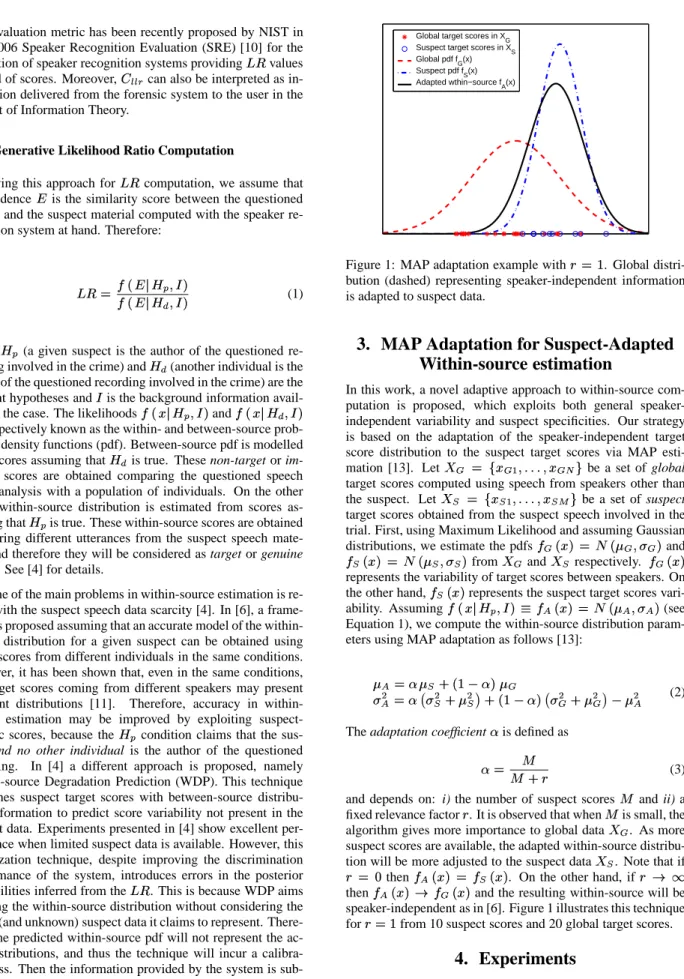
Global target scores in XG Suspect target scores in X
S
Global pdf fG(x) Suspect pdf f
S(x)
Adapted wthin−source fA(x)
Figure 1: MAP adaptation example with . Global
distri-bution (dashed) representing speaker-independent information is adapted to suspect data.
3. MAP Adaptation for Suspect-Adapted
Within-source estimation
In this work, a novel adaptive approach to within-source com-putation is proposed, which exploits both general speaker-independent variability and suspect specificities. Our strategy is based on the adaptation of the speaker-independent target score distribution to the suspect target scores via MAP esti-mation [13]. Let
be a set of global
target scores computed using speech from speakers other than the suspect. Let
be a set of suspect
target scores obtained from the suspect speech involved in the trial. First, using Maximum Likelihood and assuming Gaussian distributions, we estimate the pdfs
and
from and respectively.
represents the variability of target scores between speakers. On the other hand,
represents the suspect target scores
vari-ability. Assuming (see
Equation 1), we compute the within-source distribution param-eters using MAP adaptation as follows [13]:
` ´ ` ´ (2)
The adaptation coefficientis defined as
(3) and depends on: i) the number of suspect scores
and ii) a fixed relevance factor. It is observed that when
is small, the algorithm gives more importance to global data. As more
suspect scores are available, the adapted within-source distribu-tion will be more adjusted to the suspect data. Note that if then
. On the other hand, if
then
and the resulting within-source will be
speaker-independent as in [6]. Figure 1 illustrates this technique for from 10 suspect scores and 20 global target scores.
4. Experiments
Experiments have been performed using the evaluation proto-col proposed in NIST 2005 SRE [14]. The database used in this evaluation has been extracted from the MIXER corpus [15],
and includes different communication channels, handsets, mi-crophones and languages. The evaluation protocol defines dif-ferent training and testing conditions. We carry out our experi-ments using the ATVS GMM-MAP-UBM system submitted to NIST 2005 SRE. KL-Tnorm technique, an efficient and adap-tive speaker- and test-dependent score normalization technique, has been used to normalize scores [16]. Results are presented for the 8 conversation side training and 1 conversation side tes-ting task (8c-1c). Each conversation side has an average du-ration of 2.5 minutes of speech after silence removal. In this condition, more than 250 speakers are involved, and more than 23000 trials are performed. Details can be found in the NIST 2005 SRE Evaluation Plan in [14]. In order to obtain each sus-pect’s target score set, we have selected all the target scores
for each speaker from the whole score set in the evaluation, ex-cept the score used as evidence in eachcomputation. Thus,
there will be a variable number of within-source scores for each speaker. We have only selected suspect vs. questioned speech comparisons having more than four suspect target scores, i.e.,
. A total number of 10.618 trials have been performed in this sub-condition. All the process has been carried out in a gender-dependent way, and no cross-gender trials have been performed.
Before the evaluation, a development set consisting of the NIST 2004 SRE database was selected. Trials performed using this development set follow the NIST 2004 SRE protocol. The global target score setconsists of all the target scores in this
development set. As the database used in NIST 2004 was also a different subcorpus of MIXER,is supposed to accurately
represent the global variability of all suspect scores in the test set. The population used for computation consists of,
res-pectively, 224 female and 170 male speaker GMM models in the development set. KL-Tnorm is performed in the following ex-periments through adaptive selection of speaker-dependent 75-models cohorts. 0.1 0.2 0.5 1 2 5 10 20 40 0.1 0.2 0.5 1 2 5 10 20 40
False Alarm probability (in %)
Miss probability (in %)
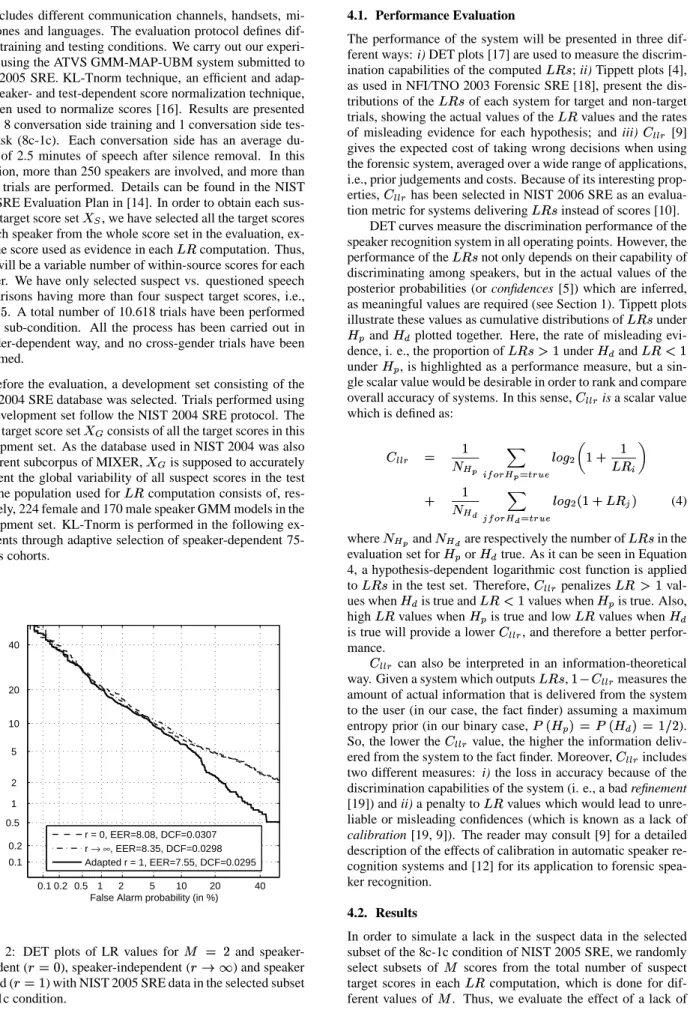
r = 0, EER=8.08, DCF=0.0307 r → ∞, EER=8.35, DCF=0.0298 Adapted r = 1, EER=7.55, DCF=0.0295
Figure 2: DET plots of LR values for
and
speaker-dependent ( ), speaker-independent ( ) and speaker
adapted ( ) with NIST 2005 SRE data in the selected subset
of 8c-1c condition.
4.1. Performance Evaluation
The performance of the system will be presented in three dif-ferent ways: i) DET plots [17] are used to measure the discrim-ination capabilities of the computed; ii) Tippett plots [4],
as used in NFI/TNO 2003 Forensic SRE [18], present the dis-tributions of theof each system for target and non-target
trials, showing the actual values of thevalues and the rates
of misleading evidence for each hypothesis; and iii) [9]
gives the expected cost of taking wrong decisions when using the forensic system, averaged over a wide range of applications, i.e., prior judgements and costs. Because of its interesting prop-erties, has been selected in NIST 2006 SRE as an
evalua-tion metric for systems deliveringinstead of scores [10].
DET curves measure the discrimination performance of the speaker recognition system in all operating points. However, the performance of thenot only depends on their capability of
discriminating among speakers, but in the actual values of the posterior probabilities (or confidences [5]) which are inferred, as meaningful values are required (see Section 1). Tippett plots illustrate these values as cumulative distributions ofunder and plotted together. Here, the rate of misleading
evi-dence, i. e., the proportion of under and
under, is highlighted as a performance measure, but a
sin-gle scalar value would be desirable in order to rank and compare overall accuracy of systems. In this sense,is a scalar value
which is defined as:
X „ « X (4)
whereandare respectively the number ofin the
evaluation set foror true. As it can be seen in Equation
4, a hypothesis-dependent logarithmic cost function is applied toin the test set. Therefore,penalizes
val-ues when is true and values whenis true. Also,
highvalues whenis true and lowvalues when
is true will provide a lower, and therefore a better
perfor-mance.
can also be interpreted in an information-theoretical
way. Given a system which outputs,measures the
amount of actual information that is delivered from the system to the user (in our case, the fact finder) assuming a maximum entropy prior (in our binary case,
).
So, the lower the value, the higher the information
deliv-ered from the system to the fact finder. Moreover,includes
two different measures: i) the loss in accuracy because of the discrimination capabilities of the system (i. e., a bad refinement [19]) and ii) a penalty tovalues which would lead to
unre-liable or misleading confidences (which is known as a lack of
calibration [19, 9]). The reader may consult [9] for a detailed
description of the effects of calibration in automatic speaker re-cognition systems and [12] for its application to forensic spea-ker recognition.
4.2. Results
In order to simulate a lack in the suspect data in the selected subset of the 8c-1c condition of NIST 2005 SRE, we randomly select subsets of
scores from the total number of suspect target scores in each computation, which is done for
dif-ferent values of
target suspect scores maintaining the rest of conditions. Figure 2 shows the performance of the proposed technique in terms of DET plots in suspect data scarcity conditions (
). It
is observed that the speaker-adapted within-source estimation technique outperforms discrimination capabilities of speaker-dependent ( ) and speaker-independent ( ) methods
for all operating points. However, this improvement is not so significant for low False Alarm rates (and DCF as defined by NIST [14]). But the performance of thedepends not only
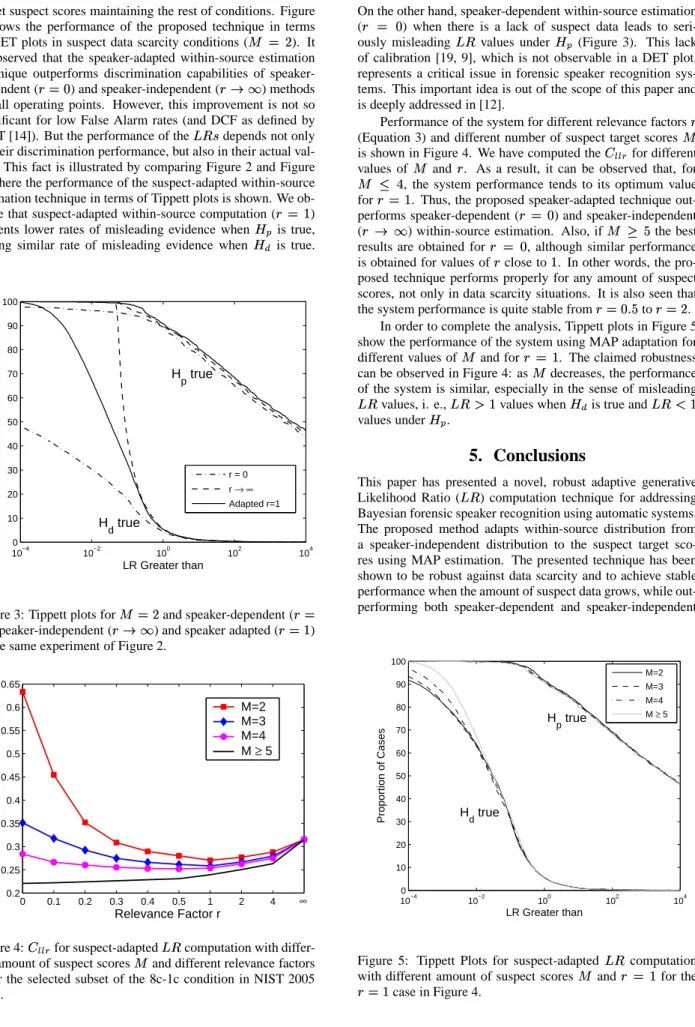
in their discrimination performance, but also in their actual val-ues. This fact is illustrated by comparing Figure 2 and Figure 3, where the performance of the suspect-adapted within-source estimation technique in terms of Tippett plots is shown. We ob-serve that suspect-adapted within-source computation ( )
presents lower rates of misleading evidence when is true,
having similar rate of misleading evidence when is true.
10−4 10−2 100 102 104 0 10 20 30 40 50 60 70 80 90 100 LR Greater than Proportion of Cases r = 0 r → ∞ Adapted r=1 H p true H d true
Figure 3: Tippett plots for
and speaker-dependent ( ), speaker-independent ( ) and speaker adapted ( )
in the same experiment of Figure 2.
0 0.1 0.2 0.3 0.4 0.5 1 2 4 0.2 0.25 0.3 0.35 0.4 0.45 0.5 0.55 0.6 0.65 Relevance Factor r C llr M=2 M=3 M=4 M ≥ 5 ∞
Figure 4:for suspect-adaptedcomputation with
differ-ent amount of suspect scores
and different relevance factors
for the selected subset of the 8c-1c condition in NIST 2005
SRE.
On the other hand, speaker-dependent within-source estimation ( ) when there is a lack of suspect data leads to
seri-ously misleading values under (Figure 3). This lack
of calibration [19, 9], which is not observable in a DET plot, represents a critical issue in forensic speaker recognition sys-tems. This important idea is out of the scope of this paper and is deeply addressed in [12].
Performance of the system for different relevance factors
(Equation 3) and different number of suspect target scores
is shown in Figure 4. We have computed the for different
values of
and . As a result, it can be observed that, for
, the system performance tends to its optimum value for . Thus, the proposed speaker-adapted technique
out-performs speaker-dependent ( ) and speaker-independent
( ) within-source estimation. Also, if
the best results are obtained for , although similar performance
is obtained for values ofclose to . In other words, the
pro-posed technique performs properly for any amount of suspect scores, not only in data scarcity situations. It is also seen that the system performance is quite stable from
to .
In order to complete the analysis, Tippett plots in Figure 5 show the performance of the system using MAP adaptation for different values of
and for . The claimed robustness
can be observed in Figure 4: as
decreases, the performance of the system is similar, especially in the sense of misleading
values, i. e., values when is true and
values under.
5. Conclusions
This paper has presented a novel, robust adaptive generative Likelihood Ratio () computation technique for addressing
Bayesian forensic speaker recognition using automatic systems. The proposed method adapts within-source distribution from a speaker-independent distribution to the suspect target sco-res using MAP estimation. The psco-resented technique has been shown to be robust against data scarcity and to achieve stable performance when the amount of suspect data grows, while out-performing both speaker-dependent and speaker-independent
10−4 10−2 100 102 104 0 10 20 30 40 50 60 70 80 90 100 LR Greater than Proportion of Cases M=2 M=3 M=4 M ≥ 5 Hp true Hd true
Figure 5: Tippett Plots for suspect-adapted computation
with different amount of suspect scores
and for the case in Figure 4.
non-adaptive approaches, both in terms of DET plots as a measure of discrimination performance, in terms of Tippett plots as a representation of the actualvalues and in terms
of application-independent expected cost of wrong decisions (). Finally, the need for calibration in the performance
analysis of forensic speaker recognition systems has also been pointed out.
6. References
[1] C. Champod and D. Meuwly, “The inference of identity in forensic speaker recognition,” Speech Communication, vol. 31, pp. 193–203, 2000.
[2] I. W. Evett, “Towards a uniform framework for report-ing opinions in forensic science casework,” Science and
Justice, vol. 38, no. 3, pp. 198–202, 1998.
[3] C. G. G. Aitken and F. Taroni, Statistics and the
Evalu-ation of Evidence for Forensic Scientists, John Wiley &
Sons, Chichester, 2004.
[4] J. Gonzalez-Rodriguez, A. Drygajlo, D. Ramos-Castro, M. Garcia-Gomar, and J. Ortega-Garcia, “Robust estima-tion, interpretation and assessment of likelihood ratios in forensic speaker recognition,” Computer Speech and
Lan-guage, vol. 20, no. 2-3, pp. 331–355, 2006.
[5] W. M. Campbell, D. A. Reynolds, J. P. Campbell, and K. J. Brady, “Estimating and evaluating confidence for forensic speaker recognition,” in Proc. of ICASSP, 2005, pp. 717– 720.
[6] F. Botti, A. Alexander, and A. Drygajlo, “An interpreta-tion framework for the evaluainterpreta-tion of evidence in forensic automatic speaker recognition with limited suspect data,” in Proc. of Odyssey 2004, pp. 63–68.
[7] F. Taroni, S. Bozza, and C. G. G. Aitken, “Decision analy-sis in forensic science,” Journal of Forensic Sciences, vol. 50, no. 4, pp. 894–905, 2005.
[8] F. Taroni, C. G. G. Aitken, and P. Garbolino, “De Finetti’s subjectivism, the assessment of probabilities and the eval-uation of evidence: A commentary for forensic scientists,”
Science and Justice, vol. 41, no. 3, pp. 145–150, 2001.
[9] N. Brummer and J. du Preez, “Application independent evaluation of speaker detection,” Computer Speech and
Language, vol. 20, no. 2-3, pp. 230–275, 2006.
[10] NIST, “2006 speaker recognition evaluation plan: http://www.nist.gov/speech/tests/spk/2006/index.htm,” 2006.
[11] G. Doddington, W. Liggett, A. Martin, M. Przybocki, and D. A. Reynolds, “Sheeps, goats, lambs and wolves: A sta-tistical analysis of speaker performance in the NIST 1998 speaker recognition evaluation,” in Proc. of ICSLP, 1998. [12] D. Ramos-Castro, J. Gonzalez-Rodriguez, and J. Ortega-Garcia, “Likelihood Ratio Calibration in a Transparent and Testable Forensic Speaker Recognition Framework,” accepted in Odyssey 2006.
[13] J. L. Gauvain and C. H. Lee, “Maximum a posteriori es-timation for multivariate gaussian mixture observations of markov chains,” IEEE Trans. on Speech and Audio
Pro-cessing, vol. 2, no. 2, pp. 291–298, 1994.
[14] NIST, “2005 speaker recognition evaluation plan: http://www.nist.gov/speech/tests/spk/2005/index.htm,” 2005.
[15] J. P. Campbell, H. Nakasone, C. Cieri, D. Miller, K. Walker, A. F. Martin, and M. A. Przybocki, “The MMSR bilingual and crosschannel corpora for speaker re-cognition research and evaluation,” in Proc. of Odyssey
2004, pp. 29–32.
[16] D. Ramos-Castro, D. Garcia-Romero, I. Lopez-Moreno, and J. Gonzalez-Rodriguez, “Speaker verification using fast adaptive Tnorm based on Kullback-Leibler diver-gence,” in Proc. of 3rd COST 275 Workshop., 2005, pp. 49-52.
[17] A. Martin, G. Doddington, T. Kamm, M. Ordowski, and M. Przybocki, “The DET curve in assessment of decision task performance,” in Proc. of Eurospeech 97, pp. 1895– 1898.
[18] D. van Leeuwen and J. S. Bouten, “Results of the 2003 NFI-TNO forensic speaker recognition evaluation,” in
Proc. of Odyssey, 2004, pp. 75–82.
[19] M. H. deGroot and S. E. Fienberg, “The comparison and evaluation of forecasters,” The Statistician, vol. 32, pp. 12–22, 1982.