Heterogeneity-Aware Placement
Strategies for Query Optimization
Dissertation
zur Erlangung des akademischen Grades Doktoringenieur (Dr.-Ing.)
vorgelegt an der
Technischen Universität Dresden Fakultät Informatik
eingereicht von
Dipl.-Inf. Tomas Karnagel
geboren am 30. August 1986 in Leipzig
Gutachter: Prof. Dr.-Ing. Wolfgang Lehner
Technische Universität Dresden
Fakultät Informatik, Institut für Systemarchitektur Lehrstuhl für Datenbanken
01062 Dresden
Prof. Dr. Jens Teubner
Technische Universität Dortmund Fakultät Informatik
Lehrstuhl für Datenbanken und Informationssysteme 44227 Dortmund
ABSTRACT
Computing hardware is changing from systems with homogeneous CPUs to systems with het-erogeneous computing units like GPUs, Many Integrated Cores, or FPGAs. This trend is caused by scaling problems of homogeneous systems, where heat dissipation and energy consumption is limiting further growths in compute-performance. Heterogeneous systems provide differ-ently optimized computing hardware, which allows different operations to be computed on the most appropriate computing unit, resulting in faster execution and less energy consumption.
For database systems, this is a new opportunity to accelerate query processing, allowing faster and more interactive querying of large amounts of data. However, the current hardware trend is also a challenge as most database systems do not support heterogeneous computing resources and it is not clear how to support these systems best. In the past, mainly single op-erators were ported to different computing units showing great results, while missing a system wide application. To efficiently support heterogeneous systems, a systems approach for query processing and query optimization is needed.
In this thesis, we tackle the optimization challenge in detail. As a starting point, we evalu-ate three different approaches on isolevalu-ated use-cases to assess their advantages and limitations. First, we evaluate a fork-join approach of intra-operator parallelism, where the same operator is executed on multiple computing units at the same time, each execution with different data partitions. Second, we evaluate using one computing unit statically to accelerate one opera-tor, which provides high code-optimization potential, due to this static and pre-known usage of hardware and software. Third, we evaluate dynamically placing operators onto computing units, depending on the operator, the available computing hardware, and the given data sizes. We argue that the first and second approach suffer from multiple overheads or high implemen-tation costs. The third approach, dynamic placement, shows good performance, while being highly extensible to different computing units and different operator implementations.
To automate this dynamic approach, we first propose general placement optimization for query processing. This general approach includes runtime estimation of operators on different computing units as well as two approaches for defining the actual operator placement accord-ing to the estimated runtimes. The two placement approaches are local optimization, which decides the placement locally at run-time, and global optimization, where the placement is de-cided at compile-time, while allowing a global view for enhanced data sharing. The main lim-itation of the latter is the high dependency on cardinality estimation of intermediate results, as estimation errors for the cardinalities propagate to the operator runtime estimation and placement optimization. Therefore, we propose adaptive placement optimization, allowing the placement optimization to become fully independent of cardinalities estimation, effectively eliminating the main source of inaccuracy for runtime estimation and placement optimization. Finally, we define an adaptive placement sequence, incorporating all our proposed techniques of placement optimization. We implement this sequence as a virtualization layer between the database system and the heterogeneous hardware. Our implementation approach bases on preexisting interfaces to the database system and the hardware, allowing non-intrusive integra-tion into existing database systems. We evaluate our techniques using two different database systems and two different OLAP benchmarks, accelerating the query processing through het-erogeneous execution.
ACKNOWLEDGEMENTS
First and foremost, I thank my thesis advisor Wolfgang Lehner, who encouraged me to start a Ph.D. in this topic and continuously provided interesting discussions on my research. Without him and his support, this thesis would not be possible.
Additionally, I want to thank Dirk Habich and Benjamin Schlegel, who supported my re-search from the beginning, helping me to focus and to publish my work. Both, Dirk and Ben-jamin, had a significant impact on my research. I am grateful to Jens Teubner, who agreed to externally review this thesis, as an expert in the field. Furthermore, I thank René Müller and Guy Lohman from IBM Almaden for taking me in as an intern, while showing me the inter-esting world of industry research. I am glad for the internship opportunity, the valuable input to my work, and the new friends that I made. Additionally, I want to thank Max Heimel, Tal Ben-Nun, and Matthias Werner for the fruitful cooperation and for co-authoring some publica-tions that went into this thesis. I would not have come this far without Max’s database system Ocelot, Tal’s hint that redundant work is sometimes better than going through a bottleneck, and Matthias’s help with profiling GPUs. I also have to thank Matthias Hille for casually men-tioning that we could use the OpenCL interface for the optimizer; an idea that grew in my mind over years without being aware of how much work this actually is.
I also thank the many internal reviewers of this work for their valuable time and helpful comments, especially Annett Ungethüm, Juliana Hildebrand, Alexander Krause, Ismail Oukid, Johannes Luong, Patrick Damme, Steffen Huber, and Till Kolditz. Additionally, I thank the rest of the database group for the constructive discussions and the good time together. In particular, I thank Katrin Braunschweig, Ulrike Fischer, Ahmad Ahmadov, Claudio Hartmann, Hannes Voigt, Julian Eberius, Kai Herrmann, Lars Kegel, Maik Thiele, Martin Hahmann, Robert Ul-bricht, Thomas Kissinger, Tim Kiefer, and Tobias Jäkel. A special thanks goes to Ulrike Schöbel for reviewing nearly all of my publications before submission and to Ines Funke for basically organizing the whole group.
I am grateful to the German Research Foundation (DFG) for providing the funding for my research through the Cluster of Excellence “Center for Advancing Electronics Dresden”. Additionally, I want to thank the Center For Information Services and High Performance Com-puting (ZIH) for access to the Taurus HPC system and the Dresden GPU Center of Excellence, for providing hardware access and an open space for in-depth discussions.
Last but not least, I owe to thank my family! My wife Sandra always supported my work and believed in me, while also accepting that I would use vacations to write papers. This thesis would not be possible without her. Additionally, my daughter Jasmin and my son Michael relentlessly tried to distract me from thinking about work, while being at home; helping me to keep a healthy work-live balance. I thank you both so much.
Tomas Karnagel May 26, 2017
CONTENTS
1 INTRODUCTION 11
2 QUERY OPTIMIZATION ANDHETEROGENEOUSHARDWARE 19
2.1 Query Optimization and Query Processing . . . 20
2.1.1 Query Optimization Techniques . . . 20
2.1.2 Query Processing . . . 22
2.1.3 Storage Models . . . 23
2.2 Hardware Heterogeneity . . . 25
2.2.1 Computing Unit Architectures . . . 25
2.2.2 Heterogeneous Connections . . . 28
2.2.3 Open Computing Language . . . 29
2.2.4 Computing Units used throughout this Thesis . . . 30
2.3 Query Processing in Heterogeneous Computing Environments . . 34
2.3.1 Operator Implementations . . . 34
2.3.2 Database Systems . . . 35
2.3.3 Placement Strategies in Heterogeneous Computing Environments . . . 37
3 APPROACHES TOUTILIZEHETEROGENEOUSENVIRONMENTS 39 3.1 Approach I: Intra-Operator Parallelism on different CUs . . . 41
3.1.1 Intra-Operator Parallelism . . . 41
3.1.2 Possible Limitations . . . 44
3.1.3 Operator Implementation and Hardware Setup . . . 45
3.1.4 Analysis of the Selection Operator . . . 46
3.1.5 Analysis of the Sort Operator . . . 51
3.1.6 Conclusion . . . 52
3.2 Approach II: Static Placement . . . 54
3.2.2 Observations . . . 56
3.2.3 TLB Analysis . . . 59
3.2.4 Implementation Adjustments . . . 64
3.2.5 Configuration-based Optimizer . . . 72
3.2.6 Conclusion and Transferability of Results . . . 74
3.3 Approach III: Dynamic Placement . . . 76
3.3.1 Observations from Previous Approaches . . . 76
3.3.2 Case Study: Dynamic Placement of Group-by Operator . . . 77
3.3.3 High Performance vs. Dynamic Placement . . . 80
3.3.4 Challenges for Automatic Placement Decisions . . . 82
4 GENERALPLACEMENTOPTIMIZATION 85 4.1 Runtime and Transfer Estimation . . . 88
4.1.1 General Directions . . . 89
4.1.2 Operator Runtime Estimation . . . 90
4.1.3 Transfer Time Estimation . . . 93
4.2 Local Placement Strategy . . . 94
4.2.1 General Approach . . . 94
4.2.2 Advantages and Limitations . . . 95
4.3 Global Placement Strategy . . . 97
4.3.1 Search Space . . . 97
4.3.2 Greedy Search Approach . . . 98
4.3.3 Search Space Reduction . . . 100
4.3.4 Advantages and Limitations . . . 100
4.4 Evaluation . . . 101
4.4.1 Runtime Estimation . . . 101
4.4.2 Placement Optimization . . . 104
4.5 Conclusion . . . 110
5 ADAPTIVEPLACEMENTOPTIMIZATION 111 5.1 Open Challenges . . . 113
5.2 Adaptive Placement Approach . . . 115
5.2.1 General Approach . . . 115
5.3 Adaptive Placement Sequence . . . 118
5.3.1 Steps at Query Compile-Time . . . 118
5.3.2 Steps at Query Run-Time . . . 122
5.3.3 Feasibility of our Approach . . . 124
5.4 Implementation Approach . . . 126
5.4.1 General Architecture . . . 126
5.4.2 Database System Interface . . . 126
5.4.3 Memory Management . . . 129 5.4.4 Kernel Handling . . . 130 5.4.5 Query Execution . . . 132 5.4.6 Summary . . . 133 5.5 Evaluation . . . 134 5.5.1 Micro-Benchmarks . . . 134 5.5.2 Overheads . . . 136
5.5.3 Performance and Placement Quality . . . 137
5.5.4 Adaptivity of Heterogeneous Placement . . . 139
5.5.5 Portability . . . 139
5.6 Conclusion . . . 140
6 CONCLUSION ANDFUTUREWORK 141 6.1 Summary . . . 142 6.2 Future Work . . . 145 BIBLIOGRAPHY 147 LIST OFFIGURES 157 LIST OFTABLES 159 LIST OFABBREVIATIONS 160
1
D
atabase management systems(DBMSs) are a core technology for the last half century and a basic building block for many applications. They are not only used for data storage and data querying but also for data analytics and data mining. Therefore, improving DBMS performance means inherently improving application performance, leading to a high demand of database performance tuning. There are many possibilities for performance tuning inside a database system. An overview on the database system architecture is given in Figure 1.1. An incoming query (e.g., SQL) is translated into an internal format, on which query optimization is performed (the query plan). This optimization includes query plan restructuring (logical optimization) and defining the specific operations that need to be executed in order to compute the query result (physical optimization). The optimized plan (query execution plan (QEP)) is passed to the processing layer, where the defined operators are executed using data and data access methods of the storage layer.Transla'on Layer Op'miza'on Layer Processing Layer Storage Layer Influenced by current Hardware Trends Database Query Query Plan
Query Execu'on Plan Data Accesses
Figure 1.1: Database System Architecture.
In order to improve performance, the database system architecture was shaped by hardware changes in the last decades. Examples are moving (1) from sequential processing to parallel multi-core execution (processing layer), (2) from disk-centric systems to in-memory systems (storage layer) [Abadi et al. 2013], and (3) from row-based execution to column-based execu-tion (optimizaexecu-tion, processing, and storage layer). Currently, hardware is changing again from homogeneous CPU systems towards heterogeneous systems with different computing units (CUs) like CPUs and GPUs, mainly to overcome physical limits of homogeneous systems [Es-maeilzadeh et al. 2011]. The computing resources in a heterogeneous system usually have different architectures for different use-cases. Database systems need to adapt to this hardware trend to efficiently utilize the given opportunities. Therefore, the current question is:
How can database systems efficiently utilize heterogeneous hardware environments to speed up query processing?
In this thesis, we strive to discuss this question in detail. In the following, we present the most influential hardware changes as motivation, before presenting challenges, our contribu-tion, and the structure of this thesis.
1970 1980 1990 2000 2010 2020 10 100 1000 10000 1e+05 1e+06
1e+07 memory (KByte)
(a) Main memory size1
1970 1980 1990 2000 2010 2020 1 10 100 1000 10000 frequency (MHz) power (W)
(b) Frequency2and power3
1970 1980 1990 2000 2010 2020 1 10 100 1000 10000 1e+05 1e+06 1e+07 #transistors (x1000) process (nm)
(c) Manufacturing process and number of transistors4
1970 1980 1990 2000 2010 2020 0 2 4 6 8 10 #cores (d) Number of cores3
Figure 1.2: Hardware evolution of different aspects from 1970 to the present. The CPU data (b, c, d) are based on Intel CPUs. We note that the logarithmic scale of the y-axis for (a, b, c), where linear growth actually stands for exponential scaling.
1http://www.jcmit.com/memoryprice.htm (Sep. 2016), 2Intel Poster: The Evolution of a Revolution,
3Intel Product Specifications: ark.intel.com (Sep. 2016, 4https://en.wikipedia.org/wiki/Transistor_count (Sep. 2016)
Motivation
In this section1, we briefly describe the major database and hardware trends of the past and the present, which are the motivation of our work. The general hardware evolution is illustrated in Figure 1.2.
Single Core Era: For the first database systems, single-core processors with a limited main memory were generally used. There, the focus of optimization was on efficient computation and minimizing costly disk accesses. While disk accesses remained a bottleneck, the compu-tation improved without changes to the database architecture through an increasing CPU fre-quency of⇡2x(Figure 1.2b) with each new processor manufacturing process [Pollack 1999].
Multi-Core Era: The power density and the leakage power rises with every new manufac-turing process [Pollack 1999], prohibiting higher voltages and further frequency scaling. Mul-tiple CPU cores on one die were introduced to reduce power consumption as it is likely that not all cores are used at peak performance. Therefore, cores can be throttled individually to control the overall power consumption. Figure 1.2b and 1.2d show that multiple cores were
1Parts of the material in this section (and Section 6.1) have been developed jointly with Dirk Habich. The
section is based on [Karnagel and Habich 2017]. The copyright is held byDe Gruyterand the original publication is available athttps://doi.org/10.1515/itit-2016-0048
introduced, when frequency and overall power reached their limit. For database systems, this means the “Free Lunch is over” [Sutter 2005], implicating that query processing can not im-prove performance with newer hardware unless we adjust the database architecture towards parallelism and concurrency.
In-Memory Era: Rising main memory capacities trigger another architecture change (Fig-ure 1.2a). Traditionally, the main memory was used as a buffer pool for a data sub-set from the disk drives. The main memory acted as cache for the hard-disk, where accesses to the disk were still the main bottleneck. With increasing memory capacity, it is now possible to store vast amounts, if not all data, in main memory. This redefines the systems’ bottlenecks, the ideal database architecture, and the actual database usage towards an increasing amount of analytical queries.
Current Challenge: Scaling further is the current challenge. Processor frequencies and over-all power consumption does not increase anymore (Figure 1.2b). At the same time, more tran-sistors are packed into one chip, which is made possible by the shrinking manufacturing process (Figure 1.2c). However, this also increases the power consumption permm2and the
theoret-ical peak consumption of the chip. Since this peak consumption is limited, not all parts (or cores) of the chip can be used at peak power (Dark Silicon [Esmaeilzadeh et al. 2011]). At the same time, data sizes and the demand for instant data analytics is growing exponentially.
One direction to accelerate query processing is using distributed database systems, where multiple nodes work together on one query. This introduces the overhead of data transfers beyond one node, however, at the same time adding the advantage of being able to add more computing power as needed. To increase the performance of a single node, possible approaches include combining multiple homogeneous computing units (e.g., CPU-based NUMA systems) or multiple heterogeneous computing units.
Heterogeneous Era: At the moment, multiple architectures are emerging to accelerate cer-tain computations like GPUs for highly parallel SIMD processing; Many Integrated Cores (MIC) for highly parallel processing of individual threads; field programmable gate arrays (FPGA) for operators on reconfigurable logics; or different application-specific integrated cir-cuits (ASIC) to speed up custom-specific algorithms. The complete systems themselves are becoming more and more heterogeneous, which was already reported in 2011:
“Energy will be the key limiter of performance, forcing processor designs to use large-scale parallelism with heterogeneous cores, ...” [Borkar and Chien 2011]
These heterogeneous systems are already widely available and most of them are also used for data processing. For example, database research was done on using common processors that integrate cores of different sizes and capabilities like ARM’s big-LITTLE [Mühlbauer et al. 2014; Ungethüm et al. 2016] or processors that integrate GPUs like AMD’s Accelerated Pro-cessing Units (APU) [He et al. 2014]. For server systems, FPGA extensions are productively used for search engines [Putnam et al. 2014] and high-end GPUs are used for visual data ana-lytics [Mostak 2013]. Becoming more specialized, hardware/software co-design was proposed
to speedup sorted-set algorithms [Arnold et al. 2014b], hashing [Arnold et al. 2014a], and com-pressed bitmap processing in database systems [Haas et al. 2016].
Even further, there are research projects like the Center for Advancing Electronics Dresden (cfAED), which strive to find new materials for building processors. These materials include silicon nanowires [Cui et al. 2003] and carbon nanotubes [Meric et al. 2008], but also organic electronics [Lüssem et al. 2013], chemical information processing [Voigt et al. 2013], and DNA origami [Gür et al. 2016]. When one or more of these materials become successful for compu-tation, processors will not only be heterogeneous in their architecture and execution modes, but also in their materials and processor design [Völp et al. 2016]. This illustrates the need to investigate heterogeneity-aware computation and evaluate strategies that utilize multiple heterogeneous computing units.
Challenges in the Heterogeneous Era
To support heterogeneous architectures or even heterogeneous materials within the database system, a redesign of the database architecture and the database query optimization is needed. Multiple choices for the computation significantly increase the complexity of the system and it is yet unknown in which way hardware heterogeneity can be supported efficiently in database systems. In the past, database operator implementations were ported from pure CPU-based processing to an execution using other CUs, like GPUs [Govindaraju et al. 2006; He et al. 2008] or FPGAs [Müller et al. 2009a,b, 2012], but also the Intel MIC [Jha et al. 2015] and the Cell Processor [Gedik et al. 2007]. Based on the assumption that operators have been ported to the different CUs in a heterogeneous environment, the challenge is using them in the most beneficial way to accelerate query processing.
For example, it would be possible to use a fork-join model and partition data in a way that multiple CUs can partially execute an operator in parallel, theoretically improving performance over a single CU execution. However, it is unclear how much the speedup will be and if possi-ble overheads of this intra-operator parallelism can be compensated by the faster execution.
For single CU execution, it would be possible to define a static operator-CU combination that is always used in this fixed scenario, e.g., using a GPU only for sorting. This allows a high level of performance tuning for this specific operator and hardware. However, it is unclear if an operator should always be executed on the same CU, given that data sizes and data properties can be different. Additionally, this approach might not be extensible to multiple operators and different hardware platforms.
A third approach would be dynamic execution, i.e., deciding the location (placement) of an operator dynamically for each query and operator execution. There, any CU can be used for any operator, allowing to change the placement if the execution is not beneficial for some data sizes or operator implementations. Here, however, the question is how to define this placement automatically, as decisions have to be based on the given computing hardware and operator implementation, but also on the query structure and data transfers within a query.
Summary of Contributions
We investigate the three mentioned approaches in isolated scenarios to evaluate their potential for heterogeneity-aware database systems. We choose the third approach as most promising and propose further strategies for dynamic execution and heterogeneous operator placement. The key contributions of this thesis are the following:
Approaches to utilize heterogeneous environments:
1. We evaluate intra-operator parallelism for two different operators and two different het-erogeneous computing environments. We propose a data partitioning scheme and inves-tigate performance effects of the execution in detail. As a result, we find underutilization, result processing, and different CUs competing for computing resources, significantly limiting the whole potential of this approach.
2. We evaluate and fine-tune a group-by operator using the static offloading approach on a GPU. We find multiple performance effects and bottlenecks, which we explain through in-depth hardware benchmarking. This includes a thorough analysis of the GPU TLB architecture, identifying never-before-published TLB properties. We propose a total of eight configurations combining different parameter and implementation adjustments to improve the performance. The configurations themselves need to be switched according to the hash table size of the operator.
3. We propose dynamic placement decisions, where the operator actually switches between different CUs to reduce CU-disadvantages by changing placement decisions at the right point. We evaluate this approach manually by executing the group-by operator on eight different CUs including different CPUs, GPUs, and MIC. We determine this approach to be highly extensible for different hardware environments and operator implementations and we discuss challenges for fully automating these placement decisions.
Heterogeneous placement optimization:
1. We propose a novel way of runtime and transfer estimation, a basic technique for place-ment optimization. We utilize a learning-based black-box approach for operators and computing units, which allows high extensibility towards unknown hardware environ-ments and operator implementations.
2. Based on the runtime estimation, we propose local and global placement optimization to define placement decisions for all database operators within a query in order to reduce the overall query runtime.
3. Placement optimization is highly dependent on cardinality estimation, where small er-rors lead to inaccurate runtime estimations and wrong placement decisions. Therefore, we propose adaptive placement optimization, which allows the decisions to become com-pletely independent of intermediate cardinality estimations. This is achieved by parti-tioning the query and allowing a combination of compile-time and run-time optimiza-tions, leading to higher precisions for runtime estimation and placement optimization.
4. Finally, we propose a novel implementation approach as virtualization layer based on OpenCL for the database system interface. This allows our approach to be highly extensi-ble for different heterogeneous environments, while also being aextensi-ble to be integrated into multiple database systems without additional effort.
We do not focus on building entirely new database systems, but instead we want to extend existing systems through our approach of heterogeneous placement. Furthermore, we focus on compute heterogeneity and not memory heterogeneity (e.g., volatile vs. non-volatile memory), as the latter is more relevant for persistence and recovery consideration.
Query Optimization and Heterogeneous Hardware Query Optimization
and Processing HeterogeneityHardware
Query Processing in Heterogeneous Env.
Approaches to Utilize Heterogeneous Environments Intra-Operator Parallelism Static Placement Dynamic Placement
General Placement Optimization Runtime and Transfer Estimation
Local Optimization Global Optimization
Adaptive Placement Optimization Adaptive Placement Approach Adaptive Placement Sequence Implementation Approach 2
3
4
5
Figure 1.3: The Structure of this thesis including chapter numbers.
Outline
Figure 1.3 illustrates the outline of this work. We first discuss background material in Chap-ter 2, divided into (1) general query optimization and processing, (2) heChap-terogeneous hardware, and (3) query processing using heterogeneous computing resources. Especially the latter part
gives an overview of related work to our approaches. In Chapter 3, we explore three differ-ent heterogeneous placemdiffer-ent approaches in order to find the most promising approach to fol-low. The three approaches include (1) intra-operator parallelism on heterogeneous hardware, (2) static placement and implementation fine-tuning, and (3) dynamic operator placement. Every approach is evaluated prototypically using a fixed scenario, where limitations and oppor-tunities are shown. We choose dynamic placement for further research and start with a general approach in Chapter 4. This general approach includes runtime estimation and data transfer cost estimation as base for any further steps. For the actual optimization, we propose local and global optimization, each with its own advantages and limitations. To improve on the general approach, we propose an adaptive approach in Chapter 5, building a middle path between local and global optimization. In detail, we describe (1) the adaptive placement approach, (2) an adaptive work sequence, and (3) our implementation approach as vitulization layer including an evaluation with two different database systems and workloads. We conclude the paper in Chapter 6 with a summary and future work.
2
QUERY OPTIMIZATION AND
HETEROGENEOUS HARDWARE
2.1 Query Optimization and Query
Processing
2.2 Hardware Heterogeneity
2.3 Query Processing in
Q
uery Processing has to adapt to heterogeneous computing environments to improve overall query execution. In the following, we first present an overview on traditional database techniques including query optimization, query processing, as well as data storage. Afterwards, we present heterogeneous computing systems by describing different hardware architectures and their capabilities together with properties of multiple CUs, which are used throughout this thesis. Finally, we present related work on query processing and optimization for heterogeneous computing environments.2.1 QUERY OPTIMIZATION AND QUERY PROCESSING
Database query processing in general uses a sequence of query parsing, query optimization, and query processing, as shown in Figure 2.1. The query parser transforms an input query (e.g., in SQL format) into an internal query plan of relational algebra. The query optimizer then rewrites the query plan, generates possible execution plans, and chooses the best plan for further processing. The query processor or execution engine executes the given plan to compute the query result. In this section, we give a brief overview on query optimization and query execution, together with different storage models.
Select … From … Where …
Query
Parser Op6mizer Query Processor Query
Figure 2.1: Query Processing Order.
2.1.1 Query Optimization Techniques
Query optimization defines the steps taken from a naive query plan based on an input query, to a highly optimized query execution plan (QEP). Query optimization has always been a key aspect in database research, resulting in a large variety of different approaches. We give a brief overview on aspects of query optimization that are important to the work in this thesis. This includes logical and physical query optimization, as well as cardinality estimation.
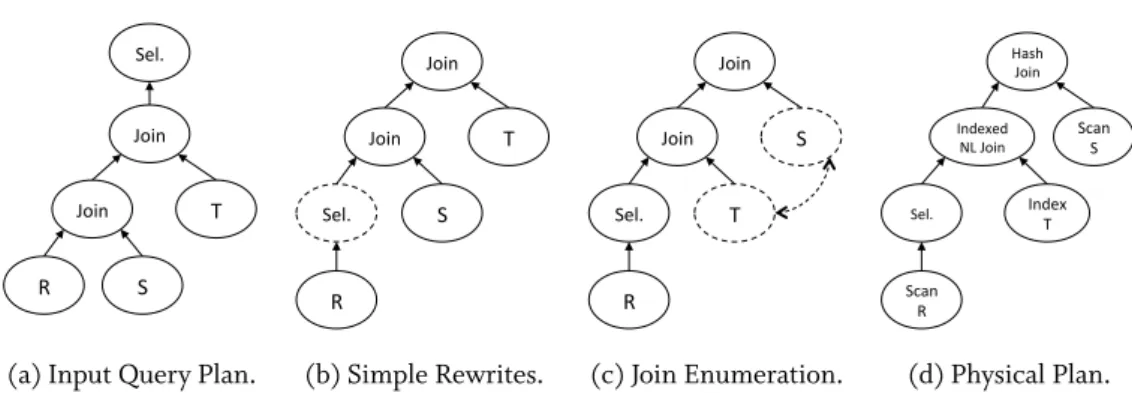
Query Optimization: As shown in Figure 2.1, the query optimizer receives a parsed query plan from the parser, with the goal to determine the most efficient plan for execution. To achieve that goal, logical and physical query optimization is applied. Figure 2.2 shows an ex-ample query with two joins and one selection.
Logical query optimizationapplies data independent rewriting rules for operator reordering, like query unnesting, redundancy removal, selection and projection moves, and cross-join re-moval [Garcia-Molina et al. 2000]. For example, this could be applying a selection early to reduce the possible number of intermediate result tuples and avoid unnecessary computation of tuples that are not part of the final result (Figure 2.2b).
R S Join
Sel.
T Join
(a) Input Query Plan. R S Join Sel. T Join (b) Simple Rewrites. R T Join Sel. S Join (c) Join Enumeration. Scan R Index T Indexed NL Join Sel. Scan S Hash Join (d) Physical Plan.
Figure 2.2: Query Optimization for an example query with three tables, two joins, and one selection.
Physical query optimization, uses data characteristics and cardinality estimation to deter-mine join enumerations and physical operator instances. Multiple join orders need to be eval-uated, as it is not trivial to find the order with the least intermediate results and the lowest runtime. For most queries, it is impractical to evaluate all possible join orderings as the search space is too large. There are two main approaches to optimize these orderings. A greedy ap-proach defines the operator order by starting with one operator that produces the smallest result, before adding more operators with the same objective [Fegaras 1998]. This is a fast way to produce an operator ordering, however, combinations that produce a large result in the beginning, but much smaller results in the end are not considered. To find the optimal plan, dynamic programming was proposed. Dynamic programming considers all promising combinations, even if the initial intermediate results are large [Selinger et al. 1979]. There, the problem is the large memory footprint and the large amount of computation. The resulting join order can be applied to the plan structure (Figure 2.2c). Finally, logical operators are replaced with physical instances, e.g., a join can be instantiated physically with different kinds of join implementations, like a hash join or a nested loop join (Figure 2.2d). The decisions are usually based on cardinality estimations and the data properties, e.g., an indexed nested loop join can be preferred if the data is indexed or sorted.
Cardinality Estimation: The physical query optimization steps are based on cardinality es-timations of the intermediate result. The cardinalities of the base relations are usually known, whereas the intermediate cardinalities need to be estimated in order to make correct optimiza-tion decisions. The main source of unknown cardinalities areselections,groupings, andjoins, whereas most other operators produce pre-known result sizes (e.g., a sorting result is always the size of its input). There are different approaches to cardinality estimation. Histograms over base table attributes are the most common approach, where either each value, a range of values, or only the most common values are stored with their frequency [Kooi 1980]. A his-togram is ideal for single selections, as the result size (or selectivities) can be easily taken from the histogram. Usually, independence between the attributes is assumed and the selectivities are multiplied for multi-attribute selections on the same table. This does not represent the real data if attributes are not independent. To solve this problem, it is possible to use
multi-Scan Scan Join Sort tuple tuple tuple next next next (a) Tuple-at-a-time. Scan Scan Join Sort full result full result full result (b) Operator-at-a-time. Scan Scan Join Sort 1k tuples 1k tuples 1k tuples next next next (c) Block/Vector. Scan Scan Join Sort tuple full result tuple (d) JIT Compilation.
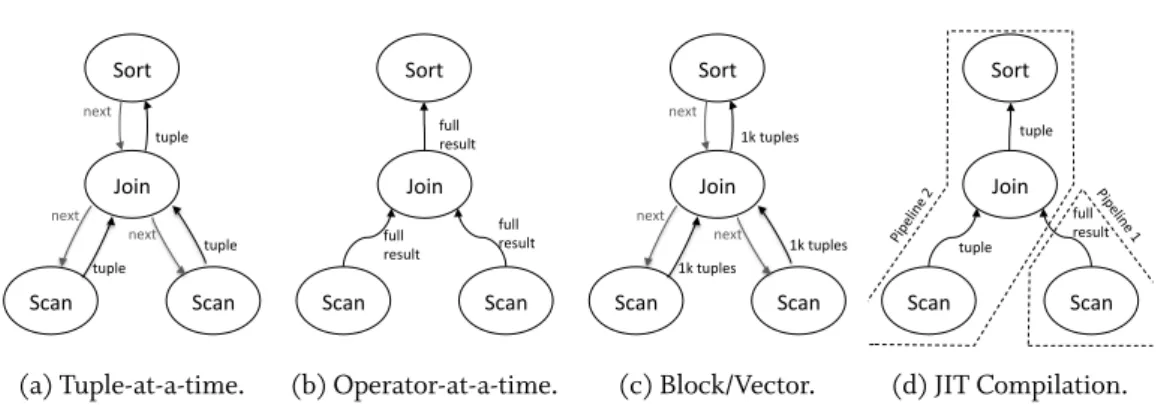
Figure 2.3: Query Processing Models for an example query with one join and one sorting. attribute histograms [Poosala and Ioannidis 1997], which can successfully model dependent selectivities, however, multi-attribute histograms are complex to maintain and space intensive. Another alternative are random samples of table rows [Lipton et al. 1990], which can be con-sulted for arbitrary predicates and different query orderings. The estimation quality depends on the sample size and the chosen rows in the sample.
2.1.2 Query Processing
There are multiple processing models possible for query processing. In general, a database query is transformed to a query plan consisting of database operators, which define the steps of query processing. Figure 2.3 shows a query plan with four operators, i.e., two table scans, a join, and a sorting. Given this query plan, there are different processing models to execute the query.
Tuple-at-a-time processing (Figure 2.3a): (also known as Volcano-model [Graefe 1994]) This processing method is based on an iterator model for operators, where each operator sup-plies anextfunction, which computes the next result tuple of the given operator. Operators can be connected, where succeeding operators call the next function of preceding operators to retrieve their input data. This model is usually used in row-based database systems, however, it can also be used in column-based systems, where the result tuples are represented as tuple IDs (TID). The tuple-at-a-time approach is intuitive and intermediate results are kept small. However, the execution of this approach is not optimized for modern processors. Each next-function call results in a next-function-pointer lookup and jump to a different code location, which itself results in instruction cache misses. As each operator keeps its own state, cache misses are produced, which result in additional data loads from the main memory. Changing the compu-tation frequently also results in many branch miss predictions preventing the processor to use pipelining efficiently.
Operator-at-a-time processing (Figure 2.3b): Instead of producing single tuples, Operator-at-a-time processing produces whole operator results [Boncz 2002]. With this ap-proach, operator computations are done in a tight loop, enabling the processor to keep data and
instructions in caches, while allowing ideal branch prediction and pipelining. Also, the func-tion call overhead becomes insignificant as only one funcfunc-tion per operator is called, instead of one function per operator per tuple. The main problem of the operator-at-a-time approach is the full materialization of intermediate results, which results in cache misses when switching to a different operator and therefore it mainly reads from main memory for the intermediate results.
Block or Vector Processing (Figure 2.3c): This approach defines a middle-path between the two previous approaches. Instead of returning one tuple pernextcall, the operators re-turn a block of tuples (e.g., 1000 tuples) but not the full result. This reduces the function call overhead significantly, while having a small block of data, which can stay inside the CPU cache for multiple operators working on the same block of data. The approach is called block-oriented processing [Padmanabhan et al. 2001] for row-based storage format, where blocks contain multiple complete tuples. With column-based storage, this approach is called vector-at-a-time processing [Boncz et al. 2005] and the operators return vectors (partitions) of table columns.
JIT Query Compilation (Figure 2.3d): This approach compiles parts of the query operators together in one function (pipeline) [Neumann 2011]. The execution is similar to the tuple-at-a-time approach, while the just-in-time (JIT) compilation removes all function call over-head through combining the computation in one single function. This is as cache efficient as the column-at-a-time or vector-at-a-time processing, while avoiding most intermediate results. Only if an operator can not be executed in a pipeline (e.g., a hash join that needs a full hash ta-ble as input), multiple pipelines are created. This results in multiple compiled functions, while intermediate results of the functions are fully materialized. However, this only happens in a few cases compared to materializing after every operator execution in the operator-at-a-time approach.
There is no best processing model and the ideal choice usually depends on the database work-load, the underlying hardware architecture, and the used storage model.
2.1.3 Storage Models
Additional to query processing models, there are different data storage models. Figure 2.4 shows the three most widely used models, which we explain briefly in this section.
Row-oriented Storage Model. For the row-oriented storage model, also known as N-ary Storage Model (NSM)[Ramakrishnan and Gehrke 2003], database tuples are stored one tuple after another including all values belonging to one table entry (table row). This is beneficial if only one tuple is altered or tuples are added, as they only need to be appended to the end of the row store. Also, logically associated information is stored together, making the retrieval of the full tuple context efficient. Single tuple operations are common for Online Transaction Processing (OLTP).
People
Name Age Phone
Bob 55 1234 Lisa 23 2345 Jasmin 33 3456 Michael 19 4567 NSM - Table People: <Bob, 55, 1234>, <Lisa, 23, 2345>, <Jasmin, 33, 3456>,<Michael, 19, 4567> DSM - Table People:
Name: Bob, Lisa, Jasmin, Michael Age: 55, 23, 33, 19
Phone: 1234, 2345, 3456, 4567
Table – logical view PAX - Table People:
Page 1: Name: Bob, Lisa Age: 55, 23 Phone: 1234, 2345 Page 2:
Name: Jasmin, Michael Age: 33, 19 Phone: 3456, 4567
Figure 2.4: Examples for different storage models.
Column-oriented Storage Model. For column-oriented storage [Abadi et al. 2013; Stone-braker et al. 2005], orDecomposition Storage Model (DSM), a database table is split into columns, which are stored separately. Usually, a tuple ID or the position in the column defines the tuple relation, e.g., the third entry in all columns assemble the third tuple of the table. Inserting a tuple is more complex as this results in one insert per column. Also, point queries for complete tuples have to access all columns. On the other hand, the storage is more efficient, as all values in a column are of the same kind (numbers, fixed size strings, etc.), which allows compression and vectorized processing. Additionally,OLAP (Online Analytical Processing)queries like“return the average age of all people”do not have to access the whole tablePeoplein Figure 2.4 but only the columnAge.
Partition Attributes Across (PAX) Model. PAX [Ailamaki et al. 2002] is a combination of the previous approaches: the complete tuples of a table are logically ordered in NSM format. Naturally, the data spans over multiple memory pages. For the PAX approach, tuple data within each page is converted from NSM to DSM format. Therefore, the individual pages contain full tuples but these tuples are stored column-wise within the page. This approach achieves a trade-off as tuples are stored close together to accelerate point queries, and, on the other hand, data can be compressed and accessed cache-friendly in a column-format. However, even with efficient column-oriented data access, every page has to be loaded for OLAP queries that aggre-gate a whole column. In contrast, for the presented DSM approach, only pages containing the queried column need to be loaded.
Beyond the presented storage models, there is a number of specializations like key-value-based storage [Seeger and Ultra-Large-Sites 2009] or graph-key-value-based storage [Jouili and Vansteen-berghe 2013]. The ideal storage model depends on the database workload, e.g., OLTP or OLAP, and the chosen query processing model.
2.2 HARDWARE HETEROGENEITY
In this section, we present background information on hardware aspects like different CU ar-chitectures, different ways of connecting these CUs, and how to program them in a universal way. In the end, we present a list of CUs used throughout this thesis.
2.2.1 Computing Unit Architectures
To describe different CUs, we choose three general architectures and discuss their advantages and limitations for different workloads. The three architectures are common CPUs, GPUs, and Many Integrated Core systems (MIC). We choose these architectures exemplarily because of their general availability and programmability. Also, all CUs used in this thesis are among these three architectures. To describe the different architectures, we use different criteria:
1. Single Core Architecture.Most CUs consist of multiple cores, however, the single core architecture can be different in complexity through internal optimizations like pipelin-ing, branch prediction, or specialized instructions.
2. Single Core Performance.The single threaded execution performance differs from CU to CU. The single core performance and the parallelism define the full CU performance. 3. Single Core Independence.There are two options, a single core can act independently of other cores, or the execution has to be synchronized between the cores of a CU, allow-ing no core independence.
4. Memory Bandwidth.Different CU architectures use different kinds of caches, memory access optimizations, and have different memory bandwidths.
5. Vectorization. CUs usually differ in the support and width of vectorization, i.e., per-forming vector operations within one clock cycle.
6. Parallelism.The architectures differ in their targeted degree of parallelism indicated by the number of cores and the support of hyper-threading.
The criteria are not exhaustive, however, they should give a guideline to describe each archi-tecture and allow an archiarchi-tecture-based comparison in the end.
Central Processing Unit (CPU): Figure 2.5a shows an example architecture of a CPU. The CPU chip consists of multiple cores and usually a last level cache shared by all cores. The cores themselves include another cache for data and instructions, registers, an instruction unit for loading and decoding instructions, and a logic processor for the actual execution. Additionally, the cores usually allow instruction pipelining with deep pipelines, out-of-order execution, and branch prediction in order to improve single thread performance. Commonly, frequencies are high and hyper-threading allows single cores to execute two threads at once in order to mask memory stalls. Modern SIMD registers and instructions currently allow vectorization to a width of 256 bit. This results in a high core complexity, but also a high performance of a single
(a) Common CPU Architecture. 1 2 N Threads without Hyper- Threading with Hyper- Threading
(b) Independent CPU Threads.
Figure 2.5: CPU architecture and thread execution.
core. Separate threads can execute instructions independent of each other, while ideally, one thread is executed per core (or two threads per core with hyper-threading, see Figure 2.5b). In general, CPUs have a large memory hierarchy with multiple caches to improve the memory bandwidth to the main memory, while the caches are coherent. If caches can not be used, memory access is limited to the bandwidth of the off-chip main memory.
Graphics Processing Unit (GPU): Figure 2.6a shows an example architecture of a GPU. Here, cores are streaming multi-processors (SM) containing many smaller processors (P) and attached registers (R), with usually 32 or 64 processors per multi-processor. The smaller pro-cessors share one instruction unit and therefore have to execute the same instruction on all processors, while different data can be used (SIMT - Single Instruction, Multiple Threads). The processors themselves are simpler than their CPU counterpart, because of the shared in-struction unit but also because of the absence of pipelining, out-of-order execution, branch prediction, and SIMD vectorization per processor. Threads are grouped in blocks, which are assigned to a certain multi-processor. Additionally, the blocks are logically organized in a grid. Branching is handled by computing all needed branches on the multiprocessor sequentially, while single threads only execute the branch they need depending on their data and thread number. Memory stalls are handled by switching whole groups of threads whenever threads are waiting for data. Shared memory within a multi-processor is usually self-managed scratch-pad memory without cache coherence, making the whole chip design simpler and more energy efficient. Modern GPUs usually have a last-level cache for all multi-processors similar to the CPU and off-chip device memory similar to the CPU’s main memory. The main difference here is the memory bandwidth to the device memory, which could be up to 10x greater than the CPU. To achieve these high bandwidths, memory accesses need to be coalesced for multi-ple requests from different threads, e.g., by letting a group of threads load data from the same memory region.
Mul$-Processor N Registers Mul$-Processor 2 Instruc$on Unit Registers Chip Mul$-Processor 1 Inst. Unit P Shared Memory R P P R R
Last Level Cache Device Memory
(a) Common GPU Architecture.
1 I Threads 1 K Thread Blocks Grid
(b) Grouped GPU Threads.
Figure 2.6: GPU architecture and thread execution.
Many Integrated Core (MIC): The MIC approach tries to bridge the gap between CPUs and GPUs. The main architecture is similar to the normal CPU (Figure 2.5a). To allow more parallelism than common CPUs, (1) more cores are added, (2) wider hyper-threading is ap-plied, and (3) wider SIMD vectorization is supported. To add more cores, the cores themselves are simplified to reduce chip space and energy consumption. Therefore, the small cores do not support out-of-order execution, branch prediction, and execute with a reduced frequency. Hyper-threading support increases from two threads per core to four threads per core and SIMD instructions work on 512 bit. The memory bandwidth usually lies between the CPU and the GPU, through on-board memory similar to GPU systems. The main product based on MIC is the Intel Xeon Phi.
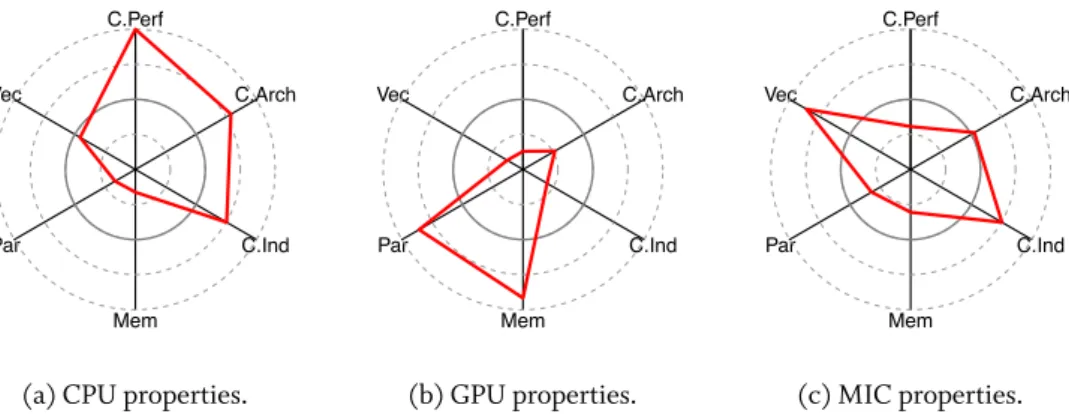
To summarize, we use our six criteria to compare the CPU, GPU, and MIC architecture. To define real values to all criteria, we choose one example CU per architecture as presented in Table 2.1. The values are visualized in Figure 2.7. The CPU has a high single core performance, highly sophisticated core architecture, and cores execute independently. Drawbacks are
lim-Type CPU GPU MIC
Model Intel Xeon E5-2680 v3 Nvidia P100 Intel Xeon Phi 7120
Core Performance 36 GFLOPS 2.5 GFLOPS 9.3 GFLOPS
Core Architecture high low medium
Core Independence yes no (32 SIMT) yes
Memory Bandwidth 33 GB/s 562 GB/s 133 GB/s
Parallelism (cores, HT) 12 (⇤2) 3584 (⇤X) 61 (⇤4)
Vectorization (width) 256 bit – 512 bit
Table 2.1: Specific CU examples for each of the three hardware architectures. Performance and bandwidth values are based on an OpenCL benchmark (See Section 2.2.4).
C.Perf Vec Par Mem C.Ind C.Arch
(a) CPU properties.
C.Perf Vec Par Mem C.Ind C.Arch (b) GPU properties. C.Perf Vec Par Mem C.Ind C.Arch (c) MIC properties.
Figure 2.7: Comparing the CPU, GPU, and MIC properties using six categories. Each ture is superior in one or more directions. (categories: single core performance, core architec-ture, core independence, memory bandwidth, parallelism, vectorization)
ited vectorization, parallelism, and the low memory bandwidth. The GPU is tackling these limits with high parallelization and high memory bandwidth, however, with limits in the other categories. MIC systems are the middle path, showing medium core performance and medium parallelization, while being especially good in vectorization and independent execution.
With this comparison, we want to illustrate the differences of the three architectures, while also showing that each architecture has advantages and limitations. No single architecture is superior to others in all categories and it depends on the use case, which architecture actually performs better.
2.2.2 Heterogeneous Connections
Multiple CUs can be connected differently to the main system. The center of the system is usu-ally the host CPU with a large amount of main memory. For other CUs, like GPUs and MICs, there are two different options: loosely-coupled connection and tightly-coupled connection.
Loosely-coupled systemsusually connect a CU to the main system using an external bus. This is common for dGPUs (discrete GPU), where the GPU is connected by PCIe bus, while it does not share resources directly with the CPU. This means the dGPU has its own device mem-ory and data used on the GPU has to be transfered through the PCIe bus. There are different versions of PCIe, with theoretical bandwidths ranging from 4 GB/s for PCIe1 over 8 GB/s for PCIe2 to 16 GB/s for PCIe3 (all for 16x lanes, the bandwidth decreases with fewer lanes). As alternative, Nvidia proposed NVLink with bandwidths between 20 GB/s and 200 GB/s [Nvidia 2014a] to connect Nvidia GPUs to themselves and to Power CPUs, however, data still needs to be transfered.
Tightly-coupled systemssolve this problem by bringing the CUs closer to the main processor and the main memory. Examples are integrated GPUs (iGPU) or Accelerated Processing Units (APUs), where the CU sits on the same die as the CPU, sharing the access to main memory
Host Program
OpenCL Library
AMD
OpenCL Driver OpenCL Driver Nvidia Compiled Executable (fixed) System Specific (dynamic) OpenCL Interface At RunFme: - Compile CU Code - Transfer Data - Control ExecuFon dGPU dGPU iGPU CPU
Figure 2.8: OpenCL setup consisting of OpenCL library and OpenCL driver.
or even access to CPU caches. Other approaches include Intel’s recent MIC version, which uses fast socket interconnects for communication [Hazra 2014]. For these approaches, data does not need to be transfered for data access. However, through NUMA effects and missing access optimizations for some CUs, it might be better to transfer data first to CU dedicated memory regions for better performance. Either way, memory bandwidths for all CUs accessing the CPU’s main memory are usually lower than in loosely-coupled systems.
2.2.3 Open Computing Language
Given different CUs and their architecture, there is a large variety of programming languages and language extensions supporting different kinds of CUs. At this point, we describe the Open Computing Language (OpenCL) in more detail, as OpenCL is supported by the many CUs, including all CUs used in this thesis.
OpenCL was standardized in 2008 [Khronos 2011] and the OpenCL interface can be im-plemented by any hardware vendor to support their computing units, making it possible to execute OpenCL code on many different CUs. Currently, there is OpenCL support for all major CPUs, including Intel, AMD, and IBM Power, as well as for all major GPUs, including AMD, Nvidia, Intel, and ARM GPUs. Additionally, different accelerators are also supported, like the Intel Xeon Phi, selected Altera FPGAs, or the IBM Cell processor.
Figure 2.8 shows how this support is achieved for many different CUs. A host program is compiled using the OpenCL library, which provides the OpenCL interface without know-ing the exact hardware environment. At run-time, the OpenCL library searches for OpenCL drivers of different vendors. In the example of Figure 2.8, we illustrate a vendor specific driver from AMD and Nvidia. The drivers also use the OpenCL interface and can support multiple CUs, including the actual host CPU. In our example, the host program is compiled without any hardware knowledge, while at run-time, it is able to use four different CUs. To offload compu-tation, the specific code is written in so calledkernels, which are being compiled by the vendor specific drivers at run-time. Afterwards, data transfers and the actual offloaded execution is possible.
Algorithm 1OpenCL kernel example.
1: __kernel void addTwoValues( __global int * input1, .kernel function
2: __global int * input2,
3: __global int * output)
4: {
5: int threadID = get_global_id(0); .retrieve thread ID
6: output[threadID] = input1[threadID] + input2[threadID]; .add inputs
7: }
OpenCL kernels are specific functions for offloading. The kernel function specifies the computation for one single thread, while the real execution is done in SIMT mode for many threads, all applying the same computation to different data. Algorithm 1 shows an example. The__kernelprefix defines the use as OpenCL kernel. Attributes marked with__globalare pointers to memory locations in the so called global memory of the CU (usually the CUs dedi-cated device memory). In our example, the three arguments are arrays in global memory. The first operation within the function retrieves the absolute thread ID. While all threads perform this operation, the actual ID will be different. In the second operation, one value from in-put1and one value frominput2are summed and stored in theoutputarray. Again, each thread performs the same operation, but since thethread IDis different, different data locations are ac-cessed. This kernel can now be offloaded to any CU for computation, provided that the kernel is first compiled and that the memory objects are allocated and accessible by the used CU.
To schedule kernels, a kernel instance can be queued to a specific CU, given that the kernel arguments are provided. Kernels can be executed with different number of threads and thread-blocks. Thread-blocks combine multiple threads, to be executed on the same multi-processor, to allow data sharing in the shared memory and thread synchronization between the threads of a multi-processor. However, there are hardware limitations on how many threads can be combined in a thread-block, depending on the CU.
CUDA is similar to OpenCL, as it applies the same SIMT execution style as OpenCL with similar usage of kernels and execution patterns. However, CUDA is limited to Nvidia GPUs and there are some naming differences to OpenCL.
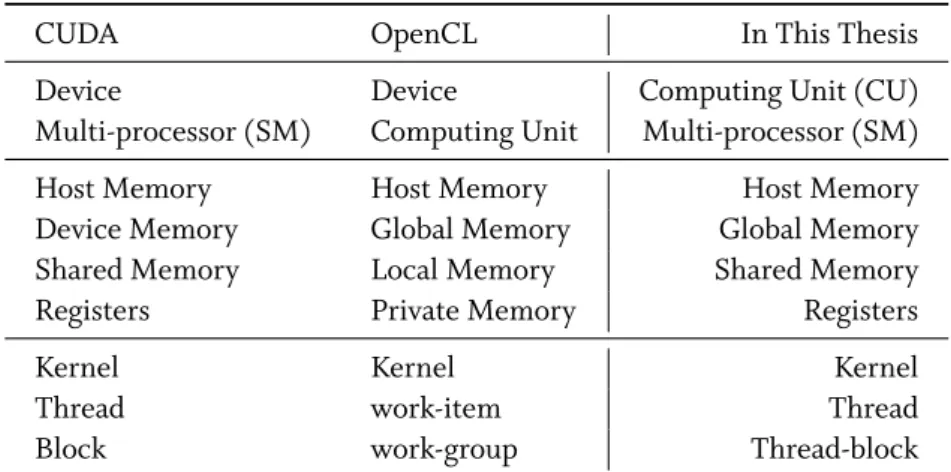
Naming Style: As CUDA, OpenCL, and other programming languages have different names for similar structures and operations, we provide a short naming guide for the remainder of this thesis to avoid any confusion. Table 2.2 shows relevant CUDA and OpenCL naming differences together with the naming we choose in this thesis. The naming we choose is not language spe-cific but rather intuitive. We note that especially the use of “computing unit” (CU) is different in our case.
2.2.4 Computing Units used throughout this Thesis
In this section, we present different CUs, to provide specific examples for the presented CU architectures and heterogeneous connections, as well as to build a reference of all CUs used throughout this thesis. Each test system in this thesis refers to a CU presented in Table 2.3. For
CUDA OpenCL In This Thesis
Device Device Computing Unit (CU)
Multi-processor (SM) Computing Unit Multi-processor (SM)
Host Memory Host Memory Host Memory
Device Memory Global Memory Global Memory
Shared Memory Local Memory Shared Memory
Registers Private Memory Registers
Kernel Kernel Kernel
Thread work-item Thread
Block work-group Thread-block
Table 2.2: Naming reference for CUDA, OpenCL, and the chosen naming in this thesis. our heterogeneous computing environments, we use mainly CPU-GPU combinations, because of their general availability and their support for OpenCL.
• CPUs: We use two different CPUs. The AMD CPU shares the chip with an integrated GPU (iGPU), whereas the combination is also known as APU. The Xeon CPU is a two socket system with 12 cores per socket and hyper-threading disabled.
• iGPUs: The integrated GPUs include AMD and Intel variants. While the AMD iGPU is used in a desktop processor, the Intel iGPU is used in a low-power notebook processor (i5-4250U).
• dGPUs:We use a variety of five different dGPUs in this thesis. The K20, K80, and GT640 are based on Nvidia’s older Kepler architecture [Nvidia 2014b], while the P100 is a newer Pascal architecture GPU [Nvidia 2016]. The K80 GPU combines two GPUs on one PCIe Board, however, to focus on heterogeneous CPU-GPU computation and to avoid resource contention on the PCIe board, we only use one of the GPUs in our tests. Only the GT640 and the Tahiti GPU are meant for graphics rendering, while the other dGPUs are purely meant for general purpose computation.
• MIC:Additionally to all CPUs and GPUs, we also work with Intel’s MIC architecture, the Xeon Phi, which is connected as PCIe card.
All CUs in Table 2.3 support OpenCL with at least version 1.1. Additionally, the CPUs and the Xeon Phi can be programmed with multiple languages including C, C++, and Java. The Nvidia GPUs can also be programmed with CUDA.
We want to compare the CUs independently of a database context to show their potential for later scenarios. Therefore, we use a synthetic benchmarking tool based on OpenCL1. With
this tool, we test the single and double precision performance, the memory bandwidth to the CUs global memory, and the transfer bandwidth from the host to the CU memory. The results are presented in Table 2.4.
Alias Type Vendor Model #Cores Freq. Mem. Connection (MHz) (GB)
CPU CPU AMD A10-7870K 4 3900 32 host
Xeon CPU Intel Xeon E5-2680 v3 2 x 12 3300 2 x 32 host
iGPU iGPU AMD integrated Radeon R7 512 866 2.2 direct
Intel iGPU iGPU Intel HD 5000 (i5-4250U) 40 1200 1.5 direct
K20 dGPU Nvidia Tesla K20c 2496 706 5 4x PCIe2
K80 dGPU Nvidia Tesla K80 2 x 2496 875 2 x 12 16x PCIe3
GT640 dGPU Nvidia GT 640 384 901 2 16x PCIe3
P100 dGPU Nvidia Tesla P100 3584 1328 16 16x PCIe3
Tahiti dGPU AMD Radeon HD 7970 1792 925 3 16x PCIe2
Xeon Phi MIC Intel Xeon Phi 7120 61 (244)a 1333 16 16x PCIe2
Table 2.3: Overview of all used CUs throughout this thesis.
Alias single double Global Mem Transfer
precision precision Bandwidth Bandwidth
(GFLOPS) (GFLOPS) (GB/s) (GB/s) CPU 44.17 23.76 18.21 (8.92) Xeon 863.72 428.98 67.18 (7.82) iGPU 877.18 55.27 25.72 8.78 Intel iGPU 492.47 — 16.67 2.87 K20 2900.63 1167.59 143.67 1.44 K80 2x3481.79 2x1403.76 2x168.66 11.38 GT640 601.97 28.81 26.56 7.15 P100 9098.78 4746.14 562.14 12.45 Tahiti 3726.65 919.99 224.23 8.72 Xeon Phi 2262.14 1163.23 133.12 6.84
Performance: We can see that the P100, K80, K20, and Xeon Phi are superior in single and double precision performance, as they are executing the benchmark highly parallel. The P100 is showing the best performance as it is the newest CU in our tests. Interestingly, for the most CUs the double precision performance is nearly half of the single precision performance, except for the GPUs that were not optimized for general purpose computation but rather for graphic rendering (AMD iGPU, Tahiti, and GT640). This is probably caused by mapping double precision computations to single precision execution units, due to missing double precision execution units. The Intel iGPU does not support double precision at all.
Memory Bandwidth: For the global memory bandwidth, the four high-performance CUs (P100, K80, K20, Xeon Phi) are leading again, since they have wide memory connections and usually a high-clocked memory bus. The P100 uses High Bandwidth Memory of the second generation (HBM2), leading to the fastest memory bandwidths of our tests.
Data Transfer: The results are different for the transfer bandwidth. There the two CPUs (AMD CPU, Xeon) do not need to transfer data before using it. The numbers are only shown as a result of the benchmark execution, but usually, no data needs to be copied. The iGPUs are also capable of accessing main memory directly but we found that it is better to copy the data first, as this provides higher memory access bandwidths than accessing the data without any copy operation. When applying the copy operation for the integrated GPUs, data is stored in a GPU specific part of the main memory, which ensures that the data can not be held in CPU caches. This reduces the GPU-CPU communication during processing and memory access. Without the copy operation, accessing CPU data from the iGPU leads to cache snooping and coherency overheads, reducing the GPU’s effective memory bandwidth. Besides CPUs and iG-PUs, the K80 and the P100 show the best transferring result, which is caused by an optimized PCIe board and a 16 lane PCIe3 connection.
We note that the numbers presented in Table 2.4 are synthetic benchmark results. The real performance might differ for each CU for several reasons: (1) For some CUs, OpenCL is not the preferred programming language, leading to different performance compared to the native languages. (2) Also, the CUs have different components specialized for different computations (e.g., single or double precision, atomic accesses, branch prediction). Therefore, results could be different with different benchmarks or real world workloads, where some CUs might excel with the given workloads (e.g., CPUs with heavy branching code), while others have difficulties. Therefore, we want to emphasize again that the values in Table 2.4 are only for a first glimpse of the CUs performance, while it is impossible to define the best CU for a given workload using these numbers.
2.3 QUERY PROCESSING IN HETEROGENEOUS
COMPUT-ING ENVIRONMENTS
In the previous sections, we presented general database query processing and heterogeneous computing environments. In the following, we present related work on combining both, data-base operators and query processing with the use of different CUs. We first give an overview on single operator implementations that were ported to different CUs by presenting some exam-ples with no intend to be exhaustive. Afterwards, we look at prototype systems that implement these operators in different ways to allow query processing on different CUs. Finally, we discuss aspects of different placement strategies by briefly describing our approaches and related work. The vast majority of publications on heterogeneous computing is on GPUs. There are mul-tiple reasons why GPUs are the preferred focus of research: (1) GPUs are generally available from laptop computers to large HPC clusters; (2) they are easy to program with well-known programming languages (CUDA, OpenCL), and (3) they have been programmed for over a decade, producing a variety of guides and documentation. MIC systems emerged later than the GPU programming and are generally found in larger systems, hence there are fewer pub-lications on MIC than on GPUs. FPGA programming emerged before general purpose GPU programming, however, the programming is more complex and the general availability is lim-ited through high prices and software licensing. Other accelerators like IBM Cell or Adapteva’s Epiphany Board [Adapteva 2014] are even less widely used, resulting in fewer publications. Given the described reasons, we focus our related work overview on GPU-based approaches.
2.3.1 Operator Implementations
Different operator implementations were proposed for GPUs. In general, the operators work in an operator-at-a-time approach on a column-based data storage.
Selection: There are multiple ways to compute a selection result on GPUs. The simplest way is to evaluate the selection predicate in parallel and produce a bitmap as result, indicating, which rows are satisfying the selection [Wu et al. 2010]. A position of the bitmap corresponds to a row number in the column. Multiple bitmaps can be concatenated to resemble multiple selections on the same table. Another approach is the immediate materialization of selection results using a prefix sum computation to return a compact list of tuple IDs (TIDs) [He et al. 2009].
Join: A number of GPU join algorithms were proposed [He et al. 2008], including a non-indexed nested loop join, an non-indexed nested loop join, a sort-merge join, and a hash join. For all join algorithms on the GPU, the unknown result size is a problem with the cross product as the worst case scenario. In most cases, the result size of the cross product is too large for the limited GPU memory. Therefore, the authors propose to run the join in three stages as shown in Figure 2.9: (1) compute the join result size for every thread by pre-computing the join, (2) concatenating the single results using a parallel prefix sum and allocating the needed memory size for the result, and (3) computing the join a second time, while now the results can
1. „Test“-Join 3. „Real“ Join 1 5 6 1 2 0 9 2. Prefix Sum 0 1 6 12 13 15 15 24 Allocate Memory … … … … … … … … … …
Result sizes Prefix Sums Result
Column A Column B Column A Column B
Figure 2.9: GPU optimized join approach.
be written to the calculated positions. Following this approach, the join is essentially computed twice, while all steps can be done highly parallel. For highly parallel CUs like GPUs, this trade-off increases the join performance and allows join computing as long as the result fits in GPU memory.
Sort: There are different approaches to sort with high parallelism. The two most common approaches are the radix sort [Dobosiewicz 1978; Davis 1992] and the bitonic sort [Batcher 1968]. While the bitonic sort is a perfect fit for highly parallel execution on the GPU or MIC, it has a complexity ofO(log2(n))with a fixed number of comparisons, independent of the actual data. The radix sort performance is also independent of the data, while having a complexity of
O(n). However, the parallelization of the radix sort is more complex, because threads have to communicate in order to find the right location for copied keys. Merrill and Grimshaw describe an efficient implementation of a parallel GPU Radix sort [Merrill and Grimshaw 2010].
Grouping: Grouping on highly parallel CUs can be done in two ways. For the sort-based grouping, data can be sorted first, using one of the presented approaches, before applying a parallel reduction to remove duplicates [He et al. 2007]. The hash-based grouping uses a global hash table, while executing the hash table inserts in parallel.
Aggregation: Aggregation is either done directly with the grouping in a combined operator (sort-based or hash-based), or it is implemented as parallel reduction [He et al. 2007].
2.3.2 Database Systems
Besides single operator implementations on different CUs, there are database systems that al-low query processing on GPUs or other CUs. Again, most systems execute in an operator-at-a-time and column-at-a-operator-at-a-time approach. In the following, we present these systems in detail.
gpuDB[Yuan et al. 2013] is a prototypical query execution engine to process OLAP queries, whereas it only supports SSB queries [O’Neil et al. 2009]. During an offline compilation step, each query is compiled into a binary for later use. gpuDB can either use CUDA to support
Nvidia GPUs or OpenCL for a wider application. Despite the support for OpenCL, heteroge-neous query processing is impossible as one query can only run on one CU, which has to be pre-defined manually before the execution.
Ocelot[Heimel et al. 2013] is an OpenCL extension to MonetDB [Boncz et al. 2008]. It is able to process nearly arbitrary queries on different CUs by altering the MonetDB query plan, which makes MonetDB to hand off certain operators to Ocelot for external computation. Ocelot then uses OpenCL to execute the operator on a given CU. Like gpuDB, a query can only run on a sin-gle CU and Ocelot is currently also limited to one query at a time. Intermediate data is cached on the CU between operators and base data might be cached even beyond one query. The latter has the potential to influence succeeding queries by either reusing cached data from a previous query and therefore avoiding data transfer, or having to evict data, which is not needed to make the memory space available. Ocelot was originally evaluated using TPC-H queries [TPC 2014].
gpuQP [Fang et al. 2007; He et al. 2009] implements traditional CPU operators alongside CUDA-based GPU operators. Internally, a set of primitive operations is implemented includ-ingmap, scatter, gather, prefix scan, split, sort, reduce, and filter. Subsets of these primitives are combined to larger database operators. gpuQP also includes a cost estimator and placement optimization, defining, which operator executes on which CU.
CoGaDB[Breß 2014] is similar to gpuQP as it keeps two sets of operators, one implemented in C/C++ for the CPU and one implemented in CUDA for Nvidia GPUs. Operators are imple-mented directly, without the use of primitives. A hybrid query optimizer called HyPE [Breß 2013] is used for physical optimization and operator placement.
pgStrom[Kohei 2015] is an extension to Postgres [Stonebraker and Kemnitz 1991] accelerat-ing joins and sortaccelerat-ings with GPUs. To include GPUs into Postgres, pgStrom implements custom operators based on OpenCL to offload the work. The row format of Postgres is transformed into column format and cached in a columnar cache for later use of the GPU. Query code is compiled at run-time in order to merge GPU operators into a few numbers of OpenCL kernels.
OmniDB[Zhang et al. 2013] is based on gpuQP and OpenCL. The system consists of a cost model, execution engine, and scheduler, while different hardware environments are supported by an adapter infrastructure. For every environment, an adapter needs to be provides in order to support it, e.g., CPU-only adapter, CPU-GPU adapter, or APU adapter. The goal is to provide a more optimized platform for operator implementations and specific cost functions for these operators.
GPUTx[He and Yu 2011] is an OLTP database system based on GPU execution using CUDA. The system uses a bulk execution model of small OLTP queries to combine multiple queries in a single task, which is then executed on the GPU in parallel. The computation model is specif-ically designed for the GPU, not supporting a dynamic reassignment of the execution location.