Enhancing Networks via Virtualized Network Functions
A DISSERTATION
SUBMITTED TO THE FACULTY OF THE GRADUATE SCHOOL OF THE UNIVERSITY OF MINNESOTA
BY
Yang Zhang
IN PARTIAL FULFILLMENT OF THE REQUIREMENTS FOR THE DEGREE OF
DOCTOR OF PHILOSOPHY
Professor Zhi-Li Zhang
© Yang Zhang 2019 ALL RIGHTS RESERVED
Acknowledgements
This dissertation is accomplished with tremendous help from many amazing people.
First of all, I would like to acknowledge my advisor, Professor Zhi-Li Zhang, for his con-tinuous support, criticism, encouragement, and guidance on conducting research and achieving personal long-term career goals throughout my stay in graduate school. He taught me, among many things, how to transform my stilted speaking and writing into engaging storylines, and how to identify the simplicity at the core of complex technical concepts. His knowledge, wis-dom, dedication, and strive for excellence amazed me, and I have been constantly inspired by his never-ending passion and commitment towards research.
I am also indebted to a variety of brilliant researchers outside of university over the years. I want to thank my collaborators: Ruben Torres, Fang Hao, Sarit Mukherjee, T V Lakshman, Bo Han, Bilal Anwer, Joshua Reich, Aman Shaikh, Vijay Gopalakrishnan, Jean Tourrilhes, and Puneet Sharma. I am grateful to all of them for their time, help, and the wisdom they have shared with me. Their valuable feedback helped me turn my research efforts into reality.
I cherish the awesome time that I spent with my lab mates in discussing research, daily life, and our future. In particular, Hesham Mekky, Eman Ramadan, Zhongliu Zhuo, Arvind Narayanan, and Zehua Guo. I have learned a lot through the discussions over the years.
I am thankful to all my fellow graduate students working with Professors David Du, Tian He, and Feng Qian for their valuable feedback on my research during our group meetings and for maintaining a friendly and intellectually creative environment.
I am grateful to Professors Abhishek Chandra, Yousef Saad, Georgios Giannakis, and David Du, who were very kind to serve as my committee members. I would like to especially acknowl-edge Professor Chandra here, who served as a committee member of my PhD qualification, thesis proposal, defense, and wrote recommendation letter for my fellowship application.
Finally, I thank my family and friends for support during this arduous but fruitful journey.
12-1-0385, DTRA grant HDTRA1- 09-1-0050, NSF grants 1411636, 1618339, CNS-1617729, CNS 1814322 and CNS183677.
Dedication
To those who held me up over the years
Abstract
In an era of ubiquitous connectivity, various new applications, network protocols, and on-line services (e.g., cloud services, distributed machine learning, cryptocurrency) have been con-stantly creating, underpinning many of our daily activities. Emerging demands for networks have led to growing traffic volume and complexity of modern networks, which heavily rely on a wide spectrum of specialized network functions (e.g., Firewall, Load Balancer) for per-formance, security, etc. Although (virtual) network functions (VNFs) are widely deployed in networks, they are instantiated in anuncoordinatedmanner failing to meet growing demands of evolving networks.
In this dissertation, we argue that networks equipped with VNFs can be designed in a fash-ion similar to how computer software is today programmed. By following the blueprint ofjoint design over VNFs, networks can be made more effective and efficient. We begin by presenting Durga, a system fusing wide area network (WAN) virtualization on gateway with local area network (LAN) virtualization technology. It seamlessly aggregates multiple WAN links into a (virtual) big pipe for better utilizing WAN links and also provides fast fail-over thus minimizing application performance degradation under WAN link failures. Without the support from LAN virtualization technology, existing solutions fail to provide high reliability and performance required by today’s enterprise applications. We then study a newly standardized protocol, Mul-tipath TCP (MPTCP), adopted in Durga, showing the challenge of associating MPTCP subflows in network for the purpose of boosting throughput and enhancing security. Instead of designing a customized solution in every VNF to conquer this common challenge (making VNFs aware of MPTCP), we implement an online service named SAMPO to be readily integrated into VNFs. Following the same principle, we make an attempt to take consensus as a service in software-defined networks. We illustrate new network failure scenarios that are not explicitly handled by existing consensus algorithms such as Raft, thereby severely affecting their correct or ef-ficient operations. Finally, we re-consider VNFs deployed in a network from the perspective of network administrators. A global view of deployed VNFs brings new opportunities for per-formance optimization over the network, and thus we explore parallelism in service function chains composing a sequence of VNFs that are typically traversed in-order by data flows.
Contents
Acknowledgements i Dedication iii Abstract iv List of Tables ix List of Figures x 1 Introduction 11.1 Contributions and Organization . . . 2
1.2 Bibliographic Note . . . 3
2 Background and Motivation 5 2.1 Software Defined Wide Area Network . . . 5
2.2 MPTCP Awareness . . . 6
2.3 Consensus in Software-Defined Network . . . 7
2.4 Service Function Chaining and Parallelizable VNFs . . . 9
3 Fusing LAN Virtualization with WAN Virtualization 10 3.1 Main Results . . . 10
3.2 Mitigating the Impact of WAN Link Failures . . . 11
3.2.1 End system MPTCP to the Rescue? . . . 11
3.2.2 WAN-aware MPTCP . . . 13
3.3 Durga Overview and Mechanisms . . . 14
3.3.2 MPTCP Proxy . . . 16
3.3.3 WAN aware MPTCP . . . 17
3.3.4 MPTCP Recovery Optimization . . . 19
3.3.5 Mechanisms Integration . . . 20
3.4 Vertical Handoff Performance Metrics . . . 21
3.5 Evaluation of Durga . . . 22
3.5.1 Bandwidth Aggregation Evaluation . . . 23
3.5.2 Handoff Traces Evaluation . . . 24
3.5.3 Handoff Metric Evaluation . . . 25
3.5.4 TCP/IP Congestion Control . . . 27
3.5.5 Handoff Impact on Applications . . . 28
3.5.6 Evaluation in the Wild . . . 31
3.6 Related Work . . . 33
3.7 Summary . . . 34
4 Making Network Functions Aware of Multiple TCP 35 4.1 Main Results . . . 35 4.2 MPTCP Subflow Association . . . 36 4.2.1 Token-based Solution . . . 36 4.2.2 Challenges in Network . . . 37 4.3 SAMPO Overview . . . 38 4.4 MPTCP Subflow Association . . . 39 4.4.1 DSN-based Association . . . 40
4.4.2 Analysis of DSN-based Association . . . 41
4.5 Evaluation . . . 51
4.5.1 Experimental Setup . . . 51
4.5.2 Experimental Results . . . 53
4.6 Related Work . . . 56
4.7 Summary . . . 57
5 Taking Consensus as a Service in Software Defined Network 58 5.1 Main Results . . . 58
5.2.1 Raft Overview . . . 59
5.2.2 P4 Overview . . . 61
5.3 Raft Meets SDN . . . 61
5.4 System Design . . . 64
5.4.1 Possible Solutions During Leader Election . . . 64
5.4.2 Offloading Raft to P4 Switch . . . 66
5.5 Evaluation . . . 68
5.5.1 Raft with Routing via PrOG . . . 68
5.5.2 Raft-aware P4 Switch . . . 70
5.6 Related Work . . . 71
5.7 Summary . . . 72
6 Parallelizing Network Functions For Accelerating Service Function Chains 73 6.1 Main Results . . . 73 6.2 Challenges in Parallelizing VNFs . . . 74 6.3 HydraNF Overview . . . 76 6.4 HydraNF Controller . . . 78 6.4.1 SPG Construction . . . 78 6.4.2 SPG Provisioning . . . 82
6.5 HydraNF Data Plane . . . 85
6.5.1 Mirror and Merge Modules . . . 85
6.5.2 Placement of Mirror and Merge . . . 87
6.6 Evaluation . . . 88 6.6.1 HydraNF Performance . . . 90 6.6.2 HydraNF Overhead . . . 92 6.7 Related Work . . . 93 6.8 Discussion . . . 95 6.9 Summary . . . 96
7 Conclusion, Lessons Learned & Thoughts for the Future 97 7.1 Summary of Contributions . . . 97
7.2 Lessons Learned & Thoughts for the Future . . . 98
List of Tables
3.1 Throughput aggregation comparison . . . 23 3.2 Vertical handoff performance of different mechanisms . . . 26 3.3 Impact of TCP congestion control (BFD=1s) . . . 29 3.4 HTTP download duration with intermittent link in controlled testbed (seconds
for 2GB file) . . . 29 3.5 TCP transaction rate with intermittent link in controlled testbed (transactions /
seconds) . . . 30 3.6 HTTP download duration with intermittent link in GENI testbed, 100ms BFD
(seconds for 20MB file) . . . 31 3.7 TCP transaction rate with intermittent link in GENI testbed, 100ms BFD
(trans-actions / seconds) . . . 32 3.8 Parameters to access Amazon EC2 . . . 32 3.9 Parameters to access Amazon EC2 . . . 32 5.1 Decomposed Latency between Raft Leader and a Follower. a: RPC latency at
leader side+ bidirectional latency betweenS1 andP4 1; b: bidirectional la-tency inP4 1;c: bidirectional latency betweenP4 1andP4 2;d: bidirectional latency inP4 2;e: bidirectional latency betweenP4 2andS2+latency at Raft follower . . . 70 6.1 Service Function Chains Used in the Experiments . . . 90 6.2 Comparison of HydraNF with ParaBox [1] and NFP [2] on the desirable features
of parallel packet processing for NFs. . . 94
List of Figures
3.1 Motivating Scenarios . . . 11
3.2 Virtualizing NIC for MPTCP to generate multiple subflows and for gateway to forward traffic in a stateless manner . . . 13
3.3 Tunnel Handoff . . . 15 3.4 MPTCP Proxy . . . 15 3.5 WaMPTCP . . . 16 3.6 Durga Integration . . . 17 3.7 L4 T-throughput repair . . . 21 3.8 L4 T-latency repair . . . 22 3.9 Tunnel Handoff . . . 24 3.10 MPTCP Tunnel . . . 24 3.11 WaMPTCP . . . 24 3.12 WaMPTCP + RO . . . 24
3.13 BFD impact over T-throughput-failover . . . 26
3.14 BFD impact over T-latency-failover . . . 26
3.15 BFD impact over T-throughput-recovery . . . 26
3.16 Outage impact on T-recovery-time (BFD=100ms) . . . 27
3.17 RTT Impact over T-throughput-recovery (BFD=100ms, Outage=5s) . . . 28
3.18 Impact of TCP contention . . . 29
3.19 GENI Network Setup . . . 31
3.20 Web Browsing via Tunnel Handoff . . . 33
3.21 Web Browsing via WaMPTCP . . . 33
4.1 Basic Knowledge for Token-based MPTCP Subflow Association . . . 37
4.2 SAMPO Workflow . . . 39
4.4 First-Level Overlap Rate . . . 47
4.5 Second-Level Overlap Rate . . . 50
4.6 Experimental Setup . . . 52
4.7 Count Based Sampling . . . 53
4.8 Timing Based Sampling . . . 54
4.9 Relation Between Packets Number And Recall Rate . . . 54
4.10 Time Spent To Reach Correct Result . . . 55
5.1 SDN Control Plane Setup. . . 59
5.2 Raft States. . . 59
5.3 Raft Terms. . . 59
5.4 Motivating Examples. . . 62
5.5 Results for simulating the motivation examples using vanilla Raft and PrOG-assisted Raft. . . 69
5.6 Vanilla Raft vs. PrOG-assisted Raft. . . 69
5.7 Experimental Setup . . . 70
6.1 NF State Poisoning in Function-level Parallelism . . . 75
6.2 Reducing Function-level parallelism with SFC latency constraints . . . 75
6.3 Traffic Distribution Across Multi-core Servers. . . 75
6.4 System Overview of HydraNF. . . 77
6.5 HydraNF Controller Design. . . 78
6.6 An example of SPG construction. . . 80
6.7 Building blocks and data structures of HydraNF data plane. . . 86
6.8 Various placements of the mirror and merge modules for the multi-server sce-nario. In the first step, the mirror module receives the packets. It then duplicates them to two NFs in the second step. In the third step, the NFs send back the packets to the merge module which generates the final output. . . 86
6.9 Experiment Setup . . . 89
6.10 Overall latency in synthetic SFCs . . . 89
6.11 SPG benefit in synthetic SFCs . . . 89
6.12 Performance of Different Service Function Chains with Different Complexity . 89 6.13 Throughput with different placement solutions . . . 91
6.15 Performance of Different Core Module Placements . . . 91
6.16 CPU Overhead in Sequential Processing and Parallel Processing . . . 92
6.17 Break Down of Controller Processing Time . . . 92
6.18 Overhead during NF Scaling . . . 92
Chapter 1
Introduction
The classical description of the Internet architecture is based on the hourglass model [3]. In this architecture, the only function in the neck of the hourglass are IP routers which determine routes and forward packets. Today, networks have been growing to meet new and sophisticated de-mands. For example, demands for securing networks – whether backbone networks of Internet service providers, campus/enterprise networks, data center networks, or even satellite networks – have been growing rapidly; carrier network keeps track of bandwidth consumption to bill users for usage; real-time streaming service designs new protocols for pursuing extremely low latency; IP depletion problem has been discussed for decades. There are many other require-ments – load balancing, data compressing and caching, proxing, to name a few – need to be satisfied, and thus today’s networks support far beyond merely forwarding packets.
To satisfy these demands for networks, virtual network functions (VNFs) are inserted into networks to perform specialized functions. VNFs run in one or more virtual machines on top of the hardware networking infrastructure, and provide functions such as transforming, inspecting, filtering, or otherwise manipulating traffic for purposes other than packet forwarding. Example of VNFs include the following.
• Load balancers. These functions distribute network or application traffic across a number of servers for the purpose of balancing traffic load required to be processed on each server. • Intrusion Detection/Prevention Systems (IDS/IPS). These functions inspect the entire network
for suspicious traffic by analyzing packet header and payload; upon detection of malicious behaviors, the functions alert administrator and may block the traffic connection.
• Proxies. Depending on configurations, these functions act as intermediaries between endpoint
clients and servers to provide content filtering, censorship bypassing, caching, etc.
While VNFs are widely deployed to bring various benefits such as regulated control and performance enhancement, they are typically developed and deployed in an isolated way, with-out interacting with each other. VNFs are programmed as gigantic black-boxes and instantiated in an uncoordinated manner, failing to meet growing demands of evolving networks.
Thesis: By following the blueprint of joint design over VNFs, networks can be made more effective and efficient.
In this thesis, we advocate for a joint design in how VNFs are implemented and operated. Instead of designing and deploying VNFs separately – where each VNF has no interaction with others or hosts – we argue that VNF development should break barriers among isolated VNFs. Rather, VNFs should provide necessary interfaces to expose certain information and to be integrated into networks, allowing VNF developers or network administrators to fuse them together. As we will show, the jointly designing blueprint is feasible for VNF development and deployment in networks, and brings better network performance, security, and manageability.
1.1
Contributions and Organization
This dissertation explores network enhancement via virtualized network functions. The outline of this dissertation, along with the primary contributions of this dissertation are as follows:
In Chapter 2, we provide a review for required background knowledge including software-defined wide area network, multi-path TCP (MPTCP) awareness, consensus in software software-defined network, service function chaining, and parallelizable VNFs.
In Chapter 3, we fuse LAN Virtualization with SD-WAN Virtualization. We advance WAN-aware MPTCP (WaMPTCP) which fusesLAN virtualizationwithWAN virtualization for fine-grained load balancing and fast failover across WAN links. We present the detailed implemen-tation of HydraNF, a comprehensive SD-WAN virtualization framework. We propose two new metrics to better capture the performance of tunnel handoff under link failures; through ex-tensive evaluation in both emulated testbeds and real-world deployment, we show the superior performance of HydraNF over existing SD-WAN solutions.
investigating how to associate subflows that belong to the same MPTCP session. We present an online subflow association mechanism for MPTCP with partial flow record. The mechanism adopts a data sequence number (DSN)-based algorithm that can associate subflows based on analysis of DSN values of each subflow, their range, and overlapping pattern.
In Chapter 5, we make an attempt to take consensus as a service in software defined network. The reliance of network OS on consensus protocols to maintainconsistentnetwork state intro-duces an intricate inter-dependency between the network OS and the network under its control, thereby creating new kinds of fault scenarios or instabilities. Thus, we use Raft to illustrate the problems that this inter-dependency may introduce in the design of distributed SDN controllers and discuss possible solutions to circumvent these issues. We then propose a network-assisted Raft consensus algorithm that takes advantage of programmable network and offloads certain Raft [4] functionality to P4 [5] switches.
In Chapter 6, we parallelize VNFs for accelerating service function chains. We present Hy-draNF, a novel framework which intends to reduce SFC latency by parallelizing VNF process-ing. HydraNF statically analyzes SFCs to construct an abstract dataplane model that contains necessary information for SFC optimization. Based on the model, HydraNF employs novel algorithms to parallelize SFCs running entirely on a single server or across multiple servers, while correctly preserving sequential processing semantics. We conduct extensive evaluation of HydraNF prototype, using real network configurations and SFCs that contain both open-source and production NFs.
Chapter 7 presents concluding remarks, lessons learned, and thoughts for the future.
1.2
Bibliographic Note
The work presented in this dissertation has been published in several conferences and journals in networking field. The related publications are as follows:
• Yang Zhang, Hesham Mekky, Fang Hao, Sarit Mukherjee, Zhi-Li Zhang, T V Lakshman. Network-Assisted Raft Consensus Algorithm. In IEEE International Conference on Com-puter Communications (INFOCOM), 2016.
• Yang Zhang, Bilal Anwer, Vijay Gopalakrishnan, Bo Han, Joshua Reich, Aman Shaikh, Zhi-Li Zhang. ParaBox: Exploiting Parallelism for Virtual Network Functions in Service Chain-ing. In ACM SIGCOMM Symposium on SDN Research (SOSR), 2017.
• Yang Zhang, Eman Ramadan, Hesham Z Mekky, Zhi-Li Zhang. When Raft Meets SDN: How to Elect a Leader and Reach Consensus in an Unruly Network. In ACM SIGCOMM 1st Asia-Pacific Workshop on Networking (APNET), 2017.
• Yang Zhang, Bo Han, Zhi-Li Zhang, Vijay Gopalakrishnan. Network-Assisted Raft Consen-sus Algorithm. In Proceedings of the SIGCOMM Posters and Demos (SIGCOMM Posters and Demos), 2017.
• Yang Zhang, Hesham Mekky, Zhi-Li Zhang, Ruben Torres, Sung-Ju Lee, Alok Tongaonkar, Marco Mellia. Detecting Malicious Activities with User-Agent Based Profiles. In Interna-tional Journal of Network Management (IJNM), 2015
Chapter 2
Background and Motivation
2.1
Software Defined Wide Area Network
Many modern enterprises are geographically dispersed across multiple sites over a wide area network (WAN). Typically, branch office site networks are connected to a central office core net-work as well as a core data center (private cloud) via “dedicated” WAN links provisioned by one or more service providers. For security and privacy, WAN gateways at each site route enterprise traffic over VPN tunnels connecting edge networks with core/cloud networks. With increasing IT cloudification and IoT deployment, traffic loads are bumping up against the WAN link ca-pacity [6]. Novel WANvirtualization solutions using software-defined wide area networking (SD-WAN) mechanisms are being developed and deployed for managing traffic traversing these WAN tunnels SD-WAN allows multiple WAN links (tunnels) to be logically combined into a virtual “big pipe” with higher capacity: it dynamically distributes traffic across heterogeneous WAN links for load balancing; when WAN link failures are detected, it employsvertical tunnel handoffto re-distribute traffic from failed links to other available links [7].
In Chapter 3, we argue that simpletunnel handoffemployed by existing SD-WAN solutions fail to provide high reliability required by today’s enterprise applications. We propose two new performance metrics to better capture the effect of tunnel handoff on standard (single-path) TCP connections under WAN network failures. Our experimental results show that WAN network failures significantly degrade application performance. We postulate that mitigating impacts of WAN failures on application performance requires jointarchitectural innovation at both SD-WAN gateways and connected end systems.
2.2
MPTCP Awareness
MPTCP is designed to boost data transmission throughput by taking advantage of multiple available paths in network. It is a major extension to TCP and has been standardized by the Internet Engineering Task Force (IETF) [8]. MPTCP allows a pair of hosts to use multiple interfaces for transmission of the upper layer data stream and has been becoming a promising technique. MPTCP can not only increase data throughput, but also seamlessly perform vertical handover between multiple paths, which makes the data transmission more robust against link failures [9]. Moreover, these features are obtained without requiring any modification at the application level. By large, MPTCP can be deployed in today’s Internet without much impact on the proper functioning of the existing network devices [10].
The reason why MPTCP can achieve such benefits is because MPTCP directly relies on TCP as its subflow protocol. Once MPTCP subflows have been established, upper layer data can be scheduled to traverse over any of the established MPTCP subflow sessions. In order to coordinate across multiple paths, MPTCP adopts two levels of sequence numbers: a data sequence number (DSN) at MPTCP session level and a regular sequence number at MPTCP subflow session level. As in regular TCP, the subflow sequence number guarantees that the data sent over each subflow can be reliably received and assembled at the subflow receiver buffer. DSN is shared across multiple subflows and designed to guarantee reliable data delivery at MPTCP session level, i.e., to ensure the entire data stream can be assembled back in sequence. Although MPTCP is designed to be compatible with most network devices, MPTCP can not be necessarily understood by these network devices. To the best of our knowledge, few network devices are designed with explicit consideration of MPTCP, and little work has been done to investigate how to better support this new protocol in the network. For example, MPTCP is designed to be no more aggressive than a regular TCP on a shared bottleneck link [11]. This implies that multiple subflows of a MPTCP session can only bring throughput improvement if the subflows do not share the same bottleneck link. However, no mechanism in either the end host or the network to allow MPTCP subflows to avoid common links currently exists. On the other hand, if routers could spread the MPTCP subflows onto disjoint paths, the overall data goodput could be greatly improved [12].
Furthermore, making network devices MPTCP-aware may improve the functionality of cer-tain network services. Take application identification service or intrusion detection service as an
example. If an application/malware signature spans across multiple MPTCP subflows, the accu-racy of the identification outcome may be improved by assembling subflows together. Likewise, when a subflow that carries the signature is identified/blocked, all other subflows belonging to the same MPTCP session can be identified/blocked too.
2.3
Consensus in Software-Defined Network
Software-defined networking (SDN) simplifies network devices by moving control plane func-tions to a logically centralized control plane; therefore data plane devices become simple pro-grammable forwarding elements. SDN controllers use OpenFlow APIs [13] to set up forwarding rules and collect statistics at the data plane, which enables controller software and data plane hardware to evolve independently. Under SDN, physical connectivity between two end points do not guarantee they can communicate with each other – the underlying (logical) commu-nication graph depends on the network policies reflected by the flow entries installed by the controller. For scalability and reliability, the logically centralized control plane (“network OS”) is often realized via multiple SDN controllers (see Figure 5.1), forming a distributed system. Open Network Operating System (ONOS) [14] and OpenDayLight (ODL) [15] are two such Network OS examples supporting multiple SDN controllers for high availability.
In distributed network OS such as ONOS and ODL, the replicated controllers rely on con-ventional distributed system mechanisms such as consensus protocols for state replication and consistency. Paxos [16, 17] is a widely used distributed consensus protocol in production soft-ware [18–21] to ensure liveness and safety. Unfortunately, Paxos is very difficult to understand and implement in practical systems [4]. Raft [4] attempts to address these complexities by de-composing the consensus problem into relatively independent sub-problems: leader election, log replication, and safety. It implements a more “easy-to-understand” consensus protocol that manages a replicated log to provide a building block for building practical distributed systems. Both ONOS and ODL use certain implementations of Raft to ensure consistency among repli-cated network states. For example, ONOS maintains a global network view to SDN control programs that is logically centralized, but physically distributed among multiple controllers. It employs Raft to manage the switch-to-controller mastership and to provide distributed prim-itives to control programs such as ConsistentMap, which guarantees strong consistency for a key-value store.
The reliance of distributed network OS on consensus protocols to maintainconsistent net-work state introduces an intricate inter-dependencybetween the network OS (as a distributed system) and the network it attempts to control. This inter-dependency may create new kinds of fault scenarios or instabilities that have neither been addressed in distributed systems nor in networking. In particular, it may severely affect the correct or efficient operations of consensus protocols, as will be expounded in Chapter 5. The key issue lies in the fact that the design of fault-tolerant distributed system mechanisms such as consensus algorithms typically focuses on server failures alone, while assuming the underlying network will handle connectivity issues on its own. For example, the design of Paxos or Raft assumes that the network may arbitrarily delay or drop messages; however, as long as the network is not partitioned, messages from one end point will eventually be delivered to another end point. Such assumptions about the network hold true in classical IP networks, where distributed routing algorithms running on routers cooperate with each other to establish new paths after failures. SDN now createscyclic dependenciesamongcontrol network connectivity,consensus protocols, andcontrol logic man-aging the network, where the control logic manman-aging the network is built on top of a distributed system (e.g.,ONOS) which relies on consensus protocols for consistency and control network connectivity for communication, whereas the network data plane (and control network) hinges on this distributed system to set up rules to control and enforce “who can talk to whom” among networking elements. Consequently, new failure scenarios can arise in SDN.
Besides new failure scenarios, consensus mechanisms typically involve expensive opera-tions, especially for strong consistency guarantee, which may require multiple rounds of com-munications. Even without failure, consensus latency is bound to round-trip time between servers running consensus algorithms. Offloading application-level implementation of sus algorithms to network may be a promising solution to improve the performance of consen-sus algorithms. Several recent projects investigate offloading consenconsen-sus algorithms to either switches [22] or FPGA devices [23]. NetPaxos [22] proposes to implement the Paxos con-sensus algorithm in network by leveraging programmable switches. Besides the Paxos roles implemented on servers, NetPaxos requires one switch serving as a Paxos coordinator and sev-eral others as Paxos acceptors. NetPaxos can be implemented using P4 [5], a domain specific language that allows the programming of packet forwarding planes. However, Paxos consensus algorithm is very difficult to understand and implement due to its notoriously opaque expla-nation and lack of details for building practical systems [4]. Thus, offloading such a complex
consensus algorithm to network is error-prone. Istv´an et al.[23] takes the efforts of imple-menting the entire ZAB consensus algorithm [24] on FPGA devices using a low-level language which is difficult to program. Moreover, this hardware-based solution may not be scalable as it requires the storage of potentially large amounts of consensus states, logic, and even the application data.
2.4
Service Function Chaining and Parallelizable VNFs
A Service Function Chain (SFC) defines a sequence of VNFs, such as firewalls and load bal-ancers (LBs), and stitches them together [25]. SFC has been a key enabler for network oper-ators to offer diverse services and an important application of Software Defined Networking (SDN) [26–28]. Recently, operators can create, update, remove, or scale out/in network func-tions (NFs)on demand[29–31], construct a sequence of NFs to form a SFC [25], and steer traffic through it to meet service requirements [32–34]. However, virtualization and “softwarization” of NFs pose many new challenges [35]. In particular, traffic traversing virtualized NFs suffers from reduced throughput and increased latency, compared to physical NFs [32–34, 36]. The flexibility offered by SDN will enable more complex network services to be deployed, which will likely lead to longer SFC. As the length of an SFC (i.e.,number of NFs) increases, so does its overhead.
Exploiting parallelism to reduce packet processing latency and increase the overall system throughput is a classical approach that is widely used in networked systems. For example, most of today’s web-based cloud computing applications take advantage of the stateless HTTP protocols for parallel HTTP transaction processing. Data analytics frameworks such as Map-Reduce and Spark utilize task level parallelism to speed up massive compute jobs using multiple servers. In terms of NFV, NF-level parallelism is first explored in ParaBox [1] and later in NFP [2] by exploiting order independence of certain NFs for parallel packet processing within an SFC. Both efforts focus on parallelizing packet processing for SFCs on asingle(multi-core) server. Real-world NFs, on the other hand, will likely be operating in edge clouds or data centers with clusters of servers [37]. How to effectively utilize multiple servers to reduce per-packet processing latency and increase the overall system throughput is the main problem we explore.
Chapter 3
Fusing LAN Virtualization with WAN
Virtualization
3.1
Main Results
We develop a novelWAN-awarenessmechanism that enables end systems with MPTCP support (even with only one network interface) to generate multiple MPTCP subflows using virtual subnetaddresses. This mechanism is enhanced at SD-WAN gateways to load-balance subflows across WAN links and dynamically reroute them away from failed WAN links in a scalable manner.
Building on top of WAN-aware MPTCP (WaMPTCP), we present Durga, a novel scal-able SD-WAN virtualization framework which not only can aggregate multiple (heterogeneous) WAN links into a (virtual) “big pipe”, but is also capable of providing fast failover with minimal application performance degradation. Durgais designed to handle diverse enterprise traffic. In addition to WaMPTCP for support of performance critical applications running on hosts with MPTCP kernel modules, it also incorporates MPTCP proxies for legacy TCP connections run-ning on hosts with no MPTCP support as well as the default tunnel handoff mechanism for non-TCP traffic. In summary, we make the following contributions:
• We advanceWaMPTCP(Section 3.2) which fusesLAN virtualizationwithWAN virtualization for fine-grained load balancing and fast failover across WAN links;
• We present the detailed implementation of Durga, a comprehensive SD-WAN virtualization framework (Section 3.3);
Wirelese Subnet Wired Subnet Campus Core Client A Client B SDN Gateway WAN Link #1 WAN Link #2 WAN Link #3 Headquarter Network Enterprise Cloud SDN Gateway SDN Gateway
Figure 3.1: Motivating Scenarios
• We propose two new metrics (Section 3.4) to better capture the performance of tunnel handoff under link failures; through extensive evaluation (Section 3.5) in both emulated testbeds and real-world deployment, we show the superior performance of Durga over existing SD-WAN solutions.
3.2
Mitigating the Impact of WAN Link Failures
Let us consider Figure 3.1 depicting a simple enterprise branch site network consisting of two subnets (one wired and one wireless) to a campus core network with an SD-WAN gateway connecting to a central office site or a corporate private cloud via three separate WAN links (each, say, to a different WAN provider). Client A has only one network interface connected to WiFi subnet, whereas client B has two network interfaces, one connected to WiFi subset and the other to wired subnet. Neither clients have awareness of multiple WAN links available at the WAN gateway. Hence traditional SD-WAN systems use gateways for performing vertical handoffs in event of WAN link failures or policy change. The key question this project aims to answer is: what novel mechanisms can we develop to mitigate the impact of WAN link failures on application performance by taking advantage of software-define control of WAN links? We believe that a comprehensive solution with modifications to end-systems and SD-WAN gateways (connecting to multiple SD-WAN links) is required.
3.2.1 End system MPTCP to the Rescue?
Given an end host with multiple interfaces, MPTCP [38] enables a TCP session to exploit these multiple parallel network paths to achieve higher throughput. MPTCP manages multiple subflows (each operating as a separate TCP connection with its own congestion control), and dynamically assigns data to each TCP subflow based on available capacity, thus load-balancing among multiple paths. If one path fails (or is highly congested), MPTCP automatically routes
data away from the failed (or highly congested) path, thereby alleviating the impact of network failures/congestion on application performance. The benefits of using MPTCP for load bal-ancing, wireless handoff and coping with network failures have been widely studied [39–43]. Furthermore, switching from standard TCP to MPTCP is application-transparent – it requires no modification to applications. Hence it is natural to think about employing MPTCP at end systems (for those with OS support for MPTCP) for mitigating the impact of WAN link failures on application performance.
However, is employing MPTCP at end systems alone sufficient? Again considering the network in Figure 3.1, we assume that the OSes on both machines support MPTCP. Client A can not avail itself of the three available WAN links using MPTCP because it is only aware of one directly connected network interface. Thus, traffic from an application running on client A can only traverse one of the three available WAN links, failure of which will affect its performance. In the case of client B, it can employ MPTCP to generate two subflows, one over the WiFi subnet and the other over the wired subnet. However, the two subflows will converge at the SD-WAN gateway, and both may be routed along the same SD-WAN link to their common destination. If this WAN link fails or is highly congested, MPTCP running on client B does not soften the impact of this WAN link failure/congestion. In general, we note that there can be a mismatch between the number of physical interfaces an end system has and the number of available WAN links at an SD-WAN gateway. Making end systems aware of the availability of WAN links at the gateway, enabling them to generate appropriate number of MPTCP subflows, and routing these subflows across different WAN links in ascalablemanner at the SD-WAN gateway1is a challenging issue.
The above scenarios raise the following questions: i)Is it possible to enable an MPTCP-compatible end system with only one network interface to exploit multiple WAN links via MPTCP? ii)Given an end system running MPTCP with multiple subflows, is there a scalable way to in-form and ensure that the SD-WAN gateway always routes subflows of an MPTCP session across different WAN links? For question i), an astute reader may suggest that one can use the ndiff-portspath manager option [38] in MPTCP to create multiple subflows across the same pair of IP addresses. However, all these MPTCP subflows will likely traverse the same WAN link, thus still suffering from the same issues as client B in the above scenario. An alternative approach
1
The SD-WAN gateway could assign flows randomly to WAN links, e.g., using hashing, but this does not guar-antee MPTCP subflows from one application will always traverse different WAN links.
is to deploy MPTCP proxies co-located at (or implemented as a module within) SD-WAN gate-ways [44–46]. This requires a pair of MPTCP proxies, e.g., one at the branch site and the other at the central office/private cloud site: a TCP connection from a client machine to a remote server is split by the MPTCP proxy at the local SD-WAN gateway to generate multiple MPTCP subflows, and the gateway routes them across different WAN links to the remote SD-WAN gateway on the other side of the WAN; these MPTCP subflows are then merged by the remote MPTCP proxy before routed to the server. Clearly, this approach incurs significant overheads, requiring MPTCP/SD-WAN gateways to keep track of every TCP connection over the enter-prise network to the WAN. Morever, the congestion control operated by the TCP connection of an application and the MPTCP congestion control operated by MPTCP proxies can interact negatively, creating performance penalties for high-speed WAN links (Section 3.5).
3.2.2 WAN-aware MPTCP
We advance a novel scalable solution, dubbedWAN-aware MPTCP (WaMPTCP). This solution combines a low-overhead mechanism at the end system side to create multiplevirtualnetwork interfaces driven by“WAN-awareness” (even though the end system may only have one phys-ical interface), and ascalablemechanism at the SD-WAN gateway side that routes different MPTCP flows from the same application across different WAN links, detects WAN tunnel fail-ures, and adaptively reroutes MPTCP flows from failed links to other available links. This is schematically depicted in Figure 3.2.
vSubnets Applications
MPTCP WAN Link #1
WAN Link #2 WAN Link #3
Figure 3.2: Virtualizing NIC for MPTCP to generate multiple subflows and for gateway to forward traffic in a stateless manner
The virtual network interfaces are WAN-aware, as each corresponds to one WAN link, each assigned from a (virtual) subnet address mapped to a WAN link at the SD-WAN gateway (and re-mapped to another available link if the current WAN link fails). Hence the SD-WAN
gateway can route the MPTCP subflows to the corresponding WAN link via a simple source-destination addresss-based flow lookup. The details regarding how the virtual subnet addresses are created and advertised to end systems and how WaMPTCP is implemented are discussed in Section 3.3.3. While WaMPTCP is developed as a key component of Durga, we remark that WaMPTCP is a general solution, and can be applied in other contexts as well.
3.3
Durga Overview and Mechanisms
Durga is designed specifically to address the requirements of SD-WAN for connecting branch office enterprise networks to a central office and/or private cloud over the Internet with multiple WAN links provisioned by several WAN service providers. The goals of Durga are multi-fold: • Aggregate capacity of WAN links (as a single “big pipe”) to deliver higher bandwidth than
existing SD-WAN solutions;
• Support fast failover in the event of WAN network failure, and mitigate the impact of such failures on applications;
• Support diverse types of traffic (TCP, UDP, MPTCP);
• Maintain fewer states at SD-WAN gateways for scalability and reliability, and minimize end system software changes.
Durga framework implements multiple WAN virtualization mechanisms to support different types of clients and traffic. The most innovative component is WaMPTCP which supports appli-cation connections from MPTCP-compatible end systems where MPTCP subflows from each connection are routed across multiple WAN links for enhanced throughput and fast failover. For legacy end systems with no OS support for MPTCP, an MPTCP proxy implemented as part of Durga is employed to provide the same support 2. In addition, UDP traffic from end systems (as well as TCP flows from non-performance critical applications) are handled using the default vertical tunnel handoff mechanism.
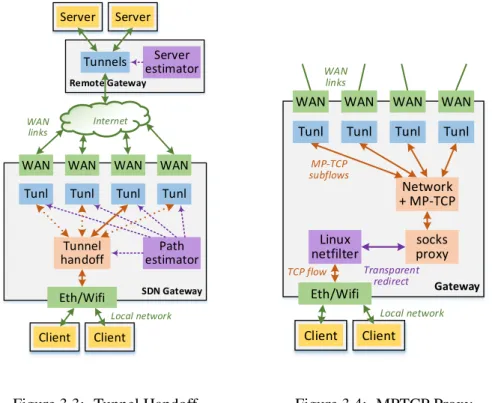
3.3.1 Tunnel Handoff
The Tunnel Handoff mechanism is a baseline of our framework and is used for both UDP and TCP traffic when a MPTCP proxy is not available. It depends on the tunnels between SDN
2
As the number of legacy end systems is relatively small and continues to dwindle, the overhead incurred by MPTCP proxy becomes a less concern.
Remote Gateway
Tunnels estimatorServer
WAN links Server Server Internet SDN Gateway Eth/Wifi Path estimator Tunnel handoff WAN Tunl WAN WAN WAN
Tunl
Tunl Tunl
Client Client
Local network
Figure 3.3: Tunnel Handoff
Gateway Eth/Wifi Linux netfilter Transparent redirect TCP flow socks proxy Network + MP-TCP MP-TCP subflows
WAN WAN WAN WAN
Tunl
Tunl Tunl Tunl
WAN links
Client Client
Local network
Figure 3.4: MPTCP Proxy
gateway and remote gateway to reroute IP traffic without having to change the external rout-ing of the gateway on the Internet, which would take too much time. The tunnels provide a simple overlay, enabling both gateways to reroute traffic by only changing local rules. Our im-plementation (Figure 3.3) uses OpenvSwitch [47], VxLAN tunnels [48], and simple OpenFlow rules [49]. More secure tunnels can be implemented without changing the architecture.
Durga maps the traffic to the tunnels using one of two schemes. The first one is a strict priority scheme, where all the traffic is sent to the preferred link and fallbacks to a backup link as needed (OpenFlow failover group). The second one is a static load balancing scheme, where the TCP flows are distributed to the various WAN links using a hash based on the IP 5 tuples and static allocation for each WAN link (OpenFlow select group). We are looking into dynamic allocation of traffic to the WAN links. The mapping is always flow aware, to avoid splitting a flow across two tunnels.
Tunnels are monitored using the Bidirectional Forwarding Detection (BFD) protocol [50], which uses a simple periodic request/reply handshake between gateways. When BFD detects a failed path, the hash is automatically reconfigured to distribute the TCP flows on the remaining
Gateway WAN links Eth/Wifi Local network WAN DHCP server Tunl Tunl Tunl
WAN WAN WAN
Source subnet routing Multiple MP-TCP subflows Routing + OVS Tunl Multiple IP subnets Multiple IP subnets (S1 ; S2 ; S3 ; S4) Number of WAN links Address
space 1 Address space 2 Address space 3 Address space 4
WaClient Eth/Wifi DHCP client Network + MP-TCP App App
IP-2 IP-3 IP-4 IP-1
Figure 3.5: WaMPTCP
WAN links, using an OpenFlow group with fast failover property.
3.3.2 MPTCP Proxy
One way to address WAN link unawareness at end system is to originate all MPTCP flows at the gateway. The MPTCP stack on the gateway is directly mapped to WAN interfaces and can generate the right number of subflows. Some SD-WAN solutions exploit this by using a MPTCP proxy on the gateway [44–46], which converts a plain TCP connection into a MPTCP connection using all WAN links.
The plain TCP connection originating from end system is intercepted by the SDN gateway and directed to the MPTCP proxy. The MPTCP proxy terminates the TCP connection, opens a MPTCP connection on behalf of this connection, and joins those two connections (Figure 3.4). The MPTCP proxy can directly generate one MPTCP subflow for each WAN link of the SDN gateway. On the remote end, another MPTCP proxy may terminate the MPTCP connection and open a TCP connection to the intended destination.
We build our first MPTCP proxy (Figure 3.4) based on the OpenSource HPSockd proxy [51], and due to limited performance, we build a second MPTCP proxy based on the Open-Source Dante proxy [52]. We selected both of those proxies for their enterprise features includ-ing flexible access control rules and logginclud-ing.
For each proxy, we added support for transparent proxying feature in addition to the orig-inal Socks protocol. The client must be modified to use the Socks protocol to initiate connec-tions. With transparent proxying, TCP connections are redirected to the proxy without client
Client Client Local network Gateway Eth/Wifi Netfilter TProxy Transparent redirect proxy + MP-TCP TCP Netfilter mark MP-TCP & UDP MP-TCP OVS group hashing TCP/UDP OVS subnet routing MP-TCP (marked)
WAN WAN WAN WAN Tunl
Tunl Tunl Tunl
WAN links
Figure 3.6: Durga Integration
intervention, which enables the use of unmodified applications on the client. We implemented transparent proxying using two netfilter mechanisms of the Linux kernel, NAT redirection [53], and TProxy [54]. Both mechanisms offer similar performance in our tests, but TProxy should be more scalable because it does not rewrite packet header.
MPTCP proxies offer the benefits of MPTCP : path aggregation, traffic re-balancing, and resilience to outages. However, using indirect TCP proxy has well known issues. Splitting the TCP connection at the proxy breaks the assumed end-to-end semantics of TCP [55]. The scalability of such proxy is problematic, as it needs to keep track of every TCP and MPTCP connection. Moreover, with these proxy implementations, we observed performance penalties for high speed WAN links (Section 3.5.1).
3.3.3 WAN aware MPTCP
Due to limitations of MPTCP proxies, we invented WaMPTCP, a new mechanism to address the lack of WAN link awareness at end system. The goal is to make MPTCP take advantage of multiple WAN links.
We want end system to initiate the same number of MPTCP flows as the number of avail-able WAN links at a SDN gateway (or multiple of that number if the server is multihomed and fullmesh is used [38]), despite the end system having a single interface connected to the gate-way. Further, the SDN gateway must map those subflows to the WAN links efficiently and in a scalable manner. The clients must be informed of the number of WAN links and generate subflows that makes mapping at the gateway easy.
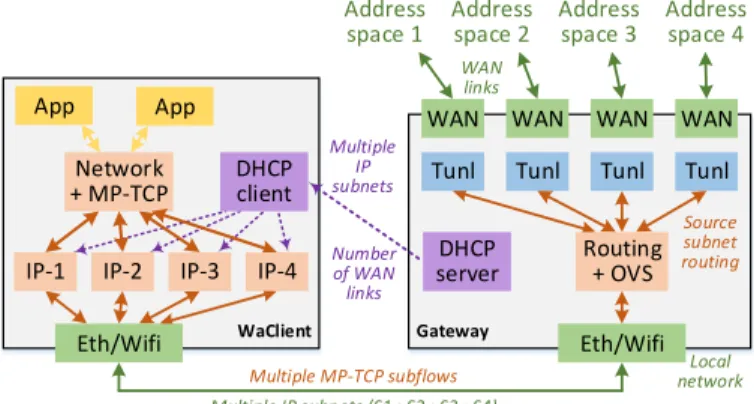
WaMPTCP is composed of three parts, a specific IP subnet allocation for the local network, a modified IP provisioning at the client, and finally a simple MPTCP subflow routing on the gateway.
IP subnet allocation: For each network segment of the local network, instead of allocating a single IP subnet, we allocate one subnet associated with each WAN link (gateway side of Figure 3.5). To simplify routing, an IP address space is associated with each WAN link, and then one subnet is created in each IP address space for each local network segment served by the gateway, based on the networking topology inside a campus network.
Direct routing adds additional constraints on the IP address space. Direct routing enables MPTCP to be routed directly to the Internet without any tunneling, instead of being restricted to the tunnels (which is the case for Tunnel Handoff). If using NAT, those subnets must reside in the private IP address space. Otherwise, each subnet associated with a WAN link must be within the IP address space routed on the Internet to that WAN link. This guarantees that the return path of any MPTCP subflow is valid and congruent with the forward path, a requirement for direct routing.
IP provisioning: We modify IP provisioning to inform the client of multiple IP subnets available on the network segment where it is connected and assign it one IP address associated with each WAN link (client side of Figure 3.5).
For IPv4, we modify the DHCPv4 protocol [56], we insert in the DHCP response a DHCP option informing the clients about the various subnets available. DHCP is a flexible protocol and allows custom DHCP options, the WaMPTCP option is a simple string listing the various subnets available on the network segment. DHCPv4 client is modified to request an IP address in each subnet of the list and configure those IP addresses on the network interface using IP aliases. We configured the ISC DHCP server and modified the ISC DHCP client to implement this option [57]. If the number of WAN links changes (not frequent in enterprise networks), DHCP TTL could be used to refresh the number of subnets on hosts.
IPv6 is simpler and does not require client modifications, because multiple IP addresses per interface is part of the IPv6 standard. DHCPv6 server is configured to assign multiple IP addresses to the client, one in each subnet, and most DHCPv6 clients automatically configure those IP addresses on the network interface. ISC DHCP server does not support multiple subnets per segment, and therefore we use the dhcpy6d server with the appropriate configuration [58]. IPv6 may alternatively use Stateless Address Autoconfiguration (SLAAC) [59]. We did not implement SLAAC, but the gateway would need to broadcast multiple Router Advertisement messages, one for each subnet.
Gateway routing: Routing on the SDN gateway forwards any packet originated in a subnet to the associated WAN link. This uses simple routing based on source subnet. A few static rules can match each source subnet, and this is supported by most OSes. Packets coming from the WAN links are routed based on destination subnet (classical routing). Our routing technique is implemented to support VxLAN tunneling to a remote gateway and direct routing to the Internet without tunneling.
Here is an example on how WaMPTCP works. Assigning multiple IP addresses to the inter-face of a client creates multiple virtual interinter-faces in the network stack, one per WAN link, the MPTCP stack by default uses all the virtual interfaces, and therefore it generates one MPTCP subflow using each source IP address. Assuming there are two WAN links available, A and B, each link would have an IP address space associated with it, IPSA and IPSB. If direct rout-ing is needed, the gateway routes IPSA on link A and IPSB on link B. IP subnet allocation assigns two subnets, IPSA.s and IPSB.s, to each network segment. If client c joins the local net-work,IP provisioningallocates two addresses to its network interface, IPSA.s.c and IPSB.s.c. Each MPTCP session generates two subflows, with respective source addresses IPSA.s.c and IPSB.s.c. Gateway routingdirects packets with source address IPSA.s.c to link A and packets with source address IPSB.s.c to link B.
3.3.4 MPTCP Recovery Optimization
During a path failure, a MPTCP subflow using the path is affected: packets don’t reach the receiver, and the TCP congestion algorithm triggers retransmissions and eventually timeouts, causing the subflow to get stalled. When a subflow is stalled, it does not send packets to probe the path and can suffer an outage much longer than the actual L3 outage (Section 3.5.2). In
certain circumstance, the subflow cannot resume at all, due to the TCP exponential backoff al-gorithm. We propose MPTCP Recovery Optimization (RO) to address stalled MPTCP subflows on failed paths, and it can be optionally applied to both MPTCP proxy and WaMPTCP.
One obvious solution would be to crank up the retransmission frequency of all the MPTCP subflows, so that the subflows do not wait such a long time before probing the path again. However, this has a number of downsides. First, this is not a standard configuration of MPTCP stack, so we would need a new mechanism for the gateway to communicate with end systems to use more aggressive retransmissions. Second, if subflows probe failed path too often, probing packets consume extra resources on the local network and on the gateway, possibly reducing the performance of subflows using healthy paths. Third, probing packets carry MPTCP session data, and this data must first be sent on the failed subflow, wait for the failure timer, before being resent on the healthy subflow. This is similar to what is measured by the T-latency metric (Section 3.4), and this can add significant latency to the data (around 300ms - Section 3.5.3).
Our solution is to combine strength of MPTCP and tunnel handoff and to allow the gateway to probe efficiently for failed subflows. When tunnel handoff detects that an path is down, it reroutes MPTCP subflows on that path to an alternate healthy path, similar to what it does for non-MPTCP traffic (Section 3.3.1). When those MPTCP subflow are on a healthy path, they can resume progress and it prevents them to stall. At this point, the subflow interfere with the subflow that was already on that path, but the effect is negligible (Section 3.5.2). Once tunnel handoff detects that the path has recovered, it reroutes all the affected TCP subflows back to their original path. This MPTCP recovery optimization is able to improve the recovery time of MPTCP sessions.
3.3.5 Mechanisms Integration
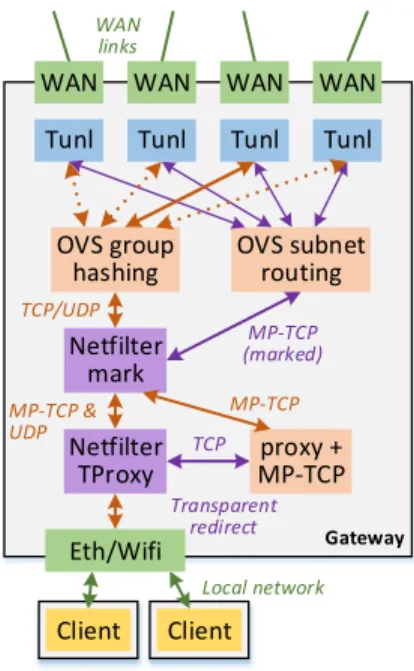
An additional challenge was integrating all the mechanisms together on the same gateway and making sure connections are routed to the proper mechanism. The integration is based on Netfilter [60] and OpenvSwitch [47] which are part of the Linux kernel (Figure 3.6). Filtering packet for the proxy is optional and done first using the TProxy mechanism [54]. Then, Netfilter mark the MPTCP packet, because OpenvSwitch does not have this field in its classifier. In OVS, there is two set of OpenFlow rules predicated on this mark, the rules for TCP and UDP use an OpenFlow failover or select group, whereas the rules for MPTCP match on the source subnet.
3.4
Vertical Handoff Performance Metrics
Tunnel Handoff and MPTCP use two completely different way to implement handoff, therefore we propose two new metrics for measuring the impact of various SD-WAN management tech-niques on application and network session performance. These metrics can not only capture the SD-WAN performance but also motivate and drive the design of Durga.
Prior studies have defined L3 metrics for measuring handoff performance under various network settings, including SDN (see, e.g., [61–64]). In addition, rerouting events adversely affect TCP performance [65], so several TCP optimization schemes have also been proposed, e.g., [64, 66, 67]. Most prior studies examine the impact of link failures on TCP performance by observing congestion window reduction, instant TCP throughput degradation, or packet losses.These metrics are too specific and are not directly related to the application experience. For this reason, we propose two new metrics to evaluate the impact of vertical tunnel handoff on TCP connections. For these new metrics to be useful, we pose the following requirements: 1) be a direct measurement of the effect of handoff; 2) applicable to both reactive and proactive handoff, due to path outages or policy changes; 3) relate directly to the application performance.
Path 1 Outage Vertical Handoff L3 reroute repair Time Path 2 Fair share throughput L4 T-throughput repair
Figure 3.7: L4 T-throughput repair
The first metric isT-throughput: time for throughput repair (Figure 3.7). It measures the time elapsed from the start of the outage or policy change, i.e. as soon as the link becomes undesirable, to when the throughput of an affected TCP connection is fully restored. As the conditions on the old link and the new link may be different, the expected throughput on the new link is likely different from the old link. Therefore, we consider that the TCP throughput has been fully restored when it has obtained its TCP-fair share of the (new) link bandwidth. In other words when the TCP slow start phase has ended and the throughput becomes stable. This metric provides a better measure of the effect of handoff on an application that is bandwidth-bound (e.g., a file download), as it quantifies how long an application suffers performance degradation before it fully recovers. This metric is a function of how efficient a TCP congestion control algorithm operates after the handoff.
Outage Handoff Worst retry latency
P.1
P.A P.B P.C P.D P.E P.F P.G R.3 P.H R.4 P.I
Retries P.5 L4 T-latency repair P.3 P.2 P.4 Time
Figure 3.8: L4 T-latency repair
The second metric isT-latency: time for latency repair (Figure 3.8). It measures the time elapsed from the start of the outage or policy change, to when all packets that were lost during the handoff are retransmitted by a TCP connection. This metric provides a better measure of the effect of handoff on an application that islatency-bound, e.g., interactive gaming over TCP. This metric is a function how efficient a TCP retransmission mechanism operates after the handoff.
A key benefit of these two metrics lies in that they allow us to evaluate how TCP configura-tions and network condiconfigura-tions affect the network failure recovery time. In particular, they enable us to design better failover and recovery mechanisms under MPTCP and evaluate them fairly against existing (single-path) TCP mechanisms.
3.5
Evaluation of Durga
We evaluate Durga in both emulated testbeds and real-world deployment, allowing us to evalu-ate performance across a wide range of workloads and network conditions.
We compare the following mechanisms implemented in the experiments:
• Tunnel Handoff is a baseline of Durga framework (Section 3.3.1). It uses Open vSwitch version 2.4.2 [47] to reroute flows across VxLAN tunnels. Unless specified, the traffic is plain TCP, and some tests do use plain MPTCP without WAN awareness;
• MPTCP Proxyis a transparent proxy solution (Section 3.3.2). By default, MPTCP Proxy in our experiments is our proxy implementation based on Dante Socks proxy version 1.4.1 [52]. For performance comparison, we also use our modified version of HPsockd v0.17 [51]; • MPTCP Tunnel [68]is a overlay solution which tunnels MPTCP over TCP. All TCP flows
are encapsulated in a single MPTCP flow between gateways. We use the implementation available online [69];
• WaMPTCPimplements WAN aware MPTCP in end systems and gateways (Section 3.3.3). End systems are provided with one IP address per WAN link, and generate appropriate num-ber of MPTCP subflows. Fullmesh, the default MPTCP path manager, is used, and gateways
route MPTCP subflows based on source subnets;
• WaMPTCP+ROimplements WAN aware MPTCP with MPTCP recovery optimization (Sec-tion 3.3.4). When the gateway detects an path failure, it reroutes infected MPTCP subflows away from the failed path, and reroutes back when the path is recovered.
Except for the bandwidth aggregation experiments in Section 3.5.1, controlled testbed setup is described as follows. The testbed uses six Ubuntu 16.04 servers with MPTCP 0.93 imple-mentation. The setup is similar to Figure 3.3: two gateways, two clients, and two servers. The gateways have two pairs of Ethernet interfaces, and they are configured at 100Mb/s to emulate a wide area network. The remote gateway terminates VxLAN tunnels originated at the SDN gateway and routes to the servers. One legacy client and one WaMPTCP client connect to a local SDN gateway at 1Gb/s. Through local and remote gateways, clients can access servers which are connected to the remote gateway at 1Gb/s. One pair of client and server is used for generating background traffic as needed.
3.5.1 Bandwidth Aggregation Evaluation
Table 3.1 shows the overall throughput of the 4 mechanisms with a single IPv4 connection, a single IPv6, or 10 IPv4 connections. These tests use 5 WAN links configured at 1 Gb/s between the gateways, the client and server use 10Gb/s.
Direct Routing (i.e., no VxLAN tunnels) can only use the default path for all plain TCP and plain MPTCP connections due to the constraints of routing. Tunnel Handoff is only available with VxLAN tunnels, and can only aggregate bandwidth when there are multiple connections. Dante proxy offers much greater performance than HPsock proxy, but suffers with VxLAN tunnels due to the smaller MTU and higher CPU load. WaMPTCP performs the best because it uses all available bandwidth in all conditions.
Mb/s Direct Routing VxLAN tunnels
IPv4 IPv6 10 IPv4 IPv4 IPv6 10 IPv4
Plain TCP 941 928 944 908 893 4550
Plain MPTCP 928 915 931 893 888 4480
MPTCP Tunnel 120 N/A 119 114 N/A 112
HPsock Proxy 740 N/A 1050 752 N/A 876
Dante Proxy 4285 3925 4550 3233 2763 3610
WaMPTCP 4606 4531 4640 4433 4221 4490
3.5.2 Handoff Traces Evaluation 0 5 10 15 20 25 Timestamp (s) 0 50 100 150 200 250 Throughput (Mb/s) LK2 down GW notified LK2 up GW notified
Figure 3.9: Tunnel Handoff
0 5 10 15 20 25 Timestamp (s) 0 50 100 150 200 250 Throughput (Mb/s) LK2 down LK2 up Figure 3.10: MPTCP Tunnel 0 5 10 15 20 25 Timestamp (s) 0 50 100 150 200 250 Throughput (Mb/s) LK2 down GW notified LK2 up GW notified Figure 3.11: WaMPTCP 0 5 10 15 20 25 Timestamp (s) 0 50 100 150 200 250 Throughput (Mb/s) LK2 down GW notified LK2 up GW notified Figure 3.12: WaMPTCP + RO
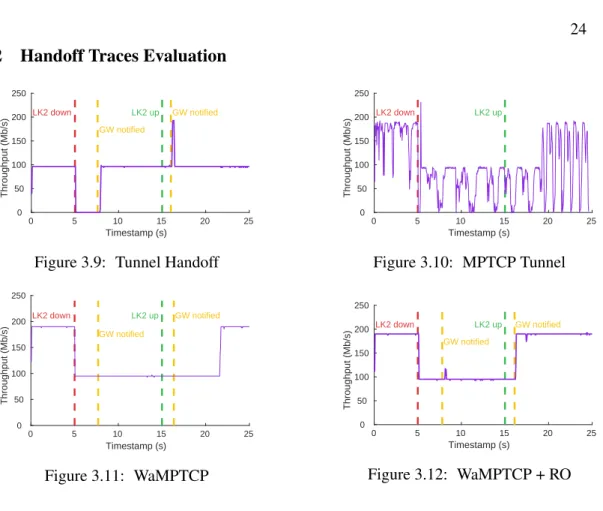
Figures 3.9, 3.10, 3.11 and 3.12 show the throughput of a single connection during an outage on a link (labeled as “LK2” in the figure). The outage is emulated by blocking the primary link after 5 seconds, and unblocking it after another 10 seconds, whereas the backup link is always healthy. The primary link is blocked using an iptables/netfilter rule [60], which is almost instan-taneous. We decompose an outage into two phases: failover (which typically harms throughput) and recovery (which typically benefits throughput). We don’t simulate policy changes, since in most cases, it would be similar to the recovery phase of an outage. MPTCP proxy behaves almost identically to WaMPTCP, so it is not shown.
Figure 3.9 shows that tunnel handoff does not aggregate available bandwidth on the two WAN links together, and it experiences more than 3 seconds down-time during failover. Ap-proximately 3 seconds after the link is blocked, BFD considers the path as failed, and tunnel handoff reroutes the affected flow to the healthy link, and it resumes progress. After the link is unblocked, BFD eventually discovers that the path is healthy, and reroutes the flow to its original path. In our experiment, the throughput spikes shortly after recovery. This is because prior to handoff, the flow has filled the send buffers of the NIC and the tunnel endpoint on
the gateway before the bottleneck link. After handoff, the flow moves to an empty link, and can therefore transmit immediately, while the other link is still draining the send buffers. This creates out of order packets [65], however the Linux TCP/IP stack has many optimization to overcome this [64].
Figure 3.11 and 3.12 show that during failover phase, there is no down-time because MPTCP natively supports resilience by maintaining multiple subflows. Just after the failure, the through-put of MPTCP goes down a little bit and quickly reaches fair share. Conceptually, suspension of one subflow does not affect the other one if the other flow has already reached its fair share.
Figure 3.11 shows that when Recovery Optimization in not used, the subflow get stalled (Section 3.3.4). When the path become available again, BFD takes less than 1 second to detect the link recovery, however throughput need further 5 seconds to recover. Further experimenta-tion shows that the L4 throughput repair time increases with the length of the outage and is due to TCP RTO backoff (Figure 3.16).
Figure 3.12 shows that Recovery Optimisation prevents the subflow to get stalled, and that it recovers the bandwidth of the second path very quickly after being moved to the recovered path. The aggregated throughput dips and spikes slightly when the gateway is notified of the failure (at 8s). With the MPTCP proxy, those dips and spike are more pronounced. The two subflows sharing the healthy path interact with each other and create out-of-order packets, causing our measurement application to mistakenly computes instant throughput higher or lower than the real value.
MPTCP Tunnel in Figure 3.10, does not exhibit stable throughput even without any back-ground traffic. We conjecture that it is caused by the interaction between the outer TCP control loop (end-to-end) and inner TCP control loop (tunnel), which is a well know issue of any TCP in TCP encapsulation [70].
3.5.3 Handoff Metric Evaluation
Visual examination of traffic traces does not convey the full picture, and in order to quanti-tatively study handoff impact on transport layer, we need use the new metrics we designed, T-throughputandT-latency(Section 3.4). We evaluate those metrics both for thefailoverphase and therecoveryphase.
For tunnel handoff, the factor that has the biggest impact on handoff performance is the configuration of theBFD protocol, used to evaluate the health of the WAN link and the Internet
100 200 300 400 500 600 700 800 900 1000 BFD Interval (s) 0 1000 2000 3000 4000 T-throughput-failover (ms) Tunnel Handoff MPTCP Proxy WaMPTCP WaMPTCP+RO Figure 3.13: BFD impact over T-throughput-failover 100 200 300 400 500 600 700 800 900 1000 BFD Interval (s) 0 1000 2000 3000 4000 T-latency-failover (ms) Tunnel Handoff MPTCP Proxy WaMPTCP WaMPTCP+RO Figure 3.14: BFD impact over T-latency-failover 100 200 300 400 500 600 700 800 900 1000 BFD Interval (s) 0 1000 2000 3000 4000 5000 6000 7000 T-throughput-recovery (ms) Tunnel Handoff MPTCP Proxy WaMPTCP WaMPTCP+RO Figure 3.15: BFD impact over T-throughput-recovery path (Section 3.3.1). Figures 3.13, 3.14, 3.15 and Table 3.2 show both metrics for both phases, with various mechanisms and various setting of the BFD timer.
seconds T-throughput-failover T-latency-failover T-throughput-recovery T-latency-recovery
BFD timer 1s 100ms 1s 100ms 1s 100ms Tunnel Handoff 3.77 0.63 3.52 0.56 1.33 0.42 0 MPTCP Tunnel 0 0.34 6.57 0 MPTCP Proxy 0 0.37 6.41 0 WaMPTCP 0 0.32 6.86 0 WaMPTCP+RO 0 0.32 1.28 0.44 0
Table 3.2: Vertical handoff performance of different mechanisms
Tunnel Handoff and Recovery Optimization rely on BFD, and consequently are impacted by the value of the BFD timer. The period of BFD handshakes is equal to the BFD timer, and by default BFD declares the path failed after 3 failed handshake. Our results pretty much confirm this and show that the performance at TCP level when using BFD is mostly dominated by the Layer 3 handoff. Mechanisms not using BFD are obviously not impacted by this setting. Tunnel handoff would need to use a very small BFD timer to compare to how MPTCP handles failures, increasing overhead and the risks of false positives.
The metrics do confirm many of our earlier findings. MPTCP provides a much better failover performance, and MPTCP without Recovery Optimization suffer worse recovery per-formance due to stalled flows. T-throughput-failoveris zero with MPTCP, which confirm that the throughput of the subflow on the healthy link is not impacted.T-latency-recoveryis always zero, because there is no retransmissions3, the handoff is between two healthy link and cause no packet loss.
The traffic traces did show near instant handoff for MPTCP, the metrics are useful to show that this is not the case. T-latency-failovershows that for all MPTCP mechanisms, some data get stuck for around 320ms on the failed subflow before being retransmitted on the healthy
10 20 30 40 50 60 Outage duration (s) 10 20 30 T-throughput-recovery (s) Tunnel Handoff WaMPTCP WaMPTCP+RO
Figure 3.16: Outage impact on T-recovery-time (BFD=100ms) subflow. This could impact latency sensitive applications.
Figure 3.16 shows the impact of the outage duration on the recovery phase and the T-throughput-recovery metric. Without Recovery Optimization, MPTCP recovery depends on TCP congestion control, and grows with outage duration. During outage, TCP reconnects af-ter one second by default in Linux, and the retry inaf-terval grows exponentially. Linux default number of retries is 15, and thus the maximum outage that can be tolerated is 924.6 seconds. For high-availability server, the suggested number of retries is 3 [71]. In this case, if the outage duration is larger than seconds, a stalled subflow will never resume.
In contrast, Tunnel Handoff and Recovery Optimization are using BFD for recovery, there-fore are independent of the outage duration. BFD is using a constant periodic timer, the subflow is not stalled, and thereforeT-throughput-recoveryis approximately layer 3 recovery time plus the delay for congestion window (cwnd) growth. Congestion window growth closely depends on round trip time, bandwidth, and congestion on the forwarding path (Section 3.5.4).
3.5.4 TCP/IP Congestion Control
Figure 3.17 shows that for all mechanisms T-throughput-recoverygrows as RTT of the path grows. Higher RTT makes opportunities to adjust the congestion window (cwnd) less frequent, thus it takes more time to recover the larger cwnd. WaMPTCP+RO and MPTCP proxy+RO do not have to perform an entire cwnd recovery, since the subflow is not stalled (Section 3.3.4), and both subflows recover in parallel. Without Recovery Optimization, the subflow needs to recover the entire tunnel bandwidth from TCP slow start.
Table 3.3 shows that theTCP congestion controlused for the subflows impacts the per-formance of WaMPTCP+RO. Six TCP congestion control algorithms are uncoupled, while the