Document Representation for Efficient Search Engines
A thesis submitted for the degree of Doctor of Philosophy
Yohannes Tsegay B.App.Sci. (Hons.),
School of Computer Science and Information Technology, Science, Engineering, and Technology Portfolio,
RMIT University,
Melbourne, Victoria, Australia.
i
Declaration
I certify that except where due acknowledgment has been made, the work is that of the author alone; the work has not been submitted previously, in whole or in part, to qualify for any other academic award; the content of the thesis is the result of work which has been carried out since the official commencement date of the approved research program; and, any editorial work, paid or unpaid, carried out by a third party is acknowledged.
Yohannes Tsegay
School of Computer Science and Information Technology RMIT University
Acknowledgments
I am indebted to my supervisors Andrew Turpin and Justin Zobel. Their guidance, con-stant encouragement, and invaluable suggestions has made my candidature a memorable one. Working with Andrew and Justin has been a joy and a privilege, and I look forward to working with them again.
The research presented in Chapter 4 is based on work jointly done with a colleague, Simon Puglisi. Simon is an enthusiastic and hard working researcher. I have immensely enjoyed working with Simon and learnt a great deal from him. During my candidature, I also had the opportunity of working with Falk Scholer, Steven Garcia and Ying Zhao. While the outcome of that research has not been incorporated in this thesis, it nevertheless is the basis for some of the future work discussed in the final chapter. Special thanks to Steven Garcia and Falk Scholer who kindly agreed to proof-read parts of the thesis.
I would like to thank many past and present fellow students in the Search Engine Group (SEG), or as it has come to be known the Information Storage, Analysis and Retrieval (ISAR) group. In particular I would like to thank Steven Garcia, Bodo Billerbeck Milad Shokouhi who welcomed me to the group and patiently answered the barrage of questions I put to them during my early days, Nick Lester and Steve Garcia for helping me understand some of Zettair’s source code, Pauline Chou, Halil Ali, Jonathan Yu, Timo Volkmer, Abdusalam Nwesri, Nikolas Askitis, Iman Suyoto, Jun Jie Foo, Chris Hoobin, Jasbir Dhaliwal, Steven Burrows, Pengfei Han, Sarvnaz Karimi, Dayang Iskandar, Shuhaida Shuhidan, and Ying Zhao for the great company and memorable laughs.
I would like to express my gratitude to RMIT University for providing me with the necessary environment and tools to carry out my work and to SIGIR and RMIT University for providing me with the financial conference travel support. I am also grateful to the participants of the user study reported in Chapter 4.
Finally, none of this would have been possible without my family. Through all my endeav-ors my parents have been a pillar of support. It is their constant encouragement, advice and belief in me that has gotten me to and through my candidature. To them I owe everything. I am also grateful to my siblings who have always been tremendously patient, supportive, and inspirational.
iii
Credits
Parts of the materials in this thesis have previously appeared in the following publications: • Document Compaction for Efficient Query Biased Snippet Generation
Y. Tsegay, S. J. Puglisi, A. Turpin and J. Zobel. In Proceedings of the 31th Euro-pean Conference on IR Research on Advances in Information Retrieval, pages 509–520. Springer-Verlag. 2009.
• Dynamic Index Pruning for Effective Caching
Y. Tsegay, A. Turpin and J. Zobel. In Proceedings of the 16th ACM Conference on Information and Knowledge Management, pages 987–990. ACM. 2007.
• Fast Generation of result Snippets in Web Search
A. Turpin, Y. Tsegay, D. Hawking and H. E. Williams. In Proceedings of the 30th Annual International ACM SIGIR Conference on Research and Development In infor-mation Retrieval, pages 127–134. ACM. 2007.
This work was supported by the Australian Postgraduate Award (APA) and the Victorian Government ICT scholarship.
The thesis was written in the vimeditor and typeset using LATEX 2ε document preparation system.
All trademarks are the property of their respective owners. Note
Unless otherwise stated, all fractional results have been rounded to the displayed number of decimal figures.
Abstract 1
1 Introduction 3
2 Background 9
2.1 Relevance and Text Retrieval Models . . . 9
2.1.1 Boolean Retrieval Model . . . 10
2.1.2 Vector Space Model . . . 11
2.1.3 Probabilistic Model . . . 13
2.1.4 Language Modeling . . . 14
Divergence-Based Language Models . . . 16
2.2 Measuring Retrieval Performance . . . 16
2.2.1 Retrieval Efficiency Evaluation . . . 17
2.2.2 Retrieval Effectiveness Evaluation . . . 17
Recall . . . 17
Precision . . . 18
Average Precision . . . 18
2.2.3 Testbeds . . . 19
TREC . . . 19
TREC Collections and Topics . . . 20
Query Logs . . . 21
2.3 Architecture of a Search Engine . . . 24
2.3.1 The Index . . . 24
Inverted Index . . . 24
2.3.2 Auxiliary Data-structures . . . 26
CONTENTS v
2.3.3 Effective Index Representation . . . 26
Inverted Index Compression . . . 26
2.4 Alternative Effective Index Representation . . . 28
2.5 Efficient Query Evaluation . . . 29
Index Reordering for Early Termination . . . 29
Frequency Ordered Index . . . 29
Impact Ordered Index . . . 30
Access Ordered Index . . . 32
Static Index Pruning . . . 32
Inverted Index Caching . . . 34
2.6 Compact Document Representation . . . 37
2.6.1 Document Compression . . . 38
2.6.2 Document Summarisation . . . 40
Query-Biased Summarisation . . . 41
2.7 Summary . . . 44
3 Compressed Token System 45 3.1 Mechanics of Snippet Generation . . . 46
3.1.1 Preprocessing Web Documents . . . 49
3.2 Baseline Snippet Engine . . . 50
3.3 The CTSSnippet Engine . . . . 52
3.4 Experimental Setup . . . 54
3.5 Results . . . 58
3.6 Snippets Generation Using Compressed Matching . . . 65
3.7 Document Caching . . . 67
3.8 Reducing the Memory Footprint of CTS. . . . 74
3.9 Summary . . . 76
4 Document Compaction for Efficient Query-Biased Snippet Generation 77 4.1 Detecting Novel Sentences . . . 78
4.2 Document Compaction . . . 82
4.2.1 Sentence Reordering . . . 82
Query-Independent Sentence Weighting . . . 83
4.3 Experimental Setup . . . 86
4.3.1 Evaluation . . . 87
4.4 Results . . . 87
4.4.1 Simple Go-Back . . . 92
4.5 Loss Due to Pruning . . . 94
4.6 Fast Snippet Generation Using Pruned Documents . . . 99
4.7 Caching Pruned Documents . . . 101
4.8 Summary . . . 104
5 Inverted Index Pruning for Efficient Caching 106 5.1 Dynamic Index Pruning Using Impacts . . . 107
5.2 Experimental Data-set . . . 108
5.3 Evaluation . . . 109
5.4 Gradual Stop Test Interval . . . 111
5.5 Caching Impact Ordered Lists . . . 113
5.5.1 Cache Management . . . 114
5.5.2 Cache Implementation . . . 115
5.5.3 Evaluating Cache Efficiency . . . 116
5.6 Experiments . . . 116
5.6.1 Query Log Analysis . . . 117
5.7 Results . . . 118
5.7.1 Gradual Stop Effectiveness . . . 118
5.7.2 Cache Performance . . . 120 5.8 Summary . . . 124 6 Conclusions 125 6.1 Future Work . . . 129 6.2 Summary . . . 131 A Experimental Specifications 132
B Snippets Assessment Interface 133
List of Figures
1.1 Example of a results page . . . 4
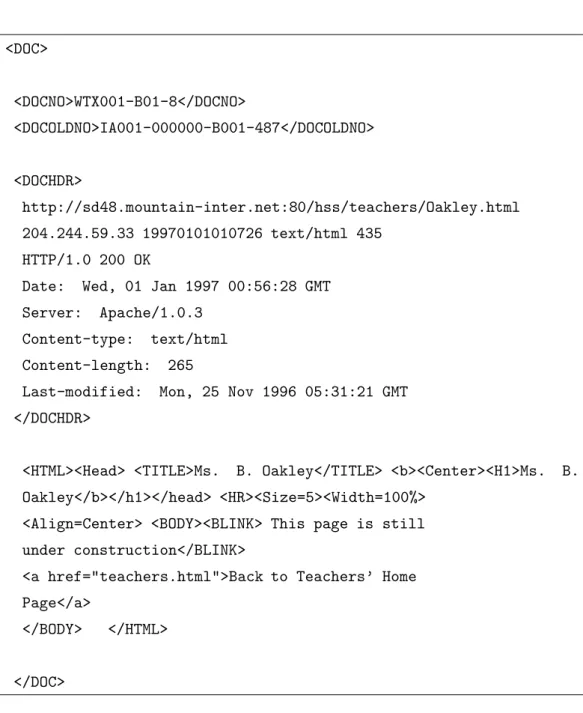
2.1 Example of a TREC document . . . 22
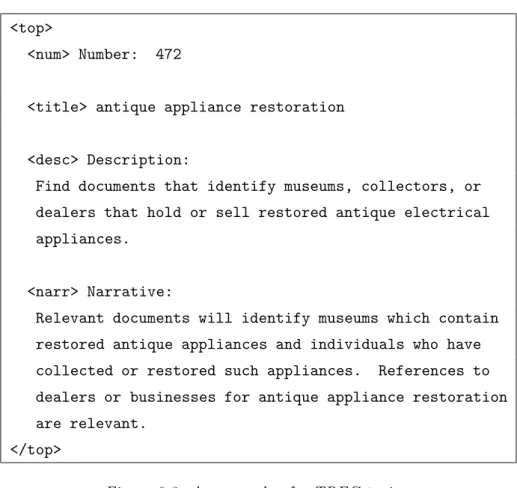
2.2 Example of a TREC topic . . . 23
3.1 Example highlighting the various parts of a caption . . . 46
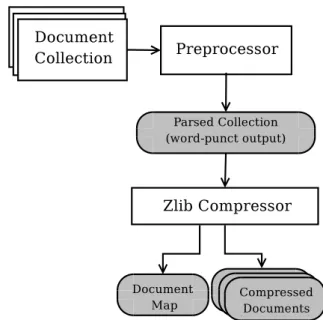
3.2 Compression component of the baseline system . . . 51
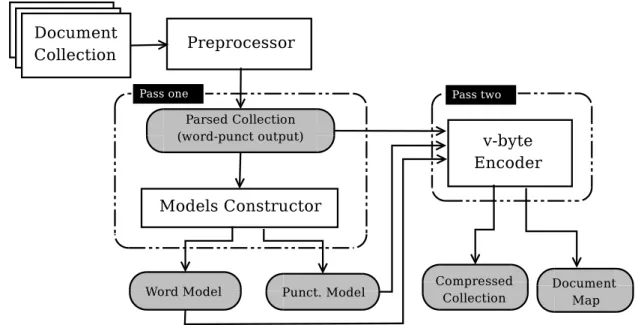
3.3 Compression component of theCTSsystem . . . . 53
3.4 Efficiency of CTSand the baseline systems in generating snippets . . . . 60
3.5 In-memory processing speed ofCTS and the baseline systems . . . . 61
3.6 Time to fetch documents from disk using various storage methods . . . 63
3.7 CTS’s speed in generating snippets using compressed text matching . . . . . 66
3.8 Document cache hit rates using two management policies . . . 70
3.9 The impact of cache size on snippet generation speed . . . 71
3.10 The impact of cache size on snippet generation speed . . . 72
4.1 Average portion of a document inspected to derive a snippet . . . 89
4.2 Similarity of pruned documents snippets to the full document snippets . . . . 90
4.3 Document cache hit rates . . . 103
5.1 Effectiveness and efficiency of Gradual Stop interval parameter test I . . . 112
5.2 Effectiveness and efficiency of Gradual Stop interval parameter test II . . . . 113
5.3 Distribution of query terms . . . 117
5.4 Inverted lists caching using large memory . . . 123
B.1 Screenshot of the snippets assessment user interface . . . 133
2.1 Statistics of the test collections used . . . 20
3.1 Test collection sizes, before and after the preprocessing stage . . . 55
3.2 Details of the documents retrieved for the test queries . . . 56
3.3 Total storage space for the compressed collections . . . 59
3.4 Average turn-around time to generate snippets for a query . . . 62
3.5 Break-down of the snippets generation time . . . 63
3.6 Snippet generation time for small documents . . . 64
3.7 Snippet generation speed using compressed matching . . . 67
3.8 Impact of word model pruning on compression ratio . . . 75
3.9 Impact of word model pruning on snippet generation time . . . 75
4.1 Number of duplicate sentences identified by users . . . 81
4.2 Examples of classes of duplicate sentences . . . 82
4.3 Information loss as a result of removing duplicate sentences . . . 83
4.4 Query logs used for sentence reordering . . . 86
4.5 Statistics of documents used in the snippet generation study . . . 88
4.6 Portion of queries with identical result sets . . . 91
4.7 Increase in portion of documents with identical snippets as a result of using the Simple Go-Back approach . . . 93
4.8 User preference of full document versus pruned document snippets . . . 95
4.9 Information loss as a result of document pruning for Wt10g and Wt100g data-set . . . 97
4.10 Information loss as a result of document pruning for theGov2data-set . . . 98
4.11 Impact of document pruning on the size of words model . . . 100
4.12 Snippet generation speed using pruned documents . . . 100 viii
LIST OF TABLES ix
4.13 Snippet generation speed due to document caching . . . 104
5.1 General statistics on the query logs used for caching . . . 116
5.2 Statistics of the stream of queries used to evaluate Inverted list caching . . . 118
5.3 Bytes and documents decoded using pruned and full indexes . . . 119
5.4 Comparison of pruned index and full index results . . . 120
5.5 Term and byte hit rates of the MSNand query logs . . . 121
1 A simple sentence scorer . . . 48
2 Constructing snippets using the CTSsystem . . . . 57
3 Constructing snippets using the baseline system . . . 58
4 Duplicate sentence detection using the shingles approach . . . 79
Abstract
Search engines process millions of user queries on a daily basis. The response to a query is typically in a form of a results page, construction of which involves identifying a set of documents that match the query — via an index — and, for each document, constructing a query-biased summary sourced from the document’s text. For a search system to achieve high throughput, the efficient processing of both these tasks is paramount. Most published work that aims to improve search efficiency is focused on optimising the inverted index. Techniques such as compression, pruning, caching, and reordering of inverted indexes have been shown to substantially speed up the query evaluation process. To date, however, there is no published literature that examines the efficient generation of query-biased summaries.
In this thesis we propose a compression based scheme for representing documents that allows efficient snippet generation. We demonstrate that, while compared to a baseline, the proposed system provides slightly inferior compression rates, it is on average 60% faster in generating snippets.
In addition to compression, we also explore lossy means of compacting documents, or doc-ument pruning. Using a docdoc-ument pruning scheme based on sentence reordering, we show that over half the content of a collection can be discarded, yet still be able to produce snippets of quality comparable to those derived using the full documents. Our experimental results show that, using pruned and then compressed documents as surrogates of the full, average snippet generation time is reduced by over 40%. In addition to limiting the amount of data processed, such pruned documents are candidates for caching. By caching such pruned surro-gates, we show that a substantially higher cache hit ratio can be achieved. Moreover, the snip-pet generation throughput also increases by 58% compared to using a cache of full documents. Finally, we examine whether the combination of pruning and caching of inverted indexes can yield similar gains as with the pruned document surrogates. While pruning and caching of inverted indexes have been studied in parallel streams, there is little published work which
examines their combination. Our experimental results on two large data-sets show that the use of the index pruning scheme we propose reduces by over 60% the amount of data processed when evaluating queries. By caching pruned inverted lists instead of the full inverted lists, we demonstrate that a gain of 7% in cache hit rate can be achieved.
Together, these new methods substantially reduce the infrastructure required to provide a large-scale search service.
Chapter 1
Introduction
Information retrieval systems, such as web search engines, are used to answer millions of user queries on a daily basis. The response to a query is typically a results page containing a list of documents, each with a brief summary. Two tasks that underpin the process of constructing a results page are identification of documents that match the query and generation of document summaries, both of which require access to data on disk.
To enable resolution of the diverse range of user queries, web search engines index large collections of documents. At the same time, it is also desirable to maximise the query throughput and minimise the response time for a query, given limited resources. To satisfy these competing expectations, efficient access to the data used by the two components of search is paramount. This thesis concerns efficient strategies of storing and retrieving the disk-resident data used by search engines, with the objective of minimising the overall query throughput.
Collections indexed by search engines may contain various types of documents, includ-ing images, text, videos, or audio. The focus of this thesis is on collections composed of text documents, in particular natural language text documents, such as electronic publica-tions (scientific or news articles) or the content of web documents, also known as webpages. Queries, a representation of the user’s information need, are expressed as a set of terms, where a term is a sequence of alphanumeric characters delimited by whitespace.
To efficiently resolve a query, a search engine needs to be able to quickly identify which documents contain the queried terms. A practical solution to locating query terms is to use an inverted index, so that a query can be resolved without inspecting the collection, by simply examining the inverted index entries (inverted lists) of the query terms. The documents that
Figure 1.1: A result page example from a commercial search engine obtained in response to the query “SIGIR” on October 9, 2008.
best match the query, according to a similarity heuristic, are then returned to the searcher in a form of a results page. Figure 1.1 illustrates a results page from a commercial search engine in response to the query “SIGIR”. In addition to the list of matching documents, supplementary information about each document, for example a brief summary, is added to the results page. These costs — of index processing and summary generation — constitute the major components of query evaluation time.
Query-biased Summaries
The notion of representing a user information need as a query as well as the similarity heuristics used for query retrieval alluded to earlier, are imprecise. For instance, a query may be interpreted in more than one way, as illustrated by the example in Figure 1.1. Here, while the searcher may have intended to locate the homepage of the Special Inspector General for Iraq Reconstruction (SIGIR) program, many results pertaining to the information
5
retrieval conference have also been retrieved. Therefore, it is not uncommon for the results to include documents that match the query but are irrelevant to the user’s need. The main purpose of including the summaries (query-biased snippets) is to help the searcher to identify those documents in the results page that are of potential interest to their need without inspecting their full content. Furthermore, snippets may directly provide the information sought, obviating the need to visit the full document.
The value of snippets in assisting users to locate relevant documents has been stud-ied in several publications. In particular Tombros and Sanderson [1998] found that users could locate more relevant documents and were less likely to refer to the full documents when presented with query-biased summaries. White et al. [2003] confirmed user prefer-ence for query-biased summaries, by measuring the time it took users to complete search tasks.
Query-biased snippets are custom-generated for every retrieved document by extracting sentences relevant to the query from either the document’s content or its metadata. The process of generating a snippet involves two stages. In the first stage, documents are fetched from disk, and their content is parsed. In the second stage, the sentences in a document are scored against the query for similarity, and the top-scoring sentences are selected to form the snippet. This process is repeated for at least 10 to 20 documents for every query resolved. However disk accesses are expensive. Given that the summarisation process incurs 10 to 20 disk accesses per query, it can easily dominate the cost of evaluating queries. Therefore, for efficient query processing, it is paramount that the resources consumed and time spent generating snippets are as small as possible.
Despite the recognised importance of efficient query evaluation, there is no prior published work, other than that included in this thesis, that concerns efficient generation of snippets. In this thesis we study document storage techniques to support efficient query-biased snippet generation. In other areas of search engine design, compression has played an important role in reducing disk access time. We therefore ask
• What document compression methods facilitate efficient snippet generation?
In Chapter 3 we propose a Compression Token System (CTS), a scalable, compact
document storage system that reduces the time taken to fetch a document from disk by applying compression. While there is rich body of research on compressing documents for text retrieval systems, this is the first work that has focused solely on investigating the value of compressing text documents for the purpose of efficient snippet generation.
Our experimental results using CTS demonstrate significant reduction in the average time spent generating snippets for a query. This is largely due to the reduction in disk access overhead, and the use of a document representation scheme that allows fast matching of query terms within the document. Further, we explore how caching of compressed documents can be used to reduce or altogether remove the disk access cost for some documents.
While compression does reduce the size of documents, further compaction can be achieved by removing parts of each document that are not useful for snippet generation, that is by document pruning.
The potential effect of document pruning on processing throughput is twofold. First, the cost of fetching full documents is reduced, as smaller documents are read from disk. Second, as there are smaller portions of each document to evaluate in order to construct snippets, the in-memory processing times are also reduced. However, the document pruning scheme used should retain the part of a document that is necessary for snippet generation. To this end we ask:
• How can we construct compact document surrogates that permit effective and efficient snippet generation?
From inspection of the content of documents indexed by search engines, in particular web documents, it is clear that not every sentence and section of a document is useful for gen-erating snippets. Documents contain adversarial content, boilerplate templates, JavaScript, Cascading Style Sheets, and other materials that are useless for snippet generation. Further-more, natural language text documents tend to contain repetitive and redundant pieces of text that are of little additional value when generating snippets.
In this thesis we study document pruning strategies. In particular, we examine construc-tion of compact surrogates of a document that produce high quality snippets. In Chapter 4, we propose document pruning schemes with the aim of further speeding up query-biased snippet generation.
Our document compaction schemes prune each document by retaining only those sen-tences that are likely to be included in a query-biased snippet. The pruned surrogates are then used to construct snippets. Our experimental results show that, for large sets of queries, these surrogates produce snippets of comparable content to those generated using the full documents. Moreover, by caching the pruned surrogates, we show that a larger portion of documents can be maintained in memory, thereby avoiding disk access for those documents, and in turn significantly reducing the average query snippet generation time.
7
Inverted Index Caching and Pruning
Given the obvious advantages brought by caching pruned documents, a natural question to ask is whether similar benefits can be obtained for the other major disk-resident data structure in a search engine, the inverted index. Inverted indexes typically require storage of about 20%–40% of the collection size [Zobel and Moffat, 2006]. For small collections the inverted lists may fit in memory, but for larger collections some or all of the lists must reside on disk. As more lists are maintained on disk, the portion of query time spent accessing disk also increases. In fact, for large collections, a considerable component of the query evaluation time is spent accessing disk [Scholer et al., 2002].
A common technique to reduce the volume of the inverted lists processed is through index pruning, where inverted lists are organized so that documents with a high probability of being returned are stored at the front of the list, and only the initial parts of the inverted lists are processed [Persin et al., 1996; Carmel et al., 2001]. Index pruning strategies can either be static or dynamic. In static pruning schemes, the portion of an inverted list to be processed is decided independent of the query being evaluated, and so less disk traffic is required during query evaluation than if the full list is used [Carmel et al., 2001; de Moura et al., 2005; B¨uttcher and Clarke, 2006]. In dynamic pruning, the volume of an inverted list processed is dependent on the query, and so savings vary [Persin et al., 1996; Anh and Moffat, 2006; Garcia, 2007].
An alternative strategy commonly used to reduce query evaluation time is index caching. By effectively maintaining inverted lists in memory, part of the disk access incurred when fetching them at query time can be avoided.
An added advantage to pruning inverted lists is to improve caching. Given the finite amount of memory a search engine has to operate under, using pruned lists means that more lists can be cached, and in turn reducing the number of disk accesses.
Existing inverted list caching literature primarily focuses on caching full (unpruned) lists [Long and Suel, 2005; Baeza-Yates et al., 2007; Zhang et al., 2008]. In this thesis we investigate the value of caching pruned inverted lists. In particular we aim to establish
• What efficiency gains can be achieved by caching pruned inverted lists instead of the full lists?
In Chapter 5 we experiment with a new dynamic inverted list pruning scheme. Here, only the parts of a list that are actually used to evaluate a query are cached. We also examine cache
performance under several new cache management schemes including, recently proposed cost-aware cache eviction policies that take into account several properties of items in cache when determining which entries to evict next [Cao and Irani, 1997; Garcia, 2007]. Experimental results involving two large collections and their corresponding large query logs show that the dynamic pruning scheme proposed uses less than 40% of the amount of data processed by the full index, while retrieving results that are comparable effectiveness to those generated by the full. Moreover, we demonstrate that a cache that uses pruned inverted lists consistently outperforms one that uses full inverted lists.
The implications of the three contributions made in this thesis is that they considerably reduce the disk overhead cost and in memory processing time associated with the two phases of search: identifying a set of document that match the user query and generating snippets for the set of retrieved documents. The combination of document compression and document pruning more than doubles the throughput of snippets generation process. Meanwhile, we show that a considerable portion of disk accesses when fetching inverted lists can be averted by caching pruned lists.
Thesis Structure
The remaining chapters in this thesis are as follows.
Chapter 2 provides an overview of the architecture of search engines and reviews the body of literature that concerns efficient query evaluation. A focus of this chapter is the inverted index and the documents from which summaries are generated.
Chapter 3 proposes and evaluates a document management system for efficient access to documents during snippet generation.
Chapter 4 examines how documents can be further compacted by pruning parts that are not necessary for snippet generation. This section also studies how pruned documents can be cached to further reduce the disk access cost associated with fetching documents. Chapter 5 investigates whether the principles of pruning and caching can also be applied
to the inverted index.
Chapter 6 provides concluding remarks and suggests potential future work that can be undertaken to extend this research.
Chapter 2
Background
Our work in this thesis builds on prior research work, and the contributions made span several aspects of search engine design. In this chapter we provide preliminary background and review related literature.
We begin by introducing relevance, a concept central to information retrieval systems, and describe the models used to retrieve relevant documents. In Section 2.3, we provide an architectural overview of a search system used to support efficient retrieval. In par-ticular, we pay attention to the index data-structure and how it is used to find relevant documents. Section 2.6 studies effective representation of documents, where we focus on document summarisation and compact document storage strategies, as they form the ba-sis for the work carried out in Chapters 3 and 4 – efficient query-biased summary genera-tion.
2.1 Relevance and Text Retrieval Models
The goal of an information retrieval system is to assist users in fulfilling their information need, by retrieving documents relevant to that need [Salton and McGill, 1986]. Central to the retrieval process is the concept of relevance. Although we intuitively understand relevance, formalising what constitutes a relevant document to a user’s request has proven to be elusive. This is largely because relevance is a subjective notion [Swanson, 1986]. A document’s relevance to a query varies between users, based on their background knowledge or their cognitive state when searching. This has been shown in several studies to date, which reveal considerable disagreement between what different users perceive as relevant [Voorhees, 1998; Al-Maskari et al., 2008; Bailey et al., 2008; Scholer et al., 2008].
The attempt to define relevance has been the subject of much research. Cooper [1971], Saracevic [1975], van Rijsbergen [1989], Harter [1992] are just a few that discuss various interpretations of relevance and how relevance may be quantified. A comprehensive survey of literature on relevance in information retrieval field was compiled by Mizzaro [1997]. A conclusion drawn by Mizzaro is that there is no clear consensus on the understanding and definition of relevance.
In the absence of a concrete notion of relevance, a simplified alternative adopted by cur-rent retrieval systems is objective relevance (also known as system-oriented or algorithmic relevance). The relevance between a document and a user request is based purely on the con-tent of the query and that of the document [Saracevic, 2006; Lavrenko, 2004]. A document is said to be relevant to a query if “there is enough semantic overlap in [their] represen-tation” [Lavrenko, 2004]. However, relevance that is solely based on content means that relevant documents expressed using different representation may not be retrieved, while, documents that are irrelevant to a query may be retrieved simply because they are simi-lar or mention the query terms. In a sense, the above simplification turns an information retrieval system from one that informs, (changes the knowledge of the user on a topic) to one that merely informs the user of the existence and locations of the documents re-lating to their request [Lancaster, 1968]. The onus of identifying the exact information which satisfies their request from the retrieved documents is therefore delegated to the user.
Merely presenting documents whose content overlaps with the query is not effective. Next, we introduce query evaluation models used by text retrieval systems to establish objective relevance, which hereafter we refer to simply as relevance.
2.1.1 Boolean Retrieval Model
In Boolean retrieval, queries are represented as Boolean expressions, where terms are joined using Boolean operatorsOR,AND, orNOT. A Boolean query is an expression that has a value of true or false with regards to a given document. As a result, a document is only considered relevant if it meets the expression specified by the query. For instance, given the query(rice AND condoleezza) NOT fried, a document is retrieved only if it contains the terms rice and condoleezzaand does not contain the term fried.
Although it may be intuitive and theoretically sound, the use of Boolean retrieval has some limitations. For instance users find it difficult to express their natural language requests
2.1. RELEVANCE AND TEXT RETRIEVAL MODELS 11
as a Boolean expression. Furthermore, the use of theAND andOR operators provides limited flexibility for partial query matching.
Most current retrieval systems use ranked query models. Here, queries are expressed in free-form text (unordered bag of words) without the need for joining Boolean operators. Instead of binary relevance — where a document is either relevant to the query or not — a document is assigned a continuous weight which reflects its degree of similarity to the query. Retrieved documents are ranked in decreasing order of their similarity weight.
2.1.2 Vector Space Model
The vector space model is one of the earliest retrieval models to utilise weighted query-document similarity [Salton, 1971; Baeza-Yates and Ribeiro-Neto, 1999; Witten et al., 1999; Manning et al., 2008]. In the vector space model, a document is represented as at-dimensional vector, where each dimension corresponds to a unique term in the collection. The similarity between two document vectorsd~1 andd~2 in this vector space is then computed by taking the cosine of the angle between them. The smaller the angle between the two vectors, the higher the cosine score and the more similar they are considered to be.
cos(θ) = d~1·d~2
|d~1||d~2| (2.1)
The numerator in the above equation (d~1·d~2) is the inner product of the two vectors, while |d~1|and|d~2|are their corresponding Euclidean lengths used to normalise the vectors to their unit vectors. Using this representation, a query is treated as a document and the similarity
sim(d, q) between a documentdand a queryq can be computed by taking the cosine of the angle between their corresponding vectors,d~and ~q.
A realisation of the above dot product is to compute the product of the weight of each query term in the document, wd,t and the query wq,t as shown in Equation 2.2. A term
weight is a score which reflects its weight in the document or query. Terms that do not occur in both query and document receive no weight. These weights are then summed to compute a final document-query similarity score.
sim(d, q) = d~·~q |d~||~q| = P t∈q∩dwd,t×wq,t q P t∈dw 2 d,t× q P t∈qw 2 q,t (2.2)
It should be noted, however, that the document score generated bysim(d, q) does not reflect (and cannot be used to establish) relevance. Instead, it is simply used to rank documents in (decreasing) order of similarity to the query, which can be interpreted as an estimate of the likelihood of relevance.
The Vector Space Model, however, does not specify how term weights should be derived. A common approach to obtain term weights is based on term statistics, which is the TF×IDF principle. TF refers to the term frequency within a document, that is, a term is considered of greater importance if is used in a document more frequently than other terms [Luhn, 1958; Salton and Buckley, 1987]. However, as Sp¨arck Jones found, a term’s frequency in a document alone does not imply importance [Sp¨arck Jones, 1972]. A term that occurs frequently in a document may also occur frequently (across others) in the collection.
Inverse document frequency (IDF) is used to counter the shortcomings of TF [Sp¨arck Jones, 1972]. With the IDF component, the fewer documents a term occurs in, then the more dis-criminating power that term has. By combining TF and IDF, terms that occur frequently in a document but rarely across the collection receive the highest weight.
While the direct product of TF and IDF can be used to compute term weight, variations are commonly adopted [Salton and Buckley, 1987]. In this thesis we make use of the following combination, due to Zobel and Moffat [1998]. The within-document term frequency, TF, is specified as
TF = 1 + ln(fd,t), (2.3)
while the inverse document frequency is defined as, IDF = ln 1 +N Ft (2.4) where fd,t is the raw count of query terms t in documentd, N is the number of documents
in the collection, andFtis the count of documents that contain the termt. To ensure either
value of TF or IDF does not dominate the final product, the logarithm of both values is used. The above TF×IDF similarity score is however biased in favour of long documents. Long documents tend to contain more frequent terms and are more likely to use rare terms, as a result are more likely to receive a higher weight than shorter, yet equally relevant docu-ments. The length normalisation component — denumerator in Equation 2.2 — attempts to compensate for such bias.
A criticism of the vector space model is that it lacks principled theoretical foundation, and that it is largely an ad hoc, heuristic based retrieval approach. Nevertheless, it is simple
2.1. RELEVANCE AND TEXT RETRIEVAL MODELS 13
to implement and relatively easy to understand, while providing reasonable effective retrieval performance [Baeza-Yates and Ribeiro-Neto, 1999].
2.1.3 Probabilistic Model
The notion of similarity employed by the vector space model does not regard relevance in its ranking process. The probabilistic model approach explicitly estimates the likelihood that a document is relevant to the query [Maron and Kuhns, 1960; Robertson and Sp¨arck Jones, 1976; Fuhr, 1992; Sp¨arck Jones et al., 2000]. Retrieved documents are presented to the searcher ranked according to this relevance probability.
The probabilistic model does not specify how to precisely quantify such relevance proba-bilities. One way of estimating relevance probability is to use previous relevance judgements; that is, by observing the probability of a query term appearing in a relevant document. However, for large scale information retrieval systems, acquiring such relevance judgements is impractical.
An implementation of the probabilistic model that circumvents the need for relevance judgements, and has proven to yield reasonable performance, is the OKAPI Best Match 25 (BM25) weighting scheme. The derivation of the probabilistic model and OKAPI BM25 are beyond the scope of this thesis. For a comprehensive coverage of these, the reader may refer to Sp¨arck Jones et al. [2000] and Manning et al. [2008].
Given a query q and a document d, the probability of a document’s relevance using the OKAPIpRel(q, d) formula is computed as,
X t∈q∩d log N −Ft+ 0.5 Ft+ 0.5 × (k1+ 1)fd,t k1×((1−b+ (b×(dlen/davgLen))) +fd,t ×(k3 + 1)fq,t k3 +fq,t (2.5)
whereNis the number of documents in the collection,Ftis the count of documents which
con-tain the query term,dlenis the document length, anddavgLenis the average document length
across the collection. The query component of Equation 2.5 is constant for all documents ranked; therefore it has no impact on final ranking and can be ignored. The parameters,k1, used to control the within-document term frequency weight, b, used to adjust the document length component, and k3, used to control the query terms’ weight, are typically set to 1.2, 0.75, and∞ respectively [Robertson and Walker, 1999]. However, these parameters should be tuned per collection used.
2.1.4 Language Modeling
Language models are a form of generative models. Given a probability distribution of symbols in a language, generative models can be thought of as state machines that generate sample output based on that model. Generative models can also be used to recognise whether a symbol was generated using a particular model. Language models are an example of the latter, where the likelihood P(t|M) that an unseen symbol t was generated using a pre-computed modelM is estimated.
Prior to their application in information retrieval, language models had been widely adopted in other areas of Computer Science. They are employed in optical character recogni-tion, spelling correcrecogni-tion, handwriting recognirecogni-tion, information coding, and statistical machine translation, where, given some training data, they are used to predict the likelihood of subse-quent symbols or tokens [Bahl et al., 1983; Brown et al., 1990; Manning and Sch¨utze, 1999]. In information retrieval, language models measure document-query relevance by esti-mating the likelihood that the user’s query and a document were generated from the same language model [Ponte and Croft, 1998]. For ranked retrieval purposes, we are interested in computing the document probabilityP(d|q); that is, given a queryq, we aim to estimate the likelihood that the documentdis based on the query’s language model. Retrieved documents are then ranked in order of this likelihood. Using Bayes’ rule, the likelihood of observingd
given q can be expressed as follows:
P(d|q) = P(d)P(q|d)
P(q) . (2.6)
The enumerator of the above equation,P(q), which estimates the query likelihood, is constant for a given query and therefore has no impact on the final ranking. Similarly, the document prior, P(d), which incorporates any prior knowledge of a document’s relevance, such as its popularity [Garcia, 2007], its authority [Farahat et al., 2006], or its length [Singhal et al., 1995], is often assumed to be constant across all documents, and is therefore ignored for ranking purposes [Ponte and Croft, 1998; Zhai and Lafferty, 2004]. It should be noted, however, that using non-uniform priors has been shown to provide superior effectiveness. Najork et al. [2007] show that the performance of a retrieval system can be improved by using a mix of OKAPI BM25 and document link information compared to BM25 alone. After applying the above simplification, the probabilityP(d|q) is in effect equivalent toP(q|d). The advantage of this transformation is that, since a document has more content than a query, it can be used to develop a rich model from which probabilities can be estimated.
2.1. RELEVANCE AND TEXT RETRIEVAL MODELS 15
A further assumption made here and in the previous models is that terms occur in-dependently. That is, a term’s likelihood is computed independent of the order and con-text that it occurs in the query and the document. Incorporating concon-text requires build-ing complex and larger search data-structures, while providbuild-ing little additional effectiveness gains [Srikanth and Srihari, 2002]. Based on the above independence assumption, the query likelihood can be estimated as the independent probability of each query term occurring in the document: P(q|d) =Y t∈q P(t|d) =Y t∈q fd,t |d| (2.7)
where fd,t is term t’s frequency in the document, and |d| is the total number terms in the
document.
Equation 2.7 works given that a document contains all query terms. Documents partially matching the query — where one or more query terms do not appear in the document — will have a zero probability, equivalent to the probability of a document that does not contain any query terms. This is known as thezero-frequency problem.
To address the zero-frequency problem, smoothing is applied where, in addition to the document model, a term’s estimate from a background model is incorporated. A commonly used background model is that of the collection. Here, the collection is treated as a larger sample of the document; and in the case of a zero-frequency, its model functions as a surrogate of the document model. Beyond the zero frequency problem, smoothing also serves another important role, to improve the accuracy of the document model estimates, as the document’s model alone does not provide sufficiently accurate estimates.
To ensure the contribution of collection model is controlled, a tuning parameter, λ, is introduced. The smoothed language model is computed as:
P(q|d) =Y t∈q λfd,t |d| + (1−λ) fC,t |C| (2.8) where the values ofλrange from 0, where only the document model is used and to 1, where only the collection-wide model is used, and fC,t is the collection wide frequency of term t
and |C|is the count of distinct terms in the collection.
In addition to the above simple linear interpolated smoothing (Jelinek-Mercer) approach, more sophisticated methods have been proposed [Hiemstra et al., 2004; Zhai and Lafferty, 2004]. In this thesis we use Bayesian smoothing (also known as Dirichlet smoothing) [Hiem-stra et al., 2004]. Instead of a single tuning parameter, the smoothing applied to a term’s
estimate is determined on a per-document basis. The Dirichlet-smoothed likelihood of a term given a document is computed as:
P(t|d) = fd,t+µP(q|C) |d|+µ
and the values of µ typically range between 1500–2500 [Bernstein et al., 2005]. For web-style (short queries) on a large web collection, Zhai and Lafferty [2004] found that Dirichlet smoothed language models provide better effectiveness compared to other smoothing meth-ods.
Divergence-Based Language Models
In the previous approach to language modeling, document-query similarity was determined by computing the likelihood estimates that a query originates from the same model as the document. An alternative approach is to measure how different the query and the document models are. This can be done by measuring the relative entropy or “distance” between the model of the query and that of the document, also known as Kullback-Leibler (KL) divergence or KLD for short [Cover and Thomas, 1991; Zhai, 2008]. The KL divergence between a query model q and a document dcan be computed as,
KLD(q, d) =X
t∈q
P(t|q) logP(t|q)
P(t|d)
where P(t|q) — the probability of observing the term t in q — and P(t|d) — the term’s probability in the document — are computed as,P(t|M) =ft,M/|M|. The shorter the
dis-tance between the two models, the higher the KL divergence, the more similar the document and query models are. To ensure query terms absent from the document do not cause the log component to fail, computing the KL divergence can be restricted to terms that occur in the document and the query.
While the KL divergence model may appear to be different to the likelihood approach discussed earlier, Zhai [2008] shows that in practice it is a special case (generalisation) of the likelihood based language model.
2.2 Measuring Retrieval Performance
Having identified the models used to resolve a query and identify relevant documents, here we describe a framework for evaluating and comparing the performance of IR systems. Eval-uation of a retrieval systems generally takes one of two forms, it can either focus onefficiency
2.2. MEASURING RETRIEVAL PERFORMANCE 17
oreffectiveness. Efficiency measures resource consumption. Effectiveness is concerned with measuring the quality of the results retrieved. A system that returns more relevant docu-ments is perceived to be more useful and more likely to satisfy the information needs of its users.
2.2.1 Retrieval Efficiency Evaluation
Efficiency evaluation is measured in both space and time. Two aspects of search systems that are most commonly evaluated are the construction of the index and query evaluation using the index. Compared to query evaluation, index construction is a rare event. In this thesis, we focus on query evaluation; in particular we measure the efficiency of the snippet generation process and the identification of set of relevant documents in response to a query. Here, measuring efficiency entails quantifying the amount of disk space, memory, processing power and the wall clock time taken to complete a given task.
2.2.2 Retrieval Effectiveness Evaluation
Effectiveness evaluation of a retrieval system measures the quality of the documents retrieved by the system. Traditionally this involves querying the search system with a representative sample of user queries, and then assessing the number of relevant documents the system retrieves. Measures used include counting the number of relevant documents returned,recall, and recording the rank position of relevant documents retrieved,precision.
Recall
Recall quantifies a systems ability to return as many relevant document as possible. Given a result set for a queryq, recall is measured as a fraction of the number of relevant documents retrieved, rq, of the total number of relevant documents present in the collection, Rq.
Recallq=
rq
Rq
For example, in a query’s results-list, if only 10 documents are relevant of a total possible 40 relevant documents, then the recall for such system is1040 = 25%. Consistent high recall scores indicate that the system returns a large fraction of the possible set of relevant documents.
Central to the recall measure is the knowledge, for each query, of the total number of relevant documents present in a collection (Rq). Although this may be feasible to acquire in a
infeasible. Furthermore, studies of web search engines and user interaction indicate that users tend to only inspect the first few documents in a results-list and usually have little interest in browsing through the entire set of relevant documents [Spink et al., 2001; Joachims et al., 2007]. Therefore, for large-scale text search, the focus is on retrieving relevant documents ranked highly in the results-list.
Precision
Precision measures a search system’s ability to highly rank relevant documents. This is measured as the fraction of relevant documents in the retrieved set of results. A commonly used precision measure is P@n (precision at n). P@n computes precision after the first n
documents. Typically used precision measures include P@10, P@20, P@100 and P@1000, which correspond to the ratio of relevant documents found after 10, 20, 100 and 1000 results have been retrieved. The 10 and 20 result size cutoffs are intended to simulate the result sizes search engine users typically inspect, while the 100 and 1000 result sizes are standard TREC result list sizes [Voorhees and Harman, 2005].
Given the result list for a queryqcontainsrqrelevant documents, the P@nof the retrieval
system with regards toq is:
P@n= rq
n
where n is the size of the result-list. A system which reports high precision score indicates that it retrieved a higher percentage of relevant documents in the set of results returned. Average Precision
P@nis not sensitive to any rank difference between two lists that have the same number of relevant documents. For example, consider the two result setsr1 ={R,N,R,R,N,R,N,N,N,N} and r2 = {N,N,N,N,N,N,R,R,R,R}, both containing 10 documents, with each document labeled Rto indicate that it is relevant, or Nto indicate it is not. Although r1 contains more relevant documents towards the start of the list, the precision of bothr1 andr2 is 104 = 25%. To ensure the effectiveness measure used accounts for such rank differences, average precision can be used [Voorhees and Harman, 2005]. Here, precision is measured as each relevant document is observed. The average precision of a query is then computed as the arithmetic mean of the precisions taken after all relevant documents have been observed.
Continuing on with the above example, the average precision of r1 is (11+23+34+46)/4 = 77% while the average precision forr2 is (17 +28 +39 +104)/4 = 28%.
2.2. MEASURING RETRIEVAL PERFORMANCE 19
Traditionally, average precision is measured for the top 1000 results retrieved. To obtain a sense of how well a system performs, average precision is measured over a series of queries. The mean of the average precision scores obtained is then computed to give a single-value summary referred to as Mean Average Precision (MAP).
Average precision has several limitations. One of its criticisms is that, it is not a ro-bust measure of comparing systems when the set of available relevance judgments is incom-plete [Buckley and Voorhees, 2004]. For instance, should previously unjudged documents be later deemed relevant, then previous average precision scores of retrieval systems and their ranking may change drastically.
In this thesis we make use of MAP and P@nmeasures. While other, more recent measures have since been proposed [Buckley and Voorhees, 2004; Yilmaz and Aslam, 2008; Moffat and Zobel, 2008], MAP and P@n are sufficient for the purpose of our experiments. Moreover, the use of MAP and P@n means that we can easily compare our results against previously published work. In Chapter 4 we use these measures to quantify information loss in a collection caused by document pruning and the removal of duplicate sentences.
2.2.3 Testbeds
In addition to effectiveness metrics, the evaluation of text retrieval systems requires a corpus (a representative sample of the collections users may search), queries and a corresponding set of judged documents (relevance judgements), against which documents retrieved by a system are evaluated.
TREC
The Text REtrieval Conference (TREC) is an annual event sponsored by the U.S. National Institute for Standards and Technology (NIST) and the U.S. Department of Defense. The primary goal of the conference is to encourage large-scale evaluation of text retrieval method-ologies and to provide a forum for researchers to compare their retrieval system perfor-mance [Voorhees and Harman, 2005]. To meet this goal TREC provides the necessary tools, such as the test corpus, topics (queries) as well as evaluation methodology.
Each year TREC runs several tracks. A track is a workshop which focuses on a particular retrieval task. For instance, tracks that have run in the past include, Million Query track, Relevance Feedback track and Web track. In a track, participants are provided with a corpus and a set of topics. Participants then use their respective retrieval systems to run the topics
Collection Size (Gb) Documents (106) Description
wt10g 10 1.7 Subset of a 1997 web crawl
Wt100g 100 18.9 Subset of a 1997 web crawl
Gov2 426 25.9 2004 crawl of.govdomain
Table 2.1: Attributes of the collections used in this thesis. The “Documents” column holds the number of documents each collection contains.
on the provided corpus and submit their results to TREC. Of the aforementioned tracks, we primarily make use of the data used in the Web track.
In the Web track, a system’s effectiveness is evaluated using the precision and recall measures introduced in Section 2.2. To use such measures, for each topic, a set of relevance judgements is required. Exhaustively judging every document in a collection against all topics is unrealistic. Pooling is used instead, where only a small subset of documents in a collection — those submitted by participants — are manually judged for relevance and used as the basis for evaluation [Voorhees and Harman, 2005].
Pooling is based on the assumption that a large portion of the relevant documents in a collection have been retrieved by current and previous submissions; and that documents not retrieved are automatically assumed to be not relevant [Sp¨arck Jones and van Rijsbergen, 1975; Gilbert and Sp¨ark Jones, 1979]. Although such an approach may not provide a complete set of relevance judgements, prior work has shown that pooling is as reliable as judging the whole collection [Zobel, 1998; Carterette and Allan, 2005].
TREC Collections and Topics
The TREC corpus consists of a diverse range of document collections used by the various tracks. The genre of documents used includes news articles (Wall Street Journal, Associated Press newswire), Federal Register documents, and U.S. Patents. These documents tend to be well authored and well structured, and are therefore easy for participants to parse. Web documents however, which are a focus of this thesis, tend to be short, not well-authored and at times even lack structure.
To account for web-style search, much larger collections have been added to the TREC corpus. Three of these collections are of particular interest to our work in this thesis,wt10g, Wt100g, and Gov2. See Table 2.1 for details. wt10g is a 10 Gb crawl of the web, while Wt100gcollection is a larger 100 Gb crawl from the same domain [Hawking et al., 1998]. In
2.2. MEASURING RETRIEVAL PERFORMANCE 21
2004, a more comprehensive and larger collection (Gov2) was introduced to TREC [Clarke
et al., 2004]. Gov2 is a crawl of the US government (.gov) domain consisting of 26 million
documents and is 426 GB large. The aim of introducing theGov2collection was to provide
a comprehensive crawl of a single domain, a well inter-linked collection, where such link information can be exploited to supplement content based evaluation [Clarke et al., 2004]. Even though its size is non-trivial, it should be noted that Gov2 is around 2–3 orders of
magnitudes smaller than what commercial search engines report to index [CUIL].
An example of a TREC document extracted fromwt10gis shown in Figure 2.1. A
docu-ment is embedded between beginning and end of docudocu-ment tags, and is uniquely identifiable by the DOCNO field. This is followed by a metadata description of its content and details of when it was crawled. Finally, the main content of the document follows.
The information request that a search system is meant to answer from the provided corpus is represented as a Topic. Figure 2.2 illustrates an example of a TREC topic. A topic has a unique identifier field, a title, and a narrative, which contains a full statement of the information the user aims to ascertain; it also describes the set of criteria that a document ought to fulfill to be considered relevant.
Finally, for each topic, a set of relevance judgements from previous and current tracks is compiled. Outside the TREC conference framework, these relevance judgements, in combi-nation with the evaluation metrics, the collections, and the topics can be used by researchers to evaluate and compare their retrieval strategies.
Throughout this thesis, we make extensive use of the collections described in Table 2.1. Moreover, we also utilise TREC topics and past relevance judgments, when evaluating doc-ument pruning strategies we propose in Chapter 4.
Query Logs
A query log chronicles the interaction between a search system and its users. In addition to the order in which searchers have submitted their requests, for each query, a query log may also contain supplementary information such as, the results the search engine has returned, and those the user decided to inspect.
Query logs capture a population’s search behaviour over a given period of time [Silverstein et al., 1999; Spink et al., 2002b;a]. In addition, they also provide an insight into what query terms searchers use to describe their information need. This information may then be exploited to improve the effectiveness and efficiency of a search system [Garcia et al., 2004].
<DOC> <DOCNO>WTX001-B01-8</DOCNO> <DOCOLDNO>IA001-000000-B001-487</DOCOLDNO> <DOCHDR> http://sd48.mountain-inter.net:80/hss/teachers/Oakley.html 204.244.59.33 19970101010726 text/html 435 HTTP/1.0 200 OK
Date: Wed, 01 Jan 1997 00:56:28 GMT Server: Apache/1.0.3
Content-type: text/html Content-length: 265
Last-modified: Mon, 25 Nov 1996 05:31:21 GMT </DOCHDR>
<HTML><Head> <TITLE>Ms. B. Oakley</TITLE> <b><Center><H1>Ms. B. Oakley</b></h1></head> <HR><Size=5><Width=100%>
<Align=Center> <BODY><BLINK> This page is still under construction</BLINK>
<a href="teachers.html">Back to Teachers’ Home Page</a>
</BODY> </HTML>
</DOC>
2.2. MEASURING RETRIEVAL PERFORMANCE 23
<top>
<num> Number: 472
<title> antique appliance restoration
<desc> Description:
Find documents that identify museums, collectors, or dealers that hold or sell restored antique electrical appliances.
<narr> Narrative:
Relevant documents will identify museums which contain restored antique appliances and individuals who have collected or restored such appliances. References to dealers or businesses for antique appliance restoration are relevant.
</top>
Figure 2.2: An example of a TREC topic.
Query logs are also utilised to enhance personalised search. Past queries submitted by a given user can be treated as background information or a user model, based on which retrieved results as well as advertisements may be customised [Yih et al., 2006]. Furthermore, such background information obtained from past query logs may also be used to suggest new queries [Baeza-Yates et al., 2004], or even perform spelling correction in queries [Ahmad and Kondrak, 2005]. Duret et al. [2007] also suggest that information contained in query logs can also be used to evaluate a search system, as a surrogate for relevance judgements.
In the IR literature, the most common use of query logs is to simulate large-scale retrieval environment as closely as possible so that conclusions reached are applicable to large data-sets. In this thesis we make extensive use of several past query logs from commercial search engines, to establish efficiency of the snippet generation system, and to evaluate the quality of snippets over a large set of queries.
2.3 Architecture of a Search Engine
In this section we describe the key data-structures currently used to support efficient query evaluation. We also discuss strategies used to effectively utilise these data-structures in order to minimise disk access and memory usage and therefore increase query evaluation throughput.
2.3.1 The Index
Critical to efficient query evaluation is the ability to quickly locate documents that contain query terms. A simple solution would be to scan the entire collection and locate matching documents using string matching algorithms such as Knuth-Morris-Pratt or Boyer-Moore every time a query is issued. Although such approaches are viable for a small size corpus, they are impractical for searching terabyte size collections at a rate of thousands of queries per second. A practical alternative is to use an index. Like indexes found in books, given a term, an index in text retrieval systems provides direct and fast access to locations where that term occurs.
Inverted Index
The inverted index is the most widely used data-structure or indexing large volumes of text documents [Witten et al., 1999; Baeza-Yates and Ribeiro-Neto, 1999; Zobel and Moffat, 2006]. An inverted index has two main components: avocabulary and a set of inverted lists. A vocabulary is a dictionary of the unique terms in the collection. This is typically stored as aB+-tree, where some of the leaf nodes are buffered in memory. Each unique term in the vocabulary has a pointer to an inverted list, typically stored on disk [Zobel and Moffat, 2006]. An inverted list is an array containing the identifiers of documents where the term occurs. In addition to the document identifiers, inverted lists also store the count of a term, fd,t,
within the document d. Collectively, the document identifier and the term frequency pair constitute a posting. A formal representation of a posting due to Zobel and Moffat [2006], takes the form,hd, fd,ti. Moreover, an inverted list may also hold the number of documents,
Ft, which contain the term. A formal representation of inverted list (postings list) and its
corresponding vocabulary entry takes the form:
2.3. ARCHITECTURE OF A SEARCH ENGINE 25
Hypothetical examples of inverted lists for the termscondoleezzaandriceare shown below. The termcondoleezzaoccurs in three documents, namely documents number 1, 2 and 17, and occurs 15 times, twice and once respectively.
condeleezza →[3],h1,15i,h2,2i,h17,1i
rice →[6],h1,3i,h4,2i,h7,3i,h9,6i,h17,6i,h20,1i
The above class of inverted index, which provides information about the presence of a term in a document and its frequency, is referred to as adocument-level index. A document-level index contains sufficient data to resolve Boolean and ranked queries. Information about the term’s presence in a document, and its frequency are sufficient to resolve this class of queries. To evaluate Boolean queries, the vocabulary is first employed to locate the inverted list of each query term. Inverted lists are fetched and intersected, and those documents that meet the Boolean condition expressed by the query are presented to the user in order of update date or size [Singhal, 2001], as no notion of similarity ranking exists.
To evaluate ranked queries, for instance using the cosine measure, a partial similarity score is computed for all documents that occur in the query terms’ lists. The final similarity score for a document is obtained by adding its partial similarity scores, and normalising that score with the document’s length. Retrieved documents are then ranked in decreasing order of similarity score and the top N results are presented to the user.
To support more complex queries such as phrase or proximity queries — where query terms must occur within fixed proximity — a more detailed, term-level index is required. In addition to the information held in a document-level index, a term-level index stores the offset of the term in each document. To evaluate a phrase or proximity query, inverted lists and offsets are intersected to identify documents which contain the query terms in the correct order and proximity. There are several options where the offsets can be stored. Offsets can be maintained in an interleaved fashion within a corresponding posting,
hd, fd,t,[pd,1, pd,2, ..., pd,fd,t]i
wherepd,1, pd,2, ..., pd,fd,t correspond to the offset positions of the termt in the documentd. However, as phrase queries constitute 5% of query volume posed to search engines [Spink et al., 2001], it would be counterproductive to fetch and process offsets for 95% of queries for which they are not required. Alternatively, offsets can be stored separately from the document-level inverted list [Trotman, 2004; Tsegay, 2005], or an auxiliary term-index can be maintained to support phrase and proximity queries.
2.3.2 Auxiliary Data-structures
In addition to the inverted index, the following supplementary data structures are essential to support efficient query evaluations.
Accumulators are in-memory data-structures, typically stored in a heap, a hashtable or a combination of both. When evaluating ranked queries accumulators play two critical roles: they accumulate partial scores of evaluated documents, and are used to rank and filter the top scoring documents.
Document Maps provide fast access to documents and metadata about indexed docu-ments. Each document in a collection is equipped with a unique identification tag. This is often an explicitly assigned document identifier string such as the TREC document identi-fier,WXT-001-2213. For efficient query evaluation and effective compression of inverted lists, these string identifiers are usually replaced with ordinal integer values. Document maps pro-vide fast mapping from one form of document identifier to the other. Moreover, document maps may also store document specific information such as the document’s size, or its on disk location.
2.3.3 Effective Index Representation Inverted Index Compression
One of the most commonly used strategies to support efficient query evaluation is compres-sion. Compression reduces index storage space, and has the advantage of decreasing the cost of reading inverted lists from disk. With regards to caching, the topic of Chapter 5, com-pression of inverted lists means that more can be buffered in memory, reducing disk access frequency.
A possible drawback of compression is that lists have to be decompressed before they can be evaluated. Where inverted lists cannot fit in memory, the cost of decoding inverted lists is more than compensated for by the time spent reading and uncompressing them in memory [Scholer et al., 2002]. Compression also means that random access to different parts of an inverted list becomes complex, and alternative mechanisms, for instance skipping, may need to be introduced to allow random access [Moffat and Zobel, 1994].
By compressing inverted lists, Scholer et al. [2002] demonstrate that the size of an inverted index can be reduced to 10%–15% of the size of the original collection and less than half the
2.3. ARCHITECTURE OF A SEARCH ENGINE 27
size of the uncompressed index. Proportionally, the time spent evaluating queries was halved in these experiments.
Inverted lists are composed of positive integers — document numbers, frequencies and offsets. Most current machine architectures store integers in 32-bit (4-byte) slots or machine words. Such fixed-length representation is not space efficient. Where an integer can be stored in fewer than 32 bits — which is typically the case with frequencies — then parts of each word go unused. Alternatives to fixed-length codes are variable-length bitwise representations, such as Elias Gamma and Delta [Elias, 1975], Golomb [Golomb, 1966] and Rice [Rice, 1979] codes, where each integer is stored in a variable number of bits. Here, an integer is coded in two parts: a selector, which indicates the number of bits in which the integer is coded, followed by a suffix which typically holds the value of the integer stored. At decompression time several bit-level operations (shifting and masking) are required to separate the selector from the suffix and to extract the integer value stored in the suffix.
Bytewise codes, on the other hand, avoid bit-level processing by storing an integer in series of 8-bit units (bytes). The most significant bit in a byte is used to signal whether the next byte is also used to store the current integer. Although less space efficient, compared to bitwise codes, bytewise schemes provide significantly faster decoding speed, up to twice as fast as bitwise methods [Scholer et al., 2002].
Word-aligned binary codes (WABC) provide a compromise between the effectiveness of bitwise codes and the efficiency of bytewise schemes [Anh and Moffat, 2004]. WABC use machine native, 4-byte (32 bit) words to store integers. A word is divided in to ξ equal-length slots. The number of bits used in a slot are large enough to store the nextξ integers. For sufficiently small numbers, up to 30 integers can be packed into a single 32-bit word, with the remaining two used to store the size of ξ. WABC provides superior compression effectiveness to the bytewise scheme while yielding competitive if not better decompression speed [Anh and Moffat, 2004].
A standard way of representing inverted lists is to sort postings in increasing order of document identifiers and, instead of the actual documents numbers, the gaps between consec-utive postings are kept. During query evaluation documents in an inverted lists are decoded sequentially and the actual document number for a posting can be obtained by adding its gap to the previous posting’s document number. The distribution of document gaps (d-gaps) tends to be skewed towards smaller integers, and therefore they can be compressed more ef-fectively. Frequency values are typically small integers, while strategies similar to d-gaps may be applied to reduce the size of term offsets [Scholer et al., 2002; Witten et al., 1999].