Doctoral Dissertation submitted to the
Faculty of Informatics of the Università della Svizzera Italiana in partial fulfillment of the requirements for the degree of
Doctor of Philosophy
presented by
Parisa Jalili Marandi
under the supervision of
Matthias Hauswirth University of Lugano, Switzerland
Antonio Carzaniga University of Lugano, Switzerland
Andre Schiper EPFL, Switzerland
Kenneth P. Birman Cornell University, USA
Dissertation accepted on
Research Advisor PhD Program Director
Fernando Pedone Stefan Wolf, Igor Pivkin
mitted previously, in whole or in part, to qualify for any other academic award; and the content of the thesis is the result of work which has been carried out since the official commencement date of the approved research program.
Parisa Jalili Marandi Lugano,
know anything; doubt grows with knowledge.
Johann Wolfgang von Goethe
Publications
• R.Soule, S.Basu, P.J.Marandi, F.Pedone, R.Kleinberg, EG.Sirer, N.Foster. “Merlin: A Language for Provisioning Network Resources”, (CoNEXT 2014).
• S.Benz, P.J.Marandi, F.Pedone, B.Garbinato. “Building global and scalable systems with Atomic Multicast”, (Middleware 2014).
• P.J.Marandi, F.Pedone. “Optimistic Parallel State-Machine Replication”, (SRDS 2014).
• P.J.Marandi, S.Benz, F.Pedone, K.P.Birman. “The Performance of Paxos in the Cloud”, (SRDS 2014).
• P.J.Marandi, E.Bezzera, F.Pedone. “Rethinking State-Machine Replication for Parallelism”, (ICDCS 2014).
• P.J.Marandi, M.Primi, F.Pedone. “Multi-Ring Paxos”, (DSN 2012).
• P.J.Marandi, M.Primi, F.Pedone. “High Performance State-Machine Repli-cation”, (DSN 2011).
• P.J.Marandi, M.Primi, N.Schiper, F.Pedone. “Ring Paxos: A High-Throughput Atomic Broadcast Protocol”, (DSN 2010).
Abstract
Replication, a common approach to protecting applications against failures, refers to maintaining several copies of a service on independent machines (replicas). Unlike a stand-alone service, a replicated service remains available to its clients despite the failure of some of its copies. Consistency among replicas is an im-mediate concern raised by replication. In effect, an important factor for provid-ing the illusion of an uninterrupted service to clients is to preserve consistency among the multiple copies. State-machine replication is a popular replication technique that ensures consistency by ordering client requests and making all the replicas execute them deterministically and sequentially. The overhead of ordering the requests, and the sequentiality of request execution, the two essen-tial requirements in realizing state-machine replication, are also the two major obstacles that prevent the performance of state-machine replication from scal-ing.
In this thesis we concentrate on the performance of state-machine replica-tion and enhance it by overcoming the two aforemenreplica-tioned bottlenecks, the overhead of ordering and the overhead of sequentially executing commands. To realize a truly scalable system, one must iteratively examine and analyze all the layers and components of a system and avoid or eliminate potential per-formance obstructions and congestion points. In this dissertation, we iterate between optimizing the ordering of requests and the strategies of replicas at re-quest execution, in order to stretch the performance boundaries of state-machine replication.
To eliminate the negative implications of the ordering layer on performance, we devise and implement several novel and highly efficient ordering protocols. Our proposals are based on practical observations we make after closely assess-ing and identifyassess-ing the shortcomassess-ings of existassess-ing approaches. Communication is one of the most important components of any distributed system and thus se-lecting efficient communication patterns is a must in designing scalable systems.
We base our protocols on the most suitable communication patterns and extend their design with additional features that altogether realize our protocol’s high efficiency. The outcome of this phase is the design and implementation of the Ring Paxos family of protocols. According to our evaluations these protocols are highly scalable and efficient. We then assess the performance ramifications of sequential execution of requests on the replicas of state-machine replication. We use some known techniques such as state-partitioning and speculative execu-tion, and thoroughly examine their advantages when combined with our order-ing protocols. We then exploit the features of multicore hardware and propose our final solution as a parallelized form of state-machine replication, built on top of Ring Paxos protocols, that is capable of accomplishing significantly high performance.
Given the popularity of state-machine replication in designing fault-tolerant systems, we hope this thesis provides useful and practical guidelines for the enhancement of the existing and the design of future fault-tolerant systems that share similar performance goals.
Acknowledgements
I wish to express my genuine gratitude to my advisor prof. Fernando Pedone. I owe the creation and completion of this thesis to his inexhaustible patience, persistent passion for educating, his continuous stream of fresh ideas, and his dedication to correcting the mistakes of his students. To him research is a glori-ous adventure, and his commitment to advising comes effortlessly; having wit-nessed his spirit has always been and will be a great motivation to me. Whenever I needed help it was impossible not to reach Fernando, as his communication links are the most reliable and fault-tolerant ones. I am extremely fortunate to have met you and to have learnt some of the most valuable lessons of my life while working with you. I could not make any phrase that justly describes the value of what you have directly and indirectly taught to me, “Thank you”.
I would like to thank the rest of my thesis committee: Prof. Andre Schiper, Prof. Kenneth P. Birman, Prof. Antonio Carzaniga, Prof. Matthias Hauswirth. Having met these great people has been a unique pleasure and has contributed to the quality of this work. I would like to also thank Prof. Mehdi Jazayeri for his friendly guidance and support. I would like to thank all the faculty and staff of the University of Lugano for their commitment to enhancing the quality of ed-ucation at the University. I am grateful to the Swiss National Science Foundation for supporting the projects I was assigned to. I am also grateful to Prof. Kenneth P. Birman and Prof. Robert Van Renesse for their hospitality at the Cornell Uni-versity and the Zeno Karl Schindler Foundation for supporting my stay there.
I am in particular indebted to the members of the distributed systems lab at the University of Lugano: Marco Primi, Nicolas Schiper, Daniele Sciascia, Amirhossein Malekpour, Ricardo Padilha, Eduardo Bezzera, Leandro Pacheco, Samuel Benz, and Alex Tomic, without whose help and contributions this work would not be accomplished.
I would like to in particular thank Shima and Parvaz for their valuable
ship over the last few years. Many other dear friends have accompanied me dur-ing this journey to whom my gratitude is endless: Pascale, little Helena, Mar-jan, little Melina, Luciana, little Giovanni, Katherine, Stefania, Adina, Marjaneh, Sepideh, Sara, Elena, Elisa, Nina, Daniella, Noushin, Nayereh, Paniz, Amirhos-sein, Mehran, Carlo, Nicoals, Hamid, Sandeep, koorosh, Marco, Andrea, Amanj, and many many others. Thanks to the Luganese my stay at Lugano has been nothing short of amazing. In rainy days and sunny days, I have been only con-fronted with warm smiling faces.
I would like to dedicate this work to Fatemeh and Javad my dearest parents, for their everlasting and unconditional support, love, and companionship. Your courage, resilience, and inspiring life has always been and will be the light of my life at the dark days. I am not sure how I would have coped with the distance if it was not for your daily calls, kindness, support, and listening ears. I am fortunate to have been born to you and words fall short at expressing my gratitude, love, and respect to you, “Thank you”. I also would like to dedicate this work to the memories of my grandparents and in particular my grandfather who wished me to be a medical doctor. I am grateful to my dear sister and her family: Samira, Javad, and little Martia for their greatest friendship. I will remain indebted to you for having always welcomed me in your small but the warmest gatherings. Thank you for creating some of the most happiest moments in my life.
Contents
Contents xiii
List of Figures xvii
List of Tables xix
1 Introduction 1
1.1 Research Contributions . . . 3
1.2 Structure of the Dissertation . . . 6
2 System Model and Definitions 7 2.1 System model . . . 7 2.2 Definitions . . . 8 2.2.1 State-machine replication . . . 8 2.2.2 Consensus . . . 9 2.2.3 Atomic broadcast . . . 9 2.2.4 Atomic multicast . . . 9 2.2.5 Consistency . . . 10 3 Ring Paxos 13 3.1 Problem statement . . . 13 3.1.1 Outline . . . 14 3.2 Basic Paxos . . . 14 3.3 Ring Paxos . . . 17
3.3.1 Motivation and design considerations . . . 18
3.3.2 Multicast-based Ring Paxos (M-Ring Paxos) . . . 22
3.3.3 Unicast-based Ring Paxos (U-Ring Paxos) . . . 25
3.3.4 Handling message loss . . . 26
3.3.5 Handling process crashes . . . 28
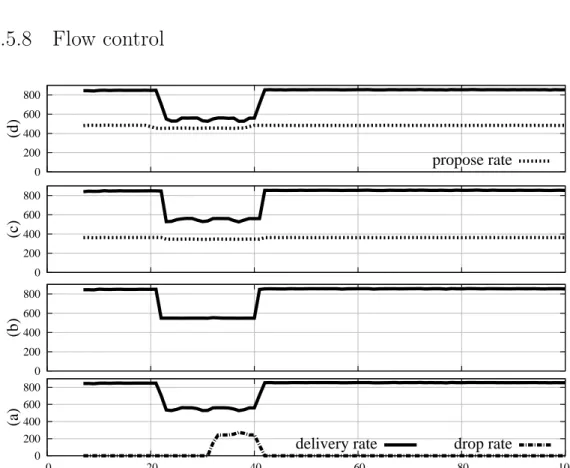
3.3.6 Flow control . . . 28
3.3.7 Garbage collection . . . 29
3.4 Related work . . . 30
3.5 Experimental evaluation . . . 33
3.5.1 Hardware settings . . . 34
3.5.2 Implementation . . . 34
3.5.3 Ring Paxos versus other protocols . . . 35
3.5.4 Impact of processes in the ring . . . 36
3.5.5 Impact of disk writes . . . 38
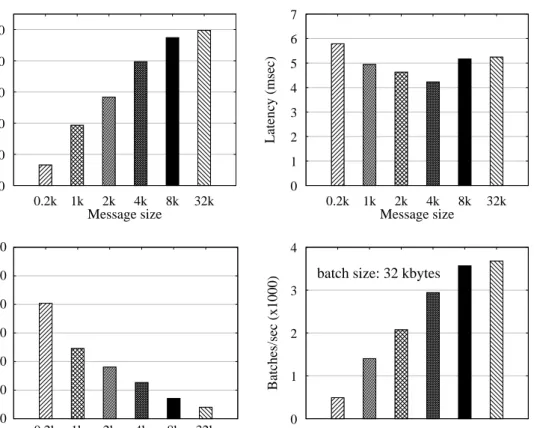
3.5.6 Impact of message size . . . 39
3.5.7 Impact of socket buffer size . . . 41
3.5.8 Flow control . . . 42
3.5.9 CPU and memory usage . . . 43
3.5.10 Conclusions from the experiments . . . 43
3.6 Conclusion . . . 44
4 Speculation and State Partitioning in State-Machine Replication 45 4.1 Problem statement . . . 45
4.1.1 Outline . . . 47
4.2 Overcoming limitations of state-machine replication . . . 47
4.2.1 Speculative execution . . . 48
4.2.2 State partitioning . . . 49
4.3 Related work . . . 52
4.4 Experimental evaluation . . . 53
4.4.1 Hardware settings . . . 54
4.4.2 Implementation and experimental setup . . . 54
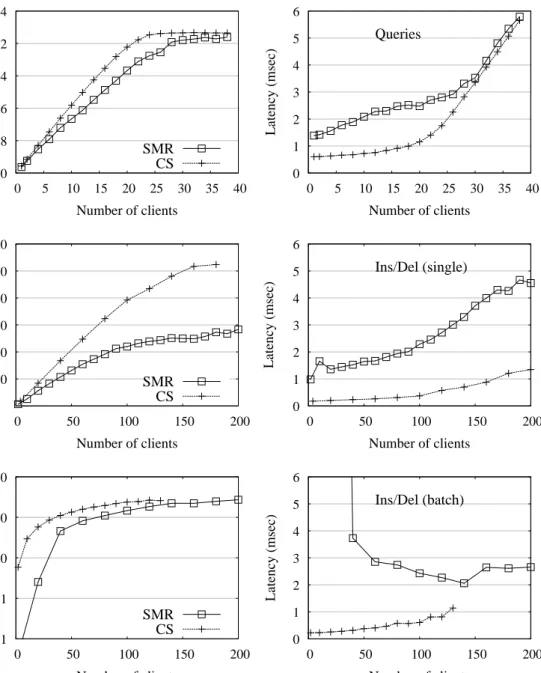
4.4.3 The cost of replication . . . 57
4.4.4 Speculative execution . . . 58
4.4.5 State partitioning . . . 59
4.4.6 Speculation and partitioning . . . 63
4.4.7 Conclusions from the experiments . . . 63
4.5 Conclusion . . . 64 5 Multi-Ring Paxos 65 5.1 Problem statement . . . 65 5.1.1 Outline . . . 68 5.2 Multi-Ring Paxos . . . 68 5.2.1 Overview . . . 68
5.2.2 Multi-Ring Paxos in detail . . . 70
5.2.4 Extensions and optimizations . . . 72
5.2.5 Additional properties of Multi-Ring Paxos . . . 73
5.3 Related work . . . 73
5.4 Experimental evaluation . . . 75
5.4.1 Hardware settings . . . 75
5.4.2 Implementation and experimental setup . . . 76
5.4.3 Scalability of Multi-Ring Paxos . . . 76
5.4.4 Impact of∆on Multi-Ring Paxos . . . 79
5.4.5 Impact of M on Multi-Ring Paxos . . . 80
5.4.6 Impact ofλon Multi-Ring Paxos . . . 80
5.4.7 Impact of discontinued communication . . . 85
5.4.8 Conclusions from the experiments . . . 85
5.5 Conclusion . . . 86
6 Replicating Parallel Applications with State-Machine Replication 87 6.1 Problem statement . . . 87
6.1.1 Outline . . . 88
6.2 A Survey on Parallel State-Machine Replication . . . 88
6.2.1 Non-replicated setup . . . 89
6.2.2 Sequential State-Machine Replication (sequential SMR) . . 89
6.2.3 Pipelined State-Machine Replication (pipelined SMR) . . . 89
6.2.4 Sequential Delivery-Parallel Execution (SDPE) . . . 90
6.2.5 Execute-Verify (EV) . . . 91
6.2.6 Parallel Delivery-Parallel Execution (PDPE) . . . 92
6.2.7 Summary . . . 92
6.3 Parallel State-Machine Replication (P-SMR) . . . 93
6.3.1 Design goals . . . 93
6.3.2 Client and server organization . . . 94
6.3.3 Protocol design . . . 96
6.3.4 P-SMR: algorithm in detail . . . 97
6.4 Related Work . . . 98
6.5 Experimental evaluation . . . 99
6.5.1 Hardware settings . . . 101
6.5.2 Implementation and experimental setup . . . 101
6.5.3 Performance of independent commands . . . 103
6.5.4 Performance of dependent commands . . . 105
6.5.5 Performance of mixed workloads . . . 106
6.5.6 Scalability . . . 107
6.5.8 Conclusions from the experiments . . . 108
6.6 Conclusion . . . 109
7 Experimenting with Paxos in the Cloud 111 7.1 Problem Statement . . . 111
7.1.1 Outline . . . 113
7.2 Open-source Paxos libraries . . . 113
7.2.1 S-Paxos . . . 114 7.2.2 OpenReplica . . . 114 7.2.3 U-Ring Paxos . . . 115 7.2.4 Libpaxos . . . 116 7.2.5 Libpaxos+ . . . 117 7.3 Experimental evaluation . . . 117 7.3.1 Experimental setup . . . 117 7.3.2 Methodology . . . 121 7.3.3 Peak performance . . . 121
7.3.4 S-Paxos under failures . . . 123
7.3.5 OpenReplica under failures . . . 123
7.3.6 U-Ring Paxos under failures . . . 124
7.3.7 Libpaxos and Libpaxos+under failures . . . 125
7.4 Main lessons from the experiments . . . 128
7.5 Conclusion . . . 129
8 Conclusion 131 8.1 Summary of our findings and lessons learnt . . . 132
8.2 Future directions . . . 134
Appendices 137
Proofs of Correctness 139
Figures
1.1 Non-replicated service and state-machine replication . . . 3
2.1 Linearizabiliy vs. sequential consistency. . . 11
3.1 Optimized Paxos. . . 17
3.2 Many-to-one communication . . . 18
3.3 The impact of multiple ip-multicast senders on packet loss. . . 20
3.4 One-to-many communication. . . 21
3.5 M-Ring Paxos. . . 22
3.6 U-Ring Paxos. . . 25
3.7 Ring Paxos versus other atomic broadcast protocols. . . 36
3.8 Impact of processes in the ring on performance. . . 37
3.9 Impact of disk writes on performance. . . 38
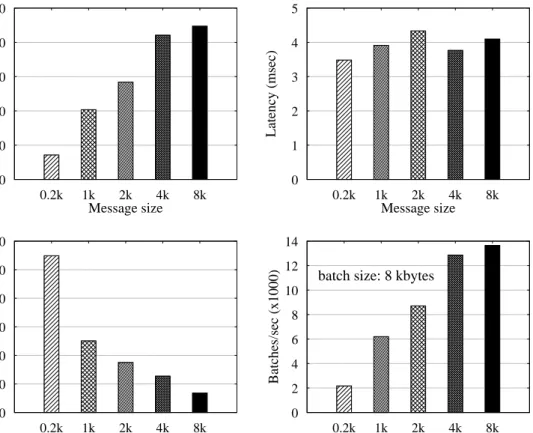
3.10 Impact of message size on the performance of M-Ring Paxos. . . . 39
3.11 Impact of message size on the performance of U-Ring Paxos. . . . 40
3.12 Impact of socket buffer size on the performance of M-Ring Paxos. 41 3.13 Impact of socket buffer size on the performance of U-Ring Paxos. 41 3.14 Flow control in M-Ring Paxos. . . 42
4.1 Non replicated server versus state-machine replication. . . 46
4.2 Full versus partial replication of a B+-tree. . . 50
4.3 The cost of replication-1. . . 56
4.4 The cost of replication-2 . . . 57
4.5 Impact of speculative execution on the performance-1 . . . 58
4.6 Impact of speculative execution on the performance-2 . . . 59
4.7 Impact of state partitioning on the performance (no cross-partition query). . . 60
4.8 Impact of state partitioning on the performance (with cross-partition queries, 2 replicas). . . 61
4.9 Impact of state partitioning on the performance (with cross-partition
queries, 3 replicas). . . 62
4.10 Impact of speculative execution and state partitioning on the per-formance. . . 63
5.1 Performance of In-memory and Recoverable Ring Paxos. . . 66
5.2 Performance of a partitioned service using In-memory Ring Paxos. 66 5.3 Muli-Ring Paxos with two rings andM =1. . . 70
5.4 Scalability of Multi-Ring Paxos (one group per learner). . . 77
5.5 Scalability of Multi-Ring Paxos (multiple groups per learner). . . . 78
5.6 Impact of∆on Multi-Ring Paxos. . . 79
5.7 Impact of M on Multi-Ring Paxos. . . 80
5.8 Impact ofλ(2 rings with constant rates.) . . . 81
5.9 Impact ofλ(2 rings with constant rates, one twice the other) . . . 82
5.10 Impact ofλ(2 rings with variable rates). . . 83
5.11 Impact of failures on Multi-Ring Paxos. . . 84
6.1 Architectures of various approaches to SMR. . . 90
6.2 Execution modes in P-SMR. . . 97
6.3 Performance of P-SMR with independent commands. . . 104
6.4 Performance of P-SMR with dependent commands. . . 105
6.5 Performance of P-SMR with independent and dependent commands.106 6.6 Scalability of P-SMR with uniform workload. . . 107
6.7 Scalability of P-SMR with non-uniform workload. . . 109
7.1 Architectural differences among S-Paxos, OpenReplica, RingPaxos, LibPaxos. . . 119
7.2 Peak performance of S-Paxos, OpenReplica, RingPaxos, LibPaxos. 120 7.3 S-Paxos in heterogeneous configurations. . . 123
7.4 OpenReplica in heterogeneous configurations. . . 124
7.5 U-Ring Paxos in heterogeneous configurations. . . 125
7.6 Libpaxos and Libpaxos+in heterogeneous configurations-1. . . 126
Tables
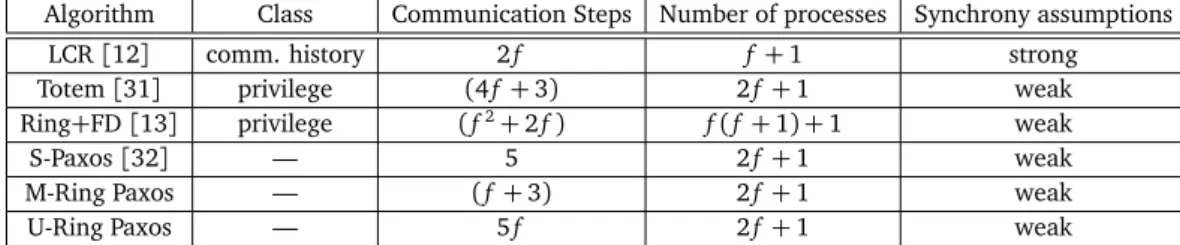
3.1 Comparison of several atomic broadcast algorithms. . . 32
3.2 Efficiency comparison among atomic broadcast protocols. . . 37
3.3 CPU and memory use in M-Ring Paxos. . . 43
3.4 CPU and memory use in U-Ring Paxos. . . 43
6.1 A comparison among approaches to parallelizing SMR. . . 92
7.1 Configurations in which S-Paxos, OpenReplica, RingPaxos, and Libpaxos are evaluated for peak performance. . . 118
7.2 Configurations in which S-Paxos, OpenReplica, RingPaxos, and Libpaxos are evaluated for flow control. . . 121
Chapter 1
Introduction
With the wide availability of commodity hardware, failures in data centers are common and inevitable. Machines fail individually due to hardware issues and software bugs, or collectively due to problems in interconnects and power distri-bution. Storage devices are equally subject to failures, and network performance is often degraded due to malfunctioning switches and damaged links. These types of failures are frequently observed in many data centers, including those from well-established service providers[1]. Given the prevalence of failures and in order to offer uninterrupted service to their clients, services deployed in data centers must look for solutions to reduce their vulnerability to failures.
Replication is a well-known approach to making computer systems fault-tolerant. To enhance fault-tolerance via replication, multiple copies of a service are created and operated on failure-independent machines. Therefore, a repli-cated service is always available to its clients despite the failure of some of its replicas. Since replicas operate independently, their state might diverge due to concurrent and isolated execution of requests. Thus, consistency among replicas is an immediate concern raised by replication. From the consistency perspective, replication strategies can be categorized into two classes: eager (synchronous) and lazy (asynchronous)[2]. In order to ensure that a service’s state is always identical among replicas, in eager replication all the requests are synchronized among replicas before execution. In lazy replication, however, synchronization among the replicas happens in the background, possibly after executing the re-quests and responding to the clients. Therefore, in systems that implement lazy replication, replicas have weaker consistency guarantees. Inconsistency among replicas is undesirable if the clients can not tolerate contradictory responses; it is acceptable if the clients can bear inconsistencies in the interest of rapid
sponses.
A popular eager replication technique that enforces strong consistency among replicas is state-machine replication [3]. State-machine replication is based on the concept of deterministic state machines. A deterministic state machine mod-els a system as a set of states among which transitions happen deterministically by the execution of well-defined operations. State-machine replication builds on this concept where all the replicas of a service independently implement a deterministic state machine: they all start at the same initial state and
sequen-tially apply anorderedset of operations to their states, one operation at a time.
Therefore, state machines on different replicas traverse the same series of states, produce the same sequence of outputs, and look consistent and identical at any given time. Consistency among the replicas of state-machine replication is the key to masking failures: the client of a failed replica can smoothly be directed to another replica without observing meaningless or inconsistent responses. In other words, consistency makes replication transparent and conveys to clients the illusion of a coherent and centralized service.
Ordering the operations and sequentially executing the ordered operations are two crucial properties of state-machine replication for realizing strongly con-sistent systems that are immune to failures. Throughout this dissertation, we argue that these same wanted requirements are also the reasons that restrain the performance of state-machine replication from scaling. First, to order the requests, an agreement layer is often positioned between clients and servers, to which all the requests are directed before being executed on the replicas (see Figure 1.1). This new layer of communication and computation adds extra over-head to the system’s performance and increases the response time experienced by the clients. Therefore, as a result of ordering, a replicated service often loses to a single-copy service in terms of performance. Second, with the addition of replicas, as physically independent machines, there are extra resources in the system (e.g. CPU, memory, IO), but because of the sequential execution of all the requests on all the replicas, the added resources can not be exploited to the advantage of performance.
Our main goal in this dissertation is to focus on the ordering requirement and the sequentiality of execution in state-machine replication and devise efficient solutions toward the realization of high-performance available systems that are implemented by state-machine replication. The main research questions (RQ) of this dissertation are as follows:
Agreement Agreement
(b) state-machine replication
Agreement
Server
(a) non-replicated service
Client
Server Request Response
Client
Figure 1.1. Non-replicated service and state-machine replication
• RQ1. How to efficiently design an agreement layer that does not restrict the performance of a replicated service?
• RQ2. How to overcome the sequentiality of execution in state-machine replication to enhance performance while preserving consistency?
In the next section, we briefly overview our main contributions in addressing these questions.
1.1
Research Contributions
In this section, we outline the main contributions of this dissertation and pro-vide a short description of each one. We defer detailed discussions to the next chapters.
The design of Ring Paxos protocols(RQ1): Ring Paxos is derived from Paxos[4] and is composed of two high-throughput atomic broadcast protocols. The com-mon feature acom-mong both versions of Ring Paxos is the presence of a ring topology at the heart of the protocols. Besides relying on a logical ring overlay, Ring Paxos is based on a series of practical observations that altogether realize its high
per-formance. Ring Paxos minimizes the overhead of ordering so that the agreement layer adds little overhead. Two variants of Ring Paxos were developed:
• Multicast-based Ring Paxos (M-Ring Paxos): This variant of Ring Paxos leverages network level ip-multicast to attain wire-speed throughput. Ip-multicast is an efficient primitive for disseminating messages to a set of re-ceivers. This property, combined with a set of other practical observations, helps M-Ring Paxos achieve high throughput with reasonable latency. • Unicast-based Ring Paxos (U-Ring Paxos): Ip-multicast may not be
avail-able in some environments. Therefore, we have developed U-Ring Paxos, a variant of Ring Paxos in which all communication is based on unicast. Removing ip-multicast, as one of the main communication mechanisms, raised new challenges that resulted in several modifications to the design of the protocol. Although on average it has higher latency, U-Ring Paxos’s throughput is comparable to M-Ring Paxos’s.
Speculative delivery with M-Ring Paxos (RQ1): Ordering in Ring Paxos is ef-ficient and has a reasonably low latency. Yet to investigate the possibility of reducing latency further, we have implemented speculative delivery with M-Ring Paxos. We have modified M-M-Ring Paxos such that requests are delivered to replicas before their order is determined. Speculative delivery assumes that the order in which requests are received at replicas will comply with the or-der decided by M-Ring Paxos. Based on the speculative assumption, replicas execute requests parallel to M-Ring Paxos ordering them. According to our find-ings, speculative delivery proves effective and is able to reduce latency.
State partitioning with M-Ring Paxos(RQ2): In the presence of Ring Paxos as a high-throughput atomic broadcast protocol, the performance bottleneck of a replicated service may shift from the agreement layer to the service side: perfor-mance is limited by the number of requests that replicas can execute rather than the number of requests the agreement layer can order. Partitioning the state of a service is a well-known approach to enhancing the execution of requests on replicas. In a fully replicated service, all the replicas deliver all the requests and execute all of them. Thus one can not expect to gain performance as a result of adding new replicas to the system. To study the effect of partitioning, we modified M-Ring Paxos to combine it with a partitioned service. In the resulting system, M-Ring Paxos totally orders all the requests but uses a set of multicast groups rather than one, to transfer requests to relevant partitions. Our evalua-tions show that partitioning the state and using the modified M-Ring Paxos in
the agreement layer results in significant improvements in performance.
Multi-Ring Paxos (RQ1): Partitioning a service elevates the throughput of re-quest execution on replicas as far as the agreement layer allows. In other words, assuming a service that can be partitioned into a large number of sub-states in which request execution is extremely efficient, the performance bottle-neck once more slides to the agreement layer. We observed this phenomenon with Ring Paxos: state partitioning continues to increase the performance until Ring Paxos reaches its maximum capacity in ordering the requests. When this happens, adding more processes to the agreement layer increases its availability and fault-tolerance without having positive impact on the performance. We de-signed Multi-Ring Paxos as an ensemble of isolated but coordinated Ring Paxos instances to address the scalability issue of Ring Paxos. Multi-Ring Paxos imple-ments atomic multicast by relying on a set of pre-defined parameters to coor-dinate independent instances of Ring Paxos. Performance of Multi-Ring Paxos scales linearly as new resources and machines are added to the system.
Parallel state-machine replication (P-SMR) (RQ2): Sequential execution of requests on replicas, with both partial and full replication, is a source of per-formance bottleneck in state-machine replication. The development of multi-threaded services on the one hand and the sequentiality of replicas at processing requests on the other hand make the union of parallel applications with state-machine replication harder. We have built parallel state-state-machine replication (P-SMR) on top of Multi-Ring Paxos as an attempt to adapt state-machine repli-cation to multicore environments, increase its performance, and bridge the gap between state-machine replication and multi-threaded services. Compared to other parallelized replication strategies, P-SMR achieves a significantly higher performance.
Evaluating Paxos in the Cloud: The last contribution of this dissertation is de-voted to comparing the performance of Ring Paxos to other Paxos implementa-tions when deployed in the cloud. We evaluated four open source Paxos libraries on Amazon EC2 under various configurations to closely analyze the performance and behavior of these libraries with and without failures. Our experiments re-veal the differences among the policies open source implementations use to cope with failures. We propose some improvements and demonstrate their effective-ness with experiments.
1.2
Structure of the Dissertation
The rest of this dissertation is structured as follows. In Chapter 2, we present our system model and definitions that are frequently used in the rest of the text. In Chapter 3 we present the Ring Paxos protocols and discuss their de-sign and properties in detail. In Chapter 4 we study speculative delivery and state partitioning and discuss their performance advantages when combined with Ring Paxos. In Chapter 5 we discuss scalability issues of Ring Paxos and introduce Multi-Ring Paxos to address them. In Chapter 6 we question the se-quentiality of execution in state-machine replication and propose P-SMR, a new parallel execution model, to parallelize execution. In Chapter 7 we evaluate sev-eral open source implementations of Paxos in Amazon EC2 and compare their policies in handling failures. Finally, in Chapter 8, we conclude the dissertation by outlining our main findings and presenting directions for future research.
Chapter 2
System Model and Definitions
In this chapter, we present our assumptions about the system model and review the definitions of several concepts that are repeatedly referred to in the rest of this text.
2.1
System model
Unless mentioned otherwise, we make the following assumptions about pro-cesses, failure and synchrony models.
• Processes and communication. We assume a distributed system
com-posed of a setΠ ={p1,p2, ...}of interconnected processes. If required we differentiate between processes as C = {c1,c2, ...}, an unbounded set of client processes, andS ={s1,s2, ...,sn}, a bounded set of server processes (replicas). We also assume the nodes (machines) on which processes are located are in a local-area network. The network is mostly reliable and subject to small latencies. Communication among processes happens through message passing. Communication can be one-to-one through the primitivessend(p,m) and receive(m), and one-to-many through the prim-itives ip-multicast(g,m) and ip-deliver(m), where m is a message, p is a process, and g is a group of processes to whichm is addressed. Messages can be lost but not corrupted. Therefore, if a process psends a messagem
to another process q, andq is non-faulty, q eventually receives mas long as p retries sending m. Moreover, nodes have access to stable storage if required.
• Failure model. We assume the crash recovery model, in which nodes can fail by crashing and recover later, but no byzantine or malicious behavior is tolerated.
• Synchrony model. Our protocols ensure safety under both asynchronous and synchronous execution periods. The FLP impossibility result[5]states that under asynchronous assumptions consensus cannot be both safe and live may a process crash. For our consensus algorithms, we thus assume that the system is partially synchronous, which means that it is initially asynchronous and eventually becomes synchronous. The time when the system becomes synchronous is called the Global Stabilization Time (GST)
[6]and is unknown to the processes. Before GST, there are no bounds on the time it takes for messages to be transmitted and actions to be executed. After GST, such bounds exist but are unknown. Moreover, in order to prove liveness, we assume that after GST all remaining processes are correct; a process that is not correct is faulty. A correct process is operational “forever” and can reliably exchange messages with other correct processes. In practice, “forever” means long enough for consensus to terminate.
2.2
Definitions
In this section, we define several concepts that constitute the building blocks of this work.
2.2.1
State-machine replication
Replication is a fundamental approach to building fault-tolerant distributed sys-tems [3; 7]. One approach to replication is state-machine replication that is based on the concept of deterministic state machines. The idea is to model a system as a set of states among which transitions happen deterministically by the execution of commands. Consequently, in state-machine replication all the replicas of a service implement a state machine. Thus, all of the replicas are initialized with the same initial state and by applying the same set of commands in an identical order traverse the same sequence of states and always remain consistent [3].
2.2.2
Consensus
Consensus is a problem in which one or more processes cooperate to select a value which is proposed by one or more participants. Uniform consensus is defined by the primitivespropose(v)anddecide(v), wherevis an arbitrary value. Uniform consensus satisfies the following properties:
I. Uniform integrity: if a process decidesvthen some process proposedv.
II. Uniform agreement: no two processes decide different values.
III. Termination: if one or more correct processes propose a value then
eventu-ally some value is decided by all correct processes.
2.2.3
Atomic broadcast
Atomic broadcast, also referred to as total order broadcast, is defined in terms of two primitives: broadcast(m)anddeliver(m)(wheremis a message) and should satisfy the following properties:
I. Validity: if a correct process broadcasts a message m, then all correct
pro-cesses eventuallydeliver m.
II. Uniform integrity:for any messagem, every processdeliversmat most once
and only ifmwas previouslybroadcastby some process.
III. Uniform agreement: if a process deliversm then all correct processes
even-tuallydeliver m.
IV. Uniform total order: if processes p and q both deliver messages m and m0,
thenp deliversmbeforem0, if and only ifq deliversmbeforem0.
Atomic broadcast can be implemented as a sequence of consensus instances[8].
2.2.4
Atomic multicast
Atomic multicast is a generalization of atomic broadcast and implements the abstraction of groups Γ ={g1, ...,gγ}, where for each g ∈Γ, g ⊆Π. Processes may belong to one or more groups. If process p ∈ g, we say that p subscribes
to group g. Atomic multicast is defined by the primitives multicast(g,m) and
I. Validity: if a correct process multicasts a message m to g, then all correct processes in g will eventuallydeliver m.
II. Uniform integrity: for any message m, every process p in g delivers m at
most once and only ifmwas previouslymulticastby some process.
III. Uniform agreement: if a process delivers m, then all correct processes in g
deliver m.
IV. Uniform partial order: if processespandqbothdelivermessagesmandm0,
thenp deliversmbeforem0, if and only ifq deliversmbeforem0.
IfΓis a singleton, then atomic multicast is equivalent to atomic broadcast.
2.2.5
Consistency
An object that can be concurrently accessed by many processes is called a con-current object[9]. Interleaving accesses to the same object can sometimes lead to unexpected behaviors. The effect of this issue can be captured by defining a consistency criterion over the shared object, which specifies the level in which operations can interleave in accessing the object. In the following we explain linearizability and sequential consistency as two types of consistency that we are interested in.
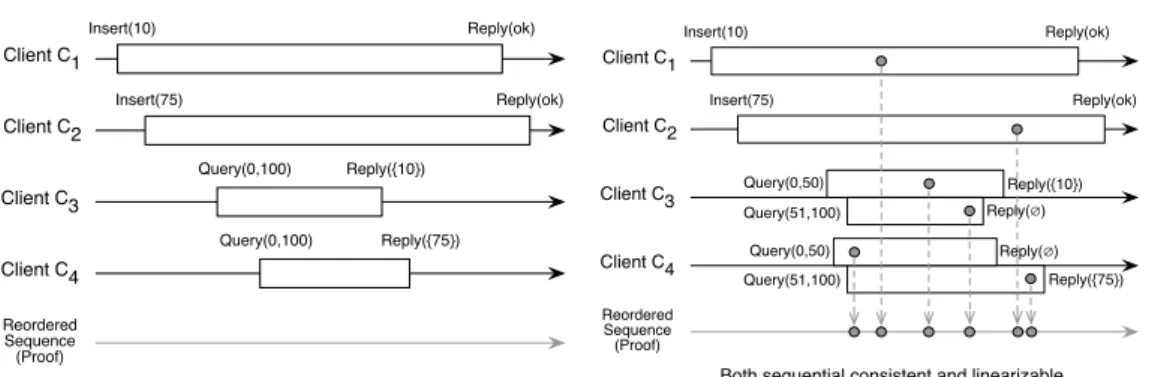
• Linearizability. A sequence of operations is linearizable if there is a way to reorder the operations in the sequence such that (a) they respect the semantics of the objects as expressed in their sequential specifications, and (b) they respect the real-time ordering of events among all the nodes. For example, if the response of operation o1 occurs in the sequence before
the invocationof operation o2 then in the reordering of the operations o1
appears beforeo2.
• Sequential Consistency. A sequence of operations is sequentially consis-tent if there is a way to reorder them such that (a) they respect the seman-tics of the objects as expressed in their sequential specifications, and (b) if
the response of operationo1 at node pi occurs in the sequence before the
invocation of operation o2 at node pi then in the reordering of the
oper-ations o1 appears before o2. Basically sequential consistency is a weaker form of linearizability.
(a) Sequential consistent but not linearizable Read(x) Reply(10) Write(x,20) Reply(ok) Client C1 Client C2 Read(x) Reply(20) time Read(x) Reply(10) Write(x,20) Reply(ok) Client C1 Client C2 Read(x) Reply(20)
(b) Sequential consistent and linearizable Reordered
Sequence
Figure 2.1. Linearizabiliy vs. sequential consistency.
Figure 2.1 illustrates sequential consistency versus linearizability for a shared object x. The sequence shown in (a) is not linearizable since any reordering of the operations that satisfies the specifications of linearizability violates the real-time ordering of the operations. Since theresponsefor Write(x, 20) occurs before
theinvocationof Read(x), clientC1 should read 20 instead of 10. However, this
is not the case based on the results. On the other hand, the sequence shown in (b) is linearizable and thus sequentially consistent. This is because the
re-sponse of Write(x) occurs after the invocation of Read(x). And thus these two
operations can be reordered with respect to each other such that linearizabil-ity is ensured without violation of real-time ordering. Both linearizabillinearizabil-ity and sequential consistency are considered strong consistency conditions.
Chapter 3
Ring Paxos
Atomic broadcast is a communication primitive often present at the core of state-machine replication. Because of the canonical role atomic broadcast pro-tocols play in the design of the systems replicated by state-machine approach, their efficiency directly affects the performance of the replicated services. Paxos is a well-known consensus protocol upon which an atomic broadcast protocol can be built. In this chapter we devise Ring Paxos, a new high-performance atomic broadcast protocol that is optimized for local-area networks and inher-its the reliabilities of Paxos. The techniques used in the design of Ring Paxos are chosen to maximize its efficiency. Our evaluations at the end of this chapter demonstrate significant performance gains obtained by Ring Paxos.
3.1
Problem statement
Atomic broadcast is a dominant primitive for implementing the agreement layer of the state-machine replication approach. Agreement is a key component of state-machine replication at preserving consistency among the replicas and is responsible for ordering client requests before they can be executed on the repli-cas. The agreement layer, however, imposes additional performance overhead on a replicated system compared to a stand-alone deployment, the price that must be paid to gain availability and fault tolerance. Therefore, the efficiency of the agreement layer directly affects the performance of replicated services and effort must be put into the design of efficient atomic broadcast protocols. The rich literature of atomic broadcast protocols indicates the considerable amount of effort invested in designing various atomic broadcast protocols with different
properties[53].1 However, building efficient systems out of these algorithms is only seen in a few papers[10].
We define the efficiency of an atomic broadcast protocol to be the rate be-tween its maximum achieved throughput per receiver and the nominal trans-mission capacity of the system per receiver. For example, a protocol that allows a receiver to deliver up to 500 Mbps of application data in a system equipped with a gigabit network has efficiency 0.5 or 50%. A protocol is efficient if it has high efficiency (>90%), ideally independent of the number of receivers. How-ever, due to inherent limitations of an algorithm, implementation details, and various overheads (e.g., added by the network layers), typical atomic broadcast protocols are not ideal according to this metric.
In this chapter, we focus on a class of atomic broadcast protocols that are based on Paxos [4]. Paxos is a consensus algorithm upon which an atomic broadcast protocol can be built. Paxos has several important properties that make it popular among system practitioners. For example it is (a) safe under asynchrony assumptions, (b) live under weak synchrony assumptions, and (c) resiliency-optimal (i.e., it requires only a majority of non-faulty processes to en-sure progress). This chapter is devoted to the design and implementation of new and highly efficient Paxos-based atomic broadcast protocols to reduce the negative implications of the agreement layer on the performance of a replicated service.
3.1.1
Outline
The rest of this chapter is organized as follows. In Section 3.2 we review the basic form of the Paxos protocol and then present Ring Paxos in Section 3.3. We first motivate the design principles of Ring Paxos and then present in de-tail its two variations: M-Ring Paxos and U-Ring Paxos. In Section 3.4 we dis-cuss related work and compare the performance of several other protocols with Ring Paxos. In Section 3.5 we experimentally evaluate Ring Paxos and discuss the main findings of our experiments. Finally in Section 3.6 we conclude the chapter.
3.2
Basic Paxos
Paxos is a well-known fault-tolerant consensus algorithm [4] that is used for implementing state-machine replication. There are three distinguished roles in
Paxos: proposers, acceptors, and learners. A process can execute multiple roles simultaneously. Proposers propose a value, acceptors choose a value, and learn-ers learn the decided value. Hereafter,Nadenotes the set of acceptors,Nl the set of learners, andQa a majority quorum of acceptors (m-quorum), that is, a subset ofNa of sized(|Na|+1)/2e.
The execution of one consensus instance spans a sequence of rounds that are uniquely identified by a round number which is a positive integer. For each round, one process plays the role of the coordinatorof the round. To pro-pose, proposers send their value to the coordinator.2 The coordinator maintains two variables: (a) c-rnd: the highest-numbered round that the coordinator has started, and (b)c-val: the value that the coordinator has picked for roundc-rnd. The first is initialized to 0 and the second to null.
Acceptors maintain three variables: (a)rnd is the highest-numbered round in which the acceptor has participated, initially 0, (b) v-rnd is the highest-numbered round in which the acceptor has cast a vote, initially 0; thus v-rnd≤
rndalways holds, and (c)v-valis the value voted by the acceptor in roundv-rnd
and is initially null.
Paxos, presented in Algorithm 1, has two phases. To execute Phase 1, the co-ordinator selects a unique round number c-rnd greater than any round number it has used so far, and sends it to the acceptors (Task 1, Phase 1A). Upon re-ceiving this message (Task 2, Phase 1B), an acceptor checks whether the round proposed by the coordinator is greater than any round it has received so far; if so, the acceptor promises not to accept any future Phase 1A messages with a round smaller than c-rnd. The acceptor then replies to the coordinator with the highest-numbered round in which it has cast a vote, if any, and the value it has voted for in that round. Notice that the coordinator does not send any proposal in Phase 1. The coordinator starts Phase 2 after receiving a reply from a m-quorum (Task 3). Before proposing a value in Phase 2A, the coordinator checks to see if some acceptor has already cast a vote in a previous round. If an acceptor has voted for a value in a previous round, then the coordinator will propose this value (this task guarantees that only one value can be chosen in an instance of consensus); otherwise, if no acceptor has cast a vote in a previous round, then the coordinator can propose any value that is received from the proposers. In some cases it may happen that more than one acceptor have cast a vote in a previous round. In this case, the coordinator chooses the value that was voted for in the highest-numbered round. From the algorithm, two acceptors cannot 2Selection of the coordinator is not essential for preserving the safety of Paxos, and proposers
can directly send their proposals to the acceptors. However, selecting a coordinator, enhances the liveness of the protocol.
1: Algorithm 1: Paxos(for processp)
2: Task 1 (coordinator)
3: uponreceiving value vfrom proposer P(v)
4: increasec-rndto an arbitrary unique value
5: for allq∈Nadosend (q, (PHASE1A,c-rnd))
6: Task 2 (acceptor)
7: uponreceiving (PHASE1A,c-rnd) from coordinator
8: ifc-rnd>rndthen
9: letrndbec-rnd
10: send (coordinator, (PHASE1B,rnd,v-rnd,v-val))
11: Task 3 (coordinator)
12: uponreceiving (PHASE1B,rnd,v-rnd,v-val) fromQasuch thatc-rnd=rnd
13: letkbe the largestv-rndvalue received
14: letV be the set of (v-rnd,v-val) received withv-rnd=k
15: ifk=0thenletc-valbev
16: elseletc-valbe the onlyv-valinV
17: for allq∈Nadosend (q, (PHASE2A,c-rnd,c-val))
18: Task 4 (acceptor)
19: uponreceiving (PHASE2A,c-rnd,c-val) from coordinator
20: ifc-rnd≥rndthen
21: letrndbec-rnd
22: letv-rndbec-rnd
23: letv-valbec-val
24: send (coordinator, (PHASE2B,v-rnd,v-val))
25: Task 5 (coordinator)
26: uponreceiving (PHASE2B,v-rnd,v-val) fromQasuch thatc-rnd=v-rnd
cast votes for different values in the same round. Proposer Coordinator Acceptor n . . . Acceptor 1 Acceptor 2 Learners v Phase 2A Phase 2B Phase 2B . . . (up to n-1)
Figure 3.1. Optimized Paxos.
An acceptor will vote for a value c-val with corresponding round c-rnd in Phase 2 if the acceptor has not received any Phase 1 message for a higher round (Task 4, Phase 2B). Voting for a value means setting the acceptor’s variablesv-rnd
andv-valto the values sent by the coordinator. If the acceptor votes for the value received, it replies to the coordinator. When the coordinator receives replies from an m-quorum (Task 5), it knows that a value has been decided and informs the learners about the decision. In order to know whether its value has been decided, a proposer is typically also a learner. If a proposer does not learn its proposed value after a certain time (e.g., because its message to the coordinator was lost), it proposes the value again. As long as a nonfaulty coordinator is eventually selected, there is a majority quorum of nonfaulty acceptors, and at least one nonfaulty proposer, every consensus instance will eventually decide on a value.
Paxos can be optimized in a number of ways [4]. For example, the coordi-nator can execute Phase 1 before a value is received from a proposer. In doing so, once the coordinator receives a value from a proposer, consensus can be reached in four communication steps, as opposed to six. Moreover, if acceptors send Phase 2B messages directly to the learners, the number of communication steps for a decision is further reduced to three (see Figure 3.1).
3.3
Ring Paxos
Ring Paxos is designed around two main ideas: (a) the separation of message ordering from payload propagation, and (b) the usage of efficient means for
performing these two tasks. We have developed two variants of Ring Paxos as M-Ring Paxos and U-Ring Paxos. Before presenting them in detail, in the following section we discuss a set of experiments and consequent findings that have played an important role in shaping these protocols.
0 200 400 600 800 1000 0 5 10 15 20 25 Th roug h
put per rece
iver (Mb ps ) Number of receivers 0 20 40 60 80 100 0 5 10 15 20 25
CPU (%) per sender
Number of receivers unicast multicast pipeline
Figure 3.2. Performance comparison of unicast, multicast, and pipeline for implementing one-to-many communication pattern; the coordinator of Paxos uses this type of communication in Phase 1A and Phase 2A to communicate with a set of processes; the left graph shows the throughput per receiver and the right graph shows the CPU usage at the sender; packet size in this experiment is 8 Kbytes.
3.3.1
Motivation and design considerations
Due to the importance of communication efficiency in a message-passing sys-tem we have performed a set of experiments to evaluate and compare several communication patterns. Based on the specifications of Paxos, we are mostly in-terested in one-to-many and many-to-one communications. In the former, a sin-gle process (sender) transmits a message to a set of other processes (receivers), and in the latter, a set of processes (senders) transmit messages to one process (receiver). In this section we discuss our findings about these communication patterns and highlight their influence in the design of Ring Paxos protocols.3
(A) One-to-many communication. In the following, we compare the perfor-mance of three strategies that implement one-to-many communication: (1) net-work level ip-multicast (multicast), (2) a set of direct unicast links from the
sender to the receivers (unicast), and (3) a uni-directional set of links pipelined among the processes (pipeline).
multicast vs. unicast. Network level ip-multicast enables high-throughput
propagation of messages to the nodes of a cluster[11]and has two advantages over unicast. First, independent of the number of receivers only one system call at the sender is sufficient to transmit a message to all the receivers. This is possible because ip-multicast delegates the task of propagating a message to the ethernet switch. In unicast however, the number of system calls at the sender increases linearly with the number of receivers. Second, unlike the multicast sender, the outgoing bandwidth of the unicast sender should be divided among the receivers.
pipeline vs. unicast. A throughput-efficient alternative to multicast is to have
nodes communicate in a pipelined pattern. In contrast to unicast where one node sends a message multiple times (equal to the number of receivers), in pipeline each node sends the message once to its successor. Pipeline enables a more balanced usage of CPU and bandwidth resources of the nodes[12].
Applicability to Paxos. It is in Phase 1A and Phase 2A of Paxos that one-to-many communication is needed. Optimizing communication in Phase 2 is more important than in Phase 1 as Phase 1 can be pre-executed for a range of instances and is not frequent. Thus, to efficiently propagate values to other processes in Phase 2A we will use multicast and pipeline in M-Ring Paxos and U-Ring Paxos respectively.
Experimental results. As it is seen in the left-most graph of Figure 3.2 as the number of receivers increases the throughput of each receiver decreases with unicast but remains constant with multicast and pipeline. The perfor-mance advantages of multicast and pipeline do not come at the expense of increased CPU utilization as the CPU of the three strategies compare similarly (right-most graph).
Packet loss. Losing packets in a message passing system invokes retransmis-sions and demands additional CPU and network consumption. Preventing packet loss is a challenging task, but some simple techniques can reduce its possibility. For example, the sending rate at a process can be controlled to prevent it from exceeding network capacity. This prevents message loss at the sender side. If the receiver at the other side of the communication is not fast enough to remove the received packets from its socket buffers, new messages will be dropped. To address this issue, socket buffer sizes can be configured properly. In some deployments the number of senders
maybe unknown and relying only on these strategies is not sufficient to address packet loss. We will discuss this issue further in Section 3.3.6.
0 5 10 15 20 0 200 400 600 800 1000 Lost packets (%)
Aggregated sending rate (Mbps) 1 sender
2 senders 5 senders
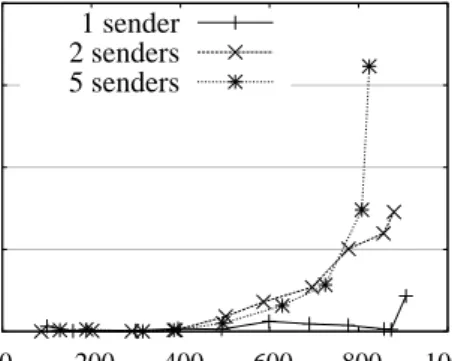
Figure 3.3. The impact of multiple ip-multicast senders on packet loss; 14 receivers are used in this experiment.
We have performed an experiment with several ip-multicast senders and measured the amount of packet loss (see Figure 3.3). As it is seen in the graph by increasing the number of senders, the rate at which packet loss starts happening reduces. The aggregate sending rate in these experiments was controlled not to exceed the capacity of the network.
(B) Many-to-one communication. In the following, we compare the perfor-mance of two strategies that implement many-to-one communication: (1) a set of direct unicast links from the senders to the receiver (unicast), and (2) a uni-directional set of links pipelined among the processes (pipeline).
pipeline vs. unicast. Pipeline has two advantages over unicast. First, it
en-ables extensive use of batching. Each process on the line appends its own mes-sage to the one received from its predecessor and forwards it to its successor. Batching is advantageous to the receiver, as the receiver receives only one packet that contains many small messages in contrast to many small messages that are received in unicast. This reduces CPU usage at the receiver. Second, it balances the usage of the incoming and outgoing links of all the nodes. In unicast, senders only use their outgoing bandwidth.
Applicability to Paxos. It is in Phase 1B and Phase 2B of Paxos that many-to-one communication is needed. Both M-Ring Paxos and U-Ring Paxos pro-tocols pipeline acceptors to propagate votes to the coordinator. For exam-ple, upon receiving a Phase 2A message, the first acceptor at the head of
0 200 400 600 800 1000 0.5 1 2 4 8 Throughput (Mbps) at coord. Packet size (KB) 0 20 40 60 80 100 0.5 1 2 4 8 CPU (%) at acceptor Packet size (KB) 0 20k 40k 60k 80K 100K 0.5 1 2 4 8
Throughput (inst/s) at coord.
Packet size (KB) pipeline unicast 0 20 40 60 80 100 0.5 1 2 4 8 CPU (%) at coord. Packet size (KB)
Figure 3.4. Performance comparison of pipeline and unicast for implementing many-to-one communication pattern; acceptors of Paxos protocol use this type of communication in Phase 1B and Phase 2B to propagate their votes to the coordinator; in all the experiments we have deployed four acceptors and one coordinator while varying the size of the packets; top left graph shows the receiving throughput from only one of the incoming links at the coordinator (which are in total one and four for pipeline and unicast respectively); bottom left graph shows the corresponding number of instances decided at the coordi-nator; the graphs on the right show the CPU usage at the acceptors (top) and the coordinator (bottom); for pipeline, CPU is shown for an acceptor at the middle of the path.
the pipeline builds a Phase 2B message and forwards it to its successor. Forwarding continues until the message reaches the coordinator.
Proposer Coordinator Acceptor n Acceptor 1 Acceptor 2 Learners . . . Proposers Coord/Acceptor n Acceptor 1 Learners Acceptor 2 ➀ ➁⧸➃ ➂ v (a) (b) Phase 2A Phase 2B Decision Phase 2B ip-multicast unicast ➀ ➁ ➂ ➃ . . . (up to n-1) ➂
Figure 3.5. M-Ring Paxos.
Experimental results. We compare the efficiency of pipeline and unicast with respect to different message sizes with five acceptors, where one of them plays the role of the coordinator. With respect to throughput, pipeline is preferable to unicast. For small messages, this happens because pipeline is less CPU-intensive at the coordinator. For large messages, the advantage stems from a balanced use of the incoming and outgoing bandwidth of the nodes. Pipeline is more CPU-intensive at the acceptors as each acceptor (except the first one) receives and forwards a Phase 2B message, whereas the coordinator only receives Phase 2B messages.4
3.3.2
Multicast-based Ring Paxos (M-Ring Paxos)
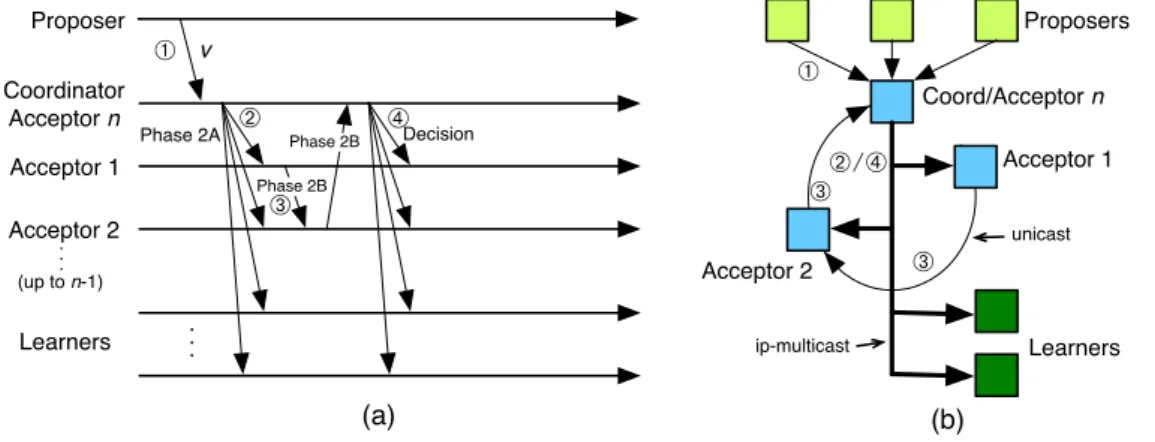
In this section we present the Ring Paxos algorithm that is based on multicast communication (M-Ring Paxos hereafter). This protocol is outlined in Algo-rithm 2. Statements in gray are the same for Paxos and M-Ring Paxos. Similarly to Paxos, the protocol is executed in two phases and the mechanism to ensure that only one value can be decided in an instance of consensus is the same as in Paxos. Differently from Paxos, M-Ring Paxos disseminates a majority quorum of acceptors (m-quorum) in a logical and directed ring (see Figure 3.5(a)(b)). The coordinator is the last process on the ring and it also plays the role of acceptor. 4As we will show later, acceptors are not the most CPU-intensive nodes when the rest of the
From Section 3.3.1 we know that placing acceptors in a ring reduces the num-ber of incoming messages at the coordinator and balances the communication among the acceptors. Before the coordinator starts Phase 1, it proposes the ring on which acceptors will be located. By replying to the coordinator, the acceptors acknowledge that they abide by the proposed ring. Since Phase 1 can be exe-cuted before values are proposed, there is little gain in optimizing the sending of Phase 1B messages. Thus, we use the ring only to propagate Phase 2B messages. In addition to checking what value can be proposed in Phase 2 (Task 3), the coordinator also creates a unique identifier for the value to be proposed. Ring Paxos executes consensus on value ids[13; 14]; proposed values in Phase 2A messages are disseminated to the m-quorum and to the learners using ip-multicast.
Upon ip-delivering a Phase 2A message (Task 4), an acceptor checks that it can vote for the proposed value. If so, it updates its v-rnd and v-val variables as in Paxos, and its v-vid variable in addition to them. Variable v-vid contains the unique identifier of the proposed value which is initialized with null. The first acceptor in the ring sends a Phase 2B message to its successor in the ring. Learners also ip-deliver the proposed value but they do not learn it since it has not been accepted yet.
The next acceptor in the ring to receive a Phase 2B message (Task 5) checks whether it has ip-delivered the value proposed by the coordinator in a Phase 2A message. The acceptor can only vote if it has received the value and not only its unique identifier. The check is done by comparing the acceptor’s v-vid variable to the value’s identifier chosen by the coordinator. This is to ensure that when consensus is reached, a majority of acceptors knows the chosen value and this value can be retrieved by learners at any time. If the condition holds (i.e., the corresponding value is ip-delivered) then there are two possibilities: either the acceptor is not the coordinator (i.e., the last process in the ring), in which case it sends a Phase 2B message to its successor, or it is the coordinator and then it ip-multicasts a decision message including the identifier of the chosen value. Once a learner ip-delivers this message, it can learn the value received previously from the coordinator through a Phase 2A message.
Ring Paxos can use a number of optimizations, most of which have been described previously in the literature. For example, when a new coordinator is elected it executes Phase 1 for several consensus instances [4]. Another opti-mization is to execute Phase 2 for a batch of proposed values rather than for a single value (e.g., [10; 15]). In addition, multiple consensus instances can be started simultaneously without the previous ones being finished [4].
Placing a majority of acceptors in the ring, as opposed to placing all of them, reduces the number of communication steps to reach a decision. The remaining
1: Algorithm 2: M-Ring Paxos(for processp)
2: Task 1 (coordinator)
3: uponreceiving value vfrom proposer 4: increasec-rndto an arbitrary unique value 5: for allq∈Qadosend (q, (PHASE1A,c-rnd))
6: Task 2 (acceptor)
7: uponreceiving (PHASE1A,c-rnd) from coordinator
8: ifc-rnd>rndthen 9: letrndbec-rnd
10: send (coordinator, (PHASE1B,rnd,v-rnd,v-val))
11: Task 3 (coordinator)
12: uponreceiving (PHASE1B,rnd,v-rnd,v-val) fromQasuch thatrnd=c-rnd
13: letkbe the largestv-rndvalue received
14: letV be the set of (v-rnd,v-val) received withv-rnd=k
15: ifk=0thenletc-valbev
16: elseletc-valbe the onlyv-valinV
17: letc-vidbe a unique identifier forc-val
18: ip-multicast (Qa∪Nl, (PHASE2A,c-rnd,c-val,c-vid))
19: Task 4 (acceptor)
20: uponip-delivering (PHASE2A,c-rnd,c-val,c-vid)
21: ifc-rnd≥rndthen
22: letrndbec-rnd
23: letv-rndbec-rnd
24: letv-valbec-val
25: letv-vidbec-vid
26: ifp= f i rst(r ing)then
27: send (successor(p,r ing), (PHASE2B,c-rnd,c-vid))
28: Task 5 (coordinator and acceptors)
29: uponreceiving (PHASE2B,c-rnd,c-vid)
30: ifv-vid=c-vidthen
31: ifp6=l ast(r ing)then
32: send (successor(p,r ing), (PHASE2B,c-rnd,c-vid))
33: else
34: ip-multicast (Qa∪Nl, (DECISION,c-vid))
Note: f i rst(r ing): process that succeeds the coordinator in
r ing
l ast(r ing): the coordinator process inr ing
acceptors are spares, used only when an acceptor in the ring fails.5 Finally, although ip-multicast is used by the coordinator in Tasks 3 and 5, this can be implemented more efficiently by overlapping consecutive consensus instances, such that the message sent by Task 5 of consensus instance i is ip-multicast together with the message sent by Task 3 of consensus instancei+1.
. . . (a) v ➀ Phase 2A,2B Decision Decision Decision Phase 2A,2B Decision,v Decision,v Proposers Coord/Acceptor 1 Acceptor 2 Acceptor 3 (b) Learners unicast ➁ ➃ ➅ Proposer Coordinator Acceptor 1 Acceptor 2 Acceptor 3 Learners . . . (up to n) ➀⧸➆ ➁⧸➇ ➂ ➃ ➄ ➅ ➂ ➄ ➆ ➇
Figure 3.6. U-Ring Paxos.
3.3.3
Unicast-based Ring Paxos (U-Ring Paxos)
In some data centers network-level ip-multicasting may not be available. In this section we present a variant of Ring Paxos algorithm (U-Ring Paxos) that is entirely based on unicast communication. In Algorithm 3 statements in gray are the same for M-Ring Paxos and U-Ring Paxos. Similarly to Paxos, the protocol is executed in two phases and the mechanism to ensure that only one value can be decided in an instance of consensus is the same as in Paxos.
In addition to a m-quorum of acceptors, U-Ring Paxos also places proposers and learners in a logical directed ring (see Figure 3.6). Recalling from Sec-tion 3.3.1 pipelining all the processes in a ring is an alternative to multicast that can reach high throughput, a fact that was proved in[12]. Processes in the ring can assume multiple roles and there is no restriction on the relative position of these processes in the ring. However, for simplicity of discussion, hereafter it is assumed that acceptors are lined up one after the other in the ring (see Figure 3.6(b)). To reduce latency, the coordinator is the first acceptor in the ring.
5This idea is conceptually similar to Cheap Paxos[14], although Cheap Paxos uses a reduced
Once a proposer proposes a value, it is forwarded along the ring until it reaches the coordinator, which will execute Phase 1 as in Paxos. When the coordinator receives Phase 1B messages from an m-quorum (Task 3), it will check which value can be proposed and assigns a unique identifier to the value to be proposed as in M-Ring Paxos. The coordinator then sends Phase 2A and Phase 2B messages to its successor in the ring (Task 3). Similarly to Paxos and M-Ring Paxos, the coordinator in U-M-Ring Paxos can execute Phase 1 before a value is proposed, reducing the latency of the protocol. Upon receiving a Phase 2A/2B message (Task 4), an acceptor checks that it can vote for the proposed value. If so, it updates itsv-rnd,v-val, andv-vidvariables. If the acceptor does not precede the last acceptor in the ring, it sends the Phase 2A/2B message to its successor. Differently from M-Ring Paxos where the coordinator checks whether a decision has been made in the instance, in U-Ring Paxos this task is delegated to the last acceptor in the ring. After deciding, the last acceptor sends the decision, possibly together with the value chosen, to its successor in the ring.
Forwarding the chosen-value ends at the predecessor of the process that has proposed the chosen value as at this point the value has been received by all the processes in the ring. The decision, i.e., the chosen-value identifier, should be forwarded along the ring until it reaches the predecessor of the last acceptor (Task 5).
3.3.4
Handling message loss
Because of unreliable communication mechanisms in M-Ring Paxos, message losses are unavoidable. In general, lost messages are handled with retransmis-sions. Because of message loss, three cases may happen with the learners: (a) they receive the proposed value but not the notification that it was accepted, (b) they do not receive the proposed value but receive the notification of its accep-tance, or (c) they receive neither the value nor the acceptance notification. In all the cases, the learners can recover lost messages by inquiring other processes. M-Ring Paxos assigns each learner to a preferential acceptor in the ring, which the learner can contact to retrieve the lost messages. Apart from that in both M-Ring Paxos and U-Ring Paxos learners may not have sufficient time to han-dle the decisions, and this may cause learners to drop some decisions. In fact, both versions of Ring Paxos need flow control to mitigate this phenomenon. We discuss flow control in Section 3.3.6.
If the coordinator does not receive a response to its Phase 1A/2A messages, it re-sends them, possibly with a bigger round number. Eventually the coordina-tor will receive a response or will suspect the failure of a process (this suspicion