Combining Thread Level Speculation, Helper Threads, and
Runahead Execution
∗Polychronis Xekalakis
†, Nikolas Ioannou, and Marcelo Cintra
School of Informatics University of Edinburgh
[email protected], [email protected], [email protected]
ABSTRACT
With the current trend toward multicore architectures, improved execution performance can no longer be obtained via traditional single-thread instruction level parallelism (ILP), but, instead, via multithreaded execution. Generating thread-parallel programs is hard and thread-level speculation (TLS) has been suggested as an execution model that can speculatively exploit thread-level paral-lelism (TLP) even when thread independence cannot be guaranteed by the programmer/compiler. Alternatively, the helper threads (HT) execution model has been proposed where subordinate threads are executed in parallel with a main thread in order to improve the ex-ecution efficiency (i.e., ILP) of the latter. Yet another exex-ecution model, runahead execution (RA), has also been proposed where subordinate versions of the main thread are dynamically created especially to cope with long-latency operations, again with the aim of improving the execution efficiency of the main thread.
Each one of these multithreaded execution models works best for different applications and application phases. In this paper we combine these three models into a single execution model and sin-gle hardware infrastructure such that the system can dynamically adapt to find the most appropriate multithreaded execution model. More specifically, TLS is favored whenever successful parallel ex-ecution of instructions in multiple threads (i.e., TLP) is possible and the system can seamlessly transition at run-time to the other models otherwise. In order to understand the tradeoffs involved, we also develop a performance model that allows one to quantita-tively attribute overall performance gains to either TLP or ILP in such combined multithreaded execution model.
Experimental results show that our unified execution model achieves speedups of up to 41.2%, with an average of 10.2%, over an existing state-of-the-art TLS system and speedups of up to 35.2%, with an average of 18.3%, over a flavor of runahead exe-cution for a subset of the SPEC2000 Int benchmark suite.
∗This work was supported in part by EPSRC under grant EP/G000697/1
and the EC under grant HiPEAC IST-004408.
†The author was supported in part by a Wolfson Microelectronics
scholar-ship.
Permission to make digital or hard copies of all or part of this work for personal or classroom use is granted without fee provided that copies are not made or distributed for profit or commercial advantage and that copies bear this notice and the full citation on the first page. To copy otherwise, to republish, to post on servers or to redistribute to lists, requires prior specific permission and/or a fee.
ICS’09,June 8–12, 2009, Yorktown Heights, New York, USA. Copyright 2009 ACM 978-1-60558-498-0/09/06 ...$5.00.
Categories and Subject Descriptors
C.1 [Processor Architectures]: Parallel Architectures
General Terms
Performance
Keywords
Multi-cores, Thread-Level Speculation, Helper Threads, Runahead Execution
1.
INTRODUCTION
With the scaling of devices continuing to progress according to Moore’s law and with the non-scalability of out-of-order proces-sors, multicore systems have become the norm. The design ef-fort is thus alleviated from the hardware and placed instead on the compiler/programmer camp. Unfortunately parallel programming is hard and error-prone, sequential programming is still prevalent, and compilers still fail to automatically parallelize all but the most regular programs.
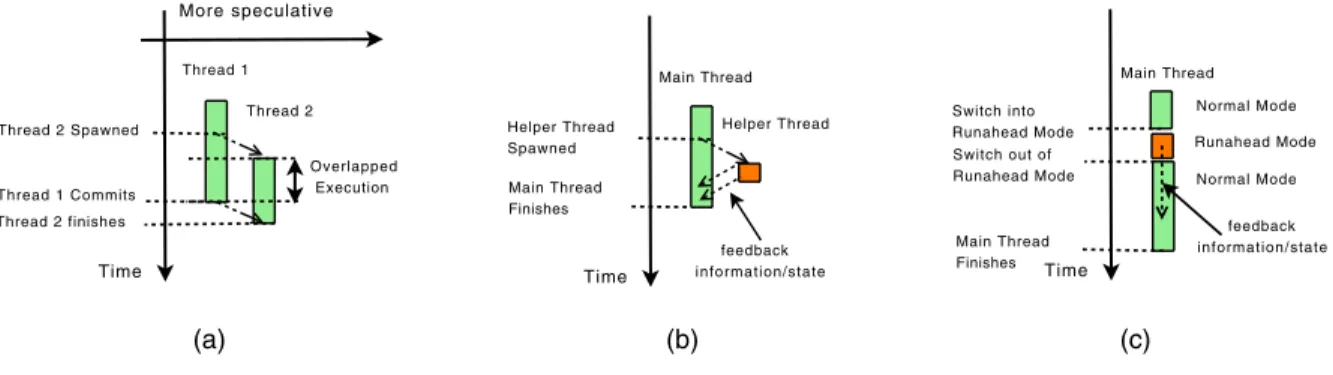
One possible solution to this problem is provided by systems that support Thread-Level Speculation (TLS) [7, 10, 12, 16, 17]. In these systems, the compiler/programmer is free to generate threads without having to consider all possible cross-thread data depen-dences. Parallel execution of threads then proceeds speculatively and the TLS system guarantees the original sequential semantics of the program by transparently detecting any data dependence vi-olations, squashing the offending threads, and returning the sys-tem to a previously non-speculative correct state. Thus, the TLS model improves overall performance by exploiting Thread-Level Parallelism (TLP) via the concurrent execution of instructions in multiple threads1(Figure 1(a)).
Another possible solution to accelerate program execution in multicore systems without resorting to parallel programs is pro-vided by systems that support Helper Threads (HT) [3, 4, 18, 20]. In these systems, the compiler/programmer extracts small threads, often called slices, from the main thread such that their execution in parallel with the main thread will lead to improved execution effi-ciency of the latter. Most commonly, helper threads are used to re-solve highly unpredictable branches and cache misses before these are required by the main thread. In almost all cases, the benefits of HT are indirect in the sense that no actual program computation is executed in parallel with the main thread. Thus, the HT model improves overall performance by exploiting Instruction-Level
Par-1In reality, the basic TLS execution model also provides some indirect non-TLP performance benefits as explained later in the paper.
Time More speculative Thread 1 Thread 2 Spawned Thread 2 Thread 2 finishes Thread 1 Commits Overlapped Execution (a) Time Main Thread Helper Thread Spawned Helper Thread Main Thread Finishes feedback information/state (b) Time Main Thread Switch into Runahead Mode Runahead Mode Switch out of Runahead Mode Normal Mode Normal Mode feedback information/state Main Thread Finishes (c)
Figure 1: Different models of multithreaded execution: (a) Thread Level Speculation. (b) Helper Thread. (c) Runahead Execution.
allelism (ILP) via the improved execution efficiency within a single main thread (Figure 1(b)).
A solution related to HT is to support Runahead execution (RA) [1, 2, 6, 9, 13]. In these systems, the hardware transpar-ently continues execution of instructions from the main thread past a long latency operation, such as a cache miss. Unlike with HT, the instructions in the runahead thread are not explicitly extracted and placed in a subordinate thread and are not executed concur-rently with the main thread. In fact, RA can be even implemented in single-core systems with some enhanced context checkpointing support. Like HT, the benefits from RA are indirect and it improves overall performance by exploiting ILP (Figure 1(c)).
Each of these three multithreaded execution models has been separately shown to improve overall performance of some sequen-tial applications. However, given the different nature of the per-formance benefits provided by each model, one would expect that combining them in a unified execution model would lead to greater performance gains and over a wider range of applications compared to each model alone. Moreover, much of the architectural support required by each model is similar, namely: some support for check-pointing and/or multiple contexts, some support to maintain spec-ulative (unsafe) data, and some support for squashing threads. De-spite these opportunities no one (to the best of our knowledge) has attempted to combine these multithreaded execution models.
In this paper we propose to combine all three multithreaded exe-cution models in a super-set unified model that can exploit the ben-efits of each model depending on application characteristics. More specifically, the resulting system attempts to exploit TLP specula-tively with TLS execution, but when this fails or when additional opportunities exist for exploiting ILP the system also employs a version of HT that is based on RA. We chose this model of HT so that its threads interact seamlessly with TLS threads and only small modifications to the TLS protocol and the TLS architectural sup-port are required. In the paper we discuss in detail this interaction and how to tune the HT and TLS models to work synergystically. Another contribution of this paper is a simple methodology that allows one to model the performance gains with TLS and the uni-fied execution model such that gains can be accurately attributed to either TLP or ILP. This methodology, then, allows one to rea-son about the behavior of the execution models and to investigate tradeoffs in the unified model.
Experimental results show that our unified execution model achieves speedups of up to 41.2%, with an average of 10.2%, over an existing state-of-the-art TLS system and speedups of up to 35.2%, with an average of 18.3%, over a flavor of runahead exe-cution for a subset of the SPEC2000 Int benchmark suite.
The rest of this paper is organized as follows. Section 2 pro-vides a brief description of the TLS, HT and RA execution models. Section 3 presents our proposed scheme to combine the three exe-cution models. Section 4 presents our methodology for quantifying the contributions to performance gains that come from TLP and ILP. Section 5 describes the experimental methodology and Sec-tion 6 presents results. Finally, SecSec-tion 7 discusses related work and Section 8 concludes the paper.
2.
BACKGROUND ON TLS, HT AND RA
EXECUTION MODELS
2.1
TLS
Under thethread-level speculation(also calledspeculative
par-allelization) approach, sequential sections of code are speculatively
executed in parallel hoping not to violate any sequential semantics. The control flow of the sequential code imposes a total order on the threads. At any time during execution, the earliest thread in program order isnon-speculativewhile the others arespeculative. The termspredecessorandsuccessorare used to relate threads in this total order. Stores from speculative threads generate unsafe
versions of variables that are stored in some sort of speculative
buffer. If a speculative thread overflows its speculative buffer it
must stall and wait to become non-speculative. Loads from specu-lative threads are provided with potentially incorrect versions. As execution proceeds, the system tracks memory references to iden-tify any cross-thread data dependence violation. If a dependence violation is found, the offending thread must besquashed, along with its successors, thus reverting the state back to a safe position from which threads can be re-executed. In most schemes a squash rolls the execution back to the start of the thread, but some pro-posals in the literature use periodiccheckpointingof threads such that upon a squash it is only necessary to roll the execution back to the closest safe checkpointed state. When the execution of a non-speculative thread completes itcommitsand the values it generated can be moved to safe storage (usually main memory or some shared higher-level cache). At this point its immediate successor acquires non-speculative status and is allowed to commit. When a specula-tive thread completes it must wait for all predecessors to commit before it can commit. Figure 1(a) depicts this execution model.
Speculative threads are usually extracted from either loop itera-tions or function continuaitera-tions, without taking into consideration possible data dependence violations. The compiler marks these structures with a fork-likespawn instruction, so that the execution of such an instruction leads to a new speculative thread. The
par-entthread continues execution as normal, while thechildthread is mapped to any available core. For loops, spawn points are placed at the beginning of the loop body, so that each iteration of the loop spawns the next iteration as a speculative thread. Threads formed from iterations of the same loop (and that, thus, have the same spawn point) are calledsiblingthreads. For function calls, spawn points are placed just before the function call such that the non-speculative thread proceeds to the body of the function, and a speculative thread is created from the function’s continuation.
The architectural support required by TLS consists of six main components: i) a mechanism to allow speculative threads to operate in their own context and to enforce that speculatively modified data be also kept separate, ii) a mechanism to track data accesses in order to detect any data dependence violations, iii) a mechanism to spawn threads in different cores or contexts, iv) a mechanism to rollback (i.e., squash and restart) incorrectly executed threads, v) a mechanism to commit the correctly speculatively modified data to the safe state, and vi) a mechanism to keep track of the ordering of threads with respect to the original sequential execution order.
2.2
HT
Under thehelper threads(also calledsubordinate microthreads) approach, small threads are run concurrently with a main thread. The purpose of the helper threads is not to directly contribute to the actual program computation, which is still performed in full by the main thread, but to facilitate the execution of the main thread indi-rectly. Common ways to accelerate the execution of the main thread involve initiating memory requests ahead of time (i.e., prefetching; such that the results are hopefully in the cache by the time they are needed by the main thread) and resolving branches ahead of time. Usually, depending on how the helper threads are generated (see below), the execution of helper threads is speculative in that they may be following some incorrect control flow path and/or produc-ing and consumproduc-ing incorrect data. In this multithreaded execution model there is no particular ordering among multiple helper threads and all arediscardedat the end of their execution. Figure 1(b) de-picts this execution model.
Helper threads are usually generated by the compiler or program-mer and often consist ofslicesof instructions from the main thread (e.g., only those instructions directly involved in the computation of some memory address or branch condition). Depending on the size and complexity of the helper threads it may be possible to keep all their intermediate results in the registers, but it may be necessary to allow for spills to the memory hierarchy, which in turn requires providing storage for speculativeversions of data. The compiler marks the main thread with fork-likespawn instructionsat points where particular helper threads should be initiated.
The architectural support required by HT consists of three main components: i) a mechanism to allow helper threads to operate in their own context and, possibly, to enforce that speculatively modi-fied data be also kept separate, ii) a mechanism to spawn threads in different cores or contexts, and iii) a mechanism to discard threads when finished.
2.3
RA
Under therunaheadapproach, when the main thread hits a long-latency operation (e.g., an L2 miss) it halts execution and a runa-head thread continues execution either ignoring or predicting the outcome of the long-latency operation. The purpose of the runa-head thread is not to directly contribute to the actual program com-putation, which is often still performed in full by the main thread once it resumes, but to facilitate the execution of the main thread indirectly after it resumes. As with HT, common ways to
acceler-ate the execution of the main thread involve prefetching and early branch resolution. Unlike HT, runahead threads do not run concur-rently with the main thread. The execution of the runahead thread is speculative since the outcome of the long-latency operation is ei-ther ignored or predicted. Thus, in most proposed models the runa-head thread isdiscardedonce the main thread resumes execution. In more aggressive models, however, if the predicted outcome of the long-latency operation is correct the execution of the runahead thread is incorporated into the main thread before stopping the ex-ecution of the runahead thread. Figure 1(c) depicts this exex-ecution model.
Runahead threads are generated on-the-fly by the hardware and, like the common HT case, consist of a selection of instructions from the main thread. Strictly speaking, in many proposals in the literature, the runahead threads are in fact obtained by simply
checkpointingthe main thread and letting it run ahead instead of
ex-plicitly spawning a new thread elsewhere. Also like HT, it may be possible to keep all the intermediate results of the runahead thread in the registers, but it may be necessary to allow for spills to the memory hierarchy.
The architectural support required by RA consists of five main components: i) a mechanism to allow runahead threads to oper-ate in their own context and, possibly, to enforce that speculatively modified data be also kept separate, ii) a mechanism to decide when to generate runahead threads or to switch the main thread into runahead mode, iii) a mechanism to discard incorrectly exe-cuted threads, and iv) and v) optional mechanisms to check if the runahead thread has executed based on correct or incorrect pre-dicted outcomes and, if so, to incorporate the runahead state and data into the main thread.
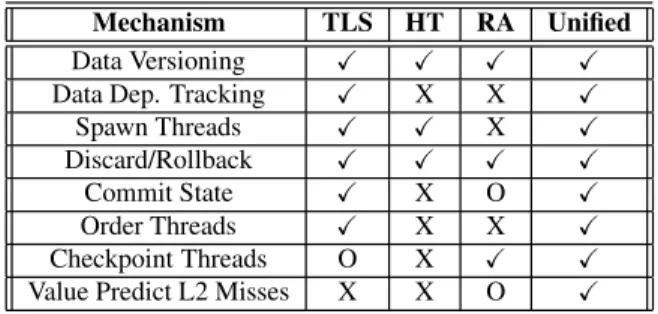
Table 1 summarizes the architectural support required by the three multithreaded execution models in columns 2 to 4 (the last column shows the support used by our unified scheme, which is described in Section 3).
Mechanism TLS HT RA Unified Data Versioning Data Dep. Tracking X X Spawn Threads X Discard/Rollback Commit State X O Order Threads X X Checkpoint Threads O X Value Predict L2 Misses X X O Table 1: Hardware support required for the different models of multithreaded execution and for our unified approach. O
stands for optional feature,Xstands for feature not required, andstands for feature required.
3.
COMBINING TLS, HT, AND RA
EXECUTION
3.1
Basic Idea
Each of the multithreaded execution models that we consider – TLS, HT, and RA – is best at exploiting different opportunities for accelerating the performance of a single-threaded application. We expect a unified scheme both to perform as well as the best model across a variety of applications and to even outperform the best model. The latter can happen if the unified scheme can adapt to the different acceleration opportunities of different program phases
or if the acceleration opportunities are additive (e.g., if ILP can be exploited in addition to TLP for some program phase).
The basic idea of our proposal for combining TLS, HT, and RA execution is to start with a TLS execution and to convert some TLS threads into helper threads by switching them to runahead execu-tion mode. Threads that have been converted to helper threads ex-ecute the same instructions as they would in TLS mode, but runa-head execution is achieved by allowing them to predict the results of L2 misses instead of stalling, as done in the RA execution model (as opposed to being achieved by some compiler/programmer slic-ing mechanism). These converted helper threads can no longer con-tribute to the actual parallel computation (i.e., they can never com-mit) but can only help the remaining TLS threads execute more ef-ficiently. In a multicore environment with TLS this can be achieved when the converted helper threads bring data into L2 that will be later used by the remaining TLS threads. Note that in TLS the L1 cache is versioned so that no sharing and, thus, no prefetching, can occur across helper threads and TLS threads.
Combining TLS, HT, and RA execution is a reasonable approach for three main reasons. Firstly, because we start by employing only TLS, we first try to extract all the available TLP. This makes sense in a system with several cores since, if TLP can be exploited, it is more likely that this will yield better performance than trying to speed up a single main thread. When we fail to speculatively extract TLP, we may utilize the extra hardware resources to improve the ILP of the main thread, whereas a base TLS system would be idle. Secondly, accommodating HT and RA execution within the TLS execution model requires only slight modifications to the base TLS system (Table 1). Finally, starting from TLS threads and implicitly generating runahead slices according to the RA model is a simple and automatic way of generating helper threads (no programmer intervention is required).
While the basic idea is simple, developing a fully working sys-tem requires dealing with a few implementation issues. The key issue relates to the policy ofwhen, where and how to create HT. These decisions are critical because in our HT/RA model threads do not contribute to TLP and consume TLP resources (e.g., cores, caches), so that a conversion policy must balance the potential in-crease in ILP with the potential loss of TLP. Another aspect of this is whether helper threads are simply converted from existing TLS threads in place, or whether new TLS threads are specifically cre-ated elsewhere for the purpose of becoming helper threads. This decision also affects how to manage helper threads in the context of an extended TLS environment. In particular, the TLS environment imposes a total ordering on the threads in the system, which is rea-sonable for TLS threads, but becomes slightly more involved when some threads are TLS and some are HT. Also, a question is what to do with a helper thread when it detects a data dependence violation and when one of its predecessors is squashed. These issues are dis-cussed in Section 3.2. Finally, another important issue relates to the policy of converting threads back from HT to TLS threads. Since our simplified HT/RA model does not allow for their execution to be integrated into the TLS execution, this latter policy boils down
tohow to destroy HTand free up resources for further TLS threads.
This issue is discussed in Section 3.3.
3.2
When, Where and How to Create HT
We identify two suitable occasions for creating a helper thread: at thread spawn and when a TLS thread suffers an L2 cache miss. By creating a helper thread on every thread spawn, we make the assumption that the original thread will benefit from prefetching, which may not be always true. On the other hand, creating a helper thread on an L2 miss will only help if the original thread will suffer
more L2 misses later. Luckily TLS threads exhibit locality in their misses, that is, they either suffer many misses in the L2 cache or they do not suffer any (due to changes in the working set). Thus, as-suming that an L2 miss will be followed by other misses is a reason-able assumption. We experimented with both approaches and found out that indeed this was the case and that the approach of spawning helper threads on a L2 miss performs better (Section 6.2.1).
As for the location where to execute the helper thread there are two possibilities: in the same core where the original TLS thread was executing (thus, effectively converting the TLS thread into a helper thread) or in a different idle core (thus, effectivelycloning
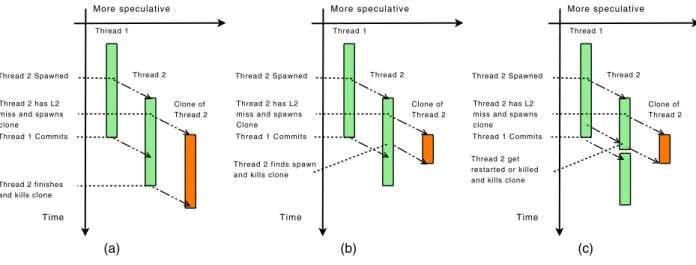
the original TLS thread and converting the clone into a helper thread, see Figure 2(a)). Obviously, the first option will sacrifice the exploitation of TLP, which may not be easily recovered by the benefits of the helper thread. On the other hand, the second option leads to an increased number of threads in the system, which in-creases the pressure on resources, possibly leading to performance degradation. If we decide to convert an existing thread, we simply have tocheckpointand mark the thread as a helper thread. This thread will proceed until the end of its execution disregarding long latency events and restart signals. If we instead create a new thread, we will have to do so using the existing TLS spawning model and marking the thread as a helper thread. We experimented with both approaches and found out that the latter performs better when it is coupled with throttling heuristics that restrict the system’s load (Section 6.2.2).
Throughout this work we optimistically assume that TLS threads will perform useful work. Since helper threads require resources that could otherwise be used by TLS threads, indiscriminately cre-ating helper threads at every L2 cache miss may prove detrimental to the final system’s performance. Thus, it is important to make the helper threads as transparent as possible. A simple way of doing this is by allowing only a small number of helper threads to exist at any given time and to ensure that TLS threads will always be given priority over these helper threads. Although spawning on an L2 miss will create helper threads only for the threads that will likely benefit from prefetching, this may still result in the creation of too many threads. For this reason we only create a helper thread for the L2 misses if there is a free processor. Additionally, we do not allow any of the helper threads to perform any thread spawn them-selves. In all cases, if we spawn a normal TLS thread and we do not have any free processor available, we pre-empt one of the running helper threads by killing it. We experimented with these different approaches and found out that keeping the number of helper threads small with the policies above gives better results (Section 6.2.3).
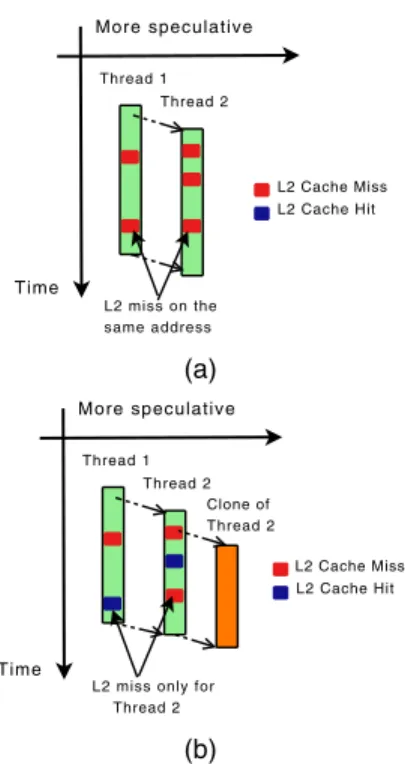
We also found that by allowing only the most speculative thread to spawn a helper thread on an idle core we can achieve most of the benefits one can achieve by allowing multiple helper threads to co-exist (Section 6.2.4). This is to be attributed to achain-prefetching
effect, under which a helper thread prefetches only for the most speculative thread, which in turn goes faster and prefetches for its parent thread. An example of this can be seen in Figure 3, where under normal TLS (Figure 3(a)) bothThread 1andThread 2 suf-fer L2 misses at about the same time. When we cloneThread 2, we manage to get rid only of the second miss fromThread 2 (Fig-ure 3(b)). However, this makesThread 2reach the third miss faster and, thus, prefetch it forThread 1.
In addition to throttling the use of resources, another reason for only allowing the most speculative thread to spawn a helper thread is that it greatly simplifies the unified TLS+HT protocol. By doing so, we separate the TLS and the helper threads in the total thread ordering scheme. This in turn means that we do not have to deal with complex interactions, such as the case that a helper thread
Time
More speculative
Thread 1
Thread 2 Spawned
Thread 2 has L2 miss and spawns clone
Thread 2
Clone of Thread 2
Thread 2 finishes and kills clone Thread 1 Commits (a) Time More speculative Thread 1 Thread 2 Spawned Thread 2 has L2 miss and spawns Clone
Thread 2
Clone of Thread 2
Thread 2 finds spawn and kills clone
Thread 1 Commits (b) Time More speculative Thread 1 Thread 2 Spawned Thread 2 has L2 miss and spawns clone Thread 2 Clone of Thread 2 Thread 1 Commits Thread 2 get restarted or killed and kills clone
(c)
Figure 2: Helper threading with clones: (a) A thread is cloned on an L2 miss. (b) The clone is killed on a thread spawn. (c) The clone is killed on a restart/kill of the thread that spawned it.
triggers a data dependence violation with a more speculative TLS thread or that a more speculative TLS thread attempts to consume a version produced by the helper thread.
3.3
When to Terminate a Helper Thread
A helper thread should be terminated in any of the following five cases. The first case is when the helper thread reaches the com-mit instruction inserted by the compiler that denotes the end of the thread. The second case is when the parent thread that created the helper thread reaches the commit instruction (Figure 2(a)). The third case is when the parent thread finds a TLS spawn instruction (Figure 2(b)). Fourth, if the thread that created the helper thread receives a restart or kill signal, the helper thread has to be killed as well to facilitate keeping the ordering of threads in the system (Fig-ure 2(c)). Finally, helper threads use predicted values for the level two cache misses and as such they might follow incorrect execution paths. So the fifth case occurs when one of these paths causes an exception.
4.
A METHODOLOGY TO QUANTIFY ILP
AND TLP PERFORMANCE GAINS IN
SPECULATIVE MULTITHREADED
EXECUTIONS
With multithreaded execution models part of the performance variation observed is due to overlapped execution of instructions from multiple threads where these instructions contribute to the overall computation – we call this a TLP contribution. Another part of the performance variation is due to indirect contributions that im-prove (or degrade) the efficiency of execution of the threads – we call this an ILP contribution. For instance, with TLS the parallel ex-ecution of threads leads to a TLP contribution but also prefetching effects may lead to an ILP contribution. This may happen when some threads share data so that the first thread to incur a cache miss effectively prefetches for the others such that the others will appear to have an improved ILP. Note that it is also possible that due to contention for resources, threads appear to have a degraded ILP. Note also that with speculative multithreaded models the pos-sibility of squashes and re-execution of threads leads to even more intricate relationships between TLP and ILP contributions. Accu-rately quantifying the TLP and ILP contributions toward the final
observed performance variation is critical in order to reason and act upon the behavior of multithreaded execution models. In this section we present a methodology to quantify these TLP and ILP contributions in multithreaded execution models using easy to col-lect timing information from the actual execution. The model is a variation of that proposed in [15]: it requires one extra simulation run but provides a more accurate estimate of the ILP contribution (Section 6.3).
The performance model is based on measuring the following quantities from the execution: 1) the execution time of the origi-nal sequential code (Tseq); 2) the execution time of the modified TLS code when executed in a single core (T1p); 3) the sum of exe-cution times among all threads that actuallycommit(PTi, for all threadsithat commit); and 4) the execution time of the modified TLS code when executed in multiple cores (Tmt). Figure 4 de-picts these quantities for a simple example with two threads. With these quantities, the overall performance variation (Sall) is given by Equation 1 and the performance variation (usually a slowdown) due to the TLS instrumentation overhead (S1p) is given by Equa-tion 2. The latter is needed in order to account for the variaEqua-tions needed in the binaries that execute the sequential and the multi-threaded versions of the program.
Sall= TTseq
mt (1)
S1p= TTseq
1p (2)
The overall performance variation of the multithreaded
execu-tionover the TLS code executed in a single core(Scomb) is given
by Equation 3. This performance variation reflects the combined effects of both ILP and TLP and the equality shown in Equation 4 holds.
Scomb= TT1p
mt (3)
Scomb=Silp×Stlp (4)
The performance variation of the multithreaded executionover
the TLS code executed in a single coreand that can be attributed to
Single Thread Tseq Time Thread 1 Thread 2 T1 T2 Time T1p Thread 1 Thread 2 T1’ T2’ T m t T 1 ’ ! = T 1 T 2 ’ ! = T 2 Time More speculative Tsq Squash
Figure 4: Quantifying ILP and TLP benefits.
Time More speculative Thread 1 L2 miss on the same address Thread 2 L2 Cache Miss L2 Cache Hit (a)
L2 miss only for Thread 2 Time More speculative Thread 1 Thread 2 Clone of Thread 2 L2 Cache Miss L2 Cache Hit (b)
Figure 3: Chain Prefetching effect: (a) Under normal TLS ex-ecution both threads find L2 cache misses concurrently. (b) The clone prefetches for Thread 2, which in turn prefetches for Thread 1.
Silp= PT1Tp
i (5)
Thus,Silpcan be computed with the measurements ofT1pand allTi’s. The performance variation of the multithreaded execution
over the TLS code executed in a single coreand that can be
at-tributed to TLP effects (Stlp) can be computed by substituting the results of Equations 3 and 5 into Equation 4. Finally, we observe that the equality shown in Equation 6 holds, which shows that the fi-nal observed performance variation can be quantitatively attributed to the variations in the binary, to the ILP contributions, and to the TLP contributions.
Sall=S1p×Silp×Stlp (6)
Comparing our model with that proposed in [15] it can be shown
that the key difference is that the ILP estimate in that model is ul-timately derived from the "code bloat" factorfbloat, while it is de-rived in our model from the actual instrumentation slowdownS1p. The problem with usingfbloatas a proxy for the actual slowdown is that it implicitly assumes that the CPI of the unmodified sequential execution and that of the TLS-instrumented sequential execution are the same. In reality, however, the TLS instrumentation does affect the CPI as it involves the addition of mainly function calls and memory operations to set up thread spawns, which in turn have a different CPI from the rest of the thread. Obviously, this impact on CPI will be more pronounced for smaller threads than for larger ones. In our experiments (Section 6.3) we measured the difference in CPI and the ultimate impact on the ILP contribution estimation and found out that it can be significant in several cases.
5.
EVALUATION METHODOLOGY
5.1
Simulation Environment
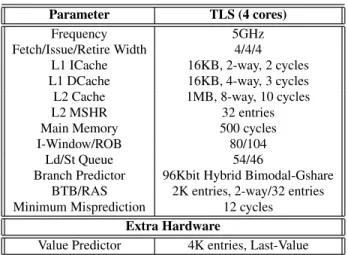
We conduct our experiments using the SESC simulator [14]. The main microarchitectural features are listed in Table 2. The system we simulate is a multicore with 4 processors, where each processor is 4-issue out-of-order superscalar. The branch predictor is a hybrid bimodal-gshare predictor. The minimum branch misprediction la-tency is 12 cycles while we also employ speculative updates of the global history register along the lines of [8]. Each processor has a multi-versioned L1 data cache and a non-versioned L1 instruc-tion cache. All processors share a non-versioned unified L2 cache. For the TLS protocol we assume out-of-order spawning [15]. Our scheme requires on top of the aforementioned TLS support a value predictor so as to predict the value to be returned by missing loads. Throughout most of the evaluation we use a simple last-value pre-dictor, but we show later that a better value predictor could improve the overall performance significantly. Our scheme also requires to transfer register state on a spawning of a clone thread. This is im-plemented using microcode and it adds an additional cost to the creation of a clone thread of 100 cycles. Note that normal TLS threads only require 20 cycles, since register state transfering is done through memory (the compiler inserts spills to memory).
5.2
Benchmarks
We use the integer programs from the SPEC CPU 2000 bench-mark suite running the Reference data set. We focus on these appli-cations because they represent a set of well accepted benchmarks that make difficult both the extraction of ILP (for RA/HT) and TLP (for TLS). We use the entire suite except eon, which cannot be compiled because our infrastructure does not support C++, andgcc
Parameter TLS (4 cores) Frequency 5GHz Fetch/Issue/Retire Width 4/4/4
L1 ICache 16KB, 2-way, 2 cycles L1 DCache 16KB, 4-way, 3 cycles L2 Cache 1MB, 8-way, 10 cycles L2 MSHR 32 entries Main Memory 500 cycles I-Window/ROB 80/104
Ld/St Queue 54/46
Branch Predictor 96Kbit Hybrid Bimodal-Gshare BTB/RAS 2K entries, 2-way/32 entries Minimum Misprediction 12 cycles
Extra Hardware
Value Predictor 4K entries, Last-Value Table 2:Architectural parameters.
reference, the sequential (non-TLS) binaries where obtained with unmodified code compiled with the MIPSPro SGI compiler at the O3 optimization level. The TLS binaries were obtained with the POSH infrastructure [11]. In order to directly compare them, we execute a given number of simulation marks, which pinpoint spe-cific code segments. This is necessary because the binaries are dif-ferent, due to re-arrangements of the code by POSH. We simulate enough simulation marks so that the corresponding sequential ap-plication graduates more than 750 million instructions.
6.
EXPERIMENTAL RESULTS
We start by showing the bottom-line results of our scheme when compared with both TLS and a flavor of runahead execution that uses value prediction but always reverts to the checkpoint made before going into runahead mode (i.e., it discards all computation done in the runahead thread and, thus, does not exploit any TLP). We next try to quantitatively explain how our scheme works and provide a detailed analysis of the reasons that led us to the proposed design.
6.1
Comparing TLS, Runahead and the
Unified Scheme
Figure 5 shows how our proposed scheme performs when com-pared with both TLS and runahead execution with value predic-tion. Each of the bars shows the total speedup and the proportion of the speedup that can be attributed to ILP and TLP based on the methodology discussed in Section 4. Speedups are relative to se-quential execution with theoriginalsequential binary. With the light grey shade below the1.0point we denote the base case each of the schemes starts from when running on a single core (TLS and unified scheme have worse quality of code; this is theS1pfactor of Section 4) and with the next two shades the proportion of speedup due to ILP and TLP accordingly2. The leftmost bars correspond to the base TLS, the middle bars to runahead execution with value prediction, and the rightmost bars to our unified scheme.
Considering the base execution models alone, we first note that while TLS performs better than runahead execution for most appli-cations, for some applications the performance of both schemes is comparable (gzipandparser). We also note that, despite the main target of TLS being the exploitation of TLP, for most applications
2
Note that the breakdown shows proportions of speedup due to each cate-gory and the height of each portion cannot be directly read as the speedup coming from ILP and TLP.
bzip2 crafty gap gzip mcf parser twolf vortex vpr avg 0.8 1.0 1.2 1.4 1.6 1.8 2.0 2.2 2.4 2.6 2.8 3.0
Speedup over Sequential Execution
Speedup due to ILP Speedup due to TLP
Unified Runahead TLS
Figure 5: Speedup breakdown based on our model. Leftmost bar is for TLS, middle bar is for Runahead with value predic-tion, and rightmost bar is for our unified approach.
the benefits of ILP in the base TLS scheme are comparable to the TLP benefits.
Comparing our unified scheme with TLS and runahead, we see that the unified scheme performs at least as well as the best of other schemes for all applications and often outperforms the best scheme. The performance advantage of the unified scheme indi-cates that often the speedups of runahead execution and TLS are additive. In fact, even in applications where runahead execution fails to deliver any speedups (crafty, gapandvortex), our unified scheme achieves speedups equal to or better than TLS. When com-pared with TLS, we see that our unified scheme obtains greater performance gains from ILP while maintaining most of the TLP benefits. Interestingly, in some cases our unified scheme is bet-ter than the base TLS scheme even in bet-terms of TLP. One possible reason for this is that faster speculative threads will uncover violat-ing reads faster and thus perform restarts earlier. This is an effect similar to having lazy or eager invalidations, where it is known that eager invalidations procure better results due to increased TLP. When compared with runahead execution, we see that our unified scheme obtains gains from TLP while maintaining most of the ILP benefits. Again, in some cases our unified scheme leads to higher ILP benefits than the base runahead execution. The likely reason for this is the deeper prefetching effect that can be achieved by per-forming runahead execution from a speculative thread, which leads to the chain-prefetching effect described in Section 3.2. Overall, we see that our unified execution model achieves speedups of up to 41.2%, with an average of 10.2%, over the existing state-of-the-art TLS system and speedups of up to 35.2%, with an average of 18.3%, over runahead execution with value prediction.
Figure 6 depicts the number of L2 misses on thecommiting path
for all the schemes normalized to the sequential case. This figure allows us to quantify the ammount of prefetching happening in each scheme. Note that all three schemes have smaller miss rates than sequential execution on average since all of them perform some sort of prefetching. Runahead execution leads to only a relatively small reduction in L2 misses and, in fact, for some applications
likeparserandtwolfit actually increases the number of L2 misses
substantially. This happens because it suffers L2 misses on data that will not be useful for the main thread. For TLS prefetcing is more substantial, but still for some applications like mcf, parser
andtwolf) TLS suffers from more misses than the sequential
ex-ecution. This happens due to code bloating and the overall lower quality of the code produced (some compiler optimizations are re-stricted by the TLS pass). The unified scheme on the other hand, is able to prefetch singnificantly more useful cache lines reducing the miss rate by 41% on average when compared with the miss rate
of sequential execution. We expect that the importance of prefetch-ing will increase as the gap between the processor and the memory widens.
bzip2 crafty gap gzip mcf parser twolf vortex vpr avg 0.0 0.1 0.2 0.3 0.4 0.5 0.6 0.7 0.8 0.9 1.0 1.1
Normalized L2 Misses over Sequential
Runahead TLS Unified
Figure 6: Normalized L2 misses over sequential execution for the commited path of the Runahead execution, TLS and our unified scheme.
Figure 7 shows the fraction of isolated and clustered misses seen
on the commited pathfor the various execution models.
Cluster-ing is identified as the presence of other in-flight memory requests when the commit path suffers another L2 cache miss. This fig-ure is then complementary to Figfig-ure 6 in explaining the prefetch-ing effects of each model as it can capturepartialprefetches (i.e., prefetches that do not completely eliminate a cache miss, but lead to a reduction in the waiting time). Note that Runahead execu-tion does very well in clustering the misses and in fact is able to do much better than both TLS and our unified scheme. As noted above, this significant increase in number of outstanding memory requests with Runahead execution does not always translate into fewer L2 misses seen by the commit path (Figure 6), but in some cases it does lead to partial prefetches and improved ILP (Figure 5). Our unified scheme manages to cluster the misses much better than TLS does, leading to further benefits from partial prefetches.
bzip2 crafty gap gzip mcf parser twolf vortex vpr avg 0 10.0 20.0 30.0 40.0 50.0 60.0 70.0 80.0 90.0 100.0
Percentage of L2 misses in Committed Threads
% of Isolated L2 Misses % of Clustered L2 Misses TLS Unified Runahead Sequential
Figure 7: Breakdown of the L2 misses in isolated and clustered for sequential, Runahead, TLS, and our unified scheme.
6.2
Understanding the Trade-Offs in our
Unified Scheme
6.2.1
When to Create a HT
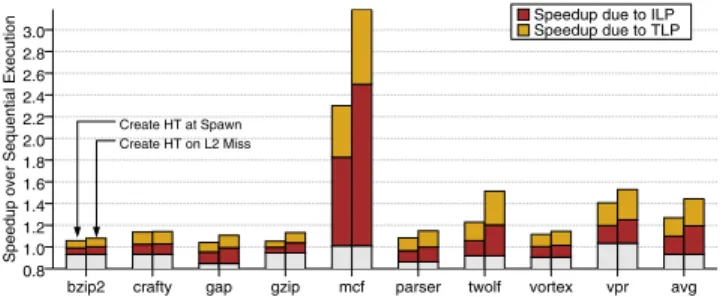
As we discussed earlier in Section 3.2, there is a choice to be made whether to create a new helper thread on an L2 cache miss or at thread spawn time. Figure 8 shows the speedup of each of the two policies. As the figure clearly shows, cloning on L2 misses is always better. The reason is that it is more targeted and, thus, it does not increase the number of running threads unless there are
prefetching needs (i.e., at least one actual L2 miss). This is evident from the ILP/TLP breakdown where we see that the main differ-ence between the two scheme is mostly in the ILP benefits.
bzip2 crafty gap gzip mcf parser twolf vortex vpr avg 0.8 1.0 1.2 1.4 1.6 1.8 2.0 2.2 2.4 2.6 2.8 3.0
Speedup over Sequential Execution
Speedup due to ILP Speedup due to TLP
Create HT at Spawn Create HT on L2 Miss
Figure 8: Impact of choosing between creating helper threads on an L2 Miss or at thread spawn
6.2.2
Converting Existing Threads into HT vs.
Spawning New HT
An interesting trade-off is whether one should try to convert some of the normal TLS threads to helper threads (checkpointing), or whether one should create separate helper threads (cloning). As we discussed in Section 3.2, converting some TLS threads to helper threads will increase the ILP but it will do so at the expense of the TLP we can extract. Figure 9 compares the two schemes. As the figure shows, spawning a new helper thread leads to better perfor-mance in all but one case (crafty). It is interesting to note that in most cases the performance advantage of the cloning approach comes not only from increased TLP, as one would expect, but also from increased ILP. It is also worth noting that for the converting approach, although in all of the cases the ILP gains are significant, for some benchmarks this scheme performs even worse than the base TLS.
bzip2 crafty gap gzip mcf parser twolf vortex vpr avg 0.2 0.4 0.6 0.8 1.0 1.2 1.4 1.6 1.8 2.0 2.2 2.4 2.6 2.8 3.0
Speedup over Sequential Execution
Speedup due to ILP Speedup due to TLP
Converting into HT Creating new HT
Figure 9: Converting TLS threads to Helper threads, as op-posed to spawning distinct helper threads.
6.2.3
Effect of the Load of the System
Helper threads require resources that could otherwise be used by normal TLS threads. Figure 10(a) shows the average distribution of number of threads that exist at a given time in a four core system with TLS. We can see that almost 90% of the time there are only up to two threads running. This means that as long as we create a small number of helper threads we should not harm the extracted TLP.
In Figure 10(b) we first show a helper thread spawning policy under which we create a new helper thread on every L2 cache miss.
1 2 3 4 Number of Threads 0.0 0.1 0.2 0.3 0.4 0.5 0.6 0.7
Proportion of Execution Time
Running Threads
(a)
bzip2 crafty gap gzip mcf parser twolf vortex vpr avg 0.8 1.0 1.2 1.4 1.6 1.8 2.0 2.2 2.4 2.6 2.8 3.0
Speedup over Sequential Execution
Speedup due to ILP Speedup due to TLP
Spawning on Every L2 Miss Load Aware HT Spawning
(b)
Figure 10: (a) Distribution of number of threads on a four core system. (b) Evaluating the effect of load aware HT spawning.
Under this scheme we allow multiple helper threads to co-exist. This scheme does not check if there is any available core to run the new helper thread on (if there is no free core, threads are placed in queues waiting to execute as we do with normal TLS spawns), and the clones are not killed when we spawn a new TLS thread. We compare this with our load-aware scheme, under which we only allow one helper thread to exist at a time and we kill helper threads in order to pre-empt them. The benefits of employing a load-aware scheme are more pronounced in applications with a large number of threads likemcfandtwolf. The benefits come mainly from better ILP since, we are making the contention on the common L2 cache smaller and we are poluting it less.
6.2.4
Single vs. Multiple Helper Threads
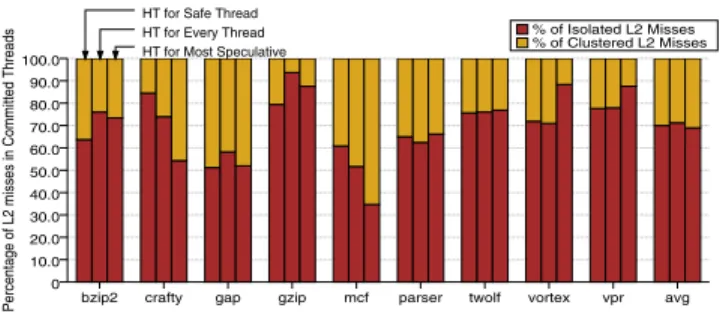
In our approach, we chose to create a single helper thread by cloning the most speculative thread because of its fairly straight-forward implementation overhead and reasonable expected perfor-mance benefits. We compare our scheme with two other schemes: one where we only allow the safe thread to create a clone, and one where we allow multiple clones to run in the system. Note that both schemes respect our load-aware policies (Section 6.2.3) so that they do not interfere negatively with the normal TLS threads. This means that for our four core system we can have at most two nor-mal and two clone threads running concurrently (as opposed to our scheme where we will only have one clone thread). As Figure 11 shows, cloning only for the safe thread gives only a fraction of the achievable benefits. This is mainly due to worse ILP, which makes sense if we take into account that we are only prefetching for one thread. In fact, Figure 12 shows that creating a helper thread for the most speculative task performs substantially more useful prefetch-ing than the scheme where we only create a helper thread for the safe thread. On the other hand, creating a clone for all the threads is slightly better than our scheme for all applications exceptmcf. Figure 13 shows the clustering of memory requests for all three schemes. In most cases the difference in clustering is not very sig-nificant. However, the clustering helps explain the case ofmcfwith our scheme and with cloning for all threads: even though the miss rates are comparable (Figure 12), the effect of partial prefetching is much more pronounced with the unified scheme.
6.2.5
Effect of a Better Value Predictor
Throughout our study we have employed a simple last value pre-dictor. In this section perform a sensitivity analysis of our scheme on this building block. As we see in Figure 14, a better value pre-dictor (i.e., a perfect one in this case) would lead to significantly increased benefits for the unified scheme. The improvement will come in terms of better ILP, which is justified by the improved
bzip2 crafty gap gzip mcf parser twolf vortex vpr avg 0.8 1.0 1.2 1.4 1.6 1.8 2.0 2.2 2.4 2.6 2.8 3.0
Speedup over Sequential Execution
Speedup due to ILP Speedup due to TLP
HT for Safe Thread HT for Every Thread HT for Most Speculative
Figure 11: Comparing the effect in performance when creating multiple HT or a single HT.
bzip2 crafty gap gzip mcf parser twolf vortex vpr avg 0.0 0.1 0.2 0.3 0.4 0.5 0.6 0.7 0.8 0.9 1.0
Normalized L2 Misses over Sequential
HT for Safe Thread HT for Every Thread HT for Most Speculative
Figure 12: Normalized L2 misses over sequential execution when creating multiple HT or a single HT.
prefetching capability resulting from always following the correct path. We see that there is still ample room for improvement for at least four out of the nine benchmarks used in this paper. We intend to further investigate the effect of value prediction in future work.
6.3
Performance Model Comparison
As discussed in Section 4, the difference between our speedup breakdown model and that of [15] is that we propose to measure the actual execution time degradation of the TLS execution when running on a single core compared to the original sequential exe-cution (S1p), instead of estimating this factor with the instruction code bloat (fbloat). In reality1/S1p =fbloat, which will lead to some innacuracy in the model of [15]. In fact, since the added TLS instrumentation consists of several memory operations and some function calls, we expect that 1/S1p < fbloat and the model of [15] willunder-estimatethe contribution of ILP.
bzip2 crafty gap gzip mcf parser twolf vortex vpr avg 0 10.0 20.0 30.0 40.0 50.0 60.0 70.0 80.0 90.0 100.0
Percentage of L2 misses in Committed Threads
% of Isolated L2 Misses % of Clustered L2 Misses HT for Every Thread
HT for Safe Thread HT for Most Speculative
Figure 13: Breakdown of the L2 misses in isolated and clus-tered when creating multiple HT or a single HT.
bzip2 crafty gap gzip mcf parser twolf vortex vpr avg 0.8 1.0 1.2 1.4 1.6 1.8 2.0 2.2 2.4 2.6 2.8 3.0 3.2 3.4 3.6 3.8 4.0
Speedup over Sequential Execution
Speedup due to ILP Speedup due to TLP
Last Value Predictor Oracle Value Predictor
Figure 14: Performance impact of value prediction accuracy.
We measured the difference between the ILP and the TLP esti-mates of both models and show the results in Table 3. Although for some applications the errors are fairly small, this is not the case for some others likegapand mcf where there is a difference of 15.3% (for ILP estimation) and 13% (for TLP estimation). More importantly, in some cases the two models do not agree, so that the model proposed in [15] indicates that there is no ILP contribution (or there is a slowdown due to ILP degradation) whereas our model contradicts this. The benchmarks where this is the case are shown in Table 3 with bold. We thus believe that the extra simulations required by our model are well justified, since they provide a much clearer picture of what is happening.
Benchmark bzip2 crafty gap gzip mcf parser twolf vortex vpr avg
% ILP Diff. 1.81 0.45 15.3 2.67 1.11 4.81 2.26 2.97 3.49 3.87
% TLP Diff. 5.09 7.19 0.02 2.89 13.0 9.32 5.98 6.64 2.01 5.79
Table 3: Difference of ILP and TLP benefit estimation be-tween our performance model and the one proposed in [15]. With bold we denote cases where our model presents speedup whereas the previously proposed does not.
7.
RELATED WORK
Thread Level Speculation.
Thread level speculation has been previously proposed (e.g., [7, 10, 12, 16, 17]) as a means to provide some degree of parallelism in the presence of data dependences. The vast majority of prior work on TLS systems has focused on architectural features directly related to the TLS support, such as protocols for multi-versioned caches and data dependence violation detection. All these are or-thogonal to our work. In particular, we use the system in [15] as our
baseline. Benefits due to prefetching were also reported for TLS systems in [15]. In our work we that by employing a unified specu-lative multithreading approach, one can obtain further benefits from prefetching. The work in [19] showed in a limit study that it might be beneficial to continue running some threads that are predicted to squash, so as to do prefetching. However, the benefits shown there were minimal if one considers the simplifications in the sim-ulation infrastracture used. In general, deffering the squashes so as to prefetch is not beneficial because we negate the TLP benefits. Checkpointing TLS threads was also proposed in [5]. However, checkpointing in a TLS execution model is used to improve TLP by supporting squash and rollbacks to a checkpointed state instead of to the start of the thread. In our work we employ checkpointing in a combined execution model to allow for improved ILP while main-taining similar TLP levels. Finally, [15] also proposed a model to quantitatively break down the performance improvements between TLP and ILP. Our model is slightly more computationally intensive as it require one extra simulation run, but our results show that it is much more accurate.
Helper Threads.
It has been previously proposed to use small helper threads on otherwise idle hardware resources [3, 4, 18, 20]. There helper threads usually try to resolve highly unpredictable branches and cache misses that the main thread would have to stall upon other-wise. Because helper threads try to improve the ILP of the main thread, they fail to procure any significant benefits in applications where the out-of-order engine is able to extract most of the ILP. As we showed in previous sections, in these cases we can achieve some addtional improvements by trying to extract TLP as well.
Runahead Execution.
Runahead execution [1, 6, 13] is a scheme that generates accu-rate data prefetches by speculatively executing past a long latency cache miss, when the processor would otherwise be stalled. Runa-head execution is similar to the helper thread schemes, although instead of using different hardware resources, it uses otherwise idle processor cycles to perform prefetching. Additionally, runahead execution does not rely on the programmer to manually extract the prefetching slices. Two more recent proposals, Checkpointed Early Load Retirement [9] and CAVA [2], build on [13] by adding value prediction. In contrast with runahead execution, correctly predict-ing the value of a misspredict-ing load eliminates the need to rollback to a checkpoint when the load returns. The work in [2] showed, how-ever, that most of the benefits from this scheme do not come from negating the roll-backs, but rather from the fact that by value pre-dicting, prefetches are more accurate.
8.
CONCLUSIONS
Thread Level Speculation, Helper Threads and Runahead Execu-tion have been separately shown to improve overall performance of some sequential applications. However, given the different nature of the performance benefits provided by each model, one would ex-pect that combining them in a unified execution model would lead to greater performance gains and over a wider range of applications compared to each model alone. Despite these opportunities no one has attempted to combine these multithreaded execution models.
In this paper we propose to combine all three multithreaded exe-cution models in a super-set unified model that can exploit the ben-efits of each model depending on application characteristics. More specifically, the resulting system attempts to exploit TLP specula-tively with TLS execution but when this fails or when additional
opportunities exist for exploiting ILP the system also employs a version of HT that is based on RA. We chose this model of HT so that its threads interact seamlessly with TLS threads and only small modifications to the TLS protocol and the TLS architectural support are required. In the paper we discussed in detail this inter-action and how to tune the HT and TLS models to work synergys-tically. Another contribution of this paper is a simple methodology that allows one to model the performance gains with TLS and the unified execution model such that gains can be accurately attributed to either TLP or ILP. This methodology, then, allows one to quan-titatively reason about the behavior of the execution models and to investigate tradeoffs in the unified model.
Experimental results show that our unified execution model achieves speedups of up to 41.2%, with an average of 10.2%, over an existing state-of-the-art TLS system and speedups of up to 35.2% with an average of 18.3% when compared with a flavor of runahead execution for a subset of the SPEC2000 Int benchmark suite.
9.
REFERENCES
[1] R. Barnes, E. Nystrom, J. Sias, S. Patel, N. Navarro, and W. M. Hwu. “Beating In-Order Stalls with ‘Fea-Ficker’ Two-Pass Pipelining.”Intl. Symp. on Microarchitecture,
pages 387-398, December 2003.
[2] L. Ceze, K. Strauss, J. Tuck, J. Renau, and J. Torrellas. “CAVA: Using Checkpoint-Assisted Value Prediction to Hide L2 Misses.”ACM Trans. on Architecture and Code
Optimization,vol. 3, no. 2, pages 182-208, June 2006.
[3] R. S. Chappell, J. Stark, S. P. Kim, S. K. Reinhardt, and Y. N. Patt. “Simultaneous Subordinate Microthreading (SSMT).”
Intl. Symp. on Computer Architecture,pages 186-195, May
1999.
[4] J. D. Collins, H. Wang, D. M. Tullsen, C. Hughes, Y.-F. Lee, D. Lavery, and J. P. Shen. “Speculative Precomputation: Long-Range Prefetching of Delinquent Loads.”Intl. Symp.
on Computer Architecture,pages 14-25, June 2001.
[5] C. B. Colohan, A. Ailamaki, J. G. Steffan, and T. C. Mowry. “Tolerating Dependences Between Large Speculative Threads Via Sub-Threads.”Intl. Symp. on Computer
Architecture,pages 216-226, June 2006.
[6] J. Dundas and T. Mudge. “Improving Data Cache Performance by Pre-Executing Instructions Under a Cache Miss.”Intl. Conf. on Supercomputing,pages 68-75, July 1997.
[7] L. Hammond, M. Wiley, and K. Olukotun. “Data Speculation Support for a Chip Multiprocessor.”Intl. Conf. on
Architectural Support for Programming Languages and
Operating Systems,pages 58-69, October 1998.
[8] S. Jourdan, J. Stark, T.-H. Hsing, and Y. N. Patt. “Recovery Requirements of Branch Prediction Storage Structures in the Presence of Mispredicted-Path Execution.”Intl. Journal of
Parallel Programming,vol. 25, 1997.
[9] N. Kirman, M. Kirman, M. Chaudhuri, and J. F. Martínez. “Checkpointed Early Load Retirement.”Intl. Symp. on
High-Performance Computer Architecture,pages 16-27,
February 2005.
[10] V. Krishnan and J. Torrellas. “Hardware and Software Support for Speculative Execution of Sequential Binaries on a Chip-Multiprocessor.”Intl. Conf. on Supercomputing,
pages 85-92, June 1998.
[11] W. Liu, J. Tuck, L. Ceze, W. Ahn, K. Strauss, J. Renau, and J. Torrellas. “POSH: a TLS Compiler that Exploits Program Structure.”Symp. on Principles and Practice of Parallel
Programming,pages 158-167, March 2006.
[12] P. Marcuello and A. González. “Clustered Speculative Multithreaded Processors.”Intl. Conf. on Supercomputing,
pages 365-372, June 1999.
[13] O. Mutlu, J. Stark, C. Wilkerson, and Y. N. Patt. “Runahead Execution: An Alternative to Very Large Instruction Windows.”Intl. Symp. on High-Performance Computer
Architecture,pages 129-140, February 2003.
[14] J. Renau, B. Fraguela, J. Tuck, W. Liu, M. Prvulovic, L. Ceze, S. Sarangi, P. Sack, K. Strauss, and P. Montesinos. “SESC simulator.”http://sesc.sourceforge.net.
[15] J. Renau, J. Tuck, W. Liu, L. Ceze, K. Strauss, and J. Torrellas “Tasking with Out-Of-Order Spawn in TLS Chip Multiprocessors: Microarchitecture and Compilation.”Intl.
Conference on Supercomputing,pages 179-188, June 2005.
[16] G. S. Sohi, S. E. Breach and T. N. Vijaykumar. “Multiscalar Processors.”Intl. Symp. on Computer Architecture,pages 414-425, June 1995.
[17] J. G. Steffan and T. C. Mowry. “The Potential for Using Thread-Level Data Speculation to Facilitate Automatic Parallelization.”Intl. Symp. on High-Performance Computer
Architecture,pages 2-13, February 1998.
[18] K. Sundaramoorthy, Z. Purser, and E. Rotenberg. “Slipstream Processors: Improving Both Performance and Fault Tolerance.”Intl. Conf. on Architectural Support for
Programming Languages and Operating Systems,pages
257-268, October 2000.
[19] F. Warg. “Techniques to Reduce Thread-Level Speculation Overhead.”PhD Thesis, Department of Computer Science
and Engineering, Chalmers University, 2006.
[20] C. Zilles and G. Sohi. “Execution-Based Prediction Using Speculative Slices.”Intl. Symp. on Computer Architecture,