Defensive Publications Series
April 2020
Cloud-Based Virtual Memory System in which Memory Pages Are
Cloud-Based Virtual Memory System in which Memory Pages Are
Offloaded to Cloud Storage
Offloaded to Cloud Storage
Robert Benea Patrik Torstensson Rajeev Kumar
Follow this and additional works at: https://www.tdcommons.org/dpubs_series
Recommended Citation Recommended Citation
Benea, Robert; Torstensson, Patrik; and Kumar, Rajeev, "Cloud-Based Virtual Memory System in which Memory Pages Are Offloaded to Cloud Storage", Technical Disclosure Commons, (April 17, 2020) https://www.tdcommons.org/dpubs_series/3150
This work is licensed under a Creative Commons Attribution 4.0 License.
Cloud-Based Virtual Memory System in which Memory Pages Are Offloaded to Cloud Storage
Abstract:
This publication describes systems and techniques to implement virtual memory to swap
memory regions, such as memory pages, between a resource-constrained electronic device and
cloud storage. Many “always-connected” or internet of things (IoT) devices are resource
constrained such that dynamic random-access memory (DRAM) and flash memory are
significantly limited. Excessive write operations can also reduce a usable lifetime of the flash
memory. For cloud-based virtual memory, pages corresponding to working sets of more important
applications are maintained in DRAM at the device. In contrast, a virtual memory system moves
memory pages that are used less frequently based on some metric (e.g., least recently used (LRU))
from the DRAM to cloud storage that is located at a remote server. The virtual memory system
may compress the memory pages to save transmission and/or storage bandwidth. The remote
pages may also be updated without moving them back to the device. In this manner, an electronic
device can have more or larger active applications without over-consuming DRAM or increasing
wear on the flash memory.
Keywords:
resource-constrained, always-connected device, internet of things (IoT), virtual memory,
memory page, swap, cloud storage, ram disk, zram, compression, compressed page, cold page,
Background:
Many electronic devices have significantly lower resources than notebook computers or
even smartphones. Examples of resource-constrained devices include television streaming
devices, smart speakers, personal voice assistant devices, and IoT devices. In addition to a less
powerful processor, such devices typically have relatively smaller volatile and non-volatile
memories. For volatile memory, these devices usually employ DRAM. For non-volatile memory,
such devices often rely on flash memory. Due to size and cost constraints, both the DRAM and
the flash memory of these types of devices are limited to such a degree that it can be difficult to
have multiple applications running simultaneously, or even just a few larger applications.
When an application is running, the data that the application is accessing—called the
“working set”—is stored somewhere on the electronic device. Applications are executed faster if
the working set is stored in DRAM instead of flash memory. Unfortunately, when multiple
applications are running, the memory consumed by the total working set across multiple
applications can exceed the size of the DRAM. To enable the multiple applications to still be
running at the same time, virtual memory techniques are used.
Virtual memory enables the electronic device to store more working set data than the
DRAM can ordinarily do on its own. To do so, a virtual memory space is created by “pretending”
that the DRAM is larger than it physically is and by dividing the virtual memory space into regions,
which are often called memory pages. For this virtual memory space to work, data that exceeds
the actual physical size of the DRAM is stored elsewhere or in a special manner. In one approach,
this additional virtual memory storage space is carved out of the flash memory. A memory page
that contains overflow information is moved from the DRAM to the flash memory to free space in
of the DRAM and is unlikely to be used again soon. The overflow information is thus stored in
the flash memory with this approach. Accessing the flash memory with multiple store cycles,
however, increases wear on the flash memory, and flash memory has a limited lifetime in terms of
storage cycles. Relying solely on flash memory to enable virtual memory can, therefore, reduce
the usable lifespan of the electronic device.
In another approach, the DRAM itself is used to provide additional virtual memory storage
space beyond the baseline physical specification of the DRAM by employing a special storage
technique. Specifically, using the DRAM for expanded virtual memory space can be enabled via
a special storage technique that involves data compression. A memory page with overflow
information is compressed such that a given quantity of data consumes less physical storage in the
DRAM after the compression. For example, a four kilobyte (4 KB) memory page may be
compressed to 1.5 KB. From an available memory space perspective, compressing a memory page
within the DRAM is equivalent to moving a portion of the memory page out of the DRAM.
Although this second approach prevents additional wear on the flash memory, each memory page
that is “paged out” of the DRAM still occupies a portion of the DRAM. Accordingly, this approach
is still ultimately limited by the size of the DRAM, which is particularly impactful for
resource-constrained devices having only a small quantity of DRAM.
Therefore, it is desirable to provide techniques that enable resource-constrained devices,
including those that use flash memory for non-volatile storage, to use virtual memory to expand a
number of applications that can be simultaneously running or to increase a complexity of
Description:
Described virtual memory techniques enable memory pages to be offloaded from an
electronic device to cloud storage. A cloud-based virtual memory system can transfer a cold page,
which has not been accessed recently, from the device to a server over a network, such as the
internet. When the offloaded page is needed locally again, the electronic device retrieves the
memory page from the cloud storage for use at the device. Alternatively, the virtual memory
system can update the offloaded page by sending a packet to the server providing the cloud storage.
In some cases, the cold page is compressed before being offloaded to the cloud storage. This
compression can reduce both transmission and storage bandwidth. Compression can also reduce
the size of an update packet.
This cloud-based virtual memory system can also be used in conjunction with paging
memory to local flash memory and/or paging memory to DRAM via compression. Selection of a
virtual memory approach for a given memory page can be based, for example, on a likelihood of
how soon the memory page will be accessed again or whether a delay in accessing a page can
affect a critical task of the device.
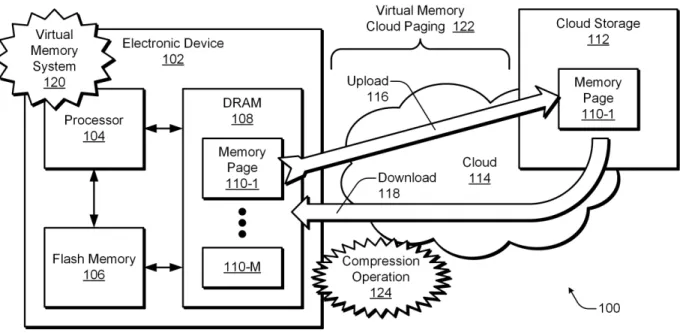
An example cloud-based virtual memory system is described with reference to Fig. 1. An
Fig. 1. Virtual memory system that offloads pages to cloud storage.
As shown in Fig. 1, a virtual memory environment 100 is distributed between an electronic
device 102 and cloud storage 112. The electronic device 102 includes at least one processor 104,
at least one flash memory 106, and at least one DRAM 108. Each of the processor 104, the flash
memory 106, and the DRAM 108 can be coupled one to another. Alternatively, the DRAM 108
can be implemented as a main memory that is directly accessible by the processor 104, and the
flash memory 106 can be implemented as backing storage that is accessed through the DRAM
108. Other computing architectures can be implemented instead.
The processor 104 realizes a virtual memory system 120 that separates the virtual memory
space into multiple memory regions. Examples of memory regions include equal-sized memory
pages and variable-sized memory segments. For clarity, the memory regions are referred to as
memory pages in the examples presented herein, but the described principles are applicable to
other types of memory regions. As shown, the virtual memory is divided into multiple memory
pages 110-1…110-M, with “M” representing a positive integer. Although not explicitly depicted
area of the DRAM 108. Using data compression or creating a compressed area of a DRAM for
virtual memory is also referred to as “zram,” “compcache,” or using a RAM disk for virtual
memory.
The virtual memory environment 100 includes at least one network, which is represented
by a cloud 114. The network may include the internet, a wireless local area network (WLAN)
(e.g., a Wi-Fi network), a wireless wide area network (WWAN) (e.g., a cellular network),
combinations thereof, and so forth. The electronic device 102 is coupled to the cloud storage 112
via the cloud 114. The cloud storage 112 can be implemented with at least one server, such as an
internet server farm including data storage capabilities. Examples of virtual memory cloud paging
122 are described next.
In example operations, the virtual memory system 120 offloads a memory page 110 using
virtual memory cloud paging 122. The virtual memory cloud paging 122 includes an upload
operation 116 and a download operation 118. As part of the virtual memory cloud paging 122, the
virtual memory system 120 determines a candidate memory page 110 for offloading from time to
time. Any of many different techniques for determining a candidate memory page 110 can be
employed. Example techniques involve an LRU analysis, identifying unused pages over some
time interval, detecting that a maximum memory utilization percentage has been reached,
discovering that another memory page is to be paged back onto the device, and combinations
thereof.
Responsive to a determination that a memory page 110-1 is to be paged off the electronic
device 102, the virtual memory system 120 implements virtual memory cloud paging 122. For
example, to perform an upload operation 116, the virtual memory system 120 causes the electronic
or as part of the upload operation 116, the electronic device 102 can compress the memory page
110-1 to reduce a size thereof as part of a compression operation 124. Accordingly, the electronic
device 102 can transfer a compressed version of the memory page 110-1 to the cloud storage 112.
The cloud storage 112 is therefore responsible for retaining the memory page 110-1.
During the page retention period, the electronic device 102 may decide to update the memory page
110-1. To do so, the virtual memory system 120 can transfer a complete copy of the updated
memory page 110-1 to the cloud storage 112 as a replacement. If, for example, a 4 KB page is
compressed to around 1.5 KB, a single internet protocol (IP) packet may be sufficient to replace
the retained copy of the memory page 110-1 at the cloud storage 112. Alternatively, the virtual
memory system 120 may transmit an indication of the changed portions of the memory page 110-1
while omitting unchanged portions.
At some point, the electronic device 102 may decide that it is necessary or more efficient
to execute some application while the memory page 110-1 is stored locally. To return the memory
page 110-1 to the DRAM 108, the virtual memory system 120 causes the electronic device 102 to
perform the download operation 118. The download operation 118 includes retrieving the memory
page 110-1 from the cloud storage 112 for storing in the DRAM 108. If the compression operation
124 was performed for the upload operation 116, the electronic device 102 can decompress the
memory page 110-1 and store a decompressed version of the memory page 110-1 in the DRAM
108. Alternatively, the electronic device 102 can store a compressed version of the memory page
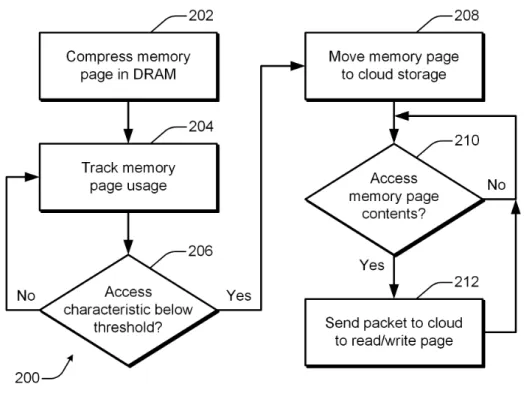
Fig. 2. Process for operating a cloud-based virtual memory system.
Fig. 2 depicts an example technique 200 to operate a cloud-based virtual memory system.
The technique 200 includes six (6) blocks 202-212. At block 202, a memory page 110 is
compressed and stored in the DRAM 108 in accordance with a compressed-block RAM procedure,
e.g., using zram principles. Alternatively, the memory page 110 may remain uncompressed to
reduce demands on the processor 104. At block 204, the virtual memory system 120 tracks
memory page usage in accordance with a scheme to trigger memory paging. For example, each
memory page 110 may be flagged, and a timer may be started. Each time a memory page 110 is
accessed, the corresponding indicator is unflagged.
At block 206, the virtual memory system 120 determines if an access characteristic is below
a threshold. Continuing with the page-flagging example, any memory page 110 that remains
flagged upon expiration of the timer has an access characteristic that is below the threshold. If the
access characteristic of a given memory page 110 is below the threshold, then the technique 200
transitions to block 208 for that selected memory page 110-1. Other types of thresholds or virtual
memory criteria may alternatively be used. For instance, any memory page 110 that is not accessed
at least twice over a two-day period may be a candidate for offloading. Also, candidates may be
selected for offloading based on having a lowest relative access frequency over some time period,
such as an hour or a week.
At block 208, the virtual memory system 120 moves the selected memory page 110-1 to
the cloud storage 112 using a network of the cloud 114 as part of an upload operation 116. While
the memory page 110-1 is retained at the cloud storage 112, the electronic device 102 may
determine at block 210 whether an application is attempting to access the contents of the memory
page 110-1. If not, the virtual memory system 120 may refrain from any activity with that memory
page 110-1 until an access does occur at block 210. If, however, the electronic device 102 does
access the memory page 110-1 at block 210, the virtual memory system 120 generates at least one
packet indicating an access operation. The access operation can be a read or a write operation. If
the access operation is a write, the packet can include full replacement data or just changes for the
memory page 110-1. At block 212, the virtual memory system 120 sends the generated packet to
the cloud storage 112 to read or alter at least a portion of the memory page 110-1. If an access
frequency of a particular memory page 110-1 exceeds a threshold, the virtual memory system 120
can return the particular memory page 110-1 to the electronic device 102 as part of a download
References:
[1] Patent Publication: US20180364918A1. Managed NAND Cold Data Storage. Priority Date:
June 19, 2017.
[2] A. Boroumand et al. 2018. Google Workloads for Consumer Devices: Mitigating Data
Movement Bottlenecks. In ASPLOS ’18: 2018 Architectural Support for Programming Languages
and Operating Systems, March 24–28, 2018, Williamsburg, VA, USA. ACM, New York, NY,