Limited Discrepancy AND/OR Search and Its
Application to Optimization Tasks in Graphical Models
Javier Larrosa, Emma Rollon
UPC Barcelona Tech
Barcelona, Spain
Rina Dechter
University of California, Irvine
Irvine, California, USA
Abstract
Many combinatorial problems are solved with a Depth-First search (DFS) guided by a heuristic and it is well-known that this method is very fragile with respect to heuristic mistakes. One standard way to make DFS more robust is to search by in-creasing number of discrepancies. This approach has been found useful in several domains where the search structure is a height-bounded OR tree. In this paper we investigate the generalization of discrepancy-based search to AND/OR search trees and propose an extension of the Limited Discrep-ancy Search (LDS) algorithm. We demonstrate the relevance of our proposal in the context of Graph-ical Models. In these problems, which can be solved with either a standard OR search tree or an AND/OR tree, we show the superiority of our approach. For a fixed number of discrepancies, the search space visited by the AND/OR algorithm strictly contains the search space visited by stan-dard LDS, and many more nodes can be visited due to the multiplicative effect of the AND/OR decom-position. Besides, if the AND/OR tree achieves a significant size reduction with respect to the stan-dard OR tree, the cost of each iteration of the AND/OR algorithm is asymptotically lower than in standard LDS. We report experiments on the min-sum problem on different domains and show that the AND/OR version of LDS usually obtains better solutions given the same CPU time.
1 Introduction
Heuristic Search [Pearl, 1984] is a standard AI method to model and solve combinatorial problems. The general idea is to abstract the space of possibilities as a graph where so-lutions correspond to paths from an initial node to one of the possibly many goal nodes. The method is suitable for prob-lems in which there is aheuristictelling how promising it is to find a good path from each node to a goal node.
In this paper we restrict ourselves to the class of problems where the graph is a height-bounded tree (the height of a tree is the length of the longest path from the root to a leaf). For these problems, the usual search method is Depth-First and
the heuristic is used to decide the expansion order of the cur-rent node successors. It is well-known that the performance of the algorithm is heavily dependent on this ordering, espe-cially at shallow levels on the tree. If a bad decision is made on one of this early nodes, a large sub-tree must be explored before this decision can be reversed. To make things worse, it has been observed that heuristics tend to be less reliable at shallow nodes where sub-problems are both larger and less biased by the (shorter) path from the root.
Search based on discrepancies (LDS [Harvey and Gins-berg, 1995], ILDS [Korf, 1996], DBDS [Walsh, 1997] ,...) is a very successful method to make Depth-First more robust with respect to early heuristic mistakes [Hmidaet al., 2010; Sakuraiet al., 2000; Joncouret al., 2010]. These algorithms tend to stick to the heuristic advice and only disregard it grad-ually as search proceeds. Disregarding the heuristic is called adiscrepancy and discrepancy-based algorithms visits tree leaves in increasing number of discrepancies.
While standard OR search trees suffice for modeling the search space of many problems, some are better modeled with AND/OR trees [Pearl, 1984; Nilsson, 1980]. Some well-known examples areGraphical Models[Dechter, 2013] and
Probabilistic Planning[Geffner and Bonet, 2013].
In this paper we introduce LDSAO, a direct extension of LDS to AND/OR search trees and demonstrate its potential in themin-sum problem over Graphical Models (GM). This problem includes important tasks like MPE/MAP inBayesian NetworksandMarkov Random Fields[Koller and Friedman, 2009], and weighted CSPs [Mesegueret al., 2006], and has been the topic of intense research in the last decade. There are two main reasons for chosing this domain. Firstly, GMs can be modeled both as an OR and an AND/OR search space so it seems a natural setting for comparing the two alternatives. Secondly, in a recent, very extensive evaluation [Alloucheet al., 2015], LDS was found a very competitive method.
We show that, in the GM context, each iteration of LD-SAO includes the search space region that LDS would visit with the same number of discrepancies, but LDSAO can visit a much larger region. Moreover, if the AND/OR tree is sig-nificantly smaller than the OR tree, each iteration can be done in asymptotically less time. Our experiments on six different benchmarks corroborate the theory and show that LDSAO can in general find better quality solutions than LDS, given the same amount of time.
The structure of the paper is as follows. Section 2 revises basic concepts and properties of Discrepancy-based search. Section 3 makes the generalization to AND/OR trees and presents LDSAO. In the first part of Section 4 there are pre-liminaries on Graphical Models concepts and the description of their AND/OR search tree. In the second part, it is shown how LDSAO instantiates to Graphical Models and it is shown its theoretical advantage over LDS. Section 5 reports experi-mental results on the min-sum problem. Finally, in Section 6 we discuss some limitations of our approach and some direc-tions of future work.
2 Limited Discrepancy Search for OR Search
As is customary in the Discrepancy-based context, we make the general assumption of a completebinarysearch tree with bounded heighth. Leaf nodes may be goals or failures and the task of interest is to find a goal leaf. Each internal node represents a decision that has to be made to reach a goal.We also follow the standard convention of assuming that the left child of each internal node represents following the heuristic and the right child represents going against the heuristic. Thenumber of discrepancies of a leaf is the num-ber of right turns in the path from the root to the leaf [Harvey and Ginsberg, 1995]. It is easy to see that the number of ter-minals withkdiscrepancies is hk .
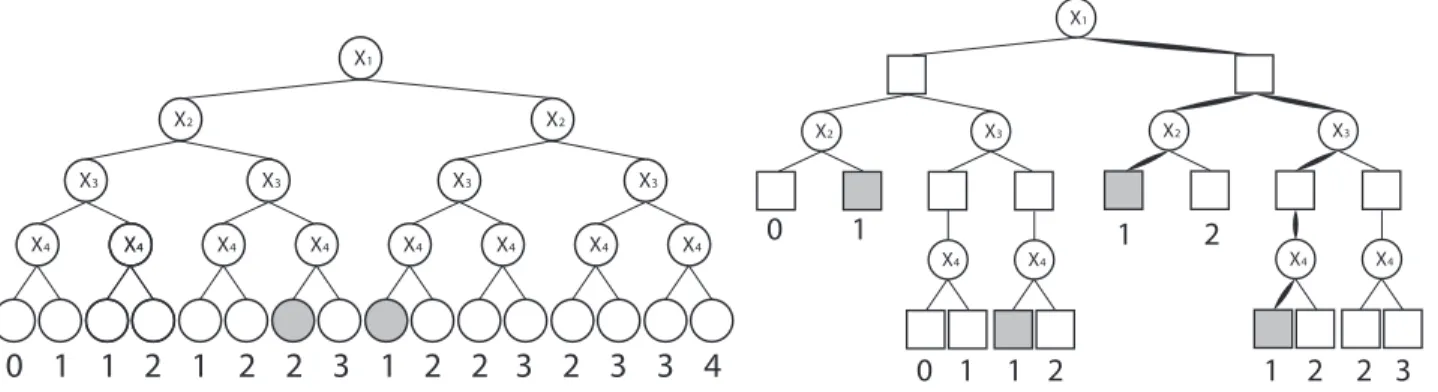
Figure 1 (left) shows a search tree of height4. Shadow leaves represent goals. The number below each leaf indicates its number of discrepancies.
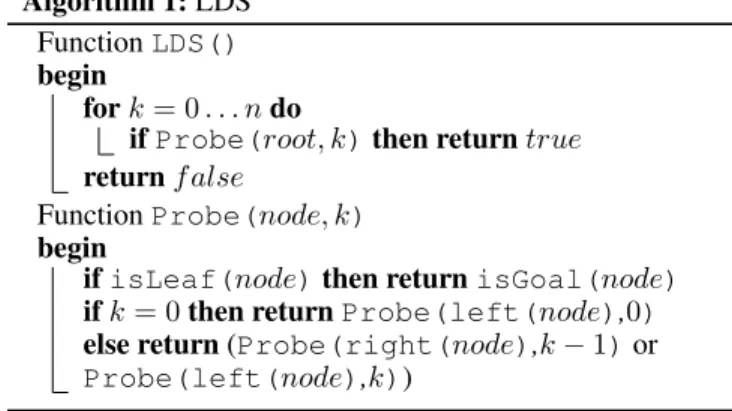
Limited Discrepancy Search (LDS) [Harvey and Ginsberg, 1995] is the algorithm that searches for a goal leaf increas-ing iteratively the number of discrepancies. The pseudo-code is given in Algorithm 1. Thek-th iteration of the main loop will visit all the leaves havingkor fewer discrepancies. The P robe function is a standard recursive implementation of DFS with three particularities:i)it keeps track (parameterk) of the number of discrepancies still available,ii)if a
discrep-ancy is consumed,kis decreased before the recursive call and iii) if no further discrepancies are available, the algorithm does not disregard the heuristic. Since then-th iteration visits all the leaves, the algorithm is complete. In the example of Figure 1 (left), LDS would stop in thek= 1iteration where
it would find the shadowed solution with 1 discrepancy. In practice LDS is used in an any-time manner until a solu-tion is found or the available time is exhausted. LDS has also been successfully used in optimization problems, where each leaf has an associated cost and the task of interest is to find the least-cost one. In this case the heuristic gives advise about the successor having the lowest cost leaf below and the result-ing (any-time) algorithm outputs upper-bounds of the optimal solution that improve over time.
The following property shows why, in practice, it is only possible to run the first iterations of the algorithm.
Property 1. The complexity of the k-th iteration of LDS searching on a binary tree of heighth, and assumingk < h/2, isO(hk+1).
Algorithm 1:LDS FunctionLDS()
begin
fork= 0. . . ndo
ifProbe(root, k)then returntrue
returnf alse
FunctionProbe(node, k)
begin
ifisLeaf(node)then returnisGoal(node)
ifk= 0then returnProbe(left(node),0)
else return(Probe(right(node),k 1)or Probe(left(node),k))
3 Limited Discrepancy for AND/OR Search
3.1 AND/OR Search Trees
In AND/OR search trees [Nilsson, 1980; Pearl, 1984] there are two types of nodes: OR nodes and AND nodes. OR nodes represent branching points where a decision has to be made, and AND nodes represent sets of sub-goals that need to be accomplished. The two children of OR nodes are AND nodes, and the (not necessarily two) children of AND nodes are OR nodes. OR nodes are always internal nodes, while AND nodes may be internal nodes, or leaves. A leaf may be labeled as a goal or as a failure. The root of the tree is an OR node. As before, we assume that the left child follows the heuristic advice and the right child goes against it.
In the AND/OR context paths to leaves are generalized to trees. Asolution tree is a sub-tree that (1) contains the AND/OR tree root, (2) if an OR node is in the solution tree, then exactly one of its children is in the solution tree, (3) if an AND node is in the solution tree, then all its children are. A solution tree is agoal solution treeif all its AND nodes with no children are labeledgoal. The task of interest in an AND/OR search tree is to find a goal solution tree.
Figure 1 (right) shows an AND/OR tree where circles are OR nodes and squares are AND nodes. Goal leaves are shad-owed. The tree has2 goal solution trees and thicker edges show one of them.
The height h of an AND/OR tree is the number of OR nodes of the longest path from the root. For simplicity, we consider AND/OR trees such that all their solution trees have the same tree structure, which implies the same number of leaves, notedl. In the running exampleh= 3andl= 2.
The following property follows directly from the defini-tion,
Property 2. The size of an AND/OR tree isO(l·2h).
We extend now the concept of discrepancy to the AND/OR context,
Definition 1. The number of discrepancies of a leaf is the number of right turns made from OR to AND nodes in the path from the root. Thenumber of discrepancies of a terminal treeis themaximumamong its leaves.
Note that for measuring how discrepant a solution tree is we take themaximum among its leaves. There are several
X2 X3 X1 X4 XX44 X4 X4 X4 X4 X4 X4 X3 X3 X3 X2
0 1 1 2 1 2 2 3 1 2 2 3 2 3 3 4
X2 X1 X4 X4 X30
0
1
1
1
2
3
1
2
1
2
2
X2 X4 X4 X3Figure 1: An OR search space (left) and an AND/OR search space (right). other alternatives, but, as we will see, this one allows simple
and efficient discrepancy-based algorithms.
Figure 1 (right) shows below each leaf its number of discrepancies. The two goal solution trees have two branches, each. In both cases the number of discrepancies ismax{1,1}= 1.
3.2 LDSAO
LDAO (Algorithm 2) is the generalization of LDS to AND/OR trees. It searches for goal solution trees and, as in the LDS case, each iteration of the main loop allows one more discrepancy.
The main difference between LDS and LDSAO is the man-agement of the AND nodes. In LDSAO each AND node searches recursively for sub-goals at each of its OR succes-sors (FunctionP robeAnd). Note that these transitions do not consume discrepancies (i.e, the value of k passes unmodi-fied along the function) because they are not associated with choices and the heuristic does not play any role.
The following two properties show the behaviour and the complexity of LDSAO.
Property 3. Thek-th iteration of LDSAO visits all terminal trees withkor fewer discrepancies.
Property 4. The complexity of thek-th iteration of LDSAO searching on a binary AND/OR tree of heighth, where termi-nal trees havelleaves, and assumingk < h/2, isO(l·hk+1).
4 LDSAO for Graphical Models
In this Section we demonstrate the potential of LDSAO for Graphical Models. We start with some basic definitions and then give the properties that show the theoretical advantage of LDSAO over LDS.
4.1 Graphical Models
Abinary graphical modelis a pairM= (X,F), whereX =
{X1, X2, . . . , Xn}is the set ofboolean variables. Fis a set
of non-negative real valuedcost function, where eachf 2F
is defined on a subset of the variables called itsscope and notedscope(f).
Themin-sum problemis the computation of the minimum cost complete assignment,
Algorithm 2:LDSAO FunctionLDSAO()
begin
fork= 0..ndo
ifProbeOr(root, k)then returntrue
returnf alse
FunctionProbeOr(nodeOr, k)
begin
ifk= 0then return
ProbeAnd(left(nodeOr),0)
returnProbeAnd(right(nodeOr),k 1)or ProbeAnd(left(nodeOr),k)
FunctionProbeAnd(nodeAnd, k)
begin
ifisLeaf(nodeAnd)then returnisGoal(nodeAnd)
fornodeOr2Successors(nodeAnd)do
ifnotProbeOr(nodeOr,k)then returnf alse returntrue x⇤=argminx2X X f2F f(xf) (1) whereXdenotes the set of complete assignments to the
vari-ables andxfdenotes the projection ofxon the scope off.
Theprimal graphGof a graphical modelMhas the vari-able as nodes, and an edge(Xp, Xq)is inGiff the pair of
variablesXp, Xqappears in the scope of anyf 2F. The
pri-mal graph is a useful tool, because it is a graphical represen-tation of the problem structure in terms of explicit interaction between variables.
A pseudo-tree T = (V, E0) of the primal graph G = (V, E)is a rooted tree over the same set of vertexesV such that every edge inE E0 must connect a node to one of its ancestors inT. The root is notedXroot.
The purpose of the pseudo-tree is to make explicit how the graphical model can be broken into independent com-ponents that can be solved separately. More precisely, it captures conditional independencies based on cost-function
X1 X3 X2 X4 X1 X3 X4 X2 (a) (b)
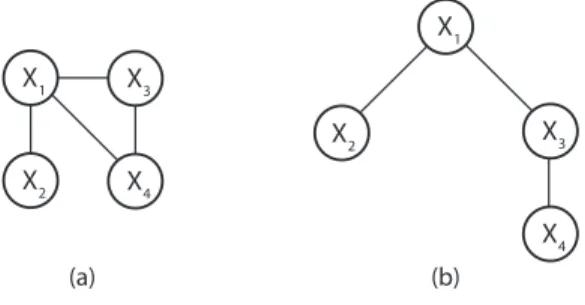
Figure 2: (a) A primal graphGof a graphical model over 4 variables; and (b) A pseudo-tree ofG
scopes. If a partial assignment of variables follows the top-down order of the tree, each unassigned sub-tree is an inde-pendent sub-problem (conditioned to the assignment) and can be solved separately. The algorithms that exploit such inde-pendences are those that use the AND/OR tree to be defined next [Dechter and Mateescu, 2007].
Figure 2 (left) depicts the primal graph G of a graph-ical model with 4 variables. One possible set of cost
functions that would have such a graph has the following scopes{{X1, X2},{X1, X3},{X1, X4},{X3, X4}}. Figure
2 (right) depicts one possible pseudo-tree T for G. The pseudo-tree indicates that the assignment of variableX1will
produced two conditionally independent sub-problems whose set of variables will be the two sub-trees rooted by its two children,X2andX3.
4.2 OR and AND/OR search trees for Graphical
Models
A search space must capture the set of all possible assign-ments. For Graphical Models there are two possibilities: an OR, and an AND/OR tree. The obvious one is an OR tree of heightn(the number of variables). Each node is labeled with a variable and its two children correspond to its two pos-sible assignments. It is clear that the size of such a tree is O(2n). The OR tree in Figure 1 (left) corresponds indeed to
the Graphical Model with the primal graph in Figure 2 (left). A more compact approach is the AND/OR search tree, an alternative search space that exploits conditional decompo-sitions. It is driven by a pseudo-treeT. Each OR node is labeled with a variable Xp 2 X and its two children are
AND nodes, each one corresponding to one possible assign-ment ofXp(left child follows the heuristic advise, right child
goes against it). The children of an AND node are OR nodes labeled with the children of Xp inT. The children of an
AND node represent the independent sub-problems given the assignments from the root up to that node. The root of the AND/OR searchtreeis an OR node labeled withXroot, the
root ofT. The AND/OR tree in Figure 1 (right) corresponds to the Graphical Model with the primal graph in Figure 2 (left) and pseudo-tree in Figure 2 (right).
Clearly, the size of the AND/OR tree of a Graphical Model is O(l· 2h) whereh andl are the height and the number
of leaves of the pseudo-tree, respectively [Dechter and Ma-teescu, 2007]. In our running example, the size of the OR tree is exponential on its height (4) while the size of the AND/OR
tree is exponential in its height (3) which is also the height of
its corresponding pseudo-tree.
4.3 LDS vs LDSAO
We now compare the performance of Limited Discrepancy Search over the OR tree (LDS) versus the AND/OR counter-part (LDSAO). First, we show that each iteration of LDSAO is at least as powerful in terms of visited terminals than the same iteration of LDS.
It can be seen that there is a one-to-one mapping between complete assignments of the variables, leaves in the OR tree and solution trees in the AND/OR tree. It follows the fact that in both trees there is a left-or-right turn below each OR node and there is one OR node associated to each variable.
Letxbe an assignment of all the variables of a Graphical Model. The number of discrepancies of the leaf associated to xin the OR tree (according to the standard definition) is noted DOR(x), the number of discrepancies of the solution tree
as-sociated toxin the AND/OR tree (according to Definition 1) is notedDAN D/OR(x). It can be seen that,
Lemma 1. For any complete assignment x, it holds that DAN D/OR(x)DOR(x).
Proof. In both cases, they have the same left and right turns in their associated search spaces. By definitionDOR(x)is the
number of right turns, whileDAN D/OR(x)takes the
maxi-mum over diferent fragments, which may be smaller or equal, but not larger.
What follows is a direct consequence of the previous lemma,
Property 5. If assignmentx, is visited during thek-th iter-ation of LDS, then it is visited during thek-th iteration of LDSAO.
The two goal leaves in Figure 1 (left) correspond to the same assignments as the two goal solution trees in Figure 1 (right). Note that in one of them the number of discrepancies decreases in the AND/OR tree. As a result, LDSAO would visit the two of them in thek= 1iteration.
Regarding time complexity it is clear that thek-th iteration of LDS and LDSAO (assumingk ⌧ h, n) isO(nk+1)and O(l·hk+1), respectively. Sincehis smaller thann(and in many important cases much smaller), LDSAO will be faster than LDS.
The actual set of assignments that LDSAO will visit and LDS will not at thek-iteration depends on the pseudo-tree structure. We illustrate it with thek= 1case in three
differ-ent simple scenarios where we also discuss the differdiffer-ent time complexities.
• Consider a pseudo-tree whose root has the rest of nodes as children (that is,h= 2, l=n 1). Thek= 1
iter-ation of LDSAO will visit some assignments that under the OR tree perspective will have up ton 1
discrepan-cies. The cost of this iteration will be timeO(n). • Consider a pseudo-tree whose root has two children,
each one rooting a chain of sizen/2andn/2 1,
re-spectively (that is, h= (n/2) + 1, l = 2). Thek = 1
OR perspective will have up to2discrepancies. The cost
of such iteration will beO(n2), similar to the LDS case.
• If the pseudo-tree is a complete binary tree (that is,h= lognandl=n/2), thek= 1iteration of LDSAO will
visit assignments that under the OR tree would have up toO(n/2)discrepancies. The cost of such iteration will
beO(n·(logn)2).
5 Experimental Results
In this section we report results comparing LDS vs LDSAO as any-time schemes in the min-sum problem of Graphical Mod-els. Note that LDS was recently found extremely efficient in that domain (see e.g. Figure4 in [Allouche et al., 2015]). All executions had a time limit of 1hour. We have
experi-mented with six different well-known benchmarks. Instances have been taken from http://genoweb.toulouse.inra.fr/ degivry /evalgm and http://bioinfo.cs.technion.ac.il/superlink. All in-stances have been read inwcspformat and in those containing more than one connected component, only the largest one has been considered.
In our experiments both algorithms guided the search with the static Mini-Bucket-Elimination heuristic [Kask and Dechter, 1999; Ihleret al., 2012; L. Otten and Dechter, 2012]. This heuristic has a control parameter, called i-bound, that allows to trade memory for accuracy. In the experiments the two algorithms ran with the samei-bound (10for all bench-marks except forLinkage andType4 pedigree where it was set to15and16, respectively). Since many instances con-tain non-boolean variables, we considered all assignments but the one with the highest heuristic value as a discrepancy (ties were broken lexicographically).
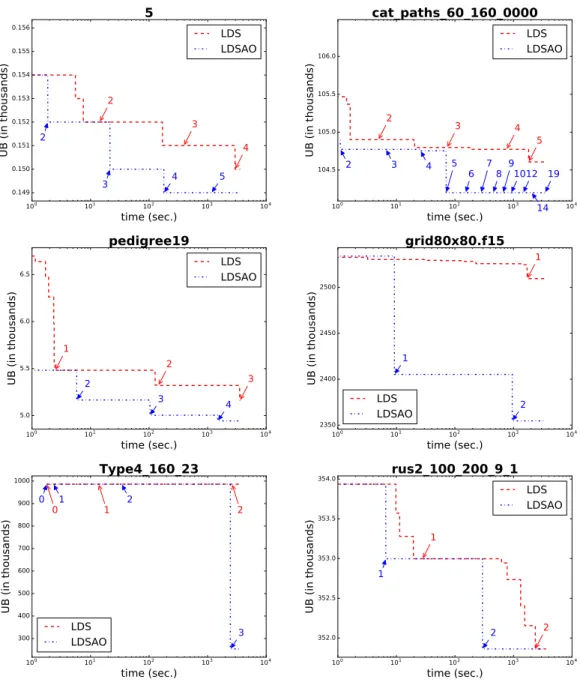
Figure 3 shows any-time plots for one instance from each benchmark (note the logarithmic scale of time). Results for the rest of instances (a total of138) can be downloaded from http://www.cs.upc.edu/larrosa/ lds-experiments.pdf. It can be seen that consistently LDSAO has better solutions than LDS given the same amount of time. As previously discussed, there are two reasons why LDSAO is likely to be superior than LDS: it iterates faster and it visits more complete as-signments at each iteration. To be able to separately assess these two factors, plots also indicate the ending point of each iteration. For instance, in theSpot5 5.wcspinstance (top-left plot) thek = 3iteration ends after20and400 seconds for LDSAO and LDS, respectively. Besides, at the end of this iteration LDSAO has an upper bound of150, while LDS has
an upper bound of151. Similar results can be observed in
thecombinatorial auction, linkage and gridinstances (i.e, top and middle rows). In theType 4 pedigreeandDBNinsntaces (i.e, bottom row) it can be observed that the advantage comes exclusively from the faster iteration of LDSAO. It means that the additional solutions that LDSAO visits for a given iter-ation do not provide any improvement in the upper bound. This is a situation that we have encountered in many other in-stances. There are two reasons that explain this phenomenon: i)the additional solutions that LDSAO may visit with respect to LDS contain their discrepancies at deep levels of the search space and Branch-and-Bound usually prunes before these dis-crepancies may occur andii)discrepancies at deep levels are
more unlikely to do any good since the heuristic is much more accurate there [Walsh, 1997].
As it can be seen in the plots, LDS updates more frequently the value of its best-so-far solution (see for instance thek= 2
iteration in the bottom-rightrus-2plot). The reason is that LDS is fully any-time in the sense that it can identify an proving solution in the middle of an iteration and report it im-mediately. In the LDSAO case, the situation is more complex. The algorithm goes from one sub-problem to another sequen-tially trying to find good sub-solutions in one sub-problem af-ter the others. Consequently, LDSAO cannot report improve-ments until the end of each iteration. The natural way to over-come this drawback is to incorporate to LDSAO a breadth ro-tation scheme like the one proposed in [Otten and Dechter, 2012].
6 Conclusions and Future Work
In this paper we have presented a generalization of LDS [Harvey and Ginsberg, 1995] to AND/OR tree search and demonstrated its practical interest on the min-sum problem for Graphical Models. In this domain, we have shown the-oretically and corroborated empirically that our LDSAO can search more solutions with (asymptotically) less effort.
One practical disadvantage of our approach inherited from the AND/OR tree usage is that LDSAO must use a static vari-able ordering (while LDS does not). This is an important lim-itation that needs to be addressed, since some state-of-the-art min-sum solvers find dynamic orderings instrumental to their success. One possible solution is to allow LDSAO to use a semi-dynamic variable ordering, where variables can be as-signed in any order within pseudo-tree chains. Another pos-sibility is to have more than one pseudo-tree, and use one or another depending on what variables are dynamically se-lected at the first levels of the search.
The investigation reported in this paper leaves room to many lines of future work. First, variations of LDS such as ILDS [Korf, 1996] or DBDS [Walsh, 1997] to the AND/OR context should be explored. We also believe that LDSAO can be improved to do a more intelligent management of the search effort. For instance, in problems with an unbalanced pseudo-tree it seems reasonable to allow more discrepancies on the largest sub-problems. More discrepancies should also be allowed on the harder sub-problems. Finally, we also want to explore the applicability of LDSAO in on-line plan-ning [Geffner and Bonet, 2013] and other domains where AND/OR structures are used.
Acknowledgments
We thank William Lam for his help in running the exper-iments. This work was suppported in part by MINECO under project TIN2015-69175-C4-3-R, by NSF grants IIS-1065618, IIS-1526842, and IIS-1254071, and by the US Air Force under Contract No. FA8750-14-C-0011 under the DARPA PPAML program.
References
[Alloucheet al., 2015] David Allouche, Simon de Givry, George Katsirelos, Thomas Schiex, and Matthias Zytnicki.
Figure 3: Experimental results on one representative instance from six different benchmarks. Top: SPOT5, Auctions. Middle: Linkage, Grids. Bottom: Type4 pedigrees, DBN. Plots report quality of best-found solution versus time. Note the logarithmic scale of time. Arrows indicate the end of each iteration.
Anytime hybrid best-first search with tree decomposition for weighted CSP. In Principles and Practice of Con-straint Programming - 21st International Conference, CP 2015, Cork, Ireland, August 31 - September 4, 2015, Pro-ceedings, pages 12–29, 2015.
[Dechter and Mateescu, 2007] Rina Dechter and Robert Ma-teescu. And/or search spaces for graphical models. Artif. Intell., 171(2-3):73–106, 2007.
[Dechter, 2013] Rina Dechter. Reasoning with Probabilistic and Deterministic Graphical Models: Exact Algorithms.
Synthesis Lectures on Artificial Intelligence and Machine Learning. Morgan & Claypool Publishers, 2013.
[Geffner and Bonet, 2013] Hector Geffner and Blai Bonet.A Concise Introduction to Models and Methods for Auto-mated Planning. Synthesis Lectures on Artificial Intelli-gence and Machine Learning. Morgan & Claypool Pub-lishers, 2013.
[Harvey and Ginsberg, 1995] William D. Harvey and Matthew L. Ginsberg. Limited discrepancy search. In Proceedings of the Fourteenth International Joint Conference on Artificial Intelligence, IJCAI 95, Montr´eal
Qu´ebec, Canada, August 20-25 1995, 2 Volumes, pages 607–615, 1995.
[Hmidaet al., 2010] Abir Ben Hmida, Mohamed Haouari, Marie-Jos´e Huguet, and Pierre Lopez. Discrepancy search for the flexible job shop scheduling problem. Computers & Operations Research, 37(12):2192–2201, 2010. [Ihleret al., 2012] Alexander Ihler, Natalia Flerova, Rina
Dechter, and Lars Otten. Join-graph based cost-shifting schemes. InUncertainty in Artificial Intelligence (UAI), pages 397–406. AUAI Press, Corvallis, Oregon, August 2012.
[Joncouret al., 2010] C. Joncour, S. Michel, Ruslan Sadykov, D. Sverdlov, and Franc¸ois Vanderbeck. Column generation based primal heuristics. Electronic Notes in Discrete Mathematics, 36:695–702, 2010.
[Kask and Dechter, 1999] K. Kask and R. Dechter. Branch and bound with mini-bucket heuristics. Proc. IJCAI-99, 1999.
[Koller and Friedman, 2009] D. Koller and N. Friedman.
Probabilistic Graphical Models. MIT Press, 2009. [Korf, 1996] Richard E. Korf. Improved limited discrepancy
search. InProceedings of the Thirteenth National Confer-ence on Artificial IntelligConfer-ence and Eighth Innovative Ap-plications of Artificial Intelligence Conference, AAAI 96, IAAI 96, Portland, Oregon, August 4-8, 1996, Volume 1., pages 286–291, 1996.
[L. Otten and Dechter, 2012] K. Kask L. Otten, A. Ihler and R. Dechter. Winning the pascal 2011 map challenge with enhanced and/or branch-and-bound. InWorkshop on DIS-CML 2012 (a workshop of NIPS 2012), 2012.
[Mesegueret al., 2006] Pedro Meseguer, Francesca Rossi, and Thomas Schiex. Soft constraints. In Handbook of Constraint Programming, pages 281–328. 2006.
[Nilsson, 1980] N. J. Nilsson. Principles of Artificial Intelli-gence. Tioga, Palo Alto, CA, 1980.
[Otten and Dechter, 2012] Lars Otten and Rina Dechter. Anytime AND/OR depth-first search for combinatorial op-timization. AI Commun., 25(3):211–227, 2012.
[Pearl, 1984] J. Pearl. Heuristics: Intelligent Search Strate-gies. Addison-Wesley, 1984.
[Sakuraiet al., 2000] Yuko Sakurai, Makoto Yokoo, and Koji Kamei. An efficient approximate algorithm for win-ner determination in combinatorial auctions. InEC, pages 30–37, 2000.
[Walsh, 1997] Toby Walsh. Depth-bounded discrepancy search. InProceedings of the Fifteenth International Joint Conference on Artificial Intelligence, IJCAI 97, Nagoya, Japan, August 23-29, 1997, 2 Volumes, pages 1388–1395, 1997.