Voting System Qualification Test Report
Dominion Voting Systems, Inc.
Democracy Suite, Release 4.14.17, Version 1
______________________________________________
August 2013
Florida Department of State Division of Elections R. A. Gray Building, Room 316
500 S. Bronough Street Tallahassee, FL 32399-0250
Contents
Executive Summary ... 3
Introduction ... 4
Background ... 4
System Overview ... 4
Components under Review ... 6
Conduct of Tests / Findings ... 7
Physical Audit ... 8
Systems Setup & Configuration ... 8
Functional System Audit ... 11
Creation/Import of Election Definitions ... 11
Election Management System – Administrative Reports ... 15
Voting Equipment Menus – Administrative and Diagnostic Reports ... 15
Mock Election Testing ... 15
Mass Ballot Counts ... 17
Additional Testing ... 20
Accessibility Test - Sound Pressure Level ... 21
Accessibility Test – Force ... 22
Audit Mark Review ... 24
Battery Life Test – ICE / ICP ... 27
Contest Recounts ... 27
Folded Ballot Test ... 28
Scanner Sensitivity ... 33
Simulated System Failure/Recovery ... 35
Time Change – ICP/ICE [Daylight Savings Time / Leap Year] ... 36
User Security ... 36
Environmental Tests... 37
Source Code Review ... 37
Continuous Improvement / Recommendations ... 38
Conclusion ... 38
Appendices ... 39
Acronyms ... 39
Figures Index ... 40
Executive Summary
The application for certification by Dominion Voting Systems, Inc. (DVS) of its Democracy Suite Release 4.14.17, Version 1 (DVS-DS) voting system was complete in March 20131. The Bureau of Voting Systems Certification (BVSC) began certification test activities in April 2013. BVSC examined the ‘Express’ and ‘Standard’ Configurations.
The system includes the ImageCast Precinct Count (ICP) optical scan tabulator, ImageCast Evolution tabulator (ICE), which can be used for both accessible and precinct voting, and the ImageCast Canon DR-X10C central count (ICC) tabulator. Assessment of this voting system required a full certification qualification test campaign.
BVSC conducted the certification testing in two phases. Phase I consisted of the setup of the two configurations to be examined, programming of two elections (Municipal and Presidential Preference Primary[PPP]), restoration/import of two elections (General and Primary elections), a physical audit, and a functional audit. Phase II encompassed the conduct of mock elections and all election cycle events, such as loading the tabulators with the requisite media, performance of logic and accuracy testing, opening and closing of polls, feeding ballots, central count tabulation, and election night and post-election reporting. The testing included all post-election voting methods and, at a minimum, included the following reporting groups: early voting, election day, absentee, and provisional. Additional tests were performed to verify compliance with standards for sound pressure levels, contest recounts, system failure/recovery, and electronic transmission verification (modem communication), as well as mass ballot count testing for the ICE, ICP, and ICC tabulators. Phase II was a publicly noticed event, which took place in the BVSC test laboratory in Tallahassee, Florida, and occurred from May 20, 2013 to June 28, 2013.
Qualification test results affirm that the voting system under test, Democracy Suite Release 4.14.17, Version 1, Express and Standard Configurations (as configured during the certification event), meet applicable requirements of the Florida Voting Systems Standards, Florida Statutes and Rules, and the Help America Vote Act (HAVA) for usability and accessibility. Therefore, the Florida Division of Elections, Bureau of Voting Systems Certification recommends that the voting system be certified for sale and use in the state of Florida.
1 The technical data package was complete in March 2013. The final test general and primary elections were
Introduction
The Democracy Suite voting system is a paper-based voting system with an element for compliance with HAVA provisions for Americans with Disabilities Act (ADA) accessibility. The voting system is comprised of an election management system (EMS); two types of optical scan precinct count tabulators—the ImageCast Precinct and the ImageCast Evolution, with optional accessible tactical interface (ATI) needed to meet ADA specifications; and an optical scan central count tabulator, the ImageCast Central.
The EMS hardware platform can be configured either as an Express, Standard, or Enterprise Configuration. The Express Configuration includes all EMS software components on a single physical personal computer or laptop that can handle up to 250 precincts. The Standard Configuration uses an optional Local Area Network (LAN) to interconnect the EMS server, and generally includes one or more EMS clients, along with the ImageCast Listener, and an optional RAS Server. The Standard Configuration can handle up to 1000 precincts. The Enterprise Configuration includes one or more clients which interconnect with two server environments, where one server is dedicated to processing tasks and the other server is the dedicated database host. These servers, together, can handle more than 1000 precincts. For this certification activity, Dominion requested that the Express and Standard Configurations be tested and further, that the Standard Configuration use all applications on a single server, rather than the client option.
Background
This is the first time this system is being recommended for certification in the state of Florida.
System Overview
The DVS-DS election management system consists of the following software applications:
Election Event Designer (EED) - client application that integrates the jurisdiction, districts, contests, and candidate database as the main pre-voting phase.
Results Tally and Reporting (RTR) - client application used for integrating election results acquisition, validation, and reporting.
Audio Studio (AS) - client application that facilitates production of audio files.
Application Server (APPS) - server application for executing processes such as rendering ballots, generating audio files, and election files, etc.
Data Center Manager (DCM) - server application used in the back-end data center configuration.
File System Service (FSS) - a Windows service application that helps read and write files on memory cards.
Election Data Translator (EDT) - end-user application used to export election data from election project and import election data into election project.
The following scanning and tabulating devices and ADA voting device are used with DVS-DS:
ImageCast Precinct (ICP) tabulator is an optical scanner, accessible voting device with ballot review. The ICP is attached on a ballot box (photo is ICP only).
ImageCast Evolution (ICE) is a precinct-level optical scanner, with ballot marking capability, audio voting using the ATI, and a tabulator connected to a ballot box.
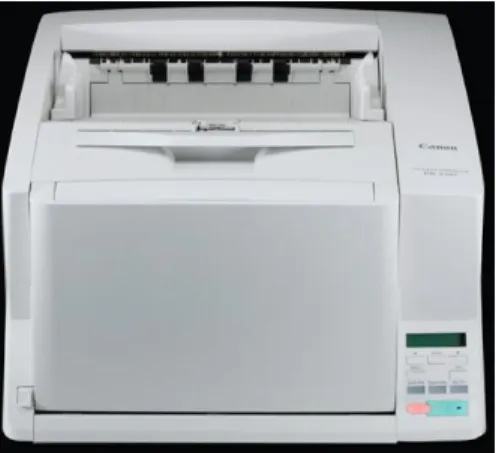
The central count scanners are the ImageCast Central (ICC) tabulators. These systems use commercial-off-the-shelf (COTS) hardware with Dominion software.
Figure 1 – View of ICP
Figure 2 - View of ICE
Components under Review
DVS requested that the following voting system components be reviewed for the Express and Standard Configurations of DVS-Democracy Suite 4.14.17, Version 1:
Election Management System (EMS)
DVS-Democracy Suite EMS Software Common to Express and Standard Configuration Server Election Event Designer
Results Tally and Reporting Audio Studio
Application Server Data Center Manager File System Service Election Data Translator
EMS COTS Software Common to Express and Standard Configuration Server Microsoft .Net Framework 4.0
Microsoft IIS 7.5 (part of the Windows installation) Microsoft Visual J# 2.0
Microsoft Visual C++ 2010 x86 Redistributable Java SE Runtime Environment 6.0 Update 20 or later Dallas 1-Wire Device Driver version 4.03 or newer Adobe Reader 10.0 or later
Optional COTS Software for Express and Standard Configurations Avast! Antivirus Software
Cepstral Voices 5.1.0
Microsoft Excel 2010 or later
Additional Fonts (Arial narrow fonts) eSATA card drivers
UPS drivers Printer drivers
COTS Hardware and Software – Unique to Express and Standard Configuration Server EMS Standard Configuration
Server computer system per Democracy Suite System Configuration Overview Microsoft Windows Server 2008 R2, with service pack 1
Microsoft SQL Server 2008 R2 Standard, with service pack 2
Client computer system per Democracy Suite System Configuration Overview Microsoft Windows 7 Professional, with service pack 1
EMS Express Configuration
Server computer system per Democracy Suite System Configuration Overview Microsoft Windows 7 Professional with service pack 1
Microsoft SQL Server 2008 R2 Express/Advanced Services, with service pack 2 Optional RAS Server, for use with Standard Configuration
Server computer system per Democracy Suite System Configuration Overview Microsoft Windows 2008 Server R2 with service pack 1 installed
Digi International serial port product drivers Digi Connect/Port LTS or equivalent
Optional ImageCast Listener 2.0.3.37502, , for use with Standard Configuration Server computer system per Democracy Suite System Configuration Overview
Microsoft Windows 2008 Server R2 with service pack 1 installed Firewall, WatchGuard XTM 5 Series or equivalent
Auxiliary Equipment
iButton (SHA-1) with USB Reader/Writer: Maxim DS9490R#
Lexar Professional USB 3.0 Dual-Slot Compact Flash Card Reader or equivalent LCD monitor, keyboard, mouse, headset with microphone, audio adapter
D-Link Model DGS-1008G 8-port gigabit Ethernet switch, for use with the Standard Configuration
Election media
iButton: Maxim DS1963S-F5+
Dominion Compact Flash Memory Cards: 4GB, 8GB ImageCast Precinct Optical Scan Tabulator
Hardware version: PCOS 321C, includes internal analog modem Firmware 4.14.5
w/ ballot box COTS Software
Bootloader (COLILO) 20040221 Optional COTS Hardware
eDevices CellGo Low Current GPRS External Cellular Modem ADA polling equipment (and/or precinct scanner) for each polling location:
ImageCast Evolution Optical Scan Tabulator Hardware version: PCOS 410A Firmware 4.14.5.3
w/ ballot box or ballot box w/ optional light pole Optional COTS Hardware
Zoom 3095 External Analog Modem Zoom 4598 3G+ External Cellular Modem ImageCast Central Scan, Canon DR-X10C
ICC COTS Computer Operating System: Microsoft Windows 7 (64-bit) Enterprise edition Elan Technologies, ImgComp.dll, version 2.11
Dallas Maxim, 1-wire driver, version 4.03 or newer (64-bit) with Kofax Virtual Rescan, version 4.5 or version Elite
Conduct of Tests / Findings
The test objective was to verify that the voting system being tested met the applicable requirements of the Florida Voting Systems Standards (FVSS), Florida Statutes and Administrative Rules, and the Help America Vote Act (HAVA) for usability and accessibility.
The FVSS qualification examination for this effort encompassed a physical and functional audit, as well as additional tests to verify compliance with standards for sound pressure levels, ballot sensitivity, and electronic transmission verification (modem communication). In addition, a mass ballot count test was conducted on the precinct count tabulators (ICP and the ICE) and the central count tabulators (ICC-Canon).
Physical Audit
Physical audit activities encompassed comparing and validating the version numbers and systems configuration software items used to set up the system with the descriptions submitted on the application for certification (DS-DE 71). Moreover, BVSC examined the ICE, ICP, and ICC firmware to ensure that they matched the documentation as follows:
For the ICP, BVSC performed this examination by using the vendor’s firmware extract tool. BVSC compared the extracted firmware with the firmware sent with the trusted build from Wyle Laboratories2.
The ICE has a utility which hashes individual programs and displays the program name, version number, and hash value for each program. BVSC used this process to verify the versions for this equipment. BVSC verified the ICC units’ COTS software using the Windows Programs and Features tool in Control Panel, with no variances from the expected version number. Also, BVSC copied and hashed the ICC software from each machine, these copies were evaluated against the hash obtained from the trusted build from Wyle.
Findings:
ICP: Comparison of the vendor’s firmware extract tool to the firmware sent with the trusted build failed. Further examination of the data extracted from the ICP, however, showed that the extraction tool was retrieving the entire contents of the EEPROM chip, not just the installable firmware. The firmware was in the middle of the extracted file. When BVSC isolated the firmware itself from the other superfluous data, BVSC found no discrepancies.
ICE: BVSC found no discrepancies when it compared the firmware sent by Wyle Laboratories to the expected firmware version per the vendor’s Technical Data Package (TDP) documentation.
ICC: BVSC found no discrepancies when it compared the firmware sent by Wyle Laboratories to the expected firmware version per the vendor’s TDP documentation.
Systems Setup & Configuration
Voting system setup included verification that the configurations of the system, as outlined in the submitted TDP documentation, corresponded with the actual system setup.
2 Wyle Laboratories is a test lab that is federally certified (by the U. S. Elections Assistance Commission) to test
The EMS hardware platforms examined for this certification effort included the Express and Standard Configurations of Democracy Suite. BVSC staff used information submitted in the TDP documentation to accomplish this activity.
Findings:
Both the Express and Standard Configurations differed in testing from the versions submitted in the TDP documentation.3 The following diagrams (Express - Figures 4 and 5; Standard – Figures 6 and 7) illustrate the expected configuration DVS submitted with its TDP versus the configurations used in testing. The modifications presented no functionality issues for either the Express or Standard Configurations as tested.
Express Configuration Expected (as submitted in TDP):
Figure 4 - DVS Express Configuration from TDP
Express Configuration Used in Testing (approved with Democracy Suite 4.14.17, Version 1):
Figure 5 - BVSC Express Configuration Used in Testing
Standard Configuration Expected (as submitted in TDP):
Figure 6 - DVS Standard Configuration from TDP
Standard Configuration Used in Testing (approved for use with Democracy Suite 4.14.17, Version 1):
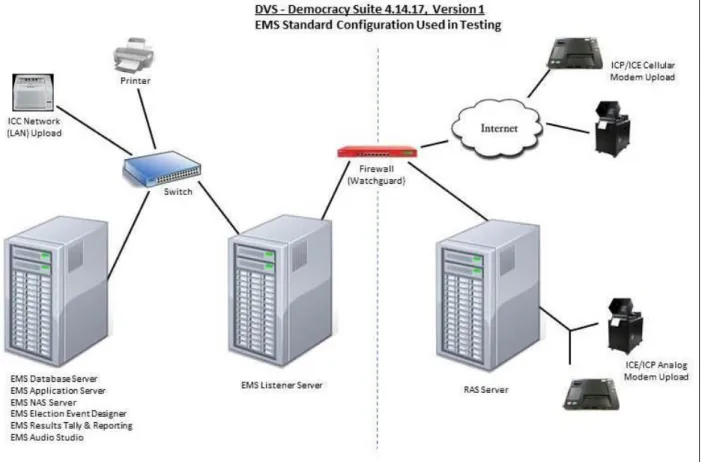
For the testing, both the Express and Standard Configurations included all EMS software components on a single EMS server. The Standard Configuration incorporated a Local Area Network (LAN) to interconnect the EMS server, the ImageCast Listener, and a RAS Server, with a firewall (“Watchguard”) to provide protection from unwanted attacks and allow only trusted data to pass into the system.
Functional System Audit
The functional system audit activities included creation and/or import of four elections (Primary, General, PPP, and Municipal), mock election testing, a mass ballot count, and various other tests conducted to ascertain whether the voting system functioned as defined in the vendor submitted documentation and whether it met requirements outlined in Florida Voting Systems Standards, Florida Statutes, and Administrative Rules. Specific details of these activities follow.
Creation/Import of Election Definitions
Descriptions of the parameters of the elections used in testing are below.
General Election Definition
1. Election Date: November 7, 2006 2. Election Authority: Miami-Dade County 3. Parties 3.1. vendor discretion 4. Languages 4.1. English 4.2. Spanish 4.3. Haitian Creole 5. Precincts
5.1. 749+ precincts, including split precincts 5.2. 20 precincts used for testing (test decks) 6. Ballot Structure
6.1. Page length: 19 inches4 6.2. Coded by Precinct ID 6.3. Full width
6.4. One or more 2-sided, 3-column 7. Ballots for Activities
7.1. Test deck includes at least 20 precincts, and
7.1.1.Test deck uses 1-2-3-4-5 marked ballots methodology, including a ballot with: 7.1.1.1.At least one overvoted contest
7.1.1.2.At least one undervoted contest 7.1.1.3.At least one blank ballot 8. Contests
8.1. Must have, at a minimum, number of candidates to accommodate 1-2-3-4-5 test pattern 8.2. One or more 'Vote for x' (>1) with at least one write-in vote
8.3. One or more with a write-in vote
8.4. Amendment contest with strikethrough and underline
4 The test plan criteria called for a 19” ballot, however, the ballots supplied by the vendor had varying lengths,
8.5. Amendment with the maximum text [include at least 1000 words] 9. Candidates
9.1. Minimum number of candidates to accommodate 1-2-3-4-5 test pattern on at least one contest 10. Reporting Groups
10.1.Absentee 10.2.Early Voting 10.3.Election Day 10.4.Provisional
10.5.Overseas (Federal ballot, UOCAVA, Federal write-in, State write-in, etc.) 11. Precinct Scanners Settings
11.1.Reject ballot for one or more overvoted contests 11.2.Reject blank ballot
11.3.Accept ballot containing one or more undervoted contests 12. Central Count Scanners Settings
12.1.Stop on or outstack ballot for one or more overvoted contests 12.2.Stop or outstack blank ballot
12.3.Accept ballot containing one or more undervoted contests 13. ADA
13.1.Audio capability using AS and synthesized audio for English and Spanish languages; and audio files (recorded human voice) for Haitian Creole language
Primary Election Definition
1. Election Date: September 5, 2006 2. Election Authority: Miami-Dade County 3. Parties 3.1. Democrat 3.2. Republican 3.3. Green 3.4. Nonpartisan 4. Languages 4.1. English 4.2. Spanish 4.3. Haitian Creole 5. Precincts
5.1. 20 precincts, including split precincts 5.2. At least one precinct with 2+ tabulators 6. Ballot Structure
6.1. Page length: 17 inches5 6.2. Coded by Precinct ID 6.3. Page width: full width
6.4. One or more 2-sided, 3-column 7. Contests
7.1. Must have, at a minimum, number of candidates to accommodate 1-2-3-4-5 test pattern
5 The test plan criteria called for a 17” ballot, however, the ballots supplied by the vendor had varying lengths,
7.2. One or more "Vote for 5" contest(s) 7.3. One or more precinct only contest(s)
7.4. One or more county-wide universal primary contest(s) 7.5. One or more district-wide universal primary contests(s) 8. Candidates
8.1. Minimum number of candidates to accommodate 1-2-3-4-5 test pattern on at least one contest 9. Polling Places
9.1. At least one polling place with multiple precincts (>1 tabulator) 10. Reporting Groups
10.1.Absentee 10.2.Early Voting 10.3.Election Day 10.4.Provisional
11. Precinct Scanners Settings
11.1.Reject ballot for one or more overvoted contests 11.2.Reject blank ballot
11.3.Accept ballot containing one or more undervoted contests 12. Central Count Scanners Settings
12.1.Stop on or outstack ballot for one or more overvoted contests 12.2.Stop or outstack blank ballot
12.3.Accept ballot containing one or more undervoted contests 13. ADA Capability
13.1.Audio capability using AS and synthesized audio for English and Spanish languages; and audio files (recorded human voice) for Haitian Creole language
Municipal Election Definition
1. Election Date: August 1, 2013 2. Election Authority: BVSC County 3. Parties 3.1. BVSC discretion 4. Languages 4.1. English 4.2. Spanish 4.3. Haitian Creole 5. Districts 5.1. At least 3 districts 6. Precincts
6.1. 5 precincts, including split precincts 6.2. At least 1 precinct with 2+ tabulators 7. Ballot Structure
7.1. Page length: 14 inches 7.2. Coded by Precinct ID 8. Contests
8.1. BVSC discretion 9. Candidates
10. Polling Places
10.1.At least one polling place with multiple precincts (>1 tabulator) 11. Reporting Groups 11.1.Absentee 11.2.Early Voting 11.3.Election Day 11.4.Provisional 11.5.Overseas 11.6.Provisional after 7pm 11.7.Early Voting – Unscanned6 11.8.Election Day - Unscanned7 12. Precinct Scanners Settings
12.1.Reject ballot for one or more overvoted contests 12.2.Reject blank ballot
12.3.Accept ballot containing one or more undervoted contests 13. Central Count Scanners Settings
13.1.Stop on or outstack ballot for one or more overvoted contests 13.2.Stop or outstack blank ballot
13.3.Accept ballot containing one or more undervoted contests
Presidential Preference Primary Election Definition
1. Election Date: August 1, 2013 2. Election Authority: BVSC County 3. Parties 3.1. Democrat 3.2. Republican 4. Languages 4.1. English 5. Districts 5.1. At least 3 districts 6. Precincts
6.1. 10 precincts, including split precincts 6.2. At least 1 precinct with 2+ tabulators 7. Ballot Structure
7.1. Page length: 11 inches 7.2. Coded by Precinct ID 8. Contests 8.1. BVSC discretion 9. Candidates 9.1. BVSC discretion 10. Polling Places
10.1.At least one polling place with multiple precincts (>1 tabulator)
6
This reporting group represents emergency bin ballots, during the early voting period, which the election official scans at a later date.
11. Reporting Groups 11.1.Absentee 11.2.Early Voting 11.3.Election Day 11.4.Provisional 11.5.Overseas 11.6.Provisional after 7pm 11.7.Early Voting – Unscanned 11.8.Election Day - Unscanned 12. Precinct Scanners Settings
12.1.Reject ballot for one or more overvoted contests 12.2.Reject blank ballot
12.3.Accept ballot containing one or more undervoted contests 13. Central Count Scanners Settings
13.1.Stop on or outstack ballot for one or more overvoted contests 13.2.Stop or outstack blank ballot
13.3. Accept ballot containing one or more undervoted contests
Election Management System – Administrative Reports
BVSC generated and verified many of the reports listed in the vendor’s documentation as a part of the certification procedures associated with mock election testing. Reports not included in this activity were verified as a separate event using one of the mock elections.
Findings:
EMS (i.e., EED, RTR, and AS) reports contained accurate data and were consistent with the description provided in the TDP. The only anomaly observed was with regard to the lack of instruction included in the documentation when the user chose the option of using Excel as a reporting mechanism. While the system generated the report correctly, the report could not be viewed within the EMS application. Instead, this required the user to open Excel and browse to the NAS Folder and retrieve the report. This is not an error, but the documentation should direct the user that this step is required.
Voting Equipment Menus – Administrative and Diagnostic Reports
BVSC generated and verified most of the reports listed in the vendor’s documentation as a part of the certification procedures associated with mock election testing. Reports not included in this activity were verified as a separate event using one of the mock elections.
Findings:
The voting equipment satisfactorily printed reports, as submitted in the TDP.
Mock Election Testing
The conduct of mock elections included election cycle events such as loading media into the tabulators, performing logic and accuracy testing, opening and closing of polls, casting ballots, central count tabulation, election night, and post-election reporting. The testing involved all election voting methods and, in totality, included the following reporting groups: absentee, early voting, early voting unscanned, election day unscanned, election day, overseas, provisional, and provisional after 7:00 p.m. This activity
also included testing to verify compliance with standards for sound pressure levels and analog / cellular modem testing.
Findings:
Express and Standard Configurations: The EMS system performed as indicated in the vendor’s TDP and in accordance with FVSS, Florida Statutes, and Administrative Rules, with the exception of a problem with the output file produced by the Florida Export XML Report template. The template failed to include “precinct level” detail for candidates with null votes. DVS corrected the problem and sent an updated template. BVSC imported the updated template and rechecked the output file. The file analysis showed that the updated template produced the expected output file.
In addition, BVSC found minor issues in the documentation. These will be reported to the vendor for incorporation of the edits into a future release.
ICP: The precinct tabulator functioned in accordance with the applicable requirements of the FVSS, Florida Statutes, and Administrative Rules.
ICE: The ADA / precinct tabulator functioned in accordance with the applicable requirements of the FVSS, Florida Statutes, Administrative Rules, and HAVA for usability.
ICC: The central count tabulator functioned in accordance with the applicable requirements of FVSS, Florida Statutes, Administrative Rules, and HAVA for usability.
Pre-Election Activities
Pre-election activities included importing the vendor-created Primary and General election definitions, as well as coding the Municipal and Presidential Preference Primary elections, in the Election Event Designer. After BVSC verified the elections to ensure that they included the election definition parameters outlined in the certification test plan, BVSC authenticated the scanners’ firmware versions and the pre-audited test decks were prepared.
The next step completed for this activity was Logic and Accuracy (L&A) testing, which included machine-marked ballots supplied by the vendor and ballots that were hand-machine-marked by staff. BVSC machine-marked the ballots using specific voting patterns to aid in ease of verification of results8. The number of precincts used for the tests varied for each of the four elections. In general, BVSC used the standard 1-2-3 test deck pattern, but in order to more thoroughly analyze whether the election database was correctly ordering contests and accurately handling the candidate vote counts associated with those contests, BVSC also used an enhanced test deck pattern for the Municipal Election9. Next, BVSC burned the media, opened the polls, printed a zero tape, cast ballots, closed the polls, printed the tabulator reports, and verified the results against expected results. BVSC uploaded the results into RTR, and generated and audited the summary reports.
Additional actions performed for each of the four elections during this pre-election testing are below: • System date set to relevant election date on server, clients, and voting equipment • Tabulator setup for ICE, ICP, ICC
8
Specific patterns used for each election: a) Primary 1-2-3-4-5; b) PPP 1-2-3; c) General 1-2-3; and d) Municipal 1-2-3 pattern and additional testing with enhanced test deck pattern.
9 Satisfactory test results were achieved from the enhanced test deck pattern in the Municipal Election
• Burned/installed required election media • Programmed security tokens
Election Activities
Election activities included casting ballots to simulate early voting, election day, absentee, and provisional voting and included the following:
• Open polls • Cast paper ballots
• Cast ADA ballots (audio, ATI) • Close polls
• Print tabulator tapes/reports
Verify tabulator tapes against pre-audited results
Election Reporting
Transfer of results from the tabulators to RTR was performed via these methods: • ICP / ICE – analog modem
• ICP / ICE – cellular modem • ICC – LAN upload
• ICP / ICE / ICC – direct method
Post-Election Activities
Post-election activities included the following activities:
• Consolidation of precinct, early voting, and absentee totals in RTR • Verification of RTR uploaded election results totals
• Creation/Validation XML election night / precinct level files for required DOE reporting • Verification of upload (to Florida DOS-CCF) of election night results / precinct level files Other available reports in EMS (i.e. Statement of Votes Cast and Cards Cast)
Mass Ballot Counts
A mass ballot count (MBC) was conducted on the precinct scanners (ICP and ICE) and the central count scanners (ICC-Canons). The test decks included easily verifiable vote patterns as well as overvotes and blank ballots supplied by the vendor. A set of predetermined results was also supplied and compared to the scanner results and the election results that were accumulated in the reporting application (RTR). The precinct tabulator mass ballot count tests required a minimum of 9,900 ballots on a single ICP and a single ICE. The central count mass ballot count test required using a minimum combined count of 192,000 ballots for any number of scanners the vendor deemed appropriate to complete the task. BVSC used the General Election for the mass ballot count on the ICP and ICE and the Primary Election for the central count mass ballot count.
Precinct Scanner (ICP & ICE)
BVSC used 53 test decks, with 224,095 total vote targets, to reach the minimum 9,900-ballot requirement. A set of predetermined results was supplied and compared to the scanner results and the results reports from RTR. Specific details follow:
Findings:
The ICP and the ICE met the acceptance criteria for the MBC.
BVSC successfully scanned 10,000
ballots, with 224,095 vote targets.
Additional details follow:Mass Ballot Count – Acceptance Criteria Expected Accepted
Did the memory registers overflow? No
Did the public counters increment appropriately? Yes
Did the tabulated results agree with predetermined vote totals? Yes Number of errors (must not exceed 1 in 1,000,000 vote targets). An error
is defined as a target scan that produces a result other than the expected result.
<= 1/1M vote targets
Table 2 - Mass Ballot Count Acceptance Criteria (ICP/ICE)
Election definition used: General Election
Ballot length: Varying lengths (11”, 14”, 17”, 20”, 22”) Number of scanner units used: 1
Number of test decks: 53 Number of runs per test deck: 5
Number of ballots per deck: Varied
Number of cards per ballot: Regular (2); Federal (1) Total number of ballots cast: 10,000
Total number of vote targets: 224,095 Table 1 - Mass Ballot Count Data (ICP/ICE)
Central Count Scanner (ICC)
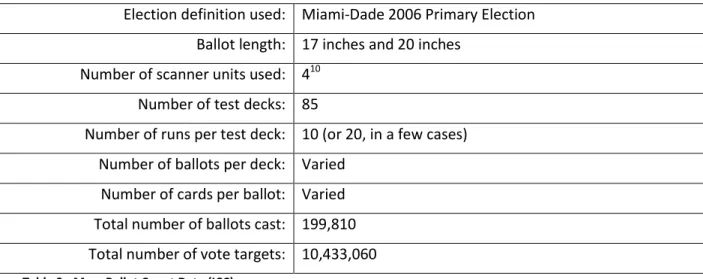
BVSC used 85 test decks, with 10,433,060 total vote targets, to reach the minimum 192,000 ballot requirement. The vendor supplied audited test decks and an ICC scanned the decks multiple times. A set of predetermined results was supplied and compared to the scanner results and the results reports from RTR. Specific details follow:
Election definition used: Miami-Dade 2006 Primary Election Ballot length: 17 inches and 20 inches
Number of scanner units used: 410 Number of test decks: 85
Number of runs per test deck: 10 (or 20, in a few cases) Number of ballots per deck: Varied
Number of cards per ballot: Varied Total number of ballots cast: 199,810 Total number of vote targets: 10,433,060 Table 3 - Mass Ballot Count Data (ICC)
The test decks, provided by DVS, were grouped by Ballot ID and ranged in deck size from 120 ballots to 1,101 ballots. There were 85 ballot IDs. The test decks included overvotes and blank ballots, on which the scanner was programmed to stop11. An ICC scanned each ballot ID 10 times (with the exception of three ballot IDs, which an ICC scanned 20 times). BVSC employed three ICCs for scanning.
BVSC observed that the scanners presented numerous “misreads” on several of the test decks. Upon closer examination, BVSC noted and attributed the following factors to the anomaly to conclude that the test deck ballots, and not the scanner, were at issue:
During the course of mass ballot testing, BVSC noticed and documented instances of faded timing marks, smudges, and other anomalies triggering scanner misreads on a number of test ballot decks. Initial attention focused on the large amount of paper dust that accumulated during the scanning process. It was determined that DVS procedures did not recommend a specific established cleaning maintenance schedule, other than to recommend ‘to clean as needed.’ A daily cleaning schedule was established. However, the daily cleaning did not eliminate all misreads which prompted more frequent cleaning. Additionally, BVSC requested that a number of test decks with ‘misreads’ be replaced. Ultimately, BVSC learned that the test ballots provided by DVS for the mass ballot testing included test ballots that had been used for other testing and certification efforts during DVS’ pre-Florida certification in-house preparations. Therefore, in addition to requesting replacement of specific test decks that produced an inordinate number of misreads, BVSC instituted a procedure whereby if the same ballot misread more than three times, BVSC replaced it with a ballot “spare.”
10
One scanner was deemed defective due to an extraordinarily high number of misreads, and BVSC subsequently replaced it with another unit. In total, four units processed ballots, but only three units were in operation at any one time.
Findings:
The ICC met the acceptance criteria for the MBC. BVSC successfully scanned 199,810 ballots, with 10,433,060 vote targets. The number of ballots scanned totaled approximately 8,000 more ballots than the required minimum. Because BVSC did not encounter “misread” errors during the use of the ICC scanners for mock election testing and the additional tests, such as audit mark review and ballot sensitivity examinations, BVSC was able to conclude that the misreads were compounded by the dust issues, which appeared to be the result of scanning and rescanning “overused” test ballots.
However, BVSC recommends that DVS require in its procedures an established cleaning schedule for the ImageCast Central Count (Canon DR-X10C) scanner. The recommended cleaning schedule should be as frequent and thorough as possible, without interfering with the conduct of the election.
Additional Testing
BVSC examined the following items to either verify compliance with standards, statutes, and rules or to proactively review various functions for informational purposes. Specific details for each test activity are reported below, in alphabetical order:
Accessibility testing Audit mark review
Assessment of the precinct tabulators’ battery life
Conducting contest recounts per Florida Administrative Rule Folded (absentee) ballot processing
Ballot sensitivity analysis System failure/recovery
Voting equipment clock update(Daylight Savings Time) User security review
Mass Ballot Count – Acceptance Criteria Expected Accepted
Did the memory registers overflow? No
Did the public counters increment appropriately? Yes
Did the tabulated results agree with predetermined vote totals? Yes Number of errors (must not exceed 1 in 1,000,000 vote targets). An error is
defined as a target scan that produces a result other than the expected result.
<= 1/1M vote targets
Number of multiple feeds (must not exceed 1 in 5,000 ballots). A multiple feed occurs when the machine pulls multiple ballots and does not “catch” the error.
<= 1/5K ballots
Number of incorrect rejections of ballots (must not exceed 3%) <= 3% total ballots
Accessibility Test - Sound Pressure Level
BVSC conducted this test to verify conformance to section 101.56062(1)(g-i), F.S., describing the sound pressure level (SPL) standards for a voting system’s audio voting features. The ICE incorporates the Accessible Tactile Interface (ATI) and headphones for accessible voting. Optional tactile devices other than the ATI are paddles or a sip-and-puff device. Because the audio signals must pass through the ATI regardless of which tactile device is used, BVSC conducted the sound pressure test using the ATI and a standard set of headphones.
The installed audio files were used as the test signal file in the introductory screen at the beginning of the ADA voting session on the ICE. This is the 'language choice' screen. The ICE plays through all three language choice screens and accompanying audio (English, Spanish, and Haitian Creole) until the user makes a selection. BVSC assumes that the language selection screens are comprised of at least three separate audio files (one for each language, accompanied by one screen). The audio files for this recording are static files not editable by the county. Because of this, these audio files became the test signal file in place of the ITU-T P.5012 test signal. DVS states that editing static files on the ICE requires a firmware change. Therefore, because this file (or set of files) is static with this version of the ICE, and it is the first screen encountered by an ADA voter, BVSC chose it as the test signal file. The test equipment included a calibrated Type I IEC 31813 Artificial Ear with Brüel & Kjaer (B&K) 2250-A analyzer14.
The three language audio files together constituted one “loop” of recording. BVSC used this “loop” in its entirety as the basis for sound pressure measurements. The loop length was 1 minute, 23 seconds. BVSC took all sound pressure level measurements after the elapse of this amount of time, in order to capture instrument readings for the entire loop. For this reason, BVSC did not take sound pressure measurements for portions of the loop, or any individual audio file.
BVSC noted that, in the Election Event Designer, the user-editable behavior settings for the ICE include a setting for choosing the default volume level. The user may choose between a “Standard Volume Level” and an “EAC Test Volume Level.” According to DVS, the EAC uses the EAC Test Volume Level to conduct testing on the voting system. BVSC followed DVS’ recommendation to use the Standard Volume Level setting, which is DVS’s customers’ setting.
Findings:
BVSC found that the ICE conformed to applicable standards.
BVSC noticed an audible difference in volume between the English and the Spanish and Haitian Creole audio files. The English file seemed the softest volume, whereas the other two audio files were decidedly louder. BVSC recommends for future certifications that the volume levels of these three files be leveled.
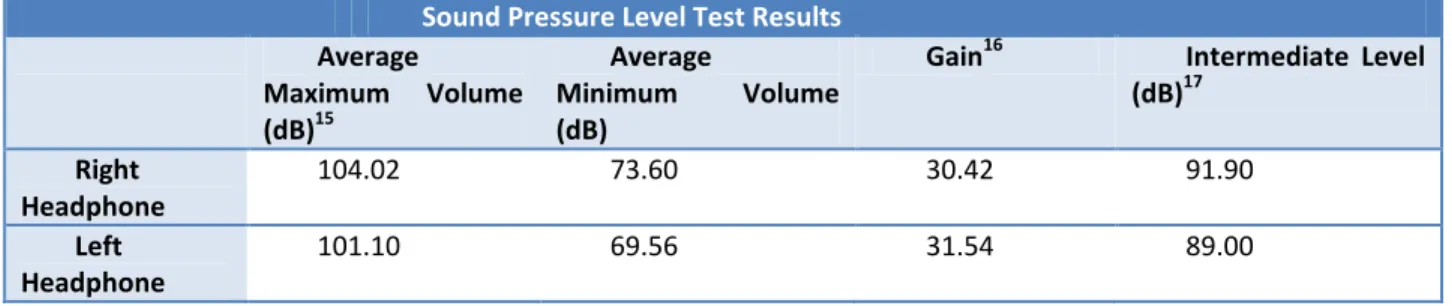
The results of the sound pressure level tests are in the table below.
12 ITU-T P.50 - “ITU-T” is the telecommunication standardization sector of the “ITU,” which is the International
Telecommunication Union. ITU is a United Nations specialized agency for information and communication technologies. The “P.50” represents one of their “P Series” objective transmission standards/measures used for testing the transmission quality of artificial voices.
13
IEC - International Electrotechnical Commission. IEC 318 is a measure used for ear simulators as defined in ITU-T P-Series standards.
14 Brüel & Kjaer (B&K) 2250 Analyzer - A hand-held analyzer and sound level meter that performs
Sound Pressure Level Test Results Average Maximum Volume (dB)15 Average Minimum Volume (dB)
Gain16 Intermediate Level
(dB)17 Right Headphone 104.02 73.60 30.42 91.90 Left Headphone 101.10 69.56 31.54 89.00
Table 5 - Sound Pressure Level Test Results
Accessibility Test – Force
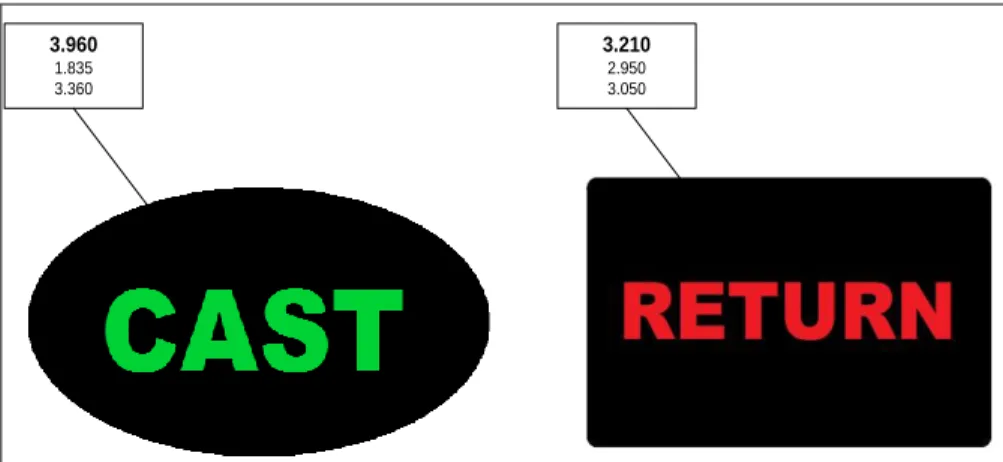
BVSC executed the Force Test on the Audio Tactile Interface (ATI), the ImageCast Evolution (ICE), and the accessible voting paddles to determine compliance with section 101.56062(1)(l) F.S., which requires that “the force required to operate or activate the controls must be no greater than 5 pounds of force.” The ICE is equipped with two buttons, the “Cast” and “Return” buttons, which are available to the voter during an accessible voting session. The ATI is a handheld device used by the voter to enter commands into the ICE. The voter also has the option of using paddles instead of the ATI.
BVSC conducted the test using a calibrated Dillon model GL digital force gauge. BVSC took the measurements during an audio voting session. The gauge was set to ‘zero’ before each measurement. BVSC took three measurements for each button.
Findings:
No measurement exceeded the maximum of 5 pounds of force. BVSC found that the tested devices complied with the applicable statute.
The figures below represent the results. All measurements are in pounds of force. Within the measurement set for each button, the highest reading is in bold, larger font.
15
Must be greater than 97 dB.
16 Maximum volume minus minimum volume. Must be greater than 20 dB. 17 Must be between (Minimum volume + 12 dB) and 97 dB.
0.800 0.525 0.710 0.865 0.620 0.755 0.760 0.725 0.645 0.635 0.585 0.515 1.215 1.005 0.930 1.330 1.010 0.955 1.375 1.100 1.190 1.650 0.970 1.185 1.425 1.230 1.035 1.300 1.130 1.140
Figure 8 - Force test measurements (in lbs. of force) on ATI
3.960 1.835 3.360 3.210 2.950 3.050
Figure 9 - Force test measurements (in lbs. of force) on "Cast" and "Return" buttons on ICE
L
R
0.115 0.100 0.115 0.130 0.100 0.110Audit Mark Review
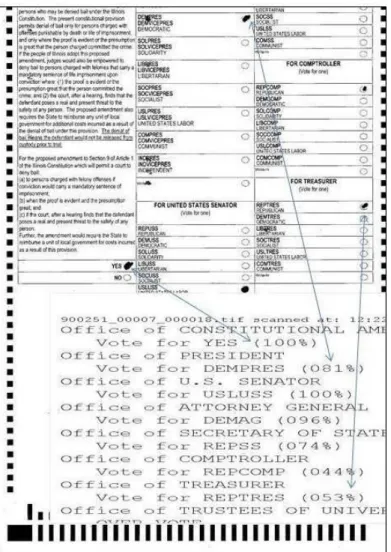
Democracy Suite has a feature called “Audit Mark™.” If an election is coded to save ballot images, this function can be used to verify the way the ICE, ICP, or ICC interpreted voter marks. Below is an example of one of the ways this information is presented to a user. For our review, we did not use the “percentage marked” setting.
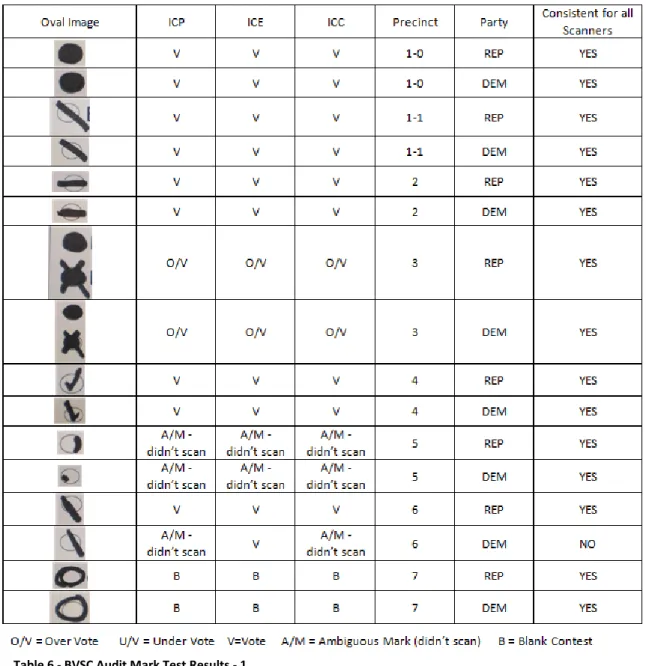
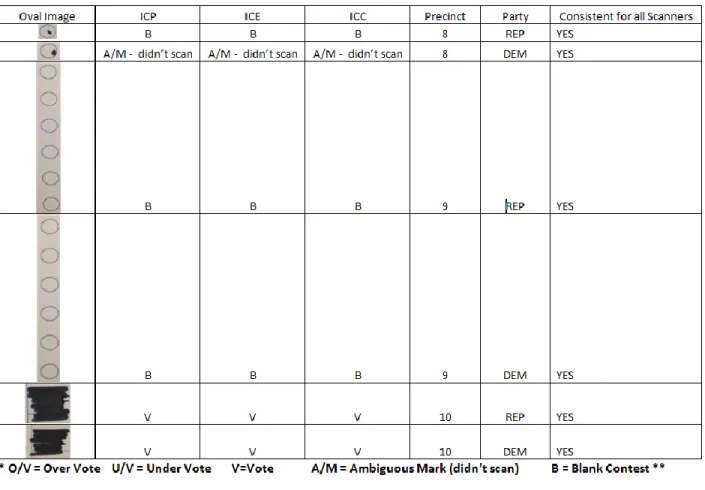
Users can export audit images for a subset of the election results file, for a single contest, or for all contests. BVSC examined this functionality across all equipment by casting the same ballot set through each of the voting devices and comparing the results. The tables below illustrate the outcome of this activity.
Table 7 - BVSC Audit Mark Test Results - 2
Findings:
BVSC examined this feature to verify that the stated function met expectations. Because Florida law and the FVSS have no requirements for this feature, BVSC did not apply ‘pass’ / ‘fail’ criteria.
Battery Life Test – ICE / ICP
BVSC performed a test to verify that the precinct tabulators with internal battery packs, when disconnected from the main power source (i.e. electricity), functioned for the time period stated in the vendor submitted TDP documentation.18 For both the ICE and the ICP, the documentation states that the battery pack is capable of powering the system for at least two hours.
In order to complete this activity, BVSC powered up the ICP and ICE and disconnected the AC adapter. BVSC left the equipment running on battery power overnight. The next morning, BVSC connected the tabulator to the electrical socket and reviewed the audit logs to determine how long the machine remained in a usable state before complete drainage of the battery power occurred. The table below reflects the outcome of these tests.
Equipment Power Cord Unplugged Logged Battery Failure
Machine Use w/o Electric Power
Source
Time Date Time Date
ICP 16:19 6/13/2013 19:11:59 6/13/2013 2 hrs 52 mins ICE 16:20 6/26/2013 21:00:10 6/26/2013 4 hrs 40 mins Table 8 - ICE / ICP Battery Life Testing
Findings:
For the ICP, the battery lasted approximately 3 hours. The ICE’s battery pack lasted approximately 4½ hours, well above the expected timeframe of 2 hours. It is worthy to note that BVSC conducted this test on equipment that remained idle throughout the test. In an actual voting situation, the time it would take for the battery to drain would likely vary due to ballot casting and other factors.
Contest Recounts
To ensure that the voting equipment could be properly configured to meet Florida’s recount requirements, BVSC conducted an activity simulating a recount of overvotes and undervotes, for both a district-wide and countywide contest, using the Municipal Election. BVSC disabled all other races on the ballot in the Election Event Designer.
This task consisted of opening the polls, running zero tapes, casting 56 test deck ballots, closing the polls and uploading the results into RTR. The system performed this activity as expected. Only the contests that were chosen as “recount” races showed results. All other contests displayed results as “Contest Removed” on the ICP tabulator tape and as ‘DISABLED’ with a vote count of ‘0’ in the RTR reports.
Figure 12 - BVSC Contest Recount Results
Findings:
The system satisfied requirements of the Florida Statutes and Rules.
Folded Ballot Test
BVSC conducted “folded ballot” tests on the ICE, ICP, and ICC scanners to simulate absentee ballot processing. The test deck consisted of General Election ballots and included ballots of each length outlined in the test plan (11, 14, 17, 19, and 22 inches19). BVSC marked the ballots with a 1-2-3 pattern, with one ballot each for an undervote, overvote, and a write-in vote.20 BVSC folded the ballots using the maximum number of folds for each length,21 as well as a C-fold and Z-fold through the vote target and a fold through a write-in vote target.
Findings:
BVSC encountered the following systems messages when casting ballots. It is important to note that these messages happened as a result of the type and/or location of the fold and do not indicate a system or counting error.
19
Although it was not included in the test plan, a 20” ballot was also added to this activity.
20 Exceptions: 20” and 22” ballots - had no 3rd position or write-in targets. 21 11” – 2 folds; 14” & 17” – 3 folds; 19” – 4 folds; 22” – 5 folds
Ambiguous Mark
Example of an “ambiguous mark” message. This resulted from a ballot that was folded through a vote target and scanned using the ICE.
Ballot Misread
Example of a “ballot misread” message on the ICE. There were instances where this message was displayed and when the ballot was re-scanned, the ICE accepted the ballot.
Figure 14 - Folded Ballot-Ballot Misfeed Message Figure 13 - Folded Ballot-Ambiguous Mark Message
Below are tables which contain specific data illustrating on which type of fold these messages occurred.
11-inch Folded Ballots
ICP Results Write-Ins Diverted
Z Fold: Scanned and Accepted all Yes
C Fold: Scanned and Accepted all Yes
Fold thru Vote Target: Scanned and Accepted all Yes Fold Thru Write-In Scanned and Accepted all Yes
Max Fold (2) Scanned and Accepted all Yes
ICE Results Write-Ins Diverted
Z Fold: A 2nd position ballot: “ambiguous mark” for fold thru Judge 43 Jose Fernandez on back, accepted the 3rd try. A 3rd ballot: “ballot misread”, accepted after 2 tries. All Z folds eventually accepted and scanned
Yes
C Fold: Scanned and Accepted all Yes
Fold thru Vote Target: Accepted all but 1: 3rd position; Fold thru Senator Roy Tanner (ambiguous mark)
Yes Fold Thru Write-In Accepted all but 2: 1 blank and 1 3rd position Yes
Max Fold (2) Scanned and Accepted all Yes
ICC Results Write-Ins Diverted
Z Fold: Scanned and Accepted all N/A –did not set to divert C Fold: Scanned and Accepted all N/A –did not set to divert Fold thru Vote Target: Scanned and Accepted all N/A –did not set to divert Fold Thru Write-In Scanned and Accepted all N/A –did not set to divert Max Fold (2) Scanned and Accepted all N/A –did not set to divert
Table 9 - 11" Folded Ballot Results
14-inch Folded Ballots
ICP Results Write-Ins Diverted
Z Fold: Scanned and Accepted all Yes
C Fold: Scanned and Accepted all Yes
Fold thru Vote Target: Scanned and Accepted all Yes Fold Thru Write-In Scanned and Accepted all Yes
Max Fold (3) Scanned and Accepted all Yes
ICE Results Write-Ins Diverted
Z Fold: Accepted all but 2: both ‘Ballot Misread’ error Yes
C Fold: Scanned and Accepted all Yes
Fold thru Vote Target: Accepted all but 2: 1st position and 2nd position. 1st position ballot ‘ambiguous mark’ and 2nd position ‘ambiguous mark’ and ‘ballot misread’.
Yes
Fold Thru Write-In Accepted all but 3: 1 ‘ambiguous mark’ 2nd position ballot. 2 ‘ballot misread’ 2nd and 3rd position ballots.
Yes
Max Fold (3) Scanned and Accepted all Yes
ICC Results Write-Ins Diverted
Z Fold: Scanned and Accepted all N/A –did not set to divert C Fold: Scanned and Accepted all N/A –did not set to divert Fold thru Vote Target: Scanned and Accepted all N/A –did not set to divert Fold Thru Write-In Scanned and Accepted all N/A –did not set to divert
Max Fold (3) Scanned and Accepted all N/A –did not set to divert Table 10 - 14" Folded Ballot Results
17-inch Folded Ballots
ICP Results Write-Ins Diverted
Z Fold: Scanned and Accepted all Yes
C Fold: Scanned and Accepted all Yes
Fold thru Vote Target: Scanned and Accepted all Yes Fold Thru Write-In Scanned and Accepted all Yes
Max Fold (3) Scanned and Accepted all Yes
ICE Results Write-Ins Diverted
Z Fold: Accepted all but 1: 3rd position ballot ‘ballot misread’ Yes
C Fold: Scanned and Accepted all Yes
Fold thru Vote Target: Accepted all but 2: ‘ballot misread’ and ‘ambiguous mark’
Yes Fold Thru Write-In Accepted all but 3: all ‘ambiguous mark’ Yes
Max Fold (3) Scanned and Accepted all Yes
ICC Results Write-Ins Diverted
Z Fold: Scanned and Accepted all N/A –did not set to divert C Fold: Scanned and Accepted all N/A –did not set to divert Fold thru Vote Target: Scanned and Accepted all N/A –did not set to divert Fold Thru Write-In Scanned and Accepted all N/A –did not set to divert Max Fold (3) Scanned and Accepted all N/A –did not set to divert
Table 11 - 17" Folded Ballot Results
22-inch Folded Ballots
ICP Results Write-Ins Diverted
Z Fold: Scanned and Accepted all Yes
C Fold: Scanned and Accepted all Yes
Fold thru Vote Target: Scanned and Accepted all Yes Fold Thru Write-In No Write-Ins on ballot** Yes
Max Fold (5) Scanned and Accepted all Yes
ICE Results Write-Ins Diverted
Z Fold: Scanned and Accepted all Yes
C Fold: Scanned and Accepted all Yes
Fold thru Vote Target: Scanned and Accepted all Yes Fold Thru Write-In No Write-Ins on ballot** Yes
Max Fold (5) Scanned and Accepted all Yes
ICC Results Write-Ins Diverted
Z Fold: Scanned and Accepted all N/A
C Fold: Scanned and Accepted all N/A
Fold thru Vote Target: Scanned and Accepted all N/A Fold Thru Write-In No Write-Ins on ballot** N/A
Max Fold (5) Scanned and Accepted all N/A
19-inch Folded Ballots
ICP Results Write-Ins Diverted
Z Fold: Scanned and Accepted all Yes
C Fold: Scanned and Accepted all Yes
Fold thru Vote Target: Scanned and Accepted all Yes Fold Thru Write-In Scanned and Accepted all Yes
Max Fold (2) Scanned and Accepted all Yes
ICE Results Write-Ins Diverted
Z Fold: Scanned and Accepted all Yes
C Fold: Scanned and Accepted all Yes
Fold thru Vote Target: Scanned and Accepted all Yes Fold Thru Write-In (6) Scanned and Accepted: All 3 ambiguous mark Yes
Max Fold (2) Scanned and Accepted all Yes
ICC Results Write-Ins Diverted
Z Fold: Scanned and Accepted all N/A –did not set to divert C Fold: Scanned and Accepted all N/A –did not set to divert Fold thru Vote Target: Scanned and Accepted all N/A –did not set to divert Fold Thru Write-In Scanned and Accepted all N/A –did not set to divert Max Fold (2) Scanned and Accepted all N/A –did not set to divert
Table 13 - 19" Folded Ballot Results
20-inch Folded Ballots
ICP Results Write-Ins Diverted
Z Fold: Scanned and Accepted all Yes
C Fold: Scanned and Accepted all Yes
Fold thru Vote Target: Scanned and Accepted all Yes Fold Thru Write-In Scanned and Accepted all Yes
Max Fold (3) Scanned and Accepted all Yes
ICE Results Write-Ins Diverted
Z Fold: Scanned and Accepted all Yes
C Fold: Scanned and Accepted all Yes
Fold thru Vote Target: Scanned and Accepted all Yes Fold Thru Write-In N/A: No write-in on this ballot. N/A
Max Fold (3) Scanned and Accepted all Yes
ICC Results Write-Ins Diverted
Z Fold: Scanned and Accepted all N/A –did not set to divert C Fold: Scanned and Accepted all N/A –did not set to divert Fold thru Vote Target: Scanned and Accepted all N/A –did not set to divert Fold Thru Write-In Scanned and Accepted all N/A –did not set to divert Max Fold (3) Scanned and Accepted all N/A –did not set to divert
Table 14 - 20" Folded Ballot Results
Findings:
During this examination, the ICE rejected more ballots on an “initial” scan, but overall the voting equipment functioned as expected.
Scanner Sensitivity
BVSC subjected the ICP and ICE precinct tabulators and the ICC central count tabulator to scanner sensitivity testing. The purpose of the scanner sensitivity test is to evaluate the scanner’s ability to read marks made by the system’s recommended marking device22 at the polls and various types of marking devices (pens, pencils, highlighters, etc.) that may be used otherwise and particularly in absentee ballot voting. The sensitivity test also demonstrates the scanner’s ability to detect a marking when the vote target is not fully or properly marked (such as “”, “”, etc.).
BVSC created the test decks from the Primary Election ballots provided by the vendor. The test included a baseline scan of the ballots with selected ovals fully marked ( ). A test deck was then run, with the same targets marked, but with a 1 millimeter line through the center of the target, rather than a fully marked oval ( ). If a scanner rejected a ballot card, or produced an “ambiguous mark” error, BVSC attempted to cast the ballot card two more times.
For testing the scanners’ ability to detect improperly marked targets, BVSC marked the target using the vendor’s approved pen (Sharpie Fine Point Permanent Marker). BVSC compared these results to a baseline of the same targets, fully marked, using the same pen. If a scanner rejected a ballot card, or produced an “unclear mark” error, BVSC attempted to cast the ballot card two more times.
BVSC conducted the test on one ICP, one ICE, and one ICC, using the same test deck for all machines. The two tables below summarize the results of the sensitivity test for the scanners.
Sensitivity Test (Fully Marked Oval unless otherwise specified) ICP ICE ICC
Marking Device Device
Type
Color Results Results Results
1 Eberhard Faber #2 HB Gray A/M23 Accepted Accepted
2 Steadler Pencil #2B Gray Accepted Accepted Accepted 3 Steadler Pencil #B Gray Accepted Accepted Accepted
4 Steadler Pencil #F Gray A/M A/M A/M
5 Steadler Pencil #H Gray A/M A/M Accepted
6 Steadler Pencil #2H Gray Accepted A/M A/M
7 Steadler Pencil #3B Gray Accepted Accepted Accepted
8 Steadler Pencil #4H Gray Blank A/M A/M
9 K-Dent Pen Ball Point
(med. pt.)
Blue A/M A/M Accepted
10 “Hotel” Ink Pen [Renaissance Hotel]
Ball Point (med. pt.)
Light Blue
Accepted A/M Accepted
11 Pilot G2 Ink Pen Ball Point (med. pt.)
Red Blank Accepted Accepted
22
Wyle Laboratories, Inc. on behalf of the U.S. EAC used the identified Sharpie brand marker as the recommended marking device in its testing for its certification of conformance, dated July 18, 2013.
12 Papermate Ball Point (med. pt.)
Green A/M A/M Accepted
13 EF Felt Pen Felt Tip
(med. pt.)
Black Accept Accepted Accepted
14 Sharpie Brand Highlighter Highlighter Orange Blank Accepted Accepted 15 Vendor Recommended Pen (Sharpie) Felt Tip Black Accepted Accepted Accepted 16 “X” Mark Using EF Felt Pen Felt Tip
(fine pt.)
Black Accepted Accepted Undervote
17 “”Mark Using EF Felt Pen Felt Tip (fine pt.)
A/M A/M A/M
18 “\”Mark Using EF Felt Pen Felt Tip (fine pt.)
Black Accepted Accepted Accepted
19 Trace Oval Line [inside oval unmarked] using EF Felt Pen
Felt Tip (fine pt.)
Black Blank Blank Accepted
20 Steadler Pencil #4B Gray Accepted Accepted Accepted 21 Steadler Pencil #5B Gray Accepted Accepted Accepted 22 Steadler Pencil #6B Gray Accepted Accepted Accepted
23 Steadler Pencil #3H Gray Blank A/M A/M
24 Mark Oval Center [w/o filling oval completely] using a EF Felt Pen
Felt Tip (fine pt.)
Black Blank Blank Accepted
25 Mark left of oval using Steadler Pencil
#HB Gray Blank Blank A/M
Table 15 - Scanner Sensitivity - Fully Marked Oval
Sensitivity Test (1mm Horizontal line) ICP ICE ICC
Marking Device Device
Type
Color Results Results Results
1 Eberhard Faber #2 HB Gray A/M A/M A/M
2 Steadler Pencil #2B Gray A/M A/M A/M
3 Steadler Pencil #B Gray A/M A/M A/M
4 Steadler Pencil #F Gray A/M A/M A/M
5 Steadler Pencil #H Gray A/M A/M A/M
6 Steadler Pencil #2H Gray Blank A/M A/M
7 Steadler Pencil #3B Gray A/M Blank A/M
8 Steadler Pencil #4H Gray Blank A/M A/M
9 K-Dent Pen Ball Point
(med. pt.)
Blue A/M Blank A/M
10 “Hotel” Ink Pen [Renaissance Hotel]
Ball Point (med. pt.)
Light Blue
11 Pilot G2 Ink Pen Ball Point (med. pt.)
Red Blank A/M Accepted
12 Papermate Ball Point
(med. pt.)
Green A/M A/M A/M
13 EF Felt Pen Felt Tip
(med. pt.)
Black A/M A/M A/M
14 Sharpie Highlighter Orange Blank A/M Accepted
15 Vendor Recommended Pen (Sharpie) Felt Tip Black Accepted Accepted Accepted
16 Steadler Pencil #4B Gray A/M A/M A/M
17 Steadler Pencil #5B Gray A/M A/M A/M
18 Steadler Pencil #6B Gray A/M A/M A/M
19 Steadler Pencil #3H Gray Blank A/M A/M
Table 16 - Scanner Sensitivity - 1 mm Horizontal Line Marked Through Oval
Findings:
Florida law and FVSS have no requirements for this test so a ‘pass’ / ‘fail’ assessment was not needed criteria. The ICP, ICE, and ICC scanners are able to detect a wide variety of marks made by several different marking devices, including ink pens, markers, highlighters, and pencils. However, some marking devices were not detected. It is important to note, though, that the vendor recommended black Sharpie marker detected vote marks 100% of the time in this test activity. Therefore, the vendor should clearly document its recommended marking device(s) and convey that information to counties using this voting system.
Simulated System Failure/Recovery
BVSC performed catastrophic failure testing on the ICP and ICE, in the event of a major power loss, to determine the behavior of the precinct scanners and whether operations would be returned to proper functioning when power was restored.
ICP: Testing included unplugging the power cable, which automatically switched the unit to battery power. BVSC then cast ballots until the LED screen displayed the following message: “Battery level is extremely low. Press the ‘Shut Down’ button to power down the unit.” At this point, BVSC restored AC power and printed the ICP’s ‘Election Report.’ The CF (compact flash) cards were then removed and uploaded into the Election Management System’s reporting application, RTR.
ICE: BVSC cast ballots in election mode with the unit’s AC power supply unplugged, which automatically switched the unit to battery power. BVSC continued to cast ballots until the battery drained to the point that the machine would no longer function and displayed a ‘shut down’ message. At this point, BVSC restored AC power and checked the vote counts and machine counters for accuracy. BVSC then uploaded the CF cards into the Election Management System’s reporting application, RTR.
Findings:
Time Change – ICP/ICE [Daylight Savings Time / Leap Year]
Daylight Savings Time Testing
BVSC examined the ICP and ICE to discover whether the time of day would “spring forward” one hour and “fall back” one hour with the Daylight Savings Time (DST) clock change.
Findings:
The ICP and ICE failed to “spring forward” and “fall back” as expected. BVSC staff contacted DVS to discuss this finding and DVS advised that this was not an operational error. The machines do not come equipped with an automated capability to perform this function. With this current release version, if an election occurs during a DST event, the time of day must be manually set. This function can be appropriately handled procedurally by the election official and/or poll worker. BVSC recommends that this functionality be automated in future release versions.
Leap Year Testing
BVSC also examined the ICP and ICE to determine whether the voting equipment implemented the date change correctly during leap and non-leap years. Test one included, setting the date to 2/28/2012 at 11:55pm. Test two involved setting the date to 2/28/2013 at 11:55pm.
Findings:
For leap years, the ICP and the ICE changed to 2/29/2012 as expected at 12:00am. For non-leap years, the ICP and ICE changed to 3/1/2013 as expected at 12:00am.
Activity (Machine Date Set) Expected Outcome (Machine Date after 12:00AM):
Actual Results (Yes-Pass/No-Fail)
ICP 02/28/2012 02/29/2012 Yes 02/28/2013 03/01/2013 Yes ICE 02/28/2012 02/29/2012 Yes 02/28/2013 03/01/2013 Yes
Table 17 - Leap Year Test Data/Outcome
User Security
BVSC reviewed user security as a part of the test events associated with mock election testing.
Findings:
Environmental Tests
Wyle Laboratories performed the required environmental tests. BVSC accepts Wyle’s recommendation that the voting system under test satisfactorily satisfies requirements for these tests. The reports referenced for this activity are: Environmental and EMI Hardware Test Report24 and the Florida Rain Exposure, Sand, and Dust Testing (Florida specific environmental hardware qualification compliance per the FVSS).25
Source Code Review
BVSC desk checked the source code and also examined it with the Klocwork static source code analysis tool. BVSC found no issues that posed significant safety, security, or operational risks.
24 EAC Report No. T57381.01-01, Appendix A.2, dated May 10, 2012 25 EAC Report No. T70828.01, dated March 29, 2013
Continuous Improvement / Recommendations
During testing, staff encountered no issues that preclude certification of the Democracy Suite Release 4.14.17, Version 1 voting system. The following recommendations are provided, however, as suggestions for the purposes of continuous improvement in a future system release. It is important to note that while the items below enhance ease of usability, and possibly, the efficiency of the system, they do not have any bearing on the effectiveness of the voting system, its tabulation, or the accumulation of election results.
1. ICC Cleaning Schedule and Troubleshooting Information. DVS should include in their documentation specific, detailed cleaning schedule instructions for their ICC tabulators, along with information regarding the types of ballot processing activities that could cause an overabundance of misreads and the recommended remedies of such anomalies.
2. Equalize the Volume Level of Audio Files. The volume levels of audio files should be the same for each language used in an election.
3. Automate the Daylight Savings Time Change Functionality – for the ICE and ICP. The ICE and ICP do not come equipped with this function as an automated process. If an election occurs during a DST event, the time of day must be manually set. While, this function can be appropriately handled procedurally by the election official and/or poll worker, reliance on a manual time change method is not as reliable as an automated function. In addition, the documentation should clearly indicate that if a DST event occurs during an election cycle, the time must be manually set.
4. Election Management System Reports in Excel. Microsoft Excel is an optional application that can be used to create/view EED, AS, and RTR reports. The documentation did not include instructions explaining that the user is required the user to open Excel and browse to the NAS Folder and retrieve the report. The documentation should direct the user that this step is required.
5. Additional Documentation Corrections/Edits. During the course of BVSC’s TDP review and certification activity testing, various issues were discovered in the submitted user documentation. A list of these issues will be provided to DVS for incorporation of edits into a future system release when the certificate is issued.
Conclusion
Qualification test results affirm that the voting system under test, Democracy Suite Release 4.14.17, Version 1, Express and Standard Configurations (as configured during the certification event), met applicable requirements of the Florida Voting Systems Standards, Florida Statutes and Rules, and the Help America Vote Act (HAVA) for usability and accessibility. The Florida Division of Elections, Bureau of Voting Systems Certification, therefore, recommends certification of the referenced voting system.
Appendices
Acronyms
ADA Americans with Disabilities
AS Audio Studio
ATI Accessible Tactical Interface
BVSC Bureau of Voting Systems Certification CF Compact Flash (memory cards)
COTS Commercial off the Shelf (software/hardware) DVS Dominion Voting Systems, Inc.
DVS Dominion Voting Systems Democracy Suite Voting System EAC U.S. Elections Assistance Commission
EED Election Event Designer EMS Election Management System FVSS Florida Voting Systems Standards HAVA Help America Vote Act
ICC ImageCast Central Count Tabulator
ICE ImageCast Evolution Precinct Count / ADA Tabulator ICP ImageCast Precinct Count Tabulator
LAN Local Area Network
L&A Logic and Accuracy (voting system test) PPP Presidential Preference Primary RTR Results Tally and Reporting TDP Technical Data Package