Knowledge Acquisition in
Databases
Boris Brešić
Article Info: Management Information Systems, Vol. 7 (2012), No. 1, pp. 032-041 Received 13 November 2011 Accepted 15 February 2012 UDC 005.94 ; 004.65 ; 004 Summary
Knowledge discovery and acquisition in databases features as a separate discipline of business intelligence. Generally speaking, it denotes the process of analysing large quantities of data, its goal being to discover new information and knowledge, and apply them in resolving business problems. More specifically, it implies to data acquisition – or mining – as the initial step, using data-driven learning algorithms, and is aimed at establishing their mutual correlations. Due to its popularisation, significantly supported by computing technology development, the notion of data mining has gradually come to be equated with knowledge discovery. This article deals with knowledge acquisition from databases, i.e. data mining with OLAP (On-Line Analytical Processing) tools, which enable multidimensional data management and graphic presentation thereof. Such an approach is mostly applicable when analysing smaller data sets, i.e. in the phase of data preparation for mining, in order to better understand or select variables included in the business information process.
Keywords
business intelligence, database, knowledge discovery, data mining, OLAP tools
1. Introduction
Discovering, or better to say, acquiring knowledge in databases as a discipline of business intelligence in its broader sense refers to the process of analysing large amounts of data with the aim of discovering new information and knowledge, and its application in resolving business problems. In its more specific tense, it refers to mining data as the initial step of this process, using data-driven learning algorithms, with the aim of discovering correlations between them. The term “knowledge discovery in databases” (KDD) was introduced by Usama Fayaad at the first international conference on knowledge discovery and data mining (Giudici, 2003, p. 2). According to Fayaad (1996), the process comprises six steps, where data mining is the step applying one of the algorithms on transformed data (Figure 1). The CRISP-DM process model contains basically the same steps, only extended and elaborated for application in industrial environment. Popularising the term “data mining” gradually led to equating it to the term “data discovery”, so that many authors and experts consider these two terms synonymous.
Dissemination and popularization of knowledge discovery were preceded by the development of computing technology, especially in the segment of data storage and relational database development.
Figure 1 Knowledge discovery process (Fayyad, Piatetsky-Shapiro, & Smyth, 1996)
When discussing knowledge in databases, one primarily refers to data mining. However, what must not be forgotten is knowledge discovery in databases using tools for ad hoc queries and analyses, as well as reporting. Actually, knowledge is also discovered by means of application of Structured Query Language (SQL) queries and relational databases, that is, compiling reports. Such a procedure starts from an assumption, i.e. setting a hypothesis.
The user sets a hypothesis, and then tries to confirm or verify it by shaping and executing queries. Such knowledge discovery procedure is even more simple and efficient with OLAP (On-Line Analytical Processing) tools, which enable multidimensional data handling and graphic presentation thereof. In a such top-down knowledge discovery method, criteria and correlations between data are implied by the user who tries to confirm them. Such an approach is applicable when analysing smaller data sets, but in
Management Information Systems
Vol. 7, 1/2012, pp. 032-041
33
the case of large amounts of data, it is not always simple and easy to confirm or refute the given hypothesis. In that case, using the data mining technique as a bottom-up knowledge discovery method, algorithms break down data and reach the goal, i.e. the discovery of patterns or regularities hidden by the data.
The classical queries and analyses in databases cannot substitute data mining as a knowledge discovery method in general. These are two mutually supplementing methods, so that, for instance, OLAP tool can be applied in the phase when data is prepared for mining so that the latter can be understood better, that is, for selecting variables to be included in the mining procedure.
2. OLAP
2.1. Transaction Processing Systems
In 1970, British mathematician E.F. Codd set up a relation data model that was to become the basis of the currently most common relational databases. Operative systems supporting parts or entire business processes save the data, which they subsequently process into relational databases. Such systems are also referred to as transactional systems, or On-Line Transactional Processing (OLTP) systems. Their main feature is that they require a high level of accessibility and response to user requirements. Adherence to normal forms (Database normalization, n.d.) when designing relational models results in logical consistency of data and robustness of the data model. Some examples of OLTP systems include systems for charging for prepaid services used by mobile telecommunication service providers and banking transaction systems.
For the purpose of reporting and analysing data left by users after every transaction, executing queries on relational bases of OLTP is not recommendable for several reasons. Data extraction for reports often includes multiple criteria and numerous tasks, which is a great burden, whereas given the inherent feature of the relational data model (normalised models), the Relational Database Management System (RDBMS) is under great burden as well. On the other hand, response time to complex analytic queries into the base can be extremely long, which naturally depends on query complexity, and is also the greatest problem. Finally, OLTP bases do not store historic data.
2.2. Data Warehouses
Due to the reasons above, late 1980s and early 1990s saw the development of the concept of data storage. Unlike transactional databases, built on the relational model, data warehouses are built on the dimensional data model1. The dimensional data
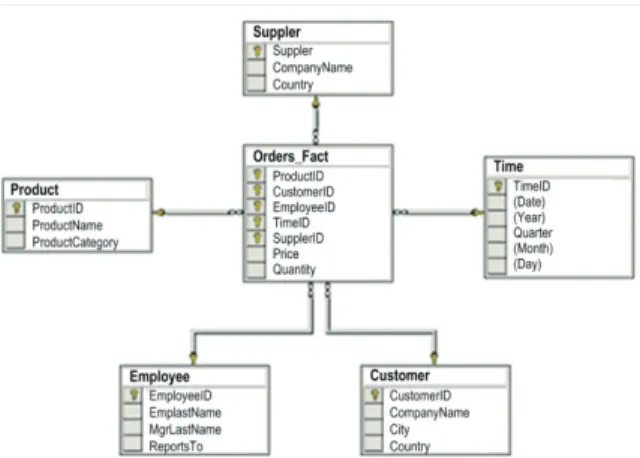
model enables fast response, because data from relational bases are denormalised and adjusted (summarized and aggregated) to the needs of analyses and reporting. Such data organization is the foundation of the OLAP system. The data warehouse also contains all historic data, and it is organized around the ratios of business processes and dimensions to be observed. Dimensional data models can also be applied in classical relational databases through the star scheme, which is the dominant form of data warehouse organization.
Figure 2 shows a simplified dimensional model adjusted to application in the relational database model. It is a case of tracking orders of various products over time. The orders_fact fact table records the quantity of ordered products according to the following dimensions: product, supplier,
employee, customer and time.
Figure 2 An example of dimensional model in the relational database (star scheme).
Data from the relational data bases of the OLTP system are loaded periodically into data warehouses, mostly in periods when system burden are the lowest. The data entry model is called
extract-transform-load process. In a nutshell, the data
is extracted from transactional bases and transform – which includes coding and deriving new valuesand variables, their aggregation and similar activities, and, finally, transformed values are loaded into the warehouse structure.
1 Besides the denormalised dimensional data warehouse model
propagated by Ralph Kimball (2002), there is also the the normalised model concept (the third dormal form) advocated by Bill Inmon.
2 I r u w m b p p – The proce Fig 2.3. OLAP Sy In 1994, Cod term OLAP, l eventually tu revealed that tool producer the concept o under the acr whole conce multidimensio by dimension access to data “at the speed p. 237). Figure 4 OL product, an Modern O analyses, and are divided (MOLAP), us (ii) relational OLAP tools personal co dedicated OL tools (HOLA concepts. Figure 5 sh – MOLAP an ess is illustrated
gure 3 Data loa
ystems d published a listing the 12 urned contro it had been r. Regardless o of dimensiona ronym of OL ept is that onal cubes con ns. Such org a, which is a
of thought”
LAP cube with th nd time, and the
OLAP tools with regard to into multidim sing their ow OLAP tools (DOLAP), mputers (wi LAP servers) AP), which hows two OL nd ROLAP: d as follows: d into databases an article intro OLAP rules. oversial, whe financed by of this, Codd al analysis and LAP. The esse
data is org nsisting of fac ganization en prerequisite f (Panian & Kl he dimensions of ratio of product q enable com o the data res mensional O wn dimensiona
(ROLAP), (i i.e. tools de ithout the
and (iv) hyb combine the LAP system ar s oducing the The article en it was an OLAP formalized d reporting ence of the ganized in cts grouped nables fast for research lepac, 2003, f customer, quantity mplex data source, they LAP tools al database, iii) desktop esigned for need for brid OLAP e first two rchitectures Figure 5 MO OLAP t reports, with and dice, hierarchical and aggregat higher hiera reports, etc. tools are dev people with marketing e that one of t information (Pendse, 200 OLAP to intelligence systems, and they are the organisation serve as an process, as t through the prerequisite OLAP tools one of the w 3. Data M As a disci mining, fou computing t storage segm systems for increasing n operations processing h data are a la 2 The OLAP dollars in 2005 almost 6 billio Microsoft, Hyp share in 2005.
LAP and ROLAP & Mancu tools enable h dimensional as well dat structures wh tion of detaile archical degree One must b vised so that hout particul experts. In thi the roles of O gap in a 08)2
ools are the fo system, i.e. d together wi e backbone o ns. Dimensio excellent da these data are e ETL proces of successful s must be ta ways of data di Mining ipline of bu und its role w
technologies i ment, but on r relation da number of on informat huge amounts arge informatio market was wo 5. This figure is on dollars in 20 perion, Cognosm P system architec so, 2002) complex a l analyses, by ta pivot, th hich enable s ed data into n e, then comp bear in mind
they can also lar technical is respect, it OLAP tools is a business o oundation of decision-mak ith corporate f the reportin onal database ata source in e filtered and ss, which is a l project. For aken in consi iscovery in da usiness intelli with the deve
in 1990s, not nly in develop atabase manag organisations tion transacti of data in rea on potential t orth somewhat u forecast to reac 007. The leading m who took up a ctures (Moreno nalyses and way of slice hen support summing up new data at a iling graphic that OLAP o be used by skills (e.g.) can be said bridging the organisation. the business king support warehouses, ng system in es can also the mining standardised an important this reason, iderations as tabases. igence, data elopment of t only in the ping modern gement. An base their ion systems al time. Such that needs to under 5 billion ch the value of g produces are a 62,3% market
Management Information Systems
Vol. 7, 1/2012, pp. 032-041
35
be liberated one way or another, and one of those is data mining. The term was introduced by analogy with excavation of valuable ores from the depths of the earth.
There are several definitions of data mining, e.g. 1. “The process of research and analysis,
automatic or semi-automatic, of large amounts of data with the aim of discovering meaning patterns and rules;” (Berry & Linoff, 2000, p. 7) 2. “The process of selecting, exploring and
modelling large amounts of data discovering regularities or relationships unfamiliar at first sight, with the aim of obtaining clear and useful results for the database owner;” (Giudici, 2003, p. 2)
3. “The process of discovering various models, summaries and derived values from the given data set”. (Kantardzic, 2003, p. 5)
All these definitions share two notions: process and data.
The notion of process somehow suggest that this is not a common procedure that can be completed with out-of-the-box3 program tools, but
a complex one comprising several steps, where an important role is played by the analyst, i.e. a data mining expert, his experience and skills. Berry and Linoff emphasise this, and compare data mining with photography, i.e. evolution of this process through history – from the first camera obscura and hand-developed photographs to the most modern and completely automated cameras: regardless of how technology is automated, the photographer’s talent and the possibility of adjusting individual parameters are decisive for the final quality. In other words, regardless of how automated the data mining process, i.e. modelling phase is, the analysts’ knowledge of the domain of the business problem being solved conditions the quality of results.
The second notion – data – point to the fact that the data are in the centre of the process. The success of a particular data mining project directly depends on their quality. What is explicitly not mentioned in definitions are mining techniques. Actually, there are several techniques gathered under the blanked term of data mining, originating from statistics and machine learning.
Machine learning as a discipline of computer science, or, in other words, as a part of the artificial intelligence domain, deals with the development of
3 This term denotes a software product that can be
immediately used for the purpose for which it was developed, without additional adaptations. An example of this is Microsoft Office and similar final products.
techniques and algorithms enabling learning, e.g. distinguishing between samples or developing computer programs. According to Berry and Linoff (2000), corporate use of discovered artificial intelligence techniques was achieved in early 1980s, at the time of sudden decline in investment in artificial intelligence, as the expectations from the 1960s and 1970s (e.g. machine translation) were not met. Some of the techniques used both in machine learning and data mining are decision making trees, neural networks and genetic algorithms.
On the other hand, statistical methods have been used in analysing gathered data even earlier, and one of the better-known statistical techniques is forecasting trends, i.e. regression.
The application of techniques for business purposes in both areas received a common name – data mining.
3.1. The Tasks and Techniques of Data Mining
In view of the two basic goals, the tasks of data mining can be classified into two categories:
predictive data mining, also referred to in literature as asymmetrical, supervised and directed.
descriptive data mining, also referred to as symmetrical, unsupervised and undirected. Each task is completed with one of the several techniques, which are, in turn, implemented with various algorithms.
3.1.1. Predictive Tasks
Predictive data mining encompasses a set of tasks with the common goal of building a model that represents the relationship between several independent input variables and a single dependent input variable. In predictive data mining, the target known the variable is the one whose value is to be related to values of remaining variables. In predictive data mining, the model is built on known data, including the value of the target variable. Applying thus obtained model on a set of data without known value of the target variable is in fact “guessing” this value, but with the knowledge of relations from the data set on which the model was built, and the assumption that these relations also apply to the data set on which the model is applied. The aim is to have a model that will produce the most accurate amount of the target variable’s value.
The category of predictive data mining procedure includes the tasks of estimation,
prediction in the narrower sense, and classification. The paradigm of tasks is not different; they only differ by the type of the target variable, i.e. its time context. Actually, the estimate implies modelling a continuous target value, which is not set in the time context, whereas continuous value is modelled in the future in the case of prediction. In the other hand, classification implies modelling categorical, discrete target variable – without time contest.
An example of classification problem is classifying a person into one of predefined income brackets (high, medium-sized and low income) based on data on work experience, educational background, profession, gender etc. In the case of estimation, a good example is assessing systolic blood pressure based on data on the observed person (gender, body mass index etc.). A case of client attrition from a telecommunication services supplier is an example of predictive mining task. Future tendency of client attrition is predicted based on data on earlier client attrition trends.
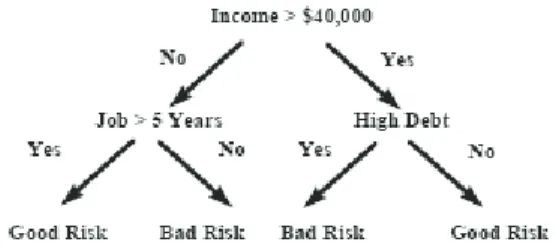
Techniques used in predictive mining include, for instance regression in statistics, or decision trees and neural networks from the machine learning area. Regression as a technique is very popular in the predictive mining domain, so that some author refers to prediction as regression method.
Figure 6 shows the decision tree technique:
Figure 6 An example of a simple decision-making dree tree of a classification task (Two Crows Corporation, 2005, p. 15)
3.1.2. Descriptive Tasks
Unlike predictive data mining, there is no target variable in a descriptive task; that is to say, one does not build a model describing the target variable as the outcome dependent on other variables. Descriptive mining is applied on data in order to discover unusual or non-trivial relations and samples among them.
The category of descriptive data mining task includes data description and summarisation, clustering and association.
Data description and summarisation is a succinct description of characteristics of data in their basic and aggregated, i.e. summarised form.
The users are thus familiarised with data, and visible regularities within the data are established. Moreover, these analyses set hypotheses which are confirmed or refuted. Data description and summarisation is, in most cases, a sub-project within a larger data mining project, which will result in a built model. In other words, the goal of data mining does not always have to be building a model, but also geting to know and describing available data. This contributes to the fact that application of tools for analysis and report, such as OLAP tools, also belongs among knowledge discovery methods.
Clusterisation is the process of identifying natural segments in a data set. More precisely, it is data segmentation, but not in accordance with predetermined criteria. The result is a set of clusters (the number of clusters is determined in advance, as a modelling parameter) where data is grouped according to a shared characteristic. After clustering, ti is necessary to analyse each cluster from the business aspect and identify its characteristics. A sample of clustering is customer behavioural segmentation with service providers. Based on habits in service utilisation, groups of users are determined based on some dominant common characteristic. The most used technique is k-means. However, techniques applied in predictive data mining such as neural networks and decision trees are also applicable in clustering tasks. Association is a task whose aim is to discover relationships between variables. Association is also often referred to as affinity analysis, or consumer basket analysis. The aim is to discover rule quantifying the relationship between two or more variables. The outcomes are associative rules of the type “If event A, then event B”, together with support and confidence ratios. For instance, a study at an American chain store showed that 200 out of 1000 customers buy diapers on Thursday evenings, and 50 out of 200 buy beer. The associative rule would be “If they buy diapers, then they buy beer”, with the support ratio of 200/1000 = 20%, security ratio of 50/200 = 25%. The techniques used include a priori algorithm and GRI algorithm.
Predictive and descriptive data mining tasks, i.e. problem-oriented approaches, can be combined within a single mining project; for instance, one could first apply clustering on the initial data set to determine the client segment that will be used for modelling the client attrition problem by predictive regression technique.
Management Information Systems
Vol. 7, 1/2012, pp. 032-041
37
4. CRISP-DM Process Model4
The data mining market was in infancy in the mid-1990s; however, there were signs of possible sudden expansion, which could have led to difficulties. More precisely, various data producers, i.e. the industry, developed their own approaches to the application of data mining, which could have resulted in non-standardised processes. This led to the need to define standards, i.e. standard data mining methods that could be introduced into any industrial environment consistently. In addition to cost cutting, the advantage of the existence of a defined method, i.e. data mining as a clearly defined process is optimizing the learning curve of the organisation that has decided to introduce data mining to solve its own business problems.
It is for this reason that Cross Industry Standard Process – Data Mining (CRISP-DM) was initiated in 1996. It was launched by three veterans in the field of this young, but propulsive discipline of business intelligence. Three companies – SPAS, DaimlerChrysler and NCR, have a long-standing experience in data mining. SPSS launched Clementine, the first commercial data mining tool, on the market in 1994; DaimlerChrysler represented industry as a leading data mining user, whereas NCR was an experienced market player in the data warehousing domain. A year later, the “trio” established a consortium and received financial assistance from the European Commission, and started implementing their idea. CRISP-DM was to be an industrial tool- and application-independent, standardised process.
To achieve successful implementation, they had to gather as much experience from data mining users as possible. The consortium therefore established an interest group, CRISP-DM Special Interest Group (SIG), which was to unify all interested parties in the process of defining a standardised process model. The first conference in Amsterdam gathered a surprising multitude of participants who supported the idea of defining the process and presented their experiences in projects of applying data mining for business purposes. It turned out that there were many points of convergence among the participants – from professional jargon to process phases that they applied in their business environments.
What followed was a period of developing CRISP-DM through projects and workshops, in cooperation with over 200 SIG members. The first framework process model was published in
4
Chapman et.al, 2000
1999, and, having been assessed through numerous projects, it was released as Version CRISP-DM 1.0. Time has shown that the standard was soon adopted and adapted by numerous firms. It is important to point out that the standard was based on experiences of users from various industries and various data mining projects.
4.1. CRISP-DM Methodology
The methodology of CRISP-DM process describes mapping a generalised, generic process and tasks comprising the process into a specific case, i.e. data mining process on a specific problem. The CRISP-DM process model describes the main phases of a project, and tasks that must be performed to have the project implemented. The model represents a generalised pattern applicable to any data mining process, and does not describe any a problem-specific application.
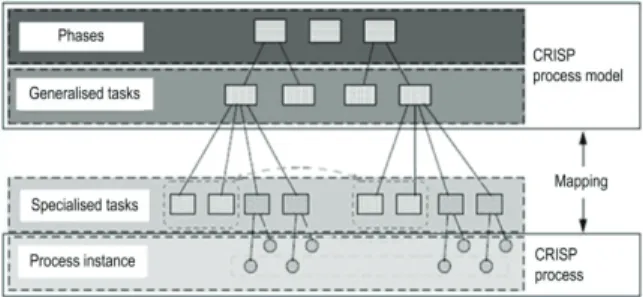
The CRISP-DM process can be viewed through four hierarchical levels describing the model at four levels of details, from general to specific (Figure 7).
Figure 7 Four abstraction levels of the CRISP-DM process model (Chapman et.al, 2000)
The first level defines the basic phases of the process, i.e. the data mining project. Each specific project passes through the phases at the first level; the first level is, at the same time, the most abstract.
At the subsequent level, each stage is broken down into generalised, generic tasks. They are generalised, as they cover all the possible scenarios in the data mining process, depending on the phase the project is in.
The third level defines particular, specialised tasks. They describe how an individual generalised task from the second level is executed in the specific case. For instance, if the second level defines a generic task of data filtering, then the third level describes how this task is executed depending on whether it is a categorical or continuous variable.
Finally, the fourth level contains the specific instance of the data mining process, with a range of
k p h p p k p 4 T m i p r r i actions, deci knowledge dis Vertically, from the ge process wit horizontally, i process, i.e. it When map process, one knowledge d dimensions (C Domain knowledge forecasting telecommu Type of knowledge classificati Technical e.g. data qu Tools and Enterprise neural netw The spec combination problem of telecommunic technique, an tool. 4.2. CRISP-D The phases o data mining model. The individual pha essence, the p of the data m steps (Figure fixed; in oth depending o phase. If the some knowle one of the pr to the previou Data minin reached, ne discovered, an same problem that the k evolutional. reached, a information fr sions and o scovery proce CRISP-DM m eneral CRISP h a specif it gives an ov ts phases cons pping from th e must view discovery. T Chapman et.a of use: spec e discovery p g client unication serv problem: de e discovery, on, etc.; aspect: possi uality or non-d techniques: e Miner, reg works etc. cific data m of these fou f forecasting cation by app nd using the DM Referenc of a CRISP-D project, are d model show ases, and rela process mode mining proce 8). The ord her words, th n the outco e stage outcom
dge was gain evious phases us phase. ng projects ar w knowledg nd their appl m yields bette knowledge Once the e new cycle from the previ
utcomes of ess. methodology P-DM proce fic applicati verview of th sisting of tasks he abstract int w the conte The context al, 2000, p.11): cific area w project is con attrition vice provider; escriptive or clustering, f ible technical existent value SPSS Cleme gression, deci mining cont ur dimension g client at plying the de SAS Enterp e Process M DM process, i described in a ws phases, ta tions between el describes th ss, comprisin er of the ph he next step ome of each me is unsatis ed that can b s, it is desirabl re iterative; on ge and ins lication on re er results. It c discovery p end of the begins, sup ious one. the actual is mapping ess into a on, while e reference s. to a specific xt of the has four : where the nducted, i.e. of a predictive forecasting, l problems, es, etc. entine, SAS ision trees, text is a ns, i.e. the ttrition in ecision tree prise Miner Model i.e. a single a reference asks within n them. In he lifecycle ng six basic ases is not is decided individual sfactory, or be useful in le to return nce a goal is sights are solving the can be said process is process is ported by Figure 8 The CRI following ph 1. Business 2. Data und 3. Data prep 4. Modellin 5. Evaluatio 6. Deploym 4.2.1. Busines This is a p according to business a cooperation determined problem. T clients, are task is to ext that the pro at later stage determined similar), an involved in required for hardware an the human specific exp phase of the carefully, so phases with A projec the first pha activities, a Resources fo Phases of the model (Chapm ISP-DM refe hases: understandin derstanding; paration; ng; on; ment. ss Understandi phase of defin o the data m aspect. This with clients and shaped The demands often conflict tract the key f oject will not g
es. In addition (marketing, u nd the organ the project. r this projec nd tools for im n resources, perts. This is e project, so th o as to com equal success t plan must b ase, with a list
as well as or tasks, their CRISP-DM refer man et.al, 2000) erence model ng; ing ning goals an mining projec is accom whose requi d into a d of business ting, so that fact from the go in the wro n, the problem user support o nisation’s bu . Furthermor t are identifi mplementatio especially th an extremel hat it must be mplete the o . be developed a of phases, wi the effort interdepende rence process defines the nd demands ct from the mplished in irements are data mining s users, i.e. the analyst’s demands, so ong direction m domain is or something siness units re, resources ied, such as n, as well as he domain-ly important e approached ther project at the end of ith tasks and estimation. encies, inputs
Management Information Systems
Vol. 7, 1/2012, pp. 032-041
39
and outputs are also defined. A special attention in project planning must be paid to risk assessment and management.
Formally, a phase comprises four tasks: determining business objectives, assessing situation, determining data mining goals, and project plan production.
4.2.2. Data Understanding
Once the project goals have been determined, and the data mining problem determined, the next phase is getting familiar with the data available in the client organisation (the data sources are defined in the previous step). The data is obtained from defined sources, and the criterion must be chosen with the specific business problem in mind. Tables are defined, and if the data source is a relational database, or data warehouse, variations of the tables to be used are also defined.
When the data is obtained from source, the next step is analysing the basic characteristics of the data, such as quantity and types (e.g. categorical or continuous), then analysis of the correlations between variables, distribution and intervals of values, as well as other simple statistical functions, using specialised statistical analysis tools if necessary. It is important to establish the meaning for every variable, especially from the business aspect, and relevance to the specific data mining problem.
What follows is a more complex analysis of the data set, possibly by the use one of OLAP or similar visualisation tools. This analysis directly addresses questions related to the data mining project itself, such as shaping hypotheses and transforming them into a mining problem space. In addition, project goals are determined more precisely. The end of this phase is the moment of determining the quality of the data set, such as completeness and accuracy of data, and frequency of discrepancies or nil-values. It is important to bear in mind that, apart from appropriate problem formulation, data is the most important key to success.
One can generally say that, at this stage, the analysts familiarise themselves through exploratory data analysis, which includes simple statistical characteristics and more complex analyses, i.e. setting certain hypotheses on the business problem.
Formally, the phase comprises these tasks: collecting initial data, describing data, exploring data and verifying data quality.
4.2.3. Data Preparation
Having analysed the data available to analysts, it is necessary to prepare data for the mining process. It includes choosing the initial data set on which modelling is to begin. Such a set is referred to model set. This is a very demanding process phase.
When defining the set for the subsequent modelling step, one take into account, among other things, elimination of individual variables based on the results of statistical tests of correlation and significance, i.e. values of individual variables. Taking these into account, the number of variables for the subsequence modelling iteration is reduced, with the aim of obtaining an optimum model. Besides this, this is the phase when the sampling (i.e. reducing the size of the initial data set) technique is decided on.
This is also the phase when the issue of data quality is addressed, as well as the manner in which non-existent values will be managed, and which strategy will be applied when handling particular values. Furthermore, new variables are derived, the values of the existing ones are transformed, and values from different tables are combined in order to obtain new variables, i.e. values. Finally, individual variables are syntactically adjusted to individual modelling tools, without changing their meaning.
The phase comprises the following tasks: data selection, data cleaning, data construction, data integration and data formatting.
It is important to note that the data preparation phase during the data mining project is performed recurrently, as findings from the subsequent modelling phase sometimes require redefining the data set for the next modelling step. A specific example is reducing the number of variables by eliminating low-impact correlations and variables based on criteria obtained as the outcome for the modelling phase.
4.2.4. Modelling
After the data set on which some of the mining techniques will be applied has been prepared, the subsequent step is choosing the technique itself. The choice of the tool, i.e. technique to be applied depends on the nature of the problem. Actually, various techniques can always be applied on the same type of problem, but there is always a technique or tool yielding the best results for a specific problem. It is sometimes necessary to model several techniques and algorithms, and then opt for the one yielding the best results. In other words, several models are built in a single iteration
of the phase, and the best one is selected. This is where the analyst’s experience is manifested. One thing, however, is clear: it must be established at the very beginning whether it is an issue for predictive or descriptive mining.
Before modelling starts, the data (model) set from the previous phase must be divided into subsets for training, testing and evaluation. The evaluation subset is used for assessing the model’s efficiency on unfamiliar data, whereas the test subset is used for achieving model generality, i.e. avoiding the overfitting on the training subset.
Division of the data subset is followed by model building. The effectiveness of the obtained model is assessed on the evaluation subset. In the case of predictive models, applying the obtained model on the evaluation subset produces data for the cumulative gains chart showing how well the model predicts on an unfamiliar set. Based on the obtained graph, the model quality ratio (surface below the graph) and other ratios – such as significance and value factors for individual variables, and correlations between them – parameters for the subsequent modelling step are determined. If necessary, the developer returns to the previous phase to eliminate noise variables from the data, i.e. model set.
If several models were built in this phase (even if it was done using different techniques), then models are compared, and the best ones are selected for the next iteration of the modelling phase. Each obtained model is interpreted in the business context, as much it is possible in the current phase iteration. The developers then assess the possibility of model deployment, result reliability, and whether the set goals are met from the business and analytic aspect. The modelling phase is repeated until the best, i.e. satisfactory model is obtained.
Tasks foreseen in the modelling phase are: generating test design, building the model, and assessing the model.
4.2.5. Evaluation
Unlike evaluating the model in the previous phase, related to the model’s technical characteristics (efficiency and generality), this phase assesses the final model, i.e. how much it meets the goals set in the first phase of the process. If the information gained at this point affects the quality of the entire project, this means returning to the first phase and re-initiating the cycle, but now taking the new facts into account. If he model meets all the business goals and is considered satisfactory for application,
this step is followed by the review of the entire data mining process, in order to secure the quality of the entire process, i.e. check whether there have been any oversights in its execution. Basically, it is a general quality management and provision, within the domain of the project management discipline.
The final step is defining the next steps, including decision on moving to the subsequent phase, the phase of model deployment, or repeating the entire process for improvement.
Tasks comprising the evaluating phase are: evaluating results, reviewing the process and determining next steps.
4.2.6. Model Deployment
Once the model has been evaluated, it is deployed in business, taking into account the way of measuring the model’s benefits and its supervision. Actually, it is of extreme importance to define a plan for model supervision, as, due to the nature and dynamics of the business process, it is necessary to repeat the modelling process from time to time so as to keep it up-to-date. Acting according to the results of a model that has not been updated may lead to unwanted circumstances. In other words, it is necessary to establish the dynamics of changing the model and choose the technique of verifying model quality over time.
The application of the model in strategic decision making of a business organisation can be used for direct measurement of the benefits of the obtained model, and gather new knowledge for the subsequent modelling cycle. Berry and Linoff therefore refer to data mining as virtuous circle of knowledge.
The end of this phase also completes a particular data mining project. Final reports and presentations are made. The project is concluded by overall review, i.e. analysis of its strengths and weaknesses. Documentation with experiences usable in possible future projects is also compiled. Project contributors and beneficiaries are interviewed.
Formally, this phase includes the following tasks: plan deployment, plan monitoring and maintenance, final report production and project review.
5. Conclusion
This article has clearly, systematically and analytically described the procedures of knowledge discovery in databases, and reached at least two conclusions. On the one hand, it is beyond doubt
Management Information Systems
Vol. 7, 1/2012, pp. 032-041
41
that knowledge discovery implies a process where data mining, i.e. acquisition is the key step, and includes certain techniques and tools. On the other, data mining has also imposed itself as a synonym for data discovery and acquisition, and features as an important factor of business intelligence as a young and relatively autonomous social discipline emerging within computing technology.
References
Berry, M. J., & Linoff, G. S. (2000). Mastering Data Mining – The Art and Science of Customer Relationship Management. New York: John Wiley & Sons.
Chapman, P., Clinton, J., Kerber, R., Khabaza, T., Reinartz, T., Shearer, C., et al. (2000). CRISP-DM 1.0 Step-by-step data mining guide. Retrieved May 14, 2011, from SPSS:
http://www.spss.ch/upload/1107356429_CrispDM1.0.pdf
Database normalization. (n.d.). Retrieved May 14, 2011, from Wikipedia: http://en.wikipedia.org/wiki/Database_normalization
Fayyad, U., Piatetsky-Shapiro, G., & Smyth, P. (1996). From Data Mining to Knowledge Discovery in Databases. Retrieved June 15, 2011, from KDnuggets: http://www.kdnuggets.com/gpspubs/aimag-kdd-overview-1996-Fayyad.pdf
Giudici, P. (2003). Applied Data Mining - Statistical Methods for Business and Industry. Chichester: John Wiley & Sons.
Kantardzic, M. (2003). Data Mining – Concepts, Models, Methods and Algorithms. New Jersey: IEEE Press.
Kimball, R. R. (2002). The Dana Warehouse Toolkit – The Complete Guide to Dimensional Modeling. New York: John Wiley & Sons.
Moreno, A., & Mancuso, G. (2002). The Role of OLAP in the Corporate Information Factory. Retrieved May 14, 2011, from Information Management and SourceMedia: http://www.information-management.com/issues/20021101/5990-1.html
Panian, Ž., & Klepac, G. (2003). Poslovna inteligencija. Zagreb: Masmedia. Pendse, N. (2008, July 3). OLAP market share analysis. Retrieved May 14, 2011, from BI Verdict:
http://www.bi-verdict.com/fileadmin/dl_temp/f8d840e599f87665172dc20ac5059324/mark et.htm
Two Crows Corporation. (2005). Introduction to Data Mining and Knowledge Discovery (3th ed.). Maryland: Two Crows Corporation.
Boris Brešić
Faculty of Organization and Informatics, Varaždin Paulinska 2
42000 Varaždin Croatia