ARTICULATA 2007 22 (1): 47–51 FAUNISTIK
First sightings ofRuspolia nitidula (Orthoptera: Tettigoniidae) and
Mecostethus parapleurus (Orthoptera: Acrididae) after fifty years in the Czech Republic
Jaroslav Holu a, Petr Ko árek & Pavel Marhoul
Abstract
Ruspolia nitidula (Scopoli, 1786) and Mecostethus parapleurus (Hagenbach, 1822) are species with similar requirements – both are hygrophilous and prefer mainly wet lowland meadows (K ÁREK et al. 2005). Besides that, they are ter-mophilous. In the Czech Republic they occurred at the margin of their ranges and became extinct in the 1950s (HOLU A & K ÁREK 2005). Now, after fifty years, these species appeared in southern Moravia lowlands. The probable reason for the current range expansion to the north are the global warming in the last de-cades.
Zusammenfassung
Nach über fünfzig Jahren wurden Ruspolia nitidula (Scopoli, 1786) und Meco-stethus parapleurus (Hagenbach, 1822) im Jahr 2006 erstmals wieder in Tsche-chien nachgewiesen. Der Hauptgrund für die Wiederbesiedlung des Südostens Tschechiens dürfte die Klimaerwärmung der zurückliegenden Jahrzehnte sein.
Ruspolia nitidula (Scopoli, 1786)
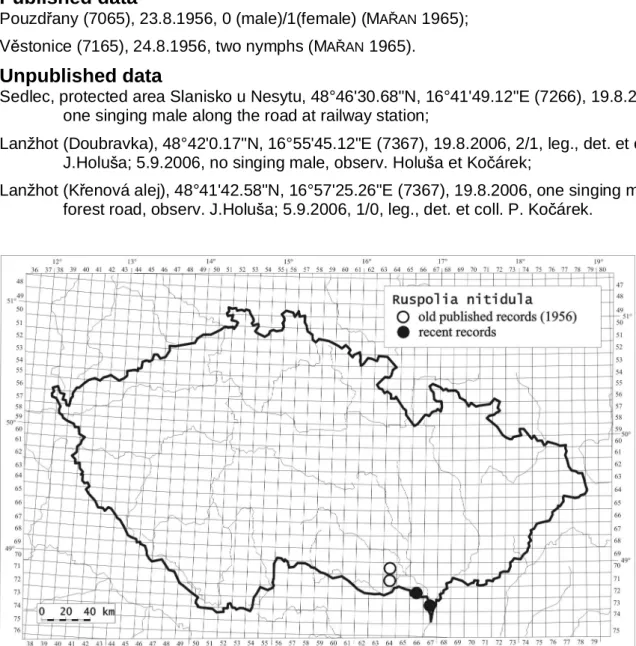
R. nitidula is a stenotopic hygrophilous species living on swampy meadows and the edges of cut-off canals and is distributed in northern Africa, southern Europe and Palearctic Asia (K ÁREK et al. 2005). In the Czech Republic, only M AN (1965) reported the occurrence of this species for Pouzd any and V stonice (Fig. 1). Since that time, no other occurrence has been recorded, despite the fact that the suitable habitats are still common in this territory (Phragmites stands). CHLÁDEK (1995) considered this species endangered due to the long absence of any records, and we also consider it critically endangered in our current red-list (HOLU A& K ÁREK2005).
In 2006, presence of R. nitidula was recorded in two areas: Sedlec (surroundings of the pond Nesyt) and Lan hot (see below, Fig. 1). It seems that the abundance is low (although the use of a bat detector is necessary for precise observation) because no singing male was observed after the collection of several specimens in Doubravka near Lan hot (see below). Based on the low abundance we as-sume that this spreading is recent. Although many suitable habitats (edges of streams and rivers, ox bows, wet meadows etc.) exist in the floodplain forests near Lan hot, it should be still classified as critically endangered in the Czech Republic.
Published data
Pouzd any (7065), 23.8.1956, 0 (male)/1(female) (M AN 1965); stonice (7165), 24.8.1956, two nymphs (M AN 1965).
Unpublished data
Sedlec, protected area Slanisko u Nesytu, 48°46'30.68"N, 16°41'49.12"E (7266), 19.8.2006, one singing male along the road at railway station;
Lan hot (Doubravka), 48°42'0.17"N, 16°55'45.12"E (7367), 19.8.2006, 2/1, leg., det. et coll. J.Holu a; 5.9.2006, no singing male, observ. Holu a et Ko árek;
Lan hot (K enová alej), 48°41'42.58"N, 16°57'25.26"E (7367), 19.8.2006, one singing male at forest road, observ. J.Holu a; 5.9.2006, 1/0, leg., det. et coll. P. Ko árek.
Fig. 1: Occurrence ofRuspolia nitidula in the Czech Republic
Mecostethus parapleurus (Hagenbach, 1822)
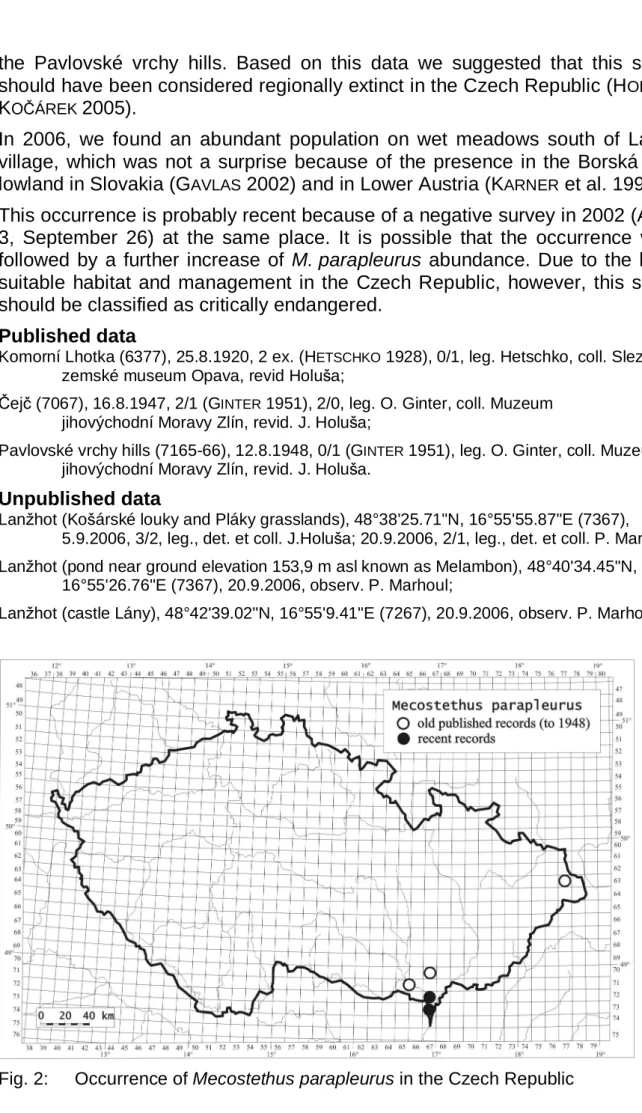
M. parapleurus is a Eurosiberian species distributed from the Pyrenees, central and southren Europe (as far as Germany and Poland in the north) to Siberia, N China, Korea and Japan. M. parapleurus is a thermophilous and moderately to strongly hygrophilous species; it inhabits wet meadows, salt marshes etc. (K ÁREK et al. 2005). In the Czech Republic, only old records with data for the Pavlovské vrchy hills (GINTER 1951, 1971), ej (GINTER 1951) and Komorní Lhotka (HETSCHKO 1928) are known. It has not been observed in the Czech Re-public since 1948 (see below), so CHLÁDEK (1995) considered this species as vulnerable. It became extinct in the surroundings of Komorní Lhotka, and now there are no suitable habitats for this species (HOLU A 2000). The locality is situ-ated near the edge of the range in Poland, where the species also became extinct due to the loss of suitable habitats (GLOWACINSKI & NOWACKI 2004). Simi-larly, there are no wet meadows in the surroundings of ej and on the foot of
the Pavlovské vrchy hills. Based on this data we suggested that this species should have been considered regionally extinct in the Czech Republic (HOLU A& K ÁREK2005).
In 2006, we found an abundant population on wet meadows south of Lan hot village, which was not a surprise because of the presence in the Borská ní ina lowland in Slovakia (GAVLAS 2002) and in Lower Austria (KARNER et al. 1992). This occurrence is probably recent because of a negative survey in 2002 (August 3, September 26) at the same place. It is possible that the occurrence will be followed by a further increase of M. parapleurus abundance. Due to the lack of suitable habitat and management in the Czech Republic, however, this species should be classified as critically endangered.
Published data
Komorní Lhotka (6377), 25.8.1920, 2 ex. (HETSCHKO 1928), 0/1, leg. Hetschko, coll. Slezské zemské museum Opava, revid Holu a;
ej (7067), 16.8.1947, 2/1 (GINTER 1951), 2/0, leg. O. Ginter, coll. Muzeum
jihovýchodní Moravy Zlín, revid. J. Holu a;
Pavlovské vrchy hills (7165-66), 12.8.1948, 0/1 (GINTER 1951), leg. O. Ginter, coll. Muzeum jihovýchodní Moravy Zlín, revid. J. Holu a.
Unpublished data
Lan hot (Ko árské louky and Pláky grasslands), 48°38'25.71"N, 16°55'55.87"E (7367), 5.9.2006, 3/2, leg., det. et coll. J.Holu a; 20.9.2006, 2/1, leg., det. et coll. P. Marhoul; Lan hot (pond near ground elevation 153,9 m asl known as Melambon), 48°40'34.45"N,
16°55'26.76"E (7367), 20.9.2006, observ. P. Marhoul;
Lan hot (castle Lány), 48°42'39.02"N, 16°55'9.41"E (7267), 20.9.2006, observ. P. Marhoul.
Acknowledgements
This paper was partly supported by the grant of No. MZe 0002070201 of the Min-istry of Agriculture of the Czech Republic.
Authors:
Dr. Jaroslav Holu a
Forestry and Game Management Research Institute Office Frýdek-Místek
Nádra ní 2811
CZ-73802 Frýdek-Místek, Czech Republic E-mail:[email protected]
Dr. Petr Ko árek
Department of Biology and Ecology University of Ostrava, Chittussiho 10 CZ-71100 Ostrava 2, Czech Republic E-mail: [email protected]
Mgr. Pavel Marhoul
Agency for Nature Conservation and Landscape Protection of the Czech Republic
Kali nická 3-6
CZ-13023 Praha 3, Czech Republic E-mail: [email protected]
References
CHLÁDEK, F. (1995): Ensifera and Caelifera. – In: ROZKO NÝ, R. & V HARA, J. (eds): Terrestrial Invertebrates of the Pálava Biosphere Reserve of UNESCO I. – Folia Fac. Sci. Nat. Univ. Masarykianae Brunensis, Biologia 92: 121–128.
GAVLAS, V. (2002): K poznaniu fauny kobyliek (Ensifera), konikov (Caelifera) a modliviek (Man-todea) Borskej niziny (JZ Slovensko). On the knowledge of bush-crickets (Ensifera), grasshoppers (Caelifera) and mantids (Mantodea) of the Borska nizina Lowland (SW Slovakia). – Entomofauna Carpathica 14 (1-2): 16–21.
GINTER, O. (1951): Výskyt vzácn ích orthopter na Morav . La présence de plus rares orthop-tères en Moravie. – Entomol. listy 14: 167–169.
GINTER, O. (1971): Orthoptera na Pavlovských kopcích. [Orthoptera of the Pavlovské kopce hills]. – In: Z jihomoravské p írody. – Regionální muzeum, Mikulov: 47-66.
GLOWACINSKI, Z. & NOWACKI, J. (2004): Polska czerwona ksiega zwierzat. Bezkregowce. – Institut Ochrony Przyrody PAN, Krakow, 447 S.
HETSCHKO, A. (1928): Notiz überParapleurus alliaceus Germ. (Orthopt.). – Wien. Entomol. Ztg. 45: 100.
HOLU A, J. & K ÁREK, P. (2005): Orthoptera (rovnok ídlí). – In: FARKA J., KRÁL, D. & KORPÍK, M. (eds.): ervený seznam ohro ených druh eské republiky. Bezobratlí. Red list of threatened species in the Czech Republic. Invertebrates. – Agentura ochrany p írody a krajiny R, Praha: 133–134.
HOLU A, JR. J. (2000): K poznání saran í (Caelifera) a kobylek (Ensifera) Moravskoslezských Beskyd. On the knowledge of grasshoppers (Caelifera) and crickets (Ensifera) in the Moravskoslezské Beskydy Mts. – Klapalekiana 36: 41–70
KARNERE., RANNER, A. & ZUNA-KRATKY, T. (1992): Zur Heuschreckenfauna der Zitzmannsdorfer Wiesen und des angrenzenden Seedammes (Neusiedler See, Burgenland). – BFB-Bericht 78: 31–46.
K ÁREK, P., HOLU A, J., VIDLI KA, . (2005): Blattaria, Mantodea, Orthoptera & Dermaptera of the Czech and Slovak Republics. Blattaria, Mantodea, Orthoptera & Dermaptera eské a Slovenské republiky. – Kabourek, Zlín; 349 S.
M AN, J. (1965): Beitrag zur Kenntnis der Taxonomie, Ökologie und der geographischen Verbreitung vonHomorocoryphus nitidulus (Scop.) in der Tschechoslowakei (Orthop-tera – Tettigonoidea). – Acta Faun. Entomol. Mus. Nat. Pragae 11: 307–326.