1
BAQIR, MUHAMMAD NAVEED, Ph.D., A Qualitative Inquiry of ICT based Socio-Economic Development in Developing Countries: The Case of Pakistan. (2009)
Directed by Dr. Prashant Palvia, Dr. Hamid Nemati. 305 pp.
The role of information communication technologies (ICT) growth in citizens’ political participation, socio-economic development, and poverty alleviation is an active area of study within information systems (IS) research in developing countries. This dissertation contributes in (1) developing an historical perspective of ICT growth, (2) identifying antecedents of ICT growth, (3) proposing extensions in ‘design-actuality gaps framework’ (for ICT policy analysis), (4) extending dimensions of ICT based socio-economic development, and (5) in integrating relationship between ICT growth and socio-economic development. The data collection was done in three phases from December 2006 to January 2009 in Pakistan. A total of 54 officials who made or influenced government’s ICT policies and 46 citizens participated. The qualitative analysis shows that government’s policies play an important role in ICT growth. However, political instability and lack of citizens’ involvement in policy design leads to inconsistent policies which can impede realization of the benefits of ICT growth. The findings have practical implications for government’s ICT policy design and evaluation, understanding of the antecedents of ICT growth, and ICT based socio-economic development. The recommendations for ICT policy design in this research can potentially benefit governments in increasing citizens’ quality of life, socio-economic development, and poverty alleviation.
2
A QUALITATIVE INQUIRY OF ICT BASED SOCIO-ECONOMIC
DEVELOPMENT IN DEVELOPING COUNTRIES:
THE CASE OF PAKISTAN
by
Muhammad Naveed Baqir
A Dissertation Submitted to the Faculty of the Graduate School at the University of North Carolina at Greensboro
in Partial Fulfillment
of the Requirements for the Degree Doctor of Philosophy Greensboro 2009 Approved by Dr. Prashant Palvia___________________ Committee Co-Chair Dr. Hamid Nemati ___________________ Committee Co-Chair
i
ii
man has no share in what he does not earn through his hard work
To
Dr. Allama Iqbal (1877-1938) Poet of the East
iii
APPROVAL PAGE
This dissertation has been approved by the following committee of the Faculty of the Graduate School at the University of North Carolina at Greensboro.
Committee Co-Chair ___________________________ Dr. Prashant C. Palvia Committee Co-Chair ___________________________ Dr. Hamid Nemati Committee Members ___________________________ Dr. Kathleen Casey ___________________________ Dr. Susan Walcott ___________________________ Date of Acceptance by Committee ___________________________ Date of Final Oral Examination
iv
ACKNOWLEDGMENTS
I want to express special gratitude to my family. My wife, Amna, stood by my side through thick and thin. She comforted me when I was worried and didn’t know what to do. Her support enabled me to spend months of sleepless nights on analyzing loads of qualitative data. She took care of both Maryam and Fatima so that I could focus on completing this dissertation. My parents assured that I understand the importance of education when I was a little child. They provided me unconditional financial and moral support to continue my studies without worrying about anything. I am also thankful to my younger brother, Ali, who has been a source of great comfort to me in times when I felt worried. My sister, Sahrish, and her husband, Kamran, have provided me a great support by taking care of my parents when they greatly needed me.
I would like to individually acknowledge the kind support of my dissertation committee members. They spent countless hours in ensuring that I grow both academically and professionally. It is because of their support and guidance that I excel in my personal and professional life. I feel fortunate to have dissertation committee members who I had the honor of working with. I will never forget Dr. Walcott’s support in adding value to my dissertation by ensuring that I understand the importance of spatial representation of my research sites. She provided constant comparison of my research with her own expertise on the socio-economic impact of technology parks in developing countries. Since my meeting with Dr. Alan Lee in August 2005, I wanted to undertake a qualitative study for my dissertation. While I took several courses on qualitative research methods, it wasn’t until I took a course from Dr. Casey that I developed the capability to design my research study which was based on sound methods. Dr. Nemati’s encouragement, support and intellectual support has been the hallmark of our mutual relationship since August 2005. His kindness throughout my course work, research projects and dissertation has been incredible. He has the capability to intellectually excite his students by making significant contributions to their
v
research. I have certainly benefitted from his guidance considerably for which I am very thankful to him. I have always expressed my gratitude for Dr. Palvia’s support since I took my first course with him during the Fall of 2005. I cried sometimes when I had to accomplish tasks that I thought I would never be able to undertake. Surprisingly, his strategy of setting higher standards and then expecting his students to do even better has worked wonders for me. I could not have completed this dissertation if he had not supported me at every step of the way.
I must also thank Dr. Lakshmi Iyer, Dr. Al Salam, Dr. Rahul Singh, Dr. Kwasi Amoako-Gyampah, and Dr. Rick Reitzug, who prepared me well to undertake challenges and avoid making mistakes. I am extremely thankful to Dr. Cathy Urquhart at the University of Auckland, and Dr. Richard Heeks at the University of Manchester, for providing valuable feedback and suggestions to improve the overall quality of the study. I must also mention Dr. Elizabeth Davidson at the University of Hawaii for encouraging reviews on initial dissertation proposal.
This dissertation was not possible without the kind support of many supporters in Pakistan. Dr. Mohammad Yaseen, Chairman Pakistan Telecommunication Authority, Dr. Nazir Sangi, Chair of the Computer Science Department at Allama Iqbal Open University (AIOU), Dr. Rashid Kausar, Pro-Rector of the University of Management and Technology in Lahore, Dr. Arshad Ali, Director General at the School of Electrical Engineering and Computer Science (SEECS) – National University of Science and Technology (NUST), Pakistan, and Dr. Hafiz Farooq Ahmad, Professor at SEECS–NUST, Pakistan, provided crucial help throughout my pursuit of graduate level education in general and dissertation in particular. Last but not the least, Dr. Mahmood Butt, Vice Chancellor at Allama Iqbal Open University in Islamabad, provided me a very supportive environment in Islamabad. I cannot thank him enough to express my gratitude.
vi TABLE OF CONTENTS LIST OF TABLES ... ix LIST OF FIGURES ... xi CHAPTER I. INTRODUCTION ... 1
1.1 ICT Growth And Socio-Economic Development ... 3
1.2 Research Gaps ... 4
1.3 Need For Developing A Theory Of ICT Based Socio-Economic Development ... 6
1.4 Research Framework ... 7
1.5 Research Objectives And Questions ... 10
II. LITERATURE REVIEW... 13
2.1 Growth and Development ... 16
2.2 Theories of Development ... 17
2.3 Economic Development ... 23
2.4 Socio-Economic Development in Different Disciplines ... 24
2.5 Digital Divide (inequality) ... 29
2.6 ICT based Socio-Economic Development in Developed World ... 33
2.7 ICT issues in Developing Countries ... 34
2.8 Why Pakistan? ... 38
2.9 Historical Perspective of ICT Growth in Pakistan ... 45
2.10 ICT Growth and Socio-Economic Development in Pakistan ... 46
2.11 Dark side of ICT ... 51
2.12 Conclusion ... 52
III. RESEARCH SCOPE/EXPLORATORY FRAMEWORK ... 53
Conclusion ... 57
IV. RESEARCH METHODS ... 58
4.1 Historical Research ... 61
4.2 Grounded Theory ... 68
vii 4.3 Narrative Research ... 73 4.4 Researcher Subjectivity ... 78 4.5 Myself as a Researcher ... 81 4.6 Conclusions ... 83 V. PILOT STUDY……… ... 84
5.1 Lessons Learned from the Pilot ... 89
5.2 Pilot Analysis and Preliminary Findings ... 92
VI. RESEARCH DESIGN AND METHOD ... 99
6.1 Theoretical Sampling and Evolution of Research Design ... 99
6.2 Research Design ... 102
6.3 Data Collection and Organization ... 113
6.4 Timeline ... 115
VII. HISTORICAL REVIEW OF ICT GROWTH IN PAKISTAN ... 116
7.1 History of ICT Growth in Pakistan ... 117
7.2 Lessons Learned from Historical Review of ICT Growth ... 138
VIII. ANALYSIS AND EVALUATION OF THE NATIONAL ICT POLICY AND ACTION PLAN... 140
8.1 Introduction to the ICT Policy and Action Plan of 2000 ... 140
8.2 Design-Actuality Gaps Framework ... 144
8.3 Discussion and Analysis of Extended Design-Actuality Gaps ... 152
8.4 Discussion and Analysis of the Causes of Gaps... 181
8.5 Summary and Lessons Learned... 187
IX. ANTECEDENTS OF ICT GROWTH ... 190
9.1 Grounded Theory based Data Analysis ... 190
9.2 Globalization ... 196
9.3 Awareness of ICT Benefits ... 202
9.4 Regional Competition ... 210
9.5 Market Size ... 212
9.6 Law Enforcement Challenges ... 214
viii
X. ICT GROWTH AND SOCIO-ECONOMIC DEVELOPMENT OF CITIZENS ... 221
10.1 Background of Research Participants (Citizens) ... 221
10.2 Dimensions of Socio-Economic Development ... 226
10.3 Axial Model ... 258
10.4 Theoretical Integration ... 259
10.5 Relationship between ICT Growth and Socio-Economic Development ... 264
10. 6 Summary ... 267
XI. SUMMARY AND CONTRIBUTIONS ... 268
11.1 Overview of the Research ... 269
11.2 Contributions and Implications for Theory and Practice ... 272
11.3 Narratives of Children ... 278
11.4 Trustworthiness and Evaluation of the Study ... 281
11.5 Limitations... 285
11.6 Future Research ... 286
11.7Conclusion ... 288
REFERENCES ... 290
ix
LIST OF TABLES
Table 1: Top-Ten Emerging Markets (Willing, 2007) ... 37
Table 2: Teledensity Growth (PTA, 2008) ... 41
Table 3: Socio-Economic Data for Pakistan (PTA, 2008) ... 41
Table 4: Foreign Direct Investment (FDI) in Pakistan (PTA, 2008) ... 42
Table 5: Historical Research in IS Research ... 62
Table 6: Grounded Theory Research in IS ... 69
Table 7: Narrative Research in IS ... 73
Table 8: Research Design of Pilot Study ... 85
Table 9: Interview Protocol for Government Officials/Industry Representatives ... 87
Table 10: Data Collection Time Frame and Number of Participants ... 102
Table 11: Research Design ... 105
Table 12: Selection of Citizens ... 110
Table 13: Research Participants Selection ... 113
Table 14: Results from initial open coding of ICT policy, action plan and related government documents ... 144
Table 15: Dimensions of Design ... 151
Table 16: Dimensions of Actuality ... 152
Table 17: Extended Design-Actuality Gaps Across Identified Dimensions* ... 154
Table 18: Foreign Direct Investment (FDI) in Telecommunication Sector (US $ Million – PTA, 2008) ... 168
Table 19: Open Codes, Key Terms and Phrases for Antecedents of ICT Growth ... 192
Table 20: Word Frequency in transcripts and codes list from 54 interviews ... 195
x
Table 21: Scaling up of Codes into Categories ... 196 Table 22: Background and Narratives of Select Participants ... 225 Table 23: Dimensions of Socio-Economic Development, Categories of Codes,
Frequencies, Key terms and Phrases ... 230 Table 24: Gender distribution of participants in three competitions ... 279 Table 25: Assessment of the Trustworthiness of this Research ... 284
xi
TABLE OF FIGURES
Figure 1: Research Framework and Questions ... 11
Figure 2: Global Digital Inequality; Source United Nations Global Development Goals Indicators ... 32
Figure 3: Teledensity Growth (PTA, 2008) ... 41
Figure 4: ICT Coverage Area in Pakistan (white space within the country boundaries represents coverage area) ... 44
Figure 5: Schematic Diagram of Data Collection and Analysis ... 60
Figure 6: NVIVO Software Screenshot ... 93
Figure 7: Open Coding from Data and Associated Attributes ... 94
Figure 8: Framework for the stages of Socio-Economic Development ... 96
Figure 9: Theoretical Model of Socio-Economic Development (Axial Coding) ... 98
Figure 10: Selection of Ordinary Citizens for Narrative Interviews. ... 109
Figure 11: Research Sites ... 115
Figure 12: Evolution of Information Communication Technologies in Pakistan ... 119
Figure 13: Extended Design-Actuality Framework ... 149
Figure 14: Axial Coding of ICT Growth Evaluation from ICT policy, action plan and other documented evidence ... 189
Figure 15: Axial Coding of the Antecedents of ICT Growth ... 220
Figure 16: A Newspaper Advertisement of a Cellular Service Provider Offering ... 235
Figure 17: Axial Model of the Dimensions of Socio-Economic Development ... 258
Figure 18: Internet and Socio-economic Development – ... 260
Figure 19: Theoretical Model of the Relationship between ICT Growth and Socio-Economic Development ... 265
xii
Figure 20: Newspaper advertisement inviting children to participate in a
narrative writing contest on “role of ICT on our lives ... 280 Figure 21: Winners of the narrative writing contest ... 280
1 CHAPTER I INTRODUCTION
Information and Communication Technologies (ICT) are often represented as a factor in global socio-economic development. There is a widespread optimism that ICT can play a significant role in economic development and GDP (gross domestic product) growth, capacity development and employment, productivity and organizational restructuring, poverty alleviation and democratic participation of citizens (Kozma, 2005). ICT are also expected to have an important impact on improved transparency and responsiveness of governmental agencies, widely available education and healthcare opportunities, cultural creativity, and social integration of individuals with different abilities and groups with diverse cultural backgrounds. However, little academic research can demonstrate that these objectives can be met simply because of ICT growth.
ICT refers to technologies that help in the communication and transmission of information. This can be accomplished by using a number of computer based technologies, voice and data telephony, wireless local loops and cellular phones in addition to the rise in electronic media outlets such as new television and radio channels that enhance awareness of the socio-economic development. In this sense, ICT form an overarching discipline which encompasses Information Systems (IS) as part of it.
2
The potential of ICT in socio-economic development is being recognized around the world in recent years (Walsham & Sahey, 2006). The recent proliferation of ICT in many developing countries has led to exponential growth of the ICT sector and is considered vital for socio-economic development. However, the concept of socio-economic development and its relationship with ICT growth remain open questions. A great deal of current literature on the subject is based upon governmental plans and strategies or their analysis. The concept of socio-economic development has been used in a variety of ways in different academic disciplines such as sociology, psychology, economics, political science, geography, management and health sciences to describe enhancement of quality of life for ordinary citizens. Furthermore, the scale of analysis for socio-economic development could range from individual to societal and from organization to international depending upon the nature of the discipline (Jaffee, 1998).
In simplest terms, social development refers to the opportunities for education, social interactions and evolution of social customs, fashion and trends (Blakely, 2001). Economic development on the other hand means creation of (better paying) jobs, a widespread and sustained increase in the living standard and accelerated economic activities (Blakely, 2001). World Bank defines economic development in terms of “qualitative change and restructuring in a country's economy in connection with technological and social progress. The main indicator of economic development is increasing GNP per capita (or GDP per capita), reflecting an increase in the economic productivity and average material wellbeing of a country's population” (World Bank,
3
2008). Economic development is closely linked with economic growth. Madon’s (2000) theoretical model attempts to define the concept of socio-economic development as well as its dimensions. In this model, dimensions of socio-economic development include (1) economic productivity, (2) health, (3) education, (4) poverty alleviation, (5) empowerment, (6) democracy and (7) sustainable development.
1.1 ICT Growth and Socio-Economic Development
The notion of ICT growth and its impact on socio-economic development is not new. Hardy (1980) argued that telephones have a direct impact on economic development because they increase managers’ capability to communicate rapidly and therefore support coordination of economic activities. Wlasham (2001) calls for a “world of difference” while referring to ICT and socio-economic development. Eggleston et al. (2003) remark that even with the widely held optimism that ICT will promote socio-economic development and alleviate poverty, there is no theoretical or empirical evidence to support this claim. With the proliferation of ICT, the economic health of cities, regions and countries will depend on their ability to actively participate in technological advancements (Gibbs and Tanner, 1997). The investments in ICT by regional and local administrations are indicative of the perceived importance of ICT for economic and technological development. In many instances, local and regional administrations have taken special interest in the encouragement of small and medium size businesses to develop capacity for ICT to support their core business. The provision of training to the local population in order to prepare trained and skilled workers for
4
knowledge based economic development is another example of investments in ICT for economic development.
The majority of existing literature on socio-economic development is policy development and analysis oriented. A number of countries around the world, particularly developing countries, have adopted ICT policies recently or are in the process of adopting them. These policies usually start with the an understanding of ICT’s role in shaping socio-economic landscape of these countries (Baqir & Pervez, 2000). Several research studies from various disciplines attempted to define socio-economic development. It has been defined in as simple terms as education and income (Hsieh, Rai & Keil, 2008) to encompass complex concepts such as quality of life, creation of a better world, social customs, fashion and trends, economic productivity, health, poverty alleviation, empowerment, democracy and sustainable development (Madon, 2000; Blakely, 2001; Walsham, 2001; Puri, 2007).
1.2 Research Gaps
Walsham (2001) and Puri (2007) emphasize the need to show the impact of ICT on socio-economic development, i.e., the creation of a better world. However, the question remains about what constitutes socio-economic development, how it is defined and how it should be measured. The literature also disputes the notion of income and education (Hsieh, Rai, & Keil, 2008) alone to define the socio-economic status of individuals, groups and nations. Existing literature and ICT growth data (ITU, 2008) from developing countries suggest tremendous growth of the ICT industries. The
5
relationship between ICT growth and socio-economic development also remains an open research question.
The MIS Quarterly June 2007 special issue on IS research in developing countries advocates further understanding of ICT based socio-economic development where 4/5th of the world’s populations lives. While the mere promise of significant economic and social transformations/development due to ICT is easy to make, little academic research can demonstrate socio-economic development that was brought about due to ICT growth. The research framework of the virtuous cycles of productivity and gains (Mistry, 2005) discusses the role of public policies, enabling legislations, governmental initiatives in the growth of ICT and the digital divide in India. Yet, it doesn’t explain the antecedents of ICT growth or what necessitates change in governmental policies.
Research on ICT growth in developing countries is specially limited. For example, most of whatever research exists on Pakistan consists of the description and analysis of ICT policy that the government adopted in 2000 (Mujahid, 2002; Baqir & Pervez, 2000). As such existing literature on the antecedents of ICT growth and their impact on socio-economic development is sparse.
There is no existing comprehensive and integrated theory of ICT based socio-economic development that empirically explains the concept of socio-socio-economic development and its relationship to ICT growth. The lack of IS oriented research on developing countries and the need to better understand antecedents of ICT growth and ICT based economic development call for in-depth research. Even though
socio-6
economic development is an interdisciplinary field, lack of a theoretical background for ICT based socio-economic development makes this research timely and worthwhile. 1.3 Need for Developing a Theory of ICT based Socio-Economic
Development
Information and communications technologies (ICT) are often presented as enablers that can bridge physical distances in a number of ways, thus creating opportunities for accelerated social and economic activities. The quantitative data from International Telecommunication Union (ITU) and regulatory bodies for ICT sectors in developing nations clearly show an unprecedented growth in ICT infrastructure and market size. A comprehensive review of governmental ICT policies from developing nations and editorials in leading journals on this topic depicts that the citizens’ point of view on ICT led socio-economic development has been specially ignored in literature.
There is a need to develop a unifying theme that integrates the concepts of ICT growth and socio-economic development. Since there is no existing theoretical foundation that explains socio-economic development and its relationship with ICT growth, this research aims at employing grounded theory and narrative research methods to develop an understanding of socio-economic development and its relationship with ICT growth. This research will develop an integrated model of ICT’s role in socio-economic development in a developing country.
As an example of the case, Pakistan recently experienced a fast paced growth in the ICT sector (PTA, 2008). Interviews with ICT industry stakeholders such as
7
government officials, policy makers, representatives from ICT industry regulators, representatives from the ICT industry service providers, hardware providers, software development firms, and ordinary citizens will be conducted. The interviews will be transcribed and analyzed using grounded theory and the narrative research method. The findings will discuss how different stakeholders of ICT industry in Pakistan view socio-economic development and its association with ICT related growth. An attempt will be made to understand the meaning of socio-economic development from people’s interpretation of these terms and impacts on their lives. This will lead to the development of a ICT based socio-economic development theory which will benefit policy makers, government officials, citizens as well as technology vendors and service providers in understanding ICT growth based socio-economic development needs. 1.4 Research Framework
The existing literature makes a number of suggestions as to what aspects of future research on IS/ICT in developing countries should be given particular attention. Walsham et.al (2007) point out the following dimensions of future research in this area: (1) geographical spread, i.e., conducting research in areas traditionally ignored in the existing literature, (2) types of organizations, i.e., traditional focus has been on public and private organizations: more research is needed on other types of organizations such as role of Non-Governmental Organizations (NGO), and (3) level of analysis, i.e., typical analysis level progress through individuals, groups, organizations, industry sectors, societies, and international organizations; progression of higher, aggregate levels of analysis tend to exclude community level research which represents an opportunity for future research.
8
Literature from other academic disciplines such as anthropology and development studies is especially important for future research in IS/ICT development in developing countries. Rich methodological and theoretical diversity from anthropology provide approaches to understanding cultures and societies. Developmental studies provide understanding of the debates around the basic tenets of “development” in various parts of the world. Additionally, academic disciplines such as political science, geography, economics, sociology, medical science, education and several others provide basic understanding and approaches towards developing a framework for research on ICT based socio-economic development in developing countries.
Walsham and Sahay (2006) suggest four basic questions for future research on IS/ICT in developing countries. These questions are listed below along with how they are addressed these in this research.
1. What is the “development” to which ICT aims to contribute?
o For the purpose of the current study, the term development refers to social and economic development. While economic development may be translated into increased opportunities for economic development such as jobs creation, higher pay, infrastructure development, business development and enrichment due to the use of ICT and ability to reach a larger customer base, there is no unified definition of the term. Different academic disciplines such as economics, political science, sociology, anthropology and others define this term differently. Similarly the concept of social development is illusive because of the wide spectrum of changes that may be considered social development. The dimensions of socio-economic development are explained in later chapters and
9
will be understood from the perspective of ICT stakeholders as a result of grounded theory and narrative research analysis.
2. What are the key issues being studied related to ICT?
o The relationship between ICT growth and socio-economic development remains open in IS/ICT in developing countries research. The causes and the consequences of the relationship between ICT growth and socio-economic development have implications for developing countries. Similarly integration of antecedents of ICT growth and socio-economic development is another important goal of this research.
3. What is the theoretical and methodological stance?
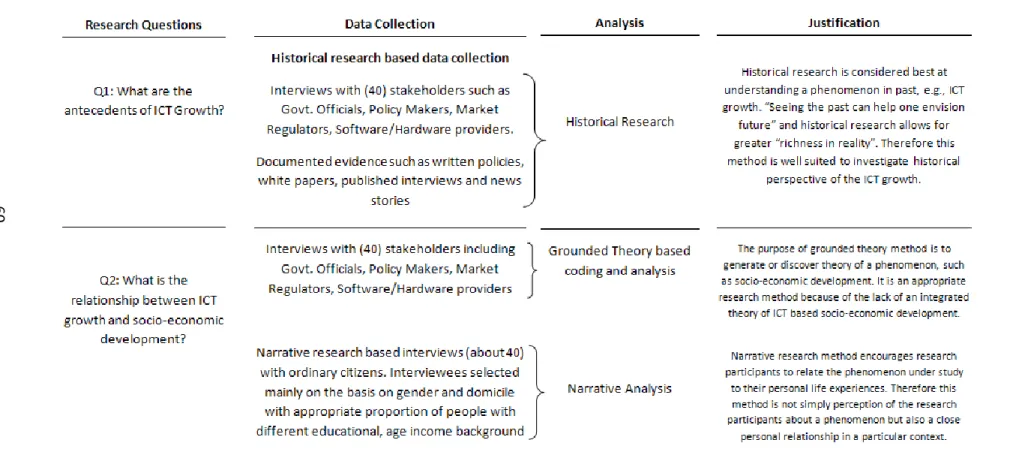
o Since there is no integrated theory of ICT based socio-economic development, a qualitative approach will used. Historical research method will be used to identify antecedents of ICT growth in developing countries. Grounded theory and narrative research methods will be used to analyze the qualitative data from interviews with government officials, industry representatives and ordinary citizens. Further discussion on this aspect of the current research is given in Chapter 4.
4. What level and focus of analysis is being adopted?
o The level and focus of analysis is society. Even though level and focus of analysis for socio-economic development can be individual, societal, organizational or international (Jeffee, 1996), societal impact of ICT growth on socio-economic development is the basic tenet of this research.
10 1.5 Research Objectives and Questions
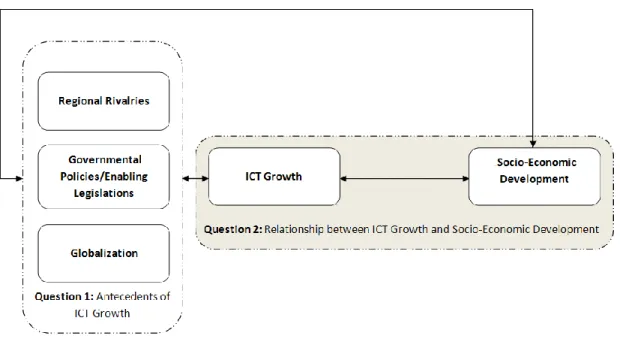
The underlying exploratory framework for this research is shown in Figure 1: Research Framework and Questions. These research questions are consistent with the suggestion for a research framework by Walsham and Sahay (2006 & 2007).
1. What are the antecedents of ICT growth?
What is the historical evolution of ICT based upon documented evidence?
How do government officials interpret historical events in the past that lead to ICT growth?
What external and internal antecedents played an important role in ICT growth in Pakistan?
2. What is ICT based socio-economic development and how is it related
with the ICT growth in developing countries?
What does socio-economic development mean to citizens (Dimensions of Socio-Economic Development)?
How do policy makers and enforcers in government interpret this relationship?
How do industry representatives such as service providers,
software/hardware providers and technology developers perceive ICT based socio-economic development and ICT growth in developing countries?
11
How ordinary citizens’ make sense of socio-economic development and ICT growth?
Based the set of research questions above, following five research objectives are undertaken in this research:
1. Develop a historical perspective of ICT growth (so that the next objective is informed by the historical context of ICT growth)
2. Identify antecedents of ICT growth
3. Identify dimensions of ICT growth (for ICT policy analysis) 4. Identify dimensions of socio-economic development 5. Integrate the relationships between ICT growth and
socio-economic development
12
The relationship between ICT growth and socio-economic development has been shown as a two way arrow to highlight a possible two-way relationship. The existing literature presents this relationship as an open question and it forms the first research question for this research. This research framework lists a few antecedents of ICT growth based upon the literature. The historical research method will be used to discover antecedents and their mutual relationships. This constitutes the second research question.
Since this research is not a positivist study, identification of the relationships between various components of the framework are based upon exploratory methods. Efforts have been made to avoid any preconceived notions of these concepts and their relationships (grounded theory method). The framework above was developed based upon the suggestions for IS research in developing countries literature. This framework serves as a starting point for this research. The research does not attempt to validate this particular model. As explained in the chapter on research methods, grounded theory based research considers literature review and relevant existing theories as data sources for theory development of the issue being studied. A theory and a model of ICT based socio-economic development will be developed as a result of grounded theory and narrative research analysis. Further discussion of this framework and concepts is provided in Chapter 3.
13 CHAPTER II LITERATURE REVIEW
Information communication technologies (ICT) have been defined by different researchers in a number of different ways. The combination of both terms i.e., “information and communication” took place in the 1980s to emphasize the merging of both technologies (Ong, 1998). Thus ICT refers to a range of technologies for gathering, storing, retrieving, processing, analyzing, and transmitting information. ICT includes but is not limited to technologies such as the Internet, mobile telephony, satellite communications and digital television over cable or aerials. Additionally, use of the term “information communication technologies” (ICT) is preferred over the term “Information Technology” (IT) or “Information Systems” (IS) in the context of this research. How information is communicated is just as important as how information is collected, stored and shared (Yildiz, 2007). Therefore, for the purpose of this research, the term “ICT” is used as an umbrella term which includes any communication device or application encompassing: Internet, cellular phones, computers, radio, television, network hardware and software and satellite systems, in addition to the various services and applications associated with them, such as videoconferencing, learning, e-government and online databases.
14
The notion of ICT based socio-economic development is not new. Several researchers have reported social and economic benefits of these technologies. Hardy’s (1980) analysis of data from 60 nations over a period of 13 years for the use of telephone showed ICT played an important role in economic development. He hypothesized that telephones play the role of a catalyst when economic development activities result in the improvement of housing, education, health etc. (i.e., social development). Even though, his data did not provide any conclusive results, he found that contribution of telephones as a vehicle for socio-economic development came from the information flow they created. It is not just the economic gains that are realized from the proliferation of ICT, social aspects of citizen’s lives also change dramatically (Campbell, 1990). It is also important to mention the impact of digital divide which creates two parallel cultures, social systems and customs (Campbell, 1990). Qureshi (2003) suggested that the disparities between the “haves” and the “have-nots” can only be bridged by developing capacity for using ICT for economic development. The digital divide may exist not only between people and communities but also between nations and large geographic regions. The ICT based socio-economic development efforts can bridge the digital divide at local level as well as regional and global level.
IT is an infrastructural technology and a transport mechanism, similar to electric power and railroads respectively and has shown similar patterns of phenomenal growth as all other infrastructural technologies (Carr, 2003). Therefore, ICT have created a new platform which brings people and organizations together. These technologies allow for
15
unparalleled socio-economic development opportunities. Qureshi (2003) cites an example of Indian villagers and farmers who can access latest developments in land management and even order seeds using the Internet thus having a major impact on the socio-economic development of their region. From social development perspective, even with the widely held optimism that ICT will promote economic development and alleviate poverty, there is no theory of ICT based socio-economic development which can explain the relationship between ICT growth and socio-economic development. Eggleston et al. (2003) state that based upon the theories of information and markets, greater access to ICT can pay off significant yields from economic development efforts. They articulated the gist of their argument in the form of “digital provide” which signifies the point that ICT can become a vehicle for socio-economic growth. These reported socio-economic benefits and the controversies surrounding the notion are intriguing points for this research which fills the gap between anecdotal examples and theory development.
Walsham and Sahay (2006) point out that future research on IS in developing countries should also attempt to define “development” to which ICT contribute. In line with the suggestions from other researchers, it seems appropriate to review the literature around the concept of “development” and associated theories of development before an in-depth analysis of socio-economic development in various academic disciplines.
16 2.1 Growth and Development
Development is defined as a progressive process of growth (Oxford English Dictionary, 2008). It is important to understand the concept of horizontal expansion and vertical advancement in the context of growth and development (Jacobs, Macfarlane & Asokan, 1999). Growth is the case of horizontal expansion in which, for example, service area for ICT might be increased by putting more cellular towers or allowing people in far off places to connect to internet hubs without cost penalties (infrastructure development). Development represents vertical advancement where society moves from lesser to greater level of energy, efficiency, quality, complexity, comprehension, creativity, enjoyment and accomplishment (Jacobs et.al, 1999). Therefore development would result in increased pace of service use for social and economic well-being of society.
From economic development theory perspective, growth is the increase in specific measures such as national income, gross domestic product (GDP) or per capita income. Development refers to improvements in literacy, life expectancy, poverty rates, leisure time, environmental quality, freedom and social justice among other measures of social aspect of society (Abbot, 2003).
17 2.2 Theories of Development
This section covers some of the well known development theories. Description of each theory is followed by a brief analysis of why a specific theory is unable to explain ICT based socio-economic development in developing countries.
2.2.1 Modernization Theory (Development Theory)
Modernization theory suggests that development can be achieved by following the development path followed by developed nations (Rostow, 1990). According to this theory, development is a linear process and every nation and country must go through stages in this linear process. A key factor in this theory is that underdeveloped/developing nations must rely on developed world for their development. Therefore the relationship between developed and developing
country would be similar to core and periphery. This theory however postulates that the imported technologies can stimulate growth at a much faster rate than they did in the developed countries. Therefore an equal level of development can be reached between developing and developed countries.
The basic tenet of this theory ignores the fact that different cultural norms, customs and traditions affect the development process differently. The linear process may not consist of the same sequence and stages of development in different nations. There are differences in the technology life cycles for various ICT even within a nation and these differences have the potential to magnify when
18
deployed in environments with considerable socio-economic and cultural
differences. In addition, there are considerable differences in the legal environment and operating regimes in different countries and this theory cannot satisfactory explain development in cross cultural situations.
2.2.2 Dependency Theory
Dependency theory represents Marxist concepts of development. This theory suggests that development and underdevelopment are result of each other (Amin, 1976). In other words, developed countries can only be considered developed as long as there are underdeveloped countries. Therefore according to this theory developing countries must break their ties with developed world and only focus on endogenous development.
This theory negates the leapfrog strategy often used when one or more stages of development are skipped to directly reach a higher level of technological advancement. This theory cannot explain development of second generation and third generation cellular and wireless technologies being deployed in several
developing nations while a large portion of the developed world is still operating the first generation technologies (US still has predominantly first generation cellular networks while several developing countries have leapfrogged to second and third generation networks skipping several stages of development that most developed countries went through).
19 2.2.3 World Systems Theory
This theory explains the relationship between industrialization within developing countries. Wallerstein (2004) describes this theory as
a social system, one that has boundaries, structures, member groups, rules of legitimation, and coherence. Its life is made up of the conflicting forces which hold it together by tension and tear it apart as each group seeks eternally to remold it to its advantage. It has the
characteristics of an organism, in that it has a life-span over which its characteristics change in some respects and remain stable in others. One can define its structures as being at different times strong or weak in terms of the internal logic of its functioning.
As opposed to modernization theory this theory introduces the concept of core, semi-periphery and periphery. In this theory, inequality is considered separate entity from growth and development and therefore leads to distrust on state for development.
Existing literature on ICT/IS development in developing countries
overwhelmingly reports that the growth of the ICT sector is heavily dependent upon government policies. Since most ICT/IS projects utilize wired or wireless
communication infrastructure for access and interconnection, government policies play an important role. Due to the lack of trust in government, world systems theory fails to explain how enabling legislations in several developing countries such as
20
Pakistan, Jordan, Egypt, India, United Arab Emirates and others have dramatically changed the ICT/IS sectors in a matter of few years.
2.2.4 State Theory
The distrust for state posed in the world systems theory led to the proposal of state theory. This theory suggests that development is intertwined with politics and each country might take different amount of time to overcome political forces that inhibit growth (Preston, 1996). According to this theory, development is dependent upon a state’s stability and influence over internal and external affairs. Therefore this theory suggests an increased role of state in spurring growth and development of the country.
The literature on ICT/IS in developing countries suggests a strong commitment from the state’s public policies, laws and regulations. However, in several developing countries including Pakistan where state’s stability has been continuously threatened, growth of ICT sector and socio-economic development has been consistent (this case has been particularly described later in this chapter).
2.2.5 Economic Development Theory
Economic development refers to increase in economic wealth of regions or countries for the well-being of their inhabitants (Abbott, 2003). This theory explains that economic development goes far more than increase in economic measures such as national income, GDP or per capita income. Economic development should reflect
21
increase in social aspects of society such as literacy, life expectancy, poverty rates, leisure time, environmental quality, freedom and social justice.
This theory pays attention to the indirect effects of economic development in line with the literature on ICT/IS in developing countries. However it does not
explain the relationship between ICT growth and socio-economic development.
2.2.6 Comprehensive Theory of Social Development
The comprehensive theory of social development was suggested by Jacobs et.al (1999). This theory states that all forms of development should make society move from lesser to greater levels of energy, efficiency, quality, productivity, complexity, comprehension, creativity, enjoyment and accomplishment. This theory suggests that political, social, economic and technological developments are various
expressions of human collective and social existence. Accordingly, no development can be realized until it results in the development of human collective and existence. Development cannot be confined to increase in the economic measures alone. Therefore development would be incomplete unless political, social and
technological progress results in enhanced quality of life experience for human beings.
While this theory emphasizes the role of indirect impacts of development, it fails to address the relationship between ICT growth and the process of socio-economic development.
22 2.2.7 Social Development
Social development is a process of transformation of social structures in a way that improves the capacity of people in a society to fulfill their aspirations (Szirmai, 2005). It is a concept that corresponds to a commitment for individual well-being and the opportunity for citizens to determine their own needs and to
influence decisions which affect them. Opportunity for citizens to determine their own needs and to influence aspects of their life such as education, human
capabilities, politics, culture, ecology, nutrition, health, life expectancy, personal dignity, freedom of association, personal safety and freedom from fear of physical harm, and the extent of participation in civil society . The term social
development is normally associated with changes in society that are considered beneficial. However, social changes may also lead to undesired side-effects that are considered negative consequences (Houtman, 2004).
ICT in developing countries have been credited in the literature for its influence on social development. Kozma (2005) explains the role of ICT in bringing about social change in the following words:
[social development] is the set of broader social changes resulting from the convergence of computers and communication technologies, their assimilation throughout society and their use for communication, collaboration, and the sharing of knowledge. As ICTs—including laptops wirelessly connected to the Internet, personal digital assistants, low-cost video cameras, and cell phones—become more accessible and embedded in society they
23
offer the potential to restructure organizations, promote collaboration, increase democratic participation of citizens, improve the transparency and responsiveness of governmental agencies, make education and health care more widely available, foster cultural creativity, and enhance the social integration of individuals with different abilities and groups of different cultural backgrounds.
Social development may mean different things to different people in different contexts. It is important to find out what does it specifically mean in the context of a developing country.
2.3 Economic Development
As discussed earlier Abbott (2003) considers economic development an increase in economic wealth of regions or countries for the well-being of their inhabitants (Abbott, 2003). More specifically, it is generally tied to the activities that lead to creation of jobs and increased income of the members of a society or even rise in the GDP of a country. Increased opportunities for economic activities including higher job availability and higher pay are considered cornerstone of economic development efforts. The literature shows a number of different measures for economic development in different contexts. Some of these measures include quantitative numbers such as GDP growth, market size and capacity, employment, productivity, poverty. Some researchers believe that economic development should reflect increase in social aspects of society such as literacy, life expectancy,
24
poverty rates, leisure time, environmental quality, freedom and social justice. However it is not a consistent view shared by several other researchers on the topic.
The role of ICT and economic development has been emphasized in the literature. There are several case studies that report ICT based economic growth in India resulted in increasing value-added telecom links to capture more benefits domestically through offshore development for developed country firms. It also helped in greater spillovers to the local economy, broadening the ICT industry with production of telecom access devices, improving the functioning of the economy through a more extensive and denser communications network, and improving governance. Other studies that examined ICT based economic development in other developing nations suggest that ICT growth has a close relationship with economic development.
2.4 Socio-Economic Development in Different Disciplines
It seems appropriate to define socio-economic development as a combination of socio and economic development. This assertion is true to a certain level but the literature treats socio-economic development as a much more refined concept than a mere combination of social and economic development.
25
Socio-economic development is a multidisciplinary concept and is frequently referred to in sociology, economics, political science, psychology, geography, management, health sciences and information systems among others. While there are unifying threads, different academic disciplines focus on significantly different aspects of socio-economic development. The following sections present a review of how the concept of socio-economic development is used in different academic discipline.
2.4.1 Economics and Socio-Economic Development
Economics views socio-economic development as a “potpourri of economic, social, cultural and political forces” (Lewis, 1954). It is considered a process which enables human beings to realize their potential, build self-confidence and lead lives with dignity and fulfillment (Lewis, 1954). Various dimensions of socio-economic development that are considered vital include grassroots development such as entitlement, empowerment, entrepreneurship, well-being and sustainability. Poverty is viewed as vulnerability and lack of voice, power and representation (Choudhury, Zaman & Harahap, 2007).
2.4.2 Sociology and Socio-Economic Development
Socio-economic development or formerly known as sociology of economic change, is an important concept in sociology. Socio-economic development refers to individual income as well as contextual income such as GDP, education, information, freedom of choice, social stability, autonomy, and social values such as power,
26
security, achievement, hedonism (aspiration), stimulation, self-direction, conformism/tradition and benevolence/goodness (Ramos, 2006). Szirmai (2005) considers development in income, education, human capabilities, politics, culture, ecology, nutrition, health, life expectancy, personal dignity, freedom of association, personal safety and freedom from fear of physical harm, and the extent of participation in civil society part of socio-economic development.
2.4.3 Political Science and Socio-Economic Development
The concept of socio-economic development is at the heart of political science. This is mostly taken in broad and equitable improvements in material and social welfare of people (Goldsworthy, 1984). It considers economic power, wealth, income, direct and indirect economic benefits in the form of (better paying) jobs, better living standards and accelerated economic activities (Blakeley, 2000).
2.4.4 Geography and Socio-Economic Development
Geography deeply impacts socio-economic development. Socio-economic development becomes an important and interesting concept when the impact of altitude, urbanization, rainfall, distance to market, sea, rivers, population density, quality of public administration, general level of health and diseases are discussed in relation socio-economic development (Gallup, 2000). It is interesting and revealing to find out that natural resources, income, infrastructure, health, poverty, infant
27
mortality, child nutrition, inequality and social cohesion combined tell a story of the socio-economic development of a region, country and society.
Geography often addresses issues such as social capital, civil society and
participatory development and economic development as it relates to geographies of development (Potter et.al., 2004).
2.4.5 Climatology and Socio-Economic Development
Climate (or weather) studies also look at the socio-economic development and its relationship to climate change. Socio-economic development is defined as complex social challenge including life-expectancy, educational achievement, quality of governance (political stability, level of corruption) and disparities in per capita income.
2.4.6 Medical Science and Socio-Economic Development
Socio-economic development is considered means of inequality in access to healthcare, service use and outcomes. Medical science’s view of socio-economic development includes understanding of the poverty levels, social justice (and inequalities), education, health care access, service use and ability to pay (Ahmed, Adam, Chowdhury & Bhuiya, 2000).
2.4.7 Information Systems and Socio-Economic Development
The concept of socio-economic development is not new to information systems researchers. This concept was referred to as early as 1977 in an article on
28
“computers and the frustrated chief executive” by Danzgler (1977). Hardy’s (1980) research on telephones as an economic development vehicle was another step towards realization of the importance of ICT in socio-economic development. Orlikowski and Iacono (2001) in their “Research commentary: desperately seeking the “IT” in IT research – a call to theorizing the IT artifact” referred to information technology on the centrality in everyday socio-economic life. Quoting Walsham’s (2001) book “making a world of difference”, Puri (2007) discussed the role of ICT in creating a better world and referred to socio-economic development as a means to advance the less developed countries. Hsieh, Rai and Keil (2008) analyzed behavior models of socio-economically advantage and disadvantage to understand digital divide (further discussed in the next section).
Interestingly enough, a concept as complex as socio-economic development is measured only in terms of income and education (Hsieh et.al., 2008). Even though Puri (2007) talks about socio-economic development as a possible way of creating a better world, it does not give any further detail of what does creating a better world entail. Madon’s (2000) work on dimensions of socio-economic development is probably as close as it can get to the definition of socio-economic development from other disciplines. Her dimensions of socio-economic development include economic productivity, health, education, poverty alleviation, empowerment, democracy and sustainable development.
29
This situation warrants an in-depth study of how socio-economic development is understood by stakeholders of ICT based socio-economic development including government officials, policy makers, citizens and others in the context of a developing country. The understanding of relationship between ICT growth and socio-economic development will help in better understanding the antecedents of ICT growth and the relationship between ICT growth and socio-economic development.
2.5 Digital Divide (inequality)
The concept of digital divide (or sometimes called digital inequality) is closely linked to socio-economic development in prior research. Digital inequality is considered a form of social inequality. There are considerable differences in the definition of the term by various researchers. For example, for some, the term refers to the gap between people who have access to the Internet and those who do not (Mehra, 2002). Digital divide may also refer to a more specialized type of inequality, i.e., broadband Internet. However, some researchers consider digital divide at a very basic level, e.g., access to ICT. It is unequal access to ICT and unequal acquisition of related skills by segments of society. Therefore the meaning of digital divide will depend upon the context. For the purpose of this research, digital inequality is the “uneven distribution of the benefits of information communication technologies” (Azari & Pick, 2005, Pick & Azari, 2007). It is
30
studied and considered at both specialized level (such as broadband Internet access) and basic ICT access level (availability of basic ICT devices such as phone, TV and radio).
For some researchers, digital divide can be bridged by increasing access to ICT. Governments around the world take special interest in bridging this gap by instituting enabling legislations to open up markets for competition (Baqir & Latif, 2007) or providing ICT services directly to the citizens (Hsieh et.al., 2008). However prior research shows that access to technology does not automatically translate into effective use (Davis, 1993). Hsieh et.al. (2008) write that government initiatives to increase ICT access “will not alter the state of digital inequality unless there is continued use”.
Prior research indicates that there are several groups of people who are more vulnerable to being ‘left out’ as a result of digital inequality. Some of the groups considered in previous research studies include women, minorities, people with little education and people living in rural areas.
Eggleston, Jensen, and Zeckhauser (2003) point out that even with the widely held optimism that ICTs will promote socio-economic development and alleviate poverty, there is no theoretical or empirical evidence to support this optimism. Based upon the theories of information and markets, greater access to ICTs can pay off significant yields from economic development efforts. They articulated the gist of their argument in the form of “digital provide” which signifies the point that ICTs can become a vehicle for economic growth. Digital provide presents the gap between ‘haves’ and ‘have nots’ as an opportunity in the sense that the ‘have nots’ can become more
31
productive members of ‘knowledge economy’ with increased opportunities for access to ICT.
2.5.1 Global Digital Divide
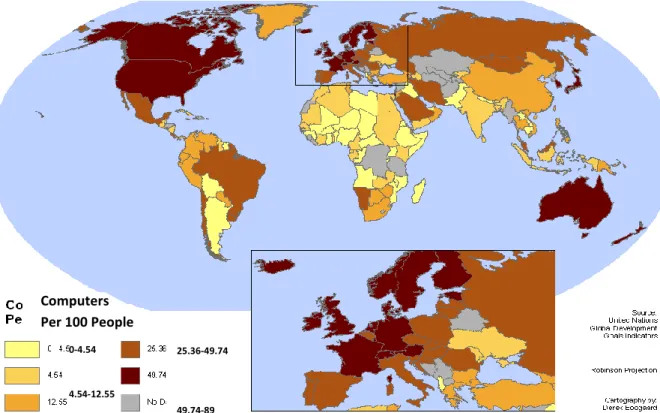
Digital inequality does not exist only within a society. It may also exist among nations and countries. There are major difference in the intensity of ICT utilization and their use in the social and economic aspects of different nations (Pick & Azari, 2008). This type of inequality is sometimes called global digital divide. Developing countries around the world face severe problems with respect of global digital divide. These problems are both in terms of access to international bandwidth and over all affordability. As discussed earlier, digital divide can be looked at from various perspectives and figure 2 shows global digital divide as far as penetration of computers is concerned.
32
2.5.2 Digital Opportunity and Socio-Economic Development
Traditional measures of digital divide in terms of direct access to technologies makes sense in the developed world where the ownership of expensive traditional ICT devices such as computers might not be a major economic burden for businesses and individuals. However, in the case of developing countries, other factors such as indirect access and their impact on the socio-economic development might be appropriate measurement. In nations with low literacy rate and poor population, measurement of direct access to the Internet might not make sense.
25.36-49.74 49.74-89 No Data Computers Per 100 People 0-4.54 4.54-12.55 12.55-25.36
33
One the other hand, these people may listen to a radio program or watch a television channel which has access to the Internet and enrich their broadcast with the latest news and entertainment from Internet. Therefore indirect access to the Internet may still help in the socio-economic development of the masses and thus bridging the digital divide.
2.6 ICT based Socio-Economic Development in Developed World
A number of policy level studies on the socio-economic impact of ICT exist. For example the information and communication technology comprehensive economic development strategy for Orange County in California is an elaborate report that documents socio-economic impact of ICT in one the most prosperous counties in the United States (Dominguez et.al, 2006). They reported alarming statistics with regards to the vast difference between availability of ICT in different parts of Orange County in California (Baqir, Babu & Palvia, 2007). The reports like these produce sensational findings because of the contrast they present (advanced ICT infrastructure for rich people, poor ICT infrastructure for poor people). Due to higher per capital income, direct access to ICT and ownership of traditional ICT devices such as computers is higher in developed countries. The use of ICT for businesses and individuals is higher but differences exist among various groups of people within the developed world. These differences are consistent with the digital divide literature. As indicated earlier, groups based upon gender, race, education, income and those living in rural areas or poor
34
neighborhoods are most vulnerable to be among the most disadvantaged as far as the ICT based socio-economic development is concerned.
2.7 ICT issues in Developing Countries
The developing countries offer a unique environment where the ICT infrastructure was laid down recently (or is still being laid down) and the jump (leapfrog) in information and communication technologies and its application has been sudden and vivid. In most cases this accelerated development of infrastructure and service provision is speculated to be due to regulatory evolution, liberalization and privatization in addition to market forces. In addition to these common characteristics, developing countries share a number of problems such as lack of appropriate products, cost of ICT devices, education, language, human resources and lack of robust regulatory framework for ICT (POST, 2006).
2.7.1 Lack of Appropriate Products
Most of the products are designed to cater for the needs of poor or those living in rural areas. Most of these products require electricity to operate which increasingly becoming a scare resource. Several developing countries are facing serious energy crises and issues with reliable electricity supply. Additionally, about 2 billion people in the world do not have access to any electricity. Some efforts have been underway to develop ICT devices that are independent of electricity or have a built-in electric supply. An example of this case is one-laptop-per-child (laptop.org)
35
initiative which aims at providing laptops to school children that are specially designed to cater for the needs of poor students living in the remote areas.
2.7.2 Cost of ICT devices
Most of the developing countries have low levels of per capita income which makes it cost prohibitive for poor people to afford ICT devices. It is therefore important to design appropriate products with affordable cost structure in order to increase ICT access.
2.7.3 Education
Education is another important issue that several developing countries face. In most of these countries, literacy levels are low. Even in situation where access to ICT is higher both in terms of availability and affordability, their use may still be limited. It is difficult to have any meaningful benefit from ICT if people cannot effectively use them.
2.7.4 Language
It is important to develop ICT services with local and meaningful content for people. Most of the content on today’s Internet is in English language and even if availability and affordability are not a problem, it is difficult to see any meaningful benefit from ICT. This also highlights the point made in the discussion on digital divide that there might be need to account for the indirect access to ICT in cases like these. People with indirect access to ICT such as through TV or radio broadcast who
36
enrich their programming due to the access to Internet may still reap the benefits of ICT.
2.7.5 Human Resources
Developing nations are dogged by the lack of skilled human resources. Movement of highly skilled ICT professionals to developed countries creates a vacuum and therefore developing nations face severe problems in benefitting from the increased and affordable access to ICT.
2.7.6 Lack of Robust Regulatory Framework for ICT
Several developing nations are going through turbulent regulatory evolution as far as ICT framework is concerned. Even though many of the developing countries around the world are now moving from highly regulated ICT industries to more liberal and deregulated ones, the pace of such movements is unpredictable. In several of these countries governments have a number of fears related to uncertainty in the traditional control over information and ICT. These uncertainties lead to policies that prove to be growth impeding and therefore a constant effort is required to keep a balance between growth and control.
These are some of the unifying themes for research on ICT in developing countries. Most of the developing countries rely on increasing ICT access by expanding and developing telecommunication infrastructure. Wireless technologies present a cost effective way of expanding ICT base in developing countries by way of
37
avoiding expensive, complex and complicated cabling system. From ICT device affordability perspectives, mobile phones become the first barrier breaker to bridge the digital divide. The availability of reliable and cheap wireless devices make it easier for poor people and those living in the remote areas to get connected without huge upfront costs. Technologies such as WiMAX, 3G, CDMA 2000 and others are enabling people in rural areas to get affordable ICT access including broadband Internet. It is no surprise that nine of the top ten emerging wireless markets are in developing nations. Due to the sheer market size of India and China, they are among the top two emerging ICT markets. Table 1 lists these countries including the size and increase in the mobile market between 2005 and 2006.