1
LEARNER ERRORS RELATED
TO
LINEAR EQUATIONS IN GRADE 10
Submitted by: PSM Tebeila Student Number: 8909990X Protocol Number: 2015ECE020H
A research project submitted in partial fulfilment of the requirements of the degree of Masters of Science (Mathematics Education)
University of the Witwatersrand Johannesburg
South Africa 10 October 2016
2
DECLARATION
I declare that this research report is my own work and no part of it has been copied from another source (unless indicated as a quote). All phrases, sentences and paragraphs taken directly from other works have been cited and the reference recorded in full in the reference list.
Stephen Tebeila 10 October 2016
Acknowledgements
This research project would have not been possible without the help of the following people: My mentor, Prof Jill Adler, for always supporting me
My supervisor, Dr Craig Pournara My family, for always supporting me
3
Table of content
Acknowledgement 2 Declaration 2Table of contents
3List of tables
6List of figures
7Abstract
8Chapter 1 Introduction
9 1.1 Introduction 9 1.2 Rationale 9 1.3 Study Problem 10 1.4 Research questions 101.5 Outline of the research report 10
Chapter 2 Literature Review
122.1 Introduction 12
2.2 Conceptual framework 12
2.3 Literature of mathematical activities 14
2.4 Literature of algebra with special attention given to linear equations 14 2.5 Differentiating between arithmetical and algebraic equations 16 2.6 Past and current research on symbolic interpretation 18 2.7 Research that singles out equations 19
2.8 Conclusion 20
Chapter 3 Research Methods
233.1 Introduction 23
3.2 Sampling 23
3.3 Design of study 24
3.4 The test 24
3.5 Analyzing the test 28
3.6 Validity and reliability 30
4
Chapter 4 Results
334.1 Introduction 33
4.2 Test 33
4.2.1 Marking memorandum 33
4.2.2 Explanation of calculations done 37 4.2.3 Average Marks for Pre-test and Post-test 38
4.2.4 Analysis of performance 39
4.3 Analysis of the pre-test and post-test by giving attention to errors 40 4.3.1 Three major categories of errors 40
4.3.2 Routine errors 41
4.3.3 Visual mediator errors 42
4.3.4 Signifiers errors 42
4.3.5 No response 43
4.3.6 Correct answer 43
4.3.7 Errors that defy explanation with codes used in the study 43 4.4 Coding responses and populating tables 43
4.5 Pre-test Tables and comments 44
4.5.1 Routine errors 44
4.5.2 Signifier, visual mediator, can’t explain errors and blanks 45 4.5.3 Comparison between routine errors and other error 46
4.6 Post-test Tables and comments 46
4.6.1 Routine errors 46
4.6.2 Comparison between pre-test and post-test 48 4.6.3 Comparison between routine errors and other errors 49 4.7 Comparison between pre-test and post-test 49
4.8 Pre-test and Post-test combined 50
4.9 Detailed analysis of scripts with unexpected changes in errors 52
4.9.1 Unexpected changes 52
4.10 Linear equations 57
4.11 Conclusion 64
Chapter 5 Conclusion
655.1 Introduction 65
5.2 Summary of main findings 66
5.2 1 The shift from arithmetic to algebra 66
5.2.2 Learner performance 66
5.2.3 Learner errors 67
5
5.2.5 Findings that relate to linear equations 68
5.3 Limitations 70
5.4 Recommendations for teaching, planning and further research 71 5.4.1 Accommodating learners’ different backgrounds 71 5.4.2 Giving students a chance to work with functions and tables 71
5.4.3 Planning 72
5.4.4 An opportunity for further study 72
5.5 Concluding remarks 73
References
74Appendix 1 Sample Pre-test code sheet
76Appendix 2 Sample Post-test code sheet
786
List of tables
Table 3.4 Explanation of each question 25
Table 4.2.1 Memo 34
Table 4.2.3 Pre-test Average and Post-test Average 38
Table 4.5.1 Routine errors in pre-test 44
Table 4.5.2 Signifier, visual mediator, can’t explain errors and blanks 45
Table 4.6.1 Routine errors in post-test 46
Table 4.6.2 Signifier, visual mediator, can’t explain errors and blanks 48 Table 4.7 Comparison between pre-test and post-test 50 Table 4.8 Pre-test and post- test errors as percentage of total errors made 50 Table 4.9 (a) Blanks and correct answers pre-test 57 Table 4.9 (b) Blanks and correct answers post-test 57
Table 5.2.3 (a) Pre-test errors 67
7
List of figures
Figure 4.2.1 Learner 34 37
Figure 4.2.3 Pre-test – Post-test Mark 39
Figure 4.5.1 Routine Errors 44
Figure 4.6.1 Routine Errors 47
Figure 4.8 Pre-test and Pro-test Combined 51
Figure 4.9.1 (a) Learner 20 53
Figure 4.9.1 (b) Learner 34 54
Figure 4.9.1 (c) Learner 29 55
Figure 4.9.1 (d) Learner 40 55
Figure 4.10 (a) Learner 32 58
Figure 4.10 (b) Learner 17 59
Figure 4.10 (c) Learner 37 60
Figure 4.10 (d) Learner 40 61
Figure 4.10 (e) Learner 24 62
8
Abstract
This research investigates three different kinds of errors made by learners using a discursive approach when dealing with equations in grade 10. The data for the study is made up of Grade 10 learners' responses to a pre-test and post-test, and is part of a much larger data set that was collected by the Wits Maths Connect Secondary Project (WMCS) in 2013. Questions like substitution and multiplying and simplifying as well as factorization are given attention as they are related to equations.
The data for this study is collected by coding pre-test and post-test scripts. The data is analyzed using codes and using commognition. The role played by the equal sign in equations and operations that are performed on symbols as well as well as errors that creep in executing these operations are given attention in the study. Special attention is given to linear equations in this study. Errors identified by Brodie and Berger (2010) are confirmed. The finding is that extent to which errors made by grade 10 learners when dealing with equations stem from errors in arithmetic is substantial. The other finding is that extent to which grade 10 learners made errors related to basic algebra, when dealing with equations, is substantial.
9
Chapter 1 Introduction
1.1 Introduction
The study focused on learner errors in basic algebra, arithmetic and linear equations, using a discursive approach. Discursive, according to Sfard (2008, p. 66), means “personal constructs” that originate in public discourses that support only certain versions of such public discourses”. The data used in the study consisted of Grade 10 learners' responses to a pre-test and a post-test, and was part of a much larger data set collected by the Wits Maths Connect Secondary Project (WMCS) in 2013. While the learner responses had already been analysed by the WMCS at the level of correct/incorrect, the analysis here focused on the errors themselves. This study analysed in depth the errors of one class (N=45), selected from the larger data set as a typical case.
1.2 Rationale
I conducted a pre-analysis of 15 pre-test and 15 post-test scripts, with attention given to learner solutions in simplifying basic algebra and solving equations. The pre-analysis was used to develop a plan for the error analysis and the kind of errors in the solutions. My analysis shows that prior learner understanding of arithmetic and basic algebra rules seem to impact negatively on how they solved equations and simplified expressions, as reflected by many of the errors.
Equations with one unknown (linear equations) are a key element of elementary mathematics, and were given attention in this study. Examples of quadratic equations which could be factorized to linear equations were included. Factorization provides the link between the two types of equations. One cannot discuss equations without looking at the equal sign, as that is essential to all equations. According to Andrews and Sayers (2012), the transition from arithmetic to algebra is difficult as a result of factors that include the ambiguous role played by the meaning of mathematics symbols, and the particular importance of the equals sign. Sfard and Linchevski (1994), note that arithmetic is about dealing with numbers and with number calculations
The notion of the difficulty of the transition from arithmetic to algebra is supported by Andrews and Sayers (2012), when they suggest that, for example, the expression 3 + 4 is arithmetically a command to carry out an operation. Algebraically, the same expression is an object on which other operations may be performed. They further state that a substantial number of early learner experiences of arithmetic impress upon learners the belief that the equals sign is a command to operate rather than having to do with of equality between two expressions. The former is contrary to the successful solution of equations.
This is supported by the notion that, when faced with equations of the form 1 + 2 = x + 5, learners would apply the additive inverse to any of the three digits in accordance with their conception of the equal sign as an instruction. The interpretation is that an equation does not give a warning to show that the equal sign connects two equivalent expressions, as in examples such as 1 + 4 = 5, 2 + 3 = 4 + 1 and 2x + 1 = 3x +2. Thus, associating the equal sign with the calculating process is a serious problem to high school learners.
10 Why is the study important now in South Africa? Warren (2003) notes that the Trends in International Mathematics and Science Study (TIMSS) reports misconceptions many students have with, for example, understanding what the word ‘variable’ means; solutions of algebraic equations; and in translating word problems into algebraic symbols. She is of the view that these misconceptions need attention, as algebra plays an important role in the school curriculum. TIMSS was conducted in South Africa in 1995 and 1999, and TIMSS-R in 2003. Both studies revealed that South African learners are not performing well in mathematics - as pointed out by Mji and Makgato (2006). Pournara, Hodgen, Adler and Pillay (2015) supported the notion of poor performance by mentioning that it is well known that most learners in South Africa attain very low marks in mathematics. They cite:
Trends in International Mathematics and Science Study (TIMSS),
the Annual National Assessments (ANA), such as the Programme for International Student Assessment (PISA), the National Senior Certificate (NSC) examinations and
Southern Africa Consortium for Monitoring Education Quality (SACMEQ).
These all provide evidence of lack of impact on learners, mainly attributed to teachers’ poor mathematical knowledge. This poor mathematical knowledge impacts negatively on learner achievement. Unsatisfactory performance in mathematics as shown in TMSS has led to study to determine which particular sections of mathematics contribute to this unsatisfactory performance. The central role of linear equations in mathematics has led to looking specifically at linear equations. The aim is to find out why candidates are doing poorly in linear equations.
1.3 Study Problem
The study problem was to identify and categorize the errors in learners' manipulation of linear equations.
1.4 Research questions Research questions were:
To what extent do errors made by grade 10 learners when dealing with equations stem from errors in arithmetic?
To what extent do errors made by grade 10 learners stem from errors in basic algebra? The test that WMCS used has been found to be appropriate in investigating the changes in the errors made, as it had questions that are representational, transformational or rule-based and global and meta-level, as will be discussed in the third chapter. These types of question link with the move from arithmetic that involves numbers, to algebra that could involve meta-level operations.
1.5 Outline of the research report
This first chapter provided the introduction to the research report, and also gave attention to the rationale for the research. The context of the research was provided and the relevance of this research discussed. The study has been described as focusing on errors made by learners when
11 answering questions relating to equations. It was emphasized throughout that a discursive approach will be used. Although the learner responses had already been analyzed by the WMCS at the level of correct/incorrect, that analysis has not focused in detail on the actual errors. Two research questions connected with the research problem of learners performing poorly in linear equations were formulated.
Important background that will be kept in mind is that:
Numerical relations and processes in moving towards generalization will be important in the analysis; and
The multi-layered recursive structure of discourses can be probed by looking at sub-discourses of equations, in this case substitution questions; multiply and simplify questions, and factorization questions.
The second chapter will give an outline of the literature relating to this research. Arithmetic, algebra and functions are given attention. Special attention is given to linear equations, and the equals sign in particular. The two theoretical frameworks are also explained in this chapter. Commognition put forth by Sfard is presented as a favoured lens employed here. The discursive framework for categorizing errors put forth by Brodie and Berger (2010) is also presented. An emphasis of routine errors, visual mediator errors and signifier errors is made. Mathematical learning is explained.
The third chapter discusses how the research was conducted. Sampling, design of the study, tests and memos to be used, analysis, validity and reliability and ethical considerations are discussed. The fourth chapter discusses the analysis of the data, giving special attention to quantitative techniques. Categories for doing the analysis are explained. Here it is shown that routine errors are prevalent, and in particular
errors that involve multiplication and division, errors that involve addition and subtraction and
errors that involve factorization in that order are the most prevalent errors. Visual mediator errors and signifier errors are shown to be least prevalent.
Differences and similarities of the pre-test and post-test sets of data are also discussed, using commognition.
Special attention to errors related to linear equations is given. Scanned images of interesting errors made by some learners are discussed, using commognition.
The fifth chapter gives a summary of the findings, recommendations for further research, suggestions for teachers, limitations of the study and the conclusions drawn about the findings.
12
Chapter 2
Literature Review
2.1 Introduction
In this literature review I discuss the theoretical framework that involves commognition and the discursive approach, research on errors in mathematics in general, and show what a discursive approach adds that was lacking in the commognitive approach on errors. Literature of algebra will then be discussed.
2.2 Conceptual framework
Commognition will be a favored lens employed here. Sfard (2007, p. 14), explains this idea as follows “commognitivists view discourse as the very object of learning”. The commognitivist view that will be used here refers to thinking as a form of communication, as put forth by Sfard. She also points out that mathematical learning involves “modifying and extending one's discourse”. Discourse, for Sfard (2007), refers to different communication types that bring some people together, but does not accommodate others. The different communication types will be analyzed by determining whether the test is representational, transformational or rule-based; global or meta-level. The meta-level learning of mathematics is, according to Sfard (2008, p. 161) considered as a “multi-layered recursive structure of discourses”. This means that the discourse is made up of sub-discourses, which relate to each other in many ways. The Sfardian (2007) framework provides the tools for exploring the mathematics found on the learners’ scripts. The exploratory tools include categorizing errors and looking at them through a discourse perspective, as was done by Brodie and Berger (2010).
This framework moves beyond arguing that errors reflect misconceptions. They develop a discursive account of errors, by using Anna Sfard (2008). They see her commognition theory as providing a stronger theoretical scope for describing and accounting for errors. By analysing a multiple-choice test, Brodie and Berger (2010) developed seven categories for errors, which fall into three larger categories:
errors as routines,
errors of visual mediators and errors of signifiers.
Errors in arithmetic, basic algebra, linear and quadratic equations as observed in the analysis of responses, were found to be prevalent in a preliminary analysis of the pre-test and post-test written by learners in this study.
The word “errors” according to Brodie & Berger (2010, p. 172), is thought of as "narratives that are endorsed by learners”. They associate the word with a pattern of mistakes made by learners that are persistent. A narrative, according to Sfard (2008, p. 300), is considered to be “a series of utterances, spoken or written, that is framed as a description of objects, of relations between objects, or processes with or by objects”. The written aspect of narrative will be given attention here. A framework for categorizing errors will be developed in line with looking at them through a discourse perspective as was done by Brodie & Berger (2010).
13 The three categories will be employed in the study. “Routines” are, according to Sfard (2007, p. 574), “well-defined repetitive patterns” shown in actions. Routines in solving problems will be investigated in this study. According to Sfard (2007, p. 571), visual mediators are “means with which participants of discourses identify the objects of their talk and co-ordinate their communication.
Visual mediators will be given little attention in this study, as graphs will not be used to solve equations and word problems do not form part of the test. Signifiers and objects are used interchangeably in discursive theory according to Brodie and Berger (2010). Signifier refers to the main object used in communication, that is, one for which there exist realization procedures according to Sfard (2008). Objects and signifiers will be used interchangeably in this study. An example of errors as routines (well-defined repetitive patterns) from the preliminary study is: if a = 2, b = -5, c = 3, then
a + 2c =2+23 (Conjoining).
According to Watson (2009, p. 19), conjoining is “an attempt to express an ‘answer’ by constructing closure, or students may just not know that letters together in this notation mean ‘multiply’. So instead of doing 2c = 2 x 3 they treat 2c as a two digit number with the unit c and get 23.
As preliminary analysis also pointed to routine errors being prevalent, special subcategories will be created for routine errors to ensure that they are given sufficient exploration. Codes were developed for all categories and subcategories in the method chapter. All these exploratory tools are provided for by commognition, and will be interpreted with that in mind. That will be done by analysing mathematical discourses taken out of learners’ scripts.
Errors of visual mediators (i. e., participants of a discourse identify objects of their talk) will be given less attention, as the initial study does not suggest that graphs will be used to solve an equation like 4t -10=2t, and the test has no word problems.
An example of errors of signifiers of a primary objects used in communication) seen in the preliminary analysis was x(x - 2) = 8 becomes x = 8 or (x - 2) = 8. We could only equate the two terms on the right hand to zero if we had zero on the right hand side and not when we have eight. The quadratic equation 𝑥2-2x-8=0 is not factorized into its factors x = 2 or x = -4, so leads to an error of communication. In this example a wrong signifier of eight is used.
Two points are important in developing a discursive account of errors as argued by Brodie & Berger (2010). One is that the discursive account suggests that pervasive errors occur because we tend to interact in similar ways, emphasizing social interaction. Social interaction will not be given attention here, as only scripts are available and that is a weakness of the discursive account for this research. The other point is that errors do not disappear. This point will be investigated in the post-test, rather than the pre-test.
Another way that Brodie & Berger (2010) use to account for learner errors is to draw on the work of Sfard (2007, p. 567), according to which mathematical learning involves “modifying and
14 extending one's discourse”. This way relates to dealing with equations by modifying and extending related discourses like arithmetic and basic algebra.
Brodie & Berger (2010) are of the view that errors are not located in the mind of the learner but are located in the interactions between learner, teacher and Mathematics. In this research the interaction between the learner and mathematics as shown in the script will be explored
2.3 Literature of mathematical activities
The representational activities of algebra, as put by Kilpatrick, Swafford and Findel (2001, p. 256), “involve translating verbal information into symbolic expressions and equations”.The authors also point out that the transformational - or rule-based - activities are mainly concerned with changing an expression or equation to an equivalent one, using the rules for manipulating algebraic symbols. They further see generalizing and justifying activities as tending to use the representational and transformational elements of algebra. According to Kieran (2004), the global, meta-level, mathematical activities for which algebra is employed as a tool do not belong to algebra exclusively.
This notion of algebra highlights that its discourse involves movement towards generalizing from numbers to symbols. Sfard and Caspi (2012) support this view, mentioning that algebraic thinking is to be found whenever one looks carefully at numerical relations and processes in searching for generalizations. However, that algebra is not only about symbols is again supported by Sfard and Caspi (2012) when they suggest that although symbolization can be important in the development of algebra, it is only a part of the general historical process of algebraic discourse formalization. Other parts include linear equations, which are the focus of this study.
In provoking meta-learning students become active in their own learning. This is supported by Sfard and Linchevski (1994) when they talk of encouraging learners to strive towards understanding as they learn, and.as they work towards making sense of communication geared towards discursive transformation. The meta-level learning of mathematics is, according to Sfard (2008, p. 161), considered as a “multi-layered recursive structure of discourses”. This means that the discourse is made up of sub-discourses, which relate to each other in many ways.
2.4 Literature of algebra with special attention given to linear equations
Solution of a linear equation with a single unknown (from here on referred to as a linear equation) is a key component of school mathematics, as seen by Andrews and Sayers (2012). They see the solution of linear equations as a topic located on the border between mathematics as concrete and inductive and mathematics as abstract and deductive. They furthermore see linear equations as offering learners with one of the first authentic opportunities to link their insight of arithmetic and the symbolism of mathematics.
A linear equation like 8 + 5 = x+9 will be referred to as belonging to elementary algebra. Elementary, or basic algebrais, according to Sfard and Caspi (2012, p. 45), defined as a “meta-discourse of arithmetic”, and that means that reflecting on arithmetical processes is crucial in the discourse of elementary algebra. Mathematical learning involves “modifying and extending” one's discourse”, as Sfard (2007) also points out. Objects will, as put by Nachlieli and Tabach (2002, p.
15 10), refer to “those things that are being talked about, do not pre-exist the talk; rather they arise as by-products of the ongoing mathematical conversation”. Object-level learning is, in this regard, considered as learning that increases the existing assortment of “routines and endorsed narratives” that currently exist as the latter author further points out.
It can be seen from results of the research done by Norton and Irvin (2007) that much of what the students struggle with could be linked to not understanding arithmetic concepts as evidenced by class discussions, students explanations and examples of the teacher and researcher scaffolding student learning as well as an analysis of work of learners for error patterns, and not understanding equivalence, operations with negative integers, as well as distributive properties. The challenges of not understanding arithmetic concepts, equivalence, basic operations and distributive properties will inform some of the codes used in the discursive approach used to explore the errors made. That means that there is more to formal mathematics than merely focusing on arithmetic generalizations only, giving attention to a pattern or structure, when setting out to solve certain types of problems. For example, a function like 𝑓(𝑥) = 𝑎𝑥 + 𝑐 could be looked at in terms of a pattern between x and f(x), and at the same time be regarded as an object. Using this object, some types of problems that have a linear relationship and that have different values of 𝑎 and 𝑐 could then be tackled. The example of function was selected as, according to Schliemann, Carraher, and Brizuela (2007), arithmetical operations could be considered to be functions.
The idea is strongly supported by Sfard and Linchevski (1994) when they suggest that the idea of functions put together, the arithmetical processes that are linked to primary processes, and the formal algebraic processes linked to secondary processes. That is because functions are developed in arithmetic and are useful in formal algebraic processes. The concept of commognition will be used to as a general foundation for understanding how learners think.
Watson (2009, p .8), looks athow learning algebra occurs by focusing on “what learners can do and how their generalizing and use of symbols develop”. This research gives information about what learners are doing and thinking, and combines research on mathematics from elementary school to sixteen-year-old learners, and identifies the issues that are important in understanding how children learn mathematics. Of special importance to this research in the article by Watson (2009) is her contribution that algebraic reasoning is about shifts that have to be made between arithmetic and algebra. These contributions are given attention in the next two subsections. Their importance is a result of the fact that equations are an important part of this research, and are very important in algebra as it helps to consolidate work that would have been done earlier like substitution, addition and subtraction, and also lays a good foundation for further work.
According to Watson (2009, p. 3), algebra has to do with expressing “generalizations about numbers, quantities, relations and functions”. So insight into links between numbers, quantities and relations is enabling in terms of good performance in algebra. As basic operations, namely, addition, subtraction, multiplication and division are important when dealing with numbers, the links include these operations. The particular importance of these operations in equations is that they provide inverses for carrying out operations on equations. The notion of the importance of basis operations will inform the choice of questions in the next chapter.
16 Watson (2009) says that anunderstanding of algebraic symbols is enhanced by an understanding of operations and being comfortable with using the symbolic shorthand. She is of the view that the learnings mentioned will most likely work out when learners have a knowledge of expressions, and when they are given sufficient time to be fluent at communicating, using the symbolic shorthand. The role played by symbols will inform the choice of questions selected.
According to Watson (2009) a letter can play different roles that include an unknown, a constant, a parameter, or a variable, and students have to decide which role is being assumed (by the letter) in any particular instance.
An example is the different roles played by n in 2n. 2n could be seen as the answer to a question as a result of multiplying 2 by n. Attaching too much importance to substitution disempowers learners in seeing structure. So instances where n appears to be an entity on its own need to be confronted so as to assist learners to be more capable communicators of symbols, and not just concentrate on calculations that involve n. So giving attention to the difference between algebraic expressions as arithmetical structures and as calculations, according to Watson (2009), can enhance students’ understanding.
It can be implied from her work that in certain instances an algebraic expression and a calculation or number or another algebraic expression can be equivalent. Now, algebra is often about transformations between these equivalent forms. Failure to understand the role of variable, and inability to deal with substitution will inform the discursive approach used to explore the errors made.
2.5 Differentiating between arithmetical and algebraic equations
Differences between arithmetical and algebraic thinking become clear when one looks at research that points to some conceptual and/or symbolic changes as noted by Filloy and Rojano (1989). These differences are helpful in understanding development of changes from arithmetic to algebra. These changes, according to Filloy and Rojano (1989), can be linked to the ideas and forms of representation of the objects and operations involved in the change from arithmetic to algebra. The ideas and ways in which the objects are represented, as well as operations involved in the change from arithmetic to algebra, inform the formulated hypothesis. It then becomes possible to visualize the changes that are made by learners as they move from arithmetic to algebraic thinking.
For discussion of change that happens or does not happen, the concept of equation will be considered and used in this study. An equation such as
Ax+ B = C
will, in a similar manner to how it was used by Filloy and Rojano (1989), be referred to as being “arithmetical”, as its left side can be thought of as a sequence of operations performed on known numbers. The right hand side stands for the result of having performed the left side operations. An example of an arithmetical equation is
17 This equation requires only operations on numbers.
Algebraic equations, unlike arithmetic ones, could have unknowns on both sides, and cannot be solved by arithmetic concepts alone. The notion is supported by Filloy and Rojano (1989, p. 19) when they suggest that ways of solving such equations require that the learner be able to operate on the variable as an entity and “understand that the expressions on both sides of the equals sign are of the same nature”. An example of an algebraic equation is
2x + 1 = 10 − x.
This equation requires operations on algebraic entities.
Transitions from arithmetic to algebra has challenges. The challenges could be the result of different structures in the areas leading to a shift that requires adjustments. Herscovics & Linchevski (1994) support the issue of fundamental difference between the arithmetic and algebraic when speaking of a cognitive demarcation between arithmetic and algebra.
This cognitive gap calls for students having to adapt to how they interpret and solve problems by not merely calculating. Adaptation is geared towards moving towards formalization. Caspi and Sfard (2012), see formalization as a discourse in mathematics with specific meta-rules which regulate it. They furthermore see the rules as being embedded in the algebraic symbolism of mathematics. However, it is possible to think algebraically without letters. Malisani and Spagnolo (2009) support the notion when they say that doing algebra is not only about working with symbols and also when they say that algebraic thinking could be connected with layers of generality that could be factual, contextual and symbolic.
Symbol usage is also connected with some errors creeping in. That is supported by studies such as the Third International Mathematics and Science Study (1998) that have shown the misconceptions that learners have as a result of struggling with not having an understanding of the concept of a variable, solving algebraic equations and in translating word problems into algebraic symbols as pointed out by Warren (2003).
Malisani and Spagnolo (2008) note that some studies maintain that different concepts of the variable present different levels of difficulty to students. They also note serious challenges with the meanings of the generalized number and the variable.
18 2.6 Past and current research on symbolic interpretation
According to Kieran (2004), as learners move from working with arithmetic ideas to an equation of the form Ax+ B = Cx + D, finding a solution involves operations extracted from outside arithmetic, and carrying out operations on unknowns. Key to carrying out operations on unknowns is making meaning of the algebraic equation Ax+ B = Cx + D.
Making meaning of algebra includes understanding that an expression on the left hand side of an equation is equal to an expression on the right hand side of the equals sign, and that these expressions are of the same structure. They further say that actions like substituting numbers for the unknowns give meaning to the equality of expressions. That means that students that are working in an arithmetic way will probably not see the relationships between aspects of operations due to focusing their attention on calculations. That means that making a shift will be necessary. This shift includes:
1. Giving attention to relations, and not just concentrating on the calculations and working towards an answer that is a number.
2. Giving attention to carrying out operations, as well as working with their inverses, and on doing and undoing in an equation.
3. Moving away from tackling a problem by only solving it, to representing a problem and also working towards solving it as well.
4. Ensuring that both numbers and letters are given attention, and that it is not numbers alone. That includes:
(i) working with letters that are not necessarily variables, but could also be unknowns or parameters.
(ii) accommodating literal expressions that are not closed as responses; (iii) Basing a comparison of expressions so as to establish equivalence, on
properties and not on an evaluation of numbers; 5. Giving attention to what an equals sign means.
Kieran (2007) noted that recent work suggests factors, including the following, to be impacting on students’ interpretation of algebraic notation:
a) The ability of learners to perceive and notice, e.g. 8 + 5 in 8 + 5 = x + 9
can be seen by some learners as a signal to compute, and they will just write down an answer of 13 instead of 4, if attention is not given to x in the equation.
19 b) Difficulties learners are confronted with when dealing with signs in simplifying expressions, e.g. when some learners are required to simplify x + 3 they do not think about the expression itself as being the subject of attention.
2.7 Research that singles out equations
According to Watson (2009, p. 3), “Students often get confused, misapply, or misremember rules for transforming expressions and solving equations”, and that means that mathematics is not seen by them as related discourses. Furthermore, mathematically, according to Watson (2009, p.6), ‘=’ means either ‘equals to’ or ‘equivalent to’, but is interpreted by learners to mean ‘calculate’. An example is an equation like
1 + 2= x
This can be construed arithmetically to be a command to execute 1+2 and not to mean that x is the same as 3. When dealing with
6 + 3 = x + 5,
an application of additive operations to any or all of the three digits is executed in line with the concept of the equal sign as an instruction to operate, and not as 6+ 3 is equivalent to x + 5. Watson (2009) also emphasizes that learners need to know what the equation is saying to them, and not just be influenced by how it looks without thinking about what it means. This means that in algebra the emphasis is on relations, and not calculations. For example, the relation 1 + 2 = 3 is often seen as a representation of 3, since 1 + 2 can be calculated, and not as 1+2 being equivalent to 3. Tall, Lima and Healy (2014) have shown that some learners solve linear equations based on their previous experience of arithmetic operations, in which operations are executed to obtain an answer, relying on procedural embodiments as they work towards a solution. They see procedural embodiments as procedureswhich have to do with embodied actions on the symbols that lead to picking the symbols up and moving them to the other side of an equation. They also see procedural embodiments to be including ‘principles’ like changing signs or putting symbols in an equation so as to obtain the answer. Procedural embodiments were seen by them to having worked for some learners, but were also not remembered by other learners, leading to a wide range of errors. Procedural embodiments are explained in the following examples:
2x-4 = 2+x
2x-x = 2+4,
obtained by the operation of shifting x to the left hand side and 4 to the right- hand side and changing sign. and
x = 6 obtained by simplifying
Tall et al. (2014), describe these steps as “swop sides, swop signs”.
Another example is the equation 3x - 1 = 5 + x, which is solved by shifting the 1 to the right and the x to the left and changing signs to get: 3x − x = 5+1
20 2x = 6.
The next step would then be 3 2 6
x , and in this step, 2 that is associated with the 2x in 2x = 6 is moved from the left side to the right and is then placed below 6.
Tall et al. (2014), refer to the procedure to be “swop sides and place underneath”. They noted that in an attempt to employ these rules when dealing with 2x = 6 learners made the following errors:
a)x62 b) 2 6 x and 6 2 x
Tall et al. (2014), refer to the procedure outlined in the last step of problem 2 as ‘swop sides and place underneath’. They call the steps in the two examples procedural embodiments.
These researchers observed that with neither type of equation had the learners employed the general principle of doing the same thing on the left side and on the right side of an equation. They did not see the equation as a balance to ‘do the same thing to both sides’; instead, they paid attention to shifting symbols around mainly relying on ‘swop sides, swop signs’ and ‘swop sides and place underneath’. According to Tall et al. (2014), procedural embodiment worked for some learners but not for others. They failed in some cases, as some learners tended to misremember these tactics, and consequently made errors. The issues raised here of procedural embodiments was explored in this study using commognition in the results chapter, that deals specifically with linear equations.
2.8 Conclusion
Literature selection has been informed by the fact that linear equations are the focus of this study. An argument that linear equations offer learners with one of the first authentic opportunities to link an insight of arithmetic and the symbolism of mathematics was advanced.
It turned out that differences that are helpful in determining developmental changes from arithmetic to algebra can be linked with the ideas and the forms of representation of the objects and operations involved. It then became possible to visualize the changes made by learners as they move from arithmetic to algebraic thinking by looking at that change in terms of forms of representation of the objects and operations involved.
Filloy and Rojano (1989) see the change from arithmetic to algebra being clarified by some conceptual and/or symbolic changes .These changes were seen to be linking up with the ideas and the forms of representation of the objects and operations. Representations of the objects and the operations involved in the change help to formulate a hypothesis about the change from arithmetic to algebra. The nature of the change that happens or does not happen was discussed by looking at how representations of objects and operations connect with linear equations. The mere fact that change can happen or not happen means that codes in the next chapter must include that. The importance of change here is that it informs the choice of the methodology used in the next chapter. The one group pre-test-post-test seems to be ideal in this case. The deliberations on linear equations
21 link up with discourses that involve substitution questions, multiply and simplify questions, as well as factorization, due to the multi-layered recursive structure of algebraic discourses. All the latter will inform the choice of codes in discursive approach used to explore the errors made in the next chapter The role played by basic operations and order of operations will have to be part of the deliberations as questions in the test given make the operations relevant.
Kieran (2004) argues that operations from working with arithmetic ideas to algebraic equations extracted from outside arithmetic. This comes from the fact that the transition involves operations on unknowns. The operations are no longer about calculations only. Relationships between aspects of the operations have also become relevant. Making a shift was seen as necessary in order to accommodate the transition.
Making a shift was seen to be giving attention to relations and to carrying out operations, as well as working with their inverses, and on doing and undoing, giving attention to both numbers and letters, as well as giving attention to what an equal sign means. The equal sign will also be given attention in the codes in the next chapter due to its importance.
Kieran (2007) added to “making a shift” by looking at factors that impact on students’ interpretation of algebraic notation and difficulties learners are faced with when dealing with signs in simplifying expressions. This contribution can be construed as linking up with giving attention to working with errors while formulating a hypothesis.
Sfard and Caspi (2012) add to the discussion about the shift and change, emphasizing that reflecting on arithmetical processes is crucial in the discourse of elementary algebra.
Sfard (2007) sees modifying and extending one's discourse to be impacting on the shift and change. Norton and Irvin (2007) see the shift and change being influenced by not understanding arithmetic concepts, and having had on understanding equivalence, operations with negative integers, and distributive properties or not. All these impediments to a smooth shift will inform the codes used in the next chapter.
To enhance a smooth transition Sfard and Linchevski (1994) are suggesting that the idea of function integrates the arithmetical processes linked to primary processes, and the formal algebraic processes linked to secondary processes. This view is shared by Carraher, Schiemann and Brizuela (2006) when they suggested that arithmetical operations could be considered as functions.
Watson (2009) adds to ‘shift’ contribution by combining research on mathematics from elementary school to sixteen-year-old-learners, and also identifies the issues that are important in understanding how children learn mathematics. Of special importance to this research are her contributions about algebraic reasoning, as well as shifts that have to be made between arithmetic and algebra:
Equations help to consolidate work that would have been done earlier, like substitution, addition and subtraction.
22 Algebra has to do with expressing generalizations about numbers, quantities, relations and functions. An insight into links between numbers, quantities and relations is enabling in terms of good performance in algebra. Basic operations are an important part of the link.
A smooth shift will be enhanced by learners with knowledge of expressions, and, given sufficient time, fluent at communicating mathematics using the symbolic shorthand.
Understanding the different roles played by a letter, and not associating them only with substitution will enhance a smooth transition.
As this research is about linear equations, attention has been given to equations. The point raised by Watson (2009) that the sign ‘=’ means either ‘equal to’ or ‘equivalent to’ but is interpreted by learners to mean ‘calculate’ was emphasized. That contributes to what affects a smooth shift from arithmetic to algebra by introducing errors.
The work of Tall et al. (2014), showing that some learners solved linear equations based on obtaining an answer as is done in arithmetic, was emphasized. These researchers contribute the notion of some learners tending to pick the symbols up and move them to the other side of an equation, as well as changing signs so as to obtain the answer, being misremembered by some learners and leading to errors. They observed that the general principle of doing the same thing on the left hand side and on the right hand side of an equation was not employed in the two instances mentioned. As a result of that errors were often introduced at the level of grade 10. This notion of procedural embodiments will be probed in the chapter that deals specifically with linear equations.
23
Chapter
3
Research Methods
3.1 Introduction
The previous two chapters detailed an overview of the research, rationale, background and conceptual framework. A detailed literature review was made and linked to the conceptual framework. This chapter describes the method used in this research.
The study is based on a detailed analysis of scripts collected in 2013 as part of the WMCS learning gains project. The development of models of professional development for secondary mathematics teachers is an essential aspect of the work of the WMCS. The models are aimed at strengthening teachers’ relationship to mathematics. The idea is that learning gains at all levels of secondary schooling can be attained. Special attention to conceptualising, designing and implementing a professional development programme and then using research to check its impact on learner achievement, is vitally necessary
This research report focuses on errors made by learners in a pre-test and a post-test. The conclusion about the link between the literature review and the discursive framework impacting on the method inform the choice of the one-group pre-test - post-test research methods and the choice of codes. These codes are useful in categorising the types of learner errors. The notion of shift, raised in the literature review, informs the exploration of what happens in terms of learner performance and errors made in the pre-test and post-test. The learners will not necessarily change from operating arithmetically to operating algebraically at the same time and the change if any will be gradual. It is hoped that the time between February, when the pre-test was written, and the October post-test, will give clues about the errors learners make in the transition from arithmetic to algebra. The discourse used by learners in the pre-test and in the post-test will be explored to determine whether any learning took place.
The study makes use of more than qualitative and quantitative analyses of learners’ errors. The next two chapters give attention to these. The study was guided by the following questions:
To what extent do errors made by grade 10 learners when dealing with equations stem from errors in arithmetic?
To what extent do errors made by grade 10 learners stem from errors in basic algebra? 3.2 Sampling
The study is based on a detailed analysis of scripts collected in the academic year 2013 as part of the WMCS learning gains project. An analysis of forty-five grade 10 pre-test, and forty-five post-test scripts of 14 - 18 year old learners in one class was done. The 45 scripts were chosen to ensure that there was a sufficient number of learner scripts by the same teacher for consistency in what learners have written. It is important to focus on the same teacher to remove the notion of any improvement on the analysis by the involvement of two or more teachers within the stated period. Any other class with a similar number of learners who wrote the pre-test and post-test could have been chosen for the same teacher.
24 3.3 Design of study
Attention was given to developing a clear understanding of common errors through learners’ scripts. Paying attention to these errors was our major concern. The teachers’ role was not considered in this study.
We conducted a one-group pre-test post-test analysis of scripts. The same test was used for the sake of consistency. The analysis of pre-test scripts included classifying the errors and answering the research questions. The analysis of post-test scripts included all that had been done for the pre-test analysis and a comparison was made. Conclusions, informed by the research questions, were then drawn.
A qualitative research method of the pre- and post-test scripts was used to identify errors noticed the responses.The qualitative research method, as defined by Hatch (2002, p. 10) is a process of “looking for patterns of relationships among the specifics”. In this study the responses were sorted, into three possible categories of errors: errors as routines, errors of visual mediators and errors of signifiers. This is discussed in more detail in 4.1. Responses of learners were analysed to determine the errors made per sub-question.
The fact that the study gives attention to patterns makes it exploratory, in line with Borg, Gall and Gall (1996, p. 759), define it as “a method for discovering patterns”. The fact of patterns arrived at by summarizing findings made the study descriptive, as in Opie (2004, p. 208), who defines it as: “describe or summarize a number of observations”. Describing or summarising can take place only when observation of types of errors and learner performance has been made.
According to Leedy & Ormond (2005), one- group pre-test and post-test designs are linked to comparing participant groups and measuring the resultant change. Change may occur due to treatment or interventions. However much more work is needed in order to validly / reliably ascribe changes to an intervention. The work would need a controlled experiment or a pseudo-experiment to investigate the possible impact of interventions. The same test is used as a pre-test and a post-test to make it easier to investigate learning gains.
3.4 The test
The questions used in the analysis chapters were developed by the WMCS project. The selected questions contain a range of difficulty. For example, sample questions 1, 2 and 3 cover grade 9 content, and could therefore be considered easy at Grade 10 level. Questions 3a and 3b are difficult at grade 9 level, so can be considered to be moderate at grade 10 level. Question 5b can be considered difficult at grade 10 level. The researcher’s experience in marked matric exams has shown that learners tend to equate each of the terms multiplied on the left side of the equation to the right side, although the right side is not zero. The selected questions assess evaluation, multiplication and simplification, factorisation and equations.
25 Table 3.4 Explanation of each question
Note: In the table above monomial stands for a number, a variable or a product of a number and a variable, where all exponents are whole numbers. Examples are 12, x, 2xy and 3x2. A binomial is the sum of two monomials.
Question Description – what was tested
1(a), evaluation Substitution, multiplication of two positive numbers and addition
1(b), evaluation
Substitution, multiplication of a positive number by a negative number, as well as addition of negative numbers
1(c), evaluation
2(a), multiplication and simplification Multiplying a binomial by a monomial, using the distributive law and addition of like terms
2(b), multiplication and simplification
Multiplication of two binomials, using the distributive law; multiplication of a binomial and a monomial using the distributive law, and addition of like terms
3(a), factorization Factorizing by taking out a common factor. 5(b), factorization Factorizing a trinomial.
5(a),solving linear equations
Introducing an additive inverse on both sides of an equation, adding like terms and using a multiplicative inverse on both sides of an equation. Learners to check the solution by inspection.
5(b),solving quadratic equations
Application of the distributive law, writing an equation in standard form and solving an equation by inspection and application of a x b
= 0 implies a = 0 or b = 0 were tested. The solutions could be checked as in previous.
5(c),solving linear equations
Introducing additive inverse on both sides of an equation, using the multiplicative inverse on both sides of an equation and adding like terms. The solution could be checked as previous.
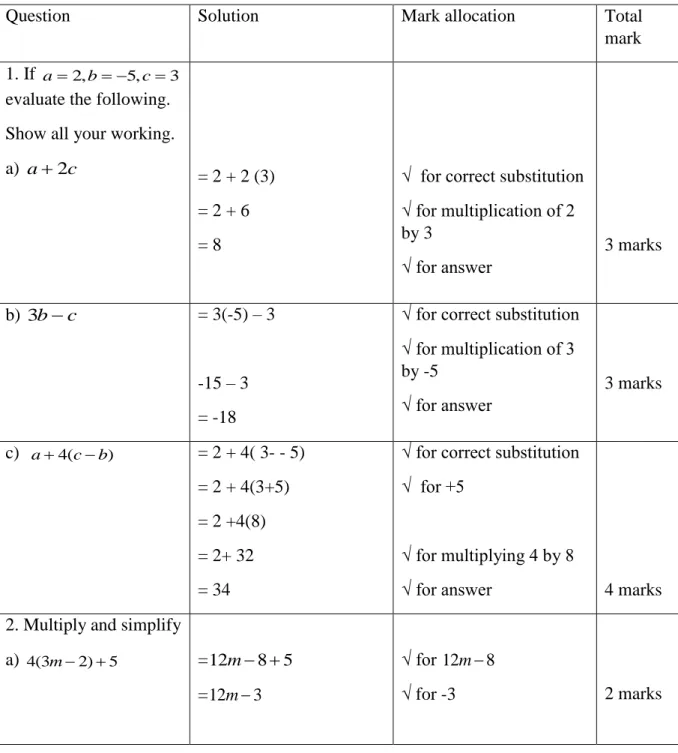
26 As the research is about linear equations the questions chosen for analysis were those that dealt with equations and/or application of skills in solving questions involving equations. The questions in the test that were analyzed are as follows:
Question 1
1. If 𝑎 = 2, 𝑏 = −5, 𝑐 = 3, evaluate the following. Show all steps in your work. a) 𝑎 + 2𝑐
Question 1a) tested whether the learners could translate symbols to numbers and whether they understood whether the expression 2c stand for multiplication, although there is no multiplication sign between 2 and c. A possible error, if the multiplication sign is not seen, could involve writing 2 x 3 to yield 23. The question also tested whether the order of operations is understood. A possible error resulting from the wrong order of operations is adding a and 2 before multiplying 2 by c.
b) 3𝑏 − 𝑐
Question 1b) tested whether the learners could translate symbols to numbers and whether they understood that the expression 3b stands for multiplication, although there is no multiplication sign between 3 and b. A possible error, if the multiplication sign is not seen, could involve writing 3 x (-5) as -35 or as 35. The question also tested whether the order of operations is understood. A possible error resulting from wrong order of operations is adding b and –c before multiplying 3 and b.
c) 𝑎 + 4(𝑐 − 𝑏)
Question 1c) tested whether the learners could translate symbols to numbers and whether they understood the order of operations. A possible error resulting from wrong order of operations is adding a and 4 before multiplying 4 by c- b.
These three expressions were included because the study also considered arithmetic and basic algebra. The questions were representational as they involve translating data. The questions are also transformational because of the carrying out of the operations. Letters in the questions were used as symbols that stood for numbers and that are key in generalized arithmetic.
Question 2
Multiply out and simplify. a) 4(3𝑚 − 2) + 5
b) (𝑚 + 2)(𝑚 − 3) + 𝑚(𝑚 + 3)
These transformational expressions were included because the study also considers arithmetic and basic algebra. The questions are transformational, as they involve changing the form of an expression to an equivalent one, using rules for manipulating algebraic symbols.
The questions tested the ability to apply the distributive law when simplifying expressions into equivalent ones. They are more cognitively demanding because they do not have numeric answers,
27 and are meant to test whether learners are making a transition towards working with abstraction in terms of symbols. Possible errors will include adding unlike terms after applying the distributive law. Another source of errors will be applying the distributive law incorrectly.
Question 3 Factorize fully. a) -3a + 15 b) 𝑏2+ 2𝑏 − 15
These transformational expressions were included because the study also looks at arithmetic and basic algebra. Like the previous question, they are transformational. They could be simplified using factorization and could be classified as testing procedure. The minus sign in a) makes the problem slightly difficult, as it is expected that learners will encounter difficulties in noting that +15 could be written as -(-15), thus factoring out a factor of -1. Question b) is easy, as it tested only procedure. Possible errors include ignorance of prime factors and the wrong allocation of the minus sign to the factors 3 and 5. The minus sign in 15 makes the question slightly difficult because of the allocation of the minus sign, but nonetheless the question mainly tested procedure.
Question 5
Solve for the unknown. a) 4t – 10 = 2t
This equation with unknowns on both sides cannot be solved by arithmetic-based methods, and can be classified as global at the level of grade 10 learners. It involves more than just using algebra as a tool to transform the equation. A possible error will be adding unlike terms.
b) 𝑥(𝑥 − 2) = 8
This transformational question involves changing the form of an expression to an equivalent one using algebraic laws. The steps involved are: the ability to apply the distributive law; have zero on one side of an equation; and factorize to solve a quadratic equation.
c) 3 − 2𝑚 2𝑚+1= 7
The ability to deal with fractions in equations is tested here. In this equation. rules of algebraic operations apply, so the problem is transformational. A possible error could be ignoring the m+1 in the fraction 𝑚+12𝑚 and treating the fraction as 2m. Other errors include inability to find the correct lowest common denominator, ignoring the minus sign and not following the order of operations. An interesting equation that could be included would be to solve for x in x + 1 = x + 1. If students do it arithmetically they get x = x. The real algebraic test is interpreting the algebraic entity. Another interesting question would be to solve for x in x + 1 = x + 2. The arithmetic process yields
28 only about a process, but also showing understanding by interpreting the algebraic entities. This understanding will lead to x being any real number in the first case, and not existing in the second. 3.5 Analyzing the test
The analysis of the data was made in two phases. The first involved identifying errors made in all the questions, informed by categories derived from the discursive approach of Brodie and Berger (2010). These categories are routine errors, visual mediator errors and signifier errors. The difference between the categories used here and those of Brodie and Berger (2010) is that in this research routine errors were placed in subcategories. This study uses the already-existing framework of Brodie and Berger (2010). It confirms the presence of errors, and in the conclusion makes recommendations on how those errors can inform planning.
The second phase involves paying special attention to errors in the questions involving equations. The reason for this is that linear equations are the focus of this study and also that most of the errors were in the preliminary work made in the equations. The data was analysed using commognition discourses.
The notion of different types of changes, namely a learner increasing or decreasing the mark from pre-test to post-test was analyzed by investigating different types of errors and discussing them in terms of the commognition discourse
To investigate the mark change (increase or decrease) in more detail errors that a decrease or increase or stay the same from post-test to pre-test will be investigated. In the first 10 scripts marked there were learners who got a solution right in the pre-test but wrong for the same question in the post-test. To ensure that this decrease is given attention coding will include a category of 1. It is expected that learners will tend to forget, misinterpret situations and misapply rules, as was seen in the analysis of 15 pre- and post-test scripts. Thus: if
a = 2, b = -5, c = 3, then
a + 2c = 2 + 23 (Conjoining) and
a + 4(c - b) = 2 + 4(3 - 5) = 6(3 - 5).
Evidence of understanding what an equation means will be provided by working out the following:
𝑥 + 2 = 0
x = -2 (Deduce).
This method will be accommodated when developing a memo for marking the scripts.
The linear equation comes from question b), and that becomes clear when the following is considered:
𝑥(𝑥 − 2) = 8 𝑥2− 2𝑥 − 8 = 0
29
(𝑥 + 2)(𝑥 − 4) = 0
Or:
𝑥 + 2 = 0
𝑥 + 2 − 2 = 0 − 2 (Subtract one both sides)
x = -2 (Simplify) It is expected that most learners will use this method.
Or 𝑥 + 2 = 0
𝑥 + 2 = −2 + 2 (Looks the same)
𝑥 = −2 (Deduce).
It is expected that only exceptional learners will use the last method. It is also expected that many learners will struggle with an equation with a variable on either side, such as:
5𝑥 + 2 = 𝑥 + 6.
Learners struggling with an equation with a variable on both sides became evident in the preliminary marking of 15 pre- and post-test scripts, in which such equations could not be solved by most learners. It could be solved by the technique shown above:
5𝑥 + 2 = 𝑥 + 6
𝑥 + 4𝑥 + 2 = 𝑥 + 4(1) + 2 (Looks the same),
30 3.6 Validity and reliability
Validity will be mainly limited to the questions that relate to basic algebra and equations. It will be ensured by analyzing scripts of a test which has already been used successfully by WMCS. The validity of a measurement instrument, according to Leedy & Ormond (2005, p. 28), is “the extent to which the instrument measures what it is supposed to measure”. In this situation employing the measurement tool involves fitting the errors to the three categories.
The validity was boosted by breaking the three major categories into smaller categories so as to ensure that the subcategories that are embedded in each of the three categories are not missed. Validity in the study will be enhanced by using the pre- and post-test marked scripts of the same learners. Justification of the decision to use a test and to strengthen validity is derived from Leedy & Ormond (2005) when they note that in a one-group pre-test, post-test analysis, it is at least known that a change has taken place - and this is a change study. There is not one possible explanation of the change that might be observed.
Reliability of the research analysis will, as put by Bertram & Christiansen (2014, p. 207), refer to “the extent to which a measure, procedure or instrument yields the same result in repeated trials”. In this research reliability will be improved by using the same test as pre-test and post-test. The notion is supported by Charles (1995), who suggests that consistency with which an individual’s scores remain relatively the same can be worked out using the test-retest method at two different times. In this instance that will refer to pre-test and post-test scripts, that will be marked and analyzed at consecutive times, though with some overlaps, allowing for investigating the learning changes. Consistency will be enhanced by allowing for some time overlaps to analyze the data, and using the same memo to mark the test. The time frame for completing this study is Aug 2015 to end March 2016.
To enhance reliability 10 pre- and post-tests scripts were given to a teacher to mark and code. The marks obtained were the same, and there were almost no error differences. That indicates that the analysis tools for coding and marking are reliable.
GDE clearance was obtained by WMCS. Ethics clearance was obtained from WSoE (Wits School of Education, protocol number 2015ECE020H). Confidentiality and anonymity were assured by using “school x” as the name of the school, and not mentioning names of learners or the educator. 3.7 Conclusion
This chapter has given details about how the data was collected and analysed. The next two chapters will give an analysis of the data and discuss findings. The discussion was informed by the research questions:
To what extent do errors made by grade 10 learners when dealing with equations stem from errors in arithmetic?
To what extent do errors made by grade 10 learners stem from errors in basic algebra? Sampling and design features of the study were discussed. That involved the reasons for choosing the one group pre-test/ test design in keeping with investigating the shift from pre-test to
post-31 test, and determine whether there are clues about the shift from arithmetic to algebra. The questions selected involved evaluation, multiplication and simplification, factorization and solving equations, as they are linked with research questions about arithmetic and basic algebra.
Coding was informed by literature conclusions, which point out skills that relate to errors in arithmetic and basic algebra, using the discursive framework. Coding will also be informed by progress or its lack in the shift pre-test to post-test, and hopefully also from arithmetic to basic algebra. Consistency in what the learners wrote was enhanced through a sufficient number of scripts and the same teacher.
The collection and analysis of errors as reflected in the scripts was the major concern. A one-group pre-test/post-test analysis of the scripts was done. The same test was used for the sake of consistency. The pre-test analysis of scripts included classifying the errors and answering the research questions while doing a quantitative analysis of performance. The post-test analysis was identical. The post-test and pre-test analyses were compared, and conclusions informed by research questions were drawn.
A qualitative, exploratory and descriptive research method of the pre- and post-test scripts was used to identify errors that were noticed in responses to questions. The responses were sorted into the three categories of errors: errors as routines, errors of visual mediators and errors of signifiers. The pre-test/post-test analysis was found to be ideal for this research, as it explored the change resulting from treatments/interventions. This provided insights into the shift from arithmetic to algebra through the linear equation and related questions.
The test questions were analyzed. The reason for classifying the questions was to explore whether the questions were shifting from relatively easy levels like calculating, to meta-level within the same discourse. That was done in keeping with algebra being a meta-discourse of arithmetic. The substitution questions were found to be representational, as they involved translating data. Letters in the questions were used as symbols that stood for numbers, and these letters were key in generalized arithmetic. The ‘multiply out and simplify’ questions were also found to be transformational, as they involved changing one form of an expression to an equivalent one using rules for manipulating algebraic symbols. The question on factorization was also found to be transformational. The sub-questions on equations showed signs of shifting towards meta-level The equation with unknowns on both sides, i.e., 4𝑡 − 10 = 2𝑡 was classified as global, as it could not be solved by arithmetic-based methods, and because it involved more than just using algebra as a tool to transform. The equation 𝑥(𝑥 − 2) = 8 was classified as transformational, as it involved changing the form of one expression to an equivalent one, using an algebraic law.
With regard to the question 3 −2𝑚+12𝑚 = 7, the rules of algebraic operations are applied in finding the solution, and that means the problem is transformational. So the selected questions contribute to a shift towards meta-level. A suggestion was then made about interesting equations involving interpreting an algebraic entity that could be included to explore the shift towards meta-level. The resulting errors are analyzed in terms of the main framework, namely, commognition.
32 Validity was ensured by analyzing test scripts which had already been used successfully by WMCS, and enhanced by using the pre-tests and post-test marked scripts of the same learners by the same teacher. Reliability was enhanced by using the same test as pre-test and post-test. The notion is supported by Charles (1995). Consistency was enhanced by allowing for some time interval as data analysis was done, using the same memo to mark the test. GDE clearance and ethics clearance was obtained from WSoE (Wits School of Education). Confidentiality and anonymity was respected by using “school x” as the name of the school, and not mentioning names of learners or the educator.