Procedia - Social and Behavioral Sciences 84 ( 2013 ) 155 – 159
1877-0428 © 2013 The Authors. Published by Elsevier Ltd. Open access under CC BY-NC-ND license.
Selection and peer-review under responsibility of Prof. Dr. Huseyin Uzunboylu & Dr. Mukaddes Demirok, Near East University, Cyprus doi: 10.1016/j.sbspro.2013.06.527
The Scale for Problem Solving Skills in Mathematics: Further
Evidence for Construct Validity
Devrim Erdem-Keklik
a1*
aFaculty of Educational Sciences, Ankara University, Ankara, 06590, Turkey
Abstract
Though numerous measures of problem solving skills in mathematics have been presented in the literature, procedures used to evaluate the construct validity of these measures are often incomplete. Few studies have examined multiple measures using dat a from the same sample or similar samples. The purpose of this study was to re-evaluate construct validity of the Scale for Problem Solving Skills in Mathematics. This study was designed to improve this newly developed instrument by following the processes of construct validity on similar sample. Using a cluster sampling of 7th and 8th grade students, 416 respondents were included in the study. Of the participants, 218 (52.4%) were female and 198 (47.6%) were male. The Scale for Problem Solving Skills in Mathemati
mathematics. This self-report instrument consists of 28 items scored on a five-point Likert type scale with responses ranging between 1 (never) to 5 (always) and has three subscales. To evaluate construct validity of the instrument, exploratory and confirmatory factor analyses were conducted. The data were analyzed by LISREL 8.7 and SPSS 17. The results of analyses based on responses to the items of 416 subjects indicated that there were problems with some of the subscales and individual items.
Keywords: Problem solving skill, mathematics, construct validity, confirmatory factor analysis.
1.Introduction
There are some universal purposes to all kinds of educational activities. Gagne (1980) stated that the central point of education is to teach people to think, use their rational powers and to become better problem solvers. Like Gagne, most psychologists and educators regard problem solving as the most important learning outcome for life; because, virtually everyone, in their everyday and professional lives, regularly solves problems (Jonassen, 2000). Thus, last couple decades have witnessed a significant increase in the number of studies examining problem solving skills (De Corte, 2004; Jonassen, 2000).
* Devrim Erdem-Keklik. Tel.: +90-312-363-33-60; fax: +0-312-362 7397. E-mail address: [email protected].
3rd World Conference on Psychology, Counselling and Guidance (WCPCG-2012)
© 2013 Published by Elsevier Ltd. Selection and peer review under the responsibility of Dr. Melehat Halat
Corresponding author name:
© 2013 The Authors. Published by Elsevier Ltd. Open access under CC BY-NC-ND license.
In recent years, one of the most important tasks of primary education is provided pupils with opportunities to learn effective problem solving skills for the issues they face on a daily basis. Thus, countries arrange their educational policies to incorporate problem solving skills in formal educational processes. For example, in 2005, Turkey changed entire curricula for all courses taught (including math, science, social sciences) from first to 12th grade in an attempt to integrate problem solving, critical and creative thinking skills in almost all subject areas.
Individuals seeking solutions to problems encountered in their social life often make use of mathematical knowledge they have learned in school. Thus, recent study
mathematical problem solving and reasoning skills. Futhermore, these studies urge educators design teaching of such skills in ways that can promote problem solving skills used in issues of everday life (Verschaffel, De Corte, Lasure, Van Vaerenbergh, Bogaerts & Ratinckx, 1999; De Corte, Depaepe, & Verschaffel, 2007). Indeed, the National Council of Teachers of Mathematics of United States of America, point out to the direct link between problem solving skills taught in mathematics courses and those used in resolving issues of various domains of
, 2000).
One of the first steps toward effective teaching of problem solving skills is to develop measurement instruments with
well-not only determine the degree to which students have these skills but also pinpoint to specific areas and skills in need of improvement. Though numerous measures of problem solving skills in mathematics have been developed so far, procedures used to evaluate the construct validity of these measures are incomplete, and few studies have examined multiple measures using data from the same sample or similar samples. A necessary stage of scale development is to ensure that the results related to the measurement construct achieved during scale construction are replicable. Thus, the purpose of this study was to re-evaluate construct validity of the Scale for Problem Solving Skills in Mathematics developed by Uysal in 2007. It attempted to further examine construct validity of this newly developed scale by utilizing a sample similar to that of the original scale development study by Uysal.
2.Method 2.1. Participants
With a cluster sampling of 416 student volunteers from upper primary schools in the capital city of Turkey participated in the study. The sample consisted of 256 (61.5%) seventh graders and 160 (38.5%) eighth graders. Of the participants, 218 (52.4%) were female and 198 (47.6%) were male. The majority of participants were from middle socioeconomic status based on a monthly income of their family.
2.2. Procedure
Potential participants of the study were informed about the purpose of the study and the nature of the 5-point
Likert- the
survey individually. Students were encouraged to ask questions during survey administration if anything was unclear and were assured that the information they provided would be confidential.
2.3. Instrument
The Scale for Problem Solving Skills in Mathematics (SPSSM) was developed by Uysal (2007) in order to -report instrument consists of 28 items scored on a 5-point Likert type scale, ranging between 1 (never) to 5 (always). The
scale has three subscales; utting effort in solving problems -confidence about
utilized in the pilot study of the scale development phase. Cronbach alpha reliability coefficients for subscale scores ranged between 0.74 and 0.82. Uysal (2007) reported that the three factors accounted for 37.806% of the variance.
3.Findings
3.1. Exploratory factor analysis
A Principle Component Analysis (PCA) with oblique rotation (direct oblimin) was performed to investigate the underlying structure of the twenty-eight SPSSM items. In the social sciences is generally expected some correlation among factors, since behavior is rarely partitioned into neatly packaged units that function independently of one another; therefore using orthogonal rotation results in a loss of valuable information if the factors are correlated, and oblique rotation should theoretically render a more accurate and more reproducible solution (Costello & Osborne, 2005). The Kaiser-Meyer-Olkin (KMO) measure of sampling adequacy provides an index (between 0 and 1) of the proportion of variance among the variables that might be common variance. In this present study the
Kaiser-Meyer-Olkin measure of sampling adequacy was .865 indic -correlations
among the items. Bartlett's test of sphericity was used to test the null hypothesis that the variables in the population significant (p<.000) and concluded that the correlation matrix was not an identity matrix. These results showed that variables were appropriate for factor analysis.
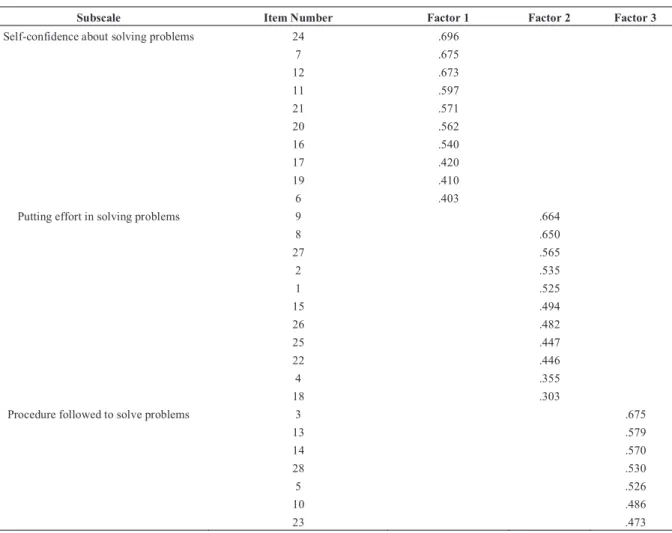
Table 1 Exploratory factor analysis: 28 SPSSM items with loadings above .30
Subscale Item Number Factor 1 Factor 2 Factor 3
Self-confidence about solving problems 24 .696
7 .675 12 .673 11 .597 21 .571 20 .562 16 .540 17 .420 19 .410 6 .403
Putting effort in solving problems 9 .664
8 .650 27 .565 2 .535 1 .525 15 .494 26 .482 25 .447 22 .446 4 .355 18 .303
Procedure followed to solve problems 3 .675
13 .579 14 .570 28 .530 5 .526 10 .486 23 .473
The analysis resulted in a three-component solution, which was evaluated with the following criteria: eigenvalue, variance and scree plot. Criteria indicated a three-component solution was appropriate. Consequently, three factors
were rotated using a direct oblimin rotation procedure. The rotated solution, as shown in Table 1, yielded the first component (self-confidence about solving problems) which accounted for 21.74% of the total variance, the second component (putting effort in solving problems) for 9.45% and the third component (procedure followed to solve problems) accounted for 5.38% of the total variance. The three factors accounted for 36.57% of the variance.
A total of six items were placed under different subscales than they were after the original study by Uysal (2007). w
-current study.
3.2. Confirmatory factor analysis second order model
Based on the expectation that sub-scales produced from the measure would be related and indicative of a higher
order factor, a second- &
an EFA run in the current study was examined. Given the amount of variance explained (R2=. 0075) and the t value of the three-factor oblique model, item 18 was excluded from subsequent CFA since it was lowering the fit of the model. Fit indices of the initial model and the final three-factor oblique model are illustrated in Table 2.
Table 2Fit indices for the second-order CFA
Model 2 RMSEA S-RMR AGFI GFI NFI CFI
Initial 779.95 .082 .097 .74 .77 .77 .83
Three-factor oblique model 604.25 .052 .062 .87 .89 .89 .94
Model fit was assessed using multiple fit indices. For RMSEA and S-RMR, values less than 0.08 are indicative of acceptable fit (Browne & Cudeck, 1993; Hu & Bentler, 1999). While 0.80 or higher values are considered as acceptable fit for AGFI and GFI (Anderson & Gerbing, 1984; Judge & Hulin, 1993), 0.90 or higher values are considered as indicative of good fit for NFI and CFI (Hoyle, 1995). As illustrated in Table 2, RMSEA (. 082) and SRMR (. 097) were higher than 0.08. On the other hand, values for AGFI (. 74), GFI (. 77), NFI (. 77), and CFI (. 83) were less than the acceptable criteria for the initial model. Therefore, fit statistics indicated unacceptable model fit in the initial model. Some of the criteria such as those for RMSEA (. 052), S-RMR (. 062), AGFI (. 87), GFI (. 89) and CFI (. 94) indicated acceptable model fit while the remaining NFI (. 89) index was close to meeting the value for an acceptable fit for the three-factor oblique model. Based on these findings the three-factor oblique model fits reasonably better to the data.
4.Results
The aim of this present study was to re-evaluate construct validity of the SPSSM developed by Uysal to measure of the original one utilized for scale development by Uysal (2007). Data from 416 7th and 8th graders was used in testing construct validity of SPSSM through EFA and CFA.
The results of analyses indicated that there were problems with some of the subscales and individual items. EFA results yielded to placement of six of the items in different subscales. After the reconstructing the items into the proper domain of the scale, CFA was conducted in order to support two factor structure. Based on the results of the CFA, item 18 needs to be excluded from the scale. After these readjustments, the resulting three-factor oblique model-in showed relatively improvements in comparison to the original (initial) model. Therefore, these results indicate that the problem solving factors of the original scale did not have a stable construct.
5.Recommendations
This study has attempted to re-evaluate measurement structure of the SPSSM. However one study alone is not sufficient to establish the measurement structure of the scale. Therefore, the need for replication of such studies is inevitable. In other words the measurement structure should supported by a variety of such studies.
Assessments have begun to be developed, but have not had time to fully mature, and theoretical models to guide Therefore, using newly developed measures lacking further exploration of construct validity and interpreting scores on these measures results obtained should be done with caution. Researchers from fields of educational sciences thus should not only pay attention to the scales they choose for their studies but also pay special attention to whether or not their construct validity is examined sufficiently. It is hoped that the extensive psychometric evidence of a newly
developed SPSSM will lead to a better understanding of upper
References
Anderson, J. C., & Gerbing, D. W. (1984). The effect of sampling error on convergence, improper solutions, and goodness-of-fit indices for maximum likelihood confirmatory factor analysis. Psychometrika, 49, 155-173.
Browne, M. W., & Cudeck, R. (1993). Alternative ways of assessing model fit. In K. A. Bollen & J. S. Long (Eds.), Testing structural equation models (pp. 136-162). Newsbury Park, CA: Sage
Costello, Anna. B. & Jason Osborne (2005). Best practices in exploratory factor analysis: four recommendations for getting the most from your analysis. Practical Assessment, Research & Evaluation, V10 (7). Available online: htpp://pareonline.net/getvn.asp?v=10&n=7
De Corte, E. (2004). Mainstreams and perspectives in research on learning mathematics from instruction. Applied Psychology, 2(53), 279-310. athematical problem solving. In D. K. Pugalee, A. Rogerson, & A. Schinck (Eds.), Proceedings of the Ninth International Conference of the Mathematics Education into the 21st Century Project: Mathematics education in a global community (pp. 144-148). Charlotte, USA: The University of North Carolina.
Gagne, R.M. (1980). The conditions of learning. New York: Holt, Rinehart, & Winston.
Hoyle, R. H. (1995). The structural equation modeling approach: Basic concepts and fundamental issues. In R. H. Hoyle (Ed.), Structural equation modeling: Concepts, issues, and applications (pp. 1-15). Thousand Oaks, CA: Sage.
Hu, L. & Bentler, P. M. (1999). Cutoff criteria for fit indexes in covariance structure analysis: Conventional criteria versu s new alternatives. Structural Equation Modeling: A Multidisciplinary Journal, 6(1), 1-55.
Jonassen, D. H. (2000). Toward a design theory of problem solving. Educational Technology Research. & Development (ETR&D), 48 (4), 63-85. [Computer software]. Lincolnwood, IL: Scientific Software International, Inc. Judge, T. A., & Hulin, C. L. (1993). Job Satisfaction as a Reflection of Disposition: A multiple Source Causal Analysis. Organizational Behavior
and Human Decision Processes, 56, 388- 421.
Kaiser, H.F. (1974) An index of factorial simplicity. Psychometrika, 39, 31-36.
Libbey, H. P. (2004). Measuring student relationships to school: attachment, bonding, connectedness, and engagement. Journal of School Health, 74, 274-283.
NCTM (2000). Principles and Standards for School Mathematics. Reston, Va. NCTM.
mentary students. California School Psychologist, 8, 53-72.
Uysal, O. (2007). Evaluation of relation between problem solving skills, anxiety and attitudes of secondary education grade II students directed Verschaffel, L., De Corte, E., Lasure, S., Van Vaerenbergh, G., Bogaerts, H., & Ratinckx. E. (1999). Learning to solve mathematical application