2016
An examination of teachers' planning processes as
they seek to integrate technology into literacy
instruction
Lindsay Woodward Iowa State UniversityFollow this and additional works at:https://lib.dr.iastate.edu/etd
Part of theEducation Commons, and theEnglish Language and Literature Commons
This Dissertation is brought to you for free and open access by the Iowa State University Capstones, Theses and Dissertations at Iowa State University Digital Repository. It has been accepted for inclusion in Graduate Theses and Dissertations by an authorized administrator of Iowa State University Digital Repository. For more information, please [email protected].
Recommended Citation
Woodward, Lindsay, "An examination of teachers' planning processes as they seek to integrate technology into literacy instruction" (2016).Graduate Theses and Dissertations. 15220.
An examination of teachers’ planning processes as they seek to integrate technology into literacy instruction
by
Lindsay Woodward
A dissertation submitted to the graduate faculty in partial fulfillment of the requirements for the degree of
DOCTOR OF PHILOSOPHY
Major: Education Program of Study Committee: Amy C. Hutchison, Major Professor
Donald Bear Byeong-Young Cho
Isaac Gottesman Donna Niday
Iowa State University Ames, Iowa
2016
TABLE OF CONTENTS Page LIST OF FIGURES ... iv LIST OF TABLES ... v ACKNOWLEDGMENTS ... vi ABSTRACT………. ... viii
CHAPTER 1 NATURE OF THE PROBLEM... 1
Background ... 1
Significance of the Problem ... 3
Purpose of the Study ... 4
Research Questions ... 5
Theoretical Perspectives ... 5
Definition of Terms... 8
Overview of the Study ... 9
CHAPTER 2 REVIEW OF THE LITERATURE ... 12
Introduction ... 12
Conceptual Framework ... 13
Technology Integration in Literacy ... 24
Teacher Lesson Planning ... 30
Summary…. ... 33
CHAPTER 3 METHODS ... 35
Introduction ... 35
Verbal Reporting Design ... 36
Participants ... 39
Methods and Data Collection ... 42
Data Analysis ... 50 Summary…. ... 55 CHAPTER 4 FINDINGS ... 56 Introduction ... 56 Teacher-Participant Profiles... 57 Thematic Findings ... 67
Orientation to Integrating Technology... 82
Enactment of the Elements of the TIPC ... 92
CHAPTER 5 DISCUSSION AND IMPLICATIONS ... 114
Introduction ... 114 Conceptual Implications ... 114 Methodological Implications ... 120 Instructional Considerations ... 121 Limitations ... 123 Future Research ... 125 REFERENCES ... 128
APPENDIX A: INSTITUTIONAL REVIEW BOARD APPROVAL ... 136
APPENDIX B: EMAIL INVITATION ... 137
APPENDIX C: PRACTICE THINK-ALOUD & TASK ... 138
APPENDIX D: RETROSPECTIVE VERBAL REPORT ... 139
APPENDIX E: PRE-INTERVIEW ... 140
APPENDIX F: POST-INTERVIEW ... 141
APPENDIX G: OBSERVATION RUBRIC ... 142
APPENDIX H: OBSERVATION PLANNING CYCLE RUBRIC ... 144
LIST OF FIGURES
Page Figure 2.1 The Technology Integration Planning Cycle
for Literacy and Language Arts ... 29 Figure 3.1 Weekly Technology Daily Diary Selections ... 48
LIST OF TABLES
Page
Table 3.1 Participant Demographic Information ... 42
Table 3.2 Example Retrospective Verbal Protocol Questions ... 45
Table 3.3 Document and Photo Data ... 50
Table 3.4 First Cycle Data Analysis ... 52
Table 3.5 Second Cycle Data Analysis ... 53
Table 4.1 Teacher-Participant Information ... 58
ACKNOWLEDGMENTS
I would like to acknowledge several people who have guided and supported me throughout my graduate work. First, the members of my committee have been invaluable to shaping who I am as a scholar. Dr. Donna Niday was the first faculty member I met from Iowa State, and her warmth and passion for her work inspired me to pursue my doctorate at ISU. Dr. Donald Bear has been an important mentor to me as I think about how to support students’ learning and has shaped my approach to teaching pre-service teachers about literacy, something that will resonate in my work for years to come. Dr. Isaac Gottesman challenged my thinking in important ways, and it is often questions that he posed in my first doctoral class that guide my reading and writing about research. Dr. Byeong-Young Cho took a chance on a doctoral student who showed up in his office one day asking about a research assistantship, which resulted in meaningful collaborations. Finally, I am simply very grateful to know my major professor, Dr. Amy Hutchison. Not only has she been an exceptional mentor to me, carefully reviewing my work, including me in exciting research projects, and guiding me as a doctoral student, but she has been a personal mentor as well. Dr. Hutchison’s remarkable work as a scholar, when coupled with her honest and approachable demeanor, has served to inspire me as I begin my own career.
I have had so many rich experiences as a member of the ISU community, not the least of which are the colleagues I gained and the friends I made. I had the pleasure of working with Chuck Achter in his Foundations of Education course for two years. I looked forward to our weekly meetings, as Chuck not only shared his work, but his life experiences and perspectives as well, and I thank him for that. I would also like to
acknowledge Drs. Beth Beschorner and Sarah Wilson for their friendship throughout graduate school, and now beyond. Your support and guidance was often a breath of fresh air during demanding times, and I am grateful for you both.
To my parents-Floyd and Evelyn Baker, you have both inspired me since before I put your picture on a Wheaties box in middle school and gave a presentation about how you were my heroes. The encouragement and support you have given me my whole life has made me the person I am today, and I am all the better for it. You are models for me, and I hope to be the kind of parent that you are to me.
To my sweet Olivia-you are the most wonderful thing to have ever happened to me. I look forward each day to seeing what new joke, dance move, or timed racing event you will have developed. You inspire me with your desire and capacity to learn, and you make me want to be the happiest, best me that I can be. I especially appreciate your hourly check-ins and the additions you made to this dissertation each time you stopped by.
To my husband-John, it is to you that I am most grateful, as none of this work would have been possible without you. From starting my doctoral program with late night classes and scrambled egg dinners at 9:30pm to days where you ran our household on your own while I worked, you have worked tirelessly in your support of my efforts. I truly don’t know how I’ll ever thank you enough for helping to make this dream of mine a reality.
ABSTRACT
This study examined the processes used by literacy teachers when planning to integrate technology into their instruction and the usefulness of the Technology
Integration Planning Cycle (TIPC; Hutchison & Woodward, 2014a) for framing teachers’ planning processes. Three participants from a larger technology integration project completed a think-aloud session as they planned an upcoming literacy lesson in which they anticipated using technology. This study was designed as a think-aloud study (Pressley & Afflerbach, 1995; Cho & Woodward, 2014) with extensive complementary data (Cho, 2014; Coiro & Dobler, 2007; Zhang & Duke, 2011). In addition to concurrent and retrospective verbal protocols, data sources included: interviews, surveys and
questionnaires, observations, and documents and photos. Analysis of data collected from these sources was conducted in two cycles, open-ended coding (Corbin & Strauss, 2008) then hypothesis coding (Saldaña, 2016). Findings indicated that participants utilized pedagogical content knowledge and technological pedagogical content knowledge in different ways when planning. Notably, misunderstandings about content knowledge may be somewhat accommodated by integrating technology into literacy instruction. Further, teachers each had different stances towards integrating technology that influenced their planned instruction. Finally, while most elements of the TIPC were found in the
participants’ planning, teachers varied in their ability to focus on the instructional goal. Conceptual, methodological, and instructional implications are discussed.
CHAPTER 1
NATURE OF THE PROBLEM
Background
As teachers continue to work towards integrating the Common Core State
Standards (National Governors Association Center for Best Practices & Council of Chief State School Officers, 2010), it is important to understand what influences teachers’ instructional planning decisions when they are situated within authentic classroom contexts. Because the Common Core draws increased attention to multimodal reading and writing (Dalton, 2012; Hutchison & Colwell, 2014; McLaughlin & Oveturf, 2012; Yim, Warschauer, Zheng, & Lawrence, 2014), exploring teachers’ planning for
integrating technology into literacy instruction is especially important. While recent research about professional development on integrating technology and high-quality literacy instruction using technology has provided much needed insights into best practices in these areas, little is known about how a teacher translates what is learned during professional development into instructional planning.
Additionally, teacher perspectives and approaches to integrating technology are recognized as important influences on the extent to which they seek to integrate
technology (Ertmer, 1999; Ertmer, Ottenbreit-Leftwich, Sadik, Sendurur, & Sendurur, 2012; Kopcha, 2012). Their orientation to using technology is an important part of the multiple systems of knowledge used to inform instructional design (Putnam & Borko, 2000). In literacy classrooms, incorporating digital tools into instruction calls into consideration the concept of new literacies (Leu, Kinzer, Coiro & Cammack, 2004),
which are those strategies and skills necessary to read, write, and communicate in digital environments. Leu et al. (2013) claim that due to the new social practices that arise with new literacies, teachers need to modify their role in the classroom to facilitate student learning in a digital environment.
One approach to supporting teachers as they plan to incorporate new literacies into their instruction is the Technology Integration Planning Cycle for Literacy and Language Arts ([TIPC]; Hutchison & Woodward, 2014a). This cycle is designed to support teachers as they plan to integrate technology meaningfully into their literacy instruction. The TIPC invites teachers to consider the following elements in their instructional planning: instructional goal, instructional approach, tool selection, contributions to instruction, constraints, and instruction. These elements should be reflected on and considered in connection to each other as a teacher is planning.
Teachers’ lesson plans are of particular interest, as they directly relate to the cognitive processes teachers use when planning and reflect important aspects of the systems of knowledge they use when planning (Jacobs, 2008; Janssen & Lazonder, 2015). Multiple approaches have been used to explore the specific planning process of teachers. Studies in higher education (Eley, 2006) and math (Leinhardt, 1989) have focused on teacher explanations of thinking after a lesson has been planned and taught. Studies in language instruction (Gatbonton, 1999) and literacy (Cho & Woodward, 2014) have focused on teachers’ verbal reports just after or during specific elements of lesson planning to gain insights into the processes used when planning.
Significance of the Problem
Currently there exists a paucity of research on teacher lesson planning for literacy instruction. Research addressing teacher thinking and planning has contributed useful insights into the systems of knowledge and perspectives teachers draw upon to design literacy instruction for their students (Borko, Shavelson, & Stern, 1981; Peterson, Marx, & Clark, 1978). Yet, recent research has not focused on the particular types of knowledge and decisions made by literacy teachers as they seek to integrate technology into
instruction. This lack of understanding of how teachers plan exposes an important need in the area of supporting teachers’ technology integration efforts in literacy instruction, as the current body of research indicates that multiple factors influence teachers’ integration of technology into literacy instruction.
Teachers’ perceptions about their own facility with integrating technology (Darling-Hammond, Wei, Andree, Richardson, & Orphanos, 2009; Hutchison & Reinking, 2011; Polly & Hannafin, 2010) and their perceptions of the barriers to
integrating technology influence their classroom instruction. For example, Hutchison & Reinking (2011) found that over 60% of teachers believe they do not have time to teach students the basic computer skills needed for more complex tasks. This finding represents a potential misconception of literacy teachers that they must be an expert in the digital tools that they use for instruction (Ertmer et al., 2012; Leu et al., 2013); however, there have not been studies that examine how teachers position themselves as experts or facilitators when planning a lesson in which they are using technology.
An additional factor influencing literacy teachers’ lesson planning is the
their instruction. While professional development in technology integration can support teachers’ integration efforts (Blocher, Armfield, Sujo-Montes, Tucker & Willis, 2011; Ertmer et al., 2012; Kopcha, 2012), over 81% teachers in a national survey (Hutchison & Reinking, 2011) reported that the professional development they had received in this area was inadequate. This finding is further complicated when viewed in light of the lack of research of how teachers enact skills and approaches learned through technology integration professional development when designing literacy instruction. Because professional development in technology integration seeks to influence teachers’
classroom instruction, it is important to also understand the processes teachers use when lesson planning in order to better connect the aims of professional development to teachers’ authentic lesson planning practices.
There are multiple areas of teacher thinking, decision-making, and planning in which knowledge is underdeveloped in the literacy field. The aim of the present study is to contribute to an understanding of the processes teachers draw on when planning a lesson that integrates technology into literacy instruction.
Purpose of the Study
Teacher lesson planning is an important component of understanding how teachers utilize multiple systems of knowledge to design instruction for students (Cho & Woodward, 2014; Leinhardt, 1989; Putnam & Borko, 2000). Examining the knowledge and beliefs literacy teachers draw upon when planning instruction can contribute to the knowledge of what processes teachers can and should use as they seek to integrate technology into their instruction. Further, exploring how elements of planning tools like the TIPC are reflected in teachers’ actual lesson planning can inform an understanding of
designing effective professional development that meaningfully supports literacy teachers in their technology integration efforts (Adelman et al., 2002; Porter, Garet, Desimon, Yoon, and Birman, 2000). The purpose of this study was twofold. First, this study examined the specific knowledge and orientation to using technology that teachers use when planning to integrate technology into their literacy instruction. Second, this study explored how the elements of the TIPC are represented in the processes teachers use when seeking to integrate technology into their literacy instruction.
Research Questions
This study examined teachers’ lesson planning processes as they designed a lesson in which technology was integrated into literacy instruction. Additionally, this study explored how the elements of the TIPC framed the instruction planned. Thus, the following questions guided this study:
1) What knowledge and dispositions do teachers draw upon when planning to integrate technology into literacy instruction?
2) How do the elements of the TIPC frame the planning process used by teachers when integrating technology into literacy instruction?
Theoretical Perspectives
The conceptual framework for this study is informed by: situated learning perspectives, new literacies, and the technological, pedagogical, and content knowledge framework. These theoretical perspectives offer different insights into teacher thinking and planning, which together serve to illuminate important elements of the processes literacy teachers use when designing instruction that integrate technology.
Situative Learning
A situative perspective of teacher thinking (Borko, 2004) fosters an approach that both focuses on individual teachers and their thinking while simultaneously accounting for the influence of the community within which they are teaching. Borko (2004) called for using a situative approach to understanding teacher learning because of the close connections between the knowledge a teacher is gaining through professional
development and the context in which the teacher is both learning it and will apply it. This view of conceptual knowledge, from a situative perspective, is a combination of the context and culture of the situation in which the concept is learned and the individual’s understanding and experiences. Brown, Collins, and Duguid (1989) offer the analogy of conceptual tools, where using the tools both deepens one’s understanding of them and influences future learning and actions as a result of using the tool. Because teachers are planning to meet instructional goals within their specific contexts, a situative perspective suggests that exploring teachers’ planning when situated within their own classroom and curriculum may provide useful insights into the cognitive tools they use when planning. Drawing on situative perspectives of learning provided a lens through which to examine the situated processes and conceptual tools teachers used when planning.
New Literacies
New literacies perspectives offer a framework for understanding the type of instruction being designed by teachers in this study, as well as insights into the roles and stances they take when lesson planning. New literacies scholars claim that digital tools have altered the landscape of literacy through changing the ways in which texts are consumed and produced in multimodal ways (Moje, 2009; Coiro, Knobel, Lankshear, &
Leu, 2008). Thus, new literacies represent the skills and dispositions required to interact and make meaning with this different type of text.
Particularly, new literacies perspectives offer an understanding of the mindsets (Lankshear & Knobel, 2007) and stances (Leander, 2009) taken by teachers when they are considering print and new literacies in their classrooms. Lankshear and Knobel (2007) discussed the perspective of two separate mindsets, one which reflects a
preference for print-based literacies, where knowledge is highly structured and authority is easily established. The other mindset reflects a new literacies mindset where
knowledge comes in multiple forms and authority can be created in increasingly diverse ways. These mindsets serve to inform four stances that Leander (2009) stated represent the ways that teachers conceptualize the relationship between print and new literacies: resistance, replacement, return, and remediation. Each stance privileges print or new literacies in different ways. New literacies perspectives provided insights into how teachers oriented themselves towards using technology as well as into the type of instruction they were planning.
Technological Pedagogical Content Knowledge
Technological Pedagogical Content Knowledge (TPACK; Mishra & Koehler, 2006) is a theoretical framework which refined Shulman’s (1986) work on pedagogical content knowledge (PCK) to include technological knowledge. This framework functions to describe how teachers think about integrating technology into their instruction by explaining the new types of knowledge created when adding technological knowledge to the PCK framework. These new overlaps of knowledge types result in several new types of knowledge, at the center of which is technological pedagogical content knowledge.
Mishra and Koehler (2006) claimed, as important as PCK is to designing meaningful instruction for students, that TPACK is that important to designing meaningful instruction for students when integrating technology. This framework illuminates the types of knowledge the teachers in this study use as they plan, as well as the types of knowledge that may be lacking in their planning.
Definition of Terms
Context. In this study, context refers to the specific situative elements in which the participants are completing the lesson planning task (Brown, Collins, Duguid, 1989; Borko, 2004). Factors involved in context include: student population, classroom environment and setting, school in which the participant teaches, and progress in curriculum.
Digital tools. Digital tools are any tools accessed by using a digital device, and is sometimes broadly referred to as technology. Digital tools include websites, apps, software, audio and video recording devices and others. These are at times identified as the Internet and other ICTs (Information Communication Technologies) in the literature (Leu, Kinzer, Coiro & Cammack, 2004).
Lesson planning. The process of designing instruction and formalizing it into an agenda for a forthcoming class is referred to as lesson planning. Lesson planning involves articulating the structure, content, and execution of a lesson, as well as operational factors, such as management, feedback, and evaluation (Leinhardt, 1989).
Literacy instruction. Literacy instruction is comprised of, “how teachers talk, show,
enact, or otherwise represent information or ideas so their students acquire a deeper knowledge of literacy and the skills they need to become proficient readers and writers”
(p. 304, Kelcey & Carlisle, 2013). For teachers in an elementary setting, this instruction may occur in a single section of time during the school day, or it may also be
incorporated into other disciplinary learning (Barone & Wright, 2008).
Teacher thinking. Teacher thinking is a broad area of research within the field of education. Teacher thinking, in this study, is situated within the work about domains of teacher knowledge as they work in a social and professional context (Mitchell & Marland, 1989). This view of teacher thinking responds to Shulman’s concerns (1986) that examination of teachers’ cognitive processes should value the perspectives of the teachers.
Verbal protocols. Verbal protocols are the result of a concurrent or retrospective verbal report, which is produced as part of a think-aloud study (Pressley & Afflerbach, 1995; Taylor & Dionne, 2000). In a think-aloud study, participants are asked to explain their thinking as they are completing a task, which is termed verbal reporting. The result of the verbal reporting completed by a participant is a verbal protocol.
Overview of the Study
Identifying conceptions of teacher thinking is an important step in understanding the processes teachers use when planning instruction (Borko, Shavelson & Stern, 1981; Stern & Shavelson, 1983). This is especially important in new literacies classrooms as a result of the critical role teachers play (Leu et al., 2013) and the influence that their orientation to integrating technology has on their instruction (Lankshear & Knobel, 2007; Leander 2009; Polly & Hannafin, 2010). Targeted professional development has been shown to increase teachers’ integration of technology (Ertmer et al., 2012; Blocher et al., 2011); however, this increase was largely measured through classroom observations and
self-reports. Understanding of the processes teachers use when connecting professional development to their instruction is not reflected in current research.
While there are many approaches to understanding teacher thinking, one particularly useful approach has been think-aloud studies. Think-aloud studies use a verbal reporting methodology to gain access to a participant’s cognitive process and activities (Ericsson & Simon, 1980, 1984/1993; Pressley & Afflerbach, 1995; Fox, Ericsson, & Best, 2011). During or after completing a task, participants are asked to think aloud about how they are navigating a task. These verbal protocols are then analyzed to make inferences about the processes used by participants. Methodological research suggests that by asking participants to think aloud both as they complete the task (concurrently) as well as after completing the task (retrospectively) that verbal protocol analysis is most robust (Taylor & Dionne, 2000).
The present study is designed as a think-aloud study (Pressley & Afflerbach, 1995; Cho & Woodward, 2014) with multiple complementary methods (Cho, 2014; Coiro & Dobler, 2007; Zhang & Duke, 2011). In addition to both concurrent and retrospective verbal protocols, other data sources included interviews, surveys and
questionnaires, observations, and documents and photos. Three participants were selected from a larger technology integration professional development study using intensity sampling (Patton, 2002). Factors that influenced participant selection included students’ consistent access to a device, student grade level, teacher experience with grade level, students’ demographic information, data on teacher use of technology, and previous lesson observations.
For the think-aloud session, participants were asked to think-aloud while planning an upcoming literacy lesson for their class in which they planned to integrate technology. There were no time limits established (Fox et al., 2011) and teachers used the computer and resources they typically used for daily planning activities. When teachers completed planning their lesson, a retrospective verbal report was elicited that explored particular actions or comments that were not fully explained during the concurrent verbal report.
Data analysis was completed in two cycles, with the first being open coding (Corbin & Strauss, 2008) to address the thinking and perspectives teachers draw upon when planning a literacy lesson in which technology was integrated. The second cycle utilized hypothesis coding (Saldaña, 2016) to explore how the elements of the TIPC reflected the teachers’ planning processes.
The following chapters report the details of this study. In chapter two, relevant literature is reviewed to inform the conceptual framework of the study and to provide an understanding of the body of research in which this study is situated. Chapter three addresses the research questions and the design of the study, including participant
selection, data sources and collection, and data analysis. Chapter four reports the findings of the study, and chapter five presents the important implications which arise as a result of this study.
CHAPTER 2
REVIEW OF THE LITERATURE
Introduction
Teacher thinking and planning has long been of interest to literacy scholars, especially in determining how to make specific instructional decisions (Borko,
Shavelson, & Stern, 1981; Peterson, Marx, & Clark, 1978; Stern & Shavelson, 1983). As teachers seek to address the Common Core State Standards’ (National Governors
Association Center for Best Practices & Council of Chief State School Officers, 2010) focus on understanding text in online and digital environments, they must plan for instruction and learning environments that are conducive to meeting complex
instructional goals (Hutchison & Woodward, 2014a; Hutchison & Colwell, 2014; Leu et al., 2015; Leu et al., 2013; Yim, Warschauer, Zheng, & Lawrence, 2014). Although there is debate as to the level of skill with technology a teacher must have to successfully integrate digital tools into their literacy instruction (Beach, 2012; Hutchison & Reinking, 2011; Lankshear & Knobel, 2007), it is widely agreed that students need instruction in how to effectively utilize literacy skills in navigating digital environments. Additionally, while several studies have explored high-quality literacy instruction using digital tools, there are none which have focused specifically on the processes used by teachers as they seek to integrate technology into their literacy instruction. This has created a dearth of knowledge in our understanding of the knowledge and dispositions used by teachers when planning to integrate technology into literacy instruction. This study is intended to
contribute to an understanding of not only how teachers plan to integrate technology into literacy instruction, but also how to support teachers in their efforts to do so.
This chapter addresses the theoretical perspectives used to inform the
development of a conceptual framework for the present study, which include: situated cognition, new literacies, and technological, pedagogical, and content knowledge. Next, literature on teacher thinking and planning is discussed, which informed an understanding of the connection between teacher knowledge and planning and the design of this study. Finally, issues of teaching literacy with technology are discussed, including the
technology integration planning cycle which guided the professional development received by teachers in this study.
Conceptual Framework
This study is informed by situative learning perspectives (Brown, Collins, Duguid, 1989; Borko, 2004), new literacies (Lankshear & Knobel, 2007; Leu, Kinzer, Coiro, & Cammack, 2004), and Technological, Pedagogical, Content Knowledge (Mishra & Koehler, 2006). First, a situative perspective is used to understand the processes that teachers use when planning to integrate technology into literacy instruction are
influenced by and related to their context. Next, a new literacies perspective frames an exploration of the roles teachers adopt when integrating digital literacies into their classrooms. Finally, the TPACK framework is utilized to understand and describe the types of knowledge teachers draw upon when planning and the ways in which these types of knowledge influence teachers’ planning process.
Situative Perspective on Learning
A situative perspective on learning views learning as “inextricably a product of the activity and situations in which it is produced” (Brown, Collins & Duguid, 1989, p.33). This perspective differs from those theoretical orientations of situated learning and situated cognition which suggest that some learning is situated and some is not
(Anderson, Reder & Simon, 1996). In a classroom, this approach considers the interactive systems that learners use as they interact with each other and selected materials and resources (Greeno, 1997). Darling-Hammond, Hammerness, Grossman, Rust, and Shulman (2005) elaborated that learning is situated within specific contexts where it needs to be developed and from which it must be helped to transfer. A situative perspective of teacher thinking enables the use of a multifocal research lens (Borko, 2004) where the focus can be on individual teachers and their learning while
simultaneously accounting for the influence the context within which they are teaching. This is a particularly useful for understanding the way in which the professional
development program may have framed the elements the participants’ planning. Borko (2004) called for using a situative approach to understanding teacher learning and thinking due to the close connections between the knowledge a teacher is gaining through professional development and the context in which the teacher is both learning it and will apply it. This view of conceptual knowledge, from a situative perspective, is a combination of the context and culture of the situation in which the concept is learned and the individual’s understanding and experiences. Borko elaborated that learning, from a situative perspective, is a process of both individual construction of knowledge and enculturation into larger social practices.
Brown, Collins, and Duguid (1989) argued that learning as enculturation can be an important aspect of a situative perspective, as through this lens, the values of teachers, schools, and communities can be revealed. They further claim that students can become disconnected from schools where their culture is not mirrored in the classroom
environments in which they learn. Therefore, learning must be reflective of authentic activities that represent the practices of students, practitioners, and “just plain folks” (Brown, Collins, and Duguid, 1989, p.35). Brown, Collins, and Duguid (1989) claimed that by presenting students with multiple instructional approaches for an instructional goal that they were able to develop conceptual tools that would allow them to transfer knowledge beyond the specific context in which it was learned. Fundamental to the analogy of conceptual tools, is that using the tools both deepens one’s understanding of them and influences future learning and actions as a result of using the tool.
Because teachers are planning to meet instructional goals within their specific contexts, a situative perspective suggests that exploring teachers’ planning within their own classroom and curriculum may provide useful insights into both the cognitive tools they use when planning and the ones they design for their students. Further, drawing on situative perspectives of learning can provide a lens through which to examine the situated processes they use and the perspectives they take when planning to integrate technology into literacy instruction.
New Literacies
Digital tools have changed both the consumption and production of texts,
especially multimodal texts (Moje, 2009; Coiro, Knobel, Lankshear, & Leu, 2008). These tools have influenced the types of reading and writing that are possible, thus creating new
possibilities and new strategies for literacy with digital tools. Leu, Kinzer, Coiro and Cammack (2004) claim this reading and writing within a digital environment requires “new literacies.” A new literacies perspective contributes an orientation towards literacy that provides some distinction among traditional print literacies and those literacies required to use digital tools effectively. Leu et al. (2004) offer the following definition:
The new literacies of the Internet and other ICTs include the skills, strategies, and dispositions necessary to successfully use and adapt to the rapidly changing information and communication technologies and contexts that continuously emerge in our world and influence all areas of our personal and professional lives. These new literacies allow us to use the Internet and other ICTs to identify
important questions, locate information, critically evaluate the usefulness of that information, synthesize information to answer those questions, and then
communicate the answers to others (p. 1572).
Although research in the last decade has expanded the conception of the Internet and ICTs to include myriad digital tools, the central tenets of considering the differences between print and digital literacies, or indeed, how those literacies are enacted differently in different environments is still a useful perspective. Recently, Leu and his colleagues (2013) have proposed a dual-level theory of New Literacies in which an overall theory of New Literacies is informed by multiple perspectives and approaches of new literacies. In this theory, uppercase New Literacies represents the common themes drawn from the large body of lowercase new literacies research.
The ability to design effective learning experiences is central to the principles of New Literacies theory. The authors claim that teachers must be aware of the new social
practices that arise when using new literacies and be prepared to create both instruction and a classroom environment that facilitates the development of new literacies. One area of new literacies research that Leu et al. (2013) called for an expanded focus and
increased attention to is professional development on new literacies due to the change in the teacher’s role that is required.
Teachers in a New Literacies Classroom
New literacies scholars argue that a new literacies approach to instruction requires a shift in belief about texts and composition from rigid and authoritative to flexible and dynamic (Lankshear & Knobel, 2007). In order to better understand how teachers may situate themselves when planning to integrate technology into literacy instruction, two perspectives are discussed: Lankshear and Knobel’s (2007) discussion of mindsets and Leander’s (2009) perspective on teachers’ stance towards the relationship between print and new literacies.
Mindsets. Lankshear and Knobel (2007) situated their discussion of teacher mindsets within the distinction between physical space and cyberspace. They claim that people, including teachers, approach the world with one of two mindsets. The first is that the world is largely the same as it has been “throughout the modern-industrial period, only now it has been technologized in a new and very sophisticated way” (p. 10). The second mindset reflects the idea that with the development of new technologies has come important new ways of interacting that enable people to envision new ways of imagining, exploring, and being. Among the many differences that characterize the more concrete elements in these mindsets, are those which focus on production, creation, validation, and relationship.
Production, from the perspective of the first mindset, is centered around producing material artifacts utilizing specific tools to complete the task, which may include research papers, responses to book-based questions, or other classroom activities where the goal is to summarize or synthesize existing knowledge. Whereas production from the second mindset would focus on practices that include the production of connectivity and relationships, such as chatting, multiplayer online role playing,
blogging, photo sharing, and others (p. 13). Next, creation differs significantly from the first to second mindset, in which the first mindset prioritizes the individual as the preferred agent for production and the second mindset reflects the importance of
collaboration, or “collectives” (p. 11). The issue of creation and agency is also reflected in the differences in how expertise and authority are established in both mindsets. In the first mindset, authority is primarily found in known individuals and institutions; however, in the second mindset authority is distributed among the collective. This reflects the value of collaboration in the second mindset, in which multiple contributions would be more valid than few or a single person’s contribution. Finally, the relationship element focuses on the approach to the text paradigm that each mindset holds. Lankshear and Knobel argue that the first mindset represents a “bookspace” (p. 13) text paradigm, in which there is a clear order to structure, rules for establishing authority, and directionality of power from the author to the readers. The second mindset considers that there is no text
paradigm. Texts can be unstructured, non-experts can write authoritatively about topics, and readers can and should question authors in an environment where authors can be held accountable.
Leander (2007) explored how these mindsets were enacted in competing
discourses in an all-girls school that had recently begun a one-to-one laptop policy in the school. He noted that teachers established differences in expectations for students in terms of time-space, or when and where students were expected to be working, as well as in the areas of production, creation, validation, and relationship. Together with Lankshear and Knobel’s (2007) perspective on mindsets, this work illuminates the importance of understanding a teacher’s stance towards integrating technology into their literacy instruction.
Stances. Drawing on earlier work from Lankshear and Knobel (2003), Leander (2009) presented a perspective that can connect these two mindsets to four specific stances that reflect how teachers may orient themselves specifically to the relationship between print and new literacies. By situating the juxtaposition of the first and second mindsets within the literacy teacher’s stance towards using new literacies, Leander provides a powerful framework for understanding teachers’ roles in a new literacies classroom. However, rather than arguing for the importance of new literacies, as Lankshear and Knobel (2007) did, Leander’s (2009) focus is on describing the stances that teachers can and do take in the classroom, in order to better inform an understanding of existing teaching and research practices.
Leander (2009) claimed that questions about the value of integrating technology into literacy instruction and how they might fit into a curriculum that is largely focused on print-based literacies stem from a lack of understanding of how new literacies relate to conventional print-based literacies. How teachers orient themselves to understanding this
relationship can be termed their stance, of which he described four: resistance, replacement, return, and remediation.
A resistance stance is characterized by a commitment to conventional print-based literacies, which include those print genres typically found in school settings such as “the novel, the academic argument, poetry, the research paper and the like” (p. 147). This stance reflects Lankshear and Knobel’s (2007) second mindset. Rish (2013) noted that while this stance might reflect the literacies most valued by teachers, it might also be a response to standards and high-stakes assessments in which print literacies are
predominant. Leander (2009) argued that teachers with a resistance stance view new literacies as interfering with meaningful literacy instruction.
The replacement stance is in direct opposition to the resistance stance and reflects Lankshear and Knobel’s (2007) first mindset. Teachers who approach literacy instruction from this stance privilege digital literacy practices over those they view as outdated and representative of a canon that does not serve the everyday practices of their students. Learning activities in a replacement oriented classroom might be film analysis,
multimedia persuasion using website design, and critical interpretations of blogs, rather than novel analysis, argumentative essays, and critical interpretations of poems.
Teachers who neither ascribe to fully rejecting or adopting technology into their literacy instruction often have a return stance. Teachers with a return stance value new literacy practices, but only insofar as they support conventional print literacies. For example, while a teacher might adopt some of the learning activities that a replacement oriented teacher might use, such as film analysis, this analysis would be used to inform
and advance students’ understanding of conducting a novel analysis. The print piece is privileged in terms of assessing student learning, rather than the digital project.
Last, a remediation stance stands apart from the first three stances in terms of how a teacher might view the relationship between print and new literacies. Leander (2009) noted that the connotation of remediation, one that relates to struggling students, is not what is meant by this term. Rather, remediation focuses on how different mediums might best mediate thinking and learning. Instead of privileging one approach over the other, as in Lankshear and Knobel’s (2007) mindsets framework, Leander recognized that teachers and students live in a world in which print and new literacies are valued differently. Therefore, neither should be privileged and the focus should be on which medium best affords communication of the meaning to an intended audience.
While the mindsets framework contributes to an understanding of the fundamental elements underlying decisions about privileging conventional print literacies or new literacies, Leander (2009) situated these perspectives within a classroom environment as reflected in the resistance and replacement stances. Further, Leander offers additional perspectives which describe teachers who do not fit firmly into a dichotomous stance towards integrating technology. These perspectives serve to inform an understanding of how teachers might orient themselves towards integrating technology into their literacy instruction.
Technological Pedagogical Content Knowledge
A final perspective that contributes to the conceptual framework for this study is a theoretical framework which extends Shulman’s (1986) work on pedagogical content knowledge (PCK) to include technological knowledge. It provides a means for
understanding how teachers think about integrating technology into their instruction by identifying overlaps among types of knowledge and proposing a new kind of knowledge, technological pedagogical content knowledge (TPACK). Mishra and Koehler (2006) argued that it is the intersection of these types of knowledge that should guide teachers in successfully integrating technology. The types of knowledge and relationships among knowledge types that constitute the TPACK framework are: content knowledge, pedagogical knowledge, technological knowledge, pedagogical content knowledge, technological content knowledge, technological pedagogical knowledge, and
technological pedagogical content knowledge. Like Shulman’s (1986) original work on pedagogical content knowledge, Mishra and Koehler’s (2006) TPACK framework is a descriptive approach to delineating the different types of knowledge used to design instruction when integrating technology. In the TPACK framework, the types of knowledge that are of particular importance are PCK and TPACK.
These two types of knowledge are especially useful for understanding how teachers plan instruction, as they illuminate both the ways that teachers provide instruction about content and how they meaningfully integrate technology when providing instruction about specific content. PCK, specifically, draws the distinction between expertise in content and knowledge of effective teaching practices to illustrate a teacher’s ability to usefully represent disciplinary concepts in ways that foster student understanding. Thus, TPACK reflects a teacher’s understanding of how technology intersects with both the content and pedagogy to inform meaningful integration of technology to “develop appropriate, context-specific strategies and representations” (p.1029).
TPACK and PCK represent one of many systems of knowledge that teachers draw upon when planning and implementing instruction.
Putnam and Borko (2000) argue that multiple systems of knowledge work in an integrative way to form the foundation of knowledge that teachers use when planning and providing instruction. Lampert (1985) emphasized the personal aspects of teaching and the difficulty teachers have establishing an identity that allows them to navigate
interpersonal issues such as classroom management and responsibilities beyond the classroom, as well as those pedagogical issues which relate to personal epistemology about how knowledge is generated. Fenstermacher and Richardson (2005) foregrounded the importance of teaching that reflects rational and moral approaches, rather than offensive or mean-spirited instruction and the types of acts that teachers select in their instruction that are reflective of that rational instruction. Finally, Putnam and Borko (2000) address the importance of teachers accounting for the contexts of their classroom, school, and community in order to design authentic learning experiences for students. These are each important systems which contribute to understanding teacher knowledge in new and different ways.
However, because the pedagogical knowledge discussed by Shulman (1986) and Mishra and Koehler (2006) highlights the importance of the context of instruction, the students being taught, and the careful selection of appropriate methods for which to provide instruction, the TPACK framework values multiple systems of knowledge in its description of the types of knowledge teachers should use when integrating technology into instruction. This theoretical framework, when combined when new literacies and situative learning perspectives, offers powerful potential for understanding how teachers
plan to integrate technology into literacy instruction, and the specific elements they draw on and prioritize when planning.
Technology Integration in Literacy
While recent studies have been conducted to determine the impact of using digital tools on student literacy learning (Dalton, 2012; Hutchison, Beschorner & Schmidt-Crawford, 2012; Vasinda & McLeod, 2011), little is known about how teachers can plan to maximize new literacies when integrating technology, especially in literacy instruction.
One factor that may influence teachers’ planning efforts is their perception of technology. Although there has been recognition of the relationship between teacher perceptions of technology and technology integration in the classroom
(Darling-Hammond, Wei, Andree, Richardson, & Orphanos, 2009; Hutchison & Reinking, 2011; Polly & Hannafin, 2010), there has been little research that examines the extent of that relationship. Hutchison and Reinking (2011) surveyed literacy teachers to explore possible barriers to teachers’ integration of technology and found that over 60% of teachers believe they do not have time to teach students the basic computer skills needed for more complex tasks. This highlights an important perception many teachers hold about student use of technology that students need direct instruction about how to use digital tools. However, there is conflicting research about whether the teacher does need to be the technology expert in instruction (Leu et al., 2004; Lankshear & Knobel, 2007). This furthers the need for insights into teachers’ planning processes to understand how they are utilizing their knowledge of digital tools and the influence that knowledge may have on their planning decisions.
Recent research has explored the role that teachers take in a new literacies
classroom. Dwyer (2016) explored a classroom in which students used specific strategies in an online inquiry environment and noted the importance of the teacher’s role as promoting mutual interdependence and respect between teacher and student. White (2016) examined her own practice and how she positioned herself in the classroom when using Internet Reciprocal Teaching. Tour (2013) reported how three teachers’ digital mindsets shaped their classroom instruction and beyond. Finally, Hutchison and
Woodward (2014b) examined the role of an English Language Arts teacher as she sought to integrate technology instruction into her sixth grade instruction. This growing body of research indicates that how teachers orient themselves towards integrating technology into their literacy instruction influences their resulting instruction. This study aims to understand the relationship between how teachers orient themselves towards using technology and the instruction they plan.
Professional Development in Literacy Technology Integration
The participants in this study were recruited from a larger technology integration project; therefore, it is useful to consider the influence that professional development in technology integration can have on participating teachers. Further, this study seeks to explore how a technology integration planning cycle, which served as the foundation of the larger professional development, may relate to the actual planning that teachers do. Many professional development initiatives are designed to increase and support teachers’ technological knowledge. However, the existing models used to support teachers’
development of technology integration skills, such as corporate training, student experts, and single technology trainers in schools, have not been empirically useful (Adelman et
al., 2002; Lawless & Pellegrino, 2007). Instead, research supports that high-quality professional development should be: (a) longer in duration, (b) involve opportunity for teachers from the same context to interact, (c) provide active learning opportunities, (d) focus on specific content, and (e) promote coherence with teaching goals and standards (Porter, Garet, Desimon, Yoon, & Birman, 2000). However, professional development for literacy teachers is complicated by their own perceptions of the quality of support they receive to integrate technology into instruction. In a national survey of literacy teachers, Hutchison (2012) found that 81% of literacy teachers felt that the professional development they received on integrating technology into literacy instruction was inadequate. Further, 75% of these teachers had received professional development on technology integration within the last school year.
These findings conflict with Ertmer, Ottenbreit-Leftwich, Sadik, Sendurur, and Sendurur’s (2012) claim that teachers are more confident in integrating technology and are skilled at using technology in the classroom. They drew on NEA results (2008) that showed that 80% of teachers found technology-related professional development valuable and that teachers noted the relevant connections to goals and standards and available technology. The results of the NEA survey highlight a key difference between literacy and other teachers, that when literacy teachers specifically were surveyed (Hutchison & Reinking, 2011), professional development is found to be lacking. This discrepancy may indicate that literacy teachers need different professional development experiences than teachers of other content areas. Further, this difference exposes the need for understanding how literacy teachers specifically may be navigating the barriers to technology integration, as current professional development models have not influenced
literacy teachers’ perceptions of their preparedness to integrate technology into instruction.
A primary barrier to integrating technology has been the support teachers receive. Lawless and Pellegrino (2007) stated that professional development is often “driven by a strong perceived need for action, but it is often not guided by any substantial knowledge base derived from research about what works and why with regard to technology, teaching and learning” (p. 576). This may explain why Blocher, Armfield, Sujo-Montes, Tucker, and Willis (2011) later claimed that, in general, typical professional development was not effective when it came to technology integration. However, they found that providing targeted and theoretically based instruction to teachers over the span of two years did have a positive impact on their use of digital tools as part of their instruction. This finding suggests that by providing opportunities for teachers to explore integrating technology into their own curriculum may influence the effectiveness of their technology integration. Further, the authors suggest that a sustained model may be effective in modifying teachers’ perceptions of technology, which can also be a significant barrier to integration (Ertmer, 1999; Ertmer et al., 2012; Kopcha, 2012).
Teachers’ perceptions of technology may also be a barrier to technology integration. For literacy teachers, their beliefs about the importance of integrating technology have been found to directly influence their integration. Hutchison and
Reinking (2011) found that there was a direct relationship between teachers’ beliefs about the importance of integrating technology and the extent to which they integrated it into their instruction. The authors found that this path was mediated by the additional variables of professional development on how to integrate technology and the skills
needed, beliefs about their own skills, perceived obstacles, support available to the teachers, their stance towards using technology, and availability of technical support and relevant technologies.
These variables highlight factors that should be accounted for when supporting teachers as they seek to integrate technology into their literacy instruction and the importance of accounting for the influence of teachers’ perceptions of the importance using digital technology on their integration efforts. These factors also highlight the need for an understanding of how teachers draw on different knowledge and stances towards technology when planning to integrate technology into literacy instruction.
Technology Integration Planning Cycle
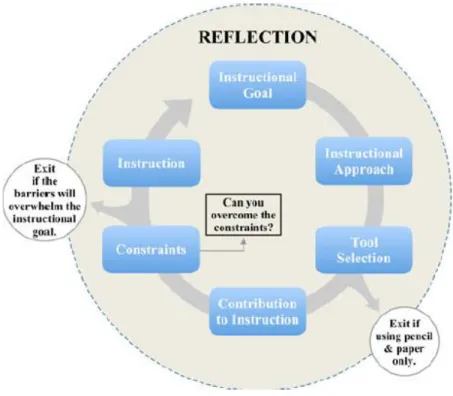
The Technology Integration Cycle for Literacy and Language Arts (Hutchison & Woodward, 2014a) is designed to guide teachers through planning and works in concert with specific, contextualized professional development to empower teachers to plan effectively on their own. This model arose from a line of classroom based research that demonstrated a need for supporting literacy and language arts teachers specifically when they are planning to integrate technology into instruction. The model, shown in Figure 2.1, is a reflective cycle in which each of the elements influences the others. The elements of the model are:
1 . Identify and adhere to a clear instructional goal when integrating digital technology 2 . Identify an appropriate instructional approach for the instructional goal
3 . Select appropriate digital or nondigital tools to support instruction 4 . Foresee how the selected tool can contribute to the instructional goal
5 . Identify the potential constraints of using the tool to determine whether they can be overcome
6. Understand how the instruction will need to be delivered or altered due to the use of the selected tool
7. Reflect on the resulting instruction and make changes/ learn more about the instructional tools as needed (p.5)
These elements are designed to support teachers as they seek to teach both digital and nondigital literacy skills and ask students to engage in multimodal content as both producers and consumers. Through receiving professional development on using this cycle to guide planning to integrate technology into literacy instruction, teachers may be able to more successfully navigate the barriers to technology instruction.
Figure 2.1 Representation of the Technology Integration Planning Cycle for Literacy and Language Arts. Reprinted from “A Planning Cycle for Integrating Digital Technologies into Literacy Instruction,” by A. Hutchison & L. Woodward, 2014, The Reading Teacher, 67(6), p. 459. Copyright 2014 by the International Literacy Association.
Participants in this study were part of a larger professional development program which used this planning cycle as a foundation for supporting teachers. However, as the model was developed from classroom-based research that largely focused on observing teachers instruction but is intended to guide the planning process, research is needed that
contributes to an understanding of how these six elements may be addressed by teachers as they are planning.
Teacher Lesson Planning
A growing body of research indicates scholars in literacy and other fields are interested in how teachers think about lesson planning from a variety of perspectives. Jacobs (2008) argued that evaluating lesson plans allow for insights into not only teachers’ decisions about structure, but also their understanding about the relationships between activities and content that are not readily evident through classroom observation. Janssen and Lazonder (2015) argued that lesson plans provide a useful understanding of teachers’ beliefs and how they orient themselves towards integrating technology into instruction. Further, lesson plans have been used specifically to measure the effectiveness of professional development in the area of literacy (Silk, Silver, Amerian, Nishimura, & Boscardin, 2009). Although lesson plans, and the processes involved in teachers’
planning, have been of scholarly interest, approaches to understanding teacher thinking as it relates to lesson planning varies widely.
Most studies involving teacher thinking and its connection to lesson planning are discipline specific. However, one notable interdisciplinary study was conducted by Eley (2006) as he sought to understand how teachers’ conceptions of teaching influenced specific decisions they made when planning to teach. His study was situated within a
higher education environment with university faculty who reflected on recent instructional planning. These participants were interviewed to determine how they considered elements such as existing student knowledge, student engagement, and student thinking. Frequencies were then calculated to inform an understanding of which elements were most important to the participants when planning. As Eley noted, a particular constraint of a recalled thinking approach is that participants might often conflate their experiences with teaching the lesson with their descriptions of their instructional planning decisions.
In the areas of math and science, investigations into teacher thinking and planning focus predominantly on the lesson itself, using additional interviews and analysis of lesson plan content to make inferences about teacher thinking. Leinhardt (1989)
incorporated the use of classroom observations and agendas to inform her understanding of mathematics teachers’ plans. Leinhardt defined agendas as the teachers’ mental representations that are not written, which involve additional goals and actions needed to enact the lesson plan. Analysis focused on five dimensions of instruction: student
response, student actions, tests, instructional actions, and instructional logic elements. In contrast, Pringle, Dawson, and Ritzhaupt (2015) conducted a large scale analysis of 525 in-service science teachers’ lesson plans who were participating in a yearlong technology integration project designed to strengthen teachers’ TPACK. Their analysis focused on evaluating the lesson plans for evidence of the different knowledge dimensions of TPACK. Finally, Janssen and Lazonder (2015) compared pre and in-service teachers’ selection of existing lesson plans. Teachers were then interviewed using a protocol designed to elicit how their TPACK influenced their selection decisions. Analysis
involved a number of factors related not only to types of knowledge used by teachers, but also factors related to their evaluation of the lesson plan materials.
In language and literacy instruction, additional approaches served to structure the investigation of teacher thinking and planning, specifically the use of verbal protocol analysis, or think-aloud studies. Gatbonton (1999) investigated how experienced in-service ESL teachers drew on their PCK when teaching a lesson. Participants watched themselves teaching a lesson and retrospectively reported their thinking as they watched. Analysis of the verbal report indicated ways in which teachers considered specific aspects of content, student contributions, maintaining rapport, and monitoring student progress. In literacy specifically, one of the earliest investigations into teacher thinking when planning literacy instruction was conducted by Borko, Shavelson, and Stern (1981). They focused on the decision-making process of elementary reading teachers when they are planning small group instruction. To inform their understanding of decision-making process, the authors analyzed the procedures and findings of four studies to determine how teacher thinking influenced their decisions. This analysis indicated that teachers consider student characteristics as well as ability first, and then contextual factors and their own beliefs about reading second. A later study conducted by Cho and Woodward (2014) also investigated teacher decision-making. Cho and Woodward (2014) conducted a think-aloud study to explore how pre-service teachers selected digital materials for instructional use. In their study, pre-service English teachers were given a specific instructional goal and classroom context and were asked to select materials they would use for their instructional approach. Analysis was of their concurrent verbal reports and revealed different ways in which their knowledge, orientation towards teaching, and new
literacies skills influenced the materials they selected. Bigelow (2000) also used a think-aloud approach to explore differences between expert and novice English teachers when planning a lesson using research-provided materials. The frame used for data analysis was the same used by Gatbonton (1999); however, Bigelow’s results indicated that novice teachers prioritized student rapport more than experienced teachers.
These studies reveal the important insights that can be gained through considering the processes used when teachers are planning instruction. Further, an approach to
investigating teacher thinking through planning to integrate technology into instruction may be especially useful to better support teachers in their integration efforts. However, due to the limited research in this area, an established methodology for exploring
teachers’ thinking as they plan a lesson has not been established, and exploring additional approaches is worthwhile. Further, previous studies which sought to situate teachers’ thinking within their own classrooms did not prioritize teachers’ concurrent thinking processes. The present study attempts to accommodate the multiple approaches
previously described through accessing teacher thinking through a situated think-aloud approach.
Summary
The strong relationship between literacy teachers’ beliefs, perceptions,
knowledge, and the resulting instruction they plan has been of recent interest to scholars (Dwyer, 2016; Hutchison & Reinking, 2011; Hutchison & Woodward, 2014b; Tour, 2013; White, 2016). Although some studies have investigated teachers’ lesson planning specifically (Bigelow, 2000; Cho & Woodward, 2014), most have been retrospective commentary after a lesson has been designed or taught (Eley, 2006; Leindhardt, 1989;
Pringle, Dawson, & Ritzhaupt, 2015). Therefore, it is important and useful to explore the specific processes that contribute to teachers’ lesson planning as they are planning the lesson. Further, while decontextualized lesson planning can contribute to an
understanding that teachers use generally when planning their lessons, exploring their planning processes as they plan for a specific class which they are currently teaching may illuminate specific contextual factors and types of knowledge that impact their planning.
The current study draws on situative learning, new literacies, and TPACK perspectives to inform an exploration of the planning processes literacy teachers use when seeking to integrate technology into literacy instruction. Specifically, this study addresses the types of knowledge teachers use and how they orient themselves towards integrating technology into instruction. Additionally, this study explores the usefulness of the Technology Integration Planning Cycle as a frame for understanding the elements of teacher planning.
CHAPTER 3 METHODS
Introduction
Understanding teacher thinking is important to understanding the instructional decisions teachers make when designing learning experiences for students (Stern & Shavelson, 1983; Fenstermacher & Richardson, 2005; Cho & Woodward, 2014). This is especially important for literacy teachers seeking to integrate technology into their instruction, as multiple factors may influence their lesson planning. These factors include the context of their classroom and school (Putnam & Borko, 2000; Borko, 2004), their ability to conceptualize meaningful instruction using technology (Mishra & Koehler, 2006), their orientation to using print and new literacies in their classroom (Leu, Kinzer, Coiro, & Cammack, 2004; Lankshear & Knobel, 2007; Leander, 2009), and the specific elements they prioritize when planning (Hutchison & Woodward, 2014a).
This study aims to explore the planning processes used by literacy teachers when they are planning instruction that integrates technology. Through the use of a think-aloud design, teachers’ in-the-moment thoughts are reported as they are planning a lesson for their students for an upcoming class session. The research questions which guide this study are:
1. What knowledge and dispositions do teachers draw upon when planning to integrate technology into literacy instruction?
2. How do the elements of the Technology Integration Planning Cycle (Hutchison & Woodward, 2014a) frame the planning process used by teachers when
integrating technology into literacy instruction?
This chapter will address the design, participants, methods and data collection, and data analysis used in this study.
Design Verbal Reporting/Think-Aloud Methodology
This study uses a verbal reporting methodology, along with complementary data, to investigate the processes teachers use when planning to integrate technology into their literacy instruction. Verbal reporting is a methodology which refers to principles,
methods, and techniques used to understand a participant’s cognitive processes and activities (Ericsson & Simon, 1980, 1984/1993; Nisbett & Wilson, 1977; Pressley & Afflerbach, 1995; Fox, Ericsson, & Best, 2011). Sometimes referred to in the literature as think-aloud studies (Berne, 2004; Ward & Traweek, 1993) or simply verbal reporting (Gog, Kester, Nievelstein, Giesbers, & Paas, 2009), the essential elements remain the same: a participant is asked to describe his or her thoughts during or just after an experience. There exists some debate regarding whether verbal reporting is a method utilized as a part of a larger methodology, or a methodology itself. However, even those studies which discuss it as a method (e.g. Kuusela & Paul, 2000), lack discussion of a separate methodology, and therefore are treating the method and methodology as one.
Concurrent and Retrospective Verbal Reports
An important distinction in verbal reporting is the one between concurrent and retrospective verbal reports. Taylor and Dionne (2000) define concurrent verbal protocols