The Quality of Education as a Primary Concern of the
Sustainable Development
N.D. Guskova
1, S.M. Vdovin
2, I.N. Krakovskaya
3, Yu.Yu. Slushkina
4Abstract:
The quality of higher education aimed at solving problems of the sustainable development in economy and society is considered in this article. The goal of the sustainable development is to ensure high quality level of life for the present day and future generations. Education plays a significant role in achievement of this goal. The task of education is to develop the comprehensive knowledge in all the elements of the sustainable development, such as: ecology, economy, social sphere, and the ways of their effective interaction. This article contains the results of the research in this area obtained by the scientists of the Management Department of the Ogarev Mordovia State University while preparing for the international conference “Lifelong Education for the Sustainable Development”. The surveys conducted among schoolchildren, students, teachers, employers and the representatives of the state authorities in several regions of the Russian Federation (the Republic of Mordovia, the Novosibirsk, Tambov, Penza, Moscow regions) allowed studying the public opinion on the quality of higher education in Russia and its compliance with the modern and future needs of the economy and society, on the necessity of permanent education, defining the ways of the further development and improvement of higher education in Russia for the benefit of the sustainable development.
The study is funded by the Ogarev Mordovia State University.
Key Words: Quality of education, sustainable development, respondents, quality level, lifelong education.
1
Full Doctor of Economics, Professor, Ogarev Mordovia State University, Saransk, Russia, [email protected]
2
PhD (Economics), Rector, Ogarev Mordovia State University, Saransk, Russia, [email protected]
3
Full Doctor of Economics, Associate Professor, Ogarev Mordovia State University, Saransk, Russia, [email protected]
4
PhD (Economics), Associate Professor, Ogarev Mordovia State University, Saransk, Russia, [email protected]
1. Introduction
Nowadays the concept of the sustainable development is one of the widely discussed all over the world. For the first time it was discussed in the World Conservation Strategy (1980), developed at the initiative of UNER, International Union for Conservation of Nature (IUCN) and World Wildlife Fund (WWF). This concept was defined more precisely through the global discussion, when Forester and Meadows started active development of this concept based on the theory of “The Limits to Growth” in 1970s, Brundtland Commission. Special attention was paid to the necessity of the sustainable development, when “satisfying the needs of the present generations does not undermine the capacity of future generations to satisfy their own needs” in the report of the World Commission on Environment and Development “Our common future” (United Nations, 1987) and in the other events realized by the international community at the end of the 20th century and in the early 2000s.
It should be emphasized that the provisions of this concept cannot be implemented only basing on the agreements of different levels, which stimulate measures of influence on populations of different countries. The implementation of this concept is impossible without changing the systems of values, ways of thinking, culture, consumption, the attitude of the individuals towards the environment. Education is the primary concern in this process and that’s why improvement of education is the crucial prerequisite in the implementation of the concept of the sustainable development.
2. Literature review
At the end of the 20th century and in the early 2000s people became conscious that the human being endowed with knowledge, skills, abilities and desires to realize these abilities is the greatest value in the society, and the criterion of development of any social and economic system is the level of the individual development and needs’ satisfaction.
The implementation of the concept of the sustainable development is aimed at the human being as the greatest value in the society and its creation requires appropriate social, economic, environmental, institutional conditions to support his/her living, self-realization, development, creative growth and competence.
The sustainable development of economy is essential in formation and implementation of these conditions. There are some definitions of the concept “sustainable development of economy”, given in Table 1.
Table 1. Definitions of the concept “the sustainable development of economy”
1 The Concise Dictionary of Basic Legal, Economical, Ecological Terms and Concepts (Astakhov and others, 2005)
The sustainable development is a
conservation of the equilibrium state within a long-term period attained by the exception of reasons that are able to break the dynamic equilibrium state of the object development. The sustainable development is aimed at satisfying the needs of the present generation without detriment to life-support capacity of the future generations.
2 The Comprehensive Law Dictionary
(Malko and others, 2009)
Acceptable, continuously supported balanced development
3 The dictionary of legal terms and
concepts (Federal council of federal assembly RF, 1997)
Harmonious development of production, social sphere, population and environment
4 Analytical report: the ecological
aspects of the sustainable
development. Prepared for the 5th Nevsky international congress on ecology (Krivov V.D. and others, 2012)
Equilibrium of economy, social sphere and ecology
5 Report “Our common future”
(United Nations, 1987)
The development, that enables to satisfy the present generation’s needs without detriment to life-support capacity of future generations to satisfy their needs.
6 The sustainable development is the
future of the Russian Federation. Russia on its way to the sustainable
development (Danilov-Danilyan,
1996)
The development when the effect on the environment stays within the economic capacity of the biosphere without destruction of the natural basis for human life support.
7 Caring for Earth: A strategy for
sustainable living. International
Union for Conservation of Nature (IUCN, UNEP and WWF, 1991)
The improvement of humans’ life quality through the conservation of capacity of economic life-supporting systems
8 The Strategy and the problems of
the sustainable development in
Russia for the 21st century (Granberg
and others, 2002)
Steady, balanced social and economic
development without destruction of
environment to ensure the continuous progress of society.
The definitions of the concept given in Table 1 can be divided into two groups: The first group includes the definitions of “sustainable development” as the equilibrium state of economy, social sphere and environment that enables to ensure the high quality level of life of the present generation without detriment to the life-support capacity of the future generations.
The second group includes the definitions of “sustainable development” as the equilibrium of economy, social sphere and environment.
We have all reasons to believe that we should stick to the first group of definitions as they include not only the high level of life of the present generation, but the necessity to create the similar or even higher quality level of life for the future generations.
The sustainable development in advanced countries is crucial for the effective life activities.
The Earth Summit, the United Nations Conference on Environment and Development took place in Rio de Janeiro in 1992 where the Declaration included 27 principles of sustainable development was adopted. It defined that the main goal of sustainable development was the concern about people’s welfare. The key document on the sustainable development “The Agenda for the 21th century” was adopted, that included the program of the sustainable development based on three components: environment, economy and social sphere. This document recommends that the governments of the world community should develop their national strategies aimed at the sustainable development.
In 2000 United Nations declared the Global Compact in which the universal principles were defined, derived from the Universal Declaration of Human Rights, the International Labor Organisation’s Declaration on Fundamental Principles and Rights at Work, Rio de Janeiro Declaration on Environment and Development, the United Nations Convention against Corruption. These universal principles embrace four areas of human activity: human rights, labour issues and labour standards, environment and anti-corruption.
The Global Compact is the major good-will initiative in the area of the sustainable development. In 2002 The World Summit on Sustainable Development in Johannesburg reaffirmed that the world community was focused on the ideas of the sustainable development. It was emphasized in the main outcome of the Summit that the social problems were in the centre of primary concerns. It is highlighted in the United Nations report “Sustainable Development and Equality: better future for every human being” (2011) that the sustainable development is inseparably linked with the equality and social justice as well as with equal availability of higher quality of life. The concept “the sustainable development of humanity” was introduced in the report, defining that the present day significant extension of freedoms should be reasonable to avoid the reduction of freedoms for the forthcoming generations.
In the UN Summit Report “Viable planet for viable people: the future we choose”……. General Secretary stressed his attention that the global sustainable development depended on economy, environment, social sphere as well as on the improvement of institutional governance to ensure their effective interaction.
We need to create a tool-box of best viable practices and a valid procedure of taking local, national, regional and global decisions to achieve the sustainable development. Thus we need to meet the following challenges effectively:
- to increase congruence on sub-national, national and international levels; - to develop the system of goals to ensure the sustainable development; - to report periodically on the outlook for the global sustainable development; - to reform and to increase the efficiency of international institutional system
(to form the global commission on the sustainable development).
The Group dealing with the problems in this area recommends, that all to whom it may concern should “include the principle of the sustainable development into their strategies, laws and into the budget procedure in particular” and to make all governments and the corresponding ministries deal with the problems of the sustainable development to improve the interaction between authorities and scientists. (UN, 2012).
Many countries of the international community including the countries of the European Union have developed and now implement the national strategies of the sustainable development. Thus it is worth paying attention to the approach of the European countries to development of the strategic policy documents and the mechanisms to control their implementation. The strategies of the sustainable development in Germany and Iceland in particular contain the immediate goals and definite indicators to be attained within a certain period of time. This allows assessing the efficiency of the strategy implementation and making the necessary amendments in proper time.
The Great Britain was one of the first countries to develop and publish the strategy of the sustainable development. Its current version “The Secure Life-Support in Future: The Strategy of the Sustainable Development” issued in 2005 contains the coherent goals, challenges, priority issues and the principles of the sustainable development in England, Scotland, Wales and the Northern Ireland. The local authorities have their strategies of the sustainable development which supplement the national strategy. The principles of the sustainable development in Great Britain include:
- life within the frames of environmental control; - life-support for strong, healthy, just society; - achievement of the sustainable economy; - assistance to the effective management;
- responsibility for use of scientific innovations. This strategy consists of four priority areas:
- sustainable output and consumption; - climatic and energetic changes;
- conservation of environment and national resources; - the sustainable communities.
The state strategy of the sustainable development of Canada was adopted in 2008. The goals, objectives and ways of implementation are focused on four priority issues:
1. Climatic change and clear air;
2. The quality of water and the accessibility to it; 3. Environment protection;
4. Reduction of environmental impact.
This strategy is aimed only at environmental sustainability, and consequently it reduces its effectiveness.
The National Strategy of Sustainable Development 2015 was developed and adopted in 2007 in Portugal. It contains seven major goals:
- information-oriented society;
- steady growth, competitive advantage, effective use of energy; - environment and nature heritage;
- equality, social justice and territory strengthening;
- active international cooperation. (Krivov and others, 2012).
The new principles of ecology and economy control are being implemented in Russia to transform to the concept of the sustainable development of the society. The State Program provides the reduction of energy intensity of GDP not less than by 40% by 2007. The Federal Law “On the energy conservation and the effective use of energy” was adopted in 2009. The RF together with the EU implements the project “Harmonisation of Environmental Standards”: the first stage of its implementation has been completed and following its results the recommendations are given to improve the complex control and to avoid pollution. The second stage is being implemented now and it is aimed at amendments to the regulations of the Russian legislation that contain:
- application of the advances methods of natural management;
- application of the advanced methods of environment protection including the methods of ecological management (standards of ISO 14000 series) ecological audit, ecological certification, insurance.
In all the regulations adopted and implemented by the world community, a special attention is paid to education. During the United Nations Summit on Environment and Development that took place in Rio de Janeiro in 1992 the leaders of more than one hundred counties agreed that high quality education is the crucial factor for the changes. One of the goals included into Agenda 21 at this conference is the reform and improvement of education. Article 36 of this agenda is devoted to education, training, public awareness. United Nations Organization announced the decade of education aimed at the sustainable development (2005-2014). During Vilnius conference in 2005 the UN Economic Commission for Europe (UN ECE) consisted of 55 countries of Central Asia and Northern Eurasia adopted the “The Strategy of Education for the Sustainable Development”. It is emphasized in this strategy that
education in addition to being the fundamental human right is a significant prerequisite for the sustainable development and the tool for effective governance, reasonable decision-making, and promotion of democracy. Education for the sustainable development increases and strengthens the capacity of individuals, groups, communities, organizations and countries to make judgments and choices in favour of the sustainable development. Education can promote a shift in people’s mindsets and thus enable them to make our world safer, healthier and more prosperous, thereby improving the quality of life. (UNECE, 2005).
The aim of this strategy is to encourage UNECE Member States to develop and incorporate the education aimed at the sustainable development into their formal national educational systems in the relevant subjects, informal learning and education (Salimova, 2014). There are the following objectives of this strategy, which will contribute to the achievement of the aim:
- to ensure political, regulatory and operational frameworks of education for the sustainable development;
- to promote the sustainable development basing on formal and informal leaning;
- to equip teachers with the competence to include the sustainable development in their disciplines;
- to ensure that adequate tools and materials for education aimed at sustainable development are available;
- to promote scientific researches in the sphere of the sustainable development;
- to strengthen cooperation on sustainable development at all levels within the UNECE region.
The quality of higher education for the sustainable development as a significant factor is defined by:
- satisfying the needs of economy and society in highly qualified specialists who possess the advanced knowledge, skills, abilities, professional and personal competence and are ready to apply them in practice;
- formation of the world information-oriented civilization;
- formation of social capital in society which is considered to be decisive non-material assets, defining the competitive advantage of the country, region and organization;
- development of science, engineering and technologies;
- the corporative culture, creation of new values and new ways of behavior; - the access to ensure the lifelong education;
- strengthening the civil society institutions.
When Russia joined the Bologna process and WTO, the higher education in Russia met new challenges to ensure comparability in the standards and quality of higher education, to ensure higher school graduates to gain recognition in quality of education etc.
Thereby the objective of all the educational institutions is to provide new contents in the learning subjects, to involve the students into the search for the sustained decisions to solve the global problems of humanity development. All the educational institutions should become the innovative centres for the sustainable development in their region and the capacity of future generations to ensure harmonious interaction between the human being, nature and economy and thus to make their region prosperous. (Mueller, 2013)
Realization of education quality as the most important prerequisite for the sustainable development of national economy and increase in its competitive advantages was reflected in the theories of human and social capital. This allowed considering the innate abilities of the individual and his acquired knowledge, skills, abilities during the upbringing, education, activity as a decisive non-material asset of the organization and the whole society.
The result of the asset use is mostly defined by the system of values, prevailing in the Russian higher education. The system of values is exactly what defines the quality of education and its compliance with the future needs in economics and society. According to E. M. Korotkov “…values are diverse and exist simultaneously, but in various combinations, and only one of them is leading, main and strategic” (Korotkov, 2014). Combination of values, level of their interaction, the definition of the leading value are exactly what forms the characteristics of higher education quality, allows setting its level and significance for economy and society in general.
The level and the quality of education, the level of upbringing and culture of every individual in the society in its turn define the development of theory and practice of its sustainable development. “…Formation of new system in education, taking into account the requirements of the concept of the sustainable development should be based on the approach consisting of the three following elements:
1. Introduction (penetration) of the sustainable development outlook into all the learning subjects;
2. Application of the principles of the sustainable development within all the educational institutions from nursery schools to universities and academies;
3. Development of training courses on the sustainable development for all stages of education. (Sivogarkov and others, 2010)
3. Method
The research carried out by the lectors of the Management Department in the Ogarev Mordovia State University while preparing for the international conference “Lifelong Education for the Sustainable Development”, supported by Joan Manne Fund reaffirm aforesaid approach while providing new reoriented educational system and it enables to improve the quality of education in Russia in accordance
with the concept of the sustainable development. The surveys were conducted among different groups of population of the Russian Federation regions (the Republic of Mordovia, the Novosibirsk, Tambov, Penza, Moscow, Ulyanovsk regions) during the research. The respondents consisted of schoolchildren, teachers, employers, representatives of the state authorities. The total amount of respondents was 286 persons (7,5% - schoolchildren, 7,4% - representatives of the state authorities, 36,8% – students, 27,7% - teachers, 20,6% - employers)
The gender distribution of the respondents is shown in Table 2.
Table 2. The gender distribution of the respondents
Target groups male female
Students 33,3 66,7
Teachers 34,2 65.8
Employers 45,8 54, 2
State authorities 59,1 40,9
Schoolchildren 19,1 80,9
Average indicators in groups 38,3 61,7
Higher percent of female respondents in the total amount is due to their higher response to take part in the survey.
According to the age, the respondents were distributed as follows: respondents aged from 18 to 30 – 30, 1%; respondents aged from 31 to 40 – 33%.
According to the level of education, the respondents were distributed as follows: humanitarians – 26,2%; persons with higher technical education - 15,7%; having a scientific degree – 25,5%.
The questionnaire list contained 32 items concerning different aspects of organization, content and quality of education in Russia.
4. Discussion and Results
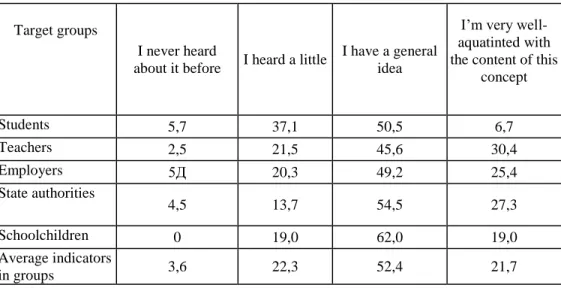
The analysis of the answers to the question: “Do you know anything about the concept of the sustainable development?” has shown that many of the respondents are aware of the concept of the sustainable development (Table 3). 82% of the respondents among state authorities, 81% of the schoolchildren, 76% of the teachers, 75% of the employers and 57% of the students think they are well-informed of the content of the concept or have a general idea of it; 4% of the respondents never heard of the sustainable development before.
Table 3. Distribution of the answers to the question: “Do you know anything about
the concept of the sustainable development?”
Target groups
I never heard
about it before I heard a little
I have a general idea
I’m very well-aquatinted with the content of this
concept Students 5,7 37,1 50,5 6,7 Teachers 2,5 21,5 45,6 30,4 Employers 5Д 20,3 49,2 25,4 State authorities 4,5 13,7 54,5 27,3 Schoolchildren 0 19,0 62,0 19,0 Average indicators in groups 3,6 22,3 52,4 21,7
Then the respondents were asked to tick off the tasks of the sustainable development: a) improvement of living quality, eradication of poverty, smoothing the social inequality; b) greening of public consciousness, prevention of worsening the environmental condition; c) ensuring balanced development of economy, social sphere and environmental safety; d) development of constitutional state, market economy and civil society; e) development of the international cooperation and global partnership; f) balancing the interests of the current and future generations; g) conservation of rare ethnic groups. Figure 1 shows that the answers to this question are distributed extremely inhomogeneously and many important tasks (greening of public consciousness, balancing the interests of generations, global partnership, conservation of ethnic groups) have not been properly emphasized by the respondents. Subsequently the respondents’ knowledge of the concept is shallow and they do not have a clear and integral vision of it.
Thus, the conducted research allowed indicating the necessity to include the questions of the sustainable development into the educational programs of different levels (from schools to post graduate and supplementary education for adults). The need for improvement of the content of the higher education programs was noticed by the respondents.
Figure 1. Distribution of the respondents’ answers to the question: “Tick off the
tasks of the sustainable development of economy”
On the one hand, when answering the question about the quality of higher education in Russia, more than a half of the respondents in each group expressed an opinion that it corresponded to the level of education in the advanced countries (55,3% of the respondents in average) (table 4).
Table 4. Distribution of the answers to the question: “What is your opinion on the
quality of the higher education in Russia?”
Target groups I is higher than in
advanced countries
It corresponds to the level of the most advanced countries It is lower than in advanced countries Students 3,8 56,2 40,0 Teachers 3,8 57,0 39,2 Employers 3,5 56,5 40,0 State authorities 4,6 54,5 40,0 Schoolchildren 4,8 52,4 42,8 Average indicators in groups 4,0 55,3 40,7
At the same time just over 40% of the respondents think the quality of the Russian education is lower than in advanced countries, and only 4% of the respondents
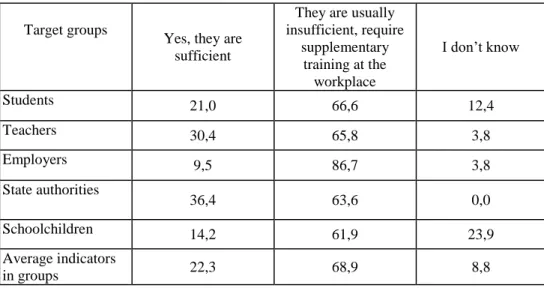
express an opinion that the quality of the higher education in Russia is higher than in advanced countries. Such results provoke thoughts that it is necessary to develop and apply the complex of measures aimed at increasing quality of the higher education and satisfying the needs in it of both the present and future generations. One of the most important indicators characterizing quality of the higher education is the employment of the graduates according to their specialties. In this regard the respondents were asked a question about sufficiency of knowledge of an average Russian university graduate for work within his/her specialty in the Russian Federation (table 5).
Table 5. Distribution of the respondents’ answers to the question: “Are an average
graduate’s knowledge and skills sufficient for work within his/her specialty in the territory of the Russian Federation?”
Target groups
Yes, they are sufficient
They are usually insufficient, require supplementary training at the workplace I don’t know Students 21,0 66,6 12,4 Teachers 30,4 65,8 3,8 Employers 9,5 86,7 3,8 State authorities 36,4 63,6 0,0 Schoolchildren 14,2 61,9 23,9 Average indicators in groups 22,3 68,9 8,8
The majority of the respondents involved into the research (68,9%) share common view, that the knowledge and skills obtained in the higher educational institution are usually not enough to work within the specialty, and supplementary training at the workplace is required. This opinion is shared by 86,7% of the surveyed employers and over 60% of the respondents from the other groups. Only one third of the surveyed teachers and authorities, 21% of the students, 14% of the schoolchildren and less than 10% of the employers think that knowledge and skills of the graduates are sufficient. These results can be explained by the insufficient use of the practice-oriented approach in the Russian higher educational institutions (first of all it is the lack of time, allowed for practice in the educational programs, their poor organization).
Almost the same results were obtained by answering the question: “Are an average graduate’s knowledge and skills sufficient for work within his/her specialty
abroad?” The majority of the respondents (70,5%) consider the level of skills and knowledge of an average graduate from the Russian higher educational institution as insufficient for their work within the specialty abroad.
According to the opinion of the majority of respondents, the main conditions for successful employment in a Russian company are high-demand profession and work experience within the specialty, in the foreign companies – knowledge of a foreign language and a prestigious university diploma.
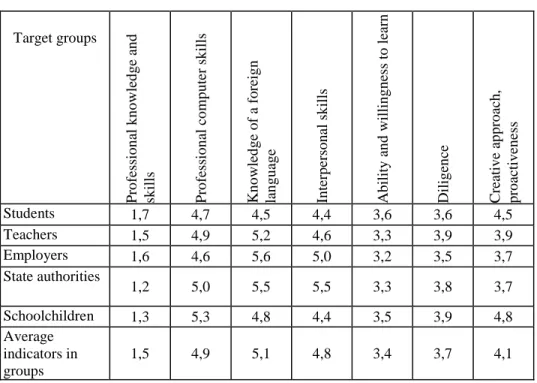
The question about competences and personal traits of a good specialist was answered almost the same way by the groups of respondents: he/she must have professional skills, be industrious and able to learn (table 6).
Table 6. Distribution of the respondents’ answers to the question: “What are the
competences, qualifications and personal traits necessary for a good specialist in your opinion? (1 – very important, 7 – not important at all)”
Target groups Pro fess io n al k n o wled g e an d sk ills Pro fess io n al co m p u ter s k ills Kn o wled g e o f a fo reig n lan g u ag e In ter p er so n al sk ills Ab ilit y an d willin g n ess to lear n Dilig en ce C rea tiv e ap p ro ac h , p ro ac tiv en ess Students 1,7 4,7 4,5 4,4 3,6 3,6 4,5 Teachers 1,5 4,9 5,2 4,6 3,3 3,9 3,9 Employers 1,6 4,6 5,6 5,0 3,2 3,5 3,7 State authorities 1,2 5,0 5,5 5,5 3,3 3,8 3,7 Schoolchildren 1,3 5,3 4,8 4,4 3,5 3,9 4,8 Average indicators in groups 1,5 4,9 5,1 4,8 3,4 3,7 4,1
There is an apparent correlation of the answers from table 4 with those to the question: “What is necessary for successful employment into a Russian company?”, showing high importance for the respondents of the obtained profession, work experience within the specialty and low importance for them of computer and interpersonal skills. It is noteworthy that the employers evaluate the importance of an employee’s personal traits higher in comparison with the other groups of respondents, while students and teachers evaluate the importance of professional
skills comparatively high (including computer skills and language knowledge). Such answers show, on one hand, that there is a delay in requirements of an average Russian employer towards personnel qualification comparing with the world tendencies of human capital assets development. On the other hand, the obtained answers show the necessity of partnership between educational institutions, state authorities and business in formation and implementation of main and supplementary educational programs (including occupational guidance for schoolchildren, practices for students, traineeship for teachers, trainings and other forms of advanced training for employers).
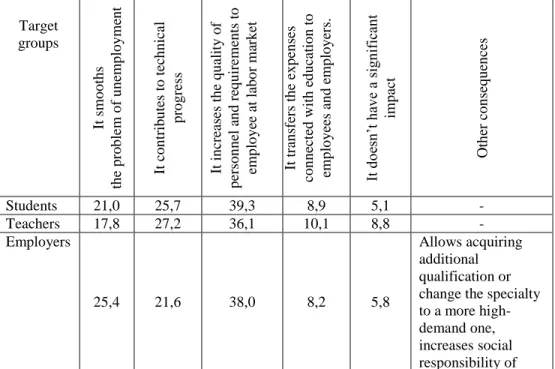
It is quite obvious, that knowledge tends to get out of date and lose value if it is not enriched and updated. In this regard there was the question in the survey: “In what way does lifelong education influence the development of economy and society?” (table 7). The analyzed results of the answers to this question show, that the majority of the respondents consider permanent education as a factor of the increase in personnel quality (33,8%), promotion of technical progress (25,1%) and smoothing the unemployment problems (23,8%). Almost 20% of the surveyed schoolchildren are concerned about commercialization of higher and supplementary education: they note that the expenses connected with education are transferred to employees and employers. The employers in their turn mention that permanent education contributes to increase in social responsibility of business.
Table 7. Distribution of the respondents’ answers to the question: “In what way does
lifelong education influence the development of economy and society?”
Target groups It sm o o th s th e p ro b le m o f u n em p lo y m en t It c o n tr ib u tes to tech n ical p ro g ress It in cr ea ses th e q u ality o f p er so n n el an d r eq u ir em en ts to em p lo y ee at lab o r m ar k et It tr an sf er s th e ex p en ses co n n ec ted with e d u ca tio n to em p lo y ee s an d em p lo y er s. It d oesn ’t h av e a sig nif ican t im p ac t Oth er co n seq u en ce s Students 21,0 25,7 39,3 8,9 5,1 - Teachers 17,8 27,2 36,1 10,1 8,8 - Employers 25,4 21,6 38,0 8,2 5,8 Allows acquiring additional qualification or change the specialty to a more high-demand one, increases social responsibility of
business State authorities 31,8 18,2 37,3 8,2 4,5 - Schoolchil dren 22,9 32,4 18,1 19,0 7,6 - Average indicators in groups 23,8 25,1 33,8 10,9 6,4 -
When answering the question about the advantages of permanent education (lifelong education), the respondents’ opinions were equally divided between guaranteed employment and career promotion (figure 2).
Figure 2. Distribution of the respondents’ answers to the question: “What are the
advantages of lifelong education?”
At the same time, a significant part of the respondents (25%) sees no advantages in permanent education. Maximal percent of such answers (43,6%) belonged to the schoolchildren, minimal (12,1%) – to teachers. The schoolchildren’s opinion might be explained by the fact that they haven’t yet completed their first education and have a poor idea of “lifelong education”. The answers of more mature respondents’ groups are determined by the work specificity (teachers), personal experience and public opinion about insufficient output of human capital investment in the majority of the Russian regions (the students, the employers).
Nonetheless, the analyzed results of the respondents’ opinions regarding regular advanced training, represented at figure 3, show that the large majority of the respondents understands the necessity of regular update and enrichment of knowledge and skills, i.e. they actually recognize the value of permanent education. Answering this question, the respondents were divided into two groups. The first group (42,4%) thinks that employee should upgrade his/her skills annually. The second group’s opinion (43,9% - mostly state authorities) is that advanced trainings is enough to take place every three years. Almost all the respondents consider the “every 10 years” advanced trainings are inefficient and unreasonable. Only 1,7% of the surveyed employers ticked off this answer.
Figure 3. Analyzed results of the respondents’ opinions regarding regular advanced
trainings
According to the results of the surveys it has been found that 47,7% of the respondents are going to receive a supplementary education in the coming 5 years (table 8), 73% of the surveyed state authorities, 51% of the teachers and 45% of the students answer this question with certainty. 18,1% of the surveyed employers consider their knowledge and skills sufficient. The main factor limiting supplementary education for teachers and employers is lack of time, while for students it is lack of money.
Table 8. Distribution of the respondents’ answers to the question: “Are you going to
receive supplementary education (to get a new profession or to upgrade qualification) in the coming 5 years?”
Target groups
Yes, I am
I would like to, but have no money
I would like to, but have
no time No, I am not, because my skills and knowledge are sufficient I don’t know Students 44,8 18,1 13,3 7,6 16,2 Teachers 50,6 13,7 24,3 7,6 3,8 Employers 37,3 8,5 25,4 18,6 10,2 State authorities 72,7 4,6 9,1 9,1 4,5 Schoolchildren 33,3 23,8 14,4 14,3 14,2 Average indicators in groups 47,7 13,7 17,3 11,5 9,8 5. Conclusion
The results of the conducted research allow defining the directions for the further development of higher education and increase in its quality for the benefit of the sustainable development of the economy and society. These are the following directions:
- development of permanent education system or “lifelong education”;
- improvement of interaction between all the parties concerned (higher educational institutions – business – state authorities – civil society) regarding the improvement of quality of higher education;
- more widespread use of the practice-oriented approach in education, aimed at formation of practical skills;
- compliance of the acquired knowledge with the requirements of the labor market;
- compliance of the structure, volumes and forms of training of specialists with the present and future needs of development of economy and society; - formation of the trainees’ new values, which allow implementing increasing
requirements to the quality of higher education under the concept of the sustainable development.
References
Astakhov, A., Zaydenvarg, V., Pevzner, M. & Kharchenko, V. (2005), “Kratkiy slovar' vazhneyshikh pravovykh, ekonomicheskikh, ekologicheskikh terminov i ponyatiy” [Concise Dictionary of Basic legal, economic, ecological terms and concepts], Moskva, BEK, http://www.vocable.ru/dictionary/92/word/ ustoichivoe-razvitie
Danilov-Danil'yan, V.I. (1996), “Ustoychivoe razvitie – budushchee razvitie RF. Rossiya na puti k ustoychivomu razvitiyu” [Sustainable Development – Future Development of the RF. Russia on Its Way to Sustainable Development], Moscow: REFIYa.
Granberg, A.G., Danilov-Danil'yan V.I., Tsikanov, M.M i dr. (2002), “Strategiya i problemy ustoychivogo razvitiya Rossii v XXI veke” [Strategy and Problems of Sustainable
Development of Russia in the 21st century], Moscow: Ekonomika, p 414.
IUCN, UNEP & WWF (1991), “Caring for the Earth: A Strategy for Sustainable Living”, IUCN, Gland, Switzerland.
Korotkov, E.M. (2014), “Obrazovanie v interesakh ustoychivogo razvitiya: tendentsii i perspektivy. Materialy mezhdunarodnoy konferentsii: “Obrazovanie cherez vsyu zhizn' dlya ustoychivogo razvitiya” [Education at the Benefit of Sustainable Development: Tendencies and Perspectives. Materials of the International Conference “Lifelong Education for Sustainable Development”], Saransk: Izdatel'stvo Mordovskogo universiteta, p 62-68.
Krivov, V.D. et al (2012), “Analiticheskiy doklad: ekologicheskie aspekty ustoychivogo razvitiya k V Nevskomu mezhdunarodnomu ekologicheskomu progressu” [Analytical
Report: Ecological Aspects of Sustainable Development for the 5th Nevsky
International Ecological Progress], Analiticheskiy vestnik Soveta Federatsii Federal'nogo sobraniya RF, No. 12, p 12.
Mal'ko, A.V., Ignatenkova, K.E, Komkova G.N. (2009), “Bol'shoy yuridicheskiy slovar” [Comprehensive Law Dictionary], Moscow: Prospekt, p 704.
Meadows, Donella H., Meadows, Dennis L., Randers J., Behrens William W. III (1972), “The Limits to Growth”, New York: Universe Books, p 205.
Mueller, E.V. (2013), “Concerning the implementation of the national strategy for education for sustainable development in Russia”, Pedagogical Sciences, No. 6, p 3-4.
OON (2012), Gruppa vysokogo urovnya General'nogo sekretarya po global'noy ustoychivosti “Zhiznesposobnaya planeta zhiznesposobnykh lyudey: budushchee, kotoroe my vybiraem. Obzor” [“Viable Planet of Viable People: Future We Choose. Review”] 25 p. N'yu-York, http://un.by/f/file/Overview %20-%20Russia.pdf
Salimova, T.A. (2014), Obrazovanie v interesakh ustoychivogo razvitiya: tendentsii i perspektivy. – Materialy mezhdunarodnoy konferentsii: “Obrazovanie cherez vsyu zhizn' dlya ustoychivogo razvitiya” [Education at the Benefit of Sustainable Development: Tendencies and Perspectives. Materials of the International Conference “Lifelong Education for Sustainable Development”], Saransk: Izdatel'stvo Mordovskogo universiteta, p 10-17.
Sivograkov, O.V., Murav'ev, A.V. i Samersova, N.V. (2010), Metodicheskie materialy dlya uchiteley po voprosam ustoychivogo razvitiya. Sovmestnyy proekt ES i programmy razvitiya OON “Ustoychivoe razvitie na mestnom urovne” [Methodological Materials for Teachers Regarding Sustainable Development. Common Project of EU and development project of UN “Sustainable Development at Local Level], Minsk, p 248. Sovet Federatsii Federal'nogo sobraniya RF (1997), Slovar' yuridicheskiy ponyatiy
[Dictionary of Legal Concepts]. Analiticheskiy vestnik Soveta Federatsii Federal'nogo sobraniya RF, No. 22 (67) http://www.budgetrf.ru/Publications/Magazines/VestnikSF /1997/vestniksf67-22/vestniksf67-22190.htm
UNECE (2005), UNECE Strategy for Education for Sustainable Development (CEP/AC.13/2005/3/Rev.1), High-level Meeting of Environment and Education
Ministries, 161 p. Vilnius, 2005. http://www.unece.org/env/documents/2005
/cep.ac.13/cep.ac.13.2005.3.rev.1.r.pdf
United Nations (1987), Report of the World Commission on Environment and Development: Our Common Future, World Commission on Environment and Development. 223 p. New York, http://www.un-documents.net/wced-ocf.htm
United Nations General Assembly (2012), Resolution adopted by the General Assembly on 27 July 2012. A/RES/66/288. The future we want. 53 p. New York, http://www.un.org/en/ga/search/view_doc.asp?symbol=%20A/RES/ 66/288