UC Merced Electronic Theses and Dissertations
TitleMulti-Domain Synchrony Within Vocal Development Permalink
https://escholarship.org/uc/item/9vb5g21x Author
Pretzer, Gina Marie Publication Date 2019
Peer reviewed|Thesis/dissertation
eScholarship.org Powered by the California Digital Library
UNIVERSITY OF CALIFORNIA, MERCED
Multi-Domain Synchrony Within Vocal Development
A dissertation submitted in partial satisfaction of the requirements for the degree Doctor of Philosophy
in
Cognitive and Information Sciences
by
Gina Marie Pretzer
Committee in Charge:
Professor Teenie Matlock, chair Professor Eric A. Walle
Professor Anne S. Warlaumont
Copyright © Gina Marie Pretzer, 2019
iii
The Dissertation of Gina Marie Pretzer is approved, and it is acceptable in quality and form for publication on microfilm and electronically:
Eric A. Walle, Ph.D., Committee Member Associate Professor of Psychological Sciences University of California, Merced
______________________________________________________________________ Anne S. Warlaumont, Ph.D., Committee Member Associate Professor, Department of Communication University of California, Los Angeles
______________________________________________________________________ Teenie Matlock, Ph.D., Committee Chair Professor of Cognitive and Information Sciences McClatch Chair in Communication University of California, Merced
University of California, Merced 2019
iv
This dissertation is dedicated to my family for their unfailing love and support throughout this great journey.
I also dedicate this work to the many friends and colleagues who have stood by with words of encouragement, deep conversations, and funny cat videos to keep my spirits
high.
v
Contents
List of Tables ...ix
List of Figures ...x
Acknowledgments ...xi
Curriculum Vitae ...xii
Abstract ...xvii
Chapter 1 Introduction ...1
1.1 Infant Prelinguistic Vocal Development ...1
1.2 Infant-Directed Speech ...2
1.3 Learning Through Infant-Adult Interactions ...2
1.4 The Present Work ...4
Chapter 2Infant-Adult Vocal Interaction Dynamics Depend on Infant Vocal Type, Child-Directedness of Adult Speech, and Timeframe ...6
2.1 Preface ...6
2.2 Introduction ...6
2.2.1 Infant Vocal Development ...7
2.2.2 Contingent Infant-Adult Vocal Interactions ...7
2.2.3 Infant-Directed Versus Other-Directed Speech ...8
2.2.4 Studying Early Vocal Interactions in Daylong Home Recordings ..10
2.2.5 Overview of the Present Study ...11
2.3 Methods ...11
2.3.1 Participants ...11
2.3.2 Recording Procedure ...12
2.3.3 Selection of High Infant Volubility Samples ...12
2.3.4 Utterance Identification and Classification by Human Listeners ....12
2.3.5 Temporal Contingency Analyses ...13
Figure 2.1 ...14
Figure 2.2 ...15
Figure 2.3 ...16
Figure 2.4 ...16
2.3.6 Acoustic Analyses ...17
2.3.7 Code and Data Availability ...17
2.4 Results ...17
2.4.1 Frequencies of Infant and Adult Vocalization Events ...17
vi
2.4.2 Infant Vocalizations Predict Subsequent Adult Vocalizations With
Various Pause Durations ...18
Table 2.2 ...19
2.4.3 Adult Vocalizations Predict Subsequent Infant Vocalizations With Various Pause Durations ...20
Table 2.3 ...20
2.4.4 Acoustic Analyses of IDS and ODS ...21
Table 2.4 ...21
2.5 Discussion ...21
2.5.1 Infant Vocalizations Predict Subsequent Infant-Directed Adult Vocalizations, and Vice Versa ...21
2.5.2 Differences Between Infant Vocalization Types ...22
2.5.3 Other-Directed Adult Vocalizations are Negatively Associated with Infant Vocalizations ...23
2.5.4 Acoustic Differences Between Infant-Directed and Other-Directed Adult Speech ...24
2.5.5 The Difficulty of Inferring Causality from First-Order Temporal Contingencies ...25
2.5.6 Additional Future Directions ...25
2.6 Conclusion ...27
Chapter 3 Locomotion, Language, and Interactions: How adult responsivity to infant vocalizations promotes vocabulary development in walking and crawling infants ...28
3.1 Preface ...28
3.2 Introduction ...29
3.2.1 Locomotor Development ...29
3.2.2 Prelinguistic Development ...29
3.2.3 Language and Locomotor Development ...30
3.2.4 Overview of the Present Study ...31
3.3 Methods ...31
3.3.1 Participants ...31
3.3.2 Recording Procedure ...32
3.3.3 Selection of High Infant Volubility Samples ...32
3.3.4 Identification and Classification of Infant and Adult Utterances ....33
3.3.5 Event Series Analyses ...33
3.3.6 Code and Data Availability ...34
3.4 Results ...34
3.4.1 Descriptive Statistics ...35
Table 3.1 ...35
Table 3.2 ...35
vii
Table 3.3 ...36
3.4.3 IDS and ODS Predict Subsequent Infant Vocalizations ...36
3.3.4 Infant and Adult Vocalization Frequencies for Walking and Crawling Infants ...36
Table 3.4 ...37
3.4.5 Associations Between Infant and Adult Vocalizations and MCDI Scores in Walking and Crawling Infants ...37
Table 3.5 ...38
Figure 3.1 ...38
Table 3.6 ...39
3.4.6 Associations Between IDS and ODS and Vocabulary in Walking and Crawling Infants ...39
Table 3.7 ...40
3.5 Discussion ...41
3.5.1Bidirectional Associations Between Infant Vocalization Type and Adult Utterance Direction ...41
3.5.2 Walking and Crawling Infants Hear and Produce Different Vocalization Types at Varying Rates ...42
3.5.3 Parent Responsivity is Related to Infant Vocalization Type, Vocabulary, and Locomotion ...42
3.5.4 Limitations of the present study ...43
3.5.5 Future Directions ...44
3.6 Conclusion ...45
Chapter 4 Multi-Domain Synchrony in Speech and Language Development ...47
4.1 Preface ...47 4.2 Introduction ...48 4.3 Methods ...48 4.3.1 Participants ...48 4.3.2 Recording Procedures ...49 4.4 Data Analyses ...50
4.4.1 Part 1 – Coding Interactions ...50
4.4.2 Part 2 – ASQ Exploration ...51
4.5 Results ...51
4.5.1 Descriptive Statistics ...51
4.5.2 Infant Vocalizations Predict Adult Responsivity at All Ages ...51
Table 4.1 ...52
Table 4.2 ...52
Table 4.3 ...53
Table 4.4 ...53
4.5.3 Multi-Domain Development Predicts Vocabulary Size ...54
viii
4.6.1 Predicting Interactions ...54
4.6.2 Vocabulary Size is Predicted by Various Developmental Domains 54 4.6.3 Limitations of the Present Study ...55
4.6.4 Future Directions for Research ...55
4.7 Conclusion ...56
Chapter 5 Discussion ...58
5.1 Introducing a Human Coding Methodology to Observe Infant-Adult Interactions in the Wild ...58
5.2 Locomotor Status Relates to Interactions and Vocabulary Development ...59
5.3 Multi-Domain Recruitment for Language Development ...59
5.4 Conclusion ...60
ix
List of Tables
Table 2.1: Event counts per vocalization type across all infants, given 1 s, 2 s, or 5 s
pause duration ...18
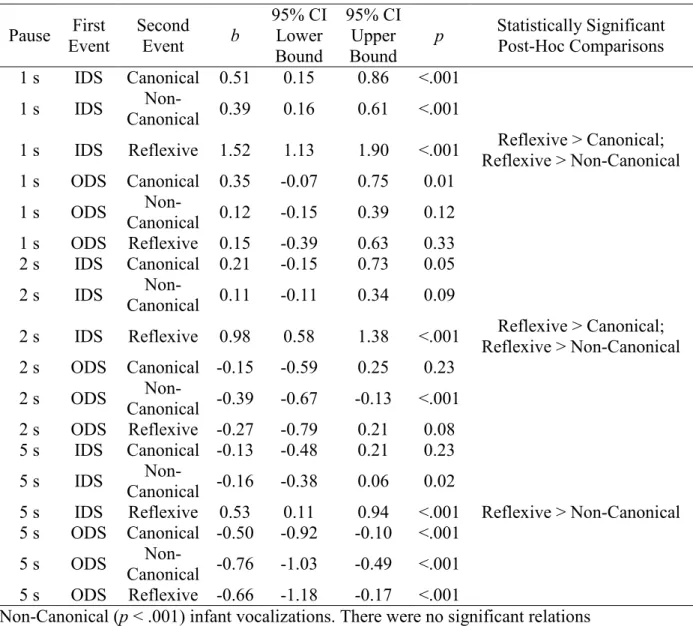
Table 2.2: Infant Vocalizations Predicting Subsequent IDS or ODS ...19
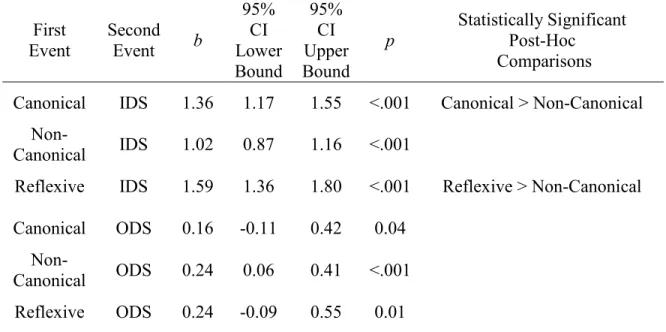
Table 2.3: IDS or ODS Preceding Infant Vocalizations ...20
Table 2.4: Acoustic Differences for Infant-Directed vs. Other-Directed Adult Vocalizations ...21
Table 3.1: Event Counts per Vocalization Type for Crawling and Walking Infants ...35
Table 3.2: Frequency of Infant-Adult Vocal Sequences for Crawling and Walking Infants...35
Table 3.3: Infant Vocalizations Predicting Subsequent IDS or ODS ...36
Table 3.4: IDS or ODS Preceding Infant Vocalizations ...37
Table 3.5: Relations between Infant Vocalizations and Adult Vocalizations in Walking or Crawling Infants ...38
Table 3.6: Infant and Adult Vocalization Types Predicting Receptive and Productive Vocabulary Size ...39
Table 3.7: Infant-Adult Vocal Sequences Predicting Receptive and Productive Vocabulary Size ...40
Table 4.1: Infant and Adult Vocalization Counts by Age ...52
Table 4.2: Proportions of Infant and Adult Vocalizations by Age ...52
Table 4.3: Infant Vocalizations Predicting Subsequent IDS or ODS ...53
x
List of Figures
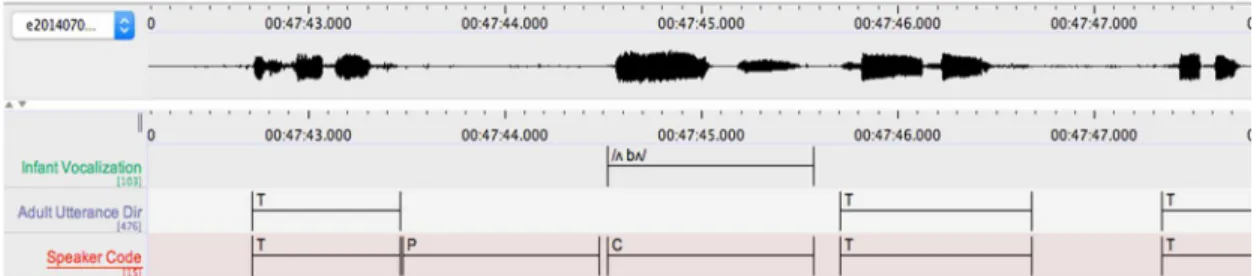
Figure 2.1. A coded segment from a participant’s recording, with lags between vocalizations of greater than or equal to 2 s coded as a pause (P). Lags between vocalizations that are less than 2 s are not coded. /ʌ bʌ/: phonetic transcription of an infant canonical (C) vocalization. T: an infant-directed adult vocalization. Speaker Code: a tier indicating how event series were constructed. The event series for this example was T P C T T ...14
Figure 2.2. A coded segment from a participant’s recording, depicting examples of infant laughs overlapping infant-directed vocalizations (labeled “T”. If the
overlapping vocalization was coded as the first event, the later onset
overlapping vocalization was coded as the second event. With P = 1, 2, or 5 s, the event series would be T R T R ...16
Figure 2.3. A coded segment from a participant’s recording, depicting an infant-directed vocalization (labeled “T”) overlapping a (phonetically transcribed) canonical infant vocalization where a first event begins before and extends beyond the other. If the overlapping vocalization was coded as the first event, the later onset overlapping vocalization was coded as the second event. When P = 1 s, the event series would be: T C T C T P P N. With P = 2 s, the event series would be: T C T T P N. With P = 5 s, the event series would be: T C T T N...16
Figure 2.4. A coded segment from a participant’s recording, depicting non-canonical infant vocalizations (labeled “x”) overlapping other-directed speech (labeled “N”). If the overlapping vocalization was coded as the first event, the later onset overlapping vocalization was coded as the second event. With P = 1 s, the event series would be: N X N X N. With P = 2 and 5 s, the event series would be: N X X N ...16
Figure 3.1. (Left) A boxplot showing the distribution of MCDI-Receptive scores for crawling and walking infants. (Right) A boxplot showing the distribution of MCDI-Productive scores for crawling and walking infants. Locomotor status did not significantly predict Receptive or Productive vocabulary size ...38
xi
Acknowledgements
First, I would like to thank my committee members – Teenie Matlock, Anne Warlaumont, and Eric Walle – for all their support and mentorship since I started my graduate studies at UC Merced.
Thank you, Teenie, for supporting me through all the comings and goings of the last couple years. I am so grateful that you were able and willing to bring me into your lab. I’m so glad we’ve had the opportunity to work together. Thank you, Anne, for launching me into the world of research and guiding me through the early years of my program. I am even more grateful for your continued mentorship and support throughout the later years. I’ve done so much and met so many amazing people in our field because of you. Thank you, Eric, for your suggestions and insights for projects, papers, and presentations over the last five years. Although I was a student in another department, I always felt that I could stop by and ask for ideas or advice.
I want to thank Jeff Yoshimi and Stephanie Shih for serving as members of previous committees throughout my studies. Thank you to Dan Hudock and Heather Ramsdell-Hudock for encouraging me to go into a research program. I never would have had the confidence to apply without you.
A very special thanks to all the Research Assistants who have spent countless hours coding vocalizations, processing audio files, organizing data, filling out
spreadsheets, and going on pick up/drop off visits. Extra credit to Sara Mendoza and Jimel Mutrie for all your work to make things go smoothly for all of us. A million thanks to my fellow grad students, Sara Schneider, who has kept the lab running in tip top shape this past year, and Lukas Lopez, who has done the bulk of the training of the new
research assistants.
I also thank the friends and colleagues at school and at work for challenging me to think critically and reflectively. I’m a better scientist and SLP because of you. So much love my to fellow speechies who inspire me on a daily basis. Thanks for talking and sharing ideas with me throughout this writing process.
My heartfelt gratitude goes out to my dear friends (old and new) and family who been by my side through all the ups and downs of this journey. You know who you are, and you know how much I value your support and encouragement. There are no words sufficient to express how deeply grateful I am to each and every one of you.
This work was funded in part by the National Science Foundation through grant numbers BCS-1529127 and SMA-1539129/1827744, by a James S. McDonnell
Foundation Fellowship in Understanding Human Cognition, and by a Faculty Research Grant from the University of California, Merced Graduate and Research Council.
xii Curriculum Vitae Gina M. Pretzer, MS, CCC-SLP [email protected] ginapretzer.com Education
Doctor of Philosophy, Cognitive and Information Sciences, University of California, Merced; School of Social Sciences, Humanities (2014-2019)
Advisor, Dr. Anne Warlaumont (2014-2017) Dr. Teenie Matlock (2017-present)
Master of Science, Speech-Language Pathology, Idaho State University, School of Rehabilitation & Communication Sciences, Department of Communication Sciences and Disorders, (2012-2014)
Bachelor of Science, Communication Sciences and Disorder with an emphasis in Speech-Language Pathology, School of Rehabilitation & Communication Sciences, Department of Communication Sciences and Disorders, (2007-2012)
Manuscripts
Pretzer, G. M., Lopez, L. D., Walle, E. A., & Warlaumont, A. S. (in press). Infant-Adult Vocal Interaction Dynamics Depend on Infant Vocal Type, Child-Directedness of Adult Speech, and Timeframe.
Lopez, L. D., Walle, E. A., Pretzer, G. M., & Warlaumont, A. S. (under review). Parent Social Engagement with Crawling and Walking Infants: Relations with Joint Attention and Language.
VPS, R., Pretzer, G. M., Mendoza, S., Shedd, C., Kello, C. T., Gopinathan, A., & Warlaumont, A. S. (in preparation). A foraging approach to analysing infant and caregiver vocal behaviour.
Pretzer, G. M., Lopez, L.D., Walle, E. A., & Warlaumont, A. S. (in preparation). Locomotion, Language, and Interactions: How adult responsivity to infant
vocalizations promote vocabulary development in walking and crawling infants.
Presentations (Presenter in bold face)
Pretzer, G. M. (2019, April). Infant Vocal Development for Early Interventionists at HopeSparks Children’s Developmental Services Professional Development Seminar, Tacoma, WA.
xiii
Lopez, L. D., Walle, E. A., Pretzer, G. M., & Warlaumont, A. S. (2018, July). Adult Responses to Infant Prelinguistic Vocalizations are Associated with Infant
Vocabulary: A Home Observation Study. Presented in Walle & Lopez “Crawling and Walking Infants’ Home Language Environments: Relations with Concurrent Vocabulary Size” at the 2018 International Congress of Infant Studies,
Philadelphia, PA.
Walle, E. A., Lopez, L. D., Pretzer, G. M., & Warlaumont, A. S. (2018, July). Crawling and Walking Infants’ Home Language Environments: Relations with Concurrent Vocabulary Size. Presented in Karasik & Walle “Walk, talk, play: Changes across the transition from crawling to walking in infancy” at the 2018 International Congress of Infant Studies, Philadelphia, PA.
Pretzer, G.M & Wood, P. (2017, October). Language Development in Bilingual Infants. Presented at CCCDS Training, Merced, CA.
VPS, R., Shea, T. M., Pretzer, G. M., Mendoza, S., Shedd, C., Kello, C., Gopinathan, A., & Warlaumont, A. S. (2017, August). Infant Vocalization as Foraging in an Acoustic Space. Paper presented at the Canadian-American-Mexican Graduate Student Physics Conference, Washington D.C.
Walle, E. A., Lopez, L. D., Johal, J., Pretzer, G., & Warlaumont, A. S. (2017, April). Parent Social Engagement with Crawling and Walking Infants: Relations with Joint Attention and Language. Paper presented at the Society of Research in Child Development biennial conference, Austin, TX.
Lopez, L. D., Pretzer, G., Walle, E. A., & Warlaumont, A. S. (2017, April). Parent Responding to Infant Canonical and Noncanonical Vocalizations: Relations with Infant Receptive and Productive Vocabulary. Poster presented at the Society of Research in Child Development biennial conference, Austin, TX.
Pretzer, G. M., Warlaumont, A. S., VanDam, M., MacWhinney, B., & Reding, C. (2016, November). HomeBank: A resource for sharing daylong audio recordings from children and families. Poster presented at the 2016 American Speech-Language and Hearing Association Convention, Philadelphia, PA.
Pretzer, G. M., Abney, D. H., Warlaumont, A. S., & Walle, E. A. (2016, November). Parental responses & language ability in walking & crawling infants. Technical Session presented at the 2016 American Speech-Language and Hearing
Association Convention, Philadelphia, PA.
Pretzer, G. M., Warlaumont, A. S., & Walle, E. A. (2016, November). Human vs. machine coding of contingencies yields completely opposite results. Technical Session presented at the 2016 American Speech-Language and Hearing
Association Convention, Philadelphia, PA.
Shea, T. M., Warlaumont, A. S., Kello, C. T., Noelle, D. C., Pretzer, G. M., & Walle, E. A. (2016, August). Deep autoencoding of naturalistic infant and parent
vocalizations. Poster presented at the Workshop on Contemporary Neural Network Models, 15th Neural Computation and Psychology Workshop,
Philadelphia, PA.
Pretzer, G. M., Warlaumont, A. S., & Walle, E. A. (2016, May). Bidirectional contingencies of infant-adult vocal interactions in daylong home recordings. Presented in J. Gros-Louis et al. “Caregiver-infant contingencies: uncovering
xiv
social mechanisms of development” at the 2016 International Congress of Infant Studies, New Orleans, LA.
Pretzer, G. M., Warlaumont, A. S., Walle, E. A., Alvarez, E., & Flores, P. (2015,
November). Examining infant-caregiver interactions in LENA home recordings of one-year-old infants. Technical Session presented at the 2015 American Speech-Language and Hearing Association Convention, Denver, CO.
Warlaumont, A. S, & Pretzer, G. M. (2015, November). How social interactions help build infants’ speech production skills: New insights from daylong, naturalistic audio recordings. Presentation at UC Early Childhood Education Center Directors Meeting, Merced, CA.
Pretzer, G. M., Warlaumont, A. S., & Walle, E. A. (2015, August). Infant vocalizations in the wild. Poster presented in M. Goldstein & C. Yu “Mechanisms of learning in social contexts,” at the 2015 IEEE International Conference on Development and Learning and Epigenetic Robotics (ICDL-EpiRob), Providence, RI.
Pretzer, G. M., Warlaumont, A. S., & Walle, E. A. (2015, July). Phonetic abilities of walking and crawling infants. Poster presented at the 37th Annual Meeting of the Cognitive Science Society, Pasadena, CA.
Erickson, E., Hudock, D., Ramsdell-Hudock, H., Altieri, N., O’Donnell, J., Vereen, L., & Pretzer, G. (2014, November). Evaluating listeners’ reactions to disfluent speech before & after an intensive stuttering clinic. Poster presented at the American Speech Language and Hearing Association (ASHA) Annual Convention, Orlando, FL.
Bull, C., Hudock, D., Altieri, N., Seikel, J., & Pretzer, G. (2014, November). Male & female reactions to typical & atypical speech with the use of disclosure
statements. Poster presented at the American Speech Language and Hearing Association (ASHA) Annual Convention, Orlando, FL.
Hudock, D., Pretzer, G., Altieri, N., & Seikel, J. A. (2014, March). Listeners’ self-reported and physiological reactions to typical and atypical speech. Poster presented at Idaho State University’s Division of Health Sciences Research Day.
Hudock, D., Altieri, N., Seikel, J., & Pretzer, G., (2013, November) Listeners’ self-reported & physiological reactions to typical and atypical speech. Poster presented at the American Speech Language and Hearing Association (ASHA) Annual Convention, Chicago, IL.
Hudock, D., Altieri, N., Seikel, J., & Pretzer, G., (2013, October) Listeners’ self-reported & physiological reactions to typical and atypical speech. Poster
presented at the Inter-Mountain Area Speech and Hearing (IMASH) Convention, Denver, CO.
Teaching
COGS 005 Introduction to Linguistics, Discussion sections, University of California, Merced (Spring 2015)
COGS 001 Introduction to Cognitive Science, Discussion sections, University of California, Merced (Fall 2014)
xv
Washington Speech-Language Pathology License, (July 2018-present)
American Speech-Language and Hearing Association Certificate of Clinical
Competency in Speech-Language Pathology (CCC-SLP), (July 2017-present)
California Speech-Language Pathology Services Credential, in Language, Speech and Hearing (August 2017-March 2019)
California Teaching Credential, in Speech and Hearing Services (August 2016-December 2018)
California Provisional Speech-Language Pathology Services Credential, in Language, Speech and Hearing (August 2016-July 2017)
Thesis and Article Writing, Dissertation Boot Camp, Graduate Enrichment &
Advancement Resources & Services (GEARS), Graduate Division, University of California, Merced (June 2015; January 2016)
Surviving the Classroom with 1st Generation Students, Teaching Matters, Center for Research on Teaching Excellence, University of California, Merced (August 2014)
Membership California Teachers Association (CTA) (2017-2018)
California Speech-Language Hearing Association (CSHA) (2017-2018)
American Speech-Language and Hearing Association (ASHA) (2016-present)
International Congress of Infant Studies (ICIS) (2016-present)
New Investigators DARCLE (2016-2018)
Co-Coordinator (2018)
Women in Cognitive Science (2015)
Cognitive Science Society (2015)
Daylong Audio Recording of Child Language Environments (DARCLE) ( 2015-2018)
Board Member, New Investigators Liaison (2018)
National Student Speech Language and Hearing Association (NSSLHA), Region 10, Idaho State University Chapter, Member (2012-2014), National Member (2013-2017)
Idaho State University Chapter President (2013-2014)
Awards
Graduate Research Fellowship Award, University of California, Merced (Spring 2018)
Graduate Research Fellowship Award, University of California, Merced (Fall 2017)
Summer Research Fellowship Award, University of California, Merced (Summer 2017)
Student Research Travel Award, ASHA Convention, Philadelphia, PA (November 2017)
Summer Research Fellowship Award, University of California, Merced (Summer 2016)
Graduate Research Fellowship Award, University of California, Merced (Spring 2016)
xvi
Summer Research Fellowship Award, University of California, Merced (Summer 2015)
Teaching Assistantship, University of California, Merced, School of Social Sciences, Humanities, and Arts, Department of Cognitive and Information Sciences (Fall 2014-Spring 2015)
IMASH Registration Scholarship, Denver, CO(October 2013)
Graduate Teaching Assistantship, Idaho State University, Department of Communication Sciences and Disorders (2013-2014)
Dean’s List, Idaho State University (2012)
Service
Co-Coordinator for New Investigators DARCLE Group, Liaison between DARCLE and NI DARCLE groups; Submit meeting notes and readings for inclusion on DARCLE website (Fall 2017-Spring 2018)
Reviewer for Many Paths to Language (MPaL) Conference, Reviewed submissions for the 2017 MPaL Conference (July 2017)
Reviewer for Language in Infants and Toddlers Topic Area, Reviewed submissions for this content area for the 2016 ASHA Convention (April 2016)
SSHA Graduate Student Judge, Undergraduate Research Poster Competition; Judged undergraduate researchers’ posters (February 2016)
Cognitive and Information Sciences Graduate and Faculty Weekly Meeting, Co-organizer for weekly departmental meetings; Coordinating student speaker schedules and distributing abstracts and materials prior to talks (Spring 2016)
NSSLHA, Planning and preparation for 2014 NSSLHA Workshop (Fall 2013 – Spring 2014)
Northwest Center for Fluency Disorders, Assisted with finding/securing grants for Intensive Stuttering Clinic; Assisting with creation of clinic manual for Intensive Stuttering Clinic (Fall 2013 – Spring 2014)
IMASH Convention, Session Moderator for “Forming Inter-Professional
Collaborations to Treat Students Who Stutter”; Volunteer at registration table, Denver, CO (October 2013)
FRIENDS of People Who Stutter Symposium, Assisted leading children’s session, Pocatello, ID (April 2013)
Capitol Hill Day, Presented information to members of Idaho state legislature at NSSLHA information table, Boise, ID (February 2013)
xvii
Abstract
Language is inherently social; thus, language learning must be facilitated by social means. Infant-adult interactions are crucial for language development. However, one cannot view communication as an independent entity; rather, communication is simply one developmental domain within the dynamical scope of infant development. Specifically, language co-exists and develops in conjunction with the motor, cognitive, social, and emotional developmental domains. This dissertation will investigate the interdependent roles of all these developmental domains as they pertain to speech and language development.
The first investigation explores how infant-adult social interactions relate to the speech-relatedness of infant vocalizations. This study, which was recently accepted for publication in Infant Behavior and Development, examined two-event vocal sequences within the context of ultra-naturalistic home interactions captured via the LENA system. We found that the dynamics of infant-adult interactions were dependent upon the type of infant vocalization, the directedness of adult utterances, and the time lags between vocal events.
The second investigation builds upon the first by adding a locomotion dimension: How do these infant-adult interactions look in walking vs crawling infants? This
question was previously explored with a smaller, unbalanced sample, but will be re-assessed with a larger, more equal sample of walking and crawling infants. We found differential responses to types of infant vocalizations between walking and crawling infants. We also found a marginally significant association between infant-directed speech and productive vocabulary.
The final component to this dissertation is an exploration of how milestone acquisition across a range of developmental domains (e.g., gross motor, fine motor, problem solving, social/emotional) relates to observable language behaviors within naturalistic daylong home audio recordings (e.g., infant vocalization count, turn count, and adult words heard). We found significant relations between infant vocalization types and adult utterance directions dependent upon age. Additionally, we found that Fine Motor, Social-Emotional, and Communication scores were predictive of vocabulary size. These three studies demonstrate evidence that supports the idea that language
development is an active participant, along with the other developmental domains, within the dynamical system that is infant development.
This dissertation, Multi-Domain Synchrony Within Vocal Development, is submitted by Gina Marie Pretzer in 2019 in partial fulfillment of the degree Doctor of Philosophy in Cognitive and Information Sciences at the University of California, Merced, under the guidance of dissertation committee chair, Teenie Matlock.
1
Chapter 1
Introduction
Language is an integral part of being human. Language drives interactions, facilitates cooperation, and provides the framework for exchanging ideas and
knowledge. From more overt methods, such as greeting with “hello,” to subtly raising an eyebrow in response to an absurd idea, we are constantly exchanging messages with one another.
However instinctual or reflexive some facets of language may be, so much of how we communicate with others must be learned, whether through direct pedagogical
methods (think about learning how to conjugate verbs in school) or through shared experiences and interactions with others. For many decades, researchers have studied how infants learn the complexities of language. We know that while generally
predictable, language learning does vary between children. This highly complex pathway can be nonlinear and, at times, convoluted. Further, “breakdowns” can occur along this developmental sequence, resulting in language delays and disorders. When this occurs, specialists work with children to boost language development and mitigate any
difficulties caused by these disorders.
As one of those specialists, I am strongly aware of the role that high-quality research plays in shaping one’s clinical practice. Speech-Language Pathologists (SLPs) are charged with engaging in Evidence-Based Practice, which is “an approach in which current, high-quality research evidence is integrated with practitioner expertise and client preferences and values into the process of making clinical decisions” (American Speech-Language-Hearing Association, 2005). My interest in research started here, for what better way is there to incorporate evidence into your practice than to help uncover and contribute evidence yourself? This effect is bidirectional, as my research about
prelinguistic vocal development has shaped my clinical career into one spent working in early intervention with infants and toddlers with speech delays and disorders.
In this dissertation, I will introduce three studies that were in part shaped by the idea that vocal development does not occur in a vacuum, but rather as part of a
cooperative system of development between domains. Given that language learning is based within interactions and that speech is a very precise motor act, one should explore vocal development with an interdisciplinary mindset where social-emotional and motor development are also considered.
1.1 Infant Prelinguistic Vocal Development
Prelinguistic development is marked by a series of predictable progression starting from primitive cries and vocalizations at birth and culminating in true words (e.g., Buder, Warlaumont, & Oller, 2013; Koopmans-van Beinum & van der Stelt, 1968; Oller, 1980, 2000; Roug, Landberg, & Lundberg, 1989; Stark, 1980; Stoel-Gammon, 1989; Vihman, Macken, Miller, Simmons, & Miller, 1985). By 2-3 months of age, infants demonstrate adequate control of their articulators (i.e., the oral structures involved with
2
vocal production, including the lips, tongue, and jaw) to produce more diverse protophone vocalizations, such as full vowels, squeals, yells, growls, whispers, raspberries, and marginal babbling (Buder et al., 2013; Oller, 1980; Roug et al., 1989; Stark, 1980). At around six months of age, infants produce canonical vocalizations (i.e., when a syllable has speech-like timing between full consonants and vowels; see Buder et al., 2013) more consistently. From then until 18 months of age, infants steadily increase the number of speech-related vocalizations, including first true words that appear around their first birthday (Oller, Eilers, Urbano, & Cobo-Lewis, 1997; Warlaumont &
Ramsdell-Hudock, 2016). These prelinguistic milestones are foundational to later lexical development (Oller, 2000). For example, the phonetic structure of canonical babbling is generally similar to the phonetic structure of first true words (Stoel-Gammon, 1989; Vihman et al., 1985). The refinement and increased coordination of infants’ vocalizations provide a foundation for communication.
1.2 Infant-Directed Speech
Prelinguistic evolution is linked to the rise of “caregiverese” (i.e., the use of highly salient speech; see Falk 2004). “Caregiverese” (often referred to as “motherese” or “parentese”) features hyper-articulated vowels, exaggerated facial expressions and movements, less complex grammar and syntax, well-defined segmentation of words and phrases, and sing-song intonation and inflection. This combination of features scaffolds language acquisition and supports phonological and semantic bootstrapping during infant-caregiver interactions. The exaggerated intonation and stress patterns of
“caregiverese” provide infants examples of how prosodic features affect the rhythm of words and phrases, helping infants discover the rhythms of their native language by 2 months of age. Fernald (1995) adds that “caregiverese” has been shaped by natural selection. Mothers use “context-specific intonation patterns” during routine caregiving activities, such as soothing, gaining attention, praise, prohibition, and modulating arousal. These acoustic features exploit an infant’s propensity to respond differentially to various acoustic features of sounds. This is especially helpful for infants’ immature auditory systems, as it allows them to better track a single speaker. Further, these modified
acoustic properties compensate for the primitive perceptual, auditory, and cognitive skills early in development as the voice is more powerful than facial expressions in early infancy. “Caregiverese”, also called Infant-Directed Speech (IDS) throughout this dissertation, serves many functions by promoting vocal, lexical, and social
communicative development in infants.
1.3 Learning Through Infant-Adult Interactions
One key factor of prelinguistic vocal development is interactions between infants and caregivers. Prior research has found that infants alter the phonological structure of their vocalizations to match adult vocalizations. For example, Goldstein and Schwade (2008) found that when maternal responses to 9-month-old infants were manipulated such that half were fully-resonant vowels and half were consonant-vowel combinations,
the infants in turn modified their responses to match the phonological structure of their mothers’ vocalizations. Similarly, Bloom, Russell, and Wassenburg (1987) found that when adults maintained a conversational flow in interactions, 3-month-old infants produced a higher ratio of speech-like (i.e., syllabic) vocalizations to non-speech-like (i.e., non-syllabic) vocalizations.
There are numerous studies linking increased rates of infant speech-related vocalizations with contingent adult responses (e.g., Gros-Louis, West, & King, 2014; Gros-Louis & Miller, 2017; Goldstein, Schwade, and Bornstein, 2009; Warlaumont et al., 2014). For example, maternal responsivity within infant-adult interactions are highly implicated in the rates of canonical syllable production (Gros-Louis et al., 2014). Warlaumont and colleagues (2014) proposed a social feedback loop where infant and adult vocalizations are contingent upon each other. They found that infant speech-related vocalizations were more likely to elicit contingent adult responses, and that infant
vocalizations were more likely to be speech-related if their previous speech-related vocalization received a contingent adult response.
Infant-adult interactions also promote lexical development (e.g., Gros-Louis et al., 2014; Tamis-LeMonda, Bornstein, & Baumwell, 2001; Ma, Golinkoff, Houston, and Hirsh-Pasek 2011; Weisleder & Fernald, 2013). Maternal responsivity, specifically to children’s play and vocalizations, is connected to language milestones including first spontaneous words, acquiring 50 words, and combining words together (Tamis-LeMonda et al., 2001). We know that infant-directed speech (IDS) is a better facilitator of lexical development than other-directed speech (ODS; i.e., speech to other children adults, or even pets), even though there is evidence of vocabulary growth associated with overheard speech (Ma et al. 2011; Akhtar, Jipson, & Callanan, 2001; Floor & Akhtar 2006). IDS in one-to-one infant-adult interactions is a better facilitator of productive vocabulary
development than IDS within groups (Ramirez-Esparza, Garcia-Sierra, & Kuhl, 2014; 2017a, 2017b). This is true for English and Spanish speaking children (see also
Weisleder & Fernald, 2013). Additionally, infants who hear more IDS demonstrate better language processing skills.
Infants learn how to use their vocalizations to effect change in their environments while interacting with their caregivers. At a basic level, infant vocalizations elicit
subsequent IDS (e.g., Warlaumont et al., 2014; Gros-Louis et al., 2014, 2017). Infants vocalize to gain attention and make requests. In this same manner, infants learn pragmatic (i.e., social usage) language skills.
When adults interact directly with infants, infants in turn learn how to navigate the pragmatic aspects of interpersonal interaction (e.g., Tamis-LeMonda, Kuchirko, & Song, 2014; Golinkoff, Can, Soderstrom, and Hirch-Pasek, 2014). Golinkoff and
colleagues pose the question of quantity vs. quality of IDS. Rather than the sheer amount of IDS heard by an infant, does the type, or quality of IDS better influence infants’ social language learning? Perceptually, IDS increases the salience of language input. IDS also highlights the speaker’s underlying emotional state. Linguistically, IDS supports the development of phoneme discrimination (see Cristia, 2011). Further, the exaggerated prosodic features of IDS highlight the structure of words and phrases, such as
grammatical boundaries between utterances or segmentation of words within phrases. IDS enables word learning in children and helps infants to better remember words they
4
have heard. Infants glean and use the social information from IDS differently across their development. As their language-learning trajectory changes, aging infants are
progressively able to harvest more information from the IDS they hear.
Adult responsivity to infant vocalizations can also support a child’s later language abilities in children with developmental disabilities (Yoder & Warren, 1999; Harbison et al., 2018). Yoder and Warren (2002) found that interventions that supported increased parent responsivity were associated with increased language growth for children with intellectual disabilities, including Down syndrome and William’s syndrome. Further, infants with higher rates of canonical syllable production before treatment benefited more from intervention strategies that encouraged high parent responsivity. Evidently, sensitive adult responses (i.e., responses that are attuned to the child’s social and emotional
regulation needs) to infant vocalizations can scaffold communication development (see also Gros-Louis et al., 2014; Field, 1980; Patten, Labban, Casenhiser, & Cotton,
2016). Note, however, that non-sensitive parent responses can actually be
overstimulating to some children, including premature infants, children with Autism Spectrum Disorders, or significant cognitive delay. These are key facts that can inform a clinician’s practice when working with families of young children with developmental disorders, various medical diagnoses, or even just speech and language delay.
1.4 The Present Work
There have been several common themes within my research and clinical practice over the past few years. Namely that (1) children learn and work best in their natural environments (i.e., in their own homes); (2) language development is inherently social, and, as such, one must consider the role of social and emotional development in
conjunction with language; and (3) speech production is an ultra-precise motor task, thus, it is important to think about motor development in relation to speech production. The clinical side of this manifests as collaborating with Developmental Specialists and Infant Mental Health Therapists, as well as co-treating with Physical Therapists and
Occupational Therapists. The research aspect of these ideas culminates in the present work.
The first section introduces a novel method of viewing naturalistic day long audio recordings of infant-adult interactions captured using the LENA system. Many studies exploring infant language development are conducted in laboratory settings or with in-home evaluators. This first study analyzes segments of daylong audio recordings, categorizing infant vocalization by speech-likeness and adult vocalizations by direction of addressee. Previous research shows that IDS is more likely to occur following infant vocalizations of any type within 1-2 seconds (Bornstein et al., 2015; Van Egeren et al., 2001). Further, adults are more likely to respond with non-overlapping sounds to speech-related vocalizations (i.e., canonical or marginal babbles) than non-speech-speech-related
vocalizations (e.g., reflexive and vegetative vocalizations, see Warlaumont et al., 2014), and that more mature consonant-vowel combinations (i.e., canonical vocalizations) are more likely to receive adult responses than less mature vowel only vocalizations (i.e. other protophone vocalizations; see Gros-Louis et al., 2014; Gros-Louis & Miller, 2018). This study extends upon those works.
The next chapter looks to add upon the first study by adding another dimension - locomotion. In this study, we expand the sample and differentiate between participants based on their locomotor status (i.e., are they walking or crawling as their primary mode of locomotion?). We also added receptive and productive vocabulary scores from the MacArthur-Bates Communicative Developmental Inventory (MCDI) as an outcome variable. Walle and Campos (2012) found that infants with walking experience (i.e., the ability to walk 10 feet without assistance) had significantly higher receptive and
productive vocabularies, measured by MCDI, than age-matched infants who were crawling (i.e., the ability to travel a distance twice his or her body length on hands and knees). This current work provides support for those findings while adding information about how the relation between IDS and infant vocal maturity interacts with locomotor status and age.
The final section explores the relations between prelinguistic vocalizations, motor development, and infant-adult interactions within a longitudinal framework. Further, a clinical screening tool called the Ages and Stages Questionnaire was utilized to measure multi-domain milestone achievements. This study follows the daylong audio recordings of 41 infants across four dates within their first two years of life. Many of these infants were also enrolled in the research study that was completed by the infants in the two previous sections. Using the same coding methodologies of the first two sections on a subset of the recordings, this study examines how the maturity, or speech-likeness, of infant vocalizations and directionality of adult speech over time relate to acquisition of major communicative, motoric and social-emotional milestones from 3 to 18 months of age.
6
Chapter 2
Infant-Adult Vocal Interaction Dynamics Depend
on Infant Vocal Type, Child-Directedness of Adult
Speech, and Timeframe
2.1 Preface
In this chapter, I will present a study accepted for publication in Infant Behavior and Development and currently In Press that was co-authored by Lukas D. Lopez, Eric A. Walle, and Anne S. Warlaumont. This study explored the temporal contingencies
between infant and adult vocalizations as a function of the type of infant vocalization, whether adult caregivers’ vocalizations were infant-directed or other-directed, and the timescale of analysis. Excerpts of day-long audio recordings of 1-year-old infants were hand coded and then analyzed to test for temporal contingencies within infant-adult interactions at various time lags. At shorter time lags of 1-2 s, infant vocalizations
predicted the occurrence of subsequent infant-directed adult vocalizations, and vice versa. The strength of the predictions were dependent upon the infant vocalization
type. Additionally, at longer time lags, other-directed adult vocalizations were negatively associated with infant vocalizations, suggesting that the absence of other-directed speech may matter to infants. While there is some debate about the role of ODS in word
learning, this finding might suggest that ODS also supports other areas of linguistic development, including learning the pragmatics of language. These results provide support for previous findings that adult responsivity and the speech-likeness of infant vocalizations are indeed related, and the time scale between vocal events influences these relations.
2.2. Introduction
A wealth of evidence indicates the importance of dynamic and contingent vocal interactions in fostering infant vocal communication development. However, much of this research has been conducted in laboratory settings (e.g., Akhtar, Dunham, & Dunham, 1991; Goldstein & Schwade, 2008; Gros-Louis, West, & King, 2014; Pelaéz, Virues-Ortega, & Gewirtz, 2011; Rollins, 2003), and studies occurring in the home often rely on a researcher being present (e.g., Bornstein, Putnick, Cote, Haynes, & Suwalsky, 2015; Shneidman, Arroyo, Levine, & Goldin-Meadow, 2013) or the use of automated coding (e.g., Warlaumont, Richards, Gilkerson, & Oller, 2014). The present study helps to address these shortcomings by using hand-coding of parent-infant interactions from day-long home audio recordings to examine the bidirectional relationship between infant
and adult vocalizations at 12-13 months, a point in development when infants understand and begin to produce meaningful speech.
2.2.1 Infant Vocal Development
The emergence of infant prelinguistic communication is marked by a predictable progression (e.g., Buder, Warlaumont, & Oller, 2013; Koopmans-van Beinum & van der Stelt, 1968; Oller, 1980, 2000; Stoel-Gammon, 1989; Vihman, Macken, Miller,
Simmons, & Miller, 1985). Infants begin vocalizing from birth, with primitive
vocalizations and cries (Buder et al., 2013; Oller, 1980; Roug, Landberg, & Lundberg, 1989; Stark, 1980). Around 2-3 months of age, infants have gained sufficient control of their vocal tracts to start producing a wider variety of protophones such as full vowels, raspberries, squeals, growls, yells, whispers, and marginal babbling (Buder et al., 2013; Oller, 1980; Roug et al., 1989; Stark, 1980). By about age 6 months, infants begin to demonstrate canonical babbling, which is when a syllable has speech-like timing between consonant and vowel (Buder et al., 2013). From then until at least 18 months, the relative frequency of infant speech-related vocalizations increases steadily (Oller, Eilers, Urbano, & Cobo-Lewis, 1997; Warlaumont & Ramsdell-Hudock, 2016). These vocal milestones provide a foundation for lexical development (Oller, 2000). For example, the phonetic features of canonical babbling are typically similar to the phonetic features of first words (Stoel-Gammon, 1989; Vihman et al., 1985).
2.2.2 Contingent Infant-Adult Vocal Interactions
Importantly, infants acquire these vocal communication abilities in part through interactions with adults. Infant-adult vocal interactions allow parents to demonstrate appropriate conventions for communication, including pragmatic use of vocalizations and rhythms of dialogue (Baldwin & Meyer, 2007; Goldin-Meadow, Goodrich, Sauer, & Iverson, 2007; Golinkoff, 1986; Gros-Louis et al., 2014; Jaffe et al., 2001; Masur, 1982; Olson & Masur, 2011). Contingent adult responses, defined as adult vocalizations that immediately follow infant vocalizations with a likelihood that is greater than what would be expected by chance from the base rates of the infant and adult behaviors, appear to be especially helpful. For example, previous research has shown that infants alter the phonological structure of their vocalizations to match the phonological structure of previous adult vocalizations if those adult vocalizations were contingent responses to infant vocalizations, but not if they were non-contingent on the child’s behavior
(Goldstein & Schwade, 2008; see also Bloom, Russell, & Wassenberg, 1987, and Bloom, 1988). Further support comes from correlations between sensitive caregiver responses to infant vocalizations (e.g., contingent responses, imitation of the infant’s vocalization, or commenting on an object within the infant’s visual field) and subsequent rates of
canonical syllable production (Gros-Louis et al., 2014). There are also numerous studies linking contingent adult responding with increased frequency of infant speech-related vocalizations (Franklin et al., 2014; Goldstein, Schwade, & Bornstein, 2009; Golinkoff, Can, Soderstrom, & Hirsh-Pasek, 2015; Gros-Louis et al., 2014; Nathani & Stark, 1996; Todd & Palmer, 1968; Warlaumont et al., 2014).
Additionally, prior research has shown that bidirectional infant-caregiver exchanges are important for other aspects of speech, language, and social development
8
(e.g., Golinkoff et al., 2015; Hart & Risley, 1995; Tamis-LeMonda, Bornstein, &
Baumwell, 2001). Parents provide models of speech sounds, word labels, and appropriate conversational behaviors, and embedding these models in contingent responses is
particularly impactful (although the degree to which children are sensitive to various features of adult language input changes with age; Adamson & Bakeman, 2006). Further, adult responses that label objects promote word learning (both receptively and
expressively) in infants even younger than 9 months of age (see Goldstein, Schwade, Briesch, & Syal, 2010; Gogate, Maganti, and Laing, 2013; Matatyaho & Gogate, 2008; Wu & Gros-Louis, 2014).
Adult responsivity to infant vocalizations can also help mediate the relationship between infant prelinguistic vocalizations and infants’ later language abilities in children with developmental disabilities (Yoder & Warren, 1999; Harbison et al., 2018). Yoder and Warren (2002) found that interventions targeting parent responsivity were associated with growth in language abilities for children with intellectual disabilities, including Down syndrome and William’s syndrome. Moreover, infants with higher rates of
pretreatment canonical syllable production benefitted most from intervention supporting high parent responsivity. Clearly, sensitive adult responses (i.e., responses that are attuned to the child’s social and emotional regulation needs; see Gros-Louis et al., 2014; Field, 1980; Patten, Labban, Casenhiser, & Cotton, 2016) to infant vocalizations can provide important support for communication development.
Infant-adult vocal interactions involve not only adult responses to infant vocalizations but also infant responses to adult vocalizations. Previous studies have demonstrated, across cultures, that infants as young as 4-months-old actively engage in turn taking with adults in their environment, with increased likelihood of infant
vocalization following adult utterances (e.g., Bornstein et al., 2015; Van Egeren, Barratt, & Roach, 2001) and that infant and maternal contingencies are significantly correlated (Bornstein et al., 2015). At a larger timescale, Gros-Louis and colleagues (2014) found that contingent maternal responses predicted maternal-directed infant vocalizations in following months. Considering that adult responses often take the form of speech, and that adult vocalizations (at least those that are non-overlapping with infant vocalizations) often occur in response to and encouragement of further infant speech-like vocalizations, we would predict that infant vocalizations are more likely to be speech-like when they occur in response to adult input. Consistent with this, Warlaumont and colleagues (2014) found evidence for a social feedback loop wherein infant vocalization is contingent upon adult vocalization and vice versa. Following up on this finding, Gros-Louis and Miller (2018) distinguished between vowel only and consonant-vowel speech-related infant vocalizations. They found that parents were more likely to respond contingently to consonant-vowel than vowel only infant vocalizations. They also found that 10-month-old infants were significantly more likely to produce vowel-like vocalizations following an adult response to the infant’s prior vowel-like vocalization and that 12-month-old infants were significantly more likely to produce consonant-vowel vocalizations following an adult response to the infant’s prior consonant-vowel vocalization.
In cultures where infants are regularly provided with infant-directed speech (IDS) from their caregivers, IDS is particularly beneficial for speech and language development compared to adult-directed speech (ADS). IDS exaggerates the phonological features of speech, thereby highlighting important aspects of the speech signal crucial for recognition of vowels and consonants and increasing infant attention to adult vocalizations (Baldwin & Meyer, 2007; Cristia, 2011; Fernald, 1985, 1989; Fernald & Kuhl, 1987; Kuhl et al., 1997; Papousek & Papousek, 1989). This slower rate of speech and exaggerated pronunciation permits more effective modeling of words for infants (Song, Demuth, & Morgan, 2010) and is associated with infant word learning (Golinkoff & Alioto, 1995; Ma, Golinkoff, Houston, & Hirsh-Pasek, 2005; Ramírez-Esparza, Garcia-Sierra, & Kuhl, 2014; Shneidman et al., 2013; Weisleder & Fernald, 2013) and appreciation of
pragmatics (Golinkoff et al., 2015). Moreover, depressed mothers, who typically have less pitch alteration, were found to have infants with larger productive vocabularies when the mother demonstrated more pitch modification (Porritt, Zinser, Bachorowski, & Kaplan, 2013)
Although research has shown that IDS promotes language development in various cultures, the role of other-directed speech (ODS), including ADS, is less clear. Many studies, including those sampling from day-long home recordings featuring abundant quantities of ODS, exclude ODS from all analyses (e.g., Ramírez-Esparza et al., 2014). Those studies that do analyze ODS have shown that the quantity of ODS to which a child is exposed seems to have little effect on language learning (Kuhl, Tsao, & Liu, 2003; Oller, 2010; Weisleder & Fernald, 2013). While those studies have not reported beneficial effects of ODS on language learning, other work has demonstrated that
toddlers can learn new words from overheard speech (Akhtar, Jipson, & Callanan, 2001). Additionally, Floor and Akhtar (2006) reported evidence of word learning after
overhearing ODS by 18-month-old infants.
Furthermore, although modification of speech directed to infants appears to share many properties across cultures, there are cultures in which substantial differences in pragmatic, linguistic and acoustic properties of IDS have been reported. For example, within the Kwara’ae culture, young infants are primarily exposed to a “modified register” of the language that share features of IDS seen in other cultures but has different
pragmatic features and emphases (Watson-Gegeo & Gegeo, 1986). Similarly, Kaluli adults have been reported to produce little IDS but have been reported to frequently use a high-pitched register to “translate” for their preverbal infants (Ochs & Schieffelin, 1984). Moreover, pitch modification in IDS has been found to be higher for more
highly-educated American mothers (Broesch & Bryant, 2015). Even significant differences in exposure to IDS and in the form that IDS takes do not totally preclude language learning, raising the possibility that ODS might play a substantial role in language learning and making it worth analyzing alongside IDS.
It is also possible that in IDS-heavy cultures, reduced exposure to ODS could be beneficial to language learning under certain circumstances. Specifically, reduction in ODS could reduce background noise, allowing infants to more effectively learn from IDS and their own vocalizations, and as well as signal to infants that adults are paying
10
lexical information from overhearing ODS, there may be other functions of ODS within these exchanges and absence of ODS may itself be valuable at least for some cultures.
Prior research indicates that IDS shows patterns of sequential association with child vocalizations — in fact, the majority of the studies of infant-adult interaction cited above focused exclusively on adult vocalizations that were infant-directed and excluded vocalizations directed toward another adult. It remains to be examined whether ODS also shows patterns of sequential association wherein an infant’s vocalization predicts the subsequent occurrence of overheard adult speech or whether overheard adult speech predicts the subsequent occurrence of an infant vocalization. Better understanding of the temporal contingencies between infant vocalizations, IDS, and ODS may help clarify both the pragmatic properties of IDS and ODS within a given culture, and thereby inform our understanding of the roles each can play in communication development. Study of day-long home audio recording have the advantage of offering ample opportunities to sample both IDS and ODS.
2.2.4 Studying Early Vocal Interactions in Day-long Home Recordings
Much of the prior research on prelinguistic development has been conducted in laboratories or short sessions in the infant’s home with a researcher present. However, wearable audio recording systems, such as the LENA system (LENA; LENA Research Foundation, Boulder, Colorado, United States), now allow researchers to collect full-day observations of infant-adult interactions in the home. The LENA system is comprised of pocket-sized audio recorders called digital language processors (DLP), specially designed clothing to hold DLPs, and software to process and analyze collected audio data. This methodology allows researchers to study how infants and their caregivers interact across a broad and ecologically valid setting with minimal observer effects. A recent study using person and third-person point of view recordings revealed that when using first-person viewpoint cameras in home recordings, there is a higher frequency of “less socially desirable maternal behaviors” (e.g., being distracted or critical) observed than in third-person viewpoint recordings (Lee, Skinner, Bornstein, Radford, Campbell, Graham, & Pearson, 2017). Another study comparing day-long audio-only recordings to hour-long video recordings made by parents during the same day found higher rates of language production during the video samples than during the rest of the portions of the day when the infant was awake (Bergelson, Amatuni, Dailey, Koorathota, & Tor, 2018). Thus, the absence of a researcher may provide a more ecologically valid sample than one collected in a laboratory context. Day-long recordings provide a naturalistic means to study
vocalization types and contexts beyond those that commonly occur in the lab or when a researcher is present. For example, infants’ distress vocalizations may be more prevalent in day-long home recordings and adults are faced with numerous situations in which they must decide whether to vocalize to the infant or engage with other adult conversational partners or other children.
Previous research by Warlaumont et al. (2014) examined infant and adult
vocalization contingencies utilizing the LENA system’s automatic labeling of parent and infant vocalizations, which compared to labeling by trained human listeners is less accurate but also less time intensive and less subject to inter and intra-rater variability. The researchers found that infant speech-related vocalizations were more likely to be
followed by adult vocalizations than children’s non-speech-related vocalizations. Further, children’s subsequent rates of production of speech-related vs. not-speech-related sounds were related to these adult responses at both immediate and longer-term timescales. However, analyzing such recordings in detail beyond speaker diarization requires either custom vocalization analysis algorithms that are not yet widely available (e.g., Oller et al., 2010) or human coding/transcription. Even so, hand coding by human listeners remains the gold standard for characterizing many aspects of vocalizations, including whether an utterance contains canonical syllables (Warlaumont & Ramsdell-Hudock, 2016) and to whom adult speech is directed (Schuller et al., 2017). Furthermore, hand-coding is necessary to ensure accurate labeling of the onset and offset of speaker
vocalizations, especially during periods of overlap. Thus, utilizing hand coding can allow researchers to examine day-long recordings of infants and their families in more detail and with greater accuracy than that provided by existing automated methods.
2.2.5 Overview of the Present Study
This study analyzed hand-coded segments from day-long LENA recordings of 12- to 13-month-old infants focusing on periods of high child vocalization rate (i.e.,
volubility). We examined the temporal relationships between infant vocalizations and IDS. Additionally, we examined the relationship between infant vocalizations and ODS (i.e., adult speech to other adults or to children other than the target infant), which is often excluded in language development studies. We also distinguished between a range of infant vocalization types, including canonical vocalizations (i.e. babbling or first true words containing at least one adult-like consonant-vowel or vowel-consonant transition; see Oller, Eilers, & Cobo-Lewis, 1997 and Buder et al. 2013), non-canonical babble (including marginal babbling and other non-canonical, non-reflexive, non-vegetative sounds), and reflexive sounds (laughs and cries). We assessed the degree to which each infant vocalization type predicted subsequent adult vocalizations, and vice versa, using three time windows of analysis, 1 s, 2 s, and 5 s. This design provided a comprehensive analysis of bidirectional contingencies between child vocalizations and adult
vocalizations of different types in naturally occurring and unsupervised contexts at a point in development when infants typically begin to produce utterances with
recognizable meanings. Finally, we tested for mean pitch, pitch variability, and mean intensity differences between IDS and ODS, to establish a broad sense of the acoustic differences between IDS and ODS in this sample; this is the first analysis of pitch and intensity for IDS and ODS from day-long audio recordings.
2.3 Methods 2.3.1. Participants
Nineteen infants (12 female) aged 12- to 13-months were selected from a larger, ongoing study of 62 recruited infants. All families were recruited from the San Joaquin Valley in central California. Families from the larger study were excluded because their recording was shorter than the 10-hour requirement or was not returned (n = 34), the primary language spoken in the home was Spanish (i.e., > 50% of the time, according to the parents’ estimates; n = 15), the infant was outside the targeted age range (n = 8), or
12
the recording was split over multiple days (n = 7). The requirement to record 10-hours within a single day was designed to ensure that the samples were drawn from a large range of different contexts that an infant typically experienced over the course of a day.
Eight infants were from families with both parents having a college degree (including 2 graduate degrees), 5 infants from families with one parent having a college degree (including 1 graduate degree), 5 infants from families with neither parent having a college degree, and one infant’s family did not report parental educational experience. Fourteen infants were reported to be of Caucasian descent, 10 infants of Hispanic descent, and 2 infants of Asian descent. No diagnoses of developmental disorders were reported for any of the infants.
2.3.2. Recording Procedure
Each family was mailed a LENA recorder and vest specially designed with a pocket on the chest to hold the recorder. The recorder captured the infant’s vocalizations, as well as linguistic and other auditory input from the infant’s home environment. Parents were instructed to turn on the audio recorder when the child awoke in the morning and slide it into the pocket of the provided vest. The infant then wore the vest for the entire day, with the exception of baths, naps, or car rides when the vest could be placed nearby while the recording continued. Parents were also allowed to pause the recording for privacy reasons. The recorder automatically shut off after 16 hours of audio collection, though some families did not or were unable to record for the entire 16 hours.
2.3.3. Selection of High Infant Volubility Samples
The recordings were first processed using the LENA Pro system’s software. The LENA software’s automatic labeling system applies a set of mutually exclusive sound source labels to the entirety of each recording. The automated labels are: infant wearing the recorder, male adult, female adult, other child, electronic sounds, noise, and silence, with all labels except silence being further divided into “near” (i.e. relatively loud) and “far” sounds. LENA’s Automatic Data Extractor (ADEX) was used to identify the three most voluble (i.e., containing the highest number of “near” infant vocalizations) 5-minute samples for each infant’s day-long recording. However, an identified sample was
replaced by the next highest-volubility sample if: the highest volubility 5-minute sample was within 30 minutes of another of the highest-volubility samples; the sample did not have at least 10 infant speech-related vocalizations (i.e., canonical babbling, marginal babbling, or other protophone vocalizations; see Buder et al., 2013 for definitions) as judged by a human listener; or it sounded as if the infant had an object (e.g., a pacifier) obstructing her mouth for a significant portion of the sample. These selection criteria ensured that distinct observational times from the day were included, the automatically assessed high volubility of the sample was valid, and the infant’s vocal expressivity was not impeded.
2.3.4. Utterance Identification and Classification by Human Listeners
For each segment, infant and adult vocalizations were marked using the EUDICO Linguistic Annotator (ELAN, 2018; Wittenburg, Brugman, Russel, Klassmann, &
vocalizations using training procedures created by the authors. Researchers marked vocalizations by listening to the recording and pausing, replaying, and jumping backward and forward as needed to mark the onsets and offsets of infant vocalizations according to the following criteria:
1. Mark any sound of nontrivial loudness that you think was made by the vocal tract (i.e. larynx, throat, mouth, lips, teeth, nasal passage, etc.).
2. Be as accurate as possible when setting utterance boundaries - try to be within tenths of a second.
3. Annotations should run from the onset of sound to the offset of sound. [For adult vocalizations, it was also noted that ends of phrases/sentences are often natural ends of vocalizations.]
Next, vocalizations were coded for the speaker (i.e., infant or adult) and type of utterance. Researchers were trained to classify infant vocalizations within four categories: Reflexive (laugh and cry), Vegetative (e.g., burp, hiccup, cough, yawn, heavy breathing), Canonical (i.e., a syllable that has speech-like timing between consonant and vowel; see Buder et al., 2013), and Non-Canonical/Non-Reflexive (including marginal babbling and other non-canonical protophones; here forward referred to simply as “Non-Canonical”). Vegetative infant vocalizations were subsequently excluded. The adult vocalizations were coded as Infant-Directed, Other-Directed (i.e., speaking to another person who is not the target infant), or unknown, based on the intended addressee. We did not distinguish to whom ODS was directed. At times, ODS was directed to other adults (e.g., one adult discussing dinner plans with another). At other times, ODS was directed to animals (e.g., telling the dog to go outside) or to other children. In the event that adult vocalizations were judged to be directed to other children as well as the target infant, these
vocalizations were classified as IDS. Transcribers listened to each vocalization a
maximum of three times during the coding process to balance having ample opportunity to hear the vocalization against over-analysis and second-guessing.
Inter-rater reliability for infant vocalization type and adult utterance direction was calculated using percent agreement and Cohen’s kappa. Reliability checks were
completed on six randomly selected 5-minute samples (one sample each from
approximately 30% of the participants). Reliability coders re-coded the originally marked infant vocalizations and the direction of the adult vocalizations, using the same criteria as the original coders. Interrater reliability was adequate for infant vocalization type
(percent agreement = 83.40%; Cohen’s k = .58) and substantial for Adult Utterance Direction (percent agreement = 89.90%; Cohen’s k = .76) (see Landis & Koch, 1977). The disagreements in infant vocalizations codes were evenly spread across all
vocalization types. Specifically, disagreements between canonical and non-canonical syllables represented 55% of the overall discrepancies and disagreements between non-canonical and reflexive vocalizations represented the remaining 45% of disagreements. There were no disagreements between canonical and reflexive infant vocalizations.
2.3.5. Temporal Contingency Analyses
Data were converted into a single series of events to test for temporal contingencies between child and adult utterances of various types. The event series