BIOINFORMATICS
ORIGINAL PAPER
Vol. 21 no. 7 2005, pages 988–992doi:10.1093/bioinformatics/bti082Structural bioinformatics
PDBML: the representation of archival macromolecular
structure data in XML
John Westbrook
1,∗, Nobutoshi Ito
2, Haruki Nakamura
3, Kim Henrick
4and
Helen M. Berman
11Research Collaboratory for Structural Bioinformatics Protein Data Bank (RCSB PDB), Department of Chemistry and Chemical Biology, Rutgers, The State University of New Jersey, 610 Taylor Road, Piscataway, NJ 08854, USA,2Protein Data Bank Japan (PDBj), School of Medical Science, Tokyo Medical and Dental University, 1-5-45 Yushima, Bunkyo-ku, Tokyo 113-8510, Japan,3Protein Data Bank Japan (PDBj), Institute for Protein Research, Osaka University, 3-2 Yamadaoka, Suita, Osaka 565-0871, Japan and4EMBL Outstation, The European Bioinformatics Institute, Wellcome Trust Genome Campus, Hinxton, Cambridge CB10 1SD, UK
Received on April 14, 2004; revised on May 10, 2004; accepted on October 8, 2004 Advance Access publication October 27, 2004
ABSTRACT
Summary: The Protein Data Bank (PDB) has recently released ver-sions of the PDB Exchange dictionary and the PDB archival data files in XML format collectively named PDBML. The automated genera-tion of these XML files is driven by the data dicgenera-tionary infrastructure in use at the PDB. The correspondences between the PDB diction-ary and the XML schema metadata are described as well as the XML representations of PDB dictionaries and data files.
Availability: The current software translated XML schema file is located at http://deposit.pdb.org/pdbML/pdbx-v1.000.xsd, and on the PDB mmCIF resource page at http://deposit.pdb.org/mmcif/. PDBML files are stored on the PDB beta ftp site at ftp://beta.rcsb.org/pub/pdb/ uniformity/data/XML
Contact: [email protected]
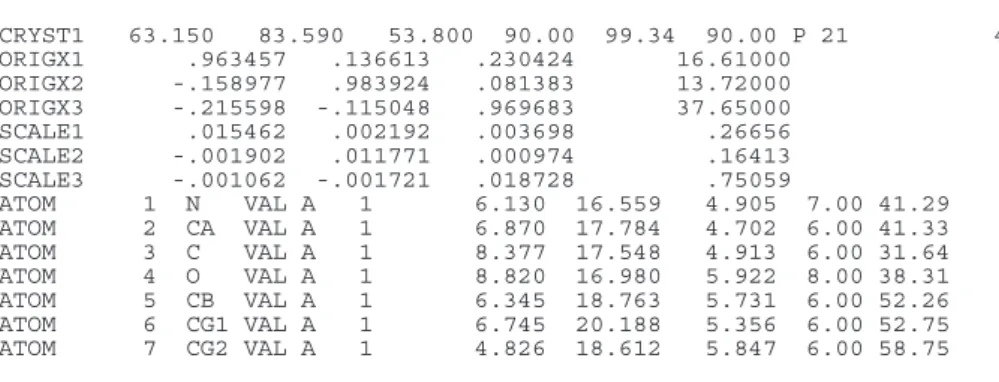
The Protein Data Bank (PDB) (Bernstein et al., 1977; Berman et al., 2000) is the single worldwide repository for macromolecular struc-ture data. For more than 30 years (Bernstein et al., 1977), the PDB has used a column-oriented data format to store archival entries. This format resembles many other data formats constrained by the limit-ations of paper punch card technology. Examples of the data format are shown in Figure 1.
The representation of coordinate, sequence, secondary structure and citation data in the PDB has remained remarkably stable since the original format definition in 1972. The data records in the PDB format are prefixed with a record tag (e.g. CRYST1, ATOM) followed by individual items of data (Figure 1a). The specifications for the records in this data format are described informally in the PDB Con-tent Guide: Atomic Coordinate Entry Format Description (Callaway
et al., 1996). The description of the experimental details of
struc-ture determination has been encoded largely in the form of remark records. Although these records have some internal structure, the organization of these records has changed over time. For example, in Figure 1b the details of refinement are presented as unstructured text,
∗To whom correspondence should be addressed.
and in Figure 1c these details are presented as semi-structured remark records.
The growing interest in database development and electronic publication in the late 1980s created a need for a more struc-tured representation of PDB data. In 1990, the International Union of Crystallography (IUCr) commissioned a working group (see http://ndbserver.rutgers.edu/mmcif/background/index.html; Fitzgerald et al., 2004) to develop macromolecular extensions to the data representation used to describe small molecule structures and crystallographic structure determination, called the Crystallographic Information File (CIF) (Hall et al., 1991). The CIF representation had been designed and deployed by the IUCr to support electronic public-ation of small molecule crystal structures. The efforts of the working group and many community experts lead to the development of the macromolecular Crystallographic Information Framework (mmCIF) dictionary. The first version of this data dictionary released in 1996 contained 1700 data definitions (Bourne et al., 1997). The con-tent of the mmCIF dictionary, a superset of PDB crystallographic content, included detailed definitions describing macromolecular structure and the current state of the macromolecular crystallographic experiment.
In 1998, the Research Collaboratory for Structure Bioinformatics (RCSB) assumed the management of the PDB. RCSB adopted the mmCIF data dictionary as the foundation of their data processing and data management infrastructure. The members of the worldwide PDB (wwPDB) (Berman et al., 2003), that includes the RCSB, the Macromolecular Structure Database (MSD) at the European Bioin-formatics Institute (EBI) and the PDBj at Osaka University, have collaborated to extend the mmCIF dictionary to include all of the data managed and distributed by the PDB. These extensions include data definitions describing internal bookkeeping, non-crystallographic structure determination methods (e.g. NMR and cryo-electron micro-scopy), greater detail in experimental crystallography and the details of protein production. These extensions are collected into the PDB Exchange data dictionary (Westbrook et al., 2004a). This data dic-tionary provides the foundation for the generation of XML schema
Fig. 1. Excerpts of records from a PDB data files. (a) Structured PDB records describing crystallographic cell constants (CRYST1), transformation matrices
between orthogonal and fractional coordinates (ORIGX and SCALE) and the atomic coordinates (ATOM). (b) Unstructured PDB records describing the details of crystallographic refinement used in PDB data files before 1996. (c) Semi-structured PDB records describing crystallographic refinement used in PDB data files after 1996.
(World Wide Web Consortium, 2001a,b,c) and XML data files described in the remainder of this article.
XML SCHEMA FOR PDB DATA, PDBML
The representation of PDB data in XML builds from the content of the PDB Exchange dictionary, both for assignment of data item names and for defining data organization. Although presented in very dif-ferent syntaxes, the PDB Exchange and XML representations use the same logical data organization. A side effect of maintaining a logical correspondence with the PDB Exchange representation is that the PDBML files lack the hierarchical structure characteristic of many XML data applications. However, preserving the logical data model of the PDB Exchange dictionary has three important advantages. First, the semantics of PDB data are completely preserved across the two formats. Second, the translation of the PDB Exchange dictionary and PDB Exchange data files to XML is greatly simplified. Third, the straightforward mapping of PDB data to relational database systems is retained.
The correspondences between the metadata attributes used in the PDB Exchange dictionary (Westbrook and Bourne, 2000; Westbrook
et al., 2004b) and those of XML schema are summarized in Table 1.
The top level of scope in the PDB Exchange dictionary or data file is the data block. The data block encloses complete data dic-tionaries or data entries. The dictionary data block is mapped to
Table 1. Summary of the correspondences between PDB Exchange data
dictionary and XML schema metadata
PDB Exchange data dictionary attributes
XML schema mapping
Data block Root level schema element Category groups
Categories complexTypes
Definition annotation and documentation elements
Examples annotation and documentation elements
Primary keys attributes of the data category
Items elements of the data category
Definition annotation and documentation elements
Examples annotation and documentation elements Data types simpleTypes
Range restrictions and allowed values
restrictions within simpleTypes or unions of simpleTypes
Mandatory data code Element attributes minOccurs and
nillable
Parent-child relationships key/keyref elements
Interdependency/exclusivity
Units of measurement Additional fixed attributes Subcategory membership
J.Westbrook et al.
Fig. 2. Examples of PDB Exchange data and PDBML data representations. (a) PDB Exchange data file example with a single category describing some of the
features of polymer molecule, (b) the corresponding example of polymer description in a PDBML data file.
the standard top-level XML schema element, and the data file data block is mapped to a datablock element. The schema and datablock elements provide namespace definitions, linkages to the supporting XML schema definition documents and linkages to the location of the current supporting schema.
Category or table definitions in the Exchange dictionary are described as XML complexTypes. The category definition and examples are mapped to XML annotation and documentation ele-ments. The data items within the category are defined as an unordered sequence of XML elements named according to the attribute portion of their dictionary equivalents. The special data items that form the primary key for the category are defined as XML attributes.
Individual data items have a definition and an optional set of examples. The item-level definition and examples are mapped to XML annotation and documentation elements. Parent–child rela-tionships between data items in the Exchange dictionary are rep-resented as XML key and keyref elements. All parent data items are identified as named XML keys, and their associated children are identified as named XML keyrefs. Primitive data types in the Exchange dictionary are described as XML simpleTypes. Allowed ranges are represented as restriction elements within simpleTypes. Complicated boundary conditions are represented as unions of
sim-pleTypes containing restriction elements. Controlled vocabularies
and allowed values are represented as simpleTypes with
restric-tions including enumeration elements. Where physical units of
measurement are included in a definition in the absence of any other
range restrictions, this information is mapped to a XML
simple-Content element containing a fixed attribute element representing the
measurement units. There are currently no mappings for the item-level dictionary attributes describing item-item-level interdependency, exclusivity or subcategory membership.
The correspondences between the PDB dictionary and XML schema metadata described in this section make the automatic translation of the PDB dictionary to XML schema possible. The current software translated XML schema file is located at http://deposit.pdb.org/pdbML/pdbx-v1.000.xsd, and on the PDB mmCIF resource page at http://deposit.pdb.org/mmcif/.
PDBML DATA FILES
The PDBML data files follow the same logical organization as their PDB Exchange data file counterparts. Figure 2 provides an abbreviated example comparing the presentation of a category describing polymer features in the two syntaxes. In Figure 2a, a single row of the entity_poly data category is illustrated within a data block named EXAMPLE. The corresponding XML represent-ation of this informrepresent-ation is shown in Figure 2b. Here the root-level enclosing XML datablock element identifies the namespace and the associated schema files. The entity_poly data category is enclosed by an XML entity_polyCategory element. Each row of the category is defined within an XML entity_poly element where the category key, entity_id, is included as an XML attribute.
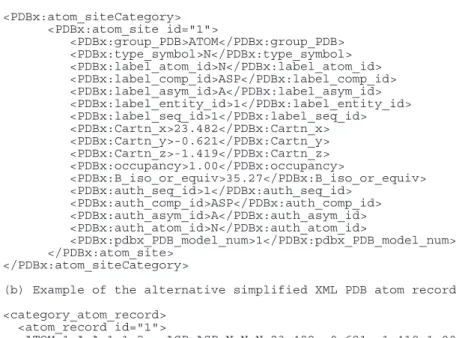
Fig. 3. Examples of PDBML atom records. (a) Example of a fully marked-up PDBML atom record. The content of this record is equivalent to the content of
the PDB Exchange data file. Empty data records are not translated to the XML data file. (b) Example of a simplified PDBML atom record. The information in this record is also the equivalent to the PDB Exchange data file; however, it is formatted as a white-space delimited string.
The remaining data items in the row are represented as XML elements.
The XML organization illustrated in Figure 2b is repeated for each data category in the data file. Because of its size the atom_site category is also represented in an alternative form. Examples of the fully marked-up atom record and the simplified alternat-ive are shown in Figure 3. The alternatalternat-ive representation of the
atom_site category in Figure 3b simplifies the fully marked-up style
in Figure 3a by presenting the data items within the atom_site category in a white-space delimited string. The current schema frag-ment describing the alternative atom_site representation is located at http://deposit.pdb.org/pdbML/pdbx-v1.000-alt.xsd.
PDBML files are stored on the PDB beta ftp site at ftp://beta.rcsb.org/pub/pdb/uniformity/data/XML. The files are updated during each weekly PDB update. These files are currently under beta test. Comments and data issues related to these files may be reported at http://pdb-forum.rutgers.edu/. Three XML data files are produced from each PDB Exchange data file. One XML file con-tains the fully marked-up translation of the PDB Exchange data file. A second XML file contains the full PDB Exchange data file con-tent omitting coordinate data. A third XML file contains only the simplified representation of the coordinate data in which each atom record is marked up as a single XML string.
SUPPORTING SOFTWARE TOOLS
The XML schema and data files described in this article are produced by software translation of the PDB Exchange dic-tionary and data files, respectively. The software tools that
RCSB has developed to automate the production of XML schema and dictionaries can be downloaded from the website http://deposit.pdb.org/mmcif/MMCIF-XML-UTIL/. The molecular graphics viewer, PDBjViewer (Kinoshita and Nakamura, in press) that PDBj has developed can parse the current PDBML files to dis-play macromolecular structures http://www.pdbj.org/PDBjViewer/. These tools are available in full source under an Open Source software license. The XML-based Protein Structure Search Ser-vice (xPSSS) is a browser with the XPath-SOAP serSer-vice, based on the PDBML files using a native XML-DB at PDBj http:// www.pdbj.org/xpsss/.
ACKNOWLEDGEMENTS
The authors thank Ms Kaori Kobayashi, Mr Hisashi Sakamoto, Ms Reiko Yamashita, Dr Daron Standley and Dr Arno Paehler at PDBj for their help to develop the schema and validation system for the PDBML. The RCSB PDB is operated by Rutgers, The State Uni-versity of New Jersey; The San Diego Supercomputer Center at the University of California, San Diego; and the Center for Advanced Research in Biotechnology of the National Institute of Standards and Technology—three members of the Research Collaboratory for Structural Bioinformatics (RCSB). The work reported in this paper has been supported by grants from the NSF, NIGMS, DOE, NLM, NCI, NCRR, NIBIB and NINDS. The MSD-EBI is supported by funds from the Wellcome Trust, the European Union (TEMBLOR, NMRQUAL, SPINE, AUTOSTRUCT, and IIMS awards), CCP4, the Biotechnology and Biological Sciences Research Council (UK), the Medical Research Council (UK), and the European Molecular
J.Westbrook et al.
Biology Laboratory. The PDBj is supported by grant-in-aid from the Institute for Bioinformatics Research and Development of the Japan Science and Technology Agency (BIRD-JST), and the Ministry of Education, Culture, Sports, Science and Technology (MEXT).
REFERENCES
Berman,H.M., Westbrook,J., Feng,Z., Gilliland,G., Bhat,T.N., Weissig, H., Shindyalov,I.N. and Bourne,P.E. (2000) The Protein Data Bank. Nucleic Acids Res.,
28, 235–242.
Berman,H.M., Henrick,K. and Nakamura,H. (2003) Announcing the worldwide Protein Data Bank. Nat. Struct. Biol., 10, 980.
Bernstein,F.C., Koetzle,T.F., Williams,G.J.B., Meyer,E.F.Jr., Brice,M.D., Rodgers,J.R., Kennard,O., Shimanouchi,T. and Tasumi,M. (1977) Protein Data Bank: a computer-based archival file for macromolecular structures. J. Mol. Biol., 112, 535–542. Bourne,P.E., Berman,H.M., Watenpaugh,K., Westbrook,J.D. and Fitzgerald,P.M.D.
(1997) The macromolecular Crystallographic Information File (mmCIF). Meth. Enzymol., 277, 571–590.
Callaway,J., Cummings,M., Deroski,B., Esposito,P., Forman,A., Langdon,P., Libe-son,M., McCarthy,J., Sikora,J., Xue,D., et al. 1996. Protein Data Bank Con-tents Guide: Atomic Coordinate Entry Format Description. Brookhaven National Laboratory.
Fitzgerald,P.M.D., Westbrook,J.D., Bourne,P.E., McMahon,B., Watenpaugh,K.D. and Berman,H.M. (2004) Classification and use of macromolecular data. In Hall,S.R.
and McMahon,B. (eds), International Tables for Crystallography vol G. Kluwer Academic Publishers, Dordrecht (in press).
Hall,S.R., Allen,A.H. and Brown,I.D. (1991) The Crystallographic Information File (CIF): a new standard archive file for crystallography. Acta Crystallogr A, 47, 655–685.
Kinoshita,K. and Nakamura,H. (2004) eF-site and PDBjViewer: database and viewer for protein functional sites. Bioinformatics, 20, 1329–1330.
Westbrook,J. and Bourne,P.E. (2000) STAR/mmCIF: an extensive ontology for macro-molecular structure and beyond. Bioinformatics, 16, 159–168.
Westbrook,J., Henrick,K., Ulrich,E.L. and Berman,H.M. (2004a) The Protein Data Bank exchange dictionary. In Hall,S.R. and McMahon,B. (eds), International Tables for Crystallography. Kluwer Academic Publishers, Dordrecht (in press).
Westbrook,J.D., Berman,H.M. and Hall,S.R. (2004b) Specification of a relational Dictionary Definition Language (DDL2). In Hall,S.R. and McMahon,B. (eds), International Tables for Crystallography. Kluwer Academic Publishers, Dordrecht (in press).
World Wide Web Consortium (2001a) In Fallside,D.C. (eds), XML Schema Part 0: Primer, W3C Recommendation. http://www.w3.org/TR/2001/REC-xmlschema-2000-20010502/.
World Wide Web Consortium (2001b) In Thompson,H.S., Beech,D., Maloney,M. and Mendelsohn,N. (eds), XML Schema Part 1: Structures W3C Recommendation. W3C. http://www.w3.org/TR/2001/REC-xmlschema-2001–20010502/.
World Wide Web Consortium (2001c) In Biron,P.V. and Malhotra,A. (eds), XML Schema Part 2: Datatypes W3C Recommendation. W3C pp. http://www.w3.org/ TR/xmlschema-2/.