Urban Learning Center Design –
prototype model developed as partof the New American Schools initiative, included as part of the federal initiative supporting comprehensive school reform
The Urban Learning Center Design was developed as part of a venture initially supported by the New American Schools Development Corporation (now called simply New American Schools). The aim was to develop "break-the-mold" comprehensive school reform designs. This particular prototype was created as a partnership among the Los Angeles Unified School District's administration, the teachers' union, and a variety of community partners. The design was one of those included in the federal legislation supporting school efforts to develop Comprehensive School Reform Initiatives.
The design encompasses a three component approach to school reform/improvement . That is, the design not only reforms curriculum/instruction and governance/management, it addresses barriers to learning by establishing a comprehensive, integrated continuum of learning supports as a third essential component. We focus here on the design for a Learning Supports (or "enabling") Component, which provides local, state, and national policy makers a framework and concrete practices for enabling students to learn and teachers to teach. By fully integrating an emphasis on addressing barriers, the Learning Supports (or enabling) Component provides a unifying framework for responding to a wide range of psychosocial factors interfering with learning and performance. Besides focusing on barriers and deficits, there is a strong emphasis on facilitating healthy development, positive behavior, and asset-building as the best way to prevent problems and as an essential adjunct to corrective interventions. In defining the component as one that both addresses barriers to learning and promotes healthy development, the framework encompasses the type of models described as full-service schools – and goes beyond them in creating an approach that is much more comprehensive. All this involves rethinking school-owned enabling activity, such as pupil services and special and compensatory education programs, how they braid with community resources, and how all this is done in ways that minimize marginalization and fragmentation and ensure that programs to address problems play out at the classroom level, schoolwide, and
Learning Supports Component
Demonstrating the
New American School's
Urban Learning Center Model
Rebuilding Community
About the Learning Support Component of
the New American School's
Urban Learning Center Model
(A Comprehensive School Reform Model)
I.
About Urban Learning Centers
II.
Excerpts from the ULC Guidebook on Learning Supports
III. Example of Mapping School Based Learning Support
Programs (from the Elizabeth Learning Center - a
demonstration site for ULC)
About Urban Learning Centers
U
rban Learning Centers is pleased to be part of the New American Schoolsdesign. The Urban Learning Centers design is a comprehensive model for the development of K-12 learning communities to meet the needs of the children of the urban neighborhoods of Los Angeles and their counterparts in urbancommunities across the United States. The Urban Learning Centers design calls for significant and substantial changes in curriculum and instruction, school management and governance, and how schools address the health and well being of student to overcome barriers to student learning.
T
he Urban Learning Centers design is organized around three essentialcomponents. Rethinking Education (Teaching and Learning) is designed to ensure that all students are taught in a community of learners usingeffective educational practices. Rebuilding Community (Learning Supports) establishes new strategies to overcome barriers to student learning by addressing the health and well being of students and their families. Restructuring Schools (Governance and Management) engages learning community members in decision-making and ensures that the learning Center can improve and evolve. Urban Learning Centers also incorporates the extensive use of advanced technology as an essential element for implementation of the design.
Operating at one site, or across a K-12 family of schools, the Urban Learning Centers design envisions the school as a safe, active hub of community life. The urban learning Centers goal is for every student to acquire fluency and
comprehension; the communication skills necessary to listen carefully, speak articulately, and write effectively, and an understanding of fundamental
mathematics concepts and their application. Every student is expected to obtain a solid understanding of the basic subjects of history, geography, science,
mathematics, and English, as well as a second language and the arts. Students are also expected to develop critical thinking and problem solving abilities,
understand and be able to use new technologies, and be prepared for success in college and the workforce.
The Urban Learning Centers design was developed by the Los Angeles Unified School District, United Teachers Los Angeles, and the Los Angeles Educational Partnership, with support from other educational, corporate, and community organizations. The Urban Learning Centers were created with funding by the New American Schools Corporations.
Table of Contents
SECTION I: WHAT IS THE LEARNING SUPPORTS
COMPONENT?
1
Learning Supports Activity Clustered Into Six Areas
3
Basic Mechanisms for Establishing
the Learning Supports Component
11
SECTION II: GETTING FROM HERE TO THERE
12
Establishing the Learning Supports Component:
Overview of Key Steps
13
MAPPING OF THE SIX PROGRAMMATIC AREAS
OF ENABLING COMPONENT AT E.L.C.
24
"What the best and wisest parent wants for (his or her) own child, that must the community want for all its children. Any other idea... is narrow and unlovely.
-John Dewey
SECTION 1: WHAT IS THE LEARNING
SUPPORTS COMPONENT?
Everyone understands the need to reduce behavioral and emotional problems, absenteeism, drug abuse, dropouts, teen pregnancy, violence, and other difficulties that interfere with learning and
performing well at school. If schools are to improve and if students are to learn and succeed, such problems must be addressed. However, most educational reforms focus primarily on the instructional and management components of schooling, without giving sufficient emphasis to students' attitudinal and motivational problems that may be unrelated to curriculum and instruction. As a result, in daily practice the limited resources available for addressing barriers to learning are uncoordinated and fragmented; this squanders valuable assets and undermines efficiency. By incorporating the Learning Supports component into school restructuring efforts, the Urban Learning Centers design offers a comprehensive model for reform which addresses this critical area.
Given the various factors that can interfere with learn-ing and performance, a school program committed to the success of all children and youth must be designed with a wide array of activities to address barriers to learning and teaching. Ideally, such efforts should be implemented as a comprehensive and integrated whole.
A guidebook is not a blueprint. Rather, it is similar to an architect's notes and sketches. Use it flexibly and in ways that respond to the unique characteristics of yoursetting and stake holders. All Urban Learning Centers will workwith an Urban Learning Centers Technical Assistance Team when beginning the implementation process. This guidebook is meant as a reference, not as a replacement for technical assistance.
Because the intent is to enable and support
learning, this facet of educational reform has been dubbed the Learning Supports component. In the Urban Learning Centers design, this component is one of the three essential cornerstones of the model (the other two are Teaching and Learning and Governance and Management). The
component's mission is to enable schools to teach and students to learn by addressing factors that interfere with learning and performance. The focus is on preventing and correcting learning, behavioral, emotional, and health problems. Through integration with the instructional component, there is a strong emphasis on the promotion of healthy development in all areas: academic, social, emotional, and physical.
Accomplishing such a mission means restructuring existing support resources and establishing collaborations with community and home resources in ways that move:
From narrowly focused activity to a comprehensive approach From fragmented to coordinated and increasingly integrated intervention
From problem-specific and specialist-oriented services to less categorical, cross-disciplinary programs
From activity that is viewed as supplementary to a full-fledged integrated component that is understood as primary and essential to enable and support learning
In this way, limited resources can be used more effectively and efficiently. The mission of the Learning Supports Component is to enable schools to teach and students to learn by addressing factors that interfere with learning and performance
Learning Supports Activity Clustered Into Six Areas
The Learning Supports component of the Urban Learning Centers design includes six areas of integrated activity that are supported by the Moving Diamond concept. This grouping of activity emerged from reviews of existing and desired services and programs (for further reading, see the Annotated Bibliography). The six areas, listed below, are described in more detail on the following pages.
• Classroom-focused Learning Supports
• Student and family assistance through direct services and referral
• Crisis assistance and prevention
• Support for transitions
• Home involvement in schooling
1 - Classroom-Focused Learning Supports
When a classroom teacher encounters difficulty working with a student, the first step is to see whether there are ways to address the problem within the classroom and/or with added home involvement. Thus, the emphasis is on enhancing
classroom-based efforts to support learning by increasing teacher effectiveness for preventing and handling problems in the classroom.1
Professional development activities that increase a teacher's array of options for dealing with a wide range of individual differences can include accommodative and compensatory strategies, peer tutoring, the use of volunteers to enhance social and academic support, resource and itinerant teachers, and counselors in the classroom. The two main aims of Class room-Focused Learning Supports are increasing teachers' abilities to effectively instruct diverse learners, including those identified as needing special education, and reducing the need for special services.
Work in the area of Classroom-Focused Learning Supports requires (See Appendix A for specific examples):
$ Professional development for teachers, aides, volunteers, and others in how to use a variety of teaching and assessment strategies to reach all students
$ Ways to expand resources in support of a variety of instructional activities
$
Programs for temporary out-of-class help to assist students who need additional instructional time to succeed2 - Student and Family Assistance Through Direct Services and Referral
Of course, some problems cannot be handled without special interventions - thus the need for student and family assistance. The emphasis is on providing special, personalized services to assist with a broad range of needs. To begin, available social, physical, and mental health programs in the school and community are used. As community outreach brings in other resources, they are integrated with existing programs. Special attention is paid to enhancing systems for triage, case and resource management, direct services to meet immediate needs, and referrals for special services, as appropriate.
An invaluable site for this activity is a school-based Family and Community Center (see p. 15 for details). The intent of such a center is to ensure that effective assistance is provided when necessary and appropriate.
Work in the area of Student and Family Assistance Through Direct Services requires:
• Information on assistance available to parents and teachers. Ideally, such information would be readily available in any database such as FASTNet. The FASTNet software and database offer schools the ability to find and access services to help children and their families.
• A programmatic approach for handling referrals (including use of strategies designed to reduce the need for special intervention) • Programs providing direct services, such as a Family and Community
Center on-site or access to community health clinics.
• Programmatic approaches for effective case and resource management such as the Client Tracking System. The Client Tracking System is a case management system that provides school staff and agency personnel with the means to continuously track and monitor the progress of client
referrals while generating reports summarizing case information. • Community outreach to recruit and assimilate additional resources into
current service delivery.
• Relevant education for all stakeholders (parents, students, teachers, administrators, staff, and community members).
3 - Crisis Assistance and Prevention
The emphasis is on preventing, responding to, and minimizing the impact of crises. A school-based Family and Community Center provides a staging area for some of this programmatic activity. Intended outcomes of crisis assistance include ensuring that immediate assistance is provided when emergencies arise and
follow-up care is provided when necessary and appropriate. The outcomes of prevention activities are reflected in the creation of a safe and productive environment for learning and the development of student and family attitudes about and capacities for dealing with violence and other threats to safety. Work in the area of Crisis Assistance and Prevention requires the
following (See Appendix A for specific examples):
• Systems and programs for crisis response at a site, at several schools in the same locale, and community-wide (including a program to ensure follow-up care)
• Prevention programs for combating suicide, school violence, and child abuse
•
Relevant education for stakeholders (Parents, students, teachers, administrators, staff, and community members)4- Support for Transitions
The emphasis here is on planning, developing, and maintaining a comprehensive focus on the variety of transitions confronting students and their families.
Common transitions include major school changes, grade level changes, exit from bilingual or sheltered English programs, transitions to or from special education, and school-to-work. Anticipated outcomes of activity in this area include reduced levels of alienation from school, increased levels of positive attitudes towards school, and increased involvement in a range of learning activities.
• Work in the area of Support for Transitions requires the following (see Appendix A for specific examples):
• Programs to establish a welcoming and socially supportive community, especially for new arrivals
• Programs to help students and their families through each new step in formal education
• Before-school, after-school, and intersession programs to enrich learning and to provide recreation in a safe environment
• Relevant education for stakeholders (parents, students, teachers, administrators, staff, and community members)
5- Home Involvement in Schooling
Home involvement in schooling focuses on enhancing parental support, by providing adult learning opportunities (English classes, computer skills, work skills, mutual support groups), mobilizing parents as problem-solvers (parenting classes, instruction in helping with schoolwork), and eliciting help from families in addressing the needs of the community. The context for some of this activity may be a Parent Center, which can be part of the Family and Community Center. Outcomes in this area include measures of parent learning, indices of student progress, and community involvement in school as a result of home engagement. Work in the area of Home Involvement in Schooling requires the following (See Appendix A for specific examples):
• Programs to address specific learning and support needs of adults in the home
• Programs to help those in the home meet their basic obligations to the student
• Systems to improve communication between school and home about matters essential to the student and family
• Programs to enhance the home-school connection and sense of community
• Interventions to enhance participation in making decisions at the Urban Learning Center that are essential to the student
• Programs to enhance home support related to the student ' s basic learning and development
• Interventions to mobilize those at home to solve problems related to student needs
• Interventions to elicit help (support, collaborations, and partnerships) from those at home with meeting classroom, school, and community needs
• Relevant education for stakeholders (parents, students, teachers, administrators, staff; and community members)
6 - Community Outreach for Involvement and Support (including Volunteers)
Reaching out to the community requires building links and collaborations,
developing greater involvement in schooling, and enhancing support for efforts to enable learning. Public and private community agencies, universities, colleges, organizations, facilities, businesses and professional organizations and groups, and volunteer service programs are all candidates for outreach. Outcomes include measures of community participation, indices of student progress, and community enhancement related to use of volunteers and use of additional community
resources.
Work in the area of Community Outreach requires the following (see Appendix A for specific examples):
• Programs to recruit community involvement and support. This can include linkages and integration with community health and social services; cadres of volunteers, mentors, and individuals with special expertise and resources; local businesses to adopt-a-school and provide resources, awards, incentives, and jobs; and formal partnership arrangements.
• Systems and programs specifically designed to train, screen, and maintain volunteers (e.g., parents, college students, senior citizens, peer and
crossage tutors, and counselors) and professionals-in-training to provide direct help for staff and students.
• Outreach programs to hard-to-involve students and their families, including those who do not come to school regularly, truants, and dropouts.
• Celebrations and cultural events to enhance community to school
connections (orientations, open houses, performances, cultural and sports events, festivals, celebrations, workshops, and fairs)
• Relevant education for stakeholders (parents, students, teachers, administrators, staff, and community members).
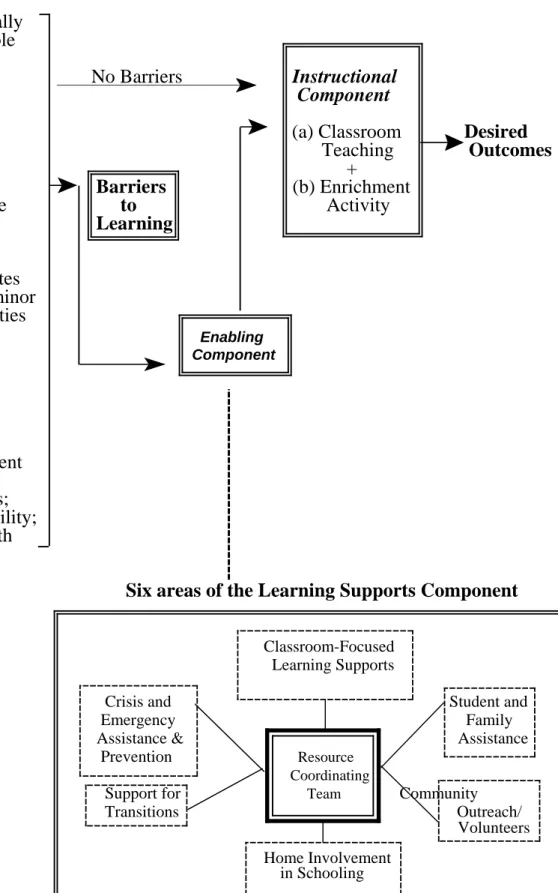
The flowchart on the following page (Figure 1) illustrates the role of Learning Supports in facilitating instruction. For the two types of learners not
motivationally ready and able for instruction, work in one or more of the areas of Learning Supports may be necessary to overcome barriers to learning. The seventh box in the Learning Supports graphic represents the Resource
Coordinating Team. The Resource Coordinating Team is a management group that ensures the proper functioning of the Learning Supports component. Its role is described in greater detail in the following pages.
Enabling Component
Figure 1: The Learning Supports Component: A Comprehensive Approach to Addressing Barriers to Learning.The component weaves six areas of learning supports activity into the fabric of the school, addressing barriers to learning and promoting healthy development for all students.
Types of Learners
(categorized by their response to academic instruction) I = Motivationally ready & able
No Barriers Instructional Component
(a) Classroom Desired
Not very Teaching Outcomes
motivated; +
lacking Barriers (b) Enrichment prerequisite to Activity II = knowledge Learning & skills;
different
learning rates & styles; minor
vulnerabilities Avoidant; very deficient in current III = capabilities; has a disability; major health problems
Six areas of the Learning Supports Component
Classroom-Focused
Learning Supports
Basic Mechanisms for Establishing the Learning Supports Component
Understanding the six key areas of Learning Supports activity and the Moving Diamond will allow a school to follow specific steps for implementing the
Learning Supports component. However, before discussing the specific steps (See Section 2), it is important to briefly describe the personnel and structural
mechanisms that will be instrumental in a successful Learning Supports program.
Learning Supports Site Administrative Lead
A school-site leader for the Learning Supports component is essential to
successful implementation. Ideally this person should be a site administrator who participates in the decision-making process for plans regarding space, time, budget, and personnel. This individual should also be responsible for ensuring the proper operation of mechanisms for coordination, resource development, and accountability within the Learning Supports component. A sample job description for the Learning Supports Site Leader is provided in Appendix B.
Resource Coordinating Team
Creation of a Resource Coordinating Team is a good starting point for
interweaving existing resources and developing program teams. This team is the type of on-site organizational mechanism needed to facilitate cohesion among the many facets of Learning Supports. Even before the Learning Supports component is implemented, the Resource Coordinating , ream can reduce fragmentation and enhance cost-efficiency by encouraging existing services and programs to function in an integrated manner.
The Resource Coordinating Team should also oversee the component's six areas. As community agencies become involved at the school, they should send
representatives to join the team. Initially, the entire group needs to meet once a week. However, as it expands, a core working group can be identified to meet weekly. The rest of the team can be informed through circulation of the team ' s working notes, and the full team can meet monthly.
Properly constituted, a Resource Coordinating Team provides on-site leadership for the Learning Supports component and ensures that activities are maintained and improved. At least one member of the team should be on the school's governing body.
SECTION II: GETTING FROM HERE TO THERE
Establishing a Learning Supports component involves the following steps:• Restructuring and expanding resources by coordinating and clustering Learning Supports activity at a school site
• Moving towards a community emphasis - integrating school, community, and home resources to the degree feasible, and enhancing access to other community programs by developing cooperative linkages
• Integrating the Learning Supports, Teaching and Learning, and Governance and Management components
• Planning and evaluating Learning Supports activity and its effectiveness on a continual basis
This section includes 13 steps related to creating readiness, starting up, phasing in, maintaining, and supporting the evolution of the Learning Supports
component. Success in implementing the component depends on staffing, the creation of a strong Resource Coordinating Team, and a functioning Family and Community Center.
Establishing the Learning Supports Component: Overview of Key Steps
Orientation to Learning Supports Creating Readiness for Change
Step 1. Disseminate information, build interest, and gain consensus.
Restructuring requires the committed involvement of a critical mass of
stakeholders. Thus, leaders often are confronted with the task of enhancing the motivational readiness for change among a significant number of reluctant or resistant community members.
Examples of key objectives at this stage include:
• Clarifying potential gains without creating unrealistic expectations
• Delineating costs - without seriously dampening expectations about benefits
• Offering incentives that mesh with the intrinsic motives of the participants
• Explaining what can be modified and what is essential and nonnegotiable
These objectives require a series of dissemination strategies (e.g., distributing written and audiovisual materials through use of the mail, media, and
communication networks). As potential participants express interest, periodic overview presentations, in-depth focus groups, and interactive question-and-answer forums can provide necessary follow-up.
Step 2. Negotiate a policy framework and conditions for engagement.
Ask the leadership group to make a policy commitment that establishes a comprehensive approach to support learning as a primary and essential
component of their work. Such a commitment means establishing a clear policy direction that treats the Learning Supports component on par with the Teaching and Learning and Governance and Management components when allocating resources such as finances, staff development, and space. It also means establishing incentives and safeguards for change.
Because the Learning Supports component is a new concept and represents a major shift in thinking about activity designed to support learning, it is essential that policy-makers explicitly commit to establishing the component. Such a commitment can be demonstrated by the adoption of a community statement agreed upon by all stakeholders. Figure 4 provides an example of the type of statement that community members might endorse.
We recognize that for some of our students, improvements in teaching and learning and governance and management are necessary but not sufficient. We are committed to enhancing activity that addresses barriers to our school 's ability to teach and barriers to student learning and performance. Thus, we will treat the Learning Supports component on a par with the Teaching and Learning and Governance and Management components. All three are essential if all students are to succeed.
Figure 4 Sample Community Statement
During the orientation phase, specific policy agreements spelling out required commitments must be negotiated and ratified by governance bodies. Questions to be answered include:
• Howwill the component be represented on governance, planning, budget, and staff development bodies?
• Who will be the administrative lead for the component? (Specify job functions and ensure adequate time for implementing them.)
• How much of the budget will be allocated? • How much space will be provided?
• Will there be a Family and Community Center? If so, how much space is allocated for adult education and parent classes? Child care?
• How will daily Learning Supports activities be staffed? • How much time and resources will be allocated for initial
strategic and ongoing planning, staff development, and technical support?
In addition, it is important to specify resources and incentives necessary to facilitate the change process (e.g. time for strategic planning and technical
Step 3. Identify a site administrative lead responsible for implementing policy commitments.
There must be leadership at the site that understands the vision and is committed to bringing it into existence. As quickly as feasible, a site administrator and one or two other leaders need to be identified to take the lead in orienting all
stakeholders at the site. The Site Administrative Lead for Learning Supports should be equivalent to the leader for the Teaching and Learning and Governance and Management components. (See Appendix B for a sample job description for the Learning Supports Administrative Lead.) A change agent (e.g. organizational facilitator) and members of a steering group can provide coaching as needed. Orientation involves a process of spiral learning. Over several months leadership must create and take advantage of opportunities to highlight, explain, explore, and generally inundate the site with the importance of Learning Supports and the benefits that will be forthcoming. Because of its complexity, the work must be carried out gradually using a variety of strategies, including written and audiovisual presentations followed with more in-depth focus groups and interactive question- and-answer forums.
The leaders of the orientation process must undertake the following tasks: • Ensure stakeholder readiness and commitment
• Overcome barriers to change
• Anticipate and address negative reactions and dynamics related to change
• Establish and maintain the necessary infrastructure, i.e., organizational and operational mechanisms
• Develop effective working relationships
• Enhance intrinsic motivation for maintaining and evolving newly acquired ideas and processes
Starting Up and Phasing In: Building An Infrastructure
If anything is certain about efforts to replicate a prototype, it is that the process is stressful. Some stress arises from the nature of the prototype; some is inherent in the process of organizational change. Coalitions must be developed, new working relationships established, disruptive rumors countered, and interpersonal conflicts resolved. Two key facets of dealing with this are phasing in changes and adding temporary infrastructure mechanisms.
Amajor goal, of course, is establishing local ownership built upon a foundation of solid policy commitments, well-designed infrastructure, and allocation of
adequate financial, personnel, space, and equipment resources. It may also be necessary to restructure the school day and year to ensure sufficient time for staff involvement in fitting the prototype to the school setting. Local ownership must be manifested in the daily practice of administrators and lead personnel. One example of such ownership would be to make the Learning Supports component a regular agenda item at weekly administrative meetings.
Step 4. Establish a Steering Group and other temporary infrastructure mechanisms and provide members with leadership training
Once there is consensus to proceed, an initial core of personnel should be identified at the site to form a Learning Supports Steering Croup. This working group plans, guides, and supports component development and ongoing daily functioning. It includes the site's administrative lead for Learning Supports and other leaders such as a lead staff member for the site's Family and Community Center, professionals who provide health and social services, resource and special education staff, and interested parents. Initial steps should include designating this leadership core and conducting a series of leadership training sessions with them to prepare for implementation.
Initial leadership training covers the substance of the Learning Supports
component and the process by which it can be developed at the site. In the months following the initial sessions, foundation and capacity building sessions will provide ongoing instruction, guidance, and support from change facilitators, mentors, and technical assistance providers.
In establishing a
leadership core, there is the potential for the initial leadership designees to experience a sense of elitism, and for those not included to react
negatively. To counter this, extensive invitations should be extended to all stakeholders who are interested and willing to commit the time and energy involved in playing a leadership role.
In addition to a site-based steering mechanism to oversee, guide, and support the establishment of the Learning Supports component, several other temporary mechanisms can be added to the institution's infrastructure to facilitate the development of the prototype. These include mentors to model and teach elements of the prototype and a change agent working with the designated change team to facilitate coalition building, problem-solving, and conflict resolution. Although the mechanisms are temporary, many of their functions are not. At the completion of the start up phase, these functions will be assimilated into the ongoing infrastructure.
Step 5.Formulate site-specific start up and phase in plans.
During the phase in stage, the prototype must be adapted to fit specific contexts at the adoption sites. The Steering Group working with other planning groups at the site can formulate start up and phase in plans for the Learning Supports component. Planning for start up and phase in includes:
•
Developing a sequence for introducing the various elements of the Learning Supports component for integration with plans for phase in of reforms related to instruction and management•
Outlining strategies to facilitate implementation•
Clarifying changes to be made in the site's infrastructure to facilitate initiation and systematic development of the componentStep 6. Establish and train a site-based Resource Coordinating Team and begin mapping and analyzing existing resources.
Creation of a Resource Coordinating Team provides a good starting place for weaving together existing school and community resources and developing school-based program teams. A Resource Coordinating Team is the type of on-site organizational mechanism needed to initiate and work toward cohesion of the many facets of the Learning Supports component. As the component takes form, the team helps reduce fragmentation and enhances cost-efficiency by encouraging existing services and programs to function in an increasingly integrated way.
A Resource Coordinating Team can be established by the Steering Group. The Urban Learning Centers Technical Assistance Team will provide guidance during the initial formation of a Resource Coordinating Team as well as aiding in
analyzing existing school resources. Initially, the team will include Steering Group members (specifically the Site Administrative Lead for the Learning Supports component and the Family and Community Center Lead, if one has been hired) I as well as representatives from any other major Learning Supports
activities that support a school's instructional efforts (e.g., school psychologist, counselor, nurse, social worker, dropout prevention coordinator, Title I
coordinator, and on-site representatives of community agencies). Over time, the Resource Coordinating Team should form teams for the component ' s six clusters of activity. Representatives from each team should join the Coordinating Team. At least one member of the Coordinating Team should be on the school's governing body. And, as community agencies become involved at the school, they should send representatives to become part of the team.
At times, the entire membership of the Coordinating Team needs to meet. However, as the team grows, it can identify a core working group to meet regularly. The rest of the team can be informed through established communication procedures, and the full group can meet once a month.
Properly constituted, trained, and supported, the Resource Coordinating Team complements the work of the Steering Group in providing on-site overview, leadership, and advocacy for the Learning Supports Component and ensures Learning Supports activity is maintained and improved.
Step 7. Organize areas of activity and establish a cross-disciplinary infrastructure.
The Resource Coordinating Team can begin the process of organizing activities in the six areas of Learning Supports activity described in the Introduction. Usually some mapping and analysis in the six areas is already underway. As soon as possible, team members should facilitate the development and training of core program teams to cover each area.
Each team ensures that programmatic activity is well-planned and carefully implemented. To do this, it helps to develop a plan with measurable objectives, a timeline for completion, and a list of the people responsible for each task. This plan should be approved by the governance council and shared with all
stakeholders. A specific school based mechanism must exist for each area so it can be pursued in daily practice and maintained over time. We think in terms of site-based program teams (not committees). These are analogous to a team of teachers. And as with teaching teams, these Learning Supports team members must interact regularly on an ad-hoc basis (i.e. a short discussion here and there) rather than waiting for formal meeting times that can only be arranged on a weekly or even less frequent basis.
As such teams take shape, a representative from each becomes part of the Resource Coordinating Team. Many schools, of course, are unable to simultaneously establish teams to cover all six areas and can phase them in slowly.
A basic problem in forming teams is identifying and deploying committed and able personnel. To begin with, one or two stakeholders who have a concern for a specific area can take the lead. Others can be recruited over time as necessary. In some cases, one team can address more than one area. For school families, cross-school teams might oversee an area for all schools. Inevitably, a major thrust in an area will require a critical mass of stakeholders.
Step 8. Enhance component visibility, communication, sharing, and problem-solving.
As with all new concepts, the Learning Supports component requires extensive explanation and frequent clarification. There should be high visibility sharing through use of a variety of internal and external communication and public relations mechanisms such as the following:
• Regular involvement in stakeholder development activity • Public display of posters and charts
• Newsletters and bulletins sharing the accomplishments of personnel and announcing upcoming events
• A bulletin board devoted to announcements and displays for Learning Supports activities
• A "concerns box" for anonymous complaints and suggestions
• One or more ombudspersons who possess mediation and problem solving skills, the respect of stakeholders, and the authority to take appropriate action
• One or more leaders who hold weekly office hours to meet with stakeholders
Step 9. Attempt to fill gaps in services by establishing formal
collaborative linkages with district and community resources.
At the site and in the local community, there may be others who can contribute to the Learning Supports component. It is important to reach out regularly to others at the site, in the school district, and in the community. The school district, community agencies, professionals and nonprofessional volunteers, businesses, and families all may be able to provide needed resources.
Step 10. Establish a system for quality improvement.
Quality improvement is an ongoing process. In the early stages of program development, formative evaluation should be the primary focus. Such evaluation can provide information about how to improve the planning processes,
participation, governance structures, resources, program organization, and operational policies and practices related to the Learning Supports component. Some ways to review quality improvement activities include:
• Checking on the functioning of program teams
• Holding meetings with school-site leadership and team leaders to ensure adequacy of resources and staff development
• Checking on efficacy of referral, triage, and case management systems
• Checking on the effectiveness of mechanisms for daily coordination, communication, and problem-solving
Maintenance and Evolution: Refining Infrastructure, Increasing Efficacy, and Fostering Creative Renewal
Step 11. Develop strategies for maintenance and progress.
There are always forces at work to erode a program I a success and progress. These might include turnover in the membership of planning and coordination teams, problems related to communication and sharing resources, and competing interests. Ultimately, efforts to maintain progress must succeed in stimulating adequate levels of continuing motivation on the part of a critical mass of stakeholders.
Step 12. Plan for maintenance.
The Learning Supports component must continue to have a reasonable share of the site's budget, staff, space, time, and resources. It is important that there continue to be advocates for this component on the site's planning and decision-making bodies dealing with governance, program planning and budgeting, facilities, and staff development.
Step 13. Generate renewal.
The need to focus on and generate renewal begins as soon as the first flush of newness wears off, and the constant demands of the job take their toll. While generating renewal is everyone's concern, the lead personnel have a special
responsibility. They must develop motivational strategies that help stakeholders to feel valued, experience a sense of community, have sufficient time and resources, stay in touch with the original mission and vision, and expect that their efforts will lead to positive outcomes for themselves and the students.
Mapping of the Six
Programmatic Areas of the Enabling
Component at E.L.C.
The Six Programmatic Areas of Enabling
Student and
Classroom
Family Assistance
Support for
Focused
Use of direct services, referral andTransitions
Programs to enhance Care management for students and Programs to welcome and support new Classroom based effort to Families in need of special assistance Students and families before and after
Address barriers to learning
school activity, support for grade to grade moves
Resource Coordinating Team
:
Administrators, Teachers, School Counselors, Nurse and Psychologist, RSP Teachers, Enabling Lead, CSUDH MFCC
Supervisors and Interns, Visiting Nurses and Family Health Center Nurse.
Community
Crisis Prevention
Outreach
Classroom-Focused
Enabling
Programs to enhance
Classroom-based efforts to
Address barriers and thus
Enable learning.
Current Programs
$ Stakeholder Development
$ Moving Diamond Mentor Program
$ Impact Educational program for prevention of drug and alcohol abuse
$ SANE
$ Tutoring in class and after school
$ Student Counselors from local colleges and universities
$ College Students from CSUDH
$ High School JTPA workers assigned to work in rooms up to 20 per quarter
$ High School Student Study Team
$ Support from resource personal for teachers directly to students and teachers
$ Accelerated Reading Program
$ Practitioner/Peer Coaching from teacher to teacher
$ Small Team Teacher Study Groups
$ Teacher Selected Professional Development
$ Teacher Clusters
$ Student Incentive or Recognition Program
$ Two LEARN davs for Class. Foc.Enab
Current Team
Mary View-Schneider Point Person
Other members from the Enabling Learning Committee
Expansion of and/or Desired New
Program
$ Additional tutoring programs
$ Ongoing recruitment of college, high school students and parents to volunteer during class time to work one on one or small group with students because this program really works
$ Recruit more adult mentors
$ Additional Peer Coaching Models
$ Curriculum Coordinator with an emphasis on early literacy acquisition
$ Campus wide value and/or conflict training during class time to foster social responsibility i.e TRIBES/Second Step
$ Increase Student Incentive Program
$ Increase programs that involve parents and teachers as partners
Support for
Transitions
Programs to welcome and
Support new students and
Families, before and after
School activity support for
Grade to grade moves
Current Programs
$ After School Clubs
$ Health and information Technology Academies provide internships and Mentors to High School Students
$ Student Agendas/Organizers paid for out to Enabling funds to assist students transitioning from elementary to middle school and from middle school to high school
$ Welcoming Club – one of the Family Center staff members coordinates this program. The program establishes a parent volunteer in the main office to greet new parents and assist in paperwork
$ Peer Buddy Program, students are trained to welcome new students to school
$ Service Learning Program
$ JTPA Federally Funded program that provides students with pay for on site jobs coordinated by Family Center
$ College Fairs
$ Health Watch Program, high school students are
Expansion of and/or Desired New
Progams
• Career Day
• College Center on Campus we are looking at funding this in conjunction with the Adult School, Head Start and Kellogg Foundation
Current Team
Point Persons- L.Kramer and E. Alvarez Members are part of the Enabling Committee
Home
Involvement in
Schooling
Programs to provide
those in the home with
opportunities to learn
and to help
Current Programs
•
Adult Education
English as a Second Language Parenting Classes
Spanish Literacy Citizenship Classes Small Business Classes Aerobics/Sewing
$ SRLDP parent Participation and Parent Classes
$ Comrades, Parent Advocate Training
$ Parent membership and leadership on Site
Management, School and District Level Title One and Bilingual Councils
$ Parent led classes
$ Parent classes on ways to help their child from Title One program
$ Parent child care training
$ Parent Volunteers
$ Back to School Night Participation
$ Open House Participation
$ Student Conference Attendance
$ Participation of parent volunteers in school beautification program
$ Parent volunteers on campus
$ Meetings will be held to inform parents of new district student standards
Current Team
Coral Valentine and Karma Aguilar* Point Persons
Other member form the Enabling Learning Committee • Parent
Desired New Programs
$ Parents volunteer about 500 hours per month but we would like to increase this
$ Increase parent participation especially in older student conferences, Back to School Night and Open House
Crisis/
Emergency
Assistance &
Prevention
Immediate emergency response
and follow up care as well as
programs to prevent crisis.
Current Programs
• School Crisis Team and Plan • District Crisis Team• Suicide Prevention Program LAUSD • Linkages to local churches
CSUDH Counseling Interns (supervision paid for out of Kellogg Grant)
FASTNET Electronic Service Data' Matching System • Consultation and Case Review Panel (members
include school site personnel, nurse practitioner from Health Clinic and MFCC supervisor)
• Student Study Team
• School Counselors provide individual and group counseling to students
• IMPACT Program
• Conflict Resolution (peer mediation) • EEC Family Health Clinic
ELC Family Center (staff provides immediate support to students and family in crisis)
• Parents trained as Community Advocates
Expansion of and/or
Desired New Programs
• Adult Support Groups
• Additional Counseling Groups for High Risk Teens and Parents
(we are working with the City of Cudahy and a service provider to bring these programs on site) • Recruitment of more MFCC Interns
• Create an Emergency Fund
• Expanding and updating current crisis team • More parent education around crisis issues
Current Team
Student &
Family
Assistance
Use of direct services,
referral and care
management for students
and families in need of
special assistance.
Current Programs
• Early Literacy small group tutoring program • ESL transitional readers tutoring program • CSUDH Counseling Interns (supervision paid for
out of Kellogg Grant)
• FASTNET Electronic Service Data, . Matching System
• Consultation and Case Review Panel (members include school site personnel, nurse
practitioner from Health Clinic and MFCC Supervisor)
• Student Study Team
• School Counselors provide individual and group counseling to students
• IMPACT Program
• Conflict Resolution (peer mediation) • ELC Family Health Clinic
• ELC Family Center (staff provides immediate support to students and family in crisis) • Parents trained as Community Advocates • Moving Diamond Mentor Program • Bell Cluster Resource Team
• Bell Cluster Teen Pregnancy Prevention Grant • Bell Cluster Wellness Grant
• Parenting Classes provided by Adult School • PSA Counselor (student attendance counselor)
Expansion of and/or
Desired New Programs
• Adult Support Groups
• Additional Counseling Groups for High Risk Teens and Parents
(we are working with the City of Cudahy and
a service provider to bring these programs on
site)
• Recruitment of more MFCC Interns
Current Team
Point Persons - C. Melvin & G. Burbank Members are part of the Enabling Committee
Community
Outreach
Volunteers
Programs to develop greater
community involvement in
schooling and support for
effort to enable learning
Current Programs
$ Volunteer Program/ Coordinator Parent volunteers provide about 1000 hours per month to ESL
$ Classes for Volunteers provide by LAUSD
$ Parent Outreach Workers
$ Health Watch Program in partnership with St. Francis Medical Center Health Academy Students do community outreach to provide health information through newsletters and Health Fairs
$ Family Center- Provides direct services to families or refers out to partners or other agencies
$ Comadres Training parents trained to be advocates for other parents
$ Leadership Training proved by Bilingual and Title 1 programs
$ Classes provided by Title 1 to support education in the home
$ Adult Education: English as A Second Language, Parenting Classes, Citizenship Classes, Basic
Current Team
Norma Contreras and Emilio Vasquez Point Persons Other members form the Enabling Learning Committee
Expansion and/or Addition of
New Programs
$ Family Literacy Program*
$ Head Start Day Program*
$ Classes for parents by age level of children to provide them with information about their children’s educational program
$ More teacher led parent workshops
$ Student/parent conferences
$ Booster Club
NW
Regional Educational Laboratory
Please help us improve this resource by filling out a short survey.
Urban Learning Centers (PreK - 12)
Accepted for Inclusion 2/1/1998 Re-accepted 11/1/2001
Description Updated 1/1/2004
Type of Model entire-school
Founder Los Angeles Unified School District; United Teachers Los Angeles; Los
Angeles Educational Partnership
Current Service Provider National center based at the Los Angeles Educational Partnership
Year Established 1992
# of Schools Served (9/1/2001) 31
Level PreK - 12
Primary Goal to build learning environments where high-quality instruction is supported by a well organized school that is strongly connected to its community
Main Features • thematic, interdisciplinary curriculum
• transitions from school to work and postsecondary education • integrated health and human services on school site
• collaborative governance model
Impact on Instruction program works with staff to develop curriculum and instructional approaches Impact on Organization/Staffing structural changes (e.g., heterogeneously grouped classrooms, team teaching);
shared decision making with school community
Impact on Schedule school is likely to be open for longer hours and throughout summer; block scheduling is an option
Subject-Area Programs Provided by Developer
no
Parental Involvement parental involvement in governance; school/home partnerships; adult programs on K-12 campus
Technology technology supports all elements of the design; cost varies
Materials no information available
N C C S R
The National Clearinghouse for Comprehensive School Reform
The
Catalog
Origin/Scope
The Urban Learning Centers design (originally called Los Angeles Learning Centers) emerged in 1992 when it was chosen as one of the New American Schools Design Teams. It was a joint effort of the Los Angeles Unified School District, the United Teachers Los Angeles, and the Los Angeles Educational Partnership. Initially the design was implemented in two schools in Los Angeles. As of September 2001, it had been implemented schoolwide in 31 schools. Another 13 schools had implemented components of the model.
General Approach
The Urban Learning Centers model is a comprehensive design for urban schools that calls for their reinvention into preK-12 “articulated communities,” or systems for collaboration between all grade levels and schools (if K-12 is not contained on one campus). The design grows out of the work of experienced teachers and other educators, parents, community members, curriculum developers, technology
specialists, and managerial consultants.
Each learning center comprises three essential strands:
• Teaching and Learning: The Urban Learning Centers model seeks to make education for each student as flexible and meaningful as possible within a framework of high standards for all. The model helps teachers develop a thematic, interdisciplinary curriculum that is integrated with state standards. Students learn by exploring issues of importance to them, often through projects rooted in the local community. The model promotes the use of various structures that help teachers know each student well: (a) division of students into smaller groups such as career academies, (b) block scheduling, (c) teacher teaming, and (d) multi-age and multi-year assignment of students.
• Learning Supports: To expand learning opportunities, the Urban Learning Centers model facilitates collaboration with local libraries, museums, performing arts organizations, businesses, and other community organizations. To address the physical and emotional problems that can interfere with student learning, the model helps schools build partnerships with appropriate social and community services. Each school has a family center, a health clinic, a parent volunteer program, and an array of parent education classes. High school students have the opportunity to serve internships in the local public and private sector. The ultimate goal is to develop a sense of community within and around the school.
• Governance and Management: Urban Learning Centers schools combine collaborative management practices with the principles of participatory democracy. All members of the learning community — students, parents, other adults, and educators — are invited to take part in the decision-making and budget discussions of their school. Together, they reach agreements on basic beliefs, values, and desired outcomes.
Urban Learning Centers schools use technology to support all elements of the design. Within the instructional program, students and staff use technology as a tool to obtain, construct, and communicate knowledge. Administrative uses include communications, programmatic budgeting, and assessment of
Results
Note: The research summarized in this model description includes only research that was submitted with the model developer's most recent application (indicated by the acceptance or reacceptance date in the upper left-hand corner of the description). More recent research on the model may exist. You may wish to search the National Clearinghouse for Comprehensive School Reform's literature database at
http://www.goodschools.gwu.edu/csrl/ld.htm.
Data from multiple Urban Learning Centers schools in California show positive trends over the past two years on the state’s Academic Performance Index (API). An API score is calculated for each school based on student performance on the Stanford 9 (administered in grades 2 through 11 in reading, writing, mathematics, and other subjects). Scores range from 200 to 1,000. Of the nine California sites for which 1999 and 2000 data were provided, eight improved their scores (Johnson & Pruitt, 2001). Average improvement across the eight schools was 43 points. Seven of the eight schools either maintained or improved their Similar Schools Rank (SSR). (The SSR compares schools to those with similar
demographic characteristics. A rank of 1 is lowest, 10 highest.) Elizabeth Learning Center, a large K-12 school in the Los Angeles area and an Urban Learning Centers demonstration site, improved its SSR rank from 2 to 7.
At eight schools in California (including six of the above), independent researchers compared changes in test scores from 1998 to 2000 with changes at a set of demographically matched schools (Guiton & Keinze, 2001). The researchers found that (a) the Urban Learning Centers schools improved achievement at a meaningful level (defined as an effect size of 0.1 or greater) in grades 2, 3, 4, 7, and 8 in reading and language arts, and in grades 2, 3, 4, and 8 in mathematics. Achievement at these schools reached this level of improvement more often than at the matched schools. The researchers also examined changes in third-and fifth-grade Stanford 9 test scores from 1999 to 2000 at 12 Urban Learning Centers elementary schools in Utah. The difference in mean third grade z-scores was 0.33 in reading and 0.25 in mathematics (which can be interpreted as meaningful improvements). Fifth grade scores improved at a lower level.
Implementation Assistance
• Project Capacity: The national Urban Learning Centers headquarters is based at the Los Angeles Educational Partnership. Seven full-time educators are on staff there, including two field
directors, in addition to some 25 part-time consultants. A satellite office has opened in Utah, with a full-time field director and 6 part-time consultants.
• Faculty Buy-In: The Urban Learning Centers model requires the support of school leadership, consensus of the school community, a signed memo of understanding, and the allocation of 1.5 FTE (full-time equivalent) for staff to coordinate implementation.
• Initial Training: Training is customized at each school based on the school’s needs and the resources available. Generally, selected school and district staff, parents, and other stakeholders attend a three- to four-day institute in Los Angeles prior to implementation, where they tour model sites, assess and prioritize needs, and begin to develop an improvement plan.
• Follow-Up Coaching: During the first two years of implementation, Urban Learning Centers field directors and consultants may provide up to 80 person-days of on- and off-site training. Training focuses on the three model strands (teaching and learning, learning supports, and governance and management) as well as on self-assessment and collaboration with other schools. During the second year, teachers generally receive training in the use of computer technology to enhance instruction and analyze data. Urban Learning Centers staff also help schools coordinate subject-area training from other organizations as necessary.
• Networking: Urban Learning Centers has a 1-800 hotline and e-mail for technical support, a resource library of materials on best practices and standards that match the design, and a Web site for supporting information.
• Implementation Review: Urban Learning Centers staff work with each school annually to analyze progress in student achievement and implementation.
Costs
The cost of the Urban Learning Centers design depends upon the size of the school; the number of students, faculty, and tracks; and the school’s specific needs. Based on these variables, Urban Learning Centers contracts range from $25,000 to over $140,000 for the first two years of support. Following is the standard full implementation package offered to large schools (1,000 or more students):
Service Cost
Self Assessment and Strategic Planning $12,000
Field Director $12,000
Teaching and Learning $22,000 Governance and Management $22,000
Learning Supports $22,000
Full Implementation at a Large Single Site $90,000
Schools must allocate 1.5 FTE for staff to coordinate implementation. Schools may also have to cover expenses for selected staff to attend a three- to four-day institute in Los Angeles.
Schools may reduce costs and/or increase the days of service by participating in joint training with neighboring or feeder schools. Schools also may choose to focus initially on selected areas of implementation, such as Self Assessment.
Finally, schools may contract for a basic package of post-implementation services for $2,500. The package entitles schools to membership in the Urban Learning Centers network, which includes a
newsletter; five registrations for the annual institute; technical assistance via phone, e-mail, and Web site; and continued analysis of the school’s achievement data and implementation status. Schools may continue to contract for on-site technical assistance at the daily rate of $1,000 plus expenses.
State Standards and Accountability
Urban Learning Centers helps schools align their current curriculum to the standards of their state and/or district. Through a curriculum mapping process, the school investigates its curricula and instructional strategies to ensure that they match the standards. State and district assessments as well as school-created
Selected Evaluations
Developer/Implementer
Johnson, J., & Pruitt, G. (2001). [Urban Learning Centers: School profiles and data reports 1994-2000]. Unpublished raw data.
Guiton, G., & Keinze, M. (2001). Report of a one-year study into Urban Learning Centers scale-up efforts in twenty schools. Unpublished manuscript.
Independent Researchers
Aschbacher, P., & Rector, J. (1996). Los Angeles Learning Centers evaluation report: July 1994 to June 1995. Los Angeles, CA: Center for the Study of Evaluation.
Sample Sites
School/Contact Size Locale
Race/Ethnicity Free Lunch ELL Stud. with Dis. Afr. Amer. Am. Indian Asian
Amer. Hisp. White Foshay Learning Center (K-12)
3751 South Harvard Boulevard Los Angeles, CA 90018 323-735-0241
Contact: Howard Lappin
3426 large
city 30% 0% 0% 70% 0% 90% 33% 9%
Laurel Elementary (K-5) 1321 West Laurel Street Compton, CA 90220 310-898-6440
Contact: Steven Schatz
379 urban fringe of large city 15% 0% 0% 85% 0% 89% 80% 4%
Westwood Middle School (6-8) 500 Apollo Street
Danville, VA 24540 804-797-8860
Contact: Laurell Malone
598
mid-size city67% 0% 0% 0% 33% 53% 1% 16%
Pleasant Green Elementary (K-5) 8201 West 2700 South
Magna, UT 84044 801-250-8635
Contact: Judith Kissell
770 urban fringe of mid-size city 1% 2% 3% 13% 81% 41% 9% 3%
Figures for school size, locale, race/ethnicity, and free lunch eligibility are taken from the National Center for Education Statistics electronic database (1997-98 figures). Figures for English language learners and students with disabilities were obtained from each school for the 1999-2000 school year. M = Missing Data
For more information, contact
Rita Flynn, Director Urban Learning Centers
315 West 9th Street, Suite 1110 Los Angeles, CA 90015 Phone: 213-622-5237, ext. 274 Fax: 213-629-5288
E-mail: [email protected]
Web site: http://www.urbanlearning.org
Northwest Regional Educational Laboratory 101 SW Main, Suite 500 Portland, OR 97204-3297 Telephone: 503-275-9500
National Clearinghouse for Comprehensive School Reform 2121 K Street, NW, Suite 250 Washington, C 20037-1801 Telephone: 877-766-4277
© 1998-2003 Northwest Regional Educational Laboratory & National Clearinghouse for Comprehensive School Reform