INTERREG V-A COOPERATION PROGRAMME
HUNGARY-CROATIA
For the period of 2014-2020
Approved by the European Commission on 7 September 2015
Compiled by the Consortium of
H-1082 Budapest, Üllői út 66/a, level 2, door nr. 2.
tel: +36-1-210-0827 fax: +36-1-210-0827 www.vitalpro.hu H-1054 Budapest, Vértanúk tere 1. tel: +36-1-319-1790 fax: +36-1-319-1381 www.hbhe.eu HR-10000 Zagreb, Bednjanska 8a tel: +385-1-4572-769 fax: +385-1-4572-769 www.razbor.hr
This version has been elaborated in line with the Commission Implementing Regulation (EU) No 288/2014 of 25 February 2014 laying down rules pursuant to Regulation (EU) No 1303/2013 of the European Parliament and of the Council laying down common provisions on the European Regional Development Fund, the European Social Fund, the Cohesion Fund, the European Agricultural Fund for Rural Development and the European Maritime and Fisheries Fund and laying down general provisions on the European Regional Development Fund, the European Social Fund, the Cohesion Fund and the European Maritime and Fisheries Fund with regard to the model for operational programmes under the Investment for growth and jobs goal and pursuant to Regulation (EU) No 1299/2013 of the European Parliament and of the Council on specific provisions for the support from the European Regional Development Fund to the European territorial cooperation goal with regard to the model for cooperation programmes under the European Territorial Cooperation goal.
CCI 2014TC16RFCB008
Title (Interreg V-A) HU-HR - Hungary-Croatia
Version 1.4
First year 2014
Last year 2020
Eligible from 1 January 2014
Eligible until 31 December 2023
EC decision number C(2015)6228
EC decision date 7 September 2015
MS amending decision number
-
MS amending decision date -
MS amending decision entry into force date
-
NUTS regions covered by the cooperation programme
EU Member States
Hungary NUTS III regions: HU 223 Zala County HU 231 Baranya County HU 232 Somogy County Croatia NUTS III regions:
HR 044 Varaždinska County HR 045 Koprivničko-križevačka County HR 046 Međimurska County HR 047 Bjelovarsko-bilogorska County HR 048 Virovitičko-podravska County HR 049 Požeško-slavonska County HR 04B Osječko-baranjska County HR 04C Vukovarsko-srijemska County
INDEX
SECTION 1.Strategy for the cooperation programme's contribution to the Union Strategy for smart, sustainable and inclusive growth and the achievement of
economic, social and territorial cohesion ... 6
1.1. Strategy for the cooperation programme's contribution to the Union strategy for smart, sustainable and inclusive growth and to the achievement of economic, social and territorial cohesion ... 6
1.1.1. Description of the cooperation programme’s strategy for contributing to the delivery of contribution to the Union strategy for smart, sustainable and inclusive growth and to the achievement of economic, social and territorial cohesion ... 6
1.1.2. Justification for the choice of thematic objectives and corresponding investment priorities ... 26
1.2. Justification for the financial allocation ... 29
SECTION 2.Priority Axes ... 33
2.1. Priority Axis 1 - Enhancing the Competitiveness of SMEs (TO3) ... 33
2.1.1. Specific objectives corresponding to the investment priority and expected results ... 33
2.1.2. Actions to be supported under the investment priority 3c ... 35
2.1.3. Performance framework ... 38
2.1.4. Categories of intervention by priority axis ... 39
2.1.5. Summary of the planned use of technical assistance ... 40
2.2. Priority Axis 2 – Sustainable Use of Natural and Cultural Assets ... 40
2.2.1. Specific objective corresponding to the investment priority and expected results ... 40
2.2.2. Actions to be supported under the investment priority 6c ... 42
2.2.3. Specific objective corresponding to the investment priority and expected results ... 47
2.2.4. Actions to be supported under the investment priority 6d ... 48
2.2.5. Performance framework by priority axis ... 50
2.2.6. Categories of intervention by priority axis ... 51
2.2.7. Summary of the planned use of technical assistance ... 52
2.3. Priority Axis 3 – Cooperation: Enhancing Institutional Capacity and an Efficient Public Administration (TO11) ... 52
2.3.1. Specific objective corresponding to the investment priority and expected
results)... 52
2.3.2. Actions to be supported under the investment priority ... 54
2.3.3. Performance framework ... 57
2.3.4. Categories of intervention by priority axis ... 57
2.3.5. Summary of the planned use of technical assistance ... 58
2.4. Priority Axis 4 – Education: Investing in Education, Training, including Vocational Training for Skills and Lifelong learning by Developing Education and Training Infrastructure (TO10) ... 58
2.4.1. Specific objectives corresponding to the investment priority and expected results ... 59
2.4.2. Actions to be supported under the investment priority ... 60
2.4.3. Performance framework ... 63
2.4.4. Categories of intervention by priority axis ... 63
2.4.5. Summary of the planned use of technical assistance ... 64
2.5. Priority Axis 5 – Technical Assistance ... 64
2.5.1. Priority axis ... 65
2.5.2. Fund and calculation basis for Union support ... 65
2.5.3. Specific objectives and expected results ... 65
2.5.4. Result indicators ... 66
2.5.5. Description of Actions to be supported and their expected contribution to the specific objectives ... 66
2.5.6. Categories of intervention ... 70
SECTION 3.The financing plan of the cooperation programme without any Division by participating member States ... 71
3.1. A table specifying for each year, in accordance with Articles 53, 110, and 111 of the CPR, the amount of the total financial appropriation envisaged for the support from the ERDF (EUR) ... 71
3.2. Financial plan of the cooperation programme specifying, for the whole programming period, for the cooperation programme and for each priority axis, the amount of the total financial appropriation of the support from the ERDF and the national co-financing (EUR) (Table 18) (Article 7 (2)(f) (ii) CPR) ... 71
3.3. Breakdown of the financial plan of the operational programme by priority axis, and thematic objective (Table 19) - Article 7 (2) (f) (ii) CPR ... 72
4.1. Where appropriate the approach to the use of community led local development instruments and the principles for identifying the areas where
it will be implemented ... 74
4.2. Where appropriate, the arrangements for sustainable urban development -Article 7 (2) (c) (iii) ETC Regulation ... 74
4.3. Where appropriate, the approach to the use of Integrated Territorial Investment (ITI) (as defined in Article 99 of the Common Provisions Regulation) other than urban development and their indicative financial allocation from each priority axis. ... 74
4.4. Where Member States and regions participate in macro regional and sea basin strategies, the contribution of planned interventions towards such strategies, subject to the needs of the programme area as identified by the relevant Member States and taking into account, where applicable, strategically important projects identified in the respective strategies. ... 74
SECTION 5.Implementing Provision for the Cooperation Programme... 78
5.1. Relevant authorities and bodies ... 78
5.2. Procedure for setting up the joint secretariat ... 79
5.3. Summary description of the management and control arrangements ... 80
5.4. Apportionment of liabilities among participating Member States in case of financial corrections imposed by the managing authority or the Commission . 90 5.5. Use of the Euro (where applicable) ... 91
5.6. Involvement of partners ... 92
SECTION 6.Coordination ... 96
SECTION 7.Reduction of the Administrative Burden for Beneficiaries ... 101
SECTION 8.Horizontal Principles ... 103
8.1. Sustainable development ... 103
8.2. Equal opportunities and non-discrimination ... 103
8.3. Equality between men and women... 106
SECTION 9.Separate Elements – presented as Annexes in printed document version... 107
9.1. A list of major projects for which the implementation is planned during the programming period (Article 87 (2) (e) CPR) (Table 30) ... 107
9.2. The performance framework of the cooperation programme ... 107
9.3. List of relevant partners involved in the preparation of the cooperation programme ... 108
SECTION 1.
S
TRATEGY FOR THE COOPERATION PROGRAMME'
S CONTRIBUTION TO THEU
NIONS
TRATEGY FOR SMART,
SUSTAINABLE AND INCLUSIVE GROWTH AND THE ACHIEVEMENT OF ECONOMIC,
SOCIAL AND TERRITORIAL COHESION1.1. Strategy for the cooperation programme's contribution to the Union strategy for smart, sustainable and inclusive growth and to the achievement of economic, social and territorial cohesion
1.1.1. Description of the cooperation programme’s strategy for contributing to the delivery of the Union strategy for smart, sustainable and inclusive growth and for achieving economic, social and territorial cohesion
1.1.1.1.The aim of the cooperation programme
The cooperation programme (CP) between Hungary and Croatia is one of the European Territorial Cooperation (ETC) programmes which constitute an important part of the EU’s Cohesion policy. ETC programmes contribute to the overall economic, social and territorial cohesion of the EU by tackling issues which cross the borders between countries and regions. The aims of ETC programmes are – among others – the creation of common identity, integrated physical space, balanced development and improved policies and governance. To achieve these aims, cross-border cooperation (CBC) programmes identify shared challenges in the border regions, and measures to address them. In doing so the focus is on strengthening cooperation structures in defined areas which are linked to the fields of activity of EU priorities.
This CP is a successor of the 2007 – 2013 Hungary – Croatia IPA CBC Programme. With the accession of Croatia to the EU the programme’s co-financing is covered by the ERDF for both countries. Thus, the principles, rules and procedures regulating the programming and the implementation of the instruments of the European cohesion policy are fully applicable to this CP. Apart from some specific rules and procedures related to the former IPA, majority of experiences of the 2007 – 2013 programme are relevant to the current programme and, with respect to its objectives and content, the programme represents strong continuity with its predecessor programme.
Due to the scope of it, the programme will not be able to support large-scale interventions especially not larger scale infrastructure developments. Therefore its guiding principle is to support selected cooperative strategic actions and pilot projects in priority fields, such as enhancing economic cooperations, poor accessibility or the business environment; enhancement and preservation of environmental and natural assets or preventing the risk of loss related to them; fostering the lack of networks among local and regional administrations and improvement of communication between educational and training institutions and key actors of local economy.
The focus of the current programme is slightly shifted towards supporting the reinforcement and expansion of the existing cooperative networks and contributing to the establishment of a sound basis for a dynamic and lasting cooperation across the border. Besides that the programme increases the concentration on encouraging sustainable economic cooperation in the region, while maintaining continuity of activities as outlined above.
1.1.1.2.The situation in the programme area Programme area
The programme area covers 31,085 km2 and has a population of approximately 2.1 million people, 46% of whom live in Hungary and 54% in Croatia (Source: EUSTAT, 2011). The programme area includes administrative units at NUTS III level as follows:
• Hungarian counties: Zala, Somogy and Baranya;
• Croatian counties: Međimurska, Varaždinska, Koprivničko-križevačka, Bjelovarsko-bilogorska, Virovitičko-podravska, Požeško-slavonska, Osječko-baranjska and Vukovarsko-srijemska.
On the Hungarian side of the programme area, Somogy is the biggest and Baranya has the greatest population. On the Croatian side Osječko-baranjska County is the biggest and is also the most populated. The programme area is mainly rural with a number of small and medium towns. The two largest urban centres, Pécs in Hungary and Osijek in Croatia, are situated in the east of the area.
Demographic trends
The programme area has experienced a significant decline in population in recent years. This has affected all parts of the programme area, but has been particularly marked in Vukovarsko-srijemska County (12.4% between 2001 and 2011), and Bjelovarsko-bilogorska County (10.1%).
Currently, there are about 16,000 Croatians living in the Hungarian part of the programme area, mostly in the settlements along the border, and around 14,000 Hungarians living in the Croatian part, mostly in Osječko-baranjska County. The city of Pécs performs a role as the educational and cultural centre of the Croatians living in Hungary, while in Croatia Osijek acts equivalent for the Hungarians.
In Hungary, the increase of Roma population has led to emerging problems of social nature which is exacerbated by the fact that the highest proportion of Roma minorities live in those localities which already are in the most disadvantageous economic and social position.
The spatial structure of the programme area is characterised by a dispersed pattern of small settlements, with only a small number of medium or large urban areas.
The settlement structure in general is characterised by a large number of small sized towns with limited economic capacity and services, and a general absence of medium sized cities with significant urban functions and services. There are only five cities with more than 40,000 inhabitants. The four Hungarian cities with county rank are: Pécs (the biggest urban centre of the programme area with an agglomeration of about 190,000 people), Kaposvár, Zalaegerszeg as county seat and Nagykanizsa as an urban pole in the south of Zala county (and the most important transport node in the programme area); and in Croatia it is only Osijek in the programme area with an agglomeration over 100,000 inhabitants.
It is also relevant that the Hungarian towns along the border (Lenti, Letenye, Csurgó, Barcs, Sellye, Siklós) are all relatively small urban centres with very limited services that influence the economic performance of the direct border area. On the Croatian side Varaždin is an important gateway to northwest Croatia. Vinkovci, Bjelovar, Vukovar, Koprivnica, Požega, Đakovo, Čakovec and Virovitica all have over 15,000 inhabitants and act as middle-sized regional centres, but have limited capacity to provide regional level services and facilities. There is a number of small towns and municipalities (Đurđevac, Pitomača, Slatina, Donji Miholjac, Belišće, Valpovo, Križevci, Beli Manastir) in the border area, but as on the Hungarian side, they are too small to act as drivers of regional development.
Economy
The GDP per capita of the counties in the programme area is relatively low, varying between 32% (Vukovarsko-srijemska County) and 54% (Zala County) of the EU average. The area is also less developed and is characterised by lower growth rates than the respective national averages (Hungarian counties: 64-83%, Croatian counties: 54-81% of national GDP per capita average).
Agriculture is important in many parts of the programme area and is a significant source of employment, for instance it provides 10.4% of employment in Vukovarsko-srijemska County compared to the Croatian national average of 2.1%.
The agricultural sector on both sides of the border suffers from a number of common structural difficulties, for instance small size of agricultural holdings, unresolved ownership issues and large amount of land not farmed.
Vineyards and wine production takes place in both the Hungarian and Croatian parts of the area and is frequently linked to the tourism and catering industry.
Tourism plays a significant role in the programme area.
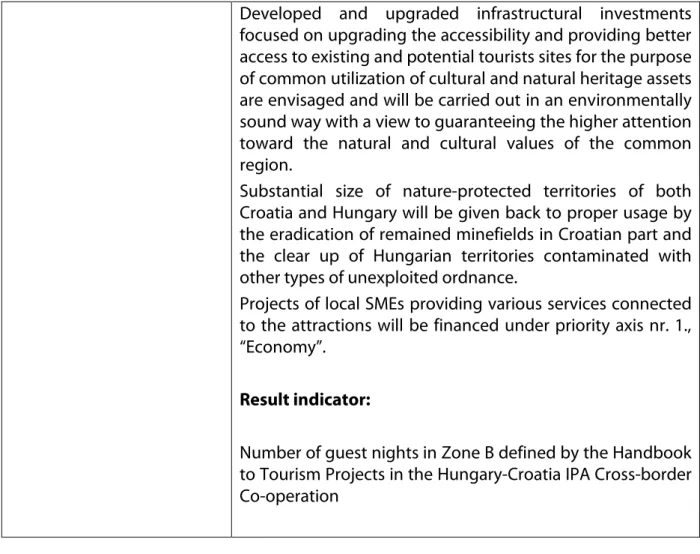
The importance of tourism is especially high in the Hungarian part of the programme area, where there are several important attractions, such as Lake Balaton and spa resorts (e.g. Hévíz and Zalakaros), the Siklósi microregion, where the Harkány spa and wine tourism generates significant tourism nights together with the historic and cultural city of Pécs, a UNESCO World Heritage Site. In the Croatian part (where nationally the great majority of tourism takes place at the Adriatic coast) there is much less tourism activity, mostly concentrated in Osječko-baranjska, Varaždinska, Koprivničko-križevačka and Međimurska County, based on rural tourism, annual events, gastronomy, as well as spa and wellness, mostly for domestic tourists. The towns Osijek and Varaždin have significant cultural heritage, but other locations such as Đurđevac, Križevci, Koprivnica, Orahovica, Lepoglava, Ilok and Kalnik have great potential in developing existing touristic offer and building new one, too. In spite of the potential, tourism activities along the border itself are not significant, with the exception of the Siklósi microregion. There is huge potential to develop sustainable tourism activity within UNESCO Transboundary biosphere reserve Mura-Drava-Danube which extends along Međimurska, Varaždinska, Koprivničko-križevačka, Virovitičko-podravska, Osječko-baranjska and Vukovarsko-srijemska Counties in Croatia and along Upper Balaton and Danube-Drava National Park.
Alongside the border a number of existing and potential attractions relate to each other in a number of ways due to the common history and the similarity of natural endowments. Thus, some sites have complementary relations to each other (such as wine-producing areas and cultural attractions), others do have some common features (such as the Zrinyi heritage that can be found on both sides of the border), that lends itself for the development of integrated tourism packages, such as thematic routes. In general, the potential individual attractions are relatively small in itself, this way the regional tourism offer is fragmented and not sufficiently visible for potential new visitors outside the region. Tourism in Hungary shows slightly increasing trends in recent years. Guest nights spent by tourists in commercial establishments increased from 2013 to 2014 in the Southern Transdanubia region slightly below the national average, +4,95% (national average +5,43%).
In Croatia tourist overnights also show an increasing trend (3,3% from 2012 to 2013). The overwhelming dominance of the Adriatic coast is changeless, however, a very slight shift towards other locations can be observed (such as growing the share of “other tourist localities” from 3,7 to 3,9 % from 2012 to 2013, in terms of tourist overnights.
The existence of the area’s potential for cultural, eco- and rural tourism has been recognised by the extensive study commissioned in the framework of the 2007 – 2013 IPA CBC OP. The study also formed the basis of the “Handbook to Tourism Projects…” document. The Handbook to Tourism Projects in the Hungary-Croatia IPA Cross-border Co-operation Programme 2007-2013 has been approved by the Joint Monitoring Committee via JMC Decision No 32/2011 (27.10) serves as document that provides firm strategic direction that tourism development projects shall address, as background for any interventions in tourism. Experiences of the 2007 – 2013 IPA CBC OP show that there is a great interest in participating in tourism-related support schemes and foreseen results of the projects are mostly positive.
The programme area is not highly industrialised. In the Hungarian part, only Zala County meets the Hungarian average for industrial production per capita. In Somogy, industrialisation is only 70% and in Baranya 32% of the national average, despite Baranya being the location of Pécs, the biggest urban agglomeration of the area. Generally, there is an absence of large enterprises. Information communication and financial services are rather weak in all of the three counties, showing the underdevelopment of the economic structure.
In Croatia, the level of industrial activity is above the national average in Međimurska, Koprivničko-križevačka and Varaždinska County, while Vukovarsko-srijemska County is significantly below the national average. The share of services is below the national average in all Croatian counties of the programme area.
In the programme area as a whole, there is no significant sector specialisation, apart from agriculture and food.
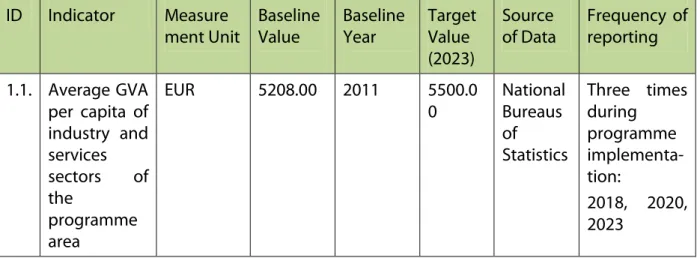
Gross value added (GVA) data of secondary and tertiary sectors (industry and services) show even less favourable picture than GDP figures in the programme area. GVA per capita of industry and services sectors in the Hungarian bordering counties reach only 65.7% and in Croatian bordering counties only 70.8% of national average – while respective per capita percentages for total GDP are 69.4% in Hungarian and 78.3% in Croatian bordering
counties (data from national statistical offices, 2011). It can be stated that the performance of industry and services sectors is rather low in the programme area which makes it necessary to foster value added producing capability of enterprises operating in industry and services.
The level of SME activity is generally lower in the programme area than the national averages. The density of enterprises is higher in the Hungarian territories than on the Croatian side, especially in the bigger towns and in the proximity of Lake Balaton, whilst it is lower in rural areas. In the Croatian part, the greatest level of SME activity is in Međimurska and Varaždinska County and lowest in the central and eastern part of the programme area.
The crisis affected SMEs much more than large companies. Until 2013, the Hungarian SME sector did not manage to fully recover from the initial shock of the crisis in 2008 and has been sluggish since 2009. Since then, it has fluctuated at around 90 % of 2008 levels for all main aggregates: number of SMEs, employment and value added. Croatia’s economy continued to suffer from the economic crisis in 2013, with GDP decreasing further for the fifth year in a row. Employment and added value in the SME sector also decreased.
In terms of employment, SMEs in Hungary are of greater importance than across the EU on average. They account for 71 % of all employees, slightly more than SMEs in the EU (67 %). Yet the share of value added in Hungary is 4 percentage points lower compared with the EU as a whole. Another interesting difference from the EU average concerns manufacturing. In the EU, 46 % of the sector’s value added is generated by SMEs, but in Hungary, it is less than a third. In Croatia there are no major differences with the rest of the EU in terms of size classes or employment, but the added value of Croatian SMEs in 2013 was 54 %, four percentage points below the EU average (see Figure 1). SMEs kept relatively more employees than the decrease in added value made necessary. This had a negative effect on labour productivity figures (Structural Business Statistics Database, Eurostat, 2013).
Figure 1: Value added of SMEs in Hungary and Croatia
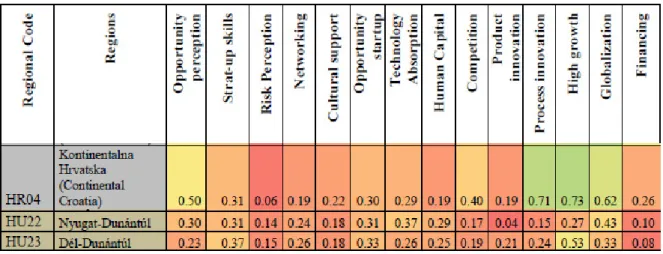
European-wide analysis clearly shows main entrepreneurial characteristics of relevant NUTS-II Croatian and Hungarian regions of programme area (see Table).
Table 1: The fourteen average equated pillar values of the three NUTS2 regions of the programme area
Source: REDI: The Regional Entrepreneurship and Development Index – Measuring regional entrepreneurship - Final report, European Commission, 2013.
Note: The colours reflect to the value of the score from the best (green) toward the medium (amber) to the worst (red). (Scale 0 – 1)
As it is shown (see red and dark amber values) enterprises of the programme area have significant problems in financing, product innovation and also in networking: all these factors reach only half or even lower values than average of 125 EU NUTS-II regions (EU average equals to 0,5 at all pillars). This clearly underpins necessity of conceiving new, tailor-made local enterprise development schemes.
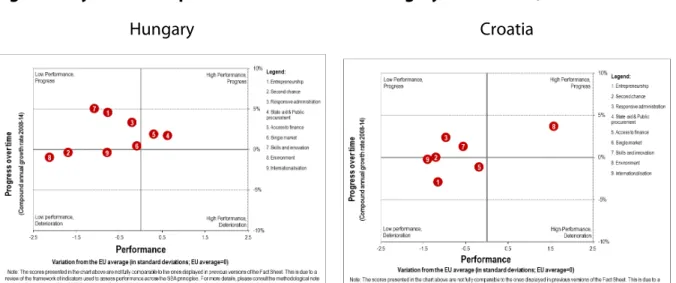
Another EU-wide analysis annually evaluates performance of SMEs according to 10 factors (SBA Fact Sheets 2014, European Commission). In Hungary problematic areas of SMEs are entrepreneurship, second chance, skills and innovation, environment and internationalisation; for all of these, Hungary scores below the EU average. While there is room for improvement in practically all SME policy areas, particular attention should be paid to access to finance, internationalisation, and supporting second chance entrepreneurs. Analysis also points out that the level of Hungary’s trade with non-EU countries languishes at a rather low level. This is in contrast to the rise in SME exports and imports to and from the single market. In Croatia performance is below average in most other areas, requiring more focused policy measures to catch up with the performance of other EU countries. These areas include entrepreneurship, second chance, responsive administration and internationalisation.
Figure 2: Dynamic SBA performance of SMEs in Hungary and Croatia, 2008-2014
Hungary Croatia
Source: SBA Fact Sheets 2014, European Commission
Figure 2 shows that Hungarian and Croatian SMEs are lagging behind considering most of the 10 development factors envisaged, especially in terms of internationalisation: SMEs have rather weak performance in this matter and SMEs have shown no measurable improvement in internationalisation since 2008.
Hungarian Strategy of SMEs 2014-2020 outlines that one of the biggest hindering factor of SMEs is lack of financial resources (Strategy of SMEs 2014-2020, 2013). It is also obvious that SMEs are lagging behind in terms of export activities: only less than quarter of SMEs plan any kind of export activities for the future, export incomes of SMEs reaches only less than half of bigger other types of companies.
Gross value of export and import activities from Croatian counties to Hungary is way under 10% of gross Croatian export-import and only a low proportion of it is carried out with Hungarian bordering counties (data of Croatian Chamber of Commerce, 2013).
Joint cross-border enterprise development strategy conceived by SOVISEC CBC project with involvement of Somogy and Virovitica-Podravina counties defined "Advanced co-operation between the economic actors across the border, helping the foreign trade and market access" as 1st priority of the Strategy (SOVISEC Joint cross-border enterprise development strategy, 2012). Although GVA of industrial sectors are rather weak in these counties, there could be export potentials pointed out: in Somogy the export of the manufacture of computer, electronic and optical products (12,3% of National export), locally manufactured electrical equipment (4.3% of National export) and textiles, leather and related product (3.2% of National export) are significant, while in Virovitica-Podravina the county’s largest export consists of manufactured goods, like leather products, furniture and other mineral products. However, the largest share of the county’s revenues generated in foreign trade comes from food manufacturing industry and production of furniture (SOVISEC Situation analysis, 2012). As it could be seen there are similarities (manufacturing, textile and leather products) and complementarities (Somogy: electronic products and equipments; Virovitica-Podravina: furniture, food industry) in export activities setting a good basis for cross border trade.
In both Croatia and Hungary, there are SME support networks, with active enterprise development agencies and foundations, chambers of commerce, innovation agencies and business incubators. These have been strengthened in recent years, particularly on the Hungarian side. However, the low level of SME development generally shows that there is a need and potential to develop this further.
Research and Development (R&D) activity is generally low in the programme area. In both Hungary and Croatia, R&D expenditure is lower than the EU average, and is concentrated in the main cities and not the peripheral border regions.
On the Hungarian side of the programme area, the main actor of research and development activities is the University of Pécs, which has a wide range of international relations with a focus on research, inter alia with the Josip Juraj Strossmayer University of Osijek.
In the Croatian part of the programme area, the main R&D centre is Osijek, where the Josip Juraj Strossmayer University has 11 faculties and the Institute for Agriculture, which is a nationally significant research institution. There is also the Agricultural College seated and operating in Križevci.
R&D activities are typically funded by the public, participation of the private sector is in both countries very weak. Thus, intensity of the cooperation of the universities with the private sector is typically low in both countries in general, and this is characteristic in the programme region, too.
The labour market in the programme area is characterised by significant and increasing levels of unemployment, particularly long-term unemployment. Economic activity as measured by the rate of employment is lower than the national averages in both Croatia and Hungary.
As noted earlier, agriculture – on the whole – is a higher source of employment than nationally, although it varies in different parts of the programme area, being higher in Baranya and Somogy County and the eastern counties of Croatia. Industrial employment also alters, being highest in Zala County in Hungary and Varaždinska and Međimurska County in Croatia.
The Croatian part of the programme area has an unemployment rate of 11.4%, which is above the national average for the same period (9.3% in 2011). However, there are wide differences between the westernmost part of the area, where unemployment is lower, and the eastern part, where it is above the national average. As in Hungary, there has been increasing unemployment in recent years.
Cross-border commuting is not significant from either side, partly because of the lack of large employers.
In Croatia, there is notable disjunction between the labour market and educational system which is reflected in the fact that the majority of unemployed are those with 1-3 year vocational secondary schools, whose number prevail in the structure of unemployed even over those with no schooling or with only primary school. Most of the unemployed have been unemployed for over 12 months and the majority of the unemployed and particularly of long-term unemployed are women. A significant proportion of the unemployed are young (34.59% of all unemployed are below 30), who have trouble
entering the labour market, but also those over 45 years of age (also 34.64%), who find it hard to re-enter the job market.
Earnings in the three Hungarian counties are below the national average, which is potentially a comparative advantage in terms of the costs of the labour. A similar situation is seen on the Croatian side, however differences between counties are also considerable, irrespectively to their performance measured by GDP per capita: Osiječko-baranjska and Koprivničko-križevačka are having the highest figures while Međimurska, Virovitičko-podravska and Varaždinska are lagging behind.
Environment
The programme area is characterised by relatively favourable environmental conditions that is partly the result of the absence of pre-1990s large scale and heavily polluting socialist industry on the Hungarian side and the dominance of less-polluting light industry on the Croatian side.
Air quality is generally considered as satisfactory on both sides of the border: in Hungary Zala county has above-average air quality figures, while Baranya county, especially Pécs matches other Hungarian big cities' average figures caused by high concentration of dust resulted by heavy traffic and unfavourable land use in areas of the Mecsek hills. On the Croatian side of the border, air quality is generally satisfactory.
The programme area is characterized by three major water systems: the Danube in the east, the Drava-Mura that forms most of the border line, and Lake Balaton to the north of Somogy and Zala counties. The water systems of the Balaton and Drava-Mura suffer from big volatility.
Volatility caused by human action is also present in the cross-border area. Intense agriculture on one side and permanent neglect of traditionally used land on the other side; one influencing quality of underground waters and land with impact on nature habitats, and the other causing misbalance in natural floodplains and cultural landscapes such as grasslands or backwaters. Backwaters’ systems, neglected or dried-out, leads to decrease of natural floodplains’ capacities and decrease of wet-land suitable for development of rich ecosystems (issues concerning the reproduction of fish, amphibian and bugs). On the Hungarian side, 7.06% of the programme area is protected landscape. The Danube-Drava National Park Directorate based in Pécs manages most of the protected areas in Baranya and Somogy counties. The Balaton Uplands National Park Directorate manages about 56,997 hectares of protected areas around Lake Balaton
In the Croatian part of the programme area there are no national parks, although there are two parks of nature, the wetland of Kopački rit with an ornithological reserve (Ramsar site), and Papuk, also proclaimed as Geopark, a mountain with rich forests, wetlands and meadows. In addition to those, the Croatian Government in 2011 established a Regional Park (the next level of protection) Mura-Drava that spreads over 5 counties of the Croatian border area.
The territory of the Danube-Drava National Park and the Mura-Drava Regional Park form part of the Mura-Drava-Danube Biosphere Reserve that has been proclaimed by the UNESCO in 2012. The total reserve covers 631,461 ha, whose 395,861 ha is in Croatia and
235,600 in Hungary (the Reserve’s area spreads also in Austria, Slovenia and Serbia). The Biosphere Reserve is managed by nationally designated bodies (Danube-Drava National Park Directorate in Hungary and coordination of public institutions (Kopački rit) in Croatia, as well as county level public institutes for protected area management in Croatia), which makes this activity clearly of important cross-border character.
The quality of surface waters in the programme area is generally favourable. According to data of ecological assessment of surface waters in 2009 the Danube has ‘moderate’ quality, while the Drava and the Balaton are marked as ‘good’ quality waters.
Flood prevention is generally well organised due to well-developed systems of flood protection dikes – although there is a few kilometres long section which needs to be built up and/or developed – and the large surface of floodplain forests and other floodplain landscapes. Ongoing and foreseen investments e.g. in Hungary aim to extend wetlands and, in general, to introduce nature-friendly ways of flood management, including extending the area of floodplain forests and other river-related ecosystems. Thus, further joint planning efforts and small scale investments in specific “green infrastructure” allowing for a more nature-friendly management of floods alongside the region’s rivers is foreseen, including further development of the existing and in it’s essential functions operational flood monitoring and forecast systems on the Drava and Mura. Capitalisation of the results of the cooperations and plans produced by the 2007 – 2013 programme can play an important role in defining bilaterally agreed smaller investments in this intervention field.
Existing natural assets – especially the large scale forests and the cross-border water bodies - are still vulnerable to man-made disasters. No comprehensive alert- or information system exist in the region that could effectively handle the effect of accidental fires or industrial contamination, on the other hand, such events could have serious destructive impact on these values. Projects of the 2007 – 2013 period that aimed at information sharing or improving the reactivity of the national bodies in charge of disaster management were successful, nevertheless, activities remained isolated and fragmented. The issue of mine-contaminated sites is still present in Croatia. The existence of ERW (Explosive Reminiscence of War), besides representing a constant threat to human life, hinders the economic, mostly tourism and agriculture related exploitation of the area. Also in Hungary, there are areas under nature protection confirmed to contain leftovers of possible military supplies including weapons, ammunition.
The Hungarian part of the border area is characterised by almost 100% level of access to public water supply utilities. However, although improvements have recently been made to sewage system connections, the level of connection in the programme area is still well below the national average.
Similar situation exists in Croatia, where water supply standards are generally in line with the national average, but the levels of water treated by the appropriate sewage systems are not satisfactory, especially in rural areas. Significant investment in the development of sewage networks with appropriate waste plants is planned through national programmes co-financed by EU Cohesion Fund.
The region has beneficial conditions in terms of potential for renewable energy resources, for example by exploiting:
• the waters of the Drava and Mura for energy production, subject to resolving conflicts with nature protection.
• the high number of sunny hours in south of Baranya County for solar energy production.
• the biomass (including agro-waste) which is available due to high level of forestation in Somogy and Zala County.
• the geothermal energy which has favourable conditions in all counties of the Hungarian side of the programme area and in Koprivničko-križevačka county in Croatia, as well as the thermal resources which are generally available throughout the programme area.
Transport
The road infrastructure of the programme area is situated in the triangle of corridors V/b (E71; A4–M7), V/c (E73; A5–M6) and X (E70; A3). The programme area’s western periphery is located at the intersection of transnational communication routes that creates excellent accessibility from Western Europe. However the area suffers from capacity problems especially in summer season.
The isolated situation of the middle part of the border area affects the internal cohesion of the programme area. In Hungary the accessibility of county seats’ varies: for example Zalaegerszeg and Kaposvár do not have good connection to motorways. The southern periphery of Somogy County is particularly hard to access either from county seats or from outside the area.
The border of Croatia and Hungary – generally speaking – is an exceptionally non-permeable one: it has the lowest border crossing density among Hungarian borders, with an average distance between border crossings of 62 km. The districts of Sellye and Szentlőrinc in Hungary and Slatina on the Croatian side are particularly isolated from the other side of the border. Since the Mura and Drava form the state border over a long distance, the accessibility and crossing over of rivers is an issue and to be enabled by e.g. ensuring ferry connections and constructing bridges.
East-west transport in the border area has serious capacity problems: the connection between Pécs and Zala County depends on poor quality side roads. Similarly on the Croatian side the Podravska main road (D2) has recently been developed with bypasses built around major centres (e.g. Osijek, Virovitica), but horizontal connection still remains ineffective due to long transit road sections on D2.
To improve prospective accessibility of the area, various road infrastructure projects are in the preparatory phase, such as the construction of the trunk road nr. 67 between Szigetvár (H) to the Hungary-Croatia border, including the construction of a bridge over the Drava at Zaláta or the possible construction of the Osijek (HR) – Mohács (H) highway.
Railway facilities are generally characterized by poor quality infrastructure and lack of electrification resulting in low speed, inefficient timetables and limited opportunities for cross-border travel. The cross-border service is limited to the Budapest-Zagreb connection via Koprivnica, Gyékényes and Nagykanizsa and the recently re-established connection between Magyarbóly and Beli Monastir. No rail connection can be accessed from
Zalaegerszeg. Several initiatives to establish regular public bus service connections have been failed, due to the lack of sufficient number of users. Thus, service is occasional and limited to certain periods, like the Pécs-Osijek service in pre-Christmas shopping period. The most significant airport in the region is Hévíz-Balaton near Hévíz that serves summer charter flights mainly from Germany; further lines are under way from Riga and Moscow. Osijek Airport serves regular scheduled flights in the summer season to Dubrovnik and Split, and to Zagreb and London during the remainder of the year. Pécs-Pogány airport currently serves charter flights in the summer season to Greece and Bulgaria.
Water transport is relevant only in the eastern part of the programme area. The Mura border river is navigable only for small vessels for tourism and sport. The Drava is navigable from Barcs to Osijek for small vessels and from Osijek to Aljmaš for larger river cruisers. The Danube has much more significance in terms of navigation. On the Hungarian side Mohács has status of public port, recently equipped with modern infrastructure. In Croatia Vukovar (on Danube) and Osijek (on Drava) have status of international port and passenger terminal facilities. On the Danube there are also small river ports at Ilok and Batina.
Education and training
In the three Hungarian counties of the programme area the most important challenges of the education – such as the uneven quality of the education or the difficulties to access educational services for certain groups of the society, including the Roma – arise from the structure of small settlements, the underdeveloped local economy, the low education level of adults and the high number of families threatened by poverty. –. While these challenges remained valid, the education level of the population in the three Hungarian counties improved steadily during the past decade, and in 2011 the proportion of those with eight grades of primary school shows a slightly more favourable picture than the Hungarian average.
The Croatian data demonstrates that the level of secondary and tertiary education in the Croatian side of the programme area (41.51% and 7.50% respectively) is much lower than the national average, especially in counties without large urban centres, such as Virovitičko-podravska, Požeško-slavonska, Međimurska and Bjelovarsko-bilogorska County. Osječko-baranjska County has a higher than average rate of university education than the Croatian area as a whole, which can be attributed to the economic and cultural importance of the City of Osijek. In terms of social inclusion, significant efforts are still required in Croatia to increase the involvement of Roma children into the educational system.
The continuous improvement of the national education systems – including the improvement of the accessibility of the services for the disadvantaged groups - is on the agenda of both national governments and the process is assisted by sectorial OP’s and other instruments of the centralised national education policies in both countries. In spite of the various historical and cultural linkages the level of knowledge about the region itself is very low on both sides. The lack of proper knowledge about the region hinders cross-border cooperation in a number of ways – including the fact that it clearly lowers the motivation to cooperate – therefore contributes to the conservation of the peripheral situation of the area with no internal cohesion. To promote the aim of increasing internal cohesion of the region split by the border there is a need to increase – in some cases
re-establish – the explicit knowledge about the region itself, additional to the general knowledge that is provided by the national school systems.
Quality of the school infrastructure – buildings, equipment – is very much varied throughout the region. Schools in larger towns are typically in better conditions, while in smaller villages neither buildings nor teaching equipment reaches national standards. School infrastructure, in general is also subject of sectorial investment programmes supported by national resources in both MS’s, however, neither additional needs of cooperation are recognised in the refurbishment projects nor preferences for cooperating schools have been set by the national schemes.
Vocational training facilities have been significantly developed in recent years on both sides of the border but need to be further aligned to the needs of employers and economic development. Territorial Integrated Vocational Training Centres were established in Kaposvár, Nagykanizsa, Marcali, Pécs and Zalaegerszeg in the Hungarian side. Adult and vocational education has also been developed in Croatia in recent years. Of 348 adult education institutions that provide formal education in Croatia, 100 are located in the programme area, mostly in Osječko-baranjska County (26) and Varaždinska County (20), while the lowest concentration is in Požeško-slavonska (8), Međimurska (7), Virovitičko-podravska (6) and Koprivničko-križevačka County (5).
Similarly to trans-border mobility of the workforce for the time being, cooperation of these establishments is not intense either. Roots of the weak cooperation are similar to the main reasons of the weak labour force mobility: weak economic linkages, in general, weak motivation and skills to cooperate. While on the short run these factors cannot be realistically changed, pilot-type demonstrative actions may effectively promote the idea of cross-border labour mobility. Thus, dual training (training-oriented cooperation of enterprises and training institutions) can give a boost to a more intense mobility of the labour, contributing to the better employability of the workforce in the region on the longer run. Over the programme period a couple of such cooperative actions may be realistically implemented, on the basis of the cooperation of the vocational training or higher education institutions of the region and the a few of the relatively larger employers. Besides the demonstrative effect, this way specific local knowledge can be created that matches employers’ needs and the capabilities of the local institutions.
In terms of the higher education system, the University of Pécs is the most important university on the Hungarian side, with 10 faculties and 26,699 students in 2011, including 53 students from Croatia. There is clear potential to increase this number. The Episcopal Theological College of Pécs is also located in the county seat of Baranya. In Somogy County Kaposvár University operates as the other important university of the region, offering studies in four faculties.
In Croatia, the most important university centre within the programme area is in Osijek, where Josip Juraj Strossmayer University is located. The University consists of 11 faculties in both arts and sciences with over 20,000 students. In Osijek there is also another organization, the Institute for Agriculture, which is a nationally significant research institution. Another university is within the programme area, Croatian youngest university, University North is located in town Varaždin and Koprivnica and in Križevci there is the College of Agriculture, too.
Universities are also very important for functioning of the Mura-Drava-Danube Transboundary Biosphere reserve since they are providing support with scientific researches needed for promotion of innovative sustainable management of the area. Stakeholders’ opinion concludes that people in the border region generally do not have sufficient knowledge about each other’s country and the cross-border region itself and that this has also an adverse impact on the intensity of cross-border cooperation. Quality of education is worse in small settlements and access to good services is especially difficult for vulnerable groups of the society such as people threatened by poverty and the Roma. Poverty and isolation hinders access to good quality education and holds back access to joint experiences, too, therefore poverty and social vulnerability also contributes to the low level of the cooperation.
Educational institutions in the region, especially the bilingual schools, educational and cultural centres as well as universities play a vital role in cultural and educational cooperation in the region as set out in the on-going evaluation of the 2007-2013 programme. Support schemes that would have promoted bilingualism as such were not popular among project applicants in the 2007 – 2013 period, indicating, that stakeholders rather prefer collaborative events and actions to pure language courses in order to improve their cooperating capabilities. Thus, support to common courses and knowledge-creation has good chances to meet stakeholders needs and results in a good uptake of funds.
Based on the results of local consultations, the joint history, the existence of shared values (such as clean environment, diversity etc.), as well as the general acceptance of each other on all level of the society may form a good basis for developing a common knowledge base. At higher educational level, complementarity of courses may offer a perspective for success.
Health care
The performance of the health care system of both countries is below the European average. Health care in the Hungarian counties is under-financed, suffers from inefficient structures and territorial disparities. In general terms the system cannot match the demand both in terms of quality and quantity.
This is reflected in lower life expectancy figures than the EU average and poor health indicators such as smoking and alcohol consumption. In addition there are higher than average levels of social dependency on both sides of the border, with the exception of the western part of the Croatian area.
Croatia, like Hungary, has a relatively low level of health care financing. Furthermore, advanced healthcare is concentrated in larger centres such as Zagreb, while smaller towns are often left with a basic and much less technologically advanced health care. The strongest health care centres of the programme area are located in Pécs and Osijek, these cities have Clinical Hospital Centres.
Language, culture and cooperation
Successful cross-border cooperation requires good command of foreign languages. However, knowledge of foreign languages in the programme area is very low and language skills are a major bottleneck to improved cooperation. There is therefore an important issue of the use of foreign languages, either Hungarian or Croatian, or a commonly used language such as English or German, to facilitate communication in the border zone. Still, support schemes that would have promoted bilingualism as such were not popular among project applicants in the 2007 – 2013 period.
There is a well-established level of cultural cooperation across the border, driven by partner municipalities and institutions. 38 partnership agreements or informal partnership relations exist between Hungarian and various Croatian municipalities or institutions. Many of these are the result of the current Hungary-Croatia CBC programme. Within the programme, up to December 2012 a total of 198 events were realised under people-to-people actions, involving 325,083 people-to-people.
This level of interest was considerably higher than expected and shows the existence of local people’s interest in cross-border cultural events and cooperation. Examples of cultural cooperation include mutual attendance at festivals, joint staging of theatre plays and gastronomic events organised around regional food specialties and wine. Bilingual schools are also active in cultural and educational cooperation. The Universities of Pécs and Osijek also cooperate in relation to arts, history, geography and linguistic subjects. Finally, intensive contacts are maintained between museums, archives and libraries. However, results of an interim evaluation of the programme concluded that intense cooperation is dominated by a relatively small number of particularly active partners - like the universities and the development agencies – while many of the region’s public institutions remained inactive.
Additionally, quality and usability of cooperative studies and plans prepared in the 2007 – 2013 period varied very much, according to the preparedness and capabilities of the cooperating partners as project holders, although this observation has not been verified by the independent evaluators, being this issue not part of their ToR.
During the programming process institutional stakeholders representing various thematic fields of the economic, environmental and social development in the region expressed their need to engage in building cross-border partnerships, mainly with the purpose of developing viable development projects with the combination of the knowledge of the partners. Thus, needs clearly tended to lack any sectorial or thematic preferences but a strong focus on building up capabilities for a lasting cooperation and clear results on the short run. Areas of cooperation therefore need to cover areas that have development potential for the region, based on its assets and problems.
Croatian counties, towns and municipalities have been building their institutional capacities for the preparation of strategic development programmes and projects since the early 2000s, dictated by the process of EU integration and supported to a large extent by pre-accession funding for regional competitiveness and cross-border cooperation. The framework for Croatian regional policy is regulated by the Regional Development Act from 2009 which was supplemented in 2010 by the National Strategy for Regional Development 2011-2013 and 21 County Development Strategies 2011-2013. The counties
are currently preparing new development strategies for the programming period of 2014-2020.
In Hungary, the 1996 Decree on spatial development and physical planning set the basic framework of regional development policy and laid the foundations of the institutions for spatial development. This Act, modified in 1999 and 2011, set a consistent system of objectives for the spatial development policy.
Regional Development Agencies (RDAs) have been working on regional development issues in the 7 NUTS2 regions of Hungary since 1997. The RDAs have accumulated extensive professional experience and competences in spatial planning; generation, development and implementation of international projects. However, the system of regional development changed in 2010 and the leading role of RDAs ended. Instead, county self-governments became responsible for the territorial coordination of development policies and instruments. Preparation of these institutions for their tasks in the 2014-2020 period is continuously underway.
There are currently two established European Groupings of Territorial Cooperation (EGTCs) in the Hungarian-Croatian Programme Area, Pannon EGTC and Mura Region EGTC. The Pannon EGTC, seated in the city of Pécs, Hungary, was established on 31 August 2010 and registered in 2012 with the participation of one Slovenian municipality and 49 Hungarian partners (http://www.pannonegtc.eu/content/members). Ptuj and Moravske Toplice Municipalities and 7 other Hungarian members have later joined the EGTC. The Croatian Government has approved Virovitičko-podravska County and Antunovac Municipality to join Pannon EGTC at its session held on 18th March 2015 and the decision was published in the Official Gazette No. 32 of 23 March 2015. On the date of publication the decision entered into force. The Municipality of Osijek has also expressed its interest to join Pannon EGTC. . The EGTC elaborated its development strategy including key projects in 2014 and it has a small administrative staff in Pécs.
The second EGTC, Mura Region EGTC (http://muraregio.eu/), has been deriving from the ‘Mura Region’ project financed within the Third CfP of the Hungary-Croatia (IPA) CBC Programme 2007-2013. It has passed the relevant national level governmental approvals on Hungarian side (December 2014) and Croatia (April 2015) and currently it is at the beginning of its functioning and the registration. The seat is in Tótszerdahely (Hungary) and includes 11 Hungarian municipalities close to Mura river and connected to the association called Muramenti Nemzetiségi Területfejlesztési Társulás in Zala county. On the other side of the border there are five Croatian municipalities that joined to that EGTC (Donja Dubrava, Donji Kraljevec, Donji Vidovec, Goričan and Kotoriba). The EGTC has clear geographical logic behind as well as the balanced cross-border effect, based on the membership, but needs quick building up of administrative capacity for managing bilateral cross-border projects.
Participation in the programme as beneficiaries could contribute to their further development.
The staff and the development strategy (“Együttes Fejlesztési Program 2014 – 2020”) of the „Pannon EGTC” has been consulted by the expert team in the preparatory phase of the programme and the EGTC has been invited to the workshops organised by the programming team. In the programming process the interests of the EGTC were rather represented by its founders then by the EGTC itself, given the lack of Croatian members of
the EGTC. Altogether, out of the programme’s four priority areas two shows clear linkages to the final choice of the programme stakeholders regarding the definition of the CP’s Specific Objectives. The relevant EGTC objectives are 1. “economic cooperation and tourism development” and 2.”developments serving the conservation of natural environment and the sustainable land management
1.1.1.3.The Cooperation Programme’s Strategy
An analysis has identified that the Hungary – Croatia border area holds a number of assets that could be utilized in order to enhance social and economic development in the region. The most important ones are the following:
• the outstanding quality of natural and cultural resources, like the unspoiled natural environment in the area, including the border river Mura and Drava as well as the Danube and the rich historical heritage of the areas’ settlement network
• the existence of medium-sized towns with higher education institutions and lively cultural and entrepreneurial life in both countries
• the excellent potential for local products coupled with long-lasting traditions and knowledge
However, the analysis concludes that currently relatively few of these assets are effectively exploited. The area is rather characterised by underutilised elements of the territorial capital, mainly as a consequence of:
• the border rivers that constitute severe physical barriers to increasing cooperation • missing elements of infrastructure (weak cross-border connectivity and sparse
regional transport networks, underdeveloped tourism and other business related infrastructure)
• weak collaboration of the universities with the business and public sector institutions
• the extremely low level of mobility of the workforce and the lack of integration of the national labour markets
• the low foreign language skills of the inhabitants of the region
• positive experiences of cross-border cooperation are not capitalized sufficiently • strong orientation of both national economies towards national centres, leaving
major parts of the areas as peripheries
The above-outlined factors result in a relatively weak cross-border cooperation among the various actors in the border region, nevertheless, results of the 2007–2013 programme are making considerable positive impact.
The following main general socio-economic problems have been identified:
• weak performance of local business sector results in high unemployment that – apart from some developing medium-sized towns, mainly in the western part of the area - is exacerbated by the low level of FDI
• mainly as result of the weak economic performance and the bad accessibility of the region (peripheral location in both Member States) outmigration trends are clearly
visible, affecting and leaving the region with an ageing population and shrinking incomes
Geographical differences of the region are significant. Main regional economic centres are situated at the eastern part of the border area (Pécs – Osijek), emerging poles are to be found in the western part (Nagykanizsa – Čakovec – Varaždin) while the areas situated in the middle section of the border are lagging behind, also showing evidence of serious poverty and social deprivation, especially but not exclusively on the Hungarian side (Ormánság).
Additionally, the region’s rich ecosystem is fragile and vulnerable by incidental natural or man-made disasters.
Some external trends may provide a favourable set of conditions for the better exploitation of the region’s assets. The most important ones are the following:
• The free movement of goods and services between the two countries with Croatia’s accession to EU encourages business cooperation of SMEs and increases the number of visitors and investors
• Increasing demand for nature-friendly („green”) and cultural tourism in both countries and in Europe as a whole
• Growing interest in various consumer groups in consuming/purchasing local and organic food products
• Initiatives in both countries to increase energy efficiency and the share of renewable sources in energy production
• Increasing interest of civil society in environmental protection and sustainability • Development and access to ICT technologies provides solutions to cooperation
without physical meetings and travelling in an increasing number of areas
However, the realization of these positive trends cannot be taken as granted. Also, external threats are numerous and their chances of impacting on the strategy are not negligible. Most relevant ones are the following:
• the slow recovery from economic crisis may maintain low level of purchasing power in both countries resulting in low level of demand to local products and services that leads to further ageing and depopulation in the region
• FDI may favour more developed agglomerations with no development impact on the large rural areas of the programme region
• integration of the Croatian economy into the EU may result in termination of jobs in rural areas due to improving push for efficiency and more open competition
• the „mainstream” national OPs in the cooperating countries may not focus adequately on the specific problems of the area, this way the level of public investment remains low and necessary investments to address inherent weaknesses will not be made (e.g. in infrastructure, businesses, human capital and environment)
• uncertainties regarding the date of Croatia joining the Schengen area may hinder the development of cross-border infrastructure
Based on the dominance of internal weaknesses and the risks associated with the external trends the strategy shall not aim at offensively exploit existing assets. Instead, it focuses on strategic choices that help overcome the main weaknesses of the region by gradually
building up capabilities in intervention areas where the programme can realistically achieve tangible, sustainable and continuously upgradeable results.
Thus, the strategy underlying the programme should focus on eliminating or reducing the existing weaknesses of the various social and economic sub-systems of the region, preparing the region’s assets to take full advantage of the emerging external opportunities. To a smaller extent the approach of stabilizing and strengthening currently weak assets to minimise impact of external threats is followed, too. Former approach lends itself in cases like, inter alia, the following:
• encouraging local SMEs by creating better conditions to networking and providing incentives to actually experience added value of cooperation,
• developing attractions for tourists and incentives for touristic service providers to help take advantage of the diverse cultural heritage and natural environment, • preparing and implementing small-scale transport infrastructure projects to
develop the connectivity of the region, in order to overcome accessibility-related barriers to the cross-border movement of visitors,
• enhancing cooperative attitudes by supporting direct cooperation and cooperative educational schemes,
whereas latter one is followed in case of measures for an increased stability and diversity of the region’s ecosystems, by
• fostering the cooperative management and the cross-border transfer of know-how, enhancing the quality of the conservation of the natural assets, such as forests and other ecosystems, habitats and the water resources,
• the improvement of cross-border information, monitoring and forecast systems to better tackle risks of mainly man-made disasters on the environment, such as floods, fires or hazardous waste of industrial origin
The strategy chosen has been also influenced by the characteristics and limitation of support that could be provided by any ETC cross-border programme and also the size of financial resources to be made available to implement the Hungary – Croatia cross-border cooperation programme. Main effects of these considerations is that the programme’s strategy supplements the strategies followed by mainstream OPs focusing clearly on enhancing the cooperative efforts of regional stakeholders and, secondly, that the strategy cannot realistically address needs of larger size infrastructure developments even if in some cases need to these investment could be seen as justified.
The objective of the programme in terms of cross-border cooperation is to deepen and, as much as possible to extend the scope of the cooperation and networking on the basis of the success of the already started and experienced cooperative efforts. To achieve this, the programme creates better conditions and provides incentives for the main stakeholders of the region.
The above outlined strategy of the programme is expected to effectively promote the overall long term vision for the programme area, formulated by the various participants of the programming process in the following way:
“The Hungary – Croatia border area is characterised by an intense and diverse cooperation, facilitated by appropriate cross-border connections, shared knowledge and active and