Comparison of 2D and 3D Vision Gaze with Simultaneous Measurements
of Accommodation and Convergence
Hiroki Hori1, Tomoki Shiomi1, Satoshi Hasegawa2, Hiroki Takada3, Masako Omori4, Yasuyuki Matsuura1, Hiromu Ishio1and Masaru Miyao1∗
1Department of Information Engineering, Nagoya University, Furo-cho, Chikusa-ku, Nagoya 464-8603, Japan
2Department of Information and Media Studies, Nagoya Bunri University, 365 Maeda, Inazawa-cho, Inazawa, Aichi 492-8520, Japan 3Graduate School of Engineering Human and Artificial Intelligent Systems, University of Fukui, 3-9-1 Bunkyo, Fukui 910-8507, Japan
4Facility of Home Ergonomics, Kobe Women’s University, 2-1 Aoyama, Higashisuma, Suma-ku, Kobe 654-8585, Japan
∗E-mail address: [email protected]
(Received November 4, 2010; Accepted July 1, 2011)
Accommodation and convergence were measured simultaneously while subjects viewed 2D and 3D images. The aim was to compare fixation distances between accommodation and convergence in young subjects while they viewed 2D and 3D images. Measurements were made three times, 40 seconds each, using 2D and 3D images. The result suggests that ocular functions during viewing of 3D images are very similar to those during natural viewing. Previously established and widely used theories, such that within a VR system eyes must maintain accommodation on the fixed LCD screen, may need to be corrected.
Key words:Accommodation, Convergence, Simultaneous Measurement, Visual Fatigue
1. Introduction
In 2009, the 3D movie “Avatar” was a record mainstream hit. Since then, many 3D movies have been seen in cinemas all over the world. We may now be entering a time called the “Era of 3D.” Many home appliance makers have started to sell 3D TVs, and the general public has also started to become very comfortable with stereoscopic vision. One reason for this is that we have perceived images by not in 3D but in 2D in cinemas or on TVs until now. 3D is addition of one dimension to 2D. In other words, in stereoscopic vision, the direction of depth is given in addition to the vertical and horizontal directions. People can therefore perceive stimulation with more presence in stereoscopic vision than in plane vision when they capture an image as a “form” on the retina.
However, there are concerns about the effects on the hu-man body from continuously watching 3D images. Exam-ples of these concerns include weakening eyesight, visual fatigue, headache, and nausea. There are great differences between individuals in the appearance of these symptoms and their mechanisms are still not fully understood.
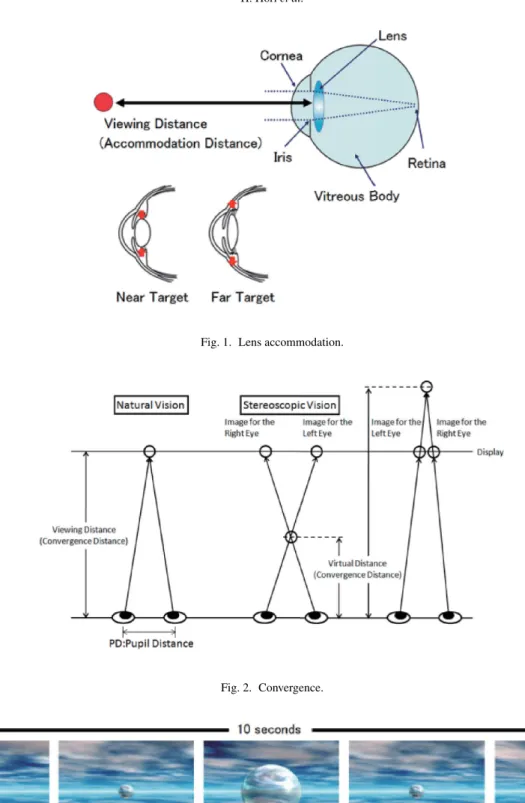
Stereoscopic vision is generally explained to the public as follows: “During natural vision, lens accommodation (Fig. 1) is consistent with convergence (Fig. 2). During stereo-scopic vision, while accommodation is fixed on the display that shows the 3D image, convergence with left and right eyes crosses at the location of the stereoimage. Hence, ac-commodation and convergence are mismatched. This is the main reason for the visual fatigue caused by stereoscopic vision (Wannet al., 1995; Simonet al., 2005; Davidet al., 2008; Hong and Sheng, 2010).” According to the findings
Copyright cSociety for Science on Form, Japan.
presented in our previous reports, however, such an expla-nation is mistaken (Miyaoet al., 1996; Hasegawa et al., 2009).
It is also commonly said that if accommodation coin-cides with convergence and focuses on the fusional points of stereoimages, focus is not on the display and blurred im-ages are seen. This can happen occasionally and is a cause of visual fatigue. We pointed out, according to our findings presented in a previous report, however, such a theory is also mistaken (Miyaoet al., 2009). Nevertheless, it is still often said that the mismatch between accommodation and convergence is the main reason for visual fatigue. This may be because the experimental evidence obtained in our pre-vious studies, where we did not measure accommodation and convergence simultaneously, was not strong enough to convince people.
In this paper, we report experimental results obtained us-ing a newly developed device that can simultaneously mea-sure accommodation and convergence, in order to compare the fixation distances during viewing of 2D and 3D images.
2. Method
The subjects in this study were 6 healthy young men and women in their twenties (2 with uncorrected vision, 4 who used soft contact lenses). The aim was to compare fixa-tion distances between accommodafixa-tion and convergence in young subjects while they viewed 2D and 3D images. We obtained informed consent from all subjects and approval from the Ethical Review Board of the Graduate School of Information Science at the Nagoya University. The details of experimental setup were as follows:
We set an LCD monitor 1 m in front of subjects, and pre-sented 2D or 3D images where a spherical object moves for-S71
Fig. 1. Lens accommodation.
Fig. 2. Convergence.
Fig. 3. Spherical object movies.
ward and back with a cycle of 10 seconds (Fig. 3). In theory, the spherical object appears as a 3D image at 1 m (i.e., the location of LCD monitor) and moves toward the subjects to a distance of 0.35 m in front of them. We asked them to gaze at the center of the spherical object for 40 seconds, and mea-sured their lens accommodation and convergence distance during that time. The 3D image was presented by using a liquid crystal shutter system and a circular polarizing filter system. The 2D image was presented by using only a liq-uid crystal shutter system. Measurements were made three
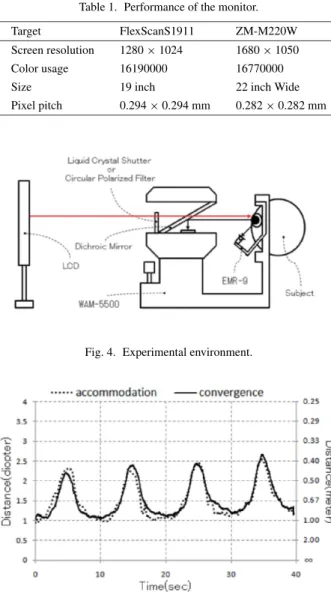
times each. The performance of the monitor used in the ex-periment is shown in Table 1. For the measurements, we made an original machine by combining WAM-5500 and EMR-9.
WAM-5500 is an auto refractometer (Grand Seiko Co., Ltd.) that can measure accommodative power with both eyes opened under natural conditions. It enables contin-uous recording at a rate of 5 Hz for reliable and accu-rate measures of accommodation. Some previous studies used WAM-5500: measurement of state accommodative
re-Table 1. Performance of the monitor.
Target FlexScanS1911 ZM-M220W
Screen resolution 1280×1024 1680×1050
Color usage 16190000 16770000
Size 19 inch 22 inch Wide
Pixel pitch 0.294×0.294 mm 0.282×0.282 mm
Fig. 4. Experimental environment.
Fig. 5. Liquid crystal shutter system (Subject A).
sponses among a college population with visual discomfort over a 90-s time period (Toshaet al., 2009); comparison of clinical subjective findings with objective measurements of AR (Jaclynet al., 2009); evaluation of validity and re-peatability (Amy and Leon, 2010); comparison of refrac-tive values measured with and without cycloplegia, or with fogging lenses (Queir´oset al., 2008); and measurement of near-induced transient myopia response with significant vi-sual discomfort (Eric et al., 2010). WAM-5500 has two measurement modes. One is a static mode, and the other is a dynamic mode. We used the dynamic mode. The in-strument was connected to a PC running the WCS-1 soft-ware via an RS-232 cable with the WAM-5500 set to Hi-Speed (continuous recording) mode. During dynamic data collection, we simply depress the WAM-5500 joystick but-ton once to start recording, and once to stop at the end of the desired time frame.
EMR-9 is an eye mark recorder (NAC Image Technol-ogy Inc.) that can measure convergence distance using the pupillary/corneal reflex method. The specifications are resolution of eye movement of 0.1 degrees, measurement range of 40 degrees, and measurement rate of 60 Hz. Small
Fig. 6. Circular polarizing filter system (Subject A).
Fig. 7. Liquid crystal shutter system (Subject B).
optical devices of 10 mm width and 30 mm long for ir-radiation and measurement of infrared are supported by a bar attached to the cap mounted on the head of the subject. Some previous studies used EMR-9 (or 8) in development of occlusion-free animation of driving routes for car navi-gation systems (Takahashiet al., 2006); examination of ex-ploratory eye movements for evaluating the development of visual cognitive function in childhood (Egamiet al., 2009); and estimation of user arm motion supported by the wear-able type robot (Sakaki, 2009).
We used a liquid crystal shutter system or a circular po-larizing filter system combined with the respective binocu-lar vision systems for 2D and 3D. The experimental envi-ronment is shown in Fig. 4 and Table 2. Here, we note that brightness (cd/m2) is a value measured through the liquid
crystal shutter or the circular polarizing light filter, and that the size of the spherical objects (deg) is not equal because the binocular vision systems for 2D and 3D have different display sizes.
The images we used in the experiment are trademarked as Power 3DTM(Olympus Visual Communications, Corp.). This is an image creation technique that combines near and far views in a virtual space, and has multiple sets of virtual displays, the position of which can be adjusted. When subjects view a close target (crossed view), far view cannot be fused. When they see a far view, the close target (crossed view) is split and two targets are seen. Therefore, Power 3D presents an image that is extremely similar to natural vision.
Table 2. Experimental environment.
System Liquid crystal shutter Circular polarizing filter
Brightness of spherical object (cd/m2) Far 3.6 34.5
Near 3.0 31.1
Illuminance (lx) Far 126 129
Near
Size of spherical object (deg) Far 0.20 0.17
Near 7.70 6.44
Fig. 8. Circular polarizing filter system (Subject B).
Fig. 9. 2D vision.
3. Results
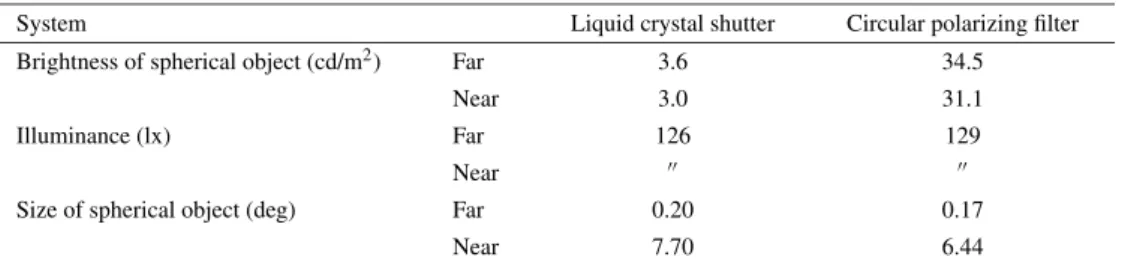
The measurements for the 6 subjects showed roughly similar results. For 3D vision, results for Subjects A and B are shown in Figs. 5–8 as examples. When Subject A (23 years old, male, soft contact lenses) viewed the 3D image with the liquid crystal shutter system (Fig. 5), accommo-dation changed between about 1.0 Diopter (100 cm) and 2.5 Diopters (40 cm), while convergence changed between about 1.0 Diopter (100 cm) and 2.7 Diopters (37 cm). The changes in the respective diopter values have almost the same amplitude and are in phase, fluctuating synchronously with a cycle of 10 seconds corresponding to that of the 3D image movement. In the same subject but with the circular polarizing filter system (Fig. 6), accommodation changed between about 0.8 Diopters (125 cm) and 2.3 Diopters (43 cm) while convergence changed between about 1.0 Diopter (100 cm) and 2.3 Diopters (43 cm). The changes in the
re-Fig. 10. 3D vision.
Table 3. Mean value of accommodation and convergence. Accommodation Convergence Difference
2D 0.96 D 0.96 D 0 D
(104.2 cm) (104.2 cm) (0 cm)
3D 1.29 D 1.32 D 0.03 D
(77.5 cm) (75.8 cm) (1.7 cm)
spective diopter values have almost the same amplitude and are in phase, fluctuating synchronously with a cycle of 10 seconds corresponding to that of the 3D image movement.
Similarly, when Subject B (29 years old, male, soft con-tact lenses) viewed the 3D image with the liquid crystal shutter system (Fig. 7), both accommodation and conver-gence changed in almost the same way between about 0.8 Diopters (125 cm) and 2.0 Diopters (50 cm). The changes in the respective diopter values have almost the same am-plitude and are in phase, fluctuating synchronously with a cycle of 10 seconds corresponding to that of the 3D im-age movement. In the same subject but with the circular polarizing filter system (Fig. 8), accommodation changed between about 0.7 Diopters (143 cm) and 1.6 Diopters (63 cm), while convergence changed between about 1.0 Diopter (100 cm) and 2.0 Diopters (50 cm). The changes in the re-spective diopter values are a little different in amplitude, but are in phase, fluctuating synchronously with a cycle of 10 seconds corresponding to that of the 3D image movement.
For 2D vision, the results for Subject A are shown in Figs. 9 and 10 as an example. When he viewed the 3D image with the liquid shutter system, his accommodation and con-vergence changed between about 1.0 Diopter (100 cm) and
2.5/2.7 Diopters (40/37 cm). They had almost the same am-plitude and were in phase, fluctuating synchronously with a cycle of 10 seconds corresponding to that of the 3D im-age movement. In contrast, when viewing the 2D imim-age, the diopter values for both accommodation and convergence were almost constant at around 1 Diopter (1 m).
Finally, Table 3 shows mean values of accommodation and convergence in the 6 subjects when they viewed 2D and 3D images. The data for the 3D image were obtained using the liquid crystal shutter system only. As shown in Table 3, the mean values of accommodation and convergence for the 6 subjects when the viewed the 2D image were 0.96±0.12 and 0.96±0.07, respectively. The difference was negligi-ble. When viewing the 3D image, the values of accommo-dation and convergence were 1.29±0.11 and 1.32±0.08, respectively. The difference was about 0.03 Diopter, which is also negligible. Therefore, we can say that there is not much quantitative difference in the results between accom-modation and convergence when viewing either the 2D or 3D images. In this experiment, there were a few subjects who could recognize the stereoscopic view with the liquid crystal shutter but not with the circular polarizing filter sys-tem. There were also a few subjects who could recognize the stereoscopic view but complained that it was not easy to see with stereoscopic vision at the point where the 3D image was closest.
4. Discussion
In this experiment, we simultaneously measured accom-modation and convergence while subjects viewed 2D and 3D images for comparison, since it is said that accommoda-tion and convergence are mismatched during stereoscopic vision. Wannet al. (1995) said that within a VR system the eyes must maintain accommodation on the fixed LCD screens, despite the presence of disparity cues that necessi-tate convergence eye movements in the virtual scene. More-over, Hong and Sheng (2010) said that the natural coupling of eye accommodation and convergence in viewing a real-world scene is broken in stereoscopic displays.
From the results in Figs. 5–8, we see that when young subjects are viewing 3D images accommodative power is consistent with the distance of convergence with both the liquid crystal shutter and circular polarizing filter systems, and that the values of focusing distances are synchronized with each other.
In addition, the results in Figs. 9 and 10 and Table 3 sug-gest that the ocular functions when viewing 3D images are very close to those during natural viewing. In general, it is said that there is a slight difference between accommo-dation and convergence even during natural viewing, with accommodation focused on a position slightly farther than that of real objects and convergence focused on the position of the real objects. This is said to originate in the fact that the index is seen even if focus is not accurate because of the depth of field (Miyaoet al., 1993). In our 3D vision experiments, the mean values of accommodation and con-vergence were found to be 1.29 ±0.11 and 1.32±0.08, respectively. This means that accommodation focuses on a position slightly farther than that of convergence by about 0.03 Diopter. Hence, our findings suggest that eye
move-ment when viewing 3D images is similar to that during nat-ural viewing. In the light of the above, the conventional the-ory stating that within a VR system our eyes must maintain accommodation on the fixed LCD screen may need to be corrected. We can also say that the kind of results presented herein could be obtained because the 3D images used in the experiments were produced not by conventional means but with Power 3D, whose images are extremely close to nat-ural viewing. Therefore, we consider that as long as 3D images are made using a proper method, accommodation and convergence should almost always coincide, even for an image that projects out significantly, and that we can view such images more easily and naturally. Conventional 3D and the Power 3D on HMD have been compared exper-imentally (Hasegawaet al., 2009). This study also found that Power 3D is superior to conventional 3D.
Finally, we should note that the experimental value of accommodation was a little smaller in Diopters than that of convergence at the viewing positions closest and farthest to the 3D object when the circular polarizing filter system was used. This is likely because the brightness with such a system is higher than that with a liquid crystal shutter system. A previous study suggests that the lens may in many cases not be accommodated strictly when brightness is low according to the previous works (Miyaoet al., 1993).
5. Conclusion
In this experimental investigation, we simultaneously measured accommodation and convergence while subjects viewed 2D and 3D images for comparison. The results sug-gest that the difference in eye movement for accommoda-tion and convergence is equally small when viewing 2D and 3D images. This suggests that the difference between accommodation and convergence is probably not the main reason for visual fatigue, motion sickness, and other prob-lems. The number of subjects in this experiment was only 6, which may still be too small for our findings to be com-pletely convincing. As said to Amy and Leon (2010), the apparatus used in this study (WAM-5500) is high reliable. If we repeat this study in the near future with a larger num-ber of subjects, the results will have even greater reliability. In order to compare states more similar to natural vision, we also would like to simultaneously measure and compare both accommodation and convergence in subjects viewing both real objects (natural vision) and 3D images (stereo-scopic vision) of those objects made with 3D cameras.
References
Amy, L. S. and Leon, N. D. (2010) Clinical evaluation of the Grand Seiko Auto Ref/Keratometer WAM-5500,OPO,30, 143–151.
David, M. H., Ahna, R. G., Kurt, A. and Martin, S. B. (2008) Vergence-accommodation conflicts hinder visual performance and cause visual fatigue,Journal of Vision,8(33), 1–30.
Egami, C., Morita, K., Ohya, T., Ishii, Y., Yamashita, Y. and Matsuishi, T. (2009) Developmental characteristics of visual congnitive function during childhood according to exploratory eye movements,Brain & Development,31, 750–757.
Eric, B., Tosha, C., Chris, C. and William, H. R., III (2010) Measuring near-induced transient myopia in college students with visual discom-fort,Optometry and Vision Science,87, 10.
Hasegawa, S., Omori, M., Watanabe, T., Fujikake, K. and Miyao, M. (2009) Lens accommodation to the stereoscopic vision on HMD, Lec-ture Notes in Computer Science,5622/2009, 439–444.
Hong, H. and Sheng, L. (2010) Correct Focus Cues in Stereoscopic Dis-plays Improve 3D Depth Perception, SPIE, Newsroom.
Jaclyn, A. B., Junita, D. C., Kimberley, M., Mark, R. and John, K. P. (2009) Does the dynamic cross cylinder test measure the accommodative re-sponse accurately?,Optometry,80, 630–634.
Miyao, M., Otake, Y., Ishihara, S., Kashiwamata, M., Kondo, T., Sakak-ibara, H. and Yamada, S. (1993) An experimental study on the objective measurement of accommodation amplitude under binocular and natural viewing conditions,Tohoku Exp. Med.,170, 93–102.
Miyao, M., Ishihara, S., Saito, S., Kondo, T., Sakakibara, H. and Toyoshima, H. (1996) Visual accommodation and subject performance during a stereographic object task using liquid crystal shutters, Er-gonomics,39(11), 1294–1309.
Miyao, M., Hasegawa, S., Omori, M., Takada, H., Fujikake, K., Watanabe, T. and Ichikawa, T. (2009) Lens Accommodation in Response to 3D Images on an HMD, IWUVR.
Queir´os, A., Gonz´alez-M´eijome, J. and Jorge, J. (2008) Influence of fog-ging lenses and cycloplegia on open-field automatic refraction,OPO, 28, 387–392.
Sakaki, T. (2009) Estimation of intention of user arm motion for the proac-tive motion of upper extremity supporting robot,IEEE 11th Interna-tional Conference on Rehabilitation Robotics, Kyoto InternaInterna-tional Con-ference Center, Japan, June, 23–26.
Simon, J. W., Kurt, A., Marc, O. E. and Martin, S. B. (2005) Focus cues affect perceived depth,Journal of Vision,5, 834–862.
Takahashi, S., Yoshida, K., Shimada, K. and Nishita, T. (2006) Occlusion-Free Animation of Driving Routes for Car Navigation Systems, IEEE. Tosha, C., Eric, B., William, H. R., III and Chris, C. (2009)
Accommoda-tion response and visual discomfort,OPO,29, 625–633.
Wann, J., Rushton, S. and Mon-Williams, M. (1995) Natural problems for stereoscopic depth perception in virtual environments,Vision Res., 35(19), 2731–2736.