Context-based design of mobile applications for
museums: A Survey of existing practices.
Dimitrios Raptis
1, Nikolaos Tselios
1,2, Nikolaos Avouris
11
Human-Computer Interaction Group, ECE Department
2
Early Childhood Education Department University of Patras, Rio Patras, 26500 Greece
{draptis, nitse, N.Avouris}@ee.upatras.gr
ABSTRACT
This paper includes a review of mobile applications used in museum environments, focusing on the notion of context and its constituent dimensions. Museums are a representative example in which the context influences interaction. During a museum visit, the visitors interact with the exhibits through mobile devices. We argue that, effective interaction design needs to take into consideration multiple dimensions of the context. Since context is often misinterpreted, superficially used or poorly defined, we attempt to analyze a number of existing mobile applications used in museum environments, through this perspective. The point of analysis is to evaluate those applications against various context dimensions. We argue that these results can be useful in other kinds of applications, in which the impact of context is not taken for granted.
1.
INTRODUCTION
Mobile computing has been an active area of research for the past years. However, research in the field suffers from fundamental methodological weaknesses, [10]. The approaches are somewhat empirical, giving a sense that the designers already know what systems to build and what problems to overcome. As Kjeldskov states, ‘given the youth of the research field, this can hardly be true’. Additionally, real world ethnographic studies are not considered important and no special effort has been put in delivering solid design methodologies for mobile applications. As a result, various issues remain to be investigated: First of all, effective and efficient positioning and context awareness methods and models. In other words, models to present useful information to the user with respect to the information communicated to him/her by the environment. Models to invert the flow of information; concerning context of use in mobile device; i.e. the flow should be inverted compared to a desktop computing environment. Information should be contextualized and
personalized according to personal needs, and presented to the user rather than having the user searching endlessly for useful information. This step should be achieved through a deeper understanding of the tasks in certain environments and clarification of cognitive issues related to those tasks.
As a result, to achieve the ultimate design goal of ‘interface transparency’, the process should be viewed as an effort to seamlessly integrate the computational device to our natural environment. By building the virtual into the real, the real is enhanced, but conversely, by drawing upon the physical, there is the opportunity to make the virtual more tangible and intuitive, lowering the overall cognitive load associated with each task. As a result, the mobile devices should not be treated as an autonomous environmental device, but as an artifact seamlessly integrated into the environment which functions as an ‘information harvesting device’ [1]. From this point of view, addressing the question of finding the best ways of making use of the real to support the virtual and visa-versa, is of central importance.
Therefore, the notion of context is of fundamental importance to anticipate the design challenges in mobile applications. From an abstract perspective, we stress that the major difference concerns the type of usage of mobile devices. Elements that can affect the task itself and the interaction with the application are distributed across the environment. Mainly these devices are used in environments which, generally speaking, involve movement, unpredictable states and various physical parameters, like noise and light, limited screen etc. These external factors, usually recalled under the name of ‘environment’ as defined by Chen and Kotz [2], can alter significantly the way a user interacts with a mobile application. All these parameters are encapsulated in the concept of context. According to Dix et al. [5], context is defined as any information that can be used to characterize the situation of an entity. An entity should be treated as anything relevant to the interaction between a user and an application, such as a person, a place or an object, including the user and the application themselves. In general terms, context is typically the location, identity and state of people, groups and computational and physical objects.
This is a rather broad definition of context. However, since this concept is directly related to the design process of mobile applications, more research is needed to produce a definition that can be used in design practice. So far, integration of the notion of context directly into the design the process is not straight forward. This is partly due to the fact that current research on the notion of context is a synthesis of different points of view, ill defined and ambiguous definitions, [9]. An interesting theoretical framework has been proposed by [6], relating to the notions of space and location as constituent aspects of context. According to this
framework context is decomposed to a number of dimensions as discussed in the following.
This paper is organized as follows. First we provide an overview of dimensions of context as proposed by Dix [6]. Then, we briefly describe a number of representative existing applications intended to enhance the experience of a visitor in different museums. A review of the design approaches against each of the four main dimensions of context is presented for these applications. Also, discussion of different approaches and their impact towards truly context aware mobile application to museums is included. Finally, we attempt to stress the best design practices and provide a practical approach of context in the particular socio-cultural aspects emerging in a museum’s visit. This is a process to further understand the user’s needs and re-orientate the discussion from a technologically dominant design paradigm to an activity focused, context centered approach.
2.
Theoretical Framework of context
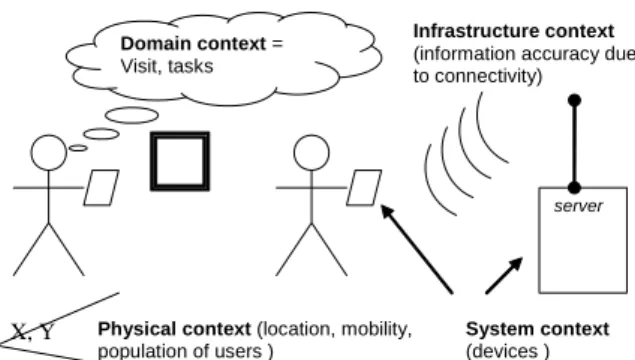
This particular theoretical framework defines context through four dimensions, which complement and interact with each other. These dimensions are: system, infrastructure, domain and
physical context. We argue that this view of context is useful for the design practice, and can be useful framework for many areas of mobile applications. While the emphasis of this paper is in Museum environments, we believe that useful design guidelines of general validity can emerge through this approach which lead to a better comprehension of the influence that context wields in usability of mobile applications.
Domain context = Visit, tasks server System context (devices ) Infrastructure context
(information accuracy due to connectivity)
Physical context (location, mobility, population of users )
X, Y
Figure 1. Framework of context dimensions
System Context refers to all the interconnected devices and their applications which constitute the system as whole. Is particular related with the awareness that every device has, about the existence of the others, and the way the overall functionality is distributed across them. Careful design of mobile applications should take into consideration the discovery and exploitation of applications and information distributed across the whole system.
Infrastructure Context describes the way the devices and their integrated applications are connected. It is related with the validity of the information, namely how timely and accurate is the information that every node of the system reflects. The central idea of infrastructurecontext is related to the variety of awareness mechanisms that a system has to give to each user about the existence of a component and the existence of timely presented information.
Domain Context is related with the adaptability that every system must provide to the specific characteristics of different users taking in consideration the situated nature of the interaction with mobile devices. The identity and the needs of each user have to guide the system to alter the quantity and the type of information that is presented to her.
Physical Context is related to the nature substance of the device and the system as a whole, and its relation with the natural environment. It describes the ability that a device must have, to know its exact position in space, to move around the space, to identify natural conditions (i.e. noise) and to communicate with other entities. Therefore, physical context can be further decomposed into three taxonomies. These are location, mobility
and population. Location describes the ability of a mobile device to understand its position in space, either by knowing the exact coordinates (cartesian) or in a more general level, i.e. inside a room (topological). Space has two dimensions: the physical and the virtual space. Virtual space exists only with technology, i.e. the physical space in a museum is a room with exhibits and the virtual space is related to the information as structured to support the visit to it. The innovation that appeared with the use of mobile devices, compared with desktop systems, is that allowed the two dimensions of space to coexist and influence one another, i.e. when a user moves to another room (physical space) then the system changes the information presented to her (virtual space).
Mobility is related with the basic characteristic of these devices, which is the non static nature. It can be described accurately by three levels: a) the level of mobility (fixed, mobile embedded and pervasive), b) from the number of people that can interact with a component at the same time (personal, group and public) and c)
population, which is related with the entities of different type that the system can interact (people, devices and objects).
It is evident, that a visit to a museum involves tasks that may be supported through a mobile application. The user has only a partial understanding of the available exhibits and a significant need to be supported during the visit. Her needs are of complementary nature to the information, as presented by the physical environment. She needs to view alternative representations, concerning the historical role of the people or the artifacts presented, the artistic value of a painting etc. This cognitive process of immersion into the cultural context, represented by the museum exhibits, could be supported by drawing upon the stimuli produced during the visit, using context aware mobile devices. Therefore, these devices should be viewed as tools to enhance the involvement of the user into the cultural discovery process, challenge him to imagine the social, historical and cultural context and align him to a meaningful and worthy visit experience. In the following, we review a number of approaches realized to support such a visit, and examine their efficiency using the context dimensions as guiding paradigm and point of reference.
3.
The studied systems
It is important to understand the kind of relation that exists between the exhibits and the visitors of a Museum. The purpose of the visitor is to see and learn more and not to explicitly use the technology, [18]. Concisely, the type of visitor’s behavior can be described through four metaphors, [12]. The ant visitors, who follow a specific path and spend a lot of time observing almost all the exhibits, the fish visitors, who move most of the times in the
centre of the room without looking at exhibit’s details, the
butterfly visitors, who don’t follow a specific path, are guided by the physical orientation of the exhibits and stop frequently examining their details, and finally, the grasshopper visitors, whose visit contains specific pre-selected exhibits, and spend a lot of time observing them. Deeply understanding of the needs of all the types of visitors is important during the design phase, to avoid disturbances that can destruct the visitor from her objective. Therefore, decisions made for the technology used and the styles of interaction, with the devices involved, have to deal with user’s patterns of visit. An example of disrespecting the user’s needs, were some of the systems used in the Exploratorium, which after evaluation tests, were found distracting and therefore not used in the museum, [8].
The museum visit is an emotionally intense learning process. It is well known that the emotions vary during the visit, affected by the visitor’s personality and by the ‘feelings’ projected by the exhibits. In respect of the visitor’s behavior, the most important factor, affecting the interaction, is the content which is going to be presented. It must be attracting, forcing the user to dig up for details and increasing the levels of excitement. Because of the emotional involvement, the use of videos, audio descriptions etc., trigger the ‘sensitive memory’ and if are carefully mixed with the
context, may lead to a richer experience compared to non-supported museum visits. As a result, the design process should involve, as a factor of great importance, the generation of various forms of content, not only concerning type of content (i.e. video or text) but also concerning different approaches of the same subject, in order to anticipate varying visitor’s needs.
Based on this discussion about visitor’s behavior in a museum setting and the significance of content, we will focus on the studied systems. We will briefly present the way each system delivers the content to the user. In the following sections, we will try to unveil the degree the context has been encapsulated in the design process.
The common characteristic of every system is the use of PDAs as a basic mobile interaction device. The first system is the “Electronic Guidebook”, deployed in the Exploratorium, a science museum in San Francisco, [8]. The system tries to involve the visitors to directly manipulate the exhibits and gives instructions and additional science explanations about the natural phenomena people are watching. The next system is based on the Marble Museum of Carrara and it was one of the first fully operating systems in a museum setting, [4]. This system stores the information locally in the PDA’s memory, uses a map to guide the visitors around the museum and presents content of different abstraction levels (room, section and exhibit). The indoor “ImogI” system is located in the Gallo-Roman Museum of Tongeren, uses Bluetooth to establish communication between the PDAs and the exhibits, and reflects the closest exhibits to the location of the user, [13]. The “Sotto Voce” system is deployed in Filoli, a Georgian Revival House in Woodside, California and gives details about everyday things located in an old house, [20], by having pictures of the walls on the PDA’s screen and asking from the user to select the exhibit she is interested in, by pressing it. The “Points of Departure” system, in San Francisco Museum of Modern Art [17], gives details, in video and audio form, about the techniques used in an artwork, the message that the artist wants to demonstrate etc., by having ‘thumbnails’ of several exhibits on the PDA’s screen. Also it uses ‘Smart Tables’ in order to enrich
the interaction. A system, existing in the Lasar Segall Museum, in Sao Paolo, Brazil, [7], which automatically delivers information to the PDA, about more than 3000 paintings. In the Tokyo University Digital Museum, a system exists, which uses three different approaches to deliver content. The PDMA application, in which the user holds the device above the exhibit she is interested in, the Point-it application, in which the visitor uses laser-pointer to select specific exhibits and finally the Museum AR which accomplishes the same purpose by wearing glasses to the visitors and making them look at an exhibit to get details about it, [11]. Finally, some experimental systems which are under deployment in Museums, are the system developed in the C-Map project, made by a research group in Kyoto, Japan, [14], which uses active badges to simulate the location of the visitor, allowing tour planning and a VR system, controlled by the gestures of the visitor. A Tour guide developed in Taiwan, [3], in which the information is automatically presented about the exhibits and there is no variation in the form of the visit, but subjective tour guides are used. A different approach influenced by the Museum of Fine Arts in Antwerp, [19], in which the user carries around a camera and selects exhibits, or details of an exhibit by taking a picture. A tour guide in the PEACH project, [16], which migrates the interaction from the PDA to screens and uses a TV like metaphor, with the use of presenters to deliver content. Finally, a nomadic information system, the Hippie, developed in the framework of the HIPS project, [15], which is called nomadic because the user can access a personal virtual space during or after her visit. In the latter system, an electronic compass is used to identify the direction of a visitor.
4.
Evaluating design process against context
In section 3, we outlined the main characteristics of the studied systems. In order to examine the significance of context, during the design process we study the context dimensions of these systems. In this section we discuss each system’s approach, we focus on major problems and finally, we attempt to derive some general conclusions.
4.1
System Context
As already discussed, decisions concerning, the technology, influence the interaction between the user and the environment. The system context focuses in the technological parts that constitute the system, either software or hardware, and in the connections between them and the environment.
In all the examined systems, only one design decision was common for every research group. PDA was the primary device to help the visitor interact with the museum exhibits. In order to serve this purpose four different technological approaches, using PDAs, where adopted by the system designers.
In the first approach, the PDA consist the whole system. There are not any other devices or awareness mechanisms involved and the information presented to the user is stored locally in the PDA. Followers of this option are the “Sotto Voce” and the “Points of Departure” systems.
The second approach uses RFID tags to establish communication between the PDAs and the exhibits. This approach is adopted by the “Rememberer” system in the Exporatorium Museum. The “Rememberer” uses cameras to take pictures from the visitors interacting with the exhibits. Through Wi-Fi, the comments that the users wrote in the PDAs and the pictures taken, are send to a
web server, stored in the form of web pages, allowing each user to remember her personal visit afterwards.
The next approach is adopted by the ‘ImogI’ system and uses Bluetooth to establish communication with the exhibits and to deliver the content. Because of several problems that occurred, the design team has decided to replace, in the future, Bluetooth with IrDA, as they found it a more suitable solution to the problem.
All the other systems include IrDA technology to estimate the position of the visitor in space. The IrDA tags are placed near every exhibit or in the entrance of each exhibition room. The use of Wi-Fi derives the information to the PDA from a server, except from the Marble Museum system, in which the data are stored locally in the device. Many different additional devices built and integrated in these systems. Some designers placed screens in specific places, either as a standalone device like the ‘Smart Table’ in ‘Points of Departure’, or as interacting devices with the PDAs, where the user has the opportunity to transmit sequentially her interaction with the system from the PDA to the Screen (“Virtual window”). In the experimental project influenced by the Museum of Fine Arts in Antwerp, the system forces the users to use cameras attached to the PDAs, take an image of an exhibit they wish to have information about and then see the information in the screen of the PDA. In the Point-it application in Tokyo the visitors use a laser pointer to inform the system about the exhibit they are interesting in, or in the Museum AR a simple look is enough.
As a result of the above discussion we can understand that the interaction between the visitor and the exhibits can be formed in various ways, depending on the devices that constitute the system. Decisions that seem of low significance to the design of the application can actually have a great importance i.e. the choice of the PDA’s type. In order to stress that every single detail during the design phase, can affect the interaction patterns, we will present some details about the differences that may result from the decision on selecting between Pocket PC and Palm OS operating systems. Each of these two operating systems has its advantages and disadvantages. Pocket PCs have bigger screens, higher resolution and support the ‘landscape mode’ of projecting info, if necessary. They can also play MP3s and multimedia in a more effective way compared to the Palm OS. They support four ways of text entry, in contrast to Palm OS, which supports two. In contrary, Palm OS devices are considered easier to use, they have an increased battery life, a lower cost and require fewer computational resources (e.g. memory and processor). As a result, depending on the museum application, a careful choice has to be made, in which kind of operating system supports better the needs of a visitor.
Except from hardware, the dimension of system context involves also software components, or more specific, the set of applications that constitute the system. There is an awareness factor that implies that the user must know each time which applications are available, and in which state these are. All the interconnections between applications are part of system context. In such distributed applications, it is important the feedback that the user gets from the system about the existing devices in the system, the existing applications etc.
Almost all the systems contain devices plugged in the exhibits. The technology selected, during the design phase, for this
purpose, can affect the interaction style between the user and the system. The ‘Rememberer’ system uses RFID tags. These tags can be used only in short distances and every exhibit must have at least one tag in order to have a fully functioning system. The metaphor that describes the interaction with the RFID tags is the use of the PDA as a scanner. The user has to locate the exhibit she is interested in, in the physical space, scan it with her PDA and then see or listen to the information about it. This procedure can produce a lot of problems, especially in museums that contain a lot of exhibits placed next to each other. It can be hard to locate the RFID card, and if the exhibit has a small size, no more than one people can interact with it simultaneously. With the use of IrDA, problems also exist. Use of many IrDA beacons may be prohibitive, since they are more expensive and there can be mixing signals, if they are placed next to each another. They operate in a higher distance than the RFIDs, and so we can describe the interaction using a “remote control” metaphor. We must underline that the use of RFID or IrDA, solves the problem of the bond between the physical and the virtual space, but in different ways. With IrDA, it’s up to the designer, if she will produce a system that automatically projects information or the user will have the initiative to select it.
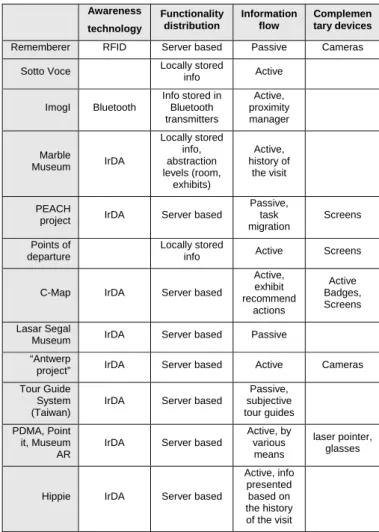
Table 1. Design decision affecting system context.
Awareness technology Functionality distribution Information flow Complemen tary devices
Rememberer RFID Server based Passive Cameras
Sotto Voce Locally stored
info Active ImogI Bluetooth Info stored in Bluetooth transmitters Active, proximity manager Marble Museum IrDA Locally stored info, abstraction levels (room, exhibits) Active, history of the visit PEACH
project IrDA Server based
Passive, task migration Screens Points of departure Locally stored
info Active Screens
C-Map IrDA Server based
Active, exhibit recommend actions Active Badges, Screens Lasar Segal
Museum IrDA Server based Passive
“Antwerp
project” IrDA Server based Active Cameras
Tour Guide System (Taiwan)
IrDA Server based
Passive, subjective tour guides PDMA, Point it, Museum AR
IrDA Server based
Active, by various means
laser pointer, glasses
Hippie IrDA Server based
Active, info presented
based on the history of the visit
A suggestion, of some designers, for tackling the constraints of the mobile devices, is the temporary migration of context of interaction from the small screen of PDAs to larger screens that are placed throughout the museum, giving the user the opportunity to use them for some time. Thus, the user can have richer interaction with information spaces, supported by multimedia. However, we must bear in mind that problems of privacy emerge in this case. Finally, usage of cameras and laser-pointers have been suggested as interaction devices, however these may impose usability problems to some user groups, especially in people of certain age groups, who cannot hold for considerable amount of time steady neither the camera nor the laser-pointer.
As discussed in this section, the system context plays an important role in mobile applications design, as it influences the visitor’s behavior towards the Museum and the tasks, so the various issues related to system context should be taken in consideration early enough in the design process, since inadequate design in system level most of the times leads to errors that are very difficult to deal with later. In Table 1, we summarize the main system context
characteristics of the Museum applications discussed in the above. By the term ‘awareness technology’, we characterize the technology used to establish communication between the user and the exhibits. The ‘functionality distribution’ describes the content delivery model and the way the available functionality is distributed across the system, the ‘information flow’ indicates if the user acquires information ‘actively’ or ‘passively’ (e.g. with her explicit request or by repositioning herself) and finally by the term ‘complementary devices’ we refer to other devices, included in the systems, other than PDAs.
4.2
Infrastructure Context
The infrastructure context concerns the connections between the devices that comprise the system, which influence the validity of the information that is provided through them to the users. Since the applications involve continues changes in the time-space dimension, the validity of the projected information may vary for many technological and domain related reasons. This factor needs to be studied separately, as it may influence the context awareness of the user. In some cases, this dimension may influence the well being of the users. If we consider a mobile device that projects levels of radiation in a possibly contaminated area, the consequences of a system malfunction, resulting in providing not timely information to the user, can have devastating effects. In the specific domain of the Museums, the results may not be so critical, but can lead the user to various misunderstandings. For instance a user, who is not aware that the wireless network infrastructure is temporarily out of service, may be frustrated when attempting in vain to receive information about an exhibit. The infrastructure context needs to be preserved not just in problematic situations. It is also related with the validity and timely updates of available information. This can be clearly seen in collaboration activities. Then, the user needs to know the other users, the virtual space, the shared objects, the manipulations that another user may perform in an object etc. Also, as another example we can assume that there are applications with varying content, like the electronic messages the visitors leave at the exhibits. In such a case, it is important to give feedback about the changes in content
The systems we are studying use an indirect way of informing the user that her requests have been carried out: the user sees and hears the reflection of her requests on the PDA. There is no clear notification that the user’s demands executed successfully or not. Some of the systems use external factors, as signs of success, such as a led light (“Rememberer”) and audio signals (“Marble Museum”). The most peculiar, but also successful, awareness factor is the fade out effect in the PDA, and correspondently the fading in image, in the screens used in the PEACH system, as the user migrate interaction context from the PDA to the Virtual Window. But in general terms, the user is left alone when problems occur and the systems leave it up to the user to find it out, by observing that there is no progress. We have to point that it is the nature of the interaction that prevents the designers to have feedback messages in every step (it could be very distracting and even annoying), but it is important, for designers, to include a non intrusive approach to inform that there is a problem and provide guidelines on what the user should do in order to tackle the problem. Without this information about an exceptional event, the user can focus on the device, spend a lot of time trying to discover if something is wrong, stop interacting with the exhibits, i.e. switch from the museum visit to the device. Replication in information stores may provide a good solution to this problem in the case of Museums applications. For instance, in case that an important component is down, e.g. the wireless network, the designers have to find alternative ways of projecting information. So, in this specific example, an alternative method of overcoming the lack of connection may be to use cashed information in the PDA’s memory, concerning the most significant exhibits of the museum.
4.3
Domain Context
An important dimension of mobile applications, is their situated domain context. It concerns aspects related to the specific situated interaction that takes place in the specific domain. In many applications, designers exploit the personal nature of these devices to associate mobile devices with users. In museum applications this is not of prime importance as we often lack information about user profiles and characteristics. It is however important to consider that each visitor in a museum has different expectations, and is interested in different aspects of the exhibits. The domain context concerns alternative ways according to which the system allows users, to interact with the system in the best way.
In the studied systems, those that allow interaction of the users with servers, there is a possibility for personalized interaction. These systems require from the user to login, answer some specific questions, in order to build a model of the user and have the presentation of the information in her PDA according to her language, her expertise level and her physical needs (i.e. bigger fonts for those with sight impediments). Often systems limit their adaptation at this level. This, however, can be extended to other more domain related characteristics. During the design phase we need to focus beyond issues of content delivery, which almost all the systems take care. As Dix, [6], predicted in his model, the four elements of context interact with each other. Therefore, decisions concerning system context, i.e. the technology used to deliver information, affect domain context. So, the information may appear in the mobile device in two different ways: the system may push information to the user or it may wait until the user decides to pull it from the system. In the first case, special
consideration should be taken to the user’s specific activity and objective. If the user is engaged in an educational activity, probably she is not interested in information about a nearest exhibit. So, questions related to situated domain context are the following: Does the system propose any relevant information based on the history of users interaction with it? Does it change its state in order to suite actions that are repeatedly made by the user? Does it provide alternative ways of presenting content? Are they flexible enough?
Except of adaptation in contain rendering, a number of interesting approaches are related with domain context. In “ImogI”, the system rearranges the order of the icons, putting in front the ones that the visitor chooses most. In PEACH system, the user can select his personal virtual guide, depending on her needs, i.e. there is a guide who gives historical information and another who gives details about the techniques used to create the exhibit. In PEACH and in ‘Points of Departure’, the user can change the interaction medium from PDAs to Screens, and as a result she can see more visualized and detailed information. A different form of interaction takes place in the “Antwerp” system. The user holds a camera and takes pictures. By choosing specific parts of the exhibit, she changes the level of detail presented to her. In other words, she can make questions to the system by shooting the part of the exhibit she is interested in. Similar use has the laser pointer device that is used in the Tokyo University Digital Museum. The system automatically gives some information when the user approaches an exhibit. If she wants to have more details, she can point the laser to the exhibit’s label.
The significance of the domain context can be better understood when it is absent from the design process. In this case, the system operates as a tool suited for the needs of a single hypothetical ‘ideal’ user. In such an environment, which contains various kinds and large amounts of information, it is likely that this ‘ideal’ user will represent the needs and expectations of a small fraction of real visitors.
4.4
Physical Context
The physical context lays in the relation of the system with the physical environment and in problems concerning the physical nature of the devices. In the studied systems, there is not a single mechanism of identifying the physical conditions. Imagine a room full with people, where a lot of noise exists. In such a case it would be ideal if the system could automatically switch from an audio to a text presentation. Or imagine a room with poor light conditions. It should be useful if the system could adapt its screen’s brightness to the conditions. Furthermore, an important design issue, which is part of the physical context, is the ergonomic characteristics of the devices used.
In this section, we discuss the studied systems according to the taxonomies that were introduced by the theoretical model. As it is presented in table 2, there are many similarities in all the systems about the physical context. The most important fact in physical context is the location. Each system must have an awareness of its position in physical and virtual space in order to present the right information at the right place. The level of this awareness depends to the nature of the application. In museum environments a topological approach (i.e. in front of the exhibit A) is suitable enough, but in other mobile applications a strict Cartesian approach is necessary. All the studied systems use a topological approach, but this cannot be applied anywhere. Imagine a
museum with densely place exhibits. In such a case, the Cartesian approach can yield accurate user localization. The technology used to achieve localization can also introduce certain constraints. If Wi-Fi localization, through triangulation, is used, there can be an error of +/- 1 meter, which can lead the system to serious errors.
From the studied systems, two of them do not have any localization mechanisms and depend only in the user’s selection to present information: the “Sotto Voce” and the “Points of Departure” systems. This lack of location mechanism can lead to misunderstandings from the users. Users can easily be confused about their position in space, and therefore not knowing where to go and what they are looking at. In PEACH project, the system can estimate the distance between the user and the exhibit, through the use of many IrDA tags. Different messages, depending on this distance, are presented to the user. If she is far, she receives a message like “You are approaching...” and if she is near, another message like “You are in front of...”. By changing the style of communication depending on the distance, the user is aware of her surrounding space. Besides, this example shows the interference between the physical and the virtual space by stressing how the movements in physical space, change the presented information in virtual space. Another form of localization, with similar results, is the use of Active Badges in the C-Map. Finally, the Hippie project provides the user with an electronic compass to navigate to the next selected exhibit and takes into account the direction the user is moving. This is a very important feature because it allows the system to understand which object the user is looking at.
Concerning the levels of mobility, we can see that all the systems can be placed among three categories, fixed, mobile, and autonomous. The studied systems did not involved autonomous components, thus not shown in Table 2. Autonomous are systems which can freely move around space on their one, i.e. robots. Some systems contain fixed components, like the Screens placed in specific locations in the museums. Despite, this ‘disadvantage’ the screen can play a dominant role in the interaction with the system. They allow the visitors to enrich their experience with the use of multimedia and other means. Also, they can present an extensive content compared with the PDAs. The screens allow group activities, like collaboration or presentations in groups with the same interests, i.e. groups of students. The basic artifact, though, is the PDA, which is mobile device with great possibilities. It allows people, except from acquiring information, to use it as a notation device, storing comments for further study, to collaborate with others i.e. in solving problems relevant with the museum etc.
Analyzing the relation with other devices we can clearly support that the majority of systems are pervasive. They share their functionality across the environment. Free, are only the ‘Sotto Voce’ and the ‘Points of Departure’, because the term free refers to devices, which are self-contained. Also, none of the systems are embedded in larger devices.
The final category in the taxonomy of mobility concerns the
number of people that can use the device at the same time. The systems can be personal, group and public. In the specific museum environments the PDAs can be used only by a person or a small group and this only if the system has the ability to support such multipersonal interaction (i.e. audio through speakers). The
systems that seems to be exclusively personal is the one in the Antwerp Museum, because one person can handle the camera, “Points of Departure” because it presents videos in the screen of the PDA and it is extremely difficult for more that one users to watch the PDA’s screen at the same time. The “Rememberer” system is also exclusively personal because it is designed for one person to interact with the exhibits. Suitable for small groups of people are the systems using screens, but because of this reason, issues of privacy must be taken in consideration. For large scale participation of the same type, big screens and large physical space are needed. In collaborative activities a varying set of people, depending on the application, can be involved and issues of feedback and awareness that concern the infrastructure context emerge.
The last taxonomy concerns the number of bodies inhabiting the environment. In the studied systems, we have devices (the PDAs, screens etc.), people (even the visitors who don’t use the systems, are part of the system, because they influence the space) and objects (which are clearly the exhibits in their physical or virtual form). In Table 2, classification of the studied systems according to the taxonomy defining the physical context is included.
Conclusions
In this paper, we attempted to describe museum applications according to a specific theoretical framework concerning context
dimensions. We tried to stress the basic factors of context that influence the interaction between a user and its physical and virtual space. We argue that in order to provide users with systems that cover their needs, deeper understanding of design challenges imposed by contextual issues, is required.
The presented museum applications indicate the multiple possibilities and the accompanied challenges that application designers have. These relate to aspects like the type of exhibits, size of the Museum, types of visitors, specific objectives of the visits etc. However, all these applications share some common characteristics: During a museum’s visit, interaction between the visitor and the historical, social, or scientific realm defined by the exhibits should take place. In order for this interaction to be effective, both sides should be able to use implicit situational information. The mobile device as a part of a context aware application should be the means to provide this particular type of situational feedback augmenting the experience of the visitor. As discussed in this study, design of context aware systems, that effectively support visits to a museum, is not a straightforward process. Additionally to the challenge presented to integrate the concept of context into the design process and independently
Table2. The taxonomies of mobility and location in all the described systems.
MOBILITY Level of mobility Relation to other
devices
People using them at the same time
LOCATION
Fixed Mobile Free Pervasive Personal Group Public Cartesian Topological
Rememberer X X X X Sotto Voce X X X X* ImogI X X X X* X Marble Museum X X X X* X PEACH project X X X X X X Points of departure X X X X C-Map X X X X X
Lasar Segal Museum X X X X* X
“Antwerp project” X X X X
Tour Guide System
(Taiwan) X X X X* X
PDMA, Point it, Museum
AR X X X X* X
Hippie X X X X* X
*only when the audio presentations are being used. from context conceptualization, a comprehension of user typical
needs and objectives should take place. We cannot expect that all the users have the same needs and as a result, design a system that is suitable for all. Taxonomy of user profiles should be built, reflecting user needs, expectations from a museum visit, user characteristics and background. In addition, the nature of the problem and the space of possible interaction design approaches is heavily influenced by the technology used, both at system and infrastructure level. Robust connection and information replication mechanisms are of particular
importance. However, as discussed in the above, technology maturity does not facilitate the process of efficient user support. Certain circumstances, such as wireless network malfunction or network inaccessibility due to overload or user’s particular position, cannot effectively anticipated and tackled. A useful approach could be to preinstall the most common functionality and information and design accordingly the nomadic application, to smoothly overcome such a temporal situation. However, those caching approaches should be carefully examined with respect to functionality distribution issues as described into the system context dimension.
Other design directives emerged from context’s definition are projection of a system component state to the users, directly or indirectly, giving appropriate feedback and
It is also important to recognize that the four dimensions of
context discussed, influence one another and sometimes is difficult to separate them. This relation according to Dix et al. [6], is termed as context in context and cannot be ignored. Clear indication of this ascertainment has been depicted in the effect of the awareness mechanism to the flow of information presented to the user. Wi-Fi and Bluetooth technologies enable pushing of information to the user regardless of her specific state and needs. Therefore they should be handled with care. On the opposite technologies such as RFID and the majority of IrDA implementations, require an explicit request from the user to retrieve specific contextualized information. However, further investigation and research on this phenomenon is required, to understand its impact to the design process.
Finally, the presented study emphasizes the importance of the theoretical framework proposed by Dix et al., [6] to this application domain and demonstrates that the use of similar approaches in other domains can lead to useful design patterns and guidelines, specific to mobile applications of the domains. Through this process, reuse of good design practices in the specific domains can be facilitated. Our research aim is to apply this framework to other domains in which mobile applications have been developed and used and produce systematic design guidance in the form of design patterns.
5.
REFERENCES
[1] Bridges, K. Thoughts on the Future of Library Computing: Implications of the Use of Hand-held Computers for Library Service. Library Philosophy and Practice, Vol. 5 No 1, 2002
[2] Chen, G. and Kotz, D. A Survey of Context-Aware Mobile Computing Research. Technical Report, Dartmouth Computer Science Department, TR2000-381, 2000.
[3] Chou, L., Lee, C., Lee, M. and Chang, C. A Tour Guide System for Mobile Learning in Museums. 195-196 2nd IEEE International Workshop on Wireless and Mobile Technologies in Education (WMTE'04), March 23 - 25, 2004, JungLi, Taiwan.
[4] Ciavarella, C. and Paterno, F. The design of a handheld, location-aware guide for indoor environments. Personal Ubiquitous Computing (2004) 8: 82–91.
[5] Dey, A. Understanding and Using Context. Personal and Ubiquitous Computing. Journal, Vol. 5(1), 2001, pp.4-7. [6] Dix, A., Rodden, T., Davies, N., Trevor, J., Friday, A. and
Palfreyman, K. Exploiting Space and Location as a Design Framework for Interactive Mobile Systems. ACM Transactions on Computer-Human Interaction (TOCHI) 7(3), September 2000, pp. 285-321.
[7] Duan, M. An Introduction to Art, the Wireless Way. Online, Available: http://www.cooltown.com/cooltown/mpulse/ 1002-lasarsegall.asp. , 2004.
[8] Fleck, M., Frid, M., Kindberg, T., Rajani, R., O’Brien-Strain, E. and Spasojevic, M. From Informing to Remembering: Deploying a Ubiquitous System in an Interactive Science Museum. Pervasive Computing 1(2):13-21, 2002.
[9] Kaenampornpan, M. and O'Neill, E. An Intergrated Context Model: Bringing Activity to Context. In "Workshop on Advanced Context Modelling, Reasoning and Management", UbiComp 2004, Nottingham, UK
[10] Kjeldskov, J. and Graham, C. A Review of MobileHCI Research Methods. In Proceedings of the 5th International Mobile HCI 2003 conference, Udine, Italy. Lecture Notes in Computer Science, Berlin, Springer-Verlag, pp. 317-335. [11] Koshizuka, N. and Sakamura, K. The Tokyo University
Museum. Kyoto International Conference on Digital Libraries: Research and Practice, November 13 - 16, 2000. [12] Levasseur, M. and Veron, E. Ethographie de l’exposition.
Paris, Bibliotheque publique d’Information, Centre Georges Pompidou., 1983.
[13] Luyten, K. and Coninx, K. ImogI: Take Control over a Context Aware Electronic Mobile Guide for Museums. HCI in Mobile Guides, 13 September 2004, University of Strathclyde, Glasgow.
[14] Mase, K., Sumi, Y. and Kadobayashi, R. The Weaved Reality: What Context-aware Interface Agents Bring About. Invited Session at Asian Conference on Computer Vision. ACCV2000, Jan 2002, Taipei.
[15] Oppermann, R. and Specht, M. A Nomadic Information System for Adaptive Exhibition Guidance. In Bearman, D. and Trant, J.(eds.) Cultural Heritage Informatics 1999: selected papers from ICHIM 99, pp. 103-109.
[16] Rocchi, C., Stock, O., Zancanaro, M., Kruppa, M. and Krüger, A. The Museum Visit: Generating Seamless Personalized Presentations on Multiple Devices. In Proceedings of the Intelligent User Interfaces 2004, January 13-16, 2004 Island of Madeira, Portugal.
[17] San Francisco Museum of Modern Art. Points of Departure.
Online, Available: http://www.sfmoma.org/ press/pressroom.asp?arch=y&id=117&do=events , 2001.
[18] Schwarzer, M. Art and gadgetry: the future of the museum visit. Museum News, July/August, 36-41, 2001.
[19] Van Gool, L., Tuytelaars, T. and Pollefeys, M. Adventurous tourism for couch potatoes. Invited, Proc. CAIP99, LNCS 1689, Springer-Verlag, pp.98-107, 1999.
[20] Woodruff, A., Aoki, P., Hurst, A. and Szymanski, M.
Electronic Guidebooks and Visitor Attention. Proc. International Cultural Heritage Informatics Meeting 2001, Milan, Italy, Sep. 2001, 437-454.