Original Research Article
Effectiveness of structured teaching program on knowledge and
practice regarding breast self-examination among college girls in a
selected college of Bhilai, Chhattisgarh, India
Anjana Tiwari
1*, Mamta Naik
2INTRODUCTION
Breast cancer is a major public health problem in both developed and developing countries and a leading cause of morbidity and mortality among women. Worldwide, over 1.15 million cases of breast cancer are diagnosed every year.1 Diagnosis at advanced stages of disease contributes to the high mortality rate among women due to breast cancer.2 Breast cancer is a preventable cancer if detected early enough. The early detection of breast
cancer, not only increases the chances of successful treatment but also improves chances of survival.1
Globally, breast self-examination (BSE), clinical breast examination (CBE) and mammography is the recommended screening test for early detection of breast cancer.3 Clinical breast examination and mammography require hospital visit and specialized instrument/ technical expertise.1,4 Breast self-examination is an appropriate screening test for screening of breast cancer ABSTRACT
Background: Breast self-examination (BSE) is most sensitive and cost effective method to diagnose breast cancer at an early stage. The present study was aimed to assess the effectiveness of structured teaching program on the knowledge and practice regarding breast self-examination among college girls.
Methods: A quasi-experimental study was conducted among college girls in the selected college, Mahila Mahavidyalaya, Bhilai from January 2012 to February 2012. Data was collected using a structured knowledge questionnaire and observation checklist and analyzed using both descriptive and inferential statistics in terms of frequency, percentage, mean, standard deviation, student’s t- test, ‘r’ value (Karl Pearson correlation of co-efficient) and chi square test.
Results: Among the 30 college girls with 15in experimental group and 15in control group, majority (60%) of girls belongs to the age group of 19-20 years. After intervention, the mean post-test knowledge and practice score of college girls were significantly increased in experimental group (p=0.00). The mean post-test knowledge and practice score of college girls in experimental group was significantly higher than the control group (p=0.00). Moderate correlation was found between test knowledge and test practice (r=0.47) in experimental group. The post-test knowledge and practice of experimental group were significantly associated with age and area of residence.
Conclusions: The present study demonstrated that the structured teaching program was effective in enhancing the knowledge and the practice of college girls regarding breast self-examination. So it is recommended that appropriate health education plan should be prepared for college girls to create awareness and motivate them to perform the BSE.
Keywords: Effectiveness, Structured teaching program, Breast self-examination, Knowledge, Practice, College girls
1
Department ofCommunity Medicine, Government Medical College Rajnandgaon, Chhattisgarh, India
2
Government Nursing College Rajnandgaon, Chhattisgarh, India
Received: 12 June 2018
Accepted: 07 July 2018
*Correspondence:
Dr. Anjana Tiwari,
E-mail: [email protected]
Copyright: © the author(s), publisher and licensee Medip Academy. This is an open-access article distributed under the terms of the Creative Commons Attribution Non-Commercial License, which permits unrestricted non-commercial use, distribution, and reproduction in any medium, provided the original work is properly cited.
in developing countries where access to diagnostic and curative facilities may be a problem.5, 6
Although breast self-examination is an ideal, simple, safe, effective and cost free, non-invasive intervention which is carried out by women themselves, the practice of BSE was low in different countries.7,8 The main barrier for not practicing BSE was lack of knowledge.9,10
Breast self-examination is most sensitive and cost effective method and practicing BSE can reduce mortality by early detection of breast cancer.11,12 Therefore it is important to educate the women and promote them to perform the BSE for early detection of breast cancer.
Keeping in view the above points, the present study was aimed to assess the knowledge and practice regarding BSE among college girls and to assess the effectiveness of Structured Teaching Program on the same.
METHODS
The present quasi-experimental study was conducted among college girls belonging to B.Sc. Final Year from Mahila Mahavidyalaya, Bhilai, during January 2012 – February 2012. Research design adopted for current study was true experimental with pretest and posttest control group design. The sample for the study, consisted of 30 college girls with 15 students in experimental group and 15 students in control group which were selected by purposive sampling method. Data was collected by using a structured knowledge questionnaire and observation checklist which was prepared by referring various research and non-research literature in the area related to breast cancer and BSE, and consultation with experts in related fields to ascertain the clarity and appropriateness of the items of the knowledge questionnaire and observation check list.
Data collection tools (structured knowledge
questionnaire and observation check list) comprised of three sections
Part I: Consisted of 5 items on background data such as age, religion, residential area, monthly family income and mass media exposure.
Part II: Consisted of 30 knowledge items for assessing the knowledge of college girls regarding Breast Self-Examination, covering following content of areas: Anatomy and physiology of breast, definition of BSE, importance and guidelines, causes of breast cancer and area method and steps of BSE. All questions were multiple choice question type. Every correct answer carries a score of one mark and wrong answer scores zero.
Part III: Consisted of 20 observation check list for assessing practice of college girls regarding Breast Self-Examination. It includes direction, procedure, steps.
Correct performance to each step of BSE had a score of one.
The different levels of knowledge were categorized as follows:
Excellent: If the score obtained was between 24 marks to 30 marks (80% to 100%)
Good: If the score obtained was between 18 marks to 23 marks (60% to 79%)
Average: If the score obtained was between 15 marks to 17 marks (50% to 59%)
Poor: If the score obtained was below15 marks (Below 50%)
The different levels of practice were categorized as follows:
Excellent: If the score obtained was between 16 marks to 20 marks (80% to 100%)
Good: If the score obtained was between 12 marks to 15 marks (60% to 79%)
Average: If the score obtained was between 10 marks to 11 marks (50% to 59%)
Poor: If the score obtained was below 10 marks (Below 50%)
Method of data collection: After obtaining permission from the principal Mahila Mahavidyalaya, Bhilai, data collection was done from January 2012 to February 2012. The purpose of study was explained to the subjects and their confidentiality assured. Written informed consent was obtained from all the participants prior to data collection. On day 1st pre-test was conducted in which knowledge and practice regarding Breast self-examination were assessed by knowledge questionnaire and observation check list in both experimental group and control group. On day 2nd, after pre-test, structured teaching program was conducted amongst the college girls in the experimental group only, through lectures, audio visual aids (LCD, charts, and black board) and demonstration on manikin on BSE for duration of 60 minutes. A session of discussion was carried out at the end of structured teaching program to clarify doubts of all the participants. On day 15th post-test was conducted using same knowledge questionnaire and observation check list in both experimental group and control group to evaluate the effectiveness of structured teaching program.
Data analysis
statistics (t- test, r value and χ2 test). Student’s paired t- test is used to test the significant difference in knowledge and practice within the group. Student’s independent t- test is used to test the significant difference in knowledge and practice between experimental and control group. Karl Pearson correlation of co-efficient (r value) is used to determine the co-relation between knowledge and practice of college girls regarding BSE in experimental and control group. The association between knowledge and practice with selected demographic variables determined by the chi-square test. P<0.05 was considered statistically significant.
RESULTS
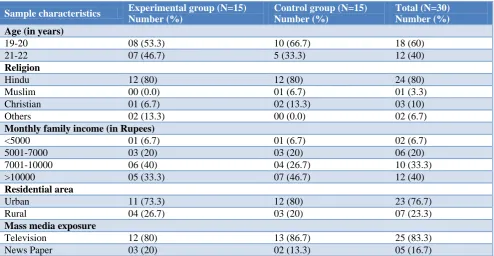
Among the total of 30 college girls (divided into 15 experimental and 15 control groups), majority (60%) of girls belongs to the age group of 19-20 years. Majority of the girls (80%) were Hindu and 76.7% live in urban area. Regarding mass media exposure, majority of girls (76.7%) were exposed through the Television. In experimental group majority (40%) of girls belong to monthly family income group Rs 7001-10,000 and in control group majority(46.7%) of girls were in the income group >Rs 10,000 (Table 1).
Table 1: Distribution of college girls according to their socio-demographic characteristics.
Sample characteristics Experimental group (N=15) Number (%)
Control group (N=15) Number (%)
Total (N=30) Number (%)
Age (in years)
19-20 08 (53.3) 10 (66.7) 18 (60)
21-22 07 (46.7) 5 (33.3) 12 (40)
Religion
Hindu 12 (80) 12 (80) 24 (80)
Muslim 00 (0.0) 01 (6.7) 01 (3.3)
Christian 01 (6.7) 02 (13.3) 03 (10)
Others 02 (13.3) 00 (0.0) 02 (6.7)
Monthly family income (in Rupees)
<5000 01 (6.7) 01 (6.7) 02 (6.7)
5001-7000 03 (20) 03 (20) 06 (20)
7001-10000 06 (40) 04 (26.7) 10 (33.3)
>10000 05 (33.3) 07 (46.7) 12 (40)
Residential area
Urban 11 (73.3) 12 (80) 23 (76.7)
Rural 04 (26.7) 03 (20) 07 (23.3)
Mass media exposure
Television 12 (80) 13 (86.7) 25 (83.3)
News Paper 03 (20) 02 (13.3) 05 (16.7)
Table 2: Level of pre-test and post-test knowledge score regarding breast self-examination in experimental and control group.
Level of knowledge Score
Experimental group Control group
Pre- test knowledge (%)
Post-test knowledge (%)
Pre-test knowledge (%)
Post-test knowledge (%) Poor (<50%) 0-14 8 (53.3) 0 (0.0) 10 (66.7) 8 (53.3)
Average (50-59%) 15-17 7 (46.7) 0 (0.0) 5 (33.3) 7 (46.7)
Good (60-79%) 18-23 0 (0.0) 4 (26.7) 0 (0.0) 0 (0.0)
Excellent (80-100%) 24-30 0 (0.0) 11 (73.3) 0 (0.0) 0 (0.0)
Regarding the level of knowledge, in the experimental group, majority 8 (53.3%) of girls had poor knowledge, 7 (46.7%) had average knowledge and none of them had good and excellent knowledge in pre-test. In the post test, majority 11 (73.3%) of girls had excellent knowledge, 4 (26.7%) had good knowledge and none of them had poor and average knowledge in post-test. In control group, majority 10 (66.7%) of girls had poor knowledge, 5 (33.3%) had average knowledge. In the post test, majority 8 (53.3%) of girls had poor knowledge and 7(47.7%) had
average knowledge. None of girls had good and excellent knowledge in the pre and post test period (Table 2).
Table 3: Area wise pre-test and post-test knowledge score regarding BSE in experimental and control group.
Study variable No. of questions
Experimental group Control group
Pre-test
knowledge score
Post-test knowledge score
Pre-test
knowledge score
Post-test knowledge score Mean
score %
Mean score %
Mean score %
Mean
score % Anatomy and
physiology of breast
4 2.00 50.0 3.60 90.0 1.47 36.7 1.53 38.3
Definition of BSE 1 0.78 78 0.87 87.0 0.73 73.0 0.84 84.0
Importance and
guidelines of BSE 5 2.33 46.6 4.33 86.6 1.73 34.6 2.13 42.6 Causes of breast
cancer 5 1.93 38.6 4.60 92.0 1.99 39.8 2.08 41.6 Area method and
steps of BSE 15 6.69 44.6 12.53 83.5 7.21 48.1 7.48 49.8
Table 4: Level of pre-test and post-test practice score regarding BSE in experimental and control group.
Level of practice Score Experimental group Control group
Pre-test practice Post-test practice Pre-test practice Post-test practice Poor (<50%) 0-9 14 (93.3) 0 (0.0) 14 (93.3) 14 (93.3)
Average (50-59%) 10-11 1 (6.7) 0 (0.0) 1 (6.7) 1 (6.7)
Good (60-79%) 12-15 0 (0.0) 7 (46.7) 0 (0.0) 0 (0.0)
Excellent (80-100%) 16-20 0 (0.0) 8 (53.3) 0 (0.0) 0 (0.0)
Table 5: Comparison of pre-test and post-test knowledge score regarding BSE in experimental and control group.
Knowledge Pretest knowledge Post-test knowledge Student’s paired t- test
Mean±SD Mean±SD
Experimental group 13.73±2.93 25.93±3.93 df=28, t=22.74 p=0.001 significant
Control group 13.13±2.29 14.06±2.31 df=28, t=1.59, p=0.12 Not significant
Student’s independent t- Test
df=14,t=0.62 P=0.53 Not significant
df=14, t=10.06 P=0.001 significant
The pre-test knowledge score of college girls in experimental group was better for definition of breast self-examination (78%) but it was poor for anatomy and physiology of breast (50%), the importance and guidelines of BSE (46.6%), causes of breast cancer (38.6%) about area method and steps of breast self-examination (44.6%). After intervention, the post-test knowledge score of experimental group was increased to 90% for anatomy and physiology of breast, 87% for definition of breast self-examination, 86.6% for the importance and guidelines of BSE, 92% for causes of breast cancer and 83.5% about area method and steps of breast self-examination.
In control group, the pre-test knowledge score was better for definition of breast self-examination (73%) but it was poor for anatomy and physiology of breast (36.7%), for the importance and guidelines of BSE (34.6%), for causes of breast cancer (39.8%) and about area method and steps of breast self-examination (48.1%). In the post-test, knowledge score of control group was 38.3% for
anatomy and physiology of breast, 84% for definition of breast self-examination, 42.6% for the importance and guidelines of BSE, 41.6% for causes of breast cancer and 49.8% about area method and steps of breast self-examination (Table 3).
Regarding the level of pre-test practice, the present study revealed that 14 (93.3%) of girls had poor practice, 1 (6.7%) had average practice and none of them had good and excellent practice in both the experimental and control group. In the post-test, practice score of girls in experiment group had increased none had a poor or average score, 8 (53.3%) had excellent and 7 (46.7%) had good practice score. Whereas in control group, in the post test, 14 (93.3%) of girls had poor and 1(6.7%) had average practice score (Table 4).
Table 6: Comparison of pre-test and post-test practice score regarding breast self-examination in experimental and control group (N=30).
Practice Pre-test practice Post-test practice Student’s paired t – Test
Mean±SD Mean±SD
Experimental group 6.27±1.58 16.00±1.31 df=28, t=20.16, p=0.001 significant
Control group 6.00±1.60 6.40±1.76 df=28, t=1.63, p=0.11 Not significant
Student’s independent t-test
df=14, t=0.45 p=0.65 Not significant
df=14, t=16.92; p=0.001 significant
Table 7: Correlation between knowledge and practice of college girls regarding BSE (experiment group) (N=30).
Correlation between Mean score Karl Pearson correlation
coefficient
Mean±SD Pre-test Knowledge versus practice
score 13.73±2.93 versus 6.27±1.58 r=0.17, p=0.23
Post-test Knowledge versus practice
score
25.93±3.93 versus
16.00±1.31 r=0.47, p=0.001
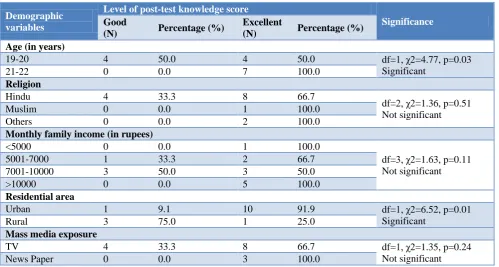
Table 8: Association between post-test knowledge and demographic variables in experimental group (N=30).
Demographic variables
Level of post-test knowledge score
Significance
Good
(N) Percentage (%)
Excellent
(N) Percentage (%) Age (in years)
19-20 4 50.0 4 50.0 df=1, χ2=4.77, p=0.03
Significant
21-22 0 0.0 7 100.0
Religion
Hindu 4 33.3 8 66.7
df=2, χ2=1.36, p=0.51 Not significant
Muslim 0 0.0 1 100.0
Others 0 0.0 2 100.0
Monthly family income (in rupees)
<5000 0 0.0 1 100.0
df=3, χ2=1.63, p=0.11 Not significant
5001-7000 1 33.3 2 66.7
7001-10000 3 50.0 3 50.0
>10000 0 0.0 5 100.0
Residential area
Urban 1 9.1 10 91.9 df=1, χ2=6.52, p=0.01
Significant
Rural 3 75.0 1 25.0
Mass media exposure
TV 4 33.3 8 66.7 df=1, χ2=1.35, p=0.24
Not significant
News Paper 0 0.0 3 100.0
The mean post-test knowledge score (25.93±3.93) in experimental group was higher than the mean post-test knowledge score of control group (14.06±2.31) and this difference was statistically significant (t=10.06, P=0.001). The mean post-test knowledge score (25.93±3.93) was higher than the mean pre-test knowledge score (13.73±2.93) in experimental group and this difference was statistically significant (t=22.74 P=0.001). This finding shows that the structured teaching program on breast self-examination was very effective for increasing the knowledge of college girls.
The mean post-test knowledge score (14.06±2.31) was higher than mean pre-test knowledge score of control group (13.13±2.29) in control group and this difference was statistically not significant (t=1.59, p=0.12) (Table 5).
The mean post-test practice score (16.00±1.31) of experimental group was higher than mean post-test practice score of control group (6.40±1.76) and this difference was statistically significant (t=16.92, p=0.001). The mean post-test practice score (16.00±1.31) was higher than the mean pre-test practice score (6.27±1.58)in experimental group, and this difference was statistically significant (t=20.16, p=0.001). This finding shows that the structured teaching program on breast self-examination was very effective in increasing the practice of college girls.
The mean post-test knowledge score (6.40±1.76) was higher than mean pre-test knowledge score (6.00±1.60) in control group but this difference was statistically not significant (t=1.63, p=0.11) (Table 6).
Data presented in Table 7 shows that there was no correlation found between pre-test knowledge score and practice score (r=0.17, p=0.23) and moderate correlation was found between post-test knowledge score and
practice score (r=0.47, p=0.001) of college girls regarding breast self-examination, in experimental group.
In control group, no correlation was found between pre-test knowledge and practice score (r=0.14, P=0.32), and post-test knowledge and practice score(r=0.18, P=0.45) of college girls regarding breast self-examination (data not shown).
Findings related to association between the post-test knowledge and practice with demographic variables Table 8 showed significant association between post-test knowledge of experimental group with age (χ2=4.77, P=0.03) and area of residence (χ2=6.52, P=0.01) (Table 8).
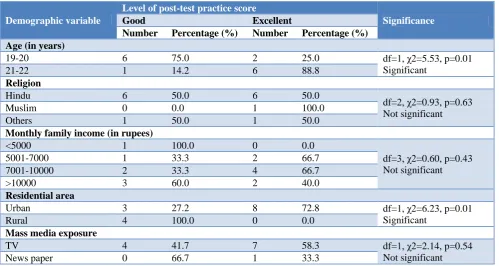
The post-test practice score in experimental group was also significantly associated with age (χ2=5.53, P=0.01) and area of residence of college girls (χ2=6.23, P=0.01) (Table 9).
Table 9: Association between post-test practice and demographic variables in experimental group (N=30).
Demographic variable
Level of post-test practice score
Significance
Good Excellent
Number Percentage (%) Number Percentage (%) Age (in years)
19-20 6 75.0 2 25.0 df=1, χ2=5.53, p=0.01
Significant
21-22 1 14.2 6 88.8
Religion
Hindu 6 50.0 6 50.0
df=2, χ2=0.93, p=0.63 Not significant
Muslim 0 0.0 1 100.0
Others 1 50.0 1 50.0
Monthly family income (in rupees)
<5000 1 100.0 0 0.0
df=3, χ2=0.60, p=0.43 Not significant
5001-7000 1 33.3 2 66.7
7001-10000 2 33.3 4 66.7
>10000 3 60.0 2 40.0
Residential area
Urban 3 27.2 8 72.8 df=1, χ2=6.23, p=0.01
Significant
Rural 4 100.0 0 0.0
Mass media exposure
TV 4 41.7 7 58.3 df=1, χ2=2.14, p=0.54
Not significant
News paper 0 66.7 1 33.3
In control group, no significant association was found between post-test knowledge with selected demographic variables such as age (χ2=0.13, p=0.71), religion (χ2=0.93, p=0.62), mass media exposure (χ2=2.63, p=0.10), residential area (χ2=2.02, p=0.15) and monthly income (χ2=2.63, p=0.53). The post-test practice score in control group was also not associated with selected demographic variables such as age (χ2=2.13, p=0.14), religion (χ2=0.94, p=0.62), mass media exposure (χ2=1.24, p=0.26), residential area (χ2=0.26, p=0.60) and monthly income (χ2=1.22, p=0.74) (data not shown).
DISCUSSION
The present study was aimed to assess the effectiveness of Structured Teaching Program on the knowledge and practice regarding breast self-examination among college girls. It was carried out using a quasi- experimental design which was considered appropriate for the current study. In this regard, Harris et al. stated that quasi-experimental designs are commonly employed in the evaluation of the effectiveness of educational programs when random assignment is not possible or practical.15
Most of the present study girls (60%) belong to the age group of 19-20 years. This is considered appropriate age as these young girls should be more aware about breast cancer and BSE before they reach the age of common occurrence of the disease. The American Cancer Society recommends monthly BSE for all the women who are 20 years or older.16 However Breast Cancer Care states that women should start being breast aware from the age of 18 years.17
Regarding mass media exposure, majority of girls (76.7%) in the current study were exposed through the Television, which shows that the main source of information regarding BSE was television among these study population. So this finding indicates the media especially television can be used to sensitize these college girls on the importance of Breast self-examination. Other studies also reported that the main source of information regarding Breast self-examination was television.18-20
Regarding the level of knowledge, the present study revealed that the level of pre-test knowledge of college girls was low in both experimental and control group. The post-test knowledge score of experimental group was higher than the post-test knowledge score of control group. Similar finding reported in study conducted by Meenakshi et al among college students found that in the experimental group 85% had inadequate knowledge (<50%) and 15% of them had moderate knowledge (50%-75%) in pre-test. In post-test 25.7% of them had moderate knowledge (50%-75%) and 72.5% of students had adequate knowledge (>75%) and none of them had inadequate knowledge (<50%) in post-test. In control group 90% had inadequate knowledge (<50%) and 10% of them had moderate knowledge (50%-75%) in pre-test. In post-test 80% of students had inadequate knowledge (<50%), 20% had moderate knowledge (50%-75%) and none of them had adequate knowledge (>75%) in pre and post-test period.21 A study by Moustafa et al also reported that after implementation of the intervention, there were significant improvements in the knowledge among the students. Overall, only one student (0.6%) had satisfactory knowledge at the pre-test compared to 93.9% at the post-test.22
Present study showed low level of knowledge in almost all area, in both experimental and control group. In post-test, college girls in the experimental group (who received structured teaching program) had higher post-test knowledge score in different areas regarding breast
self-examination than those in control group. In agreement with these finding a study by Swati et al reported a significant increase in the mean post-test awareness in the area of concept, sign and symptoms and steps of BSE in the experimental group compared to the comparison group.23
The present study finding indicated that there was increase in practice after the structured teaching program in experimental group. The post-test practice score of experimental group was higher than the post-test practice score of control group. This finding was almost similar to study conducted Swati et al which concluded that the educational program was highly effective in increasing the ability of women in performing breast self-examination in experimental group.23 A study by Mustafa et al also demonstrated that only very few students were correctly performing the steps of the procedures before the intervention. After implementation of intervention, there were significant improvements in students’ performance of BSE.22
Thus, present study finding indicated that the college girls in the experimental group (who received structured teaching program) had gained higher post-test knowledge and practice score than those in control group. This finding could be explained by the content and practical part of program which covered unmet needs and knowledge gap among students. In agreement with these finding a study by Swati et al reported that education program was effective in enhancing the awareness and ability of women, in experimental group. The mean post-test awareness and ability score of women in experimental group was higher than the comparison group.23
The results of present study revealed that the difference between mean pre-test knowledge score (13.73±2.93) in experimental group and in control group (13.13±2.29) was statistically not significant (t=0.62, p=0.53). The difference between mean post-test knowledge score (14.06±2.31) and mean pre-test knowledge score (13.13±2.29) of control group was statistically not significant (t=1.59 p=0.12). This study finding is supported by a study conducted by Swati et al which found that the mean pre-test awareness scores were found to be non-significant between experimental and comparison group (p>0.05). The mean difference between pre-test score and post-test score in comparison group was found not significant (p=0.392).23
The result of present study showed that the post-test practice mean score (16±1.31) was significantly higher than pre-test practice mean score (6.27±1.58) in experimental group (t=20.16 p=0.001).The mean post-test practice score (16±1.31) in experimental group was significantly higher than post-test practice score (6.40±1.76) of control group (t=16.92, p=0.001). This finding indicates that the Structured Teaching Program was highly effective in increasing the practice of college girls. Similar findings was reported in a study conducted by Swati et al which found that the mean post-test ability score of experimental group was significantly higher than the mean pre-test ability score of comparison group (p=0.00) which shows that the education program was highly effective in increasing the ability of women in performing breast self- examination.23 Similarly, a study conducted by Gur et al among women Living in a District of Istanbul reported that after the educational intervention, there was significant increase in awareness regarding breast cancer (z=-15.807; p<0.001) as well as in the performance of breast self-examination 321/342 (93%).24 The effectiveness of the educational program in improving the practice of BSE is in agreement with a number of studies from several countries.22,25,26
The present study revealed moderate positive correlation (r=0.47, p=0.001) between post-test knowledge score and practice score of college girls regarding breast self-examination in experimental group. This finding indicates that gain in knowledge on BSE after structured teaching program result in increase in practice of girls in experiment group. This finding was inconsistent with study conducted by Swati et al among rural women of Haryana which found that there was no significant positive correlation between mean post-test awareness and ability score toward BSE (r=0.166 and p=0.307).23
Findings related to association between the post-test knowledge and practice with demographic variables in experimental group in current study, significant association was found between post-test knowledge with age (χ2=4.77, p=0.03) and area of residence (χ2=6.52, p=0.01) and post-test practice score with age (χ2=5.53, p=0.01) and area of residence of college girls (χ2=6.23, p=0.01). So the elders and urban girls scored more
excellent knowledge and practice than others in experimental group. In control group, no significant association found between selected demographic variables such as age, religion, mass media exposure, residential area and monthly income with post-test knowledge and practice of girls. This study finding is supported Meenakshi et al which found that age and year of study was found to be associated with post-test knowledge of college students in experimental group but in control group, all the variables are not significant. 21A study conducted by Swati et al found no significant association between selected demographic variable and post-test awareness and ability score in both experimental and comparison group.23
The limitation of the present study, the size of sample was only 30 subjects with 15 students in experimental group and 15 students in control group, selected by purposive sampling method due to resource constraints. Hence it is difficult to make broad generalization. The structured knowledge and observation check list was developed as no standardized tools were available.
In conclusion, the present study findings demonstrated that the structured teaching program was very effective in enhancing the knowledge as well as the practice of college girls regarding BSE. So appropriate health education plan should be prepared to improve the knowledge and practice of college girls regarding Breast Self-Examination to diagnose breast cancer at early stage.
ACKNOWLEDGEMENTS
The authors are thankful to all participants of present study for their valuable cooperation during the entire research. Authors also acknowledge the immense help received from the scholars whose articles are cited and included in references of this manuscript.
Funding: No funding sources Conflict of interest: None declared
Ethical approval: The study was approved by the Institutional Ethics Committee
REFERENCES
1. World Health Organization. Breast cancer: prevention and control. Geneva, Switzerland: WHO; 2013. Available at http://www.who.int/cancer/ detection/breastcancer/en/. Accessed 31 May 2018. 2. Brinton LA, Figueroa JD, Awuah B, Yarney J,
Wiafe S, Wood SN, et al. Breast cancer in sub-Saharan Africa: opportunities for prevention. Breast Cancer Res Treat. 2014;144(3):467–78.
3. SEER Stat Fact Sheets: Female Breast Cancer. Available at http://seer.cancer.gov/statfacts/html/ breast.html. Accessed 31 May 2018.
document/acspc-042725.pdf. Accessed 31 May 2018.
5. Chioma C, Asuzu S. Knowledge, attitude and practice of self-breast examination among the female students of the University of Ibadan, Nigeria. Pakistan J Social Sci 2007. 2007;4(Suppl 3):400–2. 6. Arzu T, Aklime D. Assessing the efficacy of a peer
education model in teaching breast self-examination to university students. Asian Pacific of Cancer Prevention. 2007;8:481–4.
7. Norliza BS. Knowledge and practice of breast self-examination among female undergraduate students in University of Malaysia Sarawak. Available at http://ir.unimas.my/2190/1/Knowledge%20and%20 practice%20of%20breast%20self%20examination% 20among%20female%20undergraduate%20students %20in%20Universiti%20Malaysia%20Sarawak%20 (UNIMAS).pdf. Accessed 31 May 2018.
8. Nde FP, Assob JC, Kwenti TE, et al. Knowledge, attitude and practice of breast self- examination among female undergraduate students in the University of Buea. BMC Research Notes. 2015;8:43.
9. Salaudeen A, Akande T, Musa O. Knowledge and attitudes to breast cancer and breast self-examination among female undergraduates in a state in Nigeria. Eur J Soc Sci. 2009;7(3):157–64. 10. Sarfo L, Dorothy AP, Elizabeth A, Florence A.
Knowledge, attitude and practice of self-breast examination among female university students at Presbyterian University College, Ghana. Am J Res Communication. 2013;1(11):395–404.
11. Karayurt O, Ozmen D, Çetinkaya AC. Awareness of breast cancer risk factors and practice of breast self-examination among high school students in Turkey. BMC Public Health. 2008;8:359.
12. Jarvandi S, Montazeri A, Harirchi I. Beliefs and behaviors of Iranian teachers toward early detection of breast cancer and breast self-examination. Public Health. 2002;116:245-9.
13. Gupta SK. Impact of a health education intervention program regarding breast self-examination by women in a semi-urban area of Madhya Pradesh, India. Asian Pac J Cancer Prev. 2009;10(6):1113-7. 14. Yadav P, Jaroli DP. Breast cancer: Awareness and risk factors in college-going younger age group women in Rajasthan. Asian Pac J Cancer Prev. 2010;11(2):319-22.
15. Harris AD, McGregor JC, Perencevich EN, Furuno JP, Zhu J, Peterson DE, et al. The use and interpretation of quasi-experimental studies in medical informatics. J Am Med Inform Assoc. 2006;13(1):16-23.
16. Smith RA, Cokkinides V, Brawleg OW. Cancer Screening in the United States, 2008: A Review of
Current American Cancer Society Guidelines and Cancer Screening Issues. CA:A Cancer J Clin. 2008;58:161-79.
17. Breast Cancer Care. Breast awareness Available at http://www.breastcancercare.org.uk/content.php?pa ge_ id=101. Accessed 31 May 2018.
18. Naemenqani DM, Abdelmaqsoud SH, Al-Malki AA, Oraija AA, Al-Otaibi EM. Knowledge attitude practice of BSE and breast cancer among female medical students in Taif, Saudi Arabia. Open J Prevent Med. 2014;4(2):69-77.
19. Nde FP, Assob JC, Kwenti TE, et al. Knowledge, attitude and practice of breast self- examination among female undergraduate students in the University of Buea. BMC Res Notes. 2015;8:43. 20. Sarfo L, Dorothy AP, Elizabeth A, Florence A.
Knowledge, attitude and practice of self-breast examination among female university students at Presbyterian University College, Ghana. Am J Res Communication. 2013;1(11):395–404.
21. Meenakshi PC. Effectiveness of Structured Teaching Programme regarding Breast Self-Examination (BSE) among Postgraduate Students at Selected Colleges of Banglore, Karnataka. Int J Nursing Educ. 2016;8(4):92-8.
22. Moustafa DG, Abd-Allah ES, Taha NM. Effect of a Breast-Self Examination (BSE) Educational Intervention among Female University Students. Am J Nursing Sci. 2015;4(4):159-65.
23. Swati, Sheoran P, Sarin J. Awareness and Ability Regarding Breast Self- Examination (BSE):An Interventional Study in Rural Area Haryana. Int J Sci Res. 2017;6(8):101-7.
24. Gur K, Hasibe K, Sezer A. Breast Cancer Risks and Effectiveness of BSE Training among Women Living in a District of İstanbul. J Breast Health. 2014;10:154-160.
25. Ouyang YQ, Hu X. The effect of breast cancer health education on the knowledge, attitudes, and practice: a community health center catchment area. J Cancer Educ. 2014;29(2):375-81.
26. Mena M, Wiafe-Addai B, Sauvaget C, Ali IA, Wiafe SA, Dabis F, et al. Evaluation of the impact of a breast cancer awareness program in rural Ghana:a cross-sectional survey. Int J Cancer. 2014;134(4):913-24.