© 2016 IJSRSET | Volume 2 | Issue 3 | Print ISSN : 2395-1990 | Online ISSN : 2394-4099 Themed Section: Engineering and Technology
A Dynamic Algorithm for Loop Detection Software-Defined Networking Using
Open Flow in Hop by Hop Multipath Links
Kavitha V
*, Kalai Kumar K
Computer Science and Engineering, Sun College of Engineering and Technology, Nagercoil, Tamil Nadu, India
ABSTRACT
The Internet is inherently a multipath network for a primary network with only a single path connecting various nodes would have been unbreakable delicate. Unfortunately, conventional Internet technologies have been designed around the preventive assumption of a single working path between a source and a destination. The need of local multipath hold constrains network performance yet as the primary network is luxuriously connected and has unnecessary multiple paths. Computer networks can use the control of multiplicity through which a different collection of paths is resource shared as a single resource to unlock the inbuilt redundancy of the Internet. This opens up a new scene of opportunities talented increased throughput and increased consistency and fault-tolerance. There are many rising trends in networking that indicate the Internet‟s future will be clearly multipath, including utilize of multipath technology in datacenter computing; multi-interface, multi-channel, and multi-antenna trends in wireless; ubiquity of mobile devices that are multi-homer with various access networks; and the development and consistency of multipath transport protocols such as MP-TCP. The aim is to supply a complete inspection of the text on network-layer multipath solutions. Nearby a detailed inquiry of two important plan issues, that is the control plane difficulty of how to calculate and pick the routes, and the data plane trouble of how to split the flow on the computed paths. The core input of this paper is a systematic communication of the core plan issues in network-layer multipath routing along with a broad-ranging study of the huge text on network-layer multipathing. Also underline open issues and identify directions for future work.
Keywords : Computer network, Fault-tolerance, MP-TCP, Multipath Technology, Broad-ranging.
I.
INTRODUCTION
It is common for communication networks to be built with significant redundancy for the purpose of fault tolerance and reliability. This results in the availability of multiple paths that can be used for connecting network nodes. These multiple paths can potentially be resource pooled for the purpose of routing and forwarding packets, and can be used either simultaneously or in a backup configuration, for increased reliability, end-to-end throughput, network efficiency, and fault tolerance. Unfortunately, despite the widespread path diversity available on the Internet, traditional Internet technologies have focused mainly on single-path routing for the sake of its simplicity and
II.
METHODS AND MATERIAL
2.1 Related Work
A. Deficiencies of Shortest Single Path Routing
There are two fundamental weaknesses that conventional routing techniques based on shortest single-path routing go through. Firstly, it potentially limits the network throughput since only one path is accessible per source-destination pair. It has been shown that single-path routing is constraining optimal routing solutions, and that elegant optimal routing solutions can be developed if multiple paths with flexible splitting are utilized. The problem of joint optimization of routing and congestion control which belongs to the category of the general multi-commodity flow (MCF) problem is considered for both single-path and multi-path configurations. It is made known that this problem is non-convex and NP-hard when the user can make use of a single path only. On the other hand, if all available paths can be used with source-based multipath routing, the problem is convex and admits an elegant solution. This performance penalty of not using multiple paths is referred to as „the cost of not splitting. This performance penalty, although hard to determine (being an NP-hard problem), is known to be strictly positive.
Secondly, it is vulnerable to routing swinging as any changes in link lengths can cause unexpected traffic shifts. It is well-known in the literature that adaptive, shortest-path routing protocols especially those that rely on link delays can result in oscillatory behavior and instability leading to performance degradation. An example of an untimely delay-based adaptive routing algorithm is the distance-vector ARPANET routing protocol that was shortly found out to be unbalance. Optimal routing based on the rigorous mathematical theory of the MCF problem was proposed to eliminate several disadvantages of single-path routing by optimizing an average delay-like performance measure. Optimal routing is essentially a multipath routing framework. In optimal routing, traffic from a source-destination pair is split at strategic points allowing gradual shifting of traffic among alternative paths. Optimal routing aims to send traffic exclusively on paths that are shortest with respect to some link lengths computed on the basis of flows carried on those links. In optimal routing, for low input traffic, a
source-destination pair tends to use only one path (which is the fastest in terms of packet transmission time), while for increasing input traffic, additional paths are utilized to avoid overloading the shortest path.
B. Benefits of Multipathing
We provide a description of some of the major applications and features of multipathing below:
1) Resource Pooling
Resource pooling is a broad Internet architectural design principle focusing on improving resource efficiency by presenting a collection of resources as a single pooled resource that has many manifestations. For example, some of the most troublemaking modernization on the Internet packet switching, content Delivery Networks (CDN), Peer-to-Peer networks (P2P), cloud computing are based on resource pooling. The packet switching technology, which acts as a foundation of the Internet, is essentially a resource pooling technique. To put things in perspective, circuit switching techniques use fixed multiplexing schemes in which dedicated and isolated non-pooled circuits are utilized. In contrast, statistical multiplexing the underlying technique of packet switching achieves resource pooling by allowing a burst of traffic on a single circuit to use spare capacity on other circuits. CDNs and P2P networks utilize resource pooling to ensure efficient network operations. P2P protocols such as Bit Torrent use swarming downloads that let receivers pool together multiple peers as a data source thereby using multipath to pool the network paths to these peers. Cloud computing relies on pooled resources gathered at central DCs to support the computing requirements of multiple tenants through virtualization. Multipathing has been envisioned as „Packet Switching 2.0‟ since it allows an analogous resource pooling benefit at the network layer. In particular, multipath routing can pool together a number of distinct links to provide the abstraction of a single unified network resource. With the abstraction of a single resource pool, the chances of a demand being refused due to one‟s resources being utilized reduces.
2) Load Balancing
pooling is load balancing that allows congestion control techniques for diffusing congestion over resources by equitably distributing the load amongst the elements of a resource pool. This helps to avoid situations where a certain network resource unnecessarily acts as a bottleneck although the network has alternative resources that can help to relieve the congestion. Load balancing can be done over resources (e.g., the load balancing over multiple access links and paths as done in multihoming and multipath transport respectively) or can be temporal (i.e., the load is balanced between peak and non-peak hours to exploit the typical diurnal network traffic pattern). Load balancing overtime shifts the transmission of data from peak time to off-peak time and can help in reducing costs such as the commonly used 95 percentile pricing scheme.
3) Efficiency
Another major benefit of resource pooling through multiple paths is efficiency. It is well known in the literature that the Internet traffic is bursty with a pronounced correlation with a large variance of the traffic volume over long time periods. Allocating fixed amount of resources to individual circuits is inefficient due to the burst nature of the Internet traffic, which can result in largely idle resources or resources that are insufficiently provisioned. One important benefit associated with resource pooling is that it leads to increased efficiency. Resource pooling, or statistical multiplexing of shared resources, suits the Internet traffic well. This is because the law of averaging (or the law of large numbers) does not apply to individual flows. Resource pooling is useful since it exploits the statistical regularity of the aggregate of individual burst circuits. This results in efficient utilization of resources without extensive over-provisioning.
4) Reliability And Fault Tolerance
With the migration of critical businesses to the Internet, the reliability and availability of the Internet has become extremely important. Fault tolerance mechanisms for networks without multipath support are unwieldy with a link node failure potentially resulting in significant recovery times. The resource pooling benefit of multipathing allows the underlying network to gracefully handle loss of capacity or the failure of individual links paths through diffusing this anomaly by
shifting traffic to the working members of the resource pool. This allows enhanced fault tolerance and helps to build more resilient networks.
C. Challenges In Implementing Multipath Routing
Even though the future of the Internet promises to be intertwined with multipath routing, there are numerous challenges that need to be surmounted. A major challenge in implementing Internet-wide multipath routing is to achieve scalability due to the resulting considerable computational and storage overhead. Specifically, multipath routing entails significant overhead both in the control as well as the data plane. Control plane overhead refers to the need of additional bandwidth and processing resources for exchanging path information, while the data plane overhead refers to the large forwarding table and the higher memory requirement associated with forwarding entries corresponding to an increased number of paths. Another stumbling block is the lack of complete control of any organizations over the entire end-to-end path.
2.2 Proposed Methodology
In a hop-by-hop routing scenario, routing decisions are taken, as opposed to source routing, in a distributed or per hop fashion. Each node along a path processes incoming packets and forwards them by consulting a routing table stored in its memory.
A. HOP-BY-HOP Routing
the multiple paths are provisioned based on a special condition called loop-free invariant (LFI). When a routing algorithm satisfies this condition, then the loop-freeness at every instance is ensured. A family of protocols called maximum alternative routing algorithm (MARA), which is based on a directed acyclic graph (DAG), is presented. Using the DAG approach ensures that loop-free paths are constructed. Based on a network topology, the DAG approach constructs a graph with the maximum number of multiple paths within a minimum amount of time subject to a throughput constraint in order to improve the reliability of communication.
Hashing enables a node to select a path from a set of available paths while forwarding packets along a path. Two hashing schemes, namely direct hashing and table-based hashing, are studied for the purpose of packet forwarding in a multipath routing scenario. In direct hashing, a hash function is performed on a packet‟s header, and the output is directly mapped to one of the paths from the set of constructed multiple paths. In table-based hashing, on the other hand, the output of a hash function is first put in one of the bins (with the total number of bins potentially differing from the total number of available paths) and the bins are then mapped to multiple paths. In the work five 16-bit cyclic redundancy check (CRC)-based direct hashing techniques and an XOR of source-destination IP based and table-based hashing technique are developed for balancing the load over equal-cost multiple paths (ECMP). ECMP is a simple method for provisioning multiple paths that has been incorporated into many conventional routing environments (such as OSPF, MPLS and ISIS). ECMP is explained. An interesting feature of table-based hashing is that it can be used to balance load over unequal path weight at the cost of requiring more states than direct hashing. Disparity routing enables concurrent transmission of data over multiple paths. There are two different flavors of disparity routing. A node can either send distinct data packets over multiple available paths for load balancing, or send duplicated data packets over multiple paths for improved reliability and resiliency.
B. Hop-By-Hop Multipath Protocols For WSN:
Conventional single-path routing schemes put all traffic on a recomputed set of links, thus quickly draining the energy of the intervening network elements. In multipath
routing techniques on the other hand, network traffic is distributed over multiple paths with load balancing and concurrent transmission, thereby avoiding overburdening a single set of network elements and enhancing the network lifetime. The provisioning of multiple paths in a wireless scenario is prone to intra- and inter-path interference. A radio disjoint multipathing method is proposed. This technique constructs multiple paths in an incremental fashion keeping in view the congestion and interference effects, so it helps to improve bandwidth gains among bandwidth-hungry multimedia applications. In the first instance, only one path is established; and upon receiving feedback on network congestion, other paths are established in an incremental fashion. However, when high interference is observed, sensor nodes may be put into passive mode to reduce the number of multiple paths, and with that the amount of interference as well. Overall, this technique improves throughput and energy efficiency but at the cost of higher control overhead. Another technique called meshed multipath routing (MMPR) with selective forwarding is proposed in to incorporate forward error correction (FEC) and selective forwarding into multipath routing for better reliability in order to improve throughput performance. In selective forwarding, a packet is forwarded over the path with the best downstream wireless channel quality, with acknowledgement driven retransmissions eliminated by using FEC mechanism, which facilitates efficient load balancing with lesser control overhead. It has been shown that M-MPR provides higher throughput than its disjoint multipath counterparts.
C. Load Balancing Approaches For Multipath
many routing protocols like OSPF and ISIS. Intuitively speaking, ECMP can be seen as a simple “bonding” technique that can load balance over equal-cost paths. A router can implement three main techniques while choosing a next-hop node to forward the traffic.
III.
RESULTS AND DISCUSSION
A. Multipathing and Green Networking
The problem of energy efficient multipathing is an important concern for battery operated mobile devices. While mobile devices can increase their throughput by striping their connections over heterogeneous networks, this comes at a cost of higher energy consumption.
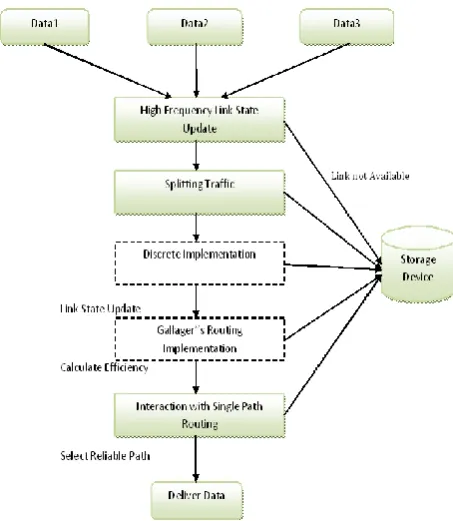
Figure 1: Architecture Diagram
With the proliferation of mobile devices, the incorporation of energy efficiency mechanisms into the design of multipath solutions has become extremely important. Early work on energy-efficient multipathing has already shown the potential for improving Smartphone‟s energy consumption. Apart from its importance for wireless networks, energy efficiency is also critically important for datacenter networking.
Fig2: Energy Efficient Calculation of Hop by Hop Network using IS-IS and OSPF
More research needs to be conducted in the area of energy efficient “green multipathing” to use the power of multipathing while reducing the energy consumption on the Internet.
Figure 3: Chart for Energy Efficient Calculation of Link Detection using SDN Network
B. Experimental Research and Analysis
This paper summarizes the major trends in how multiple paths are used in wired and wireless networks. Observe that multiple paths can be used in both concurrent backup configurations. It is observed (based on the works presented in this study) that wired general networks use backup and concurrent multiple paths almost equally, while in wireless scenarios, the concurrent transmission option is adopted more often. Increasingly, the control of flow splitting, congestion control, and load balancing is being performed at the transport layer and the recent development of multipath transport protocols can be influential in strengthening this trend. With the recent proliferation of DCs, the use of dynamic load-aware flow splitting and SDN-based
0 10 20 30 40 50 60 70 80 90
0 5 10
Network Load (%)
Link Utilization
Performance of Energy Efficient
0 10 20 30 40 50 60 70 80
0 5 10
Network Load (%)
traffic engineering is also becoming more popular and will grow in importance in the future.
IV.
CONCLUSION
Surveyed the existing literature on the network-layer multipathing. After describing the motivation and benefits of multipath in networks, and establishing that the future of the Internet is multipath based, there are two important problems that are related to multipathing, namely the issue of how to compute the multiple routes to be used, and how should these multiple routes be used by traffic flows. While our focus is on network-layer multipathing, our coverage is holistic as we also discuss issues such as congestion control, flow splitting, and resource pooling (which do not fall neatly into a single layer). In addition to highlighting the main problems in network-layer multipathing, and describing the various approaches proposed, we have provided a broadranging survey of multipath protocols in different kinds of networks. Despite a vast amount of work on network-layer multipathing, many open questions remain; we conclude this paper by highlighting some important issues that require further investigation.
V.
REFERENCES
[1] B. Fortz and M. Thorup, "Increasing internet capacity using localsearch," Comput.Optim.Appl., vol. 29, no. 1, pp. 1348, Oct. 2004.
[2] C. E. Agnew, “On quadratic adaptive routing algorithms,” Commun.ACM, vol. 19, no. 1, pp. 18–22, Jan. 1976.
[3] D. G. Cantor and M. Gerla, “Optimal routing in a packet switched computer network,” IEEE Trans. Comput., vol. C- 23,pp.1062-1069, Oct. 1974. [4] G. Agarwal, S. Srivastava, M. Pioro, and D.
Medhi, “Determining link weight system under various objectives or OSPF networks using a lagrangian relaxation-based approach” IEEE Trans. Netw. Service Manag., vol.2, no. 1,pp.9.18, Nov 2015
[5] H. Frank, I. T. Frisch and W. Chou, “Topological Considerations in the Design of the ARPA Computer Network,” AFIPS Conference Proc., SJCC , May 1970 , PP. 581-587.
[6] J. Rexford, D. Xu, M. Chiang, and, “Link-state routing with, hop-by-hop-forwarding can achieve
optimal traffic engineering,” IEEE/ACM, Trans.Netw., vol. 19, no. 6, pp. 1717–1730, Dec. 2011.
[7] L. Fratta, M. Gerla, and L. Kleinrock, “The flow deviation method: An approach to store-and-forward communication network design,” Networks, vol. 3, no. 2, pp. 97–133, 1973.
[8] L. Kleinrock, ”Analytic and Simulation Methods in Computer Network Design,“ AFIPS Conference Proc., SJCC, May 1970,PP.569-579. [9] Nithin Michael and AoTang, “Hop By Hop
Adaptive Link State Optimal Routing, IEEE Paper 2013.
[10] R. Gallager, “A minimum delay routing algorithm using distributed computation,” IEEE Trans. Commun., vol. COM- 25,no.1,pp.73–85,Jan. 1977.
[11] S. Boyd and L. Vandenberghe, Convex Optimization. New York, NY,USA: Cambridge Univ. Press, 2004.