IJSRSET2184138 | Received : 11 Feb 2018 | Accepted : 21 Feb 2018 | January-February-2018 [(4) 1 : 1385-1390 ]
© 2018 IJSRSET | Volume 4 | Issue 1 | Print ISSN: 2395-1990 | Online ISSN : 2394-4099 Themed Section : Engineering and Technology
1385
An Efficient and Secure Data Storage Operations in Mobile
Cloud Computing
V. Suresh Babu
1, Maddali M. V. M. Kumar
2 1PG Student, Department of MCA, St. Ann’s College of Engineering & Technology, Chirala, India
2Assistant Professor, Department of MCA, St. Ann’s College of Engineering & Technology, Chirala, India
ABSTRACT
Clients store tremendous measures of touchy information on a cloud. Sharing delicate information will enable undertakings to lessen the cost of giving clients customized benefits and offer some incentive included information services. Be that as it may, secure information sharing is risky. Security is a standout amongst the most troublesome errand to actualize in cloud computing. Distinctive types of attacks in the application side and in the equipment segments. This paper proposes a system for secure delicate information partaking in cloud, including secure information conveyance, stockpiling, use, and devastation on a semi-confided in cloud environment. We exhibit Kerberos convention over the system and a client procedure insurance technique in view of a virtual machine screen, which offers help for the acknowledgment of framework capacities.
Keywords : Cloud Environment, Kerberos, Sensitive Data
I.
INTRODUCTION
Cloud computing is innovation which empowers the client to get to assets utilizing front end machines, there is no compelling reason to introduce any product. Cloud engineering, the frameworks design of the product frameworks associated with the conveyance of cloud computing, commonly includes numerous cloud parts speaking with each other over free coupling instrument, for example, informing line. Cloud computing services are comprehensively partitioned into three classifications as takes after: Software as a Service (SaaS): In this model, a total application is offered to the client, as anservice on request. A solitary case of the service keeps running on the cloud and different end clients are overhauled. On the customers‟ side, there is no requirement for forthright interest in servers or programming licenses, while for the supplier, the expenses are brought down since just a solitary application should be facilitated and kept up. Today, SaaS isoffered by organizations, for example, Google, Salesforce, Microsoft, and so
Deployment Models were classified as:
Private Cloud:The cloud infrastructure is owned or leased by a single organization and is operated solely for that organization.
Community Cloud:The cloud infrastructure is shared by several organizations and supports a specific community that has shared concerns (e.g., mission, security requirements, and policy).
Public Cloud:The cloud infrastructure is owned by an organization selling cloud services to the general public or to a large industry group.
Hybrid Cloud:The cloud infrastructure is a composition of two or more clouds that remain unique entities but are bound together by standardized or proprietary technology.
II.
Security in Cloud Computing
Cloud computing envelops both a server and a customer side. Keeping up physical and coherent security over customers can be troublesome, particularly with implanted cell phones, for example, PDAs. Worked in security components regularly go unused or can be overcome or dodged without trouble by a proficient gathering to pick up control over the gadget. A few security plans for information sharing on un-trusted servers have been proposed. In these methodologies, information proprietors store the encoded information records in un-trusted capacity and convey the relating decoding keys just to approved clients. Subsequently, unapproved clients and capacity servers can't take in the substance of the information documents since they have no learning of the decoding keys. The absence of security of nearby gadgets can give an approach to malevolent services on the cloud to attackneighbourhood arranges through these terminal gadgets; trade off the cloud and its assets for different clients. The absence of security of neighbourhood gadgets can upset the buyer and furthermore give an approach to vindictive services on the cloud to attack nearby systems through these terminal gadgets. In the present omnipresent figuring environment, the nearby host machine may well be a personal computer, a
convenient workstation or cell phone. While cloud buyers stress over the security on the cloud supplier's site, they may effectively neglect to solidify their own machines. The absence of security of a nearby host can trade off the cloud and its assets for different clients. With cell phones, the danger might be considerably more grounded, as clients lose or have the gadget stolen from them. Gadgets that entrance the cloud ought to have solid confirmation instruments, ought to be altering safe, and have
cryptographic usefulness when movement
classification is required. Since this place a piece of the security trouble onto the customer, the supplier may need to stipulate in its approach or SLA. Clients interface with the cloud from their nearby host
machines. Specifically, many secure cloud
information putting away advances expect clients to produce ace keys (used to encode information or session keys) and store them on the neighbourhood machine. On the off chance that a vindictive service in the cloud can mess with the nearby machine and access these keys, secrecy of information put away in the cloud is in danger.
III.
Background
clients' delicate information. The plan is of CCA2 security demonstrates under the decisional q-Bilinear Diffie-Hellman Exponent suspicion. The various levelled approval structure of the plan decreases the weight and danger of a solitary specialist situation. The article gives a ciphertext arrangement trait based encryption (CP-ABE) conspire with productive client repudiation for cloud storage framework. The issue of client disavowal can be settled proficiently by presenting the idea of client gathering. The paper has built up a structure known as Cloud Computing Adoption Framework (CCAF) which has been tweaked for securing cloud information. This paper clarifies the diagram, basis and segments in the CCAF to ensure information security.
IV.
Previous Work Done
Peng Li, et al (2014) focused on ORAM algorithm that is applied to achieve privacy-preserving access to big data in clouds. A heap unbalance marvel saw subsequent to conveying ORAM-based capacity to various servers, which rouses us to explore an information arrangement issue to accomplish stack adjust. This issue is turned out to be NP-hard. A low-multifaceted nature calculation proposed to take care of this issue regarding substantial information volumes. X. Dong, et al (2015) proposed an efficient system of secure sharing of delicate information on enormous information software, which guarantees secure accommodation and capacity of touchy
information in light of the heterogeneous
intermediary re-encryption calculation, and ensures secure utilization of clear content in the cloud software by the private space of client process in view of the VMM. In the meantime the information proprietors have the entire control of their own information, which is an achievable answer for adjust the advantages of included gatherings under the semi-confided in environments. Teng, et al (2015) proposes a various levelled trait based access control conspire with steady size ciphertext. The plan is proficient in light of the fact that the length of ciphertext and the quantity of bilinear matching assessments to a steady
are settled. Its calculation cost in encryption and decoding calculations is low. J. Li, et al (2016) gave a formal definition and security display for CP-ABE with client denial. At the point when any client leaves, the gathering director will refresh client's private keys aside from the individuals who have been repudiated. A solid CP-ABE conspires likewise build which is CPA secure in view of DCDH presumption. Chang et, al (2016) proposed a Cloud Computing Adoption Framework (CCAF) and CCAF is outlined by the framework configuration in light of the prerequisites and the usage exhibited by the CCAF multi-layered security. The paper has exhibited the CCAF multi-layered security for the information security in the Data Centre under the proposition and suggestion of CCAF rules.
V.
Existing Methodology
ORAM Algorithm, Systematic structure with intermediary re-encryption calculation, CP-ABE get to control plot, CCA2 security conspire, Cloud Computing Adoption Framework (CCAF) were existing strategies.
ORAM algorithm: The ORAM calculation is connected to empower security saving access to huge information that are conveyed in appropriated record frameworks based upon hundreds or thousands of servers in a solitary or different geo-disseminated cloud destinations. Since the ORAM calculation would prompt genuine access stack unbalance among
capacity servers, additionally examined an
information situation issue to accomplish a heap
adjusted capacity framework with enhanced
accessibility and responsiveness.
Proxy re-encryption algorithm: A structure for secure touchy information sharing on a major information software proposed including secure information conveyance, stockpiling, utilization, and decimation on a semi-trusted huge information sharing software
and present an intermediary re-encryption
for the acknowledgment of framework capacities. The structure ensures the security of client's delicate information viably and shares this information securely.
ABE access control scheme: A various levelled CP-ABE get to control plot was proposed with consistent size ciphertext and examined the calculations in detail for our plan. This plan can settle the measure of ciphertext and the calculation of encryption and
unscrambling at a consistent incentive
notwithstanding enhancing the proficiency of the framework. This plan can keep up the extent of ciphertext and the calculation of encryption and unscrambling at a steady esteem. Subsequently, the plan can enhance the proficiency of the framework. An application display is shown in a Hadoop disseminated cloud environment. This demonstrates our plan has great flexibility and adaptability in cloud computing.
Ciphertext policy attribute based encryption (CP-ABE): A progressive property based access control conspires with consistent size ciphertext is proposed. The proposed plot embraces CP-ABE with consistent ciphertext estimate and keeps up the measure of ciphertext and the calculation of bilinear matching at a steady esteem, which enhances the proficiency of the framework and decreases the additional overhead of room stockpiling. This framework bolsters legacy of approval that diminishes the weight and hazard on account of single specialist. At long last, the plan has demonstrated vague security under a versatile picked ciphertext attack and we dissect the execution of our plan. A reproduction show is applying the plan in a cloud domain.
Cloud Computing Adoption Framework (CCAF): The CCAF approach gives an incorporated answer for cloud security in light of an unmistakable structure, business process displaying to think about the effect on the execution of a client got to benefit which is regularly learned on the fly which is exorbitant and a CCAF three layered model.
VI.
Analysis and Discussion
In this section, we examine a few calculations and methods utilized as a part of five papers and furthermore talks about our proposed structure are as per the following. ORAM calculation is connected to empower security protecting access to enormous information in cloud. To manage the test of pleasing colossal volume of information that constantly develops in high speed, huge information are put away in disseminated document frameworks based upon hundreds or thousands of servers in a solitary or different geo-conveyed cloud destinations. An efficient system of secure sharing of touchy information on huge information software, which guarantees secure accommodation and capacity of delicate information in view of the heterogeneous intermediary re-encryption calculation, and ensures secure utilization of clear content in the cloud software by the private space of client process in light of the VMM. The plan utilizes CCA2 security under the decisional q-Bilinear Diffie-Hellman Exponent presumption. The plan can keep up the span of figure content and the calculation of encryption and unscrambling at a consistent esteem. In this way, the plan can enhance the proficiency of the framework. A solid CP-ABE conspire is developed CPA secure in view of DCDH suspicion. To oppose arrangement attack, installed an authentication into the client's private key. The CCAF approach gives an incorporated answer for cloud security in view of a reasonable structure, business process demonstrating to ponder the effect on the execution of a client got to benefit which is regularly learned on the fly which is exorbitant and a CCAF three layered model.
VII.
Proposed Methodology
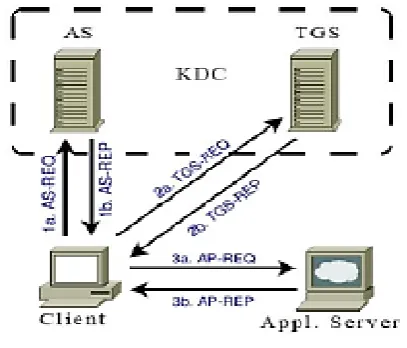
moderate for low-end gadgets on the grounds that a particular exponentiation operation is required. The heap adjusting in cloud has imported impact on the execution. Along these lines, proposed a structure that will utilize RSA encryption calculation to scramble the information. To secure delicate information Kerberosis utilized for a client procedure assurance strategy in light of a virtual machine screen. The fundamental set up of Kerberos convention is as appeared.
Figure 1. Kerberos protocol
The Kerberos server comprises of an Authentication Server (AS) and a Ticket Granting Server (TGS). The AS and TGS are in charge of making and issuing tickets to the customers upon ask. The AS and TGS more often than not keep running on a similar PC, and are on the whole known as the Key Distribution Centre (KDC). The Kerberos verification process works in three software as appeared in Figure 1. Kerberos is a dispersed, character based confirmation framework that gives a technique to a client to access an application server. Validation is basic for the security Computer frameworks. Without learning of an essential asking for an operation, it is hard to choose whether the operation ought to be permitted.
Customary confirmation techniques are not
reasonable for use in PC systems where aggressors screen arrange movement to capture passwords. The utilization of solid confirmation strategies that don't unveil passwords is basic. In this way, the proposed Kerberos verification framework is appropriate for confirmation of clients in such environments.
VIII.
Expected Results
The objective of this paper was to guarantee the security of information in cloud in cloud computing. At that point a broad methodical choice process was completed to distinguish aftereffects of proposed
structure utilizing Kerberos convention for
verification alongside encryption calculation in cloud computing. The outcomes exhibited here in this way will give a superior photo of the current securing delicate information systems utilized as a part of cloud environment where security is the key issue nowadays.
IX.
Conclusion
The normal outcomes showed that the proposed information sharing on cloud plot is effective for safely and adaptably overseeing media content in vast, inexactly coupled, circulated frameworks. The convention utilized as a part of the structure is in charge of shielding information while exchanging from disjoin to server in cloud. The structure ensures the security of client's touchy information viably and shares these information securely. With the help of the cloud server, the decoding operation is quickened altogether at the customer side.
X.
REFERENCES
[1]. Jason Kincaid. "Google privacy blunder shares your
docswithout permission",
2009.http://techcrunch.com/2009/03/07/huge-google-
privacy-blunder-shares-your-docs-without-permission.
[2]. KMPG. From hype to future: Kpmgs 2010 cloud
computingsurvey
onlineAvailable:http://www.kpmg.com/ES/es/Actuali dadyNovedades/ArticulosyPublicaciones/Documents/ 2010-Cloud-Computing-Survey.pdf.
[3]. Noam Kogan, Yuval Shavitt, and AvishaiWool.A
practical revocation scheme for broadcast encryption using smartcards. ACMTrans. Inf. Syst. Secur., 9(3):325-351, August 2006.
[4]. Amos Fiat and MoniNaor. Broadcast encryption. In
Computer Science, pages 480-491. Springer BerlinHeidelberg, 1994.
[5]. VipulGoyal, OmkantPandey, AmitSahai, and Brent
Waters.Attribute-based encryption for fine-grained access control of encrypted data. In Proceedings of the 13th ACM conference on Computerand communications security, CCS ’06, pages 89-98, New York, NY,USA, 2006. ACM.
[6]. Matthew Green and Giuseppe
Ateniese.Identity-based proxy re-encryption. In Jonathan Katz and Moti Yung, editors, AppliedCryptography and Network Security - ACNS 2007, volume 4521 ofLNCS, pages 288-306. Springer Berlin / Heidelberg, 2007.
[7]. Dijiang Huang, Tianyi Xing, and Huijun Wu. Mobile
cloudcomputing service models: a user-centric approach. Network, IEEE,27(5):6-11, September 2013.
[8]. Nguyen Thanh Hung, Do Hoang Giang, Ng Wee
Keong, andHuafei Zhu. Cloud-enabled data sharing model.In Intelligenceand Security Informatics (ISI), 2012 IEEE International Conference on,pp 1-6, 2012.
[9]. JunbeomHur and Dong Kun Noh.Attribute-based
access controlwith efficient revocation in data outsourcing systems. IEEE Transactions on Parallel and Cloud Systems, 22(7):1214-1221, 2011.
[10].Maddali M.V.M. Kumar and G. Rajesh Cloud based
Structure Approach of Content-As-A-Service for
Supplier Impartial of Mobile Gadgets,
2014International Conference on "Advances in Computer Science and Software Engineering" ISBN No 978-93-5174-851-9.
[11].F. R. Institute. Personal data in the cloud: A
globalsurvey of consumer attitudes, 2010.
Available:http://www.fujitsu.com/downloads/SOL/fai/ reports/fujitsupersonal-data-in-the-cloud.pdf.
[12].Ari Juels and Burton S. Kaliski, Jr. Pors: Proofs of retrievability forlarge files. In Proceedings of the 14th ACM Conference on Computerand Communications Security, CCS ’07, pages 584-597, New York, USA, 2007. ACM.
[13].Ryan Kalember. "celebrity photo hack: Ten takeaways
for enterprises", Sep.11, 2014.
https://www.watchdox.com/en/blog/celebrity-photo-hack-ten-takeaways-enterprises/.
[14].Peng Li; Song Guo"Load Balancing for Privacy-Preserving Access to Big Data in Cloud", 2014IEEE INFOCOM Workshop on Security and Privacy in Big
data Computer Communications Workshops
(INFOCOM WKSHPS), vol.21, no.4, 524 - 528, May 2014.
[15].Xinhua Dong; Ruixuan Li; Heng He; Wanwan Zhou;
ZhengyuanXue; Hao Wu, "Secure Sensitive Data Sharing On a Big Data Platform", Tsinghua Science and Technology published in IEEE, Vol.20, No.1, pp.72-80, Feb. 2015; doi: 10.1109/TST.2015.7040516.
[16].Sk.SuhelBaig and Maddali M.V.M. Kumar, " Personal
Privacy in Personalized through Data Obfuscation and Data Transformation Anonymization Techni-ques," in International Journal of Scientific Engineering and Technology Research, vol. 6, no.9, pp.1863-1856.
[17].W. Teng; G. Yang; Y. Xiang; T. Zhang; D. Wang, "Attribute-based Access Control with Constant-size
Ciphertext in Cloud Computing," in IEEE
Transactions on Cloud Computing , vol.PP, no.99, pp.1-1, 02 June 2015,doi: 10.1109/TCC.2015.2440247 [18].J. Li; W. Yao; Y. Zhang; H. Qian; J. Han, "Flexible and
Fine-Grained Attribute-Based Data Storage in Cloud Computing," in IEEE Transactions on Services Computing , vol. PP, no.99, pp.1-1, 22 January 2016, doi: 10.1109/TSC.2016.2520932
[19].V. Chang and M. Ramachandran, "Towards Achieving
Data Security with the Cloud Computing Adoption Framework," in IEEE Transactions on Services Computing, vol.9, no.1, pp.138-151, Jan.-Feb.1 2016,doi: 10.1109/TSC.2015.2491281
ABOUT AUTHORS:
V. Suresh Babu is currently pursuing his MCA in MCA Department, St. Ann's College Engineering and Technology, Chirala A.P. He received his Bachelor of Science from ANU.
Mr. Maddali M. V. M. Kumar received his Master of Technology in Computer Science & Engineering from JNTUK and
currently pursuing his Ph.D. in