Original Research Article
Profile of patients admitted with rabies in Epidemic Disease
Hospital of Mysore, India
Mudassir Azeez Khan
1, Prathyusha Joe
1*, Pashupathy M.
2, Laxman M.
2INTRODUCTION
Rabies is acute encephalitis or meningoencephalitis due to a Lyssavirus infection. The virus is found in wild and some domestic animals, and is transmitted to humans through their saliva (following bites, scratches, licks on broken skin and mucous membrane).1 Rabies is a zoonotic disease that is almost always fatal yet is fully preventable.2 Key interventions for rabies control include vaccination for high-risk individuals, surveillance of human cases, post exposure prophylaxis following animal bites.3 Annually about 55,000–60,000 persons die of
rabies worldwide.4 It occurs in more than 150 countries and territories and is present in all continents except Antarctica.5 Rabies remains an important public health issue worldwide due to the prevalence of endemic animal rabies in developing countries.6 The incidence of human rabies is increasing in many countries; this is likely to be related in part to the rapid growth rate of dog populations, which in many parts of Africa exceeds that of human populations.7
In India, rabies is known since Vedic periods as corroborated in Antherva Veda. The Latin word “Rabies” ABSTRACT
Background: Rabies is the only communicable disease of man that is 100 percentage fatal, yet it is easily preventable with timely and appropriate administration of vaccine and immunoglobulin. Rabies is still a neglected disease and the study was undertaken to determine the socio-demographic, clinical profile and the immunisation status of patients admitted with rabies in Epidemic Disease hospital, Mysore.
Methods: The study was done retrospectively by observation of case records and registers for a period of ten years from 2008 to 2017.
Results: Case records of 44 patients admitted with rabies were obtained. Most of them were males above the age of 40 years and reported history of dog bite (72.7%). Majority had symptoms 1-2 months after the animal bite. The classical symptoms of hydrophobia were present in 86.4% patients. All the 44 patients expired in the hospital. None of them had a complete post exposure prophylaxis of antirabies vaccination and immunoglobulin. The reasons for the same were obtained from case records and by interviewing the doctor in charge. The non-availability of vaccine and immunoglobulin, decreased knowledge and expertise in administration of immunoglobulin among hospital staff in the periphery were some of the reasons.
Conclusions: The cost incurred, loss of wages and not understanding the importance of completion of anti-rabies vaccination by the animal bite victims can be addressed only by providing the immunoglobulin and vaccine at very low costs, adequate training of doctors and ensuring the availability of vaccine and drugs.
Keywords: Rabies, Clinical profile, Post exposure prophylaxis
1Department of Community Medicine, Mysore Medical College and Research Institute, Mysore, Karnataka, India 2
Epidemic Disease Hospital, Mysore, Karnataka, India
Received: 12 April 2018 Accepted: 22 May 2018
*Correspondence: Dr. Prathyusha Joe,
E-mail: [email protected]
Copyright: © the author(s), publisher and licensee Medip Academy. This is an open-access article distributed under the terms of the Creative Commons Attribution Non-Commercial License, which permits unrestricted non-commercial use, distribution, and reproduction in any medium, provided the original work is properly cited.
seems to have originated from the Sanskrit word “Rabhas” which means “to do violence”.8
The incidence of animal bites is 17.4 per 1000 population. A person is bitten every 2 seconds, and someone dies from rabies every 30 minutes.9 In India alone 20,000 deaths (that is about 2 per lac population at risk) are estimated to occur annually. Over 90% of human deaths from Rabies are caused by dog bites. The incubation period in man is highly variable commonly 1-3 months following exposure but may vary from 7 days to many years.10
In 2006, cost-effective intradermal rabies vaccination was introduced in the government hospitals in the country. The overall socioeconomic improvements have led to more literate masses and better rabies awareness, the resultant better availability, access, and use of rabies biologicals have shown a remarkable reduction in the human rabies incidence but rabies is still a neglected disease in addition to underreporting and poor surveillance system.4 There is a dearth in literature regarding the profile of patients admitted with Rabies and the study will throw light on clinical profile and prevention. The objectives were to study the socio-demographic characteristics and clinical profile of patients admitted with Rabies and to determine the immunisation status of these patients.
METHODS
Epidemic Disease Hospital is a government run hospital which has both outpatient and in-patient facility with a physician, paediatrician, a surgeon and resident doctors. An average of 250 patients per month is admitted of which majority are Category 3 dog bite cases, acute gastroenteritis and vaccine preventable diseases like tetanus cases. The hospital is located at a distance of five kilometres from Mysore Medical College and Research institute, a tertiary care hospital and also caters to neighbouring districts like Mandya and Chamrajnagar. For animal bite victims, the hospital provides antirabies vaccine as well as Equine rabies immunoglobulin according to the category of wounds and national guidelines. In cases of human rabies there are facilities for isolation of patients.
A record based study was done retrospectively by observation of registers in Epidemic Disease hospital, Mysore and case sheets of patients admitted with rabies for a period of ten years (2008 to 2017) after obtaining permissions from the authorities. The diagnosis of human rabies was clinical based on the classical symptoms as recorded in the case sheets. Observation of in patient registers of the same period was done to verify and to know if there were missing case records. Socio-demographic details of the patients, type of animal, the duration since bite, the site of bite and clinical features were obtained from the case records. The duration of stay in the hospital was calculated based on the date of admission. Observation of the case sheets regarding the post exposure prophylaxis status was done. An interview
of the doctor in charge of the anti-rabies clinic was done regarding the reasons for incomplete post exposure prophylaxis. All the data was entered in Microsoft excel and was analysed using SPSS version 20. Descriptive statistics in the form of mean, standard deviation, percentages and proportions were used.
RESULTS
After observation of the registers in the hospital it was found that there were 63 cases of rabies reported from the hospital during the study period out of which 13 patients were discharged against medical advice. Only 44 individual case records of patients admitted with rabies were obtained. The officer in charge of medical records informed that the case sheets of patients admitted with rabies was not available.
Socio-demographic and clinical features of the patients
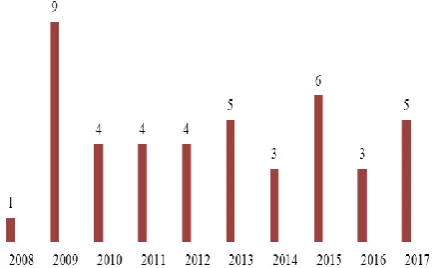
Information of a total number of 44 patients admitted with rabies was obtained which varied between a maximum number of nine patients admitted in 2009 and a minimum of one patient in 2008 as is shown in Figure 1. Majority of them were males, coming from a rural area, aged above 40 years and working as manual labourers as in Table 1. In many of the case records there were details which was not specified. As in Table 2, majority of the patients presented in the hospital one to two months after the animal bite. The duration since animal bite varied from one month to six years. The duration since the onset of symptoms to admission varied from one to 15 days with a mean of 2.9 days and standard deviation (SD) of 2.53. All the 44 patients expired in the hospital and the duration of stay in hospital varied from 0-22 days (0 indicates that patients expired on the day of admission) with a mean of 2.7 days and SD of 3.6. The total duration since symptoms to expiry varied from 2-24 days with a mean of 5.6 days SD 4.1. Majority were dog bite cases of which only five were domestic animals, one was wild animal and others were stray animals. The site of animal bite and clinical features of patients are as shown in Figures 2 and 3 respectively.
Table 1: Socio-demographic factors of patients.
Number of patients (%)
Age in years
1-10 6 (13.6)
11-20 3 (6.8)
21-30 6 (13.6)
31-40 9 (20.5)
41-50 10 (22.7)
>50 10 (22.7)
Sex
Male 38 (86.4)
Females 6 (13.6)
Occupation
Coolie 29 (65.9)
Students 3 (7.8)
Not specified 12 (26.3)
Residence
Rural 36 (81.8)
Urban 5 (11.4)
Not specified 3 (6.8)
Table 2: Clinical profile of patients admitted with rabies.
Number (%)
Duration since bite
<1 month 8 (18.2)
1-2 month 13 (29.5)
2-3 month 10 (22.5)
3-6 month 1 (2.3)
6 month-1 year 4 (9.1)
>1 year 4 (9.1)
Not specified 4 (9.1)
Animal
Dog 32 (72.7)
Cat 1 (2.3)
Cheetah 1 (2.3)
Not specified 10 (22.7)
Duration since symptoms to hospital Less than 3 days 35 (79.5)
3-7 days 8 (18.2)
>1 week 1 (2.3)
Duration of stay in hospital
Less than 3 days 37 (84.1)
3-7 days 4 (9.1)
7-14 days 3 (6.8)
>2 weeks 1 (2.3)
Immunisation status of the patients
After observation of the case records regarding post exposure prophylaxis status of these patients, it was noted 20 patients had neither taken anti rabies vaccine nor immunoglobulin, only 10 patients had taken at least one dose of anti-rabies vaccine as in Table 3. Among the 10 patients who had taken anti rabies vaccine only three
patients had completed the schedule but not taken immunoglobulin. Immunoglobulin was taken by three patients but had not completed Anti rabies vaccine schedule. Four patients had neither completed the vaccination schedule nor taken Immunoglobulin as in Figure 4.
Figure 2: Site of animal bite.
Figure 3: Clinical features of patients at the time of admission.
Table 3: Post exposure prophylaxis status of the patients
Immunization status Number of patients
Anti-rabies vaccine (ARV) 10
Not specified 14
Not taken 20
Figure 4: Anti rabies vaccination and immunoglobulin status of the patients.
face 3% upper
limb 18%
lower limb 18%
multiple sites
2% not
specified 59%
face upper limb lower limb multiple sites not specified
32 (72.7%) 38 (86.4%)
9 (20.5%)
3 (6.8%) 2 (4.5%) 7 (15.9%)
4 (9.1%) 9 (20.5%)
Completed ARV but no immunoglobu
lin 30%
taken Immunoglobu
lin, but incomplete
ARV schedule-30% incomplete
ARV schedule ,no immunoglobu
Reasons for incomplete post exposure prophylaxis
Both active and passive immunisation is recommended for category 3 bites. Most important reasons in the health system are non-availability of immunoglobulin. In government sector Equine rabies immunoglobulin is available only in Epidemic Diseases hospital in Mysore district. The hospitals in the periphery do not have enough budget to procure immunoglobulin and most of the hospital staff including doctors at periphery have fear of adverse reactions due to equine immunoglobulin and refers patients. This is a challenge to the patients as they have to travel and this leads to an increase in expenditure. In one case record it was observed that the treating doctor did not advice regarding immunoglobulin, only anti rabies vaccination was given. Another factor is the cost; only below poverty line card holders are provided post exposure prophylaxis free of cost. For complete post exposure prophylaxis an animal bite victim with category 3 wound has to spend around 500 rupees which excludes travel cost. At times there was shortage of immunoglobulin also.
It was observed that some of the patients did not know where to get immunoglobulin. The animal bite victims do not realise the importance of four doses of intradermal vaccination and the travelling cost and loss of wages act as barriers in receiving vaccination. Educational status of the patients is also important in this regard. Most of the patients do not know that vaccination should be done after animal bite and some bites can lead to rabies. They also have certain myths like applying chilli powder on wounds etc. as some of the remedies and patients do approach traditional healers after the animal bite which are delaying and hindering complete post exposure prophylaxis.
DISCUSSION
In our study there were 44 patients admitted with rabies during a ten year period. Majority of the patients reported history of dog bite and the most common site of bite were upper limb and lower limb which was similar to other studies. 6, 11 The duration since bite to onset of symptoms varied up to 6 years with majority reporting between one to two months and the most common symptoms were hydrophobia and aerophobia which was similar to a national multicentric epidemiological survey. 12 A study at NIMHANS reported that amongst 128 patients, 94% of the victims reported dog-bites, more than a third of them were children and most of the victims did not receive adequate post-exposure prophylaxis which was similar to our study as none had complete post exposure prophylaxis. 13
Treating doctors and hospital staff should have an adequate knowledge regarding management of animal bite wounds. Anti-rabies vaccination should be made available at every primary health centre and immunoglobulin at least at the taluk hospitals. According
to a study in Himachal Pradesh it was found that immunoglobulin was not available at the Community health centres (CHC) and that referral to higher centres was very low, either it was not prescribed or there was lack of adequate knowledge. 14Adequate training must be given to the hospital staff regarding administration of vaccination, immunoglobulin and management of adverse reactions. A study conducted by Agrawal et al reported that only 55% of the private general practitioners knew about immunoglobulin. 15The authorities also should be able to procure the vaccine and immunoglobulin without leading to any shortages and provide treatment free of cost or at least at much subsidised rates. Every animal bite victim should be educated about the fatality of human rabies and the importance of timely, appropriate administration of immunoglobulin and completion of the vaccination schedule. A study in Gujarat on dropout rates of antirabies vaccination schedule reported a thirty-four percent total dropout and 31.5% delayed compliance observed particularly during the last dose of intra dermal regimen. Only 68% received the first dose of ARV within 24 hours of the exposure. 16 The major constraints were loss of wages, forgotten dates, cost incurred and distance from the hospital according to a study in Karnataka.17Awareness on rabies should be created so that people consult the doctors on time and this will lead to increased reporting of cases as shown in a study which led to significant improvement in the perception related to animals transmitting rabies, modes of transmission, first aid practices, and post exposure prophylaxis following educational intervention. 18A study conducted in Bangalore regarding community perception of rabies showed that 74.1% of the participants had heard about rabies, and 54.1% knew that rabies is a fatal disease. Only 33.5% of the interviewees felt that people in the community had a role to play in controlling the stray dog population.19 Other measures like vaccination of dogs and newer methods to reduce the incidence of animal rabies and control of dog population will play a long run in reducing the burden of rabies
The major limitations of the study were the retrospective nature of the study. Many of the cases were missed and since it was record based we could not get much information regarding the immunisation status. The diagnosis of rabies was clinical and no antibody testing or post mortem examinations were done in the hospital.
Rabies though fatal can be prevented by complete post exposure prophylaxis and there should be coordination by the health authorities as well as the policy makers to ensure that post exposure prophylaxis is accessible, affordable and available and people should be aware and participate in creating a Rabies free India.
ACKNOWLEDGEMENTS
Funding: No funding sources Conflict of interest: None declared Ethical approval: Not required
REFERENCES
1. Ramakrishnan LV, Shakir L, Chandran P, Thavody J. Profile of Mass Casualties of Animal Bite Cases Reported to a Tertiary Care Institution from April 2014 to March 2015 in North Kerala: India. Int J Med Public Health. 2017;7(1):33-7.
2. Kole KA, Roy R, Kole DC. Human rabies in India: a problem needing more attention. Bulletin of the World Health Organization. 2014;92:230.
3. Abbasa SS, Manish K. Rabies control in India: a need to close the gap between research and policy. Bull World Health Organ. 2015;93:131–2.
4. Sudarshan MK. Vision 2030: Dog-mediated human rabies-free India: Action must begin now. Indian J Public Health. 2017;61:1-2.
5. Karthik C, Viswanantha PG, Shobha, Ranganath TS, Sushmitha P. Profile of dog bite cases attending the outpatient department of an urban health training centre in Bangalore city, India. Int J Community Med Public Health. 2016;3:1765-8.
6. Chauhan P, Saini G. Study of profile of animal bite victims attending anti-rabies clinic at Jodhpur. Int J Med Sci Public Health. 2013;2:1088-91.
7. Alabi O, Nguku P, Chukwukere S, Gaddo A, Nsubuga P, Umoh J. Profile of dog bite victims in Jos Plateau State, Nigeria: a review of dog bite records (2006-2008). Pan Afr Med J. 2014;18:12. 8. Singh M, Uppadhaya SK, Bhansali S, Saini JP,
Hakim A, Meena R. Animal Bite Cases in Western Rajasthan, India: A Retrospective Study 2009-2015. Sch Acad J Biosci. 2016;4(6):483-7.
9. Ganasva A, Bariya B, Modi M, Shringarpure K. Perceptions and treatment seeking behaviour of dog bite patients attending regional tertiary care hospital of central Gujarat, India. J Res Med Den Sci. 2015;3(1):60-4.
10. Park K. Park’s Text book of preventive and social medicine. 24th ed. Jabalpur: Banarsidas bhanot; 2017: 294-295.
11. Ghosh A, Pal R. Profile of Dog Bite Cases in an Urban Area of Kolkata, India. Natl J Community Med. 2014;5(3):321-4.
12. Sudarshan MK, Madhusudhana SN, Mahendra BJ, Rao NS, Narayana A, Rahman A et al. Assessing burden of rabies in India. WHO sponsored national multi-centric rabies survey. Int J Infect Dis. 2007;11(1):29-35.
13. Mani RS, Anand AM, Madhusudana SN. Human rabies in India: an audit from a rabies diagnostic laboratory. Trop Med Int Health. 2016;21(4):556– 63.
14. Kumar A, Mazta SR, Thakur A. Assessment of treatment practices as per policies for prevention and control of human rabies due to dog bite in the health institutions of Himachal Pradesh. APCRI J. 2016;18(1):14-7.
15. Agrawal K, Preeti G, Ahirwar G, Mahore R, Dwivedi S, Swami D. Knowledge of animal bite and its management among the private medical practitioners. APCRI J. 2016;18(1): 22-6.
16. Dhaduk KM, Unadkat SV, Katharotiya PR, Mer AR, Chaudhary MC, Prajapati MM. Case profile, volume analysis, and dropout rate of antirabies vaccination regimens among animal bite victims in Gujarat. Indian J Public Health. 2016;60:268-72. 17. Shankaraiah RH, Rajashekar RA, Veena V,
Hanumanthaiah AD. Compliance to anti-rabies vaccination in post-exposure prophylaxis. Indian J Public Health. 2015;59:58-60.
18. Kulkarni P, Kumar DS, Siddalingappa H, Renuka M. Effectiveness of educational intervention on perception regarding rabies among women self help group members in urban Mysore, Karnataka, India. Int J Community Med Public Health. 2016;3:1268-72.
19. Herbert M, Basha R, Thangaraj S. Community perception regarding rabies prevention and stray dog control in urban slums in India. J Infection Public Health. 2012;5:374-80.