Original Research Article
Reforming the perceptions about reproductive health amongst
adolescents in urban slums
Monika S. Masare*, Sachin S. Divekar, Sandeep M. Bhelkar, Prabhakar A. Hiwarkar
INTRODUCTION
World Health Organization (WHO) defines “adolescents” as individuals in the 10-19 years age group and “youth” as the 15-24 year age group. These two overlapping age groups are combined in the group “young people” covering the age range 10-24 years.1 Early adolescence is broadly considered to stretch between the ages of 10 and 14. It is at this stage that physical changes generally commence, usually beginning with a growth spurt and soon followed by the development of the sex organs and secondary sexual characteristics. Late adolescence
encompasses the latter part of the teenage years, broadly between the ages of 15 and 19. Risk-taking – a common feature of early to middle adolescence, as individuals experiment with „adult behaviour‟, it declines during late adolescence, as the ability to evaluate risk and make conscious decisions develops.1 Adolescence is marked by special attributes. These attributes are rapid physical growth and development; physical, social and psychological maturity; sexual maturity and onset of sexual activity; experimentation; development of adult mental process and adult identity.2 There are about 350 million adolescents in the South-East Asia Region. They constitute 15%-26% of the population in countries in the
ABSTRACT
Background: Adolescence is a transitional stage of physical and psychological development that generally occurs
during the period from puberty to legal adulthood. It is marked by rapid physical growth and development with sexual maturity. The current study aims at assessing and reforming the perceptions affecting sexual behavior and attitude towards puberty, marriage, conception, STIs, HIV/AIDS and contraception among adolescent followed by appropriate training interventions.
Methods: The study was conducted in an urban slum, on 110 adolescents of age 12 to 17 years in the field practice
area of an urban health center in urban slum. A semi structured pretest and posttest Questionnaire administered to the study subjects with appropriate training interventions. The analysis was done using Microsoft Excel software.
Results: Pretest showed that of only 19% of the adolescents could correctly mention half the physical changes occurring in boys during Puberty. Only 2% of the girls could mention the pubertal changes correctly. Awareness increased to up to 87% in boy‟s and 51% in girls, who answered at more than half pubertal changes correctly in posttest respectively after teaching interventions. Perceptions about contraception, family planning STDs and HIV were also changed significantly after the interventions.
Conclusions: Appropriate training about reproductive health is essential to sensitize the adolescents for the health empowerment at an early stage.
Keywords: Adolescents, Reproductive health, Interventions, Urban slum
Department ofCommunity Medicine, SVNGMC Yavatmal, Maharashtra, India
Received: 20 March 2018
Revised: 04 May 2018
Accepted: 05 May 2018
*Correspondence:
Dr. Monika S. Masare,
E-mail: [email protected]
Copyright: © the author(s), publisher and licensee Medip Academy. This is an open-access article distributed under
the terms of the Creative Commons Attribution Non-Commercial License, which permits unrestricted non-commercial use, distribution, and reproduction in any medium, provided the original work is properly cited.
region.2 The knowledge of contraceptives among adolescents is high in the region, exceeding 90% among married adolescent females in almost all the countries but the contraceptive use rate is very low indeed. Though most young people have heard of HIV/AIDS, comprehensive knowledge of transmission and prevention is low and misconceptions are widespread. In India, 84.9% of youth had heard of HIV/AIDS, but only half of them were aware of two correct methods of prevention. In Maldives, more than 96% of youth have heard of HIV/AIDS however only 51% of young women and 62% of young men knew two methods of HIV prevention. Awareness of STIs and its symptoms is also generally low.2 Adolescent forms about one-quarter of total India‟s population, but for many years, the needs of adolescents have largely been neglected in population and reproductive health programmes.3 It is essential to reform their reproductive health perceptions. The present study aims at detecting and discussing sexual attributes among adolescent and imparting knowledge regarding these various issues affecting sexual behavior and attitude towards puberty and pubertal changes, marriage, conception, STIs, HIV/AIDS and contraception.
METHODS
The present intervention study carried out on 110 adolescents in the age group of 12 to 17 years in the field practice area of an urban health training center in urban slum of a medical college in Yavatmal district of Maharashtra. The study was carried out over a span of 6 months from June to December 2017 after institutional ethical approval. The study subjects in the community were selected by systematic random sampling from the available data at anganwadi, functioning under the urban health mission in the slum area. The study subjects who didn‟t gave consent for participation in the study as well as who were selected for the study, but remain absent during interview were excluded from the study. Study procedure was divided into three phases-
1. Preparatory phase: A semi-structured pretest and posttest questionnaire was prepared. The questionnaire was restructured accordingly after the analysis of pilot study data. The selected study subjects were approached with the help of anganwadi workers and ASHA workers. They were informed about the study and about its importance. An informed consent for the participation was taken.
2. Intervention and data collection phase: The selected adolescents were called at the nearest anganwadi center in a group of 5-6 according to their feasibility of time in their leisure hours. They were asked to fill the pretest questionnaire. Followed by focused group discussion along with an intervention session for 2 days, of about one and half hour each day with two 5 minute breaks in between, was arranged. On Day-1 Intervention session included a 15 minute introduction to reproductive health
followed by a 45 minute session of audiovisual impression about the physical and emotional changes during puberty, followed by slide show about legal age at marriage, pregnancy, family planning and contraception. Day 2- session included revision in short of day 1 session and educating the study subjects about STIs and HIV/AIDS, followed by posttest questionnaire administration. During each session the participants were encouraged to interact with the investigator to ask their queries. The intervention sessions for girls and boys were taken separately considering their awkwardness regarding the topic of discussion.
3. Analytic phase: Data was entered in Microsoft excel sheet by investigator. Statistical analysis was done by using SPSS version 17 software and Microsoft office 2007.
RESULTS
The present study included the adolescents ranging from age group of 12-17 years of age with a mean age of 15 years (22.8%), as it was found in the pilot study that early adolescent age group, 10 to 12 year olds, typically younger girls and boys in particular are likely to have difficulty in understanding and answering questions relating to reproduction and health. Table 1 depicts the change in perceptions regarding pubertal changes among boys and girls respectively. The study subjects were asked to cite changes that take place in boys during puberty and mark according to the correct options, a half didn‟t know a single change in pretest settings; while 34.5% could write up to two correct changes and remaining 17.3% answered more than half the changes that occur during puberty, correctly. The correct answers were: Body growth with increase in height & weight with hoarsening of voice, acne and facial hair, axillary and pubic hair growth, increase in size of genitalia and nocturnal ejaculation. In the post test settings the frequency of adolescent who answered correctly increased significantly (p<0.01). When the Question regarding pubertal changes among girls were asked, 85.5% of them didn‟t give a single answer while only two could correctly answer more than half the changes that were considered as correct. The correct answers were: body growth with increase in height and weight, axillary and pubic hair growth, increase in size of breasts, starting of menstrual cycle in posttest settings.
replied that as physical growth is complete and 9% for a healthy mother and child. Remaining answers considered correct were as healthy body and mind is achieved at this age and as marital responsibilities can be handled
efficiently at this age. In the post test setting, after interventions, adolescents gave more correct answers while the number who answered incorrectly or gave no reply reduced significantly (Table 2).
Table 1: Reforms in knowledge about pubertal changes among adolescents.
Awareness of pubertal changes
In boys (pre-test) (%)
In boys (post-test) (%)
In girls (pre-test) (%)
In girls (post-test) (%)
Zero 53 (48.2) 00 94 (85.5) 22 (20)
≤50% 38(34.5) 15 (12.8) 14 (12.8) 31 (28.2)
>50% 19 (17.3) 95 (87.2) 02 (1.7) 57 (51.8)
Total 110 (100) 110 (100) 110 (100) 110 (100)
Table 2: Reasons for the age cited for marriage (18 years for women and 21 years for men) as perceived by the adolescents.
Reason for the age cited for marriage Pretest (%) Posttest (%)
Physical growth complete 30 (27.3) 43 (39.2)
For a healthy mother and child 10 (9.1) 27 (24.5)
Healthy body and mind 15 (13.6) 10 (9.1)
Can handle marital responsibilities 17 (15.5) 15 (13.6)
No answer/incorrect responses 38 (34.5) 15 (13.6)
Total 110 (100) 110 (100)
Figure 1: (A) Reforms in perceptions about pubertal changes among adolescents boys; (B) Reforms in perceptions about pubertal changes among adolescents girls.
When asked whether having sexual relation once can lead to pregnancy 32 (29.1%) of the adolescents replied correctly while remaining 78(60.9%) either didn‟t know or replied incorrectly. In the post test the awareness raised significantly. When asked about the consequences of unsafe sexual relation in posttest settings the correctness of response was raised significantly. (Chi square value <0.00001) very few were aware of STIs as an outcome of unsafe sexual relations in pretest setting, however during the posttest they could answer the consequences better as 21.8% replied the outcome of unsafe sexual relation as pregnancy and 63.6% as STIs or HIV/AIDS as the consequences of having unsafe sexual relation. On asking whether these diseases are
preventable the agreeing increased significantly from 54.5% to 88%.
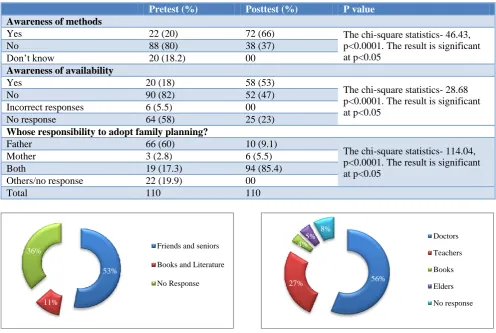
Table 4 shows the change in knowledge about the contraception, its availability and uses. 20% of the study subjects were aware of the methods of contraception and could name at least one method correctly. Nirodh/condom were the most common reply. In the post test this awareness levels increased and about 66% boys could name at least one method correctly. When asked about awareness of availability of these methods only 18% could tell correctly with the answers being government hospitals, chemist shops. This knowledge increased in posttest as 53% could answer the places where contraceptive methods are available. When asked on how many children they consider were appropriate in
0 20 40 60 80 100
Zero ≤ 50%
>50%
53 38 19
0 15
95
Awareness of Pubertal Changes among adolescent boys [Post-test]
Awareness of Pubertal Changes among adolescent boys [Pre-test]
0 20 40 60 80 100
Zero ≤ 50%
≥50%
94 14
2
22 31
57
Awareness of pubertal changes In Girls [Post-test]
Awareness of pubertal changes In Girls [Pre-test]
a family, 92% responded as either 1 or 2 children. No one replied having more than 3 children as appropriate. The responses were same in posttest also. When enquired as to whose responsibility it is to adopt contraception 60% considered father or male should be responsible and 17% considered it a responsibility of both the partners. 20% gave an incorrect response or no response. These responses changed significantly in posttest with 85%
opinionating that both partner should have a role in adopting a family planning method. When asked about the source of knowledge regarding the issues of puberty, sexuality and marriage 53% replied as friends and seniors at 11% answered books and literature as their source of knowledge while 36% didn‟t name any source. Figure 2 and 3 showed the pretest and posttest knowledge of ideal source of information regarding reproductive health.
Table 3: Reforms in awareness about once sexual relation outcomes.
Pretest (%) Posttest (%) P value
Awareness whether once sexual relation can lead to pregnancy
Yes 32 (29.1) 97 (88) The chi-square statistics- 81.27, p<0.0001. The result is significant at p<0.05
No 58 (52.7) 13 (12)
Don‟t know 20 (18.2) 00
Awareness of consequences of unsafe sexual relations (multiple responses)
Pregnancy 8 (7.3) 24 (21.8)
The chi-square statistics- 44.96, p<0.0001. The result is significant at p<0.05
STDs/ HIV-AIDS 32 (29.2) 70 (63.6) Incorrect responses 6 (5.5) 00 No response 64 (58) 25 (23)
Are STDs/ HIV-AIDS are preventable?
Yes 60 (54.5) 97 (88) The chi-square statistics- 30.45, p<0.0001. The result is significant at p<0.05
No 50 (45.5) 13 (12)
Total 110 (100) 110 (100)
Table 4: Reforms in perceptions about contraception and family planning.
Pretest (%) Posttest (%) P value
Awareness of methods
Yes 22 (20) 72 (66) The chi-square statistics- 46.43, p<0.0001. The result is significant at p<0.05
No 88 (80) 38 (37)
Don‟t know 20 (18.2) 00
Awareness of availability
Yes 20 (18) 58 (53)
The chi-square statistics- 28.68 p<0.0001. The result is significant at p<0.05
No 90 (82) 52 (47)
Incorrect responses 6 (5.5) 00 No response 64 (58) 25 (23)
Whose responsibility to adopt family planning?
Father 66 (60) 10 (9.1)
The chi-square statistics- 114.04, p<0.0001. The result is significant at p<0.05
Mother 3 (2.8) 6 (5.5) Both 19 (17.3) 94 (85.4) Others/no response 22 (19.9) 00
Total 110 110
Figure 2: Sources of knowledge regarding reproductive health (pretest).
Figure 3: Ideal source of knowledge regarding reproductive health (posttest).
53%
11%
36% Friends and seniors
Books and Literature
No Response 27% 56%
4%
5% 8% Doctors
Teachers
Books
Elders
DISCUSSION
Adolescents are the most risky portion of population in the world. They are victim of different avoidable sexual and reproductive health negative consequences such as unwanted pregnancy, unsafe abortion and sexual transmitted infections including HIV/AIDS. Almost all of sexual and reproductive health problems are preventable via transparent discussion, life skill training and making adolescents assertive on sexual and reproductive health. Accessing sexual and reproductive health service to adolescent and young people helps to avoid many health problems, and achieve the millennium development goal 3, 4, 5 and 6. Concentrating on these issues, this study sought to explore the change in perceptions regarding reproductive health among adolescents in urban slum in a field practice area of urban health center, following and intervention, which included lectures, audiovisual impression, educational power point presentations about the pubertal changes, sexually transmitted diseases, HIV/AIDs, various contraceptive methods and its availability and family planning services. The results showed that the educational intervention can significantly reform the existing perception of the adolescents regarding their reproductive health and wellbeing and can make them more empowered as a future productive population of the country. From the focus group discussion, it was found that young adolescents don‟t speak on their own as they have difficulty in understanding and answering questions relating to reproduction and health. The older age group was aware of the external, more visible pubertal changes in themselves as well as in the opposite sex. A large proportion of boys and girls mentioned changes in the opposite sex like increase in height, change in voice, breast development, and growth of facial hair, growth of hair in private parts, onset of menstruation in girls, etc when they were asked about the contraception, its availability and uses. 20% of the study subjects were aware of the methods of contraception and could name at least one method correctly. Nirodh/condom were the most common reply. In the post test this awareness levels increased and about 66% boys could name at least one method correctly. Similar study done on five hundred thirty one high school children showed that (82.8%) of students knew about at least one contraceptive method that are used to prevent unwanted pregnancy. Condom (47.7%) followed by abstinence (37.1%) were mainly reported contraceptive methods to prevent unwanted pregnancy.4 Half of students discussed on contraceptive method mainly with their peers. Almost all focus group discussants were not comfortable to have discussed on sexual and reproductive issues with their adolescents.4 When the study subjects were asked about the consequences of unsafe sexual relation in posttest settings the correctness of response was raised significantly. Very few were aware of STIs as an outcome of unsafe sexual relations in pretest setting, however during the posttest they could answer the consequences better as 21.8% replied the outcome of unsafe sexual relation as
pregnancy and 63.6% as STIs or HIV/AIDS as the consequences of having unsafe sexual relation. On asking whether these diseases are preventable the agreeing increased significantly from 54.5% to 88%.Other studies showed the consistent results that is three fourth (77.2%) of students knew about common sexual transmitted infections including HIV. Three hundred fifty eight (55.9%) of students discussed about HIV/AIDS, from these, more than half 152(54.1%) of them were discussed with their peers, these findings were similar to our post test results.4
In our study the source of knowledge of the study subjects regarding the issues of puberty, sexuality and marriage 53% replied as friends and seniors at 11% answered books and literature as their source of knowledge while 36% didn‟t name any source. A study done by Watsa on 4709 respondents showed that adolescents received sex information usually from mass media and friends but it was not reliable and teachers were ill equipped to clear their doubts on reproductive health.5 A study done in vadodara showed that most common sources of information about human reproduction were television, schoolbooks, newspapers, teachers, and friends.6,7 Francis et al study of 716 school girls in Delhi observed that most frequent source of information on reproductive facts was books (53.8%) followed by friends (47.3%) our study showed similar findings.8 Similar results were obtained in study done on adolescent girls in Pune.9 when the study subjects were asked about the health seeking behavior for the reproductive health problems in pretest setting, most of them were not aware about the services provided to them while post intervention they become aware to services provided to them through. Similar results were found in a study done by Joshi et al, on reproductive health problems and help seeking behavior among adolescents in urban India, the study reflected a poor health seeking behavior.10
CONCLUSION
The study pointed toward the need for reforming the knowledge on reproductive system, human reproduction, and related issues and reproductive health among the adolescents. This needs to be strengthened by capacity building of teachers, family members, peer groups, to handle these topics and questions delicately. Imparting training to adolescents on issue of reproductive health sensitizes them towards health and can empower them at an early stage. Medical fraternity can be trainers for the process of imparting knowledge on the issues of reproductive health to the teachers, family members and peer groups can be the direct contact of the adolescents in this aspect.
Limitation
be affected by social desirability bias because of sensitive nature and cultural barrier for open discussion. Since the study design was cross section cause and effect relationship could not be established. Analytical study design is recommended for further researches.
ACKNOWLEDGEMENTS
Authors would like to thank the department of community medicine of SVNGMC Yavatmal Maharashtra, India as well authors would like to give thanks to the Anganwadi workers and ASHA workers along with the Medical Social Worker for their kind Co-Operation.
Funding: No funding sources Conflict of interest: None declared
Ethical approval: The study was approved by the Institutional Ethics Committee
REFERENCES
1. Strengthening the adolescent component of HIV/AIDS and reproductive health programmes: a training course for public health managers. 1995: 28.
2. Strategies for Adolescent Health and development in SEAR, World Health Organization publication. 2011: 12-24.
3. Draft final report of the working group on youth affairs & adolescent development for formulation of 11th five year plan (2007-2012), Government of India, Ministry of Youth Affairs and Sports. 2007;1:15.
4. Ayalew M, Mengistie B, Semahegn A. Adolescent - parent communication on sexual and reproductive
health issues among high school students in Dire Dawa, Eastern Ethiopia: a cross sectional study. Reprod Health. 2014;11:77.
5. Watsa MC. Premarital Sexual Behaviour of Urban Educated Youth in India. Paper presented at the Workshop on Sexual Aspects of AIDS/STD Prevention in India, Mumbai. 1993: 23-27.
6. Kotecha PV, Patel S, Baxi RK, Mazumdar VS, Misra S, Modi E, et al. Reproductive health awareness among rural school going adolescents of Vadodara district. Indian J Sexually Transmitted Dis. 2009;30(2):94-9.
7. Kotecha PV, Patel SV, Mazumdar VS, Baxi RK, Misra S, Diwanji M, et al. Reproductive health awareness among urban school going adolescents in Vadodara city. Indian J Psychiatr. 2012;54(4):344-8. 8. Francis PT, Gill IS, Chawdhary S. Knowledge,
belief and attitude regarding AIDS, STDs and human sexuality among senior secondary students. Indian J Community Med. 1994;19:16–20.
9. Majumdar R, Ganguli S.K. A study of adolescent girls in Pune. Health and Population perspectives and Issues. 2000;23(2):95–104.
10. Joshi BN, Chauhan SL, Donde UM, Tryambake VH, Gaikwad NS, Bhadoria V. Reproductive health problems and help seeking behavior among adolescents in urban India. Indian J Pediatr. 2006;73:509.
Cite this article as: Masare MS, Divekar SS, Bhelkar