ABC-T: Modified Artificial Bee Colony Algorithm with
Pa-rameter Tuning for Continuous Function Optimization
Sadman Sakib
Department of Computer Science & Engineering Southeast University
Dhaka-1213, Bangladesh
Mahzabeen Emu
Department of Computer Science & Engineering Ahsanullah University of Science and Technology
Dhaka-1208, Bangladesh
ABSTRACT
This paper carries a comparative study on a population-based swarm intelligence (SI) algorithm and improved modified ver-sion of that algorithm. For optimization problems, the nature-inspired algorithm works better than other algorithms. There are different types of swarm intelligence algorithms available for this purpose. Among these swarm intelligence algorithms, ABC algorithm is one algorithm where 3 types of bees are seen, em-ployed bees, onlooker bees, scout bees. Emem-ployed bees and scout bee are responsible for exploration whereas onlooker bees are responsible for exploitation. A modified version of ABC (Artificial Bee Colony) has been implemented and then com-pared with the standard ABC algorithm. The comparisons are conducted on an experimental set of eleven benchmark func-tions. The modified version of ABC that is proposed is named ABC with tuning (ABC-T). In our analysis, the rate of exploita-tion and exploraexploita-tion was changed by maintaining one static and five dynamic ratios of employed and onlooker bees to find out which combination performs well and which combination does not perform notably. The results produced by ABC-T with dif-ferent ratio of exploration and exploitation is also compared to each other to find out which combination performs better for which type of function.
Keywords
Swarm intelligence algorithm; Artificial Bee Colony algorithm; Exploitation; Exploration; Unimodal function.
1.
INTRODUCTION
Real-world optimization problems are often very challenging to solve sometimes. To solve such problems, optimization mecha-nisms can be used, though there is no guarantee that the optimal solution can be achieved [1]. However, nature-inspired algo-rithms can obtain an optimal solution. The two most influential and triumphant classes or directions in bio-inspired optimization algorithms involves Evolutionary Algorithms (EAs) and Swarm Intelligence algorithms (SIAs) which are inspired by the natural evolution and collective behavior in animals respectively [2], [5].
One of the techniques to perform optimization is population-based method. Swarm intelligence algorithms are one of the kinds of the population-based method along with the evolution-ary algorithm. Swarm intelligence (SI) is the collective behavior of self-organized systems, decentralized, natural or artificial. In SI the candidate solution is swarm member which can be achieved by self-organization, positive/negative feedback, fluc-tuation etc. [11]. SI is the discipline that deals with natural and artificial systems composed of many individuals that coordinate using decentralized control and self-organization. In particular, the discipline focuses on the collective behaviors that result from the local interactions of the individuals with each other and with
their environment. Few mentionable examples of swarm intelli-gence algorithms are ant colony optimization [3], particle swarm optimization [2], [5], cuckoo search [6], Artificial bee colony algorithm (ABC) [11], [12], bat algorithm [7], Firefly algorithm [9] etc.
Artificial bee colony algorithm (ABC) is a meta-heuristic algo-rithm which simulates the foraging behavior of honey bees. It can be used to solve various optimization problems. ABC main-tains a distributed population and to handle Exploration vs. Ex-ploitation. The swarm bees are classified into three groups: em-ployed bees, onlooker bees and scout bees. Half of the popula-tion consists of employed bees are responsible for explorapopula-tion which brings randomness into the population and the other half is onlooker bee dedicated to exploitation. Employed bees search for food sources (i.e. candidate solutions) by exploring the search space and share the information with onlooker bees through ‘Waggle Dance’. The job of onlooker bee is to choose the best food source with the maximum fitness value. Scout bees search for new food sources when the previous food source is no longer beneficial. So, in the scout bee phase, exhausted food sources are being abandoned [8], [10].
Here the aim was to introduce an improved and modified version of ABC named ABC-T by changing or tuning some controlling parameters in order to get a more feasible solution. Exploration and exploitation rate is changed by maintaining some ratios to see which ratio produces the best result for which types of opti-mizing problems. Our numerical results show that the proposed ABC-T algorithm produces better or equal best and average solutions in all cases.
2.
THE ARTIFICIAL BEE COLONY
(ABC) ALGORITHM
ABC algorithm is based on the intelligent food foraging behav-ior of honey bees. This model was developed from the foraging behavior of a honeybee colony [10], which identifies three es-sential components (food sources, employed bees and unem-ployed bees) and two modes of behavior (recruitment to a food source and abandonment of a source).
2.1
Employed Bee Stage
This stage imitates the foraging by the employed bees in the neighborhood of their current food source positions. The posi-tion of each food source gets updated in this step. Suppose, an employed bee is currently positioned at a food source position
.The employed bee searches in the vicinity of by producing a new trial food position around using equation (1).
(1)
= the number of search dimensions
= the number of employed bees (or, food positions)
= a uniform random value from [-1, 1].
So, the new test solution is found from by perturbing one of its randomly picked parameters (i.e., ) and using the infor-mation of another randomly picked candidate solution . If has higher ‘fitness’ value than the original solution , then is rejected and substituted by . For the problem of function opti-mization, F is the function that needs to be minimized. The fit-ness value can be calculated using the equation (2). [1]
(2)
2.2
Onlooker Bee Stage
In the onlooker bee stage, employed bee is selected randomly to follow by each onlooker bee. Suppose, is the probability that an onlooker bee could select the employed bee with food source position , which is computed by ABC using equation (3).
(3)
So, the probability to be proportional to , ensuring that the probability of picking a food source is kept proportional to its quality. Similar to the employed bees, each onlooker bee also employs (1) to produce a trial food source in the vicinity of its current food position . If has better fitness value than the old food position , then is replaced by . Otherwise, is retained and is discarded. [1]
2.3
Scout Bee Stage
If a particular food source position has not been enriched over an unusually long period of time (i.e., last limit cycles), then it is presumed to be stuck at a locally optimal point. If this happens, the ABC algorithm abandons and the bee employed to now becomes a scout bee that is placed at random across the search space using equation (4). [1]
Here
= the search space along the dimension.
(4)
3.
PROPOSED ABC WITH PARAMETER
TUNING (ABC-T)
To avoid the pitfalls of the standard ABC algorithm, an im-proved version of the ABC algorithm is proposed by controlling some of the parameters in a way that it is able to produce better results than the standard one. Our ABC with tuning (ABC-T) algorithm has been tuned in such a way that it changes the ex-ploration & exploitation ratio over the generations. Also, the ABC-T algorithm allows scout bees only to a certain period of the algorithm. This upgraded ABC-T algorithm has been imple-mented and tested on standard benchmark problems and the performance was compared to the performance of the standard ABC algorithm. Our numerical results show that the proposed ABC-T algorithm produces better or equal best and average solutions for all cases. To maintain a balanced exploration to exploitation ratio over the course of generations is the prime
tion) in order to avoid being trapped in local minima. The suc-cessfulness of any such nature-inspired algorithm is determined by a proper balance between exploitation and exploration. This balance is maintained by adjusting certain parameters and also by applying some rules in certain situations. The original algo-rithm maintains a 50%-50% ratio of onlooker bees & employed bees. The algorithm was tuned by changing the proportion of employed & onlooker bees over the period of running time. The number of onlooker bees increases & the number of employed bees decreases over the execution time of the algorithm. In the following table, we have our different parameters for exploration and exploitation ratio.
Table 1. ABC-T parameter change ratio
Type of
parame-ter change Onlooker-Employed bees
Dynamic Linearly increasing onlooker bees & decreasing employed bees
Static
20% - 80% 40% - 60% 50% - 50% 60% - 80% 80% - 20%
As the method doesn’t really need exploration at last little itera-tion so the scout bees were totally ignored as it introduces the exploration which was not wanted at the later part of the execu-tion. So basically the scout bees phase work only for certain first generations. The percentage ratio was found for which algorithm derives better result. The proposed ABC-T pseudo-code is given below:
1. Initialize a pool of food source positions (candidate solutions), = 1, 2… . Each is a vector of parameters: = [ 1 , 2 , … , ]
2. Evaluate the fitness of each food source position by the equation (2).
Repeat
3. For each employed bee, produce a new food source position by using equation (1).
4. Evaluate each new solution by using equation (2). If
has higher fitness than the fitness of the previous xi, then accept to replace xi. Otherwise, discard. Set employed bee = employed bee - 10% * employed bee.
5. Then, calculate the probability value linked with each food position using the equation (2).
6. In terms of the onlooker bee, assign it to a food source position, proportionally based on the probability .
7. In terms of the onlooker bee, produce a new food source position by using equation (1).
8. Evaluate each new solution using equation (2). If has higher fitness value than , then accept to re-place. Otherwise, discard. Set onlooker bee = onlooker bee + 10% * onlooker bee.
10. Memorize the best food source position found.
11. Set cycle counter = + 1.
12. Continue until = Maximum number of cycles
(MNC)
4.
EXPERIMENTAL STUDIES
4.1
Benchmark Functions
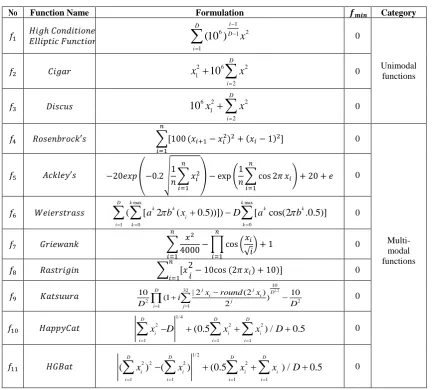
For this experimental purpose eleven benchmark functions have been used which are shown in Table 2. Among these eleven functions first three functions are unimodal functions and others are multi-modal functions.
Table 2. Benchmark Function
No Function Name Formulation Category
1 6 1 2
1
(10 )
i D D ix
0 Unimodal functions2 6 2
1 2
10
D ix
x
06 2 2
1 2
10
D ix
x
00 Multi-modal functions 0 max max
1 0 0
(
[
2
(
0.5))])
[
cos(2
.0.5)]
D k k
k k k k
i
i k k
a
b x
D
a
b
00 0 1.2 10 32 2 2 1 1
| 2 (2 )
10 10 (1 ) 2 j j D D i i j j i
x round x i
D D
0
1/ 4
2 2 2
1 1 1
(0.5 ) / 0.5
D D D
i i i
i i i
x D x x D
0
1/ 2
2 2 2 2
1 1 1 1
(
)
(
)
(0.5
) /
0.5
D D D D
i i i i
i i i i
x
x
x
x
D
04.2
Results of ABC
Parameters adopted for the ABC algorithm are given below:
Limit: Number of onlooker bees *Dim.
Number of onlookers: 50% of the swarm
Number of employed bees: 50% of the swarm
Number of scouts: 1
These are the control parameters of ABC algorithm [11].
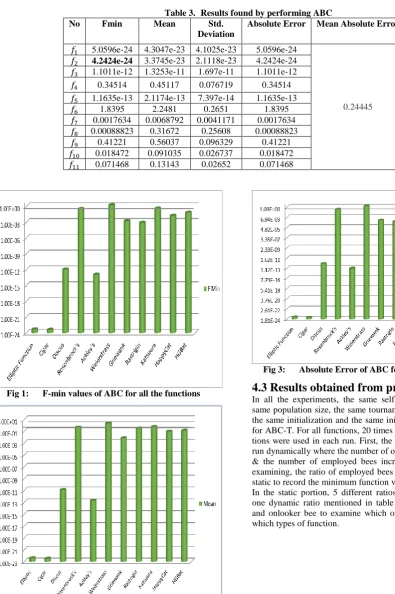
From the results, after performing ABC on the benchmark
Table 3. Results found by performing ABC
No Fmin Mean Std.
Deviation
Absolute Error Mean Absolute Error
5.0596e-24 4.3047e-23 4.1025e-23 5.0596e-24
0.24445
4.2424e-24 3.3745e-23 2.1118e-23 4.2424e-24 1.1011e-12 1.3253e-11 1.697e-11 1.1011e-12 0.34514 0.45117 0.076719 0.34514 1.1635e-13 2.1174e-13 7.397e-14 1.1635e-13
1.8395 2.2481 0.2651 1.8395 0.0017634 0.0068792 0.0041171 0.0017634 0.00088823 0.31672 0.25608 0.00088823 0.41221 0.56037 0.096329 0.41221
0.018472 0.091035 0.026737 0.018472 0.071468 0.13143 0.02652 0.071468
Fig 1: F-min values of ABC for all the functions
Fig 2: Mean values of ABC for all the functions
Fig 3: Absolute Error of ABC for all the functions
4.3
Results obtained from proposed ABC-T
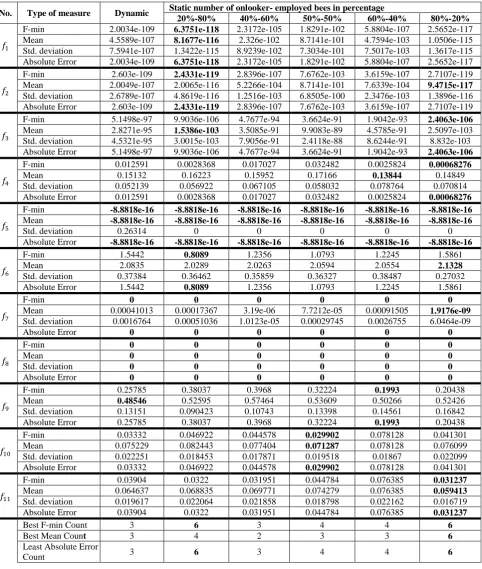
Table 4. Results produced by ABC-T
No. Type of measure Dynamic Static number of onlooker- employed bees in percentage
20%-80% 40%-60% 50%-50% 60%-40% 80%-20%
F-min 2.0034e-109 6.3751e-118 2.3172e-105 1.8291e-102 5.8804e-107 2.5652e-117 Mean 4.5589e-107 8.1677e-116 2.326e-102 8.7141e-101 4.7594e-103 1.0506e-115 Std. deviation 7.5941e-107 1.3422e-115 8.9239e-102 7.3034e-101 7.5017e-103 1.3617e-115 Absolute Error 2.0034e-109 6.3751e-118 2.3172e-105 1.8291e-102 5.8804e-107 2.5652e-117
F-min 2.603e-109 2.4331e-119 2.8396e-107 7.6762e-103 3.6159e-107 2.7107e-119 Mean 2.0049e-107 2.0065e-116 5.2266e-104 8.7141e-101 7.6339e-104 9.4715e-117 Std. deviation 2.6789e-107 4.8619e-116 1.2516e-103 6.8505e-100 2.3476e-103 1.3896e-116 Absolute Error 2.603e-109 2.4331e-119 2.8396e-107 7.6762e-103 3.6159e-107 2.7107e-119 F-min 5.1498e-97 9.9036e-106 4.7677e-94 3.6624e-91 1.9042e-93 2.4063e-106 Mean 2.8271e-95 1.5386e-103 3.5085e-91 9.9083e-89 4.5785e-91 2.5097e-103 Std. deviation 4.5321e-95 3.0015e-103 7.9056e-91 2.4118e-88 8.6244e-91 8.832e-103 Absolute Error 5.1498e-97 9.9036e-106 4.7677e-94 3.6624e-91 1.9042e-93 2.4063e-106 F-min 0.012591 0.0028368 0.017027 0.032482 0.0025824 0.00068276
Mean 0.15132 0.16223 0.15952 0.17166 0.13844 0.14849
Std. deviation 0.052139 0.056922 0.067105 0.058032 0.078764 0.070814 Absolute Error 0.012591 0.0028368 0.017027 0.032482 0.0025824 0.00068276
F-min -8.8818e-16 -8.8818e-16 -8.8818e-16 -8.8818e-16 -8.8818e-16 -8.8818e-16 Mean -8.8818e-16 -8.8818e-16 -8.8818e-16 -8.8818e-16 -8.8818e-16 -8.8818e-16
Std. deviation 0.26314 0 0 0 0 0
Absolute Error -8.8818e-16 -8.8818e-16 -8.8818e-16 -8.8818e-16 -8.8818e-16 -8.8818e-16
F-min 1.5442 0.8089 1.2356 1.0793 1.2245 1.5861
Mean 2.0835 2.0289 2.0263 2.0594 2.0554 2.1328
Std. deviation 0.37384 0.36462 0.35859 0.36327 0.38487 0.27032
Absolute Error 1.5442 0.8089 1.2356 1.0793 1.2245 1.5861
F-min 0 0 0 0 0 0
Mean 0.00041013 0.00017367 3.19e-06 7.7212e-05 0.00091505 1.9176e-09 Std. deviation 0.0016764 0.00051036 1.0123e-05 0.00029745 0.0026755 6.0464e-09
Absolute Error 0 0 0 0 0 0
F-min 0 0 0 0 0 0
Mean 0 0 0 0 0 0
Std. deviation 0 0 0 0 0 0
Absolute Error 0 0 0 0 0 0
F-min 0.25785 0.38037 0.3968 0.32224 0.1993 0.20438
Mean 0.48546 0.52595 0.57464 0.53609 0.50266 0.52426
Std. deviation 0.13151 0.090423 0.10743 0.13398 0.14561 0.16842 Absolute Error 0.25785 0.38037 0.3968 0.32224 0.1993 0.20438
F-min 0.03332 0.046922 0.044578 0.029902 0.078128 0.041301
Mean 0.075229 0.082443 0.077404 0.071287 0.078128 0.076099
Std. deviation 0.022251 0.018453 0.017871 0.019518 0.01867 0.022099 Absolute Error 0.03332 0.046922 0.044578 0.029902 0.078128 0.041301
F-min 0.03904 0.0322 0.031951 0.044784 0.076385 0.031237
Mean 0.064637 0.068835 0.069771 0.074279 0.076385 0.059413
Std. deviation 0.019617 0.022064 0.021858 0.018798 0.022162 0.016719 Absolute Error 0.03904 0.0322 0.031951 0.044784 0.076385 0.031237
Best F-min Count 3 6 3 4 4 6
Best Mean Count 3 4 2 3 3 6
Least Absolute Error
Count 3 6 3 4 4 6
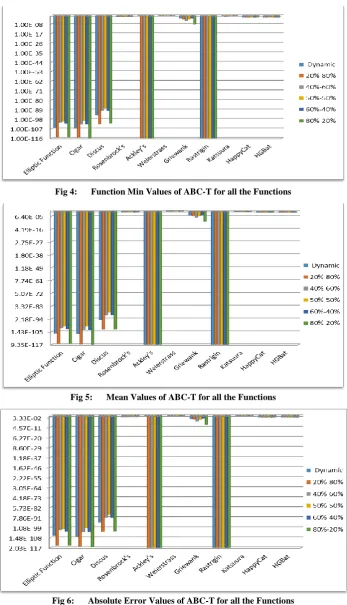
From the results it is evident that when onlooker- employed bees’ percentages are 20%-80% or 80%-20% comparatively better results were shown than others. Although 80%-20% of onlooker-employed bees’ ratio produced the best results
Fig 4: Function Min Values of ABC-T for all the Functions
Fig 5: Mean Values of ABC-T for all the Functions
Fig 6: Absolute Error Values of ABC-T for all the Functions
5.
EXPERIMENTAL RESULTS
COM-PARISON
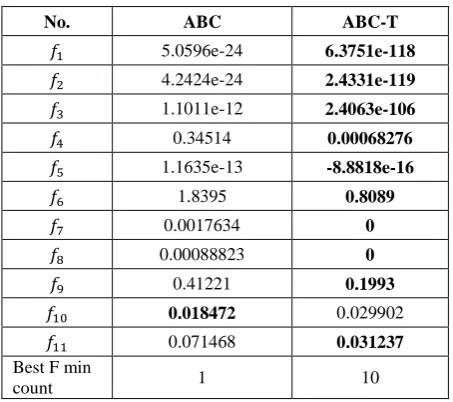
Table 5. Comparison between ABC and ABC-T
No. ABC ABC-T
5.0596e-24 6.3751e-118 4.2424e-24 2.4331e-119 1.1011e-12 2.4063e-106 0.34514 0.00068276 1.1635e-13 -8.8818e-16
1.8395 0.8089
0.0017634 0
0.00088823 0
0.41221 0.1993
0.018472 0.029902
0.071468 0.031237
Best F min
count 1 10
6.
CONCLUSION
This paper presented a modified artificial bee colony algo-rithm with a concept mixing up the rate of exploration and exploitation. The parameters were tuned by changing the per-centage of onlooker bee and employed bee. As employed bee introduces randomness or exploration the rate of employed bees were maintained higher at the beginning and kept reduc-ing it as time goes. The proposed algorithm was tested on eleven benchmark functions. This parameter adjustment actu-ally turned out to be a good solution as this ABC-T algorithm outperformed standard ABC algorithm according to the exper-imental results. This work can be proven to be useful in terms of parameter tuning and in studies related to intensification and diversification for different swarm intelligence algo-rithms.
7.
REFERENCES
[1] I. Fister, Jr, X. Yang, I. Fister, J. Brest, D. Fister (2013), A Brief Review of Nature-Inspired Algorithms for Opti-mization, ELEKTROTEHNIˇSKI ESTNIK 80(3): 1–7, 2012.
[2] Binitha S, S. S. Sathya, “A Survey of Bio inspired Opti-mization Algorithms”, International Journal of Soft Computing and Engineering (IJSCE) ISSN: 2231-2307,
[3] Dorigo, Marco & Birattari, Mauro & Stützle, Thomas.. Ant Colony Optimization. Computational Intelligence
Magazine, IEEE. 1. 28-39. 10.1109/MCI.2006.329691, 2006.
[4] Das, S. Abraham, A. and Konar, A. “Particle Swarm Optimization and Differential Evolution Algorithms: Technical Analysis, Applications and Hybridization Per-spectives”, Springer-Verlag Berlin Heidelberg 2008.
[5] Dr. M. S. Alam, “Continuous Optimization with evolu-tionary and swarm intelligence algorithms”, PhD Thesis, Bangladesh University of Engineering and Technology, September 2013.
[6] Civicioglu, P. and E. Besdok, “A conception comparison of the cuckoo search, particle swarm optimization, dif-ferential evolution and artificial bee colony algorithms”, Artificial Intelligence Review, pp 1–32, 2011.
[7] X.-S. Yang, A New Metaheuristic Bat-Inspired Algo-rithm, in: Nature Inspired Cooperative Strategies for Op-timization (NISCO 2010) (Eds. J. R. Gonzalez et al.), Studies in Computational Intelligence, Springer Berlin, 284, Springer, 65-74, 2010.
[8] V. Tereshko, and A. Loengarov, “Collective decision-making in honeybee foraging dynamics”, Computing and Information Systems Journal, Vol–9, No. 3, 2005.
[9] X.-S. Yang, “Firefly algorithms for multimodal optimiza-tion”, in: Stochastic Algorithms: Foundations and Appli-cations, SAGA 2009, Lecture Notes in Computer Scienc-es, Vol. 5792, pp. 169-178, 2009.
[10]V. Tereshko, “Reaction-diffusion model of a honeybee colony’s foraging behavior”, Proceedings of the 6th Par-allel Problem Solving from Nature (PPSN), pp 807 816, 2000.
[11]D. Karaboga, “An idea based on honey bee swarm for numerical optimization”, Erciyes University, Kayseri, Turkey, Technical Report–TR06, 2005.
[12]D. Karaboga, B. Basturk.: “A powerful and efficient algorithm for numerical function optimization: artificial Bee Colony(ABC) algorithm”. J. Global Optim. 39(3), 459–471 (2007).