Original Research Article
Middle East respiratory syndrome in Morocco: four years of
surveillance and evaluation of the management of suspected cases
Tahar Bajjou
1*, Khalid Ennibi
2,Idriss Lahlou Amine
3, Farida Hilali
1,
Abdelilah Laraqui
1, Safae Elkochri
3, Yassine Sekhsokh
1INTRODUCTION
MERS-CoV, is a particular strain of coronavirus. It has been named "Coronavirus Middle East Respiratory Syndrome or Coronavirus Syndrome, (MERS-CoV)" because cases of this viral infection first appeared in September 2012 in a patient with fatal pneumonia in Saudi Arabia.1 Subsequent investigation showed that MERS-CoV infection had occurred in Jordan in April 2012 among a cluster of patients with pneumonia.2
Most MERS patients developed severe respiratory symptoms with fever, cough and shortness of breath.3 In addition, the most serious cases were reported among patients with health issues, such as cancer, diabetes or kidney disease.4
At the end of June 2018, 2,229 laboratory-confirmed cases of human infection with MERS-CoV have been reported to WHO from 27 countries, including at least 791 deaths and a fatality rate of 38.7%.5
ABSTRACT
Background: In early 2014, Morocco took steps to prevent the Middle East respiratory syndrome disease from entering into the country. Several facilities have been equipped to accommodate suspected cases. We aimed to report the plan prepared by Morocco to prevent the importation of this infection and to evaluate our experience in the monitoring of suspected cases.
Methods: We analyze the data on the forms of surveillance witch collect demographic informations, symptoms, hospitalization, travel history, risk contacts and MERS-CoV test results.
Results: Since 2014, 152 patients were addressed to the Mohammed 5 Military Teaching Hospital for suspicion of MERS-CoV. The compliance with the suspect case definition was positive in 78 cases. Of these patients, 93.6% were Moroccans. All of them came from the Middle East and 77% returned from a Hajj trip. The most reported symptoms were fever (92.3%) and cough (84.6%). The most reported underlying conditions were asthma (17.9%) and diabetes (12.8%). All of these patients were negative for RT-PCR detection of MERS-CoV.
Conclusions: Moroccan pilgrims go to Hajj despite the warnings of the WHO. To date, Morocco has not reported any cases of MERS-CoV. Overall, the management plan to prevent importation and transmission of MERS-Cov is satisfactory.
Keywords: MERS-CoV, Surveillance, Management, Suspected, Cases, RT-PCR, Morocco
1
Research and Biosafety Laboratory, 2Center of Virology Infectious and Tropical Diseases, 3Laboratory of Virology, Mohammed V Military Teaching Hospital, Mohammed V University, Rabat, Morocco
Received: 08 November 2018
Accepted: 30 November 2018
*Correspondence:
Dr. Tahar Bajjou,
E-mail: [email protected]
Copyright: © the author(s), publisher and licensee Medip Academy. This is an open-access article distributed under the terms of the Creative Commons Attribution Non-Commercial License, which permits unrestricted non-commercial use, distribution, and reproduction in any medium, provided the original work is properly cited.
In order to prevent the spread of this new virus across the planet, the World Health Organization (WHO) has encouraged countries, especially those hosting large numbers of travelers or migrant workers from the Middle East, to create or strengthen infection control measures in health facilities and maintain a high level of vigilance.6
In accordance with these recommendations, the Inter-ministerial Committee for the Control of Emerging and Re-emerging Diseases and the Ministry of Health of the Kingdom of Morocco took steps in early 2014 to prevent the introduction of the disease into the country and, where appropriate, circumscribe its transmission.7
Among these provisions, a national preparedness and response plan was drawn up.8 The main objective of the epidemiological surveillance was to assess the risk of introducing MERS-CoV into the territory, detect cases early, investigate cases and follow up contacts.
To this end, in addition to strengthening health care facilities and isolation units, four medical biology laboratories were provided with adequate diagnostic means.
We present in this article the result of the surveillance activity of MERS-CoV in the Center of Virology and Infectious and tropical Diseases, the Laboratory of Research and Biosafety and the Laboratory of virology of the Mohammed 5 Military Teaching Hospital and we discuss the strategy implemented.
METHODS
In 2013, the Ministry of Health of Morocco began to inform the population about the risk of traveling to Saudi Arabia and in particular to Mecca for Hajj or Umrah. It informed them of the facilities they were advised to report to before and after the trip. It also informed population about the management of patients and suspected cases and airport control.9,10
At international airports of Morocco, health authorities have set up close medical units. Pilgrims and people returning from the Middle East presented with respiratory symptoms and having an epidemiological link, in accordance with the cases definition of the WHO guidance, were enrolled through active screening at these points of entry.11 Self reported cases who developed symptoms within 14 days of arrival were included in sample collection along with admitted patients.
Suspected patients were referred to the surveillance unit in the hospital and could either be hospitalized in an intensive care unit or in a medical isolation unit or monitored by an outpatient unit. Patients were kept in the isolation unit in individual rooms until the MERS-CoV detection results came out.
After several attempts, in 2014, a commercial kit for the detection of MERS-CoV by reverse transcription
real-time PCR (rRT-PCR) was validated for use in screening, allowing the deployment of the test in the laboratories around the world.12,13 The assay is intended for detection of MERS-CoV RNA in respiratory, serum, and stool samples. Laboratories participating in the surveillance network in Morocco received a batch of The PrimerDesign™ genesig HCoV 2012 kits (Primerdesign Ltd, Cambridge, United Kingdom). The surveillance network then began collecting data and specimen on suspected cases and arranging consultations and MERS-CoV tests, where indicated.
Most of the time, the test was performed on samples taken by naso-oropharyngeal swabbing.
Suspect cases were reported using a simplified form consisting mainly of checkboxes.
The form was prepared and updated on the basis of WHO recommendations.14 Since it started to be used, the short form has been revised twice to reflect the changes.
The form collects demographic information (sex, age), symptoms (Fever, Cough, Myalgia…) hospitalization (medical or intensive cares), travel history, risk contacts, risk factors and underlying conditions (asthma, diabetes…), influenza vaccine history, and MERS-CoV test results.
In accordance with the Moroccan “Acute and severe respiratory infections and Influenza Sentinel Surveillance Procedures Manual” several infections and common respiratory pathogens were tested (e.g., influenza viruses A and B, Para-influenza, Adenovirus, RSV,
Mycobacterium, S. pneumoniae …)8
The data collected on the form was entered into an SPSS® version 17.0 software database (IBM Corporation, New York, United States).
The surveillance data presented in this article corresponds to the analysis of the results of the study on the forms.
RESULTS
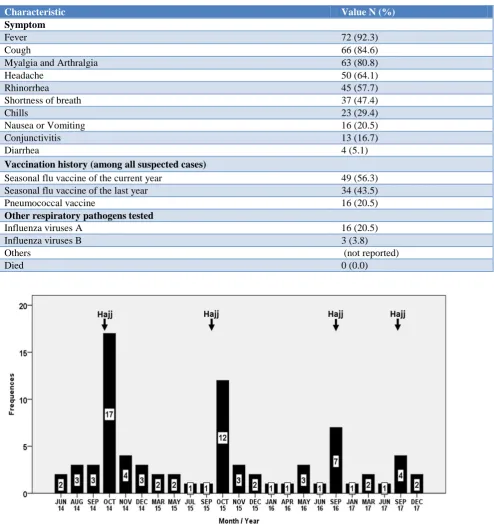
From April 2014 to December 2017, at least 152 people were addressed to the monitoring unit for consultation. The suspect case definition was valid in 78 cases (51.3%). The remaining 74 cases (48.6%) had clinical or travel data inconsistent with the suspect case definition. The evolution of the number of Hajj and the number of suspect cases in the years 2014, 2015, 2016 and 2017 is presented in Table 1 and Figure 1.
Table 1: Evolution by years of the number of Hajj and number of suspected cases for MERS-CoV.
Years Number of Hajj in the year [15] Number of suspected cases Pourcentage (%)
2014 34 100 30 38.5
2015 26 000 22 28.2
2016 25 600 13 16.7
2017 32 000 13 16.7
Total 117 700 78 100.0
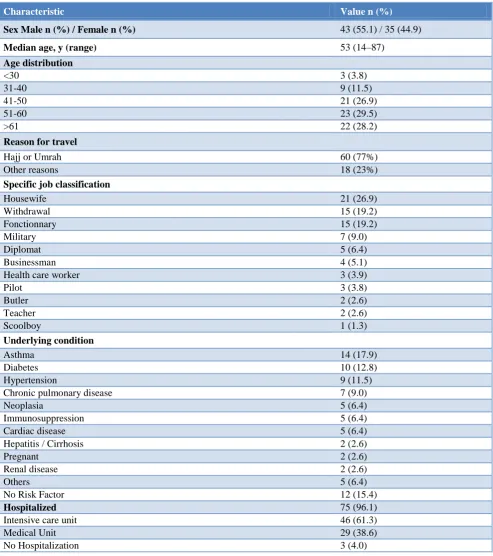
Table 2: Characteristics of suspected cases for MERS-CoV.
Characteristic Value n (%)
Sex Male n (%) / Female n (%) 43 (55.1) / 35 (44.9)
Median age, y (range) 53 (14–87)
Age distribution
<30 3 (3.8)
31-40 9 (11.5)
41-50 21 (26.9)
51-60 23 (29.5)
>61 22 (28.2)
Reason for travel
Hajj or Umrah 60 (77%)
Other reasons 18 (23%)
Specific job classification
Housewife 21 (26.9)
Withdrawal 15 (19.2)
Fonctionnary 15 (19.2)
Military 7 (9.0)
Diplomat 5 (6.4)
Businessman 4 (5.1)
Health care worker 3 (3.9)
Pilot 3 (3.8)
Butler 2 (2.6)
Teacher 2 (2.6)
Scoolboy 1 (1.3)
Underlying condition
Asthma 14 (17.9)
Diabetes 10 (12.8)
Hypertension 9 (11.5)
Chronic pulmonary disease 7 (9.0)
Neoplasia 5 (6.4)
Immunosuppression 5 (6.4)
Cardiac disease 5 (6.4)
Hepatitis / Cirrhosis 2 (2.6)
Pregnant 2 (2.6)
Renal disease 2 (2.6)
Others 5 (6.4)
No Risk Factor 12 (15.4)
Hospitalized 75 (96.1)
Intensive care unit 46 (61.3)
Medical Unit 29 (38.6)
Characteristic Value N (%) Symptom
Fever 72 (92.3)
Cough 66 (84.6)
Myalgia and Arthralgia 63 (80.8)
Headache 50 (64.1)
Rhinorrhea 45 (57.7)
Shortness of breath 37 (47.4)
Chills 23 (29.4)
Nausea or Vomiting 16 (20.5)
Conjunctivitis 13 (16.7)
Diarrhea 4 (5.1)
Vaccination history (among all suspected cases)
Seasonal flu vaccine of the current year 49 (56.3) Seasonal flu vaccine of the last year 34 (43.5)
Pneumococcal vaccine 16 (20.5)
Other respiratory pathogens tested
Influenza viruses A 16 (20.5)
Influenza viruses B 3 (3.8)
Others (not reported)
Died 0 (0.0)
Figure 1: Number of suspected cases tested for MERS-CoV reported by month of the years 2014, 2015, 2016 and 2017: The suspected cases were reported during the month of Hajj or the one immediately following.
In our series, 77% (n=60) of patients declared traveling to the Middle East for Hajj or Umrah. Of these, 70% (n=42) reported being vaccinated against influenza. Also, 33.3% (n=26) were over 65 years old. Of these, 34.6% (n=9) reported being vaccinated against Streptococcus pneumoniae.
More than half the patients (n=46, 59%) reported having had close contact with a patient or recently ill traveler from the Arabian Peninsula or neighboring countries
within 14 days of the onset of symptoms. Only 13 (13.7%) did not report suspicious contact and 19 (24.4%) did not know if contact occurred.
The most commonly reported symptoms were fever (n=72, 92.3%), cough (n=66, 84.6%), and Myalgia and Arthralgia (n=63, 80.8%). Other symptoms are shown in Table 2. The most commonly reported underlying conditions among the suspected cases were asthma (n=14, 17.9%) and diabetes (n=10, 12.8%). No deaths were reported.
All suspected patients tested negative for RT-PCR detection of MERS-CoV. Subsequently, after consulting the files of the patients suspected for MERS-CoV, the most commonly detected pathogens were influenza A (n=16, 20.5%).
DISCUSSION
The majority of laboratory-confirmed cases of MERS-CoV was reported from Saudi Arabia (n=1853/2229, 83%).5
MERS-CoV is currently limited to Middle Eastern countries, and many countries have reported travel-related cases: United Kingdom, France, Tunisia, United States, and others.16-20
Between Morocco and Middle Eastern countries, especially Saudi Arabia, economic, diplomatic and family relations are highly developed and citizens travel between the two countries is very frequent in addition to the annual pilgrimage to Mecca for Hajj and Umrah.
In September 2014, 25 600 Moroccan pilgrims planned to go to Mecca to perform Hajj, despite the warnings of the World Health Organization (WHO) and of the Moroccan Ministry of Health.9 The risk of contracting the disease is significant for pilgrims and therefore the Kingdom of Morocco has mobilized its health authorities to prevent infection among pilgrims and prevent its importation.
From that date until December 2017, 62% (n=49) of the suspected cases were reported during the month of Hajj or the one immediately following. In our series, the number of suspected patients reported in 2014 and 2015 was higher than the number of patients reported in 2016 and 2017. This is in line with the evolution of the number of confirmed cases in Saudi Arabia and the world.21 Actions to take during and after Umrah or Hajj, WHO alerts and criteria for defining probable cases as defined by WHO as well as the recommendations defined by the national plan seem to have been effectively respected.22
The collection of information concerning the profession, the recent history of travel to the Middle East and contacts with sick people during the evaluation of persons suffering from respiratory diseases was properly carried out. The forms were properly filled out (n=75, 95%) and few missing observations were to be found in the patient registration files.
The management of the suspect patients included treatments, molecular diagnosis of MERS-CoV but also quarantining the patient in individual chambers. However, three patients were not isolated in the unit dedicated to this purpose but rather in their own home after recommending that they avoid all contact with other people and wear a respiratory mask.
Management of patients hospitalized for suspicion of MERS-Cov is a major health challenge. These patients are initially treated for acute febrile respiratory illness but also as carriers of MERS-CoV infection with all that this entails in terms of logistics, additional costs, workload and medical and nursing staff.23
National plan was used to assist state health departments in identifying patients for the evaluation and screening of MERS-CoV infection. However, it was acceptable to consider testing MERS-CoV even when some features of the plan were not present, particularly in the presence of strong clinical or epidemiological judgment for suspicion of MERS-CoV.
There was no evidence of MERS-CoV carriage among pilgrims, suggesting no events of acquisition of MERS-CoV infection during the Hajj with other pilgrims and/ or contact with local people. MERS-CoV infection may be missed among returning pilgrims if they recover spontaneously without attending any healthcare establishments. This is the whole role of serological tests that have not been performed in our series and are needed to determine the seroconversion state and establish signs of infection.
The National Plan also recommends strengthening the surveillance of Severe Acute Respiratory Infections and testing common respiratory pathogens (e.g., influenza viruses) in accordance with the “Acute and severe respiratory infections and Influenza Sentinel Surveillance Procedures Manual”. Some suspected cases of our series benefited from these determinations according to the clinical indication and the analyzes provided evidence that most of these patients were infected with the influenza virus. Indeed, in our strategy of surveillance and for a better clinico-virological correlation, the detection of the other etiological agents needs to be enhanced.
CONCLUSION
There is no doubt that MERS-CoV remains a serious threat and has represented a significant public health impact in the affected countries and the management plan adopted by Morocco must be maintained and strengthened. Although no positive case has been reported so far, population, pilgrims and physicians should be constantly aware of the threat caused by MERS-CoV.
The diagnostic management of the suspected cases should be completed, first, by the serological test for the detection of IgG and M, and second, by testing other common respiratory pathogen agents.
ACKNOWLEDGEMENTS
We wish to express appreciation to Mr. Aziz Zellou for his assistance in writing this article.
Funding: No funding sources Conflict of interest: None declared
Ethical approval: The study was approved by the Institutional Ethics Committee
REFERENCES
1. Zaki AM, van Boheemen S, Bestebroer TM, Osterhaus AD, Fouchier RA. Isolation of a novel coronavirus from a man with pneumonia in Saudi Arabia. N Engl J Med. 2012;367:1814–20.
2. Milne-Price S, Miazgowicz KL, Munster VJ. The emergence of the Middle East respiratory syndrome coronavirus. Pathog Dis. 2014;71:121–36.
3. Mackay, Ian M, Arden KE. MERS Coronavirus: Diagnostics, Epidemiology and Transmission. Virol J. 2015;12:222.
4. Assiri A, Al-Tawfiq JA, Al-Rabeeah AA, Al-Rabiah FA, Al-Hajjar S, Al-Barrak A, et al. Epidemiological, demographic, and clinical characteristics of 47 cases of Middle East respiratory syndrome coronavirus disease from Saudi Arabia: a descriptive study. Lancet Infect Dis. 2013;13(9):752-61.
5. World Health Organization, WHO, Emergencies > Middle East respiratory syndrome coronavirus (MERS-CoV) MERS Situation update, 2018. Available at: http://www.who.int/emergencies/mers-cov/en/. Accessed on 05 November 2018.
6. The WHO MERS-Cov Research G. State of Knowledge and Data Gaps of Middle East Respiratory Syndrome Coronavirus (MERS-CoV) in Humans. PLoS Curr. 2013: 5.
7. Le Maroc dispose de plans proactifs de lutte contre le syndrome de coronavirus MERS, www.maroc.ma/fr/actualites/le-maroc-dispose-de- plans-proactifs-de-lutte-contre-le-syndrome-de-coronavirus-mers, Accessed 05 November 2018.
8. Plan national de préparation et de riposte à l’infection par le Coronavirus du Syndrome Respiratoire du Moyen-Orient (MERS-CoV) Version du 2015. Available at: http://www.sante. gov.ma/Documents/corona%20virus/Plan%20nation al%20de%20pr%C3%A9paration%20et%20de%20r iposte%20%C3%A0%20l%E2%80%99infection%2 0par%20le%20Coronavirus%20du%20Syndrome% 20Respiratoire%20du%20Moyen-Orient.pdf, Accessed 05 November 2018
9. Roos R. With MERS threat, Morocco advises against Hajj, CIDRAP;Center for Infectious Disease Research and Policy, 2014.
10. Morocco World News, Morocco Tightens Control at Airports to Prevent Outbreak of Coronavirus, Morocco World News, June 3, 2014, https://www.moroccoworldnews.com/2014/06/1319 30/morocco-tightens-control-at-airports-to-prevent-outbreak-of-coronavirus/ Accessed 05 November 2018.
11. World Health Organization, WHO, Emergencies preparedness, response, Middle East respiratory syndrome coronavirus:Case definition for reporting to WHO, 2017. Available at: http://www.who.int/ csr/disease/coronavirus_infections/case_definition/e n/ Accessed 05 November 2018.
12. Lu X, Whitaker B, Sakthivel SKK, et al. Real-Time Reverse Transcription-PCR Assay Panel for Middle East Respiratory Syndrome Coronavirus. McAdam AJ, ed. J Clin Microbiol. 2014;52(1):67-75. 13. Corman VM, Eckerle I, Bleicker T, Zaki A, Landt
O, Eschbach-Bludau M, Detection of a novel human coronavirus by real-time reverse-transcription polymerase chain reaction. Euro Surveill. 2012;17(39).
14. World Health Organization, WHO, Middle East Respiratory Syndrome Coronavirus (MERS-CoV) Initial Interview Questionnaire of Cases v2, http://www.who.int/csr/disease/coronavirus_infectio ns/MERS_case_investigation_questionnaire.pdf?ua =1, Accessed 05 November 2018.
15. Moroccan Ministry of Habous and Islamic Affairs, pilgrimage division, publications. Available at:
http://www.habous.gov.ma/fr/division-de-p%C3%A8lerinage-et-affaires sociales.html# publications. Accessed 05 November 2018
16. Health Protection Agency (HPA) UK Novel Coronavirus Investigation team. Evidence of person-to-person transmission within a family cluster of novel coronavirus infections, United Kingdom, February 2013. Euro Surveill. 2013 Mar 14;18(11):20427.
17. Guery B, Poissy J, el Mansouf L, Sejourne C, Ettahar N. Clinical features and viral diagnosis of two cases of infection with Middle East Respiratory Syndrome coronavirus:a report of nosocomial transmission. Lancet. 2013;381:2265–72.
disease/coronavirus_infections/update_20130620/en / Accessed 05 November 2018.
19. Kapoor M, Pringle K, Kumar A, Dearth S, Liu L, Lovchik J, et al. Clinical and Laboratory Findings of the First Imported Case of Middle East Respiratory Syndrome Coronavirus to the United States. Clin Infect Dise. 2014;59(11):1511–8.
20. Aly M, Elrobh M, Alzayer M, Aljuhani S, Balkhy H. Occurrence of the Middle East Respiratory Syndrome Coronavirus (MERS-CoV) across the Gulf Corporation Council countries:Four years update. PLoS ONE 2017;12(10):e0183850.
21. World Health Organization, WHO, Emergencies preparedness, response Middle East respiratory syndrome coronavirus Maps and epicurves 2015-2017. Available at: http://www.who.int/csr/ disease/coronavirus_infections/maps-epicurves/en/ Accessed 05 November 2018.
22. World Health Organization, WHO, International travel and health World - travel advice on MERS-CoV for pilgrimages, 2014. Available at: http://www.who.int/ith/updates/20140603/en/ Accessed 05 November 2018.
23. Veater J, Wong N, Stephenson I, Kirk-Granger H, Baxter LF, Cannon R, et al. Resource impact of managing suspected Middle East respiratory syndrome patients in a UK teaching hospital. J Hospital Infection. 2017;95(3):280–5.
24. Fiore AE, Uyeki TM, Broder K, Finelli L, Euler GL, Singleton JA, et al.the Centers for Disease Control and Prevention (CDC). Prevention and control of influenza with vaccines: recommendations of the Advisory Committee on Immunization Practices (ACIP), 2010, MMWR Recomm Rep. 2010;59:1-62.
25. Badawi A, GwanRyoo S. Prevalence of comorbidities in the Middle East respiratory syndrome coronavirus (MERS-CoV):a systematic review and meta-analysis. Int J Infectious Dis. 2016;49:129–33.