Original Research Article
Characteristics and motivation with nurse performance
in applying patient safety in hospital
Honesty Diana Morika
1*, Suharizal
2, Yasmi
1INTRODUCTION
According to Health Ministry, patient safety incidents are unintentional events and conditions that result in or potentially result in injuries to patients.1 A report from the Institute of Medicine (IOM) in 2000 states that at least 44,000 even 98,000 patients die in hospitals across America in one year due to medical errors which actually can be prevented and also in various countries in inpatient unit in hospitals there are approximately 3 -16% of unexpected events, this makes Indonesia Hospital Associations (IHA) took the initiative to invite all stakeholders to pay attention to patient safety in the hospital.1 Swayers' report (2014), at Martland Hospital stated that 6 of 73 fell incidents with death due to head injury.2
The report of incidence of patient safety in Indonesia by the Hospital Patient Safety Committee (HPSC) based on the province in 2007, found a number near injury cases were 47.6% and unexpected cases were 46.2%, whereas in 2010 unexpected cases increased to 63%, spread into 12 provinces in Indonesia.1 Another study conducted by Dunn et al, for 6 years in 1612 medical records at the ICU of the Children of the Royal Children Hospital, Melbourne, found that 325 (20%) unexpected cases related to surgery, action and anesthesia as much as 56.6%, diagnosis and therapy 24%, drugs and other treatments 12.6%, and because of the system as much as 7%. The results of the study by Forster et al in Lumenta, 2008, regarding unexpected cases of patients from internal medicine rooms in several educational hospitals,
ABSTRACT
Background: Nurse performance in patient safety implementation context is closely related to efforts to prevent the impact of unexpected events on patients such as death and permanent disability. The individual performance can be seen from the characteristics and motivation that determine the results of work. Early survey found that there were nurse who did not implemented patient safety. The purpose of this study was to determine the relationship between characteristics and motivation with the performance of nurses in implementing patient safety in the Inpatient Unit of Regional Public Hospital dr. Rasidin Padang.
Methods: The type of research was a cross sectional study. 45 nurses in surgical, child and internal room as sample were taken using simple random sampling technique. Data was analysis with chi square test.
Results: The results of this research are known as age with p value (0.291), gender with p value (1,000), education with p value (0.862), marital status with p value (0.196) and working period with p value 0.247 and motivation with pvalue (0.000).
Conclusions: There was a relationship between motivation and nurses' performance in implementing patient safety.
Keywords: Patient safety, Performance, Motivation
1
Faculty of Nursing, 2Faculty of Law, Andalas University, Indonesia
Received: 09 October 2018
Revised: 07 November 2018
Accepted: 13 November 2018
*Correspondence:
Dr. Honesty Diana Morika,
E-mail: [email protected]
Copyright: © the author(s), publisher and licensee Medip Academy. This is an open-access article distributed under the terms of the Creative Commons Attribution Non-Commercial License, which permits unrestricted non-commercial use, distribution, and reproduction in any medium, provided the original work is properly cited.
found that there were 76 unexpected cases (23%) and
72% of unexpected cases were caused by drugs.4
Nurse performance in the scope of patient safety implementation is closely related to efforts to prevent the impact of unexpected cases on patients, such as death and permanent disability. AHRQ analysis (2003, in Cahyono, 2008) regarding the root of problem at 2,966 unexpected cases found that 55% due to orientation problems.5 Considine argued that one of the things that can be done by nurses to prevent unexpected cases and its effects is by increasing the motivation of nurses to conduct early prevention, risk detection and correction of abnormalities that occur in patients.6
According to Gibson and Ivancevich theory, the factors that influence performance are individual factors like skills, background, and characteristics.7 Individual performance can be seen from the individual characteristics which characteristics have an indirect effect on behavior and performance. Characteristics are also important things that should known by the leader or someone in motivating and improving their performance. One of the factor in psychological factors that influence performance is motivation which is the interaction of someone he faces and gives the impulse of the activator (consciously or unconsciously) through certain goals. To increase someone’s desire in motivation, theory of Herzberg in Danin (2004), stated that motivation dimensions consists of intrinsic factors which include achievement, recognition, work itself, responsibility and
individual potential development then extrinsic
motivation includes rewards / salaries, working conditions, policies and administration, interpersonal relationships and quality of supervision.8
The purpose of this study was to determine the characteristics and motivation with the performance of nurses in implementing patient safety in the Inpatient Unit of Regional Public Hospital Dr. Rasidin Padang.
METHODS
This research was a quantitative research with cross sectional approach. This research was conducted in the inpatient room of Regional Public Hospital Dr. Rasidin Padang for 2 months (May - June 2016). The populations of this study were all the nurses who worked in the inpatient unit of Regional Public Hospital Dr. Rasidin with a total of 48 people. The sample was 45 respondents. Samples were taken using simple random sampling technique. Inclusion criteria was implementing nurses at the Inpatient Unit of Regional Public Hospital Dr. Rasidin Padang.
Data were collected by questionnaires and observation sheets. Data were analyzed by univariate, bivariate. Independent variables was characteristic (age, sex, education, marital status and years of service) and
dependent variable (the performance of the nurse in implementing patient safety).
Data is presented in the form of narrative tables and texts and the tests used in this study are chi-square.
RESULTS
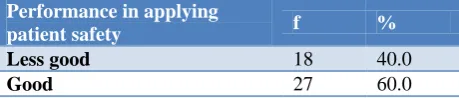
From Table 1, it can be seen that more than half (60.0%) of nurse performance in implementing patient safety in the inpatient unit of Regional Public Hospital Dr. Rasidin Padang were in good performance. Furthermore, in Table 2 it can be seen that more than half (60.0%) of respondents aged >30 years.
Table 1: Frequency distribution based on implementing nurse performance in applying patient safety in the inpatient unit of regional public hospital
Dr. Rasidin Padang (n=45).
Performance in applying
patient safety f %
Less good 18 40.0
Good 27 60.0
Table 2: Frequency distribution of respondent characteristic based on age in the inpatient unit of regional public hospital Dr. Rasidin Padang (n=45).
Age f %
20-30 years old 18 40.0
>30 years old 27 60.0
Table 3: Frequency distribution of respondent characteristic based on gender in the inpatient unit of
regional public hospital Dr. Rasidin Padang (n=45).
Gender f %
Male 4 8.9
Female 41 91.1
Table 4: Frequency distribution of respondent characteristic based on education level in the inpatient
unit of regional public hospital Dr. Rasidin Padang (n=45).
Level of education f %
Nursing school 2 4.4
Diploma 32 71.1
Undergraduate 11 24.4
Table 5: Frequency distribution of respondent characteristic based on working period in the inpatient unit of regional public hospital Dr. Rasidin
Padang (n=45).
Working Period f %
<5 years 21 46.7
Table 6: Frequency distribution of respondent characteristic based on marital status in the inpatient
unit of regional public hospital Dr. Rasidin Padang (n=45)
Marital Status f %
Unmarried 12 26.7
Married 33 73.3
Table 7: Frequency distribution based on the motivation of nurses in applying patient safety in the inpatient unit of regional public hospital Dr. Rasidin
Padang (n=45).
Motivation f %
High 18 40.0
Middle 19 42.2
Low 8 17.8
Table 3 showed that in general (91.1%) respondents are female. In Table 4, most of respondents (71.1%) have diploma education. In table 5, more than half (53.3%) of respondents had >5 years of service. In Table 6, most of respondents (73.3%) respondents were married and in Table 7 we can see that it was less than half (42.2%) of respondent had middle level of the motivation. Statistical test results showed that there was no significant relationship between age (p=0.291) in Table 8, gender (p=1.000) in table 9, education (0.862) in Table 10, years of service (p=0.247) in Table 11, marital status (p=0.308) in Table 12. In Table 13 we can conclude that there was a significant relationship between motivation and the performance of nurses in implementing patient safety (p=0.000).
Table 8: Relationship of age with nurse performance in applying patient safety in the inpatient unit of regional public hospital Dr. Rasidin Padang.
Age (years)
Performance
Total P value
Less good Good
f % f % f %
0.291
20-30 5 27.8 13 72.2 18 100
>30 13 48.1 14 51.9 27 100
Total 18 40.0 27 60.0 45 100
Table 9: Relationship of gender with nurse performance in applying patient safety in the inpatient unit of regional public hospital Dr. Rasidin Padang.
Gender
Performance
Total P value
Less good Good
f % f % f %
1.000
Male 2 50.0 2 50.0 4 100
Female 16 39.0 25 61.0 41 100
Total 18 40.0 27 60.0 45 100
Table 10: Relationship of education level with nurse performance in applying patient safety in the inpatient unit of regional public hospital Dr. Rasidin Padang.
Education level
Performance
Total P value
Less good Good
f % f % f %
0.862
School of nursing 1 50.0 1 50.0 2 100
Diploma 12 37.5 20 62.5 32 100
Undergraduated 5 45.5 6 54.5 11 100
Total 18 40.0 27 60.0 45 100
Table 11: Relationship of working period with nurse performance in applying patient safety in the inpatient unit of regional public hospital Dr. Rasidin Padang.
Working period
Performance
Total P value
Less good Good
f % f % f %
0.247
<5 years 6 28.6 15 71.4 21 100
≥5 years 12 50.0 12 50.0 24 100
Table 12: Relationship of marital status with nurse performance in applying patient safety in the inpatient unit of regional public hospital Dr. Rasidin Padang.
Marital status
Performance
Total P value
Less good Good
f % f % f %
0.308
Unmarried 3 25.0 9 75.0 12 100
Married 15 45.5 18 54.5 33 100
Total 18 40.0 27 60.0 45 100
Table 13: Relationship of motivation with nurse performance in applying patient safety in the inpatient unit of regional public hospital Dr. Rasidin Padang.
Motivation
Performance
Total P value
Less good Good
f % f % f %
0.000
High 0 0 18 100 18 100
Middle 10 52.6 9 47.4 19 100
Low 8 100 0 0 8 100
Total 18 40.0 27 60.0 45 100
DISCUSSION
The results of the study revealed that most of the nurses' performance in implementing patient safety were good (60.0%). These results indicate that nurses perform their duties with existing guidelines. Implementation of patient safety is held largely in all patient safety goals. The results of this study are in line with the research of Maryam (2009), Anugrahini (2010), and Dewi (2011). The results of Maryam showed that 77.8% of nurses in surgery inpatient installation and in medical inpatient
installation of Dr. Soetomo Hospital Surabaya
implemented patient safety. The results of Anugrahini's research (2010), showed that 73.6% of nurses in Harapan Kita Hospital Jakarta were compliant in implementing patient safety guidelines. The percentage in this study was 60.0% of the nurses stated their performance in implementing good patient safety.9-11
The performance of nurses in implementing patient safety is seen from the suitability of services provided by nurses with standards issued by the hospital.9 Quality of care in the form of nursing care is the main component provided by nurses to patients. Patient safety efforts cannot be separated from the role of nurses in providing quality nursing care.
The results of the study found that more than half of nurses aged >30 years (60%) had good performance. It was not much different if compare with younger nurse (<30 years old). The results showed that there was no relationship between age and the performance of nurse in implementing patient safety. Nurses in Regional Public Hospital Dr. Rasidin Padang has a potential age so that the hospital just have to maintains and develops its staff because this potential age has the ability, skills and competencies that are professional and supported by the
employment status of more civil servants in the hospital and the need for further regeneration so that the nurse's performance will be better.
The results of this study are in line with the research conducted by Sulistyowati (2012), she found that there was no relationship between age and nurse achievement of performance targets.12 And also Hikamah's research (2008), which says that there was no relationship between age and nurses' perceptions of staff regarding patients safety.13 In contrast to Kanestren's research (2009), which states that there was a relationship between age and nurse performance at Pertamina Jaya Hospital.14
The study found that respondents were generally female (91.1%), the performance of female respondents was good (61.0%) and also the men’s performance wass good too (50.0%). There was no relationship between gender and performance of nurses in implementing patient safety with p=1,000. This results are also supported by research conducted by Burdahyat, Mila, and Rudianti, which states that gender is not related to nurse performance.15-17 Robbins, said there were no differences between men and women in the ability to solve problems, analytical abilities, competitive drives, motivation, socialization and learning abilities.18 In addition, results was in line with Kurniadi's research (2013), that found no relationship between gender and performance of the nurse at the Dr. Mintoharjo Hospital Jakarta.19
which states that education is not related to the performance of the nurse.14 In the other hand, this result is different with Robbins’’s in which an individual's intellectual ability is related to a strong forecast indicator for performance.17
The level of education is an experience that can develop the abilities and qualities of a person's personality The higher the level of education, the greater they will utilize their knowledge and skills.18 Sulistyowati’s research found that there was a relationship between the level of education and the achievement of the target performance of nurses in the building A of Dr. Cipto Mangunkusumo Hospital.12 The results of research conducted in the United States also supported, which found that there was a relationship between level of education of nurses with patient safety. However, it was different from research that found there was no educational relationship with the performance of nurses in implementing patient safety.
The results of the study found that there were more than half of working period was more than 5 years (53.3%), with good performance at less than 5 years (71.4%) and good performance more than 5 years (50.0%). The results of the analysis revealed that there was no relationship between the working period and the performance of the nurse in implementing patient safety. Nurses in Regional Public Hospital Dr. Rasidin is more with a working period more than 5 years, so to continuously improve the performance of nurses, it need to give nurses reward for their career level system so that they do not appear bored or lazy in working, and also make a schedule for rotating the room. In addition to improving the ability of nurses, hospital need to provide training and seminars so that nurses get updated knowledge in improving the performance in hospitals. This study was supported by Sopiah, stating that there is no evidence to show that the longer a person works, the higher level of productivity.20 In line with the research of Sulistyowati and Kenestren, there was no relationship between working period and the nurses performance.12,14 Letvak, stated that nurses in the United States who have long worked tend to have a strong desire to stop being nurses due to work stress which results in lower productivity levels.21
In this study, the majority of nurses are marriage (73.3%), with good performance in unmarried (75%) and married (54.5%). Statistical test results show there is no relationship between marital status and the performance of nurses in implementing patient safety. Nurses who were unmarried performed well in applying patient safety (75.0%), this was also found in nurses who were married (54.5%). This means that nurses in the Inpatient Unit at Regional Public Hospital Dr. Rasidin, both married and unmarried, has good performance in implementing patient safety. In connection with the results of the study found that many nurses are married, the hospital need to understand and tolerate nurses with marital status in terms of problems related to their family problems. So
nurses who are married at work can focus more and do better work by producing good performance.
This research is not in line with the results of Hartati's (2012) study, which states that there was a relationship between marital status and patient safety.22 And also different from Supriatin's (2009) study, which found that there was a significant relationship between marital status and nurse caring behavior.23 Robibins & Judge stated that a person's marital status influences a person's behavior in the life of his organization, employees who are married have fewer absences, experience a lower turnover and are more satisfied with their work than their colleagues unmarried.17 According to Sopiah, the performance of nurses who are married is far better than unmarried employees. In contrast to the results above, marital status has no relationship with the performance of the nurse in implementing patient safety.20
The results showed less than half of nurses had less motivation (42.2%), with good performance in strong motivation (100%), and good performance on moderate motivation (47.4%) and good performance on weak motivation (0%). The results of the analysis revealed that there was a relationship between motivation and the performance of the nurse in implementing patient safety with p=0.000. The results of this study are in line with Ariyani’s (2009), who concluded that there was a relationship between motivation and the performance of the patient safety program in the Intensive Care Installation at Dr. Moewardi Surakarta.24 As well as the results of Badi'ah's (2008), which showed a significant relationship between internal motivation factors and external motivation factors with the performance of nurses in the inpatient unit of Panembahan Senopati Bantul Regional Hospital.25 Awalia’s research (2012), shows that there is a significant relationship between motivation and the performance of nurses in Dr. Wahidin Sudiro Husodo and also according to Qalbia’s research (2013), stated that there was a significant relationship between motivation and performance of nurses in implementing patient safety at Hasanuddin University Hospital.26,27
fulfilled then someone feels none dissatisfaction so that it will encourage motivation in work, this is a necessity given by the leadership, to achieve job satisfaction. While motivation factors are internal factors when fulfilled, they will increase their satisfaction so that they encourage to increase their motivation.28
Satisfactory factors include achievement and
development of individual potential. Achievement needs will encourage someone to develop creativity by directing all their abilities to achieve optimal work performance. A person will achieve high if possible to be given the opportunity.23 Likewise with the development of potential that is directly related to the tasks that must be carried out by staff through training and continuing education both formally and non-formally, so that the improvement of staff capacity will encourage individuals to work. This shows that the lack of opportunities for nurses to attend training has an effect on the poor motivation of nurses in documenting. This statement is supported by research conducted by Saefulloh (2009), which states that nursing care training significantly increases the work motivation of nurses in the inpatient ward of Indramayu Hospital.29
Giving the opportunity to be able to use skills and abilities can encourage someone to increase the potential of individuals to be able to carry out their duties or work optimally, especially in carrying out patient safety. Robbins states that employees prefer jobs that provide opportunities to use their abilities and offer various tasks.18
According to Herzberg, factors of individual dissatisfiers in work can be seen from the salary or wages and the quality of supervision. Supervision is a process of the resources needed for the completion of a task. Robbins (2003), supervision carried out by superiors will greatly assist staff, because in supervision activities, a supervisor will provide support for the resources needed by the staff in finish the job.18 Mc.Farland, Leonard and Marris (1984 in Arwani, 2003), who said supervision in the context of nursing as a process of providing support activities resources (resources) needed by nurses to evaluate tasks towards the achievement of goals that have been set.30
Supervision activities not only supervise and observe nursing staff in carrying out their duties, but supervision activities can also improve the implementation that is being carried out, the obstacles and shortcomings that exist in the room. So supervision activities, nurses are not as passive implementers, but as work partners who have opinions and experiences that need to be heard, valued, and included for improvement in nursing services. This is in line with the research of Hotmaida (2002), who said that there was a significant influence between supervision of the head of the inpatient ward on the performance of the nurses, and this study also found that the style of supervision of democracy was better.31 nurses feel dissatisfied with the incentives provided, Incentives are
an important indicator in motivating one's work. This is consistent with the opinion of Kopelman, which states that rewards will affect someone to increase their work
motivation which can directly improve their
performance.32 Riza statement, which states that one factor causes nurses' work motivation to decrease is a reward that doesn't exist.33
The amount of salary of Civil Servants received by nurses has been determined by the Government, so that the role of the Hospital leadership cannot raise the salary of a nurse but the authority of the leadership is only on incentives beyond salary but it is necessary to have an agreement from all parties at hospital. One of the efforts that can be done by the leader or manager to increase the motivation of nurses in the implementation of patient safety is by conducting guidance and direct supervision carried out continuously. If there is a patient safety activity that is not implemented it must be a record and be associated with incentives.
CONCLUSION
There is no significant relationship between age, sex, education, years of service and marital status and there is a significant relationship between motivation with performance of the nurse in implementing patient safety in the hospital.
ACKNOWLEDGEMENTS
Thank you to the Director of RSUD dr. Rasidin Padang, as well as all parties who have helped held this research.
Funding: No funding sources Conflict of interest: None declared
Ethical approval: The study was approved by the Institutional Ethics Committee
REFERENCES
1. MOH & KKP-RS. National Guidelines for Hospital
Patient Safety. Jakarta. 2008;2:50-8.
2. Swayers' report (2014), at Martland Hospital stated that 6 of 73 fell incidents with death due to head
injury. Available at: https://media.neliti.com/
.../193514. Accessed on 19 June 2016.
3. Dunn KL, Reddy P, Moulden A, Bowes G. Medical
record review of death, unexpected intensive care unit admission, Achieve of Disease in Chillhood. Available at: http://adc.bmj.com/content/90/1148. Accessed on 16 June 2016.
4. Lumenta N. State of the art patient safety. Presented
at the Patient Safety and Clinical Risk Management Workshop at Harapan Kita Hospital. Jakarta. 2008.
5. Cahyono JB. Building a Culture of Patient Safety in
Medical Practice. Yoykarta: Kanisius. 2008: 70-76.
6. Considine J. The Role pf nurses in preventing
7. Gibson, Ivancevich, Organizational and behavioral management, structure and processes. Jakarta: Erlangga; 2001: 12-16.
8. Danim, Sudarwan. Motivation of Leadership and
Group Effectiveness. Jakarta: Rineka Cipta ; 2004: 69-78
9. Maryam, D. The relationship between the
application of patient safety measures by
implementing nurses and patient satisfaction in the IRNA Surgery and Medical Institutions Dr. Dr. Soetomo Surabaya. Thesis. 2009;(2):16-22
10. Anugrahani C. Relationship between individual and
organizational factors with nurses' compliance in implementing patient safety guidelines in RSAB Harapan Kita: FIK UI. 2010.
11. Dewi SC. Relationship of the head of the
management function and the characteristics of nurses with the application of patient and nurse safety in IRNA I RSUP. Dr. Sardjito Yogyakarta. Thesis. 2011.
12. Sulistyowati D. Analysis of the factors that
influence the achievement of the target performance of individual nurses implementing based on individual performance index in the building of RSUP Dr. Cipto Mangunkusumo Tesis. 2012. 13. Hikmah S. Staff Perceptions regarding "Patient
Safety" at the Emergency Room Installation (IRD) of Fatmawati Hospital.
14. Kanestren DR. Analysis of the Relationship
between Individual Characteristics and Work Environment with Nurse Performance in the Inpatient Unit of Pertamina Jaya Hospital. 2009.
15. Burdahyat. Relations between organizational culture
and performance of nurses in Sumedang Hospital. FIK UI. 2009.
16. Mila. Relations between organizational culture and leadership style of the head of the room with the performance of the executive nurse in the inpatient room of Raden Mataher Jambi, FIK UI. 2009. 17. Yulistiana R. Relationship between Organizational
Communication and Performance of Executing Nurses in Inpatient Rooms One of Surabaya Private Hospitals. Thesis Master of Nursing, University of Indonesia Jakarta. Available at: www.lontar.ui. ac.id/file?file=pdf/abstrak-20282765.pdf. Accessed on 5 July 2018.
18. Robbins SP. Management. Jakarta: Erlangga; 2010:
48-56.
19. Kurniadi A. Nursing Management and Perspective.
Jakarta: FKUI. 2013.
20. Sopiah. Organizational behavior. Andi Yogyakarta
Publisher. 2009.
21. Letvak S. Factors influencing work productivity and
intent to stay in nursing. Nursing Economics. 2008. 22. Hartati T. Orientation and Characteristics Program
with Executing Nurse Performance at Roemani Hospital Pku Muhammadiyah Semarang. Seminar on Results of Research-Lppm Unimus, 2012.
23. Supriatin E. Relationship between Workload and
Professional Development and Caring Behavior of Executing Nurses at Cikini Hospital Jakarta. (Thesis) Jakarta: University of Indonesia, 2009.
24. Ariyani. Analysis of nurses' knowledge and
motivation that influences attitudes in supporting the implementation of patient safety programs in intensive care installations at RSUD Dr. Moewardi Sukarta (thesis). UNDIP. 2009.
25. Badi'ah. The Relationship between Nurse
Motivation and Nurse Performance in the Inpatient Room of Panembahan Senopati District Hospital in 2008. J Health Service Manag. 2008;12:74 –80.
26. Awalia, Anwar W. Relationship Knowledge,
motivation and supervision of performance in implementing Patienst Safety Makassar. FUH. 2012.
27. Qalbia. The Relationship between Motivation and
Supervision of the Performing Nurse's Performance in Applying Patient Safetty at Inpatient Hasanuddin University Hospital. Makassar. Thesis.
28. Malayu, Hasibuan SP. Organization and Basic
Motivation to Increase Productivity. Jakarta: PT Bumi Aksara. 2010: 25-28.
29. Saefullah M. The difference in the performance of PNS and Non PNS nurses in the inpatient room of Indramayu District Hospital. Midwifery Nursing J. 2013:9(1):65.
30. Arwani, Supriyanto H. Nursing Ward Management
Jakarta, EGC; 2003: 56-69.
31. Hotmaida. The influence of the supervision of the head of the inpatient room, the ability, motivation and rewards of the executive nurses' staff on the performance of the nurse nurses in the inpatient room of RSUD Sidoarjo. 2002.
32. Ilyas, Yaslis. Performance, Theory, Assessment and
Research. Depok: FKM UI. 200216-18
33. Riza M. Study of Optimization of Nursing
Documentation in Dharmais Hospital. Indonesian Nursing J. 2002:3(9):334.
Cite this article as: Morika HD, Suharizal, Yasmi. Characteristics and motivation with nurse