Original Research Article
Profile of HIV sero-positive attendees: an integrated counselling and
testing centre record based retrospective study
Anju Damu Ade
1*, Bhavani Yamasani
1, Ravi Sankar Deekala
1,
Nagaraj Kondagunta
1, Dnyaneshwar T. Katyarmal
2INTRODUCTION
Recognised as emerging disease only in early 1980’s, AIDS has rapidly established itself throughout the world, and is likely to endure and persist well in to the 21st century. AIDS has evolved from the mysterious illness to the global pandemic which has infected tens of million people.1
The sustainable development goal target is to end the AIDS epidemic by 2030. UNAIDS has laid the development of global strategy fast track– ending the AIDS epidemic by 2030.2 HIV continues to be a major
global public health issue, having claimed more than 35 million lives so far. In 2017, 940 000 people died from HIV-related causes globally. There were approximately 36.9 million people living with HIV at the end of 2017 with 1.8 million people becoming newly infected in 2017 globally.3
As per the India HIV estimation 2015 report (15-49 years) HIV prevalence in India was estimated at 0.26% (0.22%-0.32%) in 2015.In 2015, adult HIV prevalence was estimated at 0.30% among males and 0.22% among females. Undivided Andhra Pradesh and Telangana have the highest estimated number of PLHIV (3.95%) and estimated adult HIV prevalence was (0.66%).4 Promising
ABSTRACT
Background: The sustainable development goal target is to end the AIDS epidemic by 2030. HIV continues to be a major global public health issue, having claimed more than 35 million lives so far. The objectives of the study were to find out the pattern of socio-demographic profile among HIV sero-positive patients attending ICTC centre in SVIMS, Tirupati and to study the risk behaviour pattern among HIV sero-positives.
Methods: Retrospective cross sectional study was undertaken at ICTC Centre, SVIMS, SPMC (W), Tirupati, Andhra Pradesh, India. The records of data of all the HIV sero-positive attendees who attended the ICTC from January 2013 to June 2018 were included as study subjects. Records maintained were noted in proforma containing socio-demographic characteristics of HIV seropositive patients. Data was analysed using SPSS software version 23.00.
Results: Majority of sero-positives were illiterates, married, daily wage labourers from rural area, in 20 to 60 years age group. Transmission was predominantly through the heterosexual route (96.1%). 68(54.4%) males and 63(72.4%) females were sero-concordant while 57 (45.6%) males and 24 (27.6%) females were sero-discordant.
Conclusions: There is need to carry out intense IEC activities for behavior change at grass root levels. Low literacy and limited access to health facilities should be addressed.
Keywords: HIV seropositive, Risk behaviour, ICTC, Andhra Pradesh
1
Department of Community Medicine, 2Department of Medicine, SVIMS, Sri Padmavathi Medical College, Tirupati, Andhra Pradesh, India
Received: 26 October 2018
Revised: 05 November 2018
Accepted: 13 November 2018
*Correspondence:
Dr. Anju Damu Ade, E-mail: [email protected]
Copyright: © the author(s), publisher and licensee Medip Academy. This is an open-access article distributed under the terms of the Creative Commons Attribution Non-Commercial License, which permits unrestricted non-commercial use, distribution, and reproduction in any medium, provided the original work is properly cited.
development have been seen in recent years in global efforts to address the AIDS epidemic, including increased access to effective treatment and prevention programmes. However, the number of people living with HIV continues to grow, as does the number of deaths due to AIDS.1 The adult HIV prevalence at national level has continued its steady decline from an estimated peak of 0.38% in 2001-03 through 0.34% in 2007 and 0.28% in 2012 to 0.26% in 2015.5 The basic service division of the department of AIDS control provides HIV counselling and testing services for HIV infection. the national programme is offering these services since 1997 with the goal to identify as many people living with HIV, as early as possible and linking them appropriately and in timely manner to prevention, care and treatment services.1 A person is counselled and tested for HIV at ICTC, either of his own free will (client oriented) or as advised by a medical provider (provider initiated). Functions of ICTC include early detection of HIV, provision of basic information on modes of transmission and prevention of HIV/AIDS for promoting behavioural change and reducing vulnerability and linking PLHIV with other HIV prevention, care and treatment services.1
A study by Dutta et al in Kolkata showed that that a significant number of the positive cases in their study were in economically productive as well as in reproductive age group and majority of patients were males indicating that this disease is causing a great loss to the nation’s economy.6
Kommula et al found that HIV prevalence of Andhra Pradesh among the ICTC clients showed a gradual decline from 10.4% in 2008 to 6.1% in 2010.7
The data generated in ICTC is an important indicator of the prevalence of HIV, and its mode of transmission in the given region. As Andhra Pradesh is one of the high prevalence states, this study is undertaken to study the pattern of socio-demographic profile among HIV seropositive patients at ICTC centre in SVIMS, Tirupati.
Objectives
To find out the pattern of socio-demographic profile among HIV sero-positive patients attending ICTC centre in SVIMS, Tirupati.
To study the risk behaviour pattern among HIV sero-positives.
METHODS
Study design: Retrospective cross sectional study.
Study setting
The study was undertaken at ICTC Centre, SVIMS, SPMC (W), Tirupati, Andhra Pradesh. ICTC centre at SVIMS, Tirupati is functional since February 2010 conducting HIV tests, after taking informed consent, counsellors of ICTC collects anonymous data of patients
of HIV seropositive in registers and logbooks as per NACO guidelines under strict confidentiality. They provide pre-test and post-test counselling to the ICTC patients. HIV is diagnosed by rapid diagnostic tests as per strategy and policy prescribed by National AIDS control organization. All HIV sero-positive persons will be referred to antiretroviral therapy (ART) centre of Govt. hospital for further management.
Study population
The records of data of all the HIV sero-positive attendees excluding antenatal patients who attended the ICTC from January 2013 to June 2018 were included as study subjects.
Study instrument
Proforma containing socio-demographic characteristics of HIV seropositive patients will include whether patients belong to rural or urban area, age, sex, occupation, their education level, occupation, marital status, high risk behaviour pattern, HIV status of the spouses/partners of the study population, (concordant and discordant couples), referral pattern, to which high risk group they belong and their source of information etc.
Data collection
Records maintained in ICTC was assessed and was noted in sociodemographic proforma.
Statistical analysis
Data was entered in the Microsoft Excel sheet and analysed using SPSS software version 23.00.
Ethical considerations
Since the records include the personal information of the patients like name, address, phone numbers etc, confidentiality of identity was maintained.
Quality control measures
Complete information was obtained from different registers and data was rechecked. Pre- Structured checklist was used. format was used.
RESULTS
A retrospective review of patient records was done from ICTC center at SVIMS hospital, Tirupati, Chitoor district in southern India from January 2013 to June 2018. The data of all seropositive individuals was collected by reviewing the records, compiled, and analysed.
Table 1: Year wise distribution of individuals.
Year
Total males tested
Male positive
Percentage (%)
Total females tested
Female positive
Percentage
(%) TG
Percentage
(%) Total
2013 4205 89 52.4 3789 78 45.9 03 1.8 170
2014 4465 70 54.3 3685 59 45.7 0 0.0 129
2015 3616 73 62.9 2985 43 37.1 0 0.0 116
2016 4384 64 56.6 4254 49 43.4 0 0.0 113
2017 4954 66 58.4 4430 47 41.6 0 0.0 113
Till June2018 2536 38 52.1 1940 35 47.9 0 0.0 73
Total 24,160 400 56.0 21,083 311 43.6 03 1.8 714
Out of total 45,243 individuals visited ICTC centre for HIV counselling and testing from January 2013 to June 2018, 714 persons were HIV sero-positives. Prevalence of HIV among male was found to be 56.0% and among females it is 43.6%. Maximum sero-positivity was found among males than females since 2013 to June 2018. Higher sero-positivity in the present study could be due to high prevalence of HIV in state and also majority of population was rural ie.75.60% and illiterates. Number of individuals visited the ICTC has decreased in the year 2015 compared to the previous years for both males and females and also increased in the year 2017. About sero-positivity, not much difference was observed, it was 50.1-62.9% among males and among females 37.1%-47.9%. Recently i.e. in year 2018, sero-positivity is more among females (47.9%).
Figure 1: Area-wise distribution of sero-positives.
Figure 2: Age wise distribution of study population.
As depicted in Figure 1, 540 (75.6%) individuals were from rural area and 174 (24.4%) were from urban area.
As shown in Figure 2, HIV prevalence was significantly high in 31-40 years (31%) followed by 41-50 years (28.60%). Next affected age group was 51-60 years (17.10%). In present study, the highest age affected was two 80 years old widow women.
Table 2: Socio-demographic characteristics of study population.
Characteristics Frequency Percentage (%)
Sex
Male 400 56.0
Female 311 43.6
Transgender 3 0.4
Level of education
Illiterate 583 81.7
Primary 41 5.7
Secondary 26 3.6
College & above 64 9.0
Marital status
Married 527 73.8
Single/unmarried 50 7.0
Divorce/separated 38 5.3
Widow/widower 99 13.9
Occupation
Daily wage labourer 567 79.4 Job (govt/private) 42 5.9
Business 5 0.7
House wife 24 3.4
Retired 5 0.7
Student 19 2.7
Agricultural 16 2.2
Driver 30 4.2
Others 6 0.8
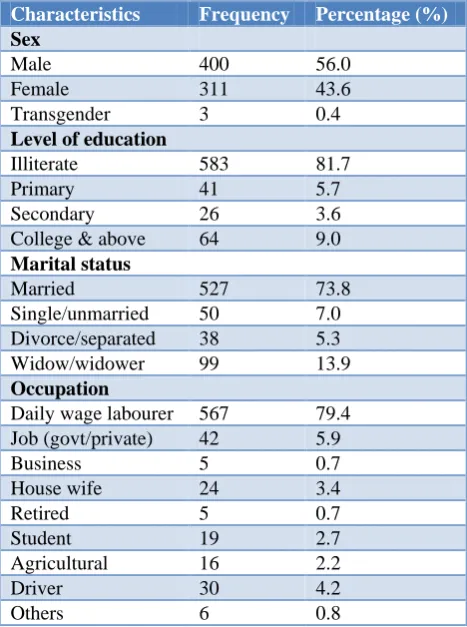
As shown in Table 2, among 714 HIV sero-positives, 400 (56.0%) were males, 311 (43.6%) were females and 3 (0.4%) were transgenders. With respect to literacy in present study, 583 (81.7%) HIV sero-positives were illiterates. Individuals who were graduates or more than
75.60% 24.40%
Percentage
Rural Urban
0.60% 1.70%
14.40%
31% 28.60%
17.10% 5.30%
1.40%
0.00% 5.00%10.00%15.00%20.00%25.00%30.00%35.00% 1- 10 yrs
11- 20 yrs 21- 30 yrs 31 – 40 yrs 41 - 50 yrs 51 – 60 yrs 61 - 70 yrs 71 – 80 yrs
that were i.e. 64 (9.0%) followed by 41 (5.7%) individuals who had primary education and 26 (3.6%) had secondary education.
Maximum sero-positivity was found among daily wage labourers, 567 (79.4%), followed by 42 (5.9%) patients who were educated individuals and had either government or private jobs. In present study, Drivers were 30 (4.2%), 19 (2.7%) were students, 16 (2.2%) were agricultural workers or farmers. In others category, sero-positives were hotel staff and tailors etc. In present study, 3.4% were housewives.
It was found that majority of the sero-positives, 527 (73.8%) were married. In this study, second most affected group was widow/widower, 99 (13.9%). Divorced or separated group affected were 38 (5.3%). Of the study population, 50 (7.0%) individuals were unmarried.
Table 3: Type of individuals.
Type of individual Frequency Percent (%)
Self-initiated 74 10.4
Referral initiated 640 89.6
Total 714 100.0
As shown in Table 3, out of total 714 sero-positives, 74 (10.4%) patients attended ICTC voluntarily or they were self-initiated while 640 (89.6%) were referral/provider initiated. These referred cases were referred to ICTC by various clinical departments for either pre-surgical screening or they had some medical problems.
Table 4: Risk behaviour pattern among HIV positive.
Route of transmission Frequency Percentage (%)
Hetero sexual 686 96.1
Homosexual 1 0.1
History of blood
transfusion 1 0.1
Parent to child 4 0.6
Not specified/unknown 22 3.1
Total 714 100.0
As shown in Table 4, majority of clients were heterosexual. Transmission by homosexual route was 1 (0.1%) in present study. Peri-natal transmission in the present study was found to be 4 (0.6%) over the period of five years. In this region, only one (0.1%) patient gave the history of previous blood transfusion. In this study, 22 (3.1%) individuals did not disclose their risk status. Transmission by intravenous drug abuse was not detected in our study.
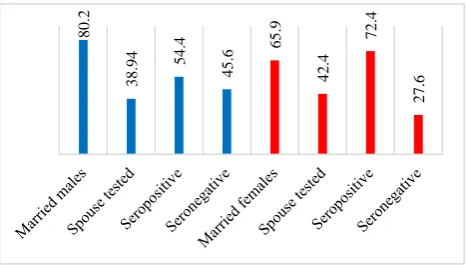
As depicted in Figure 3, Out of 527 (73.8%) married individuals, only 212 (29.7%) individuals spouse were tested. Out of 321 married males, spouse tested were 125
(38.94%) and 68 (54.4%) were seropositive and 57 (45.65%) were seronegative.
Figure 3: Spousal HIV status.
Among 205 (65.9%) married females, spouse tested were 87 (42.4%), out of which 63 (72.4%) were seropositive and 24 (27.6%) were sero-negative. Spouse positivity was higher among males 72.4% as compared to females i.e. 54.4%. As shown in Figure 3, 68 (54.4%) males and 63 (72.4%) were sero-concordant while 57 (45.6%) males and 24 (27.6%) females were sero-discordant.
Table 5: High risk group.
High risk group No Percentage (%)
FSW 25 3.5
Truckers 24 3.4
Migrant 18 2.5
MSM 7 0.9
TG 03 0.4
STD 2 0.3
Multiple 584 81.8
Table 5 depicts, HIV prevalence (%) among the high risk groups through referrals from targeted intervention projects. HIV prevalence among female sex workers recorded was 3.5%. Among men who have sex with men, HIV prevalence recorded was 0.9%. Among truckers, HIV prevalence was 3.4% and among STI/RTI group it was 0.3% while migrants were 18 (2.5%) and 584 (81.8%). Intravenous drug abuse was not recoded in this region.
Table 6: Source of information of seropositive individuals.
Source of information Frequency Percentage (%)
Counsellor 15 2.1
Doctors 528 73.9
Friends 2 0.3
Health worker. 41 5.7
Media 69 9.7
Outreach workers 32 4.5
Relatives 27 3.8
Total 714 100.0
8
0
.2
3
8
.94 54
.4
4
5
.6 6
5
.9
4
2
.4
7
2
.4
2
7
As shown in Table 6, Majority of the patients i.e. 528 (73.9%) received information from doctors, followed by media i.e. 69 (9.7%), 41 (5.7%) from health workers and 32 (4.5) from outreach workers and only 27 (3.8%) received information from relatives.
DISCUSSION
HIV incidence is a key parameter that prevention efforts aim to reduce, since newly infected persons contribute to the total number of persons living with HIV; they will progress to disease and death over time; and are potential source of further transmission.2
In present study, the total number of males tested was 24,160 and females tested were 21,083 at ICTC centre from January 2013 to June 2018
Out of total 45,243 clients visited ICTC centre for HIV counselling and testing from January 2013 to June 2018, 714 persons were HIV sero-positives. Prevalence of HIV among male was found to be 56.0% and among females it is 43.6%. Maximum sero-positivity was found among males than females since 2013 to June 2018. Higher sero-positivity in the present study could be due to high prevalence of HIV in state and also majority of population was rural ie.75.60% and illiterates. Number of individuals visited the ICTC has decreased in the year 2015 compared to the previous years for both males and females and also increased in the year 2017.About sero-positivity, not much difference was observed, it was 50.1 -62.9% among males and among females 37.1% - 47.9%. Recently i.e. in year 2018, sero-positivity is more among females (47.9%) which is because of increased referrals by NGOs. In contrast with this study, a study conducted by Kommula et al reported that, HIV sero-prevalence was found to be declining over the 4 years, except in 2008.7
They also observed that in 2008, the no. of clients attended the ICTC has decreased compared to the previous year for both males and females and at the same time the HIV positivity has increased. A study conducted by Ganju et al showed that a total of 19,234 clients were counselled, of which 17,411 were tested and 970 were detected positive for HIV.8 The HIV sero-positivity amongst the total tested clients was 5.57%. Also showed that, though only 6,670 females were screened for HIV infection in contrast to 12,56 males, the HIV positivity was higher in females 5.78% (n=386) than in males 4.64% (n=584).8 Higher HIV sero-prevalence has been reported by Gupta et al i.e.9.6% in Udupi.9
In present study, majority of sero-positive individuals, 540 (75.6%) were from rural area and 174 (24.4%) were from urban area. Similarly Bhandarkar et al in their study, reported that majority of patients were from rural setting i.e. 233 (83.2%) males and 182 (86.2%) females while Ahuja et al found that Rural to urban ratio was 2.39:1 in their study.10,11 Rural poor people are more vulnerable as they do not have easy access to existing services. Also there are different perceptions surrounding
issues on sex and sexuality, drug use and HIV as well as stigma and discrimination towards PLHIV in rural areas which require localised approach. This has further fuelled by inadequate infrastructures, weak health systems and poor connectivity with most of the facilities.12
HIV prevalence was significantly highest in 20 to 60 years age group. Other studies also found similar results. Study conducted by Vyas et al, Chougule et al and Langare et al reported higher HIV prevalence in the age group 15–49 years.13-15 Among children in age bracket of 1-10 years., 4 (0.6%) were seropositive which was because of mother to child transmission. Other studies reported higher sero-positivity among children like, Chougule et al reported 8.03% children below 14 years were HIV positive while Ganju et al reported 7.5% children <15 years were infected.8,14 In this study, seropositive cases were also recorded among elderly (60 – 80 age group) individuals. In contrast with this study, Chougule et al reported low sero-positivity of 9.26% among age group >50 years while Kommula et al reported sero-positivity among age group 50 years and above, 39 (13.9%) among males and 11 (6.6) among females.7,14 In present study, the highest age affected were two 80 years old widow women.
Socio-demographic characteristics of study population
With regard to gender, a higher percentage of those tested for HIV were males 24,160 and the rest were females i.e. 21,083. As shown in Table 1, among 714 HIV sero-positives, 400 (56.0%) were males, 311 (43.6%) were females and 3 (0.4%) were transgenders. Similarly study by Niranjan et al, Kommula et al, Ganju et al, Sharma et al reported in their study that HIV sero-positivity was higher in males than females.7,8,16,17 On the contrary to this, study carried out by Chougule et al, Chauhan et al, Mathur et al reported that seropositivity was higher among females than males.14,18,19 But Bansal et al in Haryana, reported that sero-positivity was equal among male and female.20 With respect to literacy in present study, 583 (81.7%) HIV sero-positives were illiterates. Similarly other studies like Chougule et al and Kommula et al, Dutta et al, Bhandarkar et al observed that majority of clients were illiterates and were on daily wages.6,7,10,14
In present study, individuals who were graduates or more than that were i.e. 64 (9.0%) followed by 41 (5.7%) individuals who had had primary education and 26 (3.6%) had secondary education. Kommula et al found that only 9.6% of males and 6.6% were educated college and above.7 But study by Jayarama et al reported that literate people shows high sero-positivity.21
hotel staff and tailors etc. Other studies like Chougale et al and Kommula et al, reported that maximum sero-positivity was among agricultural workers.7,14 A study by Dutta et al also observed daily wages to be the occupation of majority (70%) of HIV positive clients while Vyas et al.6,13 The occupation level and HIV sero-status of the attendees show that among males, majority of sero-positives were drivers, agriculture or unskilled workers and businessmen whereas among females, majority were housewives. Bhandarkar et al found that regarding occupation, 129 (45.9%) of males and 76 (36.2%) of females were coolie workers (daily wages) followed by agriculture, housewife, driver and unemployed.10 People residing in rural areas and working as a daily wage labourers, usually stay away from their families. This might be the reason behind the very high HIV sero-positivity rates among daily wage labourers.
In present study, 3.4% were housewives and majority of them were in reproductive age, thus they are the potential for vertical transmission of HIV and cause devastating impacts on families. In the contrast with this study Kommula et al reported 40.7% were housewives in their study.7 Newmann et al reported 81% were housewives.22
In this study, majority of the sero-positives, 527 (73.8%) were married. Similarly Chougale et al, Kommula et al, Vyas et al, Dutta et al found large percentage of HIV sero-positives were married.6,7,13,14 In this study, second most affected group was widow/widower, 99 (13.9%). Divorced or separated group affected were 38 (5.3%). Of the study population, 50 (7.0%) individuals were unmarried. More divorcees and widows were observed among HIV positives in a study conducted in Mumbai by Ingole et al.23
Out of total 714 sero-positives, 74 (10.4%) patients attended ICTC voluntarily or they were self-initiated which is attributed to stigma, fear and ignorance associated with disease while 640 (89.6%) were provider initiated, motivated by doctors. These referred cases were referred to ICTC by different clinical departments for either pre-surgical screening or they had some medical problems. Other than various clinical departments, referrals were from outside government facilities, private practitioners, DOTS Centre, outside ICTC centres, relatives, NGOs like Sneha Sangam (SS), GRASAM, Pehachan, PASS etc. These NGOs works for the cause of high risk groups like migrants, transgenders, FSWs etc.
Similarly Chougule et al, Langare et al, Ganju et al and Mishra et al reported significantly more provider initiated than selfinitiated.8,14,15,24 In contrast with this, Kommula et al found that majority 55.1% of clients attended voluntarily and 36% of them were referred by various clinical department while Quazi et alfound that, 75% of ICTC attendees were self-referred while the remaining 25% HIV positive clients were referred to ICTC by health care providers.7,25
Risk behaviour pattern among HIV positive
Majority of individuals were heterosexual, (96.1%). This is in concordance with that reported by Vyas et al (81.6%).13 Kommula et al reported 83.7% of the individuals, it is acquired through unprotected heterosexual route.7 Quazi et al found that 92.6% of male clients undertook risky behaviours associated with heterosexual contacts.25 Ganju et al Based on self-reporting, the heterosexual route of transmission was documented in 77.42% (n=751; m=439, f=312).8 Other studies like Chougale et al, Bhandarkar et al, Meenu et al, Ahuja et alreported 87.04%, 78.16%, 83.70%, 78.16% respectively that common mode of HIV transmission was heterosexual route.10,11,14,26 Transmission by homosexual route was only 1 (0.1%) in present study which is lower than reported by other studies like Ganju et al reported (0.3%), Ahuja et alreported 14.11% while Kommula et al reported 6 (1.3%) transmission through homosexual behaviour.7,8,11
Peri-natal transmission in the present study was found to be 4 (0.6%) over the period of five years. on the contrary to this, other studies reported higher peri-natal transmission, Vyas et alreported 5.6% to 12.0% over the period of six years.13 Joardar et al also reported higher i.e. (2.63%).27 Chougale et al, Kommula et al reported parent to child transmission of HIV 8.02% and 18 (4.0%) respectively.7,14 In a study conducted by Ganju et al in a Himachal Pradesh found that Mother to child transmission (perinatal transmission) was recorded in 90.78% over the period of eleven years.8
In this region, only one (0.1%) patient gave the history of previous blood transfusion over the period of five and half years which is very much less than as reported by other studies like Vyas et al in their six-year ICTC based study, reported that around 46 patients gave the history of previous blood transfusion over the study period.13 Kommula et al reported 5(1.1%) transmission through blood transfusion while Ahuja et al reported 37 (11.71%) sero-positivity through blood transfusion.7,11
In present study it was found that, 22 (3.1%) individuals did not disclose their risk status. Similarly Kommula et al reported 38 (8.6%) of sero-positives did not reveal their risk behaviour.7 Mishra et al, a large proportion of study subjects (57.59% males and 88.37% females) did not disclose their risk status.24 Quazi et al reported that a large proportion of study subjects (5.3% males and 51.6% Females) did not disclose their risk status.25 This is likely to be attributed to the fear of discrimination which still prevails in the society for HIV infected individuals.
Spousal HIV status
Out of 527 (73.8%) married individuals, only 212 (29.7%) individuals spouse were tested. Out of 321 married males, spouse tested were 125 (38.94%) and 68 (54.4%) were seropositive and 57 (45.65%) were sero-negative. Among 205 (65.9%) married females, spouse tested were 87 (42.4%), out of which 63 (72.4%) were seropositive and 24 (27.6%) were sero-negative. Spouse positivity was higher among males 72.4% as compared to females i.e. 54.4%.
In this study, 68 (54.4%) males and 63(72.4%) females were sero-concordant while 57 (45.6%) males and 24 (27.6%) females were sero-discordant. Dutta et al reported in their study conducted in 2017, 10 (43.5%) males and 8 (34.7%) females were sero-concordant while 13 (56.5%) males and 15 (65.3%) were sero-discordant and Chougule et al reported 44.90% were concordant couples, whereas 55.10% were discordant couples.6,14
HIV can affect anyone regardless of sexual orientation, race, ethnicity, gender or age. However, certain groups are at higher risk for HIV and merit special consideration because of particular risk factors. About HIV prevalence (%) among the high risk groups through referrals from targeted intervention projects in this study, among Female sex workers HIV prevalence recorded was 3.5% which is higher than the recorded prevalence at the national level (2.2%) estimated as per national integrated behavioural and biological surveillance.12 Among men who have sex with men, HIV prevalence recorded was 0.9% which is very much less than the HIV prevalence recorded at the national level i.e. (4.3%).28 In present study, among Truckers, HIV prevalence was 3.4% and among STI/RTI group it was 0.3%. As per records in ICTC, 584 (81.8%) sero positives were in multiple high risk groups.
HIV Sentinel surveillance 2016-1712 showed that the national HIV prevalence among HRG i.e. the observed HIV prevalence among was 0.51% among single male migrants (SMM), 0.86% among long distance truckers (LDT),1.56% among FSW, 2.69% among MSM, 3.14% among H/TG and 6.26% (95% CI: 5.92-6.59) among IDUs.
Majority of the seropositive individuals, 528 (73.9%) received information from doctors, followed by media i.e. 69 (9.7%), 41 (5.7%) from health workers and 32 (4.5) from Outreach workers while 27(3.8%) from relatives.
CONCLUSION
The HIV prevalence was found to be high among rural people who were illiterates, daily wage labourers and high proportion of them were in the younger, economically productive age group. As most effective approaches for the prevention and control of this disease is awareness and life style changes, epidemiology of HIV
should be understood especially with regard to various socio demographic factors. There is need to carry out intense IEC activities for behaviour change at grass root levels. Low literacy and limited access to health facilities should be addressed.
ACKNOWLEDGEMENTS
We would like to thank honourable Director cum Vice Chancellor of SVIMS, SPMC (W), Tirupati, Dr T. S. Ravikumar for his encouragement. We thank ICTC Counsellors, SVIMS, Tirupati, Andhra Pradesh, India for their cooperation. We also thank Statistician, Dr K V S Sarma.
Funding: No funding sources Conflict of interest: None declared
Ethical approval: The study was approved by the Institutional Ethics Committee
REFERENCES
1. Park K. Park’s Text Book of Preventive and Social Medicine. 24th edition. Jabalpur (India): M/s Bansaridas Bhanot; 2017: 361.
2. WHO, From MDGs (Millennium development goals) to SDGs (Sustainable Development Goals. 2015.
3. WHO. Available at: http://www.who.int/news-room/fact-sheets/detail/hiv-aids. Accessed on 30 July 2018.
4. Govt. of India (2017), Annual report 2016-2017, NACO, Department of AIDS control, Ministry of Health and Family welfare, New Delhi. 2017. 5. Available at: http://naco.gov.in/hiv-facts-figures.
Accessed on 30 July 2018.
6. Dutta R, Choudhuri S, Goswami S. Profile of HIV positive clients: an ICTC record based retrospective study. Int J Community Med Public Health. 2017;4:3018-21.
7. Kommula VM, Mishra AK, Kusneniwar GN, Chappa SN, Rao KV. Profile of HIV positive clients in an ICTC of a private medical college, Andhra Pradesh: A situational analysis. NJIRM. 2012;3:36-40.
8. Ganju SA, Bhagra S, Kanga AK, Eleven year performance of an intergrated Counseling and Testing Center in a tertiary care hospital in Himachal Pradesh India. Chrismed J Health Res. 2014;1:134-9.
9. Gupta M. Profile of clients tested HIV positive in a voluntary counselling and testing center of a District Hospital, Udupi. Indian J Community Med. 2009;34:223-6.
10. Bhandarkar PN, Shafee M, Kannan K, Jogdand GS. Socio-demographic Profile of HIV patients at ICTC, CAIMS, Karimnagar. Int J Biol Med Res. 2011;2(4):1023-5.
Counselling and Testing Centre of a Tertiary care Hospital in Meerut, Uttar Pradesh, India. Int J Curr Microbiol App Sci. 2016;5(6):384-91.
12. HIV Sentinel surveillance 2016-17.Technical Brief. NACO India’s voice against AIDS. Ministry of health & family welfare, Govt. of India. Available at http://naco.gov.in/sites/default/files/HIV%20SENTI NEL%20SURVEILLANCE_06_12_2017.pdf. 13. Vyas N, Hooja A, Sinha P, Mathur A, Singhal A,
Vyas L. Prevalence of HIV/AIDS and prediction of future trends in north-west region of India: A six-year ICTC based study. Indian J Community Med. 2009;34:3:212-7.
14. Chougale R, Shinde P. Profile of HIV seropositive attendees of integrated counselling and testing center of a tertiary care teaching hospital in Kolhapur, India. Int J Contemporary Med Res. 2017;4(6):1330-6.
15. Langare SD, Rajderkar SS, Naik JD, Prabhu PM. Profile of clients attending an Integrated Counselling and Testing Centre of Tertiary Care Hospital at Sangli District of Maharashtra. IJRTSAT. 2011;1:124-6.
16. Niranjan A, Kumar S,Adhikari P, Patnayak D, Saxena M. A five year prevalence of HIV among attendees of Integrated Counselling & Testing Centre (ICTC) of a Government Medical College of Central India. Int J Med Sci Public Health. 2016;5(11):2294-9.
17. Sharma R. Profile of attendee for voluntary counselling and testing in the ICTC, Ahmedabad. Indian Journal of sexually transmitted diseases and AIDS. 2009;30(1):31-6.
18. Chauhan T, Bhardwaj AK, Parashar A, Kanga AK. A Study on Profiles of Clients Attending an Integrated Counselling & Testing Centre of Tertiary Care Hospital in a Northern Hilly State, India. GJRR. 2014;1(1):18-26.
19. Mathur A, Sharma B, Bithu R, Mittal P. Socio-demographic Characteristics of Clients Visiting Integrated Counselling and Testing Centre (ICTC) at SMS Medical College, Jaipur (Rajasthan) India. Int Multispecialty J Health. 2015;1(2):27-31. 20. Bansal K, Aggarwal R, Chaudhary U. Knowledge,
attitude and practices (KAP) among the voluntary attendees of Integrated Counselling and Testing
Centre of a teaching tertiary care hospital on North India. J Dental Med Sci. 2016;15:20-5.
21. Jayarama S, Shenoy S, Unnikrishnan B, Rao R J. Profile of Attendees in Voluntary Counseling and Testing Centres of a Medical College Hospital in Coastal Karnataka. Indian J Community Med. 2008;33(1):43-6.
22. Newmann S, Sarin P, Kumarasamy N, Amalraj E, Rogers M , Madhivanan P, et al. Marriage, monogamy and HIV: a profile of HIV-infected women in south India. Int J STD AIDS. 2000;11(4):250-3.
23. Ingole N, Paranjpe S, Sarkate P. Demographic profile of HIV seropositive clients attending Integrated Counselling and Testing Centre, Mumbai, India. J AIDS Clin Res. 2014;5:369. 24. Mishra S, Mishra A. Socio-Demographic Profile of
an Integrated Counselling and Testing Centre Attendees: A Cross Sectional Study at a Tertiary Care Hospital in Gwalior, India. Natl J Community Med. 2013;4(3):493-7.
25. Quazi SZ, Nimbarte S, Selokar D, Gaidhane A, Mudey A, Wagh V. Profile of clients attending an integrated counselling and testing centre at a private rural tertiary care hospital India. Australasian Med J. 2010;3(6):349-52.
26. Meenu M, Choudhary U. Profile of HIV positive clients attending an Integrated Counselling and Testing Centre, Tertiary care hospital in Udaipur, Rajasthan: A five year ICTC based study. Global J Res Analysis. 2018;7(2):1-3.
27. Jordar GK, Sarkar A, Chatterjee C, Bhattacharya RN, Sarkar S, Banerjee P. Profile of attendees in VCTC of North Bengal Medical College in Darjeeling district of West Bengal. Indian J of Community Medicine. 2006;31:237-40.
28. Available at: https://www.cdc.gov/hiv/group/ index.html. Accessed on 30 July 2018.