http://www.ijcmph.com pISSN 2394-6032 | eISSN 2394-6040
Original Research Article
Awareness of cervical and breast cancer among women attending OBG
out-patient department of a medical college hospital, Bangalore
Jayanthi Srikanth, Kavya G. Upadhya*, Pankaj Kumar
INTRODUCTION
Cancer is a term used for a large group of diseases which is characterized by the growth of abnormal cells beyond their usual boundaries that can then invade adjoining parts of the body and/or spread to other organs. Any part of the body can be affected by cancer and it can further be classified into many subtypes, each of which requires specific management strategies.
Globally, cancer is the 2nd leading cause of death and about 8.8 million deaths occurred due to it in 2015. The commonest cancers among men are those of the lung,
prostate, colorectal, stomach and liver while the commonest among women are those of the breast, colorectal, lung, cervix, and stomach. Current evidences suggest that nearly 30%-50% cancer deaths can be prevented just by modifying or avoiding risk factors like
reducing alcohol consumption, regular exercise,
addressing infection related risk factors etc.1
Cervical cancer
It is the 4th most common cancer among women. More than half a million new cases were diagnosed worldwide in 2012. More than 1 million women worldwide are
ABSTRACT
Background: Cancers of the cervix and breast are commonamong Indian women. Majority of the women are not aware of the symptoms or screening methods and report late. Hence the current study was done to assess their knowledge and provide information regarding early detection.
Methods: A cross-sectional study was done in the OBG out-patient department of Kempegowda Institute of Medical Science Hospital, Bangalore over a period of 3 months and 205 women aged 18 years and above were the study subjects. The awareness of the study subjects regarding cervical and breast cancer was assessed using a pre-tested semi-structured proforma. The data was analyzed using descriptive and inferential statistics.
Results: Among 205 study subjects interviewed, the study subjects who had heard about cervical cancer were 173 (84.4%) and those who had heard about breast cancer were 202 (98.5%). Out of 173 subjects who had heard about cervical cancer, 139 (80.3%) had good knowledge regarding the symptoms and 102 (58.9%) knew about the risk factors. The fact that cervical cancer could be detected early was known to 113 (65.3%) subjects but only 57 (32.9%) were aware of a pap smear. Out of 202 subjects who had heard about breast cancer, 159 (78.7%) had good knowledge regarding the symptoms and 74 (36.6%) knew about the risk factors. The fact that breast cancer could be detected early was known to 143 (70.8%) subjects but only 42 (20.8%) were aware of mammogram.
Conclusions: Majority of the study subjects had reasonable knowledge of the symptoms and risk factors of cervical and breast cancer but the knowledge regarding screening test for early detection of these cancers was poor.
Keywords: Awareness, Cancer, Cervical, Breast
Department ofCommunity Medicine, Kempegowda Institute of Medical Sciences, Bangalore, Karnataka, India
Received: 07 March 2018
Accepted: 30 March 2018
*Correspondence:
Dr. Kavya G. Upadhya,
E-mail: [email protected]
Copyright: © the author(s), publisher and licensee Medip Academy. This is an open-access article distributed under the terms of the Creative Commons Attribution Non-Commercial License, which permits unrestricted non-commercial use, distribution, and reproduction in any medium, provided the original work is properly cited.
currently living with cervical cancer. HPV infection in women makes them more susceptible to develop cervical cancer.2 Majority of the cervical cancer cases i.e. >80% cases occur in the low and middle income countries. HPV vaccine is a safe and effective vaccine when administered to young girls between 9 and 13 years of age protects against the infection and thereby prevents cervical cancer. However in low and middle income countries, due to resource constraints its progress has been slower. Although HPV vaccination reduces the possibility of developing cervical cancer, regular cancer screening later on in life is also a must to tackle cervical cancer effectively which allows for early detection and treatment of pre-cancerous as well as cancer among apparently healthy women. The mortality rates due to cervical cancer have fallen in developed countries but the rates haves risen or remained unchanged in the developing countries, particularly among rural and poorer women. The main reasons for this are limited access to health services, lack of awareness and absence of screening and treatment programmes.3
Breast cancer
Most common cancer among women, both in developed and developing countries. Worldwide, the incidence rates of breast cancer vary from 19.3–89.7 per 1,00,000 women and over half a million deaths occurred due to it in 2011. The survival rates of Breast cancer also vary greatly, with less developed countries having a low survival rates when compared to high income countries since majority of them are diagnosed in the late stages. Important risk factors for breast cancer are early menarche, late menopause and late age at first childbirth. OCP and HRT users are a higher risk. Various modifiable risk factors like alcohol use, over-weight and obesity and physical inactivity also contribute to the breast cancer burden. In high income countries, 21% of all deaths due to breast cancer were attributable to these modifiable risk factors with the most important contributor being overweight and obesity, whereas in low-income countries these factors attributed to 18% of the deaths with physical inactivity being the major determinant. Early detection methods of breast cancer includes: early diagnosis or awareness of early signs and symptoms in symptomatic populations and systematic application of a screening test in a population considered to be asymptomatic or apparently healthy. Early detection of breast cancer helps to improve its outcome and also survival and this is a key strategy for its control.4
Most women seek medical advice in the advanced stage of the disease which is responsible for the high mortality and also, in India, women do not freely discuss about these issues due to cultural taboos. Lack of awareness among women is an important factor which leads to delay in detection of cervical and breast cancer. In this background, the current study was undertaken to assess their knowledge and create awareness about symptoms, risk factors and screening available for cervical and breast cancer detection.
METHODS
The study was conducted in the OBG out-patient department of Kempegowda Institute of Medical Sciences, Bangalore over a period of 3 months from March to May 2016. The study subjects were women aged 18 years and above. It was a cross-sectional study and purposive sampling was the sampling technique adopted. The number of study subjects was 205. Pregnant woman and women diagnosed with cervical or breast cancers were excluded from the study. The study subjects were interviewed after obtaining verbal consent. Information was collected using a pretested
semi-structured proforma regarding socio-demographic
characteristics and the awareness of the study subjects with respect to the symptoms, risk factors and early detection of cervical and breast cancer. The socio-economic status was assessed using modified B.G. Prasad classification. Each correct response was given a score of 1 and wrong response was scored 0. Those subjects who gave ≥50% correct response were considered to have good knowledge. IEC activity was done in order to improve their awareness regarding cervical and breast cancer. The data was entered in Microsoft Excel and analyzed using descriptive statistics like mean and percentages and inferential statistics like chi square test.
RESULTS
The present study involved 205 study subjects. The mean age of the study subjects was 43.05±12.05 years. Majority of the subjects were in the age group of 40–49
years (33.2%) and were educated upto
pre-university/diploma (28.8%). Most of them were from an urban background (89.2%), homemakers by occupation (67.3%), Hindu by religion (86.3%) and belonged to Class I socioeconomic status as per modified B.G Prasad classification (70.7%).
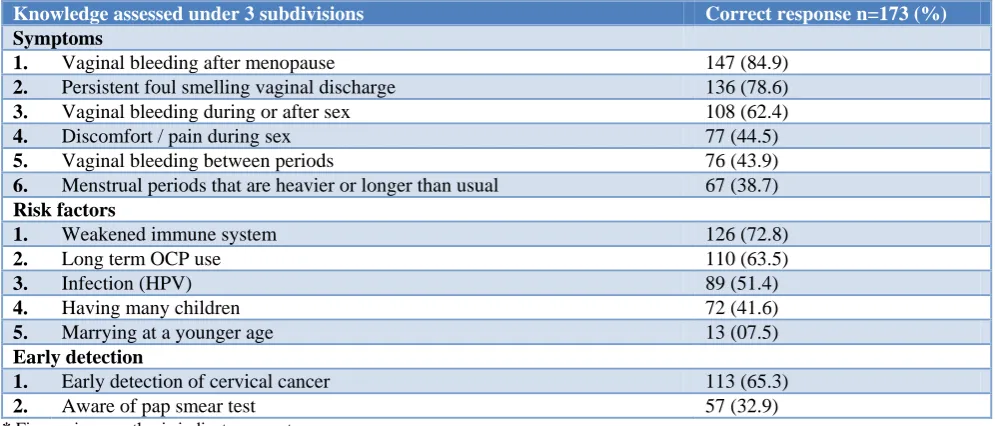
Among 205 study subjects interviewed, 173 (84.4%) subjects had heard about cervical cancer and among them 80.3% had good knowledge regarding symptoms and 58.9% had good knowledge regarding risk factors. The common source of information was from mass media (82.1%) and from friends/relatives (57.5%). Overall awareness on cervical cancer was good among 129 (63%) subjects. Table 1 shows the knowledge regarding various aspects of cervical cancer among the study subjects. The symptoms of cervical cancer known to majority of the study subjects were post-menopausal vaginal bleeding (84.9%) and foul smelling vaginal discharge (78.6%). Weakened Immune system (72.8%) and long term use of OCP (62.7%) were the risk factors which most of the study subjects knew. More than half of the study subjects (51.4%) were aware of HPV infection causing cervical cancer. 65.3% study subjects knew that cervical cancer could be detected early but only 32.9% were aware of pap smear testing as a screening method.
Table 1: Knowledge of the study subjects regarding cervical cancer.
Knowledge assessed under 3 subdivisions Correct response n=173 (%)
Symptoms
1. Vaginal bleeding after menopause 147 (84.9)
2. Persistent foul smelling vaginal discharge 136 (78.6)
3. Vaginal bleeding during or after sex 108 (62.4)
4. Discomfort / pain during sex 77 (44.5)
5. Vaginal bleeding between periods 76 (43.9)
6. Menstrual periods that are heavier or longer than usual 67 (38.7)
Risk factors
1. Weakened immune system 126 (72.8)
2. Long term OCP use 110 (63.5)
3. Infection (HPV) 89 (51.4)
4. Having many children 72 (41.6)
5. Marrying at a younger age 13 (07.5)
Early detection
1. Early detection of cervical cancer 113 (65.3)
2. Aware of pap smear test 57 (32.9)
* Figures in parenthesis indicate percentages.
Table 2: Knowledge of the study subjects regarding breast cancer.
Awareness assessed under 3 subdivisions Correct response n=202 (%)
Symptoms
1. Lump in Breast or armpit 189 (93.5)
2. Discharge or bleeding from nipple 151 (74.7)
3. Pain in one of the breast or armpit 144 (71.2)
4. Dimpling or puckering of Breast skin 87 (43.1)
5. Changes in size and shape of Breast and nipple 85 (42.0)
6. Change in position of nipple 37 (18.3)
Risk factors
1. Having a close relative with breast cancer 183 (90.6)
2. Having a past history of breast cancer 126 (62.3)
3. Having children later on in life or not at all 126 (62.4)
4. Being overweight (BMI over 25) 84 (41.6)
5. Late menopause 46 (22.7)
6. Using HRT (Hormone Replacement Therapy) 22 (10.9)
7. Menarche at an early age 09 (4.5)
Early detection
1. Early detection of breast cancer 143 (70.8)
2. Breast self examination (BSE) 32 (15.8)
3. Clinical breast examination (CBE) 05 (4.8)
4. Mammogram 42 (20.8)
* Figures in parenthesis indicate percentages.
Among the interviewed study subjects, 202 (98.5%) had heard about breast cancer and among them 78.7% had good knowledge regarding symptoms and 36.6% had good knowledge regarding risk factors. The common source of information was from mass media (78.2%) and from friends/relatives (69.8%). Overall awareness of breast cancer was good among 107 (52.2%) subjects. Table 2 shows the knowledge of study subjects regarding various aspects of breast cancer. Majority of them were aware of breast lump (93.5%), abnormal nipple discharge (74.7%) and pain in the breast (71.2%) to be the symptoms of breast cancer. Most of them i.e. 90.6%
subjects knew that history of breast cancer in a close relative is a risk factor. 70.8% said that breast cancer could be detected early. Only 20.8% were aware of mammogram and only 15.8% were aware of breast self examination (BSE).
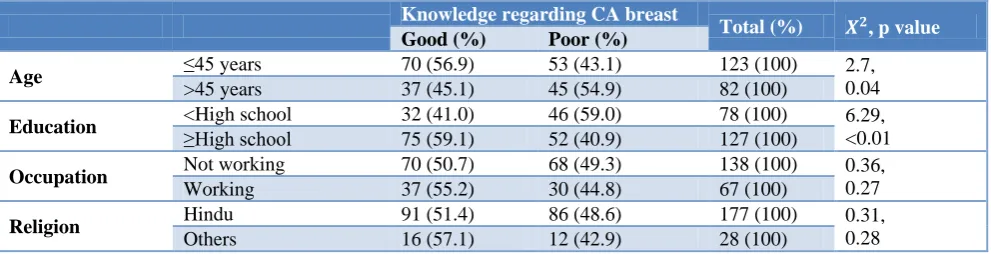
A statistically significant association (p<0.05) was found to be present between the level of awareness regarding cervical and breast cancer with the socio-demographic characteristics like age and education of the study subjects Table 3 and 4.
Table 3: Association of knowledge regarding cervical cancer with respect to socio-demographic characteristics of the study subjects.
Knowledge regarding CA cervix
Total (%) , p value
Good (%) Poor (%)
Age ≤45 years 90 (73.2) 33 (26.8) 123 (100) 13.8,
<0.01
>45 years 39 (47.6) 43 (52.4) 82 (100)
Education <High school 43 (55.1) 35 (44.9) 78 (100) 3.28,
0.035
≥High school 86 (67.7) 41 (32.3) 127 (100)
Occupation Not working 89 (64.5) 49 (35.5) 138 (100) 0.44,
0.25
Working 40 (59.7) 27 (40.3) 67 (100)
Religion Hindu 112 (63.2) 65 (36.8) 177 (100) 0.06,
0.39
Others 17 (60.7) 11 (39.3) 28 (100)
* Figures in parenthesis indicate percentages
Table 4: Association of knowledge regarding breast cancer with respect to socio-demographic characteristics of the study subjects.
Knowledge regarding CA breast
Total (%) , p value
Good (%) Poor (%)
Age ≤45 years 70 (56.9) 53 (43.1) 123 (100) 2.7,
0.04
>45 years 37 (45.1) 45 (54.9) 82 (100)
Education <High school 32 (41.0) 46 (59.0) 78 (100) 6.29,
<0.01
≥High school 75 (59.1) 52 (40.9) 127 (100)
Occupation Not working 70 (50.7) 68 (49.3) 138 (100) 0.36,
0.27
Working 37 (55.2) 30 (44.8) 67 (100)
Religion Hindu 91 (51.4) 86 (48.6) 177 (100) 0.31,
0.28
Others 16 (57.1) 12 (42.9) 28 (100)
* Figures in parenthesis indicate percentages.
DISCUSSION
In the present study, the overall awareness regarding cervical cancer was good among 63% study subjects. In contrast to this, a community based study done in New Delhi among 50 women found that majority of women i.e. 96% had inadequate knowledge regarding cervical cancer.5 This might probably be due to small sample size and different study setting in the later study.
More than 80% study subjects had good knowledge regarding symptoms of cervical cancer and 58.9% study subjects had good knowledge with respect to risk factors in our study. A similar kind of hospital based study done in Puducherry showed that only 8% and 10.8% study subjects had good knowledge regarding symptoms and risk factors respectively.6 This difference may be because of the presence of the later hospital in the rural setting.
The symptoms of cervical cancer known to majority of the study subjects in the present study were post-menopausal vaginal bleeding and foul smelling vaginal discharge. Similar results were seen in studies done in well women clinic in rural area of Tamil Nadu, hospital based KAP study done in Madhya Pradesh and a study among university students in Ethiopia.7-9
It was found that about 2/3rd of the study subjects were unaware of pap smear as a screening test for cervical cancer which was similar to a study done by Shankar et al.10 Another study done in Puducherry also showed that majority of the subjects (87.8%) were unaware of pap smear.6
In the present study, a statistically significant association was found between the level of awareness regarding cervical cancer and the socio-demographic characteristics like age and education. A similar finding was observed in a KAP study on cervical cancer in North Bengal, India, wherein cervical cancer awareness was found to be significantly associated with the educational level of women in urban area.11 This shows that the educational status of women plays a vital role with regards to the awareness of the risk factors and preventive measures.
knowledge on Breast cancer was found to be significantly associated with age, education and marital status.12 Also, in another community based study in Turkey only 22.2%
women were aware of mammography.13
The common symptoms known to the study subjects were breast lump and nipple discharge which was similar to a hospital based study done in Nepal. About 16% were aware of breast self examination (BSE) whereas in a study done in Nigeria on rural women more than 1/3rd subjects were aware of BSE.14 Another study among university students in Turkey observed that nearly 2/3rd study subjects were aware of BSE, however, a similar community based study in Turkey found that the awareness regarding BSE to below (25.3%).13,15
CONCLUSION
Although most of the study subjects had reasonably good knowledge regarding the symptoms and risk factors of cervical and breast cancer, the knowledge regarding early detection of these cancers was poor. Hence, it is necessary to improve the awareness by conducting regular health education sessions in the hospitals as well as in the community so that these cancers could be detected and treated at an early stage.
Limitation of this study was that purposive sampling technique was adopted and the sample size was small consisting of non-homogenous population.
ACKNOWLEDGEMENTS
I would like to thank the Head of the Department of Obstetrics and Gynecology, KIMS, Bangalore, for the support extended during the study.
Funding: No funding sources Conflict of interest: None declared
Ethical approval: The study was approved by the Institutional Ethics Committee
REFERENCES
1. World Health Organization. Cancer. Available at http://www.who.int/cancer/en/. Accessed 25 January 2018.
2. World Cancer Research Fund International. Cancer facts and figures. Available at: http://www.wcrf. org/int/cancer-facts-figures/data-specific-cancers/ cervical-cancer-statistics. Accessed 25 January 2018.
3. World Health Organization. Sexual and
Reproductive Health. Available at http://www. who.int/reproductivehealth/topics/cancers/fight-cervical-cancer/en/. Accessed 27 January 2018.
4. World Health Organization. Breast cancer:
prevention and control. Available at: http://www.
who.int/cancer/detection/breastcancer/en/. Accessed on 27 January 2018.
5. Jacob AM, Kurian RN. A Study to Assess the Knowledge and Attitude of Cervical Cancer among Women in a Selected Community of New Delhi. Int J Nurs Midwif Res. 2016;3(2&3):8-11.
6. Siddharthar J, Rajkumar B, Deivasigamani K.
Knowledge, Awareness and Prevention of Cervical Cancer among Women Attending a Tertiary Care Hospital in Puducherry, India. J Clin Diagnos Res. 2014;8(6):OC01-3.
7. Arunadevi, Geetha Prasad. Knowledge and
awareness of cervical cancer among women in rural India. Int J Cur Res Rev. 2015;7(21):29-32.
8. Bansal AB, Pakhare AP, Kapoor N, Mehrotra R, Kokane AM. Knowledge, attitude, and practices related to cervical cancer among adult women: A hospital-based cross-sectional study. J Nat Sc Biol Med. 2015;6(2):324-8.
9. Mulatu K, Motma A, Seid M, Tadesse M.
Assessment of Knowledge, Attitude and Pratice on Cervical Cancer Screening among Female Students of Mizan Tepi University, Ethiopia, 2016. Cancer Biol Ther Oncol. 2017;1(1):1-5.
10. Shankar A, Rath GK, Roy S, Malik A, Bhandari R,
Kishor K, et al. Level of Awareness of Cervical and Breast Cancer Risk Factors and Safe Practices among College Teachers of Different States in India: Do Awareness Programmes Have an Impact on Adoption of Safe Practices? Asian Pac J Cancer Prev. 2015;16(3):927-32.
11. Raychaudhuri S, Mandal S. Socio-Demographic and
Behavioural Risk Factors for Cervical Cancer and Knowledge, Attitude and Practice in Rural and Urban Areas of North Bengal, India. Asian Pacific J Cancer Prev. 2012;13(4):1093-6.
12. Shadap A, Pais M, Prabhu A. A descriptive study to assess the knowledge on breast cancer and utilization of mammogram among women in selected villages of Udupi district, Karnataka. Nitte Univ J Health Sci. 2014;4(4):84-7.
13. Deniz S, Kurt B, Oguzoncul AF, Nazlican E, Akbaba M, Nayir T. Knowledge, attitudes and behaviours of women regarding breast and cervical
cancer in Malatya, Turkey. PLoS One.
2017;12(11):e0188571.
14. Omotara B, Yahya S, Amodu M, Bimba J.
Awareness, Attitude and Practice of Rural Women regarding Breast Cancer in Northeast Nigeria. J Community Med Health Educ. 2012;2(5):1-4. 15. Altay B, Avci IA, Rizalar S, Oz H, Meral D. Breast
and Cervical Cancer Knowledge and Awareness among University Students. Asian Pac J Cancer Prev. 2015;16(5):1719-24.